arXiv:1411.7665v2 [hep-lat] 16 Apr 2015
ADP-14-36/T895 DESY 14-220 Edinburgh 2014/20 Liverpool LTH 1027 April 15, 2015
A lattice determination of Sigma – Lambda
mixing
R. Horsley
a, J. Najjar
b, Y. Nakamura
c, H. Perlt
d,
D. Pleiter
e, P. E. L. Rakow
f, G. Schierholz
g,
A. Schiller
d, H. St¨
uben
hand J. M. Zanotti
i– QCDSF-UKQCD Collaboration –
a School of Physics and Astronomy, University of Edinburgh,
Edinburgh EH9 3FD, UK
b Institut f¨ur Theoretische Physik, Universit¨at Regensburg,
93040 Regensburg, Germany
c RIKEN Advanced Institute for Computational Science,
Kobe, Hyogo 650-0047, Japan
dInstitut f¨ur Theoretische Physik, Universit¨at Leipzig,
04109 Leipzig, Germany
e J¨ulich Supercomputer Centre, Forschungszentrum J¨ulich,
52425 J¨ulich, Germany
f Theoretical Physics Division, Department of Mathematical Sciences,
University of Liverpool, Liverpool L69 3BX, UK
g Deutsches Elektronen-Synchrotron DESY,
22603 Hamburg, Germany
h Regionales Rechenzentrum, Universit¨at Hamburg,
20146 Hamburg, Germany
i CSSM, Department of Physics, University of Adelaide,
Adelaide SA 5005, Australia
Abstract
between between these states. We describe the formalism necessary to de-termine the QCD mixing matrix and hence find the mixing angle and mass splitting between the Sigma and Lambda particles due to QCD effects.
1
Introduction
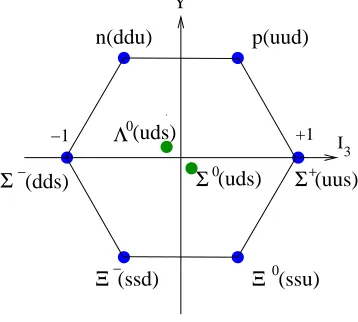
Mass breaking effects in hadron octets (and decuplets) are mainly due to a com-bination of quark mass differences and electromagnetic effects, but can also some-times have an additional component due to mixing between the hadron states. In this article we consider the baryon octet as shown in Fig. 1 where the spin 1 2
baryons are plotted in theI3–Y plane. The particles on the (outer) ring, namely
+
0 −
0
+1 −1
Ξ
Σ
p(uud)
Ξ
(uds)
I
3
Λ0(uds)
Σ−(dds)
n(ddu)
(ssd) (ssu)
Σ (uus)
[image:2.612.200.379.288.449.2]Y
Figure 1: The lowest octet for the spin 12 baryons plotted in the I3–Y plane.
the n(ddu), p(uud), Σ−(dds), Σ+(uus) and Ξ−(ssd), Ξ0(ssu) all consist of
com-binations of aabquarks (where we use the notation of denoting a quark, q, by a,
b, . . .which can be the up u, down d or strange s quark). a here are the flavour doubly represented quarks, whileb is the flavour singly represented quark. Foru
–d quark mass differences these isospin breaking effects are small. Examples for the lowest baryon octet are the n−p, Σ−−Σ+ and Ξ− −Ξ0 mass differences.
In [1] we investigated the hadronic QCD contribution to these isospin breaking splittings using lattice techniques. In this article we extend these results to the Σ0−Λ0 baryon octet masses. The method developed here for the Σ0−Λ0 mass
splitting will automatically encompass the other splittings.
The Σ0 and Λ0 masses1 are accurately known; from the Particle Data Group
[2] we have
MΣexp0 = 1.192642(24) GeV, M
exp
Λ0 = 1.115683(6) GeV, (1) 1We use Σ to stand for the unmixed Sigma particle (pure isospin 1) and Σ0 to denote the
giving a mass splitting of
(MΣ0 −MΛ0)exp = 76.959(23) MeV. (2) This is very much larger than the other mass splittings mentioned above, which are all of the order of a few MeV. It is also more complicated than other mass splittings as while both baryons have the same quark content, namely u, d, s, most of the mass difference is due to their different wave functions. However there will also be additional mixing between these states. This will be apparent when we later consider Σ(ll′s) and Λ(ll′s) where l and l′ are distinct quarks, but mass degenerate, which already has this large mass splitting.
Understanding how this mixing works will be useful for understanding other mixing cases, such asη−η′orω−φmeson mixing, for which lattice simulations are considerably more difficult as there are computationally intensive disconnected terms in the correlation function to consider, [3, 4, 5, 6]. In these latter cases a state at the centre of the octet (the pure ‘η8’ octet state) mixes with a further
singlet state, ‘η1’. The case here of Σ0 −Λ0 mixing is a little different as the
particles have the same quantum numbers but now lie in the same octet (as shown in Fig. 1). In Fig. 2 we sketch the expected situation for the Lambda and
M2 B
Λ Σ
mu+md−2ms
Λ
Σ
H
[image:3.612.160.421.395.597.2]L
Figure 2: A sketch of the heavy,H, and light,L, baryon (masses)2againstm
u+md−
2ms for fixed mu−md. The mass splitting between the Sigma and Lambda masses
in the isospin limit (mu =md) is given by the difference between the (red) circles; if mu 6= md then there is an additional mass difference due to mixing, the filled (blue)
circles. Further explanation of the figure is given in the text.
Sigma hadrons, plotting M2
B against mu +md−2ms. The lines represent lines
(blue) lines are formu−md6= 0. The central point is the quark mass symmetric
point, when all quark masses are the same, when there is no difference between the Lambda and Sigma masses. In the isospin limit, when mu = md 6= ms we
sit at the points denoted by an open (red) circle. The mass splitting between the Sigma and Lambda particles is given by the vertical difference between these points.
However ifmu 6=md then we have mixing between the ‘Lambda’ and ‘Sigma’
particles, as also depicted in the figure by (blue) lines. The physical Σ0 and Λ0
masses are now given by the (blue) filled circles. We see that there is then an additional mass splitting.
As can also be seen from the figure, depending on the numerical values of the quark masses, the physical Σ0 and Λ0 masses can have a larger or smaller
component of the original ‘Σ’ and ‘Λ’ particles. To avoid confusion we shall call in future the lower branch the ‘Light’ orLbranch with associated massML, while
the upper is the ‘Heavy’ orH branch with mass MH. For example in the isospin
limit mu =md≡ml we have
MH = (
MΣ ml < ms
MΛ ml > ms
, ML= (
MΛ ml< ms
MΣ ml> ms
. (3) At the physical point, denoted by a ∗, we set
MΣ0 =MH∗ , MΛ0 =ML∗. (4) In the following we denote the pure octet, i.e. unmixed Σ and Λ mass states, by the Hermitian matrix
M2
ΣΣ MΣΛ2
M2
ΛΣ MΛΛ2
!
, (5)
while the mixed mass states will be denoted by M2
H, ML2. We determine the
mixing angle,θΣΛ, which rotates eq. (5) with rotation matrix
R= cosθΣΛ e
iφΣΛsinθ
ΣΛ
−e−iφΣΛsinθ
ΣΛ cosθΣΛ
!
, (6)
to the diagonal form
M2
H 0
0 ML2 !
, (7)
whereφΣΛis the phase. Note that for the general symmetry arguments used here
mixing of roughly the same order of magnitude as isospin breaking effects. Thus we consider ‘pure’ QCD effects only. The method also applies to mixing ofJP =
1 2
+
baryons in the singly charmed sector. For csu(or csd) baryons the hadronic mixing will be far larger than electromagnetic effects.
Previous determinations of Σ – Λ mixing include using the quark model, e.g. [7], chiral perturbation theory, e.g. [8] and from ‘sum rule’ methods, e.g. [9, 10]. The plan of this article is as follows. In the next section, section 2, we first discuss in more detail the calculational strategy that we employ here. In partic-ular as summarised in section 2.3, and discussed further in Appendices A and B we make a SU(3) flavour expansion about a point with degenerate mass u, d
ands quarks. Section 3 then gives the Σ – Λ mass mixing expansion up to NLO (i.e. next-to-leading order or quadratic in the quark masses). We have actually computed the expansion to NNLO (i.e. next-next-to-leading order), but as we only use these to help to estimate systematic errors, the complete expansions are relegated to Appendix C. We also show numerical simulations with two mass degenerate sea quark masses as sufficient to determine the expansion coefficients also for the non-degenerate quark mass case. In section 4 we modify the expan-sion, to consider ratios, rather than lattice or scale dependent quantities. Some comments on matrix elements are given in section 5. Our numerical simulations are then detailed in section 6 and correlation functions and determination of the expansion coefficients are given in sections 6.1 and 6.2, together with results for mass degenerate quarks. Finally our results and discussion are given in section 7.
2
The
SU
(3)
flavour expansion
2.1
Mass matrix symmetries
When all three quarks have the same mass, an SU(3) transformation U on the quark fields is a symmetry of the action; it leaves the quark mass matrix, M unchanged. We, however, are more interested in what happens in the case of unequal quark masses
M=
mu 0 0
0 md 0
0 0 ms
, (8)
when we make an SU(3) transformation
M′ =UMU†. (9)
This is easiest to see if the transformation U is simply a permutation. For example, if we interchangemd andmswe still get the same set of baryon masses,
(see Fig. 1); all that changes is the names we give them. In this case, Mn and
MΞ0 would be interchanged, as wouldMp and MΞ+ and so on. A rotation of the quark mass matrix simply leads to a corresponding rotation of the baryon mass matrix, M,
M(UMU†) =UM(M)U†. (10) TheU matrices in eq. (9) belong to a 3×3 matrix representation ofSU(3), while the U matrices in eq. (10) belong to an 8×8 representation of the same group.
We can see from eq. (10) that the mass matrix and the (mass matrix)2 both
transform in the same way
M2 →(UMU†)(UMU†) =UM2U† (11) (where, as always, M2 is shorthand for MM). Therefore, as far as symmetry
arguments go, it makes no difference whether we discuss the hadron mass matrix, or the mass-squared matrix. Note also that we can see from eq. (11) that the eigenvectors of M and of M2 are the same.
We consider in future theSU(3) flavour breaking expansion ofM2 rather than
M, [8]. Thus we set
M2 =
M2
n 0 0 0 0 0 0 0
0 M2
p 0 0 0 0 0 0
0 0 M2
Σ− 0 0 0 0 0
0 0 0 M2
ΣΣ MΣΛ2 0 0 0
0 0 0 M2
ΛΣ MΛΛ2 0 0 0
0 0 0 0 0 M2
Σ+ 0 0 0 0 0 0 0 0 M2
Ξ− 0
0 0 0 0 0 0 0 M2
Ξ0
. (12)
The reason is that as in [1] we have found again that better numerical fits in the quark mass range considered are obtained using the hadron mass matrix squared.
In Appendix A an explicit example for the transformation u↔d is given.
2.2
The
Σ
–
Λ
mass matrix
2.2.1 Derivation
The SU(3) flavour expansion classifies mass polynomials according to the S3
permutation group and theSU(3) flavour group. S3 is the symmetry group of an
equilateral triangle, C3v. This group has 3 irreducible representations, [11], two
different singlets,A1 and A2 and a doublet E, with elements E+ and E−. Some
n p Σ− Σ Λ Σ+ Ξ− Ξ0 S
3 SU(3)
1 1 1 1 1 1 1 1 A1 1
−1 −1 0 0 0 0 1 1 E+ 8
a
−1 1 −2 0 0 2 −1 1 E− 8
a
1 1 −2 −2 2 −2 1 1 E+ 8
b
−1 1 0 mix 0 1 −1 E− 8
b
1 1 1 −3 −3 1 1 1 A1 27
1 1 −2 3 −3 −2 1 1 E+ 27
−1 1 0 mix 0 1 −1 E− 27
1 −1 −1 0 0 1 1 −1 A2 10,10
0 0 0 mix 0 0 0 A2 10,10
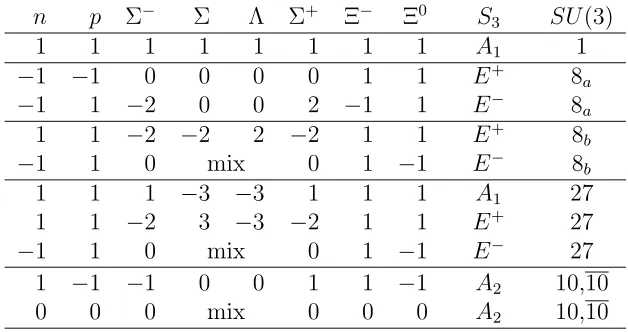
Table 1: Mass matrix contributions for octet baryons, classified by permutation and
SU(3) symmetry. (See Table V in [12].)
In [12] we classified the 10 matrices (Ni, i= 1, . . . ,10) which can contribute
to the octet baryon mass matrix eq. (12) according to their permutation, S3 and
[image:7.612.134.448.107.273.2]SU(3) symmetry, see Table 1. The compact notation of Table 1 gives just the diagonal elements (the rows/columns being denoted byn, p, . . .). From Table 1 we see that seven of the matrices are diagonal, they can be read off directly from the table. For example the first row gives the 8×8 matrix: diag(1,1,1,1,1,1,1,1). The table also contains three matrices which mix the Σ and Λ, the fifth, eighth rows which mix at the quadratic quark mass level and the tenth row which mixes with the cubic terms. All the matrices are explicitly listed in Appendix B. Thus we write
M2 =
10
X
i=1
KiNi, (13)
whereKi are some functions of the quark masses (to be determined).
We now need the three non-diagonal matrices in full. From Appendix B they are N5, N8 and N10. We thus have
E− 8
b
−1 0 0 0 0 0 0 0 0 1 0 0 0 0 0 0 0 0 0 0 0 0 0 0 0 0 0 0 √2
3 0 0 0
0 0 0 √2
3 0 0 0 0
0 0 0 0 0 0 0 0 0 0 0 0 0 0 1 0 0 0 0 0 0 0 0 −1
E− 27
−1 0 0 0 0 0 0 0 0 1 0 0 0 0 0 0 0 0 0 0 0 0 0 0 0 0 0 0 −√3 0 0 0 0 0 0 −√3 0 0 0 0 0 0 0 0 0 0 0 0 0 0 0 0 0 0 1 0 0 0 0 0 0 0 0 −1
(15)
A2 10,10
0 0 0 0 0 0 0 0 0 0 0 0 0 0 0 0 0 0 0 0 0 0 0 0 0 0 0 0 −i 0 0 0 0 0 0 i 0 0 0 0 0 0 0 0 0 0 0 0 0 0 0 0 0 0 0 0 0 0 0 0 0 0 0 0
. (16)
We are now ready to write down the general form of the Σ−Λ mass matrix. From Table 1 we see that the A1 terms always make equal contributions to the
Σ and Λ; and theE+ terms always make opposite contributions to the Σ and Λ.
From eqs. (14) and (15) we see thatE−terms contribute a real symmetric mixing term, and from eq. (16) that A2 terms contribute an imaginary, antisymmetric
mixing. The allowed form of the Σ−Λ mass matrix eq. (5) is therefore
M2
ΣΣ MΣΛ2
M2
ΛΣ MΛΛ2
!
(17)
= PA1
1 0 0 1
!
+PE+ 1 0 0 −1
!
+PE−
0 1 1 0
!
+PA2
0 −i i 0
!
,
wherePG means a function of the quark masses with the symmetryGunder the
S3 permutation group.
We can also give a permutation argument for eq. (17). The Σ and Λ form an
E representation of the permutation group, with the pure Σ even under u ↔ d
and the Λ odd. If mu 6=md there will be mixing between these states. Because
the Σ and Λ have opposite behaviours under u ↔d exchange, the mass matrix for the Σ−Λ system must have the behaviour
even odd odd even
!
, (18)
under the operation u ↔ d. The possible symmetries of the terms in the mass matrix are given by
The A1 and the E+ member of the E doublet are even under u ↔ d, so they
must be responsible for the diagonal part of the mass matrix. The mixing terms in the mass matrix are odd, so they must come fromE− and A
2 expressions.
From the above discussion we note that the formalism includes the no–mixing case when mu =md; we simply set
PE− = 0, PA2 = 0, (20)
and the upper component of eq. (17), now in a diagonal form, gives the degenerate mass of the Sigma baryons: Σ ≡ (Σ−,Σ0,Σ+) (which upon interchanging the
quarks also gives the other baryon masses on the outer ring N ≡ (n, p), Ξ ≡ (Ξ−,Ξ0)), while the lower component gives Λ.
2.2.2 Diagonalisation
We now diagonalise the 2×2 (mass matrix)2 of eq. (17) giving eigenvalues
MH2 = PA1 +
q
P2
E+ +PE2−+PA22
ML2 = PA1 −
q
P2
E+ +PE2−+PA22, (21) while if the eigenvectors are written as
eH =
cosθΣΛ
e−iφΣΛsinθ
ΣΛ
!
, eL= −
eiφΣΛsinθ
ΣΛ
cosθΣΛ
!
, (22) (cf eq. (6)) we have
tan 2θΣΛ =
q
P2
E−+PA22
PE+
, tanφΣΛ=
PA2
PE−
, (23) for the mixing angle,θΣΛ, and phase, φΣΛ. Note that eq. (21) trivially gives the
H and Lmasses and also the mass difference MH −ML.
Alternatively thePGcoefficients have some nice links to theH andLmasses.
PA1 gives the average (mass)
2
1 2
MH2 +ML2
=PA1, (24) while the other three coefficients contribute symmetrically to the splitting of the two states
1 2
MH2 −ML2
=qP2
2.3
The
SU
(3)
flavour expansion
Our strategy, as discussed in detail in [12] is to start from a point in the quark mass plane with all three sea quark masses equal,
mu =md =ms≡m0, (26)
and extrapolate towards the physical point, denoted by a star, ∗, keeping the average sea quark mass
¯
m = 1
3(mu+md+ms) (27)
constant at the valuem0. As we approach the physical point, theu anddquarks
become lighter, but the s quark becomes heavier. Pions are decreasing in mass, but K and η increase in mass as we approach the physical point. Keeping ¯m
constant greatly reduces the number of mass polynomials which can occur in Taylor expansions of physical quantities within an SU(3) multiplet. As we are expanding about the symmetric point, it is useful to introduce the notation
δmq ≡mq−m ,¯ q=u, d, s . (28)
Note that it follows from the definition that
δmu+δmd+δms = 0, (29)
so we could eliminate one of theδmqs. However we often keep all three terms as
we can then write some expressions in a more obviously symmetrical form. We can also generalise theSU(3) flavour expansion to the case when the mass of the valence quarks can be different to the mass of the sea quarks, i.e. we leave the ‘unitary line’. We call this the ‘partially quenched’ or PQ case. To do this we introduce
δµq =µq−m ,¯ q =u, d, s , (30)
where µq is the valence quark mass. In distinction to the sea quarks there is no
restriction of the form eq. (29) on the values of the valence quark masses. We give our results in this slightly more general case and then specialise to the unitary case δµq →δmq and then to the physical point δmq →δm∗q. This generalisation
will prove to be useful for the numerical determination of the SU(3) expansion coefficients.
In the following we give SU(3) flavour symmetry breaking expansions up to cubic terms in the quark’s mass, i.e. to O(δµ3
q) (in both the sea and valence
Polynomial S3 SU(3)
1 A1 1
δµu+δµd+δµs A1 1
2δµs−δµu−δµd E+ 8
δµu−δµd E− 8
(δµu+δµd+δµs)2 A1 1
(δµu+δµd+δµs)(2δµs−δµu−δµd) E+ 8
(δµu+δµd+δµs)(δµu−δµd) E− 8
(δµs−δµu)2+ (δµs−δµd)2+ (δµu−δµd)2 A1 1 27
(δµs−δµu)2+ (δµs−δµd)2−2(δµu−δµd)2 E+ 8 27
(δµs−δµu)2−(δµs−δµd)2 E− 8 27
δm2
[image:11.612.106.480.104.295.2]u+δm2d+δm2s A1 1 27
Table 2: All the quark mass polynomials needed for partially quenched masses, clas-sified by symmetry properties. The table includes entries up to O(δµ2q). (Table XIV of [12].)
3
The
Σ
–
Λ
mixing mass formula
3.1
Expansion of the
P
Gcoefficients
We now return to the evaluation of the Σ – Λ mass matrix as discussed in sec-tion 2.2 and demand that under all SU(3) transformations
M → M′ =UMU† ⇔ M2(
M′) =UM2(
M)U†. (31)
Physically there is no change, just a relabelling of the states. For example md↔
ms is equivalent to relabelling Mn ↔MΞ0, . . .
The most general form of the partially quenched octet baryon mass matrix, for 1 + 1 + 1 valence and sea quarks, up to order δµ3
q, in the case where ¯m is
held constant can now be determined. In Appendix B we illustrate explicitly the computation to leading order (LO) of the SU(3) flavour expansion and Σ – Λ mixing. We find that the coefficients2 in the Σ – Λ mixing matrix, eq. (17), are
PA1 = M
2
0 + 3A1δµ¯
+1
6B0(δm 2
u+δm2d+δm2s) +B1(δµ2u+δµ2d+δµ2s)
+1
4(B3+B4)
h
(δµs−δµu)2+ (δµs−δµd)2+ (δµu−δµd)2 i
+C0δmuδmdδms+ 3C1δµ¯(δm2u +δm
2
d+δm
2
s)
−4(C5+C7)δµuδµdδµs+ 12Q1(δµs+δµu)(δµs+δµd)(δµu+δµd)
2Note thatA
1andA2are used both for theS3representation and the expansion coefficient.
+274Q2(δµs−δµ¯)(δµu−δµ¯)(δµd−δµ¯),
PE+ = 3
2A2(δµs−δµ¯)
+12B2(2δµ2s−δµ2u−δµ2d)
+1
4(B3−B4)
h
(δµs−δµu)2+ (δµs−δµd)2−2(δµu−δµd)2 i
+3
2C2(δµs−δµ¯)(δm 2
u+δm
2
d+δm
2
s) + 6(C3−C4)(δµs−δµ¯)δµ¯2
+1 6Q3
h
(δµs−δµu)2+ (δµs−δµd)2−2(δµu−δµd)2 i
δµ¯ +1
8Q4(δµs−δµ¯)(δµ 2
u+δµ2d+δµs2−3δµ¯2),
PE− =
√
3
2 A2(δµd−δµu)
+√23B2(δµ2d−δµ2u) +
√
3
4 (B3−B4)
h
(δµs−δµd)2−(δµs−δµu)2 i
+√23C2(δµd−δµu)(δm2u+δm2d+δm2s) + 2
√
3(C3−C4)(δµd−δµu)δµ¯2
+8√1
3Q4(δµd−δµu)(δµ 2
u+δµ2d+δµ2s−3δµ¯2)
−√23Q3(δµd−δµu)(δµs−δµ¯)δµ ,¯
PA2 = C9(δµs−δµu)(δµs−δµd)(δµu−δµd), (32) where
Q1 ≡ 2C3+C5+C7
Q2 ≡ C5−C6+C7+C8
Q3 ≡ 4(C3−C4) + 3(C5−C7)
Q4 ≡ 2(C3−C4) + 3(C5−C7)−9(C6+C8), (33)
and
δµ¯≡ 13(δµu+δµd+δµs). (34)
We can check that all the polynomials that occur here are polynomials of the ap-propriate symmetry from Table 2 (i.e. Table XIV of [12]), or linear combinations of those polynomials. For example forE+ we have written
1 2(2δµ
2
s−δµ2u−δµ2d) = 13(δµu+δµd+δµs)(2δµs−δµu−δµd) (35)
+16((δµs−δµu)2+ (δµs−δµd)2−2(δµu−δµd)2).
PE+ and PE− form a doublet, i.e. they are related by S3 symmetry, and involve
the same parameters.
Using these expansions eqs. (21) and (23) now give the H and L masses, together with the mixing angle θΣΛ and phase φΣΛ. Note that in the unitary
limit δµq→δmq these expressions simplify greatly
PA1 = M
2
0 + 121(2B0+ 12B1+ 9B3+ 9B4)(δm 2
u+δm2d+δm2s)
PE+ = 3
2A2δms+ 1
8(2B2+ 3B3−3B4)
h
3δm2s−(δmu −δmd)2 i
+18(12C2+Q4)δms(δm2u+δm2d+δm2s)
PE− =
√
3
2 A2(δmd−δmu) +
√
3
4 (2B2+ 3B3−3B4)δms(δmu−δmd)
+ 1
8√3(12C2+Q4)(δmu−δmd)(δm 2
u +δm
2
d+δm
2
s)
PA2 = C9(δms−δmu)(δms−δmd)(δmu −δmd). (36)
3.2
Mass formulae, octet hadrons,
2 + 1
case
Let us now consider the equal mass valence up and down quark limit, i.e.
δµu =δµd≡δµl; (37)
then PE− = 0 = PA2 (and PA1, PE+ simplify) which means that θΣΛ = 0, i.e. there is no Σ – Λ mixing, eq. (17) is already diagonal and so
MΣ2 =PA1 +PE+, M
2
Λ =PA1−PE+, (38) with3 A
2 >0.
However as there is now no mixing then the mass formula must also auto-matically describe the Σ+, Σ− and hence all the ‘outer’ baryons, with flavour structure aab, eq. (12). Replacingδµl by δµa and δµs by δµb we find
MΣ2(aab) ≡ MΣ2(aa′b)
= M02+A1(2δµa+δµb) +A2(δµb−δµa)
+1
6B0(δm 2
u+δm
2
d+δm
2
s)
+B1(2δµ2a+δµ
2
b) +B2(δµ2b −δµ
2
a) +B3(δµb−δµa)2
+C0δmuδmdδms
+[C1(2δµa+δµb) +C2(δµb−δµa)](δm2u +δm2d+δm2s)
+C3(δµa+δµb)3+C4(δµa+δµb)2(δµa−δµb)
+C5(δµa+δµb)(δµa−δµb)2+C6(δµa−δµb)3. (39)
The notation used here is meant to indicate thata,a′ (anda′′) are distinct quarks (in the baryon wave function), but are mass degenerate, i.e. µa = µa′ (= µa′′)4
This agrees with our previous results in [1] and [12] (and justifies the notation for the expansion coefficients of eq. (32)). The valence flavour structure of eq. (39)
3From eq. (32) we have P
E+ = 32A2(δµs−δµ¯) +. . . =A2(δµs−δµl) +. . .. From eq. (3) (and Fig. 2), generalising to PQ quarks, eq. (30), we see that withA2 >0 if δµl < δµs then
MH describes MΣ while ifδµl > δµs then ML describes MΣ. Hence MΣ2 is always given by
PA1+PE+. SimilarlyM
2
Λ is given byPA1−PE+.
4It should be clear from the context whether we are referring to the Sigma particle or
then describes the broken isospin case ofp≡Σ(uud),n ≡Σ(ddu), Σ+ ≡Σ(uus),
Σ− ≡ Σ(dds), and Ξ0 = Σ(ssu), Ξ− = Σ(ssd) as well as the isospin degenerate Σ0 ≡Σ(ll′s). Furthermore now that we have cubic terms present, the Coleman-Glashow mass relation [13] is violated,
Mn2−Mp2−MΣ2−+MΣ2+ +MΞ2−−MΞ20
= 2(C4−3C6)(δµs−δµu)(δµs−δµd)(δµd−δµu) (40)
(compare with eq. (38) in [12]).
At the cubic level we have four new coefficients C3, C4, C5, C6 involving the
valence quarks alone, and three new coefficients C0, C1, C2 which involve the sea
quark masses, and which drop out for calculations on the symmetric background,
δmq = 0. Eq. (39) assumes that ¯m, the average sea quark mass, is held constant.
A large number of additional terms appear if that constraint is relaxed. If we work on single background all the sea quark terms can be absorbed into the valence parameters; the B0 and C0 terms can be absorbed into M02; C1 and C2
can be absorbed intoA1 and A2 respectively.
Useful for numerical simulations is to take mass degenerateuanddsea quarks, so we have 2 + 1 flavours rather than 1 + 1 + 1 in the generation of configurations
δmu =δmd ≡δml, (41)
which (together with eq. (29)) is equivalent to the replacements
δm2l ↔ 16(δm 2
u+δm2d+δm2s), δm3l ↔ −12δmuδmdδms, (42)
in eq. (32) for PG, G=A1, E+,E−, A2.
Similarly we can write down the mass of the octet Lambda baryon as
M2
Λ(aa′b) = M02+A1(2δµa+δµb)−A2(δµb−δµa)
+16B0(δm2u+δm2d+δm2s)
+B1(2δµ2a+δµ2b)−B2(δµ2b −δµ2a) +B4(δµb−δµa)2
+C0δmuδmdδms
+[C1(2δµa+δµb)−C2(δµb−δµa)](δm2u+δm2d+δm2s)
+C3(δµa+δµb)3 + (C4−2C3)(δµa+δµb)2(δµb−δµa)
+C7(δµa+δµb)(δµb−δµa)2+C8(δµb−δµa)3. (43)
If all three quark masses are the same then all the masses become degenerate,
MΣ2(aaa′′)≡MΣ2(aa′a′′)≡MΛ2(aa′a′′). (44)
mass MΣ = MΣ(lls) = MΣ(ll′s) and Xis, Ξ−,Ξ0 ≡ Ξ(ssl) with mass MΞ =
MΣ(ssl), but can also be extended to incorporate the fictitious baryon, Ns(sss′′)
with massMΣ(sss′′). Furthermore the expansion in eq. (43) also incorporates not
only the Lambda, Λ ≡ Λ(ll′s) with mass M
Λ = MΛ(ll′s), but can be extended
to the fictitious baryon Λ2sl(ss′l) with massMΛ(ss′l). For three mass degenerate
valence quarks, we see that this mass formula reduces to the previous formula
MΛ(ll′l′′) =MΣ(lll′′) and MΛ(ss′s′′) = MΣ(sss′′).
The Λ mass formula involves several parametersB4,C7 and C8 which do not
appear in the other baryon masses. We can understand why some terms in M2 Λ
are constrained by the other hadron masses, while others are independent. The partially quenched quantities
(XN2)P Q ≡ 31(MN2 +MΣ2 +MΞ2), (XΛ2)P Q≡ 12(M 2
Λ+MΣ2) (45)
agree with each other exactly if δµs = δµl (unbroken valence SU(3), eq. (44)).
The quantity (X2
Λ)P Q −(XN2)P Q is a 27-plet, so it should be O((δµs−δµl)2) if
valence SU(3) is broken. Therefore any terms in M2
Λ which survive, or vanish
more slowly than (δµs−δµl)2, asδµs →δµl are constrained by the other baryon
masses; any terms which vanish like (δµs−δµl)2 or faster can have new
indepen-dent coefficients unconnected to the other baryon masses. The B4, C7 and C8
terms are the only terms in M2
Λ which vanish fast enough as δµs →δµl to evade
this (X2
Λ)P Q→(XN2)P Q constraint, as from eqs. (39) and (43) we find5
(XΛ2)PQ−(XN2)PQ = 61(3B4−B3)(δµs−δµl)2
+181(3C7−C5−9C6+ 9C8)(δµs−δµl)3
+1
9(3C7−6C3−C5)(δµs+ 2δµl)(δµs−δµl)
2. (46)
At the O(δµ2
q) level all the coefficients M02, Ai, Bi occur in eqs. (39), (43),
and so can be found from a 2 + 1 flavour partially quenched calculation. (The coefficients are functions of ¯m, and so will not change from a 1 + 1 + 1 simulation to a 2 + 1 simulation provided that ¯m is held constant.) This will no longer hold at O(δµ3
q), to find PA2 we would need to measure the other A2 mass combina-tion, which is the Coleman–Glashow violacombina-tion, eq. (40) or eq. (38) of [12], which requires 1 + 1 + 1 valence quarks and a more general expansion than given in eqs. (39) and (43), so we have introduced a new coefficient, C9, here.
5 For completeness, we also give here the result for (X2 Λ)
PQ
−(X2 N)
PQ in the full 1 + 1 + 1
case, generalising eq. (46),
(XΛ2) PQ
−(XN2) PQ
= 1
4(3B4−B3)(δµ 2 u+δµ
2 d+δµ
2 s−3δµ¯
2
) +3
4(3C7−C5−9C6+ 9C8)(δµs−δµ¯)(δµu−δµ¯)(δµd−δµ¯)
+1
2(3C7−6C3−C5)(δµ 2 u+δµ
2 d+δµ
2 s−3δµ¯
2)δµ ,¯
4
Scale independent quantities
4.1
Ratios
We now restrict ourselves to giving results to NLO (which will be sufficient for our numerical determinations). For completeness the full NNLO expressions are given in Appendix C.
Numerically it is advantageous to consider scale independent quantities, as previously discussed and used in [1, 12]. As stated in section 2.3 flavour blind (or singlet) quantities are suitable to form both scale independent mass ratios and to determine the scale. We denote these quantities generically by XS. One
useful type can be considered as the ‘centre of mass’ of the multiplet. Thus for the baryon octet, one possibility is
XN2 = 16(M 2
p +Mn2 +MΣ2+ +MΣ2−+MΞ20 +MΞ2−)
= M2
0 + (16B0+B1+B3)(δm 2
u+δm2d+δm2s). (47)
At the physical point this has the value [2]
XNexp = 1.1610 GeV. (48)
As discussed in [12] flavour blind quantities, due to the vanishing of the linear
δmq terms, (see eq. (47)) remain almost constant as we approach the physical
point, so aN = (aNXN)/XNexp determines the lattice spacing aN(κ0), [12]. (We
have introduced theN subscript as we are using XN to set the scale.)
We shall in future consider for the baryon octet the dimensionless ratios
˜
M2 ≡ M
2
X2
N
, . . . , (49)
and we wish to rewrite eq. (21) in the form
˜
M2
H = P˜A1+
q
˜
P2
E+ + ˜PE2−+ ˜PA22 ˜
ML2 = P˜A1−
q
˜
P2
E+ + ˜PE2−+ ˜PA22, (50) and eq. (23) as
tan 2θΣΛ =
q
˜
P2
E−+ ˜PA22 ˜
PE+
, tanφΣΛ=
˜
PA2 ˜
PE−
, (51) where
PG →P˜G =
PG
X2
N
This can be achieved by defining
˜
Ai =
Ai
M2 0
, B˜i =
Bi
M2 0
, (53)
together with the replacement
B0 →B˜0 = −6
B1+B3
M2 0
=−6( ˜B1+ ˜B3). (54)
The ˜PG, G=A1,E+, E−, A2 scale independent flavourSU(3) expansion
coeffi-cients are then given to NLO by
˜
PA1 = 1 + 3 ˜A1δµ¯
+16B˜0(δm2u+δm2d+δms2) + ˜B1(δµ2a+δµ2b +δµ2c)
+14( ˜B3+ ˜B4)
h
(δµc−δµa)2+ (δµc−δµb)2+ (δµa−δµb)2 i
,
˜
PE+ = 3
2A˜2(δµc−δµ¯)
+12B˜2(2δµc2−δµ2a−δµ2b)
+14( ˜B3−B˜4)
h
(δµc−δµa)2 + (δµc−δµb)2−2(δµa−δµb)2 i
,
˜
PE− =
√
3
2 A˜2(δµb−δµa)
+√23B˜2(δµ2b −δµ2a) +
√
3
4 ( ˜B3−B˜4)
h
(δµc −δµb)2 −(δµc −δµa)2 i
,
˜
PA2 = 0, (55)
and
δµ¯≡ 1
3(δµa+δµb+δµc) (56)
(where we have written the more generalδµa, δµb, δµc rather than the previous
δµu,δµd,δµs respectively).
Similarly the changes to the baryon masses for mass degenerate up and down quarks are relatively simple. For completeness we give the scale independent flavour SU(3) expansions
˜
MΣ2(aab) = 1 + ˜A1(2δµa+δµb) + ˜A2(δµb −δµa) (57)
+ ˜B0δm2l + ˜B1(2δµ2a+δµ2b) + ˜B2(δµ2b −δµ2a) + ˜B3(δµb−δµa)2,
and
˜
MΛ2(aa′b) = 1 + ˜A
1(2δµa+δµb)−A˜2(δµb−δµa) (58)
+ ˜B0δm2l + ˜B1(2δµ2a+δµ2b)−B˜2(δµ2b −δµ2a) + ˜B4(δµb−δµa)2,
4.2
Analytic expressions
Finally we analytically expand out eqs. (50) and (51) to NLO. On the unitary line (which is all that we shall later need) this gives
tan 2θΣΛ =
(δmd−δmu)
√
3δms ×
(59)
"
1− 1 3
2 ˜B2+ 3 ˜B3−3 ˜B4
˜
A2
!
(δms−δmu)(δms−δmd)
δms
#
,
and for the sum and difference, after additionally expanding further in the masses (rather than (mass)2)
1 2
˜
MΣ0 + ˜MΛ0
= 1 + 1 8
−B˜3+ 3 ˜B4 −32A˜22 δm2u+δm2d+δm2s
, (60) and
˜
MΣ0 −M˜Λ0 =
s
3 2A˜2
q
δm2
u +δm2d+δm2s× (61)
"
1 + 3 2
2 ˜B2+ 3 ˜B3−3 ˜B4
˜
A2
!
δmuδmdδms
δm2
u +δm2d+δm2s #
.
In the isospin limit, upon using eq. (41) we again see that the mixing angle in eq. (59) vanishes, but the Σ – Λ mass difference in eq. (61) still persists. Let us first examine the convergence of the series. If we expand in terms of the quark mass difference δmd−δmu and, now generalising eq. (41) slightly, the average
quark massδml where δml is given by
δml = (δmu+δmd)/2, (62)
then
− (δms−δm3uδm)(δms−δmd)
s
= 3
2δml+O((δmd−δmu)
2),
3δmuδmdδms
2(δm2
u+δm2d+δm2s)
= 1
2δml+O((δmd−δmu)
2). (63)
At (or close to) the physical pointδmd≈δmuso that in the expansion of tan 2θΣΛ,
as compared to ˜MΣ0 −M˜Λ0 the NLO term is a factor ≈3 larger, and hence the convergence of the SU(3) symmetry flavour breaking series is expected to be worse for the mixing angle than for the mass difference.
As an estimate of the contribution of isospin breaking to Σ – Λ mass splitting we expand in the difference between the isospin breaking and isospin symmetric cases giving to LO
˜
MΣ0 −M˜Λ0
− M˜Σ−M˜Λ
δm
l = 1
8A˜2
(δmd−δmu)2
|δml|
Mass splitting formulae for the baryons on the outer ring were given in [1] (eqs. (12) – (15)). For example we have
˜
Mn−M˜p ≡M˜Σ(ddu)−M˜Σ(uud) (65)
= 12(δmd−δmu) h
˜
A1−2 ˜A2+ (2 ˜B1−4 ˜B2− 32A˜21+ 3 ˜A1A˜2)δml i
.
There are several differences between the isospin splitting between Σ0 – Λ0 and
n – p. For Σ – Λ mixing from eq. (64) we see that the mass splitting starts quadratically in (δmd−δmd) while from eq. (65) forn –p the splitting is linear.
Furthermore from eq. (61) we see that this difference depends principally on ˜A2
and not at all on ˜A1. (The ˜A1 term has cancelled in the unitary limit in eq. (36).)
This is completely opposite to the mass splittings of the baryons on the ‘outer ring’, [1] and eq. (65), which depend on ˜A1 as well as ˜A2. As ˜A1 is numerically
found to be much larger the result is then dominated by this coefficient.
We use these expansions in our numerical determinations. While for the central values ofMΣ0 −MΛ0 and Mn−Mp, . . . , it matters little whether we use these expressions or directly use those in section 4.1, for the error (particularly of Mn−Mp, . . . but rather less so for MΣ0 −MΛ0) the difference depending on just one or two coefficients leads to a better determination.
5
Matrix elements
While we are primarily interested in this article on masses, we now make a few comments here on matrix elements. We see from eq. (64) that in masses isospin breaking effects are second order inδmd−δmu. However, if we look at transition
amplitudes instead of masses, the effects of the mixing angle appear at first order inθΣΛ, i.e. at first order in δmd−δmu, making an experimental determination of
the mixing angle much more feasible.
It was pointed out in [14] that the semileptonic decays Σ− → Λ0eν¯ and
Σ+ →Λ0e+ν are particularly sensitive to the Σ – Λ mixing angle. In the absence
of mixing we would have
Σ− →Σ A =√2(γ
µ+F γµγ5)Vud
Σ+ →Σ A =−√2(γµ+F γµγ5)Vud
Σ− →Λ A =q2
3Dγµγ5Vud
Σ+→Λ A =q2
3Dγµγ5Vud, (66)
whereAis the amplitude,F andDare the axialSU(3) couplings andVud ∼cosθC
the appropriate CKM matrix element. There are two important points to note about these amplitudes. First, the Σ− → Λ amplitude is equal to the Σ+ → Λ
the Σ→Λ amplitudes are purely axial, while the Σ→Σ amplitudes have a large vector contribution.
If we now introduce mixing as defined in eq. (22)
Λ0 =−sinθΣΛΣ + cosθΣΛΛ, (67)
we have
Σ+→Λ0 A=
√
2γµsinθΣΛ+
q
2
3DcosθΣΛ+
√
2FsinθΣΛ
γµγ5
Vud (68)
Σ−→Λ0 A=
−√2γµsinθΣΛ+
q
2
3DcosθΣΛ−
√
2F sinθΣΛ
γµγ5
Vud,
for the transition amplitudes to the physical (mixed) Λ0.
We see two effects which might be experimentally measurable at levels of order several percent. Firstly, the Σ → Λ amplitudes have acquired a small vector component, which should change the angular distributions of the decay products. Secondly, the interference between the D and F components of the amplitudes works in opposite directions in the two cases. After correcting for phase space differences, we should see that the total Σ+ → Λ0 decay rate is
enhanced, while the Σ− → Λ0 is suppressed by mixing. Both effects are first
order in the mixing, and so first order in md−mu, and so they should be much
more significant than the effect of mixing on the hadron masses.
In principle mixing effects of this sort appear in all decays of the Σ0 and Λ0,
and all decays with a Σ0 or Λ0 in the decay products. All the semileptonic decays
effected by the Σ – Λ mixing are also discussed in [14].
6
Determination of the expansion coefficients
From eq. (17) we see that we need to find the 2×2 mass matrix. We see from eqs. (59), (61) that to determine θΣΛ, MΣ0, MΛ0 to LO we need to find the ˜A2 coefficient; to NLO also ˜B2, ˜B3 and ˜B4. We also need, of course,δm∗u,δm∗d,δm∗s,
i.e. a determination of the physical point. As apparent from section 3.2, they can in principle all be determined from 2 + 1 simulations of the Σ and Λ masses. However we have in addition also determined the off-diagonal matrix elements of the 2×2 mass matrix eq. (17) for some PQ quark masses with δµa 6=δµb 6=δµc.
Numerical simulations have been performed usingnf = 2 + 1 O(a) improved
clover fermions [15] atβ = 5.50 and mainly on 323×64 lattice sizes, [12]. Errors
given here are statistical (using∼O(1500) configurations) later together with an estimate of the systematic errors.
Once theSU(3) flavour degenerate sea quark mass,m0, is chosen, subsequent
sea quark mass points ml, ms are then arranged in the various simulations to
keep ¯m (= m0) constant. This ensures that all the expansion coefficients given
description of the numerical data on the unitary line over the relatively short distance from theSU(3) flavour symmetric point down to the physical pion mass. This proved useful in helping us in choosing the initial point on theSU(3) flavour symmetric line to give a path that reaches (or is very close to) the physical point. The bare quark masses (both valenceµq and unitaryµq →mq) in lattice units
are given by
µq =
1 2
1
κq −
1
κ0c !
with q =l, s,0, a, b , (69) and where vanishing of the quark mass along the SU(3) flavour symmetric line determinesκ0c. We denote theSU(3) flavour symmetric kappa value,κ0, as being
the initial point on the path that leads to the physical point. This is given in eq. (69) with q = 0 and replacing µ0 by m0. Keeping ¯m = constant = m0 then
gives
δµq =
1 2
1
κq −
1
κ0
!
. (70)
We see thatκ0c has dropped out of eq. (70), so we do not need its explicit value
here. While the choice of partially quenched quark masses is not restricted, along the unitary line the quark masses are restricted and we have
κs =
1
3
κ0 −
2
κl
. (71)
So a given κl determines κs here. The SU(3) flavour symmetric κ0 value chosen
here for this action was found to beκ0 = 0.12090 [12]. The constancy of flavour
singlet quantities along the unitary line to the physical point [12] leads directly from XN to an estimation of the lattice spacing here of aN(κ0 = 0.12090) ∼
0.079 fm.
6.1
Correlation functions
The wave functions (operators) used to determine the hadron masses are all taken to be Jacobi smeared. For the Σ(abc) and Λ(abc) we have
BΣ(abc)α(x) =
1
√
2ǫ
abc
ba α(x)
h
ab(x)TD
Cγ5cc(x)
i
+aa α(x)
h
bb(x)TD
Cγ5cc(x)
i
,
BΛ(abc)α(x) =
1
√
6ǫ
abc
2ca α(x)
h
ab(x)TD
Cγ5bc(x)
i
(72)
+ba α(x)
h
ab(x)TD
Cγ5cc(x)
i −aa
α(x) h
bb(x)TD
Cγ5cc(x)
i
.
whereC =γ2γ4 and the superscriptTD denotes a transpose in Dirac space6. The
Σ wave function is even under the interchangea ↔b, while the Λ wave function is odd under this interchange.
The correlation functions (on a lattice of temporal extension T and spatial volume Vs) are given from the correlation matrix7
Cij(t) =
1
Vs
TrDΓunpol
* X
~ y
Bi(~y, t) X
~ x
¯
Bj(~x,0) +
∝ AiAje−MLt+BiBje−MHt, 0≪t ≪T /2, (73)
with i, j = Σ(abc),Λ(abc). This matrix is diagonalised, yielding MH and ML.
As many of our choices of PQ valence quark masses have degenerate mass
a and b quarks, then as discussed in section 3.2, some simplification for the Σ wave function is possible. In this case we note that the Grassmann contractions lead toCΣ(aa′b)Λ(aa′b) = 0 identically, so that, as expected, the correlation matrix
eq. (73) is diagonal. Furthermore for the outer octet baryons we can use instead the wave function
BΣ(aab)α(x) =ǫabcaaα(x) h
ab(x)TD
Cγ5bc(x)
i
, (74)
for valence quarksa and b. The corresponding correlation function is
CΣ(aab)Σ(aab)(t) =
1
Vs
TrDΓunpol
* X
~ y
BΣ(aab)(~y, t)
X
~x
¯
BΣ(aab)(~x,0)
+
∝ Ae−MΣt, 0
≪t≪T /2. (75)
This determines the MΣ(aab) masses. Considering the correlation functions,
CΣ(aa′b)Σ(aa′b)(t) and CΣ(aab)Σ(aab)(t) the Grassmann contractions can be shown
to be equivalent so
CΣ(aab)Σ(aab)(t)∝CΣ(aa′b)Σ(aa′b)(t), (76)
and so the masses are the same, MΣ(aab) = MΣ(aa′b), as indicated in in eq. (39).
Similarly when all the quark masses are degenerate, then CΣ(aaa′′)Σ(aaa′′)(t) ∝
CΛ(aa′a′′)Λ(aa′a′′)(t) or MΣ(aaa′′) =MΛ(aa′a′′) as expected.
Fitting to eq. (50) then determines the ˜A, ˜B coefficients. Together with a knowledge of the physical (and unitary) quark masses,δm∗
u,δm∗d,δm∗s, this leads
to an evaluation of the physical Σ0 and Λ0 masses, see eq. (4).
6.2
Numerical results for the expansion coefficients
Although simulations between theSU(3) flavour symmetric point and the phys-ical point are in principle enough to determine the expansion coefficients, in practice it is advantageous to increase the range to try to determine the NLO terms more reliably (i.e. with reduced error bars). However we also hope that the
7Γ
SU(3) flavour breaking expansion developed here remains valid. As we see later in this section, for the Σ – Λ splitting there is a further constraint. This leads to a choice of valence quark masses in the range|δµa|+|δµb|+|δµc| ∼<0.2. This
translates to nucleon masses of <∼2 GeV, so roughly the physical baryon masses lie in the middle of our fit range. The corresponding pion mass range is from about 800 down to 200 MeV, the SU(3) flavour symmetric pion lying at about 420 MeV.
In order to determine these ˜A and ˜B coefficients, additional PQ masses have been determined on the set of gauge configurations that have all three sea quark masses equal, i.e. at theSU(3) flavour symmetric point κ0 = 0.12090. For these
particular masses δml = 0 = δms automatically. These masses are a mixture
of masses with three distinctive valence quark masses (so we have mixing and
H and L masses), together with two mass degenerate quark data, when there is no mixing. Thus we now make a simultaneous fit to eq. (50) using the available data: the unitary data from [12] (the 323×64 lattice data forM
N, MΛ, MΣ,MΞ
in Table XXII) together with some lighter quark mass data on a 483×96 lattice.
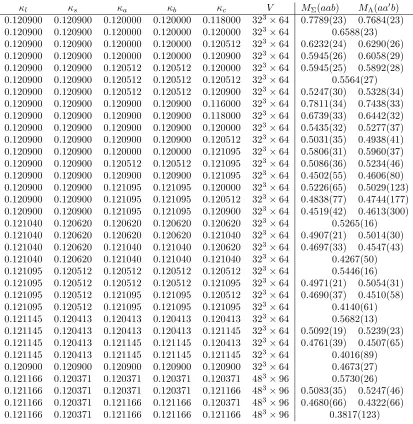
Specifically we have used 23 valence quark masses on the 323×64 lattice with
(κl, κs) = (0.12090,0.12090), four valence quark masses on each of the 323×64
lat-tice ensembles (0.12104,0.12062), (0.121095,0.120512) and (0.121145,0.120413) and a further four on the 483×96 lattice ensemble with (0.121166,0.120371). All
the fit data used are given in Appendix D.
There are two LO ( ˜A) and four NLO ( ˜B) coefficients to determine. Thus we have a six parameter fit for the fit functions in eq. (50). It was found advantageous to preserve the identity of the Σ and Λ particles whenever possible, so for the mass degenerate PQ results, eqs. (57) and (58) were used. In Table 3 we give the
˜
A1 10.17(12)
˜
A2 1.849(124)
˜
B1 13.71(4.19)
˜
B2 -20.02(4.70)
˜
B3 -4.125(5.742)
˜
B4 -30.63(5.97)
Table 3: Fit results for LO and NLO expansion coefficients.
results of this fit with bootstrap errors. With our normalisation for the expansion coefficients all the numbers are∼O(10), except ˜A2 which is rather smaller. The
(MINUIT) fit used gave χ2/dof∼38/60∼0.6 per degree of freedom.
Two simple plots which illustrate the fit results are first the completely mass degenerate case (when as discussed previously in section 6.1 all outer baryon, Σ and Λ masses are the same), which may be illustrated by defining
Secondly we can consider the ‘symmetric’ difference case (between Σ and Λ) by setting
DsymΣΛ ≡ M˜
2
Σ(aab)−M˜Λ2(aa′b)−M˜Σ2(bba) + ˜MΛ2(bb′a)
4(δµb−δµa)
= A˜2+ ˜B2(δµa+δµb). (78)
(Again in these expressions and elsewhere a′, a′′, . . . are mass degenerate but distinct quarks.) At this order DΣΛsym is just a function of δµa+δµb; at higher
orders (see Appendix C, eq. (106)) there are terms ∝ δµa−δµb. Note that the
choice for DΣΛsym tends to suppress them (and indeed eliminates them at NLO); this was the reason for the choice of this ‘symmetric derivative’.
For the SΣΛ we have the results shown in Fig. 3. For SΣΛ, the fit is very
0.0 0.1 0.2
δµa
0 5 10
SΣΛ
[image:24.612.167.419.308.519.2]SΣΛ
Figure 3: SΣΛ versusδµa(SΣΛis defined in eq. (77)), together with a fit also given in
eq. (77). Points used in the fit are denoted by filled circles (those outside the fit range are given by open circles).
good and as indicated this could be easily extended to larger quark masses. As mentioned before ˜A1 is the relevant coefficient for mass splittings on the outer
baryon ring.
In Fig. 4 we plot DΣΛsym against δµa+δµb. We see that the data is not linear
inδµa+δµb. (As explained before we would not expect the data in this plot to
lie on a unique curve due to the possible presence in the fit of terms proportional to δµa−δµb. However due to the choice of DΣΛsym deviations should be small.)
0.0 0.1 0.2
δµa+δµb
0.0 0.5 1.0 1.5 2.0 2.5 3.0
DΣΛ
sym
[image:25.612.164.420.105.318.2]DΣΛsym
Figure 4: DsymΣΛ versusδµa+δµb, (DΣΛsym is defined in eq. (78)), together with the fit
also given in eq. (78). The same notation as in Fig. 3.
Σ–Λ mass splitting, this necessitates the restricted fit region, as compared to Fig. 3. (It should however also be noted that the unitary quark masses have
|δma| ∼<0.01.)
The reason for this behaviour is due to spin–spin interaction between the quarks. It is known (e.g. [16]) that in quark models the mass splittings are partially due to the QCD spin-spin interaction between the quarks. From the Dirac equation we know that the magnetic moment of a fermion ∝ 1/ma, this
holds in QCD too, for the chromomagnetic moment, which might suggest a spin– spin interaction of the form∝ 1/(mamb). This has also recently been proposed
in [17].
6.3
The physical point
By considering the equivalent pseudoscalar SU(3) flavour breaking mass expan-sion as for the baryon octet and matching to the pseudoscalar meson masses gives
δm∗
u,δm∗d,δm∗s. Again note that by considering the outer ring of the pseudoscalar
octet, provided that the average quark mass ¯m is held constant, the expansion coefficients can be determined from partially quenched 2 + 1 flavour simulations rather than 1 + 1 + 1 flavour expansions. This was discussed in [1] (and in partic-ular the subtraction of QED effects) and we just quote the result of the analysis here, as given in Table 4. To cover uncertainties in electromagnetic effects arising from violations of Dashen’s theorem, we assign a relative error ∼ 15% to the splitting δm∗
δm∗
u δm∗d δm∗s
-0.01140(3) -0.01067(3) 0.02207(4)
Table 4: Results for the bare quark mass in lattice units at the physical point, slightly updated from [1].
6.4
Comparison with ‘fan’ plots
We now compare the fit results with the mass values along the unitary line, i.e. which describe the evolution of the baryon masses along a path from the SU(3) symmetric point down to the physical point in the isospin degenerate limit, i.e.
mu =md≡ml. For this comparison we take the physical quark mass, in lattice
units, from Table 4 as
δm∗
l ≡(δm∗u+δmd∗)/2 = −0.01103(2). (79)
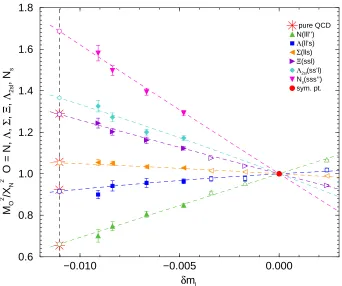
In Fig. 5 we show the ‘fan’ plot for all the ‘Σ’ and ‘Λ’ type particles. We have
N(lll′′)[= Λ
3l(ll′l′′)], Λ(ll′s), Σ(lls), Ξ(ssl), Λ2sl(ss′l) and Ns(sss′′)[= Λ3s(ss′s′′].
(Ns(sss′′) and Λ2sl(ss′l) are fictitious baryons, but provide additional useful data
for the fits.) As this is the diagonal case there is no mixing and from eq. (38) the fit is given by ˜M2
N =PA1+PE+, ˜M
2
Λ =PA1−PE+. We find good agreement with the expected results.
It can easily be seen (‘ruler test’) that the fits are dominated by the LO in theSU(3) flavour symmetry breaking expansion. Given the fit results, this is not so surprising, as for the unitary results we have a maximum quark mass given by |δml| ∼0.01, which is rather small (certainly in comparison with many of the
PQ masses used) and indicates that at least in the region we are interested in the low orderSU(3) flavour breaking expansion describes the data well.
For completeness we give here the values at the 2 + 1 QCD physical point (open circles in Fig. 5) of ˜M∗2
N = 0.6612(58), ˜MΛ∗2 = 0.9155(89), ˜MΣ∗2 = 1.052(4),
˜
M∗2
Ξ = 1.286(9), ˜MΛ∗22sl = 1.365(5) and ˜M
∗2
Ns = 1.687(6). For a comparison to these values, the stars in Fig. 5 represent the average of the squared experimental masses of the appropriate particles, as defined in the figure caption.
7
Results and Conclusions
We now give results for the QCD contribution to the baryon masses and their splittings.
7.1
Outer ring of the baryon octet
−0.010 −0.005 0.000 δml
0.6 0.8 1.0 1.2 1.4 1.6 1.8
MO
2 /X
N
2 O = N,
Λ
,
Σ
,
Ξ
,
Λ2sl
, N
s
pure QCD N(lll’’)
Λ(ll’s)
Σ(lls)
Ξ(ssl)
Λ2sl(ss’l)
Ns(sss’’)
[image:27.612.123.465.106.392.2]sym. pt.
Figure 5: The baryon ‘fan’ plot for the ‘Σ’ and ‘Λ’ type particles ˜M2
O (O = N, Λ,
Σ, Ξ, Λ2sl,Ns) versus δml. Filled up triangles, squares, left triangles, right triangles,
diamonds and down triangles are the N(lll′′), Λ(ll′s), Σ(lls), Ξ(ssl), Λ
l2s(ss′l) and Ns(sss′′) results respectively using 323 ×64 sized lattices. The common symmetric
point is the filled circle. The open up triangles, left triangles, right triangles, down-triangles are from comparison 243 ×48 sized lattices (and not used in the fits here). The vertical dashed line from eq. (79) is thenf = 2 + 1 pure QCD physical point, with
the open circles being the numerically determined pure QCD hadron mass ratios for 2 + 1 quark flavours. For comparison, the stars represent the average of the (mass)2 of M∗2
N (lll′′) = (Mnexp 2(ddu) +Mpexp 2(uud))/2, MΛ∗2(lls) = MΛexp 20 (uds), MΣ∗2(lls) = (MΣexp 2− (dds) +M
exp 2
Σ+ (uus))/2 andMΞ∗2(ssl) = (M
exp 2
Ξ− (ssd) +M
exp 2
Ξ0 (ssu))/2.
in the ms – ml plane does not quite go through the physical point, while the
systematic errors arising from a finite lattice spacing are small.
We find the results for the masses and splittings of Table 5. For the splittings,
particle exp [GeV] result [GeV]
Mp uud 0.9383 0.9427(41)(40)
Mn ddu 0.9396 0.9454(40)(40)
MΣ+ uus 1.1894 1.1874(23)(50)
MΣ− dds 1.1974 1.1947(22)(51)
MΞ0 ssu 1.3149 1.3145(49)(56)
MΞ− ssd 1.3217 1.3191(48)(56)
splitting result [MeV]
Mn−Mp 2.70(15)(11)(40)
MΣ−−MΣ+ 7.27(22)(31)(109)
[image:28.612.87.496.166.270.2]MΞ−−MΞ0 4.57(19)(19)(68)
Table 5: Left panel: Baryon masses on the outer ring of the octet. The second column gives the quark content, while the third column, ‘exp’, gives the experimental masses from [2]. The last column, ‘result’, gives the result from this work. The first error is the statistical error, while the second is the total systematic error (in quadrature). XNexp
from eq. (48) has been used to convert to GeV. Right panel: Baryon mass splittings on the outer ring. The third error is due to possible violations in Dashen’s theorem, section 6.3.
rather than using eq. (50) directly (i.e. the results of the left panel of Table 5) we use the expressions in section 4.2. As discussed there, for the central values it makes little difference, however the error is now better determined. For the baryons on the outer ring of the octet the central values (both for masses and mass splittings) are in agreement with previous results, [1]. Note that we are not trying to compare the mass splittings with the experimental values, due to electromagnetic effects (not considered here).
7.2
Σ
–
Λ
mixing
We now turn to the result for Σ – Λ mixing. In Table 6 we give the Σ0 and Λ0
particle exp [GeV] result [GeV]
MΣ0 uds 1.1926 1.1910(23)(51)
MΛ0 uds 1.1157 1.1109(54)(47)
Table 6: Σ0 and Λ0 masses. The same notation as for the left panel of Table 5.
masses. The Σ0 – Λ0 mass difference is
(The same discussion for the determination of the errors as for the previous results, section 7.1, also holds here.) This is to be compared with the experi-mental result, eq. (2) of 76.96(2) MeV. As both particles have the same quark content (and are uncharged) we do not expect much electromagnetic contribu-tion. Between the LO and NLO result there is only a few percent difference. Furthermore taking the difference between theMΣ0 −MΛ0 mass splitting in Ta-ble 6 and M∗
Σ(lls)−MΛ∗(ll′s) (i.e. the isospin limit) gives a tiny contribution due
to isospin breaking, consistent with zero and which our present results are not precise enough to reliably estimate.
For the mixing angle we find
tan 2θΣΛ = 0.0123(45)(25), (81)
which, as anticipated, gives a very small angle, θΣΛ ∼ 0.006(3) rads<∼1o.
Com-paring with e.g. a quark model result [7] givesθΣΛ ∼0.01 rads which is compatible
with our result.
We note that the LO value of tan 2θΣΛ from eq. (59) is∼0.0191 so in this case
with our determined ˜A and ˜B values for the SU(3) flavour breaking expansion, there is some reduction in the value of the angle when going to NLO. However in distinction to the Σ0 – Λ0 mass difference the non-leading term is now much
larger. This is because numerically (δms−δmu)(δms−δmd)/3δms|∗ ∼ 0.0166
to be compared with 3δmuδmdδms/2(δm2u +δm2d+δm2s)|∗ ∼ 0.0056, which as
expected from the discussion in section 4.2 is a factor 3 smaller. Thus theSU(3) symmetry flavour breaking expansion for the mixing angle in eq. (59) appears less convergent than for the Σ0 – Λ0 mass difference, eq. (61). In order to account for
this, we have increased the relative systematic error associated with the flavour symmetry expansion to ∼15%.
7.3
Conclusions
In this article we have extended our earlier work describing the QCD contribution to isospin breaking effects in baryon masses [1] to now also include states with the same quantum numbers, in this case the Σ0 and Λ0, and their isospin mixing.
This gives a complete description of theSU(3) flavour symmetry expansion of the (baryon) octet. As an example we have numerically investigated Σ0 – Λ0 mixing.
Acknowledgements
Appendix
A
Mass matrix symmetries – an example
To illustrate the transformations of the hadron mass matrices with an explicit example, let us write out in full the symmetry matrices for the transformation
u↔d. A 3×3 SU(3) matrix which exchanges the u and d quarks in the quark mass matrix eq. (8) is (see [12], eq. (128))
U = exp
iπ
2(λ1+
√
3λ8)
=
0 −1 0
−1 0 0
0 0 −1
. (82)
(The minus signs ensure that |U| = 1, as required for an SU(3) matrix). If we act with this U on the quark mass matrix it simply swaps the u and d quark masses.
U
mu 0 0
0 md 0
0 0 ms U †=
md 0 0
0 mu 0
0 0 ms
. (83)
To transform the baryon mass matrix we need an 8×8 matrix corresponding to eq. (82).
U = exp
iπ
2(λ1 +
√
3λ8)
=
0 1 0 0 0 0 0 0 1 0 0 0 0 0 0 0 0 0 0 0 0 1 0 0 0 0 0 −1 0 0 0 0 0 0 0 0 1 0 0 0 0 0 1 0 0 0 0 0 0 0 0 0 0 0 0 1 0 0 0 0 0 0 1 0
. (84)
found by using an 8×8 set of λ matrices (defined in [12], eq. (144)).
What happens to the baryon mass matrix when we rotate it with this U?
U M2
n 0 0 0 0 0 0 0
0 M2
p 0 0 0 0 0 0
0 0 M2
Σ− 0 0 0 0 0
0 0 0 M2
ΣΣ MΣΛ2 0 0 0
0 0 0 M2
ΛΣ MΛΛ2 0 0 0
0 0 0 0 0 M2
Σ+ 0 0
0 0 0 0 0 0 M2
Ξ− 0
0 0 0 0 0 0 0 M2
Ξ0
=
M2
p 0 0 0 0 0 0 0
0 M2
n 0 0 0 0 0 0
0 0 M2
Σ+ 0 0 0 0 0
0 0 0 M2
ΣΣ −MΣΛ2 0 0 0
0 0 0 −M2
ΛΣ MΛΛ2 0 0 0
0 0 0 0 0 M2
Σ− 0 0
0 0 0 0 0 0 M2
Ξ0 0
0 0 0 0 0 0 0 M2
Ξ−
.
The n and p switch masses, as do the Σ− and Σ+ and the Ξ0 and Ξ−, all as expected whenu↔d. In the central block, which tells us about the Σ0Λ0 sector,
we see that the diagonal entries are unchanged; the off-diagonal entries have their sign flipped. This is just what should happen underu↔d; the eigenvalues (masses of the two states) will be the same, but the mixing angle will be reversed,
θΣΛ→ −θΣΛ.
B
The octet baryon mass matrix
B.1
The outer octet baryon masses
Here we discuss the mass matrix for partially quenched octet baryons in more detail than we could in the body of the paper. The arguments given here are similar to those given in section B.4 of [12] for the meson mass matrix, and in section 4.1 for the partially quenched decuplet mass formula.
If we have a diagonal quark mass matrix, strangeness, ‘upness’ and ‘downness’ are all conserved quantum numbers. There are therefore only ten non-zero entries in the 8×8 octet mass matrix, namely the eight diagonal entries, and the two entries corresponding to Σ – Λ mixing. Σ – Λ mixing is permitted because both baryons have the same flavour content (uds); any other mixing would violate flavour conservation.
Since there are ten non-zero entries, we can express the mass matrix in terms of a basis of ten 8×8 matrices. In [12] we classified these ten matrices according to their symmetries; see Table 1. Seven of the matrices are diagonal, they can be read off directly from the table. The table also contains three matrices which mix the Σ and Λ.
N1=
1 0 0 0 0 0 0 0 0 1 0 0 0 0 0 0 0 0 1 0 0 0 0 0 0 0 0 1 0 0 0 0 0 0 0 0 1 0 0 0 0 0 0 0 0 1 0 0 0 0 0 0 0 0 1 0 0 0 0 0 0 0 0 1
N2=
−1 0 0 0 0 0 0 0 0 −1 0 0 0 0 0 0 0 0 0 0 0 0 0 0 0 0 0 0 0 0 0 0 0 0 0 0 0 0 0 0 0 0 0 0 0 0 0 0 0 0 0 0 0 0 1 0 0 0 0 0 0 0 0 1
N3=
−1 0 0 0 0 0 0 0 0 1 0 0 0 0 0 0 0 0 −2 0 0 0 0 0 0 0 0 0 0 0 0 0 0 0 0 0 0 0 0 0 0 0 0 0 0 2 0 0 0 0 0 0 0 0 −1 0 0 0 0 0 0 0 0 1
N4=
1 0 0 0 0 0 0 0 0 1 0 0 0 0 0 0 0 0 −2 0 0 0 0 0 0 0 0 −2 0 0 0 0 0 0 0 0 2 0 0 0 0 0 0 0 0 −2 0 0 0 0 0 0 0 0 1 0 0 0 0 0 0 0 0 1
N5=
−1 0 0 0 0 0 0 0 0 1 0 0 0 0 0 0 0 0 0 0 0 0 0 0 0 0 0 0 2
√
3 0 0 0
0 0 0 √2
3 0 0 0 0
0 0 0 0 0 0 0 0 0 0 0 0 0 0 1 0 0 0 0 0 0 0 0 −1
N6=
1 0 0 0 0 0 0 0 0 1 0 0 0 0 0 0 0 0 1 0 0 0 0 0 0 0 0 −3 0 0 0 0 0 0 0 0 −3 0 0 0 0 0 0 0 0 1 0 0 0 0 0 0 0 0 1 0 0 0 0 0 0 0 0 1
(86)
N7=
1 0 0 0 0 0 0 0 0 1 0 0 0 0 0 0 0 0 −2 0 0 0 0 0 0 0 0 3 0 0 0 0 0 0 0 0 −3 0 0 0 0 0 0 0 0 −2 0 0 0 0 0 0 0 0 1 0 0 0 0 0 0 0 0 1
N8=
−1 0 0 0 0 0 0 0 0 1 0 0 0 0 0 0 0 0 0 0 0 0 0 0 0 0 0 0 −√3 0 0 0 0 0 0 −√3 0 0 0 0 0 0 0 0 0 0 0 0 0 0 0 0 0 0 1 0 0 0 0 0 0 0 0 −1
N9=
1 0 0 0 0 0 0 0 0 −1 0 0 0 0 0 0 0 0 −1 0 0 0 0 0 0 0 0 0 0 0 0 0 0 0 0 0 0 0 0 0 0 0 0 0 0 1 0 0 0 0 0 0 0 0 1 0 0 0 0 0 0 0 0 −1
N10=
0 0 0 0 0 0 0 0 0 0 0 0 0 0 0 0 0 0 0 0 0 0 0 0 0 0 0 0 −i 0 0 0 0 0 0 i 0 0 0 0 0 0 0 0 0 0 0 0 0 0 0 0 0 0 0 0 0 0 0 0 0 0 0 0
These matrices are orthogonal, in the sense Tr[NiNj] = 0 if i6=j.
We can write the (mass matrix)2 in terms of the basis matrices
M2 =X i