of the Maritime University of Szczecin
Akademii Morskiej w Szczecinie
2017, 50 (122), 36–41
ISSN 1733-8670 (Printed) Received: 05.03.2017
ISSN 2392-0378 (Online) Accepted: 30.05.2017
DOI: 10.17402/214 Published: 16.06.2017
The effect of angle of attack on the generated wave propagation
Mohammadreza Javanmardi
, Jonathan Binns, Muhammad Iqbal Che Izham
Jalal Rafieshahraki
University of Tasmania, Australia
e-mail: {mohammadreza.javanmardi; jonathan.binns; j.rafie}@utas.edu.au; [email protected] corresponding author
Key words: wave propagation, surfable wave, wave quality, angle of attack
Abstract
The presented work is an experimental investigation into the waves generated by a pressure source moving in
a straight channel. Wave fields generated by the moving pressure source are described and the effects of angle
of attack on the generated wave height, surfable wave quality, drag and vertical forces are presented. The main objective of this study was to investigate the relationship between the angle of attack and the generated wave height across the towing tank width and the surfable wave quality. The investigations were conducted at the
Australian Maritime College towing tank on a wavedozer at four different attack angles at various speeds. Three
wave probes were installed across the channel to record the generated wave heights. Based on the experimental results, it was concluded that smaller angles of attack produced higher quality surfable waves compared to larger angles of attack, while the height of the generated wave has a direct relationship with the angle of attack.
By comparing the forces for different models, it was concluded that the pressure source with the lowest angle
of attack has the minimum drag but maximum displacement.
Introduction
Usually the waves generated by high-speed vessels moving in shallow water are considered to
be environmental and safety hazards in confined
waters. Vessel generated waves, their associated disturbances to other vessels in ports and harbours, shoreline erosion and their impact on marine life are
some of the most important issues in this field (Mac -farlane, 2012). Field studies have been conducted at several locations where problems of this nature have
occurred (Nanson et al., 1994; Macfarlane & Cox, 2004; Macfarlane, Cox & Bradbury, 2008).
The wash waves generated by vessels can be characterized in terms of the waterway
bathyme-try, hull shape (Renilson & Lenz, 1989) and oper
-ating conditions (Robbins et al., 2011). Due to the great interest in wake-wash effects, a considerable
amount of research has been conducted in recent years. In model experimental studies, the focus has been on designing low-wash ships and acquiring
reliable data for validation (Zibell & Grollius, 1999; Koushan, Werenskiold & Zhao, 2001; Macfarlane, Bose & Duffy, 2012).
Waterway bathymetry has an influence on the generated wash waves’ characteristics (Javanmardi et al., 2017). Natural and man-made water chan -nels often have non-rectangular cross sections. It is important to understand how channel geometry
affects the evolution of waves in water channels of
arbitrary shape. Several studies have been conduct-ed on waves propagating in channels with arbitrary
cross-section profiles (Peters, 1966; Peregrine, 1968)
and on wave patterns in two horizontal dimensions generated by a disturbance moving at speeds close to the critical Froude number in channels with a
rect-angular cross-section (Ertekin, Webster & Wehau
-sen, 1986; Katsis & Akylas, 1987; Pedersen, 1988; Mathew & Akylas, 1990; Teng & Wu, 1997; Jiang, Henn & Sharma, 2002; Liu & Wu, 2004). Accord -ing to the results, the wavelength and time
submerged channel cross-sectional geometry and the channel sidewall slope at the waterline. The meth-od was based on Boussinesq-type equations usually
used for the far-field flow on slender-bodies for the near-ship flow; this method is shown to be able to predict 2D wave propagation and waves far from the
vessel in a rectangular channel.
In addition to the above reasons for conducting wake wave studies, such waves can be considered
with respect to surfing (Schmied et al., 2011; Javan
-mardi et al., 2013, 2017; Javanmardi, 2015). A new surf pool concept was developed by Greg Webber;
his idea to produce continuously breaking waves
was patented (Webber, 2004; 2006) by Liquid Time Pty Ltd. This invention is based on a circular pool in which the waves for surfing are created contin
-uously along the banks of the pool (Schmied et al.,
2011). The idea was born from Webber’s
experienc-es surfing in the Clarence River on waves generat
-ed behind a fishing boat. Webber’s idea is based on
one or more pressure sources being rotated within an annular wave pool to generate waves. A pressure source is any object that disrupts the water’s surface and creates a wave. The circular channel has
slop-ing bathymetry with the outer side being deeper; the
waves are generated in the deep water and break in the shallow water on the inner island.
Regardless of waterway bathymetry, the mov
-ing vessel parameters have a great influence on the
generated wave characteristics. This study
investi-gates the effect of angle of attack on the generated
waves and forces experimentally, where the angle of attack is the relative angle between the entry surface and the water surface. A wavedozer was used as the pressure source. The investigations were conducted at the Australian Maritime College towing tank on
a wavedozer at four different angles of attack at vari -ous speeds. Three wave probes were installed across the channel to record the generated wave heights.
Two load cells were installed to measure drag and vertical forces.
Experimental setups
The experiment was conducted at the
Austra-lian Maritime College (AMC) towing tank which is 100 m in length and 3.5 m in width. The towing
tank is equipped with a powered carriage for
tow-ing models and has a maximum speed of 4.0 m/s,
it is capable of maintaining a constant speed
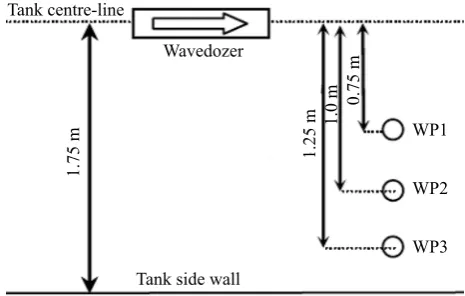
with-in ± 0.01 m/s in either forward or reverse. The car -riage is equipped with data acquisition equipment to analyse the signals measured from resistance and sea-keeping experimental setup. The tank also has wave absorbers at each side and beaches at the end of the towing tank that dissipate the wave after each run in order to calm the water prior to the next run. Three resistance wave probes were positioned
at 0.75, 1.0 and 1.25 m from the centre-line of the
model to record the elevation of the vessel-generated
waves with respect to time (Figure 1). Wave height was defined as the trough to crest height of the first significant waves, as shown in Figure 2.
Tank centre-line
Tank side wall
1.75
m
0.75
m
1.0 m
1.25
m WP1
WP2
WP3
[image:2.595.306.539.406.554.2]Wavedozer
Figure 1. Wave probe setup relative to centreline of pressure source (top view)
-50 -40 -30 -20 -10 0 10 20 30 40
5 10 15 20 25 30 35
W
av
e
H
ei
gh
t (
m
m
)
Time (s)
WP1 Crest
Trough Bow Wave
wave height
[image:2.595.70.533.606.748.2]A wavedozer was used as a pressure source to generate waves. The wavedozer was a wedge shape
body with constant beam (Driscoll & Renilson, 1980). Towing tank tests were conducted with water depth of 1.5 m and a wavedozer of 0.3 m beam and
0.1 m draft. Table 1 presents the wavedozer char-acteristics. The model was attached to the carriage using a two post towing system. The model was
fixed and therefore no sinkage or trim was permitted
during the test runs. Two load cells were installed at the connection between each towing post and the
model to measure the vertical (lift) and longitudinal (drag) forces. Figure 3 shows the wavedozer and load cells’ positions and Figure 4 shows the wave -dozer attached to the carriage at the Australian
Mar-itime College (AMC) towing tank. The model was tested for varying Froude depth numbers (Frh) from
0.4 to 1.0, where Froude depth number (Javanmardi
et al., 2012) is based on the calm water depth and is
defined by equation (1):
gh V
Frh (1)
where: V is the speed of wavedozer (m/s), g is
grav-itational acceleration (m/s2) and h is the depth of
calm water of the channel (m).
Results and discussion
Drag and vertical forces
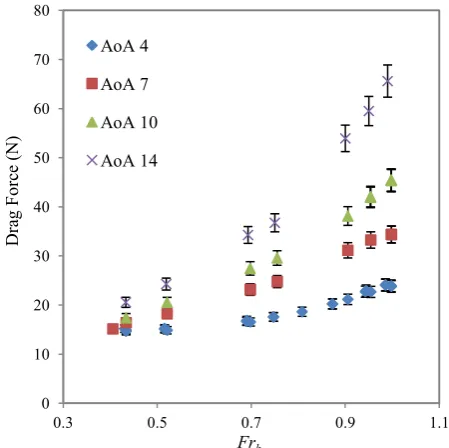
The drag forces recorded by load cell 1 at four
different angles of attack: 4°, 7°, 10° and 14°; and
at various Frh are presented in Figure 5. It can be
seen that the drag forces gradually increase at high-er Frh for all tested angles of attack. The drag force is directly proportional to the speed. While there is
no significant difference between the recorded drag
forces for all four angles of attack at low Frh, as the Frh increases, the difference between measured drag forces is significantly larger. The drag force at an angle of attack of 14° is noticeably the highest at all
Frh, while the lowest drag force was recorded for an
angle of attack of 4°; however, the displacement of the wavedozer at angle of attack of 4° is almost four times larger than at 14°. This is due to the change in pressure gradient, which affects the pressure drag
of the wavedozer. It was previously shown
numer-ically that about 95% of the drag is attributed to
pressure forces. There is water separation from the side walls and transom of the wavedozer and that portion which causes frictional drag is only about
5% of the total drag (Javanmardi, 2015); therefore, viscous drag does not have a significant influence on
the total drag.
0 10 20 30 40 50 60 70 80
0.3 0.5 0.7 0.9 1.1
Dra
g
Fo
rc
e (N)
Frh
[image:3.595.57.287.89.174.2]AoA 4 AoA 7 AoA 10 AoA 14
[image:3.595.311.536.456.680.2]Figure 5. Measured drag at different angle of attack for dif-ferent Frh
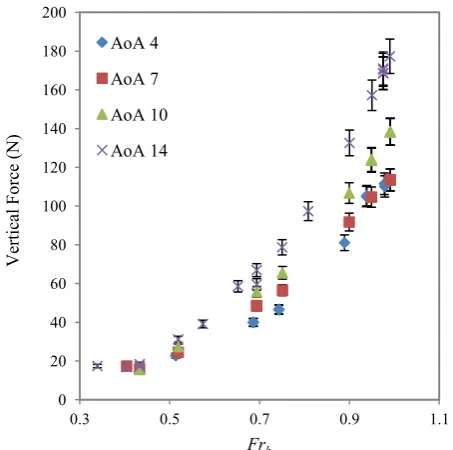
Figure 6 shows the measured vertical forces for angles of attack of 4°, 7°, 10° and 14° at various Frh. The plot shows the same trend as drag force. It is
100 mm
FZ2 FZ1
FY
Slider
Load Cell 2 Load Cell 1
[image:3.595.59.287.537.615.2]Water-line α
Figure 3. Wavedozer load cells’ positions
Figure 4. Wavedozer model attached to the towing tank carriage
Table 1. Wavedozer particulars
Length
(mm) (mm)Draft Beam (mm)
Angle of Attack
(degree)
Waterline
length (m) ment (mDisplace3-)
2150 100 302
[image:3.595.57.289.649.742.2]clearly shown that the vertical force increases with increasing Frh. It can be seen that angle of attack of
14° has the highest vertical force at all Frh.
0 20 40 60 80 100 120 140 160 180 200
0.3 0.5 0.7 0.9 1.1
V
erti
ca
l F
orc
e
(N)
Frh
[image:4.595.58.285.121.346.2]AoA 4 AoA 7 AoA 10 AoA 14
Figure 6. Measured vertical force for different Frh at differ-ent angle of attack
[image:4.595.308.539.398.469.2]Wave Height Comparison
Figure 7 shows wave height measured at WP1 at various Froude depth numbers for different angles
of attack. It can be seen that the generated wave
height at angle of attack of 4° (AoA 4) at low Frh is the lowest. The wave height for all angles of attack decreased from Frh 0.8 to 0.95. The generated wave
height at angle of attack of 14° (AoA 14) is larg -er than oth-er angles of attack at high Froude depth numbers.
Wave Quality
The quality of a wave can be defined by the change
of the wave’s height across the channel. A wave with
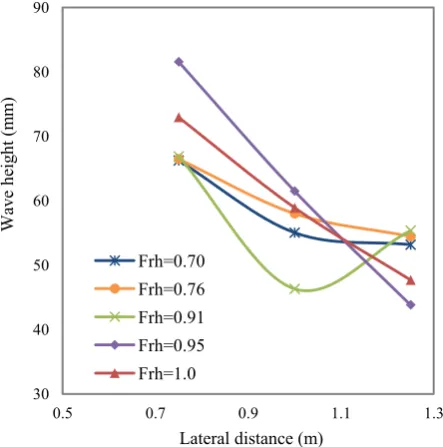
constant height has the best quality. Figure 8 shows an example of wave quality which was quantified by Hartley (Hartley, 2012). To determine which con -ditions produced high quality waves, the measured
wave heights from WP1, WP2 and WP3 are plotted with respect to lateral distances in Figures 9 to 12.
By comparing all the measured wave heights and lat-eral distances, it was found that an angle of attack of
4° (AoA 4) produced the best quality wave.
It was observed that waves at Frh larger than 0.8 at an angle of attack of 4°, and Frh = 0.76 at 7° pro -duced the only good quality waves. By comparing all the conditions, it is obvious that Frh = 0.81 at AoA 4 produced the best wave quality. It can be seen
that the wave height at Frh = 0.81 was the highest
[image:4.595.60.284.515.736.2]wave at all three wave probes.
Figure 8. Example of high quality wave (left) and low quality wave (right) (Hartley, 2012)
30 35 40 45 50 55 60 65 70 75 80
0.5 0.7 0.9 1.1 1.3
W
av
e
hei
gh
t (
m
m
)
Lateral distance (m) Frh=0.81
Frh=0.87 Frh=0.91 Frh=0.94 Frh=0.95 Frh=1.0
Figure 9. Wave quality comparison at angle of attack of 4° for different Frh
0 20 40 60 80 100 120
0.3 0.5 0.7 0.9 1.1
W
av
e
hei
gh
t (
m
m
)
Frh AoA 4
[image:4.595.312.535.516.739.2]AoA 7 AoA 10 AoA 14
Conclusions
In this research the effect of angle of attack on
quality of waves produced by a pressure source has been investigated. The wavedozer was tested at four
different angles of attack and various Frh at AMC’s towing tank.
By comparing forces measured by the load cells, the lowest value was recorded for an angle of attack
of 4°, while displacement was the largest at an angle of attack of 4°; hence, it can be concluded that
increasing displacement due to change of angle of attack will generate good quality waves with
low-er forces. Nevertheless, it is strongly recommend -ed that the relationship between displacements due to changes in beam dimension and drag forces be investigated in the future.
In general, the attack angle of the wavedozer
has a significant effect on the wave quality. Accord -ing to the results, a small angle of attack produces a high quality surfable wave with a lower power requirement.
References
1. Driscoll, A. & Renilson, M.R. (1980) The wavedozer. A system of generating stationary waves in a circulating wa-ter channel. AMTE(H) TM80013.
2. Ertekin, R.C., Webster, W.C. & Wehausen, J.V. (1986)
Waves caused by a moving disturbance in a shallow channel
of finite width. Journal of Fluid Mechanics 169, pp. 275– 292.
3. Hartley, A. (2012) Quantifying wave face quality for surf craft riding.
4. Javanmardi, M. (2015) The Investigation of High Quality
Surfing Waves Generated by a Moving Pressure Source.
PhD Thesis, University of Tasmania, in Australian Maritime
College. Tasmania.
5. Javanmardi, M., Binns, J., Renilson, M. & Thomas, G. (2017) Influence of channel shape on wave generated pa -rameters by a pressure source in shallow water. Journal of
Waterway, Port, Coastal, and Ocean Engineering 143(5).
6. Javanmardi, M., Binns, J., Renilson, M.R., Thomas, G., Schmied, S. & Huijsmans, R. (2012) The Formation of
Surfable Waves in a Circular Wave Pool: Comparison of
Numerical and Experimental Approaches. ASME Proc. 31st
International Conference on Ocean, Offshore and Arctic 30
35 40 45 50 55 60 65 70 75
0.5 0.7 0.9 1.1 1.3
W
av
e
hei
gh
t (
m
m
)
Lateral distance (m) Frh=0.70
[image:5.595.60.285.59.297.2]Frh=0.76 Frh=0.90 Frh=0.95 Frh=1.0
Figure 10. Wave quality comparison at angle of attack of 7° for different Frh
30 40 50 60 70 80 90
0.5 0.7 0.9 1.1 1.3
W
av
e
hei
gh
t (
m
m
)
Lateral distance (m) Frh=0.70
[image:5.595.309.537.70.295.2]Frh=0.76 Frh=0.91 Frh=0.95 Frh=1.0
Figure 11. Wave quality comparison at angle of attack of 10° for different Frh
30.0 40.0 50.0 60.0 70.0 80.0 90.0 100.0 110.0
0.5 0.7 0.9 1.1 1.3
W
av
e
hei
gh
t (
m
m
)
Lateral distance (m) Frh=0.69
Frh=0.75 Frh=0.90 Frh=0.95 Frh=0.99
[image:5.595.61.283.350.574.2]Engineering, Volume 4: Offshore Geotechnics; Ronald W. Yeung Honoring Symposium on Offshore and Ship Hydro
-dynamics Rio de Janeiro, Brazil, 1–6 July.
7. Javanmardi, M., Binns, J., Thomas, G. & Renilson, M.R. (2013) Prediction of Water Wave Propagation Using Com
-putational Fluid Dynamics. ASME Proc. 32nd
Internation-al Conference on Ocean, Offshore and Arctic Engineering, Nantes, France, 9–14 June.
8. Jiang, T., Henn, R. & Sharma, S.D. (2002) Wash waves
generated by ships moving on fairways of varying topogra
-phy. Proc. the 24th Symposium on Naval Hydrodynamics,
Fukuoka, Japan, 8–13 July, pp. 441–455.
9. Katsis, C. & Akylas, T.R. (1987) On the excitation of long
nonlinear water waves by a moving pressure distribution.
Part 2. Three-dimensional effects. Journal of Fluid Mechan-ics 177, pp. 49–65.
10. Koushan, K., Werenskiold, P. & Zhao, R. (2001) Exper
-imental and Theoretical Investigation of Wake Wash. Proc.
the 6th International Conference on FAST SEA TRANS
-PORTATION. The Royal Institution of Naval Architects: Southampton, UK. pp. 165–179.
11. Liu, P.L.-F. & Wu, T.-R. (2004) Waves generated by mov -ing pressure disturbances in rectangular and trapezoidal channels. Journal of Hydraulic Research 42 (2), pp. 163–
171.
12. Macfarlane, G.J. & Cox, G. (2004) The development of vessel wave wake criteria for the Noosa and Brisbane Rivers
in Southeast Queensland. Proc. 5th International Conference
on Coastal Environment, Alicante, Spain.
13. Macfarlane, G.J. (2012) Marine vessel wave wake: focus
on vessel operations within sheltered waterways.Doctor of
Philosophy thesis, Australian Maritime College, University
of Tasmania, Australia.
14. Macfarlane, G.J., Bose, N. & Duffy, J.T. (2012) Wave
wake: focus on vessel operations within sheltered water
-ways. Proc. of the SNAME Annual Meeting, Providence, Rhode Island, 24–26th October.
15. Macfarlane, G.J., Cox, G. & Bradbury, J. (2008) Bank
erosion from small craft wave wake in sheltered waterways.
RINA Transactions, International Journal of Small Craft
Technology. Part B.
16. Mathew, J. & Akylas, T.R. (1990) On three-dimensional
long water waves in a channel with sloping sidewalls. Jour-nal of Fluid Mechanics 215, pp. 289–307.
17. Nanson, G.C., Von Krusenstierna, A., Bryant, E.A. & Renilson, M.R. (1994) Experimental measurements of
river bank erosion caused by boat-generated waves on the
Gordon River, Tasmania. RegulatedRivers: Research and
Management 9 (1), pp. 1–14.
18. Pedersen, G. (1988) Three-dimensional wave patterns gen -erated by moving disturbances at transcritical speeds. Jour-nal of Fluid Mechanics 196, pp. 39–63.
19. Peregrine, D.H. (1968) Long waves in a uniform chan -nel of arbitrary cross-section. Journal of Fluid Mechanics 32(02), pp. 353–365.
20. Peters, A.S. (1966) Rotational and irrotational solitary
waves in a channel with arbitrary cross-section. Communica
-tions on Pure and Applied Mathematics 19 (4), pp. 445–471.
21. Renilson, M.R. & Lenz, S. (1989) An investigation into the
effect of hull form on the wake wave generated by low speed
vessels. Proc. 22nd American Towing Tank Conference, pp.
424–429.
22. Robbins, A., Thomas, G.A., Renilson, M.R., Macfarlane,
G.J. & Dand, I. (2011) Subcritical wave wake unsteadiness.
RINA Transactions, International Journal of Maritime En
-gineering 153, Part A3.
23. Schmied, S., Binns, J.R., Renilson, M.R., Thomas, G.A., Macfarlane, G.J. & Huijsmans, R. (2011) A Novel Method
for Generating Continuously Surfable Waves – Comparison
of Predictions With Experimental Results. Proc. 30th
Inter-national Conference on Ocean, Offshore and Arctic Engi
-neering. Rotterdam, Netherlands and Journal of Offshore
Mechanics and Arctic Engineering 2013, 135 (3).
24. Teng, M.H. & Wu, T.Y. (1997) Effects of channel cross-sec -tional geometry on long wave generation and propagation.
Physics and Fluids 9 (11), pp. 3368–3377.
25. Webber, G. (2004) Wave Generation Apparatus. I.P. Aus
-tralia, Editor.
26. Webber, W.I.P. (2006) Organization, Editor. Switzerland.