Academies Insight
Project:
understanding
system capacity
Research report
July 2017
2
Contents
List of Tables 3
List of Figures 4
1. Introduction 5
2. Objectives 6
3. Overview of report 7
4. Methodology, participants and interpretation 9
Methodology 9
Participants 9
Interpretation of findings 10
5. Findings 12
A. Pre-conversion 12
B. Trusts 27
C. Sponsors 38
6. Information: sources, experiences and needs 45
Sources of information 45
Experiences of, and channels for, receiving information 46
Key information needs 49
7. Summary of findings 50
Pre-conversion not looking to become an academy 50
Pre-conversion interested in becoming an academy 50
Trusts 51
Sponsors 51
Communication 51
8. Conclusion 53
3
List of Tables
Table 1: Profiles overview 8
Table 2: Sample 10
Table 3: Profiles – pre-conversion not looking to become an academy 18
Table 4: Profiles – pre-conversion interested in becoming an academy 26
Table 5: Profiles – trusts 37
4
List of Figures
Figure 1: Three-stage journey 5
Figure 2: Understanding and ease of becoming an academy, and who can benefit –
pre-conversion not looking to become an academy 13
Figure 3: Appetite to becoming an academy – pre-conversion not looking to become an
academy 15
Figure 4: Barriers to becoming an academy – pre-conversion not looking to become an
academy 16
Figure 5: Understanding and ease of becoming an academy, and who can benefit –
pre-conversion interested in becoming an academy 20
Figure 6: Appetite to becoming an academy – pre-conversion interested in becoming an
academy 22
Figure 7: Barriers to becoming an academy – pre-conversion interested in becoming an
academy 24
Figure 8: Understanding and ease of becoming an academy, and who can benefit –
trusts 28
Figure 9: Motivations to grow / become a sponsor – trusts 31
Figure 10: Barriers to grow / become a sponsor – trusts 33
Figure 11: SAT vs MAT comparison of who can benefit from becoming an academy 35
Figure 12: Understanding and ease of becoming an academy, and who can benefit –
sponsors 38
Figure 13: Motivations to become a sponsor – sponsors 40
Figure 14: Barriers to grow – sponsors 42
Figure 15: Sources of information 45
Figure 16: Preferred method of communication with DfE 48
5
1. Introduction
Improving school standards and tackling underperformance is a Department for
Education (DfE) commitment and priority, and a key element of their strategy to provide a good school place for every child (DfE 2016b, DfE 2017c, DfE 2017d). This has meant a strong focus on quality and raising standards for all students (particularly the most disadvantaged) in a diverse school system.
[image:5.595.76.530.325.414.2]The school system is diverse, with one in three schools now being an academy. Single Academy Trusts (SATs), Multi Academy Trusts (MATs) and sponsors operate in the academy sector. Schools can move from maintained status to academy status through academy conversion, becoming a SAT or part of a MAT. Trusts can apply to become a sponsor. If sponsor status is awarded they can take on underperforming schools and support them to improve. This three-stage journey from maintained school to sponsor can be conceptualised as shown below:
Figure 1: Three-stage journey
The Academies Insight Project was commissioned in January 2017 to engage with good and outstanding schools, trusts and sponsors throughout the school system to gather a deeper insight into the academy sector and this academy-sponsor journey1.
1 This work was carried out to ISO 20252 standards.
6
2. Objectives
Within its broad remit to gather insights from the school system about the academy sector and this academy-sponsor journey, the Academies Insight Project aimed to provide the DfE with a greater understanding of the reasons why schools choose to continue with maintained status or move to academy status, and why SATs/MATs choose to remain as a SAT/MAT or become a sponsor.
The specific objectives of the research were therefore:
• To explore the motivations, concerns and attitudes amongst schools, SATs/MATs and sponsors about moving into the academy sector and/or along the academy-sponsor journey;
• To gather a better understanding of the decisions that schools, SATs/MATs and sponsors take when moving into the academy sector and/or along the academy-sponsor journey;
• To understand the barriers that prevent schools from moving into the academy sector and SATs/MATs from moving along the academy-sponsor journey;
• To identify and profile the different school, trust and sponsor types in the school system; and,
7
3. Overview of report
The Academies Insight Project was commissioned to provide insight into schools, trusts and sponsors from across the current school system, with a particular focus on their motivations, concerns and attitudes towards the academy sector and the academy-sponsor journey. For the purpose of this research the academy-academy-sponsor journey was conceptualised as having three stages: pre-conversion, trust and sponsor.
Findings from the project, taken from a descriptive online survey and followed up with in-depth interviews, have been arranged into four sections; the first three reflect the three stages of the academy-sponsor journey and the fourth cuts across these stages to discuss information needs.
• The Pre-conversion section considers both good and outstanding maintained schools who are eligible for voluntary conversion, with a distinction drawn between those who have stated that they are not looking to become an academy and those who have stated that they are interested in becoming an academy.
• The Trusts section provides the views of SATs and MATs who do not have sponsor status, with results split by trust type where possible.
• The Sponsors section explores the opinions among trusts with sponsor status.
• The Information section reflects on the information needs and habits of all groups in relation to academies and sponsorship. It discusses where school leaders go to get information, their experiences of communication with the DfE, and areas where information is lacking at the moment.
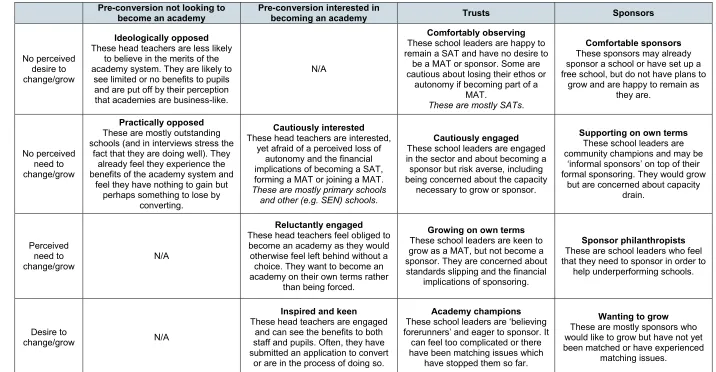
A series of thirteen different profiles were also identified through qualitative thematic analysis and into which most participants fell (table 1). The biggest differentials between these profiles were: i) attitudes towards the academies system; and ii) perceived need to change based on both an assessment of future direction of travel and the local area context in relation to capacity, demand and network of other local schools.
The report also contains a series of wider reflections and a conclusion. These sections include thoughts on future steps regarding policy delivery and communication,
Table 1: Profiles overview
Pre-conversion not looking to
become an academy Pre-conversion interested in becoming an academy Trusts Sponsors
No perceived desire to change/grow
Ideologically opposed These head teachers are less likely
to believe in the merits of the academy system. They are likely to
see limited or no benefits to pupils and are put off by their perception that academies are business-like.
N/A
Comfortably observing These school leaders are happy to remain a SAT and have no desire to
be a MAT or sponsor. Some are cautious about losing their ethos or
autonomy if becoming part of a MAT.
These are mostly SATs.
Comfortable sponsors These sponsors may already sponsor a school or have set up a free school, but do not have plans to
grow and are happy to remain as they are.
No perceived need to change/grow
Practically opposed These are mostly outstanding schools (and in interviews stress the
fact that they are doing well). They already feel they experience the benefits of the academy system and
feel they have nothing to gain but perhaps something to lose by
converting.
Cautiously interested These head teachers are interested,
yet afraid of a perceived loss of autonomy and the financial implications of becoming a SAT, forming a MAT or joining a MAT.
These are mostly primary schools and other (e.g. SEN) schools.
Cautiously engaged These school leaders are engaged in the sector and about becoming a sponsor but risk averse, including being concerned about the capacity
necessary to grow or sponsor.
Supporting on own terms These school leaders are community champions and may be
‘informal sponsors’ on top of their formal sponsoring. They would grow
but are concerned about capacity drain.
Perceived need to
change/grow N/A
Reluctantly engaged These head teachers feel obliged to become an academy as they would otherwise feel left behind without a choice. They want to become an academy on their own terms rather
than being forced.
Growing on own terms These school leaders are keen to grow as a MAT, but not become a sponsor. They are concerned about
standards slipping and the financial implications of sponsoring.
Sponsor philanthropists These are school leaders who feel that they need to sponsor in order to
help underperforming schools.
Desire to
change/grow N/A
Inspired and keen These head teachers are engaged
and can see the benefits to both staff and pupils. Often, they have submitted an application to convert
or are in the process of doing so.
Academy champions These school leaders are ‘believing forerunners’ and eager to sponsor. It
can feel too complicated or there have been matching issues which
have stopped them so far.
Wanting to grow These are mostly sponsors who would like to grow but have not yet been matched or have experienced
9
4. Methodology, participants and interpretation
Methodology
Research for the Academies Insight Project was conducted over two stages: a descriptive online survey and in-depth interviews with school leaders.
• Descriptive online survey (7 February 2017 – 23 March 2017)
A descriptive survey, hosted online by Ipsos MORI, and completed by 145 school leaders. The survey was not intended to replicate a quantitative survey methodology, but instead designed as a vehicle through which to reach a broader number of
schools in order to gain an indication of weight of opinion. It also acted as a tool for recruitment and to inform follow-up in-depth interviews. The sample included good and outstanding maintained schools, SATs, MATs and sponsors. It also comprised maintained schools who had withdrawn an application to convert. Responses were received from a wide range of school leaders, including head teachers, chief
executive officers (CEOs), executive heads and principals. It should be noted that this range of roles gave a variety of different and equally valid perspectives.
• In-depth interviews (20 February 2017 – 31 March 2017)
Follow-up in-depth interviews conducted by telephone with 55 school leaders including head teachers, CEOs, principals and deputy principals, all of whom had completed the descriptive survey and stated they were happy to be contacted for an interview. Quotas were set by phase, type, region and stage along the academy-sponsor journey to ensure a broad spread of characteristics.
Participants
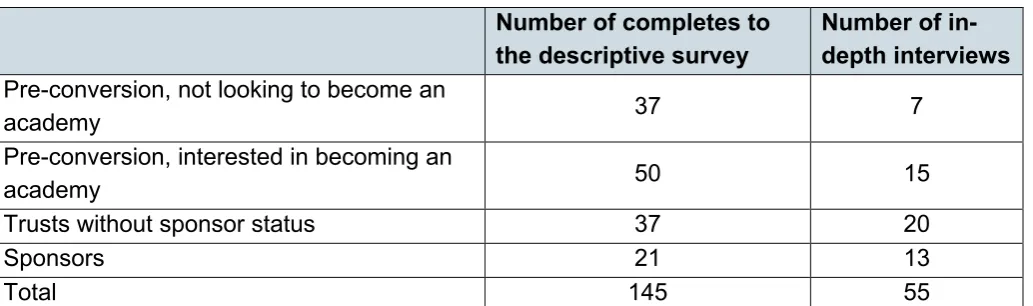
10 Table 2: Sample
Number of completes to
the descriptive survey Number of in-depth interviews
Pre-conversion, not looking to become an
academy 37 7
Pre-conversion, interested in becoming an
academy 50 15
Trusts without sponsor status 37 20
Sponsors 21 13
Total 145 55
Interpretation of findings
Descriptive online survey
Results from the descriptive survey are incorporated throughout this report. They are based on all respondents to the survey unless otherwise stated. Please note that data has not been weighted and that, given the small base sizes, results are presented as raw numbers and not percentages. The results of the descriptive survey, including any
comparisons between respondent sub-groups, should therefore be treated as indicative only. As such, findings should be used to give a broad indication of the most common responses, and a flavour of weight of opinion. Further research is required to generate results that would allow for robust statistical analysis.
In-depth interviews
Qualitative research approaches (including in-depth interviews) are used to shed light on why people hold particular views, rather than how many people hold those views. It is used to explore the nuances and diversity of views, the factors which shape or underlie them and the ideas and situations in which views can change. The results are intended to be illustrative rather than statistically reliable. Given the qualitative nature of the data collected from the in-depth interviews, this report aims to provide detailed and exploratory findings that give insight into the perceptions, thoughts and feelings of people, rather than statistical evidence from a representative sample.
It is not always possible in qualitative research to provide a precise or useful indication of the prevalence of a certain view, due to the relatively small number of participants
11
reflect views which were mentioned infrequently and “many” or “most” when views are more frequently expressed. Where views apply only to a subset of participants any proportions used in our qualitative reporting (e.g. a “couple of” participants), should always be considered indicative, rather than exact.
12
5. Findings
The following findings from the research are presented in four sections: Pre-conversion,
Trusts, Sponsors and Information.
In the Pre-conversion, Trusts and Sponsors sections, findings have been grouped by respondent and their place on the three-stage journey from pre-conversion to trust and sponsor as outlined in the introduction. Information, the fourth section, pulls together findings from across the range of respondents and details how they gather information about the academy sector and this journey.
A. Pre-conversion
i. Pre-conversion not looking to become an academy
This chapter presents findings and analysis from head teachers in good and outstanding maintained primary and secondary schools who stated in the descriptive survey that they were not looking to become an academy.
Attitudes towards academies
13
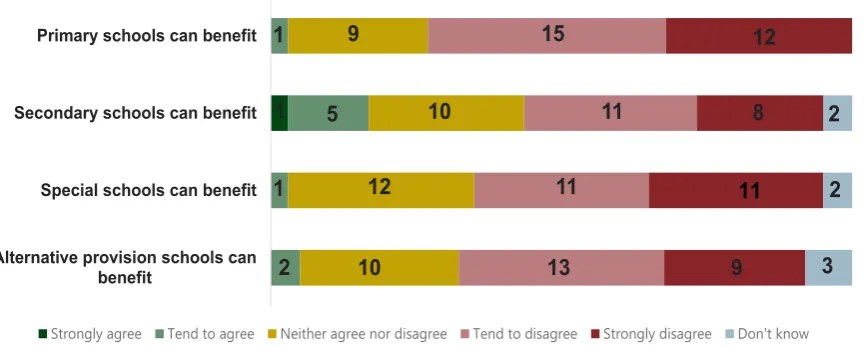
Figure 2: Understanding and ease of becoming an academy, and who can benefit – pre-conversion not looking to become an academy
Participants were asked for the top three words that came to mind when thinking about academies. These associations underpinned many of their attitudes, perceptions, experiences and actions relating to the academy system. The most commonly cited words from pre-conversion not looking to become an academy were: ‘business’,
‘pointless’, ‘unnecessary’, ‘forced’ and ‘privatisation’. These associations were explored further during in-depth interviews and are synthesised below:
• Business: was mentioned by heads of maintained schools due to the structure of academies being likened to a business. There was a perception that, in becoming an academy, head teachers’ job roles change to include taking greater
responsibility for the business aspects such as pay roll or HR, and trusts have the new business-like position of CEO.
Pre-conversion not looking to become an academy
6 20 6 3 2
I understand the current policy around academies
Pre-conversion not looking to become an academy
6 3 15 11 2
It’s easy to become an academy
Strongly agree Tend to agree Neither agree nor disagree Tend to disagree Strongly disagree Don't know
Alternative provision schools can benefit
Special schools can benefit Secondary schools can benefit Primary schools can benefit
Strongly agree Tend to agree Neither agree nor disagree Tend to disagree Strongly disagree Don't know 5
12 11 11
Base: Pre-conversion not looking to become an academy (37) Field work dates 7thFebruary – 31stMarch 2017 Source: Ipsos MORI Who can benefit from becoming an academy?
9 15 12
10 11 8
10 13 9
14
• Pointless: some maintained school head teachers did not perceive there to be any educational benefits in becoming an academy compared with their current
structure and viewed converting as pointless.
• Unnecessary: similarly, this was related to the feeling that their schools already experience the benefits of collaboration and were well supported by their local authority, resulting in there being no perceived need to convert.
• Forced: was used partly in recognition that some underperforming schools are forced to become academies through an academy order2; and because some felt that becoming an academy was inevitable and would be forced on all schools in the future in some form.
• Privatisation: like ‘business’, this related to the reduced role of local authorities in the academies system, the observation that some academies had relationships with private sector organisations, and the perception that they were managed as a business rather than a school in a more traditional sense3.
Appetite
As could be expected, participants who were not interested in becoming an academy felt there was not an appetite within their schools, nor their local authority, to convert.
2 DfE (2016a:8) guidance states that, “The Secretary of State has a duty to make an academy order in
respect of any maintained school that has been judged inadequate by Ofsted, to enable it to become an academy”.
3 All trusts are exempt charities whose charitable objective is the “’advancement of education for public
15
Figure 3: Appetite to becoming an academy – pre-conversion not looking to become an academy
Findings from the in-depth interviews with head teachers suggest that head teachers and their staff in these schools were primarily against becoming an academy due to their opinion that the academy system does not guarantee improved educational outcomes for pupils. Furthermore, interviewees reported that governors were concerned about their role in the school, the educational outcomes of pupils and the potential loss of the school’s ethos if entering the academy sector. Schools at this stage also tended to have a strong and positive relationship with their local authority, and already worked well in close collaboration with a network of other schools. As such, it seemed that some of the benefits perceived by academies of those with academy status – for example increased collaboration – may not be as relevant in this context. Indeed, some participants noted a sense of wanting to feel ‘loyal’ to their local authority.
Our local authority is very supportive and we have a strong family of
schools, we don't need to become an academy to work together, we already do. (Primary, North East London and East of England)
I am starting to become aware of some advantages of becoming an academy, particularly a MAT with our primaries, but staff will be very negative about any change unless it can be proven to be totally the right move for the children - rightly so. Even then they will not trust the process and will worry about… new contracts etc. (Secondary, South London and South East England)
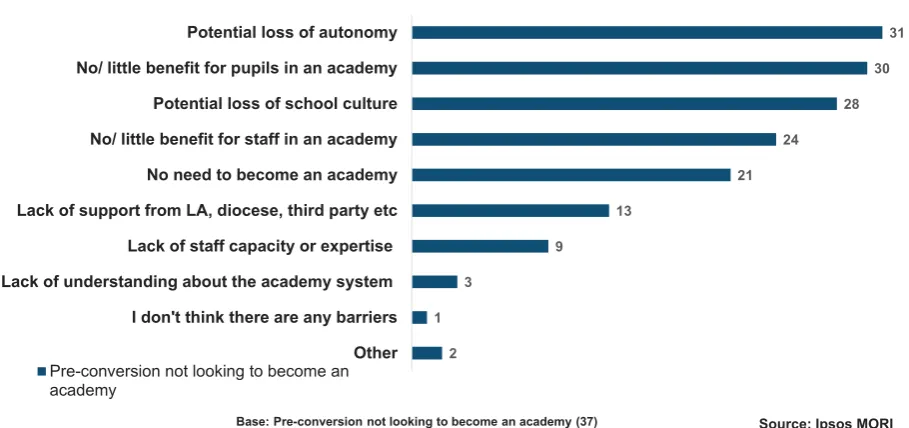
As figure 4 shows, the two most commonly cited reasons by head teachers in this group in the descriptive survey for not converting were the perceived potential loss of autonomy and a perception of no or little benefit for pupils.
9
16-023063 Academies Customer Insight Workshop | Version 1 Internal And Client Use Only
Strongly agree Tend to agree Neither agree nor disagree Tend to disagree Strongly disagree Don't know
There is a strong appetite for schools to become academies in my LA
There is a strong appetite in my school to become an academy
Base: Pre-conversion not looking to become an academy (37)
Field work dates 7thFebruary – 31stMarch 2017 Source: Ipsos MORI
4 4 16 11 2
9 26
16
Figure 4: Barriers to becoming an academy – pre-conversion not looking to become an academy
Parallel to this, the three most cited reasons to remain a maintained school were i) already collaborating informally with other schools ii) good educational outcomes in the current structure, and iii) sufficient autonomy already. For the pre-conversion schools not interested in converting, there was therefore a sense that there were no benefits in the academy system that they did not already have and so saw no reason to change. Indeed, some respondents were very strong in their opinions about this and, personally, they were not aware of the benefits:
Academies are a massive distraction and there is no evidence to suggest they have an impact on standards or progress. They are purely about political dogma and the privatisation of education. Improving teaching and the status of teachers should be the focus, not school structures, ideology and vested interests. (Primary, North East London and East of England)
No advantage in becoming an academy with a large top slice4 of income lost for services. No evidence to show they do any better than maintained
schools. (Secondary, South London and South East England)
4 MATs and sponsors can choose to ‘top-slice’ a percentage of funding from their schools’ budgets. This is
taken from revenue streams such as the General Annual Grant (GAG) and, on average, MATs top slice 4.6% from each of their academies for central services (DfE 2017a:7).
2 1
3
9
13
21 24
28 30
31
Other I don't think there are any barriers Lack of understanding about the academy system
Lack of staff capacity or expertise Lack of support from LA, diocese, third party etc
No need to become an academy No/ little benefit for staff in an academy Potential loss of school culture No/ little benefit for pupils in an academy Potential loss of autonomy
Pre-conversion not looking to become an academy
Base: Pre-conversion not looking to become an academy (37)
Field work dates 7thFebruary – 31stMarch 2017 Source: Ipsos MORI
17
A number of head teachers in this group also explained that they would be more interested in becoming an academy if they could become a SAT and retain their independence from other schools. However, they felt that this was not an option.
In addition, head teachers – especially those of primary schools – had pre-conceptions about and were mistrusting of the perceived need to give finance to a pooled central resource, and perceived there to be too great a focus on finances over educational outcomes. Furthermore, despite trusts having to publish their accounts and reports (DfE 2014:7; DfE 2017b), some school leaders were concerned about how the money is spent.
The more I hear about the corruption and money wasted in the academies and free schools programme, the more vehemently I am opposed to the whole idea. When I speak to head teachers of academies, I am struck by the lack of autonomy they have; ironically this is one of the many myths peddled about academies. (Primary, North East London and East of England)
I would very much like schools to become standalone academies so that they are not led by a CEO but by their own head teacher. I have had four and a half years’ experience as a head of a sponsored school. I would not particularly relish the idea of being part of a growing MAT where money seems to be more important than the children. (Primary, North East London and East of England)
When asked how potential barriers could be overcome, the majority of head teachers in this group reported feeling that these, in their opinon, were fundamental issues that could not be rectified.
Emerging profiles
Those head teachers of good and outstanding maintained schools not interested in becoming academies largely fell in to one of two broad groups: those ideologically opposed to conversion, and those who pragmatically did not feel the need to consider conversion. If they could more clearly see the positive impact of academies on
18
Table 3: Profiles – pre-conversion not looking to become an academy
Pre-conversion not looking to
become an academy
Ideologically opposed Practically opposed
Description These head teachers are less likely to believe in the merits of the academy system. They are likely to see limited or no benefits to pupils and are put off by their perception that academies are business-like.
These are mostly outstanding schools (and in interviews stress the fact that they are doing well). They already feel they experience the benefits of
the academy system and so feel they have nothing to gain but perhaps something to lose by converting.
Driven by
• A desire to see evidence that academies improve educational outcomes
• A belief that a school’s focus should be on the pupils and education, and less on ‘business-like’ functions such as payroll
• A belief that a head teacher’s role is not to manage the finance and HR, but to focus on school improvement
• Some concern among governors as to what becoming an academy would mean for them
• A concern that becoming an academy would mean loss of autonomy and school culture if asked to join with another school under a MAT structure
• A positive relationship with, and receive good quality services from, their local authority
• Excellent existing partnerships and collaboration with other schools
• Perfectly happy as they are
• Tend to be distrusting of partnerships, for example primaries fear ‘secondary takeover’ and SEND schools fear their needs won’t be
recognised
Future persuaded by evidence of improved outcomes under an academies These head teachers would only become an academy if they were system, or if there was no option to remain a maintained school.
These head teachers would consider becoming an academy if existing partnerships and services from the local authority changed or deteriorated,
if they were convinced by evidence of improved educational outcomes, or if they could find another school who matched their ethos and vision with
whom to form a MAT.
Illustrative quotation
Why are we doing this [converting to academies]? The last people to benefit are the children. The quality of teaching and leadership is so important – why would you send your best teachers to another primary school? You can share ideas, which is great, but we already do this now.
(Primary)
Primary and secondary run very differently. Continuous education will happen if there is one head teacher. Secondaries should be ‘MAT’ed’ together. Primary and secondary have different issues. I don’t go to a
19
ii. Pre-conversion interested in becoming an academy
This chapter presents findings from good and outstanding maintained schools who stated an interest in becoming an academy in the descriptive survey but who have yet to apply, and those who had already submitted an application to become an academy.
Attitudes towards academies
20
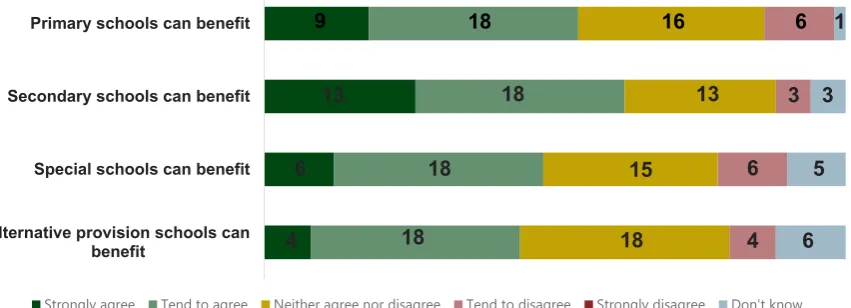
Figure 5: Understanding and ease of becoming an academy, and who can benefit – pre-conversion interested in becoming an academy
When asked for their top word associations with academies, the most commonly cited words among primary, secondary and special school head teachers who have stated an
interest in becoming an academy but have not applied were: ‘business’, ‘pointless’,
‘unnecessary’, ‘forced’ and ‘privatisation’5. The most common words cited among primary, secondary and special schools head teachers who have already submitted an
application were: ‘collaboration’, ‘opportunity’, ‘independence’, ‘scary’ and ‘innovation’.
5 These words are the same as those that were most commonly cited by head teachers not interested in
converting.
I understand the current policy around academies
Pre-conversion interested in becoming an academy
13 28 7 2
It’s easy to become an academy
Pre-conversion interested in becoming an academy
10 9 17 14
Strongly agree Tend to agree Neither agree nor disagree Tend to disagree Strongly disagree Don't know
Alternative provision schools can benefit
Special schools can benefit Secondary schools can benefit Primary schools can benefit
Strongly agree Tend to agree Neither agree nor disagree Tend to disagree Strongly disagree Don't know
9 18 16 6
18
Base: Pre-conversion interested in becoming an academy (50) Field work dates 7thFebruary – 31stMarch 2017 Source: Ipsos MORI
Who can benefit from becoming an academy?
13 18
18
18
13 3 3
6 15 6 5
4 4 6
21
These associations underpinned the attitudes, perceptions, experiences and actions relating to academies and were explored further during in-depth interviews and are synthesised below:
• Collaborative: was used in both positive and negative contexts. Positively in relation to the potential for greater collaboration by working together in a MAT; negatively due to concerns that when schools join or form MATs, they might stop collaborating with schools outside the MAT6.
• Opportunity: related to the feeling that academies were operating more strategically and could open new doors and possibilities such as procuring services independently or professional development opportunities for staff.
• Partnership: the narrative around partnership was associated with the ability to collaborate and work closely with other schools, creating better opportunities for the school, teachers and pupils.
• Control: in some cases, control related to the new freedoms such as control of curriculum and finances. However, it was also associated with some heads’ perceptions of losing control where decisions could instead be made by business managers or CEOs rather than the head teacher or head of school.
• Business: as with the not interested group, this was mentioned due to the structure of academies being likened to a business. This was, again, due to the perceived change in head teachers’ job roles including taking responsibility for the business aspects such as pay roll or HR, and the new business-like position of CEO.
• Independence: related to the positivity about being independent and autonomous from their local authority.
• Scary: was mentioned with regard to concerns about the ‘scary’ responsibilities that would come with independence and accountability of the head’s new role as trust leader.
• Innovation: like opportunity, related to the feeling that the academies system is innovative, and opens the possibility of innovative solutions to existing and future issues.
6 However, in the DfE Academy trust survey (2017a:28), two thirds of MATs stated that all individual
22
Appetite
When asked in the descriptive survey if there was an appetite for schools to become academies in their local authority, the results among this group were mixed. Head teachers reported that while some local authorities were open to the concept of
academies and were proactive in encouraging their schools to consider the options that were best for them, other local authorities had stated a preference for conversion within a set number of years. On the other end of the spectrum, however, some local authorities were reported to be less positive about their schools converting into academies.
Figure 6: Appetite to becoming an academy – pre-conversion interested in becoming an academy
The in-depth interviews indicated a more positive outlook overall: head teachers did not feel forced to consider conversion but were able to take their time in considering their options. It was reported that governors, who are key decision makers within schools, wanted to be well informed before making a definite decision, with head teachers
presenting them with clear benefits and drawbacks to get governors on board. A number of head teachers described the detailed lengths at which senior staff and governors would agonise over which was the right conversion process and model for them.
Reasons for becoming an academy
Evolving motivations
Motivations to convert for head teachers in maintained schools interested in becoming an academy differed from those who had already converted. The top three motivations identified by head teachers of maintained schools interested in becoming an academy in the descriptive survey were related to pupils and teachers: i) better educational outcomes for pupils; ii) collaboration with other schools/academies with a similar vision; and iii) professional development opportunities for staff7; while the reasons given by respondents from schools who had already converted to academy status were related to better
7 These were in particular contrast with head teachers not interested in converting who selected ‘no/little
benefits to pupils in an academy’ as the second most common concern in becoming an academy.
Strongly agree Tend to agree Neither agree nor disagree Tend to disagree Strongly disagree Don't know
Base: Pre-conversion interested in becoming an academy (50): Field work dates 7thFebruary – 31st
March 2017 Source: Ipsos MORI
There is a strong appetite for schools to become academies in my local authority
6 7 9 6 1
23
running of the academy: i) increased autonomy; ii) ability to procure own services; and iii) financial benefits.
Having worked in a model of collaboration with other schools for 3 years, I can see the benefits and can share data and go to each other for advice, rather than the local authority. Schools can share best practice. (Primary, North East London and East of England)
There is benefit for pupils through raising standards through joined up vision and practice… [We can] streamline resources. I have 60 staff with no admin or HR support. … My staff are already getting CPD. Taking the best of what we already have and using it better. Raising standards for pupils and quality CPD, peer to peer work. (Primary, West Midlands)
Among head teachers who expressed an interest in joining the academy system, their reasons for wanting to do so were grounded in two separate ways of thinking. They either i) felt there were potential benefits of conversion; or ii) wanted to convert on their own terms for fear of otherwise being forced to accept an unfavourable conversion at a later stage in the future.
Potential benefits
The main potential benefits of becoming an academy were perceived to be enabling a smoother transition between school phases, collaboration through access to resources and sharing good practice, and choice of commissioning services.
Academies enable schools to improve on current practice through
collaboration with other schools. You can do activities you couldn't before. (Primary, West Midlands)
Access to services is a big one for us, quite often in our local authority it can take an awful long time to get access to services. Sometimes I need those services at point of crisis not in 6 weeks’ time. Being an academy would give me control of services, quality and the right time to access them. (Primary, South West of England)
Sense of inevitability
In contrast to recognising the benefits, some head teachers felt it was inevitable that they would have to become an academy at some point, seeing it as “the way it is going to go”, and as such sought to become an academy on their own terms rather than eventually being forced. Linked to this, some also had concerns about the implications of the national funding formula for their schools if they waited.
24
the shared vision and value for openness and collaboration, and not left with the remainders. The local authority contracted so much, there was no
reason to stay with the local authority. (Primary, West Midlands)
My main motivator is to ensure stable school in times of poor funding for rural schools. (Primary, North East London and East of England)
Barriers to conversion among those interested
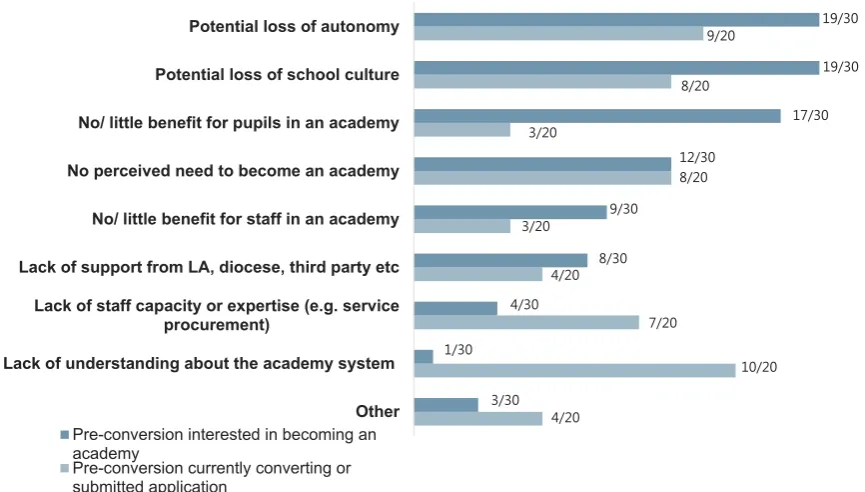
[image:24.595.77.510.345.591.2]For head teachers interested in their schools becoming an academy, or who have submitted an application, there were a range of perceived barriers to conversion. These included the perception of life as an academy and the practicalities of conversion. Both were often informed by the experiences of other head teachers or school leaders in academies as opposed to official DfE information.
Figure 7: Barriers to becoming an academy – pre-conversion interested in becoming an academy
The most commonly cited reason not to convert in the descriptive online survey was potential loss of autonomy since many head teachers felt they already had sufficient autonomy within the running of the school. Further practical reasons mentioned in interviews were that head teachers wanted to remain under the umbrella of their local authority, which was providing a good and efficient service already, and hence having ‘no reason to convert’ or ‘no perceived need to become an academy’. Furthermore, due to the governance structures of MATs, some were concerned about the extent to which
12
16-023063 Academies Customer Insight Workshop | Version 1 Internal And Client Use Only
Other Lack of understanding about the academy system
Lack of staff capacity or expertise (e.g. service procurement)
Lack of support from LA, diocese, third party etc No/ little benefit for staff in an academy No perceived need to become an academy No/ little benefit for pupils in an academy Potential loss of school culture Potential loss of autonomy
Pre-conversion interested in becoming an academy
Pre-conversion currently converting or submitted application
What do you think are the main barriers around becoming an academy?
Base: Pre-conversion interested in converting (30); Pre-conversion currently converting (20); ); Field work dates 7th February – 31stMarch 2017
Source: Ipsos MORI
9/20
8/20
3/20
8/20
3/20
4/20
7/20
10/20
4/20
19/30
19/30
17/30
12/30
9/30
8/30
4/30
1/30
25
head teachers would no longer be responsible for all decision making, and so were concerned about losing autonomy.
The second most cited reason not to convert in the online survey was potential loss of school culture. This was reflected in interviews as both a practical and perceived barrier where head teachers felt there was no critical mass of schools in the local area with which to become a MAT. They were either feeling vulnerable as a small (and commonly primary) school to be taken over, not having a suitable school to join in the area, or not finding a MAT with the same ethos. There was a perceived fear that by joining a MAT, schools would risk losing their ethos or small and local school ‘feel’ and consequently unwillingly change.
Another barrier to conversion raised by head teachers, especially in primary schools, was that they perceived a lack of evidence around improved pupil outcomes. There was also a fear of the unknown, fuelled by myths or bad experiences they had heard about from colleagues or witnessed with local schools. For example, based on experiences of
others, some head teachers were reluctant to convert due to a perceived lack of financial and staffing capacity if they did so and having to run a “business” rather than a school. This fear was exacerbated, especially in primary school head teachers, by the perception that a business manager in a MAT would make a budgetary decision (especially “top slicing”). There were also concerns amongst SEND and primary schools that their voice would not be heard in a new structure.
Huge risks. You are much more exposed; the job is very different. You rely on partnerships, but you should avoid partnerships based on head teacher personalities and focus on ethos. There are challenges and risks with that. Concern on financial resources and risk of losing autonomy. (Primary, West Midlands)
The secondary-school-led MAT were active in making sure we would join and had two tiny primary schools as part of the MAT, but part of their vision and ethos… they didn't really understand the difference between primary and secondary. Now they have lots of secondaries and only three primaries. In their senior leadership structure, all are secondary. Everyone making decisions are secondary, you need a balance, need a voice. (Primary, South West of England)
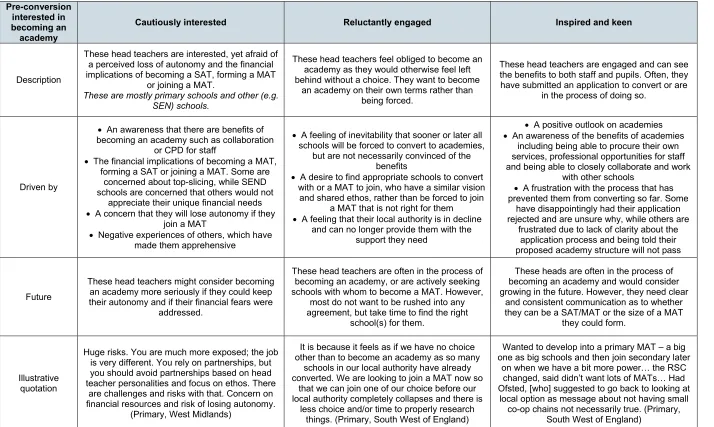
Emerging profiles
26
Table 4: Profiles – pre-conversion interested in becoming an academy
Pre-conversion interested in becoming an academy
Cautiously interested Reluctantly engaged Inspired and keen
Description
These head teachers are interested, yet afraid of a perceived loss of autonomy and the financial implications of becoming a SAT, forming a MAT
or joining a MAT.
These are mostly primary schools and other (e.g. SEN) schools.
These head teachers feel obliged to become an academy as they would otherwise feel left behind without a choice. They want to become
an academy on their own terms rather than being forced.
These head teachers are engaged and can see the benefits to both staff and pupils. Often, they have submitted an application to convert or are
in the process of doing so.
Driven by
• An awareness that there are benefits of becoming an academy such as collaboration
or CPD for staff
• The financial implications of becoming a MAT, forming a SAT or joining a MAT. Some are
concerned about top-slicing, while SEND schools are concerned that others would not
appreciate their unique financial needs
• A concern that they will lose autonomy if they join a MAT
• Negative experiences of others, which have made them apprehensive
• A feeling of inevitability that sooner or later all schools will be forced to convert to academies,
but are not necessarily convinced of the benefits
• A desire to find appropriate schools to convert with or a MAT to join, who have a similar vision and shared ethos, rather than be forced to join
a MAT that is not right for them
• A feeling that their local authority is in decline and can no longer provide them with the
support they need
• A positive outlook on academies
• An awareness of the benefits of academies including being able to procure their own services, professional opportunities for staff and being able to closely collaborate and work
with other schools
• A frustration with the process that has prevented them from converting so far. Some
have disappointingly had their application rejected and are unsure why, while others are
frustrated due to lack of clarity about the application process and being told their proposed academy structure will not pass
Future
These head teachers might consider becoming an academy more seriously if they could keep their autonomy and if their financial fears were
addressed.
These head teachers are often in the process of becoming an academy, or are actively seeking schools with whom to become a MAT. However,
most do not want to be rushed into any agreement, but take time to find the right
school(s) for them.
These heads are often in the process of becoming an academy and would consider growing in the future. However, they need clear
and consistent communication as to whether they can be a SAT/MAT or the size of a MAT
they could form.
Illustrative quotation
Huge risks. You are much more exposed; the job is very different. You rely on partnerships, but you should avoid partnerships based on head teacher personalities and focus on ethos. There
are challenges and risks with that. Concern on financial resources and risk of losing autonomy.
(Primary, West Midlands)
It is because it feels as if we have no choice other than to become an academy as so many
schools in our local authority have already converted. We are looking to join a MAT now so
that we can join one of our choice before our local authority completely collapses and there is
less choice and/or time to properly research things. (Primary, South West of England)
Wanted to develop into a primary MAT – a big one as big schools and then join secondary later
on when we have a bit more power… the RSC changed, said didn’t want lots of MATs… Had Ofsted, [who] suggested to go back to looking at
local option as message about not having small co-op chains not necessarily true. (Primary,
27
B. Trusts
This chapter presents the findings and analysis from the descriptive online survey and interviews with a range of school leaders within primary and secondary SATs and MATs. The chapter mostly reflects views of school leaders who have not expressed an interest in becoming a sponsor (mostly SATs) and school leaders (both primary and secondary, as well as SATs and MATs) who were interested in becoming an academy sponsor, but had not yet submitted a formal application. Two school leaders (both primary MATs) had submitted an application to become a sponsor, and an additional one had withdrawn their sponsorship application. Findings here are presented with regard to respondents’ interest in growing as a trust through more schools joining as well as growing by becoming a sponsor.
Attitudes towards academies
28
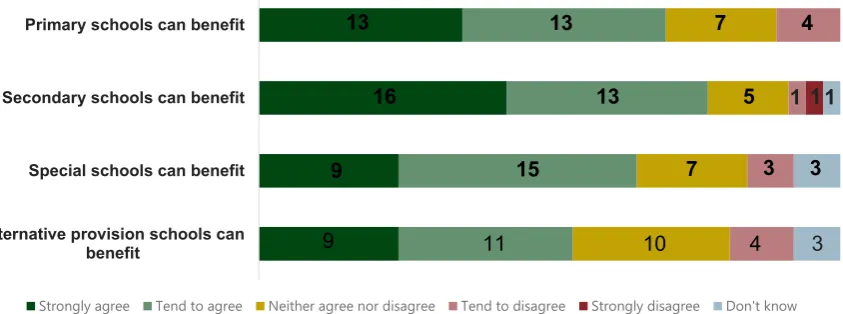
Figure 8: Understanding and ease of becoming an academy, and who can benefit – trusts
When asked for their top word associations with academies, the most commonly cited words among trusts without sponsor status were: ‘freedom’, ‘autonomy’, ‘independence’, ‘accountable’, and ‘finance’. These associations underpinned perceptions, attitudes, experiences and actions related to academies and were explored further during in-depth interviews and are synthesised below:
• Freedom: this word related positively to the new freedoms associated with trusts such as finance, but also negatively to the disappointment with the lack of
freedoms such as limited ability to move from the national curriculum in reality.
• Autonomy: likewise, despite there being positive feelings about not being
dependent on to the local authority, there was also a feeling or concern of loss of autonomy, especially with regard to joining a MAT.
I understand the current policy around academies
Trusts
20 12 3
1 1
It’s easy to become an academy
& Trusts
5
12
9
4
7
Strongly agree Tend to agree Neither agree nor disagree Tend to disagree Strongly disagree Don't know
Alternative provision schools can benefit
Special schools can benefit Secondary schools can benefit Primary schools can benefit
Strongly agree Tend to agree Neither agree nor disagree Tend to disagree Strongly disagree Don't know
13 13 7 4
16 13 5
9 15 7 3
9 11 10 4
3
Base: Academies & Trusts (37) Field work dates 7thFebruary – 31stMarch 2017 Source: Ipsos MORI
Who can benefit from becoming an academy?
3
29
• Independence: as with the pre-conversion interested in conversion group, this related to the positivity about being independent and autonomous from the local authority.
• Accountable: this feeling related to school leaders’ new roles with increased
financial and pupil outcomes accountability, a responsibility many were not used to from leading maintained schools. This also included referred to accountability for results of others in a partnership or in terms of sponsoring an underperforming school.
• Finance: financial freedoms and independence were regarded positively, such as the ability to achieve economies of scale. However, there was also a concern about being fully responsible for the schools’ finances – for example, with no financial safety net if finances went into the red.
Visions for growth
Trusts had a range of perceptions and attitudes relating to growth as a trust and growth by becoming a sponsor. These are outlined in detail below.
Sense of perspective
School leaders in this section could be divided into those who had a ‘growth’ perspective, were positive and keen to work with and support other schools by becoming a sponsor, and those who were ambivalent about growth or concerned about the negative effects that growth – either through increasing the number of schools in a MAT or sponsoring underperforming schools – could have on their school’s culture and pupils’ educational outcomes.
Those with a ‘growth’ perspective had a sense of altruism about potential growth by becoming an academy sponsor. These respondents shared a strong perception that it was their moral obligation to help and support other schools. They believed that all children deserve a good education and school leaders should use their school
improvement strategies to help others to reach their maximum potential. In contrast with those concerned about growth, these school leaders, often in more established SATs or MATs, did not feel that their own trusts would suffer from sponsoring an underperforming school. They viewed collaboration, especially with other schools in the trust, as mutually beneficial. Furthermore, alongside benefits to pupils, collaborating with or sponsoring another school was seen to create professional opportunities for staff who would be able to grow into future leaders, while retaining these within the trust.
30
Achieve high levels of attainment and offer something to others. (Primary, MAT, South London and South East England)
In contrast, other school leaders, especially in smaller academies with fewer (perceived) resources, felt that the pupils and educational outcomes of their own academies were the highest priority and felt that becoming a sponsor would compromise standards, especially based on the necessary capacity needed to do so. This included having enough
resources to put into another school, or having to take highly qualified or skilled teachers out of their own school to go to the sponsored school. The perception and concern about sponsorship taking the focus away from their own school was also reported to be held by both parents and governors. There was also an additional fear that their reputation would be at risk if they were unable to raise standards in a school of which they had become a sponsor8.
Importance of finding a good match
Whether choosing to join with another academy/other academies or sponsor a school, many school leaders in SATs and MATs perceived shared vision and ethos to be an important factor when working with others. They believed that partnering should not be based on head teachers’ personalities, but instead on what is right and suitable for the school. Also, as partnerships in MATs and sponsor arrangements are tight it was seen as vital to be in a MAT with or sponsor schools with the same attitudes and priorities rather than one with a different style. This is in line with the DfE Academy trust survey
(2017a:15-16) which found that a shared vision and ethos was the most commonly cited main reason for choosing to join a trust.
Some SAT school leaders were concerned about being part of a large, perceived as ‘soulless’, MAT and instead believed there needed to be common values unifying them. This was underpinned by a perceived ‘empire building’ strategy of some other trusts and sponsors, rather than having the pupils and educational outcomes as their guiding principles, making them wary of collaboration and feeling in competition instead.
We are very conscious that the environment is to become or join a MAT, don’t want to be the last standalone. But we need to be careful, want to share ethos, it's not about who your friends are, because friends will come and go but the MAT will stay. (Primary, SAT, South London and South East England)
8 Under the new short inspection model, sponsored schools are exempt from Ofsted inspection for three
31
Reasons to grow
School leaders interviewed as part of this group pointed to a range of reasons that would motivate them to grow – either in their current form as a trust without sponsor status or by becoming a sponsor – largely based on both internal and external outcomes and
[image:31.595.66.527.247.435.2]opportunities.
Figure 9: Motivations to grow / become a sponsor – trusts
One identified benefit of growth included joining with other outstanding schools who all have their own individual strengths. There was a sense of this providing opportunities to share good practice, learn from and support each other, while working with like-minded head teachers to make good decisions, for example about staffing or CPD. This was reflected in the descriptive online survey where collaboration with other schools was the most commonly selected reason to both sponsor and grow. The DfE Academy trust survey (2017a:9) supports this, having found that 96% of MATs believed the structure facilitated collaboration, and that a benefit was “school improvement, helping teachers and school-to-school support”. Similarly, some trusts were motivated by an altruistic outlook and wanting better educational outcomes for pupils in their own school and externally, with some mentioning a desire to impact their local area.
There is an opportunity for middle leaders to take more ownership by working together, and having more confidence when making decisions by
13
16-023063 Academies Customer Insight Workshop | Version 1 Internal And Client Use Only
Other Ability to procure own services Ability to provide wider provision (e.g. primary and
secondary phases working together) Financial benefits Ability to impact education system Better educational outcomes for pupils Professional development opportunities for staff Collaboration with other school/ academies with a
similar vision
Trust interested in sponsorship - motivations to become a sponsor
Trust without sponsor status - motvations for growing
Base: Trusts interested in sponsorship (13); Trust without sponsor status (21); Field work dates 7thFebruary – 31stMarch 2017
What are your most important motivations to grow / become a sponsor?
Source: Ipsos MORI
14/21 13/21
14/21
17/21
10/21
8/21
5/21
5/21
7/13
11/13
10/13
9/13
6/13
6/13 n/a
32
working with another head – for example going out to tender together. (Secondary, MAT, South West of England)
Altruism and impactgeographical area but only when own school has capacity to do so without standards dropping. (Primary, SAT, Lancashire and West Yorkshire)
Participants also explained that growth as a trust – either in their current form without sponsor status or as a sponsor – would create benefits and opportunities for staff in terms of Continuing Professional Development (CPD) and career progression. Indeed, this was a particularly important motivation to sponsor other schools as, often, staff were trained as future leaders to be able to take on senior roles in other schools within a MAT, sponsoring or setting up a new free school. This not only benefited staff but also schools by retaining teachers.
Opportunity for our leadership teams to step up for example as Associate Heads. That's how you grow your future leaders. Succession planning – I need to grow leaders to take over high level positions – training ground at sponsor school. Joint CPD, training, seeing your own systems in another setting would test them out. (Secondary, MAT, West Midlands)
More opportunities for our staff. From our point of view, we think it would give our staff amazing opportunities to develop further than they are at the minute. We know we’re doing a good job but to work with another school, you get so much back. (Primary SAT, South London and South East England).
Have a positive impact on the educational system. Academies allow system leaders to be the first voice at the front of education rather that to leave it to the people at local authority level. (Primary, MAT, South London and South East England)
Reasons not to grow
33
Figure 10: Barriers to grow / become a sponsor – trusts
Attitudinal and practical reasons for maintaining current size
Reasons for not growing as a trust or growing by becoming a sponsor could be broadly split into two themes: attitudinal reasons, where there was a fear of declining standards under expansion (especially when growing by becoming a sponsor); and practical reasons where there were physical elements stopping trusts from doing so.
Attitudinal reasons included not wanting to sponsor an underperforming school for fear of risking their own outcomes or reputation. Regarding sponsorship, some trusts were not willing to take responsibility of another school due to concern of not having the capacity to improve it while maintaining their own high standards. Furthermore, some participants associated (further) growth and sponsorship with an increased workload and having to run a ‘business’. They believed there to be more meetings and paperwork, something they felt they would not have the time or capacity to do, based on a shift they already experienced from becoming an academy compared with being a maintained school. Other respondents expressed the feeling that they would not be able to do justice to their sponsored academy.
To sponsor, I become responsible for their outcomes. I have to get them to be a better school, move to good or outstanding. [There is] pressure to do this. I don’t have the capacity. My school would suffer – taking my teachers out, I could manage this but not in the current unstable environment, there’s too much turnover. (Primary, SAT, South London and South East England)
14
16-023063 Academies Customer Insight Workshop | Version 1 Internal And Client Use Only
Other Lack of understanding about the trust/
sponsor system
Lack of support from governing bodies, members, trustees
No/ little benefit for staff No perceived need desire to grow
No/ little benefit for pupils Potential loss of trust culture Lack of suitable partner schools/ academies/
organisations
Potential loss of autonomy Lack of resources (e.g finances/ staff)
Trust without sponsor status - barriers to grow
Trust interested in sponsorship -barriers to become a sponsor
16/21
13/21
11/21
11/21
8/21
6/21
5/21
4/21
3/21
4/21
6/13
0/13
5/13
2/13
0/13
2/13
6/13
1/13
2/13
3/13
Base: Trusts interested in sponsorship (13); Trusts without sponsor status (21); Field work dates 7thFebruary – 31stMarch 2017
What are the barriers to growing / becoming a sponsor?
34
I am concerned about the capacity to improve another school without own suffering. That’s the difference between being a sponsor and growing as a MAT, it’s the reason we haven't [sponsored]. (Primary, SAT, Lancashire and West Yorkshire)
Practically, capacity was also mentioned as a significant reason not to grow or sponsor, especially in SATs. Many school leaders felt they did not have enough resources or staff to be able to sponsor a school and, therefore, did not feel to be in an appropriate position to do so.
Sponsoring was also felt to require a new skillset, both in terms of the running of the ‘business’ and being able to suitably support and nurture another school. In addition, lack of funding was a key concern. Participants noted the small funds they had available to them, and feared that this may reduce further in the future. They did not feel they had the capacity in terms of resources, financial stability, staff or skills to be able to successfully sponsor an underperforming school. This was highlighted in the descriptive survey where lack of resources was the most frequently selected barrier to sponsor and grow.
The skills needed to set up and run a MAT are quite different from the skills of the head teacher of a single school... Need for finance, capacity, training. (Secondary, SAT, North West London and South Central England)
At first we received 7% extra funding and this semester it will be 0% funding. We're being asked to do more for less money… We are now worse off financially than if we were a maintained school. (Secondary, SAT, North of England)
The need to find a suitable partner with a shared vision was also cited as a barrier to growth and sponsorship as many trusts felt they needed to have the same ethos and equal representation across their academies for partnerships and sponsorship
relationships to be successful. This could be particularly challenging between primary and secondary schools who often had different priorities and did not want to join a MAT where they felt their phase would be under-represented. There was also a concern among academy heads that growing would result in a loss of autonomy for them and their trust culture would be lost if joining with others. Moreover, geography plays a significant role, since many trusts did not want to join formal partnerships with schools outside their locality because of concerns over the practicalities and logistics involved. Participants also cited some confusion as to who should have responsibility for finding a suitable school to partner with or to sponsor.
35
partnerships with secondary schools and they are setting up MATs. (Secondary, SAT, East Midlands and Humber).
MAT vs SAT comparison
[image:35.595.93.504.335.521.2]With regard to outlook on the academies system, the descriptive survey showed that MATs tended to be more optimistic than SATs about the benefits of academies, with all respondents from MATs believing that both primary and secondary schools can benefit. Despite this, slightly more SATs agreed that they understand current policy around academies, but fewer agreed that it was easy to become an academy. This perception that the conversion process is not easy could potentially influence SATs’ decision not to grow further.
Figure 11: SAT vs MAT comparison of who can benefit from becoming an academy
However, despite having a different view of the academy system regarding ease of converting, understanding the system and who can benefit, in-depth interviews with school leaders in both SATs and MATs reported similar motivations and barriers to sponsor. Both their motivations were driven by the potential for collaboration and an altruistic vision to better pupils’ outcomes in their own and other local schools. They also both saw benefits for their staff, for example, with CPD. Furthermore, they shared a concern about capacity to sponsor and would require more financial support and incentives if they were to do so. While this study’s base sizes were not large enough to draw a direct comparison between SATs and MATs, the DfE Academy trust survey report found MATs’ main motivation for initially converting was opportunities for collaboration, while SATs’ motives focused on funding-related reasons (DfE 2017a:13).
Who can benefit from becoming an academy? SAT v MAT
It's easy to become an academy I understand current policy around academies Alternative provision schools can benefit
Special schools can benefit Secondary schools can benefit Primary schools can benefit
MAT SAT % Strongly agree / Tend to agree
Base: Single Academy Trusts (35), Multi Academy Trusts (22): Field work dates 7thFebruary – 31stMarch 2017 Source: Ipsos MORI 22/22
22/22
21/22
19/22
18/22
12/22
30/35 22/35
25/35
20/35
27/35
36