A Conceptual Model for
Compliant Management Systems
by
Leigh Howard de la Motte,
B.Comp. (Hons.), Grad. Cert. Commercialisation
A dissertation submitted in fulfilment of the requirements of the Degree of
Doctor of Philosophy
University of Tasmania
Declaration
I, Leigh de la Motte, declare that this dissertation contains no material which has been accepted for the award of any other degree or diploma in any tertiary institution. To my knowledge and belief, this dissertation contains no material previously published or written by another person except where due reference is made in the text of the dissertation.
This dissertation may be made available for loan and limited copying and communication in accordance with the Copyright Act 1968.
Signed,
Leigh de la Motte
Abstract
The dissertation specifies a Set of Concepts and a Conceptual Model for Compliant Management Systems (CMSs). The Set of Concepts is drawn from existing methodologies and the CMS Model, which is based on the Concepts, is evaluated against a compiled Set of Standard Requirements. The dissertation is analytical, conceptual and argumentative in nature.
The Model is designed to enable the future development of compliant, efficient and globally functional organisational Information Technology (IT) Systems. The Three Central Requirements of the Model – Compliance (essentially a Legal requirement),
Efficiency (essentially a Business Management requirement) and Global Functionality (essentially an IT requirement) – necessitated a multi-disciplinary investigation in the Legal, Business Management and IT areas.
Compliance was the focus of the research as initial investigations showed no significant solutions existed that provided specific guidelines for the design of inherently compliant IT systems. As compliance relates to meeting regulatory requirements on a local or jurisdictional basis, whereas efficiency and global functionality favour global standards for IT systems (that enable system interoperability), the means for delivering “globally compliant” IT systems is problematic. The research therefore took the approach of “thinking globally and acting locally” by designing a Model appropriate for individual local organisations that can be used, in association with the development of appropriate regulation, as a template for globally compliant IT systems.
It was found that the issues of Privacy, Consent, and Accountability were at the core of compliance requirements and that Digital Service Contracts with systematic Authorisation mechanisms for contract parties (represented as IT System “Groups”) provided the means for assuring compliance. The Model proposes software based on
Acknowledgements
The initial part of the research (about 75%) was supervised by the School of Computing and Information Systems. The remainder was supervised by the School of Law.
Special thanks go to my Supervisors – Jacky Hartnett, for her patience, time and advice on security and IT concepts, Prof Gino Dal Pont for his guidance in producing this dissertation and his advice on legal matters and Prof Young J. Choi for his oversight.
I would also like to thank all the health practitioners and administrators that have contributed ideas. Special thanks go to my wife, Heather, for her insights into hospital practices.
Table of Contents
Chapter 1
Introduction
... 11.1 Research Goals and Central Requirements ... 1
1.1.1 Limits of the Research ... 2
1.1.2 Ultimate Control and Compliance ... 3
1.2 The Research Disciplines ... 4
1.2.1 Disciplinary Dissertation Approaches ... 5
1.2.2 Use of Terminology ... 6
1.3 Background ... 7
1.3.1 Regulatory (Legal) Background ... 8
1.3.2 IT Background ... 9
1.3.3 Business Management Background ... 11
1.3.4 Existing Research Methodologies ... 12
1.4 CMS Definitions ... 15
1.4.1 Major CMS Terms ... 16
1.4.2 Definitions of Major CMS Terms ... 16
1.4.3 Organisational CMS Terms ... 18
1.4.4 Introducing the Seven General Concepts ... 19
1.5 Services ... 23
1.5.1 All-Encompassing Services ... 23
1.5.2 Standardized Service Parties ... 24
1.5.3 Standardized Service Processes ... 25
1.5.4 Commercial Service Aspects ... 26
1.5.5 Compliant Management System ... 27
1.5.6 Enabling Service Automation and Reuse ... 28
1.6 Groups ... 30
1.6.1 Groups used to Define and Manage Resources ... 30
1.6.2 Hierarchical Groups ... 32
1.6.4 Group Templates ... 34
1.6.5 Group Types and Sub-Types ... 34
1.6.6 Groups Associated with Services ... 35
1.7 Service Contracts ... 35
1.7.1 Organisation Based Contracts ... 36
1.7.2 Single-Service Contracts ... 36
1.7.3 Sub-Service Contracts ... 37
1.7.4 Generic Service Contracts ... 37
1.7.5 Digitally Managed Contracts ... 38
1.7.6 Digital Service Contracts Enabling Compliance ... 39
1.8 Compliance Concepts ... 40
1.8.1 Privacy ... 40
1.8.2 Consent ... 41
1.8.3 Accountability ... 42
1.8.4 Authorisation ... 43
1.9 Dissertation Structure ... 47
Chapter 2
Methodology
... 492.1 Introduction ... 49
2.1.1 Initial Aim of the Research ... 49
2.1.2 Background ... 50
2.1.3 The Aim of Developing a Comprehensive and Practical Model .. 50
2.1.4 A Research Voyage ... 51
2.2 Research Methodology ... 51
2.2.1 Examining Research Fields ... 53
2.2.2 Extracting Design Requirements ... 54
2.2.3 Finding Model Concepts ... 54
2.2.4 Developing the Model ... 55
2.2.5 The Validation Approach ... 56
2.3 Linking the General Concepts ... 58
2.3.1 Using Groups to Manage Authorisation and Consent ... 59
2.3.3 Linking Accountability and Privacy ... 60
2.3.4 Using Services to Manage Business Processes ... 60
2.3.5 Unifying the General Concepts with Service Contracts ... 61
2.4 Research Philosophy ... 61
2.4.1 Use Inductive Reasoning ... 61
2.4.2 Develop a Simple General Purpose Solution ... 62
2.4.3 Use Best Practice from Existing Solutions ... 63
2.4.4 Achieve Efficiency through Standardization ... 64
2.4.5 Incorporate Change Management ... 64
2.4.6 Adopt User-friendly Components ... 65
2.4.7 Automate Administration ... 66
2.5 Conclusion ... 67
Chapter 3
Literature Review
... 683.1 Introduction ... 68
3.2 Computer Security ... 69
3.2.1 Information Security Issues ... 69
3.2.2 Data Security Qualities ... 70
3.2.3 Information Ownership and Control ... 70
3.2.4 Authentication and Authorisation ... 72
3.2.5 Access Control Basics ... 73
3.2.6 The Principle of Least Privilege ... 74
3.2.7 Granularity ... 75
3.2.8 Computer Security Conclusion ... 75
3.3 Role-Based Access Control ... 75
3.3.1 Group Concept ... 77
3.3.2 Context Concept ... 78
3.3.3 Multiple Contexts ... 79
3.3.4 Constraint Concept ... 80
3.3.5 RBAC Conclusion ... 81
3.5 Clark-Wilson Model ... 83
3.5.1 Well Formed Transactions ... 83
3.5.2 The Clark-Wilson Model ... 84
3.6 Health Informatics ... 86
3.6.1 Cooperative Practices ... 86
3.6.2 Multiple Authorisations ... 87
3.6.3 Guaranteed Access ... 87
3.7 Professional Access Control ... 88
3.7.1 Professional Management ... 88
3.7.2 Service Teams ... 89
3.7.3 Restricted Access ... 89
3.7.4 Authorisation Timing ... 90
3.7.5 Authorisation Ordering ... 92
3.8 Purpose Based Access Control ... 92
3.8.1 Purpose Concept ... 92
3.9 Service Oriented Architecture ... 93
3.10 Cloud Computing ... 95
3.10.1 Inter-Domain Access ... 95
3.10.2 Inter-Domain Roles ... 96
3.10.3 Inter-Domain Rule Processing ... 97
3.11 Generic Programming ... 98
3.11.1 The Generic Nature of Services and Groups ... 98
3.11.2 User Perceptions of Service and Group Concepts ... 99
3.11.3 Generic Services and Groups ... 100
3.12 Business Process Management ... 101
3.12.1 Workflow Processes ... 101
3.12.2 Organisational Systems ... 102
3.12.3 Business Constraints and Workflow Management ... 103
3.12.4 Task Based Authorisation ... 104
3.12.5 Task Based Access ... 104
3.12.6 Standard Business Processes ... 105
3.13 Legal Compliance ... 106
3.13.2 Privacy Requirements ... 107
3.13.3 Client Consent ... 108
3.13.4 Legal Accountability ... 109
3.13.5 Service Contracts ... 111
3.14 Design Requirements Table ... 113
3.15 Conclusion ... 115
Chapter 4
Model Concepts
... 1164.1 Introduction ... 116
4.2 Model Concepts Relationship Diagram ... 116
4.3 Services ... 118
4.3.1 C#1: Global Services ... 118
4.3.2 C#2: Service Based Organisation ... 119
4.3.3 C#3: Serviceflow Dependencies ... 119
4.3.4 C#4: Service Cells ... 120
4.3.5 C#5: Client-Services ... 121
4.3.6 C#6: Service Profiles ... 121
4.3.7 C#7: Service Based Information ... 122
4.3.8 C#8: Client-Service Management ... 122
4.3.9 C#9: Service Based Security ... 122
4.4 Groups ... 123
4.4.1 C#10: Service Teams ... 123
4.4.2 C#11: Contextual Groups ... 124
4.4.3 C#12: Group Based Organisation ... 125
4.4.4 C#13: Group Based Access ... 126
4.4.5 C#14: Global Groups ... 127
4.4.6 C#15: Global Group Addressing ... 128
4.4.7 C#16: Group Based Services ... 128
4.4.8 C#17: Group Based Information Storage ... 129
4.4.9 C#18: Set Based Groups ... 130
4.5 Service Contracts ... 133
4.5.1 C#21: Compulsory Compliance ... 133
4.5.2 C#22: Compliant System ... 133
4.5.3 C#23: Worker-Service Contracts ... 134
4.5.4 C#24: Client-Service Contracts ... 135
4.5.5 C#25: Contract Based Services ... 135
4.5.6 C#26: Validation by Authorisation ... 136
4.6 Privacy ... 137
4.6.1 C#27: The “5 Ws” of Access Control ... 137
4.6.2 C#28: Service Based Purpose ... 137
4.6.3 C#29: Service Based Access Principle ... 138
4.6.4 C#30: Service Based Privacy ... 138
4.6.5 C#31: Access by Authorisation ... 139
4.7 Consent ... 140
4.7.1 C#32: Consent Type Specification ... 140
4.7.2 C#33: Service Based Consent ... 141
4.7.3 C#34: Bundled Client Consent ... 141
4.7.4 C#35: Implied Permissions ... 141
4.7.5 C#36: Consent by Authorisation ... 142
4.7.6 C#37: Service Based Information Provision ... 142
4.8 Accountability ... 143
4.8.1 C#38: Service Based Accountability ... 143
4.8.2 C#39: Client-Service Accounting ... 144
4.8.3 C#40: Required Auditing ... 144
4.8.4 C#41: Client-Service Records ... 144
4.8.5 C#42: Service Based Auditing ... 145
4.9 Authorisation ... 145
4.9.1 C#43: Mandatory Authorisation ... 145
4.9.2 C#44: Authorisation Type Specification ... 146
4.9.3 C#45: Managerial Authorisation ... 146
4.9.4 C#46: Client-Service Allocation ... 147
4.9.5 C#47: Worker Acceptance ... 148
4.9.7 C#49: Client Authorisation ... 150
4.9.8 C#50: Service Based Authorisation ... 151
4.9.9 C#51: Sub-Service Authorisation ... 151
4.9.10 C#52: Authorisation Management ... 152
4.10 Model Concepts Table ... 152
4.11 Conclusion ... 154
Chapter 5
Model Description
... 1555.1 Introduction ... 155
5.2 Incorporating Model Concepts ... 155
5.2.1 Foundational Model Concepts ... 156
5.2.2 Model Design Concepts ... 157
5.3 Model Components ... 158
5.3.1 Component Relationships ... 158
5.3.2 Organisation Composition ... 159
5.3.3 Component Origin ... 160
5.3.4 Component Instances ... 162
5.4 The Compliant Management System ... 163
5.4.1 CMS Programs and Data ... 165
5.4.2 Global Data Storage ... 169
5.4.3 A Global Access System example ... 170
5.4.4 Managing Components ... 172
5.5 Service Management ... 173
5.5.1 The Service Management Process ... 175
5.5.2 High Level Service Management ... 176
5.5.3 Management of Personal Work ... 177
5.6 Group Management ... 178
5.6.1 Group Management Services ... 179
5.7 Contract Management ... 180
5.7.1 Service Authorisations ... 181
5.9 Table of Model Concept Mechanisms ... 186
5.10 Conclusion ... 189
Chapter 6
Analytical Evaluation
... 1906.1 Introduction ... 190
6.1.1 The Standard Requirement Set ... 190
6.1.2 Model Evaluation ... 190
6.2 Purpose Related Standards ... 192
6.2.1 SR#1: Purpose & Correctness ... 192
6.2.2 SR#2: Need to Know Access ... 192
6.2.3 SR#3: Intellectual Property ... 193
6.3 Service/Task Related Standards ... 193
6.3.1 SR#4: Critical Protection ... 193
6.3.2 SR#5: Security Integration ... 193
6.3.3 SR#6: Service Based Access ... 194
6.4 Consent Practice Standards ... 194
6.4.1 SR#7: Data Collection ... 194
6.4.2 SR#8: Consent for Purpose ... 195
6.4.3 SR#9: Consent Judgment ... 195
6.4.4 SR#10: Consent Collection ... 196
6.5 Client Rights Standards ... 196
6.5.1 SR#11: Client Access ... 196
6.5.2 SR#12: Accessor Information ... 197
6.5.3 SR#13: Disclosure Account ... 197
6.5.4 SR#14: Restriction ... 197
6.5.5 SR#15: Complaint & Appeal ... 198
6.5.6 SR#16: Information Provision Process ... 198
6.6 Organisation Rights Standards ... 199
6.6.1 SR#17: Directory Data ... 199
6.6.2 SR#18: De-Identified Data ... 199
6.6.3 SR#19: Restriction Refusal ... 200
6.7 Access Rules Standards ... 200
6.7.1 SR#21: Sensitive Information ... 200
6.7.2 SR#22: Relevant Disclosures ... 201
6.7.3 SR#23: Basic Disclosures ... 201
6.7.4 SR#24: Emergency Access ... 202
6.7.5 SR#25: Event Based Disclosure ... 202
6.7.6 SR#26: Victim Disclosure ... 202
6.7.7 SR#27: Regulated Disclosure ... 203
6.8 Authorisation Standards ... 204
6.8.1 SR#28: Authorisation ... 204
6.8.2 SR#29: Role Based ... 204
6.8.3 SR#30: Validation ... 205
6.8.4 SR#31: Written Authorisation ... 205
6.8.5 SR#32: Information Flow ... 206
6.8.6 SR#33: Transaction ... 206
6.8.7 SR#34: Inter-Domain Authorisation ... 207
6.9 Compliance Practices Standards ... 207
6.9.1 SR#35: Openness & Accountability ... 207
6.9.2 SR#36: Compliance ... 208
6.9.3 SR#37: Risk Management ... 208
6.9.4 SR#38: Security Responsibility ... 209
6.9.5 SR#39: Skills & Qualifications ... 209
6.9.6 SR#40: User Account ... 210
6.9.7 SR#41: Privacy Personnel ... 210
6.9.8 SR#42: Data Correction ... 210
6.10 Information Provision Standards ... 211
6.10.1 SR#43: Information Provision ... 211
6.10.2 SR#44: Disclosure Account Data ... 211
6.10.3 SR#45: Staff Reminder ... 212
6.11 Monitoring/Auditing/Reporting Standards ... 212
6.11.1 SR#46: Activity Monitoring ... 212
6.11.2 SR#47: Security Auditing ... 213
6.11.4 SR#49: Incident Management ... 213
6.11.5 SR#50: Required Documentation ... 214
6.12 Model Rating Table ... 214
6.13 Conclusion ... 216
Chapter 7
Results and Discussion
... 2187.1 Introduction ... 218
7.1.1 Incorporating the Old and the New ... 219
7.1.2 Tradition and Future Possibilities ... 220
7.1.3 Towards Automated Business Management ... 221
7.1.4 Results and Discussion Topics ... 222
7.2 Contributions of the Research ... 222
7.2.1 Model Concept Set and New Concepts ... 222
7.2.2 The Model ... 230
7.2.3 The Standard Requirements ... 231
7.3 Analysis of the Model ... 231
7.3.1 Model Validation ... 231
7.3.2 Comparison with Current Methodologies ... 232
7.3.3 Limitations of the Model ... 239
7.4 Application of the Model ... 241
7.4.1 Regulatory Compliance ... 241
7.4.2 Business Efficiency ... 250
7.4.3 Global Functionality ... 255
7.5 Future Work ... 259
7.5.1 Compliant Management System ... 259
7.5.2 Service Based Regulation ... 260
7.5.3 Privacy of Personal Records ... 260
7.5.4 Business Web ... 260
7.5.5 Web of Identities ... 260
7.5.6 Supply Chain Management ... 261
7.5.7 Component Repositories ... 261
List of Figures
Figure 1: Aims of the Research ... 1
Figure 2: CMS Operations ... 18
Figure 3: Model Concepts ... 20
Figure 4: A Service Based Organisation ... 23
Figure 5: Basic Organisational Concept ... 24
Figure 6: A Service and its Sub-Components ... 26
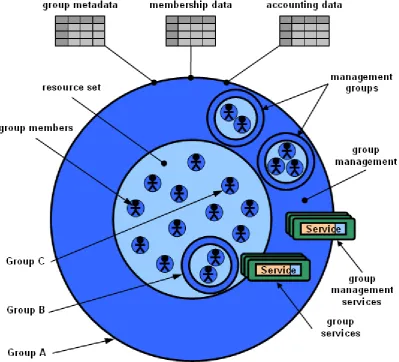
Figure 7: A Personnel Group and its Sub-Components ... 32
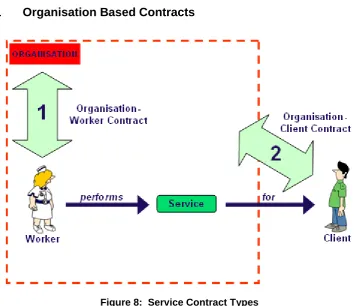
Figure 8: Service Contract Types ... 36
Figure 9: Research Fields and Methodologies ... 51
Figure 10: Basic Research Methodology ... 52
Figure 11: Research Methodology in Practice ... 52
Figure 12: Initial General Concepts ... 58
Figure 13: Utilising Groups ... 59
Figure 14: Linking Privacy ... 59
Figure 15: Linking Accountability ... 60
Figure 16: Utilising Services ... 60
Figure 17: Unifying the General Concepts with Service Contracts ... 61
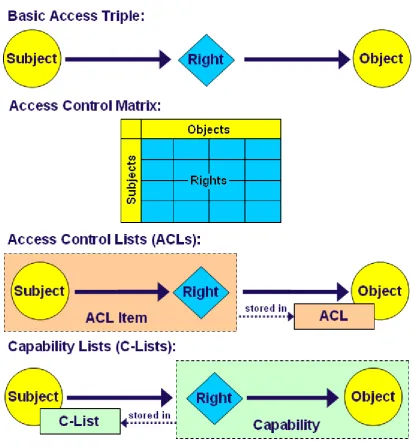
Figure 18: Access Control Matrix, ACLs and C-Lists ... 74
Figure 19: Role-Based Access Control ... 76
Figure 20: Critical Factors Analysis of the OASIS SOA Reference Architecture .... 94
Figure 21: Components of a Workflow (Russell et al. 2005) ... 101
Figure 22: Model Concepts Relationship Diagram ... 117
Figure 23: Group Based Organisation Example ... 126
Figure 24: Group Based Information Storage Example ... 130
Figure 25: Set Operations ... 131
Figure 26: Service Based Privacy ... 139
Figure 27: Key Terms for Managerial Service Offers ... 148
Figure 28: Key Terms for Worker Acceptance of Services ... 149
Figure 29: Key Terms for Client Acceptance of Services ... 150
Figure 30: Service Based Authorisation ... 151
Figure 32: Basic Model Component Relationships ... 158
Figure 33: Organisation Components ... 159
Figure 34: Component Hierarchies ... 161
Figure 35: CMS Operating System (CMSOS) ... 164
Figure 36: CMS Service Process ... 166
Figure 37: CMS Contents ... 167
Figure 38: Data and Component Relationships ... 168
Figure 39: Global Search and Authorisation Example ... 171
Figure 40: Service Management Process ... 174
Figure 41: Sub-Group and Management Group Relationships ... 179
Figure 42: Client-Service Example ... 184
Figure 43: Webs and Clouds ... 249
Figure 44: Access Control Model Comparisons ... 252
List of Tables
Table 1: Design Requirements ... 114Table 2: Model Concepts ... 153
Table 3: Model Mechanisms ... 188
Chapter 1
Introduction
1.1
Research Goals and Central Requirements
[image:19.595.180.493.405.456.2]The primary aim of this dissertation is to describe specific concepts that enable the development of organisational IT systems that are compliant in legal terms, efficient in management terms and globally functional in IT terms. Its secondary aim is to define and examine a conceptual model built on these concepts. A future aim is to develop a software system based on the conceptual model.
Figure 1: Aims of the Research
A total of 52 specific concepts, hereafter termed Model Concepts or Concepts, are described in the dissertation. The Model Concepts are sub-divided into seven groups, each based on one of the Seven General Concepts (the General Concepts) of
Services, Groups, Service Contracts (Digital Service Contracts or Contracts),
Privacy, Consent, Authorisation, and Accountability. A major part of the research involved defining these General Concepts and their interrelationships.1
The conceptual model is called the Compliant Management System Model (the CMS Model or the Model). The purpose of the Model is to describe the components and mechanisms that are necessary in a software system that meets Compliance,
Efficiency and Global Functionality requirements. These three requirements (Compliance, Efficiency and Global Functionality) are hereafter termed the Three
Central Requirements (or the Central Requirements) of the research. A software system that is designed to meet the requirements of the Model is hereafter termed a
Compliant Management System (CMS), IT System or System (note the capitalised ‘S’).
Compliance (the First Central Requirement), the most basic requirement, refers to ensuring that an Organisation employing a CMS functions in a compliant fashion, that is, in accordance with relevant Regulations. Efficiency (the Second Central Requirement) refers to the CMS enabling the Organisation to run in an efficient fashion. Since the system to be developed is an IT system that must be interoperable with other systems, the CMS requires Global Functionality (the Third Central Requirement). While Efficiency and Global Functionality are considered equally important, the research focusses primarily on Compliance as an existing scalable solution in the area was lacking. The Central Requirements are defined more fully at 1.4.2.
The Model fundamentally proposes that Digital Service Contracts(DSCs) be used as the instrument for achieving Organisational Compliance, and that systematic Authorisation mechanisms for Contract parties (Managers, Workers and Clients) provide the means for assuring that the Contractual obligations of Organisations are met.
1.1.1 Limits of the Research
It was initially intended that a live CMS system would be tested in a hospital environment, but this proved problematic due to the scale of the test required and the available resources. This, together with the need for efficiency and global functionality, prompted the search for a broader, more generic solution. The research therefore does not seek to prove itself directly applicable to any specific set of organisational situations.
Neither does the research specify any specific form for Digital Service Contracts. It only provides the IT System mechanisms necessary for their development and management. It avoids reference to specific laws, rules and regulations, as compliance within specific jurisdictions or organisational environments does not lie at the core of the significance of the Model.
The dissertation is conceptual in that it seeks to highlight, associate and draw together Concepts from the three research disciplines in preference to detailing solutions to specific problems in any one of the disciplines. Consequently, some existing methodologies may have been rejected or not considered due to their incompatibility with other aspects of the Model rather than their individual merit. The dissertation is analytical and argumentative in its approach to dealing with the relevance of existing methodologies and comparisons with the functionalities of the proposed CMS Model. The analysis, particularly with regard to evaluation of the Model, is qualitative rather than quantitative, as scientific testing of a particular solution was not the aim. Mathematical analysis of aspects of the Model was not considered feasible due to the available expertise or of sufficient value compared to the analytical evaluation method used.
Finally, it was not the aim to specify particular Business Process Management or Service Oriented Architecture methodologies within the Model, as this is considered a part of future work in the design of CMS software.
1.1.2 Ultimate Control and Compliance
One of the reasons for using IT is to automate manual tasks with a view to making life easier and/or safer. For example, IT can be used to control the temperature in a room. The nature of such automation is that decisions previously controlled by humans are controlled, or at least potentially controlled, by IT Systems.
Consider the issue of controlling an airliner. Flight crew have the option of engaging or disengaging the auto-pilot. However, the auto-pilot could potentially decide whether or not it should be in control and only allow the crew to pilot the plane when it decides it is warranted. This may indeed be preferable if and when it becomes evident that auto-pilots are safer than human pilots, especially considering that a human pilot can be incapacitated or be a suicidal terrorist.
An ultimate example of automation is a domestic robot that is capable of killing a human being. The question this dissertation asks is whether or not such automation should be designed in compliance with appropriate regulation. The dissertation does not argue whether or not ultimate control should be given to IT Systems; it argues that automated systems should be proven to be compliant before ultimate control is surrendered to them.
This research focuses on IT-controlled business systems where the IT system runs the businessin a compliant manner. This is an extension of Business Management expert Michael Gerber’s (Gerber 1995, pp. 91-92) observation that in franchised businesses “[t]he system runs the business. The people run the system…”. Such an IT system is not merely a tool used by persons, it exerts a high level of automated control where manual overriding is the exception rather than the rule.
1.2
The Research Disciplines
Each of the Three Central Requirements has a particular dimension. The Model must enable a CMS that is complaint in a legal sense, efficient (and thus commercially attractive) in a business management sense and globally functional in an IT sense. To build globally functional software that is efficient and compliant it is necessary to not only understand Information Technology (IT) design requirements but Legal and Business Management requirements as well. The research cannot therefore avoid some multi-disciplinary slant.
number of sub-disciplines were studied. Details of these studies are found in Chapters 2 and 3.
The first three General Concepts each have their basis in one of the Three Research Disciplines. Services relate to Business Management, Groups relate to Information Technology Management and Service Contracts relate to Law. The Model therefore is strongly influenced by each of the Research Disciplines.
1.2.1 Disciplinary Dissertation Approaches
In each of the three Research Disciplines there are “standard” approaches to writing and structuring dissertations. There are, unsurprisingly, some inconsistencies between these standard approaches.
IT dissertations tend to take either an “Information Systems Approach” that uses case studies or a “Computer Science Approach” where software is written and tested. Each tends to proffer a hypothesis that is subject to some quantitative test and/or analysis.
A scientific approach places no credence on commercial viability or success. This conflicts with “Business Management Approaches” that are concerned with methodologies that have been shown to be efficient or successful.
Similarly, a “Legal Approach” tends to view organisational compliance as the responsibility of organisational executives (managers). It is not generally, or at least overly, concerned about system designs or standard business practices.
As this dissertation crosses the three Research Disciplines, the approach adopted needs to be somewhat unique. The chosen approach is analytical in that it studies existing methodologies and issues in each of the Research Disciplines, conceptual in that it focuses on developing ideas that are applicable in each discipline, and
1.2.2 Use of Terminology
As the research is multi-disciplinary there is a need to clearly define the terminology used in this dissertation. CMS Terminology is the term used to describe the complete collection of terms defined in the dissertation. The major CMS Terms are defined in 1.4.2 and in the Model Concepts Chapter (Chapter 4), while others are defined as they appear in the text. The complete collection is contained in the Glossary.2
1.2.2.1 The Use of Italics and Capitalisation for CMS Terminology
Italics are use for two purposes in this dissertation – for CMS Terminology and for general emphasis. The initial occurrence(s) of each CMS Term in the dissertation is highlighted in first letter capitalised italics. Some non-CMS Terms also appear in
italics to highlight the particular words (as in this paragraph). These terms can be distinguished by their being in lower case and by their absence in the Glossary. After their first appearance, most CMS Terms appear first letter capitalised (for example, CMS Terms). This distinguishes them from the general usage of words. For example, the words “service” and “system” are used to describe any service or system whereas the words Service and System refer to a CMS Service and a CMS System respectively.
1.2.2.2 References to System Functionalities and Mechanisms
Any number of different CMSs may be developed from the CMS Model. However, when the functionalities or mechanisms of a CMS are discussed, the dissertation targets the singular terms; the CMS, the IT System or the System to distinguish what the System does from what other non-CMS systems do or what the users do. For example, the System uses Digital Service Contracts or the Manager sends an Authorisation Request to the System.
1.2.2.3 References to Components
Model. Furthermore, Model Components can be described at different levels, as a “bowl of chicken soup” can be described at different levels in a restaurant. The soup is an “entrée” (a type), a “recipe” (a template) and a particular “dish” (an instance) served to a particular customer.
At the highest level, there are three types of Components in the Model – Services, Groups and Service Contracts – hence the dissertation speaks of Service Components, Group Components and Contract Components. At the second level each particular Service, Group or Contract Component is a template for Component instances (the third Component level) – hence the dissertation speaks of Services in terms of the items offered by an organisation and Client-Services as individual instances of particular Services.
As the software Components in the Model mirror real world Services, Groups and Contracts, there are three levels of software Components. There are Service, Group and Contract software Component Types; Service, Group and Contract software
Component Templates; and Service, Group and Contract software Component Instances.
Components are all hierarchical in that Components can be Sub-Components of higher level Components. There are three types of Sub-Components – Sub-Services,
Sub-Groups and Sub-Contracts.
1.2.2.4 References to Contracts
As mentioned previously, CMS Systems use Contracts called Digitally Service Contracts (DSCs). The CMS Terms, Digital Service Contract, Service Contract,
Contract, Generic Service Contract and Digitally Managed Contract all refer to a “CMS Service Contract” and are used interchangeably throughout the dissertation according to the context.
1.3
Background
management processes. An organisational CMS is an IT system. It could also be described as a “service-based system”, a “business system”, a “business management system”, or a “generic business system”, but for consistency it will normally be termed the “CMS” or the “System”.3
The following subsections give some basic background information in each of the Three Research Disciplines. The main purpose is to provide background to readers who are unfamiliar with aspects of these Disciplines.
1.3.1 Regulatory (Legal) Background
The Central Requirement of Compliance directed the research into the study of relevant regulation. This background information relates to ways to attain regulatory compliance.
Regulations are developed in order to set levels of practice and to provide some form of standardisation. The issue of compliance relates to how well an entity conforms to regulation. Two fundamental approaches are used to encourage compliance – “penalisation” and “compulsion”. Penalisation has to do with checking for non-compliance and applying penalties to those not complying. Compulsion has to do with requiring that only technology or practices that inherently comply can be used. For example, there are two ways of govern compliance with speed limits. A penalisation based approach involves issuing fines to drivers who do not comply with speed limits. A compulsion based approach could involve only registering vehicles that are fitted with speed limiters.
that is inherently compliant. The Model proposes such a system, one based on
Generic Service Contracts (see 1.7.4).
Regulation may be considered effective if rates of non-compliance are low. Non-compliance can often stem from the “Cost of Compliance”, namely the need for responses from business, which carry both a time and financial cost. There may also be a “Cost of Non-Compliance”, which can be estimated according to the “Probability of Penalisation” multiplied by the “Cost of Penalisation”. Where the Cost of Non-Compliance is similar to or less than the Cost of Compliance, there is little incentive for businesses to comply in practice. Levels of compliance will, in these instances, tend to be lower. This is analogous with drivers choosing to speed in places where they perceive there is little risk of being penalised.
To achieve high Rates of Compliance, it is necessary to minimise the Cost of Compliance. One of the fundamental ways of reducing compliance costs is to provide systems that are inherently compliant. Such systems are suitable for a diversity of organisations thereby reducing costs due to economies of scale. The Model proposes a System that is a generic business system.
1.3.2 IT Background
This background information relates to the ability of computers (and IT systems)4 to provide generic business systems that automate tasks and reuse stored information. Computers fundamentally operate by processing data. They contain two fundamental electronic components: a processor and a memory. The processor performs a series of logical operations which are stored in memory as computer programs. In other words, the program provides the processor with a series of logical operations for it to do. Each operation generally involves the input of data from the memory and the output of resultant data to the memory. If a computer program can be likened to a cake recipe, then a single computer process is one execution of the program as the making of a single cake is one execution of the cake recipe. Each execution of a program thus spawns a new process in the processor.
The reason computers are useful to humans is that they can perform complex processes quickly and accurately, and can store and transmit large amounts of information. The challenge for IT system designers has always been how to utilise these “machine world” characteristics to gain “real world” advantages. To interact with the real world, computers are connected to input and output devices. Input devices either receive direct user input or automatically monitor real world conditions. Output devices can provide feedback to users or be automatically controlled to perform real world actions.
IT systems (utilising computers) are useful to business because they can provide efficiency gains. These gains are fundamentally due to the automation of repetitive business processes and the reuse of stored information. For example, an IT system may utilise a program that issues a reminder notice to clients when their accounts become overdue. Given the necessary information, the IT system can automatically check the accounts and issue the reminders. The reminders can simply reuse a standard letter with customised client information. IT systems can thus make quantitative decisions based on stored data values. They can also generate new data by processing existing stored information. The Model proposes using a service-based IT system that utilises automation and reuse benefits.
organisations that each use Microsoft Word can share Microsoft Word documents. The Model proposes an IT-based generic business system composed of generic programs.
Advances in technology have enabled computers to be linked together to form computer networks. Networks vary in size from local area networks in homes, through to organisational networks, up to the internet, which is a global network. Many nonetheless view computers in terms of their own experience with Personal Computers (PCs). With PCs all the essential components are in front of the user; everything is located locally. There is a box containing the processor and the memory with a few input devices (for example, keyboard, mouse and dvd player) and output devices (for example, monitor and printer) attached. The software is all stored in the memory and the processor performs all the computing. This view is very limited, as networking technology enables the use both hardware and software components which can be located remotely (as well as locally). The Model advocates the use of both local and remote components.5
1.3.3 Business Management Background
This background information relates to the ability of an IT-based business management system to provide efficiency gains.
Business Management expert Michael Gerber (Gerber 1995, pp. 91-92) makes the point that in franchised businesses “[t]he system runs the business. The people run the system… The system integrates all the elements required to make a business work”. This dissertation argues that “the system” which runs the business6 can be an IT system and that this ultimately means that “the IT system runs the business”. It is analogous to an IT system piloting a plane or controlling a spacecraft. Persons still
5 The Model assumes that any component can be remote which means it deals with all possibilities. 6 While the dissertation uses the terms “Business” and “Business Management”, the research also
run the IT system and can override it where necessary. The IT system simply performs the mundane management tasks in a prescribed manner.
An IT-based business management system offers two main efficiency benefits. First, internal business management tasks can be automated and require fewer personnel for management tasks. Secondly, external e-business methods can be utilised more directly to increase online enquiries and purchases. This dissertation aims to provide insights into how to leverage internal and external benefits by utilising the proposed IT-based business management system.
Compliance costs are also a business management issue. The proposed IT-based business management system offers the opportunity to build compliance into the System. The System uses normal business process actions to automatically trigger compliance-related actions. For example, the allocation of a patient to a nurse in a hospital System triggers the provision of access permissions for the nurse to access the patient’s private medical record. The automation of such compliance-related actions provides efficiency gains that effectively reduce compliance costs.
1.3.4 Existing Research Methodologies
The following provides a brief overview of the major existing research methodologies that have influenced the development of the Model, namely Business Process management, Service Oriented Architecture, Role Based Access Control, Generic Programming and Cloud Computing.
1.3.4.1 Business Process Management and Service Oriented Architecture
Both fields are having an impact in the commercial world. In particular, the largest business software company in the world, SAP, bases its technology on SOA. However, SAP solutions are mainly aimed at large enterprises and do not at present scale down well for Small to Medium Enterprises (SMEs).
The Model utilises a service-based approach that is similar to that used in SOA. BPM functionalities are incorporated in the proposed System.
1.3.4.2 Role Based Access Control
Another relevant field of research, within the broader field of Computer Security, is that of Access Control. Access Control is fundamentally concerned with “who has access to what” in an IT system – the “who” being a user (or “subject”) and the “what” a file (or “object”). Role Based Access Control (RBAC) is the arguably the most relevant Access Control Model employed in current IT systems. The fundamental RBAC characteristic is to grant access to users on the basis of group membership where groups represent organisational “roles”. The major drawback to RBAC is inefficiency, as systems using it properly require considerable work to administer where, as is the norm, there are large numbers of users and roles.
The Model utilises a “Group” concept (see 1.6) to manage resources. By incorporating Groups into the service-based approach the objective is to overcome the inefficiencies of RBAC.
1.3.4.3 Generic Programming
There are other, more hidden, advantages that generic programs tend to possess. These have to do with the ability to build security features into the programs and the ability to ensure regulatory compliance. It is generally only when a program becomes broadly used that it is economically feasible to build these complex features into programs.
The Model proposes that generic programs be utilised. These programs form the proposed IT-based business management System.
1.3.4.4 Cloud Computing
The “Cloud Computing” paradigm is based on the idea that the components in the “cloud” are unknown or not visible to the user. Accepting that the term “cloud computing” is somewhat vague, the following definition, from the US National Institute of Standards and Technology (NIST), is useful:
Cloud Computing is a model for enabling convenient, on-demand network access to a shared pool of configurable computing resources (e.g., networks, servers, storage, applications, and services) that can be rapidly provisioned and released with minimal management effort or service provider interaction. This cloud model promotes availability and is composed of five essential characteristics, three service models, and four deployment models.
The three service models mentioned in the definition are “Cloud Software as a Service” (SaaS), “Cloud Platform as a Service” (PaaS) and “Cloud Infrastructure as a Service” (IaaS). The idea of services being located within the cloud is evident. Indeed, there are manifold commonalities between the Cloud Computing and Service Oriented Architecture paradigms.
to be imported from remote locations. Groups are designed to represent global entities.
Considerable technical work has been done to enable Cloud Computing systems to be functional. Indeed, the proportion of computing devices7 that are connected to networks is increasing; most are now designed to be “connected”.
While this increased connectivity has obvious benefits, it has generated many business management, security and legal issues. For example, when a customer uses a service that is offered by one organisation and components of the service are provided by any number of unknown (at least to the customer) remote organisations, legal concerns arise. The organisation offering the service may itself be remote from the customer. In a Cloud Computing environment it will often be the case that the only sense in which a service belongs to an organisation is in the legal sense. The Model seeks to address these legal concerns by incorporating a generic legal contract, which it terms the Service Contract (see 1.7), with every Service. And the Model utilises generic Services (see 1.5.3) and global Groups (see 1.6.3) to deal with the business management and security issues.
1.4
CMS Definitions
Different terms are used in the Research Disciplines. As the dissertation is written for readers in each discipline, it is important to be clear regarding terminology. Jargon from a particular discipline may confuse those outside the discipline. CMS Terminology is the set of CMS Terms used in the dissertation. It seeks to be understandable to persons in all three disciplines.
The main purpose of CMS Terminology is to describe the Model. While most of the terms were developed for the sake of the Model, they seek to represent the nature of the relationships in a practical way. In other words, they are designed to be understandable for persons in the workplace. This aligns with the philosophy that
the Model will be easier to administer if users can understand it, at least to the degree needed to perform their jobs efficiently.
1.4.1 Major CMS Terms
Major CMS Terms include Organisation, Regulation (fundamental CMS Terms) Compliance, Efficiency, Global Functionality (the three Central Requirements), Service, Group, Service Contract (the three Component Concepts), Privacy, Consent, Accountability, Authorisation (the four Compliance Concepts), Manager, Worker, Client (the three Service Contract parties) and the names of the Model Concepts.
1.4.2 Definitions of Major CMS Terms
An Organisation is an organisation that employs a CMS.
Regulation refers to any rule that is externally imposed on an Organisation with which it is required to comply.
Compliance means the fulfilment by Organisations of all the requirements of applicable Regulations.
Efficiency refers to Organisations functioning with lower administrative overheads and/or greater commercial viability than current methods or systems generally allow.
Global Functionality refers to CMSs being functional in processing terms (for example, processing speed) and interoperable with other relevant systems on the Internet.
Services are templates for standard business process tasks in Organisations, with each Client-Service instance being managed by the IT System.
A Service Contract is a digital Service agreement that enables Organisational Compliance by fulfilling Privacy, Consent and Accountability Regulations and CMS Authorisation requirements.
Client Privacy is enabled by restricting access to information to that which is necessary for the Client-Service being provided.
Client Consent is incorporated into Service Contracts and managed in Service processes.
Accountability relates to meeting accounting-related Regulations through the use of appropriate Service Contracts and Service Delivery processes.
Authorisation mechanisms are the means by which Service Contract offers and acceptances are entered into the IT System during Service allocation and delivery processes.
A Manager is the Organisational representative having the authority to make Service-based decisions on behalf of the Organisation.
A Worker is an Organisational representative or sub-contractor who delivers Organisational Services to Clients on behalf of the Organisation.
A Client is the recipient of Organisational Services and is external to the Organisation unless the Service is an Internal Service.
1.4.3 Organisational CMS Terms
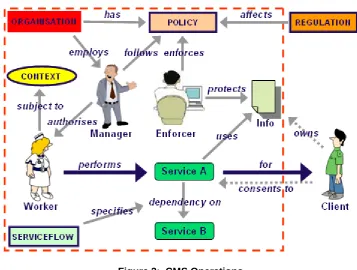
Figure 2: CMS Operations
Figure 2 displays the “Organisational CMS Terms” pictorially. These terms are used throughout the dissertation to describe the operational aspects of the CMS System. The diagram is important because it summarises the operational relationships between the major Organisational entities and resources. It is “Service oriented” since Services are “exposed” and represent the operational work of the Organisation – Groups and Service Contracts come into play as part of Service Delivery. An explanation of the diagram follows, with CMS Terms first letter capitalised and “relational” terms in bold.
The Organisation is represented by the dashed red rectangle. The Organisation has a
Policy it maintains and follows. Regulations specified by external bodies affect the Policy. The Organisation has Serviceflows that specify business processes that are consistent with the Policy.
Organisation and is charged with making decisions on behalf of the Organisation. He or she must follow the Organisation’s Policy. The decisions the Manager makes relate to Authorising the work that the Organisation does. More specifically, the Manager Authorises a Worker to perform a Service for a Client. When a Service is performed for a Client, this is one instance of Service Delivery known as a Client-Service. The details of Service Delivery are contained in the Service Description that forms part of the Service Contract.
The Authorisation is subject to Context. Context specifiesconditions such as role, time or location. Groups are used in the Model to specify Context. Performance of the Service also requires the Consent of the Client. In order to perform the Service, information relating to the client is required and/or generated. In this sense, Client-Services use Info (Service Information). Clients have a form of ownership of their Info, that is, their Personally Identifiable Data (PID). The Organisation is required to
protect the Privacy of this Info and to maintain accurate Service records for Accountability purposes. The performance of one Service is often related to the performance of a related Service. The Serviceflows specify the dependencies
between Services. The Authorisation of the Service Contracts can be viewed as a dependant Authorisation Service.
1.4.4 Introducing the Seven General Concepts
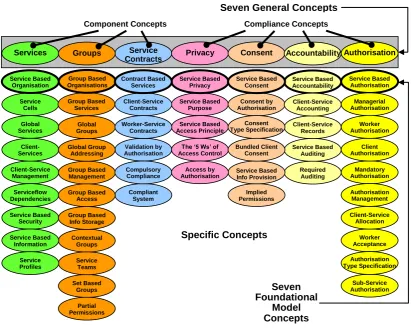
As mentioned at 1.1, the Seven General Concepts integral to the dissertation are Services, Groups, Service Contracts, Privacy, Consent, Accountability and Authorisation. Figure 3 locates the Seven General Concepts at the zenith. Each of the General Concepts has a number of Specific Concepts listed below it; these are
Sub-Concepts of the General Concept. The first Concepts in each list (those with thick borders) together form the seven Foundational Model Concepts. The Seven General Concepts are subdivided into two groups: the three Component Concepts
(Services, Groups and Service Contracts) and the four Compliance Concepts
Figure 3: Model Concepts
Components that are abstractions of the real world8 are used in software programming to model real world entities and interactions. The real world is thus modelled in the machine world. The Model defines Service, Group and Service Contract Components. This means that Services, Groups and Service Contracts exist both as real world entities and corresponding software entities in the Model.
In Object Oriented Programming (OOP) the world is viewed in terms of Objects that interact with each other. In the Model, Organisational work is viewed as Services that are performed by Groups within the Organisation and managed through Service Contracts. CMS software is based on three basic Components (the Model Components): one for Services, one for Groups and one for Service Contracts. In
8 The term “real world” is used in the dissertation in the sense that the IT system needs to model
entities (with “abstractions”) and processes that occur in organisations in particular, and in the world
Service Based Purpose Service Based Access Principle Service Based Privacy Service Cells Global Services Client-Service Management Validation by Authorisation Service Based Organisation Service Based Authorisation Consent by Authorisation Mandatory Authorisation Service Based Accountability Group Based Services Client-Service Records Service Based Auditing Required Auditing Contextual Groups Set Based Groups Partial Permissions Global Groups
The ‘5 Ws’ of Access Control Group Based Management Group Based Organisations Client Authorisation Worker Authorisation Managerial Authorisation Compliant System Compulsory Compliance Worker Acceptance Client-Service Allocation Sub-Service Authorisation Implied Permissions Service Based Info Provision Service Teams Consent Type Specification Service Based Security Client-Service Accounting Service Based Information Client- Services Client-Service Contracts Contract Based Services Bundled Client Consent Service Based Consent Worker-Service Contracts Access by Authorisation Serviceflow Dependencies Group Based Info Storage Authorisation Management Authorisation Type Specification Group Based Access Service Profiles Global Group Addressing Service Contracts
Services Groups Privacy Consent Accountability Authorisation
Seven General Concepts
OOP Services, Groups and Service Contracts would each be represented by an Object Class, that is, each would be a type of Object.
The Service, Group and Service Contract Components embody the way that the IT System relates to the real world. The IT System only understands work in terms of “Services”, people in terms of what “Groups” they belong to, and dealings in terms of “Service Contract” offers and acceptances. For example, the Hospital IT System has information about Alice’s admission last Tuesday because the “Patient Admission” Service was offered, accepted and performed for Alice. It knows that Bob is a doctor because he is a member of the “Doctor” Group and it knows that Bob is caring for Alice because he is in “Alice’s Care Team” Group.
The Model proposes Generic Service Contracts, which can be managed by the IT System and have the potential to be applied globally. Service Contracts encompass all the legal agreements that are necessary between the parties involved in service provision. Their primary purpose is to ensure Organisational Compliance.
From the above it is apparent that the IT System must be capable of relating to users through its “view” of the world. Yet an IT system, not being human, can only hold a “logical view” and utilise “logical processes”. The reason why the Services, Groups and Contracts Components are useful is that persons understand what Services, Groups and Contracts are (that is, they can adopt this logical view), and in turn can communicate with the IT System by using Service/Group/Contract-based processes (that is, they can adopt the logical processes). This is in contrast to Objects in OOP, where computer programmers are the only persons that understand the “Object” concept. Currently many IT tasks can only be performed by IT system administrators because only they know how to perform them. By utilising Component Types that Managers, Workers and Clients understand, the Model aims to enable these persons to perform IT tasks (albeit in a new way and often automatically) currently only performed by IT system administrators.
The primary purpose of each of the Model’s General Concepts is that:
1. Services are templates for standard business process tasks in Organisations with each Client-Service instance being managed by the IT System,
2. Groups represent Organisational Structure by defining collections of resources and are used to control who performs each Client-Service,
3. Service Contracts enable Compliance by fulfilling Privacy, Consent, Accountability and Authorisation requirements in a single digital Service agreement,
4. Client Privacy is enabled by restricting access to information to that which is necessary for the Client-Service being provided,
5. Client Consent is incorporated into Service Contracts and managed in Service processes,
6. Accountability requirements are addressed in Service Contracts and functionalities in Service processes, and
7. Authorisation9 mechanisms are the means by which Service Contract offers and acceptances are input into the IT System during the Service process. The following describes the General Concepts, albeit still in an introductory sense. Greater detail follows, particularly in Chapters 4 and 5. The reasons why these concepts are integral are not discussed at this early stage. Introducing the General Concepts here serves to introduce the terminology and to specify definitions that may vary from those made in other research methodologies.
9 An “Authorisation” in this sense is an “offer” or “acceptance” received from a Service Contract
1.5
Services
Services are templates for standard business process tasks in Organisations with each Client-Service instance being managed by the IT System.
Services represent distinct units of work (also known as jobs or tasks) performed by Organisations. The Model defines Services with the following basic Service Properties:
1. They are All-Encompassing,
2. They apply to Standardized Parties, 3. They consist of Standardized Processes, 4. They have Commercial Aspects, and
5. They are managed by a Compliant Management System (CMS). The following subsections deal with each of these ServiceProperties.
[image:41.595.152.509.454.722.2]1.5.1 All-Encompassing Services
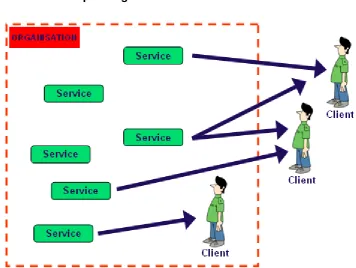
The Model uses the premise that Organisations essentially exist to provide Services to Clients who will usually pay for the Service. However, some of the work will be for Clients who are within the Organisation. All the work that is performed by the Organisation is defined by Services. In this sense Services are “units of work”. The Model considers the provision of goods (products) as a Service. For example, the purchase of a book from a retailer is considered to be a “Retail Service”. The purchaser of the book is paying not just for the book itself, but also for the retailer’s advice, payment processing, delivery, accounting and any other associated work. There is no distinction therefore between “goods” and “services”.
[image:42.595.155.507.311.579.2]1.5.2 Standardized Service Parties
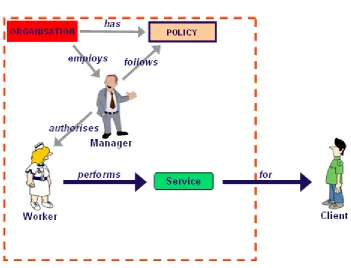
Figure 5: Basic Organisational Concept
the Client is within the Organisation (for Internal Services), the Policy may be verbal rather than written, a Manager may also perform the duties of a Worker, the Worker could be a computer program, or the Service could be the sale of a product. Despite potential variations, the items, parties and relationships always exist is some definite form.
The Model centres on the Organisational Premise that “a Manager Authorises a Worker to perform a Service for a Client”. This phrase concisely summarises the relationships between the three fundamental parties involved in Service Contracts and Service Delivery.
1.5.3 Standardized Service Processes
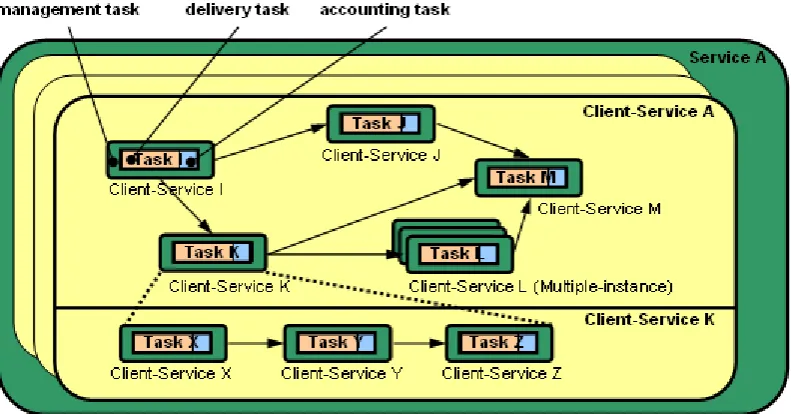
Consider the work done in an Organisation in BPM terms where there are business processes and associated business tasks. There are essentially three types of business tasks: delivery tasks, management tasks and accounting tasks. A delivery task is the actual work that is done by workers in providing the Service; for example, a nurse administering prescribed medication to a patient. A management task is the work that is done by managers and workers in making decisions about the Services that are delivered; for example, deciding which nurse will administer the medication. An accounting task is the work that is done in recording information about the task; say, that the medication has been administered.
Figure 6: A Service and its Sub-Components
Individual Services can be components of higher level Services. In this sense the higher level Service is the “Service” and the individual component Services are Sub-Services. The timing of Sub-Services and the dependencies between Sub-Services are defined by the Serviceflow. This is synonymous with the “Workflow” (BPM terminology) for the Service. There is no limit to the number of levels; individual Sub-Services can in turn have component Sub-Services. In Figure 6 Services I, J, K, L, and M are Services of Service A, while Services X, Y, and Z are Sub-Services of Service K.
In the Model all work is performed for a Client. Clients can be External Clients
(who are outside the organisation) or Internal Clients (within the organisation). Work is performed by invoking the appropriate Service. This creates an instance of the Service called a Client-Service. Services can be performed for different Clients. Each time a new Client-Service instance is created. A Service can also be performed multiple times for the same client. This is a Multiple-Instance Client-Service. In this sense the Service is like a template and each Client-Service is one copy made from the template. This is akin to individual cakes being baked using the same recipe.
1.5.4 Commercial Service Aspects
of as units of work that must be done. The Model adds a “commercial dimension” by considering that Services have value, can be advertised, and can be bought and sold. The Model therefore takes a Client-Centric Approach to Services (where all Service instances have a Client) as well as a Service Management approach (where all Service Instances are managed by the IT System).
For example, consider the Service of purchasing a new motor vehicle. The manufacturer can design a “Vehicle X” Service for a motor vehicle model that contains all the necessary information including specifications and photographs. Retailers (suppliers) that stock the vehicle can use the Service information directly in their advertising and catalogues, attaching their own details and pricing information. A customer is then able to search online for the vehicle, to locate all nearby suppliers, to compare details and costs, and even purchase the vehicle.
Once the Service has been purchased by the customer, the Service Management related Components of the IT System deal with the processing of the order and
supply of the vehicle.
1.5.5 Compliant Management System
The Model advocated in the dissertation, while having unique features, proposes a CMS that incorporates BPM, SOA and RBAC functionalities. The CMS employs Groups to control access to Services where the Services are essentially business process tasks. The inefficiencies of RBAC are overcome by incorporating BPM and SOA functionalities in the CMS. This is achieved by automating access control decisions. Instead of IT system administrators having to make these decisions by manually granting access permissions, the permissions are automatically triggered by managerial decisions made at the coalface. For example, when a Manager allocates a client’s job to a Worker, the Worker is automatically given access to the relevant Client information.
1.5.6 Enabling Service Automation and Reuse
Computers can only handle systematic processes and can only make decisions based on logic. Therefore, to attain the automation and reuse benefits of an IT management system there is a fundamental need to standardise and quantify business tasks. In other words, to gain time saving IT benefits, persons need to work in ways that computers can relate to. They have to work systematically and logically.
Delivery tasks, management tasks, and accounting tasks can all be automated. For delivery tasks to be automated the task must be broken down into basic components (sub-tasks) which are carried out in a logical and repeatable order. In other words, a standard procedure for doing the task must be found. For example, if the task is to bake a cake, the work is divided into sub-tasks like “beat the eggs” or “mix the ingredients in a bowl”. To program a robot to bake the cake, the robot would be programmed to perform each sub-task and then programmed to perform the different sub-tasks in the appropriate sequence. In a sense it is a similar process to teaching a child to bake. The child is taught how to do each sub-task and then how to do them in sequence.
Another important aspect of automation is representing the state of the tasks by measureable values. This amounts to quantifying the state. This needs to be done so that the robot can decide when a task is complete. For example, for the egg-beating sub-task the “beating time” or the mixture’s “colour variation” could be measured. The robot could then be programmed to “beat the eggs for 60 seconds” or “beat the eggs until the colour variation is zero”.
Once the sub-task programs are written, the robot can easily be programmed to bake other types of cakes by varying individual sub-task operations or by varying the sequence of the sub-tasks. This involves the reuse of the sub-task programs.