
Solar current output as a function of sun elevation: students as toolmakers. Igoe, D.P.1,* and Parisi, A.V.1
1Faculty of Health, Engineering and Sciences, University of Southern Queensland, Toowoomba, Australia.
*To whom correspondence is to be addressed.
Abstract
Solar current is an increasingly important aspect of modern life and will be even more so crucial in the students’ future. Encouraging students to be the ‘toolmakers’ allows students to take ownership of scientific investigations, as well as forcing them to refine their research questions and hypothesis the design and refinement of their tools. The modern day has seen an unprecedented opportunity for toolmaking, in the form of adapting and programming apps that use the micro-electro-mechanical sensors that are an intrinsic part of smartphone technology.
Introduction
In recent times, solar energy has become an area of increased student interest, primarily due to the enhanced awareness of global energy and environmental issues (Gfroerer, 2013). One of the main factors in solar energy efficiency is the elevation of the sun in respect to the solar panel; this provides an opportunity of student-led scientific investigations (Morgan Jr. 2013). This research explores cost-effective and enriching learning experiences that combine the use of mobile technology, toolmaking and physics concepts and touching on programming and the use of smartphone sensors for scientific exploration involved with concepts of solar energy and electric circuits (Gfroerer, 2013).
Scientific endeavour through the ages has involved experimenters developing or adapting their own tools, a process that requires intrinsic knowledge of the subject matter that they are studying. This tradition has not really ended, asides from the development and adaptation of experimental technology, the modern day toolmakers have access to an array of physical equipment that can be adapted for use and complemented by the use of ubiquitous apps available. The use of mobile devices for scientific investigations is not a new concept, recent examples include their use in modern adaptations of the Kundt’s tube experiment (Parolin and Pezzi, 2015) and measurements of the speed of sound in air (Yavuz, 2015).
Researchers have used the sensors, programming platform and minor, easy to construct add-ons to transform the mobile device into a temporary, but specific scientific instrument, while maintaining the default functions (telephony, camera etc) (for example Igoe et al. 2013; Cao and Thompson, 2014; Snik et al., 2014). The use of applications and MEMS from mobile devices for the science classroom is also not new. There is considerable research in using the pre-existing mobile device applications and micro-electrical-mechanical-sensors (MEMS) (Liu, 2013) as tools for students collecting and recording data, using the camera (Igoe et al. 2014) and using the accelerometer (Hochberg et al. 2014; Vogt and Kuhn, 2012).
A tale of two experimental approaches.
Two example approaches, based on time and educational focus are:
Class experiments, designed to be able to be performed in a single or extended timetabled lessons, which include development of tools and the use of smartphone apps. These can also be multi-day experiments with readings taken at different times of the day over proceeding days.
A longer term extensional investigation, including opportunities for students to explore programming as a tool for the experimental investigation. Future opportunities using smartphone internal and external sensors are explored.
Class experiment
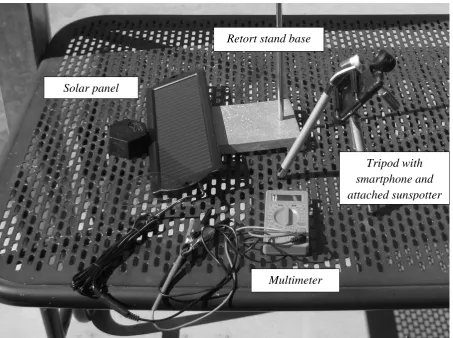
[image:3.595.73.527.379.717.2]The main focus of the class investigation is to determine a relationship between the relative angle of the sun onto the solar panel and the amount of current produced. The base experimental setup is shown in Figure 1.
Figure 1: Sample experimental setup for the detection of the generated current of a solar panel with changing relative solar angles.
Tripod with smartphone and attached sunspotter
Multimeter Retort stand base
The physical setup uses a portable solar panel and a standard digital multimeter, available at low cost in hardware stores, a tripod with a mobile device holder and the mobile device. On top of the mobile device is a handmade sunspotter. All equipment are readily available and relatively inexpensive. The smartphone has a clinometer app, freely available from the Google Store, that automatically measures the angle of tilt of the smartphone.
Figure 2: Sunspotter fixed on top of the smartphone. The white spot is sunlight focused on the translucent end of a candy tube.
Measurements are made in a short amount of time, so the sun’s angle, or altitude, can be assumed to be constant for the duration of the experiment. The sun’s altitude is determined using the clinometer based app installed on the mobile device. The example used in this setup is the free Android-based app Multiclinometer (http://www.apps.physicssolutions.info/index.html). There are many free similar apps available for both Android and iPhone.
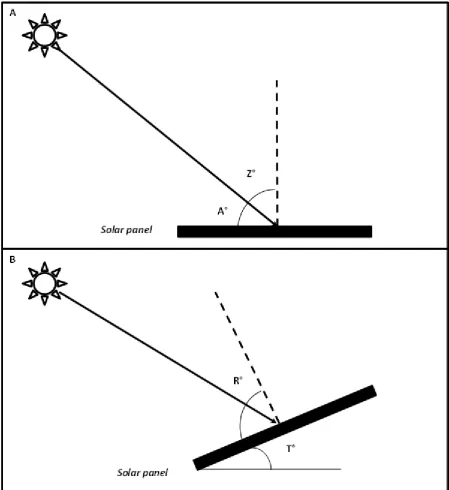
Examples of broader solar power class experiments are described by Gfroerer (2013), where they are used as an analog of a resistive circuit and are an excellent platform for investigating electric circuits. A similar consideration for this experiment in reference to this previous work is that the solar panels are at representative angles; these can be made to represent the standard way that portable solar panels are used, as well as simulating the direction and angle that solar units are used on a typical household or business roof. Comparisons of the solar panel generated current output are then made between horizontal and representative angles. The angle of the sun is confirmed using the sunspotter and the solar elevation is determined using the clinometer app. When the solar panel is placed horizontally on a surface (tilt angle 0°), the zenith angle (Figure 3A) is complementary to the sun’s altitude measured by the clinometer app. Hence,
90
The relative zenith angle (R°) decreases as the solar panel’s tilt angle (T°) approaches that of the sun’s altitude (Figure 3B), increasing again as the system is tilted to 90°. Hence, the relative zenith angle of a tilted solar panel is the absolute value of the difference between the solar zenith angle and the tilt angle of the system.
| |
Figure 3: Geometry of the solar panel with respect to the sun’s altitude (A°) and zenith angle (Z°). The relative zenith angle (R°) relative to the tilting of the solar panel (T°).
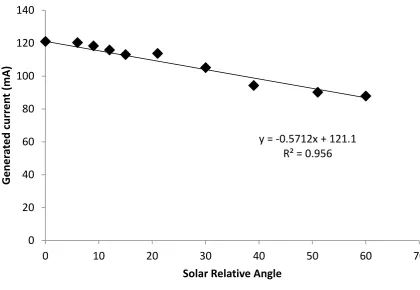
Figure 4: Sample results demonstrating a very strong correlation between the relative zenith angle and the current generated by the solar panel.
The results clearly demonstrate that the hypothesis that a definable regression is possible with the data. In this case, a linear model fits the experimental data with a very strong correlation of determination, using Microsoft Excel to model the raw data. The experiment was repeated at different times through a day and a repeat measurement at the same time, the next day. It was determined that the hypothesis was still supported; however, the regression constants change at different times of the day.
A variation of this experiment would be to perform observations across a full school day with the solar panel at a fixed angle, to simulate the usual operation of solar devices, the relative angle the sun makes with the solar panel would vary in a similar manner. In a full day experiment, students have the opportunity to perform research to determine what the theoretical relationship should be between the relative solar angle and the current produced from the solar panel. Additionally, students should perform error analysis to fully analyse the trends and anomalies.
Extension and Future Opportunities
y = ‐0.5712x + 121.1 R² = 0.956
0 20 40 60 80 100 120 140
0 10 20 30 40 50 60 70
Gener at e d curr en t (mA)
The smartphone (and iPhone) provide an unprecedented opportunity for students to engage in programming as part of their experimental toolmaking; the approach is that instead of using a pre-existing app, as in the class experiment example, the students develop their own app. There is also an opportunity in the near future to potentially use an external smartphone sensor to measure the current, known as VoltSet (http://voltset.com/).
The main difference for this suggested experimental investigations from the in-class example is asides from the time required and the treatment of variables, is that it provides an opportunity for students (and teachers) to learn, by practice, programming. A starting point for students is learning how to use open source platforms such as Android, which has the Android Developers Guide (https://developer.android.com/guide/index.html) and code and sensor manipulation examples are provided in the popular resource of the Android Cookbook (www.androidcookbook.com). A specific example as a useful starting point for measuring the sun’s altitude in the Cookbook is the section “Finding the orientation of an Android device using the Orientation sensor”. Additionally, students have an opportunity to access free-to-use programming question and answer websites, such as “Stack Overflow” (www.stackoverflow.com), where any question requires the students to have already made a start and to include specific goals and outcomes.
Conclusion
Experimental procedures for the measurement of solar panel current generation are presented, with the focus becoming increasingly student centred. One of the common threads in both main approaches presented is the notion of the student as the toolmaker, starting with simple constructions, such as the sunspotter, to the opportunity to develop more complex programming based tools. This demonstrates that it is possible and beneficial for students to develop the tools they need as part of the experimental investigations.
References
1. Gfroerer, T. 2013 Circuits in the sun: Solar panel physics Phys. Teach. 51 403-405 2. Morgan Jr. W. 2013 Quadrant to measure the sun’s altitude Phys. Teach. 51 420-421 3. Parolin, S. and Pezzi, G. 2015 Kundt’s tube experiment using smartphones Phys. Ed.
50 443-447
4. Yavuz, A. 2015 Measuring the speed of sound in air using smartphone applications Phys. Ed. 50 281-284
5. Igoe, D. Parisi, A.V. and Carter, B. 2013 Smartphones as tools for delivering sun-smart education to students Teach. Sci. 59 36-38
6. Cao, T. and Thompson, J.E. 2014, “Remote sensing of atmospheric optical depth using a smartphone sun photometer,” PLOS ONE, 9, pp.1-8.
7. Snik, F., Rietjens, J.H.H., Apituley, A., Volten, H., Mijling, B., Di Noia, A.,
Heikamp, S., Heinsbroek, R.C., Hasekamp, O.P., Smit, J.M., Vonk, J., Stam, D.M., van Harten, G., de Boer, J., Keller, C.U., 3187 iSPEX Citizen Scientists, 2014, Mapping atmospheric aerosols with a citizen science network of smartphone spectropolarimeters, Geophys. Res. Lett. 41, doi:10.1002/2014GL061462.
8. Liu, M. 2013 A study of mobile sensing using smartphones Int. J. Distr.Net. 2013 Article ID 272916
9. Igoe, D. Parisi, A.V. and Carter, B. 2014 Smartphone based Android app for determining UVA aerosol optical depth and direct solar irradiances Photochem. Photobiol. 90 233-237
10. Hochberg, K. Grober, S. Kuhn, J, Muller, A. 2014 The spinning disc: studying radial acceleration and its damping process with smartphone acceleration sensors Phys. Ed. 49 137-140
11. Vogt, P. and Kuhn, J. 2012 Analyzing free fall with a smartphone acceleration sensor Phys Teach. 50 182-183
![Primary structure study of phosphofructokinase from Streptococcus lactis : a thesis presented [in] fulfilment of the requirement for the Master of Science in biochemistry at Massey University](data:image/gif;base64,R0lGODlhAQABAIAAAP///wAAACH5BAEAAAAALAAAAAABAAEAAAICRAEAOw==)