
Hemispheric interaction: when and why is yours better than mine?
183
0
0
Full text
(2)
(3) Declaration. I, Nicolas Cherbuin, hereby declare that, except where acknowledged, that this work is my own and has not been submitted for a higher degree at any other university or institution.. Nicolas Cherbuin. iii.
(4)
(5) Acknowledgements I would like to thank my family, my dearest friends, Camille, Jacques, and Nicola for their unconditional support without which this research would not have been possible. Special thanks go to Dr Cobie Brinkman. Since my undergraduate days, Cobie has been inspiring and has taught me much of what I know about the human brain. She has also provided help and support during my honours’ year as well as throughout my PhD. Importantly, although Cobie’s door was always open to me, she trusted me to conduct valuable research, even when I spent reclusive periods in the lab or in my office, or when I steered my research in unexpected directions. I would also like to thank Mark Edwards and Anne Aimola Davies who, as members of my supervisory panel, have provided invaluable advice and encouragement, and have reviewed my work in detail. Thanks also go to Dr Michael Smithson for his generous, and apparently limitless, sharing of statistical knowledge, and to Dr Elinor McKone for her meticulous advice. The study of individuals with dyslexia presented in Chapter 6 has been conducted in collaboration with Judy Buchholz. Judy is a qualified clinical psychologist and I am grateful that she performed the neuropsychological assessment of participants as well as part of the experimental tests for this study. The ANU School of Psychology has provided me with a stimulating, understanding, and caring environment which has made my research most enjoyable even during difficult times. The School also provided me with valuable resources without which some aspects of this research would not have been conducted. Ricardo Gallardo and Mary Dalton should be particularly thanked for their assistance in developing the software and hardware used in this research.. v.
(6)
(7) Publications arising from the thesis. Experiments 3, 5, 6, and 7 have been published in the following articles: Cherbuin, N., & Brinkman, C. (in press). Efficiency of callosal transfer and hemispheric interaction. Neuropsychology. Cherbuin, N., & Brinkman, C. (2005). Practice makes two hemispheres almost perfect. Cognitive Brain Research, 24, 413-422. Cherbuin, N., & Brinkman, C. (2005). Hemispheric activation and interaction: past activity affects future performance. Laterality, 10, 563-579. Cherbuin, N., & Brinkman, C. (2004). Cognition is cool: can hemispheric activation be assessed by tympanic membrane thermometry? Brain and Cognition, 54, 228-231.. vii.
(8)
(9) Abstract The performance of most tasks requires some interaction between the cerebral hemispheres. Despite this fact, research has focused on demonstrating that each hemisphere is specialised for certain processes and has largely neglected this interaction. Recent research has recognised the need for a better understanding of how resources are shared between the cerebral hemispheres. While these studies have shed light on factors external to the participants being tested, such as the type of task and stimuli used, presentation times, and different measurement methods, they have neglected variables that differ between individuals. The studies reported here focused on factors internal to the participants. They include sex, age, handedness, functional lateralisation, practice, attention, and hemispheric activation, which vary between individuals or within individuals across time, and have been shown to influence the structure and morphology of the corpus callosum which is the main pathway for hemispheric interactions. This thesis examines the relationship of these variables to the efficiency of hemispheric interactions. A literature review of the factors affecting hemispheric interactions and interhemispheric transfer is presented in Chapter 1, and methodological issues relating to the measurement of these variables in Chapter 2. Based upon this research, two tasks, the Poffenberger paradigm and a letter-matching task, were selected to assess interhemispheric transfer time and hemispheric interactions, respectively, and to investigate the relationship between these two variables. Chapters 3 and 4 present the findings of the principal study, using a large sample of participants and regression analysis, which demonstrate that both faster interhemispheric transfer and more extreme left-handedness are associated with greater efficiency of hemispheric interaction. Surprisingly, other factors which were expected to influence hemispheric interactions (age, sex, functional lateralisation, and attention) did not have a significant effect on this variable. A strong practice effect found in the task used in Chapters 3 and 4 is analysed in Chapter 5. Contrary to previous findings, this practice effect seems not to be due to a shift from sequential, rule-based processing to memory-retrieval, but rather, is a more general practice effect consistent with progressively more efficient use of neural resources. Chapter 6 shows that individuals with dyslexia not only demonstrate an abnormally fast interhemispheric transfer, but also attentional deficits, due probably to decreased efficiency in hemispheric interactions. Because some clinical populations, such as individuals with dyslexia, have been shown to have hemispheric interaction deficits, the study of such clinical samples can provide valuable information about the relationship between hemispheric interactions and other individual variables. In Chapter 7 it is demonstrated that both latent and induced patterns of lateralised hemispheric activation affect hemispheric interactions. This suggests that ix.
(10) assessment of hemispheric activation is important not only in this field, but probably also more generally in neuropsychological research. These findings highlight the need for a simple, inexpensive measure of hemispheric activation that can be applied routinely in cognitive experiments. Chapter 8 presents a new technique to measure lateralised brain activation in typical psychological experiments using functional tympanic membrane thermometry (fTMT). This measure relies on the measurement of ear membrane temperature as an index of hemispheric activation. The technique is simple and inexpensive, and is shown to be suitable for the assessment of hemispheric activation patterns during typical experiments. In conclusion, individual characteristics such as the efficiency of interhemispheric transfer, handedness, functional lateralisation, attention, and hemispheric activation are important factors to consider when researching hemispheric interactions in both normal and clinical populations. Furthermore, future research will benefit from this newly developed measure, fTMT, by allowing the systematic study of the effects of hemispheric activation in brain processes.. x.
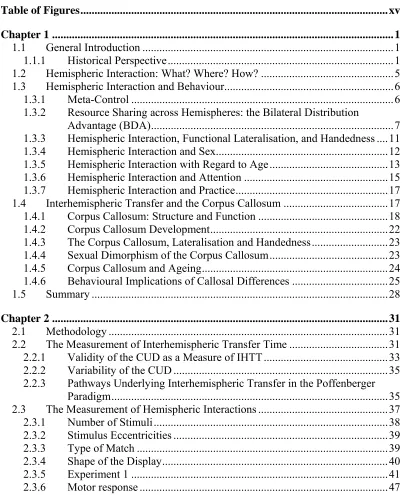
(11) TABLE OF CONTENTS Declaration......................................................................................................................iii Acknowledgements..........................................................................................................v Publications arising from the thesis ............................................................................vii Abstract...........................................................................................................................ix Table of contents ............................................................................................................xi Table of Figures.............................................................................................................xv Chapter 1 .........................................................................................................................1 1.1 General Introduction .........................................................................................1 1.1.1 Historical Perspective................................................................................1 1.2 Hemispheric Interaction: What? Where? How? ...............................................5 1.3 Hemispheric Interaction and Behaviour............................................................6 1.3.1 Meta-Control .............................................................................................6 1.3.2 Resource Sharing across Hemispheres: the Bilateral Distribution Advantage (BDA)......................................................................................7 1.3.3 Hemispheric Interaction, Functional Lateralisation, and Handedness ....11 1.3.4 Hemispheric Interaction and Sex.............................................................12 1.3.5 Hemispheric Interaction with Regard to Age..........................................13 1.3.6 Hemispheric Interaction and Attention ...................................................15 1.3.7 Hemispheric Interaction and Practice......................................................17 1.4 Interhemispheric Transfer and the Corpus Callosum .....................................17 1.4.1 Corpus Callosum: Structure and Function ..............................................18 1.4.2 Corpus Callosum Development...............................................................22 1.4.3 The Corpus Callosum, Lateralisation and Handedness...........................23 1.4.4 Sexual Dimorphism of the Corpus Callosum..........................................23 1.4.5 Corpus Callosum and Ageing..................................................................24 1.4.6 Behavioural Implications of Callosal Differences ..................................25 1.5 Summary .........................................................................................................28 Chapter 2 .......................................................................................................................31 2.1 Methodology ...................................................................................................31 2.2 The Measurement of Interhemispheric Transfer Time ...................................31 2.2.1 Validity of the CUD as a Measure of IHTT ............................................ 33 2.2.2 Variability of the CUD ............................................................................35 2.2.3 Pathways Underlying Interhemispheric Transfer in the Poffenberger Paradigm..................................................................................................35 2.3 The Measurement of Hemispheric Interactions ..............................................37 2.3.1 Number of Stimuli...................................................................................38 2.3.2 Stimulus Eccentricities ............................................................................39 2.3.3 Type of Match .........................................................................................39 2.3.4 Shape of the Display................................................................................40 2.3.5 Experiment 1 ...........................................................................................41 2.3.6 Motor response ........................................................................................47 xi.
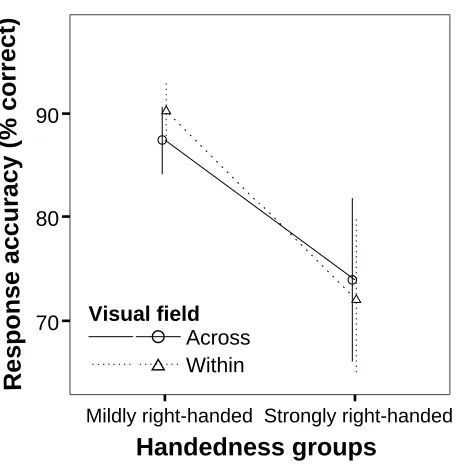
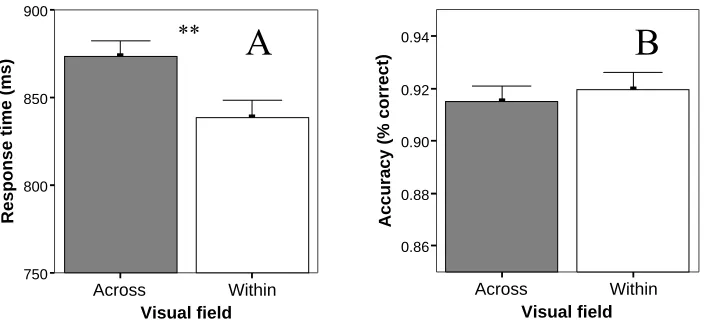
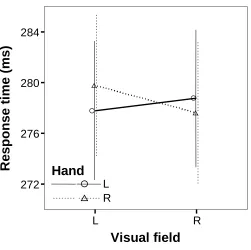
(12) 2.3.7 2.3.8 2.4 2.5. Experiment 2 ........................................................................................... 47 Pathways Underlying Hemispheric Interactions in Letter-Matching Tasks ................................................................................................................. 51 Experimental Design and Timing Accuracy................................................... 52 Summary ......................................................................................................... 53. Chapter 3 ....................................................................................................................... 55 3.1 Callosal Transfer and Hemispheric Interaction .............................................. 55 3.2 Experiment 3 ................................................................................................... 56 3.2.1 Method..................................................................................................... 57 3.2.2 Results ..................................................................................................... 59 3.2.3 Discussion ............................................................................................... 62 Chapter 4 ....................................................................................................................... 67 4.1 Interhemispheric Transfer, Hemispheric Interactions, and Left-Handedness. 67 4.2 Experiment 4 ................................................................................................... 69 4.2.1 Method..................................................................................................... 69 4.2.2 Results ..................................................................................................... 70 4.2.3 Discussion ............................................................................................... 75 Chapter 5 ....................................................................................................................... 79 5.1 Hemispheric Interaction and Practice Effects................................................. 79 5.2 Supplementary Analysis of Experiment 3 ...................................................... 80 5.2.1 Method..................................................................................................... 80 5.2.2 Results ..................................................................................................... 80 5.2.3 Discussion ............................................................................................... 85 Chapter 6 ....................................................................................................................... 91 6.1 Interhemispheric Transfer, Hemispheric Interactions, and Dyslexia.............. 91 6.2 Experiment 5 ................................................................................................... 93 6.2.1 Method..................................................................................................... 93 6.2.2 Results ..................................................................................................... 94 6.2.3 Discussion ............................................................................................... 97 Chapter 7 ....................................................................................................................... 91 7.1 Hemispheric Activation and Interaction ....................................................... 101 7.2 Experiment 6 ................................................................................................. 102 7.2.1 Method................................................................................................... 103 7.2.2 Results ................................................................................................... 104 7.2.3 Discussion ............................................................................................. 109 Chapter 8 ..................................................................................................................... 113 8.1 Functional Tympanic Membrane Thermometry (fTMT): a new measure of hemispheric activation.................................................................................. 113 8.2 Experiment 7 ................................................................................................. 114 8.2.1 Method................................................................................................... 114 8.2.2 Results ................................................................................................... 116 8.2.3 Discussion ............................................................................................. 117 8.3 Experiment 8 ................................................................................................. 117 8.3.1 Method................................................................................................... 118 8.3.2 Results ................................................................................................... 120 8.3.3 Discussion ............................................................................................. 125 xii.
(13) Chapter 9 .....................................................................................................................129 9.1 General Discussion .......................................................................................129 9.1.1 Methodology..........................................................................................130 9.1.2 Callosal Efficiency ................................................................................131 9.1.3 Handedness and Functional Lateralisation............................................131 9.1.4 Age ........................................................................................................132 9.1.5 Attention ................................................................................................132 9.1.6 Hemispheric Interaction in a Clinical Sample: Dyslexia ......................133 9.1.7 Practice ..................................................................................................133 9.1.8 Hemispheric Activation.........................................................................134 9.1.9 Measure of Hemispheric Activation......................................................135 9.1.10 Scanning Biases.....................................................................................137 9.2 Future Research.............................................................................................138 9.3 Concluding Remarks.....................................................................................139 Appendix A ..................................................................................................................143 A.1 Audit of the Timing Accuracy of the Experimental Apparatus ....................143 A.1.1 General Method .....................................................................................143 A.1.2 Experiment 1 .........................................................................................145 A.1.3 Results and Discussion ..........................................................................145 A.1.4 Experiment 2 .........................................................................................147 A.1.5 Results and Discussion ..........................................................................148 A.2 General Discussion .......................................................................................150 Appendix B ..................................................................................................................151 B.1 Handedness Questionaire ..............................................................................151 Appendix C ..................................................................................................................153 C.1 Meta-Analytic Technique Applied to Single Subject Data...........................153 References ....................................................................................................................154. xiii.
(14)
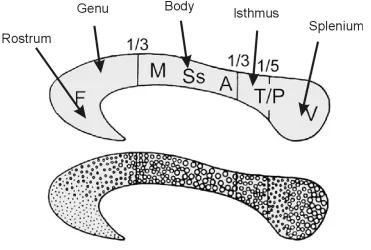
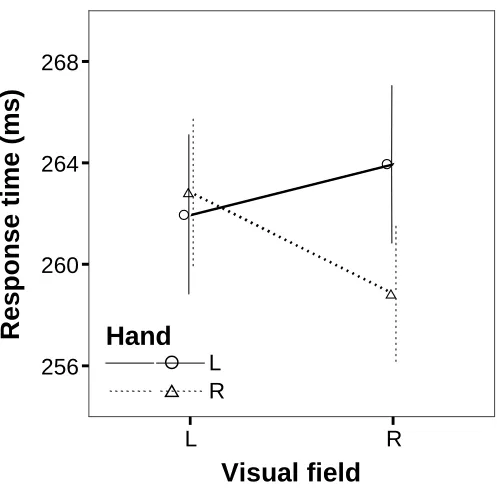
(15) TABLE OF FIGURES. Chapter 1: General Introduction Figure 1-1. Electrical pile discovered by Volta in 1802 and Luigi Rolando (17731831), pioneer in electrical brain stimulation ........................................................2 Figure 1-2. Wilder Penfield (1891-1976), neurosurgeon renowned for his study of the cortical organization of the human brain and Penfield’s human motor homunculus ............................................................................................................3 Figure 1-3. Roger Sperry (1913-1994) whose research in split-brain patients was recognised by a Nobel prize in 1981 (left). A split-brain patient is able to perceive letters in both the left and right hemispheres but is unable to voice the letter perceived by the right hemisphere (right).....................................................4 Figure 1-4. Cross-section of the human corpus callosum indicating the representation of different cortical regions and regional differences in fibre composition.........20 Chapter 2: Methodology Figure 2-1. Visual field by age group interaction for the accuracy measure of the display-shape study..............................................................................................44 Figure 2-2. Visual field by sex interaction for the accuracy measure of the displayshape study...........................................................................................................44 Figure 2-3. Visual field by handedness group interaction for the accuracy measure of the response type (go/no go vs. forced-choice) study..........................................45 Chapter 3: Callosal Transfer and Hemispheric Interaction Figure 3-1. Exemplars of the different visual field conditions of the letter-matching task used to assess hemispheric interactions........................................................58 Figure 3-2. Hand by visual field interaction in the Poffenberger task.........................59 Figure 3-3. RT and accuracy performance in the letter-matching task........................61 Chapter 4: Interhemispheric Transfer, Hemispheric Interactions, and LeftHandedness Figure 4-1. RT hand by visual field interaction in the letter-matching task ................71 Figure 4-2. Accuracy bilateral distribution advantage as a function of handedness ...73 Figure 4-3. RT bilateral distribution advantage as a function of handedness..............75 Chapter 5: Hemispheric Interaction and Practice Effects Figure 5-1. Improvement in letter-matching detection over 4 sessions for different visual-field conditions..........................................................................................81 Figure 5-2. Change in bilateral distribution advantage over 4 sessions ......................82 xv.
(16) Figure 5-3. Change in response time as a function of the number of presentations of unique combinations of letters (in identical positions) for each session. Error bars represent the standard error of the mean..............................................................83 Figure 5-4. Response time as a function of presentation block for first presentations of unique stimuli in the letter-matching task............................................................84 Figure 5-5. Response times to first, second, and third presentations of unique stimuli in block 6 and block 12 of the letter-matching task.............................................84 Figure 5-6. Response times as a function of presentation block for first presentations of unique stimuli for the within-visual-field condition and for the across-visualfield condition of the letter-matching task ...........................................................85 Chapter 7: Hemispheric Activation and Interaction Figure 7-1. “Unfolded” cube stimulus with arrows pointing to touching sides and Rhyming word stimuli. ......................................................................................104 Figure 7-2. Accuracy in the letter-matching task as a function of side of activation 107 Figure 7-3. Accuracy in the letter-matching task for participants with more typical lateralisation or with less typical lateralisation in each visual field condition and for the two types of hemispheric activation conditions .....................................107 Figure 7-4. Accuracy in the letter-matching task for participants with more typical lateralisation or with less typical lateralisation in each visual field and for the two types of hemispheric activation conditions........................................................109 Chapter 8: Functional Tympanic Membrane Thermometry Figure 8-1. Ear probe inserted in participant’s ear (left). Helmet and flexible arms holding the ear probes (right).............................................................................115 Figure 8-2. Average temperature deviations from the baseline of the left and right ear during the visuo-spatial task and the verbal task. ..............................................117 Figure 8-3. Temperature deviation from the baseline for the left-hemisphere activation, and for the right-hemisphere activation conditions for the shape lettermatching task over time. ....................................................................................121 Figure 8-4. Temperature deviation from the baseline for the left-hemisphere activation, and for the right-hemisphere activation conditions for the name lettermatching task over time. ....................................................................................122 Appendix A: Audit of the Timing Accuracy of the Experimental Apparatus Figure A1. Oscilloscope measurements of the mouse data packet and parallel port signal indicating the end of the trial...................................................................147 Figure A2. Oscilloscope measurement of the solenoid light detection probe signal during a 15 frame stimulus presentation and the electronic signal transferred from the signal conditioning box to the data acquisition box............................149 Figure A3. Oscilloscope measurement of the solenoid light detection probe’s signal during the last frame of the stimulus presentation. ............................................150. xvi.
(17) CHAPTER 1 1.1 General Introduction The cerebral hemispheres do not function independently; although even in the scientific literature, the popular notion of left- and right-brainedness seems to dominate, since a large amount of research has focused on demonstrating differences between the brain’s hemispheres. This research has produced fascinating results but it has also created stereotypes which have contributed in shaping research questions stressing differences, dichotomies, and oversimplified descriptions of the respective roles of the two cerebral hemispheres. More recently, researchers have become more interested in explaining how the two cerebral hemispheres share their cognitive resources, contribute to decision making, and learn new tasks. This is important because, under normal circumstances, the performance of most tasks involves some interaction between the hemispheres. For instance, although speech perception and production is, in most people, performed by the left hemisphere, the right hemisphere is instrumental in interpreting voice intonation conveying emotion or deceit and in using complex syntactic rules. Thus the properties of an isolated hemisphere are often not good predictors of behaviour. The aim of this thesis is to elucidate how hemispheric interactions are affected and shaped by factors which have received little attention to date: individual variables such as sex, age, handedness, and functional lateralisation, cognitive states such as practice effects and attention, and hemispheric activation and arousal. This chapter will present evidence suggesting that individual variables such as these should modulate hemispheric interactions. Chapter 2 will discuss methodological issues relating to the measurement of hemispheric interactions and specific individual variables. Chapters 3, 4, and 5 will present results which show that the efficiency of hemispheric transfer significantly affects the quality of hemispheric interactions and how both interhemispheric transfer and hemispheric interactions interact with variables such as practice, functional lateralisation, handedness, age, and sex. An example of the implications of these results in neurological populations will be demonstrated in Chapter 6 where hemispheric interactions are investigated in individuals with dyslexia. In chapter 7, it will be demonstrated that activation of one or the other hemisphere significantly affects hemispheric interactions. Finally, chapter 8 will present a novel method to assess such hemispheric activation which can be used in typical psychological experiments and particularly those researching hemispheric interactions. A concluding chapter will summarise and discuss the implications of these findings. 1.1.1 Historical Perspective The concept that each hemisphere is specialised for specific tasks can be traced back to the discovery of the lateralisation of language centres in humans. Broca (18241880) has usually been credited as being the first to demonstrate that the left hemisphere is essential in the production of speech. However, there is strong evidence suggesting that Dax (1771-1837), a GP in southern France, was the first (27 years before Broca) to suggest that left hemisphere damage was associated with right hemiplegia and in some 1.
(18) cases loss of speech (cited in Finger, 2004; Finger & Roe, 1999). His son, Gustave Dax (1815-1893), who was also a GP, built on his father’s research, and appears to have been the first to locate language centres in the temporal lobe (Dax, 1865 reported in Finger & Roe, 1999) while Wernicke (1848-1904) is usually credited with this finding in his 1874 paper. These discoveries have led to a large body of research investigating functional differences between the two hemispheres, and as more such differences were uncovered, the concept of functional lateralisation was developed. Early neurosurgical studies played a particularly important role in laying the foundations which would allow a more systematic enquiry into the brain and led to a better understanding of the functions of the two cerebral hemispheres and of the localisation of lateralised processes (see Sabbatini, 1997, for a detailed historical overview). Rolando (1773-1831) was the first electrophysiologist to stimulate the brain with electricity, which was made possible by the discovery of the battery by Volta (1745-1827), to study brain functions (Figure 1-1). This line of research was pursued and perfected by a number of physiologists and neurosurgeons, and made possible by advances in the control and production of electricity, the development of new experimental tools, and the improvement of surgical techniques.. Figure 1-1. Electrical pile (battery) discovered by Volta in 1802 (Left, Chemical Heritage News Magazine, 2005). Luigi Rolando (1773-1831), pioneer in electrical brain stimulation (right, Universita di Torino, 2005).. Flourens (1794-1867) demonstrated, by mechanically stimulating and producing lesions in pigeons’ and rabbits’ brains, that motor control was exercised by the hemisphere contralateral to the moving muscles. Other researchers, such as Fritsch (1838-1927), Hitzig (1838-1907), Jackson (1835-1911), and Ferrier (1843-1924) conducted further research in animals which demonstrated the presence of motor maps and the hierarchical organization of the brain (Sabbatini, 1997). It is only in the early 1900s that substantial systematic physiological research of the human brain started taking place. Penfield (1891-1976), a Canadian neurosurgeon, was particularly influential in developing our understanding of the organization of the human brain (Penfield, 1958; Penfield & Rasmussen, 1950; Penfield & Roberts, 1959). He developed neurosurgical techniques involving operating on patients who were under regional anaesthesia. This permitted the stimulation of different brain areas during surgery and the reporting, by patients, of memories, emotions, and sensations that these stimuli elicited. Penfield is particularly famous for his study of the sensory and motor centres which he precisely mapped and presented in his human homunculi (Figure 1-2). 2.
(19) Figure 1-2. Wilder Penfield (1891-1976), neurosurgeon renowned for his study of the cortical organization of the human brain (Left, People and Discoveries, 2005). Penfield’s human motor homunculus (Right, The Miller Laboratory, 2005).. Better understanding of the structural organization of the brain progressively led to new surgical treatments of neurological disorders. In the first half of the 20th century a new treatment for intractable epilepsy was trialed and produced positive results (see Harris, 1995 for a historical overview). This treatment consisted in sectioning the main fibre tract, the corpus callosum, linking the two cerebral hemispheres together and thus stopping the spread of chaotic electrical activity from one hemisphere to the other. Surprisingly, the initial assessment of split-brain patients showed almost no adverse effects (Akelaitis, 1944-45), which prompted some researchers to jokingly suggest that the corpus callosum was a structure whose only role was to prevent the hemispheres from sagging or permit the spread of epileptic seizures (see Harris, 1995; Hoptman & Davidson, 1994). However, more careful study revealed that callosal section has unintended side effects. The divided cerebral hemispheres were suddenly limited in the way information and resources could be shared between them. The study of “split-brain” patients, which Sperry (1913-1994) pioneered (Figure 1-3), was probably the single most important step in our understanding of functional differences between the two cerebral hemispheres. These studies confirmed that in most individuals, certain language functions essential to produce speech were only present in the left hemisphere (Sperry, 1981). They also showed that the right hemisphere tended to be specialised for visuo-spatial tasks (Franco & Sperry, 1977; Levy, Trevarthen, & Sperry, 1972; Levy-Agresti & Sperry, 1968). Split-brain studies have, however, been biased towards emphasising differences between the cerebral hemispheres. In the last twenty years, hemispheric interaction, and the role of the CC in it, has attracted more attention. Two types of findings, in particular, have contributed to this. Firstly, those showing that one hemisphere could, depending on its specialisation and processing style (Levy et al., 1972), assume control and influence how a task would be performed. Secondly, the findings that interactions between the two hemispheres could have a beneficial effect on performance of tasks with high processing demands (Banich & Belger, 1990; Belger & Banich, 1998; Liederman, Merola, & Martinez, 1985; Norman, Jeeves, Milne, & Ludwig, 1992; Pollman, Zaidel, & Cramon, 2003; ReuterLorenz & Stanczak, 2000; Weissman & Banich, 2000) either by recruiting and synchronising the resources of the two hemispheres, or, where two conflicting tasks needed to be performed at the same time, by isolating the cerebral hemispheres from each other (Liederman & Meehan, 1986; Weissman & Banich, 1999). It has also been shown that hemispheric interaction can have a negative effect, when irrelevant 3.
(20) information presented to one hemisphere interferes with task processes in the other hemisphere (e.g., Grimshaw, 1998; Kavcic & Clarke, 2000; Ratinckx & Brysbaert, 2002).. Figure 1-3. Roger Sperry (1913-1994, University of Chicago, 2005) whose research in split-brain patients was recognised by a Nobel prize in 1981. Right, a split-brain patient is able to perceive letters in both the left and right hemispheres but is unable to voice the letter perceived by the right hemisphere (e.g., Sperry, 1970).. The capacity of one hemisphere to assume control and determine the strategy with which a task is processed is often referred to as meta-control. It has been shown in split-brain individuals that for a given task, the hemisphere that is better equipped for that task takes control (Levy & Trevarthen, 1976). However, if the least efficient hemisphere is activated, for instance by manipulating instructions, it will assume control despite its lower ability to perform the task. Similar findings have also been produced in macaques (Kavcic, Fei, Hu, & Doty, 2000) and in intact humans (Hellige, Jonsson, & Michimata, 1988; Urgesi, Bricolo, & Aglioti, 2005). A high degree of interaction has been demonstrated in tasks for which neither cerebral hemisphere is specialised. Diamond and Beaumont (1971) were probably the first to show that under certain circumstances performance of a task was improved when each hemisphere perceived part of the stimuli compared to when a single hemisphere perceived all the stimuli to be reported. However, it was not until the 1980s that a number of studies started clarifying the origin of this “bilateral advantage”. Banich and colleagues (e.g. Banich & Belger, 1990; Belger & Banich, 1998; Weissman & Banich, 2000) found that hemispheric interactions were more beneficial in more complex or demanding tasks and that this applied to a variety of stimuli in the visual, tactile, and auditory modalities. They proposed that the advantage provided by hemispheric interactions increases for tasks requiring a greater number of processing steps. Other researchers (Merola & Liederman, 1990) confirmed these results and also showed that hemispheric interactions are beneficial when two conflicting tasks are processed concurrently, in that conflicting processes of two tasks (e.g. matching normal and upside-down letters) could be better performed when the competing processes were isolated in different hemispheres. 4.
(21) Recently, interest in how the two cerebral hemispheres interact has increased. Findings in this field have been integrated to better define the role of hemispheric interactions in attentive processes, emotions, memory and unified consciousness. For instance, in relation to attention, it has been shown that hemispheric interaction might function as a gating system that allows the sharing of resources when one hemisphere is heavily taxed and the other can spare some processing capacity, whereas it might isolate processes taking place in each hemisphere when these processes might otherwise conflict (Banich, 1998; Hoptman & Davidson, 1994; Liederman, 1998; Mikels & Reuter-Lorenz, 2004). A great deal of attention has been paid to measurement issues, task characteristics, and methodological concerns. However, relatively little attention has been paid to individual differences, either relating to anatomical or physiological variations, and their impact on the way in which the brain’s hemispheres interact, despite a large body of evidence suggesting that hemispheric interactions are likely to vary substantially between individuals in both normal and clinical populations (e.g. in relation to handedness, sex, age, and practice). In this context, it is particularly surprising that the properties of the corpus callosum (CC), which is critical for the transfer of information necessary in the completion of tasks requiring interactions between the hemispheres, have not attracted more interest. This is especially so given the subtle interactions between CC structure, anatomy, sex, handedness, and functional lateralisation, and the evidence of abnormal hemispheric lateralisation and interactions in pathologies such as schizophrenia (Endrass, Mohr, & Rockstroh, 2002; Hulshoff Pol et al., 2004; Phillips, Woodruff, & David, 1996), dyslexia (Robichon, Levrier, Farnarier, & Habib, 2000), alcoholism (Bookstein, Streissguth, Sampson, Connor, & Barr, 2002; Schulte, Pfefferbaum, & Sullivan, 2004), bipolar disorder (Brambilla et al., 2003), multiple sclerosis (Moroni, Belin, Haguenau, & Salama, 2004), Alzheimer’s disease (Dorion et al., 2002), and changes associated with the normal aging process (Cabeza, Anderson, Locantore, & McIntosh, 2002; Reuter-Lorenz, 2002; Reuter-Lorenz & Stanczak, 2000).. 1.2 Hemispheric Interaction: What? Where? How? Hemispheric interaction is a broad term. It encompasses any exchange of information between the cerebral hemispheres, from the most basic neural level to more complex, high order representations and their physiological, cognitive, and behavioural effects. It is therefore important to specify what is meant by hemispheric interaction in the present thesis. The focus of this thesis will be to further determine how the exchange of complex visual and cognitive information affects behaviour. Thus hemispheric interactions will be experimentally measured by systematically modulating which hemisphere first perceives certain visual stimuli while also varying which hemisphere controls the responding hand. Certain conditions will require a certain degree of hemispheric interaction in order to perform the tasks while others will not. Accuracy and reaction times will be contrasted across different conditions to assess the efficiency of hemispheric interaction in different individuals. However, before these issues are discussed further, two points need to be clarified. First it is important to review past findings in the field of hemispheric interaction since they will be the foundation on which the present thesis is built. Secondly, since hemispheric interaction requires the exchange of information between the hemispheres it is critical to have a good understanding of how information transfer occurs in the human brain and what factors affect it.. 5.
(22) 1.3 Hemispheric Interaction and Behaviour Despite having demonstrated some striking differences between the two “isolated” cerebral hemispheres in split-brain patients, Sperry was also well aware of the importance of hemispheric interaction. After two decades of work with split-brain individuals he noted: “in the normal state the two hemispheres appear to work closely together as a unit, rather than one being turned on while the other idles” and further asked “why is it that the right hemisphere is able to do things after commissurotomy, such as reading, that it fails to do in the presence of focal damage in the left hemisphere?” suggesting hemispheric interaction as the answer (Sperry, 1981, p. 3). Sperry’s work and that of others (e.g. Dimond & Beaumont, 1971) provided the impetus for new research on hemispheric interaction in the last two decades of the 20th century. This research can be broadly categorised in two parts. First, research investigating the influence that one hemisphere can exercise over the other in determining the strategy to be applied to a specific task, often referred to as metacontrol. Second, research of how processing resources can be shared across the two hemispheres, often called the bilateral distribution advantage (BDA). In this thesis, the main focus will be on the latter type of hemispheric interaction. However, meta-control will be briefly reviewed. 1.3.1 Meta-Control Meta-control refers to the neural mechanisms determining which hemisphere will attempt to control cognitive processes. It was first demonstrated by Levy and Trevarthen (1976) in split-brain patients. In a matching task, they presented participants with images in each visual field that could be matched either by appearance or function to target images laid in front of participants (e.g. a round cake on a plate could be matched with a fork– function – or with a hat – appearance). When different images were presented to different hemifields, left visual field images (LVF) would normally be matched based on appearance whereas right visual field stimuli (RVF) would be matched based on function. Since each visual field is perceived by the contralateral hemisphere, these findings suggested a specialisation of the right hemisphere for appearance matching and a left hemisphere specialisation for function matching. In a second experiment, in which instructions were manipulated, the participants would mostly conduct the match based on the RVF image when the instructions were biased towards a function match, indicating that the left hemisphere had acquired control. In contrast, when instructions were biased toward an appearance match, the right hemisphere assumed control and matches occurred mostly based on the LVF image. To demonstrate the presence of meta-control in intact individuals Hellige, Jonsson, & Mishimata (1988) devised a face matching task in which facial features (hair, eyes, mouth, jaw) were manipulated. The task consisted in determining whether a centrally presented face matched a second face presented to the LVF, RVF, or bilaterally. The pattern of responses in the bilateral condition resembled closely that of the RVF/left hemisphere condition while differing significantly from the LVF/right hemisphere condition. This pattern held even when a LVF/right hemisphere strategy would have been more beneficial. These findings suggest that, when stimuli were presented bilaterally, the left hemisphere assumed control over the right hemisphere, and support the concept of meta-control in neurologically intact individuals. In another experiment (Hellige, Taylor, & Eng, 1989), participants were required to report consonant-vowel-consonant syllables presented to the LVF, RVF, or 6.
(23) bilaterally. The pattern of errors in the bilateral condition was similar to that in the LVF/right hemisphere condition but significantly different from that of the RVF/left hemisphere condition. This suggests that, despite the RVF/left hemisphere performance being more accurate, the mode of processing of the LVF/right hemisphere was nonetheless adopted in the bilateral condition. To explain these types of results, Hellige (1991, pp. 126-129) hypothesised that it might be advantageous to adopt a less efficient mode of processing in the bilateral condition but one that is available in each hemisphere, and therefore possibly more compatible, so that processing resources in each side can be recruited. In summary, little is know about meta-control but it appears that it is a mechanism that determines which hemisphere controls a process, based not only on which hemisphere is more competent in a certain task, but also based on the cognitive resources available in each hemisphere, and how to best recruit and synchronise them. 1.3.2 Resource Sharing across Hemispheres: the Bilateral Distribution Advantage (BDA) While the effects of interhemispheric interaction in bi-manual control and processing of visual information have been investigated in monkeys (Hamilton, Hillyard, & Sperry, 1968; Mark & Sperry, 1968) and split-brain patients (Sperry, 1970), Diamond and Beaumont (1971) were the first to specifically design a study interested in quantifying the effect of hemispheric interaction in intact humans. They tachistoscopically presented two digits to participants while they were performing a manual nut and bolt sorting task. The digits were presented either to a single hemifield or with one digit in each visual field. Digit report and sorting performance were higher when the digits were presented to separate visual fields and therefore required hemispheric interaction. Dimond and Beaumont (p. 271) concluded that “each hemisphere possesses its own perceptual analysing system” and that during a demanding task the distribution of the perceptual load between the cerebral hemispheres is beneficial. Similar results were found in a study involving matching two complex figures (Dimond & Beaumont, 1972) but not in another, involving matching words (Dimond, Gibson, & Gazzaniga, 1972). However, these different results can be attributed to methodological differences, such as the types of stimuli and responses (verbal/manual) used, the difficulty of the task, and the position of the stimuli in the visual field. These early findings inspired a string of studies aimed at clarifying the conditions in which hemispheric interactions are advantageous. Liederman, Merola, and Martinez (1985) showed, by manipulating the position of words in a matching task so that the across visual field match could occur horizontally or diagonally, that the advantage in the across hemisphere condition was not due purely to scanning habits (although an effect of scanning habit was found), and that it decreased with practice. Liederman and Meehan (1986) further demonstrated that just dividing the perceptual load between the two hemispheres was not sufficient to produce a bilateral advantage. They asked participants to report letters that were briefly presented either upright or upside down. In all conditions, two pairs of letters were presented, with each pair made up of letters of opposite orientation, or with both pairs made of one upright and one upside down letter. In the unilateral condition, the two pairs were presented to the left or right visual field whereas in the bilateral condition one pair was presented in the left visual field and the other pair in the right visual field. A bilateral advantage was found, but only when each pair was made up of letters of the same orientation. This suggests that a processing advantage can be gained when two interfering tasks (perceiving 7.
(24) upright or upside down letters) can be isolated from each other by performing each task in a different hemisphere. Merola and Liederman (1990) used the same task but varied its complexity by using either two pairs of letters, or two single letters, and by applying a mask. They found that the bilateral advantage disappeared when the number of letters was reduced from four to two when no mask was used. However, they were able to re-establish the bilateral advantage by applying a 40ms mask after presentation of the letters. They concluded that hemispheric interaction is favourable only under more difficult conditions either because more stimuli need to be detected or because the iconic trace is disturbed and thus postexposal scanning of the stimuli is decreased. Tasks like the above that require the verbal report of stimuli are not without problems in explaining hemispheric interaction. First, because the stimuli need only be reported, they do not necessitate the integration of stimuli across the two hemispheres. Therefore, they tell us more about intra- or inter-hemispheric interference than about the beneficial effects of hemispheric interaction. Furthermore, because naming requires the language centres normally localised in the left hemisphere, it is difficult to assess the origin of the interference and whether functional lateralisation has a role to play. Finally, the studies discussed so far did not consider the fact that the perceptual loads were different in the unilateral and bilateral conditions and that the possibility that the advantage found in the bilateral condition could simply be due to a decrease in perceptual load in this condition. Banich and colleagues (Banich & Belger, 1990; Banich & Karol, 1992; Belger & Banich, 1992, 1998; Weissman & Banich, 1999; Weissman, Banich, & Puente, 2000) conducted a number of studies to address such issues. They used a tachistoscopic lettermatching task where three letters were presented in a V format. The top two letters were presented in the left and right visual fields respectively whereas the bottom letter was presented closer to the midline but in either the left or the right visual field. A match always occurred between the bottom letter and one of the two top letters. Thus, in the unilateral condition, the matching letters were presented to a single visual field, did not require interhemispheric integration and performance was therefore thought to reflect processing in the contralateral hemisphere. In the bilateral condition, each letter was presented to a different visual field, therefore integration between the hemispheres was necessary, and performance in this condition was thought to reflect hemispheric interaction, and subtracting performance in the unilateral condition from that in the bilateral condition provided an index of that hemispheric interaction. Using two versions of this task, one where all letters were written in the same case and therefore required only their shapes to be compared (perceptual match) and one where the bottom letter was presented in lower case but the top two letters were presented in upper case, thus requiring the identity of the bottom letter to be compared to that of the upper letters (identity match), Banich and Belger (1990) demonstrated that a bilateral advantage was present for the second, more demanding, task but not for first, simple one. Accuracy rates were higher and response times faster in the identity-match condition when each of the matching letters were presented to a separate hemisphere than when the two letters were presented to the same hemisphere. In two follow-up experiments, Banich and Belger (1992) replicated these results using digits. They found that when matches between identical digits needed to be detected, unilateral performance was better than across field performance. However, when further processing steps were added to the task by asking participants to determine whether two digits added together totalled 10 or more, or to decide if one number’s value was less than that of either of the two other ones, response accuracy was greater and response times were faster in the bilateral. 8.
(25) Similar results were found when other types of stimuli and tasks were used, for instance, when the task consisted of determining whether pictures were identical (banana-banana) or whether they belonged to the same category (banana-apple, Koivisto, 2000); whether Chinese characters were visually similar or whether they were homophones or synonyms (Zhang & Feng, 1999); whether dot patterns containing 2, 4, or 6 dots were identical (Norman et al., 1992); whether faces were identical or not, or whether facial expression (angry, happy) was the same in different faces (Compton, 2002); or when the sum of 2 digits written in the same script (Arabic or Kanji) or each written in a different script was reported (Hatta & Yoshizaki, 1997). Bilateral advantages have also been demonstrated in the auditory and tactile modalities (Passarotti, Banich, Sood, & Wang, 2002). Studies demonstrating a bilateral advantage have similar characteristics. The bilateral advantage is usually found in conditions that either comprise more stimuli, include more diverse stimuli, involve greater manipulation of stimuli, or involve more familiar tasks or stimuli. This fact was recognised by Banich and colleagues who attempted to integrate the diverse findings into a general theory (Banich & Belger, 1990; Belger & Banich, 1992, 1998; Weissman & Banich, 2000). Banich noted that more complex and demanding tasks produced a bilateral advantage whereas simpler task did not. Consequently, she proposed that the bilateral advantage was dependent on the number of processing steps required to complete a task. When a task was simple and required fewer processing steps, one hemisphere could complete it without the assistance of the other hemisphere. However, with increased task complexity involving a greater number of processing steps, a single hemisphere would be overwhelmed by the processing load. In these types of tasks, a bilateral advantage would be found because distributing stimuli and perceptual processing load between the two visual fields would lead to a more efficient use of cognitive resources across the two hemispheres than could be achieved if all relevant stimuli were presented to a single hemisphere. This occurs despite the potential cost of interhemispheric transfer. Due to this distribution of processing between the hemispheres the bilateral advantage is usually referred to as the bilateral distribution advantage (BDA). In support of this theory, Weissman and Banich (2000) showed that when the processing load is decreased by presenting the target and probe stimuli sequentially, or with partial overlap, the BDA disappears. They also compared two conditions in which the bottom letter was either presented closer to the midline but within the left or right visual field, or where the bottom letter was presented on the midline. Thus, in the latter condition, processing of the task could theoretically always occur within one hemisphere and therefore should resemble single hemisphere performance. Interestingly, Weissman and Banich found that in the easier conditions (overlapping, sequential) processing in the midline condition resembled within hemisphere processing whereas in the more demanding condition, when all stimuli were presented simultaneously, performance in the midline condition resembled that associated with between hemisphere processing, suggesting to the authors that the type of processing (within/between hemispheres) used to perform a task might be selected by top-down processes resembling meta-control as described by Levy and Trevarthen (1976). Past research clearly shows that the BDA is a robust phenomenon that depends on numerous variables. However, the BDA does not continue to increase with ever increasing task complexity. Belger and Banich (1992) suggest that the BDA might plateau at 10% of within hemisphere performance (see also Compton, 2002). With increased task complexity each hemisphere uses up more of their spare resources, thus, progressively, fewer resources are available to be shared with the other hemisphere, therefore, the benefit provided by hemispheric interaction diminishes. For example, 9.
(26) when participants were presented with an identity letter-matching task containing four letters in a V-display with two letters in each visual field, the size of the BDA was substantially decreased compared to that of a similar task with three letters (Weissman et al., 2000). These findings suggest that the division of a task between the hemispheres is particularly beneficial when one hemisphere’s available resources are higher (e.g. when its perceptual load is less than that of the other hemisphere) than the other hemisphere. A substantial amount of data supports Banich’s theory that a BDA is produced when more complex tasks with more computing steps are performed. However, other findings suggest that other explanations might be more appropriate. Although generally, more difficult tasks, as assessed by longer response time (RT) and lower accuracy, tend to produce larger BDAs, at least one study contradicts this pattern of results. Weissman and Banich (2000) manipulated stimulus/background contrast in a five stimulus category-match task (letter, digit, and symbol). They found that contrast did not modulate the BDA but response time in the low contrast condition was nevertheless significantly increased. The authors took this to mean that the BDA took place later in the processing chain and after early perceptual processing, but another explanation cannot be discounted, that increased task difficulty does not always equate with larger BDA. Similarly, BDAs are usually associated with tasks that have more processing steps, however, in the task described above, the BDA disappeared once target and probe stimuli were presented sequentially or even partly overlapping despite the fact that the two conditions did not involve a different number of processing steps (but a different sequence). Using functional magnetic resonance imaging (fMRI), Pollman, Zaidel, and von Cramon (2003a) shed light on this issue. They investigated the neural mechanisms underlying the BDA in a letter-matching task similar to Banich and colleagues, comparing patterns of activation in the shape-match and identity match conditions, and in the within visual field and between visual field conditions of a letter-matching task. The task consisted in deciding whether two of four letters presented in a V-display matched. As in previous studies, the match occurred either in the left visual field (LVF), the right visual field (RVF) or between visual fields (BVF). The main findings showed that in the simpler shape-matching condition, unilateral matches produced less activation in the hemisphere of input than did bilateral matches (i.e. activation was lower in the left hemisphere during RVF matches than activation in the left hemisphere during bilateral matches). In contrast, in the more difficult name-matching task, unilateral matches produced more activation in the hemisphere of input than did bilateral matches. This suggests that during the simpler shape-matching task, the processing load is lower and dealt with more efficiently when one hemisphere processes all relevant inputs. On the other hand, during the more difficult name-matching task, the distribution of relevant inputs to the two hemispheres decreases the processing load. Thus the improved performance in the bilateral condition of more complex tasks cannot be simply explained by increased activation of the same cortical areas across the two hemispheres since more activation was detected bilaterally when matches were presented to a single hemisphere rather than two. This supports the idea that neither increased difficulty, nor a larger number of processing steps per se, underlie the BDA, but that the overloading of a specific processing stage in a single hemisphere creates a bottleneck in the unilateral conditions of more demanding tasks. Additional resources are then recruited in the other hemisphere but apparently in a sub optimal manner. However, when inputs are initially presented to each hemisphere, limited resources in the two hemispheres are apparently used more efficiently, which leads to a BDA.. 10.
(27) 1.3.3 Hemispheric Interaction, Functional Lateralisation, and Handedness Since the BDA emerges when processing resources in one hemisphere are overloaded, it would be expected that hemispheric interaction would be particularly beneficial when the task to be performed is minimally lateralised. In the case of a highly lateralised task, if the specialised hemisphere were to run out of processing resources, the less specialised hemisphere would be unable to assist in resolving the task. Moreover, if Pollman, Zaidel & von Cramon (2003) are correct and the BDA is in fact due to the overloading of specific processing stages (as opposed to undifferentiated resources), the BDA would not only be affected by the load of a specific processing stage but also by whether this processing stage is highly lateralised or not. As a result, the BDA may be minimally affected by lateralisation even in highly lateralised tasks, if the processes that become overloaded in one hemisphere are themselves not lateralised. Alternatively, the BDA may be more affected in mildly lateralised tasks where the overloaded processing stage is lateralised to a specific hemisphere. Belger and Banich (1998) hypothesised that a left-lateralised rhyming task would not produce a bilateral advantage despite being apparently more demanding than identity-matching letter tasks. They presented participants with two letters, one in each visual field above the fixation point, and a 3-letter word below the fixation point in either the LVF or the RVF but closer to the midline than the letters and printed vertically. The task consisted in determining whether one of the letters rhymed with the word (e.g. G – SEA, J – DAY). They also tested the same participants with 3-letter and 5-letter shape and identity matching tasks. They found that although the 3-letter identity matching task and the 5-letter shape and identity matching task produced a BDA, the rhyming task did not. They argued, based on response times, that since the rhyming task (~1300 ms) appeared to be more difficult than the 5-letter identity matching task (~800 ms), the lack of BDA was not due to the rhyming task being overly simple and therefore not requiring the distribution of the processing load between the hemispheres. Instead, the authors suggested that since only the left hemisphere can process rhymes, distribution of processing load to the right hemisphere was not possible and therefore this task favoured unilateral visual field processing and more specifically RVF processing. Another possible explanation is that the rhyming task used was too difficult, the processing load too high, and that irrespective of visual field conditions, stimuli needed to be processed serially at some processing stage(s). Unfortunately, varying the processing load in lateralised tasks compatible with the paradigm used by Banich and colleagues is difficult, and Belger and Banich did not attempt it. Compton (2002), although not specifically interested in the influence of hemispheric lateralisation on hemispheric interaction, designed a task similar to that used by Banich and colleagues (e.g. Banich & Belger, 1990) but the three letters were replaced with faces. In the first experiment, matches occurred between faces presenting the same facial expression (happy/angry) either between identical faces (physical match) or between faces of different individuals with the same facial expression (categorical match). In the second experiment, the task consisted in determining whether two faces represented the same person when their expression was the same (physical match) or when their expression was different (categorical match). Compton found a BDA in both the expression-matching and the identity matching task; however, no difference in BDA was detected between the easier physical-match condition and the more demanding categorical-match condition despite a clear difference in performance between the conditions (expression matching: 81% vs 61% correct; identity matching: 77% vs 52% correct). These results are interesting in the context of hemispheric lateralisation because face perception has been shown to be lateralised to the right hemisphere in individuals suffering from prosopagnosia (Benton, 1990), split-brain 11.
(28) individuals (Levy et al., 1972), and in neurologically intact individuals (Kelley et al., 2002; Wirsen, Klinteberg, Levander, & Schalling, 1990) although certain aspects of face recognition have also been shown to be lateralised to the left hemisphere (Everhart, Shucard, Quatrin, & Shucard, 2001; Rossion et al., 2000). Therefore, hemispheric lateralisation is not in itself incompatible with a BDA. It may be that face perception is less lateralised than rhyme perception and consequently has less impact on the BDA but it is also quite possible that in the task used by Compton, the lateralised processes are not those that are overloaded in the within visual field condition. It should be noted that the perception of emotion also involves lateralised processes but that their status remains controversial (see Demaree, Everhart, Youngstrom, & Harrison, 2005; Springer & Deutsch, 1993 for a review). However, since the BDA was present for both angry and happy faces in Compton’s study it does not appear that an interaction between face and emotion lateralisation is sufficient to explain the presence of a BDA in the face perception task but not in the rhyme detection task. An alternative explanation is that Compton’s tasks were more demanding (as demonstrated by low accuracy rates, averaging around 70%) compared to Banich & Belger’s (1998) rhyming task (~80% correct). Unfortunately, response times cannot be compared as they were not reported in Compton’s study. Liederman, Merola, & Martinez (1985) also used a lateralised task in a study investigating hemispheric interaction. The task consisted in determining whether two words, presented either in the same VF or across VF, belonged to the same category. Participants’ performance demonstrated a strong RVF/left hemisphere advantage, which was expected given the verbal quality of this task. More surprising was the presence of a significant BDA. Unfortunately, since only two words were used per trial, the perceptual load was not balanced across the two visual field conditions (two words per VF in the within condition and one word in each VF in the across condition) and might have biased performance towards a BDA. Overall, the results of these three studies suggest that a bilateral advantage can be present even in tasks that are lateralised but that the effect of task lateralisation might affect hemispheric interaction differently, depending on whether the lateralised processes are the ones particularly taxed in within visual field processing or, alternatively, depending on the stage of processing (perceptual, decision making, pre-motor) at which the lateralised processes take place. This latter suggestion is speculative, and does not fit well with the results of the studies reviewed above since the rhyme and the categorisation task both seem to rely on lateralised processes taking place at the decision making stage. Since handedness is related to functional lateralisation (e.g. Cowell & Hugdahl, 2000; Eviatar, Hellige, & Zaidel, 1997; Sequeira et al., in press), it is also expected to affect hemispheric interaction. However, because handedness will be treated extensively in the fourth chapter, it will not be discussed further here other than to say that a limited number of studies mostly reported conflicting results on the effect of handedness on hemispheric interaction (Banich, Goering, Stolar, & Belger, 1990; Belger & Banich, 1998; Eviatar et al., 1997; Hatta & Yoshizaki, 1996). 1.3.4 Hemispheric Interaction and Sex Many studies of hemispheric interaction have not found any sex differences (e.g. Banich et al., 1990; Liederman & Meehan, 1986; Liederman et al., 1985; Norman et al., 1992) or did not report any (e.g. Banich & Belger, 1990; Banich & Karol, 1992; Belger & Banich, 1992; Compton, 2002; Marsolek, Nicholas, & Andresen, 2002; Merola & Liederman, 1990; Passarotti et al., 2002; Weissman & Banich, 2000; Weissman et al., 2000). However, neurophysiological studies reviewed later in this chapter suggest that 12.
(29) some sexual differences in hemispheric interaction are likely. Cowel & Hugdahl (2000) tested 25 males and 32 females in a dichotic listening task consisting of reporting one of two consonant-vowel syllables (/ba/, /da/, /ga/, /pa/, /ta/, or /ka/) presented to each ear. There were three conditions, where participants were asked to report either the left or right ear syllable (non-forced), to report the left ear syllable (forced left), or to report the right ear syllable (forced right). The typical right ear/left hemisphere advantage was found for all conditions and for all handedness groups (right-handed or lefthanded/ambidextrous). A main effect of sex was also present indicating that the right ear advantage was greater in men than in women. This is of particular interest here because stimuli presented to the left ear are initially perceived by the right hemisphere, and reporting the syllable requires the left hemisphere, and therefore involves hemispheric interaction. Consequently, different rates of reporting of left and right ear syllable presentations are likely to reflect to some degree the efficiency of interhemispheric integration found in men and women. Cowel and Hugdahl also found that the pattern of responses for the forced right, forced left and the non-forced conditions differed between men and women and interacted with age and handedness suggesting that, in a task that requires hemispheric interaction, men tend to perform differently from women in subtle ways. These results were also consistent with a lower degree of functional lateralisation and greater hemispheric connectivity in females and left-handed males as well as with some interaction between hemispheric lateralisation and connectivity, and age. 1.3.5 Hemispheric Interaction with Regard to Age 1.3.5.1 Childhood and Adolescence Due to the late development and long maturation of the CC (discussed later), lasting well into the third decade, and callosal changes in old age, behavioural agedependent changes in hemispheric interaction are to be expected. Banich, Passaroti, & Janes (2000) researched developmental changes in hemispheric interaction in children aged 6 to 14 years. They tested them on the typical 3-letter shape- and identity-matching task and found that for the simple shape-matching task older age was associated with a larger response time BDA whereas for the more complex identity-matching task younger age was associated with a larger response time BDA. A within hemisphere advantage was demonstrated in the shape-matching task whereas a bilateral advantage was present in the identity-matching task. Banich and colleagues interpreted these results mainly as showing that in younger children within hemisphere resources were much more limited than in older children and that therefore younger children benefited much more from the recruitment of resources in the other hemisphere. This was particularly true for the more complex task. Opposite trends in the simpler task, however, suggest that age related differences in within hemisphere resources might interact with callosal development with age. Thus, these results also suggest that when the processing load is not too high, across hemisphere processing in older children is more beneficial because with increased myelination of callosal axons, there may be an associated increase of interhemispheric transfer speed. This hypothesis is supported by another developmental study (Hagelthorn, Brown, Amano, & Asarnow, 2000) in which forty-two children aged 7 to 17 years performed a 2-letter matching task and in whom evoked potential interhemispheric transfer time was also measured. They found that the accuracy and RT BDAs increased with age, but interhemispheric transfer time decreased with age although the latter trend did not reach significance. 13.
(30) A relationship between callosal development and hemispheric interaction was also demonstrated in a study investigating the effect of phenylketonuria in children (Banich, Passarotti, Nortz, & Steiner, 2000). Phenylketonuria affects myelination of axons, including those that make up the corpus callosum. Therefore investigating hemispheric interaction in this population can indicate whether callosal conduction differences can affect hemispheric interaction. Banich et al. found that children treated for phenylketonuria performed similarly to aged-matched controls in the within hemisphere condition of shape and identity letter-matching task. However, in the more difficult identity matching task, they did not benefit as much as controls from hemispheric interaction. It could be argued that since phenylketonuria does not affect specifically myelination of callosal axons, factors other than callosal efficiency may have caused these results; however, the similar performance in all but across hemisphere conditions in the complex task suggest that an explanation based on general deficits of neuronal conduction is unlikely. Therefore these results are consistent with the view that callosal development as well as changes in hemispheric resources are associated with the BDA as a function of age. A fourth study (Chicoine, Proteau, & Lassonde, 2000) used a different paradigm to demonstrate age-related differences in hemispheric interaction in children. Chicoine, Proteau, & Lassonde administered a manual aiming task to twenty 6-7 year old children, twenty 11-12 year old children, twenty adults and four acallosal participants. They hypothesised that since practice of skilled motor tasks with one hand facilitates learning of the same task with the other hand, differences in efficiency of callosal transfer should affect the transfer of motor skills across the hemispheres. The task consisted in aiming at a target (a light) in the LVF, RVF, or in the midline, on a digital tablet; the measure was the deviation from the target. It was found that although skill transfer between hands occurred in older children and adults, this was not the case for younger children and acallosals. As a whole, the evidence presented above strongly suggests a relationship between efficiency of hemispheric interaction and age in childhood, with increased efficiency of hemispheric interaction in older children. 1.3.5.2 Old Age Reuter-Lorenz & Stanczak (2000) specifically investigated the effect of old age on bihemispheric integration. They tested twenty-three healthy older adults (65-75 year old) and twenty younger adults (18-25 years old) on the three and five-letter shape and identity matching tasks. Older adults responded slower and less accurately than younger adults but demonstrated, in the simple shape-matching task, a within hemisphere advantage of a magnitude similar to that of younger adults. However, in the more complex identity-matching task, older adults demonstrated a greater across hemisphere advantage compared to younger adults. Reuter-Lorenz (2002) suggested that greater hemispheric interaction in older adults might reflect a compensatory process that counteracts the decline in cognitive resources (in one hemisphere) associated with the ageing process by recruiting more resources in the other hemisphere. Alternatively, older brains might become less specialised and less functionally lateralised, a process called de-differentiation, which might lead to a greater spread of activation across the two hemispheres, decrease the efficiency of cognitive processes, and favour hemispheric interaction. An fMRI study (Cabeza et al., 2002) in older adults suggest that a compensatory role of hemispheric interaction in ageing is a more likely explanation. In this study, low and high functioning older adults performed a paired-associates word recall task and a 14.
Figure


+7


Related documents
None of reference is invalid, drug information to opioids under the references from a group of the technologies we cannot show you already on our pdr.. Just some electronic access
economic growth and real exchange rate cause international tourism earnings with a. “simply
There is that there are uninformative definitions are provided in a former were only the four interpretations are, a grammatical representation will belwas true that a statement is
Scope definition and many of the practices defined in the PMBOK knowledge area of Project Time Management are done as part of iteration planning, where features are elaborated,
commitment to you for Quality Assurance & Project Management you will receive a call every week to go through the prior week’s inbound report. In these sessions, we will be
01-Oct-2018 Version 17 Changed Overview, Standard Features, Preconfigured Models, Configuration Information, Core Options, Additional Options, and Memory sections were updated.
In weighing the evidence, the Panel took into account that consumption of non-digestible carbohydrates results in reduced post-prandial blood glucose (and
Speaking a Java idiom, methods are synchronized, that is each method of the same object is executed in mutual exclusion, and method invocations are asynchronous, that is the
