Tel. 360040 ext. 2690
Telex COMEURBRU 21877
%~fDRI':'U1T%0~
I
DEVELOPMEH AIDEXPORT CRO'PS IN THE ASSOCIATED AFRICAN COUNTRIES
-.AGRO-INDUSTRIAL INTERVEi~TION BY THE EUROPEAN DEVELOP!fu:Jfr FUND 34/72
The classical economists considered it was the :aiain function of introducing export crops in new countries, to provide the motive force for their expansion. The argument breaks down the process into three successive phases :
1. the subsistance economy stage : everybody produces for his own requirements. Thus in Black Africa,where the population density is generally low, production
is limited b,y the physical consumption capacit,y of producers. There is thus under---employment through lack of outlets.
2. introduction of cash crops for export. This bursts the bottleneck. National economies which have an abundance of factors of production,which can be converted
into specific export production,should experience a considerable increase in
national income through their opening to international trade.
3.
diversification. This is the third phase of development. The rapid expansion in incomes creates an internal market which leads to the setting up of localindustries which become a new growth factor. Thus the export crops would have been the prime mover in economic expansion,b,y creating the conditions in which a balanced industrial company can exist. As the markets for the initial
prod-unction approach saturation, the new activities would have taken over, thus creating a balance of dynamic growth.
This pattern was followed by many nations which are today highly industrialised
and developed; but it has not stood the test in practice in the new countries. A sufficient cause for the failure may be ·found in the political control under which
colonial terri torie$ existed, by which they were not only deprived of part of the commercial advan~es they could have negotiated for themselves if they had been independent, but which also, in virtue of the Colonial Pact, forbade the setting up
of local industries which could enable them tp dispense with imports. In this wa,y
their character as exporters of a single basic product,continued into our own
times ; and this is the liOre disquieting for the fact tbat most of these prod-uctions stand under the threat of a serious deterioration in their prices. On
the one hand, the supply of these products has been stimulated by technical
progress; and on the other, the development of synthetic substitutes has increased
more rapidly than the demand, which has itself become extremely inelastic by reference to prices and incomes. In these conditions,the countries which have
recently becoae im4epead.nt are left with only a narrow range of possible action. They have no control over world prices; and their efforts are thus directed :
- either to diversify their production so as to mitigate the impact on their
econo~ of fluctuations in the prices of raw materials
- or to improve their productivity so as to stand up better to falling prices.
This policy,hovever, is confronted with the saturation of demand,and therefore requires the planning of supplies on the world level. There is otherwise the risk of "impoverishment through growth",resulting f:o:-o11 falls in price which
offset the effect of increased production;
- or to enter into commercial agreements with competitors and consuming countries so as to stabilise the prices for basic materials at a satisfactory level.
Though it is clear that the expansion in the export crops no longe:t> plays its
former part as a motive force, the fact remains that it is very important for most of the African countries when there is no serious industrial alternative. There
are three reasons for this :
1. The export crops still condition the existence of most of the African peasantry.
Prospects that new lines of production may appear are somewhat remote; and any shrinkage in this field would therefore be: .. wery keenly felt;
2. The equipment of the .country,especially for industrialisation, requires that foreign currency should be available ,and this can only be provided from the sale of the export ~rops
Thus, though the development of export crops no :J,onger holds out very encouraging
prospects,these crops are nevertheless as important as ever in the economic medium-term policies of the Associated countries. It is not surprising,therefore, that the interventions by the EDF in projects of a directly productive character give
considerable prominence to the promotion of the export crops.
EDF AID FOR CASH CROPS
A - Project inventory and share in total EDF aid.
The aid given by the EEC in the different Associated African and Malagasy
countries are shown in absolute value in Table I. It Will be noted that the principal destinations of EDF aid were ag:ro-industrial groups in palm-growing and
tea-planting and also cotton production. There are some cases,however, in which the whole intervention for a particular product was concentrated in one country and was therefore proportionately important. Such cases include the groundnut
projects in Senegal, the cocor,-nutin l.W.dagascar and the cashew in Dahomey.
LIST OF EDF AIDS FOR EXPORT CROPS
Prociuo't Countries EDF Investment
Oilpal.Ja Cameroon- Congo (P,Rep)-Ivor,y
Coast-Dahomey ,'£ogo (Za!re) 74,276,000 u.a Cotton Central Africa,Ivory Coast, }~i,
Senegal,Chad,Togo 47,809,000 u.a
Tea Burundi,Rwanda,Za!re, (surveys in
Cameroon and Yadagascar) 25,008,000 u.a
Groundnuts Senegal 6,340,000 u.a
Coco~nut palm Madagascar 4,120,000 u.a
Cashew Dahomey 3,295,000 u.a
Pyrethrum Rwanda 2,560,000 u.a
Avocado Ivory Coast 574,000 u.a
Bananas Somalia 543,000 u.a
Dah Mali 438,000 u.a
Gum arabic Chad 374,000 u.a
Pepper- Central Africa 227,000 u.a
I
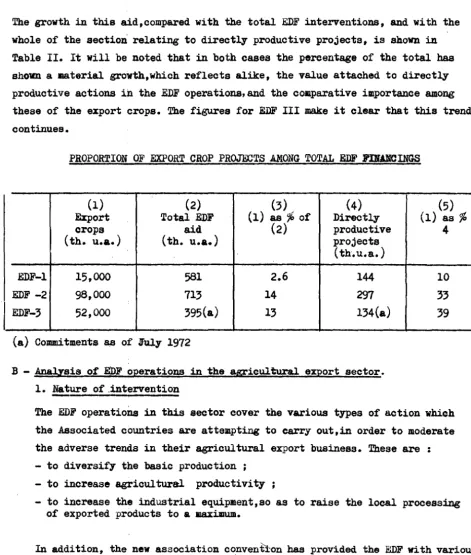
The growth in this aid,compared with the total EDF interventions, and with the
whole of the section relating to directly productive projects, is shown in Table II. It will be noted that in both cases the percentage of the total has shown a ~~aterial growth,which reflects alike, the value attached to directly
productive actions in the EDF operations, and the comparative importance among these of the export crops. The figures for EDF III make it clear that this trend
continues.
PROPORTION OF EXPORT CROP PR~TS AMONG TOTAL EDF fl.lU.KCINGS
(1) (2) (3) (4)
Export Total EDF (1) as
'fo
of Directlycrops aid (2) productive
( th. u.a.) (th. u.a.) projects ( th.u.a.)
EDF-1 15,000 581 2.6 144
EDF -2 98,000 713 14 297
EDF-3 52,000 395(a) 13 134(a)
(a) Commitments as of July 1972
B - An&llsis of EDF operations in the agricultural export sector. 1. Nature of ,intervention
(5) (1) as
%
of4
10
33 39
The EDF operations in this sector cover the various types of action which
the Associated countries are attempting to carry out,in order to moderate the adverse trends in their agricultural erport business. These are : - to diversify the basic production ;
- to increase agricultural productivity
- to increase the industrial equipment,so as to raise the local processing of exported products to a ll&Ximum.
In addition, the new association convenfton has provided the EDF with various
new instruments. These are intended partly, for coapensating &QY unduly marked deterioration in export incomes in the Associated countries {aid in exceptional circumstances due to slump in worl~ prices,or to nat~l disasters); and partly to promote the ~keting of produce.
[image:4.605.62.533.74.629.2]r
I
I
a) Diversification
Most of the AAMS,with the single exception of Zafre, were one-product
exporters; and this made it difficult for them to deal with the general
fluctuations in the prices of raw materials. With the help of EDF, several
of the countries in which natural conditions are suitable, have been able to
begin enlarging the range of their exports. Under this head the most
spectacular action was connected with the setting up of the first
agro-industrial oil palm blocks in the Ivory Coast, Dahomey and Togo and the
introduction and development of tea-planting in Rwanda and cotton in Senegal.
Action of a very promising kind, though on a more modest scale~ was connected
with the introduction of edible groundnuts in Senegal, agro-industrial avocado
blocks in the Ivory Coast.., dah and tobacco in Mali and pyrethrum in Rwanda
b) Action to increase productivity.
Most of the AAMS have taken action to modernise their traditional production
techniques, promoting the use of fertilizers and animal traction and
other-wise so as to face the fall in world prices and maintain competitive
capacities of their producers. The EDF has supported such action,particularly
in Senegal which,in virtue of the formation of the Common Market and the
Yaound~ Association, stood to lose the benefit of the price guarantees which
had been given by France. It is,however, in cotton production that the EDF
investments were the most important, reactifying and consolidating the
prod-uction in the savannah areas of the Central African Republic, the Ivory Coast,
Chad and Togo
The speed and effectiveness of these productivity operations generally made
it possible to get ahead of the fall in produce prices and at le~st to
stab-ilise,if not actually to increase,the income of producers and the State
revenue.
c) Processing agricultural produce
The development,or the introduction of these crops gave scqpe for the
setting up of important industrial units, particularly with the palm and tea
plantations, increasing the value added locally and acting as a stimulus
to modernisation in the rural areas. Among.these processing industries,
the EDF provided total or partial finance not only for the "inevitable"
units which have,for technical reasons, to be set up close to the actual
production (as for palm oil,tea and the ginning of cotton); but also
independent units producing palm kernel oil,soap,essential oils,groundnut
2. Modes of execution
In order to reach a specific production target, there are a number of technical
economic and financial alternatives from which a choice must be made. The
policy of EDF has always been flexible in su~h matters, and it does its best
to adapt itself to the particular conditions of each individual case.
The main choices which had to be made· were the following
a) Between seetor operations and integrated operations.
Most of the EDF interventions were sector operations, in the sense that they
were concentrated entirely on a single export product,such as cotton or
palm oil. In some cases,however,the growing of the export crop was part of
an integrated group of operations undertaken to secure the general
develop-ment of a region.
The latter formula has the merit of being theoretically more coherent,since
it seeks to correct the various phenomena of extroversion and the economic
imbalances in food inherited from the colonial period,when absolute priority
had to be given to the expansion of export crops. The formula is,however
somewhat ambitious,which makes it more complex to bring into execution than
a simple sector operation. At present the tendency is towards a compromise
formula,seeking to integrate into the sector project a variety of ancillary
projects which may condition the success of the principal one. ~hus, in
Senegal,the groundnut operation was also aimed at increasing productivity
in cereal growth. In Senegal,too, the use of rainfall for rice growing was
introduced into a sector operation for cotton growing,so as to provide a
balanced rotation for the agricultural operation.
b) Between commercial organisation and peasant cultivation
In the export sector there are,in general,two types of firm.The one is the
commercial undertaking,organised as a company andusing exclusively
wage-earning labour.The other is the family business,peasant farming carried on
by members of a family with no hired labour at all. The production of cotton
groundnuts and pyrethrum in the EDF projects belong exclusively to this
latter type of cultivation.From the development standpoint,this type of
op-eration has the outstanding advantage that it contributes to the formation
Of responsible peasantry;and any action frOM which it benefits Will
there-fore have considerable secondary effects.The modernisation of individual
cultivation units nevertheless raises difficult problems in the
disseminat-ion of knowledge and informatdisseminat-ion;andit can only be expected to lead to
i
!'
is ill-adapted to capitalistic projects,in which the production equipment is costly and complicated both to handle and to manage. This is the case,
for e:maple, 1n the pal.ll and cashew plantations; and for these the formula preferred has been the agro-industrial block, though experience in the Ivory Coast has shown that this does not exclude the subsequent expansion of
peasant plantations. In some of the EDF pro~ects,aore especiallY for tea,a hybrid formula has been chosen. It was a question of developing a new
production,requiring a high degree of operational discipline; and therefore
in the initial phase the agro-industrial block formula was applied,providing a minimal supply of leaf to the processing units,the operation of which is
the chief cost element in tea production. In a subsequent phase,which has indeed already begun, these nuclei become the support and pattern for the family plantations on which the further growth of tea planting will now
essentially depend.
It will be seen from these instances that the type of undertaking bas been
chosen primari~ in the light of circumstances,the practice being to find the most suitable formula for each individual ease,taking account of the
nature of the prod.g.ce,the complexity of the operations,the availability of the factors of production and other surrounding circumstances.
c) Method of finance
Soae people may be surprised to see the increasing part which is nowadays
p~ed by public development organisations in financing agro-industrial
projects which would formerly have been left to private enterprise. The
chief explanation of this lies in the deterioration in the terms of trade for under-developed countries. The prices of their agricultural exports are
continual~ going down; and the cost of their imported equipmerit,and the
skilled personnel they need for the execution of their projects,is con-ti~lly going up under the impact of inflation in the industrial countries.
Since this deterioration cannot be offset b,y increased productivity,the
profitability of the export crops is diminishing to a point at which it no longer interests the foreign capitalist,whose requirements are indeed the
As a result,the continuation of agricultural activities finds its
just-ification in economic and social factors,rather than on the financial side;
and it thus depends increasing~ on capital from public sources, national or
foreign,made available on better-than-market terms. Froa this standpoint, the EDF interventions have been specially liberal,since the finance for most of the projects was ili the form of non-repayable subsidies£
The grant formula,apart froa its usefulness for projects which are not
sufficient~ profitable,is also special~ suitable for financing peasant
cultivation projects and diversific&tion projects,in which social-psychological and technical obstacles ~ be far from negligible.
This formula is also in line with the desire to provide the Associated countries, or the firms in them,with a capacity for self-financing which will enable thea
to expand their activities without the risk of 'getting Wlduly into debt. The
value of the EDF interventio~ is derived in part froa these two elements,ana
in part from. the cover for the risks involved in innovation and the
prop-agation of new techniques,and the activation of capital accuaulations,all of which are essentials in economic development.
CONCLUSION
The export crops, though they are no longer the priae aovers in the developaent process,nevertheless have a certain medi~ter.m priorit,y in the economic
policies of the AAMS.It is for this reason that principal ingredients in the development plans of these countries often consist in the diversification of
their export base and the improvement of the productivity of labour in existing operating units. It is thus quite logical that,among the EDF interventions an increasing importance attaches to development projects for the export crops.
The EDF has become an iaportant development factor in this sector,not only through the flexibilit,y of its intervention,but also through the particularly liberal terii.S and c.onditions of its financing,which IIB.kesit.. ,possible to cover both the agronomic and the human difficulties in farming,aDd also stimulates
the accumulation of capital. The best proof of this lies in the spectacular results achieved in the oil palm operation in the Ivory Coast and tea in Rwanda and Burundi.
Free reproduction authorised with or without indication of source. Voucher copies would ·be welcomed- 11.72
/ '