European
Communities
Commission
!r! ,
B*
Directorate-General
for
Economic
and
Financial
Affairs
1
969
The economic
situation
in the Community
Commission of the European Communities
Directorate-General for Economic and Financial Affairs Directorate for National Economies and Economic Trends
EUROPEAN COMMUNITIES
COMMISSION
The Economic Situation in the Community
Contents
I. The overall situation A. Recent developments
1. Demand 2. Production
3. Balance of the markets
B. Outlook
C. Economic policy
II. The situation in each of the Community countries A. Germm~y
1. Recent developments 2. Outlook
3. The economic situation in West Berlin
B. France
1. Recent developments 2. Outlook
C. Italy
1. Recent developments 2. Outlook
D. Netherlands
1. Recent developments 2. Outlook
E. B.L.E.U.
Belgium
1. Recent developments 2. Outlook
Luxembourg 1. Recent developments 2. Outlook
GRAPHS
1. Economic indicators a) Community b) Germany c) France d) Italy e) Netherlands
f)
Belgium g) Luxembourg2. Businessmen's views on the industrial situation a) Germany
b) France c) Italy d) Netherlands e) Belgium
f)
LuxembourgAnnex 1
Opinion of the Short-term Economic Policy Committee on the economic budgets for 1969
Annex 2
Trends in labour costs in industry
NotP: Page 3 5 5 7 7 11 13 21 23 23 27 29 35 35 40 47 47 51 57 57 62 69 69 69 73 79 79 79 17 31 43 53 65 75 85 25 37 49 59 71 81 89 91
This survey was completed around mid-J\Iarch 1969. As regards the most recent developments and where it has not been possible to take them into account because of the pace at which national statistics are prepared and the time it takes to publish the Survey in five languages, the latest issue of the "Graphs and Notes on the Economic Situation in the Community" can usefully complete the information supplied here.
I.
THE OVERALL SITUATION
The monetary crisis of November and the measures taken by some member countries to cope with it have so far not significantly affected overall economic growth in the Community. Very lively though it was already, economic expansion was indeed gathering additional pace at the end of 1968 and in the early months of 1969, with the main impetus coming from the expansion of internal demand, which gathered appreciable momentum. Gross fixed asset formation rose particularly vigorously, and the growth of private consumption, too, was rapid. Export demand was also still developing along fairly expansionary lines at the end of 1968. This was in part due to the fact that the restrictive measures taken in the United States and the United Kingdom have so far had no more than a comparatively modest influence on domestic demand and consequently on these countries' imports.
So far production has been easily adapted to rising demand. With productivity gains slowing down, employment has risen appreciably. Actual working time per person employed has lengthened and the demand for additional labour has increased vigorously. The result is that unemployment has declined in the member countries.
Despite the rapid expansion of internal supply in the Community, the faster growth of internal demand has boosted imports. However, as exports have also been rising vigorously, the turn of the year saw no major change in the Community's visible trade position.
4
TV A rates in France, and a general rise in food prices; in part, however, the tendency is also a reflection of strain due to the specifically economic trends.
Growth prospects have of late improved slightly. Export demand will probably slow down to a lesser extent than had been thought likely, particularly since expansion in the United States will hardly slacken in the first half of 1969 enough to affect Community export'S to any appreciable extent. At the same time, the growth of internal demand in the Community will probably develop along more dynamic lines than had been assumed in the last Quarterly Survey (3/4-1968). The latest investment surveys among firms in the EEC and the trend of orders in the capital goods industries, for instance, suggest that investment acti'Vity will gather momentum; given the sharper rise in wage incomes and social transfer payments, private consumers' expenditure should also climb steeply.
In 1969, the real gross Community product will probably be some 6% and industrial production some 9 % higher than in 1968. Imports will forge ahead.
A. Recent developments
1. Demand
At the end of 1968 and in the early months of 1969 overall demand in the Community con-tinued to expand rapidly. The key to this trend was internal demand, which in several member countries was rising at a faster rate; demand from the rest of the world also remained fairly dynamic.
Export demand (i.e. goods and services actually exported to non-member countries) continued to develop along fairly expansionary lines, par-ticularly in the closing months of 1968, with German exports playing the leading role. The Community's visible exports (as reflected in the customs returns and adjusted for seasonal and fortuitous variations) were 4 % higher in the November-January period than in August-October.
Contrary to expectation, the slowdown in eco-nomic expansion in the United Kingdom and particularly in the United States was not sharp enough to have an appreciable impact on the expansion of trade between the major industrial-ized countries. This is mainly due to the fact that the restrictive measures taken in these two countries have so far done little to inhibit the rise in domestic demand.
In the United States, the inflationary expansion of domestic demand continued. As a result, the rise in the gross national product from the third to the fourth quarter was still 2 % in money terms and 0.9% in real terms. Imports of finished goods also continued to expand vigorously, although in January and February the flow slowed to a trickle for a time because of the strike of American stevedores.
In#the United Kingdom, expenditure on con-sumption continued to rise fairly vigorously in the period up to the end of the year. There was something of a time-lag till the restrictive measures taken in November (increase in a number of indirect taxes, credit squeeze) began to bite. The same applies to the increase in the cost of British imports as a result of the import deposit system, introduced in November,
under which importers are required to deposit with the customs authorities, interest-free and for a period of six months, sums equivalent to 50 % of the value of the imported goods.
The comparatively vigorous demand for foreign goods in the United States and the United King-dom combined with a sharp increase in the Community's imports to promote economic growth in the other industrialized countries as well. As a consequence, Community sales to these countries, particularly to Sweden and Switzerland, showed a more favourable trend than had been generally expected.
The vigorously expanding deliveries by the Com-munity to the developing countries, particularly the EEC associated overseas countries and ter-ritories, also made a major contribution to the Community's exports. Lastly, sales to the coun-tries of the Eastern bloc have been growing sharply in the past few months.
In the same period, the rise in internal demand has been gathering momentum.
This applies in particular to gross fixed asset formation. The vigorous increase in orders for plant and machinery during the past year is increasingly influencing the trend of actual expenditure on investment, especially in Ger-many and, though to a lesser degree, the Nether-lands. In Belgium, the level of investment is still comparatively low but-to judge by the results of the EEC business surveys-manage-ments in several industries have shown a greater propensity to invest.
Visible exports to non-member countries
(Values and% changes on preceding year)
1967 1968
million
Full 1st 2nd 3rd 4th Full u.a. quar- quar- quar-
quar-1 year ter ter tcr ter year
All non-member countries 31 627 + 7.5 + 12 + 2 + 18 + 14 + 11.5
ofwhich:
Industrial countries 2 20 473
+ 7 +13 + 3.5 + 16.5 + 14 + 11.5
including :
United States 4 423 + 8 + 41.5 + 28.5 + 39.5 + 16 + 30.5
EFTA 10 425 + 4.5 + 8 - 0.5 + 11 + 11.5 + 7.5
United Kingdom 2 847 + 12 + 20.5 + 1.5 + 12 + 6.5 + 10
Developing countries 3 8 296
+ 4.5 + 10.5 + 4 + 23 + 12.5 + 12
including :
Associated overseas countries and
terri-tories 1 789 + 5 + 14.5 - 3.5 + 29.5 + 22.5 + 15.5
Other 4 2 858 + 22.5 +11 -13 + 17 + 22
+ 9
Source: Statistical Office of the European Communities. (SOEC)
1 1 u.a. = 1 unit of account = 0.888671 g of fine gold = US $1 at the official exchange rate. 1 Class 1 of the Standard Country Classification for Foreign Trade Statistics of the EEC. 8 Class 2 of the Standard Country Classification for Foreign Trade Statistics of the EEC.
' Class 3 of the Standard Country Classification for Foreign Trade Statistics of the EEC, and other destinations.
a special contribution from what is still a high level of building activity in Italy and from the distinct increase in residental building starts in France. On the other hand, the tendency for public expenditure on building to slow down appears to have continued in most Member States.
With final demand and production spurting in Germany and France, dealers' stocks of raw materials and finished prooucts probably de-clined appreciably towards the end of 1968.
Private consumers' expenditure in the Commu-nity was for a while also increasing at a faster
6
In Germany, the rise in disposable incomes and private consumers' expenditure became unmis-takably faster.
In the other member countries, the trend of private consumers' expenditure has probably shown little
if
any change, although there is definite evidence of a general though moderate acceleration.2. Production
Given the situation outlined above, internal supply was expanding very vigorously around the turn of the year. Firms were again running at or a near capacity, especially in industry in France, Germany and the Netherlands.
The seasonally adjusted industrial production index of the Statistical Office of the European Communities (which, however, includes neither construction nor food, beverages and tobacco) put Community production 6 % higher in the fourth quarter than in the third quarter and 12 % higher than in the fourth quarter of 1969. The increase was particularly vigorous in France, Germany and the Netherlands. Early in 1969, however, the expansion of production slowed down. The pattern of industrial supply has changed as manufacturing industry and particularly the consumer goods industry make an increasingly important contribution to expan-sion. This is not only the result of the dynamic trend of the corresponding components of demand but also because production elasticity in this sector is still relatively high.
In building and construction, the mild weather in most member countries and the improvement in the order situation, at least until the beginning of the year, enabled a fairly high level of production to be reached. To judge by the information available on building starts, the expansion of building gathered appreciable mo-mentum in most member countries, not only in the industrial field but also in residential construction.
In the services sector the trend was similar to, if not quite as dynamic as, that in industry. At the end of 1968, activity was gathering pace, particularly in retail trade, transport and banking.
With the degree of utilization of technical plant capacity already very high, productivity gains steadily dwindled so that the rapid growth of production was in most member countries ac-companied by an appreciable increase in em-ployment. The number of actual working hours per person employed continued to increase. There was at the same time a tendency for demand for additional manpower to rise vigor-ously. The result was that the decline in un-employment was still very pronounced; in some member countries it even gained in strength at the beginning of the year. This trend has again highlighted some of the weaknesses of the Community's labour markets; in the present phase of the business cycle it may therefore well be that in some countries the labour shortage will re-emerge or even get worse while there is a comparatively high number of un-employed who either lack the right skills or live too far away from vacancy areas.
3. The balance of the markets
Despite the internal supply boom in the Community, accelerating internal demand has strengthened the propensity to import. Thus, the Community's imports from non-member countries have risen very sharply in the past few months. In the November-January period, seasonally adjusted visible imports were 5 % higher than in the August-October period. The upswing of investment and consumer demand was reflected in a particularly vigorous increase in imports of consumer goods and plant and machinery. With the growth of industrial pro-duction gathering momentum in the past few months, purchases of raw materials also climbed steeply. Lastly, food imports have, since the beginning of the autumn, been running at a very high level in all Community countries except Germany.
The brisk expansion of demand in the Com-munity contributed to a particularly lively ex-pansion of visible trade within the Community, shared by all member countries. The rise in imports was particularly sharp in France, where it grew faster towards the end of the year. As for exports, rising demand in the partner coun-tries benefited all Community councoun-tries with the exception of France, whose exports tended to level out in the closing months of 1968 under the influence of the rapid expansion of domestic demand.
Prices have risen in most member countries since November, especially in France and the Netherlands, where the system of indirect taxa-tion has been changed. In the Netherlands, the cost-of-living index jumped by 3.5 %, from December to January. In February, too, it con-tinued to rise. In France, the cost-of-living index rose by approximately 1.5 % from Decem-ber to February.
The vigorous rise in the level of consumer prices, in most member countries, under way
Visible imports from non-member countries
(Values and
%
changes on preceding year)1967 1968
million
Full 1st 2nd 3rd u.a. quar- quar-
quar-1 year ter ter ter
All non-member countries 30 767 + 0 + 6.5 + 5 + 15
ofwhich:
Industrial countries 2 16 954 - 2
+ 6 + 3 + 18
including :
United States 5 858 - 2.5 + 7 - 1.5 + 21.5
EFTA 7 093 - 2 + 6.5 + 4.5 + 17
United Kingdom 2 701 - 3 + 5.5 + 2.5 + 17
Developing countries 3 11 521
+ 1.5 + 7 + 8.5 + 13
including :
Associated overseas countries and
terri-tories 2 275 - 0.5 + 12 + 4 + 12
Central and South America 2 743 + 0.5 - 3.5 - 8 - 8
Other 4 2 292
+ 8.5 + 11.5 + 3.5 + 2.5
Source: Statistical Office of the European Communities (SOEC).
1 1 u.a. = 1 unit of account = 0.888671 g of fine gold = US $1 at the official exchange rate. • Class 1 of the Standard Country Classification for Foreign Trade Statistics of the EEC. a Class 2 of the Standard Country Classification for Foreign Trade Statistics of the EEC.
4th
Full
quar-ter year
I
+ 10 + 9
+13 + 10
+ 13 + 9
+ 14.5 + 10.5
+ 20.5 + 11
+ 6.5 + 8.5
+ 10.5 + 9.5
+ 13.5 - 2.5
+ 3.5 + 5
' Class 3 of the Standard Country Classification for Foreign Trade Statistics of the EEC, and other sources.
since last September, is due not only to the tax reforms but also to the considerable increase in food prices, which is attributable to poorer pro-duction in agriculture, particularly as regards vegetables, root crops and pigmeat.
In the services sector, too, prices rose distinctly in all countries except Italy.
Price increases for manufactures, by contrast, remained very modest (France being the only exception), for the trend of labour costs in industry was favourable throughout 1968. In the Netherlands, however, the situation changed at the beginning of 1969.
The tendency for the Community's balance of visible trade with non-member countries to deteriorate gave way for a while to a slight improvement towards the end of 1968, although this change was largely due to special factors. The Community's overall current account is also likely to have closed with a somewhat lar-ger surplus in the fourth quarter than in the previous quarter. By contrast, there was a heavy deficit on the capital account. Net exports of long-term funds were still running at a high level, and there were also substantial exports of short-term funds. Although the November monetary crisis generated an inflow of short-term funds into the Community (mainly into Germany), these funds were for the most part repatriated in the subsequent months as cur-rency speculation subsided; the rise in the level of interest rates in the USA and on the Euro-dollar market also led to an appreciable rise in net exports of funds from the Community. In the past few months, the commercial banks have also invested substantial sums abroad, par-ticularly on the Eurodollar market.
In consequence, the official gross gold and foreign exchange reserves of the Community, which in November had been swollen as a result of the monetary crisis and the inflow of foreign exchange into Germany engendered by it, con-tracted again in December and January. At the end of January, they were some$ 820 000 mil-lion below the level they had reached at the end of October, i.e. shortly before the wave of speculation began.
In the aggregate, transactions with abroad have therefore been tending to reduce internal liqui-dity in the Community.
Only in a few of the member countries did the cash transactions of the public authorities exert an expansionary influence on liquidity. InGer-many, the Federal budget closed in the fourth quarter with a cash deficit, as is usual for the season, but this deficit was substantially lower than a year earlier. In Belgium, by contrast, the cash deficit appears to have been much heavier than in the corresponding period of the previous year. In the Netherlands budget, cash expenditure also exceeded receipts, although this was mainly due to loan redemption to the United States ahead of schedule. In Italy, the cash budget closed with a smaller surplus than a year earlier, despite a steep increase in tax revenue at the end of the year. In the closing months of 1968 the cash transactions of the French treasury showed an appreciable surplus, mainly because certain types of expenditure had been temporarily blocked.
Bank lending to business and private customers expanded very sharply in almost all member countries as a result of vigorous economic growth. In France, the Banque de France took steps in November to contain credit expansion. A month later, the central bank in the Nether-lands switched to a restrictive credit policy, and the Banque de Belgique also took restrictive measures.
Given the strong expansion of demand and the heavy exports of funds, the money markets of various member countries showed distinct signs of strain towards the end of the year. With a view to reducing the country-to-country dis-parities in interest rates and thus checking the outflow of money, the central banks of France, the Netherlands and Belgium raised their respec-tive discount rates. The measures are also helping to curb demand on the money market, an objective of domestic economic policy. In Germany and Italy, the central banks have maintained their stable interest rate policy.
Demand for and supply of goods and services
19661 1967 1 1968 2 '
At
current % changes on preceding year prices
in '000 million u.a.5
Volume Value Volume
Gross fixed asset formation 73.4
+
0.7+
1.6+
6.5 Public current expenditure on goods andservices 47.1
+
4.2+
7.4+
2.5Private consumers' expenditure 197.0
+
3.2+
6.0+
4Gross Community product 323.6
+
2.9+
5.3+
5.5Balance exports ' less imports' (at current
prices, in '000 million units of account)
+
3.5+
5.71 General Statistical Bulletin, 1968, No. 7/8, Statistical Office of the European Communities. 1 Commission estimates.
8 Commission forecasts.
Value
+
9+
8+
7+
8.5+
6.91969~'
Volume
+
8.5+
4+
5.5+
6+
5.0' Based on Community totals of the aggregates of the individual member countries at official exchange rates.
5 1 u.a. = 1 unit of account = 0.888671 g of fine gold = US $1 at the official exchange rate.
• Goods, services and factor income.
Note:
(a) The difference between the figures for demand and those for supply is accounted for by movements in stocks.
(b) The estimates and forecasts are approximations based on certain hypotheses, generally mentioned in the Quarterly Surveys. They have been discussed with the experts of the member countries but are established and published on the sole responsibility of the Commission.
B.
The current outlook for export demand in 1969 differs slightly, in two respects, from the pros-pects outlined in the last Quarterly Survey ( 3
I
4-1968) . Firstly, world economic growth and trade expansion will, seen for the year as a whole, probably be more vigorous than was originally assumed. Secondly, in the first half of the year the Community's exports will still be fairly dynamic, while in the second half of the year the growth of exports must be expected to slow down.It is very unlikely that economic growth in the United States will come to a halt in the first half of 1969. Despite the restrictive character of the budget and in particular the collection of tax arrears falling due in the spring of 1969, the trend of corporate investment and residential construction is still distinctly upwards. Private consumers' expenditure, too, will probably con-tinue to rise in the first half of 1969, par-ticularly if the savings ratio of households, which in the fourth quarter of 1968 was back at a normal level, ceases to increase.
In the second half of the year, by contrast, anti-inflationary economic policy (tightening of the restrictive money and credit policy, additional cuts in the federal budget, extended application of the income tax increases introduced in July 1968) may increasingly curb the growth of domestic demand. As the wage agreements coming up for renewal later in the year will be fewer in number, mass incomes, too, must be expected to rise at a slower pace. Together with the endogenous factors, the economic policy measures may therefore lead to an appre-ciable slackening of the growth of fixed invest-ment around ~he middle of the year; with dis-posable incomes of households rising only moderately, this may lead to a decline in stock-building, which, as experience has shown, can reach very substantial proportions in the United States. In the circumstances, a temporary stagna-tion and more stable prices (the latter is appar-ently very high on the list of the new admin-istration's priorities) cannot be ruled out.
Imports by the United States, which will pro-bably continue to mount in the first half of
Outlook
the year, may therefore tend to decline later. None the less, it is safe to assume that the GNP growth rate year on year will better the 3 % predicted so far, and that imports of goods and services for the year as a whole will still be considerably up on the average level for 1968.
In the United Kingdom, the restrictive budget policy measures adopted in November and the tightening of credit restrictions, reflected in an increase in Bank rate to 8 % at the end of February, will doubtless curb the growth of imports. This does not mean, however, that the forecasts of Community deliveries to the United Kingdom would have to be revised to any substantial extent. The propensity to im-port in the UK will, for one thing, be probably higher than originally expected. Also, it is quite probable that the rise in incomes, par-ticularly in wage incomes, will not be held within the limits set by the Government, so that real GNP growth of some 3 % is by no means impossible.
In the other EFTA countries economic activity, which became more lively as early as the middle of 1968, may still gather a little more momen-tum in the first half of 1969, mainly under the stimulating influence of expanding export de-mand, including in particular demand from the Community. In the second half of the year, domestic demand in these countries can also be expected to expand faster.
In the developing countries, the trend of im-ports may become somewhat firmer because of the favourable business outlook in some in-dustrialized countries and because the prices of raw materials have of late been nising again. For 1969 as a whole, however, the level of imports by these countries will probaibly not be very appreciably up on that of 1968.
It is very probable that internal demand in the Community will expand rather more vigorously than was forecast at the end of 1968.
and machinery suggest, for inst,ance, that 1969 investment plans will be revised upwards. Even in France, investment activity in 1969 can still be expected to be lively, despite the more restric-tive course of budget and credit policy since November. The growth of investment in build-ing and construction, by contrast, will probably be modest, being roughly the same as in 1968.
Private consumers' expenditure may rise some-what more rapidly than has been assumed so far. Welfare payments, especially old age pen-sions, will be raised more substantially, par-ticularly in Italy. The faster expansion of pro-duction is also likely to lead to a steeper increase in employment.
In the circumstances, the growth of the real gross Community product from 1968 to 1969 can now be put at roughly 6 %, i.e. half a percentage point more than had been assumed
12
in Quarterly Survey No. 3/4-1968. Industrial production will probably expand by about 9 %. These forecasts imply for the Community as a whole a fairly steady upward trend during the year with only a slight slowdown towards the end of 1969.
The faster expansion of demand and production calls for an upward revision of import forecasts; for the year as a whole, however, the effect of this change will be offset by the somewhat more dynamic trend of exports to non-member coun-tries.
C. Short-term economic policy
The impact of the monetary crisis in November brought a change in policy emphasis. The main feature of the crisis was that it mainly affected two of the six countries, France and Germany. The measures taken to restore confidence in the French franc, ward off speculation on a revalua-tion of the German mark and ensure a foreign trade pattern such as would safeguard growth in Germany are set out in the second part of this report.
Shortly after the monetary crisis, the Commis-sion set out its views in a Memorandum it submitted to the Council on 5 December 1968 on the policy which should be followed within the Community in order to deal with current economic and monetary problems. The Memo-randum pinpoints three main needs: prevention of a revival of speculation, maintenance of rapid economic growth in the Community in 1969, and the safeguarding in the years ahead of the balanced development of prices and production costs in the Community to help attain the objectives of Article 104 of the Treaty of Rome.
For these needs to be met, the growth reserves still available in Germany, Italy and the Benelux countries should be put to optimum use without, however, jeopardizing stability.
In particular, the expansion of production should be facilitated by greater efforts to solve certain structural problems, particularly through measures of structural policy to assist individual industries and regions, and through an appro-priate vocational training and retraining policy. To keep the trend of wages within the limits of what the economy will bear, an active incomes policy should be pursued through measures concerted with both sides of industry. Restric-tive practices affecting price formation on the domestic markets should at the same time be combated energetically and competition from abroad encouraged. In the Memorandum, spe-cial emphasis was placed on budgetary policy, which should ensure, through creaJt:ing a suitable "framework of conditions", that the expansion of demand does not outstrip the supply possi-bilities. It was also pointed out that Germany in particular should ensure substantial long-term capital exports, since such exports were making
an important contribution to the stabilization of the international capital markets. As regards France, the Commission emphasized the need for the measures which the French Government took in November in connection with the mone-tary crisis. The Commission advocated in par-ticular stringent budgetary and financial policy and strict limits on lending. At the same time it stressed the importance attaching to modera-tion in wage increases in 1969 if overall equi-librium was to be restored. In this connection, efforts should be made to supervise the wage trend with particularly great care, promote com-petition systematically and give greater encour-agement to saving.
Discussion of the Commission Memorandum in the Council on 12 December 1968 showed that the Member States were largely agreed on the short-term economic policy to be pursued. In this connection, the Council recognized the need for greater convergence of economic policies in the Community and for an investigation of the scope for intensifying monetary co-operation. Meanwhile, the economic upswing in the Com-munity has gathered such momentum that care should be taken in any case to avoid any addi-tional action that stimulates demand. This applies in particular to Italy, where the measures introduced in the autumn to promote private and public investment activity, together with the substantial increase in old age pensions proposed by the Government in February, can be expected to lead in the months ahead to an appreciable acceleration in the expansion of domestic demand.
stabilizing measures which would be bound to entail growth losses.
Apart from France, where re-establishment of overall equilibrium has been the Government's chief aim for quite some time, the Netherlands and Belgium have recently adopted a more restrictive course of short-term economic policy. In France and the Netherlands, this involved not only measures in the field of public finance but also a limitation of the expansion of bank lending; in all three countries, Bank rate was put up.
Given the need to reduce domestic demand and prevent an unduly heavy outflow of capital, the limitations on, and the increase in the cost of, borrowing are in France entirely justified objectives.
There is certainly also a case for a credit squeeze in the Netherlands and Belgium; in the Nether-lands, this is because the rise in prices has been very vigorous in the past few months and the danger of a price-wage spiral is great, and in Belgium, because there is a great risk of un-desirable outflows of capital, but also because the price climate has deteriorated and threatens to grow even worse in the second half of the year. It must, however, be realized that this means a departure from the stable interest rate policy pursued so far in the Community. To make sure that this does not engender a cumu-lative rise in interest rates in the Community and also in the non-member countries beset by payments difficulties, the emphasis of the efforts to safeguard price stability should be on more abundant supply, on incomes and competition policy, and above all to a still greater extent on public finance policy .1
The experience of the past few months and the difficulties which may well arise for the eco-nomy of the Member States if the restrictive policy in the United States is maintained point emphatically to the need for better co-ordination of economic policy in the Community. In its Memorandum to the Council concerning the co-ordination of economic policies and monetary co-operation in the Community of 12 February 1969, the Commission made practical proposals
1 See the remarks on policy in part 2 of the country chapters.
14
to this end. In the Commission's view, there is a need for greater convergence of the national medium-term policy lines on the rates of growth of production and employment, the trend of prices, the current balance of payments, and the overall balance of payments. Accordingly, the Commission proposes that at the beginning of autumn 1969 the Council should debate the options for the period 1970-75 on which the Member States can base their policies. The Council is also called upon to adopt, after con-sultation of the Medium-term Economic Policy Committee, the measures needed to improve the synchronization of the medium-term pro-grammes of the individual Member States and to strengthen their mutual consistency. There is at the same time a need for greater co-ordination of current economic and financial policies as a means of forestalling, in good time and under the best conditions for all Member States, disequilibria due to the economic trend and, where necessary, combating them as ef-fectively as possible. In a multi-national eco-nomic area in process of integration and with a comparatively moderate tariff policy towards non-member countries, the importance attaching to a prophylactic policy is even greater than in a national economy that is comparatively closed to the outside: it is in the common interest that any imbalance, even if confined at first to a single country, should be avoided or overcome as rapidly as possible, as there is a great risk of it contaminating the rt>~t of the Community. The required measures should also be discussed jointly so as to make adequate allowance for economic interaction and ensure that the policies do not counteract each other or touch off chain reactions. This is why the Commission proposes that the procedure of prior consultation on important internal economic and financial policy measures which are liable to affect appreciably the economies of the other Member States should be extended and organized more system-atically. In addition, a system of early warn-ing signals should be created with a view to facilitating the co-ordination of the economic policies of the individual countries and the correction, in good time, of any deviation from the lines of medium-term policy already mapped out.
unforeseen events may lead in a member coun-try to internal imbalances which can very rapidly affect its external payments position. As in such a situation the progress the Community has already made on the road to integration could well be endangered, the Commission also pro-poses the creation of a system of monetary co-operation functioning within the framework of the jointly fixed medium- and short-term eco-nomic policy aims and of the co-ordination of current economic and financial policy; the
EEC
ECONOMIC INDICATORS
135 130 125 120 115 1103 400
3200
3 000
2 800
2600
2400
2200
2 (XXI
Industrial production
v
v
/
I
/
v
I
"""
/
Trade with non-member countries
A
I~ ~
~~~
~
...
!§ ~~
~
~
~
1963 = 100
(!)·
I
million u.a.~
J
~
~IWII~X~~II II~IWV~~~~~~~X~~II IIIIIWVWVII~II~XD~ I IIIIINVVI
1966 1967 1968 1969
NOTES:
22 000
21 000
20 000
19 000
18 000
17 000
2 600
2 500
2 400
2 300
2 200
2 100
2 000
1 900
Source: Statistical Office of the European Communities (SOEC).
Gold and foreign exchange reserves
~
/
(
'V
v
Trade between member countries
v
1/
v
r--
~ ~~
\
""
v
million u.a.
~
l
1\
~
I million u.a.I
I
(9
v
I
I
VII VIII IX X XI XII I II Ill IV V VI VII VIII IX X XI Xll I II Ill IV V VI VII VIII IX X XI XII I II Ill I~ V VI
1966 1967 1968 1969
Graph 1. Trend curve; estimate established on the basis of indices adjusted by the SOEC for seasonal and
fortuitous variations (excluding construction, food, beverages and tobacco).
Graph 2. Total gross reserves of gold and foreign exchange held by the monetary authorities of the Community
countries at the end of each month. '
Graph J. Three-month moving averages of the seasonally adjusted value of exports to non-member countries
(fob) and imports from these countries (cif), as shown by customs returns.
Graph 4. Three-month moving averages of the seasonally adjusted value of trade between EEC countries, as
shown by customs returns for imports.
EEC
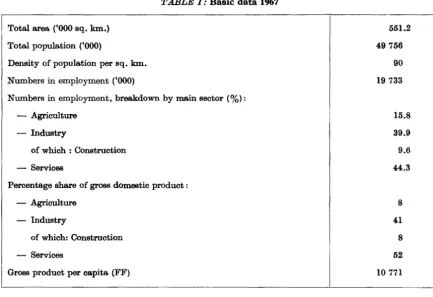
Total area ('000 sq. km.) Total population ('000)
[image:20.583.86.524.91.256.2]Density of population per sq. km. Numbers in employment ('000)
TABLE 1 : Basic data 1967
Numbers in employment, breakdown by main sector(%); - Agriculture
-Industry -Services
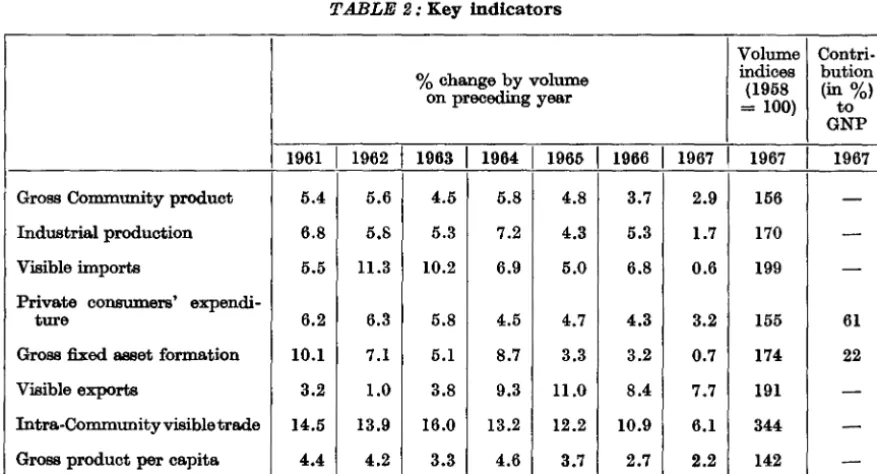
TABLE 2 : Key indicators
% change by volume on preceding year
1961
I
1962I
1963I
1964I
1965Gross Community product 5.4 5.6 4.5 5.8 4.8 Industrial production 6.8 5.8 5.3 7.2 4.3 Visible imports 5.5 l1.3 10.2 6.9 5.0 Private consumers' expendi·
ture 6.2 6.3 5.8 4.5 4.7
Gross fixed aaset formation 10.1 7.1 5.1 8.7 3.3 Visible exports 3.2 1.0 3.8 9.3 11.0 Intra-Community visible trade 14.5 13.9 16.0 13.2 12.2 Gross product per capita 4.4 4.2 3.3 4.6 3.7
18
I
1966I
1967I
3.7 2.95.3 1.7
6.8 0.6
4.3 3.2
3.2 0.7
8.4 7.7
10.9 6.1
2.7 2.2
1167.5
184 550
158
73 450
16
44
40
Volume indices
(1958
= 100)
1967
I
156
170
199
155
174
191
344
142
Contri-bution (in%)
to GNP
1967
-61
22
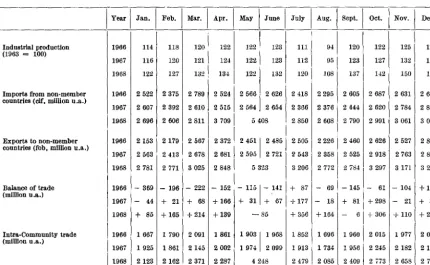
[image:20.583.85.524.526.763.2]-TABLE 3 : Basic monthly indicators
I
YearI
Jan.I
Feb.I
Mar.I
Apr.I
MayI
JuneI
Industrial production 1966 114 118 120 122 122 123 (1963 = 100)
1967 116 120 121 124 122 123
1968 122 127 132 134 122 132
Imports from non-member 19R6 2 522 2 375 2 789 2 524 2 566 2 626 countries (elf, million u.a.)
1967 2 607 2 392 2 610 2 515 2 564 2654
1968 2 696 2 606 2 811 3 709 5 408
Exports to non-member 1966 2153 2 179 2 567 2 372 2 451
I
2 485 countries (fob, million u.a.)1967 2 563 2 413 2 678 2 681 2 595 2 721
1968 2 781 2 771 3 025 2 848 5 323
Balance of trade 1966 - 369 - 196 - 222 - 152 - 1151- 141 (million u.a.)
1967 - 44 + 21 + 68 + 166 + 31 + 67 1968 + 85 + 165 + 214 + 139 -85
Intra-Community trade 1966 1 667 1 790 2 091 1 861 190311968 (mllllon u.a.)
1967 1 925 1861 2 145 2 002 1 974 2 099
1968 2 123 2 162 2 371 2 287 4 248
NOTES
Source : Statistical Office of the European Communities (SOEC).
Table 1
Total population at mid-year. Numbers in employment at mid-year.
Table 2
July
I
111
112
120
2 418
2 366
2 850
2 505
2 543
3 206
+ 87 + 177 + 356
1 852
1 913
2 479
EEC
Aug.
I
Sept.I
Oct.I
Nov.I
Dec.94 120
I
122 125 121 95 123 127 132 132108 137 142 150 147
2 295 2 605 2 687 2 631 2 675
2 376 2 444 2 620 2 784 2 837
2 608 2 790 2 991 3 061 3 008
2 226 2 460 2 626 2 527 2 849
2 358 2 525 2 918 2 763 2 876
2 772 2 784 3 297 3171 3 286
- 69 - 145 - 61 - 104 + 174
- 18 + 81 + 298 - 21 + 39 + 164 - 6 + 306 + 110 + 278
1 696 1 960 2 015 1 977 2 013
1 734 1 956 2 245 2 182 2 126
2 085 2 409 2 773 2 658 2 724
- The final column of the table gives a% breakdown of GNP at market prices by main categories of expenditure. The calculation of the Community's GNP has been made on the basis of official exchange rate.
- Industrial production: index of the Statistical Office of the European Communities, excluding construction, food, beverages and tobacco.
- Imports of goods (cif) from countries which are not members of the EEC, as shown by customs returns. Exports of goods (fob) to countries which are not members of the EEC, as shown by customs returns. - Trade between EEC member countries, as shown by customs returns relating to imports.
Table 3
- See note to Table 2.
[image:21.591.50.484.97.364.2] [image:21.591.53.484.99.364.2]A. Germany
In the spring of 1969, the German economy has been expanding very vigorously, the main factors being persistently high investment activity and a rapid expansion of private consumers' expenditure. Industrial production has soared, and the expansionary trend of imports has also recovered momentum.
As the year advances, the pace of growth of export demand will probably slow down, primarily as a result of the special measures taken by the authorities to ensure external trade equilibrium, and domestic demand will tend to take over as the main growth factor. Investment will continue to expand swiftly. Indeed, the expansion of expenditure on consumption is likely to gather momentum. As more and more firms are running at or near capacity, particularly in respect of manpower, the trend of domestic production will probably decline in vigour, although heavy investment by firms should bring fairly substantial productivity gains. The growth of imports, by contrast, will probably gather speed, notably as a result of the tax relief. The foreign trade surpluses will therefore fall appreciably, and this will go far to help improve the conditions permitting the maintenance of appropriate economic equilibrium in the country.
1. Recent developments
.The measures taken in the last two months of 1968 to cope with the monetary crisis and to safeguard the economic upswing through exter-nal trade equilibrium set some new policy targets and included the following:
For the trade surplus to be reduced, imported goods not covered by EEC market organizations will enjoy until 31 March 1970 a tax relief of 4 % (or 2 % for goods chargeable at the low TV A rate) while exports will be subject to a special turnover tax of the same rate. Exports which were covered by contracts con-cluded before 23 November and were shipped up to and including 23 December 1968 escaped the special turnover tax.
So that the inflow of short-term funds from abroad could be properly controlled, the consti-tution of non-residents' balances with German credit institutions and German bank borrowing abroad were made subject to authorization. Visible trade and service transactions and
long-term capital movements were not affected. With capital movements back to normal, this measure has since been withdrawn .
To attain the same objective, the Bundesbank fixed at 100 % the reserve ratio for 'an increase in credit institutions' foreign liabilities carrying the minimum reserve obligation.
The tax measures relating to foreign trade began to achieve the desired results only gradually. In-deed, as regards visible exports, they prompted a very rapid expansion in November and December, since firms were trying to speed up the execution of current export contracts. The tendency for exports to decline in the subse-quent months is in part a reaction to these antic-ipated export shipments but to some extent it may also reflect the first consequences of the increase in export prices.
The very buoyant trend of gross fixed asset for-mation was not affected by the measures to ensure foreign trade equilibrium. Investment in plant and machinery in particular continued to soar at the end of 1968 and in the early months of 1969. Building investment, which had been sluggish in 1968 for quite some time, was, by the beginning of the year, also back at the record (adjusted) level it had reached in 1966.
Since the end of last year, private consumers' expenditure in particular has also been making a vigorous contribution to overall economic activity. Although the rise in agreed wages has gathered little if any speed in recent months (in the fourth quarter of 1968 the level of agreed wages was only 4.7% up on that of a year earlier) actual earnings increased very appreciably. In the fourth quarter of 1968 total wages and salaries were some 10 % up on the level of the corresponding period of the previous year. There was at the same time a vigorous increase in the amounts which self-employed persons withdrew from their busi-nesses.
The tendency for shortages to occur on the labour market continued in the winter months. At the end of January, the number of unem-ployed, seasonally adjusted, was down to 240 000, while the number of unfilled vacancies was at the same time three times as large, although employment of foreign workers has again shown a distinct rise.
In general, domestic supply has adapted fairly flexibly so far to the rapid expansion of demand. Indeed, in November and December, industrial production showed an unusually sharp increase, probably in the main as a result of the drive by firms to speed up the execution of export orders. The rate of expansion shows in any
24
case that many industries still have scope for increases in production.
Imports have been rising very vigorously in recent months; this applies in particular to im-ports of finished goods, which have expanded under the influence of the tax relief on imports and the acceleration of consumer spending.
The price climate has deteriorated in recent months. From November to January, industrial producer prices rose by 0.7 %. The cost-of-living index has reverted to a more distinct upward tendency, although this is mainly attri-butable to a rise in food prices that are highly dependent on weather conditions and to higher rents partly due to the statutory increase in the interest rates charged on official loans for resi-dential construction. If these two factors are left out of account, the cost-of-living index in February was in fact somewhat less than 1 % up on the level of a year earlier, while the overall index showed a rise of 2.3 %.
The trend of the balance of payments has in recent months reflected the effects of the mea-sures to ensure external trade equilibrium and particularly to ward off speculative capital in-flows from abroad. As a result of the efforts by exporters to beat the tax deadline, the foreign trade surpluses climbed steeply in November and December but have since been showing a distinct tendency to fall. In the field of short-term capital movements, substantial funds have been withdrawn since the settlement of the monetary cr1s1s. Long-term capital exports at the same time remained at a very high level so that the overall balance of payments in Decem-ber-January closed with a deficit of DM 2 400 million. In the same period, the official gold and foreign exchange reserves of the Bundesbank actually declined by DM 8 600 million as the commercial banks were investing substantial funds abroad, particularly on the Eurodollar market.
Germany
BUSINESSMEN'S
V
I
E
WS
ON
THE I
N
DUSTRIAL SITUATION
Order- books A Stocks of finished products B
.I I r I I I I I I I I I I I I 3 - I- ... '
I I I I I I I I I I I I I I
below normal
below normal
---
--/ ___/ normal
I~ normal ....,.
~
...____
~
---
,_
-
__./...,.,
"""'...
--
-/;J lc
--1
---:-
I Iaoove normat
1- I I I I I I I I l I
aoove 1
~· I I I ~~-1 "I ·1 I
I I I I I
1967 1968 1969 1967 1968 1969
-Trend in production c Trend in selling prices D
,_' ~ '~ I
I dn~~~
I I I I I I I I I I I
! -·
nu c rwng
rr----
-
~ no chana~>.-, ...
___
v
-
-~
-I"
~ :..__._ ~
---.._
I
'----
U'D~-~
I. I
I I I I I I I I I I I I I I 1...-...-1 I T I I I I I ,up, I I I
1967 1968 1969 1967 1968 1969
Answers to questions in the EEC business survey, carried out in the German Federal Republic by the IFO-Institut.
GRAPHS A, B, C and D: The three colours (green, yellow and red) show the percentages of the three different
answers. The black curves, the scale for which is given between the graphs, show the figures obtained by adding
together the percentages weighted as follows:
by 0.03 for the answer "above normal", or "up";
j j j j j j j j j j j j j j j j j j j j j j j j j j j j
j
j j j j j j j j j j j j j j
j j j j j j j
j j j j
j j
Dematzd for and supply of goods and services
19661 1967 1 1968 1 19691
At
current %
change on preceding year prices
(in DM '000 million)
Volume Value Volume Value Volume
4 4 4
Exports 3 103.0
+
9.5+
8.0+
15.6+
13.1+
7.5Gross fixed asset formation 121.9 - 7.4 - 9.4
+
7.8+
9.7+
9Public current expenditure on goods and
services 75.5
+
3.4+
6.7+
0.2+
3.7+
6Private consumers' expenditure 274.9
+
0.6+
2.4+
3.4+
5.5+
6Gross national product 480.8 0
+
0.6+
6.9+
8.9+
5.5Imports 3 96.5
-
0.4-
1.3+
16.8+
13.2+
141 Federal Statistical Office, "Wirtschaft und Statistik", No. 1/1969. 2 Commission forecasts.
3 Goods, services and factor income. 4 At preceding year's prices.
Note:
(a) The difference between the figures for demand and those for supply is accounted for by movements in stocks.
(b) The estimates and forecasts are approximations based on certain hypotheses, generally mentioned in the Quar-terly Surveys. They have been discussed with the experts of the member countries but are established and published on the sole responsibility of the Commission.
2. Outlook
After the spurt in the (adjusted) trend of demand and production in the fourth quarter of 1968-a development reinforced by the spe-cial factors outlined above-the pace of growth must now, apart from variations, be expected to slow for a while; the endogenous forces making for expansion will at all events be strong enough to ensure that supply potential is exploited to a high degree. Allowing for the effects of the measures to ensure foreign trade equilibrium, the Commission at present reckons that from 1968 to 1969 the real gross national product will rise by some 5.5 %. In this
con-nection, on the demand side, the emphasis will probably shift increasingly from exports to domestic sales.
Despite the tax measures, however, exports will also go on rising-though at a rate that will be appreciably weaker than had been originally expected.
In 1969, the general economic situation will depend on the trend of gross fixed asset for-mation. The EEC investment survey carried out shortly before the monetary crisis in Novem-ber suggested that investment expenditure by industry would go up by some 20 % in 1969, while a year earlier the survey pointed to an expected rise of 8 %. The flow of domestic orders for key capital goods also reflects the very strong propensity to invest. The special tax hampering exports may no doubt induce some of the particularly export-oriented firms to exercise somewhat gl'eater caution in their investment decisions, but this is not likely to affect the growth of investment in plant and machinery to any significant extent this year: the propensity to invest is likely to be stimulated appreciably by the healthy profit trend in 1968, the high degree of plant utilization currently being achieved in most industries and the fa-vourable outlook for the expansion of domestic demand. The public authorities, too, will at the same time step up their investments vigor-ously, particularly if the December 1968 recom-mendation of the Financial Planning Council urging a considerable expansion of local author-ities' infrastructure investment is implemented.
Expenditure on consumption will be the second main factor behind the shift, expected for 1969, in the pattern of overall demand to a more vigorous expansion
of
domestic demand. Here, it is fairly certain that the wage and salary increases which have been agreed upon and defence expenditure which will expand more vigorously again will provoke a spurt in the growth of public current expenditure on goods and services. Private consumers' expenditure, too, will probably expand considerably. The trend of incomes, at any rate, will allow of such expansion, since, with employment and wages developing as at present, the purchasing power of the public can be expected to rise vigorously.Given the outlook for demand, there can be no doubt that employment will go up further and that the domestic supply potential will be utilized to a very high degree. As manpower reserves are practically fully deployed and the productivity gains resulting from rationalization investment by firms will make themselves felt only gradually, the growth of industrial produc-tion will probably lose momentum as the year advances. In the light of the seasonally adjusted
28
level of activity at the beginning of the year, "Dhe contribution of industry (as defined for the national accounts) can be expected to rise by about 7 %. The high level of domestic demand and the tax measures to bring down the prices of visible imports will probably lead to a distinct acceleration of imports. Apart from the fact that requirements in respect of raw materials and semi-manufactures are going up, there will now also be a stronger rise in imports of finished goods, for which some prices have already been lowered appreciably owing to the tax relief.
The foreign trade surpluses will accordingly fall very appreciably. Commission estimates suggest that in 1969 the external contributions as defined for the national accounts will be down by at least something between DM 4 000 and 5 000 million; in terms of volume this would corres-pond to an additional supply of goods on the domestic markets of the order of DM 6 000 to 7 000 million.
The supply increment will do much to help improve the conditions permitting the mainte-nance of domes& economic equilibrium. In this connection it is important to remember, however, that the price level will probably tend upwards, were it only for reasons not directly connected with the business upswing, partic-ularly since farm prices, whose decline contrib-uted substantially to the stabilization of con-sumer prices in 1967/68, will continue to rise for some time yet.
to the requirements of the current business situation, since this would mean retaining arti-ficially factors of production, and particularly labour, in these industries and impeding their employment in industries with a higher level of productivity and a brighter future.
In view of the inhibiting effects of the foreign trade measures on the trend of demand and prices (the real impact of which is, of course, very difficult to assess), those responsible for economic policy should be very careful in applying their instruments of overall guidance and should for the time being remain neutral in their action. This means that for the moment restrictive measures should be avoided, par-ticularly in the field of monetary and cvedit policy, a field in which restrictive measures, given the banks' wide liquidity margin, would in any case not take effect without a very con-siderable lapse of time, and this probahly only at the price of fresh obstacles to international payments.
To ensure that the forces tending to stimulate demand do not assume undue proportions, it is also vital that all general action over and above the action already decided upon at the beginning of the year should be avoided. Care should in particular be taken to ensure, through strict fiscal policy, that the overall rise in public expenditure of 7.5 %, for which provision was made in December, is not exceeded further, although the level of expenditure in 1968 was lower than had been forecast originally. Tax revenue exceeding the estimate should be used for anticipated debt redemption or the build-ing up of an anticyclical "buffer" reserve. As against this, the expansion of investment by the local authorities provided for in December is entirely justified in view of the capacity reserves that still exist in building and construction. Expansion is called for particularly because to defer these investments would entail a serious risk that the trend of public expenditure in 1970 will be running with, not against, the business cycle and will boost the expansion of demand. The budgetary measures should in any case be so designed as not to lead to an additional
increase in expenditure in 1970. In fact both the Federal Government and the Lander should budget for a substantially slower rise in expen-diture in 1970.
3. The economic situation in West Berlin
In 1968, Berlin's economy, too, was increasingly affected by the upswing of business activity in the federal area, although a certain disparity in the strength of the expansionary forces still persists.
Visible exports, however, did not start to ex-pand more rapidly until the closing months of 1968. Deliveries to West Germany, by con-trast, showed a decidedly lively trend throughout the year.
Gross fixed asset formation made a very con-siderable contribution to activity. Indeed, in-vestment appears to have gathered additional momentum in the past few months. This applies to both expenditure on plant and ma-chinery and building investment. Private consumers' expenditure is also tending to rise.
There was an aggravation of strain on the labour market. In January, the unemployment rate was down to 0.8 % of the number of persons in paid employment. The number of persons employed in Berlin industry in the fourth quar-ter was 2.5 % up on the level of the corres-ponding period of the previous year.
Industrial production has been expanding vigor-ously, with the growth of production in the electrical engineering and chemical industries being particularly rapid. Given the compara-tively favourable trend of incoming orders, par-ticularly to these industries, the outlook is one of rapid growth in the months ahead. Whether the scope for expansion offered by demand will be actually exploited will, however, largely depend on investment policy and particularly on moves to step up investment expenditure in
Germany
ECONOMIC INDICATORS
Industrial production
150 1963
=
100 800 Labour market (thousands)~
~140 _j
700
v
600 . .,[nfil h•CI ~~
l..-1
v
]
...
..._v
130
120
110
'
Lv
I'\
v
'----.
~
.L'f'
~
v
~
LV
-
r"'-1'""-I'-
1:-::_500
400
300
200
_../ ]JOt ap ~lie tlO ~!•
!00 100
Wages and consumer prices
160 1962
=
100 Bank lending DM '000 million!50 -~-
I~
v
i"""'j..-w
pige140
130
80
75
v
I~
~
~
JV
I'll. f\_j
v v ' -
r-v
70
65 120
-
f-ItO 60
:p F~"c:
100 55
Trade with non-member Trade with other member
300 countries million u.a.
I_ 900 countries million u.a.
600
500~-r--r--+--~~--,_--r--+--+--+--,_~
800
l.jVII ... VIII"'"IX-"X -"XI...IXII,.jl ,.jll .,j,lll I..OV V.,j,V . . I .~IV~IIII,j,X X,j,X~IXI~I l,j,II ... III.I.WO.V.I.VI.I.VII ... VIII ... IXI.XI..XIIooiXII,.jl ..Ill .,j,III..OIV ~V VI 400 ":',.'::::VII~IIX~X~X"'::IX:'-11 1"":1~1 1:'-:11 1:'-:V V~V~I VI-:!"IV:'III-::"IX·X-::"XI-:::'XII~I'-II~III~IV~V"":V~IV~II V::"III·IX ... X -::'XI ~XII_I_.II ~III~W~V"::".
1966 1967 1968 1969 1966 1967 1968 1969
NOTES:
Source: Statistical Office of the European Communities (except as otherwise indicated).
Graph 1. Trend curve; estimate established on the basis of indices adjusted by the SOEC for seasonal and
for-tuitous variations (excluding construction, food, beverages and tobacco).
Graph 2: Series adjusted for seasonal variations (Three-month moving averages).
Graph 3. Source : Statistisches Bundesamt. Cost-of-living index at middle of month; index of average hourly
gross earnings in industry (including construction).
Graph 4. Short-term loans to business and private customers within the country.
Graphs 5 and 6. Series adjusted for seasonal variations (Three-month moving averages). Exports fob, imports cif.
Conversion at official exchange rate.