Kinds, Composition, and the Identication Problem
MSc Thesis (Afstudeerscriptie) written by
Elbert J. Booij
(born January 8th, 1963 in Baarn, Netherlands)
under the supervision of Dr Ing Robert van Rooij, and submitted to the Board of Examiners in partial fulllment of the requirements for the degree of
MSc in Logic
at the Universiteit van Amsterdam.
Date of the public defense: Members of the Thesis Committee:
August 28, 2013 Dr Maria Aloni
Abstract
Kindsalso known as natural sets or universalsare a very intuitive assumption about the way the world is put together. As a piece of metaphysical theory, however, they give rise to the Identication Problem: which of all sets are the ones that in fact qualify as kinds? In this thesis an answer is given starting out from the assumption that kindhood always coincides with similarity. From this it follows that similarity must be similarity with respect to, and propertieskindsmust be arranged in similarity systems.
Contents
1 Introduction 3
2 Similarity 10
2.1 Introduction . . . 10
2.2 Saturation . . . 12
2.3 Disjunction and Negation of Kinds . . . 14
2.4 Comparison . . . 16
3 The formalism Φ 18 3.1 Introduction . . . 18
3.2 Inferences . . . 20
3.3 Syntax and Semantics . . . 22
3.4 Synonymy . . . 25
4 Parts and Wholes 29 4.1 Introduction . . . 29
4.2 Mereology inΦ . . . 31
5 Composite Kinds 36 5.1 Introduction . . . 36
5.2 Quasi-atoms . . . 38
5.3 Primitive Relations . . . 42
5.4 Numerical Abstraction . . . 47
6 Conclusion 50
A Mereological Predicates 54
B Proofs of Chapter 4 55
Introduction
Sets play it fair. If we seek to categorize the entities that inhabit our world then, by its own unbiased nature, set theory has it that every collection of entities in full equality is worth to be called a set. This assumption, the result of keeping all options open, leaves a vast space of homogeneity, reminiscent of the description in the famous nal scene from Derek Jarman's lm Wittgenstein:
"A world purged of imperfection and indeterminacy. Countless acres of gleam-ing ice stretchgleam-ing to the horizon."
This is the default supposition, securing that no unwarranted prior structure is imposed on the domain of interest.
Nature itself, however, is prejudiced: it has strong preferences for this collection of things over that, preferences that make themselves known by the patterns and regularities found in the world, the fact that some conditions entail others, while yet others are ex-cluded; and by our human tendency to classify along certain lines, to perceive similarity here and contrast there, to make this distinction, but not that. Kinds, or universals, are metaphysical terms for such `natural' sets. David Lewis (e.g. 1986b) spoke of properties, which could be sparse, as opposed abundant. Sparse properties, universals, and kinds, are all terms meant to capture the same notion, albeit not necessarily by the same theoretical framework.
Among the innumerable possible collections of entities only a very small minority be-longs to these natural sets. Whoever takes kinds seriously therefore has to face up to the question of how to identify them. How are we to know if a certain well-dened collection of items is a kind or not? It is by no means generally agreed upon that logicor even sciencehas any business here and in the analytic tradition there is even a certain hostility towards the subject, as if interest in it betrays a mildly obscurantist attitude. Quine, in one of his famous essays (1969) went as far as to state that:
In general we can take it as a very special mark of the maturity of a branch of science that it no longer needs an irreducible notion of similarity and kind. (p 137, 138)
The latter concepts are, in Quine's words, alien to logic and set theory. And there is no denying that in rst order logic, that great cathedral of formal thought, there is nothing to account for the standing out of the putative kinds.
All this is about the relation between logic and metaphysics, which is a delicate one. As Bar-Am (2008) convincingly argues it was extensionalism, the treatment of logical terms as being individuated solely by their extension, that freed logic from the metaphysical
CHAPTER 1. INTRODUCTION 4
commitments that had kept it bogged down ever since Aristotle, and made possible the rapid development that followed. According to Bar-Am it was George Boole who was, more than anyone else, responsible for setting this process in motion. Extensionalism replaced Aristotelian essentialism:
It was by reducing logic to the study of extensions that Boole was able to transcend, by default almost, some of Aristotle's most stubborn essentialist presuppositions, thereby inaugurating a new era in the study of formal logic. More specically, Boole succeeded in separating the study of valid inferences from the Aristotelian endeavor to provide the complete taxonomy of all things (and of all things known) that he conated as both logic and science. (p xii)
The result of this was a revolution in both logic and mathematics of unprecedented mag-nitude. But there was a second result. In due time a deep suspicion got foothold against metaphysical ideas that had the ambition to `know better' than mere logic. There were ex-ternal factors pushing in the same direction, especially the revolutions in empirical science around the turn of the century. Extensionalism, the doctrine that had proved so fruitful to logic, also became the only game in town with respect to metaphysicsto the extent that anyone was still interested in metaphysics in the rst place!
As with most positions seeking the extreme of a scale, there is room for qualication. There are good reasons to view the attitude as exemplied by the above quotation from Quine as the manifestation of a misconception which is the mirror-image of that observed by Bar-Am. The emancipation of logic from metaphysics, which made logic thrive, has not been accompanied by a parallel emancipation of metaphysics from logic. There was, so to speak, a changing of roles between master and slave, but otherwise the same entanglement as before. For although it may be true that kinds and similarity are alien to rst order logic, they are certainly not alien to sciencewhich is a mild way to put it. If a mature science, as Quine claims, no longer needs these basic concepts, then this maturation is quite a dramatic process, making the thing undergoing it totally unrecognisable from what it was before. The branch of science having reached this nal stage would no longer consider this way of categorizing objects more salient than that (e.g. the class of all electrons v. the class of all electrons plus the Queen's favourite horse). It would eectively mean that those working in the eld would stop classifying! But classifying is not only the very rst thing that every branch of science starts with, but also its ultimate goal. There is a clear sense in which all the activity of science reduces to replacing existing classications with better ones, where `better' means: more basic, more all-encompassing, more projectible, with sharper boundaries, and fewer of them.
There can be no doubt that Quine was well aware of all this. He generously and rather exhaustively discusses what many reasons there are to accept kinds, convincingly showing that science is all about rening the concepts of kind and similarity, only to reach, in the very last paragraph, the above-cited conclusion that they will eventually go awaya non sequitur so spectacular that it is almost heroic.
Quine's (1969) ontological relativity is mainly about communication, about agreement as regards meaning. This does not necessarily involve abundance of properties. One could admit kinds, and still claim that every matching of vocabulary to kinds has several possib-ilities of recombinant matching that work just as well and are empirically indistinguishable. Putnam's paradox is a far more radical way to put the problem. Via a detour along the Zermelo-Fränkel axioms and Löwenheim-Skolem's Theorem Putnam (ibid.) notices that the fact that axiomatic systems in logic may have unintended interpretations brings trouble for the Philosophy of Language as well. The ZF-axioms have models that, contra common wisdom and intuition, are denumerable. This is certainly not what we mean by those axioms: the set of real numbers is famously of higher cardinality. But these countable models have a slightly perverse avour. The 1-1 correspondence guring in them is in fact a stronger condition and therefore countability is not `real' countability, but something formally analogous; hence the `unintended' status of such models. But then, Putnam asks, if axioms cannot x a reference, what else could? This problem easily translates to the relation between natural languages and the physical world. Language cannot x reference by itself. No metaphysical glue! What is needed is something extra: an interpretation. But what mysterious sort of object could that be? Is it possible to provide such an inter-pretation in naturalistic terms, without embarking on radical vericationism ("as long as the truth of sentences can be tested, no one cares about their `true' reference!")?
Putnam's own reply is in the deeply Wittgensteinian mood that has haunted much of Twentieth Century analytic philosophy:
To speak as if this were my problem, "I know how to use my language, but, now, how shall I single out an interpretation?" is to speak nonsense. Either the use already xes the "interpretation" or nothing can.
Nor do "causal theories of reference", etc., help. Basically, trying to get out of this predicament by these means is hoping that the world will pick one denite extension for each of our terms even if we cannot. But the world does not pick models or interpret languages. We interpret our languages or nothing does. (p 482)
The problem is real enough, but this solution will only please the desperate. For what could be so special about `us' that we are able to do things that `the world' makes no room foras if we hover above the world, as outsiders? Really naturalistically-minded philosophers should eschew such recourse to exceptionalism. If we interpret our languages then it must rst be among the features of the world that our languages can be interpreted. The existence of kinds seems to be decisive in providing this condition. Sparseness of properties does not guarantee the working of metaphysical glue, even though abundance plainly guarantees its failure. But it does make a dierence. If the number of exten-sions eligible for being named is limited, then the opportunities for alternative word-kind matchings that remain hidden shrink signicantly. An even more important additional cir-cumstance is the correlation of kinds. Their extensions tend to be related to one another in `nice' ways, like inclusion (every tree is a plant) and complementary union (every human being is either male or female). This, as I see it, is the background of the often-quoted signicance of kinds for the understanding of causal relationships. To word such relations we need kinds.
CHAPTER 1. INTRODUCTION 6
language, the very intelligibility of words and signals, is there only thanks to the fact that the world is no `gray goo', but has structure. This structure was not made by language; it is what makes language possible. To explain why it is there, is a challenge of the same order of magnitude as that of explaining why there is something rather than nothing. But to describe it is a task that is not necessarily beyond us.
The most pressing problem with respect to kinds, to my conviction, is what I shall call the Identication Problem. Is there a systematic, rather than impressionistic, way to identify extensions of kinds? Specically, given a suggested kind, is there a procedure, at least in principle:
(1) to tell whether it really is a kind, and
(2) to nd out, of a given object, if it belongs to it?
Notice that for abundant properties no identication problem arises, since every extension is as good as any other. Anything goes! Not so with kinds. If some sets are `more equal' than others, then there is something to learn: Which are the ones?
It is easy to underestimate the full scale of the query. Electrons constitute a kind, and so do lumps of goldfair enough. So long as we stick to small particles (or amounts of them) the choices are not hard to make. But do not pebbles constitute a kind as well? Do octagons, tigers, neutron stars? Consider the cup and saucer before me: are they two of a kind? And what about Ferrari's, or Ecuadorians? It can be legitimately asked if we need kinds for all of these cases, but scaling up from quarks to atoms, molecules, bres, tissues, etc., there does not seem to be an obvious way to draw the line. Almost everything we would like to classify is made of smaller parts that determine its nature. If any meaningful answer to the Identication Problem is to get o the ground, it must include an account of how parts of some kind together make a whole of some kind, by some kind of coalescence. Therefore my theorizing will culminate in some notions about composite kinds. To clear the ground for this undertaking, however, we must rst face the problem on a more basic level. What is it for a set of objects to form a kind, composite or otherwise?
Some authors, notably Armstrong (1978, 1997), turn to universals for an answer. Clearly my use of the term `kind' is directed towards the same phenomenon, yet my strategy will not be to view, as Armstrong does, universals as real entities, doing the identication by being somehow, self-identically, `in' the dierent objects they instantiate. Even though I prefer my ontology to abstain from stipulations explicitly outlawing such constructions, I shall not use them for explanatory purposes. On the contrary: I will show that, especially in the case of complex entities, the theoretical problems that arise with theirstructuraluniversals should be blamed on taking the latter to be real objects, rather than a façon de parler. Instead of inventing new entities to order existing ones it is better, to my mind, to focus on what we know about the the latter themselves. My kitchen knife is sharp and therefore it can slice a cucumber easily. Although sharpness is a perfect universal, this fact does nothing to make the knife's being sharp anything separable from the knife as it is all by itself. Being sharp is what the knife is, not what some other entity is, and it is independent of other things's being sharp as well.
is dedicated to bring some light in these areas, so I gladly pass the buck). Suce it to say that it is not only, not even primarily, mental concepts that I want to consider here. I take it as a given that symbols of various nature, for us humans, have the power of representing. They often do so in a strongly systematic way. Pictures, scale models of buildings, Arabic numbers, colour samples, are all vehicles of representation that need only a small amount of precognition to exert unlimited expressive power. In this they dier from e.g. the system of personal identication numbers, that needs a huge database to function. Concepts have an easy-going way of matching their denotations; they can be reused indef-initely, without new information. And concepts are one-over-many! In fact I know of no other, non-Platonic, ontologically irreproachable, category of things that have this feature. Concepts are by far the most easy-to-handle access to the phenomenon of universality that we have. Even though we do not quite know how they work, we use them on a daily basis. Concepts do not always express kinds, but for the kinds that we humans can handle we typically have concepts, so it is possible to envisage a language that works with kind-concepts only. In fact this is how I will proceed: I shall develop a formalism, to be called Φ, designed to do just that. Despite the misgivings I expressed about metaphysics being equated to logic, I am strongly committed to logic as a tool for doing metaphysicsand maybe the word `tool' underdescribes the full signicance of this part of the endeavour. Metaphysicians, by the very nature of their occupation, must make do without the stern tutor of empirical observation. Besides common sense logic is all they have by way of an objective guide. SoΦwill be a full-blown formalism, providing a certain standardisation of the conceptual apparatus, thus making it easier to sharpen our intuitions about kinds, and to reect on them. This will help us to display what I take to be the heart of the matter, viz. the relations and correlations between kinds, and subsequently the way complex kinds emerge out of simpler kinds. We shall need this if we want to solve the Identication Problem not only for simple entities, but alsoin principle at leastfor cats, houses, and lumps of gold.
This notion of concept, therefore, will be my rst gateway to understanding kinds. The second is similarity. Lewis (1986b) uses this term when he explains what it is for a property to be (abundant or) sparse:
The abundant properties may be as extrinsic, as gruesomely gerrymandered, as miscellaneously disjunctive, as you please. (...) Sharing of them has nothing to do with similarity. (p 59)
The sparse properties are another story. Sharing of them makes for qualitative similarity (...). (p 60)
Even for hard-boiled extensionalists similarity is a strong intuition, stronger, it seems, than that of kind per se (this is remarkable: if it is really true that the extensions of sparse properties are kept together by similarity, then the case for sparse properties is as hard as that of similarity). Carnap's resemblance nominalism was an attempt to reduce kindhood to similarity relations, later shown, by Nelson Goodman (1951), to be logically inadequate. Rodriguez-Pereyra (2002) has more recently presented a new version of resemblance nom-inalism, where similarity does not only hold between individuals, but also between pairs of them, and pairs of pairs, etc.
CHAPTER 1. INTRODUCTION 8
to its being one of a pair that is similar to other such pairs; but only to its shape and material. Even if resemblance nominalism should come out right logically, metaphysically it turns the world upside down. Two sharp knives are not sharp because they are similar, but similar because they are sharp!
This is not to say that similarity is instead reducible to kindhood. Supercially it seems ne to hold thatx is similar toyi both have a property in common. Yet, on closer
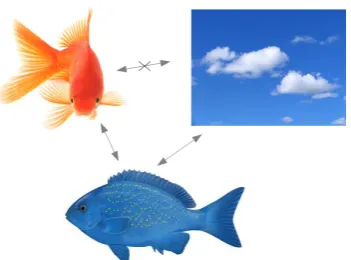
inspection, this is unlikely to work, the briefest objection being that it is hard to nd two objects that are not similar under this construal. Most pairs of objects, as wildly unalike as you please, share at least one property, even if trivialities like being self-identical are left out. The discriminatory power of such a criterion falls far short of what we are looking for. A more subtle objection is that similarity, thus understood, is a relation that is reexive and symmetric, but not transitive. Ifxis similar to y(because both are blue), andy, toz
(because both are a sh), then it is still possible thatxand zare not similar (becausexis
the sky andzis a goldsh). This, I think, squares badly with our intuitive understanding
of what similarity is.
So what do kinds and similarity have to do with one another? Al least this: for both we have concepts. `Similarity' is a concept just like `red' and `goldsh', only a relational one. Just like single entities may instantiate redness and goldshhood, pairs of them may instantiate similarity. As mentioned before, what is characteristic of those special sets that we call kinds is that there are correlations between them. In this case the correlation is particularly straightforward: instantiation of the same kind by a pair of entities will correlate with instantiation of similarity.
This, then, will be the central assumption underpinning my theory about identication: kindhood and similarity invariably go together. No kind without similarity, no similarity without kind! This may sound like a truism: similarity and kindhood are often viewed as trivially interchangeable. Yet I shall argue that the relation is really an interesting one, and that appreciating it correctly leads much of the way to solving the Identication Problem. I will also show that, given the said assumption, similarity must be similarity with respect to. There cannot be one sort of similarity doing all the work that has to be done.
A sound understanding of kindhood and similarity alone, however, will not help us to explain how these categorization principles apply to everyday objects, and why. Most of the objects we are acquainted with are complex, they are composed of parts. Now if we know of such a composite entity what kind of entities its parts are, and in what kind of way these parts are put together, is there much more that we could wish to know about itat least in those terms, at least locally?
have composite properties!
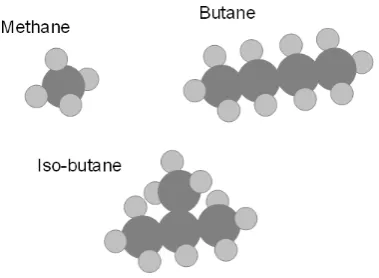
If this is so, then the solution of the Identication Problem comes down to analysing concepts up to any point where the kindhood of the constituent parts is of a simple nature. What I shall demonstrate is that the existence of composite kinds can be indeed be deduced from that of simple kinds, and that this deduction is not trivial. But it can be done making use of classical mereology only, and according to this line of reasoning composite kinds are in no crucial way dierent from other kinds. They behave in the same way, and have the same sort of similarity-relations keeping the things falling under them together. Thus I will argue that structural universals, as understood by realists like Armstrong, are of little additional value. We can solve the Identication Problem without them, and they bring problems of their own, as the discussion about methane as a structural universal bears witness to (Lewis, 1986a; Armstrong, 1986; Pagès, 2002; Kalhat, 2008; Mormann, 2010, 2012; Hawley, 2010). These are problems that should not be there; that I take to be an artefact of the theory. There is no straightforward way even to reduce structural universals neatly to their constituting universals (e.g. methane, to carbon and hydrogen), which does not involve what Lewis calls `magic', or at least non-classicaland, to my mind, quite unnaturalversions of mereology.
Chapter 2
Similarity
2.1 Introduction
My claim has been that the structure of the world is such that kinds and similarity are companions. For every kind there must be some sort of similarity, and where similarity manifests itself, there must be a kind. I have said some words about the relation between the two and here I want to summarize them by the following conditions for a credible concept of similarity:
(1) Similarity is a relation between two entities, coinciding with their being of the same kind.
(2) Similarity is an equivalence relation. (3) Similarity is an abstraction.
Condition (1) is hardly open to dispute: the being similar of two entities has to do with their sharing some natural property. So, it could be suggested, why not keep things as simple as that: two entities are similar i they share some natural property? Let us call this idea of similarity E-similarity.
In the next chapter I shall develop a formal notation especially suited for working with kinds and as a matter of convenience I already want to use some of it here. The rst convention with respect to this notation is this: predications likeP(x) will be used only if the predicate symbolP represents a kind, a natural property. So my use of Sim(x, y) for similarity between entitiesx and y already betrays my taking this relation to be natural
as wella position I do not expect many complaints about. I will furthermore use the symbol ⇒ for inferential relations. In this symbolism, therefore, E-similarity is similarity such that, for anyP, the following inference holds:
P(x)·P(y)⇒Sim(x, y)
Condition (2) is at the heart of the claim we are about to work out. If similarity is tied to kindhood, then it had better be an equivalence relation; shared membership of a given kind evidently is. Condition (3) is less straightforward, but equally important. Abstractions, as I want to understand the term, are kinds that unify a set of `underlying' kinds, without being reducible to one of them. Abstraction is never trivial: there can be no `similarity in respect of being red' that all and only means that the two relata are both red. If there is a similarity that two entities share thanks to both of them being red, it should be possible,
Figure 2.1: E-similarity
at least in principle, that two entities be similar in the same sense, but thanks to other properties. (Their being both blue is an option that comes to mind.)
So can we arrive at an understanding of similarity for which these three conditions hold simultaneously? Applying (1) in the most simple-minded way yields E-similarity. Unfortunately this construal will, in most models, violate (2): it gives us a relation that is reexive and symmetric, but not transitive. If alsoSim(y, z), it might be due to a dierent property thaty and zshare, e.g. Q(y)·Q(z). But then why shouldx andz have to share
a property?
This might lead one to cast doubt on (2), but I think this doubt is unwarranted. Al-though, as the argument just given shows, (2) is a substantial claim, it is not a particularly venturous one. Similarity and equivalence are very closely related conceptswithout much exaggeration one could say that the formal notion of equivalence has been invented to cover the intuitions behind similarity. Transitivity is an essential part of them. I feel honoured to have someone of the stature of Euclid to my witness, whose Book of Elements, Common Notions, opens with exactly this maxim:
Things which equal the same thing also equal one another.
Surely there are similarity-like concepts that are not transitive: near-similarity for instance. Yet if we take a closer look at the various versions of near-similarity we nd no reason to relinquish the demand for transitivity. First, near-similarity is `near-transitive': Ifx looks
a lot likey, and y, a lot like z, thenx cannot look too dierent from z (pullingx towards y, andy towardsz, is somehow also pullingxtowardsz). Second, it is slightly odd to have
a concept of near-similarity without the (in all likelihood simpler) one of exact similarity. At the very least it should be there as a limiting case.
We could of course tinker with our models a bit to enforce transitivity. Given P(x)·
P(y), the way to preventQ(y)·Q(z) (Q6=P) is to prevent Q(y), and a slightly odd but
instructive way to do this would be to demand that every individual necessarily have one property at most. A more convincing variation on this design is obtained by switching to a new set of properties, each of whom is really the conjunction of every property (in the old sense) an item has. Clearly of this new set everything has only one property. Call this A-similarity; it produces a beautiful equivalence-relation: a partitioning of everything into classes of indistinguishable entities. Of course A-similarity is too limited; yet every credible set-up of similarity will also include the borders that A-similarity draws.
The alternative is to tinker with the concept of similarity itself. If we do not want to letQ(y)·Q(z) spoil the similarity thanks to P(x)·P(y), we could say that there is more
CHAPTER 2. SIMILARITY 12
respect to this or that. The obvious rst attempt should be to distinguish similarity with respect to any of the original predicates. SoSimP(x, y) will mean that either bothx and
y areP, or none of them are.
This proposal, however, still has a fatal aw. In most models it violates condition (1) since it makes things similar that have nothing in common. Ifx is notP and neither is y
(and both have nothing in common otherwise), then they are nevertheless similar in respect ofP! Step two, therefore, could be that, for every original predicateP, its complement,P,
is introduced as a predicate as well. ThenSimP(x, y) entails that either P(x) and P(y),
or P(x) and P(y). Notice that, instead of SimP, we could as well writeSimP now; they
are the same. Better still, to avoid biases, we could writeSimP, withP={P, P}.
This, I think, begins to look like an acceptable notion of similarity. It produces equi-valence relations and, by conjunction, also a host of new similarity relations, each as good as the original ones, including (by conjunction of all of them) A-similarity.
2.2 Saturation
This has been achieved thanks to the fact that we have adjusted the models so as to make them saturated with respect to their original predicates. I shall use this term to indicate the condition that for every predicate there is an alternative. In this case, whatever is not
P isP and nothing is bothP andP; and this goes for every predicate.
An element, however, has been slipping into the argument the impact of which should not be taken lightly: the assumption of negative predicates. This decision has two reper-cussions. On the metaphysical level it means that, since predicates stand for kinds, we have committed ourselves to the existence of negative kinds as well, a famous non-starter according to most of those studying the matter; I shall return to this issue shortly. On the logical level these predicates, at rst glance, look perfectly well-behaved. They are not. The troubles surface immediately once we consider combined similarities, like similarity with respect to P and Q. If we accept conjunctive kindsas most authors happily do
this should be unproblematic: ifP and Qare original predicates, then the predicateP·Q
must be admitted also. Following the recipe described above, similarity in respect ofP·Q
becomes SimR, with R = {P ·Q, P·Q}. On the other hand, taking into account that
similarity with respect to P is the same thing as similarity with respect to P, analogous
for Q, it would be strange if similarity with respect to P·Q would dier from similarity
with respect toP·Q. ButSimR0 (R0 ={P·Q, P ·Q}) is certainly not the same asSimR.
Surely we could opt for multiple similarities in case of combinations of predicates (we would have four of them, in this example) but the intuitive credibility of this arrangement is low. There is little doubt that the similarity we are looking for is a simple conjunction ofSimP andSimQ. Now this conjunction isSimR00, withR00={P·Q, P·Q, P·Q, P·Q}.
Instead of one complement P·Q we have three distinct alternatives lling up the space
aroundP·Q.
This, as I see it, brings the following new insight. Similarities likeSimP, as construed in
the last chapter, are similarities with respect to binary conditions, but this is by no means essential. Instead of stipulating that everyP be complemented with its own P, we could
make the more general demand that the original predicates come in sets of alternatives such that every individual must instantiate exactly one predicate of the set. The cardinality of this set can be two, but equally well any bigger nite or innite number. A set of this sort plus its similarity relation will be called a similarity system: S=hP, SimPi.
seems that every (part of) every material object has to be coloured one way or another. Here the number of elements in the set of alternatives is rather large: the human eye can distinguish several millions of dierent shades of colour. Now colours are very much conditions belonging to the `manifest image', but in theoretical physics similarity systems are abundant: charge, mass, spin, spacial location, etc. Similarity systems, especially those with a large or innite number of alternatives, are reminiscent of dimensions1, but maybe a better identication is with determinables and determinates, as the terms were introduced by W.E. Johnson (1921). Here the similarity system is the determinable and the elements of the set of alternatives, the determinates2.
There are, apart from the above exposition about similarity, two independent reasons to take saturation seriously. First, suppose we have two objects: A is white, marble, and cubic, and B is marble and cubic only. Can this really be the case? I would say that, if B is not white, it must have a dierent colour: black, for instance. It seems to be so that you cannot just take away a property without replacing it with something else. The descriptions of A and B are perfectly acceptable concepts, with that of A having a higher degree of specicity than that of B. But two objects one of which just has one extra property? Assuming complement properties, as we did with the introduction of the P's,
is the more intuitive line, but then we conjecture the existence of a new, real property exactly one, moreover. The mere lacking of a property does not automatically create its complement as a replacement. Therefore my hunch is that our willingness to acceptP-like
properties is really the assumption of saturation.
The second point is epistemic in nature. It is no small riddle that humans can perceive things to have certain properties, but it is not even more puzzling that we can perceive things to lack properties? How can we see absence, given that absence is not something itself? The chair a few meters from me is not green. How can I tell? The answer is simple: because it is red! How can I know that there is no rhinoceros in the room? Because I see that every portion of space big enough to be a rhinoceros is transparent, and the stu such creatures are made of is not. For the same reason I cannot perceptually assure myself that there is no ant in the room, or no ghost.
The second argument has a loose end that I will shelve now, but that will have to be dealt with some day. It is all ne that the redness of an object excludes its being green, but how do I know that? For if I do not have this sort of information, the argument gets nowhere. This is an extremely delicate matter: it has to do with necessity or with a priori knowledge, or both. The issue is deserving of further investigation, but it will not be done in this text.
The important consequence is this. If saturation is assumed, if predicates line up in sets of alternatives, then they can be categorized in types. That is what the predicates in the example just given diered in. Types will be represented by the set of predicates belonging to them in brackets e.g. (P). A concept will be declared of type (P) i every argument in it is predicated in terms ofP. Concepts can be specic in terms of more than
one type, in which case we simply write, e.g.(PQ).
Not every concept has a type. IfP6=Q then:
P5(x)·Q1(x)
1The association is natural, but the analogy is convincing only where there is a xed basis. If dimensions tend to `merge' (cf. colour) it is better to view them as all belonging to one similarity system.
CHAPTER 2. SIMILARITY 14
(P5 ∈P,Q1 ∈Q) is of type (PQ), but:
P5(x)·Q1(y)
has no type, since the argumentx is not specied in terms of the set of alternativesQ.
2.3 Disjunction and Negation of Kinds
A small but signicant step towards solving the Identication Problem is to reach a verdict on whether the set of kinds is closed under conjunction, disjunction, and negation. This is an old conundrum, not to say a threadbare topic in metaphysics. The intuition is that it is indeed closed under conjunction, but not under the other operations. Notice that innite disjunction and (in combination with conjunction) negation wipes out most of the border between sparse and abundant properties, so let us concentrate on the nite case. Let us take two kinds,P and Q, and have a look at the following claims:
(4) P (not beingP) is a kind.
(5) P ·Q(being P andQ) is a kind.
(6) P ∨Q (beingP or Q) is a kind.
Which of them is true? If we think extensionally then all three are, maybe with the restric-tion that the extension should not be empty. If we let our intuirestric-tion run freely, however, then (5) is true, maybe with the restriction thatP andQshould not be contradictory, and
(4) has some credibility. But (6) is certainly false. Disjunction is the least popular of kind synthesizers. In Armstrong's (1991) words:
Consider an athat has property P but lacks Q, while bhasQ but lacksP. Is
it not a joke to say that they have (P∨Q) in common? (p 197)
This way of pressing the point it is convincing, but only because it is restating a powerful intuition; not because there is any deductive force in it. Most arguments against disjunctive kinds suer from this subtle circularity. The claim is that P ∨Q cannot be a real kind
because something that isP and something that isQneed not have anything in common
but this is because we do not accept that kinds are closed under disjunction! A very similar sleight of hand can be seen in Armstrong's (1978) appeal to the causal powers of disjunctive kinds:
Suppose, again, that a has P but lacks Q. The predicate `P∨Q' applies to a.
Nevertheless, when a acts, it will surely act only in virtue of its being P. Its
being P or Q will add no power to its arm. This suggests that being P or Q is not a property. (p 20)
But causesof all thingsare notorious for their ability to get intractably entangled. If sixty-two bullets hit a man, which of them can be said to have caused his death? The sixty-second bullet, as it seems `adds no power' to the other ones in the volley. I share Armstrong's unease about causal powers of disjunctive origin, but I do not know how to communicate it to someone who simply claims that being hit by one of those bullets causes death. Or that being sick or poor causes misery.
similarity is an equivalence-relation, then every kind must nd its place in some similarity system. If we can show that this condition is unproblematic for conjunctive kinds, but at least unlikely to obtain for disjunctive and negative predicates, we have what we want.
If we have a model that is saturated, then for any concept P(x) (P ∈ P) there will be a similarity systemS=hP, SimPi (#P>1) such that P ∈P. For convenience we shall
write P1, P2... for the elements of P. First we shall show that the most straightforward way to construct a similarity system in which the putative new predicates t works only for conjunction:
• Negation. Suppose that for anyP ∈ P there is a predicateP such thatP(x)i not
P(x). Assume that there is at least one similarity system, let it beSP, with#P>2 (if there is more than one at least binary system then this condition is already met by their conjunction). By saturation every entityamust instantiate one of the concepts
inP, so let us say P1(a). But then neitherP2(a) norP3(a), henceP2(a) and P3(a). Therefore R = {P|P ∈ P}, as it members P2 and P3 are not mutually exclusive, does not constitute a set of alternatives for a similarity system.
• Conjunction. Suppose that for any P, Q∈ P there is a predicate P ·Q such that P ·Q(x) iP(x)and Q(x). LetR={P ·Q|P ∈Pand Q∈Q}. ClearlyR is a set
of alternatives: by saturation every entity amust instantiate exactly one element of
Pand one, ofQ, hencePi·Qj(x)for exactly one pairi, j. The corresponding relation
SimR(x, y) is coextensive with SimP(x, y)·SimQ(x, y). Thus S = hR, SimRi is
a similarity system for any given P ·Q. (Remark: if P = Q then the extension of
many of the new predicates will be necessarily empty. This does not pose a problem for their existence.)
• Disjunction. Suppose that for any P, Q ∈ P there is a predicate P ∨Q such that P ∨Q(x) i P(x) or Q(x). By saturation every entity a must instantiate one of
the elements of P, so let us say P1(a). But then also P1∨Q1(a) and P1∨Q2(a). Therefore R = {X∨Y |X ∈ P andY ∈ Q}, as it members P1∨Q1 and P1∨Q2 are not mutually exclusive, does not constitute a set of alternatives for a similarity system.
Conjunction preserves the structure of similarity, whereas negation and disjunction do notat least, under very moderate presuppositions, not in the same straightforward way. Of course it could be objected that there might be a dierent way to construct a suitable set of alternatives, but the prospects for achieving this look bleak. At the very least it will not be possible to harbour all the Pi's or the Pi∨Qj's in one and the same system,
as can be done with conjunction, since they will typically overlap. So there would have to be dierent similarity systems: in the case of negation one for every one of them, the complementing predicates being of a dierent sort. I, for one, have not the slightest idea what such a construction would look like and I fee condent to contend that there is no convincing candidate to be found.
CHAPTER 2. SIMILARITY 16
2.4 Comparison
There is a natural extension to this line of thought. If saturation is an all-pervading feature of our models, as appears to be dictated by the intertwinedness of kindhood and similarity, then similarity itself, being a kind as well, should also be subject to saturation. Let us see what this may look like. Let the similarity in question beSimP, occurring in the system
S=hP, SimPi.
Reiterating the argument for saturation applied to this case: would it not be strange if, when we take two itemsxandy, a higher-level supervenient relation likeSimp(x, y)obtains
wheneverPi(x)·Pi(y), but nothing of the kind is true whenPi(x)·Pj(y) with dierent i
and j? Consider colour again: if two items are not fully similar in this respect, there is
denitely more to tell about the way they are related than only that they are dierent. The relation between purple and crimson is clearly distinguishable from that between purple and lemon: the former is closer to similarity than the latter. Other relations, providing alternatives to similarity, but otherwise equally natural, may enter the stage as well.
There is, I think, every reason to believe that saturation also applies to the level of supervenient relations. I shall call these relations, the `noble gas' among which is simil-arity itself, comparative relations. They constitute a very important class of supervenient relations. To illustrate the idea I will start with the simple yet instructive example of elementary charge in physics. Let the similarity system beC=hC, SimCi, with:
C={C1, C2, C3} also known as:
{P os, N eutr, N eg}
I shall use the notation Cmpi,jC(x, y) for the comparative relation supervening on Ci(x)·
Cj(y). Furthermore I shall write:
Comp(C) ={Cmpi,jC |i, j≤#C}
In words: given a set of alternatives C there is a second set of alternatives Comp(C) of supervenient two-place relations, the most prominent of which is the relevant similarity. This can be expressed by means of the following inferences:
(7) Ci(x)·Ci(y)⇒SimC(x, y) (i= 1,2,3)
(8) P os(x)·N eutr(y)⇒Cmp1C,2(x, y) (9) N eutr(x)·N eg(y)⇒Cmp2C,3(x, y) (10) P os(x)·N eg(y)⇒Cmp1C,3(x, y)
We have already taken for granted that Cmp1C,1(x, y) = CmpC2,2(x, y) = Cmp3C,3(x, y) =
SimC(x, y). Now physical wisdom has it that the also the step fromP os to N eutr is the
same as that from N eutr to N eg, so Cmp1C,2(x, y) = Cmp2C,3(x, y). To express this we shall also writeCmpaC(x, y) for this relation, to arrive at the more perspicuous:
(The default convention will be that dierent letters indicate dierent relations). It seems that this is how the comparative relations are arranged in this domain. And, of course, the following inference holds:
(14) CmpaC(x, y)·CmpCa(y, z)⇒CmpbC(x, z)
Comparative relations are not very exciting unless if we can make such identications: if we have reasons to declare certain of theseCmpi,jR(x, y) relations to be the same concept. This is where experience comes in. None of the identications about charge could have been foreseen by the theory of comparative relations only. These are all physical facts. They are facts, however, that are embedded within a logical structure.
Comparative relations are archetypical supervenient relations. They are also to be viewed as relational abstractionsthese terms I take to be synonymous. Supervenient relations are relational kinds that are dependent on other `underlying' kinds. Even though there are inferences both ways, there are reasons to believe that the relation between them is asymmetric. Surely the following inference holds:
Red(x)·Simcol.(x, y)⇒Red(y)
but it does not seem right to say that y's being red supervenes on x's being red plus the
Chapter 3
The formalism
Φ
3.1 Introduction
No logic is mere calculus. Systems of logic reect the way we the designers believe thought and reasoning to be, and the world to be. For rst order logic this is especially obvious, since it brings its own metaphysics in the guise of its semantics. This semantics reveals what rst order logic `really is about': it is about individuals and classes they may belong to. In its plain form these classes, labelled by predicates, may be any set of individuals. In fact they may be any set of anything: other sets, numbers, relations, expressions, etc.; all so long as they can be conceived of as individuals. In this `minimal metaphysics' there are no kinds. Dierent models may have dierent sets of predicates, but rst order logic tolerates every non-empty set of them, without preferring one to the other. And there need not be similarity either, since similarity, as construed here, is a supervenient predicate, i.e. a predicate tied to the other predicates. In rst order logic such a rule `producing' new predicates is admissible, but by no means standard.
If we want a logic enabling us to speak about kinds, the obvious rst thing to do is stipulate that its predicates refer to kinds only. To integrate this feature into the structure of the logic, we must secure saturation by introducing sets of predicates supporting com-plementary extensions. And we must demand of the set of predicates of the model that it contain similarity-predicates and predicates for comparative relationsand many, many others; one for every new kind that will emerge. With minor modications all of this can be realized within rst order logic; it is essentially strong enough for anything that, in my opinion, is needed to describe a world of kinds.
In fact it is unnecessarily strong. The formalism Φ, as I want to develop it here, can be seen as a dialect of rst order logic, trimmed down to be able to deal with kinds in a simpler and more perspicuous way. But the adaptations are also grounded in dierences in interpretation. These are subtle yet signicant. In rst order logic the main focus is on individuals: it is individuals that are being quantied over and that form classes. They may, for modal purposes, even occur in dierent worlds, with or without trans-world identity. InΦ the focus is on kinds. This does not imply realism: it is not necessary (nor prohibited, for that matter) to reify kinds as `universals', with a life of their own. They need not be anything over and above their being the way individuals are. But referring to thatto the way they are, i.e. their kindis the only way to refer to these individuals.
This is illustrated by the most basic piece of symbolism in Φ. Just like in rst order logic predication is done by a formula in which the predicate and the entity each have their own symbol, playing very dierent roles:
P(x)
In Φ the division of labour between these two sorts of symbols should be thought of as carried to the extreme. The predicate-symbolP takes care of whatever is said of the
entity-symbolx, which, in its turn, is nothing but a place-holder. It is, as Armstrong would have
it, a thin particularas thin as they come. It indicates that there is an entity and it binds predications together in case of repeated use of the same symbol. Everything else is in the predicate-symbol, which, on the other hand, signies nothing but a predication. The predication must reveal (an aspect of) what the entity is like. I shall call this thin predication.
An interesting consequence of thin predication is that it cannot ever go beyond the entityx. Hence, the following formula would not be admissible in Φ:
∗F ather(x)
becauseF atherin its most obvious interpretationwould express a condition stretching
beyond the person x who is the father. It contains a `hidden entity'. Thin predication
with respect to this condition is only possible if we use a relational predicate:
F atherOf(x, y)
wherey stands for the child of what x stands for. Φ cannot express relational properties other than in the form of the relations they are, because monadic predications can only convey local properties.
On the other hand, a consequence of the `thinness' ofx inP(x) is that what it stands for can never be more than its bare existence. It is entirely empty of predication. The occurrence ofxin the formula indicates that there is mention of an entity, plus that it is the
same entity as possible x's elsewhere in the same formula. It is a mere variable, keeping
predications together by anaphoric bonds. In Φ we will, as a limiting case, admit null predication, yielding a bare formula, one of (an) argument(s) only. In many expressions bare formulas are indispensable to convey what we want.
Predication, as exemplied by P(x), is the most fundamental bearer of meaning inΦ. This type of expression, the one that conveys concepts inΦ, I take to be so basic that I see no justication for the introduction of additional primitive types of referring symbols, like proper names or individual constants of other sorts. Although these belong to the standard furniture of rst order logic, from an ontological point of view they have little to their recommendation. If proper names are an exceptional type of kind, whose extension is necessarily a singleton, then we do not need special arrangements for them. But as of today this is a relatively unusual way of thinking about names. They are more commonly associated with a direct, or indexical way of relating to what they refer to, as opposed to the descriptive mode that uses kinds. Saul Kripke's (1981) very inuential thoughts on the matter, that have been developed and modied in various ways, have as their core the idea that the referent of a proper name gets determined by an event of e.g. pointing at it: this we call Mount McKinley. Afterwards the name remains stuck to the object by a process of the use being transferred from one user to the other, thus referring to that very object, not to some description or other. The primordial act of baptising could even have been done by a description ("the huge peak we saw after a two days walk"), but that description is not the meaning of the name. In fact there is no meaning of the name, but its use for that object.
CHAPTER 3. THE FORMALISMΦ 20
work, as when someone points and says: Do you see that? That is Mount McKinley!", the `that' reduces to a certain type of spacial relation between the pointing person and the object. But if I am enough an expert on the matter, and someone gives me a detailed description, at some point I may feel condent to decide that what she describes must be what I have come to know under the name `Mount McKinley'. It is not that in any of those examples the meaning of `Mount McKinley' coincides with one of these modes of presentation; all they do is convince us that the object in the distance is the same as the one that once has been named so, and that is enough reason for us to use the name.
First order logic commonly mimics this human behaviour by the formal device of indi-vidual constants, items that are purportedly `given' by some epistemic shortcut, bypassing their properties. The practical use of this device for modelling linguistic meaning is beyond doubt, but it is highly questionable, or so I contend, that anything corresponds with it metaphysically. Jubien (1993), in this respect, speaks of the Fallacy of Reference:
This tendency [= to confuse `is' of predication with `is' of identity] is really just a symptom of a deeper disorder in our normal philosophical thinking. That disorder is the belief that ordinary proper names and at least some denite descriptions actually refer to (of denote, or designate) specic entities. (p. 22) Kripke is right insofar that a name is intended to stand for some object, not for any specic description of it. But neither at the act of baptising, nor anywhere along the causal chain of uses of the name, was there a magical `direct' semantic access to the object so named. It was given to us by our senses, by descriptions, or by our inferences and conceptualizations. Haeceities, as they are often called, plus all that comes with them, including names, are among our most persistent intuitions, but the least that can be said is that, for our present purposes, it is more parsimonious to leave them out.
3.2 Inferences
The most important type of formula inΦwill have the following general meaning: Given a state of aairs such and such, it can be concluded that this and that is the case with it.
Here the antecedent is the assumption of the existence of an entityor a group of them under a certain positive description. It is a predication, or a conjunction of them. The consequent also consists of (a) predication(s), but they can be in a negative or a disjunctive position. A formula of this sort will be called an inferential sentence. Inferential sentences serve to express the basic relations between kinds. Rough-and-ready examples are:
(15) Black(x)⇒ ¬W hite(x) (16) Square(x)⇒Rectangle(x)
(17) Human(x)⇒M an(x) +W oman(x)
(where + stands for exclusive disjunction; below I shall spend some extra words on the peculiarities of this connective).
conjunctions of relational and monadic predications. But what they express is always a positive type state of aairs, free of negation or disjunction.
The subformula behind the inferential arrow, the consequent, is a logical formula: a propositional function of conceptual formulas. This will allow the inferential sentence to express the basic relations between kinds:
(18) Whatever is black, cannot be white. (19) Whatever is a square, must be a rectangle.
(20) Whatever is a human, must be either a man, or a woman.
What is the nature of the inference? As the examples suggest, the relation should be interpreted as being fully general: its validity means that it holds always, where `always' includes every situation that could have obtained, even if it does not actually. The cus-tomary way of handling this logically is to say that the consequent holds in every possible world where the antecedent does. This is surely correct; observe, however, that, since the antecedent is a type state of aairs rather than, as is more commonly the case in logical systems, a fact, it is repeatable also in the actual world. In case anyone would not be prepared to suer the ontological hardships of possible worlds, and therefore try to base her notion of validity on the actual world only, she would already get much of what she needed. All actual black things are not white, after all! A setback for this plan would of course be the contingency of there not being an instantiation of the antecedent, or of the consequent holding generally by mere coincidence.
This would make such an actualist modality unsatisfactory. However, or so I claim, it is unsatisfactory because it is fallible, sloppynot because it is wrong-headed in principle. For what do we in fact know about non-actual worlds, other than what can be concluded from extrapolation from what is the case in the actual world? And the scheme can easily be improved on. Take this example:
(21) Black(x)·U nicorn(x)⇒W hite(x)
Even if there happens to be no black unicorn in the actual world, we still feel that the inference should be called invalid. Why? Because we do not want things that just `happen' to be so, to interfere with the validity of inferences.
There is a way around this problem. We could base our notion of validity on ignorance about contingencies. This means that we embark on an epistemic interpretation of mod-ality. Suppose one could be sure about the correctness of certain basic inferences in the actual world, but were unknowing about everything else that is the case there. Then, for any inference, validity would mean that an intelligent thinker can be sure of its (actual) correctness. If so, since this thinker would not be able to exclude the existence of uni-corns, black or otherwise, the vacuous fullment of an inference like (21) would be blocked. Clearly this recipe also works against the fullment of inferences by coincidental truth of the consequent. As we will indeed arrange things so that, inΦ, all valid inferences can be traced to a limited number of basic ones, this understanding of modality is tailor-made for our purposes.
CHAPTER 3. THE FORMALISMΦ 22
Consequently in Φ there is no `brute' generality. Those generalities that do obtain can only follow from the instantiation of kinds. If ravens are always black there must be something about ravenhood that necessitates blackness, otherwise the generality is mere coincidence and, from the perspective ofΦ, not interesting enough to express. A separate way, therefore, to express generality that does not arise from relations between kinds is omitted inΦ: there is no explicit general quantication (∀). The inferential arrow, however, expresses an implicit type of general quantication. (There is no explicit existentional quantication either, but see below.)
What these considerations about generality show is that kinds and modality are two sides of the same coin. Modality is not an extension of the ideas about kinds; kinds precede modality. Take the cup before me. It is blue, but it could have been yellow. Had it not been blue, the set of blue things would not have been the set that it actually is, but the kind blue would have been exactly the same kind. It must be, for how otherwise could we make sense of the facts in our alternative world, viz. that the cup is yellow, and not blue?
3.3 Syntax and Semantics
After many preliminary remarks, this section will be devoted to a precise description ofΦ. A languageL ofΦwill consist of the following symbols:
• a setP of predicate symbols
• a setX of entity symbols
• the set {¬,·,∨,+,⊥} of logical constants • the inferential arrow: ⇒
• the realizability symbol: ♦
Additionally we shall make use of the following notations:
• J
i≤nφi is the generalized conjunction φ1·φ2·...φn.
• L
i≤nφi is the generalized exclusive disjunction φ1+φ2+...φn.
• arg(φ) is the set of arguments occurring in the formulaφ.
• x is the array hx1, x2, ..., xni.
• R(x) is the formulaR(x1, x2, ..., xn).
The option thatn = 0, thus x is a null-array, is included (not, however, thatR has zero
arguments!). We shall often treatx as a set, yet#xindicates the length of the array (n),
not the number of dierent elements.
InΦ we shall take the following formulas to be well-formed: Denition 3.1. conceptual formula
• If φ=x, withx∈ X, thenφis a conceptual formula.
• If φ=R(x), withR∈ P and x∈ Xn, thenφ is a conceptual formula.
formulas of the formJ
i≤nxi, withxi ∈ X, will be called bare formulas. We shall take the
liberty to abbreviate them also byx, as the context will disambiguate.
Denition 3.2. logical formula
• If φis a conceptual formula, thenφ is a logical formula.
• If φ=¬ψ, whereψ is a logical formula, then φis a logical formula.
• If φ= (ψ·χ), whereψ and χare logical formulas, then φis a logical formula.
• If φ= (ψ∨χ), whereψand χ are logical formulas, thenφis a logical formula.
• If φ = (L
i≤nψi), where, for each i < n, ψi is a logical formula, then φ is a logical
formula.
Here L
i<αψi = ψ0 +ψ1+...+φn, where + indicates exclusive disjunction. This is a
multi-argument truth-function, dened as follows:
L
i<αψi is true i exactly one of the ψi-terms is true, and all the others, false.
Exclusive disjunction it the `old fashioned' kind of disjunction. It can be found in e.g. the work of Immanuel Kant, in the Table of Judgements from the Critique of Pure Reason, as the third judgement of Relation (M. van Lambalgen, pers. comm.). For purposes of logical deduction it is not a particularly easy-to-handle operation. It is not analysable: p+q+r
is not the same as(p+q) +r, as can be seen by taking p,q, and r all true. Furthermore,
the simple introduction rule for∨has no equivalent for +(see also Quarfood, 2013) Denition 3.3. Inferential sentence
A formula of the form:
φ⇒ψ
withφa conceptual formula andψa logical formula, will be called an inferential sentence.
Many inferential sentences that we shall actually use are of the form:
φ⇒M
i≤n
ψi
with everyψi a conceptual sentence. In which case we shall speak of an expansion.
Denition 3.4. Realizability sentence A formula of the form:
♦φ
withφa conceptual formula, will be called a realizability sentence.
Denition 3.5. Antecedental and consequential arguments In the inferential sentence:
φ⇒ψ
the arguments inarg(φ) will be called the antecedental arguments, and those inarg(ψ)−
arg(φ), the consequential arguments.
CHAPTER 3. THE FORMALISMΦ 24
• W is the set of possible worlds.
• D is the set of disjoint domainsDw of individuals, one for each world w∈ W.
• I is the interpretation-function, assigning a subset I(P) ⊆ Dn to each predicate P ∈ P, wherenis the arity of P.
• L is the set of basic inferences (`laws').
There is also a set PB ⊆ P of basic predicates. These are the predicates guring in the
inferential sentences inL.
The accessibility relation is omitted, for we shall simply take each world to be accessible from each world. In accordance with the understanding of modality described above, kinds will run across the whole domain of possible individuals. Assignments will take care of keeping the dierent worlds separate.
Denition 3.6. Assignment
An assignment ν ∈ (Dw)x is a function from a set of variables to the individuals
belonging to one and the same worldw∈W.
Denition 3.7. Extension of an assignment
The assignmentν0 is an extension of the assignmentν i:
• dom(ν)⊆dom(ν0).
• for every xi∈dom(ν): ν(xi) =ν0(xi).
Denition 3.8. Realization of a conceptual formula
The conceptual formula φ is realized for assignment ν by assignment ν0 i one of the
following conditions obtains:
• φ=x andν0 is an extension of ν, such that {x} ⊆dom(ν0).
• φ = R(x) with R ∈ P and ν0 is an extension of ν, such that x ⊆ dom(ν0), and
hν0(x1)...ν0(xn)i ∈I(R).
• φ=ψ·χ and bothψand χ are realized forν by ν0.
The conceptual formulaφis realized for assignment ν i it is realized for ν by any
exten-sionν0.
The idea behind realization is that the assignment xes individuals from D for some
of the arguments, whereas those for the remaining arguments may be chosen freely so as to make the formula come out true. For a conceptual formula the extension must be one and the same throughout all subformulas. For a logical formula this need not be so. Denition 3.9. Realization of a logical formula
The logical formula φ is realized for assignment ν i one of the following conditions
obtains:
• φ is a conceptual formula andφis realized for ν.
φ=¬ψ andψ is not realized for ν.
φ=ψ·χ and bothφand χare realized for ν.
φ=ψ∨χ and either φor χ are realized forν.
φ=L
i≤nψi and for exactly onei≤n: ψi is realized for ν.
Denition 3.10. Validity of an inferential sentence The inferential sentence:
φ⇒ψ
is valid i, for every assignment ν with dom(ν) = arg(φ) for which φ is realized, ψ is
realized.
Denition 3.11. Validity of a realizability sentence The realizability sentence:
♦φ
is valid i there is an assignmentν for whichφis realized.
Clearly the sentence♦φis valid precisely whenφ⇒ ⊥is not.
Finally, the set L, the set of basic `laws' of the model M, will have as its elements a nite number of so-called foundational inferences. Validity of inferences or realizabilities withinMdepends all and only on the inferences in this set. The Axioms of Mereology, to be given in Chapter 4, will by default be contained inL.
3.4 Synonymy
If two kinds,P and Q, are necessarily co-extensive, i.e.:
P(x)⇔Q(x)
can we say that both are just the same kind,P =Q? First of all, if this were the case, what
would it mean? For abundant properties, i.e. sets, we have little else than extension as a guideline. The acceptance of kinds often goes together with a realist stance towards the universals in question. If behind kinds there are really entities that manifest their existence in the objects instantiating them, then these universals can take care of themselves, and there seems to be no obvious reason why two dierent universals could not have the same extension. But even the nominalistthe one rejecting the reication of universalsmay be sympathetic to making the distinction.
Although abundance and extensionality have the same `feel' about them, it is import-ant to appreciate the dierence. Abundance holds that to every extension there is at least one property, whereas extensionality says that there is at most one such property. Exten-sionalism, the doctrine that extension is all there is to properties, breeds no interest in the distinction, but precisely the rejection of extensionalism, as advocated here, should make one sensitive to details of this sort. The issue is whether it is possible that:
HasHeart(x)⇔HasKidneys(x) and yet:
CHAPTER 3. THE FORMALISMΦ 26
This, I think, is a real question. It is conceivable that, if on the basic leveli.e. that of the setL of basic inferences of the modelno co-extensional predicates are introduced, then
extensionality follows. It is also conceivable that non-identical co-extensive concepts can be formed under `favourable' circumstances. A proof for one of these options would be a substantial discovery.
Be all this as it may, it will not stretch our charity too far to agree that the following case is not a counterexample to extensionality:
P(x) :=A(x)·B(x)
Q(x) :=B(x)·A(x)
Since we have decided to accept conjunctive kinds, there can be no objection to these denitions ofP andQ; and obviouslyP(x)⇔Q(x). But this, it seems, is simply because
P =Q. The variation in the denitions for P andQis an artefact of our notation, hardly
more signicant than if they would have been printed in a dierent font. Cases like this are behind the idea of synonymy inΦ.
Synonymy will be expressed as:
φ=. ψ
where bothφandψmust be conceptual formulas. Synonymy will be dened for these, and
thereby derivatively for predicates. To fence o obvious synonymies from co-extensionality issues that are really worth a dispute, we shall axiomatize the notion of synonymy.
Before doing so, there is a small technicality worth mentioning. Suppose thatR(x, y)=.
S(x, y), for a non-symmetric R. In such a synonymy-expression we intend the bonds
across the equality-sign to be meaningful. Since R is non-symmetric, it is not the case
that R(x, y) =. S(y, x). But out of context, as a mere symbol, clearly R(x, y) conveys exactly the same concept asS(y, x), since the arguments only contribute their sameness-dierence relations. We shall express this asR(x, y)∼S(y, x). Neither=. nor∼belong to Φproper. They are part of a meta-language which can be used to make statements about Φ-expressions.
The Axioms of Synonymy are the following: Axiom 1. Reexivity
For every conceptual formulaφ: φ=. φ
Axiom 2. Symmetry
For every pair of conceptual formulasφ,ψ: if φ=. ψthenψ=. φ.
Axiom 3. Commutativity of conjunction For every pair of conceptual formulasφ,ψ:
φ·ψ=. ψ·φ
Axiom 4. Associativity of conjunction
For every triple of conceptual formulasφ,ψ,χ:
For every pair of conceptual formulasφ,ψ, if φ=. ψ then:
[y/x]φ= [. y/x]ψ
Axiom 6. One-sided substitution of arguments
For every pair of conceptual formulasφ,ψ, if φ=. ψ then:
φ= [. y/x]ψ
(y /∈arg(φ)∪arg(ψ))
Axiom 7. Conjunctivity
For everyP,Qthere is an R such that:
P(x)·Q(y)=. R(x,y) There are two special cases:
• P andQ are identical. Then forP(x)·Q(y) we get: P(x)·P(x)=. P(x).
• Q is a null predicate, withy⊆x. Then forP(x)·Q(y) we get: P(x)·y=. P(x). Axiom 8. Rearrangement of arguments
For everyP(x), for every arrayx0 witharg(x0) =arg(x), there is aP0 such that:
P(x)=. P0(x0)
We shall call such an x0 a rearrangement of x. This axiom allows us to take a lot more
advantage of the array-notation for variables: we can (temporarily) line them up in any convenient order. Notice that it also includes cases like: P(x, y, y)=. P0(x, y): the repeated occurrence of the same argument under one predicate can be eliminated by switching to a dierent predicate.
The axioms 7 and 8 introduce an important element intoΦ: the element of denition. Even though e.g. the kindR is guaranteed to exist, we will have to invent a name for it.
This is why we shall customarily write: R(x, y) :=. P(x)·Q(y).
For the next axiom we need some denitions: Denition 3.12. Bond
A bond is the occurrence of identical variables across dierent atomic formulas in one expression.
So in:
P(x, y, y)·Q(y)=. R(x, z)
there is one bond ony, between both atomic formulas on the left-hand side, and one onx,
across the identity-sign.
Denition 3.13. Conservative replacement
CHAPTER 3. THE FORMALISMΦ 28
Axiom 9. Replacement of formulas
Letφ·ξ =. χ (φ,ξ,χ are conceptual formulas, withξ possibly a null-formula), and let φ=. ψ. Then:
ψ·ξ=. χ
if the replacement ofψ for φis conservative with respect to the formula on the left-hand
side.
Axiom 10. Bond-Sameness
A sameness-relation is synonymous to a bond between arguments:
φ(x, y,z)·Same(x, y)=. φ(x, x,z)
We shall use the terms tightening and relaxation for conceptual formulas in which bonds are created or destroyed, respectively. Axiom 10 provides alternative ways to express tight-enings and relaxations: by adding or removingSame-elements in a conceptual formula.
A balanced synonymy is one in which the set of arguments is the same on both sides of the equality-sign.
Theorem 3.1. Balanced synonymy is transitive: if φ =. ψ and ψ =. χ (with arg(φ) =
arg(ψ) =arg(χ)) then:
φ=. χ
Proof. This is an immediate consequence of Axiom 9