Developing Pre-service Teachers’ Knowledge for Teaching
in the Early Years: Selecting and Sequencing
Sharyn Livy
Ann Downton
Monash University
Monash University
Tracey Muir
University of Tasmania
Received: 9 April 2017 / Accepted: 20 September 2017
© Mathematics Education Research Group of Australasia, Inc.
Developing pre-service teachers’ (PSTs’) knowledge of pedagogical practices can be particularly challenging within university classrooms. Teacher educators are well placed to provide PSTs with theoretical perspectives on pedagogical practices; what is particularly challenging, however, is linking theory with practice and developing PSTs’ breadth and depth of knowledge in mathematical concepts. In this article, we describe the experiences undertaken by two cohorts of PSTs during their tutorials designed to assist them to notice and discuss Year 2 students’ responses to an array task. Open-coding was used to analyse PSTs’ selection and sequencing of five different work samples. Findings indicated that while the authentic work samples assisted the PSTs to make connections with the students’ mathematical understandings, the lesson also provided an insight into the PSTs’ own foundation knowledge of mathematical understandings relating to children’s development of multiplicative thinking.
Keywords: preservice teachers
.
challenging tasks.
teacher knowledge.
multiplicative thinking.
early yearsIntroduction
errors in children’s work samples is clearly linked to levels of mathematical content knowledge (MCK) (Maher & Muir, 2013).
According to the Teacher Education Ministerial Advisory Group (TEMAG), universities need to improve the way in which they support PSTs’ pedagogical practices and mathematics knowledge (TEMAG, 2015). Research has indicated that overall teacher knowledge is linked with teaching efficacy (Beswick & Goos, 2012), which may be particularly relevant to early childhood educators who often have negative attitudes towards mathematics and feel underprepared to teach mathematical concepts (Cohrssen & Tayler, 2016). Knowledge for teaching includes knowing how and what to teach, but also relies on the teacher’s ability to design, select and analyse worthwhile mathematical tasks. Once the tasks are chosen the teacher is then responsible for facilitating children’s learning throughout the lesson and may employ particular instructional strategies. They may use the five practices to promote student understanding, a framework that can be used to facilitate children’s mathematical learning (Smith & Stein, 2011). They might also improve their teaching by focusing on the four dimensions of the Knowledge Quartet, making sense of foundation knowledge, transforming knowledge, connection and contingency (Rowland, Turner, Thwaites, & Huckstep, 2009).
The lesson and approach documented in this article was designed to assist PSTs to examine children’s multiplicative thinking as evidenced by work samples. In particular, the teacher educators were interested in the PSTs’ discussion and selection and sequencing of children’s work samples generated from a multiplication task. Data collected from the PSTs were examined in relation to the Knowledge Quartet (Rowland et al., 2009) to address the following questions:
What do PSTs identify as important when selecting and sequencing work samples to share during an early years’ mathematics lesson?
What PSTs’ knowledge of multiplicative thinking is evident when analysing children’s work samples?
The focus on multiplicative thinking was considered appropriate as it is a crucial stage in children’s mathematical understanding, and underpins mathematical concepts such as proportional reasoning, ratio and algebra (Dole, 2008). The shift from additive thinking to multiplicative thinking occurs from Years 2-4, therefore it is vital that early years’ educators understand different multiplication structures and how to teach these concepts to children.
Review of Literature
Teacher Knowledge
Teachers of mathematics, including early years’ teachers, rely on their Pedagogical Content Knowledge (PCK) and MCK in many contexts. PCK is central to understanding children’s misconceptions; knowing how topics are organised and taught; and having the ability to adjust lessons to cater for all learners (Shulman, 1986). Teachers rely on common content knowledge when planning and teaching (Ball & Bass, 2003; Thames & Ball, 2010) and can shape the way they use their PCK (Shulman, 1986). Teachers require MCK when they listen to and interpret student responses, analyse student work, and decide what to clarify when teaching (Ball & Bass, 2009). Teachers may also demonstrate breadth and depth of knowledge, through making connections between topics and making connections with more difficult concepts (Ma, 1999).
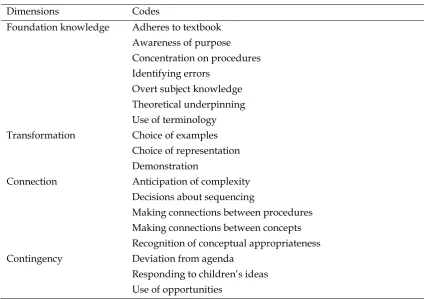
foundation knowledge, transformation, connection, and contingency, with the 18 codes being useful for
[image:3.595.84.509.186.485.2]interpreting classroom practice (see Table 1) (Rowland, et al., 2009). Classroom moments or episodes can be coded using more than one dimension.
Table 1
The Dimensions and Associated Codes of the Knowledge Quartet (Rowland et al., 2009, p. 29)
Dimensions Codes
Foundation knowledge Adheres to textbook Awareness of purpose Concentration on procedures Identifying errors
Overt subject knowledge Theoretical underpinning Use of terminology
Transformation Choice of examples
Choice of representation Demonstration
Connection Anticipation of complexity
Decisions about sequencing
Making connections between procedures Making connections between concepts Recognition of conceptual appropriateness
Contingency Deviation from agenda
Responding to children’s ideas Use of opportunities
The dimension of foundation knowledge relates to what teachers know and understand and includes their beliefs; connection, refers to the choices and decisions a teacher makes; for example, the ‘coherence’ displayed when planning or teaching; transformation and contingency relate more readily to observing teachers in action, particularly as they make choices about examples and representations and respond to unexpected events (Rowland et al., 2009; Turner & Rowland, 2011). Foundation knowledge differs from the other three dimensions in the sense that it is about knowledge possessed, rather than the application of knowledge. Connection requires consideration of a number of aspects including making links with prior learning and different areas of mathematics, and anticipating complexity. While the Knowledge Quartet was designed to be used as a framework for observing teaching in action, taking all dimensions into account, we were interested in investigating its applicability to a hypothetical teaching situation.
or six rows of four. Making connections also requires a depth of knowledge and may involve, for example, the teacher having a capacity to work flexibly with concepts, strategies and representations of multiplication at and beyond the level they teach.
Multiplicative Thinking
A recurring theme in the literature is that multiplicative thinking is a crucial stage in children’s mathematical understanding, the basis of proportional reasoning, and a necessary pre-requisite for understanding algebra, ratio and rate, and scale, and interpreting statistical and probability situations (e.g., Dole, 2008; Siemon, Bleckly & Neal, 2012). Siemon et al. maintain that teachers need to be aware of the ideas and understand the strategies underpinning the transition from additive to multiplicative thinking. Downton and Sullivan (2013) share this view and suggest that early years’ teachers need to understand the different multiplicative semantic structures and be prepared to engage children in challenging tasks related to these structures.
Historically the teaching of multiplication has focused on the equal groups model in which children accumulate groups of equal size to represent a situation. This however, is an additive model that encourages children to think of four threes as three plus three, plus three, plus three. A consistent theme in the literature is that children require experiences with different multiplicative structures such as rectangular array/area, multiplicative comparisons, allocation/rate, to support their development of multiplicative thinking (e.g., Anghileri, 1989; Greer, 1992). The rectangular array structure in particular, is powerful as it provides a visual representation of the mapping of two spaces into a third (Vergnaud, 1988), and assists students to develop a sense of the relationship between the numbers (Young-Loveridge, 2006). The physical arrangement of objects makes the property of commutativity, intuitively recognisable (Greer, 1992). Battista, Clements, Arnoff, Battista, and Borrow (1998) argued that in order for students to make sense of rectangular arrays and use multiplication to enumerate the objects they needed to see a row-by-column structure.
Being able to form visual images of the composite unit structure (recognising a group of individual items as one unit) is essential to making the transition to multiplicative thinking (Sullivan, Clarke, Cheeseman, & Mulligan, 2001). The progression to multiplicative thinking begins with modelling (using physical objects, fingers, or drawings) progressing to some form of calculation (e.g., unitary counting, to skip counting), to additive strategies based on repeated addition, and finally to multiplicative strategies, such as known and derived multiplicative facts (Anghileri, 1989; Mulligan & Mitchelmore, 1997). This knowledge is necessary when teachers observe children when engaged in a task and making informed decisions within the moment in a lesson.
The Encouraging Persistence, Maintaining Challenge (EPMC) task used in this study was part of a series of tasks designed to develop students’ multiplicative thinking in the primary years of schooling (Sullivan, 2016). As previously mentioned, children in the early years are often introduced to multiplicative situations with the use of arrays. In the Australian Curriculum: Mathematics (AC:M) multiplication is explicitly referred to in the Year 2 descriptor: Recognise and represent multiplication as repeated addition, groups and arrays (Australian Curriculum, Assessment and Reporting Authority (ACARA), 2016).
Pedagogical Practices
Anticipating likely student responses to challenging mathematical tasks;
Monitoring students’ actual responses to the tasks (while students work on the tasks in pairs
or small groups);
Selecting particular students to present their mathematical work during the whole-class
discussion;
Sequencing the student responses that will be displayed in a specific order; and
Connecting different students’ responses and connecting the responses to key mathematical
ideas (Smith & Stein, 2011, p. 8).
The two practices of selecting and sequencing are particularly relevant to the study discussed in this article. While a common classroom strategy involves students’ sharing their work with the class, the practice of selecting particular students and their solutions to share is made strategically rather than randomly or voluntary. Once selected, the teacher makes purposeful choices about the sequence in which to share these solutions. By carefully considering the sequence, teachers can maximise opportunities for children to learn. Often the choice of sequencing begins with the least sophisticated representation or strategy and ends with a more sophisticated solution (Smith & Stein, 2011). However, this can vary in practice, and sequencing decisions may be made on the basis of sharing the most common strategy, highlighting particular misconceptions, or comparing contrasting strategies. Smith and Stein (2011) acknowledge that more research needs to be undertaken to compare the value of different sequencing methods, and this article adds further to our understanding of this. In addition, requiring PSTs to explain and justify their choices, allows them to demonstrate aspects of foundation knowledge and connection (Rowland, et al., 2009).
Challenging Tasks
In order to engage in productive discussions, Smith and Stein (2011) advocated that teachers need to have clear learning goals for the lesson and must select a task or tasks that have the potential to help children achieve those goals. Current theories for teaching include the use of highly cognitive demanding tasks or challenging tasks, which are designed to promote rich student-centred learning (Sullivan, Cheeseman, Michels, Mornane, Clarke, et al., 2011). Sullivan, Aulert, Lehmann Hislop, Shepherd et al., (2013) listed some key characteristics of challenging tasks as requiring “students to connect different aspects of mathematics together, to devise solution strategies for themselves and to explore more than one pathway to solutions” (p. 618).
The challenging task used in our study originated from the EPMC project and were designed so that children would engage with important mathematical concepts, attempt the task by themselves, record and explain their thinking (e.g. Sullivan, Holmes, Ingram, Linsell, Livy, et al., 2016). Teachers in the project were encouraged to adopt a three-stage process for teaching with challenging tasks: launch, explore, and summarise (Sullivan, Boreck, Walker & Rennie, 2015). During the explore phase the teacher considers possible ways of selecting and sequencing the children’s responses to highlight the key mathematical ideas, solutions and strategies. These are shared in the summarise phase of the lesson when the teacher draws together the learning that has occurred using the strategies and solutions from the children (Sullivan, et al., 2015). The first author used this approach with a Year 2 class to generate the authentic work samples used in the study.
review of the literature has highlighted how mathematical knowledge for teaching can be considered within the framework of the Knowledge Quartet (Rowland, et al., 2009), along with the breadth and depth (Ma, 1999) of knowledge required to understand the concepts underpinning multiplicative thinking. The next section details the methodology that was adopted for the study.
Method
The aim of the qualitative research reported in this article was to gain insights into what the PSTs noticed about the work samples they were asked to select and sequence. The focus on selecting and sequencing was considered appropriate as the PSTs were being introduced to the 5 practices, and we wanted them to be familiar with these practices before being expected to make mathematical connections between children’s responses (although we were open to this occurring). A case study method was adoptedas case studies are appropriate when “you [want] to understand a real-life phenomenon in depth, but such understanding encompass[es] important contextual conditions – because they [are] highly important to your phenomenon of study” (Yin, 2009, p. 18). In this instance, the phenomenon to be examined was the PSTs’ approaches to the task, with the context being a hypothetical Year 2 classroom.
Participants
The participants were two cohorts (N=39) of third-year undergraduate primary PSTs enrolled in their second, and final core subject for primary mathematics teaching. The first core primary mathematics unit focused on early years’ mathematics pedagogy including an introduction to early multiplication concepts such as arrays. The third-year unit focused on primary teaching in the middle years. PSTs had limited experience of assessment practices related to analysing children’s work samples. Both units included two hours of face-to-face tutorials and one hour of reading and online activities each week for 10 weeks of semester.
Context and Instruments
Prior to data collection, the first author taught a multiplicative lesson at the end of 2015 to a mixed ability class of 27 Year 2 children. The first author had not visited the school before and therefore had little knowledge of the children’s prior learning. The classroom teacher mentioned that the class had completed work on early multiplication skills and had been exposed to arrays. Some of the children were able to recall multiplication facts such as, “three times five is fifteen or two times ten is twenty.”
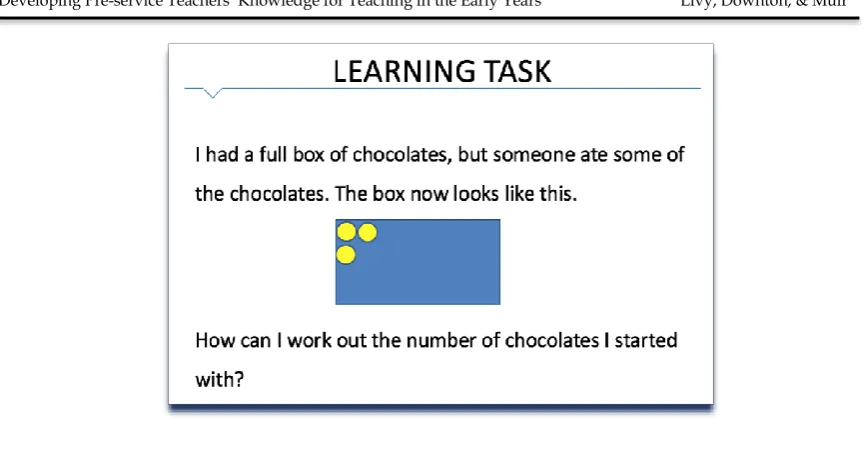
Before commencing the lesson, the children were asked to sit in a circle and each take 12 counters, make an array then share their different responses, such as, three rows of four or two rows of six. Next the children were asked to consider the following array task (Sullivan, 2016), “I had a full box of chocolates, but someone ate some of the chocolates. The box now looks like this (see, Figure 1), how can I work out the number of chocolates I started with?”
Figure 1. Array Task (Sullivan, 2016)
After the lesson, the work samples were collected. Five of the children’s work samples were chosen as instruments for this study (Figures 2, 3, 4, 5 and 6). The samples were selected to show a range of different examples of multiplicative thinking. The work samples are presented next, including a summary of the child’s response and justification for selection as instruments.
Figure 2. Sample A
In Figure 2 the child wrote, “I worked it out by cating [counting] in fives to now [know] that it is 45. I used fives to cont [count] it because it is easyer [easier].”
[image:7.595.174.449.418.609.2]Figure 3. Sample B
Figure 3, the child drew the chocolate box and wrote, “by counting and imagineing [imagining] there were still chocolate in the box.”
[image:8.595.196.420.458.602.2]This sample suggests the child was able to visualise her answer by drawing an array that matches her number sentence and explanation that shows her thinking. The work sample was chosen because it showed the connection between a diagram, equation and explanation of the student’s thinking. Sample B also showed an understanding of the row and column structure of an array.
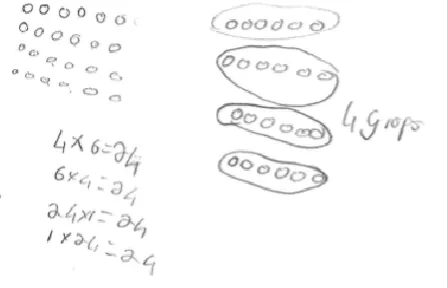
Figure 4. Sample C.
In Figure 4 the child included a drawing of the chocolates and four number sentences for 24 “4 × 6 = 24, 6 × 4 = 24, 24 × 1 = 24 and 1 × 24 = 24,” as well as a drawing of “4 grops [groups of five].
Figure 5. Sample D.
In Figure 5 the child attempted to draw eight rows of 11 chocolates and recorded 8 × 11 = 76 and 11 × 8 = 76.
Sample D shows that although the chocolates at the end are ‘squashed’ the child drew an array that shows eight rows of 11 and has attended to the need for equal rows and columns. She was able to record two number sentences 8 × 11 = 76 and 11 × 8 = 76 (although the calculation was incorrect), demonstrating knowledge of commutativity.
The sample was chosen because the child made a reasonable attempt at drawing an array. The response did not reflect a realistic solution and provides potential to gain insight into how PSTs might react to an incorrect response.
[image:9.595.191.438.407.533.2]
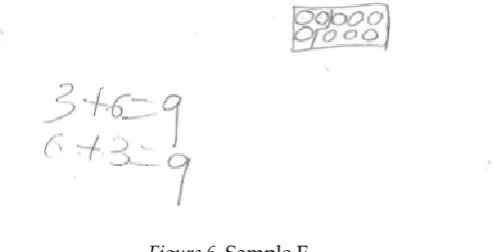
Figure 6. Sample E.
Figure 6 shows a row of five and four chocolates and two number sentences. The child attempted to fill the box by adding six chocolates to the three chocolates shown in the problem and recorded a number sentence to reflect this, 3+6=9 and 6+3=9. The number sentences suggest some understanding of the commutative property for addition. This response indicates limited understanding of an array or the meaning of multiplication. The final sample was selected as it shows naïve knowledge of the array structure and the concept of multiplication. The authors hypothesised that the PSTs might not select this sample.
Procedure
summarise phase of a hypothetical lesson. The PSTs were asked to select three work samples because the first author had also selected three samples when teaching the lesson with the children. They recorded their responses on a proforma justifying their first, second and third choices before engaging in a class discussion. The PSTs’ written responses were collected for analysis after the lesson. The activity took approximately 40 minutes to complete.
Data Analysis
The first two authors coded all data. An open-coding approach (Flick, 2009) was used initially, to identify common themes. The coding was compared and a discussion held about the reasons for any coding differences and agreement reached. The Knowledge Quartet was then used as a framework for organising the coded data, relating to the dimensions of foundation and connection as the PSTs did not have the opportunity to demonstrate transformation or contingency. This two-step process was done to ensure that the coders were open to any dimensions that may have been masked by exclusively using an existing theoretical framework.
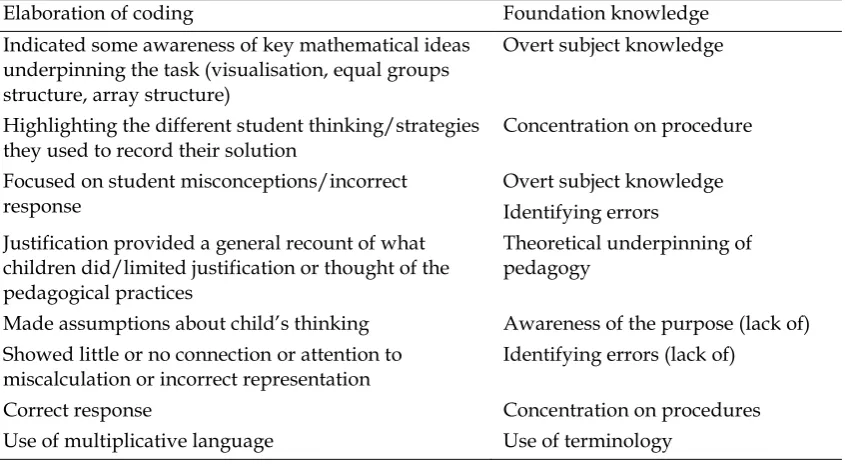
[image:10.595.89.512.386.619.2]When analysing PSTs’ responses to the selecting and sequencing activity the authors identified which work sample the PSTs selected first, second and third. Their written justifications were analysed to identify common themes. The first step involved allocating codes to each of the responses given for the selection of their first, second or third choices (Table 2).
Table 2
Coding of Pre-service Teachers’ Written Responses to the Selecting Activity
Elaboration of coding Foundation knowledge
Indicated some awareness of key mathematical ideas underpinning the task (visualisation, equal groups structure, array structure)
Overt subject knowledge
Highlighting the different student thinking/strategies they used to record their solution
Concentration on procedure
Focused on student misconceptions/incorrect
response Overt subject knowledge Identifying errors
Justification provided a general recount of what children did/limited justification or thought of the pedagogical practices
Theoretical underpinning of pedagogy
Made assumptions about child’s thinking Awareness of the purpose (lack of) Showed little or no connection or attention to
miscalculation or incorrect representation Identifying errors (lack of)
Correct response Concentration on procedures
Use of multiplicative language Use of terminology
A total of eight codes were generated, including mathematical ideas; strategies; misconceptions; limited mathematical justification; made assumptions; little or no connection; correct response; and multiplicative language. Some PSTs responses included multiple codes. For example, the following response was coded as mathematical ideas, and strategies because of reference to visualisation and strategies.
This work sample was further coded as overt subject knowledge and concentration of procedures, codes of foundation knowledge (Rowland et al., 2009) (Table 1).
Results and Discussion
As indicated earlier, our aim was to familiarise PSTs with the selecting and sequencing practices using children’s work samples, and to investigate what their responses revealed about their knowledge of multiplicative thinking. The results are presented as a collective first, then focus on individual PST choices and justification. Specific links are made to foundation knowledge and
connection dimensions of the Knowledge Quartet (Rowland et al., 2009) when considering the
PSTs’ MCK and /or PCK.
[image:11.595.85.514.333.367.2]The PSTs were asked to each select three of the five students work samples (Figures 2 to 6), sequence them in the order they would present them to the class and then justify their choices. Table 3 presents a collation of the PSTs’ choices of work samples.
Table 3
Pre-service Teachers’ Selection of Students’ Responses (Samples A-E) (n=117)
A B C D E No choice
PSTs’ selection 13 35 36 12 20 1
As seen in Table 3 Samples D and A were selected the least. Sample A made no reference to a drawing or an array, which is a possible explanation for few PSTs choosing it, whereas Sample D included an array but there was a calculation error. Samples B and/or C were chosen by all PSTs as one of their choices. One PST (Ella) only chose two work samples (B & C) and justified why in her written response: “The rest are so wrong I would not show them to the class.” A possible explanation for her choice was that she was focusing on correct solutions, representations, and/or children’s understanding of the array structure. Ella’s response highlights for teacher educators the importance of discussion of misconceptions or children’s errors with PSTs when building their foundation knowledge.
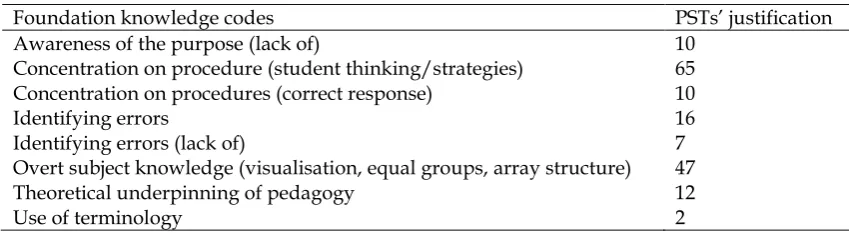
The PSTs’ justification for selection of works samples were analysed and eight codes were identified during the process (see Table 2). These codes were then aligned to the foundation
knowledge dimension of the Knowledge Quartet (Rowland et al, 2009). The collation of the PSTs’
[image:11.595.84.509.582.701.2]justifications is presented in Table 4. Some PSTs’ justifications related to more than one code.
Table 4
PSTs’ Justification of Selected Work Samples Coded to Foundation Knowledge of the Knowledge Quartet
Foundation knowledge codes PSTs’ justification
Awareness of the purpose (lack of) 10
Concentration on procedure (student thinking/strategies) 65
Concentration on procedures (correct response) 10
Identifying errors 16
Identifying errors (lack of) 7
Overt subject knowledge (visualisation, equal groups, array structure) 47
Theoretical underpinning of pedagogy 12
Overall the PSTs’ justifications focused on strategies evident in the students’ recordings. Closely aligned to this code was evidence of PSTs’ own subject knowledge with their use of knowledge of the array structure, and mathematical ideas underpinning the task. There was some attention to student errors, or possible misconception (such as in Sample E). However, there were also seven examples in which the PSTs did not identify the student error (Sample D computation) or misconception (Sample A). In relation to theoretical underpinnings of pedagogy there was evidence of this but some PSTs tended to recount what the students did rather than indicate reasons for selecting the work sample with a particular pedagogical action in mind. For example, selecting Sample B or C to illustrate the array structure to other students who may have interpreted the array as the same as equal groups.
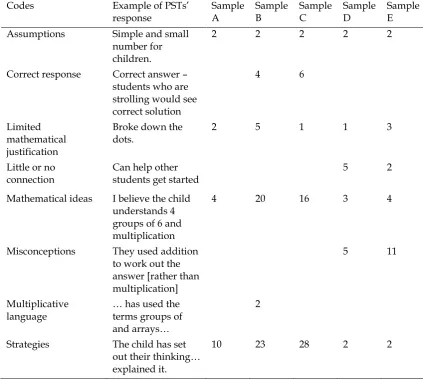
[image:12.595.84.508.304.685.2]A closer look at the PSTs justification linked to the eight codes that emerged from the analysis (see Table 2) relating to each of the five work samples is shown in Table 5.
Table 5
Codes Identified within PSTs’ Written Justifications for the Selecting and Sequencing Activity
Codes Example of PSTs’
response Sample A Sample B Sample C Sample D Sample E
Assumptions Simple and small
number for children.
2 2 2 2 2
Correct response Correct answer – students who are strolling would see correct solution
4 6
Limited mathematical justification
Broke down the dots.
2 5 1 1 3
Little or no
connection Can help other students get started 5 2
Mathematical ideas I believe the child understands 4 groups of 6 and multiplication
4 20 16 3 4
Misconceptions They used addition to work out the answer [rather than multiplication]
5 11
Multiplicative language
… has used the terms groups of and arrays…
2
Strategies The child has set
out their thinking… explained it.
10 23 28 2 2
task when selecting the work samples. Seven PSTs’ justifications for choosing Samples D or E focused on visual representation, or attention to the array structure (Sample D) or to get a sense of the student’s thinking (Sample E), rather that student errors or any misconceptions. This illustrates the diversity of thinking and what PSTs attended to when analysing the work samples - an important consideration for us as teacher educators.
The specific mathematical ideas evident in the PSTs’ justifications included the use of visualisation, equal groups, and array structure and consideration of student thinking and strategies. We suggest that these PSTs were developing their foundation knowledge needed for teaching relating to multiplicative thinking. More specifically, foundation knowledge requires early years’ teachers to demonstrate an understanding of multiplication. In particular, they should recognise the importance of the array structure over the equal group structure that encourages additive thinking when supporting children’s transition to multiplicative thinking (e.g., Anghileri, 1989).
When considering PSTs’ justifications, we were not surprised at the concentration of mathematical ideas being attended to for Samples B and C. These samples provided evidence of students at Year 2 level of the curriculum, in that their responses included a drawing of an array and /or equal groups and they explained their reasoning in words and/or with symbols and numbers (ACARA, 2016). It could be argued that Sample C shows the student is working toward Year 3 because they have recorded multiplication facts as part of their response.
In summary, the PSTs tended to focus on students’ strategies, and some mathematical ideas underpinning multiplicative thinking when selecting students’ work samples to share during a mathematical lesson.
[image:13.595.83.510.476.508.2]Having discussed the PSTs’ selection and justification of work samples the following reports on how they would sequence the work samples for sharing with their hypothetical class and why. Table 6 shows the number of PSTs who chose each of the Samples (Figure 2 to 6) as their first choice to share with the class.
Table 6
Collation of PSTs’ First Choice of Student Work Samples (A-E) (n=39)
A B C D E
PSTs’ choice 6 10 5 5 13
One third of PSTs chose Sample E as their first choice and almost another third chose Sample B. This is interesting because Sample E reflects a misconception or limited understanding of arrays, whereas Sample B shows correct representation of the array structure, along with the related number sentence and an explanation of the student’s thinking (Figure 3). The results show that the PSTs varied greatly in their choices. When justifying why they selected Sample B first, Elise wrote:
I would choose this because it is a good demonstration of how the students could use different strategies to work this out, where this child drew a picture and counted the chocolates he imagined in the box.
Sample A (Figure 2), was chosen by six PSTs as their first choice. Some of their justifications focused on the evidence of how and why the student came to the solution of 45 for the number of chocolates. One PST (Tina) suggested that, “a possible discussion point would be to highlight an inclusion of a drawing of the child’s thinking (an array) to enrich the response.”
could imagine where the other chocolates could be…and drew all the imagined counters,” and, “This work sample showed their working out as well as how they came to their answer.”
Sample C (Figure 4) was selected by five PSTs. Kate’s justification was that “it shows the child understands grouping and a drawing of multiplication and estimation of how many chocolates there are in the box.” When interpreting Sample C at least three PSTs indicated the child was using, “grouping thinking to calculate and show different arrays,” rather than understanding that the groups-of idea is different to the array model.
Sample D (Figure 5) was also selected as first choice by five PSTs. Rachel’s justification for selecting Sample D first was because it was the “weakest response” and stated:
… the student is displaying array knowledge and I think it would clue the struggling students into looking at the array.
Another PST (Louise) chose this sample as the second choice and explained:
To remind the students of the ‘gap’ or empty space between chocolates, encouraging everyone to think about how the circles relate to the imaginary chocolates… the need to replicate the way the chocolates would fit into the box.
Sample E (Figure 6) was chosen by 13 PSTs as their first choice, primarily because they thought it was the weakest response. Melody wrote that she would, “Ask the class if they think this is correct and why it wouldn’t be?” Ben selected Sample E first and wrote:
By explaining this first, you can initially eliminate any misconceptions about the box being that size. Students will then be able to (if not already) recognise that there is empty space and therefore more chocolate at the bottom of the box.
When sequencing the work samples 22 PSTs indicated that they would start with the weakest (Sample A, D or E) and progress to the strongest (Sample B or C). Strongest samples were those the PSTs considered the most mathematical response to the learning task such as the use of the array structure and evidence of student reasoning or more accurate responses. Only nine PSTs chose to start with the strongest sample and finish with the weakest. Seven PSTs chose to sequence the work samples as strong weak strong, and one chose weak strong weak. The following examples are illustrative of the PSTs’ justifications for their sharing sequences:
Annie, Jane and Kelly all sequenced their samples from what they considered to be the weakest to strongest. Annie, for example, selected Samples E, C, B because she wanted to highlight the apparent misconception or lack of understanding of the array and “draw attention to the empty spaces below the two lines and ask the children if they think this would accurately show how many chocolates would be in the box. How else might we do it?” She chose C next because it “showed how the student grouped the four rows and used that to calculates how many there would be using multiplication.” Annie considered B to be the strongest example as it showed the array, the equation and the explanation and “focused on how the student tried to replicate the chocolate box to imagine what it would look like if full.” In contrast both Jane and Kelly focused on students’ thinking processes. Kelly suggested Sample C last because it built on Sample B and the student “clearly set out her thinking allowing her to explain it to the class in a way they could all see and understand.”
Tina chose Sample A followed by E and C indicating a strong, weak, strong sequence. Her justification was to choose a strong example to support a student who was having difficulty in understanding the array structure. She focused on using Sample A to draw attention to the array structure as indicated in her justification. “I would choose this response (A) first- ask the class how this student could have shown his working out-students who drew pictures to guide themselves may suggest this. This will introduce this idea of drawing a visual representation of the chocolates.” She suggested looking at sample E next as it showed a visual representation but also some lack of understanding of multiplication. She would “ask the class what they notice (box drawn is not full) and what they need to do to fill the box?” She would use Sample C to illustrate that the student “has drawn what they imagined the full chocolate box could look like.”
From these examples and our own observations, it was evident that each PST had a well thought out reason for their selection and sequencing of work samples that reflected their own MCK and /or PCK. Many PSTs chose to begin with the least sophisticated representation or strategy and end with a more sophisticated solution. Others tended to begin by sharing the most common strategy, as a means of highlighting particular misconceptions, or comparing contrasting strategies. The choice and use of children’s examples is one of the key aspects of transformation (Rowland et al., 2009). Smith and Stein (2011) agree that selecting a commonly used strategy may be one approach, but selecting a misconception may often be a better choice. In practice, selecting and sequencing student responses requires considered judgements, and it is likely that in the event that practicing teachers were asked to select and sequence a range of students’ responses, they would likely differ in their choices and the reasons for making them, as did our PSTs.
In relation to their foundation knowledge and making connections relating to multiplicative thinking it was evident from their justifications that several PSTs were aware of the importance of visualisation and the array structure and the notion of the equal group structure in making the transition from additive to multiplicative (Mulligan et al., 2006; Sullivan et al., 2001). Their attention to the students’ thinking in their justification for their sequencing also reflects their depth of thinking about ways to assist the students to make the transition from additive to multiplicative thinking.
In terms of use of terminology, which is a code of foundation knowledge, some PSTs had difficulty using mathematical terminology to justify their choices describing Sample A as, “the easy way,” and another wrote for Sample C, “they used multiplication well and showed their working out well.” Others were able to use mathematical terminology when justifying their choices such as, “array… visual representation … scaffolding the explanation … student used groups of.”
Making connections involves the teacher being able to anticipate the complexity of the task and making connections between procedures and concepts (Rowland et al., 2009). Making
connections was evident when PSTs noticed a misconception, such as in Sample E, and were able
to consider how to assist the child to further develop their understanding of arrays. For example, providing counters to model the situation or to provide an empty chocolate box that has arrays. Making connections between concepts links with Ma’s (1999) description of breadth, “the capacity to connect a topic with topics of similar or less conceptual power (p. 124).”
Connection requires consideration of a number of aspects including making links with prior
Conclusion and Implications
In this study, we have endeavoured to link theory and practice through engaging the PSTs in activities that related directly to how children learn mathematics in the early years. The PSTs were able to clarify and justify the choices they made when analysing students’ work samples of a challenging task related to multiplication and arrays. We also drew on the Knowledge Quartet (Rowland et al., 2009) and work of Smith and Stein (2011) to gain specific insights into PSTs’
foundation knowledge and connection related to multiplicative thinking. We found that despite not
having observed the PSTs in the act of teaching, the hypothetical experience we provided them gave us insight into their knowledge of multiplicative thinking, particularly in the dimensions of
foundation and connections. With respect to the research questions the findings indicated the
following conclusions:
First, the PSTs tended to focus on the students’ strategies, evidence of the array structure, how best to support the students’ learning or any misconceptions or limited understanding evident. There was some evidence of making connections between the process and concepts underpinning multiplicative thinking.
Second, well-developed foundation knowledge, including knowledge of the stages children move though in their transition from additive to multiplicative thinking is essential when considering children’s work samples when selecting and sequencing during the summarise phase of the lesson. This was evident in several PSTs’ justifications. We do acknowledge that a possible limitation was providing the PSTs with only five student work samples rather than those of the entire class. Doing so would offer further insight into the range of student understanding evident within any one class and encourage development of PSTs’ MCK and PCK.
Third, it was evident from their justifications that some PSTs were using their knowledge of multiplicative thinking when interpreting the student work samples, such as their knowledge of the row and column structure of the array, the importance of visualisation, and that the progression to multiplicative thinking begins with modelling and additive thinking to mental imaging to then to multiplicative strategies (Anghileri, 1989; Mulligan & Mitchelmore, 1997).
Fourth, engaging PSTs’ in practice-based activities such as those described in this paper were effective ways to link theory and practice; provided guidance for future practice, and teacher educators with insights into gaps in PSTs foundation knowledge which might otherwise have gone undetected. As Grossman et al. (2009) indicated, representations of practice such as children’s work samples, have the potential to support PSTs when learning, not just about teaching, but how to use knowledge of teaching in action.
In light of these conclusions, when reviewing our course content, we need to ensure PSTs have the opportunity to extend their foundation knowledge, including conceptual knowledge of children’s misconceptions when understanding the transition for additive to multiplicative thinking. We argue that the activities PSTs engaged in within this study were innovative and supported knowledge for teaching mathematics in the early years relating to the use of challenging tasks and selecting and sequencing.
Rowland et al., (2009) suggested when demonstrating foundation knowledge, the teacher concentrates on developing understanding rather than relying on procedures. Our justification for engaging PSTs (or teachers) in a selecting and sequencing activity would extend their
foundation knowledge and making connections as important preparation for today’s classrooms
References
Anghileri, J. (1989). An investigation of young children’s understanding of multiplication. Educational
Studies in Mathematics, 20, 367-385.
Anthony, G., Cooke, A., & Muir, T. (2016). Challenges, reforms, and learning in initial teacher education. In K. Makar, S. Dole, J. Visnovska, M. Goos, A. Bennison, & K. Fry (Eds.), Research in mathematics education
in Australasia 2012-2015 (pp. 305-328). Singapore: Springer.
Askew, M., Brown, M., Rhodes, V., Johnson, D., & Wiliam, D. (1997). Effective teachers of numeracy. London: King’s College.
Australian Curriculum, Assessment and Reporting Authority (ACARA). (2016). Australian Curriculum:
Mathematics. Retrieved from
http://www.australiancurriculum.edu.au/mathematics/curriculum/f-10?layout=1
Australian Institute for Teaching and School Leadership (AITSL). (2011). Accreditation of initial teacher education programs in Australia: Standards and procedures April 2011, 1-22. Retrieved from http://www.aitsl.edu.au/verve/_resources/Accreditation_of_initial_teacher_education.pdf
Ball, D. L. (1990). The mathematical understandings that prospective teachers bring to teacher education.
The Elementary School Journal, 90(4), 449-499.
Ball, D. L., & Bass, H. (2003). Toward a practice-based theory of mathematics knowledge for teaching. In B. Davis & E. Simmt (Eds.), Proceedings of the 2002 Annual Meeting of the Canadian Mathematics Education
Study Group (pp. 3-14). Edmonton: AB:CMESG/GCEDM.
Ball, D. L., & Bass, H. (2009). With an eye on the mathematical horizon: Knowing mathematics for teaching to
learners' mathematical futures. Paper presented at the 43rd Jahrestagung für Didaktik der Mathematik,
Oldenburg, Germany.
Battista, M. T., Clements, D. H., Arnoff, J., Battista, K., & Borrow, C. V. (1998). Students’ spatial structuring of 2D arrays of squares. Journal for Research in Mathematics Education, 29(5), 503-532.
Beswick, K. (2006). Changes in preservice teachers’ attitudes and beliefs: The net impact of two mathematics education units and intervening experiences. School Science and Mathematics, 106(1), 36-47.
Beswick, K., & Goos, M. (2012). Measuring pre-service primary teachers’ knowledge for teaching mathematics. Mathematics Teacher Education and Development, 14(2), 70-90.
Beswick, K., & Muir, T. (2013). Making connections: Lessons on the use of video in pre-service teacher education. Mathematics Teacher Education and Development, 15(2), 27-51.
Clarke, B., Grevholm, B., & Millman, R. (2009).Tasks in primary mathematics teacher education. New York:
Springer
Cohrssen, C. & Tayler, C. (2016). Early childhood mathematics: A pilot study in preservice teacher education. Journal of Early Childhood Education, 37(1), 25-40.
Dole, S. (2008). Ratio tables to promote proportional reasoning in the primary classroom. Australian Primary
Mathematics Classroom, 12(2), 19-22.
Downton, A., & Sullivan. P. (2013). Fostering the transition from additive to multiplicative thinking. In A. M. Lindmeier, & A. Heinze (Eds.), Mathematics learning across the life span (Proceedings of the 37th Conference of the International Group of Psychology of Mathematics Education, Vol 2, pp. 241-248). Keil, Germany: PME.
Flick, U. (2009). An introduction to qualitative research (4th ed.). London: Sage Publications.
Greer, B. (1992). Multiplication and division as models of situations. In D. A. Grouws (Ed.), Handbook of
research on mathematics teaching and learning (pp. 276-295). NY: Macmillan.
Grossman, P., Hammerness, K., & McDonald, M. (2009). Redefining teaching, re‐imagining teacher
education. Teachers and Teaching: Theory and Practice, 15(2), 273-289.
Jaworski, B. (2006). Theory and practice in mathematics teaching development: Critical inquiry as a mode of learning in teaching. Journal of Mathematics Teacher Education, 9(2), 187-211.
Klein, M., Ralya, T., Pollak, B., Obenza, R., & Harbour, M. G. (2012). A practitioner’s handbook for real-time
analysis: Guide to rate monotonic analysis for real-time systems. Springer Science & Business Media.
Ma, L. (1999). Knowing and teaching elementary mathematics: Teachers' understanding of fundamental mathematics
in China and the United States. Mahwah, New Jersey: Lawrence Erlbaum Associates, Inc.
Maher, N., & Muir, T. (2013). “I know you have to put down a zero but I don’t know why”: Exploring the link between teachers’ content knowledge and pedagogical content knowledge. Mathematics Teacher
Meikle, E. M. (2016). Selecting and sequencing students' solution strategies: Reflect and discuss. Teaching
Children Mathematics, 23(4), 226-234.
Mulligan, J., & Mitchelmore, M. (1997). Young children’s intuitive models of multiplication and division.
Journal for Research in Mathematics Education, 28(3), 309-330.
Rowland, T., Turner, F., Thwaites, A., & Huckstep, P. (2009). Developing primary mathematics teaching:
Reflecting on practice with the Knowledge Quartet. London: Sage.
Shulman, L. S. (1986). Those who understand: Knowledge growth in teaching. Educational Researcher, 15(2), 4-14.
Siemon, D., Bleckly, J. & Neal, D. (2012). Working with the big ideas in number and the Australian Curriculum: Mathematics. In B. Atweh, M. Goos, R. Jorgensen & D. Siemon, (Eds.). (2012). Engaging the
Australian National Curriculum: Mathematics: Perspectives from the field (pp. 19- 45). Online Publication:
Mathematics Education Research Group of Australasia.
Smith, S., & Stein, M. (2011). 5 Practices for Orchestrating Productive Mathematical Discussions. Reston, VA: National Council of Teachers of Mathematics.
Sullivan, P. (2016). Exploring the potential of using challenging mathematical tasks: A resource to support teachers
in Years 3-6 semester 1, 2016. Melbourne: Monash University.
Sullivan, P., Aulert, A., Lehmann, A., Hislop, B., Shepherd, O., & Stubbs, A. (2013). Classroom culture, challenging mathematical tasks and student persistence. In V. Steinle, L. Ball & C. Bardini (Eds.),
Mathematics education: Yesterday, today and tomorrow (Proceedings of the 36th Annual Conference of the
Mathematics Education Research of Australasia, pp. 618-625). Melbourne, VIC: MERGA.
Sullivan, P., Cheeseman, J., Michels, D., Mornane, A., Clarke, D., Roche, A., & Middleton, J. (2011). Challenging mathematics tasks: What they are and how to use them. In L. Bragg (Ed.), Challenging
mathematics tasks: What they are and how to use them. (Proceedings of the 48th Annual Conference of the
Matheamtical Association of Victoria, pp. 33-46). Melbourne: The Mathematical Association of Victoria. Sullivan, P., Clarke, D., Cheeseman, J., Mulligan, J. (2001). Moving beyond physical models in learning multiplicative reasoning. In M. van den Heuvel-Panhuizen (Ed.), Proceedings of the 25th conference of the
International Group for the Psychology of Mathematics Education (Vol. 4, pp. 233-240). Utrecht, The
Netherlands: PME.
Sullivan, P., Holmes, M., Ingram, N., Linsell, C., Livy, S., & McCormack, M. (2016). The intent and processes of a professional learning initiative seeking to foster discussion around innovative approaches to teaching. In B. White, M. Chinnappan, & S. Trenholm (Eds.), Opening up mathematics education research (Proceedings of the 39th annual conference of the Mathematics Education Research Group of Australasia, pp. 669-673. Adelaide: MERGA.
Sullivan, P., Walker, N., Borcek, C. & Rennie, M. (2015). Exploring a structure for mathematics lessons that foster problem solving and reasoning. In M. Marshman, V. Geiger, & A. Bennison (Eds.), Mathematics
education in the margins (Proceedings of the 38th annual conference of the Mathematics Education
Research Group of Australasia, pp. 41–56). Sunshine Coast: MERGA.
Teacher Education Ministerial Advisory Group (TEMAG). (2015). Action now: Classroom ready
teachers. Retrieved from
http://docs.education.gov.au/system/files/doc/other/action_now_classroom_ready_teachers_print .pdf.
Thames, M. H., & Ball, D. L. (2010). What math knowledge does teaching require? Teaching Children
Mathematics, 17(4), 220-229.
Turner, F. & Rowland, T. (2011). The Knowledge Quartet as an organising framework for developing and deepening teachers’ mathematics knowledge. In T. Rowland & K. Ruthven (Eds.), Mathematical
knowledge in teaching (pp. 195-212). New York: Springer.
Vergnaud, G. (1988). Multiplicative structures. In J. Hiebert & M. Behr (Eds.), Number concepts and operations
in the middle grades (pp.141-161). Hillsdale, NJ: Lawrence Erlbaum.
Yin, R.K. (2009). Case study research: Design and methods (4th ed.). Thousand Oaks, CA: Sage Publications.
Young-Loveridge, J. (2005). Fostering multiplicative thinking using array-based materials. The Australian
Authors
Sharyn Livy
Monash University, Peninsula Campus, Frankston, VIC, 3199 email: [email protected]
Ann Downton
Monash University, Clayton Campus, Clayton, VIC, 3168 email: [email protected]
Tracey Muir