CHAPTER 4
ATTENDANCE AT THE PUBLIC SCHOOLS
From Franklin's Board, 1839, to the Establishin9 of the Board of Education, 1854.
Franklin's Regulations for the Free Day Schools, 1839, made comprehensive provision for boys and girls to attend the schools. No distinction was made between the various religious denominations and no limits, either upper or lower, were set on the ages of the children. A Board of Education was established and the Regulations were promulgated in its name, for 'the general information of the community [and] the special guidance of the Conductors' ,1 The initiative for the establishment of individual schools lay, not only with the Board, but with 'the Ordained Ministers, Police Magistrates or respectable inhabitants of the townships and districts,' acting through the Board.2 Public assistance would be given if the pupil members in Hobart and Launceston amounted to forty, in the townships to twenty and in other places fifteen pupils. The teachers were entitled to claim fees from the parents and a salary from the Board. The duties of the teacher, apart from teaching the brief course of study that accompanied the Regulations and paying 'the
greatest attention to the general behaviour of the children,' included the keeping of certain books. The Master was required to keep a journal of admission, a journal of daily attendance and to make a quarterly return to the Board:
The journal of admission must contain the name, age, and date of admission of each child, how far advanced he or she may be at the time of admission, the religious denomination of the parents, the date of removal and the cause. '3
A Visitor's Book had to be kept and the name of a visitor, with the date of the visit, had to be entered by the teacher. Every Monday morning, the teacher was required to ascertain from each child which Sunday School he or she had attended on the previous Sunday. The quarterly return had to contain the age, sex, progress, general moral conduct, daily attendance and date of admission of each child and i t was required of the teacher that it be inspected by the visitors before it was sent on to the Board.
The admission journal and quarterly return thus provided the teacher, visitor and Board with basic information concerning the child's attendance, progress and moral conduct. No clear instructions, however, were given on the recording of attendance. Most teachers, it seems, recorded attendance if a child attended school at any time during the course of the day. The hours of attendance were laid down by the Regulations as being from 9 to 12 in the morning and from 2 to 4 in the afternoon. If a child appeared at
all, and regardless of the length of stay, he or she was marked by some teachers as being in attendance for that day. Mr. Nicholson, teacher at the Campbell Street School in Hobart, on the other hand, took 'the largest number actually present together, at any one time of the day' . 4 The difference between the two methods could be considerable. Teachers seemed at a loss to know how to fill in the journals and returns correctly. Charles Bradbury, Secretary to the Board, stated to the 1845 Commission of Enquiry that it was his practice to visit schools which were within a reasonable distance of Hobart about once a quarter, schools within the town itself and the immediate neighbourhood much more frequently and those at remote distances about twice a year!l He said that he had every reason to believe that the quarterly returns were filled in correctly,6 but in his reports for 1845 and 1846, although he unfailingly noted the attendance figures, he paid little attention to the method followed and the accuracy of the compilation.
Attempts had been made promulgation of the Regulations
shortly after the to induce teachers to increase the numbers in attendance. The Board offered ten shillings as an additional annual allowance for each child enrolled beyond the figures of forty, twenty and fifteen pupils, according to location. There was a suggestion that the scheme, later abandoned, tempted teachers to enrol very young children, although Broadbury thought there had not been any abuse of the
4 AOT CSO 8/121/3000. Report of enquiry into J.D. Loch's charges, 48.
5 Jbid., p.108. 6 Ibid., p.110.
7-system. 7 But the schools were not working effectively, inducements notwithstanding.
Gell, Principal of Queen's Commission of Enquiry of
The Reverend John Philip College, Hobart, told the 1845 that James Bonwick, teacher at Liverpool Street School, Hobart, 'a zealous and intelligent man', complained to him of want of supervision and support from the Board.8 Most of the school masters expressed dissatisfaction generally with the system, he reported, although he confessed that it was difficult to get at the truth.9 Bonwick had increased the attendance at the Liverpool Street School within five months of taking charge. He had had 43 boys and 12 girls enrolled at the start and, by immediately introducing the British and Foreign system, had raised the numbers to 150 boys and 100 girls. But his success was tempered by the constant frustrations he felt at the Board's ignoring of his repeated complaints about the very bad condition of the school buildings and the lack of furniture and equipment. Gell 's opinion was that, in 1840, the public schools were very inefficient, 'the Masters seemed to be discouraged, and were in perplexity as to their own responsibility, and as to the courses they were expected to pursue. •to
The teachers, so poorly educated and, for the most part, quite untrained, looked to the Board and Bradbury for direction and, in the matter of keeping attendance records, a simple set of instructions. Occasional visits were not enough, although Bradbury's inspection reports were helpful, constructively critical and
7 Ibid., pp.104-05. 8 Ibid., p. 91.
touched by warmth and understanding. Gell thought that teachers were always glad to see him on his visits, but he said that:
They complained encourage them absence of
of the want of Visitors to and particularly of the sufficient official superintendence.tt
The school system which had been in operation before 1839 had been displaced by the schools created by Franklin's Board because it had provided only a partial system of education. In 1836, only 1061 children's names were 'on the books, ' in 1837 there were 1206, in 1838 there were 960 names and in the first two quarters of 1839 there were 814. The confident expectation had been put to the Legislative Council in 1838 that the new Board would double the number of pupils and schools .1 2 But growth was very slow for a number of years. In 1840, the number of pupils 'on the books' was 1148, in 1845 i t had risen to 1413 only.1 3
The organisation of public education was radically altered after 1846. W.E. Gladstone, the new Colonial Secretary, was not persuaded by the Report of the Commission of Enquiry that the system of public education in Tasmania would 'endure the strictest scrutiny in regard to the securities i t affords for an
11 Ibid.
12 Ibid., p.136.
entire liberty of conscience' .14 Gladstone was very
much in sympathy with the view, constantly urged by the Anglican clergy in Tasmania, that children of the Anglican faith were being taught the scriptures in schools by Dissenting clergy. Dr. William Bedford stated to the 1845 Commission of Enquiry that, with three or four exceptions, the Anglican clergy had withdrawn their services as visitors in protest against Franklin's proposal that the teaching of the Scriptures be done without commentary or exposition. He was asked by one of the Commissioners:
Then the effect of the withdrawal of the Clergy of the Church of England, from all participation in the schools has been to throw [the children] gradually into the hands of the Dissenters, do we understand that to be your opinion?to
Bedford replied, 'I think so certainly. ' It was to these objections that Gladstone listened. He himself supplied the remedy and ordered the Governor to apply it. The nub of the scheme was the payment of a penny a day for each child in attendance at schools conducted by the Church of England and Catholic Church. The effect of Gladstone's scheme was to increase the number of Church of England schools and decrease the number of Board of Education Schools. In 1848, there were 29 Anglican schools and 22 Board of Education schools, with average daily attendances
respectively.t6
~··~--··-·~-~,---~---~ . ...
of 715 and 919,
14 PLC 1847-8. Despatch from W.E. Gladstone to
Governor on the Government Schools of Van Diemen's Land, 3.3.46, pp. 2-3.
15 AOT CSO 8/122/2996-3000. Report of Commission of enquiry into J.D. Loch's charges, 1845, p.64.
A consequence of Gladstone's 1846 Despatch was that the teachers in the Board schools had their salaries and standards of accommodation regulated by the same conditions as those governing teachers employed in the schools administered by the Churches. Thus, they lost their fixed salaries and were obliged to subsist on a lower scale determined by payments of 'a penny-a-day'. In addition, they had to give up the occupation of school premises, rented from government. Arnold wrote in 1850:
This change led to some effects that were to be regretted, to others that were beneficial. On the one hand, some of the best among the existing teachers ... abandoned the public service/ and either left the Colony or engaged in private tuition ... on the other hand, the new system soon showed itself an elasticity and power of expansion/ for which the former one had not been remarkable.17
During one year alone, 18491 fifteen new schools were established, most of them Church of England schools and Arnold commented:
Nothing could be more in harmony with the views and feelings of the Clergy than to establish Schools, which, in accordance with the denominational principle1 would be subject to their exclusive direction, and where the distinguishing tenets of their Church could be freely taught: while the Government, owing to the great reduction in the payment to the teachers and the cessation of rents could afford to grant aid to a much larger number of Schools than was possible in former times.1o
the Church of Engl andl 9 The teachers' dependence on
school attendance figures for their salaries, making them 'fluctuating and uncertain', led to falsification of attendance returns, and a lowering of their social standing. 2
°
The discovery of gold in New South Walesand Victoria in 1851 brought on the resignation of many teachers and a further decline in morale.21
The gold rushes also brought about a reduction in the number of schools and in daily attendance rates. Arnold's comparison of Tasmanian attendance figures with other countries was based on the number of children in attendance as a proportion of total population, excluding from the calculation what he called 'a portion of our excessive adult population', an unstated and mysterious figure. His calculations may not bear too close an examination, therefore, but they, at least, gave a basis for comparison in their magnitudes:
Tasmania England France Scotland Holland
Massachussetts Prussia
Canton of Thurgau Canton of Berne
19 ];bid.
20 Ibid.,p.5.
21 Inspector's Report for 1852, p.3.
Proportion 1:12
1.14 1:10.5 1:8 1:8 1:6 1:6 1:4.8 1:4.3
In part, Arnold blamed Tasmania's poor attendance on 'a lower class of Private Schools, conducted mostly by persons who [had] been transported' but:
On the whole it seems evident that public and private means of instruction fall far short of what is required in order to make the next generation an educated people.23
Denison's School Bill of 1852 foundered amidst opposition from Catholic Clergy and laity who feared that a clause, 'empowering a wealthy majority to determine upon the kind of religious instruction to be given in the schools,' would have the effect of excluding Catholic children from the public schools.24
A Select Committee, unable to reconcile differences within its membership, asked the Legislative Council to re-appoint the Committee. That Committee, in its wider examination of public education as a whole, reported in 1853, in favour of a general system, that is to say, a non-denominational system.H Without giving the grounds for thinking so, i t recommended that funding be drawn from public revenue, rather than by means of a local rate .2 6 At much the same time, a Board of Inspection, composed of -representatives of the three major churches and Arnold, reported, 1 ike the Select Committee, that a general system be adopted. It condemned the 'penny-a-day system':
[It] is the subject of among the teachers. It practically inefficient 23 Ibid. p.5.
universal complaint has proved itself as a means of
24 YPLC II 1852, paper 50. Petition of Roman
Catholic Clergy and Laity against the School Bill, 1852, p.3.
providing salaries for the masters while i t is open to grave objections of another kind. Rival schools have been established, and a pernicious system of bidding against one another for pupils in order to secure the Government allowance per head has been encouraged.27
The crux of the Board's recommendations was that recommendation which dealt with teachers' conditions of employment:
The chief cause of the low state of education in the Schools was the want of adequate remuneration to the masters, as well as of funds for providing and keeping up a sufficient stock of School requisites. 28
That being so, the Board of Inspection directed its other recommendations to the creation of a system whereby teachers would be guaranteed a fixed income from public funds, with the additional rights to collect fees and receive 'a small sum for each child in attendance.' 2 9
The upshot of the recommendations of both the Board and Committee was the creation of a central Board. The Board was to be allocated funds from public, not local, revenues, and i t was to establish a salary scale identical to the scheme proposed by the Board of Inspection. From this time onwards, the State system of public education became the dominant system and the denominational schools, stripped of their public funds, came to occupy a minor position in primary education.
27 VPLC III 1853, paper 46. Report of Board of Inspection on the State of the Public Schools of the Island, 1853, p.4.
Compulsory Attendance Legislation
In the period, 1839 to 1913, five Acts were passed by Parliament concerning attendance at school. The foundation Acts were those of 1868 and 1885 and three others which were, in effect, if not in name, amendment Acts.
The Public Schools Act, 1868, was an outcome of the Royal Commission of 1867 which had been established primarily to report on public education in the colony and the best ways of reducing expenditure. The Mercury was not well disposed to commissions, whatever their kind or purpose:
There is no probability of [the] enquiry either being so thorough as that which i t would be in the power of the government to institute or of the decisions at which [it] arrive[s] being shaped with such a regard to economy as the government have pledged themselves to see carried out in every department of the public service.30
Whether the newspaper had a presentiment or not, the Commissioners declared themselves unwilling to reduce expenditure:
To endeavour to attenuate Education; to reduce i t to the most meagre outline; to be satisfied with acquirements, so indifferent that they will in all likelihood be soon forgotten; to study not how much instruction is requisite to lay a foundation for the future development of manhood both intellectual and moral, but how little can be given and yet pass for Education is both inconsistent and wasteful; for all expenditure of means that is ~~s~arj~
inadequate to accomplish the ends proposed by i t is wasteful.a1
30 Mercu£Y 16.4.67, p.2.
The Commissioners, taking some satisfaction from figures which showed that Tasmania's attendance rates were much of a kind with those of England, Victoria and New South Wales32, asked two questions: what classes, if any in particular, were not being reached and why were they not? To the first, they concluded that, as in other countries, there existed in the colony a class 'composed mainly of the lowest elements of the population, to whom abject ignorance is more congenial than discipline and instruction.33 They were 'prepared to admit the probability' that, because of the convict element, that class was more numerous in Tasmania than elsewhere.34
The 'whether or in
Commissioners rephrased the second question-the Educational system ... eiquestion-ther in principle,
the mode in which i t is ad-ministered ... discourages school attendance among the children of the poorer classes?' 3 CJ Dissatisfied with
the testimony of some witnesses - one had not inspected the public schools of the colony and another gave his evidence from hearsay the Commissioners inspected several public schools in Hobart and failed 'to detect any principle of distinction in operation' between fee-paying and 'free' pupils.3s Neither were they willing to allow that the burden of the 'free' scholars to the taxpayer was of any great moment. On the contrary, they agreed with the conclusions of two of their number that, with very few exceptions, parents who had applied
w.,-~~~~-~~---v----~---~---~--•
32 Ibid. , pp. xi-xiii 33 Il?id.
,
p.xii.34 Ibid.
for free education for the children were in no position to make even the smallest contribution.37 To the
question of whether the coming together of different classes in the public schools was to the prejudice of one class rather than another, the Commissioners made use of the testimony of witnesses to various English and Scottish enquiries to reach their conclusion that the fact that parents of the superior class 'continue to send their children to the Public Schools prove [s] that any incidental inconveniences in their case are not of a serious character'.38
Unanimity had prevailed amongst them in these matters, but the Commissioners could not agree on the question of legal compulsion:
Is the advantage attained by compulsory means sufficiently great to outweigh the incidental moral disadvantages of a resort to legal coercion in any sphere of action in which the alternative of voluntary inducements affords reasonable ground to expect that the end proposed will be accomplished?39
Consequently, the Commissioners, in their recommendations, went no further than to propose the compulsory education of neglected children.40
When the Public Schools Bill was debated in the legislature in 1868, members were similarly divided over the question of compulsory attendance and drew upon the same views, those of Mat thew Arnold, Mark
---~·,-~--~---~·-w-~.-·~-~~~---~-~~-·~---37 Ibid. I p.xiv.
38 Ibid. I p.xv.
39 Ibid. I p.xxi.
Pattison and James Fraser,4 1 which had tipped the balance of the Commissioners' recommendations against compulsory attendance.
compulsion either:
The M.ercury had no taste for
We are ... convinced that [the principle] is one which will be most difficult to give practical application to in this country, or indeed in any community like ours accustomed to regard all coercion when used to enforce compliance with moral or natural duties with almost an inherent aversion. 42
The Examiner which was much more disposed to put a cash value on education - or any activity, for that matter, on which public money was spent - thought there was a strong case for compulsory education:
The thousands of children growing up in gross ignorance, the indifference and neglect of many parents, require something stronger than persuasion to make them do their duty to their offspring.43
Henry Butler, sensing the opposition, moderate resolution of the difficulty
proposed a a proposal 'hesitatingly recommended ... with a view of testing its efficiency in securing a larger attendance of children of the school age' , as £1t§ ___ M.§'.!Cury put it. 4 4 Butler had written a memorandum for the benefit of the Commission in which he offered three grounds only for exemption from attendance - that the child was being privately educated, that the child's health was such as to render i t unable to attend and that the parents
41 House of Assembly debate on the Public Schools Bill, 20.8.68, reported in T_he Mercury 21.8.68, p.3.
42 ~~£~ry 22.8.68, p.2.
43 ExamineL 15.8.68, p.4.
could not do without the child's labour. His proposals during the debate on the Bill emerged in the Act as a clause which was so riddled with exemptions as to prove almost unworkable in practice. Any child between the ages of seven and twelve years and who lived within one mile of a public school was required to attend, but the parent could claim exemption on any one of six grounds:
(1) If [the] Child is being privately educated in reading and writing, or
(2) if it is being educated at a Public or Private School, or
{3) if its health is such that i t cannot attend
school, or
(4) if [the parent] cannot do in whole or in part without its labour at home, or
(5) if it can read or write, or
(6) if such Child cannot safely attend School4 ~
Thomas Stephens may well have had a hand in framing Butler's memorandum and, possibly, some influence on the Bill. As an administrator, although he was, in principle, in favour of compulsion, he was quite sure that there were difficulties in the way of carrying it out.46 Murray Burgess, Deputy Inspector and Secretary to the Board of Education, also gave evidence to the Board and said that he did not know of any system of compulsory education that would be practicable.47 James
Rule, on the other hand, favoured a strict application of the law and he believed that it would be effective
45 ~£.t.~ of Parliamen_L_g_!_ Tasmania, Public Schools Act 32 Viet., No.14, 1868, Schedule A.
in forcing parents to send their children to school.48 Stephens and Burgess were unwilling to support legislation on compulsory attendance such as prevailed in Prussia, but they also believed that a less severe form of legislation would be ineffective in Tasmania.
The ineffectiveness of the 1868 legislation in practice gave rise to the amendment of 1873. Debate in both Houses was brief and yielded little that was new. The main provision of the Act was the extension of the ages of compulsory attendance from 7 to 12 years to 7 to 14 years and the extension of the radius from a school, within which attendance was compulsory, from one mile to two miles, applicable throughout the colony." 9
The Select neither of the
Commit tee of two A.cts had
1882 laid
pointed out that down standards of regular attendance. Ages and distances had been fixed, but the minimum number of days in a week, quarter or year upon which a child must, by law, attend school, were not provided. George Stuart, the Board's Visiting Officer for Hobart, confirmed, with anecdotal evidence, what Stephens and George Richardson, Secretary to the Board, had already stated at the Select Committee hearings, namely, that the absence of a definition of regular attendance in the legislation put the onus of prosecution on the Magistrates who found themselves powerless to act. Consequently, said Stuart, many parents took advantage of the weakness and did not send
48 I~id., p.39.
their children to school. 50 Stephens stated to the Committee that the compulsory clause:
Rarely extend[ed] beyond producing an attendance which (was] so irregular as to be of little or no value.51
The appointment in 1874, following the Amendment Act, of a Visiting Officer for the Hobart area and another for Launceston had, in Stephens' words, done nothing to improve attendance.
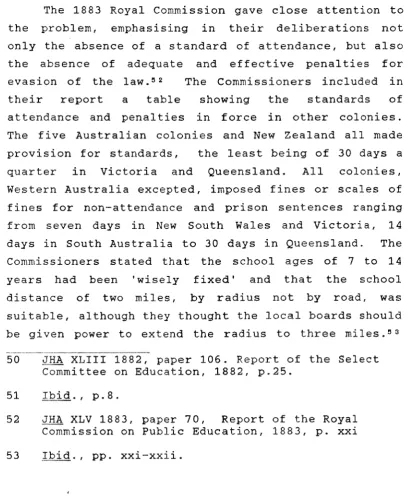
The 1883 Royal Commission gave close attention to the problem, emphasising in their deliberations not only the absence of a standard of attendance, but also the absence of adequate and effective penal ties for evasion of the law. t~ 2 The Commissioners included in their report a table showing the standards of attendance and penal ties in force in other colonies. The five Australian colonies and New Zealand all made provision for standards, the least being of 30 days a quarter in Victoria and Queensland. All colonies, Western Australia excepted, imposed fines or scales of fines for non-attendance and prison sentences ranging from seven days in New South Wales and Victoria, 14 days in South Australia to 30 days in Queensland. The Commissioners stated that the school ages of 7 to 14 years had been 'wisely fixed' and that the school distance of two miles, by radius not by road, was suitable, although they thought the local boards should be given power to extend the radius to three miles. 53
---~·---50 ~HA XLIII 1882, paper 106. Report of the Select Committee on Education, 1882, p.25.
51 Jbid. , p. 8.
[image:17.591.106.521.287.791.2]They recommended that the grounds for exemption be clearly defined, 'instead of throwing upon local bodies the entire responsibility of deciding what constitute[d] sufficient ground of exemption. ·~ 4 They
were especially interested in emulating all the other colonies, except for Western Australia, in the instituting of an exemption clause which would release from further attendance a child who had passed a Fourth Class examination.~o The Commissioners regretted that
the 1882 Select Committee's recommendation that children under 12 years of age should not be employed in factories had not been passed into law and, consequently, they made a similar recommendation.o6
The Commissioners, having earlier put the case for making education free, argued that 'the State may justly assume all the powers necessary to the rigorous enforcement of the compulsory clause' .5 7 The Education
Act of 1885, which embodied many of the Commission's recommendations, failed to provide free education, shied clear of imposing imprisonment on the defaulting parent and made no provision for exemption on the grounds of a child having passed a specified examination. The Act did define the ages of compulsory attendance and, in doing so, reduced the leaving age from 14 to 13 years; i t defined attendance as three school-days in every week in which the school was open; deemed a school day to be of four hours duration or two hours before noon on any two days or two hours after noon on any two days and the Act also provided five grounds for exemption. Apart from quite specific
... -...
-·~--~·-~---~~-~~---·-~·--54 Ibid. I p. xxii 55 Ibid.
56 Ibid.
exemptions, such as exemptions granted by the local Board of Advice or the non-existence of a public school within two miles of a child's home, the three other exemptions were vague and, in the event, proved to be practically unenforceable. Sickness was one of 'the
just causes of exemption', though no evidence was required of the child's illness. 'Regular and efficient instruction in some other manner' proved, according to Visiting Officers, to be a fruitful source of evasion of the compulsory clause. Being 'educated up to the compulsory standard of education', provided the child had reached, eleven years of age, was a vaguely-worded exemption, although later regulations made the exemption conditional on the child satisfying the Inspector that a certain standard had been reached.58
The framers of the Education Act of 1898, acknowledging that the 1885 Act had done little to raise attendance levels, made attendance compulsory for all children between 7 and 13 years of age for each day that the school was open, unless i t could be shown by the parent that the child's labour was required to help support the family, in which case the provision of the 1885 Act applied and the child was required to attend for three days only .59 The Education Act of 1912 incorporated the provisions of the 1898 Act and raised the school-leaving age from 13 to 14 years.60
58 A£1s __ QLJ?ar.).iament of TAsmf2!pia. Education Act, 49 Viet., No.15, 1885.
59 Act~QJ_fa~liament of Tasmania. Education Act, 62
Viet., No. 37, 1898.
60 ~fts _£!_:_f3~rliament o_f Ta~mania. Education Act, 3
Attendance Rates
r - - '~'"'"',..._v,.,..._..._...__~-...~-~---'-'••-H.>•••--~-,...,-~
Number of children Average Daily %Rate on the Books Attendance
1836(1) 1061 825
37 1206 879
38 960 747
39 814 672
40(2) 1148 not given
41 1255
-42 1460
-43 1407
-
I
44 1493
-45 1413
-46 1510
-47 1390
-48 1161
-49(3) 3256
-I
50 3526 2039
51 3778 2916
52 3352 2462
53(3) 3121
-54(4) 2734 2024
55(5) 3377 2444
56(6) 3661 2628
57(7) 2471 1818
58(8) 4140 2795
59(9) (12) 2825 1748
60(10) (13) 4149 1899
61(11)(14} 4751 2154
62(15) 7814 3674
-~~,----~---~,
_____
,Explanations of the data, though lengthy, are necessary.
61 Armual Reports for: 1840/ p.5.
1841/}
1842,} 1842/ p.5. 1843/ p.5.
1844/ p.5.
1845/ p.7.
1846/)
1847/} 1848/ p.7. 1848/}
18491 Half-year 1854,p.3.
1850, p.21.
1851/ 1854, p.3;1852,p.3.
1852, p.3.
1853, half year to 3D.6. 541p.3.
18541 half year to 31.12.54,p.8. 1855, p.9.
1856, (Southern Board),p.7.
1857, (Southern Board),p.8. 1858, (Southern Board} ,p.6. 1858, (Northern Board},p.8. 1859, (Southern Board),p.10.
1860, ( Southern Board) ,p.16.
1861, (Southern Board),p.16.
1862 (Southern Board),p.16. 1862 (Northern Board),p.9.
77 72 75 82
-57 77 73 -74 72 71 73 67 61 45 45 4 76 1---~-~---(1) The figures for 1836, 1837, 1838 and 1839 {first two quarters only) are taken from AOT CSO 8/122/2996-3033. Commission of enquiry into J.D. Loch's charges, 1845, Table A.
(2) The average daily attendance figures for the period 1840 to 1848 were not included in the annual reports of the Board. Figures for 1845 and 1846 are available from Bradbury • s Reports, but, as they are a mixture of 'average daily attendance' ranges rather than averages and failures to record numbers, the computation has not been made.
(3) No report was issued in 1849, due to Bradbury's sudden death. The figure of 3256 has been taken from Arnold's Report for the half year to 30th June 1854, p.3. The figure for 1853 is taken from the same report.
(4) The figure of 2024 for 1854 is an 'average attendance', presumably meaning an 'average daily attendance. •
(5) The figure of 2444 for 1855 is an 'ordinary attendance', presumably meaning an 'average daily attendance. •
{6) The return for 1856 published figures for each of the half years. The two figures above are averages of the two half years.
( 8) The figures above are compiled from the Annual Reports of the Southern and Northern Boards which show variations. The Southern Board adopted the definition 'Highest Number of Scholars on the Rolls' and the Northern Board kept to previous definitions.
( 9) The figures for 1859 are taken from the Annual Report of the Southern Board only. The definition 'Highest Number of Scholars on the Rolls' is used. (10) and (11)The figures for 1860 and 1861 are taken
from the Annual Reports of the Southern Board only. The column heading changed yet again - this time to 'Number of Scholars whose Names appear on the Rolls during the Year'.
(12) (13) and (14) The figures for the three years, 1859-61, are taken from the Annual Reports of the Southern Board only. The very large increase from 2825 to 4194, or 48%, in one year, cannot be accounted for by the change from 'Highest Number of Scholars on the Rolls' to 'Number of Scholars, whose Names appear on the Rolls during the Year'. The Inspector, J. J. Stutzer, made no at tempt at explanation and contented himself with this remark in his Report for 1860, p.25:
The year having been one of considerable depression among the working classes, it is gratifying to find a large augmentation instead of a diminution among the Scholars.
attendance from 61% to 45% It is not likely that arithmetical error is at fault, since that would call into question the data for all years prior to 1859 and that is difficult to believe.
(15) The figures for 1862 are taken from the Annual Reports of the Northern and Southern Boards. The puzzle of a continuing low percentage attendance, 47%, remains.
In 1862, the Southern Board began to use a quite different method of compilation. It established the Average Number on the Rolls during the Year, by which
they meant:
The ~ or average of the several numbers appearing on the Rolls throughout the year, and which, in point of fact, vary from week to week and from month to month.s2
Board members also used the 'Numbers in Daily Attendance', meaning:
The mean or average of the numbers found in actual attendance, not on the Rolls merely, but present in their classes from day to day during the year.s3
Had these two computations been used since the formation of the Board in 1839 or even earlier, and if the attendance registers had been properly kept, a reasonably accurate set of attendance figures would have been available from the early years. It is only from 1862 onwards, therefore, that attendance figures can be accepted with greater confidence again, 62 Southern Board of Education. Annual Report for
provided good records had been kept by the teachers and statistics accurately compiled by the Board. With this method, in use from 1862, the attendance rates for the Southern Board area, for the six years before 1862, would have been as follows:
Year
1857 58 59 60 61 62
Average Number of Scholars on Rolls 2471 2257 2371 2643 3165 3334
Average Daily % Attendance
1791 1682 1694 1855 2154 2337
72 74 71 70 68 70
Rate
6 4 Note: (1} The differences in the figures for Average
Daily Attendance for 1858 and 1862 with figures given previously are accounted for by the fact that those figures were for the whole island.
(2} The slight variations between the two sets of figures for Average Daily Attendance for 1857, 1859, 1860, and 1861 are explained by the fact that the figures were obtained by the Southern Board and published in its 1862 Report as at December 31st for each year and not at some other time of the year.
But the figures for these years are not reliable. The Board took the figure 2471 as an average for 1857 when, in the Report for that year it appears as the 'Number of Children on the Rolls' 6 ~ The figures of 2257, 2371
and 2643 do not appear at all in the Annual Reports for
1858, 1859 and 1860.6 6 The average daily attendance figures for those years were 2410, 2452 and 2711 respectively, yielding the lower rates of 69%, 67% and 68%.67 The figures 3165 and 3334 are correct. 68
So much for the accuracy of the compilers of statistics at the Central Board. From 1863 onwards, however, there are no grounds for considering their work to be inaccurate - at least because no errors of the kinds discussed above can be discovered. In any event, the system established in 1862 was the system maintained throughout the period under discussion, that is, until 1913, with minor modifications such as the assessing of the average number on the rolls at the end of each month and other variations which will be mentioned in context:
66 Southern Board of Education. Annual Reports for 1858, p.6; 1859, p.lO; 1860, p.16.
Atte~dance at Tasmanian public schools, 1861 - 1913. Year 1861 62 63 64 65 66 67 68 69 70 71 72 73 74 75 76 77 78 79
No. of Distinct Scholars on Rolls
4751 5100 7142 7791 8294 8198 8346 8746 9316 9997 10194 10491 10803 12158 12271 12231 12257 12453 12652
Av.No. of Scholars on Rolls
(A) 3165 3334 4607 4987 5357 5159 5419 5649 5992 6678 6786 6921 7047 7970 8145 8140 8222 8297 8520
Attendance at Tasmanian public schools, 1861 - 1913. Year 1880 81 82 83 84 85 86 87 88 89 90 91 92 93 94 95 96 97 98 99 1900 01 02 03
No. of Distinct Scholars on Rolls
12286 13644 13775 14241 14846 15418 16014 16527 17125 17949 18156 19207 20659 20475 19967 19907 20826 21763 22517 23272 24157 24542 24764 24595
Av.No. of Scholars on Rolls
(A) 8352 9258 9302 9708 10144 10531 11199 11383 12002 12460 12640 13491 14549 14875 14476 14594 15772 16634 17136 17682 18693 19236 19553 18596
Attendance at Tasmanian public schools/ 1861 - 1913. Year 1904 05 06 07 08 09 10 11 12 13
Note: (1)
No. of Distinct Scholars on Rolls
24082 24043 24221 25157 27760 29406 30805 32244 32817 33953
Av.No. of Scholars on Rolls
(A)
18225
25759 25368 26919
Av.Daily B+A as Attend- % ance (B) 14321 14112 13729 14464 15952 17391 17974 18130 19561 21174 78 70 77
7 86 9
The figures for 1861 and 1862 are Southern Board area only.
for the
( 2) The Education Department did not publish information on the 'Average Number of Scholars on the Rolls' for the period 1905 to
..
"'~~---~~~~·~-·-·~--~--~---69 Southern Board of Education. Annual Reports for 1861, p.16; 1862, p.16.
1863, p.12. 1871, p.l2. 1879, p.22. 64, p.12. 72, p.12. 80, p.24. 65, p.12. 73, p.12. 81, p.24. 66, p.10. 74, p.14. 82, p.28. 67, p.10. 75, p.14. 83, p.22. 68, p.11. 76, p.14. 84, p.26. 69, p.12. 77, p.28.
70, p.12. 78, p.22.
Education Department. Annual Report for: 1885, p.24. 1894, p. 5. 1905, p. 3.
86, 1887 95, p.5.
Report p.3. 96, p.4. 06, p. 2. 87, p.3. 97, p.4. 07, p. 2. 88, p3. 98, p.5. 08, p. 2. 89, p. 3. 99, p. 5. 09, p. 2. 90, p. 3. 1900, p.5. 10, pp.4,5. 91, p.3. 01, p.2. 11, p.5. 92, p. 3. 02, p.2. 12, p.10. 93, p. 4. 03, p. 2. 13, p.9.
1910. Under the Directorship of W. L. Neale for that period, the data published in its place was the 'number present at any time during the month' and 'Average attendance for the Month'.
Neale did not state his reasons for breaking with practice. The 'Number of Distinct Scholars on the Roll' during this period showed strong growth and so, probably, did daily attendance and the percentage. It is a mystery why Neale should wish to conceal figures which would have been to his credit. McCoy, who followed him, resumed the old practice of dividing the average daily attendance by the average number on the rolls to obtain the crucial figure, the percentage. (3) For the years, 1905 to 1910 i t is not possible to compile figures on the basis of the percentage ratio for previous years between the Number of Distinct Scholars and Average Number of Scholars because the ratios for, say, the previous ten years are too erratic to permit averaging for the missing years of Average Number of Scholars. The figures for 1895 to 1904 are 73%, 75%, 76%, 76%, 76%, 75%, 77%, 78%, 75% and 75%.
(4) 1893, 1898 and 1911 were years of high incidences of infectious diseases and epidemics. See Education Department. Director's Report for 1893, p.7; Annual Report for 1898, p. 3; Director's Report for 1911, p.5.
A~~enqance at Tasmanian public schools. 1861 - 1913.
Period % attendance
1861-69 1870-79 1880-89 1890-99 1900-04 1911-13
73.7 73.1 71.7 71.7 74.8 75.0
Attendances at individual schools varied greatly. Concerning the 419 schools open during the year, the Director wrote in 1912:
The variation is great and not infrequently indicates the difference in the efficiency of the schools. Twenty three schools reached 90 per cent or more and 132 obtained between 80 and 90 per cent.7o
Only thirteen school registers, covering the period to 1913, have survived, and most are for fairly brief periods and many are poorly kept. 71 Inspectors' Reports have not survived in great number and records of local Boards, if they contain details of attendance and non-attendance at all, are very patchy. Even if they were not, they could not be used as accurate records, for such was not their purpose.
The Sandy Bay School admission register, 1853-92, the oldest surviving school record, was so poorly kept that the information concerning attendance is almost useless as the following extracted entries show:
70 Director's Report for 1912, p.10.
Year Number admitted
No. of Years. at the School
.,__,~~~-~,..,..._., 1853 7
54 6 55 2 56 6 57 9 58 5 59 26 60 19 61 30 62 41
~--~-· -~-W
7 6 5 4 3 2 1 less No entry than 1 made
1 1
1
3 2
1
1
3 16
No entries made after 1862
5 5 2
6
4
4
7
18 30 40
7 2 However, i t is possible for some years, at least, to work out from the register, the class, or standard, from 1 to 6, which each child had attained at the time of leaving the school:
Year Number Highest class reached No entry
Admitted made
1 2 3 4 5 6
~---~..._
__
~- ··-~-,---~~---· ..
·~-~---1853 7 3 4
54 6 2 3 1
55 2 1 1
56 6 2 1 1 2
57 9 2 1 5 1
58 5 1 3 1
59 26 3 2 8 13
1860 19 2 3 8 6
61 30 30
62 41 41
63 20 20
64 35 1 1 33
65 41 6 5 4 4 1 21
66 31 7 9 7 5 1 2
67 38 7 14 11 3 3 68 48 13 8 20 5 2
69 26 9 5 6 5 1
1870 41 10 10 10 7 3 1 71 42 14 12 12 3 1
72 31 9 6 7 7 2
73 13 6 1 3 2 1
74 47 11 5 16 10 4 1
75 21 5 5 5 3 3
76 23 7 3 8 3 1 1
77 16 7 4 5
78 9 7 1 1
79 18 18
1880 9 3 3 2 1
81 20 4 2 9 4 1
82 7 3 1 3
83 19 12 3 3 1
84 8 4 3 1
85 23 8 4 4 2 4 1
86 10 4 1 1 4
87 16 4 1 4 2 3 2
88 15 5 1 2 3 3 1
89 14 5 3 4 1 1
1890 15 4 1 3 4 3
91 10 2 2 4 1 1 1
92 6 1 3 1 1
·---~~-.----.,.,---...~-~--~~- . - ,-,...,-~~--... ~,...__,~~~--~··
-~--~-···-~y~--7 3
It is difficult to interpret this table with assurance. The adding up of the figures in each column
shows that few children stayed at school long enough to have gained much benefit:
Class: 1 Number: 187 Percent: 29
2
Sandy Bay School. Admissions, 1853 - 92 Highest Class Reached
3 4 5
130 172 106 35 20 27 16 5
6 Total 13 643
2 10074
By themselves, the figures are deceptive because a number of the children would have gone on to other schools and many of them were too young to have learned even the most elementary reading skills. An analysis of the admission register shows this quite clearly. Period No. No.between Under No entry
admitted 4
&
7 yrs 4 yrs made of age of age---·---·
·
-1853-92 823 248 52 157 5
Of the 808 children whose ages were recorded, 31% were between 4 and 7 years of age and 6% were under the age of four. Seven children were under the age of three and two were under the age of two. Such large numbers of children under the age of seven who were in attendance at Tasmanian public schools were not uncommon.
Smithton Public School, in the timber and dairy country of the north west coast, had a very different
regional economy, but a similar youthful age structure and attainment pattern:
Smithton Public School Admission Register 1881 - 1906
Highest Class Reached
1 2 3 4 5 6
Number 129 8 89 71 46 6 Percentage: 31 1 21 17 11 1
Total
421 100
~[-"'"'""""'""'" "'""'~·--- ·-·~~·---~---...
-No. admitted
430
Smithton Public School
Admission Register, 1881 - 1906 Age Structure
No.below 7 years of age
Proportion %
- - -
·-121 28 7 6
Mathinna, a gold mining distric.t inland from Tasmania's east coast, was for many years a single industry region. It was thus quite different from Sandy Bay and Smithton, but, like them, it shows a similar age pattern, with even more extreme youthfulness, accountable, no doubt, by the youthfulness of the parents in such a community - 53% of all fathers of children at the public school were miners. The
admission register is available and records admission from its second year of operation, 1882, to 1895 {the register includes fragments of the 1896 admission details, but the pages for 1896 are damaged and have been left out of account)
--···--~---·--~-~--~---·---~----No. of children admitted
712
chool, Mathinna Public S
Age Structure
1882
No. with No. age between recorded 6 & 7yrs
712
of age 73 10%
'·
-of Pupils. No.
between
4 & 6yrs
of age 158
22%
- 95
INI
.
below4 yrs of age
I
75 10% 7 7
An analysis of the Mathinna School register shows that a very large proportion of the children who left school returned to it at a later date. Of the 712 who were enrolled during the period 1882 to 1895, the register gives the names of 665 children who left the school during that time.
returned to the school.
Of these, 137, or 20%, This may be considered a comparatively high proportion, but mobility was characb:ristic of many Tasmanian families. The Don Public School, set in an agricultural region and with a more stable population, i t might be concluded, than Mathinna, is an example:
Number of children admitted
214
Don State School
Admission Register, 1900-14
Number leaving the district
116
Ratio %
54 78
The admission registers of these three schools, each from quite different economic regions, show three characteristics of Tasmanian Education - the low level of individual attainment, the youthfulness of the pupils and the mobility of Tasmanian families. The broken schooling so many children and the irregularity of
of
their attendance reports of
were frequently mentioned in official the Board and Department, dating from the earliest period in which, it was thought, records were sufficiently reliable for inferences to be drawn. The Annual Report for 1867 of the Deputy Inspector, Murray Burgess, for example, shows the official concern for poor attendance and broken schooling and the widespread nature of the problems:
The want of correspondence between the number of children who were presented for examination under each standard, and the number of children of the age for which each standard is intended, will be seen by comparing the lines bracketted in the following table.
~l-- ---~t~.-:-~-II--~~~l~----~~--
---1
i
19 I 20I
16I
9 I 3 : 112
10I
13 12113
ju
9i
3 6&7I
7&81
8&9 19&10
110&11
Over 11! ! I
I
!
iL----~---L
________
L~__
L_ ____L _______
j _____~---79
1
=
Percentage of Number of Standard upon Average NumberScholars under each of Scholars attending same Schools
2
=
Percentage of Scholars ...3
=
Aged between ...Thomas Stephens, in 1873, similarly classified the children present at his examination, according to their class:
--Class I II III IV
v
VI TotalDiv.1 Div.2_
' ' I
6 6
~~_?.§]_
__~
__1_~_9_j
_
_2_-=:.9_:::_8_1-_ _::3:...::3:_:7_,21%
l
18i
25l
19160!
38I
3144~
1 ·l-10~:-111 I
I I ' I
I I . l I
_ _ __,'r- --+---1----
·---+---+---Years later, in 1888, the proportions had changed little and, by that date, official figures also revealed, not only the spread of ages in each class, but also the large number of children in the higher age groups who were in the lower classes:
79 Deputy Inspector's Report for 1867, p.14. (The figures have been rounded)
---~---~--~--..
--
... ,..~,..,.~ ... .-.--...._...,_,________________
._..~,,~""""~Age Class
I II III IV
v
VI Total %-~ ... -~.-... ~-~-~~ ... ~ .... ,_,,__,..,,_,
___
--~""""'--'~-·-·--
- · -
·--·-· -.,.---·---·
Under four years 71 71 0.5
Four years 210 210 1.7
Five years 500 9 509 4.2
Six years 797 80 3 880 7.4
Seven years 1088 290 44 5 1427 12.0
Eight years 878 517 164 25 1584 13.3
Nine years 499 621 391 85 11 1607 13.5
Ten years 289 512 528 222 63 6 1620 13.6
Eleven years 108 303 450 349 138 26 1374 11.5
Twelve years 68 168 327 363 222 63 1211 10.1
Thirteen years 21 76 169 261 162 63 752 6.3
Fourteen years & over 21 46 97 174 176 129 643 5.4
·-""'"~_,.,..._.._..
___
.._...,..,.,.,.,""""_.,..~-... .-..,...,.,_ ··~--.... --~-~~ ... ~ ·~-~~A- ,~...,_- -~ .~ .... -,..,...~--~--~---~-TarAL 4550 2622 2173 1484 772 287 11888
% of Scholars 38.2 22.0 18.2 12.5 6.5 2.4 100.0
B 1
--·~·---.-~~~-~~-~~~·,_...,.-~.,.,_, .. ~-.,,~,-~--
--·
- -
'"~·-·-.,..,~--~~- " " ¥ • · ' W-The figures show, for example, that of the 4550 children in Class I 1006, or 22%, were aged nine years or over. Twenty years on, in 1908, some improvement had taken place in the distribution of ages across the classes:
-~~~~---.---·---·--·.---..----i----~ - - - --~---.---~ Age Prep. I II III IV V VI 'IUI'AL
No. %
!--·---~ +---1---'---- ---~ '"""""~-~~..., 1--- -~ '~----
+---Five years
and under 704
I
704 3.1
Six years 1426 246 12 1 1685 7.5
Seven years 1355 880 172 34 2441 10.9
E:ight years 823 1006 716 132 9 2686 12.0
Nine years 296 816 1050 525 112 9 1 2809 12.6
Ten years 111 381 834 1018 483 97 10 2934 13.2
Eleven years 58 157 397 899 815 439 99 2864 12.8
Twelve years 29 69 254 548 818 759 344 2821 12.6
Thirteen yrs 6 13 87 245 402 493 586 1832 8.2
Fourteen yrs
and over
-
11 26 72 179 346 818 1452 6.5Total 4808 3579 3548 3474 2818 2143 1858 22228 100.0
---Percentage 21.6 16.1 15.9 15.6 12.6 9.6 8.3 100.0
---~--- ,___
____
---
-.------
------8 2 A greater number of pupils were staying on to Classes IV, V and VI, 30.5% as against 21.4% in 1888. Furthermore, there were fewer children under the age of seven, 10.6% as against 13.8%.
Important as the three problems of low attainment, youthfulness of school populations and geographic mobility were, they were overshadowed by the chronic low rates of attendance. The almost painfully slow improvement in the attendance rates have been discussed above, but these rates appear even worse than described when they are placed in a wider educational context.
Attempts by the Inspectors, Arnold and Cotton, in the 1850's to assess the number of children who should have been at school were based on a rule-of-thumb criterion which Arnold reckoned at 1 in 10 of the 82 Director's Report for 1908, p.3.
population,s3 and which Cotton thought should be 1 in 8.a4 In 1860, J.J. Stutzer made an attempt to show that the number requiring education, according to the census, was 22,000 and estimated that 6000 children were 'receiving education for a whole or part of the year' in the public schools with an additional 4000 receiving education in private schools. 8 11 'The mean
proportion to the population, is, therefore, about one in nine', he wrote. He thought that this figure compared well with Victoria and New South Wales,86 but admitted that his figure of 22000 was based:
On the assumption that a child receives twelve years of continuous instruction, which is at least one-third over the average in the upper classes in any country, and certainly three times as much as any child can be expected to receive in the labouring population.87
Stutzer's other serious oversight was to fail to take into account those children who were being educated at home.
Stephens was the first official to attempt to reach conclusions based on calculations which were not grounded on the belief that some desirable proportion, such as 1 in 8 or 10 of the population, should be at school.88 In 1869, using the figures derived from both public and private schools and figures derived from the census, he reached these conclusions:
83 Board of Education. Annual Report for 1855, p.12. 84 Inspector's Report for 1860, p.29.
85 Southern Board of Education. Inspector's Report for 1860, p.29.
87 1J2_id.
Public
&
private s choo 1 figures
Children 4 to 15 years
lo.
31074
No. being educated
16112
Ratio
\
52
No.
23146
23146
Children ( to 12 years
No.bein; educatec
1358(
iatio
'
58
8 9 He pointed out the ambiguity of the term 'Number on the Books' which in Tasmanian public schools meant the exclusion of those children who had been absent for four weeks, but which in England meant the number of children attending at any time during the quarter. Errors had thereby resulted from attempts to establish a ratio between the number on the books and the average daily attendance. These attempts had led to fallacies in concluding that 'there [was] a greater regularity of attendance in Tasmania than in England or Ireland. I regret to say from personal knowledge that the reverse is the case'. 9 0 Stephens acknowledged weak points in his own calculations, but thought his conclusions of 52%, 57%, 58% or 65% were 'sufficiently near the truth for all practical purposes' .91
In 1895, James Rule used the same basis of census returns and public and private school figures. Calculating that the number of children of school age, 7 to 13 years, was 23400 and the total at all public and private schools was 18600, he concluded that 4800 children, or 20%, received no education at all. Making the point that not all of the 4800 had necessarily been totally absent from schools during the year, he concluded that 'educational progress [had] been at a quicker rate than that of the increase of population~92
Two years later, he wrote that the rate had accelerated and, consequently,
All things considered, i t probable that those who have instruction at any time childhood exceed 200o.sa
does not seem not been under during their
In 1898, he concluded that of the 25,531 children aged from 7 to 13 years, 22,515 'attended school some portion of the year', leaving more than 3000, or 13%, who did not attend. But the figure of 22515 had been reached after deducting 10% from the gross enrolment figure, 10% being 'the usual deduction for possible cases of multiple enrolment. '9 4
In 1906, W.L. Neale, making use of information that no previous Director had been given,9~ was able to
arrive at the number of individual children taught in the schools. s 6 He was thus able to dispense with the much less exact categories of gross enrolment and number of distinct scholars on the roll. He was also
_.,.,_,~---~~~---~~ ..
able, for the first time, to use 'detailed and valuable returns from (the] private schools'. 9 7 He calculated the numbers not attending any school, public or private in three categories, the age groups of 7 to 13, 7 to 14
and 6 to 14 years:
Age group ·- No. of No. on rolls %not
Children of Public attending
in the State & Private any
Schools school
---7 - 13 yrs 27689 19149 30.8
7 - 14 yrs 31838 21933 31.1
6 - 14 yrs 36315 23387 35.5
9 8
In 1907, he stated that 'further investigations and discussions with local school authorities who thought [these figures] could not be the fact [s] have fully confirmed my view'.99
The following figures are the calculations, as shown above, of the percentages of Tasmanian children not receiving an education in a period of almost forty years, 1869 to 1907, regardless of age ranges and methods of calculations:
97 Ibid.
98 Ibjd.
YE>.ar Author of Calculations of percentage Calculations of children not
receiving an education
1 2 3 4
~~~~~---·
--··---,-,---·-··---1869 Stephens 48 43 42 35
1895 Rule 20 8.5
1898 Rule 13
1906 Neale 30.8 31.1 35.5
-~ .... ~--~~-~~----~··-"--- .m,.._.Y_,...,m..,._._
Such was the extraordinary range of calculations. Part of the explanation lies in the base that the three men used for their calculations, that is, the meaning of terms such as 'Number of Distinct Scholars on Rolls' ,
'Gross or Aggregate Enrolments, ' (presumably, the same term as Stephens used, 'Number being Educated •) and 'Number of Individual Children'. Only the third category can be regarded as being accurate. The other part of the explanation is that which Rule alluded to, namely, that none of the categories, 'Gross Enrolments', 'Average Number on the Rolls' and 'Average Daily Attendance', were sufficiently
explain the non-statistical phenomenon
adequate to of children moving in and out of schools, both public and private, Writing in 1895 of the 4800 children who 'attended no school at any time in the year', he added:
Still i t does not follow as a necessary inference that all of these, or even a large proportion, had not been attending more or less regularly in former years; and it is even possible that some of them may have reached a passable standard of instruction.1oo
Rule's category of those who had not attended school at any time during the year would have included children who were being educated at home and children in remote areas who were not reached by any teacher or school, public or private.
The 1885 Act listed, amongst others, as a just cause of exemption, 'that the child is being regularly and efficiently instructed in some other manner. '1 01 The Act also placed the onus of proving the grounds of exemption on the defendant once proceedings had been undertaken for non-attendance. But the means provided for the bringing of proceedings, the Boards of Advice, police and Truant Officers, were inadequate to the task and, at no time, could i t be said that all Tasmanian children were receiving some kind of education, no matter how intermittent. The Commonwealth Census of 1911, its figures based on householders' responses, showed that the number of children receiving education at home when added to the category of 'Number recorded as "Scholar", but class of School not stated', amounted to 2556 out of a total of 33392 'receiving education,' or 7%.
To this figure must be added an unknown number of children who lived in remote areas. The isolation of some children can be surmised from the 1869 report of Murray Burgess in which he described areas in his district which were served by the public school system:
The majority of [the schools] ... are purely rural, many of them very small, situated in wild and secluded glens, away from civi1ization, not easy of access, and only reached on horseback.1o2
1 0 1 A£tl:L_QJ P a _r 1 i a1Jl!~J1.L_9 f ___ T a [email protected] i a • Education Act, 49 Viet., No. 15, 1885.
The Minister, Edward Braddon, wrote of some areas in the colony where the Department could not maintain even a half-time or third-time school. On one occasion he wrote that an at tempt would be made by teachers to visit periodically children in the Lake country, though in summer months only.103 Some indication, perhaps, of
the number of children receiving no education at all may be gained from an examination of the Department's policy in 1912 of establishing subsidised schools in remote areas where previously no school had been provided. Parents were required to provide a suitable room, but qualifications and experience were not sought of the private teacher, engaged at the rate of £5 for each pupil, providing the sum of £50 yearly was not exceeded.104 Such a basic educational provision
attracted 138 children in its first year, the number rising to 48 3 in 1913.1 0 5 To these figures may be added the number of children who were conveyed to the nearest school by boat, vehicle or train at the Department's expense and for whom no such scheme had previously been in existence. In 1912, 363 children were so conveyed,106 in 1913, 2361 07
The growth in state school attendance discussed above, does not, of course, represent the total number of Tasmanian children in attendance at school. The chapter on the private schools shows that a large
_.__.~·--··--··----·----~-~~-~---~··~----··-~--·--~--~--~--~~·-~~~---·---~·--~·---103 Minister's Report for 1888,p.4. 104 Director's Report for 1912, p. 8.
proportion of children at school were in attendance at private schools. From 1894 onwards, the Department began to gather information from the registers of those private schools which Inspectors knew to be in existence. The number enrolled at all private schools formed a large proportion of the total, until the 1906 Registration Act began to take effect:
-~---~---~0---·----·---·---Year Gross enrolment No.of distinct Ratio
1894 95 96 97 98 99 1900 01 02 03 04 05 06 07 08 09 1910 11 12 13
at private schools scholars an state %
6049 7073 8364 8691 9973 8781 10199 10373 9963 8843 7289 8323 7979 9329 8448 7653 7462 6947 7515 7285
school rolls
19967 19907 20826 21763 22517 23272 24157 24542 24764 24595 24082 24043 24221 25157 27760 29406 30805 32244 32817 33953 30.2 35.5 40.1 39.9 44.2 37.7 42.2 42.2 40.2 35.9 30.2 34.6 32.9 37.0 30.4 26.0 24.2 21.5 22.8 21.4
1 0 B
Discussion of attendance is incomplete without discussion of irregularity of attendance. Irregularity was one of the greatest barriers standing in the way of
--- ----·----~---~--·-~-~-"'-~· -~----~
108 Annual Reports for: