University of Southampton Research Repository
ePrints Soton
Copyright © and Moral Rights for this thesis are retained by the author and/or other
copyright owners. A copy can be downloaded for personal non-commercial
research or study, without prior permission or charge. This thesis cannot be
reproduced or quoted extensively from without first obtaining permission in writing
from the copyright holder/s. The content must not be changed in any way or sold
commercially in any format or medium without the formal permission of the
copyright holders.
When referring to this work, full bibliographic details including the author, title,
awarding institution and date of the thesis must be given e.g.
AUTHOR (year of submission) "Full thesis title", University of Southampton, name
of the University School or Department, PhD Thesis, pagination
Faculty of Engineering, Science and Mathematics
School of Electronics and Computer Science
A narrative-based collaborative writing tool for
constructing coherent technical documents
by
Nishadi H. De Silva
A doctoral thesis submitted in partial fulfilment
of the requirements for the award of
Doctor of Philosophy
ii
UNIVERSITY OF SOUTHAMPTON
ABSTRACT
FACULTY OF ENGINEERING, SCIENCE AND MATHEMATICS
SCHOOL OF ELECTRONICS AND COMPUTER SCIENCE
Doctor of Philosophy
A narrative-based collaborative writing tool for constructing
coherent technical documents
by Nishadi H. De Silva
One important feature of an effective document that makes it easy to read and understand is known as coherence. Technical documents produced collaboratively are often incoherent due to a lack of group consensus and misaligned contributions by the individual authors. However, current document planning techniques and writing tools do not provide explicit support for improving coherence. The goal of this research, therefore, is to develop and evaluate a new technique and tool that helps teams of authors to structure coherent technical documents.
The coherence of a document can be attributed to the story (or narrative) it conveys to the reader. If this story is consistent and coherent, the same can be said about the document. A discourse theory such as Rhetorical Structure Theory (RST) that has been developed by linguists helps further to analyse and improve a narrative. RST explains the coherence of a text by virtue of relationships (such as “paragraph A justifies paragraph B”) between parts of the text. This research has combined the ideas from these parallel strands of research to develop a new document planning technique called narrative-based writing. The method
involves writing down an explicit précis of the story (called a document narrative or DN)
and then analysing it using RST. The DN and RST analysis are then used to structure the eventual document.
iii
Acknowledgements
This research has been funded completely by a scholarship from the School of Electronics and Computer Science, University of Southampton, UK and by an Overseas Research Students (ORS) award (Universities UK).
Firstly, I am indebted to my PhD supervisor, Professor Peter Henderson, for the technical guidance and motivation to reach new heights. Thank you very much.
I am thankful to all my friends and colleagues who supported me throughout my PhD work.
I would also like to pay tribute to all my past school teachers and principals who went above and beyond their call of duty for their pupils.
iv
List of publications
1. De Silva, N. and Skaf-Molli, H. (2006) Narratives to preserve coherence in collaborative
writing. Proceedings of the 8th International Workshop on Collaborative Editing Systems, Banff, Canada.
2. Henderson, P. and De Silva, N. (2006) A narrative approach to collaborative authoring: A
business process model. Proceedings of the 8th International Conference on Enterprise Information Systems (ICEIS), Cyprus.
3. De Silva, N. and Henderson, P. (2005) Narrative support for technical documents: Formalising Rhetorical Structure Theory. Proceedings of the 7th International Conference on Enterprise Information Systems (ICEIS), USA.
4. De Silva, N. (2005) A narrative approach to technical document construction. Proceedings
of the PREP 2005 conference, Lancaster University, UK. (Awarded the EPSRC prize for best oral presentation in Computer Science)
v
Table of contents
1 INTRODUCTION ... 1
1.1 BACKGROUND TO THE PROBLEM...1
1.2 OUTLINE OF OUR SOLUTION...2
1.3 A LIST OF ORIGINAL CONTRIBUTIONS...3
1.4 OUTLINE OF THE THESIS...4
1.4.1 A document narrative for each chapter ...5
2 BACKGROUND LITERATURE ... 6
2.1 DOCUMENT COHERENCE:AN INFORMAL DEFINITION...7
2.2 WHY FOCUS ON TECHNICAL DOCUMENTS...8
2.3 COLLABORATIVE WRITING...9
2.3.1 Ways in which authors collaborate ...9
2.4 THREE TECHNIQUES TO ORGANISE THE IDEAS IN A DOCUMENT...11
2.4.1 Mind maps ...11
2.4.2 Outlines...13
2.4.3 Pyramids...14
2.5 COLLABORATIVE WRITING (CW) TOOLS...17
2.5.1 Discussion ...20
2.6 THE ROLE OF NARRATIVES IN TECHNICAL WRITING...22
2.6.1 Understanding and improving narratives...22
2.7 SUMMARY...29
3 RHETORICAL STRUCTURE THEORY (RST)... 30
3.1 APPLYING RST:FIRST EXAMPLE...31
3.2 FIRST STEP:SEGMENTATION...32
3.2.1 Segment size...33
3.3 SECOND STEP:DEFINING THE RST RELATIONSHIPS...33
3.3.1 Five schemas...34
3.3.2 Recognising the relationships...35
3.3.3 Forming the RS-tree ...36
3.4 RST AND TEXT COHERENCE...38
3.5 APPLYING RST:SECOND EXAMPLE...40
3.6 SUMMARY...42
4 NARRATIVE-BASED WRITING: ... 43
4.1 THE TECHNIQUE EXPLAINED...44
4.1.1 Formulating the document narrative (DN)...44
4.1.2 Analysing the DN using RST...46
4.1.3 Producing the document ...49
4.2 THE ROLE OF DNS IN COLLABORATIVE WRITING...51
4.3 APPLYING NARRATIVE-BASED WRITING:SECOND EXAMPLE...51
4.4 DISCUSSION...53
4.5 SUMMARY...55
5 A NARRATIVE-BASED COLLABORATIVE WRITING TOOL: THE DESIGN... 56
5.1 THE CONCEPTUAL MODEL...57
5.1.1 Introduction ...57
5.1.2 The document narrative (DN)...57
5.1.3 The RS-tree ...57
vi
5.1.5 Summary ...61
5.2 VERSION CONTROL...62
5.2.1 Introduction ...62
5.2.2 Revision Control System (RCS) ...62
5.2.3 Concurrent Versions System (CVS) ...63
5.2.4 LibreSource ...63
5.2.5 Our method of version control...64
5.2.6 Summary ...66
5.3 THE BUSINESS PROCESS MODEL:AN AUTHOR’S PERSPECTIVE...67
5.3.1 Introduction ...67
5.3.2 Reading a RS-tree ...67
5.3.3 Editing a RS-tree ...68
5.3.4 Reviewing a RS-tree...71
5.3.5 Summary ...71
5.4 THE FUNCTIONAL MODEL:AN IMPLEMENTER’S PERSPECTIVE...72
5.4.1 Introduction ...72
5.4.2 The data model ...72
5.4.3 Notation used...73
5.4.4 The six core functions ...74
5.4.5 Discussion on NXT relationships...77
5.4.6 Functions to implement user actions ...78
5.4.7 Summary ...88
5.5 MERGING...89
5.6 SUMMARY...90
6 A NARRATIVE-BASED COLLABORATIVE WRITING TOOL: AN IMPLEMENTATION. 91 6.1 TIER THREE:DATABASE...92
6.1.1 Distributed vs. a centralised document repository ...92
6.1.2 XML vs. relational databases ...92
6.1.3 Developing the relational database...93
6.2 TIER TWO:FUNCTIONS...96
6.2.1 Functional programming languages vs. Java...96
6.2.2 Implementing the functions in Java ...96
6.3 TIER ONE:USER INTERFACE...97
6.3.1 Standalone vs. web-based applications ...97
6.3.2 Implementing a Web-based interface ...97
6.4 SUMMARY...99
7 CASE STUDIES ... 101
7.1 THE IMPACT OF DNS IN COLLABORATIVE WRITING...102
7.1.1 Discussion...106
7.2 SAMPLE APPLICATIONS OF NARRATIVE-BASED WRITING...106
7.2.1 Research proposals...106
7.2.2 Conference presentation...111
7.2.3 Project website ...113
7.3 SUMMARY...117
8 EVALUATION... 118
8.1 EXPERIMENT...118
8.1.1 Aims and objectives ...118
8.1.2 Experiment design ...119
8.1.3 Results and conclusions...120
8.1.4 Summary ...126
8.2 CRITICAL APPRAISAL...126
8.2.1 Semantic Web ...126
8.2.2 Ontologies...127
8.2.3 Speech acts ...128
8.3 OUR INITIAL GOALS REVISITED...129
vii
9 CONCLUSIONS AND FUTURE WORK... 132
9.1 LIST OF OUR MAIN CONTRIBUTIONS...133
9.2 SUMMARY OF OUR MAIN CONTRIBUTIONS...134
9.3 FUTURE WORK DIRECTIONS...135
9.4 CONCLUDING REMARKS...138
A: RST DEFINITIONS AND ANALYSES... 139
A.1 DEFINITIONS OF THE RST RELATIONSHIPS...139
A.1.1 Hypotactic relationships...139
A.1.2 Paratactic relationships ...145
A.2 RST ANALYSES OF THE DNS IN THE THESIS...145
A.2.1 Chapter 1 and 9 – DN for the thesis ...146
A.2.2 Chapter 2 DN...147
A.2.3 Chapter 4 DN...148
A.2.4 Chapter 5 DN...148
A.2.5 Chapter 6 DN...149
A.2.6 Chapter 7 DN...149
A.2.7 Chapter 8 DN...150
A.3 DN FOR AN ABSTRACT OF A RESEARCH PAPER...150
B: IMPLEMENTATIONS... 151
B.1 PREVIOUS PROTOTYPES...151
B.1.1 Narrative support for research proposals ...151
B.1.2 CANS (Computer-Aided Narrative Support) ...152
B.2 LIST OF JAVA METHODS IN THE CURRENT TOOL...154
B.2.1 Housekeeping methods ...154
B.2.2 Methods corresponding to the six core functions in Chapter 5 ...158
B.2.3 Methods corresponding to the other functions in Chapter 5 ...163
C: DETAILS OF THE EXPERIMENT ... 179
C.1 THE QUESTIONNAIRE...179
C.2 RS-TREES PRODUCED BY THE VOLUNTEERS...183
LIST OF FIGURES ... 192
BIBLIOGRAPHY ... 196
Chapter 1
Introduction
Certain kinds of presentations, texts, have a kind of wholeness or integrity that others lack. We recognise that they “hang together” and are understandable as whole objects. They are coherent.
(Mann et al., 1992)
1.1 Background to the problem
The need to put things in writing could be, as Barbara Minto (2002) states in her book, “one of the least pleasant aspects of a professional person’s job”. It is not just the need to produce documents that is challenging but the requirement to produce good documents.
What is a good document? A good document should contain useful information for the reader. Furthermore, the style of the sentences, grammar, language and punctuation should be appropriate. However, a document in which these attributes are all flawless can still fail to make sense. The way in which the sentences are placed together can dramatically influence the reader’s understanding of the text. This, often undervalued, characteristic of a document is called coherence. For a document to be good and effective, it must be coherent.
Achieving document coherence is not always straightforward. This is particularly true for
technical documents. By technical documents we refer to a variety of forms of communication in a scientific context. Some examples include research papers, conference presentations, theses and websites. Technical documents are often written by authors who do not come from a linguistic background or have no formal training in writing (Kieras, 1989). They are also commonly produced by multiple authors working together. In this case, the possible lack of a group consensus and misaligned contributions by different authors can affect document coherence even further.
Chapter 1 Introduction 2
sequence (Minto, 2002) and deduce, perhaps even anticipate, the story. It is important, therefore, to plan this story prior to constructing the document. However, current techniques available for technical authors to organize the material in a document and collaborative writing tools do not provide sufficient support to formulate this story.
1.2 Outline of our solution
Our solution to this problem is as follows: We introduce a new technique called
narrative-based writingand, develop and evaluate a tool that enables a team of writers engage in this technique.
Narrative-based writing draws together ideas from two parallel strands of research: narratives and technical writing. In particular, we have made use of a discourse theory developed by linguists called Rhetorical Structure Theory (RST). In narrative-based writing, authors are encouraged to write down a précis of the story their document will convey to the readers. This story is called the document narrative (DN). As an example, see the DN for this thesis in Figure 1-2.
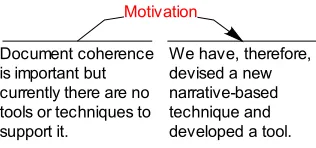
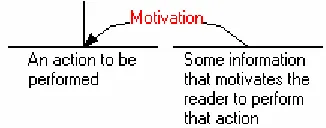
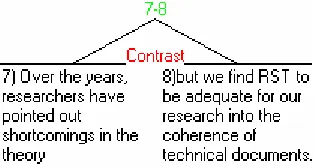
Once the DN has been created, it can be analysed using RST to enhance and evaluate its coherence. RST explains coherence by asserting relationships between parts of the text (e.g. A
motivates B). These relationships are illustrated as shown below. By identifying these relationships, authors are able to understand and improve the DN. Moreover, it is conjectured by the authors of RST that the text is coherent if these relationships can be assembled into a tree structure. This attribute of RST gives authors a mechanism to judge the quality of their DN before beginning to write.
The final part of the technique is producing the document. The sequence of parts in the DN dictate the sequence of sections in the document and the RST relationships give some guidance about the content of each of the sections.
We have, therefore, devised a new narrative-based technique and developed a tool. Document coherence
is important but currently there are no tools or techniques to support it.
Motivation
Figure 1-1: An example of a MOTIVATION relationship. The lack of support in existing tools and techniques motivated us to develop narrative-based writing and the tool.
[image:11.595.218.376.557.631.2]Chapter 1 Introduction 3
In order to evaluate the results of our research, we have studied the impact of narrative-based writing on a number of technical documents including presentations and websites. We also conducted an experiment involving a group of volunteers to test the ideas of a DN and the tool. These preliminary investigations have been encouraging.
1.3 A list of original contributions
The original contributions made by this research are listed below. They have been divided into primary and secondary contributions.
• (PRIMARY) A new technique called narrative-based writing
A technique called narrative-based writing has been introduced (Chapter 4) which helps authors, particularly those working together in a team, develop a consistent story for their document. This technique brings together the key ideas from previously parallel strands of research: technical writing and narratives. Narrative-based writing was developed to address the shortcomings of other techniques, such as outlining, by providing authors with a way of working out the natural sequence of sections for their document. The use of RST in this context (i.e. to synthesise technical documents) differs greatly to its mainly analytical applications.
• (PRIMARY) The design for a narrative-based tool for collaborative writers
The design of any collaborative working tool needs to be thorough. Our implementation is made more complex by the non-trivial RST tree structures (RS-trees) that need to be stored and maintained. Therefore, a combination of three models has been used to design the tool (Chapter 5): a conceptual model, a business process model and a functional model. The design culminates in a set of functions that are needed to manipulate the tree structures. This design furthers the understanding of narrative-based writing and modelling RS-trees. This design also allows the narrative-based functionality to be added, in the future, to existing collaborative working tools.
• (PRIMARY) A web-based tool for collaborative narrative-based writing
Chapter 1 Introduction 4
• (SECONDARY) A tutorial and a catalogue of case studies
We have produced a tutorial of narrative-based writing which is continuously being expanded. Furthermore, a set of generic DNs for popular types of documents such as a research paper, research proposal and presentation have been developed. Some of these DNs and their RST analyses are presented in this thesis as case studies in Chapter 7. The tutorial and the case studies will benefit technical authors when composing such documents.
• (SECONDARY) Evaluation via an experiment and critical appraisal
The narrative-based technique and tool have been evaluated by us and also by a group of volunteers in an experiment conducted in May 2006. The outcomes of the experiment were encouraging and are described in Chapter 8.
1.4 Outline of the thesis
This introduction has, so far, outlined the problem addressed by our research, our solution and the main contributions made by our work. The rest of the chapters are organised as follows:
Chapter 2, Background Literature, defines document coherence and describes why collaborative writing makes coherence harder to achieve. We outline three methods by which authors can plan the structure of their documents and several collaborative writing tools. We show that they do not support document coherence. We discuss the connection between document coherence and narratives, and investigate possible discourse theories that could be applied to technical writing.
Chapter 3, Rhetorical Structure Theory (RST), RST is the theory that was chosen for narrative-based writing. This chapter explains RST in detail and shows, by example, how it can be applied to a text.
Chapter 4, Narrative-based writing, introduces and explains the new technique.
Chapter 5, A narrative-based collaborative writing tool: The design, presents a detailed design for the tool. Three models are used for this design: a conceptual model, a business process model and a functional model.
Chapter 6, A narrative-based collaborative writing tool: An implementation, describes an implementation of the tool that is a proof of concept of the design in Chapter 5.
Chapter 1 Introduction 5
Chapter 8, Evaluation, details the experiment conducted in May 2006 to evaluate our technique and tool. Then we provide a critical appraisal of our work and compare it to some related technologies.
Chapter 9, Conclusions and future work, presents the conclusions and areas of future work.
1.4.1 A document narrative for each chapter
To further illustrate the use of narrative-based writing, a DN has been included for each chapter in this thesis. The current chapter is an exception because it contains the DN for the entire thesis (Figure 1-2). Each DN was created after ruminating on the material intended for the chapter and formulating the most appropriate story. The DN is always given at the end of the chapter.
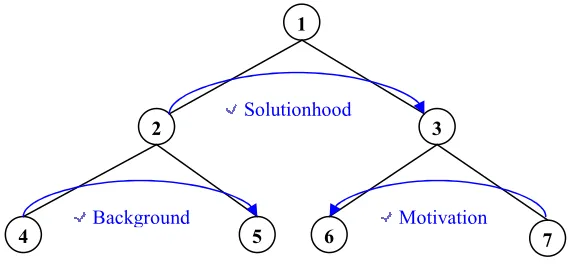
All DNs in the thesis will appear in text boxes with grey dashed lines as shown below. The RST analyses for some of them are included in the body of thesis. The rest can be found in Appendix A (section A.2). Most of the RST tree diagrams in this thesis have been drawn using the free software called RSTTool (O'Donnell, 2000).
The DN below summarises the story we want to convey via this thesis. Note that it has been divided into nine segments, each corresponding to one of the chapters.
Figure 1-2: DN for the thesis
[We believe that a narrative-based approach can help technical authors improve the
coherence of documents they produce collaboratively.]1 [Coherence can be attributed to
the story conveyed by a document. It is particularly difficult to get right in collaborative
technical writing. Current writing tools do not support document coherence.]2 [Narrative
and discourse theories, in particular RST, provide a solution.]3 [By combining the
knowledge of these two parallel strands of research (narratives and technical writing), we
have developed a new method of document structuring called narrative-based writing.]4
[In order to facilitate teams of geographically-dispersed authors to engage in
narrative-based writing, we have carefully designed a tool]5 [and done a Web-based implementation
of it.]6 [The new technique and tool are particularly beneficial in collaborative writing and
can also be applied to other genres of technical communication such as websites and
presentations.]7 [Preliminary investigations suggest that the narrative-based approach is
helpful]8 [and that the tool, with some enhancements, can be a valuable contribution to
Chapter 2
Background literature
In chapter 1 we introduced the problem addressed in this thesis and outlined our solution. The aims of this chapter are to form a firm basis for understanding this problem further and to begin paving the path for the narrative-based solution that we propose in the forthcoming chapters. In order to do this, the chapter is divided into two parts.
Part I looks at what it means for a document to be coherent and why it is common for technical documentation to be particularly incoherent. One reason for this incoherence in technical documents is that they are often produced by multiple authors. We proceed, therefore, to examine the ways in which authors collaborate, highlighting the factors that lead to poorly structured documents. Finally, we present an overview of three current techniques that can be used to plan the structures of documents and some tools that help authors collaborate with their peers. We show that there is a clear gap in these areas with regards to document coherence.
Part II introduces the prospect of approaching document coherence from a narratives perspective. Previous texts have referred to the presence of an underlying narrative or story in a good document. The formal use of narratives in technical documents as shown in this thesis is a novel approach that combines previously parallel strands of research and will be explained in detail in chapter 4. We claim that the quality of a document can be improved by thinking of a better narrative for it. In preparation for chapter 4, part II of this chapter defines what a narrative is and examines some narrative theories (formally called “discourse theories”) that have been developed by linguists and experts in narratology to analyse and synthesise better narratives. This is continued in Chapter 3 where the discourse theory chosen for our research, Rhetorical Structure Theory (RST), is discussed at length. RST is to become the mechanism by which we assess a narrative for a given document before writing any text.
Chapter 2 Background Literature 7
Coherence and collaborative technical writing
2.1 Document coherence: An informal definition
The concept of coherence is subjective and a precise definition is almost impossible. The use of language, the reader’s prior knowledge of the subject area and even the layout of the text can all affect how coherent a document is to a reader. However, for the purposes of this thesis, it is necessary to discuss, and if possible specify, what is meant by the word ‘coherence’ within the context of our research.
Let us take the case of a set of related sentences, each of which is constructed well. If they are arranged haphazardly to produce a paragraph, it is unlikely that the paragraph will make much sense. Worse still, the paragraph may appear to convey a message but burden the reader with having to make non-existent logical connections between the adjacent sentences. With just a little bit of planning, the sentences can be positioned such that there is a natural, smooth progression of ideas between them making it easier for the reader to understand the paragraph just as the author intended it to be understood. It can even be said that such a paragraph conveys a consistent story or narrative to the reader. This aspect of a text is what we call
coherence.
The above situation is best illustrated using the example below that has been taken from Alistair Knott’s PhD thesis (1996). The figure shows two texts constructed using nearly identical sentences placed in different orders. The text on the left is coherent because it is easy to understand and conveys a story to the reader. The text on the right is incoherent. It is difficult to decipher and there are no obvious relationships between adjacent sentences.
Figure 2-1: Example of a coherent (left) and incoherent text (right). Source: (Knott, 1996)
Chapter 2 Background Literature 8
processes are necessary to work out the best order of the sections and how they would be linked together. This sort of planning for short texts like a paragraph may seem trivial. Many of us do it all the time in our conversations, e-mails and so on without paying much attention to it. However, for larger texts such as papers, theses or books, it is not so straightforward.
For instance, this chapter needed to explore a multitude of ideas and areas of research. Several plans were made to determine the best possible way of arranging all the sections or, to put it in another way, to determine the best possible story that this chapter could tell its readers. One might argue that the current version of this chapter is not appropriate either. However, the point being made is that it is not always easy to plan for and ensure coherence in a text, particularly in large documents (large technical documents, to be more precise).
2.2 Why focus on technical documents
By technical documents, we refer to everything from research papers and theses to conference presentations and websites. Technical documents, unfortunately, have a reputation for being poorly designed and difficult to read. Sometimes this is due to their scientific content being pitched at a level that is either too high or too low for the reader. Most times, though, the problems with these documents are related to coherence and how the information is pieced together.
• One explanation for this is that technical documents are often not written by people with
formal training in writing or from linguistic backgrounds (Kieras, 1989). Winograd (1999) describes technical documentation as “that burdensome chore that managers are always trying to force onto recalcitrant…programmers”. This may not be applicable to academic technical writing but rings true for some industrial settings. All this makes it harder for some technical authors to recognise and correct problematic texts. Furthermore, the tight deadlines to which these documents are produced mean that there is not much time to fix problematic texts.
• Another, more likely, explanation for the lack of coherence in technical documents is
collaboration. It is very common to work with colleagues, in the same department or in different countries, to produce a technical document (e.g. a research paper). It was mentioned earlier that planning a coherent document is difficult. This is multiplied several
times in collaborative writing. Imagine a scenario where many authors are contributing
the sections of a document and also sharing opinions about where these sections should be placed. How would such a writing team arrive at the best possible story for their document? How would they make sure that each individual contribution adhered to this story?
Chapter 2 Background Literature 9
Also, later in the thesis, we recommend generic structures for types of documents such as research proposals. This cannot be done with other, less structured types of writing such as creative writing. Even though there may be anticipated formats for some creative texts (e.g. the typical set of moves in Figure 2-12 that is expected in a James Bond novel), others may deliberately be constructed to defy recommended structures for added effect (e.g. a novel with an unexpected twist at the end or a poem). We focus, therefore, on technical documents produced collaboratively.
2.3 Collaborative writing
Collaborative writing (CW) is the process in which multiple authors work together to produce one document. It is not just the soliciting of ideas about the document but the actual contribution of the various sections which are then collated together to form the final document.
CW has several advantages over single-author writing. In a survey done by Noël and Robert (2004), the participants agreed that CW resulted in richer documents owing to diverse ideas, input from co-authors with different expertise and task distribution. Theoretically, CW should also be more efficient. Each author would have to produce just a section instead of the whole document; when done in parallel, this should save time. Assuming that each section is written by the relevant expert in the team, the sections are likely to be better and more accurate as well.
The disadvantages of CW include difficult group management and coordination (Noël and Robert, 2004), and documents that are poorly structured. Extra coordination is needed in CW, especially when the authors are geographically dispersed. The sections contributed by the authors may need to be edited to fit the eventual document structure. All this could lead to an
increase in the time spent, in comparison to the time required for a single author to write the same document. The final document may also have some problems with coherence. For instance, some authors lower down in the hierarchy may not be aware of the whole purpose and structure of the document (e.g. a PhD student delegated some writing by his supervisor). The sections thus created may not fit together properly leading to documents that have been described as ‘arbitrary’ (Lowry et al., 2004).
Nevertheless, CW is becoming increasingly popular and there are, broadly, two ways in which these authors can opt to work (see below). Each model has its own pros and cons with regards to the quality of the eventual document.
2.3.1 Ways in which authors collaborate
Chapter 2 Background Literature 10
Sequential writing model
In this model, only one author can edit the document at a given time and once his/her task is complete, passes the document along to the author next in the chain.
Figure 2-2: Sequential writing model
This model is easy to organise and improves coordination between the authors. Each author can read the previous authors’ work before making his contribution. This can help improve coherence. However, there are some disadvantages (Lowry et al., 2004) in this model such as
the lack of group consensus and the difficulty in ensuring that all document sections are addressed adequately. Unless the team reviews the document, there is no way of finding out if all the sections meet everyone’s expectations and fit the story that was intended for the
document. Also, the order of the authors greatly influences the final document. One author can change previous contributions or bias subsequent authors.
Parallel writing models
In this model, a team divides the writing task into discrete units and works in parallel. This improves group consensus and efficiency. If the authors are able to view the rest of the document as they write, it is more beneficial for document coherence.
There are several variants of this process. In one, team members are assigned roles depending on their expertise such as ‘writer’, ‘reviewer’ and ‘editor’. Members then work on the document according to their roles. In another variation, the document is divided into sections
Figure 2-3: Parallel writing model
- Document
1 2 3
Chapter 2 Background Literature 11
and each author is assigned a section that he/she is responsible for. The completed sections are submitted to the team leader who assembles them together to form the final document. This approach is sometimes called horizontal-division writing (Lowry et al., 2004) and can, unfortunately, result in arbitrary sections that do not constitute a coherent story in the eventual document. Alternatively, the team leader will have the mammoth task of editing each section to make them fit. In (Alred et al., 2003), the sequence of steps in this parallel writing process is listed as:
1.Designate one person as the team coordinator.
2.Collectively identify the audience, purpose and project scope. 3.Create a working outline of the document.
4.Assign segments or tasks to each team member.
5.Establish a schedule: due dates for drafts, revisions, and final documents. 6.Agree on a standard reference guide for style and format.
7.Research and write drafts of document segments. 8.Exchange segments for team member reviews. 9.Revise segments as needed.
10. Meet your established goals.
Both the writing models above have their advantages and also their weaknesses with respect to the time taken, workload on the team leader and, most worryingly, the coherence and consistency of the final document produced. One way of improving this situation is by planning the structure of the document at the start of the writing process (as depicted by step 3 in the list above).
2.4 Three techniques to organise the ideas in a document
There is evidence to suggest that a period of planning can significantly enhance the quality and coherence of a document (Torrance and Bouayad-Agha, 2001). Such a plan makes the author aware of the goals that the entire document (and individual sections) should fulfil and the structure it should adhere to. Outlines are a popular method of planning documents. In this section, we discuss outlines and two other planning techniques. We concentrate on the impact these methods have on the coherence of collaboratively written documents, traits that make them popular and gaps in their structuring methodologies.
2.4.1 Mind maps
Chapter 2 Background Literature 12
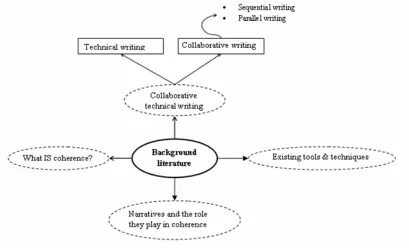
[image:21.595.94.503.165.416.2]In a mind map, key ideas are usually enclosed in boxes (or “clouds”) and lines (sometimes labelled) are used to indicate relationships between these ideas. Some authors also use various ways to differentiate the main concepts from the sub-concepts. In Figure 2-4, for instance, the levels of concepts are indicated, in order, using dark, dashed and normal lines in the boxes (and circles).
Figure 2-4: A map showing the ideas that are presented in this chapter
Mind maps are good visual aids. In writing, one can imagine a group of authors sitting in a room discussing a document and the team leader plotting the corresponding mind map on a white board. There can be debates about the inclusion, exclusion and importance of concepts and the how they relate to one another. At the end of the session, the authors have a logical picture or model of the document in their minds. This mental image will serve well when formulating the content of the document.
However, the benefits of using a mind map are unclear when the writers are far apart, having no or infrequent face-to-face meetings. Much of the information in a mind-map is gained by
understanding the associations made between ideas. The questions or relationships raised by the connecting arrows may be ambiguous. So, how well would a mind map drawn by one author in the team communicate the ideas to a second author?
Chapter 2 Background Literature 13
PART I
2.1 Document coherence 2.2 Why technical documents 2.3 Collaborative writing
Sequential writing Parallel writing
2.4 Three techniques Mind maps Outlines Pyramids
2.5 Tools
PART II
2.6 Narratives and theories
2.7 Summary of the chapter
In summary, the diagrammatic representation of ideas in a mind map is useful but the lack of a defined process by which it translates into a linear structure for a document is frustrating and, possibly, detrimental to the document.
2.4.2 Outlines
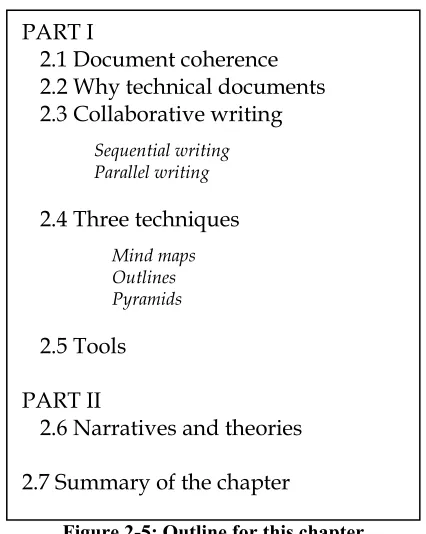
Outlines are, by far, the most popular way of planning a document. An outline is “an orderly plan…showing the division of ideas and their arrangement in relation to one another” (Roth, 1999). An example of an outline is given below, showing the organisation of the content in this chapter.
[image:22.595.191.404.316.583.2]Outlines can be composed of noun phrases (as shown in Figure 2-5) or whole sentences. Relationships between the phrases are shown by indentation (main topic and sub topics) and using the same kind of symbol for equally important ideas (A,B,C… I,II,III...1,2,3 and so on).
Figure 2-5: Outline for this chapter
Outlines transform notes, drafts and other material into an ordered progression of ideas (Lester and James D. Lester, 2005). There is a direct correspondence between an outline and the sections in the document, making it a useful reference and guide.
Chapter 2 Background Literature 14
However, outlines lack the explicit connections between the ideas that were made in mind maps. Even though hierarchical relationships are shown (such as sections, sub sections and so on), there is little indication of the purpose of each section and the role it is meant to play. This latter kind of information will help improve coherence since it advises authors on how to structure their text. For example, section 2.4 in the sample outline above is expected to discuss planning techniques. But how should this discussion be crafted? Why is this section in this chapter? What effect is it supposed to have on the reader such that it prepares the reader for the next section?
So, in summary, outlines are popular, easy to understand and have a one-to-one correspondence with the document. There is, however, a lack of information in them to support overall coherence. An outline only seems to function as scaffolding for the document.
2.4.3 Pyramids
Pyramids are another way of structuring information in a document. For years, journalists used “inverted pyramids” when writing newspaper articles. This meant that they placed the most important piece of information (often the conclusion) at the start of the article. Graphically, this was represented by the broadest part of the pyramid being at the top (hence, inverted). The rest of the article would contain information of diminishing importance. This had the advantage that if the reader left the article at any given point, he would still have the whole story (or certainly, the general gist of it). This was ideal for newspaper reports and web pages.
Figure 2-6: The inverted pyramid structure used by journalists
However, for most documents there needs to be an introduction at the start and a gradual build up to the most important part of the document (for example, theses and papers). This is often depicted by drawing the pyramid the “right way up” (i.e. with the broadest part of the pyramid at the bottom). The Pyramid Principle is a technique introduced by Barbara Minto (2002) that formalises the use of pyramids in this way. The important feature in this technique is the organisation of ideas such that it corresponds to the reader’s thinking.
She recommends structuring the ideas in a top down fashion to form a pyramid as illustrated in Figure 2-7. The top-most box in the pyramid presents the central subject (the introduction) under which all the other ideas belong. The pyramid is governed by vertical and horizontal relationships.
most important
Chapter 2 Background Literature 15
The vertical relationships in the pyramid are ‘question and answer’ relationships. Each box in the pyramid is expected to raise certain questions in the mind of the reader. These questions should be answered in the boxes immediately below it. The questions raised by this next level in the pyramid should be answered in the level below. This is continued until the writer is confident that the reader will have no more questions. As a general rule for a good document, Minto advices not to answer a question before it has been raised in the reader’s mind or to raise a question that will not be answered.
Each level in the pyramid also has horizontal relationships. These are logical relationships. The boxes should not only answer the questions raised in the line above them but answer them logically. This is done by presenting clearly either an inductive or deductive argument. To illustrate this process further and to compare it to the previous techniques, the pyramid principle has been applied to the structure of this chapter too (see Figure 2-7). More details about the Pyramid Principle can be found in (Minto, 2002).
An important point in this technique is the consideration of the document from the reader’s
perspective. The defined need for relationships between and across levels in the pyramid contributes to coherence. The technique leads to a diagrammatic display of ideas that provides a good visual aid. It also relates to the hierarchical structure of a document (main topics followed by sub topics underneath them) and the linear sequence of the sections.
The question-and-answer dialogue with the reader is also ideal, creating a certain amount of curiosity in the reader’s mind before quickly supplying the answer. The Pyramid Principle contains the right amount of detail necessary to improve coherence. Focusing on creating these logical relationships in the text will no doubt lead to better documents.
Chapter 2 Background Literature 16
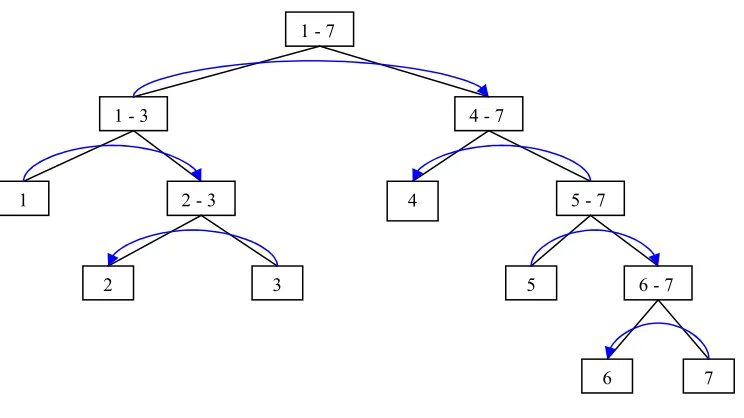
Figure 2-7: Barbara Minto’s pyramid principle applied to the content of this chapter. There are vertical question-answer relationships and horizontal logical relationships in the pyramid.
To sum up: We have studied three techniques with regards to their ability in improving the coherence of co-authored documents.
• A graphical representation of ideas like a mind map is useful but cannot be relied on
entirely. Sooner or later, a mind map has to be converted into a linear format to work out the sequence in which the ideas should appear in the document.
• Outlining is a popular and easy technique to derive the linear sequence of sections in a
document. However, an outline does not have enough information to justify this linear format or advise the authors about the logical tone that their individual sections (and the whole document) should take.
• The pyramid principle gives a good, well-defined structure to create this logical flow in
the document. While being useful, it is relatively complex.
• All three techniques also have no way of guaranteeing (or evaluating) coherence.
We recognise a need for a planning technique for co-authors that will be a graphical model,
provide a natural ordering of sections and connect these sections with logical
relationships that justify their existence and location in the document. With respect to collaborative writing, the technique also needs to be such that plans produced by one author can easily be transferred to and understood by another author. These criteria are re-examined in chapter 4 when we introduce narrative-based writing.
What?
Why?
Why?
Document coherence is hard to achieve in collaborative technical writing. Current tools and techniques do not support coherence either. However, narratives may be able to help.
Technical documents produced collaboratively are sometimes arbitrary
Current tools and techniques do not support coherence
Improving the underlying story can help coherence
Technical authors have no training in writing
Collaborative writing is difficult to coordinate
Writing tools Planning
techniques
Theories can enhance and verify this story
How?
Chapter 2 Background Literature 17
2.5 Collaborative writing (CW) tools
In section 2.3, the difficulties in achieving document coherence in CW were raised. We mentioned that one way that this situation can be helped is by using a planning technique prior to writing. Another way is to make use of an appropriate software tool. Having studied existing planning techniques in the previous sections, we now move on to look at some tools that support collaborative writing.
Writing software are many and varied (Palmquist, 2003, Porter, 2003), supporting various aspects of the authoring process. For instance, some tools aim to increase the productivity of the author and enhance the layout of a document, famously Microsoft Word and LaTex. Such tools are powerful in what they were designed to do but have little relevance to coherence or collaborative writing. The focus of this section is, therefore, on tools that aid collaborative writing. We consider these tools with respect to two questions:
1. How do these tools support collaboration? (to identify a set of features supported by a majority of collaborative writing tools)
2. Do these tools help improve coherence?
The idea of computer support for collaborative working has been around for several decades. It has even generated a dedicated field of research called CSCW (Computer-Supported Cooperative Work). It is impossible to explore all the software that has since been generated to support collaborative working. There are just too many of them. So, we examine only a demonstrative sample of collaborative writing tools, presented below in chronological order.
The first in our list is a tool called Quilt from 1988 (Fish et al., 1988). It allowed users to change, annotate and share documents. It provided messaging, computer conferencing and notification facilities to support communication between the collaborators of a document. Another stand-alone application of that era was the PREP editor (Neuwirth et al., 1992, Neuwirth et al., 1990, Neuwirth et al., 1994). Instead of storing whole documents, it introduced a concept called a ‘chunk’ (Neuwirth et al., 1990) which roughly corresponded to an idea and was able to contain text, grids or images. One of the important features of PREP was the use of a flexible difference-finding algorithm to find discrepancies between versions of documents. This enabled authors to see, at a glance, the changes that other authors had made to the document. There was no obvious support for document structures and coherence. These tools are presented here mainly for their historic value. They were developed at a time when CSCW was still in its infancy and, while demonstrating useful concepts such as version control and tracking changes, the success of both of them was limited.
There were several other collaborative tools developed at the time (Genthial and Courtin, 1992). However, with the success of the WWW, the use of web-based tools for CW was becoming increasingly popular. Even the standard HTTP/1.1 protocol was extended to
support the features necessary for asynchronous CW. The new protocol was called WebDAV
Chapter 2 Background Literature 18
editing and managing files on remote web servers in a secure way (e.g. locking, version management, access control and so on) forming a good basis for building web-based CW applications (Dridi and Neumann, 1999). Today, there are many web-based tools that assist collaboration. We discuss a couple of them.
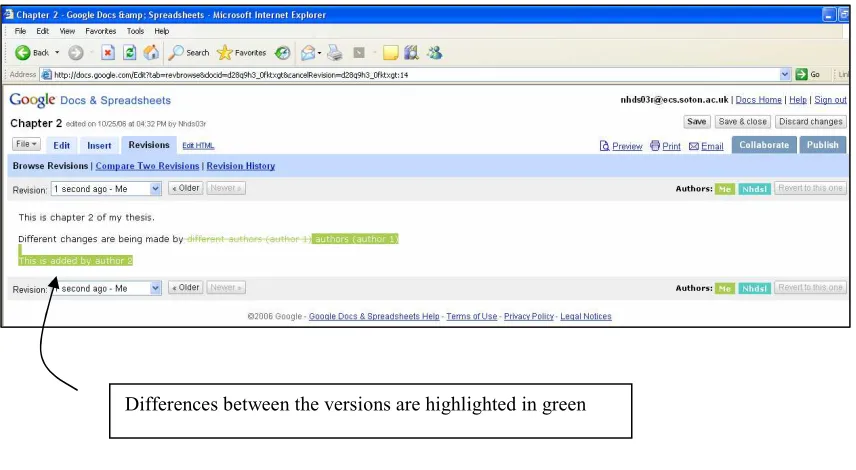
Writely1is a free web-based tool that allows authors to upload documents (in one of several
formats) and collaborate with specified co-authors in real time. Documents can be edited online via an interface similar to that of Microsoft Word. If someone else is working on the same document at the same time, the changes are merged instantly. There is offsite storage and backups are made every ten seconds. The revisions of the documents can be compared and authors can roll back to previous versions (thus ‘undo’ing some updates). Users accessing the document can be owners, collaborators or viewers (user roles). Owners own the document and can edit and delete it. Collaborators can edit the document and invite other collaborators. Viewers can only read the latest version of the document but cannot make changes.
[image:27.595.89.517.312.547.2]
Figure 2-8: An example of a document in writely. The figure shows two versions of the document being compared.
Writely possesses all the basic requirements for CW: version control, tracking changes, authorising users and so on. Furthermore, web-based tools are contemporary, are simpler to build and allow easy access. To use Writely, for example, users only require a web browser.
We conclude the discussion on web-based tools with a quick look at Wikis. Wikis are websites that allow its users to add, edit and remove the site’s content. They are among the newest forms of communication on the web. A history of revisions is often maintained and therefore, changes can be undone by reverting to an older version. The uniqueness of Wikis is
1http://www.writely.com/
Chapter 2 Background Literature 19
that there is no prior determination of the users that are allowed to edit the content and is, in this sense, open to all. This can have both advantages and disadvantages. Wikipedia, for example, is a thriving wiki. Readers contribute the facts with some minimal supervision from the host site. The varying expertise of the readers means that the information is thorough and up to date.
At the same time, there is always a question about the validity of the information on wikis (Johnson, 2006). There is no guarantee that individuals contributing to wikis are trustworthy and unbiased. An example where a wiki failed was the first ever wikitorial hosted by the LA Times in June 2005. Their editorial was re-written by about 400 “wikipedians”. However, two days after its launch the site had to be taken down because of some inappropriate content that was posted online.
[image:28.595.99.460.401.693.2]Version management software like CVS and LibreSource also assist collaborative writing by maintaining a systematic record of revisions and merging versions (see section 5.2 for a discussion of these tools with regards to version control). Merging is an important point to raise here. Co-authors working on individual local copies of the document are bound to make conflicting changes. Several merge algorithms have been developed to integrate these changes. A classic approach is to reproduce every change in all the copies of the document. However, with this method, the merged result may not always be correct.
Chapter 2 Background Literature 20
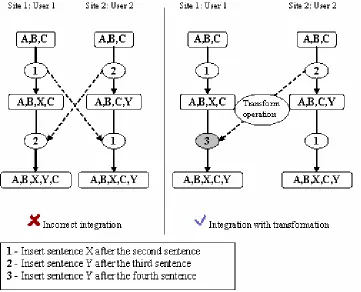
Figure 2-92 shows two authors editing a paragraph which initially has three sentences labelled
A, B and C. Both authors insert new sentences. On the left, the change made by one author is just replicated in the other author’s copy. This results in two different merged versions (ABXYC and ABXCY).
A merging technique called Operational Transformation (used in LibreSource) (Molli et al., 2003) improves this situation by integrating the changes made to the individual copies and
preserving the context in which they were made (referred to as ‘intention preservation’). So, on the right hand side of Figure 2-9, the operation performed by User 2 has been modified so that it takes into account the previous operation done by User 1. This results in both users having the identical versions of the text (ABXCY). This algorithm provides some assistance to coherence by making sure that the merged versions have all the changes integrated correctly. However, syntactic equivalence alone does not guarantee coherence and is not a complete solution to our problem (De-Silva and Skaf-Molli, 2006).
Our study into writing tools also included software that provided templates for users to create documents. For instance, the Newnovelist3 software (developed and published by Creativity
Software Ltd.) claims to help a novice write a novel in five steps. The tool provides fixed templates for various genres of novels. However, these tools were not included here because they give no leeway to authors to be creative or explore document structures on their own. These are not feasible solutions to improving coherence of documents even though the suggested templates can be good guidelines to the writing.
One may also notice the absence of tools like Mindmapper4- that helps draw mind maps –
and tools that assist in the creation of outlinesin our discussion. This is deliberate because it was decided earlier (section 2.4) that mind maps and outlines were not sufficient to improve the coherence of documents. Also, the number of writing tools is far too many for us to be able to cover everything here.
2.5.1 Discussion
Writing tools have had varied success in appealing to collaborative writers. Some authors only ever use e-mail to communicate their ideas and word processors to produce the documents that they then mail to each other (Noël and Robert, 2004). However, despite these debates about the usefulness of specialised collaborative writing tools (Noël and Robert, 2004, Pargman, 2003), programmes like CVS and even the “track changes” option in Word are in popular use.
Software tools do help collaborative writing in many aspects. Some useful features of collaborative writing tools are listed below:
2 This diagram is similar to the figure in (Molli et al, 2003). We focus on changes to a paragraph while their figure illustrated changes to a single word.
Chapter 2 Background Literature 21
•Being able to track changes
•Version control and the ability to revert to previous versions
•Merging of versions (and thus recognising syntactic conflicts)
•Being able to identify the contributor of each change
•Controlling who has rights to access and change the document
•Some tools are web-based allowing easier access
The area of collaborative writing that our research focuses on is coherence. An explanation of what we mean by the word coherence was given in section 2.1. We were, therefore, looking for software that supported co-authors make decisions about which section should go where
in a document so that it presented a good story. However, we were unable to find such support in the tools that we have come across during the course of our research. The closest the tools got to improving coherence was by making sure that the authors worked on
consistent copies of the document and by preserving the context in which changes were made to these copies. This, however, is no guarantee of coherence.
Chapter 2 Background Literature 22
Narratives and narrative theories
2.6 The role of narratives in technical writing
A narrative can be broadly defined as “the…representation of a series of events meaningfully connected in a temporal and causal way” (Onega and Landa, 1996). While some researchers distinguish between a story and a narrative (Lothe, 2000, Abbott, 2002), others use the two words interchangeably. In this thesis, a narrative is considered to be analogous to a story.
The word ‘narrative’ has been used in connection to the structuring of technical documents in several texts. For instance, when describing the pyramid principle, Barbara Minto (2002) uses the terms “narrative flow” to emphasise the need for a smooth story in the introduction. Evans and Gruba (2004) say that a thesis should “read like a novel”, thus implying the need for a story or a smooth progression of ideas. Similarly, other researchers such as Zobel (2004) have alluded to the need for a story (or narrative) to improve documents in computer science. We too turned to narratives in our attempt to address coherence. It was a natural development of our research.
The need for a consistent narrative is apparent, in our opinion, in novels, movies and other stories. A murder mystery, for example, will only succeed if the plot unravels in a logical sequence. This requirement is less obvious in technical and business writing where the emphasis is mainly on the factual content as opposed to the storyline. However, even technical documents are more effective if they present a well planned story to the reader. One of the major faults with technical writing, particularly ones with multiple authors, is that the various sections do not seem to fit together properly. We, therefore, attribute the coherence of a document to the narrative it conveys to the reader. We claim that the more coherent this narrative is, the more coherent the document will be. This idea is the basis for the new technique we introduce in chapter 4.
Having identified the role that narratives can play in technical documentation, we went further to explore methods by which narratives could be improved. Were there defined ways to structure better narratives? Theories? It turned out that there were many theories developed by linguists and experts in narratology to analyse and synthesise well structured narratives. We realised that using such a theory will benefit technical documents since the underlying story in them could be verified and improved. With this intention, we discuss some of these theories below.
2.6.1 Understanding and improving narratives
Chapter 2 Background Literature 23
new text belonging to this genre. The second was to develop mechanisms by which the human thinking process behind the construction of a successful narrative could be modelled and emulated. A similar distinction is made in (Lang, 1999). We discuss both these approaches, presenting three theories for each.
For the first category, we discuss the work of Gustav Freytag, Vladimir Propp and Umberto Eco. They have identified regular structures for a play, the Russian folktale and James Bond stories respectively.
(1) In 1863, the German journalist and writer, Gustav Freytag, recommended a five-part pyramidal structure that he believed was the most successful format for a play (Freytag, 1863).
Figure 2-10: Freytag’s pyramidal structure for a play (Freytag, 1863)
Each part in Freytag’s pyramid has a specific function and could consist of a single scene or a succession of connected scenes (an act). As the name suggests, the introduction introduces major characters, sets the theme for the plot and perhaps even hints of the forthcoming conflict (Wheeler, 2004). The second part, rise, represents an increase in tension or uncertainty. Climax is the part with the greatest tension and audience involvement, usually situated in the third act of the play. The fourth part usually has falling fortunes for either the hero (if it is a tragedy) or the antagonist (if it is a comedy). This section culminates in the final part called the catastrophe. If it is a tragedy, the final part will be a disaster involving the hero and his loved ones. If it is a comedy, this will be a denouement (or conclusion) leaving the antagonist worse than he started off with at the beginning of the play. After this final disaster, the suspense and tension ends, providing the audience with closure.
(2) Similarly, Vladimir Propp studied 128 Russian folktales (Propp, 1928) and arrived at a sequence of 31 generic narratemes (smallest narrative units), most of which were present in each folktale. A few of these narratemes are listed below. Propp’s narratemes have been
implemented in software such as the Joseph system (Beaubouef and Lang, 1998) to
generate tales that resembled folktales.
Rise Introduction
Climax
Chapter 2 Background Literature 24
Figure 2-11: A few of Propp's narratemes for the Russian folktale
(3) The third example we present in this category is the classic sequence of moves identified by Umberto Eco (1979) in all of Fleming’s James Bond novels. In each story, Bond’s ‘boss’ (M) assigns him a task which evokes some opposition from a villain. There is usually a woman who becomes involved in the conflict. The villain has temporary success when he captures Bond. However, in the end, the villain is always defeated and James Bond emerges as the winner. Below, this structure is repeated verbatim from (Eco, 1979).
Figure 2-12: Scheme of moves for a James Bond novel. .M represents James’ ‘boss’ (Copied literally from (Eco, 1979))
We presented three regular patterns identified for specific types of stories and plays. For the most part, readers welcome new but familiar patterns (Sharples, 1996). Take the James Bond movies for example. The audience is aware that James Bond will always win in the end but still enjoy watching the different settings and twists that make it difficult for Bond to win.
This latter point is also the flaw in these fixed templates. For creative writing, generic structures do not do justice to the slight variations to the patterns that make each story unique. For technical writing, this is not so much of a problem since most documents have similar patterns. However, these templates do not give authors an understanding as to why they are more popular than others. Such knowledge will help authors make decisions about whether or not their documents are good and coherent.
A. M moves and gives a task to Bond;
B. Villain moves and appears to Bond (perhaps in vicarious forms);
C. Bond moves and gives a first check to Villain or the Villain gives first check to Bond; D. Woman moves and shows herself to Bond;
E. Bond takes Woman (possesses her or begins her seduction);
F. Villain captures Bond (with or without woman, or at different moments); G. Villain tortures Bond (with or without woman);
H. Bond beats Villain (kills him, or kills his representative or helps at their killing); I. Bond, convalescing, enjoys Woman, whom he then loses.
1. A member of a family leaves home (the hero is introduced); …
12. Hero is tested, interrogated, attacked etc, preparing the way for his/her receiving magical agent or helper (donor);
…
16. Hero and villain join in direct combat; …
30. Villain is punished;
Chapter 2 Background Literature 25
The second approach to narrative analysis has led to theories that, in our opinion, equip the authors with knowledge of how stories work. This allows them to create, analyse and justify suitable structures themselves. This is more suited to enhancing the coherence of technical documents than just providing authors with templates. We looked at several of these theories with the aim of picking one for our research. We discuss three of them below with regards to the following criteria:
1. Simplicity
2. Complete definitions that help the authors produce texts as opposed to just analysing them
3. Ability to provide some way of judging if a narrative is coherent 4. Suitability for technical documents
In order to illustrate each of the theories better, we apply each one to the simple, light-hearted example below.
(1) First, we present Wendy Lehnert’s theory (Lehnert, 1981). This theory is a bottom up approach to analysing texts by breaking them up into affect states. An affect state is a smaller entity that occurs with respect to one character. There are three types of affect states.
+ Events that please (positive events)
- Events that displease (negative events)
M Mental states of the character (neutral effect)
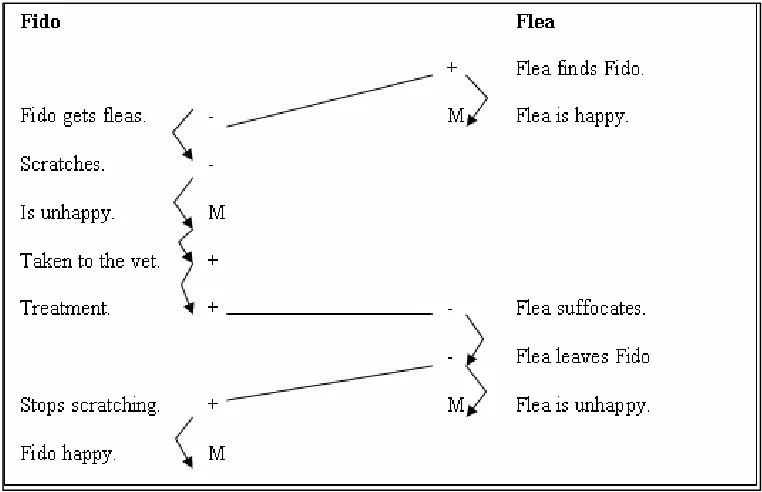
A map of chronologically ordered affect states can be drawn for each character of the story (see Figure 2-14). Diagonal links signify causalities of affect across characters.
Lehnert recognised about fifteen recurring patterns in which these affect states occurred. She called these groups of affect states plot units. A story could be summarised by using its plot units. Two examples of plot units are given below. The success plot unit depicts a mental state of a character leading to a positive event. The failure plot unit leads to a negative event.
Figure 2-13: Examples of two plot units identified by Wendy Lehnert SUCCESS
M
+
FAILURE
M
-
Fido is usually a happy dog.
One day, Fido was unhappy because he had got fleas and could not stop scratching. The vet recommended a flea treatment which got rid of the fleas.
Chapter 2 Background Literature 26
Figure 2-14: Wendy Lehnert's affect states applied to our short story
This is a reasonably simple theory to understand but while been useful to analyse texts, it does not provide much guidance regarding the production of texts. Ideally we want a theory that will help authors generate better narratives. Also, the reliance on characters in the analysis is not appropriate for technical writing.
(2) The second theory that we found interesting is the classification of narrative events by Bremond (1980). Narrative events in a story were divided into two basic types: “amelioration to obtain” and “degradation expected”. He describes three ways in which these two types of events can be combined in a story. One such combination is called coupling. This is when the amelioration of the fate of one character coincides with the degradation of the fate of another character (with opposite interests) like in our sample story (see below).
Amelioration to obtain (Get rid of fleas) vs. Possible degradation (Flea could be treated)
Amelioration process (Flea treatment) vs. Degradation process (Flea treated)
[image:35.595.106.487.88.334.2]Amelioration obtained (Fido happy) vs. Degradation achieved (Flea unhappy)
Figure 2-15: Applying Bremond's theory to our sample story
Chapter 2 Background Literature 27
(3) Finally, we present Centering Theory (Grosz and Sidner, 1986, Grosz et al., 1995). This theory focuses on the local coherence of a discourse. A discourse is a sequence of utterances that exhibit coherence. The theory suggests that each of these utterances has a centre which links it to other utterances in the discourse. Each utterance is assigned a set of forward-looking centres and a single backward-looking centre (except the first utterance in the discourse). The symbols for these concepts are given below.
C – Centre
U – Utterance
Cf (Un) – Set of forward looking centres of utterance Un
Cb(Un) – The backward looking centre of utterance Un
The eventual coherence of the text is determined by the nature of the transition of these centres from one utterance to the next. They define three ways in which this transition can happen. We examine one of them below.
Centre Continuation:
Cb(Un+1) = Cb(Un) AND this entity is the most highly ranked element of
Cf(Un+1). In a coherent discourse, Cb(Un+1) will go on to become Cb(Un+2) and
so on.
This is the easiest transition for the reader to understand and is shown below.
U1 : Fido is usually happy.
U2 : He suddenly became unhappy and started scratching.
U3 : He was taken to the vet.
The two other transition types are Centre Retaining and Centre Shifting (Cb(Un+1) ≠ Cb (Un)).
Center shifting is demonstrated in the example below and it is clear why a reader would find it difficult to comprehend.
U1 : Fido had fleas.
U2 : He was taken to the vet.
U3 : He is generally very good with animals.
The theory goes on to present two rules that govern the centre transitions of coherent discourses and is therefore able to guide an author towards a better narrative. According to the theory, an author should aim for centre continuation and avoid centre shifts. The examples above are all of very short texts but this theory can, in our opinion, be extended to whole documents. In this case, the rules will apply to the centres of entire sections. Due to the formal nature of its definitions, this theory appears to be something that can be implemented in
The backward and forward centre of these utterances is Fido.
U3 is confusing. It