UNIVERSITY OF TRENTO
Department of Psychology and Cognitive Sciences
Doctoral School in Psychological Sciences and Education
XXV Cycle
Word Recognition in Predictive Contexts
Advisor:
PhD Candidate:
Dottor Francesco Vespignani
Paolo Zandomeneghi
Contents
Chapter 1
General Introduction ... 9
1.1 Sentence Processing: an interactive and a modular perspective . 9
1.2 What is early ... 19
1.3 Top-down influence of the context ... 23
1.3.1 Early Effects ... 23
1.3.2 Anticipations ... 30
1.4 Introduction to the Studies ... 43
Chapter 2
Study 1 ... 45
2.1 Introduction ... 45
2.2 Method ... 51
2.2.1 Stimuli and Lists ... 51
2.2.2 Participants ... 52
2.2.3 Procedure ... 53
2.2.4 Data Recording ... 53
2.2.5 Statistical Analyses ... 54
2.3 Results ... 56
2.3.1 Behavioral Results ... 56
2.3.2 ERP Results ... 56
2.4 Discussion ... 59
Chapter 3
Study 2 ... 63
3.1 Introduction ... 63
3.2.1 Stimuli and Lists ... 69
3.2.2 Participants and Procedure ... 70
3.2.3 Data Recording ... 70
3.2.4 Statistical Analyses ... 70
3.3 Results ... 71
3.3.1 Behavioral Results ... 71
3.3.2 ERP Results ... 71
3.4 Discussion ... 75
Chapter 4
Study 3 ... 79
4.1 Introduction ... 79
4.2 Method ... 84
4.2.1 Stimuli and Lists ... 84
4.2.2 Participants and Procedure ... 85
4.2.3 Data Recording ... 85
4.2.4 Procedure for Statistical Analyses ... 86
4.3 Results ... 87
4.3.1 Behavioral Results ... 87
4.3.2 ERP Results ... 87
4.4 Discussion ... 91
Chapter 5
General Discussion ... 95
References ... 105
Abstract
Over the last years several results demonstrated that context-based expectations on both word-class and concepts influence the word processing at very early stages, namely at sensory analysis level. Given that these early effects are modulations of the process of stimulus analysis they depend on physical and orthographical properties of critical words in interaction with linguistic expectations. This evidence on early effects is in contrast with a syntax-first approach for which the cognitive system builds at first the syntactic structure by exploiting word-class information only. This strong syntax-first assumption pushed forward by Friederici (2002) model is based on a very early ERPs effect with latency around 150 ms that is elicited by word-class violations (eLAN: early left-anterior negativity).
I studied three linguistic violations with an ERPs sentence processing paradigm. In two studies in Italian word-class violations on prepositions and verbs were implemented, overcoming the more important methodological limitations of previous studies on word-class violations. In a third study we investigated determiner-noun gender agreement in Italian using nouns for which grammatical gender is expressed unambiguously by a long derivational morpheme, that is very salient at orthographic and visual level.
Chapter 1
General Introduction
1.1 Sentence Processing: an interactive and a
modular perspective
As language unfolds a lot of different cognitive processes are quickly performed in
order to interpret the message conveyed by the linguistic input. Analysis and
integration processes are probably performed in less than 1s after a word onset,
however, it is assumed that after just 250ms all the syntactic and semantic
informations of the word are available to the cognitive system (Marslen-Wilson,
1975). The most influent models of sentence processing diverge in the definition of
the mechanisms that underlie the incremental (word by word) comprehension and can
be reconciled to two principal categories: interactive models and modular models. The
main differences concern a) the order in which syntactic and semantic informations
are exploited by the cognitive system and b) the characteristics of the interaction
MacDonald, Pearlmutter, & Seidenberg, 1994) outline sentence comprehension
mechanisms where syntactic and semantic analysis interact from the very early
processing stages: syntactic and semantic information directly and simultaneously
influence the comprehension of the message. These models do not assume the
existence of specific and discrete processing stages in that these “stages” directly
depend on the information locally available and on the language-specific constraints.
On the other side, in modular models (Frazier & Fodor, 1987) sentence
comprehension proceeds trough independent stages, and, each of them must be
accomplished before that the following one can take place. In the models it is
proposed that mechanisms dedicated to syntactic and to semantic information analysis
can interact only after that part of the syntactic informations are exploited (i.e. in a
second processing stage). These models are thus also called syntax-first models of
sentence comprehension.
Researchers use theoretic linguistic and general cognition mechanisms knowledge
in order to identify the ERP an MEG correlate of specific operations that are assumed
to be performed on-line during comprehension and outline neurocognitive models of
sentence comprehension.
Findings of electrophysiological experiments conducted in the last 30 years shows
that syntactic and semantic anomalies elicit qualitatively distinct ERP effects. These
effects differ in multiple dimensions such as timing, polarity and scalp distribution.
Semantic anomalies elicit a negative component with centro-parietal distribution
and peaking at about 400ms after critical word onset (Kutas & Hillyard, 1980, 1984;
Osterhout & Nicol, 1999). For instance Kutas and Hillyard (1980) found that the
the context. One example of the experimental sentences used by the authors is
reported in (1). The manipulation (1b) contains a semantic anomaly and elicited an
N400 with respect to condition (1a). Later studies found that, both in sentences and
single word processing, the amplitude of the N400 depends on a variety of variables
such as the frequency of use of a word, semantic nearness with a primed context and
semantic system organization. The precise interpretation of the process underlying the
N400 is still debated and two are the main perspective: lexical/semantic access effort
and semantic integration difficulties (Federmeier, 2007). Until now the literature
provides evidence for both these interpretations suggesting that both the processes
affect the amplitude of the N400 (see Lau, Phillips, & Poeppel, 2008 for a recent
review that suggests that multiple semantic sub-process that may underlie to the
generation of this ERP component).
(1)
a. It was his first day at work.
b. * He spread the warm bred with socks.
Differently, syntactic anomalies elicit a positive component with broad and/or
posterior distribution on the scalp arising at about 500ms after critical word onset
(Hagoort, Brown, & Groothusen, 1993).
This component is referred to as the P600. An example of the experimental
sentences used by Hagoort et al. (1993) is reported in 2). In sentences as (2) on the
(2)
a. Het verwende kind gooit het speelgoed op de grond.
The spoilt child throws the toys on the floor.
b. *Het verwende kind gooien het speelgoed op de grond.
*The spoilt child throw the toys on the floor.
The P600 follows every syntactic anomaly also in absence of a proper syntactic
violation (De Vincenzi & Di Matteo, 2004) and it is assumed to index re-analysis /
repair of the sentence structure. The P600 generally has two stages, a first stage
between 500 and 700 ms (linked to the reanalysis of the structure) and a second stage
after 700ms after critical word onset (linked to the repair of the structure). For a
discussion on the functional interpretation the two stage of the P600 see Kolk and
Chwilla (2007). However, several ERP studies recently reported P600 effects, without
an accompanying N400, for sentences such as (3), which contained a semantic
anomaly.
(3)
At breakfast the eggs would eat …
For example sentences as (3), studied by Kuperberg, Sitnikova, Caplan, and
Holcomb (2003), is semantically deviant because the verb "eat" requires an animate
subject to assign the agent thematic role, but "eggs" is inanimate. This effect is called
"semantic P600". Kim and Osterhout (2005) propose that this P600 may be elicited by
a structural revision that is driven by semantic plausibility (a process they term
"eggs" becomes the object of the verb "to eat" (i.e. "the eggs would be eaten").This
view is conservative with respect to P600 classic syntactic interpretation. Kuperberg
(2007) proposes a slightly different explanation of “semantic P600” in which animacy
feature is determinant in a thematic role processing stream that works in parallel with
syntax and independently lead to the semantic P600 effect.
Frequently, syntactic mismatches elicit a biphasic pattern where the P600 is
preceded by a negativity distributed on the left anterior recording sites arising at about
300ms after critical stimulus onset (Osterhout & Holcomb, 1992; Osterhout &
Mobley, 1995; Gunter, Stowe, & Mulder, 1997; Coulson, King, & Kutas, 1998). The
elicitation of this negative component, followed by the P600, has been found to be
triggered by almost every morphosyntactic disagreement (see Molinaro, Barber, &
Carreiras, 2011 for a review). The LAN is assumed by the most of the authors to
indicate a difficulty in building the structure due to a syntactic mismatch (Hagoort,
2005; Friederici, 2002). An anterior negativity with earlier onset has been found in
some case for word-class violations (e.g. Neville, Nicol, Brass, Forster, & Garret,
1991; Friederici, Pfeifer, & Hahne, 1993; Hahne, & Friederici, 1999; Hahne, &
Jescheniak, 2001). Neville et al. (1991) recorded for the fist time an early left anterior
negativity (called eLAN in subsequent studies by Friederici) following a word-class
violation. An example of the experimental sentences is in (4). In violation condition
(4b) the preposition “of” is illegal in that structural position and elicit an eLAN with
respect to the correct condition (4a).
(4)
a. The Max's proof of the theorem.
While the nature of the manipulations that elicit these components is generally
constant across a variety of languages, presentation modalities and laboratories, their
functional interpretation is far to be common shared (Osterhout, Mclaughlin, Kim,
Greenwald, & Inoue, 2004). Different theoretical backgrounds, ERP components
functional interpretations and experimental finding lead to a variety of neurocognitive
models that roughly respect the distinction between interactive and modular model of
sentence comprehension.
One of the most influent neurocognitive model that do not assume a modular
architecture of language processor is described by Hagoort (2005). This model
(Memory, Unification and Control: MUC, Hagoort, 2005) is a “lexicalist” model
because it assumes that at lexical level is specified the “syntactic environment” of the
word that allows to a correct structure construction. Syntactic constraints at lexical
level are assumed to be specified with a three way syntactic tree specifying the
possible structural attachments of the item. Semantic and pragmatic informations are
processed in parallel to the structure building and are used to assign a semantically
and pragmatically correct interpretation the structures that have multiple “lexical”
syntactically correct configurations. In this model syntactic, semantic and pragmatic
informations are assumed to be relevant at the same time and to simultaneously aid
the comprehension processes and thus no discrete processing stages are assumed to be
specific for different linguistic features.
Differently, a very strong functional interpretation of the reviewed ERP
components lead Friederici (2002) to outline one of the most influent sentence
processing model, reinterpreting in a neurocognitive perspective the modular model
and the output of each stage is the pre-condition for the beginning of the followings.
In the first stage the syntagmatic structure is built using only word-class information
of the word and specific syntactic rules of the language. In the second stage the
syntactic analysis proceeds exploiting morphosyntactic informations in order to check
the coreference of the lexical items and, in parallel, semantic elaboration processes
combine the meaning of the words. In the third stage syntactic and semantic processes
interact, and, if it is not possible a coherent interpretation of the sentence (of the part
of the sentence until that word) the cognitive system attempts a revision and/or a
repair of the sentence. Despite the fact that the Friederici (2002) model is detailed
basing mainly on auditory studies, the Author maintains that the three stage
architecture of sentence processing, and the relative ERP evidence, holds also for
visual modality.
Several evidence attest an interaction between processing streams after 300ms after
stimulus onset (e.g. Hagoort, 2003; Wicha, 2002; Gunter, Friederici, & Schriefers,
2000; Bentrovato, Devescovi, D’Amico, & Bates, 1999; Bentrovato, Devescovi,
D’Amico, Wicha, & Bates, 2003; Kim & Osterhout, 2005; Kuperberg, 2007).
However the most distinctive and discussed assumption of this model is the
bottom-up and incapsulated nature of the first stage. The assumption that in the first 300ms
after stimulus onset the cognitive system exploit the word-class in order to update the
syntagmatic structure is based on the finding of the eLAN selectively for word-class
violations. Some scholar (e.g Friederici, 2002) maintain that the eLAN has a special
status with respect to the later linguistic components in that it has never been found to
modulate in interaction with other linguistic ERP indexes. Moreover, words having
morphosyntactic anomalies elicit a “pure” word-class violation pattern, composed by
an eLAN followed by a P600 (N400 blocking effect: Friederici, Steinhauer & Frisch,
1999 and LAN blocking effect: Rossi, Gugler, Friederici, & Hahne, 2006; Rossi,
Gugler, Hahne, & Friederici, 2005). Based on this results the modular syntax-first
models assume that the eLAN has a blocking effect on the other stages. These results
are interpreted as an evidence that the building of the syntactic structure is a
pre-condition for the effectiveness of other linguistic computations on the input
(Friederici, 2002). Syntax-first neurocognitive modes (the most influent described by
Friederici, 2002) maintain that the timing of eLAN and its here described peculiar
properties demonstrate that:
• word-class is always exploited by the cognitive system in a very early stage of
word processing in order
• syntactic structure building is performed in the first 300ms with word-class
information only
• the output of the syntagmatic structure updating is a pre-condition to proceed
trough the processing of other linguistic features and relative integration.
However several laboratories failed to consistently replicate the eLAN for
word-class violation (e.g. Friederici, Hahne, & Mecklinger, 1996; Hagoort, Wassenaar, &
Brown, 2003: Frisch, Hahne, & Friederici, 2004; Roehm & Haider, 2009; see
Steinhauer, & Drury, 2012 for an exhaustive review) and the reliability of this
interpretation have been strongly criticized. The criticisms addressed both the fact that
the eLAN underlies processes purely related to categorical information and that the
component is elicited by the manipulation on the critical word. The first two
second criticism concern only those studies that found the eLAN with auditory
presentation. Two of the most influent criticisms are:
• the eLAN could be due to spillover effects, i.e. large differences in the
baseline due to differences in the processing of the previous word(s)
(Osterhout et al., 2004). In fact, in classical studies that have reported an
eLAN the word before the critical word varied systematically between the
conditions. For example, in Neville et al. (1991) the critical word (of in 5) was preceded by a noun (proof in 5) in the correct condition (5a) and by a proper name with saxon genitive (Max's in 5) in the violation condition (5b).
• some acoustic studies on word-class violation (e.g. Rossi et al., 2005; Rossi et
al., 2006) reported an eLAN with an onset in the 100-200ms interval but, the
word-class marking morpheme (-t in example 6) was not yet presented at that latency. In these cases the eLAN effect can only be explained by spillover
effects and/or differences in prosody due to the methodology used to create the
violation in these connected speech paradigms (see Steinhauer & Drury, 2012
for an exhaustive review of methodological problems for the eLAN
interpretation).
(5)
a. The scientist criticized Max’s proof of the theorem.
(6)
a. Der Junge im Kindergarten singt ein Lied.
The boy in-the kindergarten sings a song.
b. * Der Junge im singt ein Lied.
1.2 What is early
A peculiarity of the “linguistic” ERPs components related to the sentence level
processing (as LAN, N400 and P600) is that their latency is not reported to be
affected by lexical variables as word length or frequency of use. Indeed Van Petten
(1995) have shown that word frequency affects the amplitude of the N400 while its
peak is constantly at 400ms after stimulus onset. Likewise, there are no evidence in
the literature that the syntax related ERP components (LAN and P600) variate in
latency depending on lexical variables. The LAN in visual modality is always
reported to onset at about 350ms (see Molinaro et al., 2011 for a review on
disagreements) and the P600 is typically reported to onset at around 550 ms (for an
overview see Osterhout et al., 2004).
The latency of the eLAN elicited by word-class violations is actually more
variable, ranging between 0 and 200ms (see Friederici, 2002 for an overview). The
fact that Friederici dubbed the eLAN with a different nomenclature with respect to
LAN is due to the fact that despite eLAN latency variability there is no evidence that
the eLAN should be considered “just” a LAN with an earlier onset since it was not
possible to find a way (a paradigm) to show a continuity in LAN latency variation
from 150ms to 350ms. This coarse and discrete latency variation, together with other
properties that distinguish eLAN to LAN (e.g. capability to “block” semantic analysis
by the eLAN only, in term of suppression of N400 modulations) justified Friederici to
consider the eLAN a component with a different and independent functional
the hypotheses that it is an artifact due to methodological aspects (see Steinhauer &
Drury, 2012 for a review). Basing on the criticisms moved to the eLAN by Osterhout
et al., (2004) and Steinhauer and Drury (2012) Despite I agree with these criticisms, I
believe that more experimental evidence are needed to exclude the reliability of the
eLAN and as an index of structural mismatch (in the next experimental section of this
thesis I report two experiments we run on word-class violation). With the exception
of the complex topic of the eLAN all other syntactic and semantic anomalies give rise
to ERPs effects that emerge in the same time interval, beginning roughly only after
300ms stimulus onset.
By contrast, reaction times (RTs) in behavioral studies have been consistently
shown to vary as a function of both linguistic manipulations and lexical variables.
Independently of linguistic manipulations RTs are longer for low frequency words and
long words (see Just, Carpenter, & Woolley, 1982 for self-paced reading and, Reichle,
Raynar & Pollastek, 2003 for eye tracking). In a functional perspective the
dissociation between RTs variance and linguistic ERP components constant onset,
arguably underlies the distinction between stimulus evaluation/classification processes
(that implies activate its phonological, morphological, syntactic and semantic
properties) and the integration of that stimulus within the preceding part of the
sentence.
This view is also supported by studies on the P300 component. Kutas, McCarthy,
and Donchin (1977) demonstrated that the P300 is related to stimulus
identification/classification: the deeper is the processing required to evaluate/classify
the stimulus the later is the onset of the P300, ranging from 300 to 1000ms. In a later
frequency affects the P300 latency: a later onset is reported for low-frequency
compared to high-frequency words. This is another result suggesting that while the
time required to evaluate/classify a stimulus (even a word) depends on stimulus
variables, the cognitive system uses the extracted informations to update the syntactic
and the semantic context starting at roughly 300ms after stimulus onset.
In the light of these considerations we argue that until about 300ms the cognitive
system is engaged with stimulus analysis and only after this time limit, that may be
considered a timeout at which the word level analysis should be completed for most
words, the processes of proper integration with the context take place, as indexed by
the LAN and the N400. In this perspective context effect preceding the 300ms limit
are arguably a top-down modulations of the stimulus analysis processes. Several
evidence of context effects others than eLAN before 300ms are reported in the recent
literature on sentence processing (e.g. Dikker, Rabagliati, & Pylkkänen, 2009; Dikker,
Rabagliati, Farmer, & Pylkkänen, 2010; Dambacher, Rolfs, Göllner, Kliegl, & Jacobs,
2009; Kim & Lai, 2012; see next section of this thesis for an overview). Before this
“integration stage” (beginning with LAN and N400 onset) the ERP effects can thus
depend on linguistic manipulations but, as these effects are modulations of stimulus
processing, the linguistic features are mediated by orthography, phonology and
morphology. It follows that those effects, that I will call “early effects”, should have
peculiar properties different from those of “integrative effects”. The first is that the
early effects must have a latency smaller than 300ms. The second is that the effect
should be a modulation of brain activity addressable to stimulus processing as visual
analysis or lexical access, but not to sentence level syntactic or semantic processes
context based on linguistic constraints/expectations would depend on how a linguistic
feature is expressed on the critical word, because early effects are modulations of
stimulus analysis processes. In other words given a predictive context, that may imply
expectations and/or constraints, early effects should rely on a top-down mechanism
that matches expected linguistic features and the properties of the stimuli that are
relevant for these features. What is the representational level at which expectations
and constraints can interact with stimulus analysis is surely an important aspect of
sentence processing that should be inquired in the future. So far, the ERP and MEG
experiments reporting early effects of context found a modulation of the stimulus
visual analysis (Dikker et al., 2009; Dikker et al., 2010; Dambacher et al., 2009; Kim
& Lai, 2012). Whether this mechanism is a anticipatory pre-stimulus activation of
1.3 Top-down influence of the context
Context based expectations have effects on sentence processing in terms of
facilitation for the expected material both in recognition and in integration. Whether
these effects are due to top-down mechanisms or to bottom-up integrative facilitation
is a question under debate since a long time (see Federmeier, 2007 for an overview on
the integrative/anticipatory interpretation of the N400). For instance, it seems
particularly difficult to discern between the two different interpretations especially for
the effects arising at the LAN/N400 stage, because integration operations are assumed
to be overtly at work. Facilitation effects can clearly arise also before 300ms, when
stimulus identification processes are going on. These early effects of context on word
recognition processes clearly have a top-down component in their underlying
mechanisms. In the following part I will report the early effects reported in the recent
literature.
1.3.1 Early Effects
Dikker et al. (2009) and Dikker et al. (2010), with a sentence comprehension
paradigm in visual presentation, found increased MEG activity in visual areas just
100ms after the onset of words violating the expectation on the word-class. Latency
and topography of the effect are consistent with the hypothesis that it is a modulation
of amplitude of the M100, an exogenous MEG visual component. Crucially, this
Dikker et al. (2009) found this effect only when the critical word showed the final
morpheme “-ed” (example in 7) and when the violation took place on a preposition
(example in 8, the experimental material was the same of Neville et al., 1991). The
authors argued that both prepositions and “-ed” suffixes are closed class morphemes
short, frequent and strongly indicative of the word-class. The effect on the M100
amplitude was absent when the expectation was violated by a word that didn't show
any morpheme strongly indicative of the word-class (as in example 9). As authors
underlined, it should be noted that sentence (7b) does not consist in an outright
word-class violation because a grammatical continuation is possible (as “The discovery was
in the reported interview ...”). Cloze-probability pre-tests attested however that the grammatical continuation (i.e. a participle in critical position in sentences as 7b) is
very unpreferred and thus violation condition consist in a “highly unexpected
word-class” condition.
(7)
a. The discovery was reported ...
b. *The discovery was in the reported ...
(8)
a. The boys heard Joe’s stories about Africa.
b. *The boys heard Joe’s about stories Africa.
(9)
a. The discovery was in the report …
b. *The discovery was report ...
Farmer, Christiansen, and Monaghan (2006). The typicality was defined by Farmer et
al. (2006) on the basis of a probabilistic analysis of the distribution of phonological
patterns across nouns and verbs. Items that have phonological patterns primarily
shared by items of their word class are defined as typical-items whereas items that do
not show phonological patterns mostly shared by items of their word class are defined
as non-typical items.
Defining typicality in this manner the Authors obtained typical nouns, typical
verbs, non-typical nouns and non-typical verbs. The experimental material in Dikker
et al. (2010) was built to compare word-class expectations violation on nouns typical
of their word-class as soda (example in 10) with violations on nouns non-typical of their word-class as infant whose phonological pattern is more similar to that of verbs (example in 11). Results of Dikker et al. (2010) showed an M100 amplitude effect for
violation occurring on typical nouns (10.b) but not for violations occurring on
non-typical nouns (11.b).
(10)
a. The tasteless soda …
b. *The tastelessly soda …
(11)
a. The cute infant …
b. *The cutely infant …
In a subsequent study, Dikker, & Pylkkänen (2011), showed a similar effect for
violations of expectations on specific lexical items. In this experiment, the authors
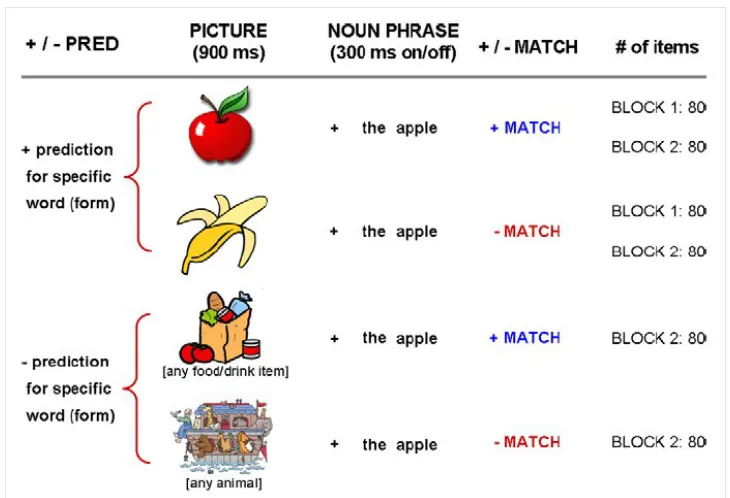
(determiner phrase) and a previously presented image. Moreover the images were half
predictive for a specific lexical item (e.g. the “tomato” in the example Fig1) and half
predictive for a semantic category (e.g. the “shopping bag” in the example Fig1). The
effect on visual areas (M100 amplitude modulation) was present only when the word
violated expectations on a specific lexical items, but not when all the elements of a
specific semantic category was likely to appear (examples and results are summarized
in Fig.1).The authors formulated the Sensory Hypotheses, according to their studies
reporting a modulation of the amplitude of the M100 and to the knowledge about the
functional interpretation of this component. In the Sensory Hypotheses is proposed
that the cognitive system, whenever possible, generates sensory anticipations of the
typical physical features of the expected material.
Tarkiainen, Helenius, Hansen, Cornelissen, and Salmelin (1999) found that letters
and symbol strings evoke an M100 of the same amplitude thus showing that this
component is not sensitive to the lexical status of the stimulus. By contrast, the
amplitude of this component correlates with features of the stimulus such as
complexity, number of items and degradation leading Tarkiainen et al. (1999) to the
conclusion that the activity underlying the M100 is linked to low-level visual
processing such as extraction of borders and contrast. In the Sensory Hypotheses the
typical subletteral features of expected material are assumed to be relatively more
activated than those of unexpected material, the unexpectedness M100 effect would
Fig 1. Figure adapted from Dikker et al. (2011). The four condition in Dikker et al. (2011) are shown for the target word "apple". The first two rows depict the specific item predictive pictures, first row in match (apple -> apple) and second row in mismatch (banana -> apple) condition. The first two rows depict the semantic category predictive pictures, first row in match (any food/drink item -> apple) and second row in mismatch (any animal -> apple) condition.
For example, in the experiments on word-class expectation violation (Dikker et al.,
2009: Dikker et al., 2010) the effect is present only when the violation occurs on a
word that shows typical features of its word-class (e.g. -ed in example 7 or more
complex phonological cluster as defined Farmer et al., 2006 in example 10) which
must be reactivated during its visual analysis. As regards the violation of specific
lexical item expectation (Dikker et al., 2011) all the physical characteristics of the
stimulus can be represented at the sensory level (because a specific item is highly
expected), the M100 effect thus indexes the reactivation of the physical features of the
unexpected word that were less active than whose of expected word. No effects were
Dikker et al. (2011), no typical phonological clusters and/or physical features are
shared by items of the same semantic class and then, any items can be “typical” or
“non-typical” in a sensory definition.
Other laboratories reported sensory effects for violations of different linguistic
expectations during sentence processing, in different languages and with different
presentation modalities supporting the finding that visual analysis can be affected by
the sentence context (Hagoort et al., 2003; Dambacher et al., 2009; Herrmann, Maess,
Hasting, & Friederici, 2011; Kim & Lai, 2012).
Hermann et al. (2011) reported a very early sensory effect for word-class violation
during acoustically presented sentences in German. Hagoort et al. (2003) reported
early sensory effects for word-class violation in Dutch with visual presented
sentences. Dambacher et al. (2009) in a sentence comprehension paradigm with
visual presentation in German found a visual analysis modulation depending on the
predictability of an upcoming lexical item (measured with Cloze Probability tests).
Finally, Kim and Lai (2012) found early visual activity modulation for pseudo-words
compared to expected words depending on the orthographic similarity between
pseudo-words and expected word. Example of the experimental material is reported in
(12). Compared to expected words (as cake in 12a) orthographically similar
pseudo-words (as ceke in 102) elicited an enhanced P130 while orthographically dissimilar pseudo-words (as tont in 12c) elicited an enhanced P170.
(12)
a. She measured the flour so she could bake a cake…
b. *She measured the flour so she could bake a ceke…
The results here reported on the early effect of context on word recognition are
clearly indicative of a top-down influence of the context on word recognition. More
precisely these early effects are indicative of a top-down effect of syntactic and
semantic context on sensory word analysis. However it is unclear whether a proper
sensory anticipation or a feedback between sensory areas and higher levels is
responsible for the observed sensory analysis modulations.
One hypotheses that account for early effects of context assumes low level
anticipations is the Sensory Hypotheses (Dikker et al., 2009; Dikker et al., 2010;
Dikker et al., 2011). However, explanations for early effects can rely on fast-feedback
mechanisms and than, possibly, even in absence of effective pre-stimulus
anticipations (imagery of visual properties of the expected word forms). Top-down
influence of context can be realized pre-stimulus (with anticipations), post-stimulus
(with feedbacks) or as a combination of these two mechanisms. The combinations of
anticipations and feedbacks implies that expectations are represented at a higher level
(with respect to sensory analysis level) and exert a top-down influence on sensory
analysis only after that the stimulus is perceived (this is similar to the reverberation
account explained by Kim & Lai, 2012).
Whether the cognitive system is really able to represent expectations at sensory
level or the early effects of context on word recognition are due to fast feedback
mechanisms/reverberations (either purely or accompanied with higher level
anticipations), is surely an important question to investigate . For instance, despite
theoretical and methodological critical arguments (see Staub & Clifton, 2006
introduction for an overview), a growing number of experimental evidence are
sentence context, and wider knowledges, to anticipate several feature of the incoming
input at different levels of representation (e.g Federmeier & Kutas, 1999 for
conceptual anticipation; Otten, Nieuwland, & Van Berkum (2007) for lexical
anticipation). In the next section I review the most important recent study on
anticipation in the attempt to depict the different level of representation at which an
expectation can be represented, and the nature of the informations that the cognitive
system exploits to generate the expectations.
1.3.2 Anticipations
To understand the study of mechanisms underlying the anticipations is important to
take into account the role of constraints, expectations and priming. In an interactive
approach, constraints are restrictions on the well-fitting range of inputs defined as
basing on semantic, compositional and syntactic principles, pragmatics and world
knowledges applied to the sentence context. The more are the restrictions, the more
constraining is the context and the more predictable is the upcoming material (Elman,
1990, 1993; Levy, 2008; Altmann & Mirkovic, 2009). Differently, in a more modular
point of view there are restrictions based on syntactic structure constraints whose are
proper requirements of the context and, expectations based on non probabilistic
computations and semantic or pragmatic combination (e.g. Staub & Clifton, 2006;
Vespignani, Canal, Molinaro, Fonda, & Cacciari, 2009). However, in the domain of
incremental comprehension of language, not all the constraints are of the same nature
and, at least at a theoretical linguistic level, this hold also given different modular and
approaches, every linguistic environment can be considerate predictive in that it
impose syntactic and semantic restrictions on the upcoming material.
Given a predictive context the cognitive system may develop expectations on a
wide range of properties of the incoming material whose can be realized in
anticipations. Anticipations are activations of (or part of) representations of the
upcoming stimuli in terms of syntactic structures or lexical, semantic, pragmatic
constructs before the perception of any stimulus that can directly induce this
activation in a bottom-up manner. To realize an anticipation then implies that, given a
predictive context, the cognitive system is able to create pre-activations, in a
top-down manner, as a function of the developed expectations. The researches and the
debate on anticipation focalized mostly on two aspects of such phenomenon: the
nature of the informations that origin the expectations and the representational level of
the anticipations.
As studies were conducted in different languages, with different experimental
paradigms and approached from different theoretic perspectives, the conceptualization
of mechanisms responsible for anticipations is still a puzzle of apparently different
manifestations. Whether there is just one mechanism underlying anticipations (for a
more probabilistic interactive view, see Levy, 2008) or different mechanisms are
responsible for a variety of anticipatory ability (for a more modular view, see Staub &
Clifton, 2006) is an open issue.
Following this definition of anticipation in language processing a distinction is
necessary to another context facilitatory phenomenon, called priming. Priming is the
facilitatory effect of previous processed material on the processing of a critical item.
and it is assumed to be due to residual (eventually spread) activation of the
previously processed material (called prime). Such priming effect can occur at
different stages during the processing of the stimuli (see McNamara, 2005 for a
review on word priming). As regard to word priming during sentence comprehension,
a semantically expected input can actually be in part pre-activated by residual/spread
activation of the preceding words, activations derived from semantic combination of
preceding words, analogies or associations. During sentence processing priming can
actually affect the processing and integration of a word but this phenomenon differs
from anticipations in that priming does not require a top-down influence from higher
representational levels. It is only a byproduct of residual activations induced by the
elaboration of the precedent stimuli. Priming, more than a anticipatory mechanism
based on the exploitation of ongoing context-based expectations, can be better
explained as the result of how informations are stored and structured in the brain. The
question of priming have then an important role in the interpretations of effects in
predictive contexts not only with respect to semantic processing (see syntactic
priming, Pickering & Ferreira, 2008). Given that priming effects have been attested
for several stimulus properties but less consistently in comprehension for syntactic
structures, in predictive contexts the effects of unexpected inputs do imply an
integrative account, but, only for stimulus idiosyncratic expectations (as meaning),
but see Otten et al. (2007) for evidence of truly pragmatic anticipation of meaning
during sentence comprehension that can not be explained just in terms of priming.
Overall, for effects that correlate to structural expectations (as word-class) it is also
more likely to assume some sort of anticipation, given the weak evidence of structural
In the following sections I will try to clarify the state of the art in the research on
anticipation during sentence processing discussing representative experiments divided
in: the phrase-marker anticipation, the conceptual anticipation and the lexical
anticipation.
Phrase-marker
The question addressed in this section is whether the parser does enter nodes in the
phrase-marker (syntactic structure) before any directly input corresponding to that
node. Several theories (since Frazier & Fodor, 1978) suggested that the parser is able
to build minimal structures in advance. As reported above, an effect for the violation
of a grammatical constraints compared to a correct condition is difficult to address to
anticipation delusion and not to a bottom up structure updating difficulties. Because of
this reason, experiments looking for anticipatory nodes in the phrase-marker
evaluated the cognitive system response while reading preferred compared to
unpreferred structures. In experiments build with this paradigm both conditions fit the
sentence structure without any integration difficulties. Any facilitatory effects can
only index that the corresponding structure fragment (or node) was pre-activated.
An exemplar study addressing this question is by Staub and Clifton (2006). The
authors followed Frazier and Fodor (1978) in noting that sentences with the word
either provide a useful context in which to explore both the question of whether syntactic predictability facilitates processing in general and the question of whether it
helps readers or listeners to avoid being garden-pathed.
which two constituents are joined by the connective or is grammatical also when
either is absent. The word either make the conjunction with or just more predictable, and thus easy to parse, but not more grammatical.
Eye movements were monitored as participants read sentences where two noun
phrases (NP-coordination) or two independent clauses (S-coordination) were
connected by the word or. The word either could be present or absent earlier in the sentence.
Results shown that when either was present, the part of the sentence following or
was read more quickly across both sentence types (NP-coordination and
S-coordination). The authors interpret the results as indicating that the word either
induced the cognitive system to anticipate a coordination structure. This
pre-activation facilitated the processing of this structure when it was finally presented.
These results support parsing theories according to which the parser can anticipate
expected syntactic fragments before encountering any lexical input that can induce its
representation.
Concepts
An experimental difficulty in the researches on the anticipation of conceptual
representations is the fact that a modulation itself of an effect (RTs, eye movements,
ERP/MEG deflections) do not tell anything about anticipation. When a facilitation
effect is found to depend on whether the critical word fits or not the semantic context
the affected process can be either anticipatory or integrative. Moreover, effects that
can be explained as a result of a spread or residual activation induced by operation on
visual word paradigm) can not be token as evidence for anticipation mechanism.
As argued by Federmeier and Kutas (1999) an evidence that lead researchers to be
sure that an effect underlies the effective conceptual anticipation of predictable
material is that such effect correlates with the congruency between the critical word
and the properties of the most expected, but not perceived input. Federmeier and
Kutas (1999) demonstrated that, at least for the material they used, semantic fit of the
critical word in the sentence context is not sufficient to explain the difference in the
N400 amplitude elicited by expected and unexpected critical words. Federmeier and
Kutas (1999) used predictive pairs of sentences (examples in 13) and manipulated the
critical word in two different deviant conditions. In the within category condition
(13b) the unexpected word shared the semantic category with the expected word
(palms and pines are both trees). In the between category condition (13c) the
unexpected word belonged to a different semantic category (as in example 13c, tulips
are not trees).
(13)
They wanted to make the hotel look more like a tropical resort.
So, along the driveway, they planted rows of . . .
a. palms ..
b. *pines ..
c. *tulips ..
Even if the fit in the context (tropically plantable things) do not change between
critical words (pines and tulips), results shown a larger N400 for the between category
The results clearly indicate that the processing induced by the presentation of the
critical word do not depend only on the congruency between critical word and
context. Processing following the critical word depends also on the semantic
similarity of the critical word to the most expected one (in the between category
condition they are both trees). An effect due to the context only would have primed
every tropical living (or even just plantable) things and then any difference between
equally context-incongruent words should have been observed depending on wether
they were trees or not. The amplitude of the N400 elicited by the critical word varied
as a function of the overlapping semantic features between the strongest expectation
and the critical word. The most expected concept “palms” must then be “anticipated”
at least at a conceptual level.
Lexical Items
We have seen that cognitive system can realize pre-activations (anticipations) for
expectations on nodes of the syntactic structure and on predictable concepts. These
two kind of anticipations however do not imply that a specific lexical entry is
pre-activated. For example Federmeier and Kutas (1999) demonstrated that semantic
features of the concept palms were pre-activated, but there was no evidence whether this anticipation regarded lexical and syntactic properties of palms or not.
Various Authors (e.g. Wicha, Moreno, & Kutas, 2004; Van Berkum, Brown,
Zwitserlood, Kooijman, & Hagoort, 2005; Otten et al., 2007; DeLong, Urbach, &
Kutas, 2005) used a paradigm similar to that used by Federmeier and Kutas (1999) to
explore the extent to which a conceptual anticipation is also realized in a lexical
Wicha et al. (2004) exploited a property of Spanish language to inquire whether
grammatical gender informations of a predictable word was pre-activated. As
grammatical gender is assumed to be expressed at lexical representation level its
pre-activation would index that anticipations is specified at lexical entries level. The
Authors built sentences that induced strong context-based expectations on a specific
lexical item, the expected word was preceded by a gender congruent (14a) or
incongruent article (14b). At that point in the sentence both masculine and feminine
articles were equally syntactically integrable in the preceding part of the structure.
The article were congruent or incongruent only with the most expected word that was
still to be presented.
(14)
a. El prı´ncipe son˜aba con tener el trono de su padre. El sabı´a que cuando su
padre muriera podrı´a al fin ponerse la corona por el resto de su vida.
The prince dreamt about having the throne of his father. He knew that when his father died he would finally be able to wear the [fem] crown [fem] for the rest of his life.
b. *El prı´ncipe son˜aba con tener el trono de su padre. El sabı´a que cuando
su padre muriera podrı´a al fin ponerse el corona por el resto de su vida.
The prince dreamt about having the throne of his father. He knew that when his father died he would finally be able to wear the [masc] crown [fem] for the rest of his life.
Waveforms elicited by the article showed a P600 for the expectation-incongruent
demonstration that grammatical gender information relative to the most expected
word was pre-activated before the word onset. This study has shown that, basing on
the combination of words in the sentence, the cognitive system develops expectations
for a lexical entry specified at lemmas level (in the Levelt et al., 1999 model of
lexicon organization). Van Berkum et al. (2005) obtained similar results using
adjectives as target words. The results showed a very early (150ms onset) broad
distributed positivity for the adjectives mismatching with the gender of the most
expected, but not yet presented , word.
Also Otten et al. (2007), with a similar paradigm, inquired expectations on
grammatical gender. Otten et al. (2007), in addition, used a negation to modulate the
effective “message” predictiveness of sentences maintaining the same “content-word
priming” power. Results shown a frontal negativity in the 300-600 ms interval for the
(expectation) mismatching adjective. The effect, however, was present only when the
negation was absent, suggesting that anticipations are guided by the computation of
the actual “message” and not just by semantic combination of single words. The
Authors argued that “content-word priming” itself is not enough to develop such kind
of lexical anticipations.
DeLong et al. (2005) exploited an English language property to probe whether
lexical anticipations are specified even at lexeme level, including phonological
informations of the expected word. In English, words beginning with a vowel require
an as indefinite article while words beginning with a consonant require a as indefinite article. The Authors, as in the previous studies on grammatical gender, used sentences
that induced strong expectations on a specific lexical item, the strongly expected word
(15)
a. The day was breezy so the boy went outside to fly a … [kite was highly expected]
b.*The day was breezy so the boy went outside to fly an … [kite was highly expected]
Crucially the two articles (a and an) are syntactically and semantically equivalent and, at their onset, they fit equally in the preceding part of the sentence. Their
congruency is relative to the most expected, but not yet presented word phonology.
Waveforms on the articles shown an N400 for the (expectations) incongruent
condition compared to the (expectation) congruent condition. Results clearly
demonstrated that expectations for a specific lexical entry can be specified at a
phonological level.
The literature here reported on the lexical anticipation (Wicha et al., 2004; Van Berkum et al., 2005; Otten et al., 2007; DeLong et al., 2005) suggests that sentence context allows the developments of online expectations on specific lexical entries and,
that the cognitive system is able to anticipate these expectations in enough detail to
include grammatical gender and phonological properties. This is revealed by the
congruity effect of the critical word (determiner or adjective) with an highly expected,
but not yet presented, content word. While these results clearly shown that lexical
properties of the most expected word were already pre-activated at the onset of the
preceding word, the reported effects varied in topography, latency and polarity across
Wicha et al. (2004), whose found a P600 on the determiner for gender expectations
mismatch, suggested that different anticipation processes can underlie the effect
whether the expected gender is a morphosyntactic property of the expected item or
not. In fact, in a previous study, Wicha, Moreno, and Kutas (2003) found an N400
using the same experimental material of Wicha et al. (2004) but with the target being
pictures instead of words. Wicha et al. (2004) argued that this difference can depend
on the experimental requirements: when the target are words the gender properties are
directly involved in the anticipated representation, while, when the target are pictures,
more semantic and conceptual emphases is required. Another account is proposed by
DeLong et al. (2005), whose found an N400 for the phonological expectations
mismatching article. DeLong et al. (2005) argue that the, together with the most
expected word, is anticipated also its matching article. In this perspective the
mismatch at the article is lexical, and the anticipatory representation affect the lexical
identification of the critical article. Finally, Van Berkum et al. (2005) suggests that
“people can, at least under some circumstances, detect agreement violations involving
an anticipated head noun”. Van Berkum et al. (2005) reported a broad distributed
positivity at about 150 after that a gender expectations mismatching adjective was
presented. This such early effect is similar in polarity and topography to the P600
generally reported for disagreements (see Molinaro et al. for a review on agreement
violations). In this perspective the effect on the critical adjective is due to an attempt
of an integration with the anticipated head noun. It remains however partially unclear
why a disagreement with an anticipated (and not still presented) constituent should
induce such an early disagreement effect compared to effects elicited by already
and Otten et al. (2007) in studies where the gender expectation mismatch arise in a
determiner instead than on an adjective.
In sum, while it seems clear that the cognitive system do anticipate lexical items
(and relative gender and phonological features) in highly predictive contexts, it is
under debate the possibility that, different mechanisms can be involved in different
contexts. With different contexts I mean different source of expectations (words
semantic combination/message level), task demand (words/pictures target) and
different critical items (determiners/adjectives).
A study on Italian idioms showed that distinct predictive mechanisms are implied
whether the nature of the expectation is probabilistic or categorical (Vespignani et al.,
2009). Idioms are stable multi-words expressions whose meaning is generally not
derived with a combination of its single parts. An influent perspective on idiom
comprehension is the Configuration Hypothesis (Cacciari & Tabossi, 1988).
According to the Configuration Hypothesis idioms are processed word by word, as
any other linguistic input, until enough syntactic and semantic information has
accumulated to recognize the string as a specific idiom and than retrieve the
multi-word expression from long term memory. The position in the expression where the
idiom is recognized is named recognition point. Only retrieving the whole multi-word
expression people understand the idiomatic meaning. Vespignani et al. (2009) argued
that when an idiom is recognized the incoming input can be matched with the
retrieved multi-word expression. In this case the expectation is not only
probabilistically inferred by the preceding context, but predictability of incoming
words is determined by the knowledge of the specific multi-word expression stored in
has also a categoric component (i.e. correct idiom recognition / incorrect idiom
recognition).
Vespignani et al. (2009) compared ERP waveforms elicited by idioms (16a) with
two correct but unexpected literal control conditions. The literal conditions diverged
to the idiomatic condition in one case at the recognition point (16b) and, in the second
case, at the word immediately after the recognition point (16c).
(16)
a. Giorgio aveva un buco[RP] nello[RP+1] stomaco quella mattina.
George had a hole in the stomach that morning.
[namely George was hungry that morning]
b. Giorgio aveva un dolore[RP] nello[RP+1] stomaco quella mattina.
George had a pain in the stomach that morning.
c. Giorgio aveva un buco[RP] sulla[RP+1] camicia quella mattina.
George had a hole on the shirt that morning.
Results showed that until the idiomatic expression is not recognized the
predictability of words affects only the N400 amplitude (16b compared to 16a),
revealing probabilistic expectation effect. After the idiom have been recognized, the
difference between idiomatic condition and non idiomatic (less predictable) condition
is also due to a P300 for the idiomatic condition (16c compared to 16a). The Authors
argued that this result clearly demonstrate that different predictive mechanism operate
during sentence comprehension depending on the probabilistic vs. categorical nature
1.4 Introduction to the Studies
As evident from the reviewed literature, context constraints and expectations of
multiple nature play a role in the incremental sentence comprehension as soon as a
word recognition begins and until its integration (Wicha et al., 2004; Van Berkum et
al., 2005; Otten et al., 2007; DeLong et al., 2005; Federmeier & Kutas, 1999; Hagoort
et al., 2003; Dambacher et al., 2009; Hermann et al., 2011; Kim & Lai, 2012; Dikker
et al., 2009; Dikker et al., 2010; Dikker et al., 2011). On an other hand the classical
earliest ERP effect of context, that is the eLAN for word-class violations, has
undergone several criticisms and it is no longer a widely shared reliable index of
syntactic structure building mismatches. In the studies that I report in the following
chapters I studied the time course of both structural mismatches and gender agreement
effects, three experiments directly addressed whether:
• the syntactic structure building in Italian elicit an eLAN
• outright word-class violations in Italian elicit an eLAN
• gender-marking derivational morphemes can allow the gender informations to
be relevant at earlier processing stages than the LAN, namely during word
Chapter 2
Study 1
2.1 Introduction
Friederici (2002) argues that in the first 200ms after word onset the cognitive
system exploits word-class information in order to update the syntactic structure of
the sentence. Friederici (2002) underlies that word-class violations, whose induce a
syntactic structure mismatch, elicit an eLAN. The eLAN is then interpreted as the
ERP correlate of the first stage of syntax-first models. However, Friederici (2002)
doesn't specify exactly what a word-class is. The Author refers in fact to word-classes
in a vague way. Crucially, it should be noted that not only a rough difference between
verbs, nouns and prepositions can induce mismatches in the syntactic structure, also a
distinction within major lexical category can be crucial to successfully achieve a
correct syntagmatic structure building. Verbs are the more clear example of this: not
all verb forms are inflected for tense and since tense expression is assumed to be the
head of a clause the fact if a verb is inflected or not clearly has a strong impact for the
can occur as head of the NPs (phenomenon known as grammatical
transcategorization, Gaeta, 2002) while other verbal forms can not. The informations
that the cognitive system needs for updating the syntagmatic structure should then be
detailed at a finer grained level. If within 200 ms from word onset the cognitive
system exploits the informations relevant to syntagmatic structure updating it should
be sensitive to the difference between fitting and unfitting verbal forms. Despite
Friederici (2002) does not directly face the question I think that, after reading a
determiner it is not so useful for the parser the information that the word is a “verb” in
general but it would be extremely useful to gain as soon as possible if it is a verb in a
finite on non-finite form.
With respect to the distinctions relevant to the syntagmatic structure of Italian NPs
with nominalized verbal head we should detail the word-class information within
verbs in a rather detailed way. For example computational taggers are able to
distinguish verbs in a rather detailed way: the italian version of the Tree Tagger
probabilistic tagging method (Schmid, Baroni, Zanchetta, & Stein, 2007) encodes
verb forms into different parts of speech tags (POS): all finite verbal forms are tagged
as the same POS while infinitive, participle and gerundive forms are tagged as distinct
POSs. The four different verbal POS indeed have different features that can be
relevant and needed in a specific linguistic context: gender, number, mood, person,
tense and aspect (Givòn, 1986).
This study on syntagmatic structure violation in Italian capitalizes on a principle
that rules the behavior of NPs with nominalized verbal heads. In Italian, infinitive,
gerundive and participle verbal moods (which are non-finite verbal moods) can all be
With respect to agreement properties the NP heads need to agree in gender and
number with the determiner. Participles and gerundive express themselves gender and
number and they thus require a determiner to agree with these feature values.
Differently, verbs in infinitive form do not explicitly express gender and number
features and can not be inflected for gender and number in relation of the contextual
constrains.
With respect to agreement, infinite forms of verbs always require a masculine
determiner however it is not clear if this requirement has to be considered as a true
agreement process since it is possible that verbs in infinite forms are defective with
respect to the expression of number and gender and thus the masculine and singular
determiner is chosen as a default, that has to agree with with an underspecified NP in
terms of features.
Independently from the theoretical description of the phenomena and with respect
to possible predictive function of parser it must be noted that in an unfolding noun
phrase after a masculine determiner the (to appear) head can be a noun, a gerundive
verb, a participle verb or an infinitive verb (as in 17a). Differently, when the
determiner is feminine, only nouns, gerundives and participles are legal continuations
(as in 17b). After a feminine determiner no verb in infinitive form can be integrated in
the existent structure and no inflectional repair on the critical word is possible.
(17)
a. il tavolo / dottorando / richiedente / cadere
b. la tavola / dottoranda / richiedente / * cadere
is distinguished from ambiguities and unpreferred continuation in that for a given
word after a given prefix string of words no grammatical continuation is possible. A
difference can be further drawn between structural violations and other, less severe,
violations such as violations of lexical restrictions or of semantic and morphosyntactic
(agreement) feature (De Vincenzi & Di Matteo, 2004). A structural violation can be
operationally defined a violation for which not only the specific target word does not
allow a grammatical continuation but for which also any other words of the same
class in that position would rise a violation. Clearly this type of violations only can be
detected on the basis of a partial lexical access that transmits the word-class
information to the parser before full lexical access. According to Friederici (2002) the
eLAN is elicited by this kind of violations when the system is able to early (within
less than 200ms from the onset of the word) retrieve the relevant word-class
information.
Only after a first structural check the morphosyntactic information of the target
word is exploited (after about 300ms) and the agreement is checked. Friederici (2002)
thus assumes that the structure updating is realized with word-class information only
however, as outlined above, what a word-class really is underspecified in the model.
Within this frame it is very likely that the infinite-verb word-class information is early
available when parsing the word scoccare (stroke) in sentences as (18), given the fact
that: a) infinite verb forms in Italian are explicitly morphologically marked with one
of three 3-letters suffixes (-are, -ere, -ire) and b) this level of definition of word-class
(18)
a. Allo scoccare della mezzanotte la scarpetta scivolò giu dalle scale. At the (m) stroke of midnight, the shoe slid down the stairs.
b. * Alla scoccare della mezzanotte la scarpetta scivolò giu dalle scale.
* At the (f) stroke of midnight, the shoe slid down the stairs.
In order to expect a LAN in (18b) with respect to (18.a) another hypothesis is
necessary, namely that the parser during the first stage of Friederici (2002) model
takes into account the gender feature of the determiner to constrain the possible legal
structural continuations. In natural reading or during speech perception since
determiners are typically short and frequent it is possible that the cognitive system has
not enough time to fully exploit determiner properties before the NP head perception
but in the typical serial visual presentation in ERP sentence reading experiments this
is more likely to be possible. In sentence reading ERPs experiments words typically
presented one