ePrints Soton
Copyright © and Moral Rights for this thesis are retained by the author and/or other
copyright owners. A copy can be downloaded for personal non-commercial
research or study, without prior permission or charge. This thesis cannot be
reproduced or quoted extensively from without first obtaining permission in writing
from the copyright holder/s. The content must not be changed in any way or sold
commercially in any format or medium without the formal permission of the
copyright holders.
When referring to this work, full bibliographic details including the author, title,
awarding institution and date of the thesis must be given e.g.
AUTHOR (year of submission) "Full thesis title", University of Southampton, name
of the University School or Department, PhD Thesis, pagination
Dynamic Discovery, Creation and
Invocation of Type Adaptors for
Web Service Workflow
Harmonisation
by
Martin Szomszor
A thesis submitted in partial fulfillment for the
degree of Doctor of Philosophy
in the
Faculty of Engineering, Science and Mathematics
School of Electronics and Computer Science
ABSTRACT
FACULTY OF ENGINEERING, SCIENCE AND MATHEMATICS SCHOOL OF ELECTRONICS AND COMPUTER SCIENCE
Doctor of Philosophy
by Martin Szomszor
Service-oriented architectures have evolved to support the composition and utilisation of heterogeneous resources, such as services and data repositories, whose deployments can span both physical and organisational boundaries. The Semantic Web Service paradigm facilitates the construction of workflows over such resources using annotations that ex-press the meaning of the service through a shared conceptualisation. While this aids non expert users in the composition of meaningful workflows, sophisticated middleware is required to cater for the fact that service providers and consumers often assume differ-ent data formats for conceptually equivaldiffer-ent information. When syntactic mismatches
occur, some form of workflow harmonisation is required to ensure that data
incompat-ibilities are resolved, a step we refer to as syntactic mediation. Current solutions are entirely manual; users must consider the low-level interoperability issues and insertType Adaptor components into the workflow by hand, contradicting the Semantic Web Service ideology.
Acknowledgements viii
1 Introduction 1
1.1 Thesis Statement and Contributions . . . 4
1.2 Document Structure . . . 7
1.3 Publications . . . 8
2 Motivation: A Bioinformatics Use Case 10 2.1 Bioinformatics Overview . . . 11
2.2 Semantic Discovery . . . 13
2.3 Use case . . . 15
2.4 Syntactic Compatibility . . . 16
2.5 Data format reuse in Web Services . . . 18
2.6 Conclusions . . . 19
3 Background 21 3.1 Grid Computing and Web Service . . . 22
3.1.1 Web Service Architecture . . . 23
3.1.2 Web Service Limitations . . . 23
3.2 Web Services and Semantics . . . 25
3.2.1 OWL-S . . . 27
3.2.2 WSMO . . . 28
3.2.3 WSDL-S . . . 30
3.2.4 Comparison of Semantic Annotation Techniques . . . 31
3.3 Viewing a Semantic Web Service Architecture . . . 32
3.4 Data Integration . . . 34
3.4.1 TAMBIS - Data Integration for Bioinformatics . . . 35
3.4.2 XDTM - Supporting Transparent Data Access . . . 35
3.4.3 Ontology-based Geographic Data Set Integration . . . 36
3.4.4 IBIS: Semantic Data Integration . . . 37
3.4.5 Data Format Definition Language . . . 37
3.4.6 Reflection on Data Integration Techniques . . . 37
3.5 XML Semantics . . . 39
3.6 Automated Workflow Harmonisation . . . 41
3.6.1 Shim based Service Integration . . . 41
3.6.2 Ontology based transformation generation . . . 43
3.7 Discovery and Composition . . . 43
3.7.1 Grid Based Semantic Service Discovery . . . 43
3.7.2 Web Service Composition with Semantics . . . 44
3.8 Conclusions and Analysis . . . 45
4 WS-HARMONY: An Architecture for Automated Workflow Harmonisation 48 4.1 Mediation Approach . . . 50
4.1.1 Using OWL as an Intermediate Representation . . . 52
4.1.2 Mapping xmltoowl and vice versa . . . 56
4.2 Mediation Infrastructure . . . 57
4.2.1 Conventional Workflow Invocation . . . 57
4.2.2 Direct Mediation Workflow Harmonisation . . . 58
4.2.3 Intermediary-based Workflow Harmonisation . . . 59
4.3 Mediation Specification Requirements . . . 60
4.4 Discovery of Type Adaptors . . . 61
4.5 Automated Workflow Harmonisation . . . 62
4.6 Conclusions and Contribution Summary . . . 63
5 Transformation Theory 66 5.1 Transformation Requirements . . . 68
5.2 XML Formalisation . . . 71
5.2.1 Normalised schema . . . 72
5.2.2 Model Groups . . . 73
5.2.3 Components . . . 75
5.2.4 Typed Documents . . . 78
5.3 Formalisation Extensions . . . 79
5.3.1 Document Paths . . . 79
5.3.2 Simple Predicates . . . 85
5.4 Transformation Process . . . 87
5.5 Mappings and the Transformation Process . . . 88
5.5.1 Mapping Paths . . . 89
5.5.2 Mappings and Bindings . . . 91
5.5.3 Transformation . . . 92
5.6 Example Mappings . . . 100
5.7 XML Syntax for Binding Specification . . . 101
5.8 Conclusions . . . 103
6 The Configurable Mediator Implementation 105 6.1 Transformation Languages . . . 106
6.2 FXML-T Representation Overview . . . 108
6.2.1 FXML-T representation of normalised component names . . 108
6.2.3 FXML-T representation of typed documents . . . 112
6.2.4 FXML-T Representation of bindings and mappings . . . 113
6.3 FXML-T Function Overview . . . 115
6.3.1 Transformation Rules in FXML-T . . . 117
6.3.2 Transformation Algorithm and Complexity Analysis . . . 118
6.4 The Configurable Mediator . . . 127
6.5 Evaluation . . . 130
6.5.1 Scalability . . . 130
6.5.2 Composition Cost . . . 133
6.5.3 Bioinformatics Data Performance . . . 136
6.5.4 Analysis . . . 136
6.6 Conclusions . . . 138
7 Invocation and Discovery Architecture 140 7.1 Dynamic Web Service Invocation . . . 142
7.1.1 WSDL and Web Service Invocation . . . 142
7.1.2 XML representation of WSDL messages . . . 146
7.1.3 Dynamic Web Service Invoker . . . 147
7.2 Generation of owl Instance Schemas . . . 149
7.2.1 Algorithm for xml Schema Generation . . . 150
7.3 Type Adaptor Description and Discovery . . . 154
7.3.1 Type Adaptor Discovery Requirements . . . 154
7.3.2 Generic Type Adaptor Description Approach . . . 157
7.3.3 WSDL Generation for M-Bindings . . . 158
7.3.4 Grimoires Repository . . . 162
7.4 Evaluation . . . 164
7.4.1 Dynamic WSDL Invoker . . . 164
7.4.2 Discovery Cost . . . 165
7.5 Conclusions . . . 167
8 Conclusions and Future Work 169 8.1 Future Work . . . 172
8.1.1 Semantic Workflow . . . 172
8.1.2 Formal Mapping Analysis . . . 173
8.1.3 Automatic Mapping Generation . . . 174
8.1.4 Ontology Mapping . . . 174
A Sequence Data Record Ontology Definition 176
B Example Mappings 181
C XML Schemas 186
List of Figures
1.1 A visual representation of the contributions in this Thesis. . . 5 2.1 The Taverna Workbench. . . 12 2.2 A subset of the bioinformatics ontology developed by the myGrid
project. . . 14 2.3 FETA Discovery Tool within Taverna . . . 15 2.4 An abstraction view of our bioinformatics use case . . . 15 2.5 Two possible concrete workflows for a sequence retrieval and
anal-ysis task. . . 16 2.6 The DDBJ-XML output is conceptually compatible with the input
to the NCBI-Blast service, but not syntactically compatible. . . 17 2.7 The DDBJ-XML web service offers a number of operations over the
same xmlschema. . . 18
3.1 owl-sservices are described by three facets; a profile, a grounding and a model . . . 27 3.2 owl-s atomic processes are grounded to wsdlService operations.
Eachowl-s parameter is grounded to a wsdl message part. . . 28 3.3 With wsmo, adaptors are placed in front of legacy components,
such as Web Services, to provide a bridge to thewsmoinfrastructure. 29 3.4 wsdl-s annotation approach: wsdl Definitions are linked to
ex-ternal semantic models via extensibility elements . . . 31 3.5 A semantically annotated Web Service is a traditional Web service
that has annotations describing the grounding of ontology concepts to its xmltypes. . . 33
3.6 A Semantically enabled Web Service which consumes input and produces output in the form of ontology instances. . . 33 3.7 A Three Tier Model to separate physical storage, logical structure
and conceptual meaning of information. . . 38 4.1 Direct Mediation: Converting data directly between formats . . . . 51 4.2 Intermediary Mediation: Converting data to an intermediate
rep-resentation . . . 51 4.3 Joining of Intermediate representations . . . 52 4.4 An Ontology to describe sequence data records . . . 53 4.5 An owl concept instance to describe a feature from a Sequence
Data Record . . . 55
4.6 Using an ontology instance as a mediator to harmonise services with
incompatible interfaces. . . 55
4.7 Current Invocation Framework for Workflow based applications . . 57
4.8 Syntactic Mediation in the context of workflow . . . 58
4.9 Modified Invocation Framework featuring a configurable mediator . 59 4.10 A high-level view of the Configurable Mediator . . . 60
4.11 WSDL is used to describe Type Adaptors which are registered with Grimoires . . . 62
4.12 High-level overview of the Grimoires registry and information sources . . . 64
5.1 Mappings between elements and attributes in the DDBJXML Se-quence Data format and elements within the xml serialisation of the Sequence Data Recordowl concept . . . 70
5.2 mslto represent the schema components defined in Listing 5.2 with listing line numbers for components indicated in square brackets. . . 77
5.3 mslto express the xml document given in Listing 5.3 . . . 78
5.4 Rules to define the application of path components to typed docu-ments . . . 81
5.5 Rules to define the direct children of typed documents . . . 82
5.6 A rule to define the application of a path expression to a typed document . . . 83
5.7 An example path expression evaluation to retrieve the contents of an attribute . . . 84
5.8 Rules to define the evaluation of predicate expressions. . . 86
5.9 Rules to define the evaluation of predicates. . . 87
5.10 Viewing a typed document as a tree . . . 88
5.11 Transformation through recursion . . . 89
5.12 Rules to define the evaluation of source mapping paths. . . 90
5.13 Rules to define mapping compatibility . . . 93
5.14 A Source Document with two possible transformations, each using a different joining operator . . . 94
5.15 Rules to define the construction of destination documents (base case). 95 5.16 Rules to define the sets of joined and branched destination creation pairs. . . 96
5.17 Rules to define the construction of sequences. . . 96
5.18 Rules to define the construction of the destination document. . . 98
5.19 Rules to define the evaluation of Bindings. . . 100
6.1 Component Name representation in fxml-T . . . 109
6.2 Component representation in fxml-T . . . 111
6.3 Typed document representation in fxml-T . . . 112
6.4 Representation of Bindings in fxml-T . . . 116
6.6 The Transformation Engine . . . 127 6.7 A detailed view of the Configurable Mediator in the context of our
use case. . . 129
6.8 Transformation Performance against increasingxmldocument size . . . 131
6.9 A summary of translation performance for increasing document sizes.132
6.10 Transformation Performance against increasingxmlschema size . . . . 133
6.11 A summary of translation performance for increasing schema sizes. . 133
6.12 fxml-Ttransformation Performance breakdown against increasingxml
schema size . . . 134
6.13 Transformation Performance against number of bindings . . . 135
6.14 A summary of translation performance for increasing M-Binding composition. . . 135
6.15 Transformation Performance against a random selection of Sequence
Data Records from the DDBJ service . . . 137
6.16 A summary of translation performance for bioinformatics data col-lected from DDBJ. . . 137 7.1 A simple vehicle ontology . . . 150 7.2 Differences in execution for direct and intermediary based mediation 156
7.3 Usingwsdlto describe different Type Adaptors . . . 158
7.4 The use of a registry to discover Type Adaptors . . . 159
7.5 The relationship between and M-Binding and itswsdl definition . . . . 160
7.6 The Binding Publisher Service can be used to automatically generate
wsdldefinitions of M-Bindings and register them with Grimoires. . . 161
7.7 An overview of the uddi data model with examples inxml . . . 162
7.8 How theGrimoires repository can be used to discover M-Bindings at
run time . . . 164
7.9 dwsiand Apache Axis performance invoking the DDBJ-XML Web Service166
I would like to thank my two supervisors, Luc Moreau and Terry R. Payne, for their continued support, encouragement and patience. In particular, I thank them for helping me develop the academic skills and personal fortitude required to com-plete this Thesis. I would also like to thanks my colleagues at the University of Southampton for their stimulating conversation and motivation, particularly Paul Groth, Mischa Tuffield, Seb Francois, Antonis Loizou, Maria Karam, Rox-ana Belecheanu, Steve Munroe, Danius Michaelides, Ayomi Bandra, and Hugh Glaser.
Outside of the University, I extend my biggest thanks to my family. Over the past three years they have supplied me with an incentive to work hard, given me valuable advice, and provided a refuge in my times of need.
Finally, I give a special mention to Laura. Her vitality and affection is a constant inspiration.
Chapter 1
Introduction
During the latter half of the 20th Century, scientists took the initiative to build a global communication medium to support the transmission of information between parties located anywhere on the planet. Their efforts culminated in the 1990s with the appearance of what is now commonly recognised as the Internet: a world-wide network of interconnected computers supporting the reliable interchange of data. The Internet itself should not be considered as a monolithic entity but rather a dynamic and loosely coupled collection of smaller networks managed by businesses, academic institutions, governments, and individuals, all sharing a diverse range of information exposed in a rich variety of formats.
With an explosion in the volume and connectivity of computing resources, the requirements to manage computations across large, geographically separated, het-erogeneous resources have become more complex. Information can be spread across different storage end-points in a variety of different formats, each with different ac-cess models. Grid [44] and Web Services [23] have evolved to support applications operating in these types of environment, enabling the collation of computing as-sets to meet complex computing requirements through the use of service-oriented architectures (SOAs). SOAs are founded on a perspective that facilitates the con-solidation of loosely coupled, dynamic resources, by adhering to a uniform access model that hides the underlying implementation. This facilitates cost effective and rapid adaptation to changes in requirements, and the convenient incorporation of
new resources, while maintaining high levels of interoperability. By providing uni-form access to resources spanning both physical and organisational boundaries, SOAs allow users to gather information from disparate resources, perform inten-sive computational analysis, and collect results in sophisticated formats. One ap-plication domain that profits from the benefits of such an architecture is eScience where bioinformatics [80], high energy physics [50] and astronomy [11] applications have been developed to assist users in scientific experimentation.
Much of the success of these applications comes from the ability to provide end-users with simple paradigms onto which they can map conventional scientific prac-tices. One key example of this is workflow: the specification of a computational process across multiple resources. This is very similar to the design and execution of a scientific experiment which is usually expressed as a workflow with a number of tasks. With SOAs, these scientific tasks are realised by services, allowing users simply to convert their intended experiment directly to a workflow specification. To this end, Grid and Web Services communities strive to provide users with the most productive conditions, supporting them in the discovery of services to meet their goals, and the specification of meaningful workflows.
With the introduction of semantically-annotated Web Services, workflow compo-sition has shifted to a higher-level design process: users can choose to include services in workflow to achieve particular goals based on a high-level definition of the service capability. While tools [89, 48] that exploit these semantic definitions can make workflow design more accessible to untrained users, it does lead to more complex architectural requirements. The situation often arises where users wish to connect two services together that are conceptually compatible but have different syntactic interfaces. This occurs when service providers use their own data for-mats to represent information within their application domain. To reconcile any data incompatibilities in a workflow,syntactic mediation is required, often taking the form of a translation script, bespoke application code, or mediation Web Ser-vice. Currently, theseType Adaptor components must be discovered manually and inserted into the workflow by hand, imposing additional effort on the user [58]. Consequently, they are distracted from the workflow design, spending additional time understanding why an incompatibility has been encountered and how it can be resolved.
To improve on the manual selection and insertion of Type Adaptors, existing Web Service architectures can be augmented to identify when syntactic mediation is required within a workflow, what components are available to carry it out, and how they can be invoked. Semantic Web Service research has addressed this issue to a certain degree [2, 84]: semantic annotations that describe the service capa-bility can be used to give meaning to the information it consumes and produces. By extending existing semantic service definitions to capture the structure and se-mantics of the data consumed and produced, an ontology can be used as a shared conceptual reference model, facilitating the translation of data between different syntactic representations.
relationship between concrete data formats and their corresponding conceptual models. We derive the requirements for this mapping language from bioinfor-matics data sets and present a formalism that describes such mappings and the transformation process derived from them.
1.1
Thesis Statement and Contributions
The following thesis statement summarises our solution to the problem of workflow harmonisation:
Whenever data representations assumed by Web Services lead to semantically compatible but syntactically incongruous data flow, automated workflow harmonisation can be achieved by combining a composable, declarative mapping
language with semantic service annotations, providing a scalable mediation approach that promotes sharing and reuse.
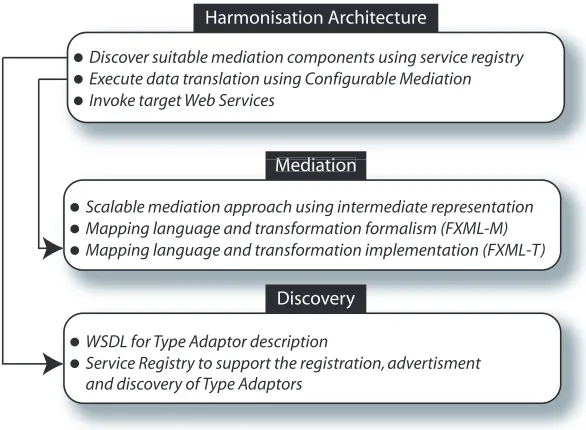
Workflow harmonisation, the act of identifying syntactic mismatches, finding the appropriate Type Adaptors, and invoking them, can be driven using data transla-tion mediated by a canonical intermediary representatransla-tion derived from the shared semantics of the service interfaces. In this dissertation, we present an architec-ture to support automated workflow harmonisation, making use of three principal contributions (presented graphically in Figure 1.1):
1. Mediation
Scalable mediation approach using intermediate representation Mapping language and transformation formalism (FXML-M) Mapping language and transformation implementation (FXML-T)
WSDL for Type Adaptor description
Discovery
Service Registry to support the registration, advertisment and discovery of Type Adaptors
Harmonisation Architecture
[image:15.595.165.458.79.294.2]Discover suitable mediation components using service registry Execute data translation using Configurable Mediation Invoke target Web Services
Figure 1.1: A visual representation of the contributions in this Thesis.
(a) Scalable mediation approach
We conceived an intermediate representation, making use of owl
on-tologies, to capture the structure and semantics of different data for-mats. With a common representation in place, maximum interoper-ability can be achieved by providing mappings between each data for-mat and its corresponding owl model. As more xml data formats are added, a linear expansion in the number of required mappings is observed.
(b) A declarative, composable and expressive mapping language
To specify the relationship between a concretexmlrepresentation and
its corresponding conceptual model inowl, the bespoke mapping lan-guage fxml-M is used to define mappings that associate schema ele-ments from a source schema to eleele-ments in destination schema using an xpath like notation. Since complex mappings are often required,
fxml-M provides predicate support (to enable the conditional map-ping of elements), local scomap-ping (so different mapmap-pings can be applied depending on element context), and the mapping of collections of ele-ments and attributes for composite relations. Mappings are combined to form an M-Binding document (expressed in xml), which can be
M-Bindings may also import mappings from other documents.
(c) A practical and scalable mapping language implementation
fxml-T— our mapping language and transformation implementation, can be used to translatexmldocuments by consuming an M-Binding,
the source document schema, and a destination document schema. Em-pirical testing proves that our Mapping Language approach is practi-cal, our implementation scales well,M-Binding composition comes with virtually no cost, and the implementation is efficient when translating bioinformatics datasets. fxml-Tis combined with the ontology reason-ingapi jena[60] to create the Configurable Mediation (C-Mediator):
a reconfigurable Type Adaptor to enable the mediation of data through a shared conceptual model.
2. A uniform description method for Type Adaptors using wsdl
Because Type Adaptor components may come in many forms: e.g. trans-lation scripts, bespoke code and Web Services, it is important to describe their capabilities uniformly. While it is understood that wsdl can be used to specify Web Service interfaces and invocation methods, we establish that Type Adaptors can also be described with wsdl, allowing existing Web
Service registry technology to be reused, and support the advertising and discovery of Type Adaptor components.
3. Automated Workflow Harmonisation Architecture
(dwsi) is used, offering improvements over existing Web Service invocation
apis such as Apache Axis [10] and jax-rpc in terms of performance and practicality.
1.2
Document Structure
We begin in Chapter 2 by investigating a bioinformatics grid application to see why workflow design and execution is impeded by service providers assuming dif-ferent representations for conceptually equivalent information. Using a common bioinformatics task as a use case, we find that existing workflow harmonisation techniques are entirely manual: users must identify when mismatches in data for-mat occur, what components are available to resolve them, and how they should be inserted into the workflow, drawing their attention away from the scientific process at hand.
In Chapter 3, we analyse related work in the areas of Semantic Web technology, data integration and automated service integration. Through assessment of the state of the art, we conclude that Semantic Web Service technology can be incor-porated with existing data integration techniques to facilitate automated workflow harmonisation.
Chapter 4 presents WS-HARMONY: an architecture to support automated workflow harmonisation. The use of owl as an intermediate representation is discussed with examples to show how our use case scenario can be harmonised us-ing a common conceptual model. Software to support the automated discovery and execution of Type Adaptors is presented with an emphasis on the C-Mediator
and how it is used to create the required Type Adaptors on-the-fly.
Chapter 5 focuses on the xml data transformation problem where a formalised
mapping language and transformation theory is presented in the form of fxml-M. Through the analysis of data sources within our bioinformatics use case, we derive the requirements forxmlmapping and transformation which are shown to
In Chapter 6, we outline our transformation libraryfxml-T. This implementation of thefxml-Mlanguage is presented in detail with particular attention to the way in which rules from the formalisation are implemented. The inner workings of the
C-Mediatorare shown, and a detailed example is provided to demonstrate how syntactic mediation is provided in our use case scenario. Empirical testing of the transformation implementation is made to establish fxml-T as scalable and
efficient transformation implementation that offersM-Binding composability with virtually zero cost.
Finally, the architecture components required to make use of our C-Mediator
and support the automated discovery and inclusion of Type Adaptors is presented in Chapter 7. A method for the description of Type Adaptor capabilities using
wsdl and their subsequent registration, advertisement, and discovery through a service registry is demonstrated along with a presentation of our Dynamic Web Service Invoker (dwsi). Conclusions and future work are given in Chapter 8 to show how our contributions can be reused in the advancement of Semantic Web Service technology.
1.3
Publications
During the development of this Thesis, the following work has been published:
Szomszor, M., Payne, T. and Moreau, L. (2005) - Using Semantic Web Tech-nology to Automate Data Integration in Grid and Web Service
Archi-tectures. InProceedings of Semantic Infrastructure for Grid Computing Applica-tions Workshop in Cluster Computing and Grid (CCGRID) - IEEE, Cardiff, UK.
Szomszor, M., Payne, T. and Moreau, L. (2006) -Dynamic Discovery of
Com-posable Type Adapters for Practical Web Services Workflow. In
Proceed-ings of UK e-Science All Hands Meeting 2006, Nottingham, UK.
http://eprints.ecs.soton.ac.uk/12753/
Szomszor, M., Payne, T. and Moreau, L. (2006) - Automated Syntactic
Me-dation for Web Service Integration. In Proceedings of IEEE International
Conference on Web Services (ICWS 2006), Chicago, USA.
Motivation:
A Bioinformatics Use Case
The Web Services computing vision promises an environment where services can be discovered, composed, executed and monitored easily. However, through the inspection of a real world Web Services application, we find that this vision has not been fully realised: the composition and execution of services is often hindered by the fact that service providers use different data formats to represent conceptually equivalent information. In order to resolve these mismatches, additional processing is required to translate data between different formats. Current solutions to this problem are entirely manual and require skilled user intervention.
This Chapter characterises the workflow composition and execution problem, re-vealing the current solutions, as well as a description of a more user-friendly approach. This Chapter begins with Section 2.1, providing an introduction to bioinformatics and an overview of the myGrid [80] project. Section 2.2 follows,
containing a description of how semantic annotations are used to augment the ser-vice discovery procedure. In Section 2.3, we present our use case scenario before outlining the problems it reveals in Section 2.4. Section 2.5 examines the schema reuse often employed in service interface definitions and the implications it holds for a mediation solution. We conclude in Section 2.6 by discussing the current solutions and how they can be improved.
A Bioinformatics Use Case 11
2.1
Bioinformatics Overview
Bioinformatics is the application of computational techniques to the management, analysis, and visualisation of biological information. With the collection and stor-age of large quantities of genomic and proteomic data, coupled with advanced computational analysis tools, a bioinformatician is able to perform experiments and test a hypothesis without using conventional ‘wet bench’ equipment — a technique commonly referred to asin silico experimentation [49]. To support this kind of science, multiple vendors offer access to a variety of resources creating a loosely coupled, dynamic, and large scale environment which scientists can exploit to achieve their scientific aims.
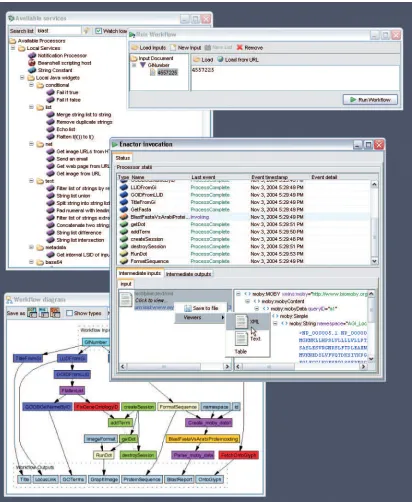
The myGrid [80] project provides an open-source Grid middleware that sup-ports in silico biology. Using a service-oriented architecture, a complex infras-tructure has been created to provide bioinformaticians with a virtual workbench with which they can perform biological experiments. Access to data and com-putational resources is provided through Web Services which can be composed using the workflow language XSCUFL [97] and executed with the FreeFluo [46] enactment engine. The biologist is provided with a user interface (Taverna [89]) which presents the services available, enables the biologist to compose and view workflows graphically, execute them, and browse the results. A screenshot of the Taverna workbench is shown in Figure 2.1 and contains four windows: Available Services, Workflow Diagram, Run Workflow, and Enactor Invocation.
A Bioinformatics Use Case 13
Within the Taverna application, one of the most difficult tasks the user faces is finding the service instances they require. Typically, the user has planned their experimentation process prior to their interaction with the Taverna workbench. Most likely, this has been done on paper with various abstract definitions of the types of service required for each stage in the process. To find a particular service which achieves a goal they desire, the user has to inspect the services available in the Available Services window and manually choose the most appropriate one. Given the terse and often cryptic service descriptions, and the sheer number of services offered (over 1000 in myGrid) [58, 71], the discovery of services is
awkward. Hence, recent research from the myGrid project has been centred on
the incorporation of Semantic discovery.
2.2
Semantic Discovery
According to the basic premise of the Semantic Web [20], information should be presented in a way where the meaning is captured in a machine processable format so computers can understand the semantics of the data and exchange information accurately. This vision has been partially realised through the use of ontologies: a language to formally define a common vocabulary of terms for a given domain and how such terms relate to each other [51], and in particular, through the develop-ment of ontology languages, such asowl[83], that provide mechanisms to support the publishing, sharing, and collaboration of ontology definitions using the Web. By annotating service definitions with concepts from these shared ontologies, users can find services based on conceptual definitions of the service capability, rather than the low-level interface definitions.
GenBank_record protein_family_record
nucleotide_sequence_record bioinformatics_record
PIR_record RefSeq_record
RNA_sequence
UniGene_record
TREMBL_record protein_interaction_record
biological_structure
protein_sequence
protein_sequence_record phylogenetic_record
EMBL_record proteomics_record
genotype_phenotype_record
SWISS-PROT_record pathway_record
UniProt_record
nucleotide_sequence biological_sequence
dbEST_record microarray_database_record
biological_location Entrez_genbank_protein_record
sequence_record
bioinformatics_report bioinformatics_data
literature_citation genome_map_record
DDBJ_record
DNA_sequence enzyme_record
protein_structure_record
dbSNP_record
Figure 2.2: A subset of the bioinformatics ontology developed by themyGrid
project.
the service interface definition. To implement this feature in Taverna, the Pedro [48] tool is used to annotate service definitions with concepts from the bioinfor-matics ontology. These semantic annotations can then be consumed by FETA
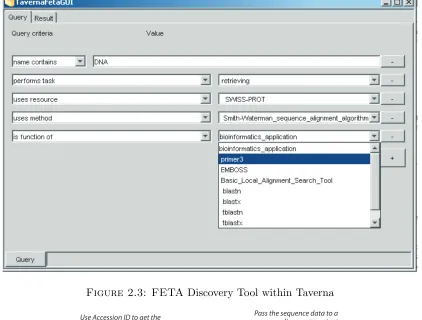
[71], a light-weight architecture for user-oriented semantic service discovery, that in turn, provides a query interface to search over services. The most recent release of the Taverna workbench provides a graphical query interface toFETA, which is
illustrated in Figure 2.3. The query window here allows the user to find services based on values of certain service attributes which have been set previously using the Pedro annotation tool. In this example, some of the required attributes are:
1. the service name must contain the string "DNA";
2. it must perform the task with concept "retrieving";
3. it must make use of the "SWISS-PROT" resource (a database in this case).
A Bioinformatics Use Case 15
Figure 2.3: FETADiscovery Tool within Taverna
Accession ID Get Sequence
Data Record
Sequence Data
Sequence Alignment
Alignment Results
Use Accession ID to get the full sequence data record.
Pass the sequence data to a sequence alignment service to
find matching sequences.
Figure 2.4: An abstraction view of our bioinformatics use case
2.3
Use case
For our use case, we examine a typical bioinformatics task: retrieve sequence data from a database and pass it to an alignment tool, such as Blast [6], to check for similarities with other known sequences. According to the service-oriented view of resource access adhered to by myGrid, this interaction can be modelled as a
simple workflow with two stages: an initial stage to retrieve the sequence data, and a second stage to check for similarities with other sequences. We show this simple workflow at an abstract level in Figure 2.4.
suitable services for each step. Many Web Services are available to retrieve se-quence data, for our example, we could use one available from EMBL [96], or alternatively, one from DDBJ [36]. For the second stage of the workflow, an align-ment service available from NCBI [81] could be used. Therefore, two concrete workflows can be created to perform the analysis: one using the XEMBL service and another using the DDBJ-XML service, illustrated in Figure 2.5.
Accession ID Sequence
Data
Alignment Results
and DDBJ-XML both provide sequence data records.
NCBI-Blast performs Sequence Alignment
XEMBL
DDBJ-XML
NCBI-Blast
Figure 2.5: Two possible concrete workflows for a sequence retrieval and
anal-ysis task.
2.4
Syntactic Compatibility
While both sequence retrieval services are similar, in that an accession id is passed as input to the service and an xml document is returned containing all the
se-quence data, the format of the xml documents is different: XEMBL returns an
EMBL-EBI formatted document1, whereas DDBJ-XML returns a document
us-ing their own custom format2. When considering the compatibility of the data
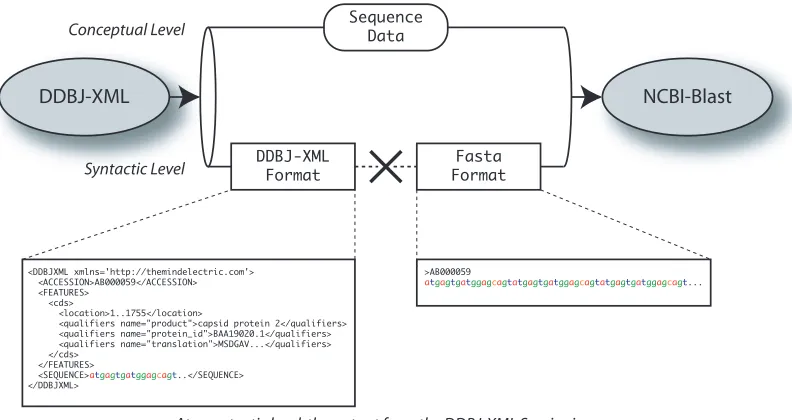
flow between the services, it can be seen that the output from neither sequence retrieval service is directly compatible for input to the NCBI-Blast service. Figure 2.6 illustrates this example: the DDBJ-XML service produces a DDBJ formatted sequence data record, and the NCBI-Blast service consumes a FASTA formatted sequence.
A Bioinformatics Use Case 17
Sequence Data
DDBJ-XML NCBI-Blast
DDBJ-XML Format
Fasta Format
At a conceptual level, the output of the DDBJ-XML Service is compatible with the input to the NCBI-Blast Service.
At a syntactic level, the output from the DDBJ-XML Service is not compatible with the input to the NCBI-Blast Service. Conceptual Level
Syntactic Level
<DDBJXML xmlns='http://themindelectric.com'> <ACCESSION>AB000059</ACCESSION> <FEATURES>
<cds>
<location>1..1755</location>
<qualifiers name="product">capsid protein 2</qualifiers> <qualifiers name="protein_id">BAA19020.1</qualifiers> <qualifiers name="translation">MSDGAV...</qualifiers> </cds>
</FEATURES> <SEQUENCE>atgagtgatggagcagt..</SEQUENCE> </DDBJXML>
>AB000059
[image:27.595.117.513.119.329.2]atgagtgatggagcagtatgagtgatggagcagtatgagtgatggagcagt...
Figure 2.6: The DDBJ-XML output is conceptually compatible with the input
to the NCBI-Blast service, but not syntactically compatible.
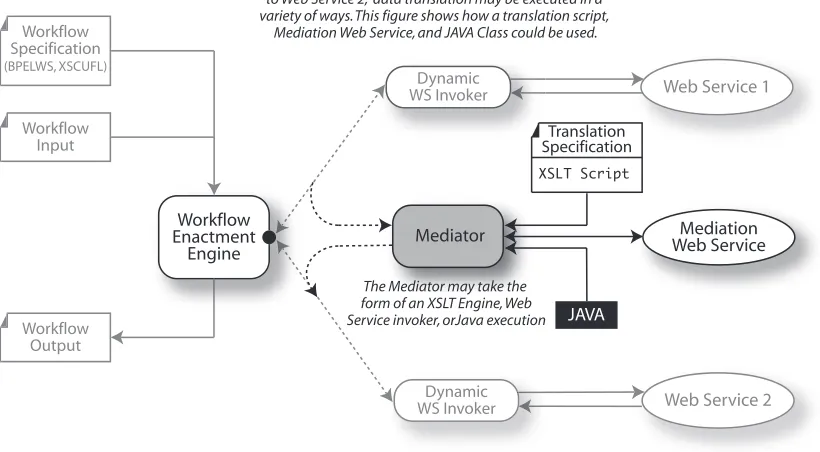
To execute a workflow where the output from the DDBJ-XML service is passed as input to the NCBI-Blast service, the differences in data format assumed by each provider must be reconciled, a process we refer to as workflow harmonisation. Within Taverna, this is a manual task: users must identify when a syntactic mismatch has occurred, what components are available to carry out the necessary translation, and in many cases, new ones must be created. The transformation of data between different representations by an external software components, or syntactic mediation, can be achieved using a variety of techniques: a bespoke mediator could be programmed using a language such as java; a transformation language such as xslt[34] is used to specify how the translation is performed; or
2.5
Data format reuse in Web Services
Upon further examination of services in myGrid, it is apparent that a single Web Service may offer a number of different operations. The service interface definition (expressed usingwsdl[33]) defines the input and output types for each
operation by referencing an xml schema type (referred to as the syntactic type), and semantic annotations attached using the Pedro tool define the conceptual type for each input and output by referencing a concept from the bioinformatics ontology (the semantic type). Often, it is the case that a Web Service offers operations with inputs and outputs that utilise parts of the same global data structure. For example, the DDBJ-XML Service in our use case offers many operations over sequence data records. A singlexmlschema exists to describe the format of the sequence data record, and each operation defines the output type by referencing an element within this schema. We illustrate this scenario in Figure 2.7 by showing the DDBJ-XML interface definition (right box), and how semantic annotations relate message parts to concepts from the bioinformatics ontology (left box).
The DDBJ-XML service offers access to many sequence data repositories: SWISS, EMBL and UNIPROT are three of them. Each of these databases is maintained separately so users may elect to retrieve sequence data from one source over an-other. To support this, the DDBJ-XML service offers separate operations to supply
DDBJ-XML Get SWISS record
DDBJ-XML
Accession_id Get EMBL record
Get UNIPROT record xsd:string
DDBJ-XML xsd:string
DDBJ-XML xsd:string
Get Sequence Features Features
xsd:string
The DDBJ-XML service offers a number
of operations input
output
input
output
input
output
input
output
Sequence_Data
Sequence_Feature
Ontology
Each line represents the semantic type of the input or output.
WSDL
Figure 2.7: The DDBJ-XML web service offers a number of operations over
A Bioinformatics Use Case 19
access to each repository. Each of these three operations has the same input and output types, both in terms of the syntactic type and the semantic type. The DDBJ-XML service also offers operations to retrieve only parts of the sequence data record. In Figure 2.7, we show the “Get Sequence Features” operation that allows users to retrieve only the features of a sequence data record. In this case, the output syntactic type is the<Feature>element from the DDBJ-XML schema and the semantic type is the Sequence Feature concept. With this kind of schema reuse, one can imagine that a single Type Adaptor component may be suitable for use with many service operations, even those which operate over a subset of a global schema. In our use case, a single Type Adaptor could translate sequence data from DDBJ-XML format to FASTA format, and would therefore be suitable for any of the operations shown in Figure 2.7.
2.6
Conclusions
Chapter 3
Background
In Chapter 2, we analysed a bioinformatics Grid application and found that work-flow composition and execution is often hindered by the differences in data rep-resentation assumed by service providers. Our aim is to improve on the current manual solutions and support autonomous workflow harmonisation through the discovery and invocation of necessary Type Adaptors at runtime. This Chapter examines background material in the areas of Grid, Web Services, and Semantic Web, as well as a review of related work in the fields of data integration, service integration and workflow composition.
We begin in Section 3.1 with an introduction to Grid and Web Services, sum-marising the fundamental technologies and their limitations. Section 3.2 shows how Semantic Web technology can augment existing Grid and Web Service envi-ronments, supporting more intuitive service discovery and facilitating autonomous service invocation. We describe the current technologies that aim to support the application of Semantic Web techniques to Web Service architectures and finish with a comparison of their approaches.
In Section 3.4, an overview of relevant data integration work is presented, high-lighting the similarity of problems addressed with those underpinning the workflow harmonisation problem. We present existing workflow harmonisation technology in Section 3.6 and discuss the relevance to our workflow harmonisation problem. In Section 3.7, we look into high-level service discovery and workflow composition
techniques to see how they support the creation of meaningful workflows in scien-tific applications. We conclude in Section 3.8 by discussing how data integration approaches can be combined with Semantic Web Service technology to support automated service integration.
3.1
Grid Computing and Web Service
Ever since the early 1970’s, when computers were first linked together by networks, the concept of harnessing computational power from multiple machines to perform a single task has become a fundamental computer science field. Research in this field has been driven mainly by the high performance computing community who concentrate on splitting up large computational tasks, allocating them to multiple machines for calculation, and reintegrating the final results.
In the 1990’s the distributed computing community saw new opportunities arise through the emergence of the Internet. The Internet provides a global network on which any two machines on the planet can communicate across a simple and reliable transport mechanism. This explosion in connectivity and computing power has been matched by the increasing complexity of tasks users want to perform. Particularly motivated by scientific fields such as astronomy, particle physics and biology, users now demand access to powerful computational systems that hold vast amounts of data collected from a range of disparate sources.
access is employed. Essentially, this means that access to every type of resource is modelled as though it is a service. To implement this type of architecture, Web Services can be used.
3.1.1
Web Service Architecture
The Grid architecture relies on a service-oriented view of resource access inspired by the use of the Web Services Architecture [23]. This allows resource providers to describe their capabilities in terms of a Web Service, most commonly through the use ofwsdl[33]. wsdlis a specification language that describes the abstract operational characteristics of a service using a message-based paradigm. Services are defined by operations (which are analogous to methods from traditional pro-gramming paradigms), each of which has an input message and an output message (like the parameters and result of a method). Each message may contain a number of parts, each of which is defined by a reference to a schema type (typically xml
Schema [41]). These abstract definitions are bound to concrete execution mod-els to explain the invocation method (for example soap [52] encoding over http
transport).
Other Web Service technologies are also available to support more intricate service functionality such as service discovery (uddi[1]), secure message exchange ( WS-Security[61]) and the specification of collaborations between resources (ws-cdl
[62]). Many software implementations are available to support the Web Services Architecture, such as the Apache Axis Web Service Project [10] and IBM’s Web-Sphere Software suite [59]. To this end, the Web Service Architecture provides a fundamental model on which to build Grid computing applications through a set of widely recognised standards and a range of software tools to support them.
3.1.2
Web Service Limitations
notion usually referred to as the semantics of the service. This leads to two major problems:
1. Unsophisticated service discovery
Service discovery is the process through which we can find services that perform a given task. Although current Web Service standards such as
uddiand ebxml[40] support the registration and indexing of large numbers of services, their information models are constrained, allowing only simple string matching on business and service types. In extreme cases, interface definitions are completely undocumented and operation names bear little relation to the actual functionality provided. Paolucciet al [82] demonstrates that human comprehension of a service description is required before we can be sure that it matches any given requirements. Hence, the level of autonomy we can achieve is limited.
2. Limited automatic invocation
Assuming a candidate service has been discovered, we would then wish to invoke it. wsdldescribes the structure and required data types of the mes-sage contents, so we can determine a valid mesmes-sage format. However, it does not state what the parts of the message contents represent. For example, a service may expose an operation to calculate the distance between two cities. The interface for such a service could take two strings as input: one for the source city name and one for the destination city name. Without additional semantics, an automated invocation component would not know which city name to place in which part since they both have the same type, namely a string. Since service vendors are unlikely to subscribe to a predefined mes-sage layout, we cannot assume that a client will know how to create the correct message [77].
3.2
Web Services and Semantics
The Semantic Web [20] is an extension of the existing Web that aims to support the description of Web resources in formats that are machine understandable. According to the Semantic Web approach, resources are given well-defined mean-ing by annotatmean-ing them with concepts and terminology that typically correlate with those used by humans. To share knowledge at a high-level using well-defined semantics, we can use an ontology: a modelling language to formally define a com-mon vocabulary of terms for a given domain and how such terms relate to each other [51]. The Web Ontology Language (owl) [83] is an example of an ontology
language that is specifically designed to facilitate the publication and sharing of domain models on the Web. owl is an extension of the existing Resource De-scription Framework (RDF) [66], incorporating features from the DARPA Agent Markup Language (DAML) [91] and Ontology Inference Layer (OIL) [56] to cre-ate a rich conceptual modelling language with well defined reasoning procedures founded on description logics [12].
Inowl,classes (or concepts) are used to define groups of items or individuals that
should be collected together because they share common attributes. For example, the individuals Anne, Barry, and Colin would all be members of the Person class. Properties are used to state relationships between classes of individuals, (called object properties, and from classes to specific data values (called datatype proper-ties). Class hierarchies can be used to specify classes which are considered more specific or general than other classes (e.g. the class Male is more specific than the class Person). Individuals (or concept instances) can then be specified in terms of defined classes with object properties to relate them to other individuals, and datatype properties that define their attributes using literal values such as strings or integers. Withowl, both the ontology definition and its concept instances can be represented using an xml syntax, with datatype properties instantiated using
xml schema types. Through the use of ontologies, the Semantic Web supplies
computers with rich annotations enabling them to reason on resources distributed across the Web through a common, high-level conceptual model.
This approach supports: (a) more advanced service discovery [72] because queries on a service’s functionality can be formulated in terms of the high level, human oriented descriptions; and (b) better automation [9] because service interfaces will be annotated with semantics that describe what the data represents and not just its syntactic type.
To enable the annotation of Web Services with semantics, the use of ontologies is critical. Given that any particular service instance operates within a set of domains (e.g. a book buying service works in the purchasing and book information domains), we can encode the operational characteristics of the service using an ontology. For example, a purchasing ontology would have concepts describing payment, shipping, ordering, etc. and a book information ontology would describe books, authors, publishers, etc. To create these service description ontologies, we must ensure that we encapsulate the necessary information:
• Information processing
What are the inputs and outputs of the service? Given that service providers will often use their own bespoke data structures, an ontology describing the service information requirements should state what the inputs and outputs are using terms from a shared conceptualisation, enabling clients to deter-mine what each part of a service’s interface means. This enables clients to invoke services properly by ensuring that data given to the service for processing is both the correct syntactic type (specified in the interface def-inition) and appropriate semantic type (the concept referenced within the ontology).
• Behaviour
The combination of Semantic Web technology with Web Services to produce Se-mantic Web Services has received a great deal of attention. In the following sub-sections, we investigate the major technologies that aim to support the Semantic Web Service vision, before comparing their approaches.
3.2.1
OWL-S
owl-sis a set of ontology definitions (expressed using theowlontology language) designed to capture the behaviour of Web Services. The top levelservice ontology presents the serviceprofile, a description of what the service does (e.g. that a ser-vice is used to buy a book). The serser-vice is described by the serser-vice model, which tells us how the service works (e.g. a book buying service requires the customer to select the book, provide credit card details and shipping information and pro-duces a transaction receipt). Finally, the service supports the service grounding that specifies the invocation method for the service. Figure 3.1 shows the basic re-lationship between these top level ontologies. In terms of data representation and service invocation, our interest lies primarily in the service grounding ontology because it describes the relationship between the high-level service description, encapsulated within the owl-s ontology definition of the service, and the actual service interface.
Service
Service Profile
Service Grounding
Service Model
supports
The Service profile describes what the service does.
The Service Grounding describes how to invoke the service.
The Service Model describes how to interact with the service.
presents
described by
Figure 3.1: owl-sservices are described by three facets; a profile, a grounding
OWL-S Process
OWL-S Parameter
OWL-S Parameter
input parameter
output parameter
WSDL Operation Message
Message Part
Part
input message
output message
OWL-S Input Parameters are grounded to WSDL Input Message Parts
OWL-S Output Parameters are grounded to WSDL Output Message Parts
OWL-S Atomic Processes are grounded to WSDL Service Operations
Figure 3.2: owl-satomic processes are grounded towsdlService operations.
Each owl-sparameter is grounded to a wsdlmessage part.
The currentowl-srelease (Version 1.2 Beta [2]) supports the annotation ofwsdl
interfaces for services that usesoapinvocation only. The basic grounding premise is that each owl-s atomic process (the most basic process element) is grounded
to awsdloperation. The input parameters to an atomic process, which represent the conceptual type of the input, are grounded to wsdl input message parts. The same applies for the output parameters: they are grounded to wsdl output
message parts (Figure 3.2).
To annotate an existing Web Service that has a wsdl definition, xslt scripts
are used to describe how an input owl concept instance (serialised in xml) is translated to asoapenvelope so it can be sent directly to the service for invocation. The reverse applies for the service output: xslt is used to translate the output soap envelope into an owl concept instance. While this is a rather restrictive approach since only one style of Web Service invocation and data encoding is supported, it is only one implementation style that has been explored by theowl-s
community: owl-sis designed to be extensible and support other encoding types and invocation styles, although this has yet to be explored.
3.2.2
WSMO
WSMO Infrastructure
Web Service
Adapter XML SOAP Encoding
over HTTP Transport
WSML Message in F-Logic Format
A bespoke Adapter is used to provide an interaction mechanism between any software components
and the WSMO Infrastucture
Adapter Database
ODBC Access
WSML Message in F-Logic Format
Ontologies
Mediators
[image:39.595.110.524.93.384.2]Goals
Services
Figure 3.3: With wsmo, adaptors are placed in front of legacy components,
such as Web Services, to provide a bridge to the wsmoinfrastructure.
Web Services based on logical inference mechanisms. Conceptually,wsmois based on an event driven architecture so services do not directly invoke each other, in-stead goals are created by clients and submitted to thewsmoinfrastructure which automatically manages the discovery and execution of services. Likeowl-s,wsmo
uses ontologies to describe both the behaviour of Web Services and the informa-tion they consume and produce. This is achieved using the bespoke F-Logic based language wsml [37]. It is assumed that components within the wsmo architec-ture communicate using a standardised message format: an xml serialisation of
the wsml language. Essentially, this means that all participants within a wsmo
framework are expected to communicate at a conceptual level usingxml serialisa-tions ofwsmlconcepts. To accommodate differences in conceptual representation,
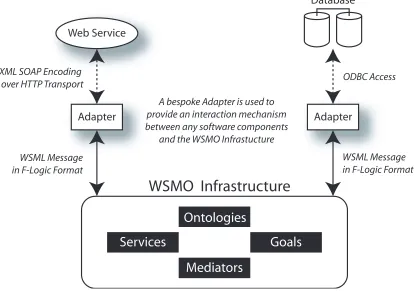
the wsmoinfrastructure also contains explicit mediator components that support the translation of information between different wsml representations.
To elevate conventional computing resources, such as Web Services and databases, into the wsmo framework, message adaptors are placed in-front of the resource
as a soap interface to a Web Service or an ODBC interface to a database) and
the wsml message layer as we show in Figure 3.3 These Adaptors are a super set of what we defined earlier as Type Adaptors because they are responsible for more than the translation of data between different syntactic representations: conversions between different access models (e.g. relational databases and xml
data), different transport types (e.g. http, and ftp), and different interaction
protocols (e.g. request / response Web Services, and remote method invocation). An example of such an adaptor can be found in Section 5.3 of [76] which performs translations between wsml and Universal Business Language [74] (ubl). With
this approach, the syntactic interface to a business service is hidden because its interface is exposed only through thewsmo framework.
3.2.3
WSDL-S
wsdl-s (Web Service Semantics, a W3C Member submission) [5] is an extension
of the existing wsdl interface definition language that supports meta-data at-tachment. wsdl-s assumes formal semantic models (i.e. models that describe the service behaviour using semantics) exist outside the wsdl document and are
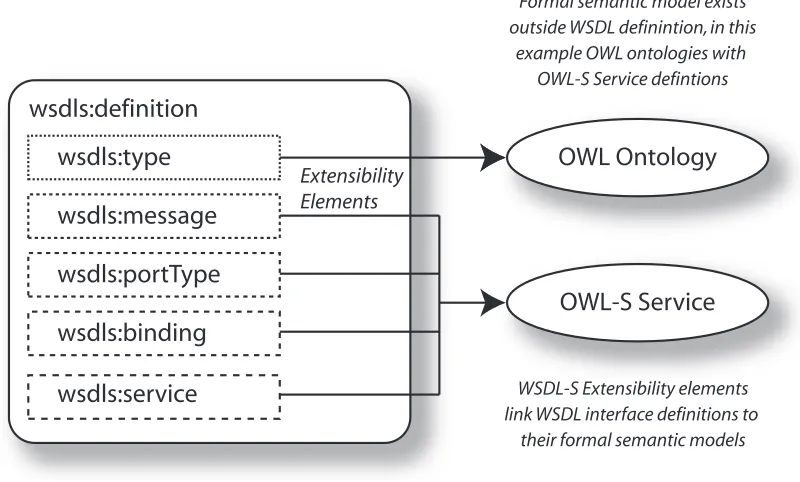
referenced via wsdlextensibility elements. wsdl-sis technology agnostic so any formal semantic model can be used, such asowl-s orwsmo. We provide a visual representation in Figure 3.4 that shows a conventionalwsdldocument referencing
an owl ontology (to provide formal semantics for the data types) and an owl-s
definition (formal semantics for the service behaviour). To support the relation-ship between concrete data (in xml) and its conceptual representation (in owl), wsdl-shas two annotation models:
1. Bottom Level Annotation
For simple cases, when a one-to-one correspondence exists between an xml
element within the wsdl message and an owl concept, bottom level
OWL Ontology
wsdls:definition
wsdls:type
wsdls:message
wsdls:portType
wsdls:binding
wsdls:service
OWL-S Service
Formal semantic model exists outside WSDL definintion, in thisexample OWL ontologies with OWL-S Service defintions
WSDL-S Extensibility elements link WSDL interface definitions to
their formal semantic models
[image:41.595.114.514.91.332.2]Extensibility Elements
Figure 3.4: wsdl-s annotation approach: wsdl Definitions are linked to
external semantic models via extensibility elements
2. Top Level Annotation
With the top level annotation approach, an external mapping can be refer-enced that specifies the full translation between xmland owl. This allows complex data representations to be assigned a model inowl. Again, wsdl-s is technology agnostic so any form of mapping can be used, such as xslt
orxquery [22].
3.2.4
Comparison of Semantic Annotation Techniques
owl-s, wsmo, wsdl-s and the annotation policy adopted by FETA (discussed
previously in Chapter 2) are oriented around the idea of high-level service de-scriptions specified using an ontology based language: owl in the case of owl-s,
wsml for wsmo, and rdfs [25] for FETA. The description approaches are
in their implementation methodology. owl-s and FETA are used as an
annota-tion model, supplying language constructs to describe the behaviour of services at a conceptual level without imposing any standard message exchange format or invocation style. While current owl-s implementations are based around
some-what restricted models, i.e. wsdl interface annotation with soap invocation, the model is designed to be extensible and therefore support other types of Web resource and access methods. Implementation of the wsmo architecture can be
considered more mature than those supporting owl-s. The wsmx framework which implements wsmo already supplies a integrated annotation, discovery and
invocation environment - something which has yet to be fully realised by the owl-s community. However, this has been achieved mainly because of the restrictions placed on wsmo participants, namely a standardised message exchange format
and imposed invocation style. Since wsdl-sis only an annotation approach that relies on the existence of an external formal model, it cannot be compared directly toowl-s, wsmo, or FETA. However, it does subscribe to the same basic
princi-ple i.e. services are described using high-level, conceptual definitions expressed in an ontology.
3.3
Viewing a Semantic Web Service
Architec-ture
The amalgamation of the term “semantic” with “web service” to produceSemantic Web Service has been used frequently, but also indiscriminately. Sometimes it is used to refer to the notion that existing Web Services are augmented with Semantic Web technology to aid computers in understanding what the service does and how it works. All other times, it used to refer to a new type of service that sits on the Semantic Web, directly consuming and producing information at the conceptual level. To distinguish between these different views, we introduce the termssemantically annotated Web Service and semantically enabled Web Service.
Semantically annotated Web Services are conventional Web Services, such as those described bywsdl, that have been annotated with a semantic description. This
more advanced components, such as a discovery service, to utilise the additional annotations and reason on the capabilities of the service. We illustrate this type of service in Figure 3.5. With these types of service, some mechanism must exist to describe how conceptual information structures, such as ontology instances, are grounded to concrete data representations such as xml.
Semantically Annotated Web Service Ontology
Instances
Ontology Instances
Service Input Service Output
Web Service XML Data
<a>
<b>foo<\b> <b>bar<\b> </a>
XML Data
<x> <y>5<\y> <z>10<\z> </x>
Transform Ontology Instance to XML
XML Input XML Output
Transform XML to Ontology Instance
Figure 3.5: A semantically annotated Web Service is a traditional Web service
that has annotations describing the grounding of ontology concepts to itsxml
types.
Semantically enabled Web Services are services that consume input and produce output at a conceptual level. We assume these types of service are able to reason on the data received and have a suitable mark-up mechanism to describe their functionality. We illustrate these types of service in Figure 3.6.
Semantically Enabled Web Service Ontology
Instances
Ontology Instances
Service Input Service Output
Figure 3.6: A Semantically enabled Web Service which consumes input and
produces output in the form of ontology instances.
it, it is likely that several ontologies will develop to explain the same domain using slightly different structures and terms. Service providers must also anticipate the requirements of the client which can be problematic because different clients may use the same service to achieve different goals. For example, the Amazon Web Service (www.amazon.com) can be used to purchase CDs, but a client may wish to use the service to find album track listings or cover art. In addition, for a service to be semantically enabled, the provider is forced to provide a semantic descrip-tion; a complex task which they may not be qualified to perform or wish to spend resources doing so.
A semantically annotated Web Service permits multiple annotations for a single service instance. This allows different organisations and communities to describe Web Services with their own ontologies according to their own interpretations. It also means service providers can still use conventionalwsdldocuments to expose their capabilities and rely on third party annotations to give them semantics. Finally, by annotating existing definitions rather than altering them, we can ensure compatibility between semantic and non-semantic clients.
The bioinformatics application in which our work is situated is a semantically annotated environment. Services expose their functionality using conventional interface definitions such as wsdl. These interface definitions are then annotated
with terms from a bioinformatics ontology, supplying semantics and capturing the meaning of the service.
3.4
Data Integration
geographic dataset integration solution; a semantic data integration system for the web; and a Grid data definition language to support the meaningful interchange of Grid data.
3.4.1
TAMBIS - Data Integration for Bioinformatics
The Transparent Access to Multiple Bioinformatics Information Sources [87] (TAM-BIS) framework is designed to support the gathering of information from various data sources through a high-level, conceptually-driven query interface. In this sys-tem, information sources are typically proprietary flat-file structures, the outputs of programs, or the product of services, with no structured query interface such as
sqlorxquery[22], and no standard representation format. A molecular biology
ontology, expressed using a description logic, is used in conjunction with functions that specify how every concept is accessed within each data source to deliver an advanced querying interface that supports the retrieval of data from multiple in-formation sources assuming different data representations. The requirements for syntactic mediation are similar to those of data integration: syntactic mediation requires a common way to view and present information from syntactically incon-gruous sources; data integration systems, such TAMBIS, have achieved this by using conceptual models to describe information source in a way that is indepen-dent of representation. While the TAMBIS approach is useful when considering the consolidation of Web Service outputs, it does not support the creation of new data in a concrete format, a process that is required when creating inputs to Web Services.
3.4.2
XDTM - Supporting Transparent Data Access
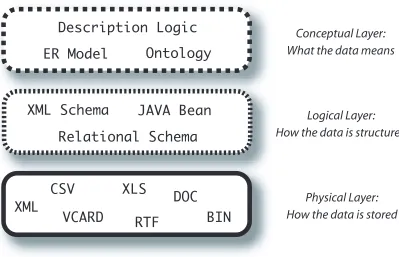
logical structure of the information rather than the way in which it is physically represented. To achieve this, anxmlschema is used to express the logical structure of an information source, and mappings are used to relatexmlschema elements to
their corresponding parts within a physical representation. The XML Data Type and Mapping for Specify Datasets (XDTM) prototype provides an implementation which allows data sources to be navigated using xpath. This enables users to
re-trieve and iterate across data stored across multiple, heterogeneous sources. While this approach is useful when amalgamating data from different physical represen-tations, it does not address the problem of data represented using different logical representations. Within a Web Service environment where service are described using wsdl, we can assume homogeneous logical representation because inter-face types are described usingxmlschema. Our workflow harmonisation problem
arises from the fact that service providers use different logical representations of conceptually equivalent information, i.e. differently organised xml schemas to hold the same conceptual items.
3.4.3
Ontology-based Geographic Data Set Integration
3.4.4
IBIS: Semantic Data Integration
The Internet-Based Information System (IBIS) [29] is an architecture for the semantic integration of heterogeneous data sources. A global-as-view approach [19, 32] is employed meaning a single view is constructed over disparate infor-mation sources by associating each element in a data source to an element in a global schema. A relational model is used as the global schema with non-relational sources wrapped as legacy file formats; Web data and databases models can all be queried using a standard access model. A novel feature of the IBIS architecture is the ability to deal with information gathered via Web forms. This is achieved by exploiting and implementing techniques developed for querying sources with binding patterns [69].
3.4.5
Data Format Definition Language
The Data Format Definition Language (DFDL) [16] is a proposed standard for the description of data formats that intends to facilitate the meaningful interchange of data on the Grid. Rather than trying to impose standardised data formats across vendors, the DFDL language can be used to specify the structure and contents of a file format at an abstract level, with mappings that define how abstract data elements are serialised within the data format. The DFDL api can then be used to parse data and operate over it without regard for the physical representation of the data. This approach has the benefit that information providers can choose to represent their data using the most appropriate format. This is an important consideration for Grid applications because data sets can be large and complex, and therefore, enforcing a particular representation language such as xml is not feasible.