White Rose Research Online URL for this paper: http://eprints.whiterose.ac.uk/114818/
Article:
Frohlich, D. and Spence, J. (2016) Storytelling for Development: Final Report. Working Papers of the Communities & Culture Network+, 7. ISSN 2052-7268
[email protected] https://eprints.whiterose.ac.uk/
Reuse
Unless indicated otherwise, fulltext items are protected by copyright with all rights reserved. The copyright exception in section 29 of the Copyright, Designs and Patents Act 1988 allows the making of a single copy solely for the purpose of non-commercial research or private study within the limits of fair dealing. The publisher or other rights-holder may allow further reproduction and re-use of this version - refer to the White Rose Research Online record for this item. Where records identify the publisher as the copyright holder, users can verify any specific terms of use on the publisher’s website.
Takedown
If you consider content in White Rose Research Online to be in breach of UK law, please notify us by
STORYTELLING FOR
DEVELOPMENT
COMMUNITIES & CULTURE NETWORK+
FINAL REPORT
P
ROFESSORD
AVIDF
ROHLICHD
RJ
OCELYNS
PENCED
IGITALW
ORLDR
ESEARCHC
ENTRE,
U
NIVERSITY OFS
URREYJ
ULY2015
EXECUTIVE SUMMARY
The Storytelling for Development project has concluded with the generation of all five of the originally planned outputs and significant insight into the two research questions. Project partners have worked closely together to meet the project aims and objectives, although discrepancies between the priorities of each partner organisation have led to some unexpected shifts in procedures and methods. The project generated a corpus of digital stories that slightly exceeded our target and provided substance for a thorough analysis of demographics and content. This rich set of findings can steer future projects seeking to use digital storytelling in the context of urban redevelopment.
KEY PROJECT PARTICIPANTS
Professor David Frohlich, University of Surrey
Dr Jocelyn Spence, University of Surrey
Professor Marialena Nikolopoulou, University of Kent
Tom Barrett, Trisha Boland, and Hannah Jameson, Lambeth Council
John Letherland, Farrells
Steve Broome, RSA
AIMS AND OBJECTIVES
The starting point for the project was a challenge and opportunity related to participatory design of the built environment. In a recent report on architecture and planning in the UK created by project partners Farrells architect planners, current design processes were criticised for not being participatory enough in representing the needs and aspirations of local residents, or respecting the history and cultural heritage of areas subject to re‐development. This project aimed to take a more holistic view of places and their identities and to draw on knowledge of the past in planning for the future, using digital storytelling as an empowering and pro‐active method of community engagement in the planning process for urban redesign.
Within the above context, we aimed to help communities and architects to tell and exchange stories about the past, present and future of an urban
neighbourhood. We address two research questions:
1. What is the role of digital storytelling in community engagement for urban development?
For the purposes of this project, we used an extremely lean version of digital storytelling as it was conceived by Joe Lambert and colleagues in the United States over twenty years ago.1 This tradition is strongly rooted in social justice movements and seeks to give participants all the tools needed to tell their own stories in their own, unique voice. Technically speaking, digital stories in this tradition are video files comprising one or more still images with a voiceover narration. This project aimed for participants to create digital stories of no more than two minutes’ duration, using only photos of objects or places in their local area and a voice‐only narration. In other words, at no time does a digital story show a video of the storyteller herself.
Our objectives for this project were distributed among four work packages (WPs). WP1 involved deliverables for project‐level stakeholders in the Network and at Lambeth Council. WP2 was devoted to digital storytelling in the
community. WP3 involved engagement with Farrells architect planners in response to the digital stories created in WP2. Finally, WP4 crystallised around the reflective workshop led by Steve Broome of the RSA. Our outcomes for each WP are summarised below.
WP1 Ð Network and Lambeth Council
We began planning with Lambeth Council before the project officially began on 1 February 2015, and we held our first meetings within the first week of February. Also in February, we developed a Memorandum of Understanding with Lambeth Council, identified avenues for community engagement, and developed a
community engagement plan to guide all future work. We collected demographic data along with the community stories throughout the project and prepared an analysis of the data and stories for stakeholders in the Network and at Lambeth Council. We also compiled a list of findings for refining our planned AHRC bid, for which this was the pilot project.
This WP also includes dissemination plans. In April we presented our early findings at the DS9 (Digital Storytelling) Festival on Storytelling and Activism, 24‐25 April 2015 at the University of South Wales, Cardiff. Jocelyn Spence delivered a paper titled ‘Storytelling for Development: Shaping Localism in London’ that was met with great interest among many conference attendees, both practitioners and academic researchers, from around the world.
Our main dissemination activity for the local community was the Digital Storytelling Project Exhibition, held Wednesday, 29 July, 2015, from 18:00 to 20:00 at the Myatts Field North Community Centre Café. We invited all of our participants, including those who expressed an interest by filling out a consent form but who never completed a digital story for the project. (For reasons relating to the university’s ethics process, we did not invite the six participants who were under the age of 16, though ideally we would have liked to.) We also invited stakeholders from Lambeth Council, the various community leaders and activists that we came into contact with through the project, the participating
1
See Lambert, Joe, 2013. Digital Storytelling: Capturing Lives, Creating Community, 4th
architects at Farrells, and interested students from the University of Kent working with Professor Nikolopoulou. The event was fully catered.
The exhibition was run by David Frohlich with support from Jocelyn Spence and Steve Broome. Approximately 15 people attended, mostly project participants. We allowed guests to eat before beginning the exhibition. David introduced the project, with translation by Maria. We then screened a 20‐minute compilation video of community and design stories. Following the screening we had a brief, informal discussion. Attendees were very positive about the project, including a guest brought by one of the participants, who came to it with fresh eyes.
Our findings are summarised for the Network in this report, which is also being shared with all project partners. We have also produced an analysis of the community digital stories specifically responding to Lambeth Council’s aim of gaining input on the CLIPs initiative in Stockwell, Larkhall, and Vassall wards. WP1 will be completed in September 2015 with the dissemination of these findings at the Communities and Culture Network + meeting.
WP2 Ð Community members
In total, we collected 41 digital stories from community members. We solicited stories about the past, present, or future of participants’ local areas, or stories about other urban redevelopment projects that they might have had experience with. The university research team was very open‐ended in their aims regarding story content, as a key outcome would be to discover the types of stories that people wanted to tell. However, Lambeth Council was keen to use this project as a supplement to their data collection for the newly started Co‐operative Local Investment Plans (CLIPs). This initiative gathers preferences from the local community to determine how funds contributed by developers will be spent in their area. The priorities of the university researchers and Lambeth Council were not perfectly in line, but they did not contradict each other, so the project went ahead.
The original intention was to establish an online‐only means of contributing digital stories, with the aim of increasing engagement from underrepresented groups such as children and young adults. This approach would be supported by face‐to‐face facilitation sessions led throughout the three wards targeted in this project, some of which would be delivered directly to underrepresented groups such as the elderly. However, some weeks into the project, Lambeth Council decided against the online approach.
The stories were analysed in terms of length, platform, category, use of photos, participant demographic, content, and contribution to the Lambeth Council CLIPs initiative. The key findings of these analyses are presented in the Analysis section below.
Our original intention to host a community storytelling workshop during the third or fourth month of the project was deemed to be unworkable due to the low numbers of participants at that stage. We had anticipated the opportunity to generate a fairly large number of stories early on, in part through the online route. Instead, we found that the process started very slowly and began to pick up momentum in the fifth month of the project as word of the project spread from one community activist group to another. It also became clear that many participants were happy to contribute a story but seemed uninterested or intimidated by the prospect of taking part in a public forum – although those who attended the Final Project Exhibition were delighted to see their stories in public and to discuss their experiences with the project.
WP3 Ð Farrells Architect Planners
Our engagement with Farrells was in two parts. First, David Frohlich and Marialena Nikolopoulou visited the offices on 23rd June to give a seminar on the approach and seek initial feedback on the ideas. At the same session we
advertised a design brief to respond to the community stories with design ideas, expressed as stories themselves. Second, David Frohlich and Jocelyn Spence return one month later on 20th July to capture sketches and verbal explanations of design ideas in story form using the Com‐Phone Android app. This was also an opportunity to gain further feedback on the architect’s perspective.
Taken together, we found that the architects were interested in the community stories as an insight into the lives of residents and were sometimes moved by the emotional tone of the narratives. On the other hand they could see that the processing of multiple stories would take some time and might be difficult to fit into busy working schedules, unless key themes and insights were summarised beforehand. They saw the community materials as supplementing rather than replacing existing consultation with resident groups or representatives. While four architects were able to respond to some stories with their own design ideas, these tended to be on quite specific complaints about existing space and
buildings, suggesting that stories should be much more targeted around specific development opportunities and clearly identified locations. A failing of the current method, in their view, was not to mark the location of places being spoken about or depicted in images, and collecting rather diffuse comments about aspects of the built environment more generally.
A strong recommendation was to embed community storytelling in a longer iterative process of design. The current pilot study did not allow multiple cycles of interaction between architects and community members over time, during the time course of a real development project. That would have been more
design revision and additional requests for more community information. The issue of who pays for architects’ time in this process came up in the discussion. In the usual process, architects are commissioned by developers, but in a more proactive system they might ideally be commissioned by communities
themselves to create more speculative design proposals for later funding.
A final finding relates to the use of digital stories in design itself. There was a natural fit between making a story to describe a design proposal and common processes of assembling a pitch to clients. Stories could be rough and ready envisioning tools in pitch preparation, or filmic parts of the pitch itself. It was also suggested that they might be assembled into a multimedia collection displayed on multiple screens at a pitch event.
WP4 Ð Reflective Workshop
On 29 July 2015, Steve Broome of the RSA led a two‐hour reflective workshop for the project partners. All of the key members except John Letherland were able to attend, including Steve Griffin and Victoria Sherwin, who led our on‐the‐ground community engagement efforts at the request of Lambeth Council (see Figure 1). The discussion was focused on four elements of the project: purpose, process, people, and potential. Each person in this workshop described their own conception of its purpose, making clear the different emphases that each stakeholder group had placed on their respective contributions. Trisha Boland, Steve Griffin, and Victoria Sherwin saw the project in terms of its contribution to requirements gathering for the CLIPs project, while Susan Sheehan, Hannah Jameson, and Max Fallowfield of Lambeth Council looked for its potential contribution to broader concerns. Marialena Nikolopoulou focused on the potential contribution to design practice, and David Frohlich and Jocelyn Spence wanted to understand how everyone’s perspectives could inform a potential future research project.
[image:7.595.91.507.505.651.2]
Figure 1. Project team at the reflective workshop. From left: Steve Broome, David Frohlich, Susan Sheehan, Jocelyn Spence, Marialena Nikolopoulou, Hannah
Jameson, Steve Griffin, Max Fallowfield, Victoria Sherwin, Trisha Boland.
process, calling for a more co‐productive approach, or detailed and instrumental requirements gathering, calling for a more directed approach. Digital storytelling is seen as a complement to traditional methods of community engagement and requirements gathering for initiatives such as CLIPs. It could also be more powerful for Lambeth Council if more of their departments had been involved.
There was also consensus that the strength of digital storytelling is the powerful emotional content of the stories, which would be best fostered through more co‐ productive methods. The main problem with this approach was highlighted by Marialena Nikolopoulou, who pointed out the difficulty that the architects had in working with digital stories whose point was too vague to provide a design direction. However, this seems to be more of a challenge for future projects to create a step between the creation of the digital story corpus and the actual design process. In this step, one would analyse digital stories in a way that is productive for designers to use, capitalising on their emotional content and multivocal perspectives.
All stakeholders agreed that any future development of digital storytelling in urban development should build their community engagement methods to support community storytelling workshops that can leverage digital stories into an on‐going discussion of community priorities. In fact, all of the stakeholders from Lambeth Council agreed that they and others from the council would be happy to contribute digital stories to a two‐way conversation with community members, less hampered by the constraints of formal modes of communication. This two‐way conversation would be key to creating a sense that community members’ voices are actually being heard by decision‐makers, which would ideally have the effect of increasing engagement and helping the council to act in line with the expressed wishes of the community.
At the conclusion of the reflective workshop, participants discussed
opportunities for future applications of this project’s methods. These include:
• starting geographically‐placed conversations around how the council and councillors deliver on their manifestos
• supporting cross‐departmental initiatives within the council
• helping public sector organisations coalesce around people rather than their own instrumental concerns
• distributing influence in community forums
• demonstrating that community members’ voices are valuable and are responded to
• demonstrating the ‘flavour’ of a local community online • encouraging contribution to a range of community issues • supporting local planning processes
PROJECT MILESTONES
The project was launched immediately after the project start date, and in fact included a preparatory teleconference three weeks before the start date. All project participants keenly felt the time pressure for accomplishing our many objectives in the span of only six months. Project milestones were:
1. Kick‐off meeting with partners at Lambeth Council, in Lambeth, 6 February.
2. Selection of digital storytelling technologies (Shadow Puppet for iOS, Com‐Phone for Android, no viable option for Windows), February.
3. Development of memorandum of understanding between University of Surrey and Lambeth Council, February.
4. Commencement of application to University Ethics Committee regarding digital story collection, February (continued into June).
5. Specifying and refining community engagement plan, February.
6. Creating the project web page
(www.surrey.ac.uk/dwrc/projects/storytelling-development/index.htm), and the processes for online story creation, February.
7. Train‐the‐trainers meeting with community activists, 10 March.
8. Facilitation sessions 15 April, 21 April, 1 May (two sessions), 5 May, 6 May, 13 May, 19 May, 15 June, 18 June, 19 June.
9. Internal project meetings, online, 3 March, 5 May, 2 June, 7 July.
10. Dissemination of early findings at the DS9 (Digital Storytelling) Festival on Storytelling and Activism, 24‐25 April 2015 at the University of South Wales, Cardiff.
11. Creation of an online digital story corpus, made up of 41 community‐ generated stories and four design response stories. The publicly available collection can be found at vimeo.com/album/3498319.
12. Presentation to Farrells architect planners on 23 June 2015.
13. Workshop with participating Farrells architect planners on 20 July 2015.
14. Farrells digital storytelling facilitation session, 20 July.
15. Analysis of digital stories, July.
16. CLIPs‐specific analysis of community‐generated digital stories, July.
17. Reflective workshop, 29 July.
18. Final project exhibition, 29 July.
19. Development of guidelines for revising the AHRC bid for which this is the pilot, July.
DATA ANALYSIS
The 41 community‐generated digital stories were analysed for participant demographics, content, and contribution to Lambeth Council’s CLIPs initiative. The key points are described below.
Story length and composition
Stories ranged in length from 10 to 125 seconds, and used between 1 and 6 individual images. Participants were given a time limit of two minutes. Most stories are between half a minute and a minute and a half in length, which seemed comfortable for a story devoted to a single topic. Most stories used one or two photos, though this might be in part due to participants’ lack of facility with the tools and the frequent lack of access to their own photo archive. We suspect that improvements to the story generation method would promote the use of more photos, and more personal photos, within the half‐minute to one‐ and‐a‐half‐minute time frame.
Story category
The ‘present‐day’ category was the most popular, with 28 of 41 stories falling into this category. This could be due in part to the facilitator’s policy of steering participants who were unsure what to say into thinking in practical, present‐day terms, aiming to satisfy Lambeth Council’s desire for input into their CLIPs initiative. While we found the categories of past, present, and future to be helpful in accommodating stories that would fall outside of narrower categories, we might require further differentiation within the ‘present’ category.
Technology
Because we were constrained to face‐to‐face story generation, participants did not need to choose an application based on their own technology platform (i.e., Android owners could use the iOS application or vice versa). Therefore, the choice of platform was often influenced by the facilitator’s preference, and no conclusions should be drawn as to participant preferences. However, one conclusion we have drawn is that an online‐only solution would ideally be completely integrated with the application used for story creation (see discussion below).
Gender and age
Of the 33 storytellers, 21 were female. This reflects the tendency throughout digital storytelling practice for women to show more interest than men.
Participants ranged in age from 12 to 80, with a concentration in the 26‐65 age range. Most participants in the age range from 12‐25 were asked to participate by a (middle‐aged) teacher or group leader, as were four of the elderly
Past experiences
While eight participants had had previous contact with their council regarding redevelopment – some of them as activists regarding local redevelopment projects – 25 were making their first foray into such communications with this project. This was somewhat surprising given that our introduction to
participants was coordinated by leaders of existing community groups. Less surprisingly, 27 participants had never made a digital story before, and the six who felt that they had done something similar named activities such as blogs or interviews. These responses revealed that it seemed to be the act of making their views available to others, rather than the particular technologies or aesthetics of digital storytelling, that was most salient to participants.
Privacy
More than half of the storytellers (19 of 31) made their stories publicly available. The six under‐16s were required by the university’s ethics procedures to keep their stories private (restricted to the research team), meaning that the
proportion of people willing to make their stories public might have reached nearly 80%. This fact could provide an indication of the volume of public stories that might be generated in a future project that succeeds in scaling up its story generation process.
Story themes (content)
The most common themes arising from the stories involved safety, particularly pedestrian safety, and traffic calming. Second to this interlinking set of concerns was a desire for more outdoor green spaces, particularly play spaces. It is interesting to note that participants wanted not only open space but functionality, such as benches and play equipment, as well as purely aesthetic elements such as flowers. Many of the stories in these themes involved references to the needs of local children (nine such references overall).
There was also a great deal of emphasis on intangibles having to do with how the community is treated, rather than specific things or services. This is reflected in the many stories that speak of the need for attention to the individuals or small
communities that live in an area, often in contrast to the needs of the larger borough council or developers. It is also reflected in the two stories that focus on the wish to integrate new residents into established communities, particularly where the newer residents are financially or socially better off. Themes of cleanliness, an improved image, and quiet space also indicate an attention to quality of life beyond the simple availability of goods and services.
CLIPs analysis
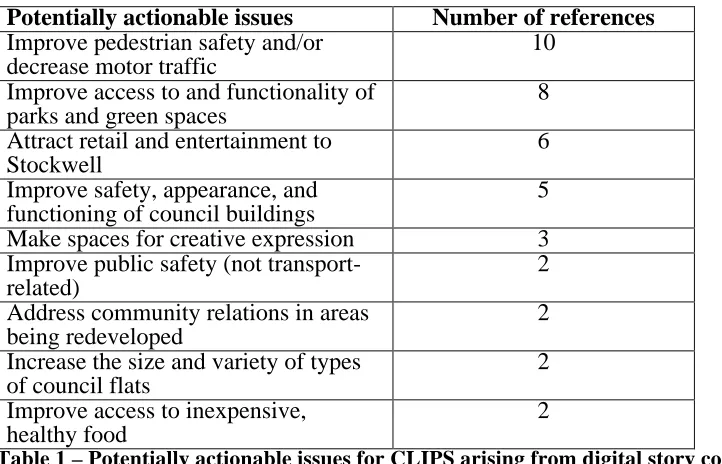
Potentially actionable issues Number of references Improve pedestrian safety and/or
decrease motor traffic
10
Improve access to and functionality of parks and green spaces
8
Attract retail and entertainment to Stockwell
6
Improve safety, appearance, and functioning of council buildings
5
Make spaces for creative expression 3 Improve public safety (not
transport-related)
2
Address community relations in areas being redeveloped
2
Increase the size and variety of types of council flats
2
Improve access to inexpensive, healthy food
2
[image:12.595.92.453.102.334.2]Table 1 – Potentially actionable issues for CLIPS arising from digital story corpus
Table 1 summarises the potentially actionable issues arising from the community digital stories. These closely resemble the content and themes identified in the previous analysis, though they necessarily leave out the emotional and holistic elements identified as valuable by all project partners.
Design stories
We did not collect the same demographic information for architects as for community members, but it was notable that all four were young white men with no obvious or stated ties to the underrepresented communities we were trying to reach. They expressed a preference for stories that held clear and actionable requests for an
architectural response, as these were easiest for them to apply their skills to. However, one pointed out that more general, vague, or emotionally based stories could be interesting to try to address, given enough time and resources to do so. The
participating architects that we interviewed at length saw value in using digital stories to understand the makeup of the community they would be working in and the
personal, emotional connections they felt to elements of their built environment. Those stories would need to come to them already analysed, with a manageable number of representative stories to view, and at the very earliest stages of their involvement in the project.
PROJECT OUTPUTS
1. Knowledge of the role of storytelling and stories in community
development and urban design.
This project has shown that digital storytelling is a powerful tool for creating a holistic and emotional understanding of the needs and desires of a local community. All project partners identified emotion and a sense of ‘feeling’ what is really
During the reflective workshop, we also discovered that the process of generating digital stories within a local community is beneficial in and of itself for local councils and community groups. It can forge new ties and strengthen existing ones among community workers. The permanence of the video record can create impact, stimulate discussion, and possibly entice people to engage with their local community
organisations for the first time. The digital storytelling method was seen as inviting a more ‘human’ and inviting tone that could ease communications between community members and local councils, especially during tense negotiations around urban redevelopment.
We have also realised that digital storytelling needs to be carefully aligned to
particular types of projects, and at particular times in their cycles. While it is possible that the process could be modified to suit a more directed and systematic information-gathering imperative, we feel that the emotional power of the stories would be best leveraged by using them at the very earliest stages of an urban planning process. This would benefit not only the information-gathering aspect of digital storytelling but the potential for an on-going two-way communication between community members and those in charge of the redevelopment process.
This is not to say that the method used in this project is ready to be exported. We encountered a number of difficulties, primarily due to the need to work only face-to-face in situations where participants were rarely able to take their own photos for use in the digital stories. To create digital stories closer to the original tradition described above, we would need to devote far more time and resources to each storyteller, most importantly by building in the opportunity for participants to take or contribute their own photos. However, it seems that the powerful emotional tone of these stories would not be lost if we made the process more scalable by using a large corpus of photos that we could make available to our participants to use. This would lead to a type of digital story that might have more in common with audiophotographs2
than with digital stories as they have traditionally been defined.
Audiophotographs are also defined by their combination of still image(s) and audio track, often a voiceover narration, but they differ from traditional digital storytelling in their lightweight, almost conversational approach to story generation. Where traditional digital storytelling often involves several days of story development and refinement along with training in photo and video editing skills, audiophotos tend to involve far less intensive preparation. We would argue that this less intensive, more scalable approach is promising for work in the area of urban redevelopment. Further concerns around the amount and type of guidance given would depend on the
specifics of any given project, the needs of all project partners, and the importance of the principles of co-production in any future application of this method.
2. Requirements for better technical support of story creation,
analysis and discussion.
As alluded to in Output 1 above, the technical approach to digital storytelling is deeply entwined with the overall method of story generation and the requirements of project partners. We had aimed to explore specific technical requirements through our use of the online-only generation method, which was rejected by our project partners early in the project. However, we can confirm that the vast majority of our
participants were unfamiliar with any digital storytelling technologies and needed some degree of support – often quite substantial – in dealing with the technology.
2
See Frohlich, David M., 2004. Audiophotography: Bringing Photos to Life with
The process of generating digital stories also revealed obstacles in recruitment that are very much in line with findings of others working with the digital storytelling
methodology. We have relied upon community leaders to recruit potential participants. They rely on their established networks for recruitment, which in effect limits them to the small segment of the community that is already actively engaged in local issues. It can also be difficult to recruit participants in the absence of a particular pressing need, such as an upcoming redevelopment project, to focus their attention.
On the other hand, several potential participants who have been very vocal in their opposition to a local redevelopment project that has been ongoing for the past six years expressed their best wishes for our project but refused to contribute. They described themselves as burnt out and unwilling to invest further in a process that they feel ignores their wishes and acts against their interests. This situation was sometimes exacerbated by the inclusion of Lambeth Council as a project partner; some potential participants refused to take part because they believed that the council was untrustworthy and would spoil our stated intention of making local voices heard.
It also became clear that a digital story corpus of any size would require analysis before it would be usable by project partners such as local councils, architects, or urban designers. Therefore, analysis needs to be figured into any future work. It is also important to consider they type of analysis to be used and whether it will be seen as primarily instrumental. For example, project partners at Lambeth Council were primarily concerned with specific and actionable requests for physical changes to the built environment for their CLIPs initiative, and architects tended to respond to the most detailed and architecture-oriented stories in the corpus, despite the fact that both groups identified the emotional and holistic aspects of digital storytelling as the most compelling part of the project. It seems that the success of digital storytelling as a component of a design or redevelopment process might hinge on the ability of
researchers to analyse those emotional or holistic aspects of the story corpus in a way that makes them accessible to project partners with tight remits.
3. A story corpus available to the local community and network
members.
The stories that participants were willing to share with the public can be found at
https://vimeo.com/album/3498319. They have been placed on the Vimeo platform in
such a way that they can be downloaded or embedded on other sites, but no one can comment on them (unless the owner of the Vimeo account, Jocelyn Spence, allows it). This should permit open access without the risk of negative feedback. All videos have been made available using the Creative Commons Attribution Non-Commercial Share Alike license, which allows re-use of the material but only with full attribution and never for another’s financial gain.
4. Dissemination of findings to the Network and DE programme
through final exhibition and talks.
The findings from this project will be presented at the Community and Culture
5. This pilot work will feed into an EU Horizon 2020 bid currently
being prepared for April 2015.
As this project completed in July 2015, the actual funding scheme to which we will apply is still under discussion. However, the findings from this study have been enormously useful in determining future plans regarding project partners, digital storytelling methods, and the continued challenges of broadening community engagement.
ADDITIONAL FINDINGS
Many community leaders have expressed great enthusiasm for the digital storytelling approach, and our participants have for the most part approved of the idea of offering a rich, humane sense of context to their interactions with the council. Out of those who completed a digital story, informal feedback ranges from the straightforward to the triumphant: those more comfortable with the technology and with giving voice to their opinions found the process to be positive or mildly interesting, while those who came to a facilitation session unsure of their ability to complete a story responded very positively to our encouragement and to seeing the result of their efforts played back to them.
GUIDELINES FOR REVISING THE METHOD
The most critical of these guidelines have been discussed elsewhere in this report, but are summarised below.
1. Consider restructuring the process to be as lightweight as possible, using audiophotography rather than digital storytelling as the framework.
2. Pursue the hybrid method that was originally intended in this project, combining an online‐only process with a series of face‐to‐face
facilitation sessions.
3. Develop or acquire a large selection of photos with appropriate rights for people to use.
4. Consider other sources of imagery such as appropriately licensed material sourced online or working with digital artist to translate the feelings expressed by a participant into visual representations.
5. Ask participants if they are referring in their stories to specific locations and record that information in the digital story.
6. Consider the potential benefits and risks of not partnering with the local council. There could be significant drawbacks to working without the local council’s support, particularly if it has good relations with the community in question, but those drawbacks might be balanced by the public perception of being independent of council priorities.
7. Tie the digital storytelling project to a specific redevelopment initiative at the earliest possible stage.
8. Consider soliciting the help of urban design students at the early stages of the project to help frame project goals and interventions as
effectively as possible.
9. Consider working with historians at the initial stages of the project to determine which elements of an area’s heritage the community wants to preserve. Stories of loss and of what not to lose may be a significant new category of stories, or may bolster the ‘past’ category.
10. Consider working with professional artists and urban designers at the end of the project to translate the digital story corpus and analysis documents into emotive, accessible representations.
11. Create an interplay between digital stories and live encounters by encouraging responses from other community members and
stakeholders in the redevelopment process. This interplay might take the form of digital stories from councillors or developers, written comments in an online forum, or conversations during live events.
ANSWERS TO RESEARCH QUESTIONS
1. What is the role of digital storytelling in community
engagement for urban redevelopment?
We have concluded that a lightweight form of digital storytelling, perhaps better referred to as audiophotography, is a powerful complement to existing methods of community engagement for urban redevelopment. It provides a unique insight into the emotional and holistic aspects of people’s relationship to their local areas, and can facilitate a less bureaucratic and more ‘human’ two‐way dialogue between individuals and decision‐making organisations. The process of
generating digital stories through community engagement is a valuable activity in its own right, forging and strengthening bonds among existing community groups, and engaging people who have never taken an active role with their council. To succeed, the specific methods must be carefully considered, and the process must be carefully tied to a particular redevelopment initiative – ideally at the earliest possible stage.
The practicalities of story creation within the context of existing community groups must also be taken into account. It was common for community leaders to invite us into an open public space or meeting room and expect us to create digital stories with however many members of the public chose to join in. In practical terms, this situation presented a number of difficulties. The lengthy process of explaining the project and seeking informed consent was often interrupted and took up a large proportion of the available time. Some
participants were shy about speaking in front of others, and it was difficult to control the quality of the audio with other people in the room. However, it would have been next to impossible to demand private recording spaces in these
contexts, or to expect participants to sign up in advance to particular times. The relatively low turnout at each session made these situations an inconvenience rather than a serious obstacle, but any scaling‐up of the process would require serious thought into the mechanics of digital story creation.
Finally, the approach that we used for gaining access to participants was to engage with local community leaders. We had hoped that they could introduce us to a variety of community groups, particularly underrepresented groups such as the elderly or minority ethnic communities, but this proved to be more difficult than any of us (including the community leaders themselves) had anticipated. What happened instead was that most facilitation sessions involved a
happenstance meeting with other community leaders and activists who
2. What is the value of past, present, and future stories in urban
design?
Community participants were invited to create digital stories in one or more of these categories as well as a ‘redevelopment’ category, which would allow participants with first‐hand knowledge of an urban redevelopment process in another location to contribute their stories. ‘Present’ stories were the most popular and the easiest for people to come up with content for. The only substantial contingent who created ‘past’ stories was a group of elderly
Portuguese residents of Stockwell who went on a walk around the Larkhall Park area and reminisced together about the community resources that had
disappeared over the past decades. Similarly, the only substantial contingent who created ‘future’ stories were a group of six schoolchildren who were
specifically asked to imagine the community building of their dreams. There was only one story in the ‘regeneration’ category.
This situation reveals that past, present, and future are useful categories for an inclusive digital storytelling project. Some people wished to talk only about the past or only about their imagined futures, and they would have been prevented from speaking their minds if we had forced them to deal only with present‐day issues. The past/present/future framework was also valuable in terms of explaining our aims to participants.
We would alter our original plans by avoiding a separate ‘regeneration’ category. The only difference between a ‘past’ story and a ‘regeneration’ story is the fact that ‘regeneration’ stories might apply to different locations than the location currently under discussion for regeneration. There is nothing preventing a participant from sharing ‘past’ stories about other locations, especially as we are also advocating the capture of location data for each story. We would also
consider whether a further categorisation within ‘present’ stories would be valuable, either for participants or for data analysis.
When considering which photos to use and how to acquire those photos, ‘present’ stories are perhaps the easiest to manage. Participants with their own