Sex Allocation Patterns across Cooperatively Breeding Birds Do
Not Support Predictions of the Repayment Hypothesis
Nyil Khwaja,
1,* Ben J. Hatchwell,
1Robert P. Freckleton,
1and Jonathan P. Green
1,21. Department of Animal and Plant Sciences, University of Sheffield, Sheffield S10 2TN, United Kingdom; 2. Department of Zoology, University of Oxford, Oxford OX1 3PS, United Kingdom
Submitted October 24, 2016; Accepted May 16, 2017; Electronically published August 9, 2017
Online enhancements:appendix.Dryad data:http://dx.doi.org/10.5061/dryad.9bk88.
abstract: The repayment hypothesis predicts that reproductive fe-males in cooperative breeding systems overproduce the helping sex. Thanks to well-documented examples of this predicted sex ratio bias, repayment has been considered an important driver of variation in sex allocation patterns. Here we test this hypothesis using data on population brood sex ratios and facultative sex allocation from 28 co-operatively breeding bird species. We find that biased sex ratios of helpers do not correlate with production biases in brood sex ratios, contrary to predictions. We also test whether females facultatively produce the helping sex in response to a deficiency of help (i.e., when they have fewer or no helpers). Although this is observed in a few spe-cies, it is not a significant trend overall, with a mean effect size close to zero. We conclude that, surprisingly, repayment does not appear to be a widespread influence on sex ratios in cooperatively breeding birds. We discuss possible explanations for our results and encourage fur-ther examination of the repayment model.
Keywords:birds, cooperative breeding, local resource enhancement, repayment hypothesis, sex ratio, sex allocation.
Introduction
Fisher (1930) formulated an elegant explanation for why sex ratios are so often equal in nature. Because each offspring has a mother and father, any sex that becomes rarer immedi-ately enjoys a reproductive success advantage, and the asso-ciated selection pressure drives population sex ratios toward parity. Exceptions to the general rule of equal sex ratios have fascinated evolutionary biologists since then (West 2009). In these cases, producing one sex confers a cost or benefit that trades off against the benefit of rarity underlying Fisher’s
prin-ciple (Hamilton 1967). Sex allocation by breeders can be viewed as an adaptive decision in the context of parental in-vestment, with the relative costs and benefits of producing each sex being key to its outcome.
In cooperative breeders, one benefit that has attracted a great deal of attention is thefitness gain that parents re-ceive from offspring that help them in future breeding at-tempts (Malcolm and Marten 1982; Koenig and Walters 1999; Griffin et al. 2005). Help is usually more likely to come from one sex than the other (Komdeur 2004). The repay-ment hypothesis predicts that parents should invest more in this helpful sex because of the greater chance that their investment will be repaid through future help (Emlen et al. 1986; Lessells and Avery 1987). The hypothesis rests on the assumption that apparent help provides a genuinefitness benefit to breeders, and so its predictions apply only where this is the case (see“Methods”).
The repayment hypothesis yields intuitive predictions about offspring sex ratios in cooperative breeders, and long-term studies of bird populations provide valuable data sets with which to test these. Thefirst general prediction is that offspring sex ratios should be biased toward the helping sex at the population level because of the extra payoff associated with producing this sex. Brood sex ratios in bell miners ( Ma-norina melanophrys) are consistent with this prediction: help-ing is extremely male biased, and 58% of hatchlhelp-ings are male (Clarke et al. 2002). The second prediction is that breeders with no or fewer helpers should facultatively adjust the sex ratio of their broods to be more biased toward the helping sex, as they have more to gain from doing so. There is again some empirical support, especially from Seychelles warblers (Acrocephalus sechellensis): helping is female biased in this species, and breeders without helpers produce more females when their territory is of sufficient quality to support the ex-tra philopatric offspring (Komdeur et al. 1997).
Despite these examples, the status of repayment as a wide-spread driver of sex ratio skew is called into question by a number of negative results. For example, in purple-crowned fairy wrens (Malurus coronatus) and white-banded
tan-* Corresponding author; e-mail: [email protected].
ORCIDs:Khwaja, http://orcid.org/0000-0003-1314-6984; Hatchwell, http://
orcid.org/0000-0002-1039-4782; Freckleton, http://orcid.org/0000-0002-8338 -864X.
Am. Nat. 2017. Vol. 190, pp. 547–556.q2017 by The University of Chicago. 0003-0147/2017/19004-57346$15.00. All rights reserved. This work is licensed under a Creative Commons Attribution 4.0 International License (CC BY 4.0), which permits reuse of the work with attribution.
agers (Neothraupis fasciata) there is no significant bias to-ward production of the helping sex at the population level and no evidence for facultative adjustment of brood sex ratios in response to any cues (Kingma et al. 2011; Gressler et al. 2014). While the predictions of the repayment hypoth-esis are intuitively appealing, the adaptive value of produc-ing each sex will also depend on difficult-to-measure com-ponents of the directfitness of both parents and offspring. Long-term data on red-cockaded woodpeckers (Picoides bo-realis) have been used to estimate directfitness differentials between the sexes and incorporate them into a repayment model; however, the model still failed to predict brood sex ratios at the population level (Koenig and Walters 1999). A meta-analysis by Griffin et al. (2005) suggests that indi-viduals are more likely to adjust their offspring’s sex ratio in systems where the benefits of help are high. This provides some explanation for failures to observe adjustment, but such negative results have proliferated since Griffin et al.’s (2005) study, perhaps because authors realize that they run counter to the prevailing view of adaptive sex allocation (Cockburn and Double 2008).
Here we use a comparative analysis and meta-analysis to test the key predictions of the repayment hypothesis, using data from previously published studies of 28 cooperatively breeding bird species spanning 18 families. We then discuss the usefulness and generality of the concept of repayment in light of our results.
Methods
We collected data from relevant studies identified using the search term“(brood) sex ratio birds”in Web of Science and Google Scholar as well as from Koenig and Dickinson (2016), Komdeur (2004), and references within. We also searched the primary literature using Web of Science for any spe-cies identified as a kin-based cooperative breeder by Riehl (2013). We included data only from bird species with kin-based cooperative breeding systems, as production is related to future help only in these cases. Where multiple studies were published for the same species, we chose the one with the largest sample size or, in the case of Seychelles warblers, the one that came from a natural population (Komdeur et al. 1997). Helper sex ratios were obtained from Green et al. (2016) or from the literature directly, where possible from the same population as brood sex ratios. Data are deposited in the Dryad Digital Repository: http://dx.doi.org/10.5061 /dryad.9bk88 (Khwaja et al. 2017).
Breeding females are expected to benefit from biasing their offspring’s sex ratios toward the helping sex only if the help actually improves theirfitness in turn (Emlen et al. 1986; Griffin et al. 2005). For this reason, from a data set of 32 can-didate species we excluded four for which research suggests
help has no positive effect on thefitness of breeding females (table A1; tables A1–A3 are available online). We included a further 10 species for which this effect has not been tested be-cause help had a positive effect on breederfitness in 82% of tested species (np22). We checked the influence of includ-ing these untested species by carryinclud-ing out a restricted anal-ysis in which they were removed from the data set.
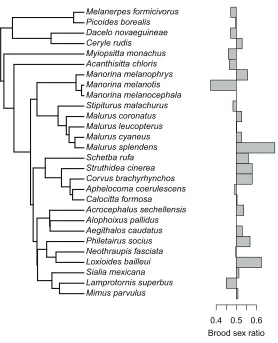
We investigated the effect of helper sex ratio on log-transformed brood sex ratio across 28 species in the full data set and 18 species in the restricted data set, controlling for phylogeny using a phylogenetic generalized least squares (PGLS) model implemented in R software (ver. 3.2.2). We ap-plied this model across 1,000 trees downloaded from BirdTree .org (Jetz et al. 2012) using the Hackett et al. (2008) back-bone (fig. 1). Following Green et al. (2016), we included data quality as a variance component in the model, using cate-gories of weak, medium, or strong assigned to each study. When assigning these scores, we considered the sample size, the length of study, the sample size for the helper sex ratio es-timate, and the point at which brood sex ratio was measured (with closer to the primary sex ratio being considered better quality).
For 16 studies that tested for facultative sex allocation in cooperatively breeding bird species, we used a meta-analysis to investigate the hypothesis that breeders without helpers or with fewer helpers show greater production of the helping sex. This is the strongest prediction made by the repayment hypothesis in the context of facultative allocation. We did not include studies of two species for which research suggests help has no positive effect on thefitness of breeding females, for the reasons given above. We extracted effect sizes of the relationship using equations from Lajeunesse (2013), except for two studies where we obtained effect sizes from Griffin et al. (2005). Brood sex ratio was treated as the response, and the predictor was either whether a nest was helped (cat-egorical; seven studies) or number of helpers (integer; nine studies). We derived confidence intervals (CIs) and sample weights for each study using equations from Lipsey and Wil-son (2001), and we calculated a weighted mean and 95% CI using the Hmisc package in R (Harrell 2016).
Results
There was effectively no phylogenetic signal to brood sex ratio (PGLS:l!0:01;fig. 1). As expected, studies with a data quality score of weak accounted for more variance (1:23l#109) than those scoring medium (2:41l#108),
and those scoring strong accounted for the least variance (1:30l#107). Once these effects were controlled for, we
found no relationship between brood sex ratio and helper sex ratio (PGLS: effect of helper sex ratio p 0:0450:06 SE,R2!0:01,tp0:67,Pp:509;fig. 2). With phylogeny
accounting for such little variation, a simple linear model without phylogenetic or data quality controls produced equiv-alent results (ANOVA: effect of helper sex ratiop0:025 0:09 SE,R2!0:01,F
1, 26p0:03,Pp:857). Removing the
10 species for which benefits of help to breeders were un-confirmed also produced equivalent results (PGLS: effect of
helper sex ratio p0:0450:06 SE,R2p0:08, tp0:67,
Pp:515).
We obtained effect sizes for the relationship between the number of helpers or being helped and brood sex ratios from studies of 16 cooperatively breeding bird species (fig. 3; ta-ble A3). Seven of these effects were in the expected direc-tion, with more of the helping sex produced by unhelped fe-males or those with fewer helpers. Seven were in the opposite direction, and the directions of two small effects were not reported. The weighted mean of the 14 effect sizes whose di-rection was reported was 0.01 (95% CI,20.17 to 0.036) in the direction expected. This result was the same (to two dec-imal places) when both excluded effect sizes were treated as positive, and the weighted mean shifted to 0.00 when they were treated as negative. Effect sizes have been closer to zero
Myiopsitta monachus Acanthisitta chloris
Stipiturus malachurus Malurus coronatus Malurus leucopterus
Malurus splendens Malurus cyaneus Manorina melanophrys
Manorina melanocephala Manorina melanotis
Schetba rufa Struthidea cinerea
Calocitta formosa
Aphelocoma coerulescens Corvus brachyrhynchos
Aegithalos caudatus Alophoixus pallidus Acrocephalus sechellensis
Mimus parvulus Lamprotornis superbus Sialia mexicana Loxioides bailleui Neothraupis fasciata Philetairus socius Ceryle rudis
Dacelo novaeguineae Picoides borealis Melanerpes formicivorus
[image:3.636.182.460.100.443.2]Brood sex ratio 0.4 0.5 0.6
Figure 1: Phylogeny showing relationships between the 28 species used in our comparative analysis, with branch lengths from one of 1,000 sampled trees downloaded from BirdTree.org (Jetz et al. 2012). Brood sex ratio for each species is expressed as the mean proportion of males in broods from a studied population. Brood sex ratio is randomly distributed with respect to phylogeny (see“Results”).Myiopsitta monachus,
Manorina melanophrys,Manorina melanotis,Manorina melanocephala,Stipiturus malachurus,Malurus leucopterus,Corvus brachyrhynchos,
in more recent studies (ANOVA: effect of yearp 20.01,
R2p0:50,F
1, 14p14:24,Pp:002; fig. 4), notably since
the publication of Griffin et al.’s (2005) meta-analysis of sex ratio adjustment in cooperative breeders.
Discussion
We investigated two general predictions attributed to the repayment hypothesis. Thefirst is that in kin-based coop-erative breeders females produce broods biased toward the helpful sex because the futurefitness contribution made by helpers repays some of their investment. Across 28 bird spe-cies, we found no evidence that this was generally the case, despite a lack of phylogenetic signal indicating that brood sex ratio is a labile trait. The second prediction was that females in need of help adjust their brood’s sex ratios further in favour of the helping sex. We drew together tests of this prediction from 16 studies, and although it was borne out in a minority of cases, there was not a significant directional trend across species. Earlier studies reported greater effect sizes than more recent studies, which may have led to an overestimation of the prevalence of adaptive sex allocation in the literature.
No Overall Bias toward Producing the More Helpful Sex
A predicted global sex ratio skew toward the helping sex in cooperative breeders is the most direct interpretation of the repayment model; in their introduction to the original model, Emlen et al. (1986) proposed that“the sex ratio should achieve an equilibrium in which there is an overproduction of the helper sex.”There are two levels at which this prediction may falter: (1) proper accounting of the costs and benefits of producing each sex and (2) empirical observation. Where sexes differ in their tendency to help, they are also likely to differ in other key life-history traits. Although one sex may
“repay” investment by helping and thus improving their parents’productivity, this could feasibly be counteracted by enhanced reproductive success in the nonhelping sex im-proving parents’ production of grandoffspring. If this is the case, biased brood sex ratios should not be adaptive. This important point was identified by Koenig and Walters (1999), who incorporated sex differences in survival and re-productive success into an extended repayment model that aimed to predict optimal brood sex ratios in red-cockaded woodpeckers. Their results were interesting in two respects: (1) the predicted optimal brood sex ratio in this species with male-biased help was still male biased and was little affected
0.0 0.2 0.4 0.6 0.8 1.0
Helper sex ratio
Brood se
x r
a
tio
0.3
0
.4
0.5
0
.6
[image:4.636.171.465.104.366.2]0.7
by considering differences in the direct fitness achieved by male and female offspring and (2) the predicted optimal brood sex ratio was significantly different from observed sex ratios, which were close to parity. Here we were unable to account for the relative influence of offspring and grandoff-spring production on expected sex ratios because very few species in our sample have been studied in as much detail as the red-cockaded woodpecker. Instead, we used helper sex ratio, the key driver of expected brood sex ratio bias in Koe-nig and Walters (1999), and similarly found that observed brood sex ratios do notfit expectation. This does not neces-sarily mean that the extended repayment model as applied to red-cockaded woodpeckers also fails in other systems; it is still possible that this species is exceptional and that in most cases including sex differences in future productivity may better explain observed patterns (but see Koenig et al. 2001). For example, the benefits of rarity identified by Fisher (1930) may be much greater than the marginalfitness
ben-efits associated with the likelihood of helping. Nevertheless, in general our results suggest that females biasing produc-tion toward the helping sex, which is the most intuitive pre-diction of repayment models, is not a valid generalization. The repayment hypothesis makes predictions opposite to those of the local resource competition hypothesis, which suggests that females may benefit from overproducing the dispersive (generally nonhelping) sex, to reduce competition for resources (Clark 1978). Costs of competition could ex-plain the discrepancy between our predictions and results, although there are reasons to doubt this interpretation. First, in most systems the benefits of help appear to compensate for any costs because helped nests are usually provisioned more frequently (Hatchwell 1999) and are generally more productive (Dickinson and Hatchwell 2004; Koenig and Dickinson 2016). Furthermore, if competition provided the main constraint to adaptively biasing the sex ratio, we would expect biases toward the helping sex to be especially
pro-−0.6 −0.4 −0.2 0.0 0.2 0.4 0.6 Acorn woodpecker
Red−cockaded woodpecker
Laughing kookaburra
Rifleman
Bell miner
Purple−crowned fairy−wren
Superb fairy−wren
White−winged fairy−wren
Carrion crow
Seychelles warbler
Long−tailed tit
Sociable weaver
White−banded tanager
Western bluebird
Weighted mean
[image:5.636.179.465.103.450.2]Effect size
nounced in species like riflemen (Acanthisitta chloris), where most helpers had previously dispersed from their natal ter-ritory and the sexes do not differ significantly in their dis-persal distances (Preston 2012). It is noteworthy, therefore, that the observed sex ratio is close to parity in this species (Khwaja 2017). Nevertheless, competition may limit the adap-tive value of biased sex allocation in other species.
A third possible explanation is simply that biasing brood sex ratios is constrained or costly, although again this has little support. Mechanisms of biased sex allocation are cur-rently unknown, and some suggestions rely on potentially taxon-specific characteristics, such as size dimorphism in the centromeres of sex chromosomes (Rutkowska and Badyaev 2008). However, our models showed a complete lack of phy-logenetic constraint on brood sex ratios. Although across species these average around parity, some studies with con-vincingly large sample sizes show significantly biased popu-lation brood sex ratios (Clarke et al. 2002; Cockburn and Double 2008). There may be a mechanistic barrier to biasing sex ratios in some species, but as this is clearly not global— and phylogenetically random—it is not a well-supported in-terpretation (West and Sheldon 2002). While a combination of the three explanations we have suggested may underlie our results, none are especially convincing for the reasons dis-cussed. We would welcome a theoretical reevaluation of the
repayment model, which may make sense of its uneasyfit with empirical data.
Rarity of Facultative Production of the More Helpful Sex
Afinal candidate explanation for this lack of population-level brood sex ratio biases is that biases may be context de-pendent rather than consistent (Pen and Weissing 2000). Females may bias their broods’ sex ratios only when they have fewer or no helpers (for such facultative manipulation, the local resource competition and repayment hypotheses make the same rather than opposite predictions). In contrast to the lack of evidence for population-level sex ratio biases, a few studies do provide strong support for facultative control of sex ratios. In Seychelles warblers, females show extraordi-narily sophisticated control of their broods’sex ratios, with fe-males (the more helpful sex) overproduced on good-quality ter-ritories without existing helpers (Komdeur et al. 1997, 2002). This does not, however, result in an overall population-level bias toward the production of females because males (the more dispersive sex) are overproduced on poor-quality terri-tories, where supernumeraries are likely to be costly. Thus, in this case an unbiased population sex ratio is consistent with the repayment hypothesis because females across different contexts adaptively allocate their offspring’s sex. Western
1985 1990 1995 2000 2005 2010 2015
0.0
0
.1
0.2
0
.3
0.4
Year
Magnitude of eff
e
ct siz
e
[image:6.636.173.462.107.368.2]150 broods
bluebirds (Sialia mexicana) also show evidence of facultative control (Dickinson 2004), but in general our meta-analysis shows that these species are the exception rather than the rule (with an average effect size close to zero). There is no general tendency across species to produce the helping sex when breeders are deficient of help. This picture emerges strongly with the inclusion of more recent publications doc-umenting negative results, providing a contrast to the mainly positivefindings published by the time of Griffin et al.’s (2005) previous meta-analysis and leading us to somewhat different conclusions (fig. 4). We hope this encourages publication of negative results, which are essential for the validity of com-parative work.
Ourfindings raise the question of why helpers are appar-ently not facultatively produced in response to “need” in other species, where there may be a plausible benefit to do-ing so; or, what is exceptional about Seychelles warblers? One unusual feature of this species’s breeding system is that al-though females are more likely to become helpers than males, they are also more likely to become subordinate cobreeders that lay their own egg in the nest of the dominant pair (Rich-ardson et al. 2001, 2002). This provides an additional selec-tion pressure against producing philopatric females on poor-quality territories, as their potential reproduction would place a further strain on resources; it is conceivable that without this additional pressure the benefits of manipulation may not outweigh its costs (see Pen et al. 1999). In addition to other species lacking such a dual selective pressure on sex ratio ma-nipulation, we outline four suggestions below that may ex-plain why the helping sex is elsewhere rarely overproduced in response to apparent need.
Unpredictable Environments.Adaptive sex allocation in Sey-chelles warblers relies on assessment of environmental qual-ity. Philopatric females are overproduced only on territories with sufficient food (Komdeur et al. 1997). Cooperatively breeding birds are commonly associated with unpredictable environments, with extra care thought to buffer against sto-chasticity (Jetz and Rubenstein 2011; but see Griesser and Suzuki 2016). Species living in such conditions may lack adap-tive cues for sex allocation. In acorn woodpeckers ( Melaner-pes formicivorus), helpers have a generally positive effect on breeders’reproductive success, but this effect becomes neg-ative when conditions are poor (Koenig et al. 2011). A change in environmental conditions may therefore cancel any adap-tive benefit of facultatively producing philopatric males.
Unpredictable Help.In species that breed in kin neighbor-hoods, such as riflemen and long-tailed tits (Aegithalos cauda-tus), helpers are not permanently affiliated with the breeding pair (Hatchwell 2009). Respectively, helpers in these species begin the breeding season dispersed onto their own territo-ries or attempting to breed themselves, and they start
help-ing at a nest partway through the provisionhelp-ing phase (Preston et al. 2013; Hatchwell 2016). As a result, breeding females may not have good information on the amount of help they will receive (Nam et al. 2011). This constraint is not limited to species in kin neighborhoods: even in cooperative groups formed by delayed dispersal, it is sometimes the case that not all group members help (e.g., Rubenstein 2016), and there-fore group size may be an inaccurate cue for assessing fu-ture help. Unpredictable help limits the potential for female breeders to make adaptive sex allocation decisions based on need.
Other Cues Influencing Allocation Decisions.Sociable weav-ers (Philetairus socius) display a surprising sex allocation pat-tern in which females with helpers produce relatively more rather than fewer males, the helping sex (Doutrelant et al. 2004). In this species, the need for help is clearly not a key driver of allocation decisions; the authors suggest that the inheritance of within-colony rank by philopatric males may select for overproduction of males by high-ranking breeders, which would inevitably correlate with levels of help. In white-winged fairy wrens (Malurus leucopterus) and superb star-lings (Lamprotornis superbus), sex allocation is consistent with the Trivers-Willard hypothesis, where females with bet-ter reproductive prospects overproduce males, which have higher potentialfitness (Trivers and Willard 1973; Rathburn and Montgomerie 2005; Rubenstein 2007). In these species, allocation decisions based on rank and breeding condition presumably carry more benefit than those based on a need for help.
Insufficient Benefits of Help.Griffin et al. (2005) found that the benefit of help was key to the extent of facultative pro-duction of the helping sex. They used helpers’effect on pro-ductivity as a measure of this benefit. There are issues with this approach, as in some species helpers improve down-stream recruitment rather than breeding productivity and in others they have less effect on productivity but provide di-rect benefits to breeders through load lightening (Hatchwell 1999; Hatchwell et al. 2004; Preston et al. 2016). Quantifying the total benefit that help provides to breeders is therefore challenging and potentially misleading. Nevertheless, varia-tion in the true value of this effect is likely to explain some of the wide variation in patterns of sex ratio adjustment that we have identified in this study.
Conclusion
have suggested several factors that may confound predicted results, but it is surprising that predictions from such an in-tuitively appealing theory do notfit observed patterns. This contrasts with the majority of work on sex allocation, in which theoretical predictions have matched empirical results with a great deal of success (West 2009). We conclude that repay-ment is an occasional but not widespread influence on sex allocation in cooperatively breeding birds.
Acknowledgments
This research was supported by a studentship to N.K. from the Natural Environment Research Council and the Uni-versity of Sheffield. Thanks to E. Kenny and J. Jackson for help withfigure production. The associate editor and two referees each made helpful comments that improved the analyses and discussion presented in this article.
Literature Cited
Clark, A. B. 1978. Sex ratio and local resource competition in a pro-simian primate. Science 201:163–165.
Clarke, M. F., D. A. Jones, J. G. Ewen, R. J. Robertson, R. Griffiths, J. Painter, P. T. Boag, and R. Crozier. 2002. Male-biased sex ratios in broods of the cooperatively breeding bell minerManorina mela-nophrys. Journal of Avian Biology 33:71–76.
Cockburn, A., and M. C. Double. 2008. Cooperatively breeding su-perb fairy-wrens show no facultative manipulation of offspring sex ratio despite plausible benefits. Behavioral Ecology and Sociobiology 62:681–688.
Dickinson, J. L. 2004. Facultative sex ratio adjustment by western blue-bird mothers with stay-at-home helpers-at-the-nest. Animal Behav-iour 68:373–380.
Dickinson, J. L., and B. J. Hatchwell. 2004. Fitness consequences of helping. Pages 48–66inW. D. Koenig and J. L. Dickinson, eds. Ecol-ogy and evolution of cooperative breeding in birds. Cambridge Uni-versity Press, Cambridge.
Doutrelant, C., R. Covas, A. Caizergues, and M. du Plessis. 2004. Un-expected sex ratio adjustment in a colonial cooperative bird: pairs with helpers produce more of the helping sex whereas pairs without helpers do not. Behavioral Ecology and Sociobiology 56:149–154. Emlen, S. T., J. M. Emlen, and S. A. Levin. 1986. Sex-ratio selection in
species with helpers at the nest. American Naturalist 127:1–8. Fisher, R. A. 1930. The genetical theory of natural selection.
Claren-don, Oxford.
Green, J. P., R. P. Freckleton, and B. J. Hatchwell. 2016. Variation in helper effort among cooperatively breeding bird species is consis-tent with Hamilton’s rule. Nature Communications 7:12663. Gressler, D. T., Z. da Paz Pereira, and M. A. Marini. 2014. Brood sex
allocation in the Neotropical cooperative white-banded tanager Neo-thraupis fasciata. Journal of Ornithology 155:713–719.
Griesser, M., and T. N. Suzuki. 2016. Occasional cooperative breeding in birds and the robustness of comparative analyses concerning the evolution of cooperative breeding. Zoological Letters 2016:2–7. Griffin, A. S., B. C. Sheldon, and S. A. West. 2005. Cooperative breeders
adjust offspring sex ratios to produce helpful helpers. American Nat-uralist 166:628–632.
Hackett, S. J., R. T. Kimball, S. Reddy, R. C. K. Bowie, E. L. Braun, M. J. Braun, J. L. Chojnowski, et al. 2008. A phylogenomic study of birds reveals their evolutionary history. Science 320:1763–1768. Hamilton, W. D. 1967. Extraordinary sex ratios. Science 156:477–
488.
Harrell, F. E. 2016. Hmisc: Harrell miscellaneous [R package]. https:// cran.r-project.org/web/packages/Hmisc/index.html.
Hatchwell, B. J. 1999. Investment strategies of breeders in avian coop-erative breeding systems. American Naturalist 154:205–219.
———. 2009. The evolution of cooperative breeding in birds: kinship, dispersal and life history. Philosophical Transactions of the Royal Society B 364:3217–3227.
———. 2016. Long-tailed tits: ecological causes andfitness conse-quences of redirected helping. Pages 39–57inW. D. Koenig and J. L. Dickinson, eds. Cooperative breeding in vertebrates: studies of ecology, evolution, and behavior. Cambridge University Press, Cambridge.
Hatchwell, B. J., A. F. Russell, A. D. C. MacColl, D. J. Ross, M. K. Fowlie, and A. McGowan. 2004. Helpers increase long-term but not short-term productivity in cooperatively breeding long-tailed tits. Behav-ioral Ecology 15:1–10.
Jetz, W., and D. R. Rubenstein. 2011. Environmental uncertainty and the global biogeography of cooperative breeding in birds. Current Biology 21:72–78.
Jetz, W., G. H. Thomas, J. B. Joy, K. Hartmann, and A. O. Mooers. 2012. The global diversity of birds in space and time. Nature 491: 444–448.
Khwaja, N. 2017. Investment patterns and kinship cues in a cooper-atively breeding bird. PhD thesis, University of Sheffield. Khwaja, N., B. J. Hatchwell, R. P. Freckleton, and J. P. Green. 2017.
Data from: Sex allocation patterns across cooperatively breeding birds do not support predictions of the repayment hypothesis. Amer-ican Naturalist, Dryad Digital Repository, http://dx.doi.org/10.5061 /dryad.9bk88.
Kingma, S. A., M. L. Hall, and A. Peters. 2011. No evidence for off-spring sex-ratio adjustment to social or environmental conditions in cooperatively breeding purple-crowned fairy-wrens. Behavioral Ecol-ogy and SociobiolEcol-ogy 65:1203–1213.
Koenig, W. D., and J. L. Dickinson, eds. 2016. Cooperative breeding in vertebrates: studies of ecology, evolution, and behavior. Cambridge University Press, Cambridge.
Koenig, W. D., M. T. Stanback, J. Haydock, and F. Kraaijeveld-Smit. 2001. Nestling sex ratio variation in the cooperatively breeding acorn woodpecker (Melanerpes formicivorus). Behavioral Ecology and So-ciobiology 49:357–365.
Koenig, W. D., and J. R. Walters. 1999. Sex-ratio selection in species with helpers at the nest: the repayment model revisited. American Naturalist 153:124–130.
Koenig, W. D., E. L. Walters, and J. Haydock. 2011. Variable helper ef-fects, ecological conditions, and the evolution of cooperative breed-ing in the acorn woodpecker. American Naturalist 178:145–158. Komdeur, J. 2004. Sex-ratio manipulation. Pages 102–116inW. D.
Koenig and J. L. Dickinson, eds. Ecology and evolution of cooper-ative breeding in birds. Cambridge University Press, Cambridge. Komdeur, J., S. Daan, J. Tinbergen, and A. C. Mateman. 1997. Extreme
adaptive modification in sex ratio of the Seychelles warbler’s eggs. Nature 385:522–585.
Lajeunesse, M. J. 2013. Recovering missing or partial data from studies: a survey of conversions and imputations for meta-analysis. Pages 195–206inJ. Koricheva, J. Gurevitch, and K. Mengersen, eds. Hand-book of meta-analysis in ecology and evolution. Princeton University Press, Princeton, NJ.
Lessells, C. M., and M. I. Avery. 1987. Sex-ratio selection in species with helpers at the nest: some extensions of the repayment model. American Naturalist 129:610–620.
Lipsey, M. W., and D. B. Wilson. 2001. Practical meta-analysis. Sage, New York.
Malcolm, J. R., and K. Marten. 1982. Natural selection and the com-munal rearing of pups in African wild dogs (Lycaon pictus). Behav-ioral Ecology and Sociobiology 10:1–13.
Nam, K.-B., J. Meade, and B. J. Hatchwell. 2011. Brood sex ratio var-iation in a cooperatively breeding bird. Journal of Evolutionary Bi-ology 24:904–913.
Pen, I., and F. J. Weissing. 2000. Sex-ratio optimization with helpers at the nest. Proceedings of the Royal Society B 267:539–543. Pen, I., F. J. Weissing, and S. Daan. 1999. Seasonal sex ratio trend in the
European kestrel: an evolutionarily stable strategy analysis. Ameri-can Naturalist 153:384–397.
Preston, S. A. J. 2012. Routes to cooperation in the rifleman, Acan-thisitta chloris. PhD thesis, University of Sheffield.
Preston, S. A. J., J. V. Briskie, T. Burke, and B. J. Hatchwell. 2013. Ge-netic analysis reveals diverse kin-directed routes to helping in the riflemanAcanthisitta chloris. Molecular Ecology 22:5027–5039. Preston, S. A. J., J. V. Briskie, and B. J. Hatchwell. 2016. Adult
helpers increase the recruitment of closely related offspring in the cooperatively breeding rifleman. Behavioral Ecology 27:1617– 1626.
Rathburn, M. K., and R. Montgomerie. 2005. Offspring sex ratios cor-relate with pair-male condition in a cooperatively breeding fairy-wren. Behavioral Ecology 16:41–47.
Richardson, D., F. Jury, K. Blaakmeer, J. Komdeur, and T. Burke. 2001. Parentage assignment and extra-group paternity in a cooperative breeder: the Seychelles warbler (Acrocephalus sechellensis). Molecu-lar Ecology 10:2263–2273.
Richardson, D., J. Komdeur, and T. Burke. 2002. Direct benefits and the evolution of female-biased cooperative breeding in Seychelles warblers. Evolution 56:2313–2321.
Riehl, C. 2013. Evolutionary routes to non-kin cooperative breeding in birds. Proceedings of the Royal Society B 280:20132245. Rubenstein, D. R. 2007. Temporal but not spatial environmental
var-iation drives adaptive offspring sex allocation in a plural coopera-tive breeder. American Naturalist 170:155–165.
———. 2016. Superb starlings: cooperation and conflict in an un-predictable environment. Pages 181–196 in W. D. Koenig and J. L. Dickinson, eds. Cooperative breeding in vertebrates: studies of ecology, evolution, and behavior. Cambridge University Press, Cambridge.
Rutkowska, J., and A. V. Badyaev. 2008. Meiotic drive and sex deter-mination: molecular and cytological mechanisms of sex ratio ad-justment in birds. Philosophical Transactions of the Royal Society B 363:1675–1686.
Trivers, R. L., and D. E. Willard. 1973. Natural selection of parental ability to vary the sex ratio of offspring. Science 179:90–92. West, S. A. 2009. Sex allocation. Princeton University Press, Princeton,
NJ.
West, S. A., and B. C. Sheldon. 2002. Constraints in the evolution of sex ratio adjustment. Science 295:1685–1688.
References Cited Only in the Online Appendixes
Arnold, K. E., S. C. Griffith, and A. W. Goldizen. 2001. Sex-biased hatching sequences in the cooperatively breeding noisy miner. Jour-nal of Avian Biology 32:219–223.
Asai, S., S. Yamagishi, and K. Eguchi. 2003. Mortality offledgling fe-males causes male bias in the sex ratio of rufous vangas (Schetba rufa) in Madagascar. Auk 120:700–705.
Bednarz, J. C. 1987. Pair and group reproductive success, polyandry, and cooperative breeding in Harris’hawks. Auk 104:393–404. Berg, E. C. 2004. A test of sex-ratio biasing in the white-throated
magpie-jay, a cooperative breeder with female helpers. Condor 106: 299–308.
Bucher, E. H., J. J. Martínez, and M. C. de Aranzamendi. 2016. Ge-netic relatedness in monk parakeet breeding trios. Journal of Or-nithology 157:1119–1122.
Caffrey, C. 1992. Female-biased delayed dispersal and helping in American crows. Auk 109:609–619.
Canestrari, D., M. Vila, J. M. Marcos, and V. Baglione. 2012. Cooper-atively breeding carrion crows adjust offspring sex ratio according to group composition. Behavioral Ecology and Sociobiology 66: 1225–1235.
Cockburn, A., L. Brouwer, N. Margraf, H. L. Osmond, and M. van de Pol 2016. Superb fairy-wrens: making the worst of a good job. Pages 133–149inW. D. Koenig and J. L. Dickinson, eds. Cooper-ative breeding in vertebrates: studies of ecology, evolution, and be-havior. Cambridge University Press, Cambridge.
Covas, R., A. Dalecky, A. Caizergues, and C. Doutrelant. 2006. Kin as-sociations and direct vs indirectfitness benefits in colonial coopera-tively breeding sociable weaversPhiletairus socius. Behavioral Ecol-ogy and SociobiolEcol-ogy 60:323–331.
Covas, R., M. du Plessis, and C. Doutrelant. 2008. Helpers in colonial cooperatively breeding sociable weaversPhiletairus socius contrib-ute to buffer the effects of adverse breeding conditions. Behavioral Ecology and Sociobiology 63:103–112.
Curry, R. L. 1988. Influence of kinship on helping behavior in Galápa-gos mockingbirds. Behavioral Ecology and Sociobiology 22:141–152. Curry, R. L., and P. R. Grant. 1989. Demography of the cooperatively breeding Galapagos mockingbird,Nesomimus parvulus, in a climat-ically variable environment. Journal of Animal Ecology 58:441–463. Dickinson, J. L., C. Akçay, E. D. Ferree, and C. A. Stern. 2016. Western bluebirds: lessons from a marginal cooperative breeder. Pages 19– 38inW. D. Koenig and J. L. Dickinson, eds. Cooperative breeding in vertebrates: studies of ecology, evolution, and behavior. Cambridge University Press, Cambridge.
Dickinson, J. L., W. D. Koenig, and F. A. Pitelka. 1996. Fitness con-sequences of helping behavior in the western bluebird. Behavioral Ecology 7:168–177.
Du, B., and X. Lu. 2009. Bi-parental vs. cooperative breeding in a pas-serine:fitness-maximizing strategies of males in response to risk of extra-pair paternity? Molecular Ecology 18:3929–3939.
du Plessis, M. 1993. Helping behaviour in cooperatively-breeding green woodhoopoes: selected or unselected trait? Behaviour 127:49–65. Eberhard, J. R. 1998. Breeding biology of the monk parakeet. Wilson
Bulletin 110:463–473.
Eguchi, K., S. Asai, and S. Yamagishi. 2009. Individual differences in the helping behaviors of cooperatively breeding rufous vangas. Or-nithological Science 8:5–13.
coop-eratively breeding bird, the black-eared miner, and its implications for conservation. Biological Conservation 101:137–145.
Ewen, J. G., R. H. Crozier, P. Cassey, T. Ward-Smith, J. N. Painter, R. J. Robertson, D. A. Jones, and M. F. Clarke. 2003. Facultative control of offspring sex in the cooperatively breeding bell miner,Manorina melanophrys. Behavioral Ecology 14:157–164.
Fitzpatrick, J. W., and R. Bowman. 2016. Florida scrub-jays: over-sized territories and group defense in a fire-maintained habitat. Pages 77–96inW. D. Koenig and J. L. Dickinson, eds. Cooperative breeding in vertebrates: studies of ecology, evolution, and behavior. Cambridge University Press, Cambridge.
Gowaty, P. A., and M. R. Lennartz. 1985. Sex ratios of nestling and
fledgling red-cockaded woodpeckers (Picoides borealis) favor males. American Naturalist 126:347–353.
Innes, K. E., and R. E. Johnston. 1996. Cooperative breeding in the white-throated magpie-jay: how do auxiliaries influence nesting suc-cess? Animal Behaviour 51:519–533.
Kingma, S. A., M. L. Hall, E. Arriero, and A. Peters. 2010. Multiple benefits of cooperative breeding in purple-crowned fairy-wrens: a consequence offidelity? Journal of Animal Ecology 79:757–768. Kingma, S. A., M. L. Hall, G. Segelbacher, and A. Peters. 2009. Radical
loss of an extreme extra-pair mating system. BMC Ecology 9:15. Kinnaird, M. F., and P. R. Grant. 1981. Cooperative breeding by the
Galápagos mockingbird,Nesomimus parvulus. Behavioral Ecology and Sociobiology 10:65–73.
Koenig, W. D., and J. L. Dickinson. 1996. Nestling sex-ratio variation in western bluebirds. Auk 108:79–88.
Koenig, W. D., E. L. Walters, and J. Haydock. 2016. Acorn wood-peckers: helping at the nest, polygynandry, and dependence on a var-iable acorn crop. Pages 217–236inW. D. Koenig and J. L. Dickinson, eds. Cooperative breeding in vertebrates: studies of ecology, evolu-tion, and behavior. Cambridge University Press, Cambridge. Komdeur, J., T. Burke, H. Dugdale, and D. S. Richardson. 2016.
Sey-chelles warblers: complexities of the helping paradox. Pages 197– 216inW. D. Koenig and J. L. Dickinson, eds. Cooperative breeding in vertebrates: studies of ecology, evolution, and behavior. Cambridge University Press, Cambridge.
Legge, S. 2000. Helper contributions in the cooperatively breeding laughing kookaburra: feeding young is no laughing matter. Animal Behaviour 59:1009–1018.
Legge, S., and A. Cockburn. 2000. Social and mating system of coop-eratively breeding laughing kookaburras (Dacelo novaeguineae). Behavioral Ecology and Sociobiology 47:220–229.
Legge, S., R. G. Heinsohn, M. C. Double, R. Griffiths, and A. Cock-burn. 2001. Complex sex allocation in the laughing kookaburra. Be-havioral Ecology 12:524–533.
Lennartz, M. R., R. G. Hooper, and R. F. Harlow. 1987. Sociality and cooperative breeding of red-cockaded woodpeckers,Picoides bore-alis. Behavioral Ecology and Sociobiology 20:77–88.
Lindsey, G. D., S. G. Fancy, M. H. Reynolds, T. K. Pratt, K. A. Wil-son, and J. D. Jacobi. 1995. Population structure and survival of palila. Condor 97:528–535.
Maguire, G. S., and R. A. Mulder. 2004. Breeding biology and demog-raphy of the southern emu-wren (Stipiturus malachurus). Australian Journal of Zoology 52:583–604.
Manica, M. T., and M. A. Marini. 2011. Helpers at the nest of white-banded tanagerNeothraupis fasciatabenefit male breeders but do not increase reproductive success. Journal of Ornithology 153:149– 159.
Mulder, R. A. 1994. Natal and breeding dispersal in a co-operative, extra-group-mating bird. Journal of Avian Biology 26:234–240. Patch-Highfill, L. D. 2008. Estimating genetic diversity of palila (
Lo-xioides bailleui) and familial relationships of helper males. MS the-sis, University of Hawai‘i, Honolulu.
Reyer, H.-U. 1990. Pied kingfishers: ecological causes and reproduc-tive consequences of cooperareproduc-tive breeding. Pages 527–557inP. B. Stacey and W. D. Koenig, eds. Cooperative breeding in birds: long-term studies of ecology and behavior. Cambridge University Press, Cambridge.
Russell, E., and I. Rowley. 1988. Helper contributions to reproduc-tive success in the splendid fairy-wren (Malurus splendens). Be-havioral Ecology and Sociobiology 22:131–140.
Sankamethawee, W., B. D. Hardesty, and G. A. Gale. 2010. Sex-bias and timing of natal dispersal in cooperatively breeding puff-throated bulbulsAlophoixus pallidus. Journal of Ornithology 151:779–789. Varian-Ramos, C. W., J. Karubian, V. Talbott, I. Tapia, and M. S.
Web-ster. 2010. Offspring sex ratios reflect lack of repayment by auxiliary males in a cooperatively breeding passerine. Behavioral Ecology and Sociobiology 64:967–977.
Walters, J. R., and V. Garcia. 2016. Red-cockaded woodpeckers: alter-native pathways to breeding success. Pages 58–76inW. D. Koenig and J. L. Dickinson, eds. Cooperative breeding in vertebrates: stud-ies of ecology, evolution, and behavior. Cambridge University Press, Cambridge.
Webster, M. S., K. A. Tarvin, E. M. Tuttle, and S. Pruett-Jones. 2004. Reproductive promiscuity in the splendid fairy-wren: effects of group size and auxiliary reproduction. Behavioral Ecology 15:907– 915.
Woolfenden, G. E., and J. W. Fitzpatrick. 1984. The Florida scrub jay: demography of a cooperative-breeding bird. Princeton University Press, Princeton, NJ.
Woxvold, I. A, and M. J. L. Magrath. 2005. Helping enhances multiple components of reproductive success in the cooperatively breeding apostlebird. Journal of Animal Ecology 74:1039–1050.
———. 2008. Sex-biases in the hatching sequence of cooperatively breeding apostlebirdsStruthidea cinerea. Evolutionary Ecology 22: 139–151.
Woxvold, I. A., R. A. Mulder, and M. J. L. Magrath. 2006. Contribu-tions to care vary with age, sex, breeding status and group size in the cooperatively breeding apostlebird. Animal Behaviour 72:63– 73.
Wright, J., P. G. McDonald, L. te Marvelde, A. J. N. Kazem, and C. M. Bishop. 2010. Helping effort increases with relatedness in bell miners, but“unrelated”helpers of both sexes still provide substan-tial care. Proceedings of the Royal Society B 277:437–445.