This is a repository copy of A Comprehensive Algorithm for Approval of Health Technologies With, Without, or Only in Research : The Key Principles for Informing Coverage Decisions.
White Rose Research Online URL for this paper: http://eprints.whiterose.ac.uk/99851/
Version: Accepted Version
Article:
Claxton, Karl orcid.org/0000-0003-2002-4694, Palmer, Stephen
orcid.org/0000-0002-7268-2560, Longworth, Louise et al. (5 more authors) (2016) A Comprehensive Algorithm for Approval of Health Technologies With, Without, or Only in Research : The Key Principles for Informing Coverage Decisions. Value in Health. pp. 885-891. ISSN 1524-4733
https://doi.org/10.1016/j.jval.2016.03.2003
Reuse
This article is distributed under the terms of the Creative Commons Attribution-NonCommercial-NoDerivs (CC BY-NC-ND) licence. This licence only allows you to download this work and share it with others as long as you credit the authors, but you can’t change the article in any way or use it commercially. More
information and the full terms of the licence here: https://creativecommons.org/licenses/
Takedown
If you consider content in White Rose Research Online to be in breach of UK law, please notify us by
Value in Health: Original research
A comprehensive algorithm for approval of health technologies with,
without, or only in research: the key principles for informing coverage
decisions
Karl Claxtona,b, PhD, Stephen Palmera, MSc, Louise Longworthc, PhD, Laura Bojkea, PhD,
Susan Griffina, PhD, Marta Soaresa, MSc, Eldon Spackmana, PhD, Claire Rotherya, PhD.
a, Centre for Health Economics, University of York, York, UK.
b, Department of Economics and Related Studies, University of York, York, UK. c, Health Economics Research Group, Brunel University, London, UK.
Corresponding author:
Dr Claire Rothery
Centre for Health Economics Alcuin 'A' Block
University of York Heslington
YORK YO10 5DD UK
Email: [email protected] Tel: +44 (0)1904 321457
Fax: +44 (0)1904 321402
Running head:Approval of health technologies with, without, or only in research.
Keywords:cost-effectiveness, coverage with evidence development, health technology
Funding:
This paper is based on research funded by the Medical Research Council and the National
Institute for Health Research Health Technology Assessment (NIHR HTA) programme (project
number 06/90/99) and will be published in full in the Health Technology Assessment series.
Visit the HTA programme website for further project information. The views and opinions
expressed therein are those of the authors.
Acknowledgements:
We would like to thank the members of the Advisory Group for this project: Kalipso Chalkidou;
Iain Chalmers; Sarah Garner; Chris Henshall; John Hutton; Catherine Law; Jonathan Michaels;
Bhash Naidoo; Jon Nicholl; Hans Severens; Ken Stein; Sean Tunis; and Tom Walley, as well as
Steve Holland and Tony Hope, as ethics advisors to the project. Any errors or omissions are
the sole responsibility of the authors. The views and opinions expressed are also those of the
authors and do not necessarily reflect those of the Advisory Group, HTA programme, NIHR,
ABSTRACT
Objectives:The value of evidence about the performance of a technology and the value of
access to a technology is central to policy decisions regarding coverage with, without, or only in
research and managed entry (or risk-sharing) agreements. We aim to outline the key principles of
what assessments are needed to inform ‘only in research’ (OIR) or ‘approval with research’
(AWR) recommendations, in addition to approval or rejection.
Methods:We develop a comprehensive algorithm to inform the sequence of assessments and
judgements which lead to different types of guidance: OIR, AWR, Approve or Reject. This
algorithm identifies the order in which assessments might be made, how similar guidance might
be arrived at through different combinations of considerations, and when guidance might
change.
Results:The key principles are: whether the technology is expected to be cost-effective; whether
the technology has significant irrecoverable costs; whether additional research is needed; whether
research is possible with approval and whether there are opportunity costs which once
committed by approval cannot be recovered; and whether there are effective price reductions.
Determining expected cost-effectiveness is only a first step. As well as AWR for technologies
expected to be cost-effective and OIR for those not expected to be cost-effective, there are other
important circumstances when OIR should be considered.
Conclusions: These principles demonstrate that cost-effectiveness is a necessary but not
sufficient condition for approval. Even when research is possible with approval, OIR may be
appropriate when a technology is expected to be cost-effective due to significant irrecoverable
1 INTRODUCTION
The value of evidence about the performance of a technology and the value of access to a
technology is central to policy decisions regarding coverage with, without, or only in research
and managed entry (or risk-sharing) agreements. Decisions about health technologies are
increasingly being made close to licence when the evidence base to support the technology is
least mature. This is partly linked to changes in the regulatory landscape where regulators and
payers have produced new approaches in an effort to provide patients with timely access to new
medicines. For example, the European Medicines Agency has introduced the “Adaptive
Pathways” approach which is open to interventions in the early stages of development (1, 2).
Inevitably this means that coverage decisions in many different jurisdictions and healthcare
systems are being made when there may be substantial uncertainty surrounding the technology’s
effectiveness, cost-effectiveness and potential for harm. In these circumstances, further evidence
may be particularly valuable as it can lead to better decisions which improve patient outcomes
and/or reduce resource costs. Establishing the key principles for ‘only in research’ (OIR),
defined as when a technology is only approved within the context of a suitable research study,
and ‘approval with research’ (AWR), which refers to approval while research is being conducted,
will enable coverage decisions to be addressed in an explicit and transparent manner. This has
wide relevance to different types of health care systems, helping to inform the questions posed
by coverage with evidence development and managed entry agreements (3-6).
If the resources available for health care are limited, then approving a more costly technology
will displace other activities that would have otherwise generated improvements in health for
other patients (7). If the objective of a health care system (HCS) is to improve health outcomes
across the population it serves then even if a technology is expected to be more effective, the
health gained must be compared to the health expected to be forgone elsewhere as a
(8-10). An assessment of expected cost-effectiveness or net health effects relies on evidence
about effectiveness, impact on long-term overall health and potential harms, as well as additional
health care costs together with some assessment of what health is likely to be forgone as a
consequence (the cost-effectiveness threshold) (11). In health systems without administrative
budgets there are often constrains on the growth in health care expenditure. Even where there
are no constraints the same principles are likely to apply but the opportunity costs may manifest
in terms of non-health expenditure, e.g. through increased insurance premiums, co-payments or
taxation.
Such assessments are inevitably uncertain and without sufficient and good quality evidence,
subsequent decisions about the use of technologies will also be uncertain. There will be a chance
that the resources committed by the approval of a new technology may be wasted if the expected
positive net health effects are not realised. Equally, rejecting a new technology will risk failing to
provide access to a valuable intervention if the net health effects prove to be greater than
expected. Therefore, if the social objective is to improve overall health forbothcurrent and
future patients then the need for and value of additional evidence is an important consideration
when making decisions about the use of technologies (12-14). This is even more critical once it
is recognised that the approval of a technology for widespread use might reduce the prospects of
conducting the type of research that would provide the evidence needed (15). In these
circumstances there will be a trade-off between the net health effects to current patients from
early access to a cost-effective technology and the health benefits to future patients from
withholding approval until valuable research has been conducted (16).
Research also consumes valuable resources which could have been devoted to patient care or to
other more valuable research priorities. Uncertain events in the near or distant future may also
change the value of the technology and the need for evidence (17). In addition, implementing a
recovered if guidance changes in the future (18-22). Guidance about the use of health
technologies will depend on whether the benefits of research are likely to exceed the costs and
whether any benefits of early approval are greater than withholding approval until additional
research is conducted or other sources of uncertainty are resolved.
The purpose of this paper is to outline the key principles of what assessments are needed to
inform coverage decisions. The starting point is an assessment of expected cost-effectiveness
from an underlying extra-welfarist approach, which identifies improvements in health as an
important objective of health care provision (23). This is the approach that has been adopted by
major decision making bodies such as the National Institute for Health and Care Excellence
(NICE) in the UK, the Pharmaceutical Benefits Advisory Committee (PBAC) in Australia and
the Canadian Agency for Drugs and Technologies in Health (CADTH). These principles do not
presuppose how the assessments might be informed in terms of the methods of analysis or how
different aspects of health gained and forgone might be measured and valued. This distinction
between principles and methods of analysis is important since different healthcare systems (or
decision making bodies) are likely to vary in terms of the social values they apply as well as the
time and resources available to carry out an appraisal of a health technology and may adopt
different methods of analysis to inform the same question. Based on these principles, we
present a comprehensive algorithm which demonstrates how the sequence of assessments and
judgements can lead to different types of guidance: OIR, AWR, Approve (without research) or
Reject (without research). Full details on the development of this comprehensive framework and
algorithm have been described elsewhere (24) and we refer the reader to this fuller description
for a deeper insight. An illustration of how the assessments can be informed in terms of the
methods of analysis is also presented elsewhere, with application to a number of case studies (24,
2 KEY PRINCIPLES AND ASSESSMENTS NEEDED
The key principles fall into a number of broad areas: i) whether the technology is expected to be
cost-effective; ii) whether the technology has significant irrecoverable costs; iii) whether
additional evidence/research is needed; iv) whether research is possible with approval and
whether there are significant (opportunity) costs which once committed by approval cannot be
recovered; and v) whether there are any effective price reductions offered. These key principles
can be represented by a sequence of assessments and judgements, which are summarised as a
7-point checklist (24, 25):
1. Is the technology expected to be cost-effective?
2. Are there significant irrecoverable costs?
3. Does more research seem worthwhile?
4. Is the research possible with (without) approval?
5. Will other sources of uncertainty resolve over time?
6. Are the benefits of research greater than the costs?
7. Are the benefits of approval greater than the opportunity costs?
Based on estimates of expected net health effect (NHE) at each point of this checklist, a
judgement Yes or No can be made. For example, a judgement at point 1 uses standard
cost-effectiveness analysis to estimate the NHE, a judgement at point 2 assesses the impact of
irrecoverable costs on NHE, a judgement at points 3 and 4 uses probabilistic sensitivity analysis
and methods of value of information analysis (the reader is referred to McKenna et al, 2015 (25)
for the methods of analysis for each point of the checklist). Guidance will depend on the
combined effect of these assessments. In some cases all 7 assessments may not be necessary as
earlier decisions lead directly to guidance.
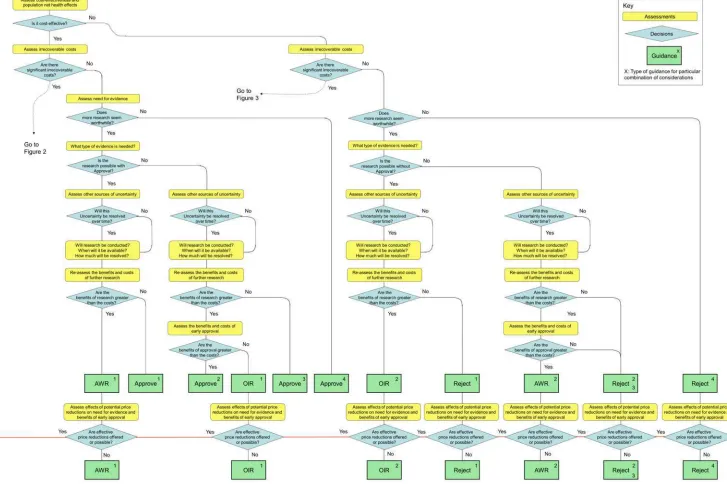
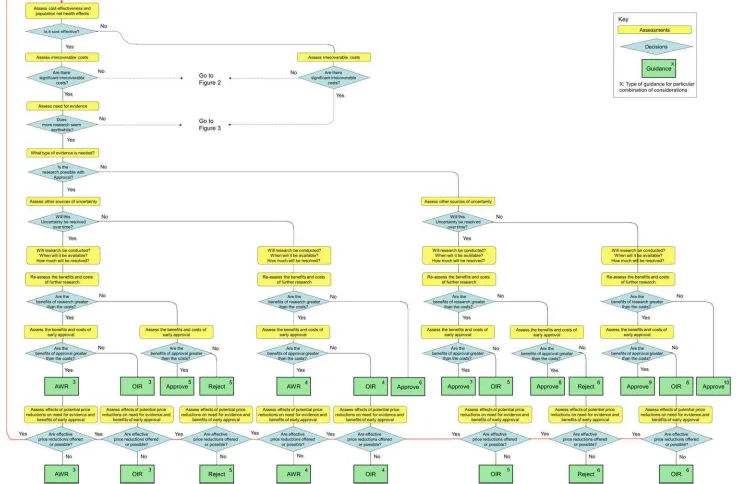
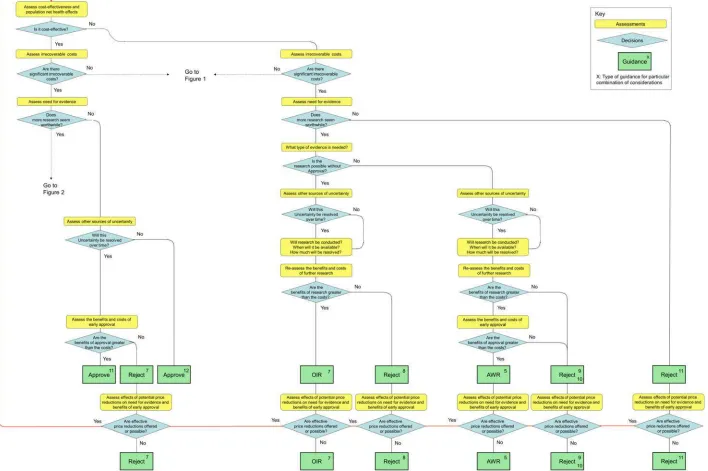
Figures 1 to 3 show the sequence of assessments and decisions which lead to a particular
of guidance are represented within the algorithm: Approve, AWR, OIR and Reject. Each
different type of guidance illustrates how similar guidance might be arrived at in different ways,
helping to identify the particular combination of considerations which underpin the guidance.
Figure 1 is for technologies without significant irrecoverable costs, while Figures 2 and 3 are for
technologies with significant irrecoverable costs. Figures 2 and 3 are separated further based on
whether the technology is expected to be cost-effective and research is needed (Figure 2) or
whether it is not expected to be cost-effective and research may or may not be needed (Figure 3).
The key principles underpinning each of these assessments are now described in the sections
which follow. The reader is referred to Claxton et al (2012) for a more detailed explanation (24).
<<Insert Figures 1 - 3 >>
2.1 Technologies without significant irrecoverable costs
Although some element of cost which once committed cannot be subsequently recovered is
almost always present in the evaluation of technologies, the sequence of assessments and
decisions for these technologies is relatively straightforward compared to other technologies
judged to have ‘significant’ irrecoverable costs associated with approval. Significant irrecoverable
costs depend on the commitment of upfront costs and whether there is sufficient flexibility in
when a patient can initiate treatment (e.g., if treatment can be delayed until uncertainty is
resolved then the commitment of these irrecoverable costs can be avoided). Technologies
without significant irrecoverable costs are considered first as the simpler case (see Figure 1).
2.1.1 Technologies expected to be cost-effective
The sequence of assessment is assumed to start with cost-effectiveness and expected incremental
net health effect for the technology relative to its comparators since this is the starting point used
by many decision making bodies such as NICE, PBAC and CADTH. In order to avoid binary
should be assessed. An assessment is also required of whether the research needed to provide
this evidence is possible if the technology is approved for widespread use while the research is
being conducted.
Need for evidence
Some initial assessment about whether further research might be potentially worthwhile is
important because a ‘No’ at this point can avoid further assessments, e.g. a technology offering
substantial and well-evidenced health benefits at modest additional cost is likely to exhibit little
uncertainty about whether the expected population net health effect is positive. In these
circumstances, further research may not be worthwhile so guidance to approve could be issued
(e.g. Approve4in Figure 1). If additional evidence is needed and further research might be
worthwhile, then further assessments and decisions are required before guidance can be issued.
Critically, some assessment is required of the type of evidence that is needed and whether or not
the type of research required to provide it is likely to be conducted if approval is granted (24, 26).
Where research is possible with approval
If research is possible with approval, some assessment of the long term benefits of research is
required, including: i) the likelihood that the type of research needed will be conducted; ii) how
long the results of research will take to report; and iii) how much of the uncertainty might be
resolved by the research (15). An assessment of other sources of uncertainty which will only
resolve over time is also needed, e.g., changes in prices or the launch of new technologies (17).
These sources of uncertainty will influence the future benefits of research. For example, if the
price of the technology is likely to fall significantly before or shortly after research reports then
the benefits, once the research reports, might be very limited. In these circumstances it might be
better to approve (rather than AWR) and reconsider whether and what type of research is
long term benefits of research are likely to exceed its expected costs determines guidance, with
AWR1and Approve1in Figure 1 dependent on ‘Yes’ and ‘No’ respectively.
Where research is not possible with approval
The type of research needed may not be possible once a technology is approved for widespread
use, e.g. randomised clinical trials (RCTs) may not be possible due to ethical concerns,
recruitment problems and limited incentives for manufacturers. In these circumstances the
expected benefits of approval to current patients must be balanced against the benefits to future
patients from withholding approval until the research is conducted. The same assessments of
the long term value of research and the impact of other sources of uncertainty is still required. If
the benefits of research are judged to be less than the costs (i.e. research is not worthwhile
anyway), the technology can be approved based on current evidence and prices (Approve3in
Figure 1). However, judging that research is worthwhile at this point is not sufficient for OIR
guidance. An assessment of whether the benefits of early approval are expected to be greater
than the opportunity costs of research that may be forgone to future patients is required. If the
expected benefits are judged to be less than the opportunity costs then OIR guidance would be
appropriate (OIR1in Figure 1), whereas if they are judged to be greater, then approval would be
appropriate (Approve2in Figure 1).
2.1.2 Technologies not expected to be cost-effective
A technology which is not expected to be cost-effective based on existing evidence is expected
to impose negative net health effect if it is approved. In these circumstances Approve can be
ruled out, but depending on the level of uncertainty in the current evidence and other changes
that may occur, subsequent assessments and decisions are required before guidance is reached
Need for evidence
Even if the technology is not expected to be cost-effective, the assessment may be uncertain;
therefore it remains a possibility that the technology might offer positive net health effect.
Again, the scale and consequences of uncertainty must be considered and whether additional
research might potentially be worthwhile. If it is not, then the technology can be rejected (Reject
4in Figure 1). Alternatively, if further research might be worthwhile then an additional
assessment is required of whether the type of evidence and research that is needed can be
conducted without approval.
Where research is possible without approval
Generally, most types of research (including RCTs) will be possible without approval. The long
term value of research and the impact of other sources of uncertainty are required. If, following
this re-assessment, the expected benefits of research are judged to exceed the associated costs
then OIR would be appropriate (OIR2in Figure 1). Alternatively, if the costs of research are
likely to exceed the longer term expected benefits then the technology should be rejected at this
point (Reject1in Figure 1).
Where research is not possible without approval
In some circumstances it is possible that certain types of evidence might only be acquired once a
technology is in widespread use, e.g., linking surrogates to longer term outcomes, longer term (or
rare) adverse events, learning and incremental improvements, or identifying particular types of
patients that might benefit most (27). Where the type of research needed is not possible (or is
significantly more costly) without approval, the same assessment of the longer term benefits of
research is required. If further research is judged not to be worthwhile following this
re-assessment, the technology can be rejected (Reject2in Figure 1). Alternatively, if research is
is required. In this case, approval will impose opportunity costs (negative expected NHE of
widespread use of a cost-ineffective technology). The key question is whether the net benefits of
the research exceed these opportunity costs. If they don’t, then the technology should be
rejected even though research would have been worthwhile (Reject3 in Figure 1). Alternatively,
if the net benefits of research more than offsets the opportunity costs then AWR would be
appropriate even though the technology is expected to be cost-ineffective (AWR2in Figure 1).
Therefore, AWR guidance for technologies not expected to be cost-effective is certainly possible
but only appropriate in certain circumstances, where: i) the type of research needed is not
possible without approval; ii) the long term benefits of the research are likely to exceed the
expected costs and iii) the additional net benefits of such research exceeds the opportunity costs
of approving a cost-ineffective technology.
2.2 Technologies with significant irrecoverable costs
Irrecoverable costs are those which once committed cannot be recovered if guidance is changed
at a later date. Irrecoverable costs are most commonly thought of as ‘up-front’ or capital costs
of new facilities or equipment with long life expectancy. In most appraisals these types of cost
are first annuitized and then allocated pro-rata to the number of patients likely to be treated
during the lifetime of the equipment. If guidance remains unchanged throughout this period (i.e.,
research does not report or other sources of uncertainty resolve) then this common assumption
has no influence. However, should guidance change (initial approval is withdrawn) before the
end of the lifetime of the equipment then, although future patents will no longer use the
technology, the cost of the equipment which was allocated to them cannot be recovered.
Even in the absence of capital investment costs, most new technologies impose initial per patient
treatment costs which exceed the immediate health benefits. These irrecoverable treatment costs
health effects (losses) are only gradually compensated by later positive ones (gains). Therefore, a
technology expected to be cost-effective may only accumulate sufficient ‘gains’ to compensate
earlier ‘losses’ after some considerable time. Whether this type of irrecoverable opportunity cost
is significant (i.e., might influence decisions) depends on whether treatment decisions for
individual patients are irreversible, which in part depends on the nature of the disease. For
example, in an acute condition the decision to treat a particular patient with a technology cannot
be reconsidered at a later date, whereas for a chronic condition the decision to treat can be
delayed until uncertainty is resolved. Therefore, the commitment of irrecoverable opportunity
costs (negative NHE) can be avoided (21). In these circumstances, OIR or reject avoids this
commitment and preserves the option to approve the technology at a later date when its
purchase represents a ‘less risky investment’ (21).
2.2.1 Technologies expected to be cost-effective
The presence of irrecoverable costs for a technology that is expected to be cost-effective will
only influence guidance and be regarded as ‘significant’ if there are future events (research
reporting or other sources of uncertainty resolving) which might change guidance. For example,
if research is possible with approval and is expected to be worthwhile, AWR does not necessarily
follow as previously (e.g., see AWR1in Figure 1) because the impact of irrecoverable costs must
also be considered. Now OIR may be more appropriate than AWR (e.g., the choice between
OIR4and AWR4in Figure 2), even though the research would be possible with approval
because OIR avoids the commitment of irrecoverable costs until the results of research are
known. This is especially the case when there are also other sources of uncertainty which might
resolve while the research is being conducted as it increases the chance that guidance will be
If research is not possible with approval but is expected to be worthwhile, then OIR will be
appropriate if the opportunity costs of early approval are judged to exceed the benefits (e.g.
OIR6rather than Approve9in Figure 2). Irrecoverable costs will tend to make OIR rather than
approval more likely, particularly when there are other sources of uncertainty which might
resolve while the research is being conducted (e.g., OIR5rather than Approve7in Figure 2).
If research is not judged worthwhile, approval does not necessarily follow as previously (e.g.,
Approve1, 3, 4in Figure 1). Now the technology should only be approved if there are no other
sources of uncertainty. If there are other sources of uncertainty, then an assessment of the
benefits and costs of early approval is needed which takes account of irrecoverable costs and the
risk that guidance might change in the future. Therefore, reject rather than approval is possible,
even though a technology is expected to be cost-effective, because the decision to commit the
irrecoverable costs can be reconsidered once the other sources of uncertainty have resolved (e.g.,
Reject5, 6in Figure 2).
2.2.2 Technologies not expected to be cost-effective
The presence of irrecoverable costs for technologies not expected to be cost-effective means
that reject is more likely to be appropriate than AWR when research is not possible without
approval (see AWR5in Figure 3). This is because a decision to reject, although it may be revised
to approve, generally does not commit irrecoverable costs. There may be circumstances when
implementing guidance to reject a technology also requires resources if it has already been
diffused into clinical practice. If these are significant they should be taken into account in the
2.3 Changes in effective price of a technology
Any change in the effective price of the technology will affect the key assessments, leading to
different categories of guidance. For example, OIR for a technology, which is expected to be
cost-effective, might be revised to Approve with a sufficient price reduction because the benefits
of early approval will be greater and the value of additional evidence will tend to be lower (e.g.,
from OIR1to Approve2in Figure 1). Similarly, AWR might be revised to Approve if the
benefits of early approval now exceed the value of additional evidence (e.g., from AWR1to
Approve2in Figure 1). Therefore, consideration of the effect of price changes on OIR and
AWR is needed when assessing the potential impact of discount schemes and more direct price
negotiation (24).
Even if direct price negotiation is possible through a value based pricing scheme (10), it will be
important to retain OIR and AWR as possibilities because there is no guarantee that
manufacturers will always agree to the lower price below which Approval rather than OIR or
AWR would be appropriate, and there may be many circumstances when there is no effective
price reduction which would make Approval appropriate. For example, Reject or OIR guidance
may still be appropriate even if the effective price of a technology was zero if there is substantial
uncertainty about its effectiveness and/or potential for harms.
3 DISCUSSION
Each sequence of assessment and decision leads to a different category and type of guidance for
technologies with differing characteristics, indications and target populations. The different
types of guidance illustrate how similar guidance might be arrived at but in different ways, adding
to the transparency of the appraisal and helping to be explicit about the particular combination
of considerations which underpin the guidance. There are many circumstances when AWR and
when a technology is expected to be cost-effective. Even when research is possible with
approval, OIR is appropriate if there are significant irrecoverable costs. Reject remains a
possibility even for a cost-effective technology if there are irrecoverable costs. Therefore, the
full range of categories of guidance (OIR and Reject as well as AWR and Approve) ought to be
considered for technologies, which on the balance of existing evidence and current prices, are
expected to be cost-effective. It is only approval that can be ruled out if a technology is not
expected to be cost-effective, i.e., cost-effectiveness is a necessary but not sufficient condition
for approval but lack of cost-effectiveness is neither necessary nor sufficient for rejection. There
are circumstances when AWR may be appropriate even when a technology is not expected to be
cost effective. Importantly, the category of guidance only partly depends on an assessment of
expected cost-effectiveness. A number of other key assessments are required: the need for
evidence; whether the type of research required is possible with approval; the expected longer
term benefits and costs of research that is likely to be conducted; the impact of other sources of
uncertainty which will resolve over time; and the significance of any irrecoverable costs.
This paper has set out the key principles of what assessments are needed for coverage decisions.
It has not specified how these assessments might be informed as this can differ across different
jurisdictions. The explicit framework for OIR and AWR decisions is likely to have a number of
implications for policy (e.g., drug pricing and incentives for evaluative research), as well as the
process of appraisal (e.g., greater involvement of research commissioners) and the methods of
appraisal (e.g., additional information, evidence and analysis that might be required).
Coverage decisions which are based on some assessment of the likely health opportunity costs,
whether or not a ‘threshold’ is explicitly stated, sends a signal of how much health care systems
can afford to pay for the benefits that new technologies offer. Manufacturers inevitably respond
(29) but the effects and the costs of developing and producing new technologies are endogenous
as well. Therefore, the role of reimbursement agencies can be seen as signalling collective
demand for the health benefits that new technologies offer, reflecting the social choices of how
much resource is to be made available for health care. The endogeneity of price aligns the
dynamic incentives for research and development with the needs and resource constraints of
health care systems that reflects social values and mirrors how temporary monopolists with
patent protection respond to demand in other markets (30). The principles of how the need for
evidence might influence coverage decisions and the implications that it has for pricing decisions
by manufacturers enables greater subtlety in the signal sent and a better alignment of incentives
for the development of new technologies and evaluative research available to support their use.
REFERENCES
1. European Medicines Agency. Human Medicines Research & Development Support. Questions and answers following the initial experience of the Adaptive Licensing Pilot project 2014 [cited 2015 13th November 2015]. Available from:
http://www.ema.europa.eu/docs/en_GB/document_library/Other/2014/09/WC500172810.pdf. 2. Baird LG, Banken R, Eichler HG, Kristensen FB, Lee DK, Lim JC, et al. Accelerated access to innovative medicines for patients in need. Clinical Pharmacology and Therapeutics. 2014;96(5):559-71.
3. Carlson J, Sullivan S, Garrison L, Neumann P, Veenstra D. Linking payment and health outcomes: A systematic review of performance-based health Washington: University of Washington, 2008.
4. McCabe CJ, Stafinski T, Edlin R, Menon D. Access with Evidence Development Schemes A Framework for Description and Evaluation. Pharmacoeconomics.
2010;28(2):143-52.
5. Stafinski T, McCabe CJ, Menon D. Funding the unfundable: mechanisms for managing uncertainty in decisions on the introduction of new and innovative technologies into healthcare systems. Pharmacoeconomics. 2010;28(2):113-42.
6. Towse A, Garrison LP, Jr. Can't get no satisfaction? Will pay for performance help?: toward an economic framework for understanding performance-based risk-sharing
agreements for innovative medical products. Pharmacoeconomics. 2010;28(2):93-102. 7. Culyer A, McCabe C, Briggs A, Claxton K, Buxton M, Akehurst R, et al. Searching for a threshold, not setting one: the role of the National Institute for Health and Clinical Excellence. Journal of Health Services Research & Policy. 2007;12:56-8.
9. Stinnett AA, Mullahy J. Net health benefits: a new framework for the analysis of uncertainty in cost-effectiveness analysis. Med Decis Making. 1998;18(2 Suppl):S68-80. 10. Claxton K, Briggs A, Buxton M, Culyer A, McCabe C, Walker S, et al. Value based pricing for NHS drugs: an opportunity not to be missed? BMJ. 2008;336:251-4.
11. McCabe C, Claxton K, Culyer AJ. The NICE cost-effectiveness threshold: what it is and what that means. Pharmacoeconomics. 2008;26(9):733-44.
12. Claxton K. The irrelevance of inference: a decision-making approach to the stochastic evaluation of health care technologies. Journal of Health Economics. 1999;18(3):342-64. 13. Claxton K, Cohen J, Neumann P. When is Evidence Sufficient? Health Affairs. 2005;24(1):93-101.
14. Claxton K, Sculpher M, Drummond M. A rational framework for decision making by the National Institute for Clinical Excellence. Lancet. 2002;360:711-5.
15. Griffin SC, Claxton KP, Palmer SJ, Sculpher MJ. Dangerous omissions: the consequences of ignoring decision uncertainty. Health Econ. 2011;20(2):212-24. 16. Trueman P, Grainger DL, Downs KE. Coverage with Evidence Development: applications and issues. Int J Technol Assess Health Care. 2010;26(1):79-85.
17. Philips Z, Claxton K, Palmer S. The half-life of truth: what are appropriate time horizons for research decisions? Med Decis Making. 2008;28(3):287-99.
18. Eckermann S, Willan AR. The option value of delay in health technology assessment. Medical Decision Making. 2008;28(3):300-5.
19. Fenwick E, Claxton K, Sculpher M. The value of implementation and the value of information: combined and uneven development. Medical Decision Making. 2008;28(1):21-32.
20. Hoomans T, Fenwick EA, Palmer S, Claxton K. Value of information and value of implementation: application of an analytic framework to inform resource allocation decisions in metastatic hormone-refractory prostate cancer. Value Health. 2009;12(2):315-24.
21. McKenna C, Claxton K. Addressing Adoption and Research Design Decisions Simultaneously: The Role of Value of Sample Information Analysis. Med Decis Making. 2011.
22. Palmer S, Smith P. Incorporating option values into the economic evaluation of health care technologies. Journal of Health Economics. 2000;19:755-66.
23. Drummond MF, Sculpher MJ, Claxton K, Stoddart GL, Torrance GW. Methods for the Economic Evaluation of Health Care Programmes (4th Edition): Oxford Medical Publications; 2015.
24. Claxton K, Palmer S, Longworth L, Bojke L, Griffin S, McKenna C, et al. Informing a decision framework for when NICE should recommend the use of health technologies only in the context of an appropriately designed programme of evidence development Health Technology Assessment. 2012;16(46).
25. McKenna C, Soares M, Claxton K, Bojke L, Griffin S, Palmer S, et al. Unifying research and reimbursement decisions: case studies demonstrating the sequence of assessment and judgments required. Value in Health. 2015;18(6):865-75.
26. Chalkidou K, Lord J, Fischer A, Littlejohns P. Evidence-based decision making: when should we wait for more information? Health Affairs. 2008;27(6):1642-53.
27. Basu A. Economics of individualization in comparative effectiveness research and a basis for a patient-centered health care. J Health Econ. 2011;30(3):549-59.
28. Eckermann S, Willan A. Expected value of information and decision making in HTA. Health Econ. 2006;16(2):195-209.
29. Jena AB, Philipson TJ. Endogenous cost-effectiveness analysis and health care technology adoption. Journal of Health Economics. 2013;32:172-80.