This is a repository copy of Planar Disjoint-Paths Completion.
White Rose Research Online URL for this paper:
http://eprints.whiterose.ac.uk/104729/
Version: Accepted Version
Article:
Adler, I, Kolliopoulos, SG and Thilikos, DM (2016) Planar Disjoint-Paths Completion.
Algorithmica, 76 (2). pp. 401-425. ISSN 0178-4617
https://doi.org/10.1007/s00453-015-0046-2
© 2015, Springer Science+Business Media New York. This is an author produced version
of a paper published in Algorithmica. The final publication is available at Springer via
http://dx.doi.org/10.1007/s00453-015-0046-2. Uploaded in accordance with the publisher's
self-archiving policy.
Reuse
Unless indicated otherwise, fulltext items are protected by copyright with all rights reserved. The copyright exception in section 29 of the Copyright, Designs and Patents Act 1988 allows the making of a single copy solely for the purpose of non-commercial research or private study within the limits of fair dealing. The publisher or other rights-holder may allow further reproduction and re-use of this version - refer to the White Rose Research Online record for this item. Where records identify the publisher as the copyright holder, users can verify any specific terms of use on the publisher’s website.
Takedown
If you consider content in White Rose Research Online to be in breach of UK law, please notify us by
Planar Disjoint-Paths Completion
abIsolde Adlerc Stavros G. Kolliopoulosd Dimitrios M. Thilikosef
Abstract
We introducePlanar Disjoint Paths Completion, a completion counterpart of the Disjoint Paths problem, and study its parameterized complexity. The problem can be stated as follows: given a, not necessarily connected, plane graphG, kpairs of terminals, and a face F of G, find a minimum-size set of edges, if one exists, to be added insideF so that the embedding remains planar and the pairs become connected by kdisjoint paths in the augmented network. Our results are twofold: first, we give an upper bound on the number of necessary additional edges when a solution exists. This bound is a function ofk, independent of the size ofG.Second, we show that the problem is fixed-parameter tractable, in particular, it can be solved in timef(k)·n2
.
Keywords: Completion Problems, Disjoint Paths, Planar Graphs.
1
Introduction
Suppose we are given a planar road network with ncities and a set of k pairs of them. An empty area of the network is specified and we wish to add a minimum-size set of
aThe second and the third author where co-financed by the European Union (European Social Fund
– ESF) and Greek national funds through the Operational Program “Education and Lifelong Learning” of the National Strategic Reference Framework (NSRF) - Research Funding Program: “Thalis. Investing in knowledge society through the European Social Fund”.
b
Emails: Isolde Adler: [email protected], Stavros Kolliopoulos: [email protected], Dim-itrios M. Thilikos: [email protected]
c
Institut f¨ur Informatik, Goethe-Universit¨at, Frankfurt, Germany.
d
Department of Informatics and Telecommunications, National and Kapodistrian University of Athens, Athens, Greece.
e
Department of Mathematics, National and Kapodistrian University of Athens, Athens, Greece.
f
AlGCo project-team, CNRS, LIRMM, France.
intercity roads in that area so that the augmented network remains planar and the pairs are connected bykinternally disjoint roads. In graph-theoretic terms, we are looking for a minimum-size edge-completion of a plane graph so that an infeasible instance of the
Disjoint Paths problem becomes feasible while maintaining planarity. In this paper we give an algorithm that solves this problem in f(k)·n2 steps. Our algorithm uses a combinatorial lemma stating that, whenever such a solution exists, its size depends exclusively on k.
The renowned Disjoint Paths Problem (DP)is defined as follows.
DP(G, s1, t1, . . . , sk, tk)
Input: An undirected graph G and k pairs of terminals
s1, t1, . . . , sk, tk ∈V(G).
Question: are there k pairwise internally vertex-disjoint paths
Q1, . . . Qk inGsuch that pathQi connectssi toti?
(Bypairwise internally vertex-disjointwe mean that two paths can only intersect at a vertex which is a terminal for both.)
DP is NP-complete even on planar graphs [14] but, when parameterized by k, the problem belongs to the parameterized complexity classFPT, i.e., it can be solved in time
f(k)·nO(1),for some functionf.More precisely, it can be solved inf(k)·n3 time by the
celebrated algorithm of Robertson and Seymour [19] from the Graph Minors project. For planar graphs, the same problem can be solved inf(k)·n [16].
We introduce a completion counterpart of this problem, Planar Disjoint Paths Completion (PDPC), which is of interest on infeasible instances of DP, and we study its parameterized complexity, when parameterized by k. We are given an em-bedding of a, possibly disconnected, planar graphG in the sphere,k pairs of terminals
s1, t1, . . . , sk, tk ∈ V(G), a positive integer ℓ, and an open connected subset F of the
surface of the sphere, such that Fand G do not intersect (we stress that the boundary ofF is not necessarily a cycle). We want to determine whether there is a set of at most
ℓedges to add, the so-called patch, so that
(i) the new edges lie insideF and are incident only to vertices ofGon the boundary of
F,
(ii) the new edges do not cross with each other or withG, and
(iii) in the resulting graph, which consists ofGplus the patch, DPhas a solution.
of T. That way, we force the set of additional edges to be empty and obtain DP as a special case.
Notice that our problem is polynomially equivalent to the minimization problem where we ask for a minimum-size patch: simply solve the problem for all possible values of ℓ. Requiring the size of the patch to be at most ℓis the primary source of difficulty. In case there is no restriction on the size of the patch and we simply ask whether one exists, the problem is in FPT by a reduction to DP, which is summarized as follows. For simplicity, let Fbe an open disk. Let G′ be the graph obtained by “sewing” along the boundary ofFan O(n)×O(n)-grid. By standard arguments,PDPChas a solution onGif and only if DPhas a solution on G′.A similar, but more involved, construction applies whenF is not an open disk.
Parameterizing completion problems. Completion problems are natural to define: take any graph property, represented by a collection of graphsP, and ask whether it is possible to add edges to a graph so that the new graph is inP.Such problems have been studied for a long time and some of the most prominent are the following: Hamiltonian Completion [8, GT34], Path Graph Completion [8, GT36] Proper Interval Graph Completion [9] Minimum Fill-In [20] Interval Graph Completion [8, GT35].
Kaplan et al. in their seminal paper [12] initiated the study of the parameterized complexity of completion problems and showed that Minimum Fill-In, Proper In-terval Graph Completion and Strongly Chordal Graph Completion are in
FPT when parameterized by the number of edges to add. Recently, the problem left open by [12], namelyInterval Graph Completionwas also shown to be inFPT[11]. Certainly, for all these problems the testing of the corresponding property is inP,while for problems such asHamiltonian Completion, whereP is the class of Hamiltonian graphs, there is noFPTalgorithm, unlessP=NP.For the same reason, one cannot expect anFPT-algorithm whenP contains all YES-instances of DP, even on planar graphs. We
consider an alternative way to parameterize completion problems, which is appropriate for the hard case, i.e., when testingP is intractable: we parameterize the property itself. In this paper, we initiate this line of research, by considering the parameterized property
Pk that contains all YES-instances of DPon planar graphs with kpairs of terminals.
LetGbe a graph embedded in the sphere Σ0.Embeddings are always without
cross-ings and we view the graph G as a subset of Σ0. Given a set X ⊆ Σ0, let clos(X),
int(X), and ∂X denote the closure, the interior, and the boundary of X, respectively. We define V(X) = V(G)∩∂X. A noose is a Jordan curve of Σ0 that meets Gonly on
vertices. LetDbe a finite collection of mutually non-intersecting open disks of Σ0whose
boundaries are nooses and such that each point that belongs to at least two such nooses is a vertex of G. We define ID = SD∈DD and define ΓD as the Σ0-embedded graph
whose vertex set is V(ID) and whose edge set consists of the connected components of the set∂ID\V(ID).Notice that, in the definition of ΓD, we permit multiple edges, loops, or vertex-less edges.
Let J be an open subset of Σ0. J is a cactus set of G if there is a collection D as
above such thatJ=ID, all biconnected components of the graph ΓD are cycles,V(G)⊆ clos(J), and each edge ofE(G) is a subset ofJ.Given such aJ, we define ΓJ= ΓD.Two
[image:5.595.190.413.377.520.2]cactus sets J and J′ of G are isomorphic if ΓJ and ΓJ′ are topologically isomorphic. Throughout this paper, we use the standard notion of topological isomorphism between planar embeddings, see Section 2.
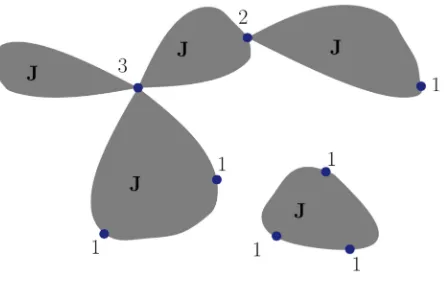
Figure 1: A cactus setJand the vertices ofV(J).Next to each vertexv we give its multiplicity
µ(v).
Given a cactus set J, we define for each vertexv ∈ V(J) itsmultiplicity µ(v) to be equal to the number of connected components of the set ΓJ\ {v}, minus the number of
connected components of ΓJ, plus one. We also define µ(J) = Pv∈V(J)µ(v). Observe
(i) no two of them intersect at more than one point and
(ii) they intersect withGonly at (some of) the vertices inV(G).
Cactus sets are useful throughout our paper as “capsule” structures that surround G
and thus they abstract the interface of a graph embedding with the rest of the sphere surface.
We say that an open setFof Σ0 is anouter-cactus setofGif Σ0\clos(F) is a cactus
set of G. See Fig. 2.(ii). For example, if G is planar, any face F of G can be used to define an outer-cactus set, whose boundary meetsG only at the vertices incident toF.
Our definition of an outer-cactus set is more general: it can be a subset of a face F,
meeting the boundary ofF only at some of its vertices.
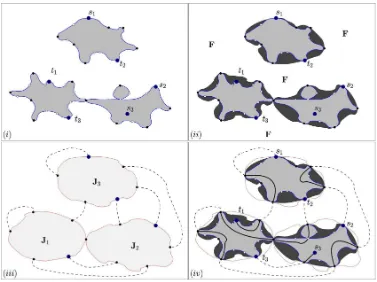
Let Gbe an input graph toDP, see Figure 2.(i). Given an outer-cactus setFof G, anF-patch ofGis a pair (P,J) where (i)Jis a cactus set ofG, where Σ0\clos(J)⊆F
and (ii) P is a graph embedded in Σ0 without crossingssuch thatE(P)⊆Σ0\clos(J), V(P) =V(J) (see Figures 2.(iii) and 2.(iv)). Observe that the edges of P do not cross any edge inE(G).In the definition of theF-patch, the graphP contains the new edges we add. The vertices inV(F) define the vertices ofGwhich we are allowed to include inP. V(J) is meant to contain those vertices ofV(F) that become vertices (possibly isolated) of P. In terms of data structures, we assume that a cactus set J is represented by the (embedded) graph ΓJ.Similarly an outer-cactus setFis represented by the (embedded)
graph ΓΣ0\clos(F).
We restate now the definition of thePlanar Disjoint Paths Completionproblem as follows:
PDPC(G, s1, t1, . . . , sk, tk, ℓ,F)
Input: A graph G embedded in Σ0 without crossings, terminals
s1, t1, . . . , sk, tk ∈V(G),a positive integerℓ, and an outer-cactus setFof
G.
Parameter: k
Question: Is there an F-patch (P,J) of G, such that |P| ≤ ℓ and
DP(G∪P, s1, t1, . . . , sk, tk) has a solution? Compute such an F-patch
if it exists.
If such anF-patch exists, we call it asolution forPDPC.In the corresponding optimiza-tion problem, denoted bymin-PDPC, one asks for the minimumℓfor whichPDPChas a solution, if one exists. See Fig. 2 for an example input of PDPCand a solution to it.
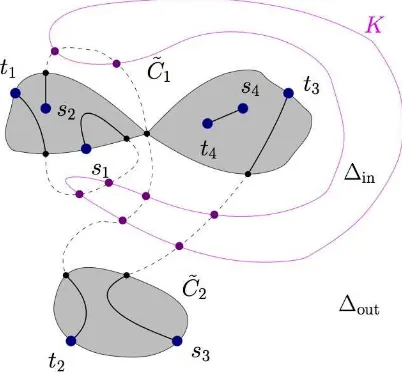
Figure 2: An example input of the PDPC problem and a solution to it when ℓ= 8: (i) The graph embedding in the input and the terminalss1, t1, s2, t2, s3, t3.The closure of the grey area
contains the graphGand the big vertices are the terminals. The white area is a face ofG.(ii) The input of the problem, consisting ofG, the terminals and the outer-cactus setF. The solid black vertices are the vertices ofGthat are also vertices ofV(F).(iii) The solution of the problem consists of theF-patch (P,J) where the edges of P are the dashed lines andJ=J1∪J2∪J3.
(iv) The input and the solution together where the validity of the patch is certified by 3 disjoint paths.
parameterized complexity classXP,i.e., it has an algorithm of timenf(k) for some
func-tion f. Our first contribution, Theorem 2, is a combinatorial one: we prove that if a patch exists, then its size is bounded by k2k
.Therefore, we can always assume thatℓis bounded by a function ofk.This bound is the departure point for the proof of the main algorithmic result of this paper:
Theorem 1. PDPC∈FPT.In particular,PDPCcan be solved inf(k)·n2 steps, where f is a function that depends only on k.Therefore, min-PDPCcan be solved in g(k)·n2
steps.
1.1 Proof strategy
Combinatorial Theorem. In Theorem 2, we prove that every patch whose size is larger than k2k
, can be replaced by another one of strictly smaller size. In particular, we identify a regionB of Fthat is traversed by a large number of segments of different paths of the DP solution. Within that region, we apply a global topological transfor-mation that replaces the old patch by a new, strictly smaller one, while preserving its embeddability in F.The planarity of the new patch is based on the fact that the new segments are reflections in B of a set of segments of the feasibleDP solution that pre-viously lied outsideB.This combinatorial result allows us to reduce the search space of the problem to one whose size is bounded by min{ℓ, k2k
}.Therefore, the construction of the corresponding collection of “candidate solutions” can be done in advance, for each given k, without requiringany a priori knowledge of the input graphG.
We note that the proof of our combinatorial theorem could be of independent interest. In fact, it is one of the ingredients of the proof of the main result of [1].
The algorithm for PDPC. As the number of patches is bounded by a function ofk,
we need to determine whether there is a correct way to glue one of them on vertices of the boundary of the open setFso that the resulting graph is a YES-instance of theDP
problem. For each candidate patch ˜P ,together with its corresponding candidate cactus set ˜J, we define the set of compatible graphs embedded in ˜J. Each compatible graph
˜
H consists of unit-length paths and has the property that ˜P ∪H˜ contains k disjoint paths. Intuitively, each ˜H is a certificate of the part of theDPsolution that lies within
G when the patch in F is isomorphic to ˜P . It therefore remains to check for each ˜H
whether it can be realized by a collection of actual paths within G. For this, we set up a collection H of all such certificates. Checking for a suitable realization of a member of H in G is still a topological problem that depends on the embedding of G: graphs that are isomorphic, but nottopologically isomorphic,may certify different completions. For this reason, our next step is to enhance the structure of the members of H so that their realization in G reduces to a purely combinatorial check. (Cf. Section 4.1 for the definition of the enhancement operation). We show in Lemma 6 that for the enhanced certificates, this check can be implemented by rooted topological minor testing. For this check, we can apply the recent algorithm of [10] that runs inh1(k)·n3 steps and obtain
an algorithm of overall complexityh2(k)·n3.
We note that the use of the complicated machinery of the algorithm in [10] can be bypassed towards obtaining a simpler and faster f(k)·n2 algorithm. This is possible
Tech-niqueintroduced in [19] for solving, among others, the Disjoint Paths Problem. The details of this improvement are in Section 5.
2
Preliminaries
We consider finite graphs. For a graph G we denote the vertex set by V(G) and the edge set by E(G). IfG is embedded in the sphere Σ0, the edges of G and the graphG
refer also to the corresponding sets of points in Σ0.Clearly the edges of G correspond
to open sets and G itself is a closed set. We denote by F(G) the set of all the faces of
G, i.e., all connected components of Σ0\G.Given a set S⊆V(G),we say that the pair
(G, S) is a graph rooted atS.We also denote as P(G) the set of all paths inG with at least one edge. Given a pathP ∈ P(G), we denote byI(P) the set of internal vertices of
P. Given a vertex v∈V(G) and a positive integerr, we denote byNr
G(v) the set of all
vertices in Gthat are within distance at most r from v.Given a vertex v of a graphG
with exactly two neighbors x and y, the result of thedissolution of v inG is the graph obtained if we removev from Gand add, if it does not already exist, the edge{x, y}.
Rooted topological minors. Let H and G be graphs, SH be a subset of vertices
in V(H), SG be a subset of vertices in V(G), and ρ be a bijection from SH to SG.
We say that (H, SH) is a ρ-rooted topological minorof (G, SG), if there exist injections
ψ0:V(H)→V(G) and ψ1:E(H)→ P(G) such that
1. ρ⊆ψ0,
2.for every e={x, y} ∈E(H),ψ1(e) is a (ψ0(x), ψ0(y))-path in P(G), and
3.all e1, e2∈E(H) withe16=e2 satisfyI(ψ1(e1))∩V(ψ1(e2)) =∅.
In words, when H is a topological minor of G, G contains a subgraph which is isomorphic to a subdivision of H. In addition, when (H, SH) is a ρ-rooted topological
minorof (G, SG) then this isomorphism respects the bijectionρ between the vertex sets
SH andSG.
Contractions. LetGand H be graphs and letσ:V(G)→V(H) be a surjective map-ping such that
1.for every vertex v∈V(H), the graph G[σ−1(v)] is connected;
2.for every edge {v, u} ∈E(H), the graph G[σ−1(v)∪σ−1(u)] is connected;
We say thatH is a σ-contraction ofG or simply thatH is a contractionofG if such a
σ exists.
Observation 1. Let H and Gbe graphs such that H is a σ-contraction ofG. If x, y∈ V(G), then the distance inGbetween xand yis at least the distance in H betweenσ(x) and σ(y).
We also need the following topological lemma.
Lemma 1. Let G be a Σ0-embedded graph and let J be a cactus set of it. Let also M
be a Σ0-embedded graph such thatM∩J=∅ andV(M)⊆V(J). Then there is a closed
curve K in Σ0\clos(J) meeting each edge of M twice.
Proof. We consider the dual graph of ΓJ∪M and we remove from it all vertices lying
insideJ.We denote byQthe resulting graph and notice thatQis connected because the set Σ0\clos(J) is connected. Next, construct the graphQ′ by subdividing once every
edge of Qsuch that the subdivision vertex is the intersection point of the edge and its dual. Let T be a spanning tree ofQ′ and let K be a closed curve such that T is inside one of the connected components of the set Σ0 \K and J in the other. If we further
requireK to intersectM a minimum number of times, we obtain the claimed curve.
Topological isomorphism. Given a graphGembedded in Σ0, letf be a face inF(G)
whose boundary has ξ connected components A1, . . . , Aξ. We define the set π(f) =
{π1, . . . , πξ} such that eachπi is the cyclic ordering ofV(Ai), possible with repetitions,
defined by the way vertices are met while walking along Ai in a way that the facef is
always on our left side. Clearly, repeated vertices in this walk are cut-vertices of G.
Let G and H be graphs embedded in Σ0. We say that G and H are topologically
isomorphicif there exist bijections φ:V(G)→V(H) andθ:F(G)→F(H) such that
1. φ is an isomorphism from G toH, i.e. for every pair{x, y} of distinct vertices in
V(G), {x, y} ∈E(G) iff{φ(x), φ(y)} ∈E(H). 2.For every face f ∈F(G),φ(π(f)) =π(θ(f)).
In the definition above, byφ(π(f)) we mean {φ(π1), . . . , φ(πξ)}, where, if πi = (x1, . . . , xζi, x1), then by φ(πi), we mean (φ(x1), . . . , φ(xζi), φ(x1)).Notice that it is possible for
two isomorphic planar graphs to have embeddings that are not topologically isomorphic (see [6, page 93] for such an example and further discussion on this topic).
Treewidth. A tree decomposition of a graph Gis a pair (X, T) whereT is a tree with nodes {1, . . . , m} and X = {Xi | i ∈ V(T)} is a collection of subsets of V(G) (called
1.S
i∈V(T)Xi =V(G),
2.for each edge{x, y} ∈E(G), {x, y} ⊆Xi for some i∈V(T), and
3.for each x∈V(G) the set {i|x∈Xi} induces a connected subtree ofT.
The width of a tree decomposition ({Xi | i ∈ V(T)}, T) is maxi∈V(T){|Xi| −1}. The
treewidthof a graphGdenotedtw(G) is the minimum width over all tree decompositions of G.
3
Bounding the size of the completion
In this section we show the following.
Theorem 2. If there is a solution for PDPC(G, s1, t1, . . . , sk, tk, ℓ,F), then there is a
solution (P,J) with |E(P)| ≤k2k
.
For the proof, we need the following combinatorial lemma.
Lemma 2. Let Σ be an alphabet of size |Σ| = k. Let w ∈ Σ∗ be a string over Σ. If |w|>2k, thenw contains an infixy with |y| ≥2, such that every letter occurring in y,
occurs an even number of times in y.
Proof. Let Σ = {a1, . . . , ak}, and let w = w1· · ·wn with n > 2k. Define vectors
zi ∈ {0,1}k for i∈ {1, . . . , n}, and we let the jth entry of vector zi be 0 if and only if
letterajoccurs an even number of times in the prefixw1· · ·wiofwand 1 otherwise. Since
n >2k, there exist i, i′ ∈ {1, . . . , n}withi6=i′, such thatz
i =zi′.Theny=wi+1· · ·wi′ proves the lemma.
We also need the following easy topological lemma.
Lemma 3. LetG be a connected outerplanar graph that may have loops but no multiple edges (or loops) and let Γbe an embedding of Gin Σ0 such that all its vertices belong to
the boundary of a face f. Let also Ein be the set of all the edges or loops of G that do
not belong to the boundary off. Then there is a unique (up to topological isomorphism) embedding Γ′ of G such that Γ∩Γ′ is the boundary of f and that all edges of E
in are
embedded inside f.
Proof. Let ˜Γ be the boundary of f. Let F be the set of all connected components of Σ0\Γ, except from˜ f.
For each e∈ Ein we denote by Se the set of endpoints of e. For each edge e∈ Ein
Case 1. |Se|= 2. Notice thatSe is a separator of G. Notice also that G\Se contains
two connected components. Also there exists a (unique) cycleCe containing the edgee
and no other points of Γ such that each of these connected components belong each to a distinct disk among the two disks that are bounded byCe. We define ¯e=Ce\clos(e).
Case 2. |Se|= 1. Notice that there exists a unique cycle Ce defining two disks D and
D′ such that (i)Ce∩Γ =Se and (ii) Γe⊆Dwhere Γe is the (unique) member ofF that
contains the loope. We define ¯e=Ce\Se.
Notice that it is possible to define all ¯e’s, one by one, such that they do not intersect. Given the above definitions, it follows that ˜Γ∪S
e∈Eine¯is the required embedding.
Proof of Theorem 2. Let (P,J) be a solution for PDPC(G, s1, t1, . . . , sk, tk, ℓ,F) with
|E(P)|minimal. Consider the embedding ofG∪P in the sphere Σ0, and let Q1, . . . , Qk
be the paths of aDPsolution inG∪P.By the minimality of|E(P)|we can assume that the edges of P are exactly the edges of S
i∈{1,...,k}Qi that are not in G. For the same
reason, two edges in P have a common endpoint x that is not a terminal only if x is a cut-vertex of ΓJ.
Let P∗ denote the graph obtained from the dual of P ∪Γ
J, after removing the
vertices corresponding to the faces of ΓJthat are disjoint fromF.We first show that the
maximum degree of P∗ is bounded by k.Assume, to the contrary, thatP∗ has a vertex incident to two edges e∗1 and e∗2 such that e1 and e2 belong to the same path, say Qx,
in{Q1, . . . , Qk}.Then it is possible to choose an endpointp1 ofe1 and an endpoint p2
of e2 such that, (P′,J′) is also a solution such that |E(P′)| < |E(P)|. Indeed, p1 and p2 are the vertices incident to e1 and e2 belonging to the two connected components of Qx\ {e1, e2}that contain respectivelysx andtx. Therefore we established that for every
i ∈ [k], no vertex of P∗ is incident to two distinct edges of Qi, thus all vertices of P∗
have degree at most k.
Here P′ =P \ {e1, e2} ∪ {{p1, p2}} and J′ is defined such that ΓJ′ is obtained from ΓJ after dissolving the vertices that became isolated during the construction of P′.
Our next aim is to prove that the diameter ofP∗ is bounded by 2k.Then|E(P∗)|= |E(P)| ≤ k2k and we are done. Note that every edge in E(P∗) corresponds to an edge in exactly one path of Q1, . . . , Qk. Hence, given a pathR = (r0, . . . , rζ) in P∗, it
corresponds to a string w ∈ {Q1, . . . , Qk}∗ in a natural way. It is enough to prove the
following claim.
Proof of the Claim. Towards a contradiction, suppose that wcontains such an infix
y.We may assume thatw=y. LetER⊆E(P) be the set of edges corresponding to the
edges of the pathR ⊆P∗. Then|ER| ≥2 because w (and hence R) has length at least
2. LetB ⊆Σ0 be the open set defined by the union of all edges in ER and all faces of
the graph P ∪ΓJ that are incident to them. Clearly,B is an open connected subset of Fwith the following properties:
(a) B contains all edges inER and no other edges of P,
(b) the ends of every edge in ER lie on the boundary∂B, and
(c) every edge inE(P)\ERhas empty intersection with B.
We consider an ‘up-and-down’ partition (U = {u1, . . . , ur}, D = {d1, . . . , dr}) of the
endpoints of the edges in ER as follows: traverse the path R in P∗ in some arbitrary
direction and when theith edgeei ∈ER is met, the endpointui ofei on the left of this
direction is added toU and the right endpoint di is added to D.Notice that U and D
may be multisets because it is not necessary that all vertices in P have degree 1. For each i∈ {1, . . . , r} we say thatui is the counterpart ofdi and vice versa.
Because the pathsQ1, . . . , Qk are vertex-disjoint, the following holds.
Observation: If x ∈ V(P) has degree larger than one, then either x is a terminal and has degree at mostk orx is a cutpoint of ΓJ and has degree exactly 2.
By assumption, every path Qi crosses R an even, say 2ni, number of times. Now
for every path Qi satisfying E(Qi) ∩ER 6= ∅, we number the edges in E(Qi)∩ ER
by ei
1, . . . , ei2ni in the order of their appearance when traversing Qi from si to ti and
we orient them from si to ti. We introduce shortcuts for Qi as follows: for every odd
number j ∈ {1, . . . ,2ni}, we replace the subpath ofQi from tail(eij) to head(eij+1) by a
new edge fi
j inD (see Figure 3).
After having done this for all odd numbers j ∈ {1, . . . ,2ni}, we obtain a new path
Q′
i from si to ti that uses strictly less edges in B than Qi. Having replaced all paths
Qi withE(Qi)∩ER 6=∅ in this way by a new path Q′i, we obtain fromP a new graph
P′ by replacing every pair of edges ei
j, eij+1 ∈ E(P) by fji for all i ∈ {1, . . . , k} with
E(Qi)∩ER 6= ∅, and for all j ∈ {1, . . . ,2ni}, j odd. We denote by ER′ the set of all
replacement edges fi
j.We also remove every vertex that becomes isolated in P′ during
this operation.
Then it is easy to verify that:
• None of the edges ofER survives in E(P′).
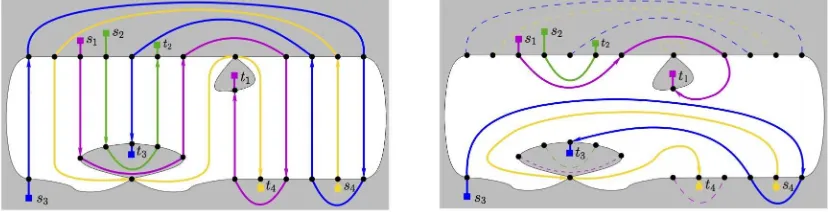
Figure 3: Example of the transformation in the proof of the Claim in the proof of Theorem 2; P is on the left and P′ is shown on the right. The dashed lines represent the edges ofC.
• DP(G∪P′, s1, t1, . . . , sk, tk) has a solution.
If we show that, for some suitable cactus setJ′ ofG, (P′,J′) is anF-patch, then we are done, because|E(P′)|<|E(P)|.In what follows, we prove thatP′can also be embedded without crossings inclos(F) such thatE(P′)⊆Σ
0\∂F.For this it suffices to prove that
the edges inER′ can be embedded inB without crossings.
For every pathQi withE(Qi)∩ER6=∅letFjidenote the subpath ofQi fromhead(eij)
totail(ei
j+1), forj ∈ {1, . . . ,2ni},jodd (this path may be edgeless only in the case where
head(eij) = tail(eij+1) is a cut-vertex of ΓJ). We replace Fji by a single edge cij (when
the corresponding path is edgeless, the edge ci
j is a loop outside B). We consider the
graph C with vertex set V(P) and edge set {ci
j | i∈ {1, . . . , k}, E(Qi)∩ER 6= ∅, j ∈
{1, . . . ,2ni}, j odd}.
Our strategy consists of a two-step transformation of this embedding. The first step creates an embedding of C insideclos(B) without moving the vertices. Indeed, notice thatC is embedded in Σ0\Bwithout crossings such that all the endpoints of the edges
in C lie on the boundary of B. As for every odd j in [2ni], j+ 1 also belongs to [2ni],
it follows that none of the endpoints of Fi
j can be a terminal. This, together with the
observation above, implies that no two edges of C have a common endpoint.
By applying Lemma 3 on the Σ0-embedded outerplanar graph Γ = ΓJ∪C where B
plays the role of the face f, we obtain a new non-crossing embedding Γ′. Notice that Γ′\Γ
J is a new non-crossing embedding ofC where all of its edges lie inside B.(Recall
that none of the edges ofER is present in this embedding.) This transformation maps
every edgeci
j to a new edge insideBwith the same endpoints.
The second step “reflects” the resulting embedding along the axis defined by the path R such that each vertex is exchanged with its counterpart. Now define (ci
that it connectstail(ei
j) andhead(eij+1) – these are exactly the counterparts ofhead(eij)
and tail(ei
j+1).Due to symmetry, the (cij)′ are pairwise non-crossing, and none of them
crosses a drawing of an edge in E(P)\ER. Hence the (cij)′ together with the drawing
of edges in E(P)\ERprovide a planar drawing ofP′ (where (cij)′ is the drawing offji).
We finally define (up to isomorphism) the cactus set J′ of G such that ΓJ′ is obtained from ΓJafter dissolving the vertices ofP∩ΓJ that are isolated inP′. It is easy to verify
that (P′,J′) is anF-patch ofG. This concludes the proof of the Claim.
Using the Claim above and from Lemma 2, it follows that |w| ≤2k, and hence the
diameter of P∗ is bounded by 2k.The proof of Theorem 2 is now complete.
Let L be a list of all simple plane graphs with at most min{ℓ, k2k} edges and no isolated vertices. We call a graph in L a completion. As a first step, our algorithm for
PDPCcomputes the list L.Obviously, the running time of this process is bounded by a function depending only onk.
4
The algorithm for
Planar-Dpc
The fact that the size ofL is bounded by a function of kimplies that PDPCis in XP. Indeed, given the listL, for each completion ˜P ∈ Lwe define the graphQP˜ = (V( ˜P),∅)
and we consider all cactus sets ˜J of QP˜ where ( ˜P ,J˜) is a (Σ0\clos(˜J))-patch of QP˜
andV(˜J) =V( ˜P).We denote the set of all such pairs ( ˜P ,˜J) byJ and observe that the number of its elements (up to topological isomorphism of the graph ˜P∪Γ˜J) is bounded
by a function ofk.
For each pair ( ˜P ,˜J)∈ J, we check whether there exists anF-patch (P,J) ofGsuch that ˜P∪ΓJ˜ and P∪ΓJare topologically isomorphic andDPhas a solution in the graph G∪P.As there arenz(k)ways to choose (P,J) and each check can be done inO(z
1(k)·n3)
steps, we conclude that PDPC can be solved in nz2(k) steps. In the remainder of the
paper, we will prove that the problem is actually in FPT.
The main bottleneck is that there are too many ways to identify V(˜J) with vertices of V(F), because we cannot bound |V(F)| by a function of k. To overcome this, we associate with a positive instance of PDPC a rooted topological minor ( ˜H,T˜) of the original graphG, that witnesses the fact that ( ˜P ,˜J) corresponds to the desiredF-patch of G. For convenience, we assume from now on that Γint(Σ0\F) does not contain any
loops or multiple edges. In other words, none of the open disks corresponding to the connected components of Σ0 \F contains less than 3 vertices in its boundary. If the
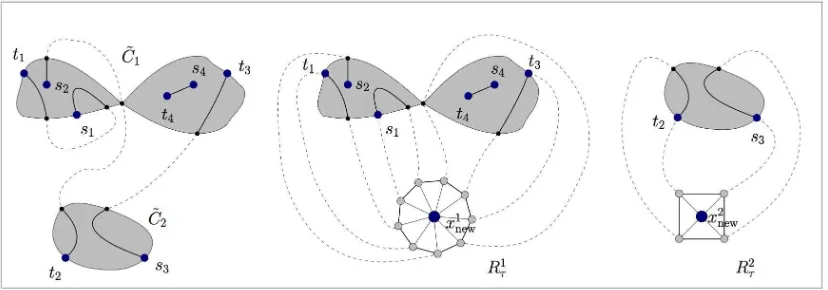
Figure 4: In the leftmost image the dotted lines are the edges of ˜P .Together with the interior of the grey areas they form a pair ( ˜P ,J˜)∈ J.J˜has two weakly connected components. V(˜J) con-sists of the 12 vertices on the boundary of the grey areas. The solid lines that intersect the open set ˜Jare the edges of the graph ˜H,which is compatible with ( ˜P ,˜J).Let ˜T ={s1, t1, . . . , s4, t4}.
The tripleτ = (˜J,H,˜ T˜) ∈ H has two parts. The middle and the leftmost pictures show how each of these parts is enhanced in order to construct the graphsR1
τ andR
2
τ.
and modifyF such that the new vertices belong to its boundary. Similarly, we restrict
J to contain only pairs ( ˜P ,˜J) where Γ˜J does not contain any loops or multiple edges.
Given a pair ( ˜P ,J˜) ∈ J, we say that a rooted simple graph ( ˜H,T˜ = {a1, b1, . . . , ak, bk}) embedded in Σ0, iscompatiblewith ( ˜P ,J˜) when
1. for everye∈E( ˜H),e⊆J˜,
2. the vertices of ˜H that are also vertices of ΓJ˜ are |V( ˜P)|, while the vertices of ˜H
that are not vertices of Γ˜J are all vertices of ˜T,
3. V( ˜H)\T˜ ⊆V(˜J)⊆V( ˜H),
4. DP( ˜P∪H, a˜ 1, b1, . . . , ak, bk) has a solution.
We define
H = {(˜J,H,˜ T˜)| there exists a ( ˜P ,J˜)∈ J such that ( ˜H,T˜) is compatible with ( ˜P ,˜J)
and notice that|H|is bounded by some function ofk.See the leftmost part of Fig. 4 for an example of a triple in H.
Assuming that (P,J) is a solution for PDPC(G, s1, t1, . . . , sk, tk, ℓ,F), consider the
definition above is that ˜H is a certificate of these “partial paths” in G. Clearly, the number of these certificates is bounded by |H| and they can be enumerated in f0(k)
steps, for some suitable function f0. For example, for the solution depicted in Fig. 4,
˜
H consists of 7 disjoint edges, one for each subpath within G. Our task is to find an
FPT-algorithm that for every such certificate checks whether the corresponding partial paths exist inG.
Given an open set O, a weakly connected component of O is the interior of some connected component of the setclos(O).Notice that a weakly connected component is not necessarily a connected set.
Let ¯F1, . . . ,F¯λ be the weakly connected components of the set Σ0\clos(F).We call
such a component ¯Fi active ifclos( ¯Fi)∩T 6=∅. We denote the collection of all active components by FF. A crucial observation is that if an F-patch exists we can always
replace it by one that bypasses the inactive components.
Lemma 4. Let (G, s1, t1, . . . , sk, tk,F) be an instance for the PDPC problem and
let G′ = G[S
¯
Fi
∈FFclos( ¯F
i) ∩ V(G)] and F′ = Σ
0 \ SF¯i
∈FFclos( ¯F
i). Then
(G′, s
1, t1, . . . , sk, tk,F′) is an equivalent instance.
Proof. For the non-trivial direction, we assume that G has an F-patch (P,J) such thatG∪P contains a collection{P1, . . . , Pk}paths that certify the feasibility ofDP(G∪
P, s1, t1, . . . , sk, tk).LetP′be the graph obtained if in (Si=1,...,kPi)∩clos(F′) we dissolve
all vertices that are inF′.Let also J′ be the union of all weakly connected components of the setJthat contain some open set fromFF.Observe that (P′,J′) is anF′-patch of G′.
By Lemma 4, we can assume from now on that the numberλof the weakly connected components of the set Σ0\clos(F) is at most 2k.Also werestrict Hso that it contains
only triples (˜J,H,˜ T˜) such that the weakly connected components of the set ˜Jare exactly
λ.
4.1 The enhancement operation
Consider the triple τ = (˜J,H,˜ T˜) ∈ H. Let ˜J1, . . . ,˜Jλ be the weakly connected com-ponents of the set ˜J. Then we define ˜Ci = Γ
˜
Ji∪(clos(˜Ji)∩H˜) for i∈ {1, . . . , λ} and
we call them parts of τ. Also we set ˜Ti = ˜T ∩V( ˜Ci), 1 ≤ i ≤ λ. We now apply the
following enhancement operation on each part of τ: For i = 1, . . . , λ, we consider the sequence Rτ = (R1τ, . . . , Rλτ) where Riτ is the rooted graph (Rτ′i,T˜i∪ {xinew}) such that R′i
τ is defined as follows. Take the disjoint union of the graph ˜Ciand a copy of the wheel
V(˜Ji) and the peripheral vertices of Wµ(˜Ji) such that the resulting graph remains Σ0
-embedded and each vertex v∈V(˜Ji) is incident to µ(v) non-homotopic edges not in ˜J.
As the graph Γ˜Ji is connected and planar, the construction ofRτ′i is possible. Observe
also that R′i
τ \˜Ji is unique up to topological isomorphism. To see this, it is enough to
verify that for every two vertices in R′i
τ \J˜i of degree ≥ 3 there are always 3 disjoint
paths connecting them (here we use our assumption that ΓJ˜ does not contain any loops
or multiple edges).
We define R = {Rτ | τ ∈ H} and observe that |R| is bounded by a function of k
because the same holds for |H|.(For an example of the construction ofRτ, see Fig. 4)
We now define (C1, . . . , Cλ) such that Ci = Γ
¯
Fi∪(clos( ¯Fi)∩G), i∈ {1, . . . , λ}.We
call the graphs in (C1, . . . , Cλ) parts of G and let Ti = T ∩V(Ci), 1 ≤ i ≤ λ, where
T ={s1, t1, . . . , sk, tk}.As above we define theenhancement of the parts ofGas follows.
For each i = 1, . . . , λ we define the rooted graph G∗i = (G′i, Ti∪ {x∗i
new}) where G′i is
defined as follows: take the disjoint union of Ci and the wheel W∗
µ( ¯Fi
) with centerx∗
i
new
and addµ( ¯Fi) edges, called∗i-external,between the vertices ofV( ¯Fi) and the peripheral vertices of W∗
µ( ¯Fi
) such that the resulting graph remains Σ0-embedded and each vertex v ∈ V( ¯Fi) is incident to µ(v) non-homotopic edges. As above, each G′i is possible to
construct and G′i\F¯i is unique up to topological isomorphism.
The purpose of the above definitions is twofold. First, they help us to treat separately each of the parts of G and try to match them with the correct parts of τ.Second, the addition of the wheels to each part gives rise to a single, uniquely embeddable interface, between the part and its “exterior” and this helps us to treat embeddings as abstract graphs. Therefore, to check whether a part of τ is realizable within the corresponding part ofG, we can use the rooted version of the topological minor relation on graphs as defined in Section 2.
4.2 The stretching lemma
A bijection ρ from ˜T ={a1, b1, . . . , ak, bk} toT ={s1, t1, . . . , sk, tk} is legalif for every
i∈ {1, . . . , k}, there exists somej∈ {1, . . . , k} such thatρ((ai, bi)) = (sj, tj).
Let τ ∈ H and let ρ be a legal bijection from ˜T to T and let ρi be the restriction
of ρ in ˜Ti.We say thatRτ = (R1τ, . . . , Rλτ) isρ-realizable inGif there exists a bijection
φ:{1, . . . , λ} → {1, . . . , λ}such that fori= 1, . . . , λ,Ri
τ is a ˆρi-rooted topological minor
of G∗φ(i) were ˆρ
i =ρi∪ {(xinew, x
∗φ(i) new )}.
By enumerating all possible bijectionsφ, we enumerate all possible correspondences between the parts of of Gand the parts of τ.In order to simplify notation, we assume in the remainder of this section thatφis the identity function.
The following lemma is crucial. It shows that whenRi
we can always assume that all vertices and edges of ˜Ci are mapped via ψ
0 and ψ1 to
vertices and paths in clos( ¯Fi); the wheel Wµ(˜Ji
) is mapped to a “sub-wheel” ofWµ( ¯Fi
)
while i-external edges are mapped to∗i-external edges. This will be useful in the proof of Lemma 6, as the i-external edges represent the interface of the completion ˜P with
˜
Ci. The topological minor relation certifies that the same interface is feasible between
the corresponding part Ci of G and its “exterior”. Lemma 5 establishes also that the
image of Γ˜Ji can be “stretched” so that it falls on ΓF¯i.As all the vertices in V( ¯Fi) are
within distance 2 from the artificial terminal x∗i
new in G∗i, this allows us later in the
proof of Lemma 9 to locate withinG∗i the possible images of V(R′i
τ) in a neighborhood
of the terminals. It is then safe to look for an irrelevant vertex “far away” from this neighborhood.
Lemma 5. LetRi
τ be aρˆi-rooted topological minor ofG∗i whereρˆi =ρi∪{(xinew, x∗newi )},
for i= 1, . . . , λ. Let alsoψi
0 and ψ1i be the functions (cf. Section 2) certifying this
topo-logical minor relation. Then ψi
0 and ψ1i can be modified so that the following properties
are satisfied.
1. ife˜is an edge of the wheelWµ(˜Ji
) incident toxinew, then ψ1i(˜e) is an edge incident
to x∗i
new.
2. if e˜ is an edge of the wheel Wµ(˜Ji
) not incident to xinew, then ψi1(˜e) is an x∗newi
-avoiding path of Wµ∗( ¯Fi
). Moreover, each edge in W
∗
µ( ¯Fi
) is contained in a path ψi
1( ˜f) for some edge f˜of the cycleWµ∗(˜Ji)\x
i
new.
3. if ˜e is an i-external edge between V(˜Ji) and V(Wµ(˜Ji
))\ {xinew}, then ψ1(e) is a
path consisting of an ∗i-external edge between V( ¯Fi) and V(W
µ( ¯Fi
))\ {x∗newi }.
4. ψi
0(V(˜Ji))⊆V( ¯Fi).
Proof. Our first step is to enforce Properties 1 and 2. For each edge ˜e={xi
new, x} of Ri
τ, let ˜e′={x, x′}be the unique edge ofRτi that is not an edge of Wµ(˜Ji).Consider the
pathPe˜that is formed by the concatenation ofψi1(˜e′) andψ1i(˜e) and let ˆxbe the neighbor
of ψi
0(xinew) = x∗newi in the path ψ1i(Pe˜). For each such ˜e and its incident vertex x, we
simultaneously update ψi
0 such that ψ0i(x) = ˆx. Accordingly, for every ˜e = {xinew, x}
we simultaneously update ψi
1 so that ψi1({xinew, x}) is the path consisting of the edge
{x∗newi ,xˆ}(enforcing Property 1) andψ1i(x, x′) is the subpath ofPe˜between ˆxandψ0i(x′).
We also updateψi
1 such that for each ˜e1 ={xinew, x1} and ˜e2={xinew, x2}wherex1 and x2 are adjacent, we setψi1({x1, x2}) to be the (ˆx1,xˆ2)-path ofWµ∗( ¯Fi
)that does not meet
any other vertex of ψi
0(V(Wµ(˜Ji
So far, we have enforced that for each i ∈ {1, . . . , λ}, the wheel Wµ( ¯Fi) is mapped
via ψi
0 and ψi1 to the wheel Wµ(˜Ji
) (by slightly abusing the notation, we can say that ψ1(Wµ(˜Ji
)) =Wµ( ¯Fi)). Notice that Properties 1 and 2 imply that all vertices and edges
of ˜Ci are mapped viaψ
0 andψ1 to vertices and paths ofclos( ¯Fi).
Oursecond stepis to enforce Properties 3 and 4. The transformation that we describe next, essentially “stretches” the image of ˜Ji until it hits from within the boundary of
¯
Fi. Let ˜e = {x, x′} be an edge of Ri
τ where x ∈ V(˜Ji) and x′ ∈ V(Wµ(˜Ji
))\ {xinew}.
We also setP˜e =ψ1i(˜e). By definition,P˜e is a path in G∗i which starts from ψi0(x) and
ends atψi
0(x′).Asψ0i(x) is a point of clos( ¯Fi) and ψ0i(x′) is not, we can define ˆxas the
first vertex of Pe˜ that is a vertex of V( ¯Fi). For each such ˜e and its incident vertex x,
we simultaneously updateψi
0 such thatψ0i(x) = ˆx.Accordingly, for every ˜e={x, x′}we
simultaneously update ψi
1 so that ψ1i({x, x′}) is the path consisting of the single edge
{x, ψˆ i
0(x′)}– thus enforcing Property 3 – and for each edge{x1, x2}of Γ˜Ji we updateψi1
so that ψi
1({x1, x2}) is a (ˆx1,xˆ2)-path avoiding any other vertex of ψ0i(V(˜Ji)).As now
all images of the vertices and the edges of ΓJ˜i lie on ΓF¯i, Property 4 holds.
4.3 Reducing PDPC to topological minor testing
Lemma 6. PDPC(G, t1, s1, . . . , tk, sk, ℓ,F) has a solution if and only if there exists a
τ = (˜J,H,˜ T˜)∈ H and a legal bijection ρ: ˜T →T such that Rτ is ρ-realizable in G.
Proof. Suppose that (P,J) is a solution forPDPC(G, t1, s1, . . . , tk, sk, ℓ,F) giving rise
to a collectionP ={P1, . . . , Pk} of disjoint paths inG∪P wherePi connects si withti.
From Theorem 2, we can assume that |V(J)|is bounded by a suitable function of k
and therefore, (P,J) is isomorphic to a member ( ˜P ,J˜) of J, in the sense that ˜P ∪Γ˜J
andP∪ΓJare topologically isomorphic. Let (H, T) be the rooted subgraph ofGformed
by the edges of the paths in P that are also edges of G. We now define the rooted graph (H′, T) by dissolving all non-terminal vertices in the interior of J and observe that (H′, T) is isomorphic, with respect to some bijection ω, to some ( ˜H,T˜) that is compatible with ( ˜P ,J˜). Therefore τ = (˜J,H,˜ T˜) ∈ H and let ρ be the correspondence between ˜T andT, induced byω.By partitioningω with respect to the weakly connected components of the set ˜J, we generate a bijection φbetween the parts{C˜1, . . . ,C˜λ} ofτ
and the parts{C1, . . . , Cλ}ofGsuch that a subdivision of ˜Ciis topologically isomorphic
to a subgraph of Cφ(i),i∈ {1, . . . , λ}.This topological isomorphism can be extended in
the obvious manner to the graphs obtained after the enhancement operation applied to the parts ofτ and the parts ofG.This translates to the fact that each of the resultingRi
τ
ρto the vertices ofV(Ri
τ) plus the pair (xinew, xnew∗i ).We conclude thatRτ isρ-realizable
inG.
For the opposite direction, letτ ∈ H.By renumbering if necessary the parts ofG,let
Ri
τ be a ˆρi-rooted topological minor ofG∗i were ˆρi =ρi∪ {(xinew, x∗newi )}, fori= 1, . . . , λ.
Let alsoψi
[image:21.595.197.398.197.390.2]0 and ψi1 be the functions satisfying the four properties of Lemma 5.
Figure 5: The graph ˜HK+ when ˜H+ is the leftmost graph of Figure 4.
For the given τ = (˜J,H,˜ T˜) ∈ H we assume w.l.o.g. that |V(˜J)| is minimal. Recall that there exists a ˜P such that ( ˜H,T˜) is compatible with ( ˜P ,J˜).Let ˜H+= ˜H∪Γ
˜
J∪P .˜
From Lemma 1, there exists a curve K where K ⊆ Σ0 \clos(˜J) and such that K
intersects each edge of ˜P twice. Let ∆in and ∆out be the two connected components
of the set Σ0\K and w.l.o.g. we may assume that clos(˜J) ⊆∆out. If we consider all
connected components of the set K\H˜+ as edges and take their union with the graph obtained by ˜H+ after subdividing the edges of ˜P at the points of K∩H˜+, we create a new graph ˜HK+ (see Figure 5 for an example). We also define ˜HK,+in = ˜HK+ ∩∆in
and ˜HK,+out = ˜HK+∩clos(∆out). For i ∈ {1, . . . , λ}, we define ˜HK,+(outi) as follows: first
take the graph obtained by ˜HK,+out if we remove all edges except those that have at least one endpoint in ˜Ci and those that belong inK and, second, dissolve in this graph
all vertices that have degree 2. If we now add a new vertex xi
new ∈ ∆in and make it
adjacent to all remaining vertices inK, it follows, by the minimality of the choice ofτ, that the resulting graph is isomorphic to Ri
τ. In the above construction, we considered
the vertex setQ=K∩H˜+⊆V(HK+) and we slightly abuse notation by denoting byQ
also its counterpart inRi
order of appearance of the vertices in Q along K. Similarly, for i ∈ {1, . . . , λ}, we set
Qi=Q∩V( ˜HK,+(outi) ) and we denote byπQi the induced sub-ordering ofπQ.We denote by
˜
Ei ={e˜i
1, . . . ,e˜iµ(˜Ji
),˜e
i
1} the edges of Riτ, not inWµ(˜Ji
), that are incident to the vertices
of Qi, cyclically ordered according toπQi.
We now take the graphG∗iand remove from it all edges outsideclos( ¯Fi) except from
the images of the edges of ˜Ei (observe thatclos( ¯Fi) is always a connected set while this
is not necessarily the case for ¯Fi). From Property 3 in Lemma 5, these images are just edges between V( ¯Fi) and V(Wµ( ¯Fi))\ {x∗newi }. We denote the resulting graph by G∗i−
and observe that it can be drawn in Σ0 in a way that the vertices in ψ0(Qi) lie on a
virtual closed curve in accordance with the cyclic ordering πQi of their ψ
i
0-preimages.
We consider the disjoint union G∗
out of all G∗i− and we observe that it is possible to
embed it in Σ0 such that all vertices in Q∗ = Si∈{1,...,λ}ψ0i(Qi) lie on the same closed
curve K∗. By the way each πQi is defined from πQ and the bijection between Q and
Q∗ we directly obtain that the following properties are satisfied: (i) the new embedding is planar, (ii) G∗out is a subset of one of the connected components of the set Σ0∩K∗,
(iii) for all i ∈ {1, . . . , λ}, the cyclic ordering of ψi
0(Qi) is an induced sub-ordering of
the cyclic ordering defined by the way the vertices of Q∗ are being arranged alongK∗.
Note thatψ0 =Si∈{1,...,λ}ψi0 defines a bijection from the vertices ofQto the vertices of Q∗.Our next step is to obtain the graphG∗in by taking ˜HK,+inand renaming each vertex
x∈Q toψ0(x).Now the graph G+=G∗in∪G∗out consists of the original graph Gand a
collection Z of paths of length 3.
We are now ready to define the desired F-patch (P,J) of G. The edges of P are created by dissolving all internal vertices of each path in Z.Also, J can be any cactus set for which the embedding of ΓJ results from the embedding of ΓF after dissolving all
vertices of V(F) that are not in ψ0(V(˜J)).
In [13], Grohe, Kawarabayashi, Marx, and Wollan gave an h1(k)·n3 algorithm for
checking rooted topological minor testing, whereh1 is some computable function.
Com-bining their algorithm with Lemma 6, we obtain anh2(k)·n3 algorithm forPDPC(here,
again,h2 is some computable function). Therefore,PDPC∈FPT.
In the next section, we show how to obtain the improved running time claimed in Theorem 1.
5
Applying the irrelevant vertex technique
Lemma 6 established that for every candidate patch ˜P, certifying its feasibility forPDPC
on Greduces to finding a rooted topological minor. By the results of [10], PDPC is in
improved. We first explain the intuition behind this improvement.
5.1 Proof strategy
At a high level, we have reduced the validity of ˜P to the problem of determining whether a q-vertex rooted graphH is a rooted topological minor of an n-vertex graphG, where
q is bounded by some function of k. By Lemma 5, we can assume that the images of the vertices ofH are either terminals ofGor lie on the boundary of the same face of G. This observation makes it possible to directly employ, in Lemma 9, theirrelevant vertex technique [19].
In particular, if the treewidth of Gis big enough, one can detect a sufficiently large set of concentric cycles that are away from the images of the vertices of H in G; this is possible due to Lemma 5. Using the “vital linkage” theorem of Robertson and Sey-mour [18, 17] (see also [13]), we obtain that the topological minor mapping can be updated so that the realization ofH avoids the inner cycle of this collection. Therefore, the removal of any of the vertices of this cycle creates an equivalent instance of the problem with a smaller number of vertices. By repeating this vertex-removal operation, we end up with a graph whose treewidth is bounded by some function of q. In this case, since the rooted variant of the topological minor checking problem is definable in Monadic Second Order Logic (msol) (see Lemma 10 in the Appendix), the problem can be solved in a linear number of steps according to Courcelle’s Theorem.
For the running time of our algorithm, we use the fact that the detection of an irrelevant vertex in planar graphs requires to find a vertex that is “far enough” from all the terminals. As this can be done by standard BFS inO(n) steps and at most n such vertices are deleted, the overall complexity of the algorithm isf(k)·n2.
5.2 Treewidth and linkages
LetGbe a graph. A linkageinGis a set of pairwise disjoint paths of it. The endpoints of a linkageL are the endpoints of the paths in L.The patternof L is defined as
π(L) ={{s, t} | Lcontains a path from stot}
Consider now the rooted graph G= (G′, T) where G′ is a Σ
0-embedded graph. We
call a cycle ofG′ T-respectful if all the vertices ofT are inside one of the two connected components of the set Σ0\C. Given a T-respectful cycleC ofG′ we denote by ∆ext(C)
the connected component of the set Σ0\C that contains T and by ∆int(C) the other.
A sequence C1, . . . , Ck of T-respectful cycles in G is T-concentric if ∆ext(C1) ⊆ · · · ⊆
Figure 6: The leftmost graph is Γ6. The insulation ofx in the rightmost graph is equal
to 2 (the terminals are the blue vertices).
Let Γk (k≥2) be the graph obtained from the (k×k)-grid by triangulating internal
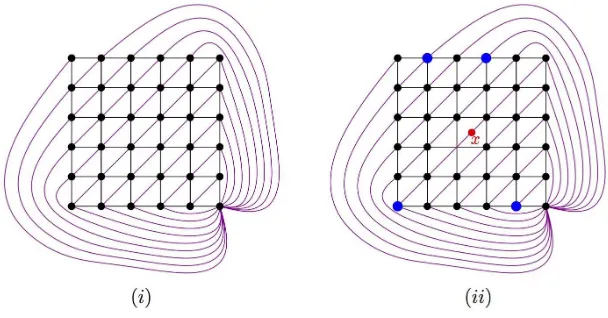
faces of the (k×k)-grid such that all internal vertices become of degree 6, all non-corner external vertices are of degree 4, and then one corner of degree two is joined by edges – we call themexternal– with all vertices of the external face (thecornersare the vertices that in the underlying grid have degree two). Graph Γ6 is shown in Fig. 6.(i). We also
define the graph Γ∗
k as the graph obtained from Γk if we remove all its external edges.
In Γ∗k we call all vertices incident to its unique non-triangle faceperimetric. Let G = (G′, T) be a rooted Σ
0-embedded graph. Given x ∈ V(G′) we define the
insulation between x and T, denoted insT(x) as the maximum length of a sequence of
T-concentric cycles C1, . . . , Cl in G such that (i) {x} ∩Si∈{1,...,l}Ci = ∅ and (ii) every
line of Σ0 connecting x and some vertex of T meets every Ci, i ∈ {1, . . . , l} For an
example, see Figure 6.(ii). We define theplanar thicknessof a rooted graphG= (G′, T) as follows:
pthT(G) = max{insT(x)|x∈V(G′)}.
It is easy to verify thatpth is closed under contractions. In other words, the following holds.
Lemma 7. Let G1 = (G′1, T1) and G2 = (G′2, T2) be two rooted graphs where G′1 is a σ-contraction ofG′2 and T1=σ(T2).Then pthT1(G1)≤pthT2(G2).
Lemma 8. Let G = (G′, T) be a rooted plane graph where tw(G′) ≥ 24·(2l+ 2r+ 2)(⌈p
|T|+ 1⌉) + 49.Let also T′=S
t∈T NGr′(t). ThenpthT′(G)≥l.
Proof. By using [7, Lemma 6], the graph G′ contains as a σ-contraction the graph
H′ = Γ(2l+2r+2)(⌈√|T|+1⌉).Define the rooted graphH = (H′, TH) whereTH =σ(T).We
consider a vertex packing ofH′ in|T|+ 1 copies of Γ∗
2l+2r+2.By the pigeonhole principle
and the fact that|TH| ≤ |T|, one, sayZ, of these copies does not contain any vertex in
TH.By Observation 1, contractions do not increase distances, hence σ(T′)⊆NHr′(TH).
Let Z′ be the subgraph of Z that is isomorphic to Γ∗2l+2 whose vertices have distance at least r from the perimetric vertices of Z and therefore are also at distance strictly greater than r from TH.We conclude that V(Z′)∩σ(T′) =∅. Notice that Z′ contains
l+ 1σ(T′)-concentric cyclesC1, . . . , Cl, Cl+1 that are alsoσ(T′)-concentric cycles ofH.
Let x ∈ Cl+1. Then the cycles C1, . . . , Cl certify that insσ(T′)(x) ≥ l. Therefore pthσ(T′)(H′)≥l. By Lemma 7, we conclude thatpthT′(G)≥l.
We need the following theorem from [17]. We present it using the terminology of [5].
Proposition 1. There is a computable function g such that the following holds: Let Γ be a Σ0-embedded plane graph, L be a linkage of Γ and let T be the set of vertices
in the pairs of π(L). Let also C1, . . . , Cg(|π(L)|) be T-concentric cycles of Γ. Then there
is a linkage L′ with the same pattern as L such that all paths in L are contained in ∆ext(Cg(|π(L)|)).
5.3 The algorithm
Using Lemmata 5, 7, 8, and Proposition 1, we can prove the following result.
Lemma 9. There is an FPTalgorithm, running in f2(k) ·n2, for some function f2,
that given a τ = (˜J,H,˜ T˜) ∈ H and a legal bijection ρ: ˜T → T, checks whether Rτ is
ρ-realizable in G.
Proof. As the number of bijectionsφ:{1, . . . , λ} → {1, . . . , λ}is bounded by a function ofkit is enough to show how to check in FPTtime whether, fori= 1, . . . , λ,Ri
τ is a ˆρi
-rooted topological minor ofG∗φ(i)were ˆρi =ρi∪{(xinew, x∗newi )}.To simplify notation, we
drop indices and we denoteRi
τ = (R′τi,T˜i∪ {xinew}) andG∗φ(i)= (G′φ(i), Tφ(i)∪ {x∗
φ(i)
new })
by R= (R′,T˜∪ {xnew}) and G∗ = (G′, T ∪ {x∗new}) respectively. We also use ˆρ instead
of ˆρi andxnew instead ofxinew.
We now apply the irrelevant vertex technique, introduced in [19] as follows. Using the algorithm from [2] (or, alternatively, the one from [15]) one can either compute a tree-decomposition ofG′of width at mostq = 4·(24·(2·g(|E(R′)|) + 8)(p
tw(G′)≤q, we recall that|E(R′)|is a function of k and |T| ≤2k. Consequently, there exists a functionf3 such that tw(G′)≤f3(k) and the result follows from Lemma 10 in
the Appendix.
Suppose now thattw(G′)≥q/4 = 24·(2·g(|E(R′)|) + 8)(p
|T|+ 2) + 49.Applying Lemma 8 forr= 3 we have that pthT′(G∗)≥g(|E(R′)|) whereT′=NG3′(T∪ {x∗new}).
We now prove that there is a vertexx∈V(G∗) such that ifRis a ˆρ-rooted topological minor of G∗ then R is a ˆρ-rooted topological minor of G∗\ {x}. Let ψ
0 and ψ1 be the
functions certifying that R is a ˆρ-rooted topological minor of G∗.We apply on ψ0 and ψ1 the modifications of the Lemma 5 so that they satisfy Properties 1–4. An important
consequence is that the images of all vertices of R under ψ0 are close to terminals
in T. Indeed, from Properties 1 and 2, all neighbors of xnew are mapped via ψ0 to
vertices that belong in NG1′(x∗new). Moreover, from Properties 3 and 4 it follows that ψ0(V(˜J)) ⊆ V(F) ⊆ NG2′(x∗new). So far we have proved that all vertices of R, except
those inside ˜J, are mapped via ψ0 to vertices inNG2′(x∗new).As all vertices ofR that are inside ˜J belong to ˜T, it follows thatψ0(V(R))⊆T′.
The setL={ψ1(e)|e∈E(R)}is a set of paths inG∗.LetL1 ⊆Lbe the set of those
paths that have length at most 2 and defineL2 =L\L1.For each pathQ∈L2 define its
interior, denoted int(Q),as the subpath ofQ consisting of all vertices ofI(Q).Clearly,
L = {int(Q) |Q ∈ L2} is a linkage in G∗ and π(L) ⊆ T′.Consider the collection C of T′-concentric cycles C1, . . . , Cg(|E(R′)|) certifying the fact that pthT′(G∗)≥ g(|E(R′)|). Define the graph Γ = (clos(∆in(C1))∩G∗)∪
S
Q∈L2int(Q)
.We have that (i) L is a linkage of Γ,and (ii) |E(R′)| ≥ |π(L)|.Letx be a vertex of Cg(|π(L)|). By Proposition 1
there is another linkageL′ with the same pattern asLsuch that all paths inL′ avoidx. The vertices of all paths inL1 belong toT′ since they are at distance at most 3 from T ∪x∗new. The endpoints of all paths in L2 also belong T′ since they are at distance
at most 2 from T ∪x∗
new. Therefore all paths in L1 and the endpoints of all paths in L2 avoid Γ altogether. We now show that all paths in L can be rerouted so that they
avoid x, while they remain internally vertex-disjoint. The paths in L1 stay the same.
For the paths inL2,we only have to reroute their interiors within Γ.This is achieved by
connecting the pairs in π(L) via the linkage L′. After this substitution all paths in the updated set L avoid x.By updating ψ1 to reflect the new interiors of the paths inL2,
we obtain thatR is a ˆρ-rooted topological minor ofG∗\ {x}.
From Lemmata 6 and 9 we obtain Theorem 1.
6
Further extensions and open problems
We chose to tackle the disjoint-paths completion problem with the topological restriction of having non-crossing patch edges. A natural extension of this problem is to allow a fixed numberξ >0 of crossings in the patch. We believe that, using the same techniques, one may devise an f(k)·n2 algorithm for this problem as well. The only substantial difference is a generalization of our combinatorial result (Theorem 2) under the presence of crossings.
An interesting topic for future work is to define and solve the disjoint-paths com-pletion problem for graphs embedded in surfaces of higher genus. A necessary step in this direction is to extend Theorem 2 for the case where the face to be patched contains handles.
Another issue is to extend the whole approach for the case where the faces to be patched are more than one. This aim can be achieved without significant deviation from our methodology, in case the number of these faces is bounded. However, when this restriction does not apply, the problem seems challenging and, in our opinion, it is not even clear whether it belongs toFPT.
Acknowledgement. We wish to thank the anonymous reviewers of an earlier version of this paper for valuable comments and suggestions.
References
[1] I. Adler, S. G. Kolliopoulos, P. K. Krause, D. Lokshtanov, S. Saurabh, and D. M. Thilikos, Tight bounds for linkages in planar graphs, in Proceedings of the 38th International Colloquium on Automata, Languages and Programming (ICALP 2011), 2011.
[2] E. Amir, Efficient approximation for triangulation of minimum treewidth, in Un-certainty in Artificial Intelligence: Proc. of the Seventeenth Conference (UAI-2001), San Francisco, CA, Morgan Kaufmann Publishers, 2001, pp. 7–15.
[3] B. Courcelle,The monadic second-order logic of graphs. I. Recognizable sets of finite graphs, Information and Computation, 85 (1990), pp. 12–75.
[5] A. Dawar, M. Grohe, and S. Kreutzer, Locally excluding a minor, in Proc. of the 21st IEEE Symposium on Logic in Computer Science (LICS’07), New York, 2007, IEEE, pp. 270–279.
[6] R. Diestel, Graph theory, vol. 173 of Graduate Texts in Mathematics, Springer-Verlag, Berlin, third ed., 2005.
[7] F. V. Fomin, P. Golovach, and D. M. Thilikos,Contraction bidimensionality: the accurate picture, in 17th Annual European Symposium on Algorithms (ESA ’09), Lecture Notes in Computer Science, Springer Verlag, 2009, pp. 706–717.
[8] M. R. Garey and D. S. Johnson,Computers and Intractability, A Guide to the Theory of NP-Completeness, W.H. Freeman and Company, New York, 1979.
[9] M. C. Golumbic, H. Kaplan, and R. Shamir, On the complexity of DNA physical mapping, Adv. in Appl. Math., 15 (1994), pp. 251–261.
[10] M. Grohe, K. Kawarabayashi, D. Marx, and P. Wollan, Finding topolog-ical subgraphs is fixed-parameter tractable, in 43rd ACM Symposium on Theory of Computing (STOC 2011), San Jose, California, June 6-8 2011.
[11] P. Heggernes, C. Paul, J. A. Telle, and Y. Villanger,Interval completion with few edges, in Proceedings of the 39th Annual ACM Symposium on the Theory of Computing (STOC 2007), San Diego, California, American Mathematical Society, 2007, pp. 374–381.
[12] H. Kaplan, R. Shamir, and R. E. Tarjan, Tractability of parameterized com-pletion problems on chordal, strongly chordal, and proper interval graphs, SIAM Journal on Computing, 28 (1999), pp. 1906–1922.
[13] K. Kawarabayashi and P. Wollan, A shorter proof of the graph minor algo-rithm - the unique linkage theorem, in Proc. of the 42nd annual ACM Symposium on Theory of Computing (STOC 2010), 2010.
[14] M. R. Kramer and J. van Leeuven,The complexity of wire-routing and finding minimum area layouts for arbitrary VLSI circuits, Advances in Comp. Research, 2 (1984), pp. 129–146.
[16] B. A. Reed, N. Robertson, A. Schrijver, and P. D. Seymour, Finding disjoint trees in planar graphs in linear time, in Graph structure theory (Seattle, WA, 1991), vol. 147 of Contemp. Math., Amer. Math. Soc., Providence, RI, 1993, pp. 295–301.
[17] N. Robertson and P. Seymour, Graph minors. XXII. Irrelevant vertices in linkage problems, preprint, 1992.
[18] N. Robertson and P. Seymour, Graph minors. XXI. Graphs with unique link-ages, J. Combin. Theory Ser. B, 99 (2009), pp. 583–616.
[19] N. Robertson and P. D. Seymour, Graph minors. XIII. The disjoint paths problem, J. Combin. Theory Ser. B, 63 (1995), pp. 65–110.
Appendix
A.1 MSOL and rooted topological minors
In this section we define a parameterized version of Rooted Topological Minor Testing that uses treewidth as a parameter and we show, using Monadic Second Order Logic (msol), that it is in FPT. The corresponding algorithm will be used as a subroutine in the proof of Theorem 1.
p-Bounded Treewidth Rooted Topological Minor Test-ing
Input: a rooted graph (H, SH), a rooted graph (H, SG), and a
bijection ρ:SH →SG.
Parameter: k=tw(G) +|V(H)|
Question: is (H, SH) is a ρ-rooted topological minor of the rooted
graph (G, SG)?
Lemma 10. p-Bounded Treewidth Rooted Topological Minor Testing can
be solved in f(k)· |V(G)| steps.
Proof. LetSH ={a1, . . . , as}, letV(H)\SH ={u1, . . . , ut}, and letE(H) ={e1, . . . , eǫ}.
Let τs = {VERT,EDGE, I, c1, . . . cs} be the vocabulary of graphs (as incidence
struc-tures) with sconstants. We give an msol[τs] formula φH,SH such that for every graph
G with SG = {b1, . . . , bn} and ρ(ai) = bi we have that (G, b1, . . . , bs) |= φH,SH ⇐⇒
(H, SH) is a ρ-rooted topological minor of (G, SG).
Letpath(x, y, Z) be themsol[τs] formula stating thatZ is a path fromxtoy.(This