City, University of London Institutional Repository
Citation:
Bond, R. L., He, Y-H. ORCID: 0000-0002-0787-8380 and Ormerod, T. C. (2018).
A quantum framework for likelihood ratios. International Journal of Quantum Information,
16(1), 1850002.. doi: 10.1142/S0219749918500028
This is the accepted version of the paper.
This version of the publication may differ from the final published
version.
Permanent repository link:
http://openaccess.city.ac.uk/20367/
Link to published version:
http://dx.doi.org/10.1142/S0219749918500028
Copyright and reuse: City Research Online aims to make research
outputs of City, University of London available to a wider audience.
Copyright and Moral Rights remain with the author(s) and/or copyright
holders. URLs from City Research Online may be freely distributed and
linked to.
City Research Online:
http://openaccess.city.ac.uk/
[email protected]
arXiv:1508.00936v1 [math.ST] 4 Aug 2015
Rachael L. Bond∗ and Thomas C. Ormerod† The School of Psychology, The University of Sussex,
Falmer, East Sussex, BN1 9QH, United Kingdom.
Yang-Hui He‡
Department of Mathematics, City University, London, EC1V 0HB, United Kingdom, and School of Physics, NanKai University, Tianjin, 300071, P.R. China, and and
Merton College, Oxford University, Oxford, OX1 4JD, United Kingdom. (Dated: August 6, 2015)
The ability to calculate precise likelihood ratios is fundamental to many STEM areas, such as decision-making theory, biomedical science, and engineering. However, there is no assumption-free statistical methodology to achieve this. For instance, in the absence of data relating to covari-ate overlap, the widely used Bayes’ theorem either defaults to the marginal probability driven “naive Bayes’ classifier”, or requires the use of compensatory expectation-maximization techniques. Equally, the use of alternative statistical approaches, such as multivariate logistic regression, may be confounded by other axiomatic conditions, e.g., low levels of co-linearity. This article takes an information-theoretic approach in developing a new statistical formula for the calculation of likeli-hood ratios based on the principles of quantum entanglement. In doing so, it is argued that this quantum approach demonstrates: that the likelihood ratio is a real quality of statistical systems; that the naive Bayes’ classifier is a special case of a more general quantum mechanical expression; and that only a quantum mechanical approach can overcome the axiomatic limitations of classical statistics.
In recent years, Bayesian statistical research has often been epistemologically driven, guided by de Finetti’s famous quote that “probability does not exist”[1]. For example, the “quantum Bayesian” methodology of Caves, Fuchs, & Schack[2] has applied de Finetti’s ideas to Bayes’ theorem for use in quantum mechanics. In doing so, Caves et al. have argued that statistical systems are best interpreted by methods in which the Bayesian likelihood ratio is seen to be both external to the system and subjectively imposed on it by the observer[3].
From a decision-making perspective the Caves et al. approach is problematic. Bayes’ theorem and, in particular, the “naive Bayes’ classifier” have been used extensively to interpret information systems and develop normative decision-making models[4]. While subjectivity may play a role in a descriptive model of human decision-making, its use in normative analysis could suggest the presence of a cognitive “homonculus” with the power to influence decision outcomes. Yet at a human scale, for instance, an observer’s belief as to the chances of a fair coin landing either “heads” or “tails” has no known effect. Rather, within normative decision-making theory, the “heads:tails” likelihood ratio of 0.5:0.5 is only meaningful when considered as a property of the coin’s own internal statistical system rather than as some ephemeral and arbitrary qualia.
∗[email protected] †[email protected] ‡[email protected]
However, there are axiomatic difficulties associated with Bayes’ theorem, notably its reliance upon the use of marginal probabilities in the absence of structural sta-tistical information, such as estimates of covariate over-lap. This has led some researchers to attempt to recon-ceptualise psychology and decision-making theory using quantum mechanics[5, 6] - an approach with intuitive merit given that both disciplines apply statistical axioms to analyse and interpret probabilistic systems. Yet, de-spite progress made in this area, the lack of an orthodox Copenhagen-based theoretical counterpoint to Caves et al. has impeded the development of new normative mod-els. It is this knowledge gap which this article aims to fill.
I. THE LIMITS OF BAYES’ THEOREM
Bayes’ theorem is used to calculate the conditional probability of a statement, or hypothesis, being true given that other information is also true. It is usually written as
P(Hi|D) =
P(Hi)P(D|Hi)
P
j
P(Hj)P(D|Hj)
. (1)
Here,P(Hi|D) is the conditional probability of
hypoth-esisHi being true given that the information D is true;
P(D|Hi)is the conditional probability ofD being true if
Hiis true; andP j
P(Hj)P(D|Hj)is the sum of the
2
Street A (H1) Street B(H2)
Number of houses(n) 10 10
% blue front door(D) 0.8 0.7
% not blue front door ( ¯D) 0.2 0.3
(2)
To exemplify using the contingency information in (2), if one wishes to calculate which of two streets is most likely to have a house with a blue front door, then using Bayes’ theorem it is trivial to calculate that Street A is most likely with a likelihood ratio of approximately 0.53:0.47,
P(H1|D) =
0.5×0.8
(0.5×0.8) + (0.5×0.7) = 8
15 ≈0.533,
P(H2|D) = 1−P(H1|D) = 7
15 ≈0.467,
(3)
whereP(Hi) = 10/(10 + 10) = 0.5for bothi= 1,2.
However, difficulties arise in the use of Bayes’ theorem for the calculation of likelihood ratios where there are multiple non-exclusive data sets. For instance, if the in-formation in (2) is expanded to include data about the number of houses with a garage (4) then the precise co-variate overlap (i.e.,D1∩D2) for each street becomes an unknown.
Street A(H1) Street B(H2)
Number of houses (n) 10 10
% blue front door(D1) 0.8 0.7
% with garage(D2) 0.6 0.5
(4)
All that may be shown is that, for each street, the num-ber of houses with both features forms a range described by (5), wheren(Hi)is the total number of houses in street
i,n(D1|Hi)is the total number of houses in streetiwith
a blue front door, and n(D2|Hi) is the total number of
houses in streetiwith a garage,
n(D1∩D2|Hi)∈
h
n(D1|Hi) +n(D2|Hi)−n(Hi), . . . ,min(n(D1|Hi), n(D2|Hi))
i
ifn(D1|Hi) +n(D2|Hi)> n(Hi), or
h
0, . . . ,min(n(D1|Hi), n(D2|Hi))
i
ifn(D1|Hi) +n(D2|Hi)≤n(Hi).
(5)
Specifically for (4) these ranges equate to
n(D1∩D2|H1)∈ {4, 5, 6},
n(D1∩D2|H2)∈ {2, 3, 4, 5} . (6)
The simplest approach to resolving this problem is to naively ignore any intersection, or co-dependence, of the data and to directly multiply the marginal probabilities[7–9, for example]. Hence, given (4), the like-lihood of Street A having the greatest number of houses with both a blue front door and a garage would be cal-culated as
P(H1|D1∩D2) =
0.5×0.8×0.6
(0.5×0.8×0.6) + (0.5×0.7×0.5)
≈0.578. (7)
Yet, because the data intersect, this probability value is only one of a number which may be reasonably calcu-lated. Alternatives include calculating a likelihood ratio using the mean valueµof the frequency ranges for each hypothesis
P(µ[n(D1∩D2|H1)]) =
1 10×
1
3(4 + 5 + 6) = 0.5,
P(µ[n(D1∩D2|H2)]) =
1 10×
1
4(2 + 3 + 4 + 5) = 0.35
⇒ P(H1|µD1∩D2)≈0.588 ;
(8)
and taking the mean value of the probability range de-rived from the frequency range
minP(H1|D1∩D2) =
4 4 + 5 ,
maxP(H1|D1∩D2) =
6 6 + 2
contin-gency data.
II. A QUANTUM MECHANICAL PROOF OF BAYES’ THEOREM FOR INDEPENDENT DATA
Previously unconsidered, the quantum mechanical von Neumann axioms would seem to offer the most promise in this regard, since the re-conceptualization of covariate data as a quantum entangled system allows for statisti-cal analysis with few, non-arbitrary assumptions. Unfor-tunately there are many conceptual difficulties that can arise here. For instance, a Dirac notation representation of (4) as a standard quantum superposition is
|Ψi=√1
N
α r
1
3|4iH1+
r
1
3|5iH1+
r
1
3|6iH1
+β r
1
4|2iH2+
r
1
4|3iH2+
r
1
4|4iH2+
r
1
4|5iH2
.
(10)
In this example, (10) cannot be solved since the possible values of D1 ∩D2 for each hypothesis (6) have been
described as equal chance outcomes within a general su-perposition ofH1andH2, with the unknown coefficients
α and β assuming the role of the classical Bayesian likelihood ratio.
The development of an alternative quantum mechani-cal description necessitates a return to the simplest form of Bayes’ theorem using the case of exclusive populations
Hi and data sets D, D¯, such as given in (2). Here, the
overall probability ofH1may be simply calculated as
P(H1) =
n(H1)
n(H1) +n(H2) . (11)
The a priori uncertainty in (2) may be expressed by con-structing a wave function in which the four data points are encoded as a linear superposition
|Ψi=α1,1|H1⊗Di+α1,2 H1⊗D¯
+α2,1|H2⊗Di+α2,2 H2⊗D¯
. (12)
Since there is no overlap between eitherD andD¯ or the populationsH1andH2, each datum automatically forms
an eigenstate basis with the orthonormal conditions
hH1⊗D|H1⊗Di=
H1⊗D¯|H1⊗D¯
= 1
hH2⊗D|H2⊗Di=
H2⊗D¯|H2⊗D¯
= 1
all other bra-kets = 0, (13)
where the normalization of the wave function demands that
hΨ|Ψi= 1 , (14)
so that the sum of the modulus squares of the coefficients
αi,j gives a total probability of 1
|α1,1|2+|α1,2|2+|α2,1|2+|α2,2|2= 1. (15)
For simplicity let
x1=P(D|H1), y1=P( ¯D|H1),
x2=P(D|H2), y2=P( ¯D|H2),
X1=P(H1), X2=P(H2). (16)
If the coefficients αi,j from (12) are set as required by
(2), it follows that
|α1,1|2=x1, |α1,2|2=y1, |α2,1|2=x2, |α2,2|2=y2,
(17) so that the normalised wave function|Ψiis described by
|Ψi= √1
N(
√x
1|H1⊗Di+√y1
H1⊗D¯
+√x2|H2⊗Di+√y2 H2⊗D¯
) (18)
for some normalization constantN.
The orthonormality condition (14) implies that
N =x1+y1+x2+y2=X1+X2, (19) thereby giving the full wave function description
|Ψi= √x
1|H1⊗Di+√y1
H1⊗D¯
+√x2|H2⊗Di+√y2
H2⊗D¯
√
X1+X2
.
(20)
If the value ofP(H1|D)is to be calculated, i.e., the prop-erty D is observed, then the normalized wave function (12) necessarily collapses to
|Ψ′i=α1|H1⊗D1i+α2|H2⊗D1i , (21)
where the coefficients α1,2 may be determined by
pro-jecting|Ψion to the two terms in|Ψ′iusing (13), giving
α1=hΨ′|H
1⊗Di=
r x 1
X1+X2 ,
α2=hΨ′|H2⊗Di= r
x2
X1+X2
. (22)
Normalizing (21) with the coefficientN′
Ψ
′
= √1
N′
r x
1
X1+X2 |
H1⊗Di+
r
x2
X1+X2|
H2⊗Di
,
4
and using the normalization condition (14), implies that
1 =hΨ′|Ψ′i= 1
N′
x1
X1+X2
+ x2
X1+X2
→N′ = x1+x2
X1+X2
. (24)
Thus, after collapse, the properly normalized wave func-tion (23) becomes
|Ψ′i=
r x 1
x1+x2|
H1⊗Di+ r x
2
x1+x2|
H2⊗Di ,
(25) which means that the probability of observing|H1⊗Di is
P(|H1⊗Di) =
r x 1
x1+x2
!2
= α21
α2
1+α22
= x1
x1+x2 .
(26)
This is entirely consistent with Bayes’ theorem and demonstrates its derivation using quantum mechanical axioms.
III. A QUANTUM MECHANICAL EXPRESSION TO CALCULATE LIKELIHOOD
RATIOS, WITH CO-DEPENDENT DATA
Having established the principle of using a quantum mechanical approach for the calculation of simple likeli-hood ratios with mutually exclusive data (2), it is now possible to consider the general case ofnhypotheses and
mdata (27), where the data are co-dependent, or inter-sect.
H1 H2 · · · Hn
D1 x1,1 x1,2 · · · x1,n
D2 x2,1 x2,2 · · · x2,n
..
. ... ...
Dm xm,1 xm,2 · · · xm,n
(27)
Here the contingency table in (27) has been indexed using
xi,α , α= 1,2, . . . , n; i= 1,2, . . . , m . (28)
While the general wave function remains the same as be-fore, the overlapping data create non-orthonormal inner
products which can be naturally defined as
hHα⊗Di|Hβ⊗Dji=cijαδαβ , cαij =cαji∈R, cαii= 1 ,
(29) Assuming, for simplicity, that the overlaps cα
ij are real,
then there is a symmetry in that cα
ij = cαji for each α.
Further, for each αand i, the state is normalized, i.e.,
cα
ii = 1. The given independence of the hypothesesHα
also enforces the Kroenecker delta function,δαβ.
The Hilbert space V spanned by the kets |Hα⊗Dii
is mn-dimensional and, because of the independence of
Hα, naturally decomposes into the direct sum (30) with
respect to the inner product, thereby demonstrating that the non-orthonormal conditions are the direct sum ofm
vector spacesVα:
V =Span({|Hα⊗Dii}) = n
M
α=1
Vα, dimVα=m .
(30) Since the inner products are non-orthonormal, each
Vα must be individually orthonormalised. Given that
V splits into a direct sum, this may be achieved for each subspace Vα by applying the Gram-Schmidt
algorithm[13] to {|Hα⊗Dii} of V. Consequently, the
orthonormal basis may be defined as
|Kα ii=
n
X
k=1
Aα
i,k|Hα⊗Dki ,
Kα i|Kjα
=δij ,
(31) for each α = 1,2, . . . , n with m×m matrices Aα
i,k, for
eachα.
Substituting the inner products (29) gives
m
X
k,k′=1
Aα
ikAαjk′cαkk′ =δij ∀α= 1,2, . . . , n . (32)
The wave-function may now be written as a linear com-bination of the orthonormalised kets |Kα
ii with the
co-efficients bα
i, and may be expanded into the |Hα⊗Dii
basis using (31), i.e.,
|Ψi=X
α,i
bα
i |Kiαi=
X
α,i,k
bα
iAαik|Hα⊗Dki . (33)
As with (17) from earlier, the coefficients in (33) should be set as required by the contingency table
X
i
bαiAαi,k =
√
xkα , (34)
where, to solve for theb-coefficients, (32) may be used to invert
X
k,k′
X
i
bαiAαikAjk′cαkk′ =
X
k,k′
√
giving
bαj =
X
k,k′
√x
kαAαjk′c α
kk′ . (36)
Having relabelled the indices as necessary, a back-substitution of (34) into the expansion (33) gives
|Ψi= X
α,i,k
bα
iAαi,k|Hα⊗Dki=
X
α,k
√x
kα|Hα⊗Dki ,
(37) which is the same as having simply assigned each ket’s coefficient to the square root of its associated entry in the contingency table.
The normalization factor for |Ψi is simply 1/√N, whereN is the sum of the squares of the coefficientsbof the orthonormalised bases|Kα
i i,
N =X
i,α
(bαi)2=
X
i,α
bαi
X
k,k′
√
xkαAαk′,icαkk′
= X
k,k′,α
√x
kαxk′αcαkk′ . (38)
Thus, the final normalized wave function is
|Ψi=
P
α,k
√x
kα|Hα⊗Dki
rP
i,j,α
√x
iαxjαcαij
, (39)
where α is summed from 1 to n, and i, j are summed from 1 to m. Note that, in the denominator, the diagonal term√xiαxjαcαij, which occurs wheneveri=j,
simplifies toxiαsincecαii = 1for allα.
From (39) it follows that, exactly in parallel to the non-intersecting case, if all properties Di are observed
simultaneously, the probability of any hypothesisHα, for
a fixedα, is
P(Hα|D1∩D2. . .∩Dm) =
P
i
(bα i)2
P
i,α
(bα i)2
=
P
i,j
√x
iαxjαcαij
P
i,j,α
√x
iαxjαcαij
,
(40)
In the case of non-even populations for each hypothesis (i.e., non-even priors), each element within (40) should be appropriately weighted.
IV. EXAMPLE SOLUTION
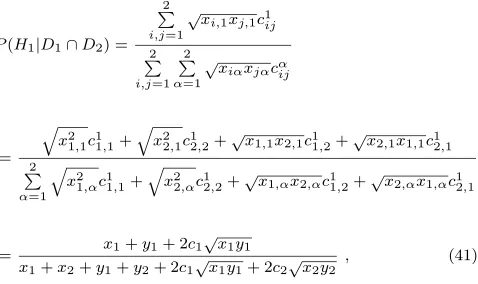
Returning to the problem presented in the contingency table (4), it is now possible to calculate the precise prob-ability for a randomly selected house with the properties of “blue front door” and “garage” belonging to Street A (H1). For this 2 ×2 matrix, recalling from (29) that
cα
ii= 1andcαij=cαji, the general expression (40) may be
written as
P(H1|D1∩D2) = 2
P
i,j=1 √x
i,1xj,1c1ij
2 P i,j=1 2 P α=1 √x
iαxjαcαij
=
q
x2 1,1c11,1+
q
x2
2,1c12,2+√x1,1x2,1c11,2+√x2,1x1,1c12,1 2
P
α=1
q
x2 1,αc11,1+
q
x2
2,αc12,2+√x1,αx2,αc11,2+√x2,αx1,αc12,1
= x1+y1+ 2c1 √x
1y1
x1+x2+y1+y2+ 2c1√x1y1+ 2c2√x2y2
, (41)
where, adhering to the earlier notation (16),
x1=x1,1=P(D1|H1), y1=x2,1=P(D2|H1),
x2=x1,2=P(D1|H2), y2=x2,2=P(D2|H2),
X1=P(H1), X2=P(H2), (42) and, for brevity, c1 := c1
1,2 , c2 := c21,2 . For simplicity,
P(Hi|D1∩D2)will henceforth be denoted asPi.
Imple-menting (41) is dependent upon deriving solutions for the yet unknown expressionsci,i= 1,2which govern the
ex-tent of the intersection in (29). This can only be achieved by imposing reasonable constraints uponci which have
been inferred from expected behaviour and known out-comes, i.e., through the use of boundary values and sym-metries. Specifically, these constraints are:
Data dependence.: The expressions ci must, in some
way, be dependent upon the data given in the con-tingency table, i.e.,
c1=c1(x1, y1, x2, y2;X1, X2),
c2=c2(x1, y1, x2, y2;X1, X2). (43)
Probability.:The calculated values forPi must fall
be-tween 0 and 1. Since xi and yi are positive, it
suffices to take
−1 < ci(x1, y1, x2, y2) < 1 . (44)
Complementarity.:The law of total probability dic-tates that
P1+P2= 1, (45)
which can easily be seen to hold.
Symmetry.: The exchanging of rows within the contin-gency tables should not affect the calculation ofPi.
In other words, for each i = 1,2, Pi is invariant
underxi↔yi. This constraint implies that
ci(x1, y1, x2, y2) =ci(y1, x1, y2, x2). (46)
[image:6.612.323.562.81.223.2]6
map to each other, i.e., for eachi= 1,2thenP1↔
P2underx1↔x2, y1↔y2which gives the further
constraint that
c1(x1, y1, x2, y2) =c2(x2, y2, x1, y1). (47)
Known values.: There are a number of contingency ta-ble structures which give rise to a known probabil-ity, i.e.,
H1 H2
D1 1 1
D2 m n
→ P1= m
m+n
H1 H2
D1 m n D2 1 1
→ P1=
m m+n
H1 H2
D1 n m D2 m n
→ P1=
1 2
H1 H2 D1 n n D2 m m
→ P1=
1 2
H1 H2 D1 m m
D2 m m
→ P1=
1
2 , (48)
where m, nare positively valued probabilities. For such contingency tables the correct probabilities should always be returned by ci. Applying this
principle to (41) gives the constraints
m m+n=
2c1(m,1, n,1)√m+m+ 1
2c1(m,1, n,1)√m+ 2c2(m,1, n,1)√n+m+n+ 2
,
(49)
1 2=
2c1(n, m, m, n)√m√n+m+n
2c1(n, m, m, n)√m√n+ 2c2(n, m, m, n)√m√n+ 2m+ 2n
,
(50)
1 2=
2c1(n, m, n, m)√m√n+m+n
2c1(n, m, n, m)√m√n+ 2c2(n, m, n, m)√m√n+ 2m+ 2n
.
(51)
Non-homogeneity.:Bayes’ theorem returns the same probability for any linearly scaled contingency
ta-bles, e.g.,
x1→1.0, y1→1.0, x2→1.0, y2→0.50⇒P1≈0.667, (52)
x1→0.5, y1→0.5, x2→0.5, y2→0.25⇒P1≈0.667. (53) While homogeneity may be justified for condition-ally independent data, this is not the case for inter-secting, co-dependent data since the act of scaling changes the nature of the intersections and the rela-tionship between them. This may be easily demon-strated by taking the possible value ranges for (52) and (53), calculated using (5), which are
Eq. (52)⇒(D1∩D2)|H1={1} ,
(D1∩D2)|H2={0.5},
Eq. (53)⇒(D1∩D2)|H1={0.0. . .0.5} ,
(D1∩D2)|H2={0.0. . .0.25}. (54)
The effect of scaling has not only introduced uncer-tainty where previously there had been none, but has also introduced the possibility of 0 as a valid an-swer for both hypotheses. Further, the spatial dis-tance between the hypotheses has also decreased. For these reasons it would seem unreasonable to assert that (52) and (53) share the same likelihood ratio.
Using these principles and constraints it becomes possible to solveci. From the principle of symmetry it follows that
c1(n, m, m, n) =c2(m, n, n, m) =c2(n, m, m, n),
c1(n, m, n, m) =c2(n, m, n, m) =c2(n, m, n, m), (55) and that the equalities (50), (51) forPi= 0.5
automati-cally hold. Further, (49) solves to give
c2(m,1, n,1) =
2√mnc1(m,1, n,1)−m+n
2m√n , (56)
which, becausec1(n,1, m,1) =c2(m,1, n,1), finally gives
c1(n,1, m,1) =
2√mnc1(m,1, n,1)−m+n
2m√n . (57)
Substitutingg(m, n) :=√nc1(m,1, n,1)transforms (57)
into an anti-symmetric bivariate functional equation in
m, n,
g(m, n)−g(n, m) = m 2√mn−
n
2√mn , (58)
whose solution isg(m, n) = m
This gives a final solution for the coefficientsc1,2 of
c1(x1, y1, x2, y2) =
√x
1y1
2x2y2 , c2(x1, y1, x2, y2) =
√x
2y2
2x1y1
. (59)
Thus, substituting (59) into (41) gives the likelihood ratio expression of,
P(H1|D1∩D2) =
x1y1
x2y2 +x1+y1
x1y1
x2y2 +x1+y1+
x2y2
x1y1 +x2+y2
.
(60) Given that the population sizes of H1 and H2 are the same, no weighting of the elements needs to take place. Hence, the value ofP(H1|D1∩D2) for (4) may now be
calculated to be
P(H1|D1∩D2)≈0.5896. (61)
V. DISCUSSION
One of the greatest obstacles in developing any statistical approach is demonstrating correctness. This formula is no different in that respect. If correctness could be demonstrated then, a priori, there would be an appropriate existing method which would negate the need for a new one. All that may be hoped for in any approach is that it generates appropriate answers when they are known, reasonable answers for all other cases, and that these answers follow logically from the underlying mathematics.
However, what is clear is that the limitations of the naive Bayes’ classifier render any calculations derived from it open to an unknown margin of error. Given the importance of accurately deriving likelihood ratios this is troubling. This is especially true when these calculations are used to describe normative psychological theories [7] from which inferences are drawn as to the failure of human logic.
As a quantum mechanical methodology this result is able to calculate accurate, iteration free, likelihood ratios which fall beyond the scope of existing statistical techniques, and offers a new theoretical approach within cognitive psychology. Further, through the addition of a Hamiltonian operator to introduce time-evolution, it can offer likelihood ratios for future system states with ap-propriate updating of the contingency table. In contrast, Bayes’ theorem is unable to distinguish directly between time-dependent and time-independent systems. This
[image:8.612.340.561.261.326.2]may lead to situations where the process of contingency table updating results in the same decisions being made repeatedly with the appearance of an ever increasing degree of certainty. Indeed, from (26), it would seem that the naive Bayes’ classifier is only a special case of a more complex quantum mechanical framework, and may only be used where the exclusivity of data is guaranteed.
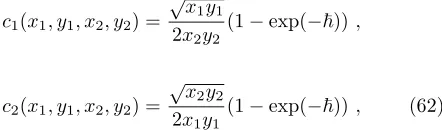
The introduction of a Hamiltonian operator, and a full quantum dynamical formalism, is in progress, and should have profound implications for cognitive psychology. In-evitably, such a formalism will require a sensible contin-uous classical limit. In other words, the final expressions for the likelihood ratios should contain a parameter, in some form of ~, which, when going to 0, reproduces a
classically known result. For example, the solutions to (59) could be moderated as
c1(x1, y1, x2, y2) =
√x
1y1
2x2y2
(1−exp(−~)),
c2(x1, y1, x2, y2) =
√x
2y2
2x1y1(1−exp(−~)), (62)
so that in the limit of~→0, the intersection parameters,
c1andc2, vanish to return the formalism to the classical situation of independent data.
VI. CONCLUSION
This article has demonstrated both theoretically, and practically, that a quantum mechanical methodology can overcome the axiomatic limitations of classical statistics in respect to their application within cognitive psychology. In doing so, it challenges the orthodoxy of de Finetti’s epistemological approach to statistics by demonstrating that it is possible to derive “real” likelihood ratios from information systems without recourse to arbitrary and subjective evaluations.
While further theoretical development work needs to be undertaken, particularly with regards to the applica-tion of these mathematics in other domains, it is hoped that this article will help advance the debate over the na-ture and meaning of statistics, particularly with respect to cognitive psychology and decision-making theory.
A. Citations and References
[1] B. de Finetti,Theory of probability: A critical introduc-tory treatment(Wiley, New York, New York, 1974).
8
R. Schack, Physical Review A66, 062111 (2002), arXiv:0206110 [quant-ph].
[3] C. G. Timpson, Studies in History and Philosophy of Science Part B: Studies in History and Philosophy of Modern Physics39, 579 (2008) [4] M. Oaksford and N. Chater, Bayesian rationality. The
probabilistic approach to human reasoning (Oxford Uni-versity Press, Oxford, England, 2007).
[5] A. Khrennikov, BioSystems95, 179 (2009).
[6] J. R. Busemeyer and P. D. Bruza, Quantum models of cognition and decision (Cambridge University Press, Cambridge, England, 2012).
[7] M. E. Doherty, C. R. Mynatt, R. D. Tweney, and M. D. Schiavo, Acta Psychologica43, 111 (1979).
[8] Feeney, A. and Evans, J. and Venn, S., Thinking & Reasoning14, 209 (2008).
[9] M. D’addario and L. Macchi, Psychology03, 489 (2012). [10] A. P. Dempster, N. M. Laird, and D. B. Rubin,
Journal of the Royal Statistical Society. Series B (Statistical Methodology) [11] C. F. J. Wu, The Annals of Statistics11, 95 (1983).
[12] D. Kahneman,Thinking, fast and slow(Farrar, Straus & Giroux, New York, New York, 2011).