Theses Thesis/Dissertation Collections
12-2014
A Computer Network Model for the Evaluation of
Moving Target Network Defense Mechanisms
Benjamin Fredrick Wheeler
Follow this and additional works at:http://scholarworks.rit.edu/theses
This Thesis is brought to you for free and open access by the Thesis/Dissertation Collections at RIT Scholar Works. It has been accepted for inclusion in Theses by an authorized administrator of RIT Scholar Works. For more information, please [email protected].
Recommended Citation
by
Benjamin Fredrick Wheeler
A Thesis Submitted in Partial Fulfillment of the Requirements for the Degree of Master of Science in Computer Engineering
Supervised by
Associate Professor Dr. Shanchieh Jay Yang Department of Computer Engineering
Kate Gleason College of Engineering Rochester Institute of Technology
Rochester, New York December 2014
Approved by:
Dr. Shanchieh Jay Yang, Associate Professor
Thesis Advisor, Department of Computer Engineering
Dr. Michael Kuhl, Professor
Committee Member, Department of Industrial & Systems Engineering
Dr. Andres Kwasinski, Associate Professor
Rochester Institute of Technology Kate Gleason College of Engineering
Title:
A Computer Network Model for the Evaluation of Moving Target Network Defense Mechanisms
I, Benjamin Fredrick Wheeler, hereby grant permission to the Wallace Memorial Library
to reproduce my thesis in whole or part.
Benjamin Fredrick Wheeler
Dedication
To my family, whose unconditional love and support have enabled me to pursue my goals
and dreams unafraid of failure. Also, to my friends, who have filled my college experience
with great times and memories that I will cherish forever. Finally, to my best friend and
soulmate, Bethany, whose daily expressions of love and encouragement both through words
and through actions have enabled me to accomplish things I would never have been able to
Acknowledgments
Thank you to my thesis committee, Dr. Yang, Dr. Kuhl, and Dr. Kwasinski, for their
support and guidance throughout my time working on this thesis, for believing in my ability
to do this, and for being able and willing to work around my schedule as I finished this thesis
while also working full-time. I have learned a lot and gained several new skills during my
time working on this thesis, and I appreciate having had the opportunity to do so.
Thank you also to the CASCADES design and development team, consisting of Dr.
Yang, Dr. Kuhl, Stephen Moskal, and Derek Kreider, for the many discussions that helped
shape the direction of this thesis and of the simulator itself, as well as the work done to
create the simulator, without which this thesis would not have been possible. CASCADES
is a top-of-the-line project in a relevant field with a very bright future, and I am grateful to
Abstract
A Computer Network Model for the Evaluation of Moving Target Network Defense Mechanisms
Benjamin Fredrick Wheeler
Supervising Professor: Dr. Shanchieh Jay Yang
In order to combat the increasing complexity of cyber attacks, a new category of cyber
defense called moving target network defense has been the focus of a significant amount of
work. Moving target network defense mechanisms aim to protect networks by modifying
their attributes in order to confuse would-be attackers. Currently, the majority of the
exist-ing mechanisms are purely theoretical and have been the subject of minimal performance
analysis. There has also been almost no effort to perform comparative analysis of different
techniques. As a result, there is a great need for a method of modeling different
mecha-nisms within a single system in order to conduct comprehensive, comparative performance
analysis.
This work develops the framework of a system called Dynamic Virtual Terrain (DVT),
which can be used for comparative analysis of moving target network defense mechanisms
under identical conditions. DVT models network topology using nodes, which represent
members of a network, and access permissions, which describe the connectivity of the
network. DVT also defines a generic moving target network defense algorithm that can
be extended in order to implement a hierarchy of techniques. An implementation of DVT
is created in order to perform experiments with IP address hopping, port hopping, and
dynamic firewall mechanisms in a cyber attack simulation environment. Attack scenarios
are developed to evaluate the performance of the mechanisms under identical conditions,
and the results of simulating these scenarios are used to analyze the performance of the
Contents
Dedication. . . iii
Acknowledgments . . . iv
Abstract . . . v
Glossary . . . xiii
Acronyms . . . xvi
1 Introduction. . . 1
1.1 Background . . . 1
1.2 Related Work . . . 3
1.2.1 Cyber Attack Simulation . . . 3
1.2.2 Cyber Attack Simulator . . . 4
1.2.3 Multistage Attack Scenario Simulator . . . 6
1.2.4 Attack Graphs . . . 9
1.3 Motivation . . . 11
2 Moving Target Network Defense Mechanisms . . . 13
2.1 Port and IP Address Hopping . . . 13
2.1.1 Port Hopping . . . 13
2.1.2 Network Address Hopping . . . 14
2.1.3 Random Port Hopping . . . 15
2.1.4 Full Service Hopping and End Hopping . . . 17
2.1.5 Spread Identity . . . 19
2.2 Dynamic Firewalls . . . 21
2.2.1 Traffic-Based Approaches . . . 21
2.2.2 Risk-Based Approaches . . . 22
2.3 Other Techniques . . . 24
2.4.1 Percent of Successful Attacks . . . 26
2.4.2 Percent of Partially Successful Attacks . . . 27
2.4.3 Mean Duration of Successful Attacks . . . 27
2.4.4 Defensive Effectiveness . . . 28
3 Dynamic Virtual Terrain . . . 30
3.1 Network Model . . . 30
3.1.1 Nodes . . . 31
3.1.2 Services . . . 32
3.1.3 Sensors . . . 32
3.1.4 Access Permissions . . . 33
3.2 Modeling Moving Target Network Defense Mechanisms . . . 33
3.2.1 Terrain Management . . . 34
3.2.2 Threat Detection . . . 35
3.2.3 General MTNDM Algorithm . . . 39
3.2.4 IP Address Hopping . . . 40
3.2.5 Port Hopping . . . 41
3.2.6 Dynamic Firewall . . . 42
3.3 Considerations for Cyber Attack Simulation . . . 42
3.3.1 Timing in an Event-Based System . . . 43
3.3.2 Attacker Knowledge vs. Simulator Knowledge . . . 43
3.3.3 Interaction with the Network . . . 44
4 Cyber Attack Scenario And Network Defense Simulator . . . 45
4.1 System Architecture . . . 45
4.1.1 Context Models . . . 46
4.1.2 Event Queue . . . 49
4.1.3 Distinguishing Between Perspectives . . . 50
4.2 Simulation Algorithms . . . 51
4.2.1 Similarities to MASS . . . 52
4.2.2 Validating Attempted Attacks . . . 52
4.2.3 Updating Attacker Knowledge . . . 53
5 Attack Scenarios . . . 55
5.1 Purpose . . . 55
5.2 Experimental Context Models . . . 56
5.2.2 Scenario Guidance Template . . . 57
5.2.3 Attacker Behavior Models . . . 58
5.3 Metric Calculation . . . 58
5.4 Assumptions and Constant Parameters . . . 59
6 Results and Analysis . . . 62
6.1 Finding a Baseline ABM . . . 62
6.1.1 Skill Level . . . 63
6.1.2 Stealth Level . . . 64
6.1.3 Attempts Per Node . . . 65
6.1.4 Attempts Per Exploit . . . 67
6.2 Time Driven MTNDMs . . . 68
6.3 Event Driven MTNDMs . . . 71
6.3.1 Threat Detection Through Node Observation . . . 71
6.3.2 Threat Detection Through IDS Sensor Alert Observation . . . 74
6.3.3 Threat Detection Through IDS Sensor Alert Detection . . . 77
6.4 Experimental Limitations . . . 79
6.5 Potential Flaws in CASCADES . . . 81
7 Conclusions . . . 83
8 Future Work . . . 85
8.1 Dynamic Virtual Terrain . . . 85
8.1.1 Additional Experiments . . . 85
8.1.2 Additional Implementations . . . 86
8.1.3 Expanding the Network Model . . . 87
8.2 Cyber Attack Scenario and Network Defense Simulator . . . 88
8.2.1 Scenario Guidance Template . . . 89
8.2.2 Attacker Behavior Model . . . 89
8.2.3 IDS Sensors . . . 90
8.2.4 Reconnaissance . . . 90
8.2.5 General Considerations . . . 91
Bibliography . . . 92
List of Tables
5.1 The simulation parameters that remain constant in the experimental attack scenarios. . . 60
6.1 The results of experiments testing the effects of Attacker Behavior Model (ABM) skill level with stealth level = 0.0, attempts per node = 5, and at-tempts per exploit = 5. . . 63 6.2 The results of experiments testing the effects of ABM stealth level with
skill level = 10.0, attempts per node = 5, and attempts per exploit = 5. . . . 65 6.3 The results of experiments testing the effects of ABM node attempts with
skill level = 10.0, stealth level = 0.0, and attempts per exploit = 5. . . 66 6.4 The results of experiments testing the effects of ABM exploit attempts with
skill level = 10.0, stealth level = 0.0, and attempts per node = 5. . . 67 6.5 The results of experiments testing the effects of varying the period of
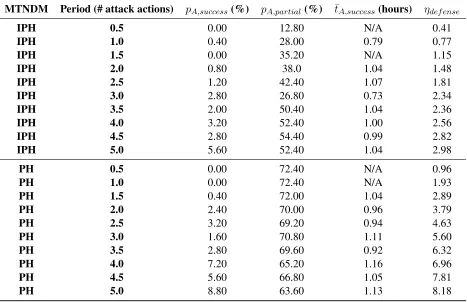
time-driven IP address hopping and port hopping with an overhead of 0.05 hours. 69 6.6 The results of experiments testing the effects of varying the overhead of
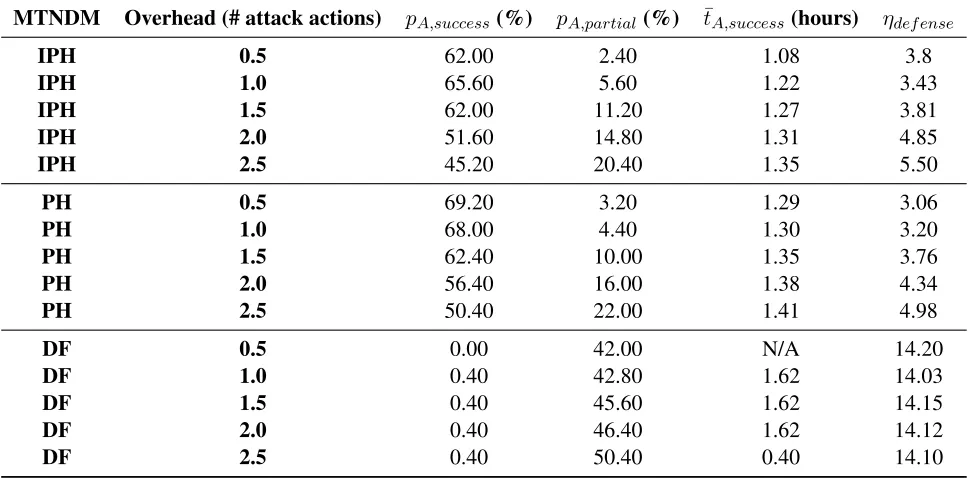
event-driven threat detection through node observation with IP address hopping, port hopping, and dynamic firewall. . . 72 6.7 The results of experiments testing the effects of varying the overhead of
event-driven threat detection through Intrusion Detection System (IDS) sensor alert observation with IP address hopping, port hopping, and dy-namic firewall. . . 75 6.8 The results of experiments testing the effects of varying the overhead of
List of Figures
3.1 High-level diagram of the Dynamic Virtual Terrain (DVT) computer
net-work model. . . 31
3.2 The general Moving Target Network Defense Mechanism (MTNDM) al-gorithm used by DVT. . . 40
3.3 The IP address hopping Execute function used in DVT. . . 40
3.4 The port hopping Execute function used in DVT. . . 41
3.5 The dynamic firewall Execute function used in DVT. . . 42
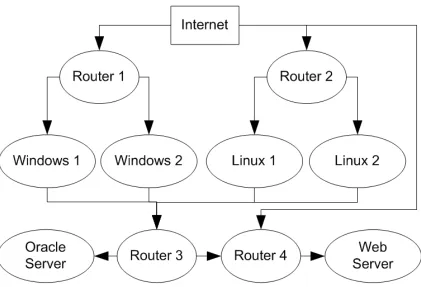
4.1 The algorithm used by Cyber Attack SCenario And network DEfense Sim-ulator (CASCADES) to update the Attacker Knowledge (AK) context model. 54 5.1 Topology of the network used in the experiments. . . 57
5.2 High-level flowchart of the stages of the Scenario Guiding Template (SGT). 58 6.1 Effect of ABM skill level onpA,successandpA,success+pA,partialfor a static network. . . 64
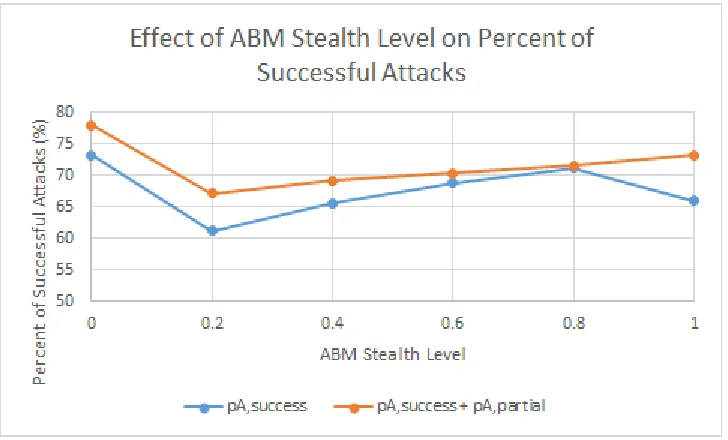
6.2 Effect of ABM stealth level on pA,success and pA,success + pA,partial for a static network. . . 65
6.3 Effect of ABM node attempts onpA,success and pA,success +pA,partial for a static network. . . 66
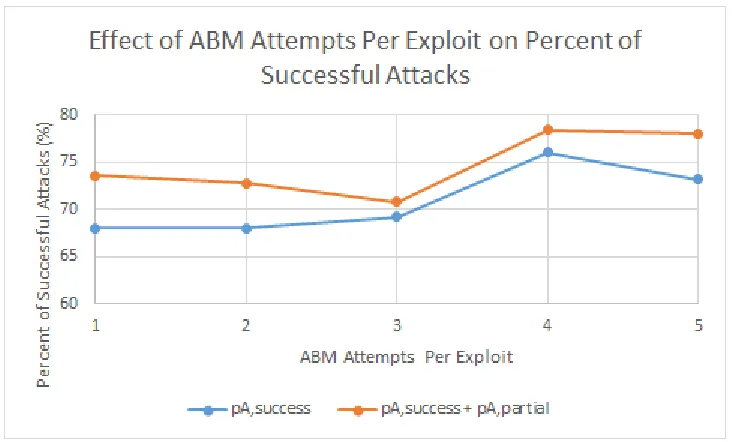
6.4 Effect of ABM exploit attempts onpA,successandpA,success+pA,partialfor a static network. . . 68
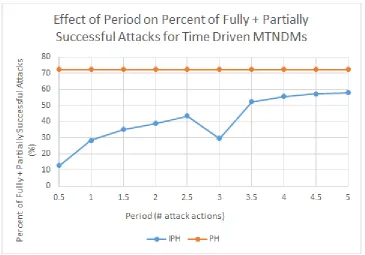
6.5 Effect of period onpA,success for a dynamic network using time-driven IP address hopping and port hopping. . . 70
6.6 Effect of period onpA,success+pA,partialfor a dynamic network using time-driven IP address hopping and port hopping. . . 71
6.7 Effect of overhead onpA,success for a dynamic network using event-driven IP address hopping, port hopping, and dynamic firewall with threat detec-tion through node observadetec-tion. . . 73
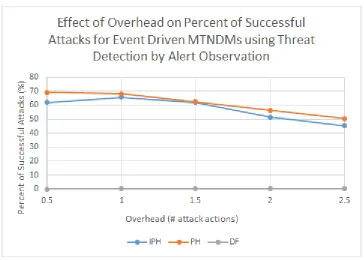
6.9 Effect of overhead onpA,success for a dynamic network using event-driven
IP address hopping, port hopping, and dynamic firewall with threat detec-tion through alert observadetec-tion. . . 76 6.10 Effect of overhead on pA,success + pA,partial for a dynamic network using
event-driven IP address hopping, port hopping, and dynamic firewall with threat detection through alert observation. . . 76 6.11 Effect of overhead onpA,success for a dynamic network using event-driven
IP address hopping, port hopping, and dynamic firewall with threat detec-tion through alert detecdetec-tion. . . 78 6.12 Effect of overhead on pA,success + pA,partial for a dynamic network using
event-driven IP address hopping, port hopping, and dynamic firewall with threat detection through alert detection. . . 79
A.1 The combined Common Vulnerability Scoring System (CVSS) score fre-quencies across all Common Weakness Enumeration (CWE) categories. . . 98 A.2 The CVSS score frequencies for the “Gain privileges / assume identity”
CWE category. . . 98 A.3 The CVSS score frequencies for the “Execute unauthorized code or
com-mands” CWE category. . . 99 A.4 The CVSS score frequencies for the “DoS: crash / exit / restart” CWE
cat-egory. . . 99 A.5 The CVSS score frequencies for the “DoS: resource consumption (CPU)”
CWE category. . . 100 A.6 The CVSS score frequencies for the “Read application data” CWE category. 100 A.7 The CVSS score frequencies for the “Modify application data” CWE
cate-gory. . . 101 A.8 The CVSS score frequencies for the “DoS: instability” CWE category. . . . 101 A.9 The CVSS score frequencies for the “DoS: resource consumption
(mem-ory)” CWE category. . . 102
A.10 The CVSS score frequencies for the “Modify memory” CWE category. . . 102
A.11 The CVSS score frequencies for the “Hide activities” CWE category. . . 103 A.12 The CVSS score frequencies for the “Modify files or directories” CWE
category. . . 103 A.13 The CVSS score frequencies for the “Read files or directories” CWE category.104 A.14 The CVSS score frequencies for the “DoS: resource consumption (other)”
Glossary
Access PermissionData structure containing information about how two nodes are allowed
to communicate.
Attack ControllerThe central module in CASCADES that manages the simulation of an
attack scenario.
Attack Scenario The full details of a situation to be simulated, including the network
topology, attacker characteristics, and goal conditions.
Attack SequenceA set of attack actions executed by an attacker to achieve a goal.
Attack StepA single attack action executed by an attacker.
Attacker Behavior Model (ABM) Context model used in CASCADES to influence the
choices and behavior of attackers.
Attacker Knowledge(AK) Context model used in CASCADES to model the information
an attacker has gathered about the network, which may or may not be accurate at
any given time.
Common Plaform Enumeration (CPE) Dictionary of information technology systems,
software, and packagesm each of which can be referred to as “a CPE”.
Common Vulnerabilities and Exposures (CVE) Dictionary of publicly known
informa-tion security vulnerabilities, each of which can be referred to as “a CVE”.
Common Vulnerability Scoring System(CVSS) Standard used to provide relative
assess-ments of the severity of computer system security vulnerabilities.
Common Weakness Enumeration (CWE) List of software weaknesses, each of which
can be referred to as “a CWE”.
Cyber Attack SCenario And network DEfense Simulator (CASCADES) Cyber attack
simulator used in conjunction with DVT to evaluate MTNDMs.
behavior.
Defensive Effectiveness (ηdef ense) Ratio of the number of unsuccessful attacks per 100
defensive actions.
Denial-of-Service(DoS) Form of cyber attack that attempts to make a machine or network
resource unavailable to its intended users.
Distributed Denial-of-Service(DDoS) DoS attack carried out by two or more parties.
Dynamic Firewall (DF) MTNDM that involves turning off the access permissions of a
node that has been determined to be a threat in order to prevent attackers from
progressing further through the network.
Dynamic Virtual Terrain (DVT) Generic computer network model that supports the use
of MTNDMs. Based on the many of the same concepts used to develop VT.2.
Intrusion Detection System(IDS) Device that monitors a network for malicious activities.
IP Address Hopping(IPH) MTNDM that involves changing the IP addresses of machines
in the network.
Mean Duration of Successful Attacks (¯tA,success) Amount of time taken by a successful
attacker to progress from the initial stage of an attack through the goal stage.
Moving Target Network Defense Mechanism(MTNDM) Technique intended to protect
a computer network against cyber attacks by modifying the state of the network in
some way.
Multistage Attack Scenario Simulator (MASS) Cyber attack simulator developed by
Moskalet al.in 2014.
Noise Generator Context model used in CASCADES to create noise alerts to insert into
the network’s IDS sensor logs.
Percent of Partially Successful Attacks(pA,partial) Percentage of cyber attacks in which
an attacker is able to successfully complete each stage except for the goal stage.
Percent of Successful Attacks(pA,success) Percentage of cyber attacks in which an attacker
Port Hopping(PH) MTNDM that involves changing which ports are in use by services on
machines in a network.
ReconnaissanceActions executed by an attacker in order to gather information about the
target network.
Scenario Guiding Template (SGT) Context model used in CASCADES to specify the
goal conditions of attack scenarios and how to achieve them.
Terrain Manager (TM) Subsystem of DVT used to detect threats and control the set of
nodes on which MTNDMs operate.
Virtual Terrain (VT) Network model used in Cyber Attack Simulator. Consists of hosts,
routers, and users.
Virtual Terrain v2(VT.2) Network model based on VT and used in MASS. Represents all
network members generically as nodes.
Vulnerability Hierarchy (VH) Context model used in CASCADES to map services
Acronyms
ABMAttacker Behavior Model
AKAttacker Knowledge
CASCADESCyber Attack SCenario And network DEfense Simulator
CPECommon Plaform Enumeration
CVECommon Vulnerabilities and Exposures
CVSSCommon Vulnerability Scoring System
CWECommon Weakness Enumeration
DDoSDistributed Denial-of-Service
DoSDenial-of-Service
DVTDynamic Virtual Terrain
IDSIntrusion Detection System
MASSMultistage Attack Scenario Simulator
MTNDMMoving Target Network Defense Mechanism
SGTScenario Guiding Template
TMTerrain Manager
VHVulnerability Hierarchy
VTVirtual Terrain
Chapter 1
Introduction
This work develops a computer network model that supports the use of Moving Target
Network Defense Mechanisms (MTNDMs), techniques intended to protect a computer
network against cyber attacks by modifying the state of the network in some way. The
model is generic in order to support any network configuration, and a general algorithm for
MTNDMs is developed in order to allow any technique to be implemented. The model,
called Dynamic Virtual Terrain (DVT), is then implemented in the form of a plug-in for a
cyber attack simulator. The resulting system is used to simulate the results of cyber attacks
on computer networks that use MTNDMs in order to evaluate the effectiveness of those
MTNDMs using established metrics.
1.1
Background
Cyber defense refers to actions taken in order to protect a computer network against
ma-licious behavior. Examples of cyber defense techniques include firewalls, which manage
incoming and outgoing traffic, and data encryption, which helps to prevent unauthorized
parties from acquiring sensitive information. However, due to the increasing sophistication
of cyber attacks in recent years, there is a need for techniques to be developed that can
pro-vide better protection than these static techniques. As a result, much work has been done in
order to develop MTNDMs, which achieve protection against cyber attacks by modifying
attributes of the networks the protect in order to create moving targets.
Two common categories of MTNDMs are port hopping and IP address hopping. Port
hopping involves periodically changing which ports are in use by services on machines
or pseudorandom. IP address hopping involves periodically changing the IP addresses
of machines in the network in a similar manner [2]. These techniques are effective in
increasing network security because when they are active and an attacker discovers an IP
address or port that is in use, the attacker must act quickly in order to compromise the
discovered asset before its attributes are changed. If the attacker is not quick enough and
the hopping algorithm modifies the discovered attribute before it can be compromised, the
attacker will be forced to start over and attempt to discover a new port or IP address. These
techniques are also effective against Service (DoS) and Distributed
Denial-of-Service (DDoS) attacks for this reason.
Dynamic firewalls are another category of MTNDMs. Firewalls are used in computer
networks to improve security through the use of traffic policies, which specify rules that can
be used to determine whether traffic should be allowed into the network or blocked.
Be-cause the performance and security of firewalls is significantly influenced by the structure
of their policies, a large amount of work has been done in the area of firewall policy
opti-mization [3]. These techniques can be divided into two groups based on their objectives.
The first group, matching optimization techniques, aims to minimize the amount of time
needed to match normal network traffic to firewall rules. The second group, early rejection
techniques, aims to maximize the amount of unwanted traffic that is filtered out by the
fire-wall while also minimizing the number of rules needed in the firefire-wall policy. These groups
can be broken down further based on properties such as complexity and limitations.
Re-gardless of classification, dynamic firewall policy management techniques are self-adaptive
in nature so that the performance improvement always outweighs the overhead required to
implement the technique.
Two other possible categories of MTNDMs are dynamic network topology mutation
and dynamic cryptographic key assignment. Network topology refers to the arrangement
of and connections between the nodes in a network. Dynamically changing the way a
network’s nodes are connected could make it significantly more difficult for a potential
at-tacker to navigate through the network in order to reach a target. At the same time, there is
keys are used for a variety of applications, including data encryption and decryption and
message authentication. These techniques are used to keep data and communications
pri-vate, but if a malicious party is able to gain access to a valid key, any information that is
encrypted using that key is compromised. Dynamic cryptographic key assignment
algo-rithms could potentially mitigate this risk, but the process of reassigning keys also requires
a lot of overhead.
1.2
Related Work
1.2.1 Cyber Attack Simulation
Simulation is a useful tool for many applications because it allows for the analysis of how
changing certain parameters will impact the system. In recent years, the field of cyber
defense has begun to take advantage of simulating cyber attacks in order to determine how
different types of attacks progress through different types of networks [4]. By evaluating
the ground truth results of cyber attack simulations, the major vulnerabilities in a network
can be identified and actions can be taken to improve the security of the network. However,
in order for the results of a cyber attack simulation to be valid and useful, the definition of
the network and the attacker characteristics must be as realistic as possible. If the defined
network does not match the actual network, or if the characteristics of the defined attacker
do not reflect plausible characteristics of a real attacker, the results of the simulation will
be meaningless.
Cohen [4] developed one of the earliest cyber attack simulators in 1999. This simulator
is driven by a network model and a cause and effect model for processing threats, cyber
attacks, and defenses. The cause and effect model is based on 37 classes of threats, 94
classes of attack mechanisms, and 140 classes of protective mechanisms, interlinked in a
database in order to associate threats with related attacks and attacks with relevant defenses.
The database also links threats, attacks, and defenses with other characteristics that may be
important to a simulation, such as impact on network integrity and sophistication level
of attackers. These parameters are all processed by the model in order to calculate the
links that represent how the nodes are connected. Each node has a name and a list of
defense mechanisms in use. The output of the simulator simply states whether the attacker
“wins” (by achieving the goal of the attack) or “loses” (if prevented from achieving the goal
of the attack). While Cohen admits that his simulations are unverifiable through comparison
with real world data, experts have agreed that his model was accurate [5].
In 2001, Parket al.[6] presented SECUSIM, a simulator influenced by Cohen’s work [4]. Parket al.argued that Cohen’s cause and effect model for attack and defense represen-tation was too simplistic. SECUSIM instead uses a discrete event model with a state
tran-sition diagram in order to characterize attack and defense behaviors and the corresponding
consequences. The attack behaviors were implemented as sequences of high-level attacks
that followed pre-defined attack paths. SECUSIM also includes a very customizable and
user-friendly interface, which enables users without strong computer security knowledge
to run simulations more easily, as well as different modes to choose from in order to best
suit the needs of users with different backgrounds.
Kotenko and Man’kov [7] developed a simulator simply called Attack Simulator in
2003 in order to assess the vulnerability of computer networks during design and
deploy-ment. A strict formal model for attack generation was developed using probabilistic state
machines to model the intentions of attackers. Attack Simulator itself uses a multi-agent
system consisting of Network Agents and Hacker Agents. Network Agents represent the
defense system in place to pretect the target computer network, while Hacker Agents
repre-sent the attacker or attackers attempting to infiltrate the network. Attack Simulator ensures
that the knowledge of the Network Agents and Hacker Agents are maintained separately in
order to properly simulate interactions between the two entities.
1.2.2 Cyber Attack Simulator
In 2007, Kuhlet al.[8] presented a simulator called Cyber Attack Simulator, designed to efficiently simulate cyber attack scenarios through a simulation modeling approach. Cyber
Attack Simulator represents an alternative to the construction of virtual and physical
an attacker’s goals are achieved, Cyber Attack Simulator outputs a set of Intrusion
De-tection System (IDS) sensor alerts that can be used for evaluating cyber security systems.
Cyber Attack Simulator uses a discrete-event simulation model (initially implemented
us-ing the ARENA simulation software before beus-ing reimplemented in Java) to generate data
for attacks and IDS sensor alerts. Cyber Attack Simulator primarily focuses on attacks
originating from the Internet, but insider attacks can also be modeled. The simulator maps
attack actions to IDS sensor alerts while also producing noise alerts to represent normal
ac-tivity within a network. After the simulation is completed, output files including IDS alert
files (which contain all IDS alerts produced by the system), IDS ground truth files (which
exclude noise alerts and focus on alerts caused by attack actions), and a Ground Truth
Ac-tions file (which lists the attack acAc-tions executed during the simulation and whether they
were successful) are generated.
The computer network model used in Cyber Attack Simulator is Virtual Terrain (VT),
developed by Argauer [9]. Developed as part of a system designed to perform impact
assessment of networks and their components as a result of cyber attacks, VT was motivated
in part by the rising use of IDS sensors in networks in order to detect and report malicious
activity. There are two main types of IDS sensors: network based and host based. Network
IDSs are placed strategically within networks in order to monitor traffic. Host IDSs, on
the other hand, are placed directly on specific devices in a network in order to monitor
incoming and outgoing traffic specifically for those devices. In 2000, Bass [10] discussed
the ineffectiveness of IDSs working independently and proposed a model for cyberspace
situational awareness consisting of heterogeneous distributed network sensors that share
information with each other. Argauer’s model incorporated that concept with cyber attack
simulation in order to test its effectiveness.
VT models networks as directed graphs made up of hosts, routers, and users. In order
to simplify network specification, hosts may have multiple IP addresses in order to define
clusters of machines with the same configuration. Hosts have permission lists that,
allowed to communicate or a list of machines with which the host is not allowed to
com-municate. Hosts also have service trees used to specify which versions of its services are
in use. Routers are not especially relevant in the scope of cyber attacks, so VT simply uses
them to provide connections and a means for communication between hosts. Like hosts,
routers have permissions lists that specify the other machines with which they may or may
not communicate. Users are used to identify the privilege level of services currently
acces-sible on hosts. If the current user does not have a high enough privilege, some services on
the host may not be usable.
1.2.3 Multistage Attack Scenario Simulator
In 2013, Moskalet al. [11] developed a new simulator based on Cyber Attack Simulator called CyberSim, which was later renamed Multistage Attack Scenario Simulator (MASS)
[12]. This simulator was designed with a plug-in architecture in mind and consists of a
simulator core that interacts with several context models. The Scenario Guiding Template
(SGT) is used to specify the goal conditions of attack scenarios and how to achieve them.
The Attacker Behavior Model (ABM) is used to influence the choices and behaviors of
attackers. Virtual Terrain v2 (VT.2), an extension of the original VT, is used as the network
model.
MASS uses a hierarchical structure in order to represent the attacks in each simulation.
At the lowest level is the attack step, which represents a single action performed by an
attacker during a simulation and determines which IDS sensor alerts, if any, are generated
by that action. Several attack steps make up attack sequences, which represent the actions
an attacker takes from the initial infiltration of the network until either the goal is achieved
or the attack ends in failure. At the highest level of the hierarchy is the attack controller,
which performs setup operations, manages the attack sequences, and determines when the
simulation is complete. The attack controller also manages the noise generator, which
generates IDS sensor alerts that are unrelated to any attack step in order to model regular
network activity.
output files, including IDS sensor logs, a Ground Truth results file similar to that used in
Cyber Attack Simulator, and another results file that provides more detail on how many
alerts were triggered by each attack step. This attack hierarchy, the context models and
the simulation core make up a single attack scenario to be simulated. MASS focuses on
flexibility and scalability in order to allow for the simulation of many simultaneous attack
sequences using context models that may be incomplete depending on the knowledge and
expertise of the user.
VT.2 is the model used in MASS to represent computer networks. VT.2 is designed to
be as generic as possible and defines all machines in a network simply as nodes, regardless
of whether they are hosts, servers, or routers. Parameters of nodes include IP address,
services in use, IDS sensors in use, send and receive permissions lists, and whether the
node is visible to the Internet. In VT.2, send and receive permissions are specified simply
as lists of nodes. The send permissions list contains nodes to which a node is allowed to
send packets, and the receive permissions list contains nodes from which a node is allowed
to receive packets. Nodes also have a flag that is used to determine whether the node is
a router. There is no need for a special router object, since VT.2 simply models routers
as special nodes that have no services and thus no vulnerabilities. As a result, attackers
that come across a router are allowed to pass through the router to another node in the
network. Nodes also contain sensor range lists for each of their IDS sensors that are used
to determine which sensors in the network generate alerts for each attack step. These lists
are used to model host IDSs and network IDSs in VT.2.
The Vulnerability Hierarchy (VH) is used in MASS to map services running on VT.2
nodes to vulnerabilities that attackers could potentially exploit in order to compromise
nodes and progress through the network. The definition is generic in order to allow for
custom VHs to be used as long as the number of levels in the hierarchy and the level at
which the services reside are specified. The VH implemented by Moskal et al.uses data from the National Institute of Standards and Technology’s National Vulnerability Database.
Specifically, the Common Weakness Enumeration (CWE), Common Plaform Enumeration
where CPEs map directly to the services specified in VT.2. At the top of the hierarchy,
CWEs are grouped into CWE categories. The CWEs themselves make up the second level,
CPEs are grouped by CWE in the third category, and the relevant CVEs for each CPE make
up the fourth and lowest level. Additional entries not covered by the CWE, CPE, and CVE
classification systems were added to the hierarchy in order to account for reconaissance.
The VH is used by the simulation core inside each attack step, which selects from each
level of the hierarchy in succession in order to choose a vulnerability to attempt to exploit
on the selected node. If the attempt is unsuccessful or no vulnerability in the hierarchy
exists on the selected node, the attack step fails and another node is selected.
The SGT is used in MASS to guide the attacker through the specification of the steps
of an attack that must be completed in order to achieve the goal. MASS allows for the
specification of one SGT per attack sequence in order to allow for simulations of attack
scenarios in which different attackers have different targets instead of working toward the
same goal. The SGT defines an attack as a series of stages that are connected by arcs.
Parameters of the stage include whether the stage is a potential starting point for an attack
sequence, whether the stage is the final stage that must be completed before the goal is
achieved, whether the attacker’s choices for attack actions to perform should be restricted
based on the arcs, and whether the attacker should choose a new node from the VT before
attempting the stage. The arcs are used to specify which actions will allow the attacker to
move on from the current stage and the next stage in the progression. If the stage restricts
an attacker’s attack choices, the attacker must switch between currently accessible nodes
and attempt an action from the restricted list. If none of the actions from the restricted list
are possible on the currently accessible nodes, the attack fails. If the stage does not restrict
the attacker’s choices, the attacker is free to attempt any action that will compromise a node
and progress through the network. Stages also specify default arcs to take if an action that
does not satisfy one of the other arc conditions is chosen. This default arc often loops back
to the current stage in order to allow an attacker to continue moving through the network
until an action that satisfies another arc condition is completed, but this is not always the
The ABM is used in MASS to specify the preferences and tendencies of an attacker.
Like with the SGT, MASS allows for one ABM to be specified per attack sequence in
or-der to allow for simulations of attack scenarios in which attackers with different skills and
mentalities work together. The simulator core combines information from the ABM and
the SGT of each attack sequence in order to determine which attack steps to attempt and
whether they succeed. An ABM contains several parameters, including the probability that
an attack step will be undetected by IDS sensors, the probability that an attacker will
dis-cover a node if it is hidden, the average number of times an attacker will attempt an action
if not successful, and the attacker’s skill in successfully executing exploits. In addition,
the ABM contains optional lists of overall preferred attacks from the VH, preferred attacks
from the VH on a per node basis, and preferred nodes to attack if possible. Each of these
lists may be filled if the relevant information is known or left empty if such preferences do
not exist or are not known.
1.2.4 Attack Graphs
Outside the scope of cyber attack simulation, another method of analyzing network security
is through the use of attack graphs. Attack graphs, first proposed by Phillips and Swiler
[13] in 1998, approach the problem of network vulnerability analysis from a graph-based
approach. Phillips and Swiler model attacks using attack templates, which consist of nodes
representing each state of an attack. Each node contains five fields: user level required,
machines involved in the attack, vulnerabilities exploited in the attack, capabilities of the
attacker, and the state of the attack. Databases of attack templates are combined with
configuration files used to describe the network and attacker profiles in order to create attack
graphs. Cost analysis can then be performed on the attack graphs in order to determine the
lowest-cost attack paths and set up cost-effective defenses.
Phillips and Swiler’s attack graph definition has been expanded and applied in a wide
range of areas. In 2004, Noel and Jajodia [14] proposed a framework for managing
at-tack graph complexity. This work is based on several other works between 1998 and 2004
model much more complex scenarios than can be modeled manually, which can result
in extremely complex and potentially unmanageable attack graphs. After defining a new
exploit-dependency representation of attack graphs that is much more computationally
ef-ficient than the previous state-transition model, Noel and Jajodia define a hierarchy of rules
that can be used to aggregate attack graphs. The resulted is an abstracted graph that is much
more usable.
In 2005, Jajodiaet al.[15] applied their updated attack graph model in a network vul-nerability analysis tool called Topological Vulvul-nerability Analysis (TVA). TVA consists of
three components: a database of exploits, a description of the network of interest, and an
attack scenario specification including the target, initial attack control, and changes in the
network configuration. These components are incorporated into an engine used to generate
attack paths based on directed graphs of dependencies between exploits and conditions,
which are modeled using preconditions and postconditions. The output of the tool is a list
of all possible preventative actions that can be taken that have a minimal impact on the
services running in the network.
Noel and Jajodia [16] used attack graphs in 2008 to determine optimal IDS sensor
place-ment within networks. This work utilizes and expands upon the previous works involving
attack graph aggregation and the TVA network vulnerability analysis tool. First, all
pos-sible attack paths through the network of interest that can be used to reach critical assets
are predicted using TVA. A greedy algorithm is then used to place the minimum number
of sensors that can cover all of the predicted attack paths. Once the sensors have been
placed and alerts begin to be generated, the attack graphs are used to prioritize sequences
of alerts that may be indicators that an attack is progressing through one of the predicted
attack paths and use that information to formulate reactive defense actions.
Louthanet al.[17] developed extensions to the attack graph in 2014 to model attacks on discrete information systems. This new model is called hybrid attack graph because it
leverages the vulnerability space between information systems and a restricted set of hybrid
world. Hybrid systems are often modeled by combining finite state machines with
differ-ential equations to form hybrid automata. This work uses hybrid automata as inspiration
to develop hybrid extensions to attack graphs in order to capture blended attack vectors
consisting of both discrete and continuous exploits. In the future, Louthan et al. hope to incorporate attack dependency graphs into their hybrid attack graph model in order to
improve performance.
1.3
Motivation
Many MTNDMs have been developed over the past decade, but there is a need for a more
comprehensive performance analysis of these techniques. For some techniques, no
perfor-mance analysis studies have been conducted at all. For others, studies have been conducted
that are incomplete or unrealistic and therefore do not provide a complete understanding of
how the technique will perform in a real world setting. Additionally, even if realistic
stud-ies have been completed to verify the performance of a technique, the study will have been
conducted in a different setting from any other studies on other techniques, which makes
comparing techniques very difficult. There is a need for a way to analyze the performance
of different techniques in a common, realistic setting so that more comprehensive studies
of MTNDMs can be conducted.
The purpose of this thesis is to implement a dynamic computer network model that can
provide the common, realistic setting necessary to perform comprehensive, comparative
studies of MTNDMs. DVT allows for the evaluation of the effectiveness of different types
of MTNDMs against different types of cyber attacks, attackers with different characteristics
and preferences, and scenarios consisting of multiple simultaneous attacks conducted by
attackers whose characteristics and preferences may or may not differ. This in turn allows
for a more complete analysis of the relative strengths and weaknesses of different strategies.
Additionally, DVT supports the use of multiple types of MTNDMs at the same time, which
allows for experimentation with using different combinations of dynamic cyber defense
strategies in an attempt to increase network security. The results of these experiments can
protecting against different types of attacks and attackers.
An implementation of DVT enables the development of a new cyber attack
simula-tor called CASCADES. Based on the architectural concept of the work done by Moskal
et al.[11] in 2013, CASCADES uses DVT as its computer network model, serving a simi-lar role to that of VT.2 in MASS. However, as its name suggests, CASCADES represents a
slight shift in focus from simple cyber attack simulation. While CASCADES still simulates
cyber attacks, the inclusion of DVT to represent dynamic cyber defense allows for more
experimentation and a wider range of scenario possibilities. Instead of simply comparing
the results of simulations using different types of attacker behavior, CASCADES also
al-lows for the comparison of results of simulations using different network configurations.
The ability to specify the different types of defense technologies in use by a target network
in addition to the capabilities and preferences of an attacker allows CASCADES to provide
Chapter 2
Moving Target Network Defense Mechanisms
This chapter gives a brief overview of MTNDMs that have been proposed, specifically in
the areas of port hopping, IP address hopping, and dynamic firewalls. A short discussion
of other types of MTNDMs follows, but these three categories are by far the most common
in literature and as such are the focus of the design and initial implementation of DVT.
Metrics that can be used to evaluate MTNDMs are also discussed.
2.1
Port and IP Address Hopping
2.1.1 Port Hopping
In order to mitigate DoS attacks, Lee and Thing [1] proposed a technique called port
hop-ping (PH) in 2004. The proposed technique attempts to decrease the ability of attackers to
gain information about a network through port scanning by periodically and dynamically
changing the port numbers in use by a server as a function of both time and a shared
cryp-tographic key. Any authorized client should have access to the key and be able to determine
the correct port number currently in use by the server, which allows the server to filter out
illegitimate traffic based on port number.
Lee and Thing’s PH algorithm divides time into discrete time slots of uniform duration.
The current port number in use for a server connection is a pseudorandom function of the
current time slot number and the cryptographic key used for that connection. In order to
avoid synchronization errors between a server and client, there are two valid ports at time
slot boundaries, which are defined with an overlapping time slot factor. This algorithm
is compatible with UDP using the UDP socket mechanism and can be adapted for TCP
at the end points cannot be changed. They management of the cryptographic keys can be
achieved using either a symmetric key mechanism or Public Key Cryptography (PKC). In
either case, the client must request a key from the server in order to communicate with it.
Lee and Thing propose that PH would be more effective if implemented at the ISP end
of the traffic flow rather than at the application server in order to more effectively reduce
traffic congestion. In this scenario, the server would periodically update the ISP router,
which would be assumed to be a trusted entity, with the correct port number in use. If an
attacker knows that PH is in use, there is vulnerability in the mechanism due to the
possibil-ity of the attacker simply brute forcing attempted connections using random port numbers.
This vulnerability can be minimized be keeping the duration of time slots as short as
pos-sible. In terms of implementation, the proposed approach is the addition of middleware
between the application and socket layers, which would handle key management and the
maintenance of socket connections.
2.1.2 Network Address Hopping
In 2005, Sifalakiset al.[2] proposed network address hopping (NAH) as a mechanism for protecting data in communications across untrusted networks. This method involves
peri-odically changing the IP addresses in use by communicating end points. The idea behind
NAH is that the interception of information by a malicious agent will be significantly more
difficult if the fact that the communication is taking place between specific end points is
hidden. Even if an attacker is able to intercept some information by listening to the
cor-rect channel at a given time, NAH spreads data streams across multiple communication
channels, making it very difficult for an attacker to reconstruct the entire stream of data.
It would be possible for an attacker to reconstruct the data without knowing the hopping
pattern if the data transmissions were not encrypted, but doing so would require locating
a central network point to tap in order to listen to network traffic, sufficient storage and
processing capabilities, and the timeliness and validity of the traffic being intercepted.
One way to increase the effectiveness of NAH is to reuse any currently inactive channels
for an attacker to determine which transmitted data is valid and worth attempting to piece
together. Additionally, since it is difficult for an outsider to determine which channel is
in use at a given time, NAH is very effective in protecting against attempts to distort,
alter, or forge parts of the communication stream. One inherent benefit of NAH is that an
attacker must search for tapping points where network traffic is high in order to maximize
the chance of reconstructing relevant communication streams, which will require much
more processing time and decrease the speed of the attack. One potential issue with NAH is
the synchronization of IP addresses in use between end points of a communication channel
[18]. A possible solution could be to include a mechanism similar to that used in Lee and
Thing’s port hopping, in which two ports are simultaneously valid within a certain window
of the change in active ports.
2.1.3 Random Port Hopping
Independently of Lee and Thing, Badishi et al. [19] proposed a similar algorithm called random port hopping (RPH) in 2007. Like port hopping, the main goal of RPH is to
ad-dress the issue of DoS attacks. Random port hopping assumes that a secret key is shared
between communicating parties and used as an input to a pseudorandom function used to
choose the sequence of ports to be used. Badishi et al. note that such a mechanism has a
negligible effect on communication overhead when the intervals between hops are
realis-tic. RPH is proposed as an acknowledgement-based protocol with two port-based channels.
The receiving channel always keeps two ports (one current and one previous) open for data
reception from the sending channel, and the sending channel always keeps one port open
for acknowledgement reception from the receiving channel. The ports used for these
com-munications are determined using a pseudorandom function.
All communications on the sending and receiving channels carry authentication
infor-mation, which is generated using a second pseudorandom function. The two channels
share a secret key, different parts of which are used by each of the pseudorandom
func-tions. The sending channel always sends to the most current data reception port of the
sends an acknowledgement to the previous acknowledgement port of the sender. Similarly,
when the receiving channel receives a message on the current port, it sends an
acknowl-edgement to the current acknowlacknowl-edgement port of the sender. However, upon receiving a
message on the current port, the receiving channel also updates the ports in use according
to the relevant pseudorandom function. Likewise, the sending channel updates its port in
use according to the pseudorandom function upon receiving an acknowledgement on the
current acknowledgement port.
Badishi et al. also introduce a proactive reinitialization mechanism for RPH in order to allow new seeds to be chosen based on time rather than on message exchanges. In this
scheme, the number of time units between reinitializations is defined, and the channels
change ports each time the specified number of time units has passed. However, the old
ports are kept active either until a sufficient enough amount of time has passed to determine
that they will no longer be used or until communication is established using the new ports,
whichever happens first. In order to account for the possibility of delay or unsynchronized
channels, the receiving channel opens the new ports a specified amount of time before the
scheduled time that the sending channel will begin to send to the new ports. RPH is a
two-party communication protocol, so each pair of communicating channels using RPH will
share a different secret key and communicate using a different (but possibly overlapping)
set of ports. The network and rate-limiting models used to demonstrate the effectiveness
of port RPH are very simplistic. However, Badishi et al.[20] later demonstrated through simulations that the use of port hopping decreases the load on the server and that the initial
nave analysis is a good estimate of realistic results.
Hari and Dohi [21] refined the RPH algorithm after discovering a flaw in the original
protocol defined by Badishi et al. in 2010. They pointed out that while Badishiet al. as-sumed in their analysis that an attacker would choose random ports for each attempted
attack, this is not the optimal approach. When the ports in use have not been exposed,
attacking random ports has a relatively low success rate, and the attacker should instead
choose as many ports as possible and continually attack those ports until the attack is
continue to choose random ports to attack in the case in which the ports in use by the sender
and receiver have already been exposed. Against a more intelligent attack strategy, RPH
does not fare well due to the fact that the ports in use are not updated when
communica-tions between the sender and receiver fail. Hari and Dohi propose that RPH would be more
secure if the port numbers were changed even when communications fail. This change is
implemented by keeping two ports open at all times on both channels. Any time a message
is received on a port, that port is updated according to the pseudorandom function in use
by the channels. Any time the communication is not successful, the subsequent message
is sent on the other open port, so the port in use for communication effectively changes in
either case. Hari and Dohi [22] evaluated the dependability of random port hopping in 2012
using discrete-time Markov chain (DTMC) models and determined that their proposed
al-gorithm is an improvement in terms of safety and successfully eliminates the weak point in
the algorithm Badishiet al.developed.
2.1.4 Full Service Hopping and End Hopping
Shi et al. [23] proposed a protocol in 2007 that incorporates both port hopping and IP hopping, which is simply called port and address hopping (PAH). PAH consists of four
modules: a noise generator, a synchronizer, a data module, and a hopping module. Data
transfer is performed using the synchronizer and the data module. The data module
pro-vides the hopping service, dividing messages into fragments that are transmitted at different
service slots in order to confuse would-be attackers. The noise generator is also used to
mis-lead attackers by generating large noise packets that contain fake addresses and ports. The
hopping module generates address-port pairs for services according to a shared hopping
algorithm. The synchronizer ensures that the server and its clients remain synchronized
using a timestamp-based synchronization scheme.
Based on PAH, Shiet al.[24] proposed an algorithm called full service hopping (FSH) in 2008. In this algorithm, all service information is changed pseudorandomly, including
port number, IP address, service slot, cryptographic algorithm, and protocol. The FSH
and a trusted client component. The command and control component contains the
hop-ping control unit, the hophop-ping tables, and the hophop-ping algorithms. The hophop-ping control
unit controls the hopping stations and defines the above information in the form of a
5-tuple determined by the hopping algorithms. The command response unit of each hopping
station is used to interpret commands sent from the control center and act accordingly. Each
hopping station uses either a service unit to provide hopping service or a honey pot unit,
which implements a dynamic honey pot system. The role of each hopping station is also
changed pseudorandomly in order to provide an additional layer of security. The trusted
client component consists of a synchronizer, a client unit, and the necessary hopping tables
and algorithms. The synchronizer ensures that the trusted client stays synchronized with
the hopping unit and updates the 5-tuple of hopping information appropriately. The client
unit is used to request the correct server and decrypt the cipher-service with the 5-tuple.
Also based on PAH, Zhaoet al.[25] proposed a technique called end hopping (EH) in 2010. In EH, the end information, which is defined as a triple of port number, IP address,
and protocol, is changed pseudorandomly by both ends of a communication channel. EH
leaves open the possibility that different nodes may use different hopping strategies. A mix
of port hopping, IP hopping, protocol hopping, and combinations of the three is encouraged
in order to increase the overall unpredictability of the network. In addition to the traditional
approach of applying EH directly on a server, an alternate approach using a helper node
called a Middle Agent (MA) is proposed. In this approach, the true end information does
not change. Instead, the MA acts as a hopping agent placed between the two ends that
manages the hopping mechanism so the regular network members can function normally.
The MA consists of a control module, synchronization module, and service module. The
control and synchronization modules function similarly to their FSH counterparts. The
service module contains several transmission subsets, which provide channels of
commu-nication between the MA and the clients. These transmission subsets switch between active
and inactive states depending on what server has sent information to the MA and the client
to which that information needs to be sent. This MA approach decreases the overhead of
suffers from a major security issue in that if the MA is compromised by an attacker, the EH
technique will be rendered useless and the attacker will be able to freely move to any node
connected to the MA.
Lin and Jia [26] introduced a punching scheme in 2012 in which a client sends a
punch-ing packet to the server in order to create mapppunch-ing rules in NAT that will allow packets
to be able to pass through effectively. Experimental results demonstrate that the service
rate for clients behind NATs using the proposed punching scheme is 100%. In 2013, Zhao
et al.[27] extended EH to use a new spatial adaptive strategy in order to increase its ability to protect against sem-blind attackers. The main contribution of this new strategy is the
addition of a list of valid nodes to the central hopping algorithm. The list is initialized to
include all nodes within a system that employ EH as before. However, a new parameter
is defined to specify the maximum number of data packets a node can receive in a unit
amount of time before being considered under attack. If a node is determined to be under
attack, it is removed from the EH list so that it no longer receives updates when hopping
actions are performed.
2.1.5 Spread Identity
In 2005, Phatak [28] proposed an IP hopping scheme called Spread Identity (SI) with the
goal of providing anonymity and DDoS defense mechanisms for communications over the
Internet. SI aims to take advantage of the potential of heterogeneous multi-homing by
al-lowing each interface to simultaneously assume multiple IP addresses across different
sub-nets. These addresses may be dynamically acquired and released as needed, which provides
a significant amount of protection against DDoS attacks. The fundamental mechanisms of
SI are dynamic extended multi-homing, spreading identity by controlling name resolution,
and address resolution strategies. The concept of multi-homing refers to the scenario in
which a node has multiple IP interfaces and each interface has its own IP address. SI
ex-tends conventional multi-homing by allowing each interface to have multiple IP addresses,
preferably spanning multiple subnets. In order to truly “spread” identity, SI modifies the
“self resolution.” The main strategy used by SI is to keep a mapping of source address and
state to the IP address to return, but any strategy could be used as long it supports multiple
addresses per interface. Phatak proposed a high level architecture for SI, in which the DoS
resilient SI servers include a name resolver, a data and connection request handler, and an
optional challenge issuer, where each of these entities could be either a process within a
single node or a unique node within the network.
Phataket al.[29] expanded SI in 2013 with a more formal definition of the algorithm used to support multiple IP addresses per interface within a single node. The fleshed out
architecture of an SI network includes source SI servers (SSI), source SI gateways (SIGS),
destination SI servers (DSI), and destination SI gateways (SIGD). SSIs are used to
deter-mine the associations between private and public IP addresses within the source network,
while DSIs determine associations between host names and routable IP addresses in the
destination network. Each SIGS includes a router and firewall whose NAT entries come
from the SSI, while each SIGD includes a router and firewall whose NAT entries come
from the DSI. Phatak et al. defined an eleven step connection establishment protocol
algo-rithm for SI. First, a source host issues a DNS request to an SSI to resolve the hostname
of a destination. Then, after choosing a public IP address for the source and prompting the
applicable SIGS to create a temporary NAT entry, the SSI obtains the public IP address of
a DSI from a DNS server and sends the DNS request to the SIGS. From there, the SIGS
forwards the request to the SIGD, which sends it to the DSI. Next, the DSI chooses an
available public IP address for the destination host and the SIGD creates the NAT entry to
be used for communications between the source and destination hosts. Then, the DSI sends
the DNS response, which propagates through the SIGD, SIGS, and SSI on its way back to
the source host. Before forwarding the DNS response to the source host, the SSI updates
the temporary NAT entry to enable communications between the source and destination
hosts. Once the DNS response reaches the source host, the process is complete and data
transfer can begin. While this process provides many advantages in defending against DoS
2.2
Dynamic Firewalls
2.2.1 Traffic-Based Approaches
Teo et al. [30] proposed a dynamic access control architecture called Authorization En-forcement Facility (AEF) in 2003 that uses the concept of risk to determine whether a
con-nection into a network should be allowed or denied. AEF is designed as a complementary
mechanism rather than a full replacement for traditional firewalls due to the unlikelihood
of organizations to replace existing security mechanisms with something completely new.
A network using AEF would still contain a traditional firewall, which would filter traffic
based on a rule set defined by a system administrator. One issue with this type of firewall
that AEF aims to address is the possibility of malicious traffic appearing to be legitimate
based on the administrator-defined rule set and being allowed through the firewall. AEF
mitigates this problem by analyzing incoming traffic and determining the amount of risk
associated with each incoming source. Teo et al.clarify the difference between the tradi-tional firewall and AEF by pointing out that traditradi-tional firewalls perform authentication of
traffic to ensure that only legitimate traffic is allowed to pass through, while AEF performs
authorization on the traffic, analyzing the risk levels and authorizing traffic with sufficiently
low risk levels to pass through. The risk level is calculated based on operations called
ac-tions that can dynamically change the threat level. Teo et al. define actions based on the characteristics of the network traffic and the contents of received packets.
Hamed and Al-Shaer [31] presented a technique called dynamic rule ordering in 2006,
which optimizes firewall policies based on traffic characteristics. The development of this
technique was motivated largely by previous studies that indicated that in many cases, the
vast majority of traffic for a given network matches a small subset of the networks
fire-wall rules. By separating the most commonly matched rules from the rest and checking
them first, packet matching time is significantly reduced. Additionally, the subset of most
active rules is continually updated based on actively calculated traffic statistics. However,
dynamic rule ordering is limited in that it does not perform well with policies containing
optimize traffic rules in order to reject unwanted traffic in as little time as possible and
op-timized the dynamic rule ordering technique using statistical search trees to further reduce
packet matching times.
Motivated by privacy and performance concerns in military wireless networks, Agarwal
and Wang [33] introduced Dynamic Security Policy Management (DSPM) in 2006. DSPM
consists of a monitoring system, a decision-making system, and a switching system. The
monitoring system collects traffic statistics and passes them to the decision-making system
regularly. The decision-making system is modeled as a semi-Markov decision process and
is used to decide which security policy is best given the current state of the network. When a
decision is made, it is passed to the switching system, which handles dynamically switching
security policies. Also in 2006, Acharya et al. [34] described a framework for traffic-aware firewall optimization that significantly reduces operational cost. This work focuses
on rule redundancies and dependencies in list-based firewalls. The proposed Traffic-aware
Firewall Optimizer (TFO) uses a dynamic feedback mechanism to achieve cooperation
between a rule set based optimizer and a traffic based optimizer. These optimizers work
together to optimize the firewall rule set based on current traffic characteristics. However,
the framework requires a lot of processing overhead in order to work efficiently.
2.2.2 Risk-Based Approaches
Ahmed and Zhang [35] proposed a Context-Risk-Aware Access Control (CRAAC) model
to handle access control in ubiquitous computing environments in 2008. The goal of
CRAAC is to achieve context-aware adaptation, flexibility, and extensibility, all while
min-imizing performance costs. CRAAC uses a risk assessment approach to access control,
calculating risk-based levels of assurance (LoA) to be used for making access control
de-cisions. For each resource, an Object LoA (OLoA) is calculated to represent the sensitivity
level of the resource and the impact if an unauthorized party were to gain access. Then,
whenever a request is received for access, the current attributes of the requestor are used
to calculate the Requester LoA (RLoA), which represents the level of confidence of the
then access is allowed. Otherwise, the access request is denied.
CRAAC consists of two major components: the context management component and
the access control component. These two components are loosely coupled, so changes
made to one component do not affect the other. Determining OLoA values can be done
through simple risk assessment, but calculating RLoA values is more challenging. This is
achieved by identifying contextual attributes that impact the degree of certainty of the
trust-worthiness of an access request, defining LoA values for each attribute, and developing an
equation for calculating the RLoA based on the LoA values of a given requestor. Ahmed
and Zhang define four attributes to be used for calculating RLoA: the eToken attribute, the
access location (ALoc) attribute, the channel security attribute, and the intrusion response
attribute. The eToken attribute represents the resource provider’s confidence level in the
va-lidity of the credentials of the requestor. The ALoc attribute represents the confidence level
in the security of the claimed access location. The channel security attribute represents
the confidence level in the security of the channel connecting the requestor to the resource
provider. The intrusion response attribute represents the confidence level of the provider
in the defense mechanisms in place were an intrusion attack to be attempted. Given these
attributes, Ahmed and Zhang identify two types of relationships between them: the
ele-vating relationship and the weakest-link relationship. The eleele-vating relationship states that
for certain attributes, such as the eToken and ALoc attributes, the combined use of the two
provides a greater confidence level than either attribute could provide on its own. On the
other hand, the weakest-link relationship states that the RLoA should be equal to the lowest
LoA value of all attributes in the set. These relationships lead to the derivation of a group
of equations that could be used to calculate RLoA.
In order to address the problem of weakened security in workflow systems that use
delegation, Han et al. [36] proposed Measurable Risk Adaptive Role-based Delegation (MRARD) in 2009. MRARD follows four basic steps: risk component measurement, risk
level evaluation, acceptable risk level definition, and the final determination of whether the
using fuzzy logic, a superset of Boolean logic extended to handle the concept of partial
truth, rather than calculate a precise value using a formula. The fuzzy risk evaluation
policy defined by Han et al. includes four steps: fuzzification, inference, composition, and
defuzzification. Fuzzification uses the membership functions of fuzzy subsets for each risk
component to calculate a degree to assign to each fuzzy subset. Inference evaluates the
risk based on each applicable fuzzy risk evaluation policy, and composition composes all
of the results generated in the inference step. Finally, defuzzification uses the fuzzy subset
membership functions to defuzzificate the result generated in the composition phase. Han
et al. note that there are some problems associated with fuzzy risk evaluation. Specifically,
information systems are very complex, so there are almost always additional components
of risk that cannot be modeled. Additionally, the fuzzy logic evaluation process requires
membership functions of fuzzy subsets and fuzzy risk evaluation policies to be defined.
The complexity of these tasks and the need for a well-defined desi