.N 0252-8266
%
eurostat
EUROSTATISTIK
Daten zur Konjunkturanalyse
EUROSTATISTICS
Data for short-term economic analysis
EUROSTATISTIQUES
Données pour l'analyse de la conjoncture
Monatlich Π Monthly Π Mensuel
Ξ££
eurostat
OFICINA ESTADÍSTICA DE LAS COMUNIDADES EUROPEAS
DE EUROPÆISKE FÆLLESSKABERS STATISTISKE KONTOR
STATISTISCHES AMT DER EUROPÄISCHEN GEMEINSCHAFTEN
ΣΤΑΤΙΣΤΙΚΗ ΥΠΗΡΕΣΙΑ ΤΩΝ
ΕΥΡΩΠΑΪΚΩΝ ΚΟΙΝΟΤΗΤΩΝ
STATISTICAL OFFICE OF THE EUROPEAN COMMUNITIES
OFFICE STATISTIQUE DES
COMMUNAUTÉS EUROPÉENNES
ISTITUTO STATISTICO DELLE COMUNITÀ EUROPEE
BUREAU VOOR DE STATISTIEK DER EUROPESE GEMEENSCHAPPEN
SERVIÇO DE ESTATÍSTICA DAS COMUNIDADES EUROPEIAS
L2920 Luxembourg Tél. 43 011 Télex COMEUR LU 3423
B1049 Bruxelles, rue de la Loi 200 Tél. 299 11 11
Las publicaciones de Eurostat están clasificadas por temas y por series. La clasificación se encuentra al final de
la obra. Para mayor información sobre las publicaciones, rogamos se pongan en contacto con Eurostat.
Para los pedidos, diríjanse a las oficinas de venta cuyas direcciones figuran en la página interior de la
contracubierta.
Eurostats publikationer er klassificeret efter emne og serie. En oversigt herover findes bag i hæftet. Yderligere
oplysninger om publikationerne kan fås ved henvendelse til Eurostat.
Bestilling kan afgives til de salgssteder, der er anført på omslagets side 3.
Die Veröffentlichungen von Eurostat sind nach Themenkreisen und Reihen gegliedert. Die Gliederung ist hinten in
jedem Band aufgeführt. Genauere Auskünfte über die Veröffentlichungen erteilt Eurostat.
Ihre Bestellungen richten Sie bitte an die Verkaufsbüros, deren Anschriften jeweils auf der dritten Umschlagseite
der Veröffentlichungen zu finden sind.
Οι
εκδόσεις της Eurostat ταξινομούνται κατά θέμα και κατά σειρά. Η ακριβής ταξινόμηση αναφέρεται στο
τέλος κάθε έκδοσης. Για λεπτομερέστερες πληροφορίες σχετικά με τις εκδόσεις, μπορείτε να
απευθύ-νεσθε στην Eurostat.
Για τις παραγγελίες μπορείτε να απευθύνεσθε στα γραφεία πώλησης, των οποίων οι διευθύνσεις
αναγράφονται στη σελίδα 3 του εξωφύλλου.
Eurostat's publications are classified according to themes and series. This classification is indicated at the end of
the publication. For more detailed information on publications, contact Eurostat.
Orders are obtainable from the sales offices mentioned on the inside back cover.
EUROSTATISTIK
Daten zur Konjunkturanalyse
EUROSTATISTICS
Data for short-term economic analysis
EUROSTATISTIQUES
Inhaltsverzeichnis
Zeichen und Abkürzungen
KURZ NOTIERT
5
KONJUNKTURDATEN
1. Volkswirtschaftliche Gesamtrechnungen . .17
2. Beschäftigung
19
3. Arbeitslosigkeit
23
4. Industrielle Produktion
28
5. Meinungsumfrage in der Industrie
39
6. Energie
43
7. Einzelhandel
47
8. Landwirtschaftliche Erzeugnisse
48
9. Außenhandel
51
10. Verbraucherpreise
68
11. Landwirtschaftliche Erzeugerpreise
. . . . 73
12. Löhne und Gehälter
75
13. Finanzstatistiken
76
14. Zahlungsbilanz
81
Anmerkung betreffend Grafiken und Tabellen:
Π Die Daten beziehen sich auf das Gebiet der
Bundesrepublik Deutschland vordem 3.10.1990
einschließlich WestBerlin.
Wir bitten das Fehlen von Grafiken in dieser Ausgabe
zu entschuldigen.
%
T/T1%
T/T4%
T/T-12%
BALANCE%
1990=100
1000
MIO
MRD
Τ
TJ(GCV)
GWH
USD
ECU
SZR
ESVG
NACE
SITC
EUR
Weniger als die Hälfte der verwendeten
Einheit
Prozent
Prozentualer Zuwachs eines
Vierteljahres gegenüber dem vorher
gehenden Vergleichszeitraum
(Monat,Vierteljahr,Jahr)
Prozentualer Zuwachs eines
Vierteljahres gegenüber dem
entsprechenden Vierteljahr des
Vorjahres
Prozentualer Zuwachs eines Monats
gegenüber dem entsprechenden Monat
des Vorjahres
Saldo zwischen den positiven
Antworten (Zunahme,Verbesserung der
Situation)und den negativen Antworten
(Abnahme.Verschlechterung der
Situation)der Konjunkturumfrage bei
den Unternehmern in der Gemeinschaft
Basisjahr
in 1000
Million
Milliarde
Metrische Tonne
Terajoule= 109KJ
Gigawattstunde = 106kWh
USDollar
Europäische Währungseinheit
Sonderziehungsrechte
Europäisches System
Volkwirtschaftlicher Gesamtrechnungen
Allgemeine Systematik der
Wirtschaftszweige in den Europäischen
Gemeinschaften
Standard International Trade
Classification
EUROSTATISTIK: kurz notiert
Wechselkurse: Dollarkurs nach Anstieg wieder rückläufig
Der Anstieg des DollarKurses gegenüber dem Yen setzte sich Anfang
September fort. Nachdem der japanische Diskontsatz am 8. September
von 1 % auf 0,5 % gesenkt worden war, konnte der Dollar die
100YenMarke durchbrechen. Als Reaktion auf schlechte USHandelsda
ten und die bekanntgewordenen Einzelheiten eines neuen finanzpoliti
schen Maßnahmenpakets der japanischen Regierung zur Konjunkturan
kurbelung machte sich am Markt jedoch eine gewisse Nervosität bereit,
und am 27. September stand der USDollar trotz Zentralbankinterventio
nen wieder bei 100 Yen, was gegenüber seinem Mitte April erreichten
Tiefststand von 81 Yen (Schlußnotierung am Londoner Markt) immer
noch eine deutliche Verbesserung bedeutete.
Gegenüber der DMark entwickelte sich der DollarKurs dagegen weniger
spektakulär. Er sank im September auf 1,42 DM (28. September),
verglichen mit 1,46 DM am Monatsanfang und 1,35 DM Mitte April, was
sein bisher niedrigster jemals erreichter Stand war.
Die Entwicklung an den Devisenmärkten wurde im September wesentlich
von der Europäischen Währungsunion beeinflußt. Innerhalb des EWS
Wechselkursmechanismus zog die DMark leicht an, insgesamt war das
System jedoch relativ stabil, und die Positionen der einzelnen Währungen
änderten sich kaum. Was die nicht am Wechselkursmechanismus teilneh
menden Währungen betrifft, so verloren die italienische Lira, die Finnmark
und das Rund Sterling gegenüber der DMark leicht an Wert.
Eine Ausnahme war in diesem Zusammenhang die schwedische Krone,
die gegenüber der DMark seit April an Wert gewinnt. Am 28. September
betrug die Schlußnotierung 4,92 SKR für 1 DM, verglichen mit 5,43 SKR
im April. Eine weitere Ausnahme war der Schweizer Franken, der, obwohl
der Schweizer Diskontsatz am 21. September auf 2 % gesenkt wurde,
offensichtlich von seinem Status als „Zufluchtswährung" profitieren
konnte, denn im September war sein Wechselkurs gegenüber der DMark
mit 0,80 SFR für 1 DM so hoch wie seit neun Jahren nicht mehr.
Außer in der Schweiz und Japan wurde die Geldpolitik im September auch
in einigen EUMitgliedstaaten gelockert, denn in Deutschland, Belgien, den
Niederlanden, Dänemark und Osterreich kam es ebenfalls zu Zinssenkun
gen.
Renditen von Staatsanleihen: Nervosität beeinträchtigt die Märkte
Die Nervosität an den Devisenmärkten spiegelte sich im September auch
an den Anleihemärkten wider. Der seit Beginn 1995 zu verzeichnende
allgemeine Rückgang der Renditen von europäischen Staatsanleihen
setzte sich Anfang September zunächst fort, kam im weiteren Verlauf des
Monats jedoch zum Stillstand. Die Rendite von zehnjährigen Bundesanlei
hen betrug am 28. September bei Börsenschluß 6,7 %, das war der
gleiche Wert wie im Vormonat. Die Rendite von zehnjährigen ECU
Anleihen zog dagegen auf 7,8 % an, da sich das bei Staatsanleihen
bestehende Renditegefälle zwischen Deutschland und einigen anderen
Ländern, insbesondere Frankreich und Italien, vergrößerte. Der Markt für
schwedische Staatsanleihen war dagegen im September in besonders
guter Verfassung, denn die Rendite für zehnjährige Anleihen fiel im Laufe
des Monats von 10,3 % auf 9,6 %.
Am amerikanischen und am japanischen Anleihemarkt fand in der zweiten
Septemberhälfte ebenfalls eine Trendwende statt. Im Monatsvergleich
(28. September) ging die Rendite von zehnjährigen USStaatsanleihen
dagegen um rund 0,2 Prozentpunkte auf 6,3 % zurück, während die
vergleichbare japanische Rendite um 0,5 Prozentpunkte auf 2,7 %
nachgab und damit nur geringfügig über ihren im Juli verzeichneten
Tiefstständen lag.
Amtliche Währungsreserven: Anstieg in Osterreich, Schweden und
Irland
Die österreichischen Währungsreserven (ohne Gold) erhöhten sich seit
dem EUBeitritt des Landes Anfang 1995 um 3,3 Mrd. ECU auf 16,9 Mrd.
ECU (Juli). Während die Währungsreserven Schwedens um 2,1 Mrd. ECU
auf 21 Mrd. ECU stiegen, gingen die finnischen Währungsreserven auf 8,2
Mrd. ECU zurück.
Was die übrigen EUMitgliedstaaten betrifft, für die Daten vorliegen, so
erhöhten sich die Währungsreserven in diesem Jahr lediglich in Irland
(+0,8 Mrd. ECU auf 5,8 Mrd. ECU) und BelgienLuxemburg (+0,5 Mrd.
ECU auf 11,8 Mrd. ECU).
Die japanischen Währungsreserven erreichten im Juni das Rekordvolu
men von 117,9 Mrd. ECU (gegenüber 102,3 Mrd. ECU Ende 1994),
nahmen im Juli jedoch um 0,3 Mrd. ECU ab. Der Anstieg der japanischen
Währungsreserven ist auf die starke Zahlungsbilanzposition Japans eben
so zurückzuführen wie auf Devisenmarktinterventionen, mit denen die
Zentralbank den Anstieg des YenWechselkurses gegenüber dem US
Dollar bremsen wollte. Die Währungsreserven der USA erhöhten sich
zwischen Ende 1994 und Juli 1995 trotz der Dollarschwäche von 51,4
Mrd. ECU auf 59,3 Mrd. ECU.
Jahresinflationsrate der Europäischen Union der 15: 3,1 % im August
1995.
Die Jahresinflationsrate der Europäischen Union der 15 betrug im August
1995 3,1 %. Im Juli 1995 betrug der Wert 3,2 % und im August des
Vorjahres 3,1 %.
Im August schloß der Wert für Deutschland (1,7 %) für das erste Mal die
neuen Länder ein.
Mit 0,5 % weist Finnland wiederum die niedrigste Preissteigerungsrate
auf. Danach folgt Belgien mit 1,3 %.
Für die Inflationsraten der Mitgliedsländer im Augustmit entsprechen
den Vorjahreszahlenergibt sich folgende ansteigende Reihenfolge:
Finnland
Belgien
Niederlande
Dänemark
Deutschland*
Luxemburg
Frankreich
Österreich
EUR 15
Aug 95
Aug 94
0,5 %
1,3 %
1,5 %
1,6 %
1,7%
1,8%
2.0 %
2.1 %
3,1 % ρ*
Aug 94
Aug 93
1,9%
2,4 %
2,6 %
2,2 %
n/v
2,0 %
1,7%
3,2 %
3,1 %
Neue Länder eingeschloßen. ρ Vorläufig
n/v Nicht verfügbar
Irland
Schweden
Ver. Königreich
Portugal
Spanien
Italien
Griechenland
Aug 95
Aug 94
2,5 %
2,7 %
3,6 %
4,1 %
4,3 %
5,6 % ρ
8,7 %
Aug 94
Aug 93
2,5 %
2,7 %
2,4 %
4,8 %
4,8 %
3,8 %
11,1 %
ARBEITSLOSENQUOTE: Die saisonbereinigte Arbeitslosenquote der
Europäischen Union der 15 im August 1995 bei 10,6 %.
INDUSTRIEPRODUKTION: Wachstum der Industrieproduktion in der
Europäischen Union der 15 im ersten Halbjahr '95.
Die Industrieproduktion in der Europäischen Union der 15 ist im ersten
Halbjahr '95 gegenüber dem gleichen Vorjahreszeitraum um 4,7 %
gestiegen.
Im zweiten Halbjahr '94 war die Industrieproduktion um 6,3 % höher als
in der zweiten Jahreshälfte '93.
Die höchsten Wachstumsraten erreichten in der ersten Jahreshälfte '95
die neuen Mitgliedstaaten Österreich, Finnland und Schweden sowie
Irland.
Für die einzelnen Mitgliedstaaten ergeben sich, soweit Daten vorhanden
sind, folgende Werte (in %). Die Wachstumsraten für das zweite Halbjahr
'94 gegenüber dem zweiten Halbjahr '93 sind in Klammern angegeben
(E = Schätzung):
Schweden
Irland
Osterreich
Finnland
Spanien
Italien
Dänemark
12,5
12,3 E
10,9
10,0
7,7
7,0
6,5
(11,9)
(14,2)
(6,3)
(11.4)
(8,3)
0,8)
(9,6)
Frankreich
Portugal
Ver. Königreich
Deutschland
Niederlande
Griechenland
4,3
4,0
3,4
2,5
2,5
1,2
(5,1)
(1,0)
(5,0)
(5,2)
(3,5)
(1,7)
Außenhandel: 1994 stiegen die Einfuhren der Europäischen Union der
12 etwas stärker (um 0,2 Prozentpunkte mehr) als die Ausfuhren.
1994 ergab der Handelsbilanzsaldo der Europäischen Union der 12* ein
Defizit von 1 Mrd. ECU, während 1993 die Einfuhr- und Ausfuhrströme
Aufgrund häufiger Überarbeitungen der von den Mitgliedstaaten übermittelten monatlichen Zahlen sind die ausgewiesenen Daten nicht unbedingt identisch mit den Daten in den früheren Veröffentlichungen.
(mit einem Defizit von lediglich 0,1 Mrd. ECU) noch fast im Gleichgewicht
waren.
Diese Entwicklung ¡st das Ergebnis einer eindeutigen Zunahme der
Extra-EU-Einfuhren (Wachstumsrate 10,8 %, dagegen 1993 Stagnation)
bei gleichzeitigem Rückgang der jährlichen Wachstumsrate der Ausfuhren
um 1 Prozentpunkt (10,6 % gegenüber 11,7 % 1993).
Deutschland erzielte 1994 nicht nur den höchsten Extra-EU-Überschuß
aller EU-Mitgliedstaaten (25,6 Mrd. ECU), sondern auch dessen höchste
Steigerung im Vergleich zur selben Periode des Vorjahres (5,6 Mrd,
ECU).
Der italienische Handelsbilanzüberschuß erhöhte sich von 11 Mrd. ECU
im Jahre 1993 um 1,7 Mrd. ECU auf nunmehr 12,7 Mrd. ECU.
Die stärkste Verschlechterung ihres Handelsbilanzsaldos hatten zwischen
1993 und 1994 die Niederlande zu verzeichnen. Das Extra-EU-Defizit stieg
um 9,9 Mrd. ECU auf 22 Mrd. ECU und war damit höher als in allen
anderen EU-Staaten.
Das Vereinigte Königreich verzeichnete 1994 von allen EU-Mitgliedstaaten
mit 20,5 Mrd. ECU das zweitgrößte Handelsbilanzdefizit.
Der Extra-EU-Handelsbilanzüberschuß Frankreichs erhöhte sich 1994
gegenüber dem Vorjahr um 1,4 Mrd. ECU (von 9,4 Mrd. ECU auf 10,8
Mrd. ECU).
In der BLWU und Griechenlands verbesserten sich die
Außenhandelssal-den. Das griechische Handelsbilanzdefizit ging von 4,3 Mrd. ECU 1993 auf
2,8 Mrd. ECU zurück, und das Defizit der BLWU verringerte sich um 1,7
Mrd. ECU.
Die Außenhandelsüberschüsse Dänemarks und Irlands gingen im
Ver-gleich zu 1993 leicht zurück, nämlich auf 2,5 Mrd. ECU bzw. auf 0,8 Mrd.
ECU.
Foreword
Eurostatistics - data for short-term economic analysis is a monthly publication aimed
at providing, as rapidly as possible, the latest statistical data on the European
Community as a whole (EUR 12), each Member State, the United States and Japan.
Eurostatistics does not present all the statistics held by Eurostat, but a selection of the
most relevant series on the economic situation.
Speed of publication and punctuality are the main features of this publication; that is
why it is deliberately streamlined and does not contain any methodological notes,
which are given in Eurostat's specialized publications.
The data published in Eurostatistics are taken from Eurostat's on-line database, New
Cronos. New Cronos includes old Cronos and Regio, both represented not by
chronological series but through multi-dimensional tables. New Cronos is a
dissemination product directly from Eurostat's Reference Environment. The data are
also available via the Commission host Eurobases in the Eurocron database.
Further information on Eurostat and its products can be obtained from the following
addresses:
Eurostat - Information Office Data Shop
L-2920 Luxembourg 121, Rue Joseph II
Tel.: (352) 4301 -34567 Office 3/235
Fax: (352) 43 64 04 B-1049 Bruxelles
Contents
Symbols and abbreviations
IN BRIEF
9
SHORT-TERM TRENDS
1. National accounts
17
2. Employment
19
3. Umeployment
23
4. Industrial production
28
5. Opinions in industry
39
6. Energy
43
7. Retail sales
47
8. Agricultural products
48
9. External trade
51
10. Consumer prices
68
11. Producer prices of agricultural products . . 73
12. Wagesand salaries
75
13. Financial statistics
76
14. Balance of payments
81
Note concerning graphs and tables:
Data for the Federal Republic of Germany,
including West-Berlin, as constituted prior to
3 October 1990.
We apologise for the absence of graphs in this issue
of Eurostatistics
0
%
T/T-1 %
T/T-4%
T/T-12%
BALANCE%
1990=100
1000
MIO
MRD
Τ
TJ(GCV)
GWH
USD
ECU
ESA
SDR
NACE
SITC
EUR
UEBL
ACP
Data less than the unit used
Per cent
Percentage increase of one period
(month, quarter, year) on the
corresponding previous period
Percentage increase on the
corresponding quarter of the previous
year
Percentage increase on the
corresponding month of the previous
year
Balance between positive replies
(increase, improvement in the situation)
and negative replies (reduction,
worsening of the situation) in the
short-term-trends enquiry conducted among
heads of enterprises in the Community
Reference year
Thousand
Million
Thousand million
Tonne
Terajoule=109kj
Gigawatt hour (= 106kWh)
US dollar
European currency unit
European system of integrated
economic accounts
Special drawing right
General industrial classification of
economic activities within the European
Communities
Standard international trade
classification
EUROSTATISTICS: in brief
EXCHANGE RATES: dollar fails to hold on to gains
The US dollar continued its rebound against the Japanese yen in early
September. A cut in Japan's discount rate from 1% to 0.5% on 8
September helped the dollar to break through the Y100 level. Market
nervousness set in, however, following poor US trade figures and details
of a new Japanese fiscal package to help revive the economy, and by 27
September the dollar had fallen back to Y100, despite central bank
intervention. Nevertheless, this still represents a considerable advance for
the dollar compared with its historical low of Y81 (London market closing
rate) in midApril.
Meanwhile, the dollar's performance against the Deutschemark has been
less impressive: it weakened in September to DM 1.42 (on 28 Septem
ber), compared with DM 1.46 at the start of the month, and an alltime
low in midApril of DM 1.35.
European monetary union was one of the key issues influencing the
markets during September. The DM appreciated slightly within EMS
exchange rate mechanism, but the system nevertheless remained fairly
stable, with little change in the respective positions of currencies. Outside
the ERM the Italian lira, Finnish markka and pound sterling all depreciated
slightly against the DM.
One exception was the Swedish krona, which has been on an appreciating
trend since April. At the market close on 28 September the krona / DM
rate was 4.92, compared with a lowpoint of 5.43 in April. Another
exception was the Swiss franc, which appeared to gain from its status as
a 'safe haven' currency, despite a reduction in the Swiss discount rate on
21 September to 2%. The Swiss franc reached a nineyear high against
the DM during September of SFR 0.80.
Along with Switzerland and Japan, monetary easing took place in several
EU countries during September, with interest rate cuts Germany, Belgium,
the Netherlands, Denmark, and Austria.
GOVERNMENT BOND YIELDS: nervousness affects markets
Nervousness in the foreign exchange markets in September was also
reflected in the bond markets. The general downward trend in European
government bond yields since the beginning of 1995 continued in early
September, but the trend was reversed later in the month. At the market
close on 28 September the 10year German Bund yielded 6.7%, the same
as a month earlier. Meanwhile the ECU 10year yield edged higher to
7.8%, reflecting a widening of the gap between German government bond
yields and those of certain other countries, particularly France and Italy.
The Swedish government bond market was, however, notably buoyant,
with the 10year yield falling during the month from 10.3% to 9.6%.
The US and Japanese bond markets also saw reversals in the latter part of
September. Nevertheless, on a monthly comparison (to 28 September),
the yield on 10year US government bonds fell by around 0.2 percentage
points to 6.3%, while the equivalent Japanese yield fell by 0.5 percentage
points to 2.7%, little above the record lows seen in July.
MONEY SUPPLY: weak trend continues
For most EU countries, and also for the US and Japan, the trend in broad
money supply growth remains weak. Annualised M3 growth in Germany
remains below its 46% target range, despite the Bundesbank's continued
easing of monetary policy this year. In other countries where monetary
targets have been announced, the growth trend is normally within or
below range.
Japan's reserves surged to a record level in June of ECU 117.9bn,
compared with ECU 102.3bn at the end of 1994, but fell by 0.3bn in July.
The increase is a reflection of Japan's strong balance of payments
position, but also of currency intervention by the central bank to stem the
yen's rise against the US dollar. Despite the dollar's weakness, US
reserves rose between the end of 1994 and July 1995 from ECU 51.4bn
to ECU 59.3bn.
EUROPEAN UNION OF FIFTEEN ANNUAL INFLATION: 3 . 1 % in August
1995
European Union of Fifteen annual inflation was 3.1% in August 1995. This
compares to a revised 3.2% in July 1995 and 3.1% in August last
year.
In August the figure for Germany (1.7%) included the new Länder for the
first time.
Finland continues to enjoy the lowest rate (0.5%) with Belgium next at
1.3%.
August rates in Member States, in ascending order of Inflation, with
corresponding figures for a year earlier, are as follows:
Finland
Belgium
Netherlands
Denmark
Germany*
Luxembourg
France
Austria
EUR 15
Aug 95
Aug 94
0.5%
1.3%
1.5%
1.6%
1.7%
1.8%
2.0%
2.1%
3.1% p*
Aug
94
Aug 93
1.9%
2.4%
2.6%
2.2%
n/a
2.0%
1.7%
3.2%
3.1%
including the new Länder
ρ
Provisional
n/a not available
Ireland
Sweden
United Kingdom
Portugal
Spain
Italy
Greece
Aug 95
Aug 94
2.5%
2.7%
3.6%
4.1%
4.3%
5.6% ρ
8.7%
Aug 94
Aug 93
2.5%
2.7%
2.4%
4.8%
4.8%
3.8%
11.1%
UNEMPLOYMENT
:
European Union of Fifteen seasonallyadjusted
unemployment in August 1995 at 10.6%.
Eurostat estimates European Union of Fifteen seasonallyadjusted unem
ployment in August 1995 at 10.6%, same as July's revised figure. In
August last year it was 11.1%.
Eurostat says that after falling gradually but consistently since spring '94,
unemployment is levelling in most Member States except Italy. This trend
seems to apply equally to men and women and those under and over
25.
Luxembourg continues to enjoy the European Union of Fifteen's lowest
rate (3.8%) followed by the Netherlands (6.7%July).
Eurostat estimates that around 17.6 million people were unemployed in
the European Union of Fifteen in August 1995. This is a seasonally
adjusted figure in line with ILO criteria.
The unemployment rate and numbers of unemployed are estimated
according to ILO recommendations after taking account of the differences
between national methods of recording unemployment.
EUROPEAN UNION OF FIFTEEN INDUSTRIAL OUTPUT UP 0.4%
The European Union of Fifteen industrial production trend* rose by 0.4%
in March to May 1995 compared to the previous three months. The figure
was held down primarily by the weakness of growth in Germany and the
United Kingdom.
Figures (in %) for Member States, where available, are (E = estimate):
Sweden
Austria
Finland
Italy
Denmark
Spain
3.2 E
2.2
2.1
1.2
1.1
1.1
France
Netherlands
Greece
United Kingdom
Germany
Portugal
0.6
0.6
0.2
0.1
0.0
0.0
'Trend' means adjusted for both seasonal and Irregular fluctuations.EXTERNAL TRADE: The European Union of Twelve's imports increased
by slightly more than exports during 1994 (+0.2 percentage points).
In 1994, the European Union's of Twelve* trade balance went down to a
deficit of ECU 1 billion compared to 1993 when the imports and the
exports flows were almost in equilibrium (only a small ECU 0.1 billion
deficit).
Due to frequent revisions of the monthly figures sent by the member states, the
data shown is not necessarily Identical to that presented in the previous
publications.
This performance is the result of a clear upturn in extra-EU imports
(10.8% growth rate against the stagnation registered in 1993), together
with the one percentage point reduction in the exports annual growth rate
(10.6% compared to 11.7% in 1993).
In 1994, Germany registered both the largest extra-EU surplus among the
EU member states (ECU 25.6 billion) and the most important
improve-ment compared to the previous year (ECU 5.6 billion).
The Italian trade balance improved its surplus by ECU 1.7 billion, reaching
ECU 12.7 billion, from ECU 11 billion recorded in 1993.
The Dutch extra-EU deficit recorded the most important deterioration
between 1993 and 1994 (ECU 9.9 billion) and became the largest among
the EU countries (ECU 22 billion).
In 1994, the United Kingdom was the EU country that experienced the
second largest trade deficit, totalling ECU 20.5 billion.
France's extra-EU trade surplus Improved by ECU 1.4 billion in 1994
compared to a year earlier (from ECU 9.4 billion to ECU 10.8 billion).
The BLEU and Greece improved their external trade accounts: the Greek
trade deficit went down to ECU 2.8 billion from the ECU 4.3 billion
registered in 1993, and the BLEU's trade balance reduced its deficit by
ECU 1.7 billion.
The external trade surpluses of Denmark and Ireland reduced slightly
compared to 1993: to ECU 2.5 billion and ECU 0.8 billion respectively In
1994.
Avant-propos
Eurostatistiques - Données pour l'analyse de la conjoncture est une publication
mensuelle qui a pour but de fournir dans les meilleurs délais ies données statistiques
les plus récentes pour la Communauté européenne en tant qu'ensemble (EUR 12),
pour les pays membres ainsi que pour leurs principaux partenaires
extra-communautaires (États-Unis d'Amérique et Japon).
Eurostatistiques ne publie pas d'une manière exhaustive toutes les statistiques
disponibles auprès d'Eurostat, mais les plus importantes parmi celles-ci.
Cette publication se veut rapide et facilement maniable. Pour cette raison, elle ne
comporte pas de notes méthodologiques, qui sont par ailleurs disponibles dans les
publications spécialisées d'Eurostat.
Les données publiées dans Eurostatistiques proviennent de la base de données New
Cronos. New Cronos se compose de l'ancien Cronos et de Regio, représentés non
plus sous forme de séries chronologiques mais de tableaux multidimensionnels. New
Cronos constitue en fait un des produits de diffusion émanant directement de
l'environnement de Référence. Ces données sont aussi disponibles dans la base de
données Eurocron, accessible par l'intermédiaire du serveur Eurobases de la
Commission.
De plus amples informations concernant Eurostat et ses produits peuvent être
obtenues aux adresses suivantes :
Eurostat - Bureau d'information Data Shop
L-2920 Luxembourg 121, Rue Joseph H
Tél. : (352) 4301-34567 Bureau 3/235
Fax : (352) 43 64 04 B-1049 Bruxelles
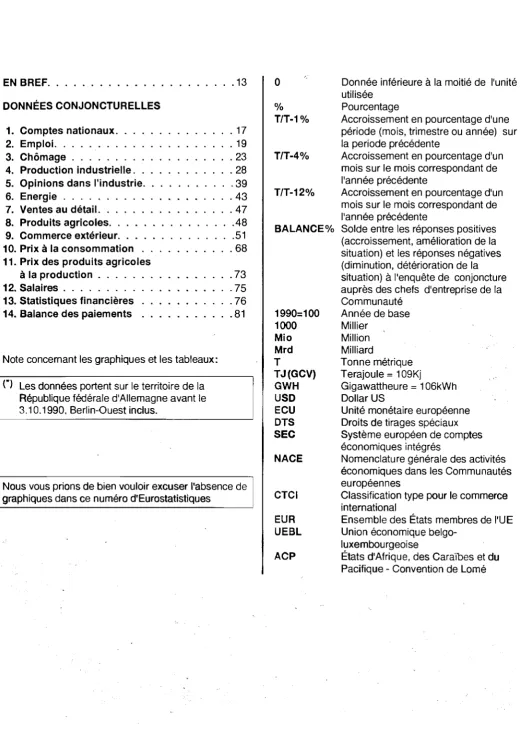
Table des matières
Signes et abréviations
EN BREF
13
DONNÉES CONJONCTURELLES
1. Comptes nationaux
17
2. Emploi
19
3. Chômage
23
4. Production industrielle
28
5. Opinions dans l'industrie
39
6. Energie
43
7. Ventes au détail
47
8. Produits agricoles
48
9. Commerce extérieur
51
10. Prix à la consommation
68
11. Prix des produits agricoles
à la production
73
12. Salaires
75
13. Statistiques financières
76
14. Balance des paiements
81
Note concernant les graphiques et les tableaux:
Π Les données portent sur le territoire de la
République fédérale d'Allemagne avant le
3.10.1990, BerlinOuest inclus.
Nous vous prions de bien vouloir excuser l'absence de
graphiques dans ce numéro d'Eurostatistiques
Donnée inférieure à la moitié de l'unité
utilisée
Pourcentage
Accroissement en pourcentage d'une
période (mois, trimestre ou année) sur
la periode précédente
Accroissement en pourcentage d'un
mois sur le mois correspondant de
l'année précédente
Accroissement en pourcentage d'un
mois sur le mois correspondant de
l'année précédente
BALANCE
% Solde entre les réponses positives
(accroissement, amélioration de la
situation) et les réponses négatives
(diminution, détérioration de la
situation) à l'enquête de conjoncture
auprès des chefs d'entreprise de la
Communauté
Année de base
%
T/T-1 %
T/T4%
T/T-12%
1990=100
1000
Mio
Mrd
Τ
TJ(GCV)
GWH
USD
ECU
DTS
SEC
NACE
CTCI
EUR
UEBL
Millier
Million
Milliard
Tonne métrique
Terajoule = 109Kj
Gigawattheure = 106kWh
Dollar US
Unité monétaire européenne
Droits de tirages spéciaux
Système européen de comptes
économiques intégrés
Nomenclature générale des activités
économiques dans les Communautés
européennes
Classification type pour le commerce
international
EUROSTATISTIQUES: en bref
TAUX DE CHANGE: le dollar ne parvient pas à maintenir son avance
Le dollar US a poursuivi sa remontée visàvis du yen japonais au début
de septembre. Un abaissement du taux d'escompte du Japon de 1 % à
0,5 % le 8 septembre a aidé le dollar à franchir la barre des Y100.
Cependant, la publication des chiffres décevants du commerce US et du
détail du nouveau train de mesures fiscales au Japon pour contribuer à la
relance de l'économie ont irrité le marché, et le 27 septembre, le dollar est
retombé au niveau des Y100 en dépit de l'intervention de la banque
centrale. Néanmoins, ce niveau représente un rebond considérable pour le
dollar par rapport à son plus bas historique de Y81 (cours à la clôture du
marché de Londres) à la miavril.
Dans le même temps, la performance du dollar visàvis du deutschemark
a été moins impressionnante: il s'est affaibli en septembre à DM 1,42 (le
28 septembre), par rapport à DM 1,46 au début du mois et à son plus bas
absolu de DM 1,35 à la miavril.
L'Union monétaire européenne a été au centre des questions influençant
les marchés au cours du mois de septembre. Le DM s'est apprécié
légèrement à l'intérieur du mécanisme du taux de change du SME, mais le
système est néanmoins resté très stable avec peu de modifications sur les
positions respectives des monnaies. En dehors du MTC, la lire italienne, le
markka finnois et la livre sterling se sont tous légèrement dépréciés par
rapport au DM.
La couronne suédoise qui s'apprécie depuis avril constitue une exception.
A la clôture du marché le 28 septembre, le taux couronne/DM était de
4,92 comparé au point bas de 5,43 en avril. Le franc suisse qui semble
avoir profité de son statut de monnaie refuge en dépit de la réduction du
taux d'escompte suisse le 21 septembre à 2 %, a constitué une autre
exception. Le franc suisse a atteint un plus haut sur une période de neuf
ans par rapport au DM au cours du mois de septembre à SFR 0,80.
Comme en Suisse et au Japon, le climat monétaire s'est détendu dans
plusieurs pays de l'UE au cours de septembre avec des réductions de taux
d'intérêt en Allemagne, Belgique, PaysBas, Danemark et Autriche.
RENDEMENT DES OBLIGATIONS D'ETAT: la nervosité affecte les
marchés
La nervosité sur les marchés des changes en septembre s'est également
répercutée sur les marchés obligataires. La tendance générale à la baisse
sur les rendements des obligations d'État européens depuis le début de
1995 s'est poursuivie au début septembre, mais la tendance s'est
renversée dans le courant du mois. A la clôture du marché le 28
septembre, le Bund allemand à dix ans rapportait 6,7 %, le même
rendement qu'un mois auparavant. Entretemps, le rendement de l'écu à
dix ans progressait à 7,8 % reflétant ainsi le creusement de l'écart entre
les rendements des obligations d'État allemands et ceux d'un certain
nombre d'autres pays, en particulier la France et l'Italie. Le marché des
obligations d'État suédois était cependant très actif avec un rendement à
dix ans en baisse au cours du mois de 10,3 % à 9,6 %.
Les marchés des obligations US et japonais ont également enregistré des
renversements de tendance en fin de mois de septembre. Cependant, sur
la base d'une comparaison d'un mois (au 28 septembre), le rendement
des obligations d'État US à dix ans a perdu environ 0,2 point de
pourcentage à 6,3 %, tandis que le rendement japonais équivalent
abandonnait 0,5 point de pourcentage à 2,7 %, légèrement audessus des
records à la baisse enregistrés en juillet.
RÉSERVES OFFICIELLES SUR L'ÉTRANGER: accroissement en Autri
che, Suède, Irlande
Depuis son adhésion à l'Union européenne au début de 1995, les réserves
de l'Autriche (à l'exclusion de l'or) se sont accrues de 3,3 milliards d'écus
pour atteindre 16,9 milliards d'écus en juillet. Dans le même temps, les
réserves de la Suède se sont accrues de 2,1 milliards d'écus pour
atteindre 21 milliards d'écus, mais en Finlande, les réserves sont revenues
à 8,2 milliards d'écus.
Parmi les autres membres de l'UE, les seuls autres accroissements
connus des réserves au cours de cette année ont été enregistrés en
Irlande (0,8 milliard d'écus à 5,8 milliards d'écus et BelgiqueLuxembourg
(+0,5 milliard d'écus à 11,8 milliards d'écus).
Les réserves du Japon ont fortement augmenté pour atteindre le niveau
record de 117,9 milliards d'écus en juin comparé à 102,3 milliards d'écus
à la fin de 1994, mais ont diminué de 0,3 milliard en juillet. Cet
accroissement des réserves reflète la forte position de la balance des
paiements du Japon mais aussi l'intervention de la banque centrale pour
freiner la hausse du yen contre le dollar US. En dépit de la faiblesse du
dollar, les réserves US sont passées de fin 1994 à juillet 1995 de 51,4
milliards d'écus à 59,3 milliards d'écus.
INFLATION ANNUELLE DANS L'UNION EUROPEENNE DES QUINZE:
3,1 % en août 1995
L'inflation annuelle dans l'Union européenne des Quinze s'élève à 3,1 %
en août 1995 comparé à 3,2 % (chiffre révisé) en juillet 1995 et 3,1 % en
août 1994.
En août, le chiffre pour l'Allemagne (1,7 %) comprend les nouveaux
Länder pour la première fois.
La Finlande continue de détenir le taux le plus faible avec 0,5 %. La
Belgique, avec 1,3 %, arrive en deuxième position.
Voici les taux enregistrés en août 1995, classés par ordre croissant, pour
chaque État membre ainsi que les chiffres correspondants pour l'année
précédente :
Finlande
Belgique
PaysBas
Danemark
Allemagne*
Luxembourg
France
Autriche
EUR 15
y compris ρ Provisoire
août 95
août 94
0,5 %
1,3 %
1,5 %
1,6 %
1,7 %
1,8 %
2,0 %
2,1 %
3,1 % p*
août 94
août 93
1,9 %
2,4 %
2,6 %
2,2 %
n/d
2,0 %
1,7%
3,2 %
3,1 %
les nouveaux Länder n/d non disponible
Irlande
Suède
RoyaumeUni
Portugal
Espagne
Italie
Grèce
août 95
août 94
2,5 %
2,7 %
3,6 %
4,1 %
4,3 %
5,6 % ρ
8,7 %
août 94
août 93
2,5 %
2,7 %
2,4 %
4,8 %
4,8 %
3,8 %
11,1
%
PRODUCTION INDUSTRIELLE: Hausse de la production industrielle
dans l'Union européenne des Quinze au cours du premier semestre
1995.
La production industrielle dans l'Union européenne des Quinze est en
hausse de 4,7 % au cours du premier semestre 1995 par rapport à la
même période en 1994.
L'augmentation était de 6,3 % au second semestre 1994 par rapport au
second semestre 1993.
Durant le premier semestre 1995, les nouveaux États membres l'Autriche,
la Finlande et la Suède, ainsi que l'Irlande ont enregistré les croissances
les plus importantes.
Voici les chiffres (en %) pour les États membres pour lesquels des
données sont disponibles. Les augmentations pour le deuxième semestre
de 1994 par rapport au deuxième semestre de 1993 sont entre
parenthè-ses (E = estimation) :
Suède
Irlande
Autriche
Finlande
Espagne
Italie
Danemark
12,5
12,3 E
10,9
10,0
7,7
7,0
6,5
(11,9)
(14,2)
(6,3)
(11.4)
(8,3)
(9,8)
(9,6)
France
Portugal
Royaume-Uni
Allemagne
Pays-Bas
Grèce
4,3
4,0
3,4
2,5
2,5
1,2
(5,1)
(1,0)
(5,0)
(5,2)
(3,5)
(17)
COMMERCE EXTERIEUR: En 1994, les importations de l'Union
euro-péenne des Douze ont augmenté un peu plus que les exportations
(+0,2 points en pourcentage).
En 1994, la balance commerciale de l'Union européenne des Douze* a
accusé un déficit d'1 milliard d'écus, alors que l'année précédente,
Les fréquentes révisions des chiffres mensuels communiqués par les États
membres expliquent que les données de la présente analyse ne correspondent
pas nécessairement à celles figurant dans les publications antérieures.
importations et exportations étaient pratiquement en équilibre (le déficit
n'atteignait que 0,1 milliard d'écus).
Ce résultat est la conséquence de la nette reprise des importations
extra-UE (qui ont augmenté de 10,8 % en 1994 après avoir stagné l'année
précédente et de la baisse de 1 % du taux de croissance annuelle des
exportations (10,6 % pour 11,7 % en 1993).
Au cours de 1994, l'Allemagne a enregistré à la fois l'excédent extra-UE le
plus important des États membres de l'Union européenne (25,6 milliards
d'écus) et la hausse la plus forte par rapport à la même période de l'année
précédente (5,6 milliards d'écus).
En 1994, l'excédent de la balance commerciale italienne s'est accru de 1,7
milliard d'écus, atteignant 12,7 milliards d'écus contre 11 milliards en
1993.
Le déficit extra-UE des Pays-Bas a enregistré la plus forte détérioration
entre 1993 et 1994 (9,9 milliards d'écus); avec 22 milliards d'écus, il est
maintenant le plus élevé de tous les pays de l'UE.
Pour l'année 1994, le Royaume-Uni a, parmi les États membres de l'UE,
enregistré le deuxième plus important déficit commercial (20,5 milliards
d'écus).
L'excédent commercial extra-UE de la France s'est accru de 1,4 milliard
d'écus en 1994 par rapport à l'année précédente (passant de 9,4 à 10,8
milliards d'écus).
Tant l'UEBL que la Grèce ont amélioré leurs comptes extérieurs, la
première réduisant le déficit de sa balance commerciale de 1,7 milliard
d'écus, la seconde ramenant son déficit commercial de 4,3 milliards
d'écus en 1993 à 2,8 milliards d'écus.
Par rapport à 1993, les excédents commerciaux du Danemark et de
l'Irlande se sont légèrement réduits, passant respectivement à 2,5 et 0,8
milliards d'écus.
VOLKSWIRTSCHAFTLICHE
GESAMTRECHNUNG ESVG
NATIONAL ACCOUNTS
ESA
COMPTES NATIONAUX
SEC
EUR
DK
D(*GR
IRLNL
UK
USA JAP0101
1991 1992 1993 1994 1993 I
II
III
IV
1994 I0102
1991 1992 1993 1994 1993 I
II
III
IV
1994 I0103
1991 1992 1993 1994 1993 I
II
III
IV
1994 I0105
1991 1992 1993
Bruttoinlandsprodukt
Volumen
119.8 120.4 119.8 121.6 -0.9
0.4 0.5 0.3 0.9
118.1 119.8 118.3 119.8
108.3 109.8 111.3 115.6 -1.4 -0.6
2.3 2.9 0.4
Privater Verbrauch
Volumen
122.7 123.6 123.9 124.7 -0.9
0.5 0.7 0.1 0.5
118.9 122.4 120.7 121.7
104.1 104.9 107.8 112.5 -0.2
0.2 2.4 2.9 0.8
123.4 125.3 122.9 123.9 -2.0
0.5 0.4 0.2 1.2
122.5 124.2 125.7 124.4 -1.7
0.5 0.8
-0.7
1.2
Bruttoanlageninvestitionen
Volumen
132.0 130.4 122.4 123.6 -2.8 -1.7
0.5
-1.0
1.6
153.9 155.5 144.6 146.6
Einfuhr
Volumen
148.0 154.0 147.5
146.7 150.8 144.6
98.8 90.7 89.0 95.5
9.6
-4.5
1.8 0.7 4.3
117.7 117.1 112.2
135.3 136.5 126.5 126.2 -4.7 -1.5
0.1
-2.7
3.3
151.2 156.9 141.3
111.8 112.8 112.6 113.4
115.4 117.4 117.1 117.8
143.9 139.7 135.1 137.6
183.5 194.0 197.3
127.2 128.2 126.9 128.3 -0.3 -0.2
0.1 0.2 0.7
Gross Domestic Product
volume
118.0 119.4 118.3 120.2 -1.0
0.2 0.3 0.0 0.7
1985= 100 205.2
142.6 146.1 152.2 T/T-1 %
117.5 118.4 117.6 119.4 -0.2
0.3
-0.6
0.9 0.1
129.3 131.7 132.2 134.3
Consumption of households
volume
129.1 131.8 128.7 128.8 -0.9 -1.1 -0.8 -0.1
0.1
176.6 169.7 152.2 150.2 -3.2 -2.8 -2.2 -1.0
0.1
216.7 231.0 223.6
118.4 120.0 120.8 122.1 -0.9
0.6 0.7 0.0 0.0
Fixed
132.3 129.0 122.4 124.2 -3.3 -1.2
0.7
-0.6 -0.2
147.7 149.3 143.7
1985=100 247.9 135.5 138.1 143.6 T/T-1 %
124.2 126.9 123.1 123.7 -1.8 -0.3
0.0
-0.2
1.3
capital formation
volume
1985=100 114.2 114.0 114.4 120.9 T/T-1 %
Imports
volume
1985=100 142.7 150.5 154.7
125.0 122.5 108.9 109.7 -4.5 -3.4 -1.9
0.2 1.6
146.7 155.2 143.9
129.7 131.9 132.2 134.4
210.4 206.0 214.3 210.4
148.3 148.5 144.9
118.7 120.4 120.7 122.2 -0.5
0.6 0.5
-0.3
1.0
118.1 120.6 121.6 122.6 -2.2
2.4 0.3
-0.3
0.1
120.7 122.0 118.5 118.1 -5.1
1.5 4.4
-6.8
0.6
135.0 138.5 137.6
127.1 128.5 126.9 128.3 -0.5 -0.9
134.5 139.5 140.7 141.0
0.4
-0.5
Produit Intérieur Brut
volume
115.1 114.6 116.8 119.7
0.3 0.8 0.7 0.7 0.8
113.6 116.5 120.0 123.6
0.2 0.5 0.7 1.7 0.7
130.0 131.4 131.5 132.5
0.9
-0.5
0.3
-0.7
1.0
Consommation privée
volume
122.9 122.9 125.9 128.7
0.3 0.6 1.2 1.1 0.6
113.7 116.6 120.5 124.5
0.2 0.8 1.1 1.1 1.1
125.6 127.8 129.1 131.5
1.3
-0.6
0.4 0.7 1.4
Formation brute de capital fixe
volume
168.7 177.8 170.8 172.7 -2.4 -2.7
215.2 239.2 237.4
118.0 116.5 116.9 121.0
0.2
-2.4
1.1 2.5 2.0
132.4 140.7 144.7
94.5 100.4 111.4 122.1
2.6 2.2 2.1 5.7 1.6
123.7 134.5 148.4
158.7 157.4 155.3 153.9
0.8
-0.4
0.3
-1.5 -0.7
Imports
volume
VOLKSWIRTSCHAFTLICHE
GESAMTRECHNUNG ESVG
NATIONAL ACCOUNTS
ESA
COMPTES NATIONAUX
SEC
EUR
DK
DD
GR
IRLNL
UK
USA JAP0106
1991 1992 1993 1994 1993 I
II III IV 1994 I
0111
1991 1992 1993 1994 1993 I
II III IV 1994 I
0112
1991 1992 1993 1994 1993 I
II III IV 1994 I
0113
1991 1992 1993
Ausfuhr
Volumen
135.5 141.0 141.3 148.2 -2.0 0.4 1.8 2.2 1.9
139.8 142.1 137.5 141.9
136.0 141.0 139.1 144.9 -4.4 -2.0 7.1 2.0 -3.8
Bruttoinlandsprodukt
Veränderung der Preise
126.9 131.5 132.7 135.8 0.9 0.8 0.5 0.7 0.6
127.4 133.7 141.1 147.1
125.9 130.0 136.0 138.5 2.1 -0.4 -0.3 0.8 0.7
Privater Verbrauch
Veränderung der Preise
122.6 127.5 128.6 132.0 0.9 0.7 0.6 0.8 0.7
121.8 126.2 133.4 138.9
124.2 128.4 134.3 137.2 0.9 0.4 0.5 0.0 0.7
145.4 150.9 141.8 148.6 -4.1 -0.1 -0.7 3.5 2.8
127.2 134.8 145.3 148.7 0.7 0.9 0.4 0.9 0.4
121.8 128.7 137.9 141.8
1.0 0.6 0.6 1.3 0.5
Bruttoanlageninvestitionen
Veränderung der Preise
122.7 124.8 125.4
121.4 126.8 132.4
121.1 127.1 132.9
127.4 134.7 144.7
171.5 185.3 189.9 197.8
116.5 122.0 127.7 131.9
122.9 128.4 134.2 138.4
88.2 93.1 95.2
130.5 139.3 151.6 165.5 1.6 3.0 3.4 4.5 7.1
153.7 158.7 147.4 145.0 0.8 1.0 0.9 1.0 1.0
147.3 152.0 142.1 140.8 1.2 1.2 1.2 1.2 1.2
138.2 137.3 128.4
132.4 139.0 138.1 143.3 -2.2 0.7 3.2 0.9 -0.1
Exports
volume
1985= 100 161.2 182.1 189.0 198.9 T/T-1 %
129.4 136.2 151.0 161.5 5.9 -1.1 2.8 1.2 5.1
Gross Domestic Product
change in price
1985=100
118.8 123.7 130.7 133.1 1.0 0.6 0.2 0.1 0.4
70.9 109.2 107.2 111.8 T/T-1 %
141.7 142.3 128.7 131.3 1.2 1.4 1.2 0.6 0.7
134.2 136.0 131.3 134.6
127.8 135.6 142.5 149.0
Consumption of households
change in price
1985=100 116.2
121.2 127.8 130.4 0.7 0.5 0.5 0.4 0.6
57.4 112.0 108.7 112.9 T/T-1 %
134.5 136.2 123.9 127.2 1.6 1.3 1.1 1.3 0.2
124.3 129.7 138.1 144.2
Sross fixed capital formation
change in price
1985=100 115.9
118.9 124.7
113.4 116.3 114.2
127.1 126.8 114.9
128.8 136.0 142.0
136.2 139.6 140.4 145.8 -3.0 3.1 1.9 2.3 -0.4
116.6 121.4 128.5 131.3 -0.3 0.4 0.6 0.8 0.7
117.5 122.9 131.1 134.2 0.6 1.1 0.3 0.0 1.2
119.2 124.3 131.0
161.3 171.2 165.1 175.6 -0.6 -9.0
161.4 187.2 187.2 188.3 3.3 1.2
142.5 159.9 158.4 159.7 2.2 0.7
121.0 124.7 128.6 134.6 1.0 -1.4 3.0 0.6 2.3
175.7 186.9 193.5 203.9 -0.6 0.9 -0.2 4.7 -0.3
Exports
volume
125.4 131.9 133.3 135.0 1.1 -1.9 0.7 -2.1 3.7
Produit Intérieur Brut
évolution des prix
117.2 116.3 113.6 119.6 1.3 0.8 0.7 0.9 0.7
76.8 75.4 85.8 90.6 0.9 0.6 0.4 0.3 0.7
117.6 121.2 154.4 172.1 0.2 0.3 0.5 0.0 -0.1
Consommation privée
évolution des prix
114.8 114.3 111.9 118.0 1.0 0.8 0.7 0.6 0.8
79.3 78.2 89.0 94.2 0.7 0.6 0.3 0.6 0.3
116.7 120.8 154.0 172.2 0.3 0.3 0.5 -0.4
0.5-Formation brute de capital fixe
évolution des prix
145.0 162.8 163.4
113.2 104.7 99.1
70.4 67.0 74.3
BESCHi
0201
1991 1992 1993 1994
0202
1991 1992 1993 1994
0203
1991 1992 1993 1994
0205
1991 1992 1993 1994
0206
1991 1992 1993 1994
0207
1991 1992 1993 1994
0208
ÍVFTIGUh
EUR
JG
Β
DK
Gesamtbevölkerung
329264.1 10004.5 5146.5 330988.6 10045.2 5162.1 330867.2 5180.6 330875.2
Zivile Erwerbspersonen
insgesamt
146229.6 4126.6 2860.6 146624.8 4159.7 2868.6 145430.3 2874.4 145452.3
Zivile Erwerbstätige
insgesamt
132988.1 3735.5 2607.3 132083.7 3724.0 2584.1 129377.9 2573.9 129407.9
Zivile Arbeitnehmer
insgesamt
109102.2 3001.4 2342.2 108644.5 3067.9 2351.6 106230.6 2310.1 106230.6
DD
64074.0 64865.0 65316.0
30203.0 30502.0 30533.0
28514.0 28694.0 28263.0
25460.0 25627.0 25199.0
Arbeitnehmer Landwirtschaft
2394.0 17.9 52.4 2215.6 17.9 51.8 2026.4 51.8 2026.4
Arbeitnehmer Industrie
37714.4 949.7 651.2 36404.7 932.6 630.8 34647.1 630.8 34647.1
222.0 211.0 201.0
10599.0 10411.0 9884.0
Arbeitnehmer Dienstleistungen
GR
10200.0 10313.6 10368.2
3933.5 4034.3 4118.4
3632.4 3684.5 3720.2
1930.5 1937.6 1980.8
30.4 28.5 35.7
690.0 675.7 621.4
EMPLOYMENT
E
F
IRL
Total population
mon
39024.9 39085.1 39082.6
57055.4 3526.0 57373.7 3549.0 57666.8 3563.0 3571.0
Civilian labour forces
total
1000
15073.7 15149.7 15308.2
24491.2 1330.0 24598.7 1348.0 24692.0 1363.0 1385.0
Civilian employment
total
1000
12607.7 12359.2 11825.6
22142.3 1122.0 22007.9 1127.0 21780.6 1134.0 1164.0
I
57114.0 57187.0 56121.0
24063.0 24069.0 22614.0
21410.0 21270.0 20152.0
Mumber of civilian employees
total
1000
9332.3 9030.0 8634.0
19281.7 853.0 19241.7 858.0 19111.4
Number of employees
agriculture
1000
464.7 400.7 371.7
260.1 23.0 259.3 22.0 258.8
Number of employees
industry
1000
3539.5 3330.7 3009.0
6032.8 288.0 5837.3 280.0 5568.6
15297.0 15297.0 14266.0
743.0 748.0 605.0
5726.0 5674.0 5421.0
Number of civilian employees
services
L
387.1 392.5 395.2
165.8 166.7 166.7
163.5 164.0 163.2
177.7 182.7 186.3
1.5
1.5
1.6
55.9 56.5 56.6
NL
15069.5 15184.0 15290.5
E
P
MPLOI
UK
Population totale
9861.3 57800.9 9833.0 57998.4 9839.7
Population active civile
total
6934.0 6905.0 7008.0
6444.0 6519.0 6571.0
4799.9 28248.3 4706.1 28117.0 4681.9 27911.0
Emploi civil
total
4602.1 26007.3 4512.0 25438.0 4424.4 25046.0
Emploi civil salarié
total
5721.0 5794.0 5806.0
107.0 101.0 99.0
1576.0 1502.0 1477.0
3193.1 22512.3 3351.0 21906.0 3257.1 21554.0
Emploi salarié
agriculture
135.5 336.5 95.9 278.0 85.9 276.0
Emploi salarié
industrie
1327.6 6278.7 1266.1 5808.0 1227.1 5539.0
BESCHÄFTIGUNG
EMPLOYMENT
EMPLOI
EUR
DK
D D
GR
IRLNL
UK
0209
1991 1992 1993 1994 1994 I
II
III
IV
1995 I0210
1991 1992 1993 1994 1994 I
II
III
IV
1995 I0211
1991 1992 1993 1994 1994 I
II
III
IV
Arbeitnehmer
Industrie
NACE Rev.1 C-E
98.0 94.4 88.6 84.9 85.6 85.2 84.7 84.3
99.1 95.5 90.3 77.5 81.2 78.9 76.2 73.8
97.9 95.9 91.5
Arbeitnehmer
Verarbeitendes Gewerbe
NACE Rev.1 D
98.0 94.4 88.7 85.2 85.9 85.4 85.0 84.6
98.8 95.0 89.8
Arbeitnehmer
Metalle
NACE Rev.1 27
91.6 86.2 84.1 74.4 79.5 78.9 78.0 77.8
98.1 93.0 87.7 35.1 45.6 38.4 31.2 25.2
98.6 96.6 92.4
98.0 98.6 95.0
101.4 98.9 90.3 84.4 86.0 84.8 83.8 82.9
101.6 99.0 90.4 84.4 86.0 84.8 83.8 82.9
97.5 92.9 81.5 72.6 74.1 72.9 72.1 71.4
92.5 88.1 83.8 82.4 83.6 82.8 81.9 81.4
92.2 87.7 83.0 80.7 82.1 80.9 80.4 79.4
97.6 91.7 83.9 80.7 81.8 81.1 80.9 79.1
Number of employees
industry
NACE Rev.1 C-E
97.0 94.2 85.2 83.1 83.2 82.7 82.8 83.5
1990=100 98.2 94.9 90.6 88.9 88.9 88.8 88.9 89.0 89.1
100.2 99.8 99.7
101.0 101.2 101.3
Number of employees
manufacturing industries
NACE Rev.1 D
96.8 93.5 88.2 85.9 86.1 85.2 85.8 86.5
1990=100 98.4 95.6 91.1 89.3 89.3 89.2 89.3 89.4 89.6
100.5 100.2 100.2
101.6 101.9 102.2
Number of employees
production of metals
NACE Rev.1 27
95.4 97.8 166.3 149.3 151.8 150.7 144.0 150.9
1990=100 92.8 86.7 81.2 78.0 78.9 78.1 77.9 77.3
100.0 88.2 88.2
89.3 87.5 82.5
97.2 91.8 86.7 82.4 83.9 82.9 82.0 80.8
96.4 90.9 85.2 80.5 82.0 80.8 80.1 79.0
95.5 87.3 79.5 76.0 76.6 76.4 75.9 75.1
99.2 99.4 94.2 90.8 91.8 90.9 90.5 90.2
99.1 99.3 94.1 90.9 91.5 91.1 90.7 90.1
94.1 88.9 79.9 74.2 75.6 74.6 73.8 72.9
99.7 99.0 95.3
92.6 92.0 91.3
Emploi salarié
Industrie
NACE Rev.1 C-E
96.0 87.9
93.0 87.9 84.9 84.3 84.3 84.3 84.2 84.2 84.1
Emploi salarié
Industrie manufacturière
NACE Rev.1 D
99.6 98.6 94.4
91.4 90.7 89.9
95.9 87.7 79.5
92.7 87.8 85.5 85.1 84.7 85.2 85.2 85.3 85.3
Emploi salarié
Métallurgie
NACE Rev.1 27
BESCHÄFTIGUNG
EMPLOYMENT
EMPLOI
EUR
DK
DD
GR
IRLNL
UK
0212
1991 1992 1993 1994 1994 I
II
III
IV
1995 I0213
1991 1992 1993 1994 1994 I
II
III
IV
1995 I0215
1991 1992 1993 1994 1994 I
II
III
IV 1995 I
Arbeitnehmer
Chemie
NACE Rev.1 24
97.4 94.5 90.2 85.9 87.6 86.3 85.2 84.6
100.5 99.7 96.1 91.1 91.9 91.4 90.8 90.3
Arbeitnehmer
Machinenbau
NACE Rev.1 29
97.9 93.2 85.4 80.7 81.5 80.7 80.4 80.1
97.1 87.3 81.4 85.4 84.0 84.8 85.8 87.0
Arbeitnehmer
Fahrzeugbau
NACE Rev.1 34-35
95.4 92.3 85.2 80.6 81.8 81.1 80.1 79.5
98.2 97.7 91.4
102.2 99.4 91.6
101.0 99.5 92.8 86.9 88.5 87.3 86.3 85.4
101.1 97.5 86.8 79.0 80.5 79.4 78.4 77.7
100.8 98.3 89.6 83.2 84.7 83.7 82.6 81.8
93.1 87.7 87.0 86.6 87.0 86.9 86.6 85.9
87.4 87.4 82.6 78.2 78.3 77.6 78.7 78.2
97.5 93.8 80.9 78.8 81.9 77.0 77.8 78.5
Number of employees
chemical industry
NACE Rev.1 24
94.7 80.7 76.5 76.6 80.8 75.9 73.9 75.8
1990=100 99.0 97.1 94.6 93.6 93.6 93.4 93.7 93.8 93.4
107.3 113.0 116.6
121.7 123.8 124.7
Number of employees
machinery and equipment
NACE Rev.1 29
92.6 90.8 87.0 84.9 84.0 83.3 85.5 86.8
1990=100 100.0
96.5 90.2 87.5 87.2 87.3 87.5 87.9
98.2 100.9 100.6
105.1 107.9 108.8
Number of employees
transport equipment
NACE Rev.1 34-35
95.7 98.9 90.8 86.6 87.0 87.6 86.1 85.8
1990=100 97.7 95.9 92.7 89.7 90.5 89.8 89.5 89.2 89.4
104.4 106.1 107.4
106.7 105.6 95.3
98.7 92.8 87.0 79.2 81.9 80.2 78.3 76.4
93.5 85.7 78.7 75.5 76.3 75.6 75.2 74.9
97.0 90.1 83.2 78.7 80.8 79.7 78.3 76.3
143.2 239.9 243.2 235.9 239.4 239.5 233.3 231.5
99.1 97.0 92.1 87.6 89.9 88.7 86.8 84.9
98.9 97.1 92.6
90.4 90.3 89.2
Emploi salarié
Chimie
NACE Rev.1 24
92.7 84.8 76.2
95.5 94.9 92.9 87.9 90.9 88.6 86.7 85.7 85.6
Emploi salarié
Machines et équipements
NACE Rev.1 29
101.6 101.5 96.4
94.8 93.2
98.8 98.8 88.1
83.2 82.2 79.7
98.8 95.3 86.7
92.3 85.9 81.4 79.9 79.9 79.4 79.8 80.5 81.1
Emploi salarié
Matériel de transport
NACE Rev.1 34-35
96.9 93.5 89.5
BESCHÄFTIGUNG
EMPLOYMENT
EMPLOI
EUR
DK
D(*GR
IRLNL
UK
0216
1991 1992 1993 1994 1993 IV 1994 I
II
III
IV
0217
1991 1992 1993 1994 1994 I
II
III
IV
1995 I0218
1991 1992 1993 1994 1994 I
II
III
IV
1995 IArbeitnehmer
Nahrungsmittel, usw.
NACE Rev.115
78.9 78.6 78.1
Arbeitnehmer
Textilien
NACE Rev.117
78.2 77.8 77.3 77.2
96.6 93.1 86.6 86.5 86.9 86.8 86.1 86.0
Arbeitnehmer
Schuhe, Bekleidung
NACE Rev.1 18
98.6 95.1 93.1
93.2
89.1 87.7 83.6
106.7 106.3 100.6 97.6 99.1 98.3 98.1 97.4 96.7
98.1 91.6 79.6 71.8 74.0 72.7 71.2 69.4
95.9 86.1 69.0 60.9 63.4 61.8 59.7 58.4
93.6 92.8 93.7 91.4 98.1 94.6 92.6 92.2 86.1
88.1 80.6 70.9 67.6 66.8 66.9 67.1 69.7
Number of employees
food, drink
NACE Rev.115
95.4 91.8 92.0 91.0 93.4 93.4 90.1 91.3 89.1
1990=100 101.6 102.5 101.4 101.1 101.1 101.1 101.3 101.2 101.0
100.7 99.9 101.0
102.5 103.0 101.2 100.7
Number of employees
textiles
95.7 80.5 65.9 65.8 63.2 64.6 65.1 70.4
NACE Rev.117
1990=100 91.9 85.8 74.5 68.8 70.2 69.3 68.1 67.5
98.3 97.1 91.4
92.6 94.6 95.0
Number of employees
footwear, clothing
NACE Rev.118
1990=100 92.1 85.9 78.1 75.3 75.5 75.4 75.4 74.9 74.8
95.1 90.8 85.8 81.5 81.7 81.5 81.3 81.3
101.1 98.1 94.1 89.1 90.8 89.6 88.8 88.6 89.3
Emploi salarié
Alimentation et boisson
NACE Rev.115
101.0 100.4 99.5
98.7 96.6 97.6
103.3 99.5 96.2
91.6 90.8
99.5 94.6 76.3
73.0 68.4 69.2
95.7 86.8 63.7
19.6
84.8 79.2 78.3 79.1 80.3 80.2 78.9 78.7 78.7
Emploi salarié
Textiles
NACE Rev.117
93.4 80.1 70.4
91.1 88.4 87.8 88.1 88.6 87.5 88.1 88.3 87.7
Emploi salarié
Habillement
NACE Rev.118
99.6 95.7 89.4