University of Southern Queensland
Faculty of Health, Engineering and Sciences
miniROV
A dissertation submitted by
Mr Matthew Robe
In fulfilment of the requirements of
Bachelor of Engineering
Major in Mechatronics
ABSTRACT
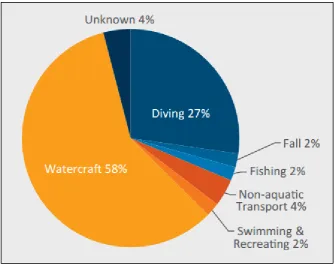
ROVs (Remotely Operable underwater Vehicle) are versatile vehicles used to get into hard-to-reach and/or dangerous marine environments. Current ROVs are expensive and require either a hardwire tether to the operator(s) or expensive acoustic communication methods, both limiting the distance an operator (usually more than one) is from the ROV. Given that underwater diving is a very dangerous profession, making up 27% of Australia’s ocean and harbour deaths prior 2012/2013, there is an obvious need for an affordable ROV which is wirelessly controllable by a single operator in a location remote from the ROV, and which is capable of verbal and visual communication with divers, in particular marine archaeologists.
In determining if such a ROV is possible, a comprehensive study of existing ROVs, communication techniques, components/elements available, and costings were examined. From this a system model of a buoy buddy system was developed. There are three main elements to this model: a buoy, a ROV, and the operator. The buoy is hardwire tethered to the ROV. The operator is then able to wirelessly communicate with the buoy through traditional IP networks (i.e. GSM or WiFi networks).
University of Southern Queensland Faculty of Health, Engineering and Sciences
ENG4111/ENG4112 Research Project
LIMITATIONS OF USE
The Council of the University of Southern Queensland, its Faculty of Health, Engineering & Sciences, and the staff of the University of Southern Queensland, do not accept any responsibility for the truth, accuracy or completeness of material contained within or associated with this dissertation.
Persons using all or any part of this material do so at their own risk, and not at the risk of the Council of the University of Southern Queensland, its Faculty of Health, Engineering & Sciences or the staff of the University of Southern Queensland.
University of Southern Queensland
Faculty of Health, Engineering and Sciences ENG4111/ENG4112 Research Project
CERTIFICATION OF DISSERTATION
I certify that the ideas, designs and experimental work, results, analyses and conclusions set out in this dissertation are entirely my own effort, except where otherwise indicated and acknowledged.
I further certify that the work is original and has not been previously submitted for assessment in any other course or institution, except where specifically stated.
ACKNOWLEDGEMENTS
Firstly, I would like to thank my parents and brothers for their endless support and
encouragement. They are the foundation of who I am today.
I would also like to thank my supervisor, Dr Andrew Maxwell, and my long-time friend
TABLE OF CONTENTS
ABSTRACT i
LIMITATIONS OF USE ii
CERTIFICATION OF DISSERTATION iii
ACKNOWLEDGEMENTS iv
List of Figures viii
List of Tables x
List of Appendices xi
Nomenclature and acronyms xii List of Constants & Variables xiii
Chapter 1 INTRODUCTION 1
1.1 Outline of Study 1
1.2 Introduction 1
1.3 The Problem(s) 2
1.4 Research Objectives 2
1.5 Conclusions 3
Chapter 2 LITERATURE REVIEW 4
2.1 Introduction 4
2.2 SCUBA Diving & Marine Archaeology 4
2.3 What is a ROV? 7
2.4 Types of ROVs 7
2.4.1 Glider 7
2.4.2 Robotic 8
2.5 Previous Designs 9
2.5.1 Bluefin-21 9
2.5.2 Dive Works Work Class ROV 10
2.5.3 Hercules 11
2.5.4 Global Explorer 11
2.5.5 Sea Explorer 12
2.5.6 OpenROV 13
2.6 Conclusions 14
Chapter 3 METHODOLOGY 15
3.1 Introduction 15
3.2 Methods of Communication 15
3.4 Peer-to-peer underwater communication 18
3.5 Hydrodynamic Drag 19
3.6 Thrust 21
3.7 Hardware 21
3.7.1 Camera & Lighting 21
3.7.2 Inverters 23
3.7.3 Umbilical Cord (Tether) 23
3.7.4 Telemetry 24
3.7.5 Emergency Air Tank 25
3.7.6 Manipulator Arm 26
3.7.7 Motors 26
3.8 Control System 27
3.8.1 Depth control 27
3.8.2 Navigation 28
3.9 Conclusions 28
Chapter 4 SYSTEM DESIGN 29
4.1 Introduction 29
4.2 System Model 29
4.2.1 Chassis 31
4.2.2 Video Capture 31
4.2.3 Tether Management System 31
4.2.4 Propulsion 31
4.2.5 Control System 31
4.2.6 Telemetry 32
4.2.7 Variable Ballast System 32
4.2.8 Power 32
4.2.9 Diver Communications 32
4.3 Methods of Communication 33
4.3.1 Completely Wireless 33
4.3.2 Operator to buoy tether 33
4.3.3 ROV to buoy tether 35
4.4 Full System Overview 37
4.5 ROV Requirements 38
4.5.1 Structural Requirements 38
4.5.2 Electrical Requirements 38
4.6 ROV Equipment 39
4.6.1 Frame Materials 39
4.6.2 Thrust & Motor Layout 41
4.6.3 Variable Ballast System 44
4.6.4 Camera, Telemetry and tether 46
4.6.5 Computer & Electronic Equipment 48
4.7 Final ROV Design 51
4.7.1 Structural Analysis 51
4.7.2 Components 53
4.7.3 Fluid Analysis 55
4.8 Buoy 59
4.8.1 Structural Requirements 59
4.8.2 Electronic Requirements 59
4.8.3 Functional Requirements 60
4.9 Buoy Equipment 60
4.9.1 Photovoltaic Panel(s) & battery bank 60
4.9.2 Electronic Components (GPS, Compass & Wireless transmission) 62
4.10 Final Buoy Design 64
4.10.1 Components 65
Chapter 5 CONCLUSIONS 66
5.1 Future Work 67
References 68
LIST OF FIGURES
Figure 2-1: Ocean / Harbour Drowning Deaths by Activity Immediately Prior, 2012/13
(Source: Denoble, et al., 2008)... 5
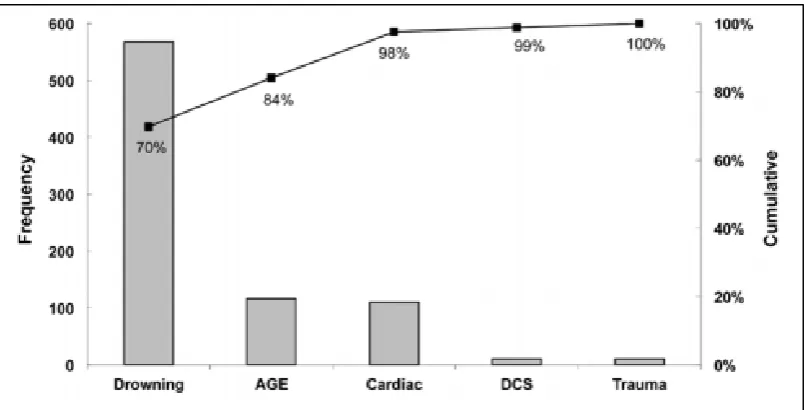
Figure 2-2: Cause of death in 814 DAN America scuba fatalities (not previously published) (Source: Denoble, et al., 2008) ... 6
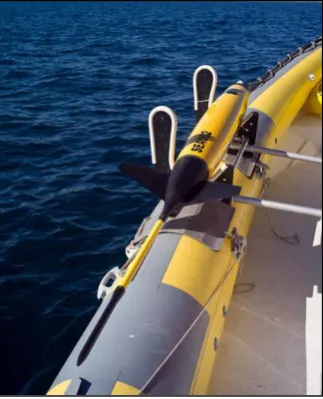
Figure 2-3: Spectrum AUV glider (Source: MacNeill, 2008)... 8
Figure 2-4: ROV Operators (Source: Kempin, 2010) ... 9
Figure 2-5: Bluefin-21 AUV (Source: BlueFin Robotics, 2014) ... 9
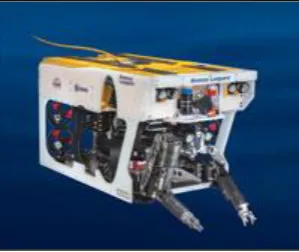
Figure 2-6: DIVEworks Seaeye Leopard ROV (Source: DIVEworks, 2014) ... 10
Figure 2-7: Hercules ROV by IFE (Source: NOAA, 2014) ... 11
Figure 2-8: Sea Explorer AUV (Source: ACSA Alcen, 2014) ... 12
Figure 2-9: OpenROV image (Source: OPENROV, 2014) ... 13
Figure 3-1: TMS, System Design (Source: Tarmey, 2006) ... 16
Figure 3-2: Centre of Buoyancy (CB) & Centre of Gravity (CM/CG) relationship (Source: Cornerstone Robotics, 2014) ... 18
Figure 4-1: System Model Specifications (Source: Robe, 2014) ... 30
Figure 4-2: Buoy-Operator tether (Source: Robe, 2014) ... 34
Figure 4-3: Buoy-ROV tether (Source: Robe, 2014) ... 35
Figure 4-4: Overall System component schematic (Source: Robe, 2014) ... 37
Figure 4-5: PVC & PMMA Max. Stress (Source: Robe, 2014)... 40
Figure 4-6: Preliminary motor layout (Source: Robe, 2014) ... 41
Figure 4-7: Final motor layout (Source: Robe, 2014) ... 42
Figure 4-8: Relative-to-motor thrust visual (Source: Robe, 2014) ... 42
Figure 4-9: Percentage of utilised motor (Source: Robe, 2014) ... 43
Figure 4-10: Hobby King 1700kV Brushless motor (Source: Hobby King, 2014) ... 44
Figure 4-11: High Sensitivity water level (Source: Emart, 2014) ... 45
Figure 4-12: MV75 Micro 12V Solenoid (Source: Irrigation Australia, 2014) ... 45
Figure 4-13: Logitech HD Pro Webcam C920 (Source: Logitech, 2014) ... 46
Figure 4-14: Luminus SST-90 LED (Source: lck-led, 2014) ... 46
Figure 4-15: 12VDC Power loss analysis (Source: Robe, 2013) ... 47
Figure 4-16: 12VDC vs. 240VAC Power loss over 100m (Source: Robe, 2014) ... 47
Figure 4-17: Beaglebone Black (Source: elinux, 2014) ... 48
Figure 4-18: Arduino MEGA (Source: Marian, 2014) ... 49
Figure 4-19: Piezoresistive pressure sensor (Source: digi-key, 2014) ... 49
Figure 4-21: Ocean Reef GSM G-Power communicator (Source: Ocean Reef, 2014) .. 50
Figure 4-22: Final ROV Design (Source: Robe, 2014)... 52
Figure 4-23: ROV design highlighting balancing weight adjuster (Source: Robe, 2014) ... 52
Figure 4-24: Sectional view of the motor assembly (Source: Robe, 2014) ... 53
Figure 4-25: ANSYS CFX fully constrained ROV model (Source: Robe, 2014) ... 55
Figure 4-26: Incredibly simplified version on the inventor model for ANSYS (Source: Robe, 2014) ... 56
Figure 4-27: ANSYS Fluent simulation result with pathlines representing static pressure (Pa) (Source: Robe, 2014) ... 57
Figure 4-28: Drag monitor inputted for drag force in the X-Y-Z vectors (Source: Robe, 2014) ... 58
Figure 4-29: Century Deep Cycle Gel battery (Source: Century Batteries, 2014) ... 61
Figure 4-30: 62W Semi-flexible PV Panel (Source: Kulkyne Kampers, 2014) ... 62
Figure 4-31: Samsung Galaxy Neo (Source: JB Hifi, 2014) ... 62
LIST OF TABLES
Table 2-1: Bluefin Specifications (BlueFin Robotics, 2014) ... 10
Table 2-2: DIVEworks Seaeye Leopard Specifications (Source: DIVEworks, 2014) ... 11
Table 2-3: Global Explorer ROV Specifications (DEEP SEA SYSTEMS International, 2014) ... 11
Table 2-4: Sea Explorer AUV Specifications (Source: ACSA Alcen, 2014) ... 12
Table 2-5: OpenROV Specifications ... 14
Table 3-1: Formulae for simple geometric objects ... 17
Table 3-2: Projected Area of common, simple shapes (Source: Robe, 2014) ... 20
Table 3-3: integral LED household lumen ratings (Source: integral LED, 2014) ... 22
Table 4-1: MinIMU-9 9DOF measuring capabilities (Source: Pololu, 2014) ... 50
Table 4-2: ROV component/element costs (Source: Robe, 2014) ... 53
Table 4-3: sea water properties at 10oC (Source: ITTC, Appendix C.5) ... 55
LIST OF APPENDICES
Appendix A Project Specification 71 Appendix B Table of Materials 72
Appendix C ROV Design 73
Appendix C.1 ROV preliminary designs 73
Appendix C.2 ROV Detailed Drawings 74
Appendix C.3 MIT Wax for waterproofing (pages 9-11) 77
Appendix C.4 ROV Buoyancy calculations using PTC MathCAD®. 80
Appendix C.5 Sea Water Properties 83
NOMENCLATURE AND ACRONYMS
The following abbreviations have been used throughout the text and bibliography: - ROV Remotely Operated/Operable underwater Vehicle
AUV Autonomous Underwater Vehicle
SCUBA Self-Contained Underwater Breathing Apparatus
CM Centre of Mass
CB Centre of Buoyancy
HD High Definition
SD Standard Definition
TMS Tether Management System AGE Arterial Gas Embolism DAN Divers Alert Network
CFD Computational Fluid Dynamics ESC Electronic Speed Controller
PVC Polyvinyl Chloride
PMMA Polymethyl Methacrylate VBS Variable Ballast System LED Light Emitting Diode GPS Global Positioning System
LIST OF CONSTANTS & VARIABLES
𝑔 = 𝑔𝑟𝑎𝑣𝑖𝑡𝑦 = 9.81(𝑚𝑠−1)
𝐹𝐷 = 𝐷𝑟𝑎𝑔 𝐹𝑜𝑟𝑐𝑒(𝑁𝑚) 𝐶𝐷 = 𝐷𝑟𝑎𝑔 𝐶𝑜𝑒𝑓𝑓𝑖𝑐𝑖𝑒𝑛𝑡 𝜌 = 𝑑𝑒𝑛𝑠𝑖𝑡𝑦 𝑜𝑓 𝑙𝑖𝑞𝑢𝑖𝑑 (𝑘𝑔 𝑚⁄ 2)
𝑣 = 𝑣𝑒𝑙𝑜𝑐𝑖𝑡𝑦 (𝑚𝑠−1) 𝐴𝑝 = 𝑃𝑟𝑜𝑗𝑒𝑐𝑡𝑒𝑑 𝐴𝑟𝑒𝑎 (𝑚2)
𝑇 = 𝑇ℎ𝑟𝑢𝑠𝑡 𝐹𝑜𝑟𝑐𝑒 (𝑁𝑚)
𝐷𝑝 = 𝐷𝑖𝑎𝑚𝑒𝑡𝑒𝑟 𝑜𝑓 𝑃𝑟𝑜𝑝𝑒𝑙𝑙𝑒𝑟 (𝑚) ∆𝑣 = 𝐶ℎ𝑎𝑛𝑔𝑒 𝑖𝑛 𝑣𝑒𝑙𝑜𝑐𝑖𝑡𝑦 (𝑚𝑠−1)
𝐶𝑆𝐴 = 𝐶𝑟𝑜𝑠𝑠 𝑆𝑒𝑐𝑡𝑖𝑜𝑛 𝐴𝑟𝑒𝑎 (𝑚𝑚2) 𝑃 = 𝑃𝑟𝑒𝑠𝑠𝑢𝑟𝑒 (𝑀𝑃𝑎)
CHAPTER 1
INTRODUCTION
1.1
Outline of Study
The need for an affordable ROV (Remotely Operable underwater Vehicle) which is wirelessly controllable by a single operator in a location remote from the ROV, and which is capable of verbal and visual communication with divers, in particular marine archaeologists was identified from preliminary research detailed in Chapter 2.
Study in this area has never been undertaken by anyone at USQ.
The purpose and scope of this study is detailed in 1.4 Research Objectives.
1.2
Introduction
ROVs are versatile vehicles used to get into hard-to-reach or dangerous marine environments. There are many different versions of ROVs in the marketplace at the moment. They currently require either: a hardwired tether from the operator all the way to the ROV, or expensive acoustic communication methods to communicate between the operator (on a boat) and the ROV.
This study firstly looks at already implemented designs for industrial and hobbyist ROVs. An Autonomous Underwater Vehicle (AUV) system like the Bluefin-21 (by Bluefin Robotics) has cost tens of thousands of US dollars to produce and requires technology that small organisations cannot afford.
These designs are then assessed to see what can be improved upon to achieve wireless communication that is economically and physically viable so that an operator can manually control the ROV from remote locations.
This study will also address the need for effective verbal and visual communication between divers, more specifically marine archaeologists, and people above the surface of the water.
1.3
The Problem(s)
As briefly outlined in Section 1.1, this study looks at two major problems relating to ROVs and marine archaeology;
The first problem – marine archaeologists have no method of live verbal and visual communication with people above the surface of the water.
The second problem – ROVs lack the ability to communicate wirelessly with an operator on land or in various other remote locations. They are also very expensive devices. The specific effects of the second problem, and which will be addressed in Chapter 3 and Chapter 4, are;
Complications related to wireless transmission in the air and water. Tether management options
1.4
Research Objectives
The research comprised of identifying the problems, trends and needs for marine archaeologists and ROVs. The main research objectives were derived from the project specification (Appendix A). They are:
Research into previous designs of ROVs
o Covered in Section 2.4 and 2.5 Factors related to designing a ROV.
o Covered in Chapter 3: METHODOLOGY and Section 4.2 Critically evaluate the subsystems used in the previous designs of ROVs
o Also covered in Chapter 3: METHODOLOGY. This is also critically evaluated through Chapter 4 where elements of the ROV were chosen and required critical evaluation.
Selection of appropriate methods of navigating (controlling) ROVs
o The innovative new wireless control system is covered in Section 4.3. Integration of electronic components with the mechanical.
o This objective is referring to the integration of the components into the frame/compartments, essentially a system model.
This is covered in Chapter 4: SYSTEM DESIGN.
A research objective that was not previously covered in the project specifications was the investigation into marine archaeologists. The primary focus of the old specifications only involved the research into a ROV, on its own, the actual study encompasses more than that. It has extended objectives to:
Include in the design a method of live communication with divers.
o This is to incorporate both verbal and visual aids for divers.
As time permits a prototype was to be constructed and tested. A yearlong study into this field proved that manufacturing a prototype was not possible in such a short time-frame. However, a thorough investigation into a feasibility study involving a complete system design and model was done.
1.5
Conclusions
This dissertation aims to come up with an innovative system design for a wirelessly controlled ROV capable of voice and video capture.
The research is expected to result in a system model which will specify possible elements of design and components required to solve the problem outlined in 1.3.
A review of literature for this research will identify what the minimum components required for the design to be beneficial to marine archaeology.
CHAPTER 2
LITERATURE REVIEW
2.1
Introduction
Chapter 2 covers the preliminary research into the areas of recreational SCUBA diving, marine archaeology, and of currently manufactured ROVs. The benefits of a ROV for marine archaeology will also be covered.
2.2
SCUBA Diving & Marine Archaeology
Figure 2-1: Ocean / Harbour Drowning Deaths by Activity Immediately Prior, 2012/13 (Source: Denoble, et al., 2008)
Figure 2-2: Cause of death in 814 DAN America scuba fatalities (not previously published) (Source: Denoble, et al., 2008)
The current known causes of death (triggers) pre 2008 are gas-supply problems (41%), entrapment/entanglement (19%) and equipment issues (16%). These make up 76% of the triggers. Emergency ascent (60%), insufficient breathing gas (20%) and buoyancy problems (14%) made up 94% of all causes of death (Denoble, et al., 2008). The gas-supply & equipment issues can be interrelated as triggers which cause panic, creating previously mentioned causes of death. The addition of emergency air helps remove this panic.
Marine archaeology is the application of archaeology underwater. Archaeology is the investigation of the physical remains of material cultures found through artefacts, structures, human remains or animal and plant remains. For marine archaeologists, this is often in shallow depths (no more than 100m) where they investigate ship wreaks and the oceans floor for evidence of historical events. The divers’ equipment is very similar to that of recreational SCUBA divers, however they do require delicate excavation tools and cameras.
2.3
What is a ROV?
A ROV is a Remotely Operable Underwater Vehicle. They are abbreviated to ROV to avoid confusion with remote control vehicles. Typically ROVs are operated through the use of an umbilical cord which is tethered from the controller to the vehicle. Umbilical cords are made of multiple collections of cables to send signals to and from the vehicle as well as power. This includes receiving the video feed of what the vehicle is seeing to the operator. On a large scale, umbilical cords are used to send power from the operators’ location to the vehicle. The operator controls the vehicle with the use of a computer or a joystick controller from a boat (industrial) or the land (hobby).
ROVs have many different uses since they are capable of navigating into hard to reach locations. They are not restricted (like divers are) to any shallow depth, and do not have dive duration limitations that affect safety.
2.4
Types of ROVs
2.4.1 Glider
Gliders have very little mechanical movements, so they use less electricity. This allows them to travel large distances sampling water content over several days, to weeks at a time. They move by changing depth; once at the apex of the dive they sample water, then return to the surface. At the surface they transmit their data onshore, then receive orders for their next sample location. On board, gliders can be equipped with:
sensors for sampling the water for scientific purposes
gyroscopic compasses & accelerometers for stability & direction batteries for running components
a pump for evacuating a floodable chamber
To change direction, it can either rotate a battery pack to change side balance, or it can use ailerons. Both actions roll the vehicle to change direction.
Figure 2-3: Spectrum AUV glider (Source: MacNeill, 2008)
These gliders are able to control their pitch and roll on the fly, but they are completely unable to change their yaw.
2.4.2 Robotic
Figure 2-4: ROV Operators (Source: Kempin, 2010)
The number of operators required to control the vehicle can number 6; where 2 control the cameras, 2 control the ROVs direction and the final 2 are there to do the delicate jobs such as operating manipulator arms.
2.5
Previous Designs
2.5.1 Bluefin-21
The Bluefin-21 is an autonomous underwater vehicle (AUV) capable of carrying different payloads due to its modular design. It is outfitted with multiple sensors making it capable of highly accurate autonomous activities.
Even though the Bluefin-21 boasts lots of features, it comes with a large cost. It was estimated that a simple mission off the coast of Western Australia in 2014 cost over USD $1 000 000.
Table 2-1: Bluefin Specifications (BlueFin Robotics, 2014)
Depth limitation 4.5km
Weight 750kg
Cost Over $1million USD for a mission
Maximum Speed 4.5 knots
Runtime with standard Payload 25 hours @ 3knots
Payloads 1. EdgeTech 2200-M 120/410 kHz side
scan sonar
(option: EdgeTech 230/850 kHz dynamically focused)
2. EdgeTech DW-216 sub-bottom profiler
3. Reson 7125 400 kHz multibeam echosounder
2.5.2 Dive Works Work Class ROV
The Work Class ROV by Dive Works is an extremely heavy ROV, deployable from large sea vessels for underwater exploration. Its design for inspection, repair and maintenance of vessels, petroleum asset inspections & subsea surveys makes this a very versatile vehicle. It features a Tether Management System (TMS) which drops down with the ROV inside of it, then once the ROV is out of it, it helps keep the tether out of the ROV’s way. It is capable of operating at depths of 2km with a radius from the TMS of 200m.
[image:24.595.251.401.596.722.2]Table 2-2: DIVEworks Seaeye Leopard Specifications (Source: DIVEworks, 2014)
Depth limitation 2.2km
Weight 3300kg
Payloads 1. Adjustable height garage to
accommodate ROV tool skids 2. up to 400kg extra for tooling/skid
2.5.3 Hercules
Built for the Institute for Exploration (IFE), Hercules is capable of performing delicate tasks at a depth of 4km. Designed for study and recovering of artefacts from ancient shipwrecks, this ROV has a High Definition (HD) camera for the intricate processes. To reach the depths of 4km, Hercules goes down with its own TMS called Argus.
Figure 2-7: Hercules ROV by IFE (Source: NOAA, 2014)
2.5.4 Global Explorer
The Global Explorer is a portable ROV weighing approximately 13600kg able to be transported in 40ft shipping containers or it can be side loaded onto a Boeing 737. The ROV can be launched from a vessel with an A-Frame or an articulated crane. It features the ability for 3D & HD video streaming through a fibre optic. Its most significant feature is its large payload bay and manipulator arm. The manipulator arm is an Orion 7-function spatially correspondent hydraulic manipulator. This manipulator arm is capable of picking up objects, and is also outfitted with the capability to cut wire rope.
Depth limitation 3000m
Weight 14ton (30,000lb)
Payloads Up to 200lb (90kg) on the bay reduced
to 80lb (36kg) with the suction sampler.
2.5.5 Sea Explorer
[image:26.595.245.407.348.548.2]The Sea Explorer is the most advanced glider on the market. It dives by changing its buoyancy and is capable of reaching speeds of 1 knot. It does not having moving wings or any external moving objects. This reduces the risk of entanglement on debris and makes it easier to launch. As it is an automated system, when it surfaces, it sends the GPS location the pilot then dives again with the new GPS location specified.
Figure 2-8: Sea Explorer AUV (Source: ACSA Alcen, 2014)
Table 2-4: Sea Explorer AUV Specifications (Source: ACSA Alcen, 2014)
Depth limitation 700m
Weight 59kg
Maximum Speed 1 knot
Turn radius 20m
Runtime Up to 2 months
Optional Sensors CTD (SeaBird ) DO (SeaBird) Turbidity (WetLabs)
Chlorophyll, CDOM, Phycobilins (WetLabs)
CDOM (WetLabs)
Hydrocarbon MiniFluo (ACSA) Acoustic recorder (ACSA) Acoustic positioning (ACSA) Altimeter
2.5.6 OpenROV
OpenROV is a hobby specific underwater vehicle. It is designed to be open source, meaning the coding and hardware are up to the user to change and adapt to their preference. It is not a product you simply buy and use immediately. The current system uses very little sensory input and allows for users to view what is going on through a web user interface. It operates with a BeagleBone Black (BBB) and a customised Arduino sending telemetry and power through Power over Ethernet (POE). The assembled model is only capable of video imagery to a depth of 100m.
Table 2-5: OpenROV Specifications
Cost $849USD (KIT), $1450USD
(Assembled)
Depth limitation 100m
Weight N/A but is easy for a single person to
carry
Payloads Lithium batteries
2.6
Conclusions
CHAPTER 3
METHODOLOGY
3.1
Introduction
The specifics to the major design aspects of ROVs is covered in Chapter 3. They are: current methods of communication (between operators and vehicle)
buoyancy & stability of the ROV underwater
hydrodynamic drag and how to calculate the thrust produced from a combination of motors and propellers
hardware required for functional purposes, including:
o video streaming
o depth limitations
o methods of controlling the vehicle through motors and computers.
3.2
Methods of Communication
The most common system that is currently implemented in most industrial ROVs is the hardwired tether. Using this system ROVs are capable of reaching depths of 3000 metres below the surface. This system is acceptable, but has the annoying possibility of the tether coiling up and tangling with debris or with the vehicle itself.
Figure 3-1: TMS, System Design (Source: Tarmey, 2006)
A TMS is only used with highly expensive ROV applications. The cheapest alternative at the moment for small scale applications is a tether directly connected to the operator’s controls. This is not very flexible in terms of operational location.
A less common method of communicating with a ROV from a boat is by the use of acoustic wavelengths underwater. The operators’ boat has a node which transmits/receives control and visual information to and from the boat to the ROV. These vehicles are not designed to have a long runtime, typically taking a few hours to perform a singular task.
3.3
Buoyancy & Stability
immersed in a fluid, is buoyed up be a force equal to the weight of the fluid displaced by the object. This law can be used to derive a relationship between density and weight of an object in a liquid.
𝑑𝑒𝑛𝑠𝑖𝑡𝑦 𝑜𝑓 𝑜𝑏𝑗𝑒𝑐𝑡 𝑑𝑒𝑛𝑠𝑖𝑡𝑦 𝑜𝑓 𝑓𝑙𝑢𝑖𝑑 =
𝑤𝑒𝑖𝑔ℎ𝑡
𝑤𝑒𝑖𝑔ℎ𝑡 − 𝑎𝑝𝑝𝑎𝑟𝑒𝑛𝑡 𝑖𝑚𝑚𝑒𝑟𝑠𝑒𝑑 𝑤𝑒𝑖𝑔ℎ𝑡 (3.1)
For each element in the design, the buoyancy will be determined. This involves calculating the volume of each solid and liquid to be submersed, multiplying it by the density which will give a weight. Materials which are of higher density than sea water will sink, the opposite will give buoyancy. The formulae for typical volumes of simple shaped objects relating to this study can be seen in Table 3-1.
Table 3-1: Formulae for simple geometric objects
Type of 3D Shape Formulae for Volume
Cube 𝑉 = 3𝑙
Rectangular Prism 𝑉 = 𝑊 ∗ 𝐷 ∗ 𝑙
Cylinder (Solid) 𝑉 = 𝜋𝑟2. 𝑙
The weight of a solid is subtracted from the liquid to give the buoyancy as shown in equation 3.2.
𝐵𝑢𝑜𝑦𝑎𝑛𝑐𝑦 𝑜𝑓 𝑒𝑙𝑒𝑚𝑒𝑛𝑡 = 𝑊𝑠𝑢𝑏𝑚𝑒𝑟𝑠𝑒𝑑 𝑠𝑜𝑙𝑖𝑑− 𝑊𝑠𝑢𝑏𝑚𝑒𝑟𝑠𝑒𝑑 𝑓𝑙𝑢𝑖𝑑 (3.2) If the value from equation 3.2 is negative, the vessel will sink, the opposite will happen if this value is positive.
It will be necessary for the elements of the ROV to be buoyancy tested in order to determine the required ballast. Since there are many elements to the vehicle, these calculations will be done through PTC MathCAD®. The results for final design using MathCAD® are in 0.
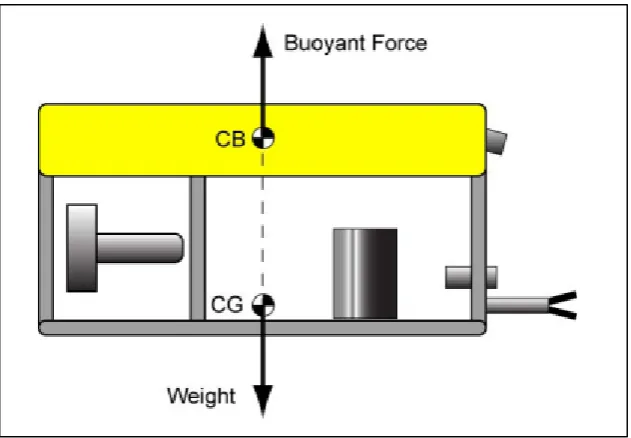
Figure 3-2: Centre of Buoyancy (CB) & Centre of Gravity (CM/CG) relationship (Source: Cornerstone Robotics, 2014)
Although it is important to know this relationship between the CM and CB, the distance apart from each other is not as important as the buoyancy of the vehicle. As long as the vehicle has a slight positive buoyancy, it will be very stable underwater.
3.4
Peer-to-peer underwater communication
3.5
Hydrodynamic Drag
The natural force on an object which resists its motion through a fluid (air or water) is called drag. As the ROV is an underwater object, this drag is called hydrodynamic drag. The portion of drag which is of importance is the pressure drag. Pressure drag is the inertia of the fluid causing resistance which is required to be pushed aside.
Bernoulli’s equation for the pressure in a fluid is…
𝑃1+ 𝜌𝑔𝑦1+1 2𝜌𝑣1
2 = 𝑃
2 + 𝜌𝑔𝑦2+
1 2𝜌𝑣2
2
The part of this equation relevant to the drag of an object is the kinematic contribution of the pressure of the fluid.
As pressure is a unit of the force applied over an area, we can solve the equation for pressure to find the drag force.
𝑃 = 𝐹𝐴
𝐹𝐷 = 𝑃𝐴 =1 2𝜌𝑣
2𝐴 𝑝
As drag is influenced by many other factors; shape, texture, viscosity, lift, etc. These factors can be neatened to one simple term called the drag coefficient (CD).
This leaves us with the equation for the drag force (FD N) (NASA, 2014):
𝐹𝐷 = 𝐶𝐷1 2𝜌𝑣
2𝐴
𝑝 (3.3)
Where 𝐶𝐷 is the coefficient of drag on the object (no units)
𝜌 is the density of the fluid in kilograms per cubic metre (𝑘𝑔. 𝑚−3) 𝑣 is the flow of the water in metres per second (𝑚. 𝑠−1)
𝐴𝑃 is the projected area of the objects in (𝑚2)
in conjunction with the thrust calculations in section 0 which will be used to solve for an estimated diameter for the propellers to achieve the required thrust.
The projected area 𝐴𝑝 for the calculation is the two-dimensional area under the effect of
the drag force. For simple shapes used in this study, refer to Table 3-2.
Table 3-2: Projected Area of common, simple shapes (Source: Robe, 2014)
Name of Shape Formula for Projected Area (AP)
Sphere 𝐴𝑃 = 𝜋. 𝑟2
Cube 𝐴𝑃 = 𝑙2
Rectangular Prism 𝐴𝑃 = 𝑙. 𝑤
Cylinder End 𝐴𝑃 = 𝜋. 𝑟2
Cylinder Wall 𝐴𝑃 = 𝑙. 𝐷
NOTE: These formulae are for the shapes at a normal perpendicular angle (90𝑜) with the plane of impact
of the drag force(𝐹𝐷).
3.6
Thrust
Thrust is the amount of force produced by a propeller relative to the flow & density of the liquid. Often, the possible thrust capable for a propeller is given by the manufacturers with relevance to the revolutions of the motor it is attached to. Unfortunately, the supplier of the propellers available for the scale vehicle this study is going to model do not supply relevant data. The best option for the thrust to be found would be purchasing of multiple propellers & motors, then run the motor at 12V to find the optimal setup. This procedure tests the motor’s current draw at a specific speed and the thrust produced by the propeller. This test can be done in the future when the design is ready for prototyping.
The thrust output (T [N]) from the combination of the motors and propeller can be identified in the equation below.
𝑇 =π 4𝐷𝑝
2(𝑣 +∆𝑣
2) 𝜌∆𝑣 (3.4)
Where 𝑇 is the thrust in Newtons (𝑁)
𝐷𝑃 is the diameter of the propeller in metre/s (𝑚)
𝑣 is the velocity of incoming flow in metres per second (𝑚. 𝑠−1)
∆𝑣 is the additional velocity/acceleration by propeller in metres per sec (𝑚. 𝑠−1) 𝜌 is the density of the liquid in kilograms per cubic metre (𝑘𝑔/𝑚3)
3.7
Hardware
3.7.1 Camera & Lighting
There are currently three common resolutions for video capture: standard definition (SD) has a pixel density of 720 x 480 pixels, and high definition (HD) has 1280 x 720 and 1920 x 1080 pixel options.
The bandwidth for these cameras varies, ranging from as low as 1Mbps to over 10Mbps running with full 30FPS (perfect stream, low quality).
Ultra bright lighting will be required for the system model. Lumens is the measurement for the total amount of visible (to the human eye) light from a light source (integral LED, 2014). The general ratings for a household lighting is shown in Table 3-3. For lighting underwater (a task set objective) a luminosity of 800 lumens will be required. The most energy efficient light producing product is an LED (Light Emitting Diode). A LED with a power rating of 12W is capable of 806Lm of light, the equivalent of a 60W incandescent bulb (rated at 850Lm). They are frequently available for an inexpensive cost and are also available pre-made as singular high powered LEDs or as an array of multiple LEDs. It is necessary to keep to the voltage within the manufacturer product requirements.
3.7.2 Inverters
Inverters are used as a device to change DC to AC voltage, and vice versa. Fortunately these are very easy to acquire for the common Australian voltages of 12V and 240V. If the battery bank on the buoy is set to 12VDC, high amperage, it can be scaled up to 240VAC by the inverter to be sent down the power supply lines to the ROV. Like on the surface, this process can occur again on the ROV, transforming the power from 240VAC to 12VDC to operate all the required components on the ROV. Prices of inverters vary from AUD ~$30 to over AUD $600 through Jaycar Electronics. The cost of these will be dependent on the amperage draw of the ROV components and the total length of the tether investigated in Section 3.7.3.
3.7.3 Umbilical Cord (Tether)
The umbilical cord, also referred to as the tether, is the item that transmits data and power from the surface of the water to the ROV. It is crucial that communication between the buoy, on the surface, and the ROV, underwater, be consistent and capable of transmitting all the data from the ROV to the buoy 24/7. There are two options for this are: to use Power over Ethernet (POE) or a high speed Ethernet cable (CAT5E) with separate power supply. The one major benefit of using POE is that data is transmitted through only two cables. This benefits the design by making the tether lighter and more buoyant, keeping it away from the ROV naturally. It also reduces the cost of increasing the buoyancy of the tether and is easier than going with the other option (CAT5E).
Deducing when the use of AC over DC power transmission is an important factor for the tether. The loss of any power over a distance is reliant on the impedance (𝑅) of the chosen cable over the required distance. Ohm’s law is the basis for calculating the power loss over the specified distance.
𝑃𝑙𝑜𝑠𝑠 = 𝐼2. 𝑅 (3.5)
Where 𝑃 is the power at the lost in watts (𝑊)
𝐼 is the current transmitted down the line in amperes (𝐴)
𝑅 is the impedance of the line over the required distance in ohms (Ω)
3.7.4 Telemetry
Telemetry is the automated transmission of measured data sent from a remote location (ROV) to a receiver (Operator) for monitoring and storage. The word telemetry comes from the Greek “Tele” meaning remote and “Metron” meaning measure. Telemetry is a wireless data transfer between transmitter and receiver, the most common being through GSM Networks (Global System for Mobile Communication) by using SMS (Short Message Service) to send and receive data. Telemetry can also be referred to in computer networking & telecommunications.
This section covers all relevant telemetry data/sensors available for ROVs.
GPS
Global Position System (GPS) consists of a network of multiple satellites (24 to 32 solar-powered satellites) orbiting Earth at an altitude of approximately 20,000km, with control stations on Earth located at Hawaii, Kawajale, Diego Garcia & Ascension Islands, and a receiver (MiTAC International, 2014). The GPS receivers are commonly mobile phones, GPS trackers, and GPS Navigation devices.
The control stations are used to monitor the satellites’ conditions. They initialise a sequence to triangulate the position of the receiver from three of those satellites, then they proceed to check the result against a fourth satellite. If the check procedure does not give conclusive results, the process is repeated again until a precise location is found. The measurement is done by timing the duration it takes for the microwave signals to travel from the satellites to the receiver.
A GPS would be a worthwhile addition to a ROV if it is to be autonomous. This would allow the possibility of adding waypoints for the ROV, like currently done with drones.
Depth
common and observes a change in wiper location (Potentiometric) or observes the physical change in an optical fibre to detect strain (Optical). Essentially all collectors are strain gauges that determine the actual pressure applied to a surface. This pressure can be used to solve for the depth relative to atmospheric pressure.
Another option for depth measurement is by measuring the altitude above the sea floor. Sonar Altimeters are one such measuring device. They use sonar wave frequencies and their rebound time to calculate the distance off the ocean floor. There are many options of Sonar Altimeters available but are all of high cost ~ USD $1000 (Kongsberg, 2014).
Accelerometer vs Gyroscope
A Gyroscope is capable of measuring the poll, roll and yaw of a vehicle, irrespective of compass orientation (Goodrich, 2013). The device is used to maintain orientation based on the principles of angular momentum. An Accelerometer measures the instantaneous changes in velocity in any direction in proper acceleration called g-force (Dimension Engineering LLC, 2014).
Since a ROV has very slow movements and is designed to be very stable, the use of a gyroscope and accelerometer is somewhat unnecessary for the ROV in this system design. The application of a 6DOF (Six Degrees of Freedom) is relatively cheap when using electromechanical versions of these with prices ranging from AUD $2 to AUD $15.
Sensors
CTD (Conductivity, Temperature & Depth) sensors can be used to measure the salinity, temperature and depth by means of conductivity in sea water. The pressure on the gauge can give depth. The temperature and the salinity is measured by changes in the current produced by the device due to the salinity in the water.
3.7.5 Emergency Air Tank
Spare Air is one such solution to this problem. Invented in 1986, Spare Air now has three different options for tank sizes (Spare Air, 2014). With a capacity range from 48L (Model 170) to 85L (Model 300), Spare Air allows divers to get in 30 to 57 emergency breaths (based on 1.6L per breath). This allows divers to safely make it to the surface of the water.
3.7.6 Manipulator Arm
Manipulator arms are relatively common amongst robotic ROVs. Typically being a 2 or 3 axis device, they are used by the larger ROVs to sample materials or remove/repair material to gain access to new areas. Some optional functions of these arms are:
Gripping objects Wire/Rope cutting Wire brush
Welding
For the purposes of this project, the addition of a manipulator arm would not be included unless specified by a client.
3.7.7 Motors
Primarily there are DC motors, Asynchronous and Synchronous AC motors. The major differences between the DC and AC versions of motors is that DC motors require brushes to make contact for them to work. These wear over time and cause DC motors to be less efficient than AC motors.
control – they only have one direction. As the motors on a ROV are required to have bidirectional control, these cheap ESCs do not meet the required specifications.
3.8
Control System
3.8.1 Depth control
Adjusting the depth of the vehicle can be done in two different ways: changing buoyancy or using thrust produced by vertically aimed thrusters. As discussed in Section 3.3, the buoyancy of a system is very important for the stability of the system underwater. A negative buoyancy (required to sink the vehicle) will result in instability, which isn’t desired. Mechanical adjustment of the ROV with vertically displaced thrust is the best method of changing the depth when under live operation.
The ROV will need to withstand the pressure that results from the depth at which it is required to operate in sea water. This can be expressed in the following formula… 𝑃 = 𝜌𝑔ℎ𝑑 (3.6) Where 𝑃 is the pressure in Pascals (Pa)
𝜌 is the density of the fluid in kilograms per cubic metre (𝑘𝑔/𝑚3)
𝑔 is the acceleration due to gravity which is 9.81 metres per second (9.81𝑚/𝑠) ℎ𝑑 is the maximum depth in metres (m)
Assuming the maximum length of the tether is 100m (without loss), and the density of sea water is 1025 𝑘𝑔/𝑚3, the maximum pressure the ROV will need to withstand is:
3.8.2 Navigation
Navigation of the ROV will primarily be manual (controlled by an operator). For the operator to understand the ROV’s orientation and location, the computer system requires a gyroscope, compass and depth gauge. There are multiple devices that can accept these tools. These devices are Linux based computers, Arduino boards and BeagleBone Blacks. The data processed by these computers can be sent over a hardwired network device (Ethernet) or wirelessly (acoustic or traditional IP networks).
3.9
Conclusions
An affordable version of a ROV is possible if only the absolutely necessary components for full functionality are used. The motor and propeller combination is outside the scope of this project. Tests done in laboratory conditions will need to be completed to decide on these components.
CHAPTER 4
SYSTEM DESIGN
4.1
Introduction
Chapter 4 encompasses the design process (Section 4.2) required to achieve the specifications detailed in Section 1.4.
The requirements and components of the ROV are chosen in Section 4.6, which dictates the final design, depicted in Section 4.7.
The same process is covered for the buoy where the requirements and components are selected in Section 4.8. The final design of the buoy is not required for this study, but an example is given in Section 4.10.
4.2
System Model
4.2.1 Chassis
The chassis of the ROV will be required to withstand all pressures up to and including a depth of 100 metres below the surface of the water. This minimum pressure requirement has been calculated in Section 4.6.1 to be 1.3MPa. This is a different situation for the buoy, where there is no pressure exerted on its body. Both chassis requirements are discussed in Sections 4.5.1 and 4.8.1 for the ROV and buoy, respectively.
The ROV will have an extra payload for the emergency air, previously discussed in Section 3.7.5.
4.2.2 Video Capture
Video capture will only occur on the ROV and this will have to be of a high clarity, allowing for clearer live footage. The choices made for the video feed have been discussed in Section 4.6.4
4.2.3 Tether Management System
The TMS, from this point on in the report, will be referring to the method of tethering the devices together for means of communication. The two feasible options for this are discussed in Section 4.3 and the tether is discussed in Section 4.6.4.
4.2.4 Propulsion
Propulsion is the design subcategory that includes the motor and propeller combination. This combination is required to provide two times thrust necessary to overcome the drag coefficient of the ROV. As discussed in Section 3.6, this combination will be optimised by using laboratory testing. For the pricing and drawings, a standard high torque motor has been chosen in Section 4.6.2.
4.2.5 Control System
The ROV will have its own computer system consisting of a BeagleBone Black and a customized Arduino MEGA board. The ROV computer system will communicate with an Android phone on the buoy via power over Ethernet. The ROV computer is discussed in Section 4.6.5 and the buoy computer is discussed in Section 4.9.2.
4.2.6 Telemetry
The telemetry sensors have already been discussed in previous section 3.7.4, where all possible telemetry options were considered.
The only devices to send telemetry throughout the system will be:
On the ROV – Gyroscope/Accelerometer/compass combo, two pressure gauges and a volume gauge (VBS) which are discussed in greater depth in Section 4.6.4.
On the buoy – there will be the android phone which is capable of GPS and compass data acquisition, which are discussed in section 4.9.2.
4.2.7 Variable Ballast System
The ROV VBS consists of two volume gauges – required to give full capacity, a submersible pump, and an emergency compressed air canister. These features are discussed in detail in Section 4.6.3.
4.2.8 Power
The power requirements are considered solely by assumption for this system model. The laboratory testing for the motor and propeller combination will give the main drain on a battery bank. The batteries will be stored on the buoy, which allows constant daytime charging by a semi-flexible solar panel. These aspects are discussed in Section 4.9.1.
4.2.9 Diver Communications
4.3
Methods of Communication
This section covers ideas for a method of communication between the operator and the ROV through means of wireless transmission.
4.3.1 Completely Wireless
Wireless communication is not possible from an underwater object to an above the surface object/operator. An issue occurs when investigating possible methods of communication from above the water to below the water, and vice versa. It is possible to send data 1.5km/s underwater using acoustic methods (low frequency waves), however it is severely affected by multipath propagation (Goh, et al., 2009). Multipath propagation occurs due to reflection and refraction of the signal. Multipath propagation causes the signal to take multiple pathways. This can cause data to arrive at irregular intervals. This is not ideal. This is the first problem with are completely wireless solution. To fix this problem, it is possible to use electromagnetic (EM) wave propagation. EM wave propagation happens at a higher frequency than acoustic wavelengths, traveling at 3x10⁸m/s. The increase in
frequency means more signals will be sent and received, this makes it more accurate than the acoustic solution.
The second problem occurs with the application of acoustic signals out of water. Acoustic & EM communication is not very good in the air as it does not act as well as it does in water. To fix this, a buoy of some sort would have to be in place to change the communication method between the air and the water. This buoy converter has already been constructed by the University of Buffalo. The buoy is designed to convert air-based radio waves to water-based acoustic waves, creating an Underwater Network
Architecture.
4.3.2 Operator to buoy tether
Figure 4-2: Buoy-Operator tether (Source: Robe, 2014)
This sort of system would be better done by having a wired acoustic transmitter on a boat to talk with the ROV underneath the boat. As the idea is currently, there are some major points to consider:
ROV would need to surface to send its location to the operator ROV is restricted to the buoys location
Increased interference underwater, however negligible, when using acoustics However, this communication idea still has some positives to consider:
Long-distance control is possible due to acoustic communication Fast response time for control
4.3.3 ROV to buoy tether
In this section, the method of communicating with a tether from a buoy to the ROV, then wirelessly from the buoy to the operator is considered. This method proves best since wireless communication through air is incredibly common across the globe.
Figure 4-3: Buoy-ROV tether (Source: Robe, 2014)
This method allows the vehicle to have no batteries on board if needed. This is because the buoy can have a solar panel attached to generate electricity to charge a bank of batteries on the buoy. The ROV could also dock with the buoy if required, keeping the benefits of this docking noted in 4.3.2.
This method would be accessible through the traditional IP network infrastructure with the possibility of communication through a device as small as a phone. The limitation of this communication method is the transmitter/receiver chosen to be on the buoy. The maximum signal range possible of this device will determine the maximum distance from which an operator is able to control the ROV. The buoy’s transmitter/receiver could be changed to cater for different communication methods in the future.
This method of tethering the ROV to the buoy would bring many benefits, solving issues previously outlined in Section 4.3.2:
The buoy gets towed along by the ROV (no longer limited to buoy location) The buoy can charge an array of batteries through solar panel(s)
o Charging is continuous and can occur while the ROV is operating
It utilises current technology which is readily available in today’s IP network infrastructure.
However, this communication method does have its limitations: ROV is limited to the length of the tether
o This length can be pre-set for different tasks making it quite versatile ROV still has the issue of tether entanglement with the motors
4.4
Full System Overview
The communication method discussed in section 4.3.3 has been chosen for its benefits of powering the vehicle and communicating with the operator. The system of components and their connections has been made into a schematic (Figure 4-4) to help decide on components required for the overall system.
Figure 4-4: Overall System component schematic (Source: Robe, 2014)
4.5
ROV Requirements
4.5.1 Structural Requirements
Structural integrity of the ROV will be verified to be able to withstand the pressure of salt water at a depth of 100m below sea level. A Factor of Safety of 1.3 shall be applied to all structural elements of the ROV. The material yield strengths are to be used as the maximum allowable stresses for the elements, ensuring the safety of all equipment and continued functionality of the components.
The complete design is required to withstand an external pressure of 1.01MPa, with a FOS of 1.3, this makes the minimum permissible pressure 1.313MPa.
4.5.2 Electrical Requirements
The electrical requirements for the ROV, at a minimum, need to run all sensory equipment, the Variable Ballast System and all motors simultaneously. This may not necessarily happen at any stage during operation, but will ensure that the power requirements will be satisfactory in the worst case situation. Commonly the use of the low power draw sensors will be operational, however the major drain will be in the motors’ draw (typically 4 motors in operation simultaneously). Therefore it is important for the tether to also accept a standard voltage of 240V with a small amperage draw which will be inverted to a lower voltage 12V and higher amperage.
4.5.3 Functional Requirements
The ROV is required to be 3DOF (3-Degrees of Freedom): rotation around the Z-axis of the vehicle (Turning), horizontal displacement on the XY-Plane (Forward/Reverse), and vertical displacement in the Z-axis (up/down). It will also be required to have the ability to transport an extra payload, up to 2kg, of any small items the archaeologists may wish to send to the surface easily. To allow for this payload, the vehicle will need variable ballast. It will also be important, as this ROV will be operational near divers, for there to be Emergency Air on board.
It is not required to carry batteries for power, but will need to convert the received AC power to DC through an inverter, which will happen through Power over Ethernet. The cable transmitting the power in 240VAC, will also be transmitting the telemetry data between the ROV and the buoy.
There will be a small high definition camera showing what is happening to the operator. Overlayed on this image will be the pressure and GPS location of the buoy (location of ROV relative to the buoy is not covered in this study). The pressure sensor will give an idea of depth which will be stored and graphed for operators to see onscreen, along with the GPS location.
4.6
ROV Equipment
4.6.1 Frame Materials
The frame will need to be constructed of materials with structural properties that will not yield and fail with 1.3MPa of external pressure on the elements.
For the camera and electronics bay, a transparent acrylic PMMA tube will be used. These have a yield strength ranging from 48 to 76MPa with it typically being 60MPa with a density of 1170 – 1180kg/m3 (Holland Plastics, 2014).
The maximum permissible stress these tubes can withstand is called the hoop stress. Hoop stress (𝜎ℎ [𝑀𝑃𝑎]) is solved by the following formula for thin-walled pressure vessels:
𝜎ℎ = 𝑝𝑟 𝑡
This is rearranged to give the maximum pressure (p)… 𝑝 =𝜎ℎ𝑡
𝑟 (4.1)
Where 𝑡 is the wall-thickness of the pressure vessel in metres (m) 𝑟 is the radius of the pressure vessel in metres (m)
𝜎ℎ is the hoop stress on the pressure vessel in mega pascals (MPa)
[image:54.595.120.532.462.739.2]The available PVC and PMMA materials are listed in Appendix B. The maximum pressure capabilities for each material were calculated by Equation 4.1. These results are graphed in Figure 4-5.
Figure 4-5: PVC & PMMA Max. Stress (Source: Robe, 2014) 1.783 0 2 4 6 8 10 12 14 16 18
15 20 25 32/30 40 50
[2.5]
50 [3]65/60 90 [1.8] 90 [1.5] 100 [2.5] 100 [3] 150 Ma x Pres su re (MPa)
Tube Diameter PVC/PMMA [thickness] (mm)
PVC tube Maximum External Stress capabilities
As the vessel is required to withstand a pressure of 1.3MPa (4.5.1), all sizes of PVC and PMMA tubing will be suitable. Both PVC and PMMA far outdo this requirement, the smallest for the PMMA tubing being 2.4MPa and PVC being 1.783MPa. With a 1.3 FOS, the tubing would be able to dive to a depth of 136.4m with no yielding issues.
4.6.2 Thrust & Motor Layout
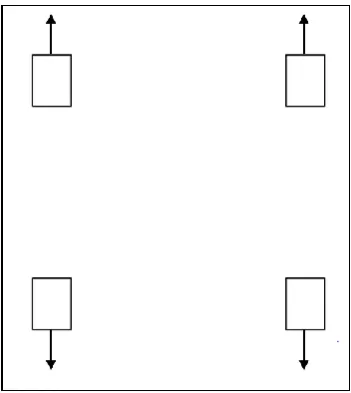
[image:55.595.238.414.296.493.2]Thrust was covered in Section 3.6, highlighting the main equation for forward thrust. Initially, the layout for the motors was chosen to be very simple, as per Figure 4-6.
Figure 4-6: Preliminary motor layout (Source: Robe, 2014)
Figure 4-7: Final motor layout (Source: Robe, 2014)
The forward thrust for the vessel can now be calculated by taking the cosine of this new angle to give a relative thrust.
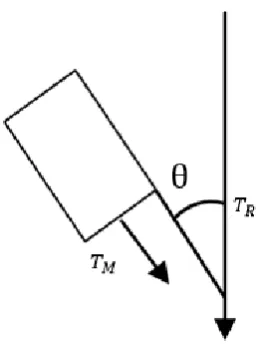
Figure 4-8: Relative-to-motor thrust visual (Source: Robe, 2014)
For the introduced angle in Figure 4-7, 𝜃 would be 35o. TM denotes the motors thrust and
TR is the relative thrust we want to find for the forward thrust for the vessel. The adjusted
thrust equation for TR can be calculated as:
𝑇𝑅 = cos 𝜃 ∙ (𝑇𝑀)
𝑇𝑅 = cos 𝜃 ∙ [
π 4𝐷𝑝
2(𝑣 +∆𝑣
[image:56.595.256.387.407.587.2]Where 𝜃 is the introduced angle between 0o and 90o 𝐷𝑃 is the diameter of the propeller in metre/s (𝑚)
𝑣 is the velocity of incoming flow in metres per second (𝑚. 𝑠−1)
∆𝑣 is the additional velocity/acceleration by propeller in metres per sec (𝑚. 𝑠−1) 𝜌 is the density of the liquid in kilograms per cubic metre (𝑘𝑔/𝑚3)
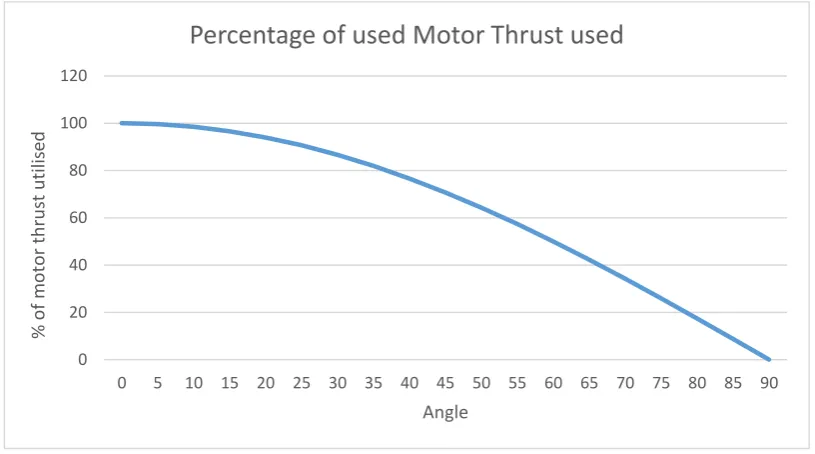
An increase in theta will reduce the forward thrust by a set percentage relative to the change in the angle. As theta increases, the amount percentage of actual motor thrust (TM)
used for the forward thrust (TR) can be seen in Figure 4-9. At 350 the motor outputs 81.9%
[image:57.595.122.530.313.540.2]of its actual thrust in the forward direction.
Figure 4-9: Percentage of utilised motor (Source: Robe, 2014)
The motors are 1700kV motors from Hobby King. These are high torque motors and have been chosen for example costing purposes only as tests would need to be done to find the optimal setup for the motor and propeller choices.
0 20 40 60 80 100 120
0 5 10 15 20 25 30 35 40 45 50 55 60 65 70 75 80 85 90
% o f m o to r th ru st u tilis ed Angle
Figure 4-10: Hobby King 1700kV Brushless motor (Source: Hobby King, 2014)
4.6.3 Variable Ballast System
The Variable Ballast System (VBS) is a tank that has variable water/air levels. Variations in the water level will be accomplished using a custom made submersible water pump which will be activated with a solenoid valve to add and disperse water from the tank. Salt water will be the only liquid in this system for changing buoyancy, so a filter will be put over the inlet to reduce cavitation and improve the pump rate. This pumping action will be utilised for changing buoyancy of the ROV for payloads and a negative buoyancy can also be used to make the ROV an anchor for the buoy.
Figure 4-11: High Sensitivity water level (Source: Emart, 2014)
The solenoids for the system will be supplied from Irrigation Store Australia. Their MV75 12VDC Micro Solenoid is has operating specifications of 20kPa to 1.25MPa, which is appropriate for the application. This does not include operation in sea water at a pressure of 1.01MPa; a trial pressure test will need to occur to ensure its plastic case will be structurally sound for underwater use. Figure 4-12 shows the solenoid with the two male ends for the inlet/outlet which is capable of a 5 to 50 Litres per minute flow rate.
[image:59.595.207.447.471.682.2]4.6.4 Camera, Telemetry and tether
[image:60.595.241.411.502.674.2]The camera chosen for the ROV will be a standard 1080p web camera running at 30FPS. Web cameras are already designed for low data rates, making them ideal for this application. 3D imagery will not be used as it requires a large bandwidth and is above the requirements for the design. The web camera will be in a separate sealed unit than the other computer components. A Logitech HD Pro c920 has been chosen as the brand is reputable and known for its reliability.
Figure 4-13: Logitech HD Pro Webcam C920 (Source: Logitech, 2014)
To increase the clarity of the camera’s footage, the addition of two individual High powered LEDs will be used. The chosen LEDs are a 12W adjustable current LED by Luminus. The SST-90 has adjustable drive currents from 1A to 9A, allowing adjustable brightness for the LED, which will be required when looking directly at divers.
Figure 4-14: Luminus SST-90 LED (Source: lck-led, 2014)
Assuming that the current drain by the ROV is 3A, the tether can be chosen. Data for American Wire Gauge (AWG) dimensions from 1 to 24 gauge were considered and the power loss over a 100m tether can be formulated using the method from Section 3.7.3. This relationship between the gauge of the wire and the power loss with a 12VDC input are shown in Figure 4-15.
Figure 4-15: 12VDC Power loss analysis (Source: Robe, 2013)
Due to the size of the loss with DC, AC transmission will be utilised. The percentage of power loss can be seen in Figure 4-16 where Australian standard 240VAC was considered compared with the 12VDC power loss.
Figure 4-16: 12VDC vs. 240VAC Power loss over 100m (Source: Robe, 2014)
0 10 20 30 40 50 60 70 80
24 23 22 21 20 19 18 17 16 15 14 13 12 11 10 9 8 7 6 5 4 3 2 1
Po
w
er
(W)
Wire gauge (AWG)
Power Loss vs 12VDC Power Input over 100m
P(loss)
Power @ 12VDC
5.248 0 50 100 150 200 250
24 23 22 21 20 19 18 17 16 15 14 13 12 11 10 9 8 7 6 5 4 3 2 1
Po
w
er
(W)
Wire gauge (AWG)
Percentage of 240VA Power Input loss over 100m
%loss AC
[image:61.595.113.540.519.733.2]As AWG21 only has a loss of ~5% it has been chosen. This loss will leave an input power of ~227.4VAC at the ROV which is sufficient for an AC to DC converter.
4.6.5 Computer & Electronic Equipment
[image:62.595.152.500.300.536.2]A Beaglebone Black with three Arduino boards will be used to control the ROV and record all data produced by the other components of the ROV. The Beaglebone Black will be the main processing unit, capable with interfacing with the Ethernet network.
Figure 4-17: Beaglebone Black (Source: elinux, 2014)
Figure 4-18: Arduino MEGA (Source: Marian, 2014)
The two solenoids only require outputs, but these will be fed back into the analog inputs to show when they are on and off. The pressure sensors will be set at two different locations on the ROV to allow for averaging to occur; this will be a feasible solution to a usually expensive use of depth perception measurement.
This computing equipment was chosen as it is light weight and compact.
The analog absolute pressure sensor is a P51-3000psi cylindrical device valued at USD $96.20. Using piezoresistive technology the sensor outputs an analog signal between 4 to 20mA when pressure between 0 and 3000psi (20.684MPa) is applied to it. The maximum measureable pressure by this sensor far exceeds the system models required depth.
Figure 4-19: Piezoresistive pressure sensor (Source: digi-key, 2014)
accelerometer and the gauss (magnetic field) by the magnetometer. Table 4-1 shows the IMU’s measurements step-sizes.
Table 4-1: MinIMU-9 9DOF measuring capabilities (Source: Pololu, 2014)
Measurement Measurement Units Sensor
± 250, ± 500, ±2000 o/s (change in angle per
second)
Gyroscope
±2, ±4, ±8, ±16 g (g-force) Accelerometer
±1.3, ±1.9, ±2.5, ±4, ±4.7, ±5.6, ±8.1 Gauss (magnetic field) Magnetometer
Figure 4-20: MinIMU-9 9DOF Gyro, Compass, Accelerometer (Source: Pololu, 2014)
For voice communication with the divers, a modulated ultrasound device will need to be altered to work with the Beaglebone Black. The ROV will be inclusive of an Ultrasonic voice communicator.
The ultrasonic voice communicator chosen is an Ocean Reef GSM G-Power Communicator. It has a range of 500m and has a runtime of 25hrs. The device will require alteration to work with the computer/phone.
[image:64.595.290.360.573.711.2]Unfortunately, this device has a maximum permissible depth of ~40 metres. The reason behind this is not specified by Ocean Reef. The product would need to be examined and reinforced to allow for a depth possibility of 100m.
4.7
Final ROV Design
4.7.1 Structural Analysis
NOTE: The detailed drawings for this section can be found in Appendix C.5. Also, the hard 90o corners have been drawn for a higher probability of successful fluid analysis to occur.
Three preliminary designs were created after the preliminary research. Two of which were very similar and are not included in this study. The two designs included function in completely different ways and can be seen in Appendix C.1. The second design would be the least expensive option of the two, but it is not as easy to adjust for different payloads. For this single reason design 1, the cubic shaped one, has be slightly altered for the final design.
The final model has a large compartment for housing the major computing components (4.6.5) shown in green and a small transparent tube for holding the camera and two LEDs. The model also features two large 2.776L buoyancy chambers and two narrow 0.954L weights for concentrating the centre of mass in a lower position. All of these chambers are designed to be attached using ordinary electronics zip ties.
Figure 4-22: Final ROV Design (Source: Robe, 2014)
NOTE: Figure 4-22 shows the ROV without a mesh on the bottom. The mesh runs from corner to corner, fixed between the balance weights and the structure. This mesh will be required for the prototype to carry a payload(s) up to 2kg.
[image:66.595.144.508.519.733.2]The bottom four corners of the vehicle have primary balancing rods (Figure 4-23). These rods are used to adjust the balance of the ROV each time it is launched. This allows for the Centre of Mass to be equally distributed. The balancing weights can be constructed of any material of high density that has an internal diameter of 10mm.
The motor assembly is set in wax. This method has been used by Massachusetts Institute of Technology (MIT) in their SeaPerch ROV project (Appendix C.3). This will seal in the motor and keep it watertight. There is no need for sealing the motors with tape since brushless motors do not need to breathe. Although my design has a tighter seal around the motor, a tolerance of 2mm before the 32m end cap will be used to create the wax seal.
Figure 4-24: Sectional view of the motor assembly (Source: Robe, 2014)
As this design simply slips onto another 32mm PVC tube on the frame, the motor assemblies can be adjusted to their own angles relative to the x-direction for thrust, discussed in Section 4.6.2.
4.7.2 Components
All of the elements to construct the ROV mechanically, and electronically is in Table 4-2.
Table 4-2: ROV component/element costs (Source: Robe, 2014)
QTY Component Cost
Frame Components
1 100mm Straight 1m PVC AUD $9.80
1 50mm Straight 1m PVC AUD $5.50
4 50mm End Caps PVC AUD $4.00
1 32mm Straight 3m PVC AUD $11.77
8 32mm Corner PVC AUD $15.60
18 32mm T-Joint PVC AUD $46.80
14 32mm End cap PVC AUD $23.10
1 100mm PMMA tubing AUD ~$30.00
1 3D printed Components AUD ~$50.00
N/A Assorted high pressure connections AUD ~$20.00 FRAME TOTAL AUD $226.40
All sourced locally in Australia through Hollands Plastics, Bunnings & Master home Improvement.
Computer Components
1 Pololu MinIMU-9# USD $14.95
2 P51-3000psi M20 pressure sensor# USD $192.40
1 BeagleBone Black# USD $54.95
1 Customised Arduino MEGA# AUD ~$100.00
2 High sensitivity water g