1
First Year Experience in Law School: A New Beginning?
Bond University, 2 July 2011
RENEWAL OF THE LLB TRANSITION CURRICULUM FOR THE NEW QUALITY REGIME
RACHEL BRADSHAW,NICHOLA CORBETT-JARVIS,KATE GALLOWAY,MANDY SHIRCORE, DOMINIQUE THIRIET*
In this paper, we chart the evolution of an explicitly designed first year law program as it has used the discipline standards to recalibrate the balance of lawyering skills, legal method and analysis, and reflectivity in the first year curriculum. Early uptake of transition pedagogies in the program’s original 2005 design gives the authors some five years of data on which to reflect, concerning student learning, the role of assessment, changing student realities and sustainability of academic staff practice. This case study of curriculum renewal illustrates the tools and philosophy that underpin a refresh of the first year law curriculum with the discipline standards and the forthcoming quality assurance scheme in mind.
I. INTRODUCTION
In 2004 a small group of staff from the Townsville and Cairns campuses of James Cook University undertook a comprehensive review of the first year of the undergraduate law degree.1 Engaging with the emerging literature on the importance of the first year experience to transition students to university studies, the team embarked on an ambitious program to develop an explicitly designed, holistic program which would integrate student support, content and skills.2 Although not aware of it at the time, the first year program introduced in 2005, could fairly be described as a second generation first year experience.3
To the original design team, the new program would revolutionize the law students’ experience. Retention rates would rise while fail rates would drop; students’ skill levels at the end of first year would be vastly improved; students would be in a position to successfully complete the
* James Cook University Law School.
1 For an overview of the first year experience design process see Lisa Westcott and Mandy Shircore ‘The
Experience of a Small Regional Law School in Preparing Students for a Journey through Law’ [2006]
James Cook University Law Review 81
2 Kerri-Lee Krause et al, The First Year Experience in Australian Universities: Findings From a Decade of National Studies, Australian Government, Department of Education, Science and Training (2005) Centre for the Study of Higher Education, University of Melbourne; Sally Kift, ‘Organising First Year Engagement Around Learning’(Paper presented at the Inaugural Pacific Rim – First Year in Higher Education Conference: Dealing with Diversity, Melbourne, 14-16 July 2004) 2.
3 Second generation FYE is referred to as the stage in the development of FYE programs where the
2
remaining years of their degree; and importantly, first year teachers would stop being blamed for all of the ‘shortfalls’ of the second, third and final year students:
‘they can’t write; they can’t solve problems; have they ever read a case?; why can’t they research?; do they understand what it means to critically analyse?; do you cover referencing in first year?; doctrine of precedent, statutory interpretation?’
While the first year team can certainly lay claim to improvement in some of these areas and making the learning experience more relevant, more explicit, more scaffolded and aligned for the first year student, the reality is that creation of the perfect student is an illusive goal. Yet despite the difficulties involved in sustaining a cohesive first year program, we continue to aim for something close to that ideal. For the evolution of the first year program does not start and end with its original design. It needs to be ‘enhanced by regular evaluation that leads to curriculum development and renewal designed to improve student learning’.4
This paper charts the evolution of the first year law program at JCU over the past six years. In particular it looks at how the program has been sustained through the development of a community of practice and how the role of skills development and assessment has had to adapt to changing student realities and the focus in higher education on quality assurance and discipline standards.
II. BACKGROUND TO THE FIRST YEAR PROGRAM AND CONTEXT FOR RENEWAL
The original aim of the first year team was to develop a fully integrated first year educational package that implemented (across all subjects) constructive alignment of learning outcomes, content, teaching settings and assessment practices. By replacing the two existing introductory subjects with four new introductory law subjects and introducing contract law into the first year curriculum, a range of skill development was carefully situated within each subject. Varied assessment tasks were designed to scaffold skill development and encourage the development of broadly based legal, technological, critical and emotional literacy of students. The most original feature of the first year program was the horizontal alignment of content across the first semester subjects through three common modules which included Ethical Orientation to the Law and to the Study of Law, Governance as a Conceptual Tool (Sources of Law), Governance through Adjudicative Law and Governance through Law in its Legislative Mode. Maintaining horizontal alignment of content has proved difficult with changing staff and changing emphasis. In the most recent review of the first year program it was considered that content alignment had become contrived and had lost its meaning. Consequently while explicit alignment is referred to in one of the subjects, the common use of modules across the first year subjects has been withdrawn (at least for the time being) from the program.
In identifying the skills to be developed throughout the first year program, some attention was paid to the broad university graduate attributes, however greater emphasis was placed on what teachers within the school considered a completing first year student should be able to achieve. These included such skills as a capacity for directed self-learning, reading for comprehension, written and oral communication skills, interpersonal communication skills and teamwork, legal
3
research, problem solving, legal method and reasoning, critical analysis, value clarification and ethical awareness.5
While continued reflection and evaluation of the first year program has confirmed that these broad skills remain relevant, the first year team (which has changed over the six years) has struggled with determining the appropriate level required for first year students and how these skills fit more broadly within the whole of degree process. With the adoption of discipline threshold learning outcomes in law and the introduction of a new quality assurance agency6 the first year group has a new framework within which to place and monitor the first year program. The Tertiary Education Quality and Standards Agency (TEQSA) established in June this year ‘will be required to undertake evaluations of the quality of providers, provide information about the quality of higher education and provide independent advice on standards, quality and regulation’.7 As part of the new regulatory structure, the Department of Education, Employment, and Workplace Relations (DEEWR) has mandated that discipline communities develop clearly articulated learning outcomes for their students. Assessment of performance against the defined standards ‘must be efficient, transparent, sustainable and include external peer review’.8
The development of Threshold Learning Outcomes (TLOs) for law was completed by discipline scholars Sally Kift and Mark Israel in late 2010.9The TLOs for law are said to ‘represent what a
graduate is expected to know, understand and be able to do as a result of learning’.10 The six TLOs cover knowledge, ethics and professional responsibilities, thinking skills, research skills, communication and collaboration, and self-management. The discipline scholars have provided explanatory notes which include the background of each TLO and guidance on terminology. The notes ‘are intended to help stakeholders understand the meaning of the TLOs, and allow program coordinators and academics to develop and refine their curricula by stimulating ongoing discussion and reflection’.11 A national network of associate deans (or equivalent) of teaching and learning in law, in consultation with Sally Kift, has also commissioned a series of good practice guides to provide guidance on the meaning and implementation of the standards.
Ongoing discussion and reflection of the first year program at JCU has been a constant in our ongoing quest for quality. One of the primary challenges in sustaining the first year program has been maintaining focus on the philosophy and methodology of the program curriculum in the face of multiple staff changes and a lack of buy-in from academic staff outside the first year. The
5 Westcott and Shircore, n 1 above, 93.
6Tertiary Education Quality and Standards Agency Act 2011 (Cth) NB – this has not yet been published
on comlaw as an Act.
7 Department of Education, Employment, and Workplace Relations, ‘Developing a Framework for
Teaching and Learning Standards in Australian Higher Education and the Role of TEQSA’(Discussion Paper, June 2011) 5
<http://www.deewr.gov.au/HigherEducation/Policy/teqsa/Documents/Teaching_Learning_Discussion_Pa per.pdf>
8 Department of Education, Employment, and Workplace Relations, ‘Transforming Australia’s Higher
Education System’ (2009)
32<http://www.deewr.gov.au/HigherEducation/Pages/TransformingAustraliasHESystem.aspx>
9 Sally Kift and Mark Israel, Learning and Teaching Academics Standards Project; Bachelor of Laws Learning and Teaching Academics Standards Statement, Australian Learning and Teaching Council (December 2010).
4
most recent review of the first year program has sought to address these issues primarily through the lens of the discipline standards for law.
III. DEVELOPING AND MAINTAINING THE FIRST YEAR COMMUNITY OF PRACTICE
From the start, the first year program has been developed through a team-based approach and this has developed into what might be termed a community of practice. As observed by Star et al, ‘[communities of practice] provide a context for academics to engage in supportive and sustained learning situated in their teaching practice’.12 It has however taken some years of informal practice to recognise the structures that are needed to sustain the shared approach to program development.
The first year of the program saw formal reflection by the team on its efficacy in increasing student skills and retention. However it took a further three years to reinstate this formal process, at a time when almost all of the original staff members involved in the program’s inception had left. By this time, a first year co-ordinator role had evolved to include leading an annual review of the subject. This required reflection on the perceived success or otherwise of each subject’s alignment within the program, teaching and learning settings and assessment. In the context of a refresh of the law degree, the 2010 review looked further afield for feedback against which to assess the efficacy of the program.
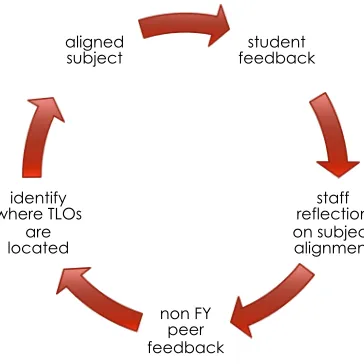
[image:4.595.178.360.460.642.2]The key to the latest re-design of the program has been an evidence-based approach to feedback on the program from a number of quarters additional to those in the past, coupled with a clear assessment of the extent to which the curriculum represents the TLOs (see Figure 1 Reflection Process).
Figure 1 Reflection Process
Anecdotally in the past, there has been an implication that in later year subjects students are not demonstrating skills – such as problem solving – as expected, and that this seems to have been attributed to the approaches of the first year program. As a program designed to scaffold learning thus improving student retention, it has been disappointing to see a perception of first year as somehow ‘easy’ or ‘spoon feeding’. Lizzio and Wilson have examined attitudes of academic
12 Casandra Star et al, Priority 1 Leadership Project ‘Project Summary’<http://cops.org.au/project.html>.
student feedback
staff reflection on subject alignment
non FY peer feedback identify
where TLOs are located
5
staff to assessment and student engagement.13 In doing so, they have confirmed our experience that not all academics adhere to principles of scaffolding implicit in transition pedagogies. They describe various academic approaches, including the ‘nostalgic enforcer’, who believes that ‘tough love builds resilience’ in students,14 and the academic who is disengaged, detached and alienated from students.15 This reflects the thinking of some colleagues in our own institution, and inhibits the effective integration of first year into the overall LLB. It might be pointed out that Lizzio and Wilson’s work validates the approach of the FYE that aims for ‘progressive enabling’16 that encompasses support and guidance, and scaffolding of student learning.17 Their surveys of students in first year provide strong data evidencing that students learning is enhanced through scaffolding and support from academic staff.
The question has always been though, of how to work constructively with colleagues post-first year. In the latest review, the first year coordinators interviewed colleagues outside the first year to ascertain what skills, knowledge and attitudes were expected of law students post-first year. The responses led us to articulate more clearly not just what skills, knowledge and attitudes we were teaching in the first year, but also to what level. This was done through the lens of the discipline standards.
The first step for renewal was a renegotiation of the goals of the FY program:
The first year in the JCU LLB will foster students’ capacity to stay and succeed by connecting them with the discipline of law through a focus on development of students’ academic and professional skills.
This overarching aim for the first year was then broken down into the threshold learning outcomes as interpreted for the context of the JCU LLB, and the first year in particular. The approach to the TLOs has been one of seeing an opportunity to integrate the entire degree within a clear framework. In addition, because they are not prescriptive (a criticism levelled by some18) we had the opportunity to interpret them to provide our own measure of what our students’ capabilities would be. As Kift and Israel point out,
Law schools may use a variety of ways to structure the learning environment to ensure graduates achieve the knowledge and skills set out in the TLOs to the requisite minimum/threshold standard. The activities which students undertake as part of their learning will doubtless be designed by each law school in the context of their own institution’s learning and teaching mission and goals.19
The advantage of using the language of the TLOs in the FY program is that the entire degree will need to interpret and apply the TLOs and these therefore provide a common framework and language with which to design an integrated curriculum and to transition first year learning into the rest of the degree. It might be observed that graduate attributes could serve the same purpose however while the LLB represents JCU generic graduate attributes within its subjects, the TLOs
13 Alf Lizzio and Keithia Wilson, ‘Assessment in First Year: Beliefs, Practices and Systems’ (Paper
presented at ATN Assessment Conference, Sydney, 18-19 November 2010).
14 Ibid 23. 15 Ibid 37. 16 Ibid 93. 17 Ibid 88.
18 Joachim Dietrich, ‘Law Threshold Lowers the Bar’, The Australian (Sydney) 30 March 2011,
<http://www.theaustralian.com.au/higher-education/opinion-analysis/law-threshold-lowers-the-bar/story-e6frgcko-1226030258554>
6
provide a discipline specific and therefore more comprehensible framework likely to garner more support. There are also fewer of them, organised coherently for the discipline.
Table 1 Threshold Learning Outcomes for Law
TLO 1: Knowledge TLO 4: Research
TLO 2: Ethics TLO 5: Communication and collaboration
TLO 3: Thinking TLO 6: Self-management
The task then was to interpret our curriculum through the TLOs. We had in mind the possibility of the TLOs forming the basis for quality assessment by TEQSA or other accrediting agency. Therefore, it was important to identify not only what the subject aimed to do in terms of each TLO, but also how that learning outcome was taught and how we might demonstrate student achievement. This was done not just on a subject level, but within the program as a whole. (see figure 2 annexed).
For example, while we ‘knew’ that one subject tackled critical thinking and another tackled legal analysis or problem solving, using the TLOs allowed us to consider these as elements of ‘thinking’ and to be more explicit about how these worked together within an aligned program. Likewise, while three of the core subjects had commenced with a module on ‘ethics’ that represented a temporal alignment (because they all covered this theme in week one) we dealt with this TLO more widely, identifying where learning opportunities arose within the entire subject curriculum. These then were linked together across the program.
For each of these learning outcomes we also needed to identify how we could demonstrate student learning. In some cases this was through summative assessment, but in other cases it was through teaching and learning activities. Oral communication skills for example were not explicitly assessed in all subjects, but tutorial participation implies development of oral communication skills. We then needed to consider how these skills were actually taught.
This process has resulted in a more explicitly accountable curriculum and through this process, still in train, we are able to explain to colleagues exactly what it is that we teach and what our students should be able to do upon leaving the first year. It has also caused a re-evaluation of the process of skills development of our students.
IV. REFLECTING ON SKILLS DEVELOPMENT IN THE FIRST YEAR PROGRAM: THE LITERACY ISSUE
As mentioned, the creators of the first year law program intended the program to focus on the acquisition and development of ‘generic skills, legally specific skills and an ethical awareness’. 20 Written communication skills, legal research and problem solving were just some of the primary skills identified.21 These skills are taught in context, using activity-based learning, within at least one of the three horizontally aligned subjects undertaken by law students in study period 1.22 In some cases, these skills would appear in more than one subject. Problem solving, for example, was taught, developed and assessed in Contract Law but was also taught and assessed in LA1102
20 Westcott and Shircore, n1 above, 93. 21 Ibid.
7
Legal Research, Writing & Analysis, where students were taught a method for identifying and solving problem questions containing precedent and statutory interpretation issues. Notwithstanding the first year law program’s harmonised and integrated approach towards content, certain skills were allocated to just one of the three core subjects. Legal Research, Writing & Analysis was selected as the vehicle by which legal research and writing skills were to be explored, developed and enhanced. In relation to legal writing, the program designers prescribed that legal writing was to be developed in two ways within this subject. Referencing was, and still is, explored with students in lectures and workshops. Students are then assessed twice in relation to this. The first assessment forms part of a research skills assessment and is designed to encourage the development or enhancement of these skills at the outset so that students’ on course assessment in their first semester subjects complies with the referencing style employed in the Law School. Students are then assessed on referencing again at the end of the semester in a bid to reassert the importance of this particular aspect of legal writing and identify areas in which they need to improve before the start of second semester and, ultimately, their progression into the second year.
In contrast to this detailed and prescriptive approach to referencing, written communication is not taught explicitly although it was, and is, assessed. Of course, writing skills are assessed within all subjects in relation to on course assessment, but it was envisaged that LA1102 Legal Research, Writing & Analysis would provide an opportunity for student development in this area. As such, students were expected to provide weekly reflective journals of approximately 250 words to their tutor, which were later reduced to fortnightly journals. Students were provided with extensive feedback in relation to their writing style, spelling, grammar, argument construction and the development and expression of ideas. Comments were also made to encourage critical thinking and logical reasoning.23 Students’ comments were therefore questioned and challenged in a sensitive manner.24 It was anticipated that students would learn from this detailed feedback and thus their writing and critical thinking skills would progress over the course of the first semester. Although positive outcomes were initially experienced,25 observations over the last two years have revealed that the journal is no longer an effective learning tool in relation to academic and legal writing skills. One of the predominant reasons for this is that students received 2 marks per journal (five were submitted, totalling 10 marks and 10% of their overall grade) and these 2 marks were achieved regardless of the competency of writing and notwithstanding the lack of improvement in writing from the previous journal. As the marks provided for this on-course assessment had no correlation to the standard of literacy, little improvement was identified. Peer review of the reflective journals was recently introduced, as it was thought that students were more likely to reflect on their own writing if they were required to mark and provide feedback on other students’ work according to a detailed criteria grid and guidance from the tutor. However, this also proved to be unsuccessful and it is anticipated that part of the reason for the failure of this assessment item as a scaffolded learning tool is that students are unable to identify specific literacy issues. In this sense, the lack of explicit teaching of academic and professional writing skills meant that students were unable to identify areas in which improvement was required and this prevented the development of these skills further.
A reflection by those involved in the first year program resulted in agreement that a greater focus on literacy in the first year was necessary. This had not only been identified as a concern by
23 Joanne Roebuck, Lisa Westcott and Dominique Thiriet, ‘Reflective narratives: A useful learning
activity and assessment for first year law students’ (2007) The Law Teacher 4, 44
8
those teaching second years and beyond (and most of those teaching at a first year level also teach in subsequent year levels), but also at a University-wide level.26 Indeed, the School of Education has recently developed on an on-line literacy module within a core first year subject.27 As a consequence, it was resolved that in the first year law program writing skills need to be taught and developed in an explicit manner. However, the question that arises from this is how do we incorporate literacy skills into the first year program that accounts for the differing literacy levels of the first year students?
In light of the fact that our students are from diverse backgrounds, with an above sector average number of under 25 year old students, lower SES, academic preparedness28 and literacy levels that vary substantially across the first year student cohort, it is anticipated that students will need to be ‘streamed’. Diagnostic tests will be utilised to identify those students who need to be referred to university learning support services for additional tutoring and/or support.29 Drawing on some of the ideas and experiences of the School of Education, it is anticipated that students will be provided with online modules that they must complete in the early weeks of the semester.30 Literacy exercises will be embedded into the tutorials throughout the semester to encourage the continued development of these skills.31 Such modules, literacy exercises and assessments will be scaffolded. In addition, a ‘professional writing’ module will be incorporated into the subject so that the foundational skills addressed and improved through the on-line literacy module can be developed into a professional skill set that prepares students for their progression through law school.
Building upon the current approach adopted across the first year, which utilises an authentic learning environment,32 the literacy components of the course will be set within a law firm. As a consequence, literacy and professional writing will be incorporated into the subject in a manner that prevents the students from feeling that they are re-living English classes at school. It is hoped that students will be more engaged with the literacy development process if it is within an authentic legal environment. For example, students will conduct exercises in which they are trainees in a law firm and are set tasks by their supervisors. Such tasks will include amending and drafting documents, such as letters and file notes, and researching, comprehending and summarising information. Such exercises will adopt a systematic and scaffolded approach towards teaching and assessing these skills. As has always been the case with the first year law program as a whole, the embedded literacy program will also be reviewed at least annually in order to further enhance the learning environment and transition pedagogy employed in relation to first year law students. It is anticipated that this ‘cyclic review’33 will assist us to produce in
26 A Literacy and Numeracy body was initiated in 2008 and receives funding to research literacy and
numeracy initiatives and strategies across the University.
27 Clifford Jackson, Pauline Taylor and Raoul Adam ‘Practical challenges and possibilities for the
integration of academic literacy in a first year subject’ (Paper presented at Australian Teacher Education Association Conference, Townsville, 4-7 July 2010).
28 ATAR/OP of 15/70
29 The School of Education at James Cook University utilised 4 phases in its literacy pilot; the ‘awareness
phase’, ‘diagnostic phase’, ‘support phase’ and ‘accountability phase’. See Raoul Adam ‘The design and implementation of a first year literacy initiative for pre-service teachers: a preliminary review’ (Paper presented at Australian Teacher Education Association Conference, Townsville, 4-7 July 2010).
30 Ibid 31 Ibid
32 Wescott and Shircore, n 1 above, 6
33 Cyclic review is employed successfully by the School of Education in its pilot literacy program. See
9
the future an informative and progressive legal literacy program that aligns with the current methodology of the first year law program.
It is expected that embedding explicit literacy learning into the first year program will not only produce benefits at first year level. With the support of colleagues in subsequent years these skills can be further enhanced and thereby produce more rounded students, who are more likely to satisfy the TLO 4: Research and TLO 5: Communication and collaboration, whilst at the same time increasing student confidence and improving performance in assessments.
V. ASSESSMENT
Assessment has long been recognised as one of the most important components of subject design.34 Reflection on whether an appropriate balance has been struck with assessment tasks over the last six years in the JCU LLB has produced mixed findings. Some areas of assessment could be deemed relatively successful at achieving that equilibrium requiring only minor tweaking, but other areas continue to evolve in an attempt to reduce the perceived gaps in student learning while balancing sustainability concerns for students and staff alike. Deliberation of the assessment aims and outcomes of two first year first semester subjects provide an interesting contrast.
LA1102 Legal Research, Writing and Analysis is an introductory subject that is, and ought to be, fluid to address foundation skills required in first year and beyond. As a result of the challenges described above in using the reflective portfolios to develop writing skills, the subject has shifted this assessment task to a standalone statutory interpretation assessment. Mindful of the criticisms of over-assessing and the growing unrest nationally about students’ statutory interpretation skills, the assessment evolved into one statutory interpretation assignment. Rather than attempt to achieve “everything” (writing, referencing, analysis and reflection skills) the goal was to increase students’ consciousness of the importance of statutory interpretation skills while still focusing on writing and referencing development implicitly in this task. Again, the first year mantra of support and guidance was adhered to. The approach taken was to ensure that students had a low-stake opportunity to build on their statutory interpretation skills, which had been formatively assessed in tutorials. The goal was to develop skills and confidence before the more complex statutory interpretation problems to be encountered in the end of semester exam. The increased emphasis on statutory interpretation skills was supported by increased teaching time in the form of a two hour interactive workshop which focused on the practical elements of statutory interpretation procedures. As this assessment was only implemented this semester, scrutiny of the effectiveness of this substantial change to the assessment has yet to be made.
LA1105 Contract Law I seemingly enjoys more stability in assessment balance as the assessment structure has not altered significantly from its inception in 2005. Perhaps this could be attributed to the comparatively narrower focus on skill development enjoyed by a substantive subject compared to an introductory subject. Tutorial participation is significantly intertwined with the on course assessment. A tutorial portfolio consisting of three submissions were based on submitting answers to the problem style questions in the tutorials.
…[S]tudents were required to attend tutorial classes prepared to discuss that week’s tutorial tasks in buzz groups and whole of class discussions. Communication skills, writing skills, reflection
10
and problem solving were emphasised. After tutorials students would be in a position to refine their tutorial answers to be later submitted in the portfolio.35
Conceivably this structure contributes to students achieving several important TLOs (such as knowledge, thinking skills, communication and self-management) at a foundational level. The “carrot approach” of attaching marks to tutorial preparation and participation has the advantage of attaining distinctive progress in skill development in important areas, such as the IRAC method. Tutorial preparation and participation in conjunction with the tutorial portfolio is designed to ensure problem solving skills are not some ‘holy grail’ that students ‘stumble upon accidently or intuitively pick up along the way.’36 Many students have been enticed by the allure of 10 “easy marks” and student participation over the years has largely been vigorous and meaningful. Rather than a passive student engagement, students overall tend to relish the opportunity to submit better quality on course assessment. The scaffolded approach allows students to receive timely feedback to improve their work for the next submission. This assessment has continued to promote student confidence in their own ability and independent (albeit guided) work at a critical stage in the infancy of their degree.
In LA1101, Institutions and Processes, learning outcomes focus on development of skills of analysis and critique within the context of Australian legal institutions and processes. These are supported by graduate attributes of speaking and writing clearly, and skill in finding and accessing information using appropriate media and technologies. As with LA1102 and LA1105, there is a deliberate focus across the first year curriculum on regular lower stakes writing tasks providing regular feedback to students to help improve their writing. In this assessment task, originally students were required to make four blog posts through the semester – an introductory entry introducing themselves, and three entries addressing three different themes: a report of the student’s observation of a court proceeding; a critique of legal institutions and processes as reported in a current news article; and an overview of an online journal article or case addressing a set research topic, explaining how the article or case was found and why it is relevant to the topic. Each post is 300-400 words.
The medium for this assessment seeks to promote a community of learning amongst our students across two campuses through the interconnectedness of the internet as a platform – supporting the pedagogy of engagement. In addition, our students can generate their own content within our subject site, over which they have control – promoting learner-centredness. In addition, we present this task as an authentic learning experience, using examples of blawgs (law blogs) on the internet itself as a model for thinking like a lawyer. To ensure equity in student access to this task, we use the standard blackboard platform, and provide detailed instructions on use of the technology involved.
This task has undergone significant changes over the years – to become a hard copy piece of critical thinking on topical issues. This evolution resulted from the ambitious aims of the assessment task – in trying to promote good writing and critical thinking in the first semester all in this one medium, the task lost some of its web 2.0 characteristics37 of immediacy of connection. In attempting to mark up students’ written work, the task became very complex to mark and give such feedback, and this was unsustainable for staff.
35 Westcott and Shircore, n 1 above, 98.
36 Kift, ‘My Law School – Then and Now’, above n 34, 3.
37 Paul Anderson ‘What is Web 2.0? Ideas, Technologies and Implications for Education’ JISC Technology and Standards Watch, February 2007,
11
Across the program, assessment sustainability for both students and staff continues to be an ongoing issue. Assessment alignment in relation to time management continues to be an important focus to ensure first year students are not unduly overwhelmed. First year teaching staff are mindful that law students report higher levels of stress related to time and academic issues than students completing other degrees such as medicine.38 Trepidation as whether assessment is trying to “achieve everything” and spreading the skill development too thin has been an enduring concern. As discussed, the approach in LA1102 has been to concentrate on containing the identified gaps in first year student ability.
Assessment fatigue is a syndrome that is acutely felt by first year teaching staff, particularly when teaching several first year subjects. Engaging with a large student body coupled with providing incremental, timely and comprehensive feedback on both development of skills and substantive law contributes significantly to staff burnout. Unlike many institutions there is no set budget allocation for casual marking assistance and workload management models do not account adequately for the additional demands associated with first year teaching. Strategies involving teaching rotation of first year subject modules and broader colleague involvement in first year marking have yet to be developed to provide a more streamlined and equitable outcome.
VI. CONCLUSION
The Threshold Learning Outcomes are deceptively simple. They distil into a neat list of six, the entire LLB and what a graduate needs to know, do and ‘be like’. Yet for academics in first year designing a stepping off point for students who may be underprepared, unsure of their interests and aptitudes, whilst incorporating opportunities to engage in these skills, is more complex than it would seem.
What our most recent review of the FYE reveals, is that to design an integrated, aligned first year program requires a number of elements. First, a community of practice amongst first year academic staff. Secondly, a particular focus on incremental explicit teaching of foundation skills – usefully aligned with the TLOs as a framework – and assessment that is appropriately targeted to provide a focus on these skills.
Thirdly is a genuine third generation approach to first year. This is a whole of institution approach, and in our experience, this could read as a whole of school approach whereby the first year goals are then built up into more complex learning, with more complex outcomes. In our experience, expressing what we do in terms of first year through the lens of the TLOs provides us with a clear discourse with which to engage the whole school in designing a curriculum that moves from first year to the rest of the degree.
38 Norm Kelk, Sharon Medlow and Ian Hickie, ‘Distress and Depression among Australian Law Students: