0022-538X/11/$12.00 doi:10.1128/JVI.01605-10
Copyright © 2011, American Society for Microbiology. All Rights Reserved.
Efficient Culture Adaptation of Hepatitis C Virus Recombinants
with Genotype-Specific Core-NS2 by Using Previously
Identified Mutations
䌤
†
Troels K. H. Scheel,
1Judith M. Gottwein,
1Thomas H. R. Carlsen,
1Yi-Ping Li,
1Tanja B. Jensen,
1Ulrich Spengler,
2Nina Weis,
3and Jens Bukh
1*
Copenhagen Hepatitis C Program (CO-HEP), Department of Infectious Diseases and Clinical Research Centre, Copenhagen University Hospital, Hvidovre, and Department of International Health, Immunology, and
Microbiology, Faculty of Health Sciences, University of Copenhagen, Copenhagen, Denmark1; Department of Internal Medicine 1, University of Bonn, Bonn, Germany2; and Department of
Infectious Diseases, Copenhagen University Hospital, Hvidovre, Denmark3
Received 1 August 2010/Accepted 9 December 2010
Hepatitis C virus (HCV) is an important cause of chronic liver disease, and interferon-based therapy cures only 40 to 80% of patients, depending on HCV genotype. Research was accelerated by genotype 2a (strain JFH1) infectious cell culture systems. We previously developed viable JFH1-based recombinants encoding the struc-tural proteins (core, E1, E2), p7, and NS2 of prototype isolates of the seven major HCV genotypes; most recombinants required adaptive mutations. To enable genotype-, subtype-, and isolate-specific studies, we developed efficient core-NS2 recombinants from additional genotype 1a (HC-TN and DH6), 1b (DH1 and DH5), and 3a (DBN) isolates, using previously identified adaptive mutations. Introduction of mutations from isolates of the same subtype either led to immediate efficient virus production or accelerated culture adapta-tion. The DH6 and DH5 recombinants without introduced mutations did not adapt to culture. Universal adaptive effects of mutations in NS3 (Q1247L, I1312V, K1398Q, R1408W, and Q1496L) and NS5A (V2418L) were investigated for JFH1-based genotype 1 to 5 core-NS2 recombinants; several mutations conferred adap-tation to H77C (1a), J4 (1b), S52 (3a), and SA13 (5a) but not to ED43 (4a). The muadap-tations permitting robust virus production in Huh7.5 cells had no apparent effect on viral replication but allowed efficient assembly of intracellular infectious HCV for adapted novel or previously developed recombinants. In conclusion, previously identified mutations permitted development of novel HCV core-NS2 genotype recombinants. Mutations adapt-ing several recombinants to culture were identified, but no mutations were universally adaptive across genotypes. This work provides tools for analysis of HCV genotype specificity and may promote the under-standing of genotype-specific patterns in HCV disease and control.
Hepatitis C virus (HCV) is an important human pathogen chronically infecting around 180 million people. Infection can lead to severe liver diseases, such as liver cirrhosis and hepa-tocellular carcinoma. HCV is a positive-strand RNA virus be-longing to theFlaviviridaefamily. It has a 9.6-kb genome con-taining one long open reading frame (ORF) encoding a polyprotein that is co- and posttranslationally cleaved into the structural proteins (core, E1, E2), p7, and the nonstructural proteins NS2, NS3, NS4A, NS4B, NS5A, and NS5B. HCV is classified into seven major genotypes and numerous subtypes and isolates, deviating⬃30%,⬃20%, and 2 to 10% from each other, respectively, at the nucleotide and at the amino acid level (5, 27, 36). The genotypes differ biologically (30), as well as in sensitivity to neutralizing antibodies (14, 16, 26, 34). In addition, genotype 3 is associated with increased risk of liver steatosis (7). Genotype is an important factor in the outcome of the currently licensed therapy combining alpha interferon
(IFN-␣) and ribavirin. A sustained virological response is achieved for 80 to 90% of genotype 2- and 3- and for around 50% of genotype 1- and 4-infected patients (24). In many cases, treatment is not initiated or completed due to contrain-dications or side effects, and there is no vaccine against HCV. The chimpanzee is the only true animal model for HCV infections; human liver chimeric SCID-uPA mice can be in-fected but are not applicable to pathogenesis studies. Until the development of infectious cell culture systems based on the genotype 2a isolate JFH1 (19, 31, 40, 46), in vitro research relied on systems recapitulating only parts of the viral life cycle, i.e., the replicon and pseudoparticle systems (11). We and others generated JFH1-based intra- and intergenotypic recom-binants expressing core-NS2 of genotypes 1a (isolate H77), 1b (J4 and Con-1), 2a (J6), 2b (J8), 3a (S52 and 452), 4a (ED43), 5a (SA13), 6a (HK6a), and 7a (QC69) (13, 14, 16, 19, 20, 29, 34, 44). Most recombinants relied on adaptive mutations for efficient virus production. These systems permitted genotype-specific studies of the capsid protein, core (14), which has been associated with increased cytoplasmic lipid accumulation for genotype 3 (7). Further, the genotype-specific expression of the envelope proteins E1 and E2 facilitated studies on receptor use (14) and neutralizing antibodies (14, 16, 34), as well as func-tional studies, e.g., of hypervariable region 1 (HVR1) in E2 (1,
* Corresponding author. Mailing address: Department of Infectious Diseases, Copenhagen University Hospital, Hvidovre, Kettegaard Alle 30, DK-2650 Hvidovre, Denmark. Phone: 4538626380. Fax: 4536474979. E-mail: [email protected].
† Supplemental material for this article may be found at http://jvi .asm.org/.
䌤Published ahead of print on 22 December 2010.
2891
on November 7, 2019 by guest
http://jvi.asm.org/
30). The p7 protein can function as an ion channel, and geno-type-specific studies on function (37) and potential inhibitors (14, 15, 38) were conducted. Genotype-specific cell culture systems further permitted studies of the NS2 protease and its functions in replication, assembly, and release (9, 17, 28, 45). The genotype of the core-NS2 region did not significantly in-fluence sensitivity to IFN-␣ or ribavirin in short-term assays (14).
To differentiate between genotype-, subtype-, and isolate-specific effects in such studies, it will be important to develop a panel of recombinants for several isolates of each genotype. In this study, we focused on genotype 1a, which is the most prevalent in the Americas, genotype 1b, which is predominant in Europe and Asia, and genotype 3a, which is also prevalent in Europe and Asia (11). Since most previously developed core-NS2 recombinants relied on specific adaptive mutations, we investigated whether mutations adaptive for JFH1-based 1a, 1b, and 3a core-NS2 recombinants could adapt novel con-sensus sequence core-NS2 recombinants of the same subtypes to efficient growth in cell culture. The analyses revealed a number of common mutations acquired by different recombi-nants. Thus, we further analyzed whether selected mutations in the common JFH1 NS3 and NS5A proteins could confer ad-aptation to core-NS2 recombinants of different major geno-types. Finally, we attempted to determine which step in the viral life cycle was affected by the adaptive mutations. These analyses revealed novel information on cell culture adaptation of JFH1-based recombinants and how this knowledge can be used to establish new cell culture systems for HCV.
MATERIALS AND METHODS
HCV source and plasmid construction.The HC-TN isolate (genotype 1a) was recovered from an HCV-infected patient who developed fulminant hepatic
fail-ure, and anin vivo-infectious consensus clone (pHC-TN) was described (32). The
DH1 (1b), DH5 (1b), and DH6 (1a) isolates were obtained from Danish patients, and the DBN (3a) isolate was obtained from a German patient, all of whom were chronically infected with HCV. From serum-extracted RNA, the consensus se-quences of DH1, DH5, and DH6 were obtained from 5 to 9 clones of reverse transcription-PCR (RT-PCR) amplicons covering the complete core-NS2 region. The DBN sequence was obtained from 5 clones covering the core-p7 and partial
NS2 genes and from 5 clones of an overlapping amplicon covering the 3⬘end of
the NS2 gene. pTN/JFH1 was generated by inserting a PCR fusion product,
containing the pHC-TN core-NS2 sequence (32) and partial JFH1 5⬘
untrans-lated region (5⬘UTR) and NS3 sequences, into pJFH1 (40) using AgeI (5⬘UTR)
and AvrII (NS3). For construction of pDH1/JFH1, pDH5/JFH1, and pDH6/ JFH1, fusion PCR products from pJFH1 and consensus clones covering the
core-NS2 region were inserted into pJFH1 using AgeI (5⬘UTR) and SpeI (NS3).
pDBN/JFH1 was generated similarly by insertion into pJ6/JFH1 (20) using EcoRI (vector) and AvrII (NS3).
Since the DH5 sample contained two subpopulations, pDH5/JFH1 was con-structed to reflect the consensus sequence of the subpopulation without addi-tional sequence in HVR1 (see Results). Wherever this subpopulation consensus sequence could not be determined due to a 50%/50% sequence distribution among the 4 clones analyzed, the consensus sequence was determined from analysis of both subpopulations. At three such positions of pDH5/JFH1 (G1582C, C2363T, and T2908C, all noncoding), deviation from the whole-pop-ulation consensus sequence occurred. At five additional positions (T1562G [amino acid change S408V], G1612A, T2300C, A2608G, and G2897A [amino acid change A853T]), pDH5/JFH1 and the subpopulation consensus sequence on which it was based deviated from the whole-population consensus sequence. pDH6/JFH1 deviated from the consensus at position G1510A (3/5 clones had G, noncoding) and T1697C (2/5 clones had T; one each had C, A, and G; T, C, A, and G encoded S, P, T, and A, respectively). pDBN/JFH1 deviated from the consensus sequence at position A3043G (4/5 clones had A, noncoding).
pH77C/JFH1, pJ4/JFH1, pS52/JFH1, and pED43/JFH1 were previously de-scribed (13, 14, 34). Culture adaptation experiments with SA13/JFH1 were done
with a recombinant containing the 5⬘UTR-NS2 SA13 sequence (Y.-P. Li,
un-published). SA13 reverse genetics studies were done in the previously described pSA13/JFH1 background (16). Mutations were introduced using site-directed mutagenesis. The complete HCV sequences of final plasmid preparations were confirmed (Macrogen Inc.).
Culturing, transfection, infection, and evaluation of cell cultures.Culturing of Huh7.5 (20) hepatoma cells was done as described previously (13). One day
before transfection or infection, 4⫻105cells were plated per well in six-well
plates.In vitrotranscription of RNA was described previously (34). For
trans-fection, 2.5g RNA was incubated with 5l Lipofectamine 2000 (Invitrogen) in
500l Opti-MEM (Invitrogen) for 20 min at room temperature. Cells were
incubated with transfection complexes for 16 to 24 h in growth medium. The individual transfection efficiencies of 20 independent experiments, as measured by HCV core enzyme-linked immunosorbent assay (ELISA) (see below) after 4 h, varied less than 2-fold from that for the positive control. To determine intracellular infectivity levels, S29 cells (31) were transfected as described above, except for the exchange of the growth medium with Opti-MEM during the 16-hour transfection incubation, leading to increased transfection efficiency. To release intracellular HCV particles from cells after 48 h, cells were trypsinized,
centrifuged, and resuspended in 100l growth medium. Thereafter, cells were
subjected to four freeze-thaw cycles in liquid nitrogen and a 37°C water bath, and the supernatant containing the intracellular virus population was clarified by two
centrifugations at 1,500⫻gfor 5 min at 4°C. For infection experiments, cells
were inoculated with virus-containing supernatant for 16 to 24 h. Supernatants
collected during experiments were sterile filtered and stored at⫺80°C.
Infected cultures were monitored by immunostaining using mouse anti-HCV core protein monoclonal antibody (B2; Anogen) or anti-NS5A (9E10, a gift from C. Rice) as described previously (13, 34). HCV RNA titers were determined by
a TaqMan quantitative PCR assay of the 5⬘untranslated region (13). Infectivity
titers were determined by adding 100l of triplicate sample dilutions (diluted 1:2
or more) to 6⫻103
Huh7.5 cells per well that had been plated out the day before
on poly-D-lysine-coated 96-well plates (Nunc). Cells were fixed and
immuno-stained for HCV 48 h after infection using a previously established protocol (13). Primary antibody was anti-NS5A (9E10) or HCV NS3 antibody (H23; Abcam). The number of focus-forming units (FFU) was determined by manual counting or on an ImmunoSpot series 5 UV analyzer (CTL Europe GmbH) with custom-ized software (12). For automated counting, the mean FFU count from six negative wells was always below 15; this number was subtracted from FFU counts in experimental wells. The limit of detection was set to the mean of results for negative wells plus 3 standard deviations plus 3. Counts of up to 200 FFU/well were in the linear range of test dilution series and comparable to manual counts.
HCV core ELISA.For measurement of intracellular HCV core, 105S29 cells
(31) per well were plated in 24-well plates. After 24 h, the cells were transfected with HCV RNA transcripts. After 4, 24, 48, and 72 h, cells were trypsinized,
centrifuged at 1,000⫻gfor 5 min at 4°C, washed in cold phosphate-buffered
saline (PBS), and lysed in cold radioimmunoprecipitation assay (RIPA) buffer supplemented with protease inhibitor cocktail set III (Calbiochem). Cell lysates
were clarified at 20,000⫻gfor 15 min at 4°C before HCV core levels were
measured using an Ortho HCV antigen ELISA kit (Ortho Clinical Diagnostics).
Sequence analysis of cell culture-derived HCV.Procedures for direct sequence analysis of the ORF and primers for H77C/JFH1, S52/JFH1, and ED43/JFH1 were described previously (13, 34). Primers specific for TN/JFH1, DH6/JFH1, DH1/JFH1, DH5/JFH1, and J4/JFH1 are given in Tables S1 to S4 in the sup-plemental material. For DBN/JFH1, primers for S52/JFH1 were used (13). Sequence analysis of HCV was done using Sequencher (Gene Codes), Vector NTI (Invitrogen), and BioEdit. For phylogenetic analysis, Molecular Evolution-ary Genetics Analysis 4 (MEGA 4) was used (39). HCV sequences were re-trieved from the Los Alamos HCV sequences database and the European HCV database.
Nucleotide sequence accession numbers.Sequences of the novel HCV core-NS2 recombinants are available in GenBank under accession numbers HQ852453 to HQ852457.
RESULTS
Core-NS2 sequence analysis of HCV isolates of genotypes 1a, 1b, and 3a.To develop novel cell culture systems for ad-ditional HCV isolates and to analyze the adaptive effect of previously identified mutations, we used the cloned TN isolate (HC-TN, genotype 1a [32]) and further determined the core-NS2 consensus sequence from 5 to 9 cDNA clones obtained
on November 7, 2019 by guest
http://jvi.asm.org/
from patient samples of genotypes 1a (isolate DH6), 1b (DH1 and DH5), and 3a (DBN). For DH6 and DH1, the clonal variation from the core-NS2 consensus sequence of five clones was 0.1 to 0.8% at the nucleotide and at the amino acid level. The DH5 sample consisted of two subpopulations; the core-NS2 consensus sequences of the subpopulations, derived from four clones each, differed by 5.4% at the nucleotide level and by 4.8% at the amino acid level. In one subpopulation, 3 of 4 clones encoded additional amino acids (S, R, and K) at the very N terminus of E2 within HVR1, as was previously ob-served for other 1b isolates (3). The clones of this subpopula-tion deviated by 0.1 to 2.5% at the nucleotide level and by 0.1 to 1.0% at the amino acid level from the subpopulation con-sensus sequence. For the other subpopulation, the deviations from the subpopulation consensus were 0.1 to 0.9% at the nucleotide level and 0.1 to 0.4% at the amino acid level. In the DBN sample, 4 of 5 clones differed by 0.2% to 0.3% from the core-NS2 consensus sequence at the nucleotide and at the amino acid level, while one clone deviated by⬃2.0%.
[image:3.585.60.265.69.273.2]The core-NS2 sequences of DH6, DH1, and DH5 (without the additional HVR1 sequence, as occurred in 5 of 8 clones) consisted of 1,026 amino acids, equivalent to most other genotype 1 isolates, including TN, H77C, J4, and Con-1 (22, 32, 41, 43). The DBN core-NS2 consisted of 1,033 amino acids, which is one residue more in E2 than in most other genotype 3a isolates, including S52 and 452 (12, 29). Greatest heteroge-neity (percentage of amino acid positions with at least one clone differing from the consensus sequence) was found in E2
FIG. 1. Phylogenetic analysis of core-NS2 amino acid consensus sequences of isolates used for intergenotypic JFH1-based HCV core-NS2 recombinants (12, 14, 16, 18, 22, 29, 32, 41–43). Genotype 1a, 1b, and 3a isolates used in novel recombinants in this study are indicated with diamonds. The evolutionary history was inferred by using the neighbor-joining method. The percentages (⬎70%) of 1,000 replicates in which the associated taxa clustered together in the bootstrap test are shown. The evolutionary distances were computed using the Dayhoff matrix-based method, and the units are numbers of amino acid sub-stitutions per site.
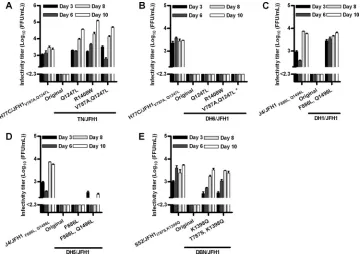
FIG. 2. HCV infectivity titers after transfection of Huh7.5 cells with novel JFH1-based core-NS2 genotype recombinants with previously identified adaptive mutations. Cells were transfected with RNA transcripts from TN/JFH1 (A), DH6/JFH1 (B), DH1/JFH1 (C), DH5/JFH1 (D), and DBN/JFH1 (E) recombinants without mutations (original) and with mutations (numbering according to the H77 polyprotein [GenBank accession number AF009606]). Previously developed H77C/JFH1V787A,Q1247L, J4/JFH1F886L,Q1496L, and S52/JFH1I787S,K1398Qrecombinants were included as controls (14, 34). The lower limit of detection in the experiments shown was up to 102.3FFU/ml; titers below this level are shown as ⬍2.3 log10(FFU/ml). Error bars indicate standard errors of the means (SEM) of results from triplicate determinations. *, data from a separate experiment.
on November 7, 2019 by guest
http://jvi.asm.org/
[image:3.585.113.473.405.659.2]HVR1 and NS2 for DH6, in HVR1 and p7 for DH1, and in E2 (HVR1 in particular) for DH5 and DBN.
At the amino acid level, the TN (genotype 1a) core-NS2 consensus sequence differed by 4.0% from H77C (1a), while DH6 (1a) differed from H77C and TN by 6.5% and 6.9%, respectively. The DH1 (1b) and DH5 (1b) sequences differed by 5.9% from each other and by 8.6 to 9.1% from the J4 (1b) and Con-1 (1b) isolates. The DBN (3a) sequence deviated by 6.5% and 7.4% from S52 (3a) and 452 (3a), respectively. Thus, the novel isolates constituted core-NS2 sequences significantly deviating from the H77 (1a), J4 (1b), Con-1 (1b), S52 (3a), and 452 (3a) isolates, for which intergenotypic recombinants were previously developed (Fig. 1) (13, 14, 19, 34).
Previously identified adaptive mutations conferred adapta-tion to novel intergenotypic core-NS2 recombinants. From
consensus sequences of the TN (1a), DH6 (1a), DH1 (1b), DH5 (1b), and DBN (3a) isolates, we constructed JFH1-based core-NS2 recombinants and investigated in single replicate transfection experiments (unless otherwise stated) whether ad-aptation could be conferred by mutations previously identified in cell culture for isolates of the same subtype.
[image:4.585.46.539.81.511.2]We analyzed the effect of the genotype 1a H77C/JFH1 NS3 mutations Q1247L (singly and in combination with V787A in p7) and R1408W (34) on the TN/JFH1 and DH6/JFH1 recom-binants (numbering throughout is according to the H77 refer-ence polyprotein [GenBank accession number AF009606]). One day after transfection of Huh7.5 cells with RNA tran-scripts from the TN recombinants, as well as with trantran-scripts from all other recombinants analyzed in this study, around 30% of cells were HCV positive by immunostaining. TN/JFH1
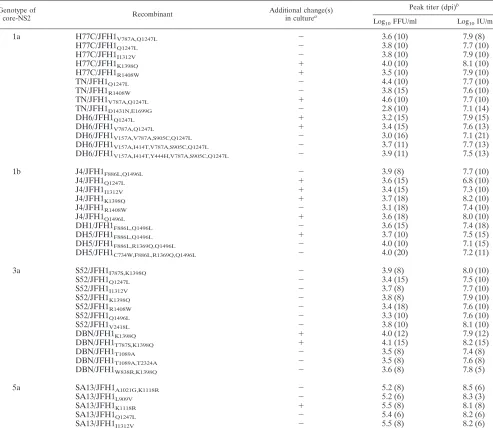
TABLE 1. Peak HCV infectivity and RNA titers of JFH1-based core-NS2 genotype recombinants after passage to naı¨ve cells
Genotype of
core-NS2 Recombinant
Additional change(s)
in culturea
Peak titer (dpi)b
Log10FFU/ml Log10IU/ml
1a H77C/JFH1V787A,Q1247L ⫺ 3.6 (10) 7.9 (8)
H77C/JFH1Q1247L ⫺ 3.8 (10) 7.7 (10)
H77C/JFH1I1312V ⫺ 3.8 (10) 7.9 (10)
H77C/JFH1K1398Q ⫹ 4.0 (10) 8.1 (10)
H77C/JFH1R1408W ⫹ 3.5 (10) 7.9 (10)
TN/JFH1Q1247L ⫺ 4.4 (10) 7.7 (10)
TN/JFH1R1408W ⫺ 3.8 (15) 7.6 (10)
TN/JFH1V787A,Q1247L ⫹ 4.6 (10) 7.7 (10)
TN/JFH1D1431N,E1699G ⫺ 2.8 (10) 7.1 (14)
DH6/JFH1Q1247L ⫹ 3.2 (15) 7.9 (15)
DH6/JFH1V787A,Q1247L ⫹ 3.4 (15) 7.6 (13)
DH6/JFH1V157A,V787A,S905C,Q1247L ⫺ 3.0 (16) 7.1 (21)
DH6/JFH1V157A,I414T,V787A,S905C,Q1247L ⫺ 3.7 (11) 7.7 (13)
DH6/JFH1V157A,I414T,Y444H,V787A,S905C,Q1247L ⫺ 3.9 (11) 7.5 (13)
1b J4/JFH1F886L,Q1496L ⫺ 3.9 (8) 7.7 (10)
J4/JFH1Q1247L ⫹ 3.6 (15) 6.8 (10)
J4/JFH1I1312V ⫹ 3.4 (15) 7.3 (10)
J4/JFH1K1398Q ⫹ 3.7 (18) 8.2 (10)
J4/JFH1R1408W ⫺ 3.1 (18) 7.4 (10)
J4/JFH1Q1496L ⫹ 3.6 (18) 8.0 (10)
DH1/JFH1F886L,Q1496L ⫺ 3.6 (15) 7.4 (18)
DH5/JFH1F886L,Q1496L ⫹ 3.7 (10) 7.5 (15)
DH5/JFH1F886L,R1369Q,Q1496L ⫺ 4.0 (10) 7.1 (15)
DH5/JFH1C734W,F886L,R1369Q,Q1496L ⫺ 4.0 (20) 7.2 (11)
3a S52/JFH1I787S,K1398Q ⫺ 3.9 (8) 8.0 (10)
S52/JFH1Q1247L ⫺ 3.4 (15) 7.5 (10)
S52/JFH1I1312V ⫺ 3.7 (8) 7.7 (10)
S52/JFH1K1398Q ⫺ 3.8 (8) 7.9 (10)
S52/JFH1R1408W ⫺ 3.4 (18) 7.6 (10)
S52/JFH1Q1496L ⫺ 3.3 (10) 7.6 (10)
S52/JFH1V2418L ⫺ 3.8 (10) 8.1 (10)
DBN/JFH1K1398Q ⫹ 4.0 (12) 7.9 (12)
DBN/JFH1T787S,K1398Q ⫹ 4.1 (15) 8.2 (15)
DBN/JFH1T1089A ⫺ 3.5 (8) 7.4 (8)
DBN/JFH1T1089A,T2324A ⫺ 3.5 (8) 7.6 (8)
DBN/JFH1W838R,K1398Q ⫺ 3.6 (8) 7.8 (5)
5a SA13/JFH1A1021G,K1118R ⫺ 5.2 (8) 8.5 (6)
SA13/JFH1L909V ⫺ 5.2 (6) 8.3 (3)
SA13/JFH1K1118R ⫹ 5.5 (8) 8.1 (8)
SA13/JFH1Q1247L ⫺ 5.4 (6) 8.2 (6)
SA13/JFH1I1312V ⫺ 5.5 (8) 8.2 (6)
a
ORF sequence changes of viruses recovered from cultures are reported in Tables 2 to 6 and 8.
b
The highest representative titers in the cell culture supernatant are shown with the day postinfection (dpi) in parentheses.
on November 7, 2019 by guest
http://jvi.asm.org/
did not, however, spread to the majority of cells until day 42. Contrarily, all three TN/JFH1 mutants immediately spread in culture and peak infectivity titers of 104to 105focus-forming units (FFU)/ml were produced in transfection cultures (Fig. 2A) and after passage to naïve cells; peak RNA titers above 107.5 IU/ml were observed (Table 1). Peak infectivity titers were⬃10-fold higher than for adapted H77C/JFH1. Only TN/ JFH1V787A,Q1247L had acquired additional mutations in the ORFs of viruses recovered from first-passage cultures (Table 2). Mutations in NS3 and NS4A were identified for the original TN/JFH1 recombinant after the spread of infection in culture. None of the H77C/JFH1 mutations led to efficient virus pro-duction early after transfection of Huh7.5 cells with RNA transcripts of DH6/JFH1 recombinants (Fig. 2B), in contrast to the effect of mutations for TN/JFH1. DH6/JFH1Q1247L, DH6/ JFH1R1408W, and DH6/JFH1V787A,Q1247Lspread to the major-ity of cells after 27, 38, and 52 days, respectively. Peak infec-tivity titers of around 103.5FFU/ml were produced for DH6/ JFH1Q1247L and DH6/JFH1V787A,Q1247L in transfection cultures and after subsequent passage to naïve cells (Table 1); DH6/JFH1R1408Wproduced peak titers of 102.9FFU/ml. Both mutants carrying the Q1247L mutation acquired mutations in core, E2, NS2, and NS5A (Table 3), including changes at positions 157 and 414, previously shown to increase infectivity titers of a genotype 7a recombinant (14). DH6/JFH1R1408W acquired T1089I in NS3. Previously identified mutations were, however, a prerequisite for culture adaptation, as the number of HCV-positive cells for the original DH6/JFH1 recombinant decreased from 30% on day 1 to none from day 36 posttrans-fection.
To analyze the effects of mutations for the novel genotype 1b recombinants, we inserted the J4/JFH1 mutations F886L (NS2) and Q1496L (NS3) (14). While DH1/JFH1 in a single replicate transfection spread to the majority of cells on day 24, DH1/JFH1F886L,Q1496L immediately spread in culture in two replicate transfections. The highest infectivity titers were 103.8
FFU/ml on day 10 after transfection, comparable to those for J4/JFH1F886L,Q1496L(Fig. 2C). Recovered virus was passaged to naïve cells, where similar peak infectivity titers and HCV RNA titers above 107 IU/ml were observed (Table 1). No additional changes occurred in the ORF (Table 4). The orig-inal DH1/JFH1 recombinant changed residues in NS3, NS4A, and NS5A, including R1408W and Y2099N, previously ob-served for JFH1 and the genotype 7a (QC69) recombinant (14, 19) (Table 4). However, F886L and Q1496L did not fully adapt DH5/JFH1. During 10 days after transfection with DH5/ JFH1F886L,Q1496L, peak infectivity titers of around 102.5 FFU/ml were produced in two replicate transfections, while titers for DH5/JFH1 and DH5/JFH1F886L in single replicate transfections were below the assay detection limit (Fig. 2D). The number of HCV-positive cells decreased from 30% on day 1 after transfection to none for DH5/JFH1 from day 34, while DH5/JFH1F886L,Q1496Lspread to the majority of cells on day 22 or 47; DH5/JFH1F886Linfected most cells on day 45. Peak infectivity titers after the spread of infection were above 103 FFU/ml. After passage of DH5/JFH1F886L,Q1496Lto naïve cells, similar infectivity titers and RNA titers above 107 IU/ml were observed (Table 1). For both DH5/JFH1 mutants, changes oc-curred in E2 and NS3, including changes at position 444, also observed for DH6/JFH1 and 1369, as was previously observed for J8 (2b) and S52 (3a) recombinants (13, 14) (Table 5).
[image:5.585.45.542.80.262.2]The genotype 3a S52/JFH1 NS3 mutation K1398Q was in-troduced into DBN/JFH1, singly and in combination with T787S in p7 (13, 14). After transfection, DBN/JFH1 did not spread to the majority of the cells until day 20. Compared to S52/JFH1I787S,K1398Q, the DBN/JFH1K1398Q and DBN/ JFH1T787S/K1398Qmutants were slightly delayed in viral spread and production of comparable infectivity titers (Fig. 2E). After passage to naïve cells, both recombinants had acquired W838R in NS2. DBN/JFH1 acquired mutations in NS3 and NS5A, including the changing of position 1089, also observed for DH6/JFH1 (Table 6). Peak infectivity titers after the spread of
TABLE 2. Mutations observed for TN/JFH1 viruses recovered from cell culturea
HCV gene
H77 reference nucleotide position
Nucleotide in pTN/JFH1
Nucleotide in indicated recombinant and expt (day)
H77 reference amino acid
position
Amino acid change TN/JFH1
transf (46)
TN/JFH1
Q1247L
1st (15)
TN/JFH1
R1408W
1st (15)
TN/JFH1
V787A,Q1247L
1st (15)
TN/JFH1
D1431N
transf (22)
TN/JFH1
E1699G
transf (30)
TN/JFH1
D1431N, E1699G
1st (10)
E1 1384 T 䡠 䡠 䡠 䡠 䡠 C 䡠 348 I3T
p7 2701 T 䡠 䡠 䡠 C 䡠 䡠 䡠 787 V3A
NS3 4081 A 䡠 T 䡠 T 䡠 T/A 䡠 1247 Q3L
4533 A 䡠 䡠 䡠 䡠 A/C 䡠 䡠 1398 K3Q
4563 C 䡠 䡠 T 䡠 䡠 䡠 䡠 1408 R3W
4632 G A 䡠 䡠 䡠 A 䡠 A 1431 D3N
NS4A 5437 A G 䡠 䡠 䡠 䡠 G G 1699 E3G
NS4B 5557 C 䡠 䡠 䡠 C/T 䡠 䡠 䡠 1739 A3V
NS5A 6274 G 䡠 䡠 䡠 䡠 䡠 G/A 䡠 1978 R3H
6639 T 䡠 䡠 䡠 T/A 䡠 䡠 䡠 2100 S3T
6850 T 䡠 䡠 䡠 T/C 䡠 䡠 䡠 2170 V3A
7150 T 䡠 䡠 䡠 T/C 䡠 䡠 䡠 2270 I3T
NS5B 9190 T 䡠 䡠 䡠 䡠 䡠 C 䡠 2950 V3A
a
Viral genomes were recovered from supernatants at peaks of infection in transfection culture (transf) or after one (1st) or two (2nd) passages in naı¨ve cells. Positions
are numbered according to the H77 absolute reference (GenBank accession number AF009606). Positions with coding mutations representingⱖ50% of the sequence
read in at least one experiment are shown. Dots indicate identity with the original plasmid sequence. Positions with mixtures are written with both letters capitalized to indicate that a dominant nucleotide was not determinable. Boldface and underlining indicate engineered mutations. In addition, the following noncoding mutations
(numbering according to the H77 reference sequence) were observed as follows: for TN/JFH1, C1982A; for TN/JFH1D1431N, C830C/T and C894C/T; and for
TN/JFH1E1699G, A7841G.
on November 7, 2019 by guest
http://jvi.asm.org/
infection in transfection culture and after passage to naïve cells were around 104FFU/ml; peak HCV RNA titers were around 108IU/ml (Table 1).
Thus, introduction of mutations previously identified for other isolates of the same subtype immediately led to efficient robust cell culture systems for one 1a (TN/JFH1) and one 1b (DH1/JFH1) recombinant. For the DH6/JFH1 (1a), DH5/ JFH1 (1b), and DBN/JFH1 (3a) recombinants, previously identified mutations accelerated adaptation to culture. For DH6/JFH1 and DH5/JFH1, adaptation depended on previ-ously identified mutations, since the original recombinants never adapted to culture in Huh7.5 cells.
Additional changes further adapted core-NS2 recombinants that were partially adapted by previously identified mutations.
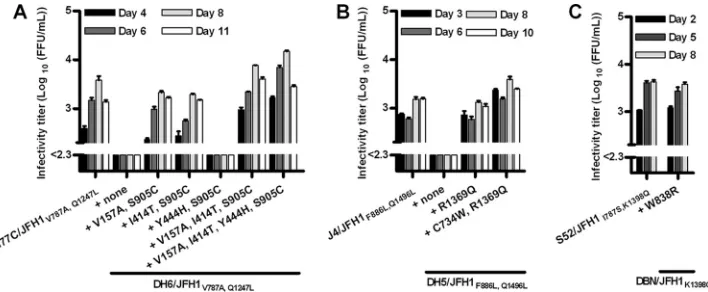
Introduction of previously identified mutations into DH6/ JFH1, DH5/JFH1, and DBN/JFH1 conferred only partial cul-ture adaptation. To further adapt these recombinants, we in-troduced additional mutations identified for the respective recombinant recovered from culture (Tables 3, 5, and 6). Thus, T1089I was introduced into DH6/JFH1R1408W; however, titers after transfection were only around 102.5FFU/ml (not shown). We further transfected DH6/JFH1V787A,Q1247Lrecombinants harboring the additional mutations V157A, I414T, Y444H, and S905C in selected combinations. Mutants carrying the V157A and S905C mutations efficiently spread in culture. Mu-tants with all mutations or the combination of V157A, I414T,
and S905C produced peak infectivity titers of around 104FFU/ ml, higher than for the adapted H77C/JFH1 recombinant (Fig. 3A and Table 1). No additional mutations were observed after passage to naïve cells (Table 3).
For DH5/JFH1, the R1369Q mutation was introduced into DH5/JFH1F886L,Q1496Lsingly and in combination with C734W. Both mutants had improved kinetics of spread in culture and produced peak infectivity titers of 103.5to 104FFU/ml in trans-fection and after passage to naïve cells, comparable to those for the adapted J4/JFH1 recombinant (Fig. 3B and Table 1). No additional mutations were observed after passage to naïve cells (Table 5).
RNA transcripts of DBN/JFH1W838R,K1398Qwere tested in culture to analyze the importance of the W838R mutation; peak infectivity titers were 103.5FFU/ml, comparable to those for the adapted S52/JFH1 recombinant (Fig. 3C and Table 1). No additional mutations were observed (Table 6).
Thus, all core-NS2 recombinants constructed from novel HCV isolates could efficiently be adapted to culture in Huh7.5 cells either after introduction of previously identified muta-tions or after combination of such mutamuta-tions with additional changes identified for the given recombinant in culture.
Mutations acquired by the respective original coNS2 re-combinant did not lead to more efficient HCV culture systems than previously identified mutations.To investigate whether mutations acquired by original nonmodified core-NS2
recom-TABLE 3. Mutations observed for DH6/JFH1 viruses recovered from cell culturea
HCV gene
H77 reference nucleotide
position
Nucleotide in pDH6/JFH1
Nucleotide(s) in indicated recombinant and expt (day)
DH6/JFH1
Q1247L
2nd (15)
DH6/JFH1
R1408W
transf (43)
DH6/JFH1
V787A, Q1247L
transf (52)
DH6/JFH1
V787A, Q1247L2nd
(10)
DH6/JFH1
V157A, V787A, S905C, Q1247L
1st (16)
DH6/JFH1
V157A, I414T, V787A, S905C, Q1247L
1st (13)
DH6/JFH1
V157A,I414T, Y444H, V787A, S905C, Q1247L
1st (11)
H77 reference amino acid
position
Amino acid change
Core 346 G 䡠 䡠 G/A 䡠 䡠 䡠 䡠 2 S3N
811 T T/c 䡠 䡠 C C C C 157 V3A
E2 1582 T 䡠 䡠 T/C C 䡠 C C 414 I3T
1671 T 䡠 䡠 T/C C 䡠 䡠 C 444 Y3H
1674 T T/C 䡠 䡠 䡠 䡠 䡠 䡠 445 Y3H
2550 A A/G 䡠 䡠 䡠 䡠 䡠 䡠 737 M3V
p7 2638 T 䡠 䡠 C 䡠 䡠 䡠 䡠 766 V3A
2701 T 䡠 䡠 C C C C C 787 V3A
NS2 2929 C C/T 䡠 䡠 䡠 䡠 䡠 䡠 863 P3L
2932 T 䡠 䡠 䡠 T/C 䡠 䡠 䡠 864 L3P
3054 A A/t 䡠 T T T T T 905 S3C
NS3 3607 C 䡠 C/T 䡠 䡠 䡠 䡠 䡠 1089 T3I
4081 A T 䡠 T T T T T 1247 Q3L
4563 C 䡠 T 䡠 䡠 䡠 䡠 䡠 1408 R3W
NS4A 5379 G 䡠 䡠 A 䡠 䡠 䡠 䡠 1680 V3I
NS5A 6664 A 䡠 䡠 A/G 䡠 䡠 䡠 䡠 2108 D3G
6868 C C/A 䡠 䡠 䡠 䡠 䡠 䡠 2176 T3K
7080 G 䡠 䡠 䡠 G/A 䡠 䡠 䡠 2247 E3K
7303 A 䡠 䡠 䡠 A/G 䡠 䡠 䡠 2321 K3R
7541d T 䡠 䡠 C C 䡠 䡠 䡠 2400b S3P
a
Positions are numbered according to the H77 absolute reference (GenBank accession number AF009606). Positions with mixtures are written with the dominant sequence in uppercase and the minor sequence in lowercase letters or with both capitalized when a dominant nucleotide was not determinable. Boldface and underlining indicate engineered mutations. See also the footnote to Table 2. In addition, the following noncoding mutations (numbering is according to the H77 reference sequence)
were observed: for DH6/JFH1Q1247L(2nd), G4004G/A; for DH6/JFH1V787A,Q1247L(transf), G836G/A, T2048C, T3077C, C6908T, A7739G, and T7949G; for DH6/
JFH1V787A,Q1247L(1st), T2048C, A6920A/G, A7739G, and T7949G; and for DH6/JFH1V787A,Q1247L(2nd), T2048C, A5336G, A7739G, and T7949G.
on November 7, 2019 by guest
http://jvi.asm.org/
[image:6.585.45.542.80.373.2]binants would lead to more efficient systems than introduction of mutations identified for recombinants of other isolates, we performed reverse genetics studies of mutations observed for the TN/JFH1 and DBN/JFH1 recombinants (Tables 2 and 6). After transfection of TN/JFH1 with D1431N and E1699G singly and in combination, only the double mutant produced infectivity titers comparable to those of the adapted H77C/ JFH1 recombinant in transfection and after passage to naïve cells (Fig. 4A and Table 1). TN/JFH1D1431N and TN/ JFH1E1699Ginfected the majority of cells after 22 and 30 days, respectively. Recovered TN/JFH1D1431N virus had acquired K1398Q, while TN/JFH1E1699Gchanged residue 348 in E1 (as was previously observed for an H77/JFH1 recombinant [25]), Q1247L in NS3, and additional residues (Table 2). No addi-tional mutations were observed for TN/JFH1D1431N,E1699G.
To analyze mutations observed for the DBN/JFH1 recom-binant, RNA transcripts of DBN/JFH1 with T1089A and T2324A were tested singly and in combination. DBN/ JFH1T1089A(one replicate) and DBN/JFH1T1089A,T2324A(two replicates) produced peak infectivity titers comparable to those of DBN/JFH1W838R,K1398Qand the adapted S52/JFH1 in transfections of Huh7.5 cells and after passage to naïve cells (Fig. 4B and Table 1). No additional coding mutations were observed. DBN/JFH1T2324Adid not efficiently produce infec-tious virus until acquisition of T1089A, as determined on day 26 of the transfection culture (Table 6).
Thus, compared to titers for recombinants with mutations identified for other isolates of the same subtype, viral titers were not improved after introduction of mutations acquired by the respective core-NS2 recombinant. Contrarily, for the TN/ JFH1 recombinant, the most efficient system was obtained with H77C/JFH1 adaptive mutations.
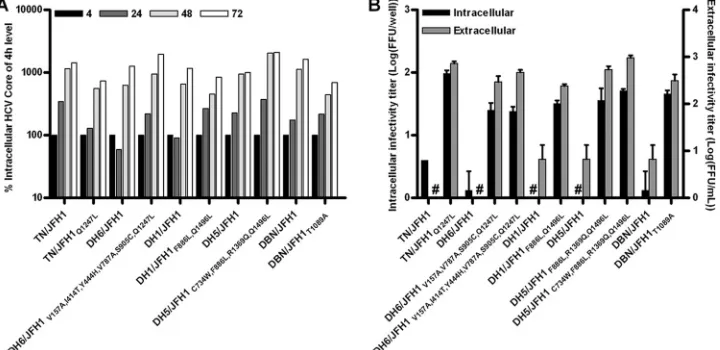
Mutations adapting novel HCV core-NS2 recombinants al-lowed assembly of intracellular infectious particles but had no apparent effect on replication. Having identified mutations adapting the novel core-NS2 recombinants, we wanted to address which step in the viral life cycle was affected. To determine whether mutations enhanced RNA replication, we measured intracellular HCV core levels after transfec-tion of CD81-deficient Huh7-derived S29 cells, which are not susceptible to HCV entry (31); thus, results were not influenced by viral spread. We did not observe enhancement of replication for the most efficiently adapted TN/JFH1,
DH6/JFH1, DH1/JFH1, DH5/JFH1, and DBN/JFH1 recom-binants compared to replication of the original recombi-nants (Fig. 5A). This was in agreement with results of im-munostainings that showed similar levels of around 30% HCV antigen-positive cells at day 1 posttransfection for the different recombinants tested.
To investigate whether mutations affected the production of intracellular infectious HCV, we harvested S29 cells 48 h after transfection of recombinants with and without adap-tive mutations and released intracellular infectious particles by repeated freeze-thaw cycles. Titration of infectivity on Huh7.5 cells demonstrated an increase in intracellular in-fectious particles after introduction of the most efficient adaptive mutations into the core-NS2 recombinants from none or a few FFU/well to around 100 FFU/well (Fig. 5B). Since the DH6/JFH1 (1a) and DH5/JFH1 (1b) recombi-nants acquired mutations in the envelope genes, the low in-tracellular titers observed for the original recombinants could potentially be caused by deficiencies in entry in the titration assay. To exclude this possibility, we analyzed intracellular infectivity for the adapted DH6/JFH1V157A,V787A,S905C,Q1247L and DH5/JFH1F886L,R1369Q,Q1496Lmutants that did not carry envelope mutations (Fig. 3A and B); the level of intracellular infectivity for these recombinants was comparable to that for the most efficiently adapted recombinants (Fig. 5B). Increases in the intracellular infectivity titers of core-NS2 recombinants with adaptive mutations were reflected in increases in the in-fectivity titers of the viruses released to the supernatants of transfected S29 cells (Fig. 5B).
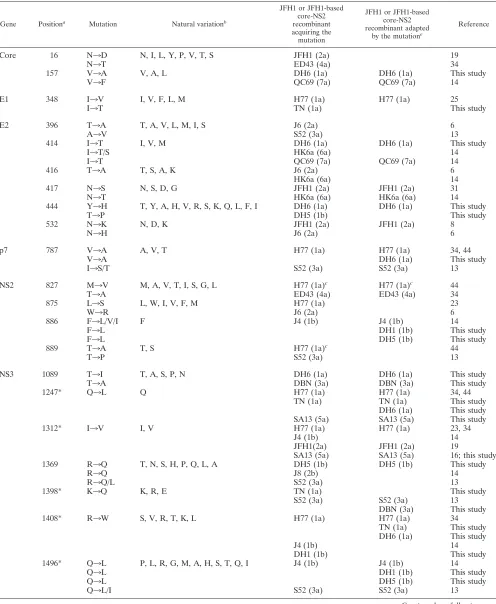
[image:7.585.44.541.576.683.2]Adaptation of HCV core-NS2 recombinants of genotypes 1a, 1b, 3a, and 5a but not 4a by previously identified mutations in NS3 or NS5A. Changes were identified for several recombi-nants at a number of common positions in this study, and additional such positions were identified by comparison with data from previous studies (Table 7). Thus, we initiated an analysis of selected residues in the common JFH1 NS3-NS5B genes. The mutations Q1247L, I1312V, K1398Q, R1408W, and Q1496L in NS3 and V2418L in NS5A were inserted into un-adapted JFH1-based core-NS2 recombinants of genotypes 1a (H77C), 1b (J4), 3a (S52), and 4a (ED43), previously found to be viable after introduction of specific adaptive mutations (13, 14, 34). RNA transcripts from the six mutants of each core-NS2 genotype recombinant were transfected into Huh7.5 cells
TABLE 4. Mutations observed for DH1/JFH1 viruses recovered from cell culturea
HCV gene
H77 reference nucleotide
position
Nucleotide in pDH1/
JFH1
Nucleotide(s) in indicated recombinant and expt (day) H77 reference
amino acid position
Amino acid change DH1/JFH1
transf (27)
DH1/JFH1F886L,Q1469L
1st (15)b DH1/JFH1F886L,Q1469L
1st (15)b
NS2 2997 T 䡠 C C 886 F3L
NS3 4563 C C/T 䡠 䡠 1408 R3W
4828 A 䡠 T T 1496 Q3L
NS4A 5386 T T/C 䡠 䡠 1682 I3T
NS5A 6636 T T/A 䡠 䡠 2099 Y3N
a
Positions are numbered according to the H77 absolute reference (GenBank accession number AF009606). Positions with mixtures are written with both letters capitalized to indicate that a dominant nucleotide was not determinable. Boldface and underlining indicate engineered mutations. See also the footnote to Table 2. In addition, the following noncoding mutations (numbering is according to the H77 reference sequence) were observed: for DH1/JFH1, G4217G/A and A6830A/G.
b
These results were from independent transfection and passage experiments.
on November 7, 2019 by guest
http://jvi.asm.org/
in parallel with the previously developed adapted genotype recombinants. J6/JFH1 (2a) did not depend on adaptive mu-tations (13, 34), and we observed no improvement in kinetics after introduction of the K1398Q or Q1496L mutation (not shown).
After introduction of the Q1247L or R1408W mutation, H77C/JFH1 (1a) produced infectivity titers close to those ob-tained for H77C/JFH1V787A,Q1247L (34). Production of effi-cient titers for the I1312V and K1398Q mutants was delayed around 5 days, while Q1496L and V2418L mutants produced titers below the assay detection limit and were not further analyzed (Fig. 6A). After passage of the H77C/JFH1 mutants that yielded detectable infectivity titers to naïve cells, peak infectivity titers close to 104 FFU/ml and RNA titers above 107.5IU/ml were observed (Table 1). H77C/JFH1
V787A,Q1247L, H77C/JFH1Q1247L, and H77C/JFH1R1408W, as previously
ob-served, did not acquire additional coding mutations. H77C/ JFH1I1312Vacquired K1399M in NS3, while H77C/JFH1K1398Q acquired I1312V.
[image:8.585.49.539.81.292.2]Six to 10 days after RNA transfection, the J4/JFH1 (1b) NS3 mutants yielded infectivity titers around 103 FFU/ml, up to 10-fold lower than J4/JFH1F886L,Q1496L titers (Fig. 6B); the NS5A mutant J4/JFH1V2418Lproduced titers below the assay detection limit and was not further analyzed. After passage of the remaining J4/JFH1 mutants to naïve cells, peak infectivity titers of 103.5to 104FFU/ml and HCV RNA titers of 107IU/ml or higher were produced (Table 1). J4/JFH1I1312V and J4/ JFH1Q1496L acquired F886L; additional mutations in NS5A were observed for J4/JFH1Q1496L. Sequencing of J4/ JFH1K1398Qand J4/JFH1R1408W revealed the minor presence of F886L as the only change. J4/JFH1Q1247Lacquired several mutations in E1, NS4B, and NS5A (Table 8). In previous
TABLE 5. Mutations observed for DH5/JFH1 viruses recovered from cell culturea
HCV gene H77 reference nucleotide position Nucleotide in pDH5/ JFH1
Nucleotide in indicated recombinant and expt (day)
DH5/JFH1 F886L transf (52) DH5/JFH1 F886L, Q1469L 2nd (8) DH5/JFH1 F886L, Q1469L transf (52)b DH5/JFH1 F886L, Q1469L
1st (10)b
DH5/JFH1 F886L, R1369Q, Q1469L 1st (20) DH5/JFH1 C734W, F886L, R1369Q, Q1469L 1st (8) H77 reference amino acid position Amino acid change
Core 357 A 䡠 䡠 A/G G/a 䡠 䡠 6 K3E
E2 1671 A 䡠 䡠 A/C C/a 䡠 䡠 444 T3P
2477 T 䡠 T/A 䡠 䡠 䡠 䡠 712 F3L
2494 A G 䡠 A/g 䡠 䡠 䡠 718 Y3C
2543 C 䡠 C/G G/c G 䡠 G 734 C3W
NS2 2997 T C C C C C C 886 F3L
3390 A 䡠 䡠 䡠 A/G 䡠 䡠 1017 S3G
NS3 4447 G 䡠 G/A G/A 䡠 A A 1369 R3Q
4606 A G 䡠 䡠 䡠 䡠 䡠 1422 D3G
4828 A 䡠 T T T T T 1496 Q3L
NS5A 6571 A 䡠 䡠 䡠 C 䡠 䡠 2077 N3T
6979 C T 䡠 䡠 䡠 䡠 䡠 2213 A3V
aPositions are numbered according to the H77 absolute reference (GenBank accession number AF009606). Positions with mixtures are written with the dominant
sequence in uppercase and the minor sequence in lowercase letters or with both capitalized when a dominant nucleotide was not determinable. Boldface and underlining indicate engineered mutations. See also the footnote to Table 2. In addition, the following noncoding mutations (numbering is according to the H77 reference sequence)
were observed: for DH5/JFH1F886L,Q1496L(1st and 2nd viral passage, first experiment), T2544C; for DH5/JFH1F886L,Q1496L(transf., second experiment), T2544C,
T3650C, T4481T/A, A4826A/G, C5864C/T, and T7541uT/C; and for DH5/JFH1F886L,Q1496L(1st viral passage, second experiment), T2544C, A3611A/G, C5237T,
G6671A, and T8648C.
bData from an independent transfection and passage experiment.
TABLE 6. Mutations observed for DBN/JFH1 viruses recovered from cell culturea
HCV gene H77 reference nucleotide position Nucleotide in pDBN/ JFH1
Nucleotide in indicated recombinant and expt (day)
DBN/JFH1 transf (28) DBN/JFH1 K1398Q 1st (12) DBN/JFH1 T787S, K1398Q 1st (12) DBN/JFH1 T1089A 1st (10) DBN/JFH1 T2324A transf (26) DBN/JFH1 T1089A, T2324A 1st (10) DBN/JFH1 W838R, K1398Q 1st (10) H77 reference amino acid position Amino acid change
p7 2701 C 䡠 䡠 G 䡠 䡠 䡠 䡠 787 T3S
NS2 2853 T 䡠 A C 䡠 䡠 䡠 A 838 W3R
NS3 3606 A G 䡠 䡠 G G G 䡠 1089 T3A
4533 A 䡠 C C 䡠 䡠 䡠 C 1398 K3Q
NS5A 7311 A G/a 䡠 䡠 䡠 G G 䡠 2324 T3A
aPositions are numbered according to the H77 absolute reference (GenBank accession number AF009606). The position with a mixture is written with the dominant
sequence in uppercase and the minor sequence in lowercase letters. Boldface and underlining indicate engineered mutations. See also the footnote to Table 2. In
addition, the following noncoding mutations (numbering is according to the H77 reference sequence) were observed: for DBN/JFH1T2324A, C1620C/T and C5729T;
and for DBN/JFH1T1089A,T2324A, C5327C/T (in one of two experiments).
on November 7, 2019 by guest
http://jvi.asm.org/
[image:8.585.45.541.584.706.2]analyses, mutation of position 886 in NS2 was shown to be important for J4/JFH1 adaptation (14).
As previously observed (14), the highest infectivity titers after transfection of S52/JFH1 (3a) RNA transcripts were pro-duced for S52/JFH1I787S,K1398Q(around 104FFU/ml); almost comparable titers were produced for S52/JFH1K1398Q. S52/ JFH1I1312Vand S52/JFH1Q1496Lpeak titers were around 103 FFU/ml, while titers for the other S52/JFH1 mutants were around 102.5FFU/ml (Fig. 6C). After passage to naïve cells, the mutants produced infectivity titers around 103.5 FFU/ml and HCV RNA titers above 107.5IU/ml at the peak of infec-tion (Table 1). None of the recombinants acquired addiinfec-tional mutations.
We previously demonstrated that ED43/JFH1 (4a) de-pended on two NS2 mutations, T827A and T977S (34). As shown in Fig. 6D, only the recombinant with the original NS2 mutations and none of the recombinants with NS3 or NS5A mutations produced titers above the detection limit of the assay after transfection, and further analysis was not con-ducted.
The highly efficient SA13 (5a) recombinant, previously de-veloped in our laboratory, relied on the adaptive mutations A1021G in NS2 and K1118R in NS3 (16). In two additional transfection experiments with unadapted SA13 recombinants performed in the present study, virus recovered after an eclipse phase had acquired Q1247L or a combination of L909V in NS2 and I1312V. Due to the overlap with mutations analyzed for genotype 1 to 4 recombinants, we investigated whether SA13/ JFH1 could be adapted by these mutations in transfection and passage experiments. Peak infectivity titers were around 105 FFU/ml for SA13/JFH1L909V, SA13/JFH1Q1247L, and SA13/ JFH1I1312V, comparable to titers observed for SA13/ JFH1A1021G,K1118R. SA13/JFH1 with only one of the original adaptive mutations, K1118R, produced slightly lower titers (Fig. 6E and Table 1); we previously found that SA13/ JFH1A1021G yielded titers comparable to those of SA13/ JFH1A1021G,K1118R(16). The recombinants tested here did not acquire additional coding mutations, except SA13/JFH1K1118R, for which a mixture of original and mutant sequence at posi-tion 1118 was observed.
Thus, the combinations of adaptive mutations originally identified for the same genotype yielded the most efficient systems for all recombinants analyzed. However, mutations in NS3 and NS5A conferred efficient or partial adaptation to most JFH1-based core-NS2 recombinants; only the 4a recom-binant depended exclusively on mutations also identified for this recombinant. A comprehensive overview of cell culture mutations observed and analyzed for adaptation of JFH1 and JFH1-based core-NS2 recombinants in this and previous stud-ies is given in Table S5 in the supplemental material.
Previously identified mutations adapted HCV genotype 1 to 5 core-NS2 recombinants by allowing assembly of intracellular infectious particles.To investigate whether the NS2, NS3, and NS5A mutations providing adaptation to different core-NS2 recombinants influenced the same step of the viral life cycle, we performed functional studies on the original and mutated genotype 1 to 5 recombinants. The analyzed mutations adapt-ing H77 (1a), J4 (1b), S52 (3a), ED43 (4a), and SA13 (5a) recombinants had no major effect on RNA replication, as re-combinants with and without mutations appeared to replicate
efficiently, determined by measuring intracellular HCV core levels after transfection of S29 cells (Fig. 7). However, mea-surements of infectivity titers 48 h after transfection of S29 cells revealed increases in intracellular infectivity after intro-duction of adaptive mutations (Fig. 8). In general, the most efficient adaptive mutations identified above (Fig. 6) conferred the most pronounced increases in intracellular infectivity, cor-responding to around 102 intracellular FFU/well, except for SA13/JFH1 (5a) mutants, which produced up to 103 intracel-lular FFU/well. Further, extracelintracel-lular infectivity released from S29 cells corresponded to infectivity titers early after transfec-tion of Huh7.5 cells (Fig. 6 and 8). Most original nonmodified recombinants produced none or only a few intracellular FFU/ well; S52/JFH1 (3a) was slightly more efficient. Thus, appar-ently all adaptive mutations analyzed resolved a block in the assembly of intracellular infectious particles present for the original H77C/JFH1, J4/JFH1, S52/JFH1, ED43/JFH1, and SA13/JFH1 recombinants.
DISCUSSION
After the development of efficient cell culture systems for HCV, a number of studies provided further insight into mech-anisms of viral entry, assembly, and release, many of which relied on genotype 2a recombinants. With the recent develop-ment of intergenotypic core-NS2 recombinants for the major genotypes, important parts of the viral life cycle and ways of interference can now be studied at a genotype-specific level. To discern whether observed differences are genotype, subtype, or isolate specific, a broader panel of recombinants with several isolates of each genotype is required. This study provides novel culture systems for genotypes 1a, 1b, and 3a with significant sequence heterogeneity compared to previously developed sys-tems, thereby contributing important reagents for these geno-types, which are important worldwide. The novel genotype 1a systems produced higher infectivity titers than the previously developed H77/JFH1 systems, while novel genotype 1b and 3a recombinants produced infectivity titers comparable to those of previously developed recombinants of these genotypes. Ef-ficient systems are of interest in the screening of putative drug candidates and of neutralizing antibodies and potentially in the development of inactivated HCV vaccine candidates. The novel cell culture systems were developed through an extensive analysis of the effect of putative adaptive mutations, providing important information for the development of an even broader panel of isolate recombinants for these and other genotypes.
For all analyzed recombinants, mutations previously identi-fied for the same subtype provided adaptation to novel core-NS2 isolate recombinants. Efficient JFH1-based systems were obtained for the TN (1a) and DH1 (1b) recombinants after introduction of H77C/JFH1- and J4/JFH1-adaptive mutations, respectively. The DH6 (1a), DH5 (1b), and DBN (3a) JFH1-based recombinants were partially adapted by the introduced subtype-specific mutations but required additional changes for efficient virus production. Importantly, DH6/JFH1 and DH5/ JFH1 culture adaptation depended on introduction of previ-ously identified mutations, since adaptation was not achieved for the original recombinants. These findings may reflect the closer relationship between the H77C isolate and TN than between H77C and DH6 (Fig. 1). However, the phylogenetic
on November 7, 2019 by guest
http://jvi.asm.org/
distances do not explain why J4 mutations led to more efficient adaptation of DH1 than of DH5. The large heterogeneity of the DH5 quasispecies population could have led to a subopti-mal consensus sequence, thus causing additional barriers to adaptation. Though mutations identified in recovered viruses may compensate for nonconsensus positions, none of the adap-tive mutations identified in the core-NS2 region of the novel isolate recombinants occurred at positions with clonal se-quence heterogeneity. Introduction of mutations identified for the original TN and DBN recombinants did not lead to more efficient systems than introduction of previously identified mu-tations. This strengthens the use of mutations adaptive for recombinants of the same subtype in the development of novel systems.
During adaptation to culture, the JFH1-based intergeno-typic core-NS2 recombinants developed in the present study acquired mutations at a number of positions also observed for other recombinants (Table 7 and Table S5 in the supplemental material). This led us to analyze selected mutations in the common JFH1 region with regard to their potential to adapt core-NS2 recombinants of other subtypes or major genotypes. For some recombinants, such as S52/JFH1 (3a), a number of different mutations provided culture adaptation, while others,
such as ED43/JFH1 (4a), relied on a few mutations identified for the respective virus. The different core-NS2 genotype se-quences were expected to influence the selection of adaptive mutations in culture. Also, the different sequences may influ-ence which mutations in the common JFH1 NS3-NS5B back-bone provide adaptation to the individual recombinant. Such differences may be caused by genotype-specific incompatibili-ties between genes and/or proteins from the core-NS2 and JFH1 genome regions. For none of the analyzed recombinants did introduction of an individual NS3 or NS5A mutation lead to more efficient cell culture systems than the adapted systems previously developed (Fig. 6) (13, 14, 16, 34). Thus, for devel-opment of novel JFH1-based recombinants, mutations previ-ously identified for the same subtype had the greatest potential compared to mutations observed for other genotypes. Al-though no universally adaptive mutation was identified, this study integrated previous findings to provide a comprehensive overview of culture adaptation, as given in Table S5 in the supplemental material.
Our functional analyses revealed that all novel as well as previously developed unadapted recombinants were impaired in the assembly of intracellular infectious HCV but not in HCV RNA replication. This block was apparently eliminated by in-troduction of efficient combinations of adaptive mutations into the novel genotype 1a, 1b, and 3a recombinants, as production of intracellular viral particles was greatly enhanced (Fig. 5). Likewise, single adaptive mutations in NS3 and NS5A as well as the previously reported most efficient adaptive mutations for the JFH1-based H77 (1a), J4 (1b), S52 (3a), ED43 (4a), and SA13 (5a) recombinants (Fig. 6) led to increased intracellular infectivity (Fig. 8).
Our data on intracellular infectivity was in agreement with a previous study on the Q1247L mutation in the H77/JFH1 back-ground, which also showed this mutation to be essential for the production of intracellular infectious HCV, while HCV RNA replication and enzymatic activities of the viral NS3 protease, ATPase, and helicase were not affected (23). In our study, this mutation efficiently adapted H77C (1a), TN (1a), and SA13 (5a) core-NS2 JFH1-based recombinants; the growth kinetics of DH6 (1a), J4 (1b), and S52 (3a) recombinants were
[image:10.585.116.470.68.214.2]im-FIG. 3. HCV infectivity titers after transfection of Huh7.5 cells with novel JFH1-based core-NS2 genotype recombinants with combinations of mutations previously identified for H77C/JFH1, J4/JFH1, and S52/JFH1 recombinants (13, 14, 34), combined with mutations identified in the present study for novel core-NS2 recombinants. Cells were transfected with RNA transcripts from DH6/JFH1 (A), DH5/JFH1 (B), and DBN/JFH1 (C) recombinants. See also the legend to Fig. 2.
FIG. 4. HCV infectivity titers after transfection of Huh7.5 cells with the novel JFH1-based core-NS2 genotype recombinants TN/JFH1 (A) and DBN/JFH1 (B) with mutations identified for the same recom-binants after long-term adaptation in culture. See also the legend to Fig. 2.
on November 7, 2019 by guest
http://jvi.asm.org/
[image:10.585.60.266.557.678.2]proved, but additional mutations were acquired. Previously, Q1247L was found to also adapt JFH1, but not H77/JFH1 or J6/JFH1 (Jc1), when the isolate junction was placed between NS2 transmembrane domains I and II (23, 28). Furthermore, Q1247L (possibly in combination with T1089A), as well as E1699G (adapting TN/JFH1), was shown to compensate for attenuating mutations in NS2 (28), suggesting a role for Q1247L in NS2-NS3 compatibility that is possibly necessary during particle assembly. The fact that Q1247L also adapted JFH1, which was not expected to require compensating muta-tions for NS2-NS3 interaction, may suggest an additional role in the interaction with cellular factors. Although all known isolates have glutamine at this position, Q1247L was permis-siblein vivofor H77/JFH1, since the mutation did not revert after intrahepatic inoculation of a chimpanzee (23).
Previously, we observed the I1312V mutation in cultures of several different recombinants (Table 7 and Table S5 in the supplemental material). Here, we found it to adapt H77C (1a), J4 (1b), S52 (3a), and SA13 (5a) JFH1-based recombinants; only the H77C and J4 recombinants acquired additional mu-tations. Interestingly, valine is present at position 1312 for all genotype 3 and 5 sequences and only sporadically for other genotypes. We observed relatively high infectivity titers after H77C/JFH1 culture adaptation when I1312V and a down-stream K1398Q or K1399M mutation were present together, indicating the potential benefit of a combination of mutations in these two regions. Others found that H77/JFH1 was adapted by I1312V combined with I1425V, also in the NS3 helicase domain (23). When I1312V was introduced into JFH1, only a minor increase in infectivity was reported (19). Thus, I1312V possibly also compensates for genotype-specific incompatibili-ties between NS2 and NS3 in a way that is necessary for particle assembly.
K1398Q and R1408W provided adaptation to H77C/JFH1
(1a), J4/JFH1 (1b), and S52/JFH1 (3a), while Q1496L pro-vided adaptation to J4/JFH1 and S52/JFH1 (Fig. 6). However, when K1398Q and Q1496L were introduced into J6/JFH1, we observed no changes in the course of infection, indicating that these mutations alone did not in general adapt HCV recom-binants. While we did not observe enhancement of replication levels by these mutations, a change of position 1496 to leucine was reported to enhance replication in the H77 genotype 1a replicon system (2). However, replicon-enhancing mutations were previously observed to have the contrary effect in the context of the complete viral life cycle (4).
In this study, mutational analysis confirmed the F886L change in NS2 to be an important adaptive mutation for JFH1-based 1b recombinants (14). Phenylalanine is conserved among all isolates, and when it was mutated to alanine in a genotype 2a virus, a slight decrease in infectivity was observed (28). We further confirmed that T827A and T977S mutations in NS2 were indispensable for ED43/JFH1 (34). While a broader repertoire is found at position 827, all genotypes have serine at position 977, except genotype 4, which has threonine. Conservation of position 827 was demonstrated to be impor-tant for the release of infectious particles of a 1b recombinant (with junction internally in NS2) but not for JFH1 (17). Several genotype 1a and 2a studies have now demonstrated an impor-tant role for serine at position 977 for controlling NS2 protein degradation (10, 17, 45). Position 977 was also shown to be important for late steps in viral particle assembly (45). This was in agreement with our data on T827A and T977S allowing the assembly of intracellular infectious ED43/JFH1 particles (Fig. 8). Interestingly, an S977G mutation in H77/JFH1 could be compensated for by V2418L in NS5A (45), indicating a possi-ble interaction between NS2 and NS5A during assembly (21). In this study, limited adaptation was conferred by V2418L and only for S52/JFH1 (3a) (Fig. 6). In contrast to our data,
sig-FIG. 5. Determination of efficiencies of HCV RNA replication and assembly of intracellular viral particles for novel JFH1-based core-NS2 genotype recombinants. (A) As a measure of HCV RNA replication, intracellular HCV core levels were measured by ELISA 4, 24, 48, and 72 h after transfection of CD81-deficient S29 cells with original and efficiently adapted core-NS2 recombinants. Values were normalized for transfection efficiency using the 4-h core amounts. Triplicates of positive (J6/JFH1) and negative (J6/JFH1-GND) controls (20) for replication showed only slight variation (35). (B) Intra- and extracellular infectivity titers 48 h after transfection of S29 cells with original and efficiently adapted core-NS2 genotype recombinants. For DH6/JFH1 and DH5/JFH1, mutants without amino acid changes encoded in the envelope genes were included to exclude an effect of such mutations on the titration assay. Intracellular titers are given per well of 4⫻105transfected S29 cells. #, no FFU were detected. Error bars indicate SEM of triplicate determinations.
on November 7, 2019 by guest
http://jvi.asm.org/
[image:11.585.114.474.71.246.2]TABLE 7. HCV amino acid positions with changes observed in culture for several JFH1-based core-NS2 recombinants in this and previous studiesa
Gene Positiona Mutation Natural variationb
JFH1 or JFH1-based core-NS2 recombinant acquiring the mutation
JFH1 or JFH1-based core-NS2 recombinant adapted
by the mutatione
Reference
Core 16 N3D N, I, L, Y, P, V, T, S JFH1 (2a) 19
N3T ED43 (4a) 34
157 V3A V, A, L DH6 (1a) DH6 (1a) This study
V3F QC69 (7a) QC69 (7a) 14
E1 348 I3V I, V, F, L, M H77 (1a) H77 (1a) 25
I3T TN (1a) This study
E2 396 T3A T, A, V, L, M, I, S J6 (2a) 6
A3V S52 (3a) 13
414 I3T I, V, M DH6 (1a) DH6 (1a) This study
I3T/S HK6a (6a) 14
I3T QC69 (7a) QC69 (7a) 14
416 T3A T, S, A, K J6 (2a) 6
HK6a (6a) 14
417 N3S N, S, D, G JFH1 (2a) JFH1 (2a) 31
N3T HK6a (6a) HK6a (6a) 14
444 Y3H T, Y, A, H, V, R, S, K, Q, L, F, I DH6 (1a) DH6 (1a) This study
T3P DH5 (1b) This study
532 N3K N, D, K JFH1 (2a) JFH1 (2a) 8
N3H J6 (2a) 6
p7 787 V3A A, V, T H77 (1a) H77 (1a) 34, 44
V3A DH6 (1a) This study
I3S/T S52 (3a) S52 (3a) 13
NS2 827 M3V M, A, V, T, I, S, G, L H77 (1a)c H77 (1a)c 44
T3A ED43 (4a) ED43 (4a) 34
875 L3S L, W, I, V, F, M H77 (1a) 23
W3R J6 (2a) 6
886 F3L/V/I F J4 (1b) J4 (1b) 14
F3L DH1 (1b) This study
F3L DH5 (1b) This study
889 T3A T, S H77 (1a)c 44
T3P S52 (3a) 13
NS3 1089 T3I T, A, S, P, N DH6 (1a) DH6 (1a) This study
T3A DBN (3a) DBN (3a) This study
1247* Q3L Q H77 (1a) H77 (1a) 34, 44
TN (1a) TN (1a) This study
DH6 (1a) This study
SA13 (5a) SA13 (5a) This study
1312* I3V I, V H77 (1a) H77 (1a) 23, 34
J4 (1b) 14
JFH1(2a) JFH1 (2a) 19
SA13 (5a) SA13 (5a) 16; this study
1369 R3Q T, N, S, H, P, Q, L, A DH5 (1b) DH5 (1b) This study
R3Q J8 (2b) 14
R3Q/L S52 (3a) 13
1398* K3Q K, R, E TN (1a) This study
S52 (3a) S52 (3a) 13
DBN (3a) This study
1408* R3W S, V, R, T, K, L H77 (1a) H77 (1a) 34
TN (1a) This study DH6 (1a) This study
J4 (1b) 14
DH1 (1b) This study
1496* Q3L P, L, R, G, M, A, H, S, T, Q, I J4 (1b) J4 (1b) 14
Q3L DH1 (1b) This study
Q3L DH5 (1b) This study
Q3L/I S52 (3a) S52 (3a) 13
Continued on following page
on November 7, 2019 by guest
http://jvi.asm.org/
nificant adaptation by this mutation was previously reported for JFH1 as well as JFH1-based recombinants of genotype 1a (H77), 1b (Con-1), and 3a (452) but not for Jc1 (19). The difference from results obtained in the present study may have
[image:13.585.42.546.79.261.2]been caused by the different 1b and 3a isolates used and the internal NS2 genotype junction used for 1a and 1b recombi-nants in the previous study. Also, it was not reported whether additional adaptive mutations occurred (19).
[image:13.585.95.492.434.686.2]FIG. 6. HCV infectivity titers after transfection of Huh7.5 cells with JFH1-based genotype 1 to 5 recombinants with single mutations. Huh7.5 cells were transfected with RNA transcripts of H77C (1a) (A), J4 (1b) (B), S52 (3a) (C), ED43 (4a) (D), or SA13 (5a) (E) core-NS2 recombinants harboring the most efficient combination of adaptive mutations previously described (left columns, see references 14, 16, and 33) or mutations analyzed in the present study. See also the legend to Fig. 2.
TABLE 7—Continued
Gene Positiona Mutation Natural variationb
JFH1 or JFH1-based core-NS2 recombinant acquiring the mutation
JFH1 or JFH1-based core-NS2 recombinant adapted
by the mutatione
Reference
NS5A 2099 Y3N F, C, Y, S, H, N, A DH1 (1b) This study
Y3H JFH1 (2a) 19
Y3C QC69 (7a) 14
2247 E3K E, D, G, K, N DH6 (1a) This study
HK6a (6a) 14
2270 I3T V, I, T, A, L TN (1a) This study
I3L S52 (3a) 13
2274 C3R I, C, Y, V, L J4 (1b) 14
ED43 (4a) 34
2418* V3L V, I H77 (1a)d 19
Con-1 (1b)d 19
JFH1(2a) JFH1 (2a)d 19
452 (3a)d 19
ED43 (4a) 34
aNumbering is according to the H77 reference polyprotein sequence (GenBank accession number AF009606). Mutations indicated with asterisks were selected for
further analysis.
bAmino acid residues are listed in order of frequency and were included if they were present in at least two isolates at a given position in the most recent premade
Web alignment from the Los Alamos HCV sequence database.
cThis recombinant had a genotype junction between NS2 transmembrane domains I and II.
dThe H77/JFH1 and Con-1/JFH1 recombinants had genotype junctions between NS2 transmembrane domains I and II. Determination of whether additional
mutations occurred was not reported previously (19).
eAdapted by mutations singly or in combinations as demonstrated in reverse genetics studies.
on November 7, 2019 by guest
http://jvi.asm.org/
In conclusion, we used knowledge of adaptation patterns for JFH1-based HCV cell culture systems to broaden the current panel of core-NS2 recombinants. Thereby, this work contributes important reagents for future studies on
[image:14.585.45.540.81.274.2]geno-type-, subgeno-type-, and isolate-specific aspects of the viral life cycle. Importantly, this study also demonstrated that geno-type recombinants with higher infectivity titers could be achieved through development of systems for novel isolates,
[image:14.585.111.475.389.677.2]FIG. 7. HCV replication levels after transfection of CD81-deficient S29 cells with JFH1-based core-NS2 genotype recombinants without (original) and with NS2, NS3, and NS5A adaptive mutations. As a measure of HCV replication, intracellular HCV core levels were measured by ELISA 4, 24, 48, and 72 h after transfection of H77C/JFH1 (A), J4/JFH1 (B), S52/JFH1 (C), ED43/JFH1 (D), and SA13/JFH1 recombinants (E). Values were normalized for transfection efficiency using the 4-h core amounts. *, data were from a separate experiment. See also the legend to Fig. 5.
TABLE 8. Mutations observed for J4/JFH1 viruses recovered from cell culturea
HCV gene
H77 reference nucleotide
position
Nucleotide in pJ4/JFH1
Nucleotide(s) in indicated recombinant
H77 reference amino acid
position
Amino acid change J4/JFH1
F886L, Q1496L
J4/JFH1
Q1247L
J4/JFH1
I1312V
J4/JFH1
K1398Q
J4/JFH1
R1408W
J4/JFH1
Q1496L
E1 1033 A 䡠 G/a 䡠 䡠 䡠 䡠 231 Q3R
1194 T 䡠 C/t 䡠 䡠 䡠 䡠 285 F3L
NS2 2997 T C 䡠 T/C T/c T/c C/t 886 F3L
NS3 4081 A 䡠 T 䡠 䡠 䡠 䡠 1247 Q3L
4275 A 䡠 䡠 G 䡠 䡠 䡠 1312 I3V
4533 A 䡠 䡠 䡠 C 䡠 䡠 1398 K3Q
4563 C 䡠 䡠 䡠 䡠 T 䡠 1408 R3W
4828 A T 䡠 䡠 䡠 䡠 T 1496 Q3L
NS4B 6090 A 䡠 A/C 䡠 䡠 䡠 䡠 1917 N3H
NS5A 6759 T 䡠 C/t 䡠 䡠 䡠 䡠 2140 F3L
7075 A 䡠 G/A 䡠 䡠 䡠 䡠 2245 E3G
7141 A 䡠 䡠 䡠 䡠 䡠 G/a 2267 E3G
7596 T 䡠 䡠 䡠 䡠 䡠 T/A 2419 C3S
a
Positions are numbered according to the H77 absolute reference (GenBank accession number AF009606). Positions with mixtures are written with the dominant sequence in uppercase and the minor sequence in lowercase letters or with both capitalized when a dominant nucleotide was not determinable. Boldface and underlining indicate engineered mutations. See also the footnote to Table 2.