Research Report No 275
Entry, Retention and Loss:
A Study of Childcare Students and
Workers
Claire Cameron, Charlie Owen, Peter Moss
Thomas Coram Research Unit, Institute of Education, University of London
The views expressed in this report are the authors' and do not necessarily reflect those of the Department for Education and Employment.
© Queen’s Printer 2001. Published with the permission of DfES on behalf of the Controller of Her Majesty's Stationery Office. Applications for reproduction should be made in writing to The Crown Copyright Unit, Her Majesty's Stationery Office, St Clements House, 2-16 Colegate, Norwich NR3 1BQ.
Contents
Contents ...1
Tables...4
Figures...6
Executive Summary ...7
Acknowledgements...12
Chapter 1 Introduction ...13
1. 1 Policy background...13
1.2 Childcare and early education services ...14
1.3 Training and qualifications in childcare and playwork ...17
1.4 The study overall...18
1.4.1 The student and worker studies...18
1.5 Perspective adopted...19
1.6 Methods...20
2.1 Labour Force Survey ...23
2.2 Standard Occupational Classification...23
2.2.1 Childcare and Related Occupations ...23
2.2.2 Census estimates ...26
2.2.3 Labour Force Survey estimates...26
2.2.4 Qualifications ...27
2.2.5 Income...27
2.3 Childcare Workforce ...27
2.3.1 Qualifications ...30
2.3.2 Income...31
2.4 Key findings ...32
Chapter 3. The student survey...33
3.1 Introduction ...33
3.2 Personal Characteristics...33
3.2.1 Main and core samples: Gender ...33
3.2.2 Main and core samples: Age ...33
3.2.3 Main and core samples: Ethnicity ...33
3.2.4 Main and core samples: Household ...34
3.2.5 Main and core samples: Parent status and age of children... 34
3.2.6 Differences for those on non-core courses and from minority ethnic backgrounds ...34
3.3 Education and employment background ...36
3.3.1 Pathways to colleges ...36
3.3.2 Prior experiences...36
3.3.3 Alternatives to childcare considered ... 37
3.3.4 Differences for those on non-core courses and from minority ethnic backgrounds ...38
3.4 Childcare: in training and as an occupation ...38
3.4.1 Reasons for choosing childcare training ...38
3.4.2 Views on the course and the college ...38
3.4.3 Students’ present and future employment...40
3.4.4 Differences for those on non-core courses and from minority ethnic backgrounds ...41
3.5 Work preferences and expectations...42
3.5.1 Preferred childcare employment settings ...42
3.5.2 Employment obtained ...44
3.5.3 Matching employment obtained with stated preferences ...44
3.6 Views on childcare, employment and the next five years ... 46
3.6.1 Views on non-parental childcare...47
3. 7 Key findings ...49
Chapter 4. The Focus Groups ...51
4.1 Introduction ...51
4.2 Childcare careers ...52
4.2.1 A job or a career? ...52
4.2.2 Careers and motherhood ...53
4.2.3 Belief one: You should be available to your children...54
4.2.4 Belief two: You shouldn’t leave young children to be cared for by others55 4.2.5 Perceptions of careers for those participants who were not mothers ... 57
4.3 Valuing childcare careers ...57
4.3.1 Sources of devaluation of childcare and playwork: low wages and poor conditions ...58
4.3.2 Sources of devaluation of childcare and playwork: skills and responsibility ...58
4.3.3 Sources of devaluation of childcare and playwork: parents’ views ... 59
4.3.4 Sources of devaluation in childcare and playwork: the role of government ...60
4.4 Expectations of the Course...60
4.4.1 Playwork courses ...61
4.4.2 Childcare courses ...62
4.5 Key findings ...63
5.1 Introduction ...64
5.2 The nurseries and staff ...64
5.2.1 The nurseries ...64
5.2.2 Registered places and numbers of children...65
5.2.3 Ages of children ...66
5.2.4 Other services...67
5.2.5 Staffing...67
5.2.6 Replacing staff ...67
5.2.7 Methods of recruitment ...69
5.2.8 Suitability of applicants and recruits...70
5.2.9 Effect of the National Minimum Wage on nurseries ...71
5.3 The staff...71
5.3.1 Age ...71
5.3.2 Gender...72
5.3.3 Ethnicity ...72
5.3.4 Disability...73
5.3.5 Own children...73
5.3.6 Household arrangement ...73
5.4 Entry to the childcare workforce ...73
5.4.1 Reasons for working in childcare...74
5.4.2 Careers advice ...74
5.4.3 Qualifications: school leaving...74
5.4.4 Qualifications: childcare and/or early education... 75
5.4.5 Qualifications: management and business training ...76
5.4.6 Qualifications: Higher education ...76
5.4.7 Previous employment experience: childcare and early education... 77
5.4.8 History of employment in childcare...77
5.4.9 Previous employment experience: non-childcare or early education... 78
5.5 Retention ...78
5.5.1 Job titles and supervision of other staff...78
5.5.2 Hours worked in previous week and annual salary...79
5.5.3 Contract, pension, sick pay and sick leave...80
5.5.5 Membership of a trade union or professional organisation...81
5.5.6 Access to training...81
5.5.7 Commitment to childcare and early education work...82
5.5.8 Prospects in childcare and early education: five years ahead ... 84
5.5.9 Prospects in childcare and early education: combining work and family commitments ...86
5.6 Loss ...86
5.6.1 Reasons for leaving present job ...86
5.6.2 Future plans...87
5.7 Key Findings ...88
Chapter 6. Conclusions ...91
6.1 Introduction ...91
6.2 What we found ...91
6.2.1 Entry characteristics ...91
6.2.2. Factors influencing retention of staff in day nurseries and childcare work ...92
6.2.3 Factors influencing the loss of childcare workers... 92
6.3 Conclusions ...92
Appendix 1...99
Childcare Student Survey – Summer 1999 ...99
Appendix 2...109
Focus Groups with childcare and playwork students ...109
Appendix 3...111
Staffing survey, heads and other staff ...111
Appendix 4...146
Childcare and early education qualifications held by more than 5% of respondents ... 146
Appendix 5...147
Tables
Table 1.1 Childcare student survey, main and supplementary samples; core and
non-core courses; ethnicity ...21
Table 1.2 Details of achieving the sample of nurseries... 22
Table 2.1 Minor Group 65: Childcare and Related Occupations...24
Table 2.2 Census counts for childcare and related occupations...26
Table 2.3 Preschool childcare and education workforce by gender... 27
Table 2.6: Selected qualifications for the workforce ... 31
Table 2.7: Gross pay per week, £...32
Table 3.1: Age distribution by sample type, course type and ethnicity: numbers and percent ...33
Table 3.2: Ethnic backgrounds by sample type and course type: numbers and percent 34 Table 3.3: Household arrangements by sample type, course type and ethnicity: numbers and percent...34
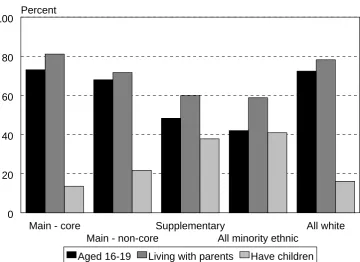
Table 3.4 Children of students by age bands and sample groups, numbers and percent35 Figure 3.1 Proportion of students aged 16-19, living with parents and have own children in different sample types...36
Table 3.5 Experience students bring to childcare courses: employment, further education, voluntary work and unpaid caring responsibilities, numbers and percent ... 37
Table 3.6 Reasons for choosing childcare courses, numbers and percent ... 38
Table 3.7 Student ratings of academic and practice preparation on childcare courses, numbers and percent ...39
Table 3.8 Methods of helping students find employment, numbers and percent...40
Table 3.9 Expectations of working with children, numbers and percent...41
Table 3.10: Preferred childcare settings for employment by sample type, course type and ethnicity, numbers and percentages ...43
Table 3.11: Preferred working conditions in childcare settings: hours a week and weeks a year, by sample type, course type and ethnicity, numbers and percent ...44
Table 3.12: Employment obtained in childcare settings by sample type, course type and ethnicity, percent...44
Table 3.13 Matching preferences to employment obtained, hours per week and weeks per year, percent...45
Table 3.14 Job presence and absence and views on finding a job, numbers and percent ... 46
Table 3.15 Students’ views on the best form of non-parental childcare in three age bands, under 1, 1–2, 3–school age, percent ...47
Table 3.16 The next five years: daytime caring responsibilities for preschool aged children and elder or disabled kin, by sample type, numbers and percent ... 48
Table 3.17 Preferred work pattern when combined with own preschool children, numbers and percent ...48
Table 3.18 Students’ projected destinations in five years time, numbers and percent... 49
Table 4.1: Characteristics of focus group participants by course type... 51
Table 5.1 Management of nurseries ...65
Table 5.2 Number of places in sampled nurseries ... 65
Table 5.3 Full-time and part-time children on roll, numbers and percentages ...66
Table 5.4 Age distribution in sampled nurseries (1) ...66
Table 5.5 Age distribution in sampled nurseries: percentages (2) ... 66
Table 5.6 Size of nurseries: number and percentage of full-time and part-time childcare and education staff posts...67
Table 5.7 Whether vacant posts and number of vacant posts ...68
Table 5.9 Whether recruited staff and number recruited in previous 12 months...69
Table 5.10 Average length of time to induct new recruits and replace members of staff, numbers and percentages ...69
Table 5.11 Methods of recruitment, numbers and percentages...70
Table 5.12 Nursery heads’ views on applicants, numbers and percentages... 70
Table 5.13 Nursery heads’ views on inadequate recent recruits, numbers and percentages ...71
Table 5.14 Effects of the National Minimum Wage, numbers and percentages... 71
Table 5.15 Age of nursery heads and other childcare and education staff, numbers and percent ...72
Table 5.16 Ethnicity of nursery heads and other childcare and education staff, numbers and percentages...72
Table 5.17 Own children of nursery heads and other staff, numbers and percentages .. 73
Table 5.18 Living arrangements for nursery heads and other staff, numbers and percentages ...73
Table 5.19 Reasons for working in childcare, heads and other staff: numbers and percentages ...74
Table 5.20 Careers advice given to heads and other staff, numbers and percentages.... 74
Table 5.21 School leaving qualifications, heads and other staff, numbers and percentages ...75
Table 5.22 Levels of childcare and early education qualification attained by heads and staff, numbers and percentages...75
Table 5.22 Non-childcare qualifications attained by heads and other staff, numbers and percentages ...77
Table 5.23 Previous relevant employment experience, heads and other staff, numbers and percentages...77
Table 5.24 Duration of childcare or early education employment, heads and other staff, numbers and percentages ...78
Table 5.25 Non-childcare employment experience, heads and other staff, numbers and percentages ...78
Table 5.26 Job titles of heads of nurseries by scope of post ... 79
Table 5.27 Job titles and supervision responsibilities of other staff ... 79
Table 5.28 Hours worked in previous week, heads and other staff, numbers and percentages ...80
Table 5.29 Number of days sick leave, heads and other staff, numbers and percentages ... 81
Table 5.30 Number of days paid holiday, heads and other staff, numbers and percentages ...81
Table 5.31 Short courses attended in the previous year by heads and other staff, numbers and percentages ...82
Table 5.32 Commitment to the childcare field and to current job, heads of other staff, numbers and percentages ...83
Table 5.33 Reasons for feeling settled in childcare and early education work, heads and other staff, numbers and percentages...83
Table 5.34 Five years ahead: envisaged employment, heads and other staff, numbers and percentages...84
Table 5.35 Expectations of work five years ahead, heads and other staff, numbers and percentages ...85
Table 5.36 Whether paid course fees influences take up of further qualifications ... 85
Table 5.37 Reasons for leaving childcare work, numbers and percentages... 87
Figures
Figure 3.1 Proportion of students aged 16-19, living with parents and have own
Executive Summary
Three studies of the childcare workforce in training and at work are reported here. These include two national surveys, one of childcare students, and one of day nursery workers, and a focus group study of childcare workers and playworkers in training. All the studies were commissioned by the Department for Education and Skills (DfES) (formerly known as the Department for Education and Employment, DfEE) and took place between 1998 and 2000. The main aim of the studies was to investigate issues of entry, retention and loss in the childcare workforce at a time when government policy supports a major expansion of childcare services and so of this workforce. Particular objectives were to describe the characteristics of those people who train, and work, in the childcare field, to identify their views and experiences of training and employment and to explore how their commitment to childcare employment is combined with other commitments they may have.
This report provides a detailed account of the three studies in separate chapters. The policy background, perspective and methods employed in each study are reported in Chapter 1. Chapter 2 provides a broad description of the childcare workforce, and compares it with other kinds of early childhood and caring work, drawing on secondary analysis of a large data set, the Labour Force Survey. The survey of childcare students is reported in Chapter 3, followed by the findings from the focus groups in Chapter 4. The focus groups were undertaken in order to provide some in-depth exploration of issues that arose in the student survey, and to offer representation to groups of students largely missed in the survey. Chapter 5 details the survey of childcare workers who work in registered day nurseries, and is the first UK study to interview a large sample of childcare workers in detail about their personal circumstances and ambitions and their perspectives on their workplace. In Chapter 6 we give an overview of our findings organised according to our three key issues - entry, retention and loss - as well as offering some conclusions about the future of the childcare workforce.
Two themes run through these studies. The first is that of the value placed on childcare and playwork as an occupation and as a service. Workers and students reported a high level of intrinsic commitment to, and reward from, childcare and playwork. But they also repeatedly claimed that their work was not valued sufficiently highly both within the early years field and by society at large. A combination of high commitment and persistent undervaluation of the work must make these workers vulnerable to competing sources of employment. The second theme is combining childcare work itself with parenting. Given that most of the childcare workforce is female and many are young, this combination of roles is already, or will soon be, a reality for many workers and the possibilities and difficulties of doing so from both a practical and ideological viewpoint are highlighted throughout the report.
Major findings are:
Chapter 2
Using data from the Labour Force Survey for 1996-1998 it was found that: • There were almost 100,000 ‘nursery nurses’ working in Great Britain • Almost all were female
• Their average age was 32, with a third aged under 26 • Most were white
• Almost one third were single and almost half lived with their own children • Over half had a teaching or nursing qualification, or a vocational qualification
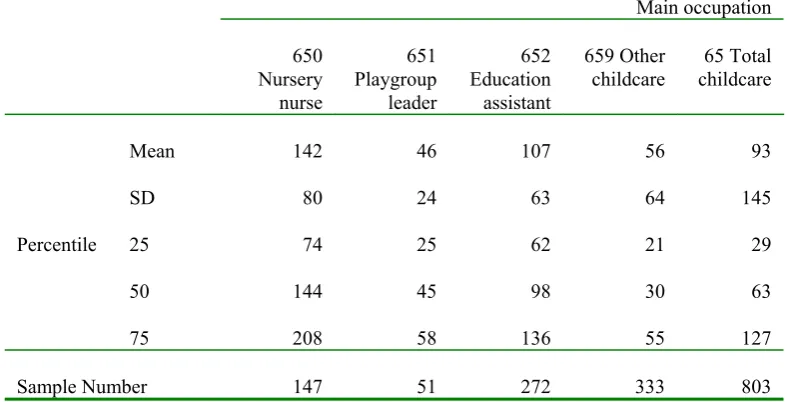
• Average gross pay per week was £142
Chapter 3
• The survey covered students completing diploma and certificate childcare courses at a random sample of further education colleges offering diploma courses in 1999
• Most childcare students are female, white and aged 16–19. They mostly live with their parents and are not mothers themselves
• Students from minority ethnic backgrounds are more likely to be older, to live independently from their parents, and to have children of their own
• Many students begin their courses with related employment or voluntary work experience or are familiar with childcare from childhood
• Over 90% of students are satisfied with the academic and practical preparation provided by their courses
• Nearly three-quarters of white students, but fewer than half of minority ethnic students, are employed while studying combine study and employment
• Two thirds of those that combined study and paid employment said this was difficult
• Over 85% of childcare students are committed to working in the early years field and many want to continue their studies
• Other employment options considered were nursing, social work, clerical work, working with animals, performing arts, and health and beauty work
• The most popular childcare employment option was working in a nursery school or class, followed by working in a day nursery or as a nanny
• Minority ethnic students preferred local authority day nursery and special needs work to working in private day nurseries and very few would choose to work as a nanny
• There is often a mismatch between preferred and obtained employment. Where students had obtained jobs, few were in schools, and employment was more likely to be in private nurseries or as nannies
• Over three-quarters of students wanted to work full-time, but around half wanted to work school terms only
• Students tended to believe that relatives provided the best non-parental care for children under the age of one, and day nurseries provided the best form of non-parental care for children aged three to school age1. For children aged one and two, the best option was more evenly divided between day nurseries, nannies, childminders and relatives
• Minority ethnic students rated day nurseries as the preferable option at an earlier age, after the age of one
• 52% of students envisaged having day time caring responsibilities for their own children in the coming five years
• Part-time employment was the most common method envisaged for combining employment with care of own preschool aged children, followed by not working at all, and working from home. Working full-time was the least favoured option, although minority ethnic students were more likely to consider this possibility than were white students
Chapter 4
• The focus group participants were broadly similar to the student survey respondents in respect of some factors, such as gender, educational background
and ethnicity, but were selected to be different in others: they were older, usually had additional responsibilities (jobs and children at home) and included students from playwork courses and NVQ courses
• Participants found childcare work and playwork rewarding, varied and stimulating
• Many participants thought of childcare and playwork as a career, but saw considerable constraints operating around achieving a career. Major constraints were having children and priority given to partners’ careers, hours of work and occupational mobility
• A further constraint was the effect of two particular beliefs, which provided a framework for the combination of work and motherhood. One was that mothers (and fathers to a lesser extent) should be available to their children, and the second was that you shouldn’t leave your children to be cared for by others • Achieving a career in childcare and playwork was also constrained by a
perceived devaluation of the work from many sources including low wages generally and a competitive pay environment in the early years field; poor recognition of the level of skills and responsibility required for childcare and playwork; parents’ views and government policies
• Courses were reported to be stimulating and demanding but in some cases organisational problems detracted from students’ learning experiences
Chapter 5
• The survey covered over 2,000 heads and other staff working in 251 registered day nurseries in England
• Three-quarters of the nurseries were privately owned. The average size was 44 places, with considerable variation. Most nurseries were open all day
• Most children attended part time, and the most common ages were 2 and 3 year olds. Nearly all nurseries said they would care for children with special needs, and nearly all actually had at least one child with special needs
• There was an average of 7 full-time and 3 part-time childcare staff per nursery. Nearly a third of nursery heads had at least one vacancy, and nearly three quarters of nurseries had had at least one member of staff leave in the preceding 12 months. By far the most common ways of recruiting staff were via local adverts and word of mouth
• Nearly three-quarters of nursery heads who had recruited in the past year felt there had been problems with applicants - either there were not enough, or else they lacked adequate experience or qualifications
• The National Minimum Wage had had little effect, as most nurseries had already paid at or above the rate
• The characteristics of nursery staff were homogeneous: overwhelmingly female; mostly young (average age 24); largely white and able-bodied. A third of nursery staff had their own children and two-fifths lived with family. Heads of nurseries were older and most had their own children
• On average heads have worked 13 years in the childcare field, other staff 6 years
• Staff had typically left full-time education with GCSEs or equivalent qualifications
• Compared with the national average, day nursery staff were as likely to have GCSEs or equivalent but were much less likely to have A-level qualifications • Most staff cited positive reasons for working in childcare, such as liking
• 22% of heads and 33% of other staff did not hold any relevant childcare or early education qualifications
• 59% or heads and 52% of other staff held a Level 3 (diploma) qualification; 3% of heads and 13% of other staff held a Level 2 (certificate) qualification. 16% of heads and 3% of other staff held a Level 4/5 (professional/vocational) qualification
• 40% of heads had either completed a managerial or assessment qualification such as the NVQ Assessor Award, or some other form of management or business training
• 56% of heads and 71% of other staff would consider further training in childcare in the next five years
• Most staff worked full time: the average working week was 39 hours for heads and 35 hours for other staff
• Three quarters of heads worked additional hours unpaid, but only 17% of other staff did this
• Most staff had permanent contracts and averaged 20 days paid holiday per year • Gross annual salaries were low. The mean annual salary before tax for heads
was £13,400 and £7,700 for other staff. This is well below the national average for full-time non-manual female employees, which in 2000 was £19,193
• Very few staff had pensions or were members of trade unions or professional organisations
• Nearly all viewed their work as a longer-term career, most felt settled in their present post and there were, overall, very high levels of job satisfaction
• Looking forward five years, three quarters of the heads but only 48% of the other staff expected still to be working in day nurseries
• During the coming five years, 26% of heads and 34% of other staff expected to have caring commitments (for children or elder kin) that would take them away from employment
• Reasons for feeling settled in current jobs related to the intrinsic nature of the work, in particular, the children, as well as organisational aspects, such as working as a staff team
• 8% of heads and 14% of other staff were actively thinking of leaving their present job. The reasons for leaving were both to do with the nature of the job and the working conditions, but the most commonly cited factor was the poor rate of pay
• Among other staff, those with higher level qualifications and those with higher rates of pay were more likely to expect to leave their present jobs than other groups
• Among the staff who were thinking of leaving, only a small minority planned to leave childcare work altogether
Chapter 6
• The high degree of commitment to childcare work is a real strength of the current workforce
• But other findings in these three studies give cause for concern about the future of the childcare workforce
• Achieving a career in childcare is not easy, particularly if and when workers combine working with motherhood. Pay is low and there are few other benefits to suggest that nurseries support their workforce
• Staff retention relies on individual staff commitment
• This over-reliance on one segment of the workforce may exacerbate recruitment and retention difficulties
• The pool of labour available from young women is diminishing just as demand is growing. This is due to several factors:
• The educational achievements of and opportunities for young women are growing nationally
• Motherhood is much more likely among younger women with lower levels of educational qualifications than other groups
• Many of the childcare students and workers anticipate full-time motherhood and leaving employment for a few years at least while their children are young
• These factors point to discontinuity of employment and consequent high turnover and in-built instability in the day nursery workforce placing increasing demands on nurseries and their management
• The problems of recruitment and retention in childcare are also evident in social care which recruits people from similar backgrounds
• Three possible options are posed:
• Diversify the compositions of the workforce, addressing the gender and age imbalance
• Improve pay and other conditions, including ‘family friendly’ working conditions
Acknowledgements
The studies on which this report is based were conducted with the help of a large number of people whom the authors would like to thank. These include the lecturers, tutors and managers in further education colleges who helped deliver the student survey and facilitated the focus groups; Caroline Bell, who took a major role in the organisation of both the surveys; Paul Bonel and the National Play Centres who helped find participants; Phil Barnett from System Three International, the market research company which conducted the survey of staff; and the heads of nurseries who agreed to participate in a study that demanded considerable staff time. The studies also benefited from advice from members of the Advisory Committee set up by officers from the DfES. In addition, the work could not have been completed without the assistance of data entry staff and transcribers at Thomas Coram Research Unit. But most of all, the authors would like to thank the thousands of students and workers whose lives, views and experiences are brought together in this report.
Material from the Labour Force Survey is Crown Copyright; has been made available by the Office for National Statistics through the Data Archive and has been used with permission. Neither the ONS nor the Data Archive bears any responsibility for the analysis or interpretation of the data reported here.
Chapter 1 Introduction
1. 1 Policy background
The three studies of the childcare workforce, in training or in work, covered by this report come at an auspicious time for policy and practice in early childhood services2. The current Government has shown unprecedented interest in improving the availability, quality and accessibility of services for young children through a range of initiatives and programmes:
• Educational provision has been made for all 4 year olds and is to be extended to at least two-thirds of 3 year olds by 2002 through nursery education grants.
• A National Childcare Strategy is in place to support parents and children through increasing the supply of, and enhancing the quality in, services designed to care for children while parents are in employment or training. This Strategy is being implemented by Early Years Development and Childcare Partnerships, informed and guided by childcare audits and local early years development and childcare plans.
• The Sure Start initiative targets children under 4 years of age and their families in disadvantaged areas, with 250 local programmes envisaged by the end of 2002 (and further extended in the 2000 Comprehensive Spending Review).
• A programme of Centres of Early Excellence, intended to highlight ‘best practice’ has been launched.
• New sources of funding have been provided, including a Childcare Tax Credit for parents introduced in October 1999.
• Two of the existing systems for regulating early years education and child care in the voluntary and private sectors (inspections by OFSTED under Section 122 of the Nursery Education and Grant Maintained Schools Act 1996 and by social services under the Children Act 1989) are being brought together within a new Early Years Directorate within OFSTED, and a new set of national standards for the regulation of childcare services is being drafted.
• Desirable learning outcomes have been replaced by early learning goals complemented by guidance.
• The Qualifications and Curriculum Authority (QCA) has produced a framework of nationally accredited qualifications for early years education, childcare and playwork. The formal educational orientation of preschool services has never been more forcefully emphasised, with implications for the roles and responsibilities of staff employed in early childhood services.
• The DfES has mounted an extensive recruitment campaign for childcare workers.
The workforce is a major issue that runs through all of these policies and initiatives. It has a major bearing on availability, quality and accessibility of early childhood services: the achievement of these goals is contingent on recruiting and retaining sufficient, appropriately trained workers. This has been recognised by government, for example through training initiatives outlined above and a recruitment campaign for childcare workers launched in 2000.
The project reported here addresses entry, retention and loss at several levels: the childcare training stage in further education colleges, training while also employed, and in one important part of the early childhood workforce itself: day nursery staff. It sheds light on how these services can recruit and retain ‘competent individuals’, whose
expertise, skills and qualifications are acknowledged in the National Childcare Strategy as an essential contributor to quality services.
1.2 Childcare and early education services
In the UK, services designed for the care and education of preschool aged children are characterised by immense diversity. This diversity is the result of several factors. First, there has been a long-standing structural divide in governmental responsibility for care services on the one hand and early education services on the other. Second, this division has traditionally led to different kinds of services, with differing priorities, goals and ethos, and different types of funding, being supported by different government and local authority departments.
Within the Department of Health (DH), for example, there has been a discretionary responsibility on local authorities to support day nurseries3. The health and welfare
concerns of this department and local authority social services departments meant that the primary role of these nurseries was largely (but not always exclusively) to care for socially, emotionally or materially deprived children aged 0–5, and not all children. These publicly provided day care services have accounted for a small minority of the total number of places for preschool aged children (there were 15,500 places in local authority provided nurseries in 19994). Local authorities could also pay for children to attend services in the private and voluntary sector, and, in 1998, they paid for, or sponsored, 5,400 such day nursery places. Over the last decade, the number of places in publicly provided places has been decreasing, and is today almost half of the 1989 total (28,800). Instead, local authorities have begun to focus on the provision of services for families, known as family centres, and these services (there were 470 of them in 1999,
rising from 400 in 1989) may or may not provide day care for children, and are not necessarily exclusively for children under five. The workers in these day nurseries and family centres were traditionally known as ‘nursery nurses’, a term that is used in the collection of statistical data (see chapter 2), but in many centres and nurseries this term is not used so the collective term we have used in this report is childcare worker. These
workers may be trained or untrained, and will typically include a good proportion with a childcare diploma qualification, as well as other qualifications such as social work or nursing (EO/IDeA, 1999a).
The Department for Education and Skills (DfES) and local education authorities have had different concerns. Their responsibility is to provide education for all children over the age of five. An historic discretionary responsibility to provide preschool education5 has been given a new emphasis by the government and now local education authorities have a responsibility to provide a free early education place for all four year olds prior to the beginning of compulsory education at the age of five. Historically, the focus here has been on establishing nursery schools and nursery classes within infant and primary
schools, catering for children aged three and four, which in practice were unevenly distributed (Owen and Moss, 1989). Many four-year-old children also attend reception classes in primary schools. This provision is more extensive, with, in 1999, 713,608
children attending such schools and classes in the maintained sector and a further 57,542 two, three and four year old children attending independent schools6. Most of
3 This responsibility was given to local authorities in the Maternity and Child Welfare Act 1918. 4 All statistics in this section are from
Children’s Day Care Facilities at 31 March 1999 England, Statistics of Education, DfES, 1999 unless referenced separately.
5 This provision was contained in the Education Act 1918. 6
Pupils Under Five Years of Age in Maintained Schools in England, Statistical First Releases, DfES, 1998; Statistics of Education: Schools in England 2000, DfES, 2000.
the children attending nursery schools and classes attend part-time, for 2½-hour sessions, whereas most children in reception classes attend full-time. The Government has pledged to increase the availability of nursery education: it is ‘working towards a target of universal nursery education for all three and four year olds’ (Hodge, 2000). Part of the method of doing this is to provide grants to care and education services in the private and voluntary sectors who provide an accredited curriculum (see below). Maintained sector schools employ diploma qualified nursery nurses to assist early years teachers (EO/IDeA, 2000).
Beyond the statutory provision, there are three major kinds of services in terms of places available. The first two are playgroups or preschools, voluntary sector groups
originating in the self-help tradition and usually run by a parent-led management committee (347,200 places in 1999) and childminders, or self-employed persons
(usually women) who charge fees to care for children under the age of eight in their own homes (337,000 places in 1999)7. Both these kinds of services appear to be in decline. While historically the information base in early childhood services is not good so it is difficult to rely entirely on national statistics (Moss, et al., 1998) (although recent changes may lead to improvements), the best available national figures suggest that there has been a drop in both playgroup places (65,400 down since 1994) and in childminder places (45,700 down since 1996).
The third major type of provision, and the main concern of this report, is registered day nurseries. Day nurseries in the private and voluntary sector (also known as independent
or registered day nurseries) offer all day care for children aged 0–4 (and some offer additional services for older children such as breakfast or after school care or holiday schemes). They are largely dependent on parental fees (subsidies in the form of nursery education grants are now available for four-year-old children and some three-year-old children in nurseries running an accredited educational programme) and cater for the children of working parents. They have seen rapid growth in the last decade, from 1,700 in 1989 to 6,400 in 1999, offering a total of 220,200 places. A recent survey estimated that there were about 43,300 care and education staff working in registered day nurseries in 1998 (EO/IDeA, 1999a). These nurseries are a primary source of employment for childcare workers (or ‘nursery nurses’) with diploma and certificate (and other) qualifications. They also employ a proportion of unqualified childcare workers (ibid.).
A third division between care and education systems has also, until recently, been seen in arrangements for the regulation of services. All care services (childminders, playgroups and day nurseries) are required to be registered with local authorities under the Children Act 1989 (Part X). With a few exceptions8, they are then subject to an annual inspection. Local maintained nursery schools, primary schools with nursery classes and independent schools are subject to inspection by OFSTED under the Schools Inspection Act 1996. Since 1998, day care providers wanting to access the nursery education grant available for three and four-year-old children have had an OFSTED inspection under the Nursery Education and Grant Maintained Schools Act 1996. Following the administrative integration of childcare and early education responsibilities in the DfES in 1998, a single OFSTED inspection system for all childcare and education services will be introduced by the new Early Years Directorate. This will be introduced in 2001 under Part V1 of the Care Standards Act 2000 to ease inconsistencies and overlap between the two methods of quality assurance.
7 Around 9,000 children had places in playgroups or with childminders paid for by local authorities in 1998.
The system already described is complicated. However, there are also other, unregistered, services, such as nannies, who are persons (usually women) employed to
care for young children in their employer’s home, either living in or out, and generally have a diploma qualification, although this is not a requirement. Because this service is not registered, it is not possible to quantify the number of nannies, although a survey of childcare use showed that 2 percent of working mothers with dependent children used nannies in 1994 (Finlayson et al., 1996).
Apart from the main early childhood services for preschool aged children, there are also other occupations where trained childcare workers might be employed, such as in children’s wards in hospitals, or as children’s representatives for holiday companies. It is not possible at present to estimate the number of childcare workers in these occupations. In addition, childcare workers are employed as learning support or classroom assistants in nursery, primary, secondary, independent and special schools. A recent survey estimated that there were 121,472 education support staff working in maintained and independent schools (EO/IDeA, 2000). Education support staff covered a wide range of job titles, and around a third of them held a childcare diploma level qualification.
Trained childcare workers are also employed as playworkers with school-aged children. Playwork services such as after-school (or out of school) clubs or holiday playschemes are another growth area, as care for children outside school hours is seen as key to facilitating mothers’ paid employment. If they include children under eight, they also need to be registered under the Children Act 1989: in 1999 there were 90,400 places in after-school clubs and 345,200 places in registered holiday playschemes. In addition, some local authorities provide after school clubs (8,800 places) and holiday schemes (71,600 places in 1999). Although specific training and qualifications for playworkers are fast being developed (SPRITO, 1999; QCA, 1999) and many workers do not hold a relevant qualification, around a quarter of playworkers hold childcare qualifications (EO/IDeA, 1999b).
The final point on childcare services is that of availability and accessibility. Until recent policy initiatives to increase the supply of childcare services by offering financial support to services and to low and middle income parents take effect, registered childcare services for preschool and school aged children cater for an estimated one in nine children under the age of eight (Day Care Trust, 1997). In these circumstances it is not surprising that many families do not used registered childcare at all: Finlayson et al. (1996) showed that, in 1994, 50 percent of working mothers with children under the aged of four used informal care provided by relatives such as partners, parents and parents-in-law.
1.3 Training and qualifications in childcare and playwork
Training to work in the early childhood field of education, care and playwork is currently undergoing enormous change. Taking just one early childhood service, a survey of day nurseries in 1998 (EO/IDeA, 1999a) used information from responding heads of nurseries and established that 90 percent of nursery managers and 75 percent of other childcare and education staff had some relevant qualification9. A similar method was used for a survey of day care providers in 1994 (Moss et al., 1995), which showed that most nurseries surveyed employed a mixture of qualified and unqualified staff. A historical problem in the early years field noted by Cordeaux et al. (1999) was that of extreme fragmentation in the range and level of relevant qualifications so that although a wide range of possible qualifications existed, many had little currency across administrative boundaries and there was inconsistency between employers about which qualifications were relevant for particular posts.
Since the advent of the National Childcare Strategy, which aimed to establish a clear, comprehensive qualifications and careers structure (DfES, 1998: 2.31), many initiatives have begun to both raise the proportion of qualified staff and improve the coherence of training and qualifications. For example, an Early Years National Training Organisation (EYNTO) has been introduced, and a Playwork Unit has been formed within the National Training Organisation for Sport, Recreation and Allied Occupations (SPRITO), each charged with improving the training and qualifications base within their fields. A training and qualifications framework (QCA, 1999; QCA, 2000) has begun the process of constructing a coherent set of qualifications that address the different occupations within the early years sectors, rationalising the number of accredited qualifications; and local Early Years Development and Childcare Partnerships have been introduced with a responsibility to co-ordinate a broad programme of vocational training and qualifications through a training strategy. These initiatives represent a concerted attempt to improve the qualification base in the early years field.
These initiatives build on the system of accrediting competence through the National Vocational Qualifications (NVQ/SNVQ) framework introduced in the mid-1980s (Hevey and Curtis, 1996). Designed to be modular, flexible and to reflect experience as well as training, the NVQ system has a series of levels, which denote increasing competence and specialisation in particular areas. However, NVQs are not solely workplace-based, or workplace and college-based forms of accrediting competence: the system has also been developed to map the series of levels onto the existing qualifications in order to provide a coherent ladder or climbing frame of qualifications and occupations (QCA, 1999).
The main types of training in childcare, early education and playwork are these:
• Two-year college plus placement Diploma courses aimed at working with babies and young children (e.g. CACHE Diploma in Child Care and Education (previously the NNEB Diploma in Nursery Nursing); BTEC/EdExcel National Diploma in Childhood Studies (Nursery Nursing)10). These two qualifications are the most commonly found qualifications in nurseries (46 percent of all childcare and education staff hold one of these two (EO/IDeA, 1999a))
9 Relevant qualifications included CACHE and BTEC Diplomas, Advanced Diplomas and Certificates, teaching and nursing qualifications, Montessori qualifications, S/NVQs Levels 2, 3, and 4 in Childcare and Education and in Playwork, professional social work qualifications, and PLA/PPA diplomas.
• One-year college plus placement Certificate courses aimed at preparation for the Diploma courses or employment under supervision in nurseries (e.g. CACHE Level 2 Certificate in Child Care and Education; National Certificate in Childhood Studies (Nursery Nursing)11). This kind of qualification is held by about 5 percent of staff (EO/IDeA, 1999a).
• S/NVQ (Scottish/National Vocational Qualifications) Levels 2 and 3 in Early Years Care and Education designed for those in employment, with completion of discreet modules at students’ own pace, and with some college-based or training centre commitments. S/NVQ Levels 2 and 3 are each held by about 6 percent of the nursery workforce (EO/IDeA, 1999a). A higher-level award, an NVQ Level 4, designed for managers and those with specialist interests, has recently been accredited (QCA, 2000) for use in England and Wales.
• S/NVQ levels 2 and 3 in Playwork designed for those in employment, with completion of discreet modules at students’ own pace, and with some college-based on training centre commitments. These NVQs are held by about 2 percent of the nursery workforce, and about 5% of those who work in registered out of school clubs (EO/IdeA, 1999b). The NVQ Level 4 in Early Years Care and Education is also available for playwork managers and development officers (QCA, 2000). • Modern Apprenticeships (MAs) for Early Years Care and Education, a system of
accreditation during employment at NVQ Level 3, and can take up to 3 ½ years for completion of the necessary modules. These are completed through a partnership between TECs, employers and apprentices based on a Training Agreement including an Individual Training Plan.
• Post-qualifying or higher education qualifications (e.g. Advanced Diploma in Childcare and Education (ADCE); HE Diploma in playwork; BEd and PGCE in Early Years).
• Specific occupation orientated training (e.g. CACHE Level 3 Diploma in Preschool Practice; CACHE Level 3 Certificate in Childminding Practice).
1.4 The study overall
In 1998, the DfES commissioned the Thomas Coram Research Unit to undertake a study of childcare students and the day nursery workforce in order to inform policy and practice on recruitment, retention and training of childcare workers. This was linked to a preceding study for the DH by the same team on gender issues in the childcare workforce (cf. Owen et al., 1998; Cameron et al., 1999). Further work by the Thomas Coram Research Unit is in progress to carry out telephone follow-up studies of students and workers interviewed in this study. This will assess the rate of staff turnover and the subsequent destinations of staff and students, and include a qualitative, in-depth study of former childcare students and workers.
1.4.1 The student and worker studies
This research report brings together three studies all concerned with issues of entry, retention and loss. First, a survey of students undertaking central qualifications in childcare, such as the diploma and certificate courses is reported in Chapter 3. Second, Chapter 4 details the conclusions of a series of six focus groups with groups of childcare and playwork students. The third element, in Chapter 5 is a major survey of the registered nursery workforce. This is the first UK study to interview a large sample of childcare workers in detail about their personal circumstances and ambitions and their perspectives on their workplace.
The aims of all three studies are to investigate who is being recruited to childcare courses, to understand which factors help staff stay in childcare and playwork employment, and conversely, which factors encourage the training or employed workforce to leave the childcare field. Two themes run through the results of these studies. The first is the value placed on the work as an occupation and a service. Workers and students reported a high level of intrinsic commitment to their work but forcefully claimed that wider society did not value their work highly. The second theme is combining employment with family commitments. Practical and ideological problems and possibilities arising from this combination of roles are highlighted throughout the report.
1.5 Perspective adopted
The approach adopted was to obtain a picture of students’ and workers’ lives that integrated their employment and training with other commitments and interests in their lives such as caring responsibilities or career ambitions. Reasons for entry, retention and loss in the registered day nursery workforce may be related to factors outside the employment or training environment as well as within it. In addition, there is a well-documented gender imbalance in the childcare and playwork workforce, with well over 95 percent of the workforce being women (Cameron and Moss, 1998).
Most women, regardless of marital or parental status, now expect to be employed for much of their adult lives (Crompton, 1997). However, the structure of women’s employment alters with additional commitments, such as families and children. For example, women’s working lives incorporate domestic commitments to a much greater extent than men’s (Brannen and Moss, 1991; Jowell et al., 1992), with higher rates of
part-time working, shift working, and periods of time spent outside the labour market altogether in order to carry out domestic or caring responsibilities (Crompton, 1997; Holtermann et al., 1999).
The fastest rate of increase within female employment is that of mothers with children under five. Between 1990 and 1997, the proportion of this group of mothers who were employed rose from 45 percent to 57 percent (Holtermann et al., 1999) and is likely to
continue to rise. However, the rate of increase was unevenly distributed. Mothers with higher levels of education and higher salaries were far more likely to be returning to employment than those with lower levels of education and lower potential salaries (ibid.).
1.6 Methods
The methods used in each of the three studies are reported in detail here, beginning with the national survey of students on childcare courses, then the focus groups and last the survey of the day nursery workforce.
For the student survey, colleges were selected from a data base of further education
colleges in England offering the two-year CACHE Diploma in Child Care and Education and the BTEC National Diploma in Childhood Studies (or their equivalent courses), a total of more than 400 colleges. The aim was to survey students leaving courses designed to prepare them for employment with young children in the summer of 1999. Twenty-seven colleges were selected randomly. This was the main sample. Six
further colleges were added to the sample, from areas of relatively dense minority ethnic population (based on the 1991 census), to provide additional minority ethnic students. These colleges were not selected at random, because of the deliberate method of selection, and are referred to as the supplementary sample. This made a total of 33
recruited colleges, representing urban and rural areas, and from all the regions of England.
The design of the survey aimed to maximise participation by students with economy of distribution. Childcare lecturers were initially contacted in February 1999 by telephone and their help with the survey obtained. The questionnaires were sent to lecturers in the summer term (copy in Appendix 1). Lecturers were asked to ensure that students completed the questionnaire during a group teaching session and that students returned it using a sealable envelope (provided by the research team) to the lecturer. Each college’s questionnaires were then to be returned to the research team. Even after several reminders, one college in the main sample and one in the supplementary sample did not return their questionnaires, reducing the number of colleges to 31.
The two-year diploma courses were the ones of key interest to the study, and these have been designated the ‘core’ courses. However, students on the other ‘non-core’ courses were also of interest. These courses, such as the certificate course, were of shorter duration and were aimed at preparation for further study or supervised employment12. Lecturers were asked also to distribute questionnaires to students on these other courses. Thus, although the survey covered the predominant qualifying courses in childcare, some of the course categories described in section 1.3 were not included in this survey, namely, the modern apprenticeships, the post-qualifying training and the specific occupation oriented training.
A total of 1,094 questionnaires were returned, 775 from students on the ‘core’ or diploma courses and 319 from students on ‘non-core’ or certificate and other courses. Since it was not possible to get reliable figures on the number of eligible students in each college, it is not possible to calculate an overall response rate. Lecturers were asked to report the reasons for any non-completion of questionnaires. These mostly involved the unreliability of students’ attendance at college towards the end of the summer term, pressing deadlines for written work, and failures of lecturers to ensure the completion of questionnaires during teaching sessions. However, most reported that almost all eligible students had in fact completed a questionnaire.
For this report, the key group comprises students in the main sample on core courses.
These students form a random sample of students at colleges in England offering the CACHE or BTEC diploma or equivalent. In addition, results are presented for students in these same colleges following non-core courses. However, since these courses will
be offered in colleges in addition to those on the database of colleges offering the core courses, these students do not form a truly random sample of students on the non-core
courses. Results are also presented by ethnicity, comparing white students with those from minority ethnic backgrounds. These results use data from both the main and the supplementary samples. Since the supplementary sample was a purposively selected,
not random, sample, these samples are not random. Table 1.1 indicates the numbers of students in each of the categories.
Table 1.1 Childcare student survey, main and supplementary samples; core and non-core courses; ethnicity
Main sample Supplementary
sample Total
Core Courses 648 127 775
Non-core courses 241 78 319
White* 795 90 885
Minority ethnic* 85 112 197
*12 missing cases
The focus groups were designed to augment the student survey findings. This would
occur both through exploring in greater depth issues raised in the survey, and through targeting groups of students that proved difficult to access through college courses. In particular, these groups were playwork students, whose courses were not necessarily or even likely to be based in colleges of further education; NVQ students, whose status as workers in training was not well reflected through the survey; and mature students, whose views and experiences may differ from those of school leaver students. In total, six focus groups were conducted between January and March 2000, and from various regions of England, from the north-east to the south-west.
The topic guide for the focus groups was based on the same topics as those explored in the student questionnaire, but the discussion technique allowed for more in-depth probing of these topics (copy in Appendix 2). In total 30 students participated from six childcare and education and playwork courses. This was fewer students than anticipated, despite careful preparation, albeit at a distance, through lecturers and tutors. However, the results (see Chapter 4) are remarkably consistent. When asked about the reasons for non-participation, lecturers and tutors reported that students either found it difficult to see the relevance of the project to them, or participation entailed extra time commitments, which were difficult to accommodate in their busy work/study schedules. For the future, serious consideration must be given to financial reward for participation in focus groups.
The focus group interviews took between an hour and an hour and three-quarters to complete. They were tape-recorded and fully transcribed, with transcripts of between 30 and 40 pages long. The analysis was completed with assistance of a computer package (NVivo) and informed by the perspective on women’s work and motherhood described above. Each discussant also completed a short questionnaire about their individual circumstances.
The survey of day nursery staff aimed to survey the characteristics and views of around
did not offer full-day all-year round care) were then selected, using a random numbers table where there were sufficient nurseries within the local authority, and all nurseries where there were not, and written to asking for permission to interview all the staff. The achieved sample comprised 2,060 staff from 251 nurseries in 16 local authorities. These nurseries were drawn from all the regions of England and include rural and inner-city areas. Public Attitude Surveys (PAS), a market research company, carried out the fieldwork, using a questionnaire designed and piloted by the research team (copy in Appendix 3). Each member of staff was also given a self-completion questionnaire to fill in to assess job satisfaction and motivation (copy in Appendix 4). The response rate from those nurseries contacted was 64 percent. Table 1.2 sets out the details of obtaining the sample. Of those nursery heads who refused to participate, only two cited refusal on the part of the staff: the two main reasons given concerned their workload, they were unable to spare the staff for individual interviews or were too busy.
Table 1.2 Details of achieving the sample of nurseries
N %
Addresses supplied 441 100
Uncontactable: Unobtainable/ no response to messages/ did not answer telephone/ closed down
45 10
Refused:
Not able to spare staff Too busy
Not interested Irrelevant
Private nursery – commercial considerations precluded participation Staff refused
Other/not given
32 18 9 5 3 2 76 Total
Participated 145 251 33
Response rate – including uncontactable
Response rate – excluding uncontactable 57 64
Chapter 2. The larger picture: secondary analysis of the
Labour Force Survey
The Labour Force Survey is the largest of the government’s regular household surveys (Owen, 1999). It collects a range of demographic data from all members of the household, including details of their occupation. Thus it provides us with the opportunity of forming a picture of the childcare workforce, looking at such features as age, qualifications and hours of work. There are limitations in using the LFS, however. These are to do with the way occupations are classified, the level of detail on qualifications and the small numbers of people in childcare occupations included each year. These limitations are outlined below. The LFS has been analysed for this report, to put the results of our own data into a wider context. Figures are presented for some childcare occupations, alongside some other care and education occupations for comparison.
2.1 Labour Force Survey
The Labour Force Survey (LFS) is a national survey of private households in the United Kingdom. It collects data from approximately 60,000 households per quarter. The survey is conducted by the Office for National Statistics (ONS) on behalf of the government. Results are published in the
LFS Quarterly Supplement to
Labour
Market Trend
s.
Data are collected on a wide range of subjects, including occupation, training, marital status and household composition. When people in a household agree to take part in the LFS, they are interviewed five times at quarterly intervals. Most questions are repeated each quarter, but income questions are not asked every quarter. (This is discussed further below.) For the 1991 Census a new occupational classification was introduced, and this is also used by the LFS.2.2 Standard Occupational Classification
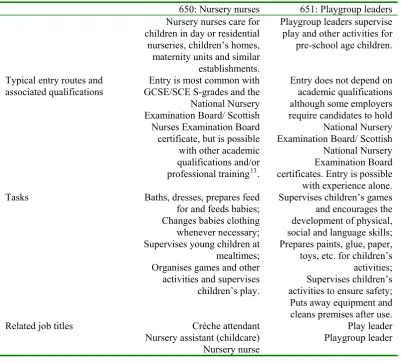
The Standard Occupational Classification is a detailed classification of occupations. (See Office of Population Censuses and Surveys, 1990). It is a hierarchical classification with nine major groups, 87 minor groups and hundreds of unit groups. Unit groups are sets of specific occupations, grouped together on the basis of the tasks performed and on similarities of qualifications, training, skills and experience commonly associated with those tasks.
2.2.1 Childcare and Related Occupations
Table 2.1 Minor Group 65: Childcare and Related Occupations
650: Nursery nurses 651: Playgroup leaders Nursery nurses care for
children in day or residential nurseries, children’s homes, maternity units and similar establishments.
Playgroup leaders supervise play and other activities for pre-school age children.
Typical entry routes and
associated qualifications GCSE/SCE S-grades and the Entry is most common with National Nursery Examination Board/ Scottish Nurses Examination Board certificate, but is possible with other academic qualifications and/or professional training13.
Entry does not depend on academic qualifications although some employers require candidates to hold National Nursery Examination Board/ Scottish National Nursery Examination Board certificates. Entry is possible with experience alone. Tasks Baths, dresses, prepares feed
for and feeds babies; Changes babies clothing whenever necessary; Supervises young children at mealtimes; Organises games and other activities and supervises children’s play.
Supervises children’s games and encourages the development of physical, social and language skills; Prepares paints, glue, paper, toys, etc. for children’s activities; Supervises children’s activities to ensure safety; Puts away equipment and cleans premises after use. Related job titles Crèche attendant
Nursery assistant (childcare) Nursery nurse
Play leader Playgroup leader
652: Educational assistants 659: Other childcare and related occupations Educational assistants assist
teachers with, or relieve them of, a variety of non-teaching duties.
Workers in this unit group perform a variety of childcare and related occupations not elsewhere classified in MINOR GROUP 65: Childcare and Related Occupations Typical entry routes and
associated qualifications
Academic qualifications may be required but entry is possible with relevant experience alone.
Entry may not depend on qualifications, though some employers require candidates to hold GCSE/SCE S-grades and the National Nursery Examination Board/ Scottish Nursery Nurses Examination Board Certificate or other qualifications.
Tasks Assists teacher with
preparation or clearing up of classroom; Looks after lesson materials such as paper, pencils and crayons; Assists children with washing or dressing for outdoor and similar activities; Assists teachers with other non-teaching duties as required.
Assists children to wash and dress; Prepares and serves children’s meals; Mends, washes and irons children’s clothes and tidies their rooms; Supervises children during meals and keeps order in playground and after meals and before classes resume; Assists playgroup leader with the preparation and supervision of children’s games and their other activities. Related job titles Classroom helper
Educational assistant School helper Au pair Child minder Dinner supervisor Nanny Playgroup assistant Playgroup helper Source: OPCS (1990: 204-205)
As can be seen, the first two occupations, nursery nurse, playgroup leader and educational assistants, are fairly clearly defined. The term ‘nursery nurse’ covers all those people who work with children in day nurseries except managers, who are separately classified, and thus is a reasonably close match with the workforce surveyed in Chapter 5 of this report. Nursery nurses and playgroup leaders would seem to be involved exclusively with the care of preschool-aged children, whereas educational assistants clearly care for school-aged children, although probably confined to primary schools (EO/IDeA, 2000). However, the final category covers a wide range of duties and roles. The category includes playgroup workers who are not leaders, as well as some staff employed in residential children’s homes, childminders and nannies.
classification is the Standard Industrial Classification (SIC) (Central Statistical Office, 1992): it classifies the industry or location where a job is carried out. However, information supplied by ONS indicates that there is no simple relation between the SIC codes and occupations within SOC 659 that can be used to disentangle different childcare jobs. Consequently, it has not been possible to subdivide this group any further.
2.2.2 Census estimates
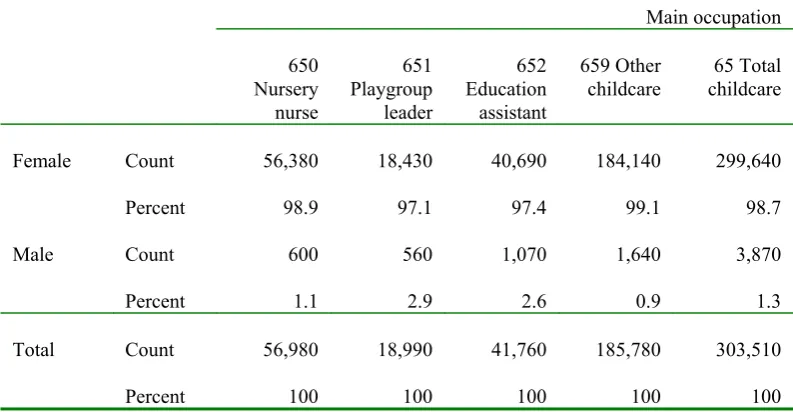
[image:27.595.135.532.313.519.2]The 1991 census used the SOC codes. From these data the numbers of men and women in childcare occupations was estimated. These figures are shown in Table 2.2. In 1991 there were almost 57,000 nursery nurses. Nursery managers and officers in charge were not included in these figures: they were included with other managers and could not be identified separately. In addition, there were 19,000 playgroup leaders and 42,000 educational assistants. The largest group, however, was the other childcare occupations, with 186,000 people. Overall, 99 percent of the childcare workforce were women.
Table 2.2 Census counts for childcare and related occupations
Population estimates, Great Britain
Main occupation
650 Nursery nurse
651 Playgroup leader
652 Education assistant
659 Other childcare
65 Total childcare
Count 56,380 18,430 40,690 184,140 299,640 Female
Percent 98.9 97.1 97.4 99.1 98.7
Count 600 560 1,070 1,640 3,870
Male
Percent 1.1 2.9 2.6 0.9 1.3
Count 56,980 18,990 41,760 185,780 303,510 Total
Percent 100 100 100 100 100
Source: Census 1991 Economic Activity Table 4
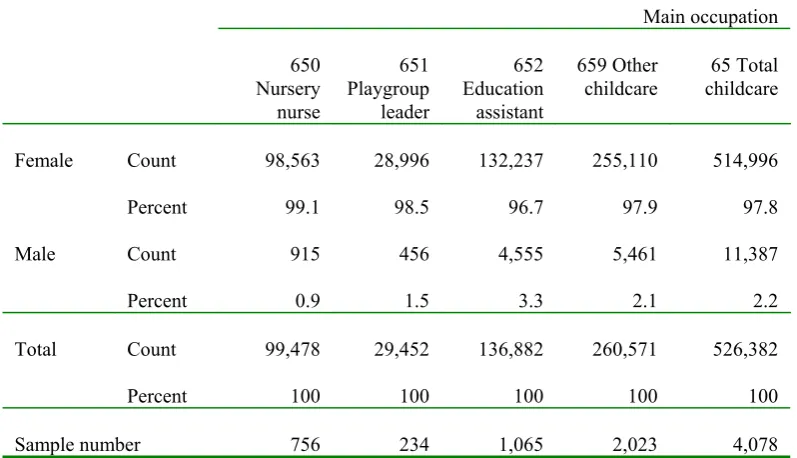
2.2.3 Labour Force Survey estimates
Table 2.3 Preschool childcare and education workforce by gender
Population estimates, Great Britain
Main occupation
650 Nursery nurse
651 Playgroup leader
652 Education assistant
659 Other childcare
65 Total childcare
Count 98,563 28,996 132,237 255,110 514,996 Female
Percent 99.1 98.5 96.7 97.9 97.8
Count 915 456 4,555 5,461 11,387
Male
Percent 0.9 1.5 3.3 2.1 2.2
Count 99,478 29,452 136,882 260,571 526,382 Total
Percent 100 100 100 100 100
Sample number 756 234 1,065 2,023 4,078
Source: Labour Force Survey, 1996-1998, Spring Quarter
2.2.4 Qualifications
The LFS collects data on educational qualifications. However, it does not specifically code childcare qualifications. These are very varied, both in their titles and their awarding bodies (see section 1.2, Chapter 1). The level of the qualification is not always evident, and they could come under a number of codes, depending on their level. In addition, some would be coded as code 23: Other professional, vocational and foreign qualifications. (Qualifications are discussed in more detail below.)
2.2.5 Income
The LFS also includes questions on income, but these are not asked of everybody. From 1997 the income questions are asked on the first and fifth interviews; prior to that the questions were only asked in the fifth interview. The rationale for not asking the income questions prior to the final interview had been based on a concern that people might object to disclosing their income, and so refuse to take part in the survey at all, reducing the overall response rate. However, over 90 percent of interviewees who were asked the questions did in fact answer them so it was decided also to include them in the initial interview.
2.3 Childcare Workforce
Table 2.4 Key statistics for childcare occupations and other care and education occupations from the Labour Force Survey, percentages
Population estimates, Great Britain
Educational qualifications Female Under 26 White Single Live with
own children Full-time Temporary Shifts
Degree None
Nursery nurses 99.1 32.5 95.4 30.7 46.3 66.0 10.6 16.4 2.0 3.7
Playgroup leaders 98.5 4.3 97.1 4.3 77.9 7.7 5.7 3.6 6.7 5.4
Educational assistants 96.7 6.7 96.5 7.5 70.1 33.0 36.0 1.2 6.3 14.6
Other childcare 97.9 18.9 97.2 19.2 60.6 26.4 16.0 3.5 2.0 22.4
Primary teachers 85.5 5.9 97.8 13.4 50.9 78.0 17.4 0.3 57.9 0.2
Secondary teachers 53.8 5.6 97.4 17.7 46.1 82.4 12.8 0.3 81.2 0.1
Social workers 72.0 4.7 91.5 18.5 41.5 77.4 7.5 25.2 41.7 1.3
Care assistants 91.7 19.2 95.1 19.1 40.7 44.6 6.7 58.8 2.2 21.7
Nurses 89.1 8.3 93.5 16.7 48.1 62.4 6.9 66.1 8.3 0.2
Midwives 100 5.6 91.3 15.6 62.2 59.1 4.8 80.2 8.7 0.0
It can be seen that the childcare workforce is predominantly female, about 98 percent - a little below midwives. (There are male midwives, but none were interviewed in these three years of the LFS: the census counted 140 in 1991.) As a percentage, there are fewer female primary teachers (86 percent) and even fewer female social workers (72 percent). However, not all social workers have contact with children, and it may be that those who do are more likely to be female. Nurses (89 percent) and care assistants (92 percent) are also both largely female occupations.
Childcare workers are young, especially nursery nurses (33 percent aged under 26), much younger than the other groups. ‘Other’ childcare occupations and care assistants both have 19 percent aged under 26. Playgroup leaders are the least likely of the childcare occupations to be under 26.
For nursery nurses, the proportion who are white (95 percent) is much the same as for the population as a whole (94 percent: Schuman, 1999). Midwives (91 percent) and social workers (92 percent) have a noticeably lower percentage who are white. Playgroup leaders, educational assistants and other childcare occupations all have higher percentages of white staff (97 percent), as do primary teachers (98 percent) and secondary teachers (97 percent). Table 2.5 gives a more detailed breakdown by ethnic group for the childcare workforce. It can be seen that the childcare workforce is predominantly white, especially playgroup leaders and other childcare occupations (97 percent each). Almost 3 percent of nursery nurses are black, which is in line with the total population, but few of the other groups were black; there are few childcare workers from Asian backgrounds, fewer than in the population (3 percent).
Table 2.5: Preschool childcare and education workfor