School Effectiveness
Framework pilots:
an evaluation
Research
Audience Schools, local authorities, unions, professional and national bodies and other stakeholders involved with children and young people’s learning and well-being.
Overview This report provides an evaluation of the School Effectiveness
Framework (SEF) pilots. It provides an assessment of the effectiveness of the pilots and seeks to inform the direction and development of future implementation of the Framework.
Action None – for information. required
Further Any questions on the evaluation should be addressed to: information Joanne Starkey
Senior Research Officer Social Research Division
Department of the First Minister and Cabinet Welsh Assembly Government
Government Buildings Cathays Park
Cardiff CF10 3NQ
e-mail: [email protected]
Additional Further copies may be obtained from the above address. copies This document can be accessed from the Welsh Assembly
Government website at: www.wales.gov.uk/educationandskills
Related None. documents
The People and Work Unit
Development and Implementation of an
Evaluation Programme for the Piloting in
Schools of the School Effectiveness
Framework for Wales
Final Report
Dr Duncan Holtom with
Dr Sarah Lloyd-Jones
September 2009
32 Monmouth Road
Abergavenny
Monmouthshire
NP7 5HL
Tel: 01873 850975
Fax: 01873 855190
E-mail:[email protected]
ACKNOWLEDGEMENTS
Thanks are extended to the SEF project team, including Chris Britten, Andy
Henderson, Hugh Knight, Sarah Lakeman, Sylvia Lindoe, Richard Matthews,
Cheryl Morgan, Andy Timpson, Giulia Vidal and Steve Vincent and the project’s
Evaluation Manager, Joanne Starkey, for their help and support. Thanks are also
extended to the Consortia Coordinators, David Brunton, Gareth Coombes,
Pauline Lewis, David Trace and Anwen Williams, for their help organising visits
to schools, to the 20 SEF schools we visited and the 33 interviewees who kindly
gave their time to contribute to the evaluation.
The report draws upon ongoing dialogue and discussion within the People and Work
Unit’s research team and thanks go to the other members of the research team,
Rhodri Bowen, Jodie Sims and Bethan Wyn-Jones, for their important contribution to
CONTENTS
Acknowledgements 2
Executive Summary 4
1. Introduction 11
2. Methodology 13
3. The Development Of The SEF Pilot 19
4. The Process And Operation Of The Pilots 27
5. Tri-level Working 52
6. The impact of the pilots 59
7. The Development Of An Evaluation Framework 64
8. Conclusions 71
9. Bibliography 78
EXECUTIVE SUMMARY
1. INTRODUCTION
This report looks at the pilot to introduce the School Effectiveness Framework
in schools in Wales. The School Effectiveness Framework (SEF) is an
ambitious Welsh Assembly Government (WAG) programme that aims to raise
attainment, to close the gap in attainment and improve children and young
people’s well-being (WAG, 2008a). It has been developed through three
phases and this external evaluation focuses upon the second phase, in which school pilot programmes were established in each of the four regional
consortia (Central South Wales, North Wales, South East Wales and
swamwac). Two models were piloted. Each used Head Teachers and
experienced school improvement professionals, but each developed distinct
roles for them, those of Associates and Improvement Facilitators.
2. METHODOLOGY
The evaluation’s methodology included interviews with SEF Associates and
Improvement Facilitators (n=20); LEA Link Advisers (n=3); key stakeholders
(n=10) and the Consortia Coordinators (n=4) and visits to SEF pilot schools
(n= 20).
The principles that underpin the evaluation’s methodology, included:
· working with Assembly Government SEF team and the four consortia, whilst
maintaining an independent and objective stance;
· engaging a wide range of stakeholders in dialogue, discussing and sharing
ideas and insights through interviews, meetings and conferences; and
· exploring processes and changes in each of the three levels, the Assembly
Government, Local Authorities and schools, from multiple perspectives (the
3. THE DEVELOPMENT OF THE SEF PILOT
The SEF represents an ambitious and in many ways radical vision that brings
together two strands of reform:
· “tri-level reform” and “systems thinking”, which aim to align policies and
resources in order to improve outcomes for children and young people; and
· the means to systemically apply evidence about school effectiveness,
including the identification of the elements of an effective school and the
development of models to embed these within schools, such as the
establishment of the roles of Associates and Improvement Facilitators (WAG,
2008a).
We found that, initially, many people did not fully understand or support the SEF
vision, but that the more involved people were in the SEF process, the greater
their understanding of the SEF (as would be expected) and more importantly, the
greater their support for the SEF vision (which could not be taken for granted).
Overall, we found strong support for the SEF vision amongst those involved in
the pilots.
4. THE PROCESS AND OPERATION OF THE PILOTS
The pilots involved the development of two models, one based upon Associate,
the other based upon Improvement Facilitators. Each shares the same goals and
has a broadly comparable approach. For example each use Head Teachers or
experienced school improvement professionals, working with schools and
networks of schools and using the SEF. However, there are differences in areas
such as structure and the discretion given to Associate and Improvement
Facilitators in how they work with schools and Local Authority Link Advisers.
Although the Assembly Government and the four consortia experienced some
included recruiting sufficient numbers of Associates and Improvement Facilitators
with the requisite skills and experience and developing training for the new roles.
Across the four regions, Associates and Improvement Facilitators have
demonstrated the value of the new role, its distinctiveness, and the potential of
networks of schools to share ideas and good practice. They have also explored
different ways of working with schools. This has led to differences in:
· The relationships that have developed between Associates or Improvement
Facilitators and Head Teachers, including those of critical friend, mentor or adviser;
· The people they worked with within schools, most notably Head Teachers,
but in some cases other school leaders and teachers; and
· The way that the networks of schools they established operated and in the
focus of their work.
We considered the key differences in the roles of three key school improvement
partners: Associates and Improvement Facilitators, Local Authority school advisory services and Estyn. We found agreement amongst those we spoke to
that they share a common aim and a strong message from pilot schools,
Associates and Improvement Facilitators that the roles of Associates and
Improvement Facilitators are very valuable and complement the work of Local Authority school advisory services and Estyn.
We reviewed the experiences of pilot schools. We found that their motivations for
taking part differed and that some were initially sceptical. However, by working
with Associates and Improvement Facilitators and using tools such as the School
Effectiveness Profile, they have developed a stronger understanding of the SEF
and are enthusiastic about what it offers and that most expect it to have a
5. TRI-LEVEL REFORM AND SYSTEMS THINKING
Tri-level working is a process where policy is “designed and implemented
collaboratively and coherently through all levels of the system: nationally, locally
and at the level of the individual learning setting” (p. 5, WAG, 2008a). Systems
thinking is a key component of tri-level reform. It “requires the focus at all levels,
and throughout all the organisations that work to improve outcomes for children
and young” (p. 6, WAG, 2008a).
There are examples of tri-level working and systems thinking in the pilot, including the involvement of wide range of stakeholders in the initial development
of the SEF and the alignment of the SEF with Assembly Government policies and
the forthcoming Estyn Inspection Framework (Estyn 2010).
Nevertheless, overall, the pilots fell far short of true tri-level working and systems
thinking. Neither the Associate or Improvement Facilitator model fully involved
each of the three levels, schools, local authorities and the Assembly
Government, nor have they led to a truly holistic approach in which the reform is
focused upon the whole system, rather than on the individual components, such
as schools. This was not an inherent weakness of the SEF vision, but was a
consequence of the way it was implemented.
6. THE IMPACT OF THE PILOTS
The pilots were intended to trial the SEF approach in order to inform a proposed
roll out of the programme. The consensus amongst the stakeholders we
interviewed was that the pilots had enabled one strand of the SEF’s vision, the
elements of an effective school, the themes and the school effectiveness profile,
and two distinctive models of implementation, using Associates and Improvement
facilitators respectively, to be trialled. However, there was also consensus
amongst the stakeholders we interviewed, that the second strand of the SEF
Although it is still too early to judge the impact of the pilots, they are expected to
make an important contribution to the Assembly Government goals, laid out in
the Learning County: Vision into Action, including the objectives “Tackle poverty
of educational opportunity and raise standards in schools” and “Develop the skills
and knowledge of our learning workforce” (p. 10, p. 19, WAG, 2007). They have
also strengthened the emphasis upon schools’ role in promoting children and
young people’s well-being.
The interviews with Associates and Improvement Facilitators and visits to
schools support the conclusion that the impact of the SEF has been different in
different schools. Those schools that were ready and able to change got the
most out of the SEF pilots. This is consistent with the literature on school
effectiveness, which suggests that schools are at different points in the
effectiveness pathway, and that their capacity and readiness to change and the
type of support needed to change, differ at different points in the pathway
(Hopkins, 2007). Because the needs of schools differed, Associates and
Improvement Facilitators needed the skills and experience to take on different
roles, which included those of critical friend, coach, and mentor.
7. THE DEVELOPMENT OF AN EVALUATION FRAMEWORK
We proposed that the evaluation framework for the SEF should focus upon:
· Changes in the effectiveness of pilot schools;
· Changes in the educational performance of children and young people in SEF
pilot schools (learning outcomes); and
· Changes in the well-being of children and young people in SEF pilot schools.
We consulted SEF pilot schools, Associates and Improvement Facilitators
and key stakeholders about these proposals and found broad consensus in
support of a focus upon each of the three areas we proposed, but less
agreement about the best way to measure the impact upon them. Given the
each of these areas could be measured and we recommend that changes in
the effectiveness of pilot schools should be measured using Estyn’s
forthcoming inspection framework (Estyn 2010); that changes in the
educational performance of children and young people be based upon value
added measures of attainment; and that measures of changes in the
well-being of children and young people be aligned with the Assembly
Government’s work to develop a common measure of well-being.
8. CONCLUSIONS
A key purpose of a pilot, such as phase 2 of the SEF programme, is to trial or
test an approach on a relatively small scale so that lessons can be learnt before
decisions are taken about its future development. The key lessons from this pilot
are:
· The consensus on the need to raise the bar, narrow the gap and improve the
well-being of children and young people in Wales and the widespread
support for the SEF, as a means for this, amongst those involved in the pilot;
· The value and potential of the new roles of Associates and Improvement
Facilitators, which complement the work of others school effectiveness
partners such as Estyn inspectors and Local Authority Advisers;
· The skills and knowledge that Associates and Improvement Facilitators need to be effective; skills and experience that some Head Teachers and some
Advisers have, but which cannot be taken for granted;
· The importance of not equating the SEF with the role and work of Associates
or Improvement Facilitators: all schools can benefit from the SEF, but not all
schools will need or necessarily benefit from the support that Associates or
Improvement Facilitators offer;
· The need to use data, as a means for enabling not only accountability, but
· The value and potential of professional learning communities which go
beyond sharing solutions to problems, to enable schools to explore and
understand the underlying causes of problems;
· The importance of tri-level working and systems thinking, of working
collaboratively with each level in the development, implementation and
evaluation of policy and of adopting a holistic approach, that focuses upon
the system as a whole, rather than upon individual components;
· The importance of leadership at all three levels, the Assembly Government,
Local Authorities and schools, in order to drive reform;
· The time and resources needed to plan and implement a major programme
such as the SEF in a tri-level way;
· The critical role of dialogue, through both formal events such as steering and
reference groups and more informally, on an on-going day to day basis, to
build understanding and relationships and enable true collaboration; and
· The importance of capacity building to enable consistency of quality across
1. INTRODUCTION
1.1. The School Effectiveness Framework (SEF) is an ambitious Welsh
Assembly Government (WAG) programme that aims to raise attainment,
to close the gap in attainment within schools, between schools and within
and between local authorities and to improve children and young people’s
well-being (WAG, 2008a).
1.2. In order to develop the SEF and enable it to be “trialled and refined”, a
three stage process of “research, development and implementation” was
established:
· Phase 1, January to July 2008, involved the work of five seconded head
teachers, working with local authority school improvement officers and
other key stakeholders to develop the framework and the materials
needed to enable the programme to be rolled out to schools, such as the
School Effectiveness Profile. This process culminated in the publication of
the central guiding document, the School Effectiveness Framework: Building Effective Learning Communities Together” (WAG, 2008a), commonly known as the “red book”;
· Phase 2, September 2008 to July 2009, in which the School Effectiveness
Framework pilot was established in schools in each of the four ADEW
consortia1; and
· Phase 3, mid 2009 onwards, when the Assembly Government would
decide in light of the pilot phase and its evaluation, on arrangements for
rolling out the SEF (pp. 23-27, WAG, 2008a)
1Central South Wales (comprising Caerphilly Bridgend, The Vale of Glamorgan, Rhondda Cynon
Taf and Merthyr Tydfil); North Wales (comprising Gwynedd, Ynys Mon, Conwy. Denbighshire, Flintshire and Wrexham); South East Wales (comprising Torfaen, Blaenau Gwent,
1.3. In order to test different approaches to delivery, it was envisaged that two
models would be piloted. One model was intended to involve a “head
teacher or school improvement professional working as an ‘associate’ with
the schools in a developmental capacity”. The second was intended to be
a Local Authority consortium approach “building on school improvement
activity they already have in place rather than using associates”. This has
involved the development of the role of Improvement Facilitators as an
alternative approach to the Associate model.
1.4. An external evaluation of the phase two pilots was commissioned in
August 2008. Its objectives2 were structured around four overarching themes:
· The development of an evaluation framework (in essence,
identifying what should be measured and how);
· Reviewing the process and operation of the pilot projects;
· Identifying and reporting on any changes brought about by the
School Effectiveness Framework (SEF); and
· Making recommendations for the future.
1.5. This Final Report outlines the evaluation’s methodology (section two), our
findings on the process and operation of the pilot projects to date (sections
three to six); proposals for an evaluation framework (section seven); and
our conclusions and recommendations (presented as a series of lessons),
based upon these (section eight).
1.6. The final report considers the impact of the SEF only through
interviewees’ observations and our analysis of the changes brought about
by the SEF in schools. The consensus amongst all those that we spoke to
was that it was too early to expect or measure many of the changes.
examples of changes that were already happening in schools, most
suggested that the impacts of those changes would not be seen for at
least 12-24 months. Similarly, the report deliberately does not seek to
systematically identify and report on the changes in the way the three
levels, schools, Local Authorities and the Welsh Assembly Government,
collaborate with each other (tri-level reform). Nor does it systematically
identify and report on changes in the way in which a wide range of actors
within each level collaborate with each other in order to coordinate change
and reform across a system or systems (systems thinking). This is
because it is likely to be many years before the impact of these structural
changes can be measured. This timescale reflects the breadth and
ambition of the SEF and is consistent with the evidence from comparable
reforms elsewhere in the world (Fullan, 2001a).
2. METHODOLOGY
2.1. Principles: In line with the spirit of the SEF, the external evaluation was
designed to be collaborative, whilst remaining objective. This meant that
the external evaluation has:
· worked with Assembly Government SEF team and the four Consortia,
whilst maintaining an independent and objective stance;
· engaged a wide range of stakeholders in dialogue, discussing and
sharing ideas and insights through interviews, meetings and
conferences; and
· explored processes and changes in each of the three levels, the
Assembly Government, Local Authorities and schools, from multiple
perspectives (the principle of triangulation).
2
2.2. Using the pilot’s systems: We have sought to work in a collaborative
way with the Assembly Government’s SEF team and each of the
Consortia. We have, for example, consulted Consortia about the range of
pilot schools to visit. We have negotiated access to a sample of
Associates and Improvement Facilitators’ Logs, the records of activity kept
by Associates and Improvement Facilitators. We have also drawn upon
the Consortia progress reports and, as outlined in section three, have
proposed that the evaluation framework for the SEF uses existing tools,
such as Estyn’s forthcoming common inspection framework (Estyn 2010)
and existing data sources, such as school data on children and young
people’s achievement.
2.3. Dialogue with stakeholders: The core of our fieldwork has been based
upon exploring the SEF from the perspective of Associates or
Improvement Facilitators and pilot schools. We have interviewed 20
Associates and Improvement Facilitators, eight of whom were interviewed
twice; three LEA Link Advisers; the five Coordinators3 with responsibility for SEF at Consortia level and visited 20 pilot schools. We have also
informally consulted a range of non-pilot and pilot schools about the SEF
through a planned programme of visits as part of our external evaluation
of RAISE.
2.4. We have contextualised this ‘insider’ perspective on the SEF with a wider
process of consultation, which has included a series of meetings with the
Assembly Government SEF project team, interviews with eight
stakeholders drawn from Estyn, the Welsh Local Government Association
(WLGA), the Welsh Assembly Government, the teachers’ unions, Local
Education Authorities and the academic and voluntary sectors. 4
3There are two coordinators in swamwac.
2.5. The process has been deliberately structured as a two way dialogue,
rather than a purely extractive process. For example, the interviews have
all been semi-structured, providing us with flexibility to explore interesting,
but unexpected issues, we have invited and responded to questions put
by interviewees in the course of interviews and the interview guides used
have evolved, so that as issues emerged, we could test them out with
subsequent interviewees. More broadly, we have taken opportunities to
feedback and discuss emerging findings with:
· The Assembly Government SEF Team;
· The Association of Directors of Education Wales (ADEW);
· Associates and Improvement Facilitators, through a presentation and
workshops at a national training conference in Llandudno; and
· The SEF Programme Board.
2.6. This iterative process has enabled us not only to share emerging findings,
building knowledge and understanding, but also to test out and validate
these findings with different groups of stakeholders, a principle we
consider further below.
2.7. Triangulation and a tri-level focus: By examining an issue from the
perspective of different stakeholders and sources and using different
methods, evaluators can develop a more rounded and balanced
understanding of an issue (Chambers, 1997). Where there is agreement amongst stakeholders and sources (e.g. performance data), evaluators
can have greater confidence in the validity of their findings. In contrast,
where there is disagreement, there is a need to consider and understand
why. For example, do some stakeholders’ judgments differ? That is to say
is there disagreement about the issue? If so, why? Or were the flaws in
the research that meant that the views of some stakeholders have been
judgments we have considered both the evidence from our fieldwork and
the wider literature, including both that which was produced for the pilot5,
and the wider literature on school effectiveness, tri-level reform and
systems thinking.
2.8. This independent external evaluation faces the challenge of understanding
processes and changes at three different levels: the Assembly
Government, Local Authorities and schools, in multiple sites (most notably
the 96 schools in the pilot). Given the evaluation aims and objectives and
in order to make the best use of the available resources, the fieldwork has
been weighted toward understanding process and actions within pilot
schools and the contribution of the SEF to this. Wherever possible we
have considered these actions and processes from multiple perspectives,
so for example, in assessing the work of Associates and Improvement
Facilitators, we have interviewed a sample of Associates and
Improvement Facilitators, visited a sample of the schools they were
working with, reviewed a sample of their logs, interviewed the Consortia
Coordinators, spoke to external stakeholders and then fed back our
emerging findings to a large group of Associates and Improvement
Facilitators at a national training conference, ADEW and to a SEF
planning seminar in the spring of 2009.
2.9. Maintaining objectivity: The collaborative approach has important
strengths. It reflects the spirit and ethos of the SEF. It has helped foster support, understanding and ownership of the external evaluation amongst
key stakeholders. It has also minimised unnecessary duplication, by
ensuring that ‘data is collected once, but used many times’.
2.10. The collaborative approach also creates some risks. They include the
danger of external evaluators getting ‘too close’ and losing their objectivity,
5
and the limits collaboration may place upon the evaluation. The research
team was deliberately structured to ensure that while some members of
the team worked closely with the SEF project team, others maintained
their distance, and could act as critical friends, testing out and challenging
conclusions. In specific areas, such as looking at the impact of SEF on
schools, a balance was maintained between seeking guidance from
Consortia Coordinators on which schools to visit to gain a good range of
experiences, and triangulating findings by seeking out a range of data and
views on each of the issues considered, ensuring that the evaluation can
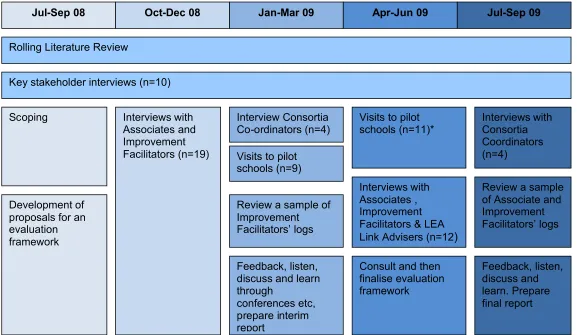
2.11 Figure 1 provides an overview of the different strands of the evaluation.
Figure 1. Overview of the Evaluation methodology Figure 1. Overview of the Evaluation
Jul-Sep 08 Oct-Dec 08 Jan-Mar 09 Apr-Jun 09 Jul-Sep 09
Rolling Literature Review
Key stakeholder interviews (n=10) Scoping
Development of proposals for an evaluation framework Interviews with Associates and Improvement Facilitators (n=19) Interview Consortia Co-ordinators (n=4) Visits to pilot
schools (n=9)
Review a sample of Improvement Facilitators’ logs
Feedback, listen, discuss and learn through
conferences etc, prepare interim report
Visits to pilot schools (n=11)*
Interviews with Associates , Improvement Facilitators & LEA Link Advisers (n=12)
Interviews with Consortia Coordinators (n=4)
Review a sample of Associate and Improvement Facilitators’ logs Feedback, listen, discuss and learn. Prepare final report Consult and then
finalise evaluation framework
3. THE DEVELOPMENT OF THE SEF PILOT IN SCHOOLS
3.1. In order to ‘raise the bar and narrow the gap’ the SEF aims to:
· align policies in support of improving outcomes for all children and
young people, through “tri-level reform”6and “systems thinking”7; and
· systemically apply evidence about school effectiveness, through the
identification of “the core themes”8 and “the elements” of an effective school9 and the development of a model to embed these within schools (WAG, 2008a).
3.2. These two high level aims were developed in phase one of the SEF
programme by different groups within the Welsh Assembly Government.
The first was led by the, then, Director for Department of Children,
Education, Lifelong Learning and Skills, Steve Marshall, working with
Michael Fullan; the second was developed by a team of three academics,
Professors David Egan, David Hopkins and David Reynolds. The work of
these two groups was brought together, along with the contributions of a
range of other stakeholders, by a group of five seconded Head Teachers
working with the SEF team within the Assembly Government, and the
School Effectiveness Framework: Building Effective Learning Communities Together, the so called “red book”, was published in 2008.
6In summary, a collaborative approach to policy development and implementation, working with
and through each of the three levels of the system: nationally, locally and at the level of individual learning settings.
7
In summary, the recognition that “schools do not exist in isolation”; that schools work within a local context that is always changing and in which the interactions between the different people and different institutions in this context (or system) shape policy implementation and outcomes for children and young people. Therefore for tri-level reform to work, different policies within and between each of these three levels must be aligned (pp. 6-7, WAG, 2008a).
8I.e. “Systems Thinking”, “Bilingualism”, “High Performance Culture”, “Equality” And “Supportive
and Interdependent” , which should inform work within each of the three levels (p. 12, Ibid)
9I.e. “Leadership”; “Working With Others”, “Networks Of Professional Practice”; “Intervention And
3.3. The ‘red book’ is visionary and complex. Interviewees praised its ambition,
and many were clearly enthused by its promise and the breadth of the
initial consultation was also praised. There was a broad consensus around
the need to raise the bar, narrow the gap and enhance children and young
people’s well-being. There was also broad support for the SEF’s approach
to addressing this challenge and there has been international interest in
the developments.
3.4. Alignment of the SEF with WAG objectives, values, initiatives and
policies: Although radical in their implications, both tri-level working and
systems thinking have clear roots in earlier strategies and practice.
Although not called “tri-level working”, the approach has clear antecedents
in the longstanding commitment of the Assembly government to work in
partnership with Local Authorities and schools, a commitment reflected in
strategies such as “Making the Connections” (WAG, 2006). As a
consequence, as one interviewee put it, describing tri-level working could
feel like “a statement of the obvious”. Nevertheless, we were told, “in
practice”, the Assembly Government, Local Authorities and schools were
not always fully aligned and there is a need to strengthen tri-level working.
Similarly, although not always described as “systems thinking”, the
concept has clear antecedents in the efforts made to ‘join up’ policy in
order to better meet the needs of children and young people. The
establishment of Children and Young People’s Partnerships offers a good
example of this type of thinking (WAG, 2004).
3.5. The second strand of the SEF, the “elements” and “themes”, are drawn
from the existing body of school improvement and school effectiveness
research, and are not in themselves particularly radical. Crucially,
however, the SEF offers a new framework to enable them to be more
of the aspirations of the Learning Country; Vision into Action10 (WAG, 2007) document. The Framework also emphasises the importance of
these elements to all schools, and not only to schools whose pupil
attainment is below average, reflected in the Assembly Government’s aim
of both raising the bar and narrowing the gap.
3.6. The SEF places children’s and young people’s well-being, alongside
learning, at the heart of the framework. Although the focus upon improving
learning outcomes is a longstanding commitment, the decision to place
well-being alongside it was judged by interviewees to represent an
important new emphasis upon schools’ role and purpose. A wide range of
factors influence children and young people’s well-being and its
prominence in the SEF helps stress schools’ responsibility to work with
others in order to promote children and young people’s well-being. This is
consistent with the Assembly Government’s overarching vision and
strategy for children and young people Rights to Action (WAG, 2004), but is a relatively new development for schools in Wales. Well-being has very
little prominence in the Learning Country: Vision into Action (WAG, 2007), and in the Guidance for Learning Pathways 14-19 (NAfW, 2006), although
it is a key element of the Foundation Phase Curriculum for 3-7 year olds
(WAG, 2008b).
3.7. The focus upon well-being also represents a subtle, but important
difference in emphasis to the focus upon rights and entitlements in the
Assembly Government’s strategy for children and young people, Rights into Action (WAG, 2004). A focus upon rights means focusing upon the conditions that enable children and young people to experience a ‘good
life’. It is useful for highlighting the areas where the state, and by
extension schools, can intervene to promote this. In contrast, a focus upon
10“There is a body of knowledge on how schools can transform themselves using the outcomes
well-being means focusing upon outcomes. Crucially, well-being as an
outcome is linked to, but is not synonymous with, access to rights and
entitlements. For example, children and young people may make choices
that damage their well-being and internal factors such as disposition and
temperament also influence well-being.
3.8. The ‘red book’ makes reference to rights and entitlements but the
discussion is largely restricted to core aim 2, that “children and young
people have the right to education, training and work experience” (p. 3,
WAG, 2008). Schools clearly have a central role here but schools can also
make an important contribution to the other six aims, and will need to do
so, if they are to promote children and young people’s well-being (see
boxed text).
The Seven Core Aim for Children and Young People
The seven core aims are based upon the UN Convention On The Rights
Of The Child and are the basis for all policy toward children and young
people in Wales. They are that children and young people:
· have a flying start in life and the best possible basis for their future growth and development;
· have access to a comprehensive range of education, training and learning opportunities, including acquisition of essential personal
and social skills;
· enjoy the best possible physical and mental, social and emotional health, including freedom from abuse, victimisation and
exploitation;
· have access to play, leisure, sporting and cultural activities;
· are listened to, treated with respect, and are able to have their
race and cultural identity recognised;
· have a safe home and a community that supports physical and emotional wellbeing; and
· are not disadvantaged by child poverty.
3.9. Overall therefore, at a strategic level, the SEF is aligned with the
Assembly Government’s values and objectives. Nevertheless, at an
operational level, as outlined in section 4, it has taken time to work out
how the SEF aligns with, for example, the Pedagogy initiative, existing
Local Authority school improvement and advisory services and local
planning structures, such as Children and Young People’s Partnerships.
This development of understanding, though, is part of the purpose of a
pilot, to provide the scope to work out the operational detail of how
different initiatives and areas of policy fit together in practice. As one
interviewee commented “this [the SEF] is a sophisticated piece of policy
and you would expect a pilot to throw up these sort of issues”.
3.10. Communicating the Vision: The ‘red book’ is a challenging agenda to
communicate because:
· The ideas and concepts used, such as “tri-level reform and systems
thinking”, are complex. This is not necessarily a bad thing, as one
interviewee forcefully argued, “yes it’s complex, we have to recognise this,
[and] not address it by simplifying things…complex problems need
complex solutions”; a position we agree with;
· The SEF is ambitious. It “is designed to bring together the range of
existing programmes of action directed at school improvement” and
provide “the vehicle for taking forward these commitments [to improving
outcomes for all learners], by aligning polices and their implementation”
the Assembly Government and beyond, meant the ‘red book’ addresses a
broad swathe of principles and policy for and about children and young
people; and
· There is a need to integrate the separate strands of work (i.e. tri-level
reform and systems thinking and the “elements” and “themes” (‘the pizza’)
which underpin the SEF, together with a range of other complementary
polices, such as the pedagogy initiative and the
improvement/accountability pilots in Local Authorities into a single
coherent vision.
3.11. The challenge of communicating the SEF vision was compounded by two
further factors. Firstly, a number of interviewees suggested, and we would
agree, that the final section, “Researching, Refining and Implementing the
Framework”, which includes details on the pilots (pp. 23-27, WAG, 2008a)
is probably the least developed section of the document. This meant that
those involved in the pilots were not always clear about how the vision
would be trialled through the pilots. Secondly, a number of interviewees,
and the schools we visited, reported that it was only as they began
working with and through the SEF process that they came to understand
it. As a consequence, many Associates, Improvement Facilitators and
pilot schools were initially not entirely clear what they were signing up to.
As one Head Teacher described, “at first, we didn’t really know what we
were doing”.
3.12. Generally, we found that the more involved people were in the process,
the greater their understanding of the SEF (as would be expected) and,
more importantly, the greater their support for the SEF vision (which could
not be taken for granted). This provides powerful testimony to the strength
of the SEF vision, but indicates a significant challenge in stimulating
commitment to it amongst stakeholders who are uninterested or even
amongst some ‘key stakeholders’, awareness and understanding of the
SEF was somewhat limited. Moreover amongst those schools who were
not involved, we found much lower levels of awareness and understanding
and in some Local Authority School Improvement services, the often
limited understanding of the SEF and of the pilot programme had fostered
some suspicion and mistrust about the SEF.
3.13. Some interviewees suggested that the scope for effectively
communicating the SEF vision has not yet been fully implemented. Most
notably:
· many of those who were initially involved in phase one, reported that
they were not involved as the SEF moved into phase two and
developments were, for a time, driven by a small team within the
Assembly Government;
· the involvement of individual representatives from particular sectors,
such as schools and Local Authorities, was seen by some as being
equated with participation of the whole sector, with the result that
insufficient effort was being devoted to engage other representatives
from each sector;
· the support of leaders of organisations was sometimes seen as being equated with support from the organisation they led, which was not
always the case (that is to say, the leaders might support the SEF, but
this did not necessarily mean that front line staff also understood and
supported the SEF); and
· a number of interviewees reported that the strong initial leadership of
the SEF weakened as a series of changes in the key personnel took
place, against the backdrop of wider reorganisation of the Department
of Children, Education and Lifelong Learning (DCELLs), with the
Teachers seconded to develop the SEF, and changes in the project
management of the SEF.
3.14. In considering these challenges, it is important to bear in mind that the
SEF was still in a pilot phase and although a communication strategy was
being developed, it had not been launched when the pilot projects were
started. Moreover, many interviewees stressed the commitment of the
Assembly Government SEF team throughout, in what they recognised had
been a challenging process. A number also highlighted the strengthening
of leadership in early 2009, citing the clear sponsorship from Professor
David Hawker, Director General of DCELLS, and strong leadership from
the re-structured DCELLS team in the Assembly Government in particular.
The new team made strenuous efforts to re-establish links with key
partners and the feedback we received in the summer of 2009 suggested
that good progress had been made in strengthening links between the
4. THE MANAGEMENT AND IMPLEMENTATION OF THE PILOTS
4.1. The Delivery Models: As outlined in the introduction, in order to test different models for delivery of the SEF in schools, it was envisaged that
two approaches would be trialled. The models would be trialled by
consortia of local authorities in the four Welsh regions.11 The first approach was devised by the WAG and based upon employing
headteachers and advisers as Associates and a second was to be
devised by consortia and use a different approach. In practice, three
consortia (North, South East and Central South Wales) opted to pilot an
Associate led model and only one consortium, swamwac, developed a
distinctive alternative approach based upon Improvement Facilitators.
4.2. The Assembly Government drew up the key policy documents for all four
Consortia (most notably, School Effectiveness Framework: Building Effective Learning Communities Together), tools (such as the School Effectiveness Profile and the School Effectiveness Data Packs); job specifications, and developed and delivered training for Associates and
Improvement Facilitators. Moreover, the Assembly Government drew up criteria for the recruitment of Pilot schools and Associates. Consortia were
asked to recruit pilot schools and Associates but within specified criteria
and it was reported by one Consortium Coordinator that the Assembly
Government initially indicated that the role of SEF Regional Coordinators
and the Consortia in the Associate model was primarily an administrative
one. Members of the SEF project team reported that the Coordinators’ and
Consortia’s roles were not intended to be administrative but it was clear
that there was some confusion about roles. As a result Local Authorities
11The South East Wales consortia includes the Local Education Authorities of Cardiff, Newport,
and SEF Coordinators in three of the four regions, Central South, South
East and North Wales, did not feel that the Consortia had shaped the
structure of the pilot project.
4.3. As the pilot progressed, the Coordinators in the North, South East and
Central South Wales Consortia and Regional Coordinators took a more
active role in developing the pilot. Consortia and Regional Coordinators
have responded to this in different ways. In South East Wales the
consortia has actively encouraged Associates to engage non-pilot schools
in networks (which in some cases are becoming professional learning
communities – PLCs) and has initiated dialogue between Local Authority
Advisers and Associates; In Central South, the Regional Coordinator
organised briefings for Local Authority Advisers and established meetings
and a website to enable Associates to share their experiences and
learning; and in North Wales the Coordinator has provided support for
Associates and coordinated links between schools, Local Authorities and
the Advisory services. In effect though, each has seen their role as
primarily facilitating and testing rather than developing or shaping a model.
4.4. In contrast, the establishment of the SEF model in South West and Mid Wales has been led by the Consortium, swamwac, and its two
Coordinators. This model shares the same aim, improving outcomes for
children and young people by systematically applying evidence about
school effectiveness. It also uses a broadly similar methodology, with
Head Teachers or an experienced school improvement professional
working with individual schools, fostering the development of networks of
schools and using the SEF tools, the six “elements of an effective school”
and the five “core themes” (commonly referred to as the ‘pizza’) and the
School Effectiveness Profile and some Improvement Facilitators have
attended the SEF training organised by the Assembly Government.
4.5. However, the model also has some important differences to the Associate
led model being piloted in the other consortia. The tools and materials
developed by the Assembly Government are supplemented, or sometimes
substituted, by training and detailed guidance developed by swamwac. In
many ways the approach is more structured, giving Improvement
Facilitators a stronger framework to work within12, but less discretion about how they work with schools. Moreover, the aim is that Improvement
Facilitators are required to work more closely with Local Authority Link
Advisers and spend less time with each school, whilst working with a
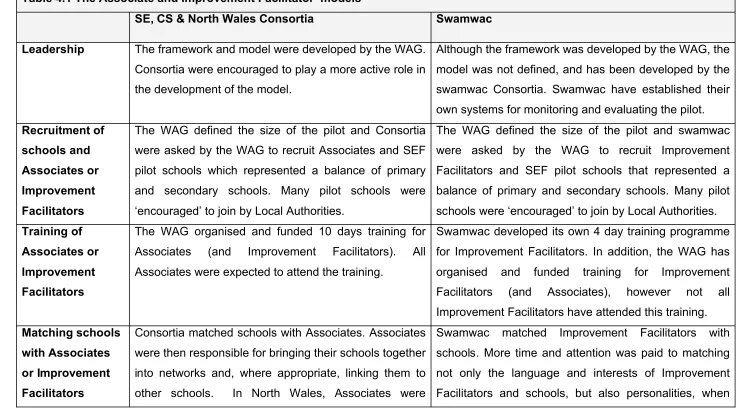
greater number of schools in total. Table 1. below illustrates some of the
main differences between the Associate and Improvement Facilitator
models.
12This is based around five phases: Understanding the School Context; Agreeing Themes for
Table 4.1 The Associate and Improvement Facilitator ‘models’
SE, CS & North Wales Consortia Swamwac
Leadership The framework and model were developed by the WAG.
Consortia were encouraged to play a more active role in
the development of the model.
Although the framework was developed by the WAG, the
model was not defined, and has been developed by the
swamwac Consortia. Swamwac have established their
own systems for monitoring and evaluating the pilot.
Recruitment of
schools and
Associates or
Improvement
Facilitators
The WAG defined the size of the pilot and Consortia
were asked by the WAG to recruit Associates and SEF
pilot schools which represented a balance of primary
and secondary schools. Many pilot schools were
‘encouraged’ to join by Local Authorities.
The WAG defined the size of the pilot and swamwac
were asked by the WAG to recruit Improvement
Facilitators and SEF pilot schools that represented a
balance of primary and secondary schools. Many pilot
schools were ‘encouraged’ to join by Local Authorities.
Training of
Associates or
Improvement
Facilitators
The WAG organised and funded 10 days training for
Associates (and Improvement Facilitators). All
Associates were expected to attend the training.
Swamwac developed its own 4 day training programme
for Improvement Facilitators. In addition, the WAG has
organised and funded training for Improvement
Facilitators (and Associates), however not all
Improvement Facilitators have attended this training.
Matching schools
with Associates
or Improvement
Facilitators
Consortia matched schools with Associates. Associates
were then responsible for bringing their schools together
into networks and, where appropriate, linking them to
other schools. In North Wales, Associates were
Swamwac matched Improvement Facilitators with
schools. More time and attention was paid to matching
not only the language and interests of Improvement
instructed not to involve non-pilot schools in the
networks.
compared to the other Consortia. Pilot schools were
organised into thematic networks and a notional £5k
was devolved to each cluster of schools.
Process Associates and pilot schools have considerable
discretion about how to proceed and the process has
consequently been jointly negotiated, with Associates
taking on different types of role with different schools
(see paragraphs 4.14-4.16).
Improvement Facilitators and pilot schools are expected
to work through a five step process (understanding the
school context; agreeing themes for improvement and
barriers to effectiveness; action planning;
implementation; and review and planning for
sustainability).
Intensity of
support
Associates work with between 4 to 10 schools and can
spend up to 25% of their time working with these
schools and training (about 50 days)
Improvement Facilitators work with between 1 and 3
schools and are allocated 6 days per school (together
with up to 7 days training)
Relationship to
Link Advisers
Associates and pilot schools have considerable
discretion about the extent to which LA Advisers are involved in the process. In most cases informal links
have been established and is some cases Advisers
attend meetings.
Improvement Facilitators are expected to contact LA
Link Advisers to discuss the school and the support they provide early in phase one. Advisers may choose to
share additional information with Improvement
Facilitators and are asked to liase with Head Teachers
to avoid any risk of duplication of their work with that of Improvement Facilitators. Advisers’ involvement in
Development &
quality assurance
Associates are expected to attend training and submit
logs to their Consortia. However, the capacity of the
SEF team within the WAG to scrutinise Logs is limited.
Consortia have established networks of Associates to
enable them to share experiences, but are not actively
monitoring the quality of their work.
Improvement Facilitators are required to attend training
and submit logs to swamwac. Logs were closely
scrutinised and if considered unsatisfactory, payment
could be withheld. Improvement Facilitators were
required to work to a code of conduct and arrangements
made to observe (and monitor) the work of Improvement
4.6. The Recruitment of Associates and Improvement Facilitators: A number of interviewees highlighted problems in recruiting sufficient
numbers of people with the skills and experience needed and as we
outline further below there were some concerns over the skills, experience
and approach of a minority of Associates and Improvement Facilitators.
The role, as conceived for the pilots, was a challenging one that demands
knowledge and experience of work in schools13, analytical skills, a strong understanding of and commitment to SEF and a range of social and
emotional skills, such as self-efficacy (or self-belief), empathy and the
ability to manage relationships effectively. These social and emotional
skills are difficult to formally ‘train’ people in, but can be nurtured over time
(Goleman, 1995). This suggests that it is very important that Associates
and Improvement Facilitators already have many of these skills but also
that training is geared to helping them understand, refine and develop
their skills.
4.7. Associates were asked to provide up to 50 days during the school year for
their work on SEF, Improvement Facilitators up to 20 days. In South East
and Central South Wales, the plan was to have 6 Associates working with
24 schools in each consortium and in North Wales, there were 8
Associates, working with 24 schools. In swamwac 16 Improvement
Facilitators worked with 28 schools. Associates and Improvement
Facilitators applied for the role and went through a selection process.
4.8. The problems the pilot experienced in recruiting Associates and
Improvement Facilitators may have reflected the level of understanding of
the SEF (outlined in section three) and the concerns, reported by many
Associates and Improvement Facilitators, of School Governing bodies
13Different types of role involving, for example, a professional without knowledge and experience
about the amount of time that they would need to spend out of school. It
was reported that their ability to take on this role depended upon their own
success in establishing distributed leadership within their own schools.
4.9. Training and development opportunities that have been provided to the Associates and Improvement Facilitators: Both Associates and Improvement Facilitators praised elements of the training they had been
provided with, but were critical of other elements. There was some
variation about which elements Associates and Improvement Facilitators
praised and which they criticised. For example, whilst many highlighted
the value of the training provided by the Hay group, a minority were critical
of it or said that they had already done this course and so found it
repetitive. In general, Improvement Facilitators praised the training
provided by swamwac, and the level of detail and guidance offered by the
Handbooks that swamwac had prepared. In contrast, a number of
Associates were critical of training provided by the WAG, reporting that
elements of it were not sufficiently tailored to the SEF. A vocal minority
expressed the view that elements were patronising. There appeared to be
some evidence of a misunderstanding of the Associate and Improvement
Facilitator role within the Assembly Government, because some training
sessions were used to disseminate Assembly Government policy
developments, an approach seen as more appropriately targeted at
Advisers whose role includes supporting schools to comply with national
and local policy.
4.10. Responses to the training appeared to depend, in part, upon Associates’
and Improvement Facilitators’ prior experience and their feedback may
highlight the challenge of providing a generic training programme to
learners whose skills, knowledge and experience vary. There was
in-depth knowledge of the School Effectiveness Framework, exploring the
role of the School Effectiveness Profile; and developing facilitation skills.
4.11. A number of Associates reported that the training had not clarified their
role. There was also reported to have been “mixed messages” most
notably over the use of data by Associates and Improvement Facilitators.
Even where they were not initially clear about the role, all reported that
they were able to develop a good understanding through their work.
However, there was a view amongst some stakeholders we interviewed
that a lack of real understanding of the role meant that some Associates
and Improvement Facilitators fell back on existing roles that they were
familiar with, such as that of adviser, and were too reliant upon tools such
as the School Effectiveness Profile, limiting their effectiveness.
4.12. Both Associates and Improvement Facilitators highlighted the networking
opportunities that training offered as a key strength. There are regular
meetings of Associates and Improvement Facilitators within their
consortium area. These were held as frequently as once a month in some
areas, but geography was identified as a barrier to meeting in other areas,
because it creates the need to travel long distances.
4.13. Differences in Approach: Table 4.1 illustrates some of the variations in the way Associates and Improvement Facilitators worked. Although
Associates had greater discretion than Improvement Facilitators, there was still reported to be considerable variation in the way Improvement
Facilitators operate. This was attributed to differences in the preferences,
skills, knowledge, experience and confidence of individual Associates and
Improvement Facilitators and pilot schools and cultural differences
between primary and secondary schools. The main differences that were
· The relationship between Associates or Improvement Facilitators and
Head Teachers;
· The people they worked with within schools; and
· The way that the networks of schools they established operated.
4.14. The relationship between Associates or Improvement Facilitators and Head Teachers: the descriptions given by Associates and Improvement Facilitators of their relationships with pilot school Head Teachers
suggested three broad models. The first was that of mentor/mentee, with
Associates and Improvement Facilitators taking on the coaching role of a
more experienced professional supporting, for example, an inexperienced
Head Teacher who might lack confidence. In the second model,
Associates or Improvement Facilitators adopted a problem-solving role
that could be characterised as a quasi-advisory role. The third was
characterised in terms of “peer” or “professional” support and challenge, in
which Associates or Improvement Facilitators and Head Teachers met as
equals and took more of a critical friend role by, for example, helping a colleague stand back from, and reflect on, their work. Some Associates
and Improvement Facilitators reported that they took on different roles with
different schools so that in one setting they were operating as a coach and
in another as critical friend. Despite the differences, all were agreed that the key characteristic of the relationship was that it was based on the
school’s agenda.
4.15. The depth of engagement with schools: Some Improvement Facilitators and Associates reported working only with a pilot school’s Head Teacher,
whilst others were seeking to engage a number of different members of a
pilot schools’ senior management team. Some also reported on work with
governors and children and young people including a pupil learning
community that had been developed and bi-lateral pupil visits. Although
with other teachers in many of the pilot schools we visited, teachers were
actively involved in working through the SEP and in the networks that
Associates or Improvement Facilitators had helped establish.
4.16. Networks and professional learning communities: Both Associates and Improvement Facilitators established networks of pilot (and
occasionally non-pilot) schools and most involved their own schools in
these networks. It was intended that these Networks would become
professional learning communities (PLCs) (see boxed text) (Stoll, et al,
2004 and the edited collection by Stoll & Louis, 2007) and by the end of
the pilot some were reported to have done so. In the swamwac area a
distinction has been made between intra-school Professional Learning
Communities and inter-school Network Learning Communities.
Professional Learning Communities
In their discussion of PLCs, Louise Stoll and others describe them as an
“inclusive group of people, motivated by a shared learning vision, who
support and work with each other, finding ways, inside and outside their
immediate community, to enquire on their practice and together learn
new and better approaches that will enhance all pupils’ learning”. They go on to identify eight key characteristics that define PLCs.
· “Shared values and vision”;
· “Collective responsibility for pupils’ learning”;
· “Collaboration focused on learning”;
· “Group as well as individual professional learning”;
· “Reflective professional enquiry”;
· “Openness, networks and partnerships”;
· “Inclusive membership”; and
(italics omitted, p. 1, Stoll, et al, 2006)
4.17. Although all the pilot schools we spoke to were already sharing ideas and
information with other schools, through fora such as school cluster
meetings and training sessions run by Advisory services and through
relationships between Head Teachers, most have responded very
positively to the new networks that Associates and Improvement
Facilitators have established. They reported that opportunities to “share
ideas and information” with other schools was one of the key strengths of
the SEF Pilots. In particular, the networks were reported to have
expanded the number of schools they were in contact with and, critically,
linked them to schools in other counties. This not only gave them access
to new ideas and approaches, some pilot schools also reported that it
gave them opportunities to expose their teachers to new ways of working,
helping cultivate their support for change.
4.18. Schools, Associates and Improvement Facilitators agreed that the
cross-county dimension to the SEF and the networks of schools they worked
with was a key strength. Schools reported that they rarely had
opportunities to work with schools in other counties and the networks
brought together schools which did not feel in competition with each other.
This, combined with Associates’ or Improvement Facilitators’ freedom
from holding schools to account, meant that some Head Teachers said
they felt able to discuss problems more openly than they were comfortable
doing with other school improvement partners such as LA Link Advisers
and Estyn. The extent to which they saw this as a different way of working varied according to the school and Head Teacher’s own level of
awareness of the SEF.
4.19. Although positive overall about the new networks, some problems were
have dropped out of networks because they felt they were not addressing
their needs. The importance of effective facilitation within the Networks
was identified, and it was pointed our that the skills needed to keep a
Network operating well were not the same as those needed for working
with individual schools. A number of pilot schools we visited reported that
they were already in contact or working with most of the schools in their
networks, limiting the added value. Some questioned what they could
learn from schools in very different circumstances. For example there
were schools serving disadvantaged areas that were most interested in
learning from other schools in similarly disadvantaged areas. The practical
problems of finding times when everyone could meet and the distances
between schools (and consequent long travel times), particularly in rural
areas, were also highlighted.
4.20. The accounts given by pilot schools of the networks that have developed
suggest that many are focused upon sharing ideas and good practice
rather than operating as true “professional learning communities”
developing, for example, “shared values and vision”; “collective
responsibility for pupils learning”; and “group as well as individual
professional learning”; (Stoll, et al, 2004). This is likely to have limited their
impact to date, because rather than focusing upon changing the
fundamentals, what David Hopkins has called the “key drivers of change”,
they have focused upon what might regarded as more superficial
solutions14 (p. 6. Hopkins, 1995). Interviewees confirmed this, questioning how “deep” the networks had gone in addressing
effectiveness. In contrast, there is some evidence that the networks that
have developed and been consolidated within schools, may come closer
to becoming true PLCs.
14This analysis has parallels to David Hopkins’s distinction between the adoption of “tactics”,
4.21. The initial networks between schools have provided a good starting point
and many have decided to go on meeting after the pilot project has ended.
They have build trust and relationships between schools, enabled schools
to secure some ‘quick wins’ and they exhibit some of the characteristics of
PLCs, such as openness, reflective professional enquiry and mutual trust,
respect and support. If they develop into true professional learning
communities, the way in which they work and their membership may need
to change as multiple, often overlapping, communities develop around
particular issues. They may need to involve different school leaders and
teachers and bring in new schools and new partners that may not be part
of the pilot.
4.22. The focus upon sharing good practice may help explain why some schools
saw limited value in working with schools with very different characteristics
to their own. If the aim were to simply ‘borrow’ models and ways of
working, there would be a clear logic in working with schools in
comparable contexts. In contrast when the aim is to encourage and
enable deeper reflective learning, there is strong case for working with
schools operating in different contexts and in different ways so that
different approaches can be explored.
4.23. The roles played by Associates and Improvement Facilitators: Despite the differences in emphasis and approach outlined above,
Associates and Improvement Facilitators described their roles in similar
ways. They were clear that it complemented the work of LA Link Advisers
and Estyn and, although acknowledging that there were some areas of
potential overlap most notably in data analysis15, also clearly identified
change is happening and understand the reasons why and are abele to sustain positive change in the medium an long term” (p. 145, Hopkins, 2007).
15This reflects the acknowledged expertise of Local Authorities in analysing school and pupil
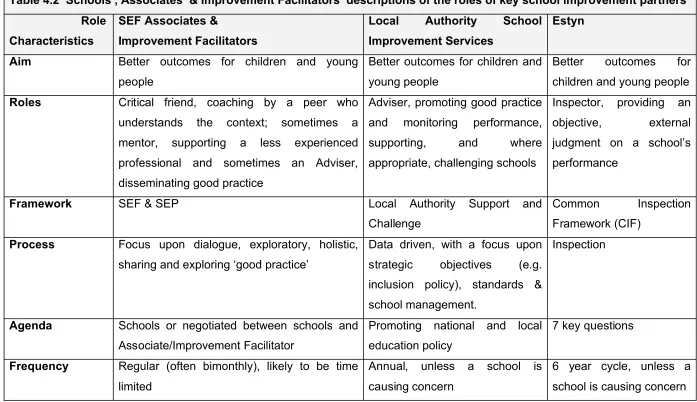
differences. Table 4.2 provides a summary of the descriptions provided
by schools, Associates and Improvement Facilitators of the key
characteristics of the work of SEF Associates & Improvement Facilitators,
LA Link Advisers and Estyn.
4.24. Introduction to Table 4.2.The Table is descriptive rather than normative, that is to say it describes how schools, Associates and Improvement
Facilitators see the characteristics, rather than how they think they should
be. The table is also selective as it is only based upon the views of a
sample of SEF schools, Associates and Improvement Facilitators and it
does not describe the role of other important school improvement partners
such as those involved in performance management.
4.25. We have discussed the table with some of the other stakeholders we
interviewed. Some elements of the description of Estyn’s characteristics
were strongly disputed by interviewees from Estyn, with particular
concerns voiced about the impression given by the table that their role
was simply one of making judgments, what might be thought of as an
accountability function. Estyn interviewees highlighted what they saw as
their complementary roles sharing good practice, developing practice in
school and building capacity, suggesting that their role was in many ways
much closer to that of Associates and Improvement Facilitators. The
current proposals for a new inspection framework (Estyn, 2010), which
includes a greater use of peer assessors, self-evaluation and follow up
activity are likely to further blur the boundaries.
4.26. Moreover, feedback from LA Advisers suggests a concern that the work of
Associate or Improvement Facilitators overlaps with theirs, and could
duplicate or even undermine their role. Some were reported to feel in the
dark or excluded from the SEF programme, creating suspicion of a ‘hidden