Materials Science and Engineering Publications
Materials Science and Engineering
1-1999
A high specific strength, deformation-processed
scandium-titanium composite
Alan M. Russell
Iowa State University, [email protected]
Y. Tian
U.S. Steel Company
J. D. Rose
U.S. Steel CompanyT. W. Ellis
Kulicke & Soffa Industries, Inc.
L. Scott Chumbley
Iowa State University, [email protected]
Follow this and additional works at:
http://lib.dr.iastate.edu/mse_pubs
Part of the
Metallurgy Commons
The complete bibliographic information for this item can be found at
http://lib.dr.iastate.edu/
mse_pubs/123
. For information on how to cite this item, please visit
http://lib.dr.iastate.edu/
howtocite.html
.
A high specific strength, deformation-processed scandium-titanium
composite
Abstract
A 59% Sc–41% Ti deformation-processed metal-metal composite was produced by rolling to a true strain of 2.3 at 873 K followed by cold rolling to a total true strain of 3.6. Rolling reduced the original eutectoid microstructure to lamellae of α–Sc and α–Ti with average lamellar thicknesses of 150 nm (Sc) and 120 nm (Ti). The cold-rolled material had an ultimate tensile strength of 942 MPa and a specific strength of 259 J/g. The Sc matrix was oriented with the 〈0001〉 tilted 22° from the sheet normal direction toward the rolling direction, an unusual texture for an HCP metal with a lowc/aratio, which suggests Sc may deform primarily by basal slip.
Keywords
Ames Laboratory
Disciplines
Metallurgy
Comments
This article is fromJournal of Materials Research14 (1999): 8-11,doi: 10.1557/JMR.1999.0003. Posted with permission.
A high specific strength, deformation-processed
scandium-titanium composite
A. M. Russell and Y. Tian
Ames Laboratory, Iowa State University, Ames, Iowa 50011
J. D. Rose
U.S. Steel Company, Gary, Indiana 46402
T. W. Ellis
Kulicke & Soffa Industries, Inc., Willow Grove, Pennsylvania 19090
L. S. Chumbley
Ames Laboratory, Iowa State University, Ames, Iowa 50011
(Received 3 June 1998; accepted 20 August 1998)
A 59% Sc – 41% Ti deformation-processed metal-metal composite was produced by rolling to a true strain of 2.3 at 873 K followed by cold rolling to a total true strain of 3.6. Rolling reduced the original eutectoid microstructure to lamellae ofa–Sc anda– Ti with average lamellar thicknesses of 150 nm (Sc) and 120 nm (Ti). The cold-rolled material had an ultimate tensile strength of 942 MPa and a specific strength of 259 Jyg. The Sc matrix was oriented with the k0001ltilted 22±from the sheet normal direction toward the rolling direction, an unusual texture for an HCP metal with a low cyaratio, which suggests Sc may deform primarily by basal slip.
The light metals Al, Mg, and Ti have seen large-scale industrial use for decades, especially in applications where high specific strengths are required. The light metal Sc has received far less research and develop-ment attention, even though Sc has a density of only 2990 kgym3 and a melting temperature as high as that of Fe. The primary impediments to greater use of Sc are its high cost and the lack of Sc alloy development work. The high cost of metallic Sc is not a result of inherent scarcity, but results from processing difficulties and lack of demand. In fact, commonly used elements such as Ta, Mo, and W are all considerably scarcer in the earth’s crust than Sc.1
Research in Sc mechanical metallurgy began nearly 40 years ago,2– 6 but has received only limited attention during the ensuing years. In this project, a Sc – Ti defor-mation processed metal metal composite (DMMC) was produced in an attempt to expand the limited knowledge base of Sc mechanical metallurgy. The authors believe this study is the first attempt to produce a high strength alloy or composite with a Sc matrix.
Previous studies of DMMC’s have shown anoma-lous strengthening in fcc matrix materials such as Cu7–11 and Al.12,13Work in HCP matrix DMMC’s14,15has been more limited, but suggests that the ability of HCP metals to be axisymmetrically deformed to large true strains is limited by their tendency to assume texture orientations that permit only plane strain. Texture-induced plane straining would not necessarily be a limitation for rolled DMMC’s, and one of the motivations for this study was
to determine if anomalously high strengths would result from extensive deformation processing by rolling a two-phase Sc – Ti DMMC. The preferred orientation of rolled Sc has not been reported in the literature. Based on the elements’cyaratios, one might suppose that Sc (cya 1.594) would deform similarly to Ti (cya 1.587) and Y (cya1.571): primary slip on theh1010j k1120land secondary slip on the s0002d k1120l.16,17
The Sc– Ti specimen was produced by arc-melting 21.0 g Ti and 19.7 g Sc into a finger of approximate diameter 12 mm and length 100 mm. The specimen’s density was 3640 kgym3 (measured by immersion). This composition is 59 vol % Sc –41 vol % Ti. The Sc used had a metals-basis purity of 99.97% plus 48 wt. ppm O, 21 wt. ppm F, and 24 wt. ppm C. The Ti used had a metals basis purity of 99.99% plus 223 wt. ppm O, 16 wt. ppm N, and 27 wt. ppm C. A small coupon was cut from this specimen for metallography, and the remaining portion was wrapped in Ta foil and electron beam welded shut in vacuo in a 48 mm diameter, 150 mm long steel can to protect it from atmospheric contamination during hot rolling. The canned specimen was heated for 2 h in a furnace at 873 K and rolled with a 2.5 mm reduction in thickness on each pass with a 15 min reheat between passes. Rolling continued until the can-specimen assembly was 4.8 mm thick, at which point the steel was milled from the specimen. The Sc–Ti specimen had a thickness of 1.27 mm after rolling, a reduction from the original diameter of 12 mm corresponding to a true strain (h) of 2.3 when shape
8 J. Mater. Res., Vol. 14, No. 1, Jan 1999 1999 Materials Research Society
Journal of
Communications
factors are considered. Effective true strain (h) for all rolling deformation described in this project was calculated using the relation between initial thickness (t0) and final thickness (tf):
h
√ 2 p
3 !
ln √
t0
tf
! .
A portion of thish 2.3material was reduced by cold rolling to 0.41 mm thickness (an additional true strain of 1.3 for a totalh 3.6) with 10% reduction per pass at room temperature. The remainder of theh 2.3 material (18.3 g) was cut into 10 pieces, wire-brushed to clean the surfaces, and stacked 10-high inside an Inconel tube backfilled with Ar. This stacked assembly was then rolled at 873 K to h 4.2. It was intended that these ten pieces would roll bond into a single piece; however, the final product was incompletely bonded in places.
[image:4.612.312.549.258.442.2]Although the small size of the initial sample pre-cluded tensile testing ath 0, tensile specimens of the deformation processed materials at h 2.3, h 3.6, andh 4.2 were cut to the proportions of the ASTM standard rectangular (flat) uniaxial tensile specimen di-mensions. Each specimen was cut with the tensile axis parallel to the rolling direction. The limited amount of material available required that the specimens be smaller than the ASTM standard size18; gauge lengths varied be-tween 10 and 12 mm with other dimensions proportioned accordingly. Tests were performed at room temperature with a strain rate of 0.025 min21. The incompletely bonded material at h 4.2 did not provide reliable tensile specimens. Tensile test results are summarized in Table I. By comparison, the maximum specific strength attainable in Ti–6Al–4V (in the solutionized 1 aged condition) is typically about 265 Jyg with 25% reduction in area ductility.19 The strongest commercially available precipitation hardening Al alloys have similar specific strengths.
The Sc –Ti equilibrium phase diagram indicates a monotectoid reaction followed by a eutectoid reaction as this composition cools.20 SEM examination of the specimen at various levels of deformation processing showed that the initial, rapidly solidified eutectoid
micro-TABLE I. Tensile testing results for 59Sc – 41Ti deformation pro-cessed composite.
Mean
ultimate Mean Mean tensile specific ductility, Specimen history strength strength reduction (htrue strain) (MPa) (Jyg) in area
Hot rolled at 873 K toh2.3 758 208 16% Hot rolled at 873 K toh2.3, 942 259 10%
then rolled at 300 K toh3.6
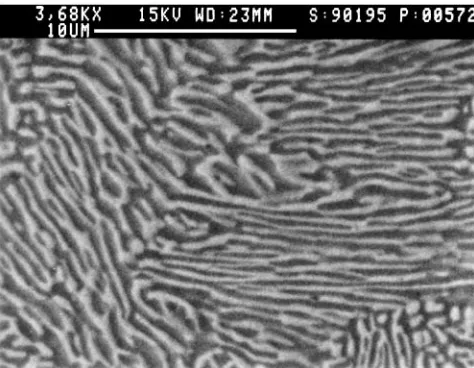
[image:4.612.311.550.497.682.2]structure was reduced in scale to a finer lamellar structure (Figs. 1 and 2) as deformation progressed. In DMMC’s deformation processed by cold work, the reduction in microstructure phase thickness is usually approximately proportional to the change in macroscopic specimen thickness.21 In this study prolonged exposure to 873 K during hot rolling apparently caused coarsening of the phase structure at the same time the deformation was reducing the phases’ thicknesses. These two effects seem to have worked at cross purposes, yielding a rather modest net reduction of phase thickness (Fig. 3) from the hot work between h 0 and 2.3. Similar behavior has been observed in other DMMC’s that were either hot worked or annealed after cold work.14,22–24 The
[image:4.612.56.291.632.730.2]FIG. 1. Backscattered electron SEM image of the rapidly solidified eutectoid microstructure of as-cast 59Sc-41Ti specimen (unetched). Ti is light gray; Sc is dark gray.
FIG. 2. Backscattered electron image of the 59Sc-41Ti specimen (unetched) after rolling at 873 K toh2.3. Ti is light gray; Sc is dark gray. This cross section was cut showing the sample as viewed along the rolling direction.
Communications
FIG. 3. Relation between phase size and deformation processed true strain. Open circles are Sc mean phase thickness; closed symbols are Ti mean phase thickness. Error bars indicate6one standard deviation from the mean value.
solid solubility of Ti in a– Sc and of Sc in a–Ti is approximately 2% at 873 K.20 Although the diffusion coefficients for Sc diffusing in Ti and vice versa are unknown, this degree of solubility probably makes the Sc–Ti system somewhat vulnerable to rapid coarsening at elevated temperature, since both phase boundary dif-fusion and bulk difdif-fusion could contribute to transport. With finer phase sizes, boundary diffusion would be expected to dominate the process. This outcome is unfortunate because it prevents development of phase sizes small enough to produce the exceptionally high strengths observed in other DMMC’s when the phase thickness is smaller than 100 nm. It may be possible in future studies to suppress this coarsening tendency by hot working at a somewhat lower temperature; however, both pure Ti and pure Sc have ductility minima that might cause cracking during rolling near 700 K.25
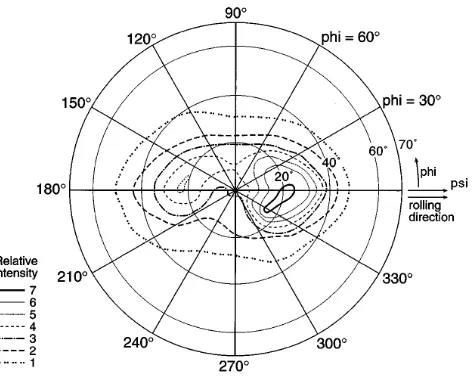
An x-ray texture specimen (8 mm square) was taken from the h 4.2 material. X-ray texture data acquisition and analysis were performed with a Philips APD1700 automated powder diffraction system texture goniometer and unfiltered Cu x-rays. The specimen was positioned with the sheet’s rolling direction parallel to the f 0± rotation direction. The specimen was electropolished in a perchloric acid-methanol solution at 210 K to remove approximately 25mm of surface material. Measurements were made over the range 0±< w <70±. The Sc (0002) pole figure shown in Fig. 4 indicates that the Sck0001ltends to cluster around a direction tilted 22±from the sheet normal toward the rolling direction.
[image:5.612.53.295.77.237.2]The primary and secondary slip systems of Sc are unknown, and this study was not designed to determine them. However, the preferred orientation of the Sc(0002) indicated in Fig. 4 suggests that the primary slip system in Sc at 873 K may be thes0002d k1120l. Rolled Cd and
FIG. 4. Pole figure for the (0002) plane of the Sc phase rolled at 873 K to h4.2.
Zn acquire the same texture as that shown in Fig. 4, the (0002) basal plane tilted 20± to 25±toward the rolling direction. Cd and Zn have high cya ratios (1.886 and 1.856, respectively), and with one special exception26 their only active slip system is the s0002d k1120l. This differs from the primary slip system in HCP metals with cyaratios below the “ideal” value of 1.632. In Ti (cya 1.587), the primary slip system is the h1010j k1120l with secondary slip occurring on the s0002d k1120l. In Zr (cya 1.590), the primary slip system is also the
h1010j k1120l, and basal slip has never been observed. Thus, one typically sees highcyaratio HCP metals slip on the s0002d k1120l system and low cya ratio HCP metals slip on theh1010j k1120l. Ti, Zr, and Be (cya 1.586) all acquire a rolling texture with the k0001l tilted 20±to 40±toward the transverse directions.27 The Sc(0002) pole figure in Fig. 4 has the appearance one would associate with a high cyaratio metal slipping on the s0002d k1120l, which is somewhat unusual in light of the low Sc cya ratio.
Schmid’s relation for resolved shear stress is:
tR scosfcosl,
where
tR resolved shear stress on the slip plane in the slip direction
s applied stress
f angle between the slip plane normal and the applied stress
langle between the slip direction and the applied stress
On a Sc (0002) tilted 22±from the sheet plane,lmust be greater than or equal to 68±; withlequaling 68±(the
Communications
complement of 22±) when the slip direction is parallel to the rolling direction. Schmid’s relation predicts a resolved shear stress factor on the (0002) of 0.35swhen thek1120lslip direction is oriented at the optimal value of l68±. A factor of 0.35s is relatively favorable for slip, the maximum possible factor being 0.50s. This same 22± tilt of the (0002) with k1120l parallel to the rolling direction yields a largest possible resolved shear stress on the h1010j first-order prism planes of only 0.12s, a considerably less favorable resolved shear stress for slip.
The foregoing observations are certainly not conclu-sive evidence that the primary slip system of Sc is the
s0002d k1120l. Rolling texture is an imperfect indicator of the primary slip system, and the Sc phase in this composite presumably contains as much as 2% Ti in solid solution, which could affect the critical resolved shear stress for the Sc slip systems. Nevertheless, it raises the intriguing possibility that Sc may not behave according to the established precept for slip systems in HCP metals with low cya ratios.
This preliminary study suggests two new research efforts for future work. The first is an engineering-oriented project to continue the development of nano-scale Sc DMMC’s. The specific strength of 259 Jyg observed in this study is similar to the specific strengths of the best commercially available Al and Ti alloys, a surprisingly high value for this first, small-scale attempt to strengthen Sc. This observation is all the more in-triguing when one notes that the highest strengths for DMMC’s are seen when the phase thicknesses are smal-ler than 100 nm, and the phase thickness in this mate-rial was coarser than 100 nm. A rolling temperature lower than the 873 K used here may reduce the diffusion-driven coarsening effects seen in these speci-mens and allow production of smaller phase thicknesses that might possess still higher strengths. Alternatively, second phase metals other than Ti possessing lower solid solubility in Sc (e.g., Nb or Ta) might prove more resistant to coarsening, although their higher densities would reduce specific strength.
From a scientific perspective, a study to determine the active slip system(s) in single-crystal Sc might reveal whether the primary slip system in Sc actually is the
s0002d k1120l, as the texture in this specimen seems to suggest. Such a finding could add a useful new perspective on fundamental deformation processes in HCP metals.
ACKNOWLEDGMENTS
The authors are grateful to L. Jones, F. Laabs, L. Lincoln, T. Lund, H. Sailsbury, J. Wheelock, P. Wheelock, and K. Xu all of Ames Laboratory for their valuable discussions and for preparing and examining the
materials used in this study. This work was performed at Ames Laboratory, operated for the U.S. Department of Energy by Iowa State University under Contract No. W-7405-ENG-82.
REFERENCES
1. Thermochemical and Physical Properties, Version 2.0 (E S Microware, Hamilton, OH, 1994).
2. D. Geiselman, J. Less Common Metals 4, 362 (1986).
3. E. M. Savitskiy, V. F. Terekhova, and O. P. Naumkin, Usp. Fiz. Nauk 79, 263 (1963) [Sov. Phys. Usp. 6, 123 (1963)].
4. E. M. Savitskiy, Redkie Metally i Splavy (Rare Metals and Alloys) (Dom Tekhniki, Moscow, 1959), p. 19.
5. L. D. Sokolov, V. M. Solenov, V. A. Skudnov, and A. N. Glad-kikh, Izv. Akad. Nauk SSSR. Metal. 2, 181 (1970) [Russ. Met.
2, 106 (1970)].
6. M. P. Zalesky, M. S. Thesis, Iowa State University, Ames, IA (1980).
7. J. Bevk, J. P. Harbison, and J. L. Bell, J. Appl. Phys. 49 (12), 6031 (1978).
8. J. D. Verhoeven, F. A. Schmidt, E. D. Gibson, and W. A. Spitzig, J. Metals 38 (9), 20 (1978).
9. J. D. Verhoeven, W. A. Spitzig, L. L. Jones, H. L. Downing, C. L. Trybus, E. D. Gibson, L. S. Chumbley, L. G. Fritzmeier, and G. D. Schnittgrund, J. Mater. Eng. 12 (2), 124 (1990).
10. W. A. Spitzig and P. D. Krotz, Acta Metall. 36 (7), 1709 (1988). 11. J. D. Verhoeven, W. A. Spitzig, F. A. Schmidt, and C. L. Trybus,
Mater. Manufacturing Processes 4 (2), 197 (1989).
12. C. L. H. Thieme, S. Pourrahimi, and S. Foner, Scripta Metall. Mater. 28, 913 (1993).
13. A. M. Russell, T. Lund, L. S. Chumbley, F. C. Laabs, L. L. Keehner, and J. L. Harringa, Composites: Part A (in press). 14. A. M. Russell, L. S. Chumbley, T. W. Ellis, F. C. Laabs, B. Norris,
and G. E. Donizetti, J. Mater. Sci. 30, 4249 (1995).
15. J. A. Jensen, A. M. Russell, T. W. Ellis, and L. S. Chumbley, in Trace & Reactive Metals: Processing and Technology, edited by R. G. Reddy and B. Mishra (TMS Publications, Warrendale, PA, 1995), p. 508.
16. E. A. Anderson, D. C. Jillson, and S. R. Dunbar, J. Metals Trans AIME 197, 1191 (1953).
17. T. E. Scott, in Handbook on the Physics and Chemistry of the Rare Earths: Volume 1 — Metals, edited by K. A. Gschneidner, Jr. and L. R. Eyring (North-Holland Publishing, Amsterdam, 1978), p. 608.
18. B. W. Christ, ASM Metals Handbook, Vol. 8 (ASM INTERNA-TIONAL, Materials Park, OH, 1988), p. 28.
19. M. J. Donachie, Titanium: A Technical Guide (ASM INTERNA-TIONAL, Materials Park, OH, 1988), p. 450.
20. B. J. Beaudry and A. H. Daane, Trans. AIME 224, 770 (1962). 21. C. A. Trybus, Ph.D. dissertation, Iowa State University, Ames,
IA (1988).
22. J. C. Malzahn Kampe, T. H. Courtney, and Y. Leng, Acta Metall.
37 (7), 1735 – 1745 (1989).
23. T. H. Courtney and J. C. Malzahn Kampe, Acta Metall. 37 (7), 1747 (1989).
24. D. G. Morris and M. A. Morris, Acta Metall. Mater. 39 (8), 1763 (1991).
25. T. E. Scott, op. cit., p. 621.
26. R. L. Bell and R. W. Cahn, Proc. R. Soc. A239, 494 (1957). 27. G. Y. Chin, ASM Metals Handbook, Vol. 8 (ASM
INTERNA-TIONAL, Materials Park, OH, 1985), p. 229.