University of Warwick institutional repository: http://go.warwick.ac.uk/wrap
A Thesis Submitted for the Degree of PhD at the University of Warwick
http://go.warwick.ac.uk/wrap/1296
This thesis is made available online and is protected by original copyright. Please scroll down to view the document itself.
Evaluation of Environmental Education
Programmes as a Means for Policy Making
and Implementation Support:
The Case of Cyprus Primary Education
by
Chrysanthi Kadji — Beltran, MSc
A thesis submitted for the degree
of Doctor of Philosophy
University of Warwick,
Institute of Education
TABLE OF CONTENTS
ACKNOWLEDGEMENTS x.
DECLARATION xi.
ABSTRACT xii.
TABLES AND ILLUS I RATED MATERIAL xiii.
CHAPTER I: INTRODUCTION
1.1 Statement of the problem I
1.2 Purpose of the research study 3
1.3 Rationale of the study 7
1.4 Framework 8
CHAPTER 2:
TOWARDS EDUCATION FOR SUSTAINABILITY
2.1 Towards Education for Sustainability 10
2.1.1 Human — Nature relationship 10
2.1.3 From the 60s to the present. The evolution of E.E. through
International Conferences 17
2.2 From Environmental Education to Education for Sustainability:
A transition 24
2.3 The effect of environmental and educational ideologies on Environmental
Education 33
2.3.1 Environmental Ideologies. 33
2.3.2 Educational Ideologies 36
2.3.3 The reflection of ideologies in Environmental Education 37
2.4 Education for Sustainable Development 40
2.4.1 A challenge for Education in the 21st century 40
2.4.2 The difference between EfS and EE 47
2.4.3 EfS in the Primary years 48
CHAPTER 3:
ISSUES OF IMPLEMENTATION
3.1 The classroom level 50
3.1.1 Implementation models 50
3.1.2 Approaches to teaching and learning 59
3.2 Whole School Policy 73
3.2.1 Curriculum, Teaching and learning 78
3.2.2 Environmental Management for schools 81
3.2.3 School Activities — Events 85
3.2.4 Links 86
3.3 The role of the Co-ordinator 91
3.4 Environmental Ethics in a school policy 95
3.4.1 Inculcation 97
3.4.2 Cognitive and moral development 99
3.4.3 Values analysis 99
3.4.4 Values Clarification 100
3.4.5 Action learning 101
3.4.6 Laissez faire 101
CHAPTER 4:
EVALUATION AND ASSESSMENT ISSUES
4.1 Clarification of the terms 103
4.2 Educational Evaluation 106
4.3 Curriculum Evaluation 107
4.4 Curriculum Evaluation models 111
4.5 Evaluation in Environmental Education 113
4.6 Using alternative forms of evaluation for evaluating E.E. 119
4.6.1 Evaluation tools for E.E. 122
4.6.1.1 Portfolio 124
4.6.1.2 Storyline 125
4.6.2 What should be evaluated? 129
CHAPTER 5
ENVIRONMENTAL EDUCATION IN CYPRUS PRIMARY EDUCATION
Introduction 131
5.1 The National Policy 132
5.2 Cyprus Educational System 132
5.3 E.E. through the primary education curriculum 135
5.5 E.E. Programmes in 5prA5Primary Education 146
5.5.1 Eco-Schools 147
5.5.2 Chrisoprasino fillo 157
CHAPTER 6:
ENVIRONMENTAL EDUCATION IN EUROPE
Introduction 158
6.1 Crosscurricular — Integrated approaches 162
6.1.1 Interdisciplinary Approach 162
6.1.1.1 Norway 162
6.1.2 Multidisciplinary approach 168
6.1.2.1 Spain 168
6.1.2.2 Denmark 172
6.1.3 Integrated approach 178
6.1.3.1 Sweden 178
6.1.3.2 Scotland 182
6.2 Separate subject approach 184
6.2.1 Netherlands 184
6.2.2. Finland 188
CHAPTER 7: METHODOLOGY
7.1 Introduction 194
7.2.1 Type of research followed 196
7.2.2 The combination of quantitative and qualitative research
methods 200
7.3 Description of the study 204
7.3.1 The sequence of the survey events 204
7.3.2 The Pilot Study 208
7.4 Justifying the research tools used in the survey 209
7.4.1 The questionnaire 209
7.4.2 The interview as part of the survey 229
7.5 The Case Studies 243
7.5.1 Document analysis of the evaluation reports 244
7.5.2 The Case Studies' interviews 247
CHAPTER 8:
THE RESEARCH FINDINGS
Introduction 254
8.1 The results from the survey questionnaires 255
8.1.1 The student questionnaire 255
8.1.2 The teacher questionnaire 267
8.1.3 Questionnaire triangulation 285
8.2 Case Study of the three Eco-Schools 287
8.2.1 Document analysis ... 287
8.2.2 Interviews ... 301
The Interviews categories 301
Category 1 303
Category 2 312
Category 3 316
Category 4 321
Category 5 328
Category 6 332
CHAPTER 9:
DISCUSSION AND REFLECTIONS ON THE RESEARCH OUTCOMES
9.1 The current environmental education situation ... 342
9.2 Whole school environmental education programme ... 344
9.2.1 Why opt for a whole school environmental education programme? ... 344
9.2.2 The role of the Ministry of Education: whole school environmental education programme considerations ... 349
9.3. Curriculum issues ... 353
9.3.1 The Environmental Education through the Cyprus Formal 9.3.2 The role of the Ministry of Education: Curriculum considerations... 354
9.4 Encouraging Teachers to employ environmental interventions in their teaching 360 9.4.1 Teachers' training on environmental education ... 360
9.4.2 Teacher's Profile ... 361
9.5 Visualisation of a National Environmental Education Programme ... 362
REFERENCES 368
APPENDICES
APPENDIX I: Triangulation of Research Questions through the Research
Tools Used 386
APPENDIX II: Official Correspondence 387
APPENDIX ifi: Students' questionnaire 389
APPENDIX IV : Teachers' questionnaire 395
APPENDIX V: Pilot Student's questionnaire 403
APPENDIX VI: Students' questionnaire descriptive analysis 410
APPENDIX VII: Teachers' questionnaire descriptive analysis 418
APPENDIX VIII: a. Interviews Codes and Colours 425
b. Example of an interview coding 427
APPENDIX IX: Document analysis by question 440
ACKNOWLEDGEMENTS
I would like to express my many thanks and love to all the people that made this
study possible.
I express my gratitude and sincere thanks to my supervisors, Dr. Susan Barker and
Dr. George Raper, for their guidance and support during the preparation of this
thesis.
I thank all my good friends and colleagues from the Eco-School Programme, the
teachers, and students that were involved in the investigation.
Many thanks to my parents, for all their moral and practical support, that made this
project possible.
Finally I want to thank by beloved husband, Ernesto, for all his love, his patience,
his encouragement and his expert contribution to the statistical analysis of the
research data.
I also would like to thank my daughter, Kassandra, who without knowing gave me
the incentive to take this research project to its end.
Chrysanthi Kadji — Beltran
DECLARATION
I declare that the material within this thesis has not been presented in any other theses. Chapters 4, 7 and 8 contain material, which has formed the basis for 4
conference papers, published in the conferences' proceedings and one paper approved for presentation on November 2002.
Kadji-Beltran, C., (2002) Considering the Teacher's Profile for Effective
Implementation of Environmental Education, 2" International Conference on Science Education, Conference Proceedings, Cyprus Pedagogical Institute,
11-13 November 2002, Cyprus.
Kadji-Beltran, Ch., Barker, S. & Raper, G. (2001). Primary school pupils' awareness of environmental issues: The influences of teaching styles and activities. In Valanides, N. (Ed.). Science and Technology Education. Preparing Future Citizens, 1 st IOSTE Symposium in Southern Europe. Vol.I-II, IOS'TE, University of Cyprus, Ministry of Education and Culture, The Cyprus Pedagogical Institute.
Zachariou, A. & Kadji-Beltran, Ch. (2001). Alternative Methods of Evaluation in Environmental Education: The use of Portfolio and Story-line. In Valanides, N. (Ed.), Science and Technology Education. Preparing Future Citizens, 1 st IOS'TE Symposium in Southern Europe. Vol.I-II, IOSTE, University of Cyprus,
Ministry of Education and Culture, The Cyprus Pedagogical Institute.
Kadji-Beltran, C., & Zachariou, A., (2001). Alternative methods of Evaluation in Education. The case for Environmental Education, Conference on School
Teaching and Learning in Primary Education, Department of Education, University of Ioannina, Greece
Kadji-Beltran, C., (2000). The impact of an Environmental Education Programme, on children's environmental cognition and attitudes. In Valanides, N., (Ed.). Proceedings of the 2" Pan-Hellenic Conference on Teaching Natural Sciences and applying New Technologies in Education. Department of Education, University of Cyprus
ABSTRACT
This investigation emerges from the awareness of the marginalisation environmental
education faces and the need for the development of an effective policy for the
implementation of environmental education in Cyprus. The purpose of the research study
is to present. as an end product, information that would be useful in the formation of a
National Programme for the implementation of environmental education in Primary
Education in Cyprus. The thesis describes the current situation of environmental
education and examines current practices.
Out of a limited variety of environmental education programmes that currently 171D
Cyprus Primary Education, the Eco-School project is taken as an example. This research
study, firstly, aims to measure the success of the Eco-School project, by testing children's
environmental cognition, awareness and action and comparing them to the environmental
cognition and action of children in other schools outside the programme. It also attempts
to reveal the factors that contribute to successful implementation of the project as well as
practices that could be improved or avoided. The teachers' opinions are analysed both at
organisational and personal levels. Since they are closely involved in any school
innovative project, they should be given the opportunity to express their opinion and
experience about the organisation of the policy, their expectations and the problems they
foresee.
Briefly, the general research aims are to:
1. describe the current situation of environmental education in Cyprus;
2. obtain interested parties' opinions about the development of a National Programme for
the implementation of environmental education in Cyprus Primary Education;
3. verify and evaluate the impact of the Eco-School project
4. distinguish the factors that contribute to the successful implementation of an
environmental education programme.
Finally the information obtained is the basis of a proposal model, which might facilitate environmental education implementation.
TABLES AND ILLUSTRATED MATERIAL
Page number
CHAPTER 2: TOWARDS EDUCATION FOR SUSTAINABILITY
Fig. 2.1 The dual role of Education 13
Fig. 2.2 The chronological development of environmental education 14
Fig. 2.3 Conservation = f (development) 21
Fig. 2.4 Conservation' = f (development) 21
Fig. 2.5 Conservation" = f (development) 21
Fig. 2.6 The threefold structure of environmental education 28
Fig. 2.7 The attitude filter 31
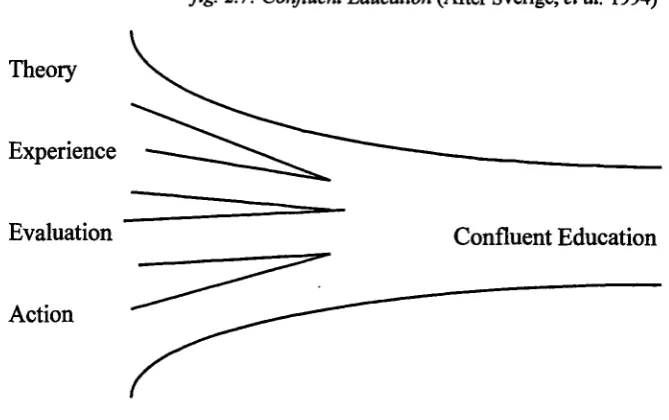
Fig. 2.8 Confluent Education 32
Fig. 2.9 Education for Sustainable Development 45
Table 2.1 The ideological structure of contemporary environmentalism 35
Table 2.2 Approaches in Environmental Education and ideologies 38
Table 2.3 Rough Map of Orientations and Associations 43
CHAPTER 3: ISSUES OF IMPLEMENTATION
Fig. 3.1 Linear logic 52
Fig. 3.2 Multifactor problem 52
Fig. 3.3 Multidisciplinary Approach 54
Fig. 3.5 Approaches for teaching and learning 60
Fig. 3.6 Fieldwork Project 62
Fig. 3.7 The staircase model 63
Fig. 3.8 Model for teaching and learning 70
Fig. 3.9 Grade level emphasis on environmental education objective
categories 71
Fig. 3.10 Age and objectives 71
Fig. 3.11 The spectra of strategy styles 76
Fig. 3.12 Whole school environmental Policy 77
Fig. 3.13 Planning and implementing environmental management for
schools 85
Fig. 3.14 Uzzell's Model of the school as an isolated island 89
Fig. 3.15 Uzzell's Model of the Local community invited into school 89
Fig. 3.16 Uzzell's Model of the school as guest in the local community.... 90
Fig. 3.17 Uzzell's Model of the school as local agent 91
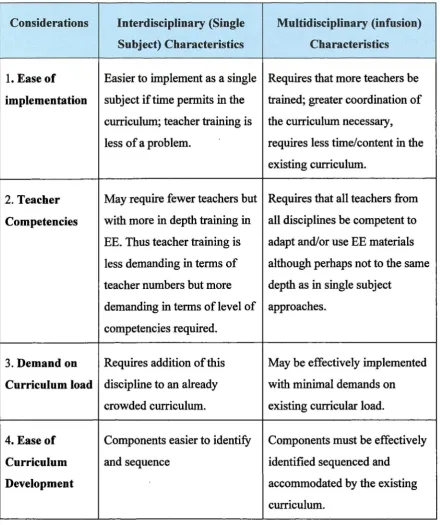
Table 3.1 Interdisciplinary Vs Multidisciplinary (infusion) formats for
environmental education. Advantages and disadvantages 57
CHAPTER 4: EVALUATION AND ASSESSMENT ISSUES
Fig. 4.1 Advantages and disadvantages accruing from different traditional
approaches to evaluation 105
Fig. 4.2 Determining the teaching material and the criteria for selection of
the work to be included in the portfolio 127
Fig. 4.3 Development of the story line model 128
CHAPTER 5: ENVIRONMENTAL EDUCATION IN CYPRUS PRIMARY EDUCATION
Fig. 5.1 The Educational system of Cyprus 134
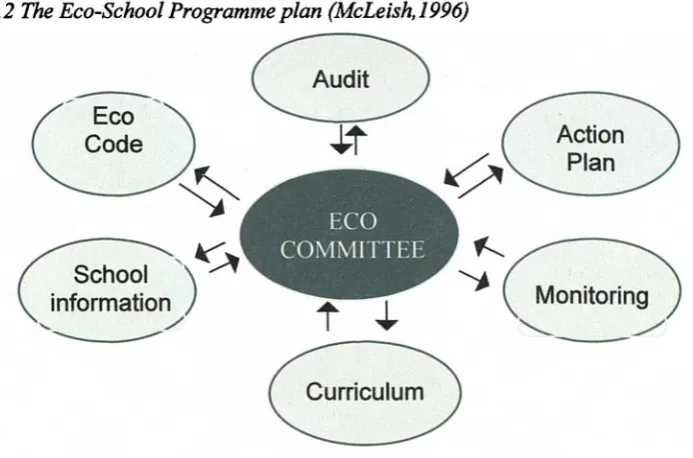
Fig. 5.2 The Eco — School Programme Plan 151
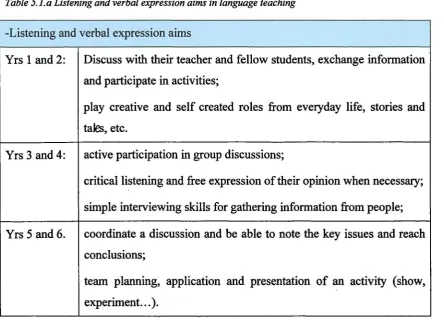
Table 5.1.a Listening and verbal expression aims in language teaching 136
Table 5.1b Study skills and source use aims in language teaching 137
Table 5.2 Environmental issues in Science Curriculum 139
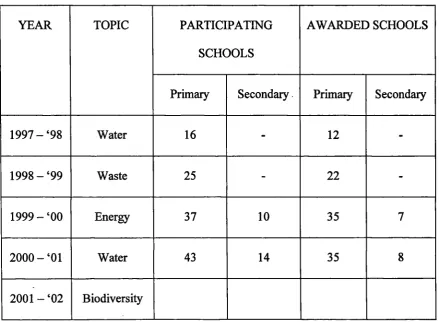
Table 5.3 Eco — School Programme participation and awarded schools 156
CHAPTER 6: ENVIRONMENTAL EDUCATION IN EUROPE
Fig. 6.1 The different areas of environmental and natural studies 189
Table 6.1 Curriculum organisation for environmental education 162
Table 6.2 The evolution of environmental education in Norway 163
Table 6.3 Environmental Education reorientation in Denmark 173
Table 6.4 Policy documents of the European Countries studied 191
CHAPTER 7: METHODOLOGICAL CONSIDERATIONS
Fig. 7.1 Time order and application time, of the Research Stages 203
Fig. 7.2 Research questions and questionnaire questions on student
questionnaire 214
Fig. 7.3 Research questions and questionnaire questions on teacher
questionnaire 215
Fig. 7.4 Student Questionnaire Question Cl 216
Fig. 7.5 Student Questionnaire Question C3 223
Fig. 7.6 The variables examined in the teachers' questionnaire 227
Fig. 7.7 Survey Interviews and links with Research Questions 231
Fig. 7.8.1 Interview Agenda Ministry of Education representatives 234
Fig. 7.8.2 Interview Agenda University of Cyprus Programme
Collaborator 235
Fig. 7.8.3 Interview Agenda National Operator 236
Fig. 7.8.4 Interview Agenda Teacher 1 237
Fig. 7.8.5 Interview Agenda Teacher 2 237
Fig. 7.9 Common Interview Agenda 238
Fig. 7.12 Case Studies' Interview Agenda 248
Table 7.1 The Methodological Plan of the Research Study 202
Table 7.2 Research Tools employed and Research Questions answered by
each Research Method 204
Table 7.3 The schools' sample 205
Table 7.4 Structure of the teachers' questionnaire 228
Table 7.5 Case Studies' interviewees Profile 248
CHAPTER 8: THE RESEARCH FINDINGS
Fig. 8.1 Non Eco-Schools and Eco-Schools environmental score
distribution 255
Fig. 8.2 Students' environmental cognition, action and school impact on
family in Eco-Schools and non-participating schools 257
Fig. 8.3 Students' school performance and environmental cognition score
in Eco-Schools and in non participating schools 258
Fig. 8.4 How the Eco School programme affects the students'
environmental action with respect to their school performance 259
Fig. 8.5 How the programme affects the students' environmental action
with respect to their district 260
Fig. 8.6 School's impact on the family with respect to the students'
achievement in class 262
Fig. 8.7 How the Eco-School programme influences the level of
communication and messages transferring from school to the family with
respect to their socio- economic background 263
Fig. 8.8 Students' attitudes and opinion of the programme 265
Fig. 8.8 Formula for environmental education curriculum integration
model 273
Fig. 8.10 Formula for the environmental education extracurricular
implementation 278
Fig. 8.11Triangulation of teachers' estimation of their students'
environmental action score and action score obtained by the students ... 285
Fig. 8.12 Teachers' overestimation of their students' environmental
action level 286
Fig, 8.13 Target achievement in the three schools 291
Fig. 8.14 Number of targets set and achieved by each school 292
Fig. 8.15 Monitoring process 293
Fig. 8.16 Categories formed by the grouping of the activities 295
Fig. 8.17 Schools' Action Day 296
Fig. 8.18 School — Community Communication I 297
Fig. 8.19 School — Community Communication II 298
Fig. 8.20 Management - Coordination — Teacher cooperation triangle 310
Fig. 8.21 Programme implementation problems and solutions 322
Fig. 8.22 Categories of extracurricular activities 325
Table 8.1 Sample size of each research tool used 254
Table 8.2 The relation between independent and dependent variables 256
Table 8.3 Teachers' working experience 268
Table 8.4 Teachers' working position 269
Table 8.5 Environmental education integration in the curriculum
disciplines 270
Table 8.6 Environmental education through extracurricular activities 272
Table 8.7 Model 1 Coefficients 274
Table 8.7.1 Model 1 Application Example 276
Table 8.8 Model 2 Coefficients 279
Table 8.8.1 Model 2 Application Example 280
Table 8.9 Curriculum implementation method preferred 281
Table 8.10 Results of question 6, Teachers' questionnaire 283
Table 8.11 Teachers' benefits from the programme 284
Table 8.12 School staff participation in the committee 288
Table 8.13 Local community members in the environmental committee 288
Table 8.14 Students participation in the environmental committee 289
Table 8.15 Development of the Action Plan 291
Table 8.16 Categories and numbers of activities per school 295
Table 8.17 Number of age focused and whole school activities in each
school 296
CHAPTER 9: DISCUSSION AND REFLECTIONS ON THE RESEARCH OUTCOMES
Fig. 9.1. Environmental education implementation through a whole
school environmental education programme 345
Fig. 9.2. Planning and applying an environmental education programme
in Cyprus 364
Chapter 1: Introduction
CHAPTER 1: INTRODUCTION
1.1 Statement of the problem
The quality of life is directly dependent on the quality of the environment in which
we live. Our immediate environment is a part of the global environment, each
component of which, interacts, affects and is affected by all the rest.
Many environmental problems are of global concern and solutions demand
co-ordinated international effort. This to some degree affects everyone:
intergovernmental panels, governments, adults and children. Many strategies for
addressing environmental problems highlight the need for everyone to learn about
the environment and adjust their attitudes to a more environmentally friendly way of
living (Rio Declaration, The Earth Summit, 1993). This forms the basis of
sustainable development.
Attitude change requires the development of awareness that would lead to action; the
development of informed awareness requires education. Environmental education
serves this purpose: it aims to provide education, which encourages people to strive
towards sustaining our planet and its resources for future generations (Palmer, &
Neal, 1994). For children its goal is even more important since it is addressing the
citizens of tomorrow.
Environmental education is now part of many curricula across the globe: U.K.,
Sweden, Norway etc. Its necessity has established it as an individual discipline
Chapler I. Introduclion
mechanisms depending on the educational system and other variables (e.g. social and
political values, or other educational priorities).
For Cyprus, environmental education is part of the "Action Plan for the Protection of
the Environment" set by the Ministry of Agriculture, Natural Resources and
Environment as an important requirement of the general harmonisation and
adjustment of the Cyprus legislation to the corresponding laws of the European
Community. The statement indicates that:
"Environmental education should be introduced through
every curriculum topic in Cyprus Education, giving special
emphasis on the Primary and Secondary level of Education"
(Ministry of Agriculture, Natural Resources and Environment, 1996)
Although this implies an integrative approach, the Ministry of Education has, to date,
made no special reference in the primary education curriculum to environmental
education. Furthermore, there is no indication in any official document as to how it
should be applied. The absence of a more solid National Programme for
environmental education in Cypriot schools results in its marginalisation and
probable absence.
The marginalisation of environmental education extends to the programmes of study
of the teachers' initial training, and although there are opportunities for in-service
training, these are optional, limited and short-term. Therefore another problem of
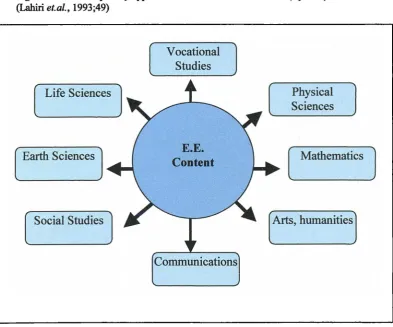
implementation is the lack of competent teachers to support it (Lahiri et al.,
1993:50). This is probably because environmental education, not as the mere part of
ecology or science (Ministry of Education and Culture, 1996), but as the
Chapter I: Introduction
attitudes and action), has only recently been introduced in Cyprus (Ministry of
Agriculture and Natural Resources, 1996). It is a new discipline cross-curricular
root, as discussed at conferences held in Stockholm, 1972; Belgrade, 1975; Tbilisi,
1977, etc. As most cross-curricular disciplines it has to compete for attention with
other disciplines of a perceived "greater status" (Lahiri et aL,1993; Papademetriou,
1998).
In order to overcome such problems, and achieve effective implementation, its
introduction should be carefully studied and applied in the best way. This is an issue
which initially requires a thorough background - literature review which will bring
out the possibilities that exist. Environmental education is a discipline with particular
characteristics and explicit requirements, which should be considered. There also
exists the opportunity of studying the implementation methods used by other
countries. Research investigation will provide a diagnosis of the current situation in
Cyprus and an in-depth study of the practices employed in the country over the past
few years.
1.2 Purpose of the research study
The main purpose of the research study is therefore to present, as an end product,
information that would be useful for the formation of a National Programme for the
implementation of environmental education in Cyprus Primary Education. A
description of the current situation of environmental education in addition to the
Chapter I: Introduction
Out of a limited variety of environmental education programmes' that currently run in Cyprus primary education, the Eco-School project is taken as an example for two main reasons: Firstly, according to the Cyprus Pedagogical Institute's evaluation, the
Eco-School project is successful (Kadji-Beltran, 1998). Secondly it has been steadily taken up by a considerable number of schools, becoming the most popular programme applied (43 primary schools in 2001). This research study, aims to verify the success of the Eco-School project by testing the participating children's environmental cognition, awareness and action and comparing them to the
environmental cognition and action of children in schools outside the programme. It also highlights factors that contribute to the successful implementation of the project as well as practices that could be improved or avoided. The success of any educational initiative depends ultimately on the commitment of the teachers delivering it. Thus their opinions have been sought at both organisational and personal levels.
The general research aims are to :
1. describe the current situation of environmental education in Cyprus;
2. elicit views from interested parties on the development of a National Programme for the implementation of environmental education in Cyprus Primary Education; 3. evaluate the impact of the Eco-School project;
4. distinguish the factors that contribute to the successful implementation of an
environmental education programme.
The main participants in the project are:
1. students from Eco-Schools and non Eco-Schools;
Chapter 1: Introduction
2. teachers and school directors from Eco-Schools and non Eco-Schools;
3. National Operator of the Eco-Schools Programme;
4. government decision makers: General Director of Primary Education in Cyprus,
Primary Science Inspector, INSET trainers and initial teacher training educators
(University of Cyprus).
These, along with other interested parties not participating in the research, such as
NG0s, could contribute in the development of a National Plan for the
implementation of environmental education in Cyprus.
The specific research questions to be addressed are:
1. To describe the current situation of environmental education in Cyprus.
RQ1.1 What is the environmental education national policy followed by the ministry
of education?
RQ1.2 How is environmental education currently practised through the curriculum?
RQ1.3 What environmental education initiatives are there in Cyprus primary
schools?
2. To obtain interested parties' opinions about the development of a National Programme for the implementation of environmental education in Cyprus Primary Education.
RQ2.1 Which are the views of each of the interested parties on the national
environmental education policy?
RQ2.2 How would the interested parties visualise a national environmental education
programme / model?
RQ2.4 Which role would each of the interested parties play in an effective
implementation of a national programme?
RQ2.5 Which role would the NGOs play in a national environmental education
programme / model?
RQ2.6 What is the extent of co-operation between government (Ministry of
Education) and NGOs (Environmental Organisations)?
3. To evaluate the impact of the Eco-School programme.
RQ3.1 Is there a difference in environmental cognition and action between the
Eco-School students and students in schools not participating in the programme?
RQ3.2 Can the Eco-School programme influence the environmental awareness of a
student's family?
RQ3.3 Which are the students' attitudes towards the Eco-School programme?
RQ3.4 Have the students benefited from the programme? If so, how?
RQ3.5 Have the teachers benefited from the programme? If so, how?
4. To highlight the factors contributing to successful implementation of an environmental education programme.
RQ4.1 Which parts of the programme are motivating for the teachers?
RQ4.2 Which parts of the programme are motivating for the students?
RQ4.3 Which approaches and practices have been successful?
RQ4.4 Which practices are more effective for the inculcation of environmental
attitudes?
Chapter 1: Introduction
RQ4.6 What problems exist during the implementation of the programme?
RQ4.7 How can teachers be supported?
RQ4.8 Which are the teachers' attitudes towards the programme?
1.3 Rationale of the study
Learning to care for our environment is becoming increasingly important to our
quality of life and our future prosperity. Education is an important vehicle for
achieving environmental awareness. In Cyprus, several good initiatives are already
occurring in schools throughout the country (see Chapter 5). The increasing number
of these initiatives highlights the general interest In the issue and
emphasises that a well organised and co-ordinated policy for formal environmental
education is indispensable for the substantial guidance and support of these
initiatives. This research study will respond to this necessity. Its importance lies in its
originality and the practical application it can have. Examining and evaluating
current practices will provide useful information for the development of an effective
plan for the implementation of environmental education in Cyprus.
The analysis of different models of environmental education from other countries
will enable strengths and weaknesses of different approaches to be identified.
The ultimate aim is to develop a Cyprus Model which, if applied, will contribute to
Chapter 1: Introduction
1.4 Framework
The study is structured into nine chapters. The current chapter introduces the
problem, the purpose of the research and the questions to be answered. It is followed
by literature review chapters.
Chapter 2 presents, through literature, a review of environmental education and the
pathway followed until it reached its contemporary form. It includes a study of the
environmental ideologies that appeared over the years and the impact they had on the
formation of environmental education.
Chapter 3, focuses on the implementation of environmental education, including both
curriculum and school management issues. It explains how these two dimensions can
result in a holistic approach to environmental education in schools and considers the
environmental ethics within it.
Chapter 4 examines evaluation and assessment issues. It provides general
information on educational evaluation and specific information on evaluation in
environmental education. It also introduces some evaluation tools specially adjusted
for environmental education.
Chapter 5 describes the current situation of environmental education in Cyprus. The
information for this chapter was extracted through review of official documents of
the Ministry of Education, as well as the National Curriculum.
Chapter 6 presents an overview of environmental education implementation in a
Chapter 1: Introduction
Chapter 7 explains the methodology followed in order to find answers to the research
questions. The methods and the research tools used are presented and justified
according to the sequence in which they were applied.
The results of the research are displayed in Chapter 8. They are presented according
to the research tool used. Information about the analysis is also provided.
Chapter 9, provides a general discussion and analysis of the fmdings and makes
recommendations on the basis of the results with regard to implementation of
CH 1PTER 2 . Lterature Review
CHAPTER 2: ENVIRONMENTAL EDUCATION AND
EDUCATION FOR SUSTAINABLE DEVELOPMENT
2.1 Towards Education for Sustainability
2.1.1 Human - Nature Relationship
The human being is the child of nature and as such s/he is part of the Cosmos l . This
belief was held by many cultures and civilisations in the past and it generated their
way of perceiving earth. In ancient Greece and Renaissance Europe, for instance,
Cosmos was considered to be "a living organism with a nurturing female earth at its
centre" (Huckle 1997: 5). The ancient civilisations had a sense of subordination to
nature due to their appreciation of what the earth offered them. Their knowledge,
emotions and aesthetic appreciation resulted in hymns and legends. (Lahiri et al.,
1993).
The importance of the environment is also emphasised by the oriental religions'
teachings of Buddhism, Jainism, Taoism and others, including messages about living
harmoniously with our surroundings and preserving plants and animals. (Lahiri et al.,
1993:3) Any attempt to master or conquer nature is considered to be a distortion of
human nature (Capra, 1976; Kabilisignh, 1988). Therefore, local wisdom was used to
limit the non-sustainable use of resources and balance the human - nature
relationship.
Doris D' Souza (1997) explains that Indian tradition has always upheld the need for
sustainable lifestyles. Evidence for this is found in scriptures and ancient monuments
CHAPTER 2: Literature Review
as well as elements of their culture. She refers to a national song that venerates
Mother Earth:
"I bow to thee Mother, richly watered richly fruited
cool with thee winds of the south,
dark with the crops of the harvests the mother!"
(Thessaloniki International Conference Proceedings, 1997:308)
Nowadays, views about nature have become «human centred» and «human
-oriented». Modem Western perceptions of the nature - human relationship are
therefore homocentric and scientific, considering nature largely as a world of objects,
their social use being democratically regulated and distributed (Sterling, 1997). The
mechanistic, scientific view of the world considers oEarth to be dead and nature to
be a machine that can be transformed, improved and managed in the human
interestD (Huckle, 1997)
Humans are considered to be superior to nature; they are not a part of nature. The
human being is the manager and the exploiter.
Sterling (1990) sees two approaches in today's human - nature relationship:
• the technocentric approach, which supports the view that further scientific
research will lead to a better understanding of environmental problems and
hence will develop better technology and management strategies in order to fnid
solutions;
• the ecocentric approach which considers it necessary to bring fundamental
CH 1PTER 2: Literature Review
This epistemological view was substantial for the massive technological progress of
the contemporary industrial system, which took place at a cost. Based on the
"availability ethics", only now do we realise that "the system which is consuming its
environment eventually is also consuming itself" (Marx in Wilden, 1997: 28),
leading to a global ecological crisis.
The ecological crisis, however, is not the result of a technological crisis: technology
cannot be blamed and neither can we deny that we have benefited enormously from
its progress. There is no «good» and «bad» technology. There is good and bad use of
it, either because of ignorance or because of greed. The ecological crisis is a crisis of
"Human maladaptive behaviour" (Newhouse, 1990: 26). The notion of resource
limitations and the necessity of a sustainable organisation of our welfare and
production systems has not ((prevailed in society's values » and has not been
"inherited in its education" (Holmberg et al. 1991:11), thus, the sense of people's
responsibility and stewardship towards earth and its resources has been neglected.
Technology may provide solutions to environmental problems (technocentric
approach) but we can ensure its "correct" use and development only through forming
environmentally aware, critical, conscious, participative and active citizens (the
eco-centric approach).
2.1.2 The origins of Environmental Education.
The need for change and adjustment in education is constant because, as suggested
by Papademetriou (1998), schools react and adjust their role according to society's
Educators' dual role
CHAPTER 2: Literature Review
reflects those changes in education. Education has the potential to bring social
change and improvement as long as it manages to break through the "status quo"
preservation mechanisms. In order to acquire an environmental orientation,
educational systems should apply dynamic schemas that establish new
environmentally oriented educational structure (Posh, 1994:27). As Federico Mayor
(1997) sees it, education plays a dual role: reproducing the aspects of society and at
the same time, preparing students to transform society for the future.
Fig. 2.1 The dual role of education (After Mayor, 1997)
Reproducing aspects of society
Preparing students to transform society
Environmental education (today under the umbrella of Education for Sustainability)
being part of the Educational System follows the "Education" - "Society" interaction
and thus has undergone many changes and adjustments to take eventually the form it
has today.
Following a chronological sequence, environmental education has developed from
the apolitical perspective it had in the times of Sir Patric Geddes (1854 - 1933),
through the quasi political conservation education (as the purposes of environmental
education were defined in Keele University during a conference in 1965) to today's
challenging character of education for sustainability which is far from apolitical
1 st phase rd phase 31.d phase
Environmental Studies
Environmental Education
) Education for Sustainability
apolitical quasi political political
CHAPTER 2: Literature Review
fig.2.2 The chronological development of Environmental Education
Environmental education has its origins in subjects such as biology, science and
environmental studies. In these contexts it is about getting to know the environment
and understanding natural laws and has an entirely scientific and informative
character.
According to Papademetriou (1998) at the end of the 19 th century - beginning of the
20th century, the educational movements "Study of Nature" and "Agricultural
Studies" appeared. They were both developed in USA and Europe. Despite the fact
that two different terms were used, the two movements were identical as far as their
aims, context and approaches were concerned. They both focused on providing
opportunities for the student to work in nature, experience country life and through
this, develop knowledge, awareness and skills of the environment. Clearly the
development of these educational movements was based on naturalistic models,
influenced by the environmental interest of the times towards the natural
environment as well as Rousseau's "value of educating a child in the natural
CHAPTER 2: Literature Review
phase of the development of environmental education. According to Kirk (1985) (cited in Lahiri et al., 1993) these stages were:
The Awareness Phase (1860 — 1890). This was the initial phase in which
"various powerful writers awakened many to recognise that man was not a
single solitary figure above other living and non living systems, but rather an
integral part of the system". (p. 4)
The Preservation Phase (1890 — 1910). Again, writers popularised a need for the conservation of natural resources. Forests were not only considered to be sources of raw materials, but also resources for recreation, relaxation, research and study.
The Nature Study phase. (1910 — 1932) The American Nature Study Society was established during this period. An understanding and appreciation of the beauty, the majesty and mystery of nature was promoted through materials — tools used by teachers and naturalists.
The Education Phase (1937 — 1950) was marked by the development of the Civilian Conservation Corp. Young people were given the opportunity to learn and value the forests and woodlands. The importance of learning about the interrelationships of and interactions between living and non living things was highlighted and environment was used by teachers as an extension of their classrooms.
CHAPTER 2: Literature Review
nature's beauty, preoccupation for endangered species, conservation, bioethos etc., dominate. The development of these attitudes is connected to an awareness that the consequences of human actions not only reflect on nature but on the quality of life too. Industrialisation and "imperialism over nature" as Francis Bacon (1562 - 1626) suggests are being questioned. We may say that, at this stage, environmental education was not influenced by any political orientations.
Nevertheless, increasing environmental awareness had led to the establishment of various environmental societies, e.g. The Royal Society for the Protection of Animals (1824), The British Commons, Open Spaces and Footpaths Preservation Society (1865). In education, because of the recognition of the value of nature in children's
education, the "Study of Nature" was established as an additional programme. At this point, though, all the movements that were established, apart from their environmental concern, also had political motives. As Papademetriou (1998) suggests,
"these movements both in the UK and the USA were connected
to government policies aiming to constrain the migratory wave
towards industrial centres... " (Papademetriou 1998: 24)
So environmental education, following the social demands, acquires a quasi political character and serves political and social purposes. The Study of Nature covered both Primary and Secondary Education, especially small countryside schools. This was succeeded by "Agricultural Studies" or "Rural Studies", a movement which developed during the 1920's and 1930's (Carson, 1980).
CHAPTER 2: I ihratun Reviot
prestige (Goodson, 1983), along with the criticism it received for dictating
"agricultural professions" to students of agricultural origins, Agricultural Studies
was absorbed completely eventually, by Natural Sciences (such as biology and
physics). Its aims were adjusted so as to contribute to a better general education.
During this second phase of its evolution, environmental education added to the
initial study of the environment a new duty: "education for conservation".
2.1.3 From the 60s to the present. The evolution of environmental education through international conferences.
The importance of the contribution of education to the conservation of nature and
natural resources has been apparent for many years now and a distinct new subject
has emerged.
The term environmental education appeared for the first time in Paris in 1948 at a
meeting of the International Union for Conservation of Nature and Natural
Resources.
The Commission on Education of the International Union for the Conservation of
Nature and Natural Resources (IUCN) was established in 1949 (Lahiri et al. 1993).
This organisation aimed at the promotion of environmental conservation education
and for this purpose produced a number of publications and organised several
conferences and symposia:
CH 1PTER 2 . Literature Revielt
• Conference on Conservation on Renewable Natural Resources, Bariloche,
Argentina, March, 1968;
• Conference on Environmental Education, Nevada, U.S., 1970;
• European Working Conference on Environmental Conservation Education,
Ruschlicon, Switzerland, December, 1971, etc.
In the UK, the environmental education issue was raised during a conference at
Keele University, 1965, which aimed to investigate the conservation of the
countryside and its implications for education. At about the same time in the United
States, environmental issues became a public concern, especially after the publication
of Rachel Carson's "Silent Spring" 3 in 1962. The awaking public awareness was
intensified by the call of an International Conference on environmental education in
Nevada organised by the International Union for the Conservation of Nature and
Natural Resources. The findings of the Nevada Conference still influence the
development of environmental education and its definition is accepted and used by
the National Association of Environmental Education (NAEE) in England and
elsewhere.
"Environmental Education is the process of recognising values and
clari6ling concepts in order to develop skills and attitudes necessary to
understand and appreciate the interrelatedness among man, his culture
and his biophysical surroundings. Environmental education also entails
practice in decision making, and self formulation of a code of behaviour
about issues concerning environmental quality". (IUCN, 1970)
3 Rachel Carson, in "Silent Spring" exposes the effects of the intensive use of chemicals. This book remains a classic statement which founded a whole movement. It describes how pesticides and insecticides applied without any control in farms, gardens, forests and homes will eventually
contaminate our environment and destroy wildlife. Rachel Carson argues that the human being is only a part of the living world and the progressive poisoning he creates will eventually bring the
CHIPTER 2: Literature Rcriot
At an international level the interest in environmental matters was launched at the
UN Conference on the Human Environment in Stockholm in 1972. A result of that
was the creation of the UN Environmental Programme. Principle 19 of the
Conference stated that: "Education in Environmental matters for the younger
generation as well as adults giving due consideration to the underprivileged is
essential" (UN Conference on Human Environment, Stockholm 1972)
Several Conferences were initiated after that and focused on environmental
education. In 1975 an International Workshop on environmental education was held
in Belgrade. It launched the International Environmental Education Programme
(I.E.E.P.) and resulted in the first intergovernmental statement on environmental
education. The objectives of environmental education, well summarised in the
Belgrade Charter (as cited in Trends in EE, UNESCO, 1977: 28 and Lahiri et al.,
1993) were separated into six groups:
1. Awareness: to help individuals and social groups acquire an
awareness of and sensitivity to the total environment and its allied
problems
2. Knowledge: to help individuals and social groups acquire basic
understanding of the total environment, its associated problems and
humanity's critically responsible presence and role in it,
3. Attitude: to help individuals and social groups acquire social values,
strong feelings of concern for the environment and the motivation for
actively participating in its protection and improvement
4. Skills: to help individuals and social groups acquire the skills for
solving environmental problems.
5. Evaluation ability: to help individuals and social groups evaluate
environmental measures and education programmes in terms of
CHAPTER 2: Literature Revieu
6.
Participation: to help individuals and social groups develop a sense ofresponsibility and urgency, regarding environmental problems so as to
ensure appropriate action to solve those problems.
A broader set of objectives (UNESCO, 1975) indicates that environmental education
aims to:
1 . Foster clear awareness of and concern about economic, social,
political and ecological interdependence in urban and rural areas
2. To provide every person with opportunities to acquire the
knowledge, values, attitudes, commitment and skills needed to
protect and improve the environment
3. To create new patterns of behaviour of individuals, groups and
society as a whole towards the environment)).
(P.Neal & J.Palmer, 1990:5; J.Palmer & P.Neal, 1994:13; Lahiri et al., 1993)
The same goals were also set in the final report of the Tbilisi Conference (October,
1977). The Brandt Commission covered the issues of poverty and economic
development.
People started realising that development and environment conservation were two
factors with reciprocal effects and that one should not be dealt with separately from
the other. This issue was discussed by the UN World Commission on Environment
and Development (WCED 1987), under the chair of Gro Harlem Brundtlant, in
Norway. The resulting report is called «Our Common Future». For the first time the
term «Sustainable Development» appeared and was defmed as:
«...the development that meets the needs of the present without
compromising the ability of future generations to meet their own
needs. Development + Conservation = Sustainable Development.>>
Development
d1
CillPTFR 2: literature Review
The relation found between conservation and development was described by Giselle
Vergnes - DGXE, European Commission, during an In-Service Training Programme
for teachers, on Education and the Environment in Europe, organised by the Central
Bureau (for Educational visits and exchanges, Council of Europe, 25 - 32 March
1996).
Fig. 2.3 Conservation = f(development)
The relation between conservation and Development
Development could be described as
inversely proportional. That is
maximum development, we have
for
no
d1
Max. Development
conservation and for maximum conservation
development pauses.
An even more frustrating relation is the one
shown by Fig.2.4 where for the same
development (di), conservation (c2) is even
smaller than (ci )
Sustainable Development aims to maximise
both, introducing a new Development
-Conservation relation. It is apparent that for
the same development (di), conservation in
relation A' is smaller than conservation in
relation A and much smaller than A".
C2 < CI <C3
Max. Conservation.
0 >
C1 Conservation
Fig. 2.4 Conservation' = f(development)
C2 CI Conservation'.
Fig. 2.5 Conservation = f(development)
Development
C2 C1 C3
CHAPTER 2: Likratufre Rt. vieu
Relation A" gives the maximum conservation having the maximum development
and represents the relationship fostered by Sustainable Development.
The Report, «Our Common Future», (Faye, 1991) generated the commitment for a
World Conference on Sustainable Development. The aim of the UNCED was:
"To establish a new equitable global partnership through the
creation of new levels of co-operation among states, key
sectors of societies and people ... to make agreements which
respect the interests of all and protect the integrity of the
global environmental and developmental systemi!
(Earth Summit 1992, Regency Press Corporation, London 1996)
As an outcome of the Earth Summit, 27 principles were developed through which
Sustainable Development could be achieved. Two of them, (principles 10 and 21)
also refer to Education as a means of meeting the aims of Sustainable Development.
Principle 10 states that Environmental issues are best handled by the participation of
all citizens concerned. There should be:
'Appropriate access to environmental information held
by public authorities,.., an opportunity to participate in
decision making process and ...states shall facilitate and
encourage public awareness and participation by
making information widely available" (Palmer 1998: 72).
Awareness and participation, however, require information. An uninformed person
will find it difficult to participate and even more difficult or risky to make decisions.
Consequently such a person will not be capable of resolving environmental
CHAPTFR 2: literati/le &view
Principle 21 states that:
"The creativity, ideas and courage of youth of the world
should be mobilised to forge a global partnership in order
to achieve sustainable development and ensure a better
future for all."
Apart from the 27 principles of the Rio Declaration, governments also agreed on a
Plan of Action for achieving Sustainable Development, known as Agenda 21. It
includes 40 chapters stating what nations are required to do, in respect of social and
economic dimensions, conservation and management of resources for development,
strengthening the role of major groups and the means of implementation. In 1991,
five years after the Earth Summit in Rio, the world still had not managed to meet the
goals for ecological and social change. The negative global ecological and social
trends Rio addressed weren't effectively tackled.
The New York Conference (1997) made it clear that industrialised nations were
reluctant to allocate more funds to developing countries for environmental protection
and poverty alleviation. Additionally, most of the developing countries regarded
their economic growth of higher importance than respect to environmental protection
(Unmossing, 1997).
Therefore, one could conclude that it is very difficult for governments to help to
create a better world. It is up to the individuals to take action and bring about
change.
The resulting resolution adopted by the General Assembly (23 - 27 June 1997)
CHAPTER 2: Litcranne &Wen
"A fundamental prerequisite for Sustainable Development is an
adequately financed and effective educational system at all levels,
particularly at the Primary and Secondary levels, that is accessible to
all and augments both human capacity and well being ... Even in
countries with strong educational systems there is a need to reorient
education, awareness to widespread public understanding critical
analysis and support for sustainable development. Education for a
sustainable future should engage a wide spectrum of institutions and
sectors ... and should include the preparation of sustainable
development education plans and programmes". Hopkins (1998)
The role and the importance of Education is emphasised throughout the literature
(UNESCO 1977, Benedict, 1991, Mayor, 1997, National Forum on Partnerships,
supporting Education about the Environment 1994, UNESCO 1998, UNESCO,
UNEP, IEEP, Environmental Education Series 22. 1993). The following chapters
aim to present the philosophy of environmental education and the progressive
changes it went through to eventually constitute part of "education for sustainable
development".
2.2 From environmental education to education for sustainability: A
transition
There is some consensus that environmental education is perceived as a means of
dealing with many of the environmental issues the world is facing. It constitutes a
fundamental part of the school management and educational ethos and as such it can
fulfil its ultimate purpose by giving the students, through all areas of the curriculum,
CHAPT1 R 2 . literature Revieis
-learn facts about the environment and environmental issues;
-develop a respect for evidence by examining and interpreting the environment from
a variety of perspectives (physical, geographical, biological, etc.);
-clarify their own values in relation to the environment and acknowledge that people
hold different, equally legitimate points of view;
-take an active part in resolving environmental problems. (SCAA, 1996)
General aims of environmental education include:
«- The need to develop attitudes of care, curiosity and concern for
the environment in such a way as to develop a sense of responsibility
towards home, school and the community.
- The need to demonstrate to children the complex
interrelationships between humanity and the environment and to give
pupils the necessary skills to do these things)). (DES 1986)
A similar aim was reported in the Draft Guidelines in the U.K. for the development
of a policy for environmental education (1992), where it is underlined that
environmental education should provide the opportunities for children to acquire the
values mentioned above as well as knowledge, skills and commitment. Students
should be encouraged to examine the environment from various perspectives:
physical, sociological, biological, technological etc., and to be critical and
interpretative. Finally, environmental education should aim to arouse children's
awareness and curiosity about the environment and participate actively in resolving
environmental problems.
Thus students will become «environmentally knowledgeable, skilled, dedicated
citizens who are willing to work individually and collectively towards achieving and
maintaining a dynamic equilibrium between the quality of life and the quality of the
CH 1P7 FR 2- I it( ratut e &view
Many of the aims and general ideas which emerged from the statement of the Tbilisi
conference (1977) specify that environmental education should aim to offer lifelong
education following an interdisciplinary and holistic approach. Environment is a
multidimensional concept since it can be divided into social, moral, technical, natural
and cultural environment and as such it should be seen as an entirety through which
the human - nature relationship could be examined (overlap with DES, 1986, cited in
Palmer and Neal 1994). Moreover environmental education should promote, through
first hand experience, sensitivity, awareness, ethics and values among students and
consequently lead to participation and active responsibility.
Engleson et al. (1991) categorise environmental education objectives in five groups:
awareness, attitudes, participation, knowledge and skills. Nevertheless, others form
wider groups so they can categorise the objectives into knowledge and skills
objectives, and the objectives concerning attitudes and behaviour (Palmer and Neal,
1990, Council for Environmental Education, 1987):
-Knowledge and skills: for the children to develop a coherent body of knowledge, to
be able to gather and evaluate information, appreciate interaction of environmental
issues and eventually have the ability to bring about environmental change.
-Attitudes and behaviour aims refer to an appreciation of the environment,
acquisition of an attitude of concern, participation in initiatives and decision making
and also cultivation of one's critical spirit about personal environmental attitudes.
There is no distinctive border line between the categories of targets. This is why we
experience, for example, provides important knowledge and at the same time
cultivates awareness and may lead to action.
Palmer and Neal (1994) proposed a model which illustrates these overlaps of the
aims and at the same time organises everything within the threefold structure of
environmental education, as it is reflected in the Tbilisi Conference Papers
(UNESCO, 1977).
Education ABOUT the environment suggests basic knowledge and understanding of
the environment and concerns values, attitudes and positive action for the
environment. Education IN or THROUGH the environment suggests using the
environment as a teaching tool emphasising inquiry, investigation and first hand
experience. The nucleus of the whole "ABOUT- IN - FOR" approach is an individual
holistic development, through knowledge and understanding of concepts,
development of skills and attitudes leading to behaviour formation. It is clear that in
this behaviouristic model «Knowledge 4 Attitudes
4
Behaviour», knowledge is avery important condition for the formative style of the specific approach.
Georgopoulos and Tsaliki (1998) support the view that the three folds of this model
must be dealt with as parts of one approach. Overemphasising one of them, for
instance acquiring knowledge and neglecting another, such as skill formation,
devalues the holistic character of environmental education. Cooper, (cited in
Georgopoulos and Tsaliki 1998) criticises the fact that very often the two dimensions
(about and through) are being emphasised, and education FOR the environment
...„.,..___,Education
for ..
the environment
CHAPTER 2. literature Rcri
Fig. 2.6 The threefold structure of environmental education (after Palmer & Neal, 1994)
Fig. 2.6 is modified from Palmer and Neal (1994). It illustrates the overlap between
education ABOUT, THROUGH and FOR the environment as in the original figure.
The rotation though, shows, how easily the threefold structure of environmental
education could be interpreted as a "one-fold" educational field where all
dimensions, namely education ABOUT and education IN, end up serving the
ultimate environmental education targets: values, attitudes and positive action FOR
the environment. Learning ABOUT the environment brings out the concern which
serves the purposes of education FOR the environment. The experience, gained from
the cognitive part (ABOUT) and the contact with the environment
po,
arouses theconcern and the will for action FOR the environment. The emphasis placed upon
education FOR the environment also appears in official and national organisational
documents which according to Uzzell (1999) attempt to define the aims and content
of environmental education, such as the Council for Environmental Education
CHAPTER 2- I iiet-ature Review
Council (1990). The focus of the majority of these documents has been the need to develop attitudes of care, curiosity and concern for the environment (DES, 1988).
Georgopoulos and Tsaliki (1998) claim that the meaning of "Education FOR the Environment" is not yet clarified. They support this view with Sterling's (1990) suggestion of the two "human - environment relationship" approaches: the teclmocentric and the ecocentric (chapter 2.1). They conclude that the educators may
interpret "Education FOR the Environment" with respect to their personal ideological orientation.
Critisising the threefold structure and principal focus of environmental education, Uzzell (1999: 400) argues, that, "on the surface these seem to be laudable and
desirable objectives meeting the need for environmentally aware and responsible
youth. However a closer inspection suggests that with their emphasis on
understanding, attitude and behaviour change at an individual level and the failure
to recognise the social and political context in which attitudes are formulated and
actions are undertaken, they inevitably miss important educational opportunities".
In order to avoid the 'individualisation trap', Uzzell (1999) supports an alternative perspective in which environmental education has the potential to provide learning, develop concern and fmd solutions. This can be achieved by 'action competence' which is a "way of thinking about and taking people each stage of problem
identification and solution generation" (p.401). Action competence consists of
CHAPTFR I it( rature Review
1. Choosing the subject of concern...
2. Spec6ing the specific nature of the problem...
3. Identifying the causes and consequences of the problem...
4. identifying the relevant attributes and conditions to be changed...
5. ident6ing the action possibilities...
6. specifying constrainis and barriers to change...
7. establishing priorities of action ...
8. selection of appropriate and sustainable actions. (p. 401-402)
This procedure, possibly followed through a project, helps students obtain a better
insight into problems.
Other critics of the threefold structure and its behaviouristic origins, Sverige et aL
(1994) affirm that although «Knowledge
4
Attitudes4
Behaviour» is the mostcommon approach, there is no scientific research supporting its validity. The
Swedish authors argue that a person's existing attitudes and values act as a filter and
permit entry only to information of the same orientation. They illustrate their
argument in a very realistic manner.
Fig. 2.7 shows that «certain amount of knowledge passes the attitude filter while
other knowledge is filtered out. Sverige et al., (1994), are supporters of confluent
education. They distinguish four different elements which constitute this approach:
C'H 1P FP R 2. 1 itcrcaure Rc.view
Fig. 2.7: The attitude filter (Sverige eta!,. 1994:20)
Theory involves traditional teaching, conveying information in the form of
background data. It aims to help students acquire a «fundamental understanding as
well as learning the terminology and key concepts». In order to achieve this, various
forms of traditional teaching and learning activities must be followed, e.g. lectures
and presentations, the study of literature, films, interviews etc.
Experience, the second element, considers personal experiences and questions
relating to the field of study to be of key importance. It aims to ((utilise and
incorporate children's and young adults' experiences and reactions to what they
study. This can be achieved through «fieldwork, study visits, group discussions,
dramatisations, reading, laboratory experiments, nature studies and creating a
record of pupils ' own experiences» (Sverige et. al., 1994: 20).
The third element is evaluation. It concerns «individual or group attitudes towards
the subject of study. Education promotes self awareness and increases awareness of
individuals' and groups' attitudes and values. Thus we ((develop insights into the
standards we live by, the way we act and the possible consequences of our actions))