International Journal of Innovative Technology and Exploring Engineering (IJITEE) ISSN: 2278-3075, Volume-9 Issue-2, December 2019
Abstract: Internet of Things (IoT) is an evolving idea that observes the physical world as a set of smart objects. All the objects are able to communicate with each other. All the objects are internet enabled as well as capable of performing computations. These objects are used by different users in various manners. There are number of resources that can be identified in an IoT environment. The number of resources is limited but the demand of the users is not bounded to any limits. Therefore, to design and execute a specific IoT system encounters many challenges. The most prominent challenge is resource management. The resources must be managed in such an efficient manner that the resultant throughput of the complete system should be maximized. In this paper, after discussing the concept of resource management, an algorithm is proposed, namely RDSA (Request-Discovery-Scheduling-Allocation). This algorithm can further be extended by implement artificial intelligence for dynamic and unpredictable demands of the users.
Keywords: IoT, Smart Objects, Resources, Resource Management, RDSA.
I. INTRODUCTION
In the last two decades we have observed a great potential towards wireless networking, reduction in device size and presence of computing and communication capabilities in the devices. These three important criteria together emerged as an attractive notion of Internet-of-Things (IoT).
One of the most renowned and promising technology in today‟s era is Internet of Things (IoT). IoT can be thought of as a collection of devices that are capable of communicating with each other, as well as capable of providing services to the end-users. These devices can be considered as resources in an IoT environment. These resources must be accessed and utilized by the end users in an efficient manner, so as to increase the throughput of the system, and increase the level of satisfaction for the end user.
This paper consists of 7 sections. After introducing the subject, in section 1 of the paper, in section 2 discusses the different application areas of IoT. In section 3, paper elaborates different challenges while designing an IoT system. Section 4 focusses on the concept of resource management. In section 5, we described the proposed algorithm, its system model and data structure. In section 6, the analysis of the algorithm is done. Finally, the work has been concluded in section 7.
Revised Manuscript Received on December 05, 2019.
Priya Matta, Graphic Era Deemed to be University Dehradun, Uttarakhand, India
Bhasker Pant, Graphic Era Deemed to be University Dehradun, Uttarakhand, India
Sachin Sharma, Graphic Era Deemed to be University Dehradun, Uttarakhand, India
II. APPLICATIONS
IoT offers a vast range of services to our physical world. Every so often, various academicians and researchers have classified these services into many categories. With the passage of time, an extensive range of IoT applications are recognized by academicians and researchers [1] [Vongsingthon]. According to a ranking report generated in 2012, 50 notable application areas of IoT were identified. Finally these application areas were further generalized into 13 groups, these are namely (i) Smart-cities, (ii) Smart-environment, (iii) Smart-water, (iv) Smart-metering, (v) Security & Emergencies, (vi) Retail, (vii) Logistics, (viii) Industrial control, (ix) Smart-Agriculture, (x) Smart-Animal-farming, (xi) Demotic & Home automation, (xii) Smart-Education and (xiii) e-Health.
IoT application areas are categorised into 5 key areas by Perera et. al [2], these are namely: smart wearable, smart home, smart city, smart environment, and smart enterprise. Matta et. al [3] also proposed the classification of application areas into five broader categories. This classification is based on the requirements of the tasks. These categories are: (i) Domestic; (ii) Societal; (iii) Environmental; (iv)
Technological; and (v) Emergency & Critical Situations.
I. CHALLENGES
Whenever a new paradigm is in evolving stage, it faces various social, environmental and technological challenges, and therefore IoT. It is realistic to assume that the current state of IoT may lead to a numerous range of challenges. Many researchers have attempted to present the architecture as a major challenge in an IoT system. Baraniuk [4] and Hendricks et. al [5] mentioned heterogeneity as one of the key issues during the design and development of an IoT system.
According to many researchers (Chen, Hu, Liu, Wang & Xu, 2014[6]; Lee & Lee, 2015[7]; Mikkonen & Taivalsaari[8], 2017; Mijic[9], 2018; Matta & Pant, 2019[10]) there are a wide range of challenges encountered while designing an IoT system. One can face a number of technological as well social challenges while working on an IoT system. Once an IoT System is implemented, there are many challenges in its ideal and faultless execution. Resource management has remained in the forefront in all the emerging research fields, so in IoT.
According to Borgia et. al[11], “the vagueness of the term “Things” makes it hard to define the ever expanding boundaries of the IoT, but at the same time offers a clear idea of its heterogeneity and its virtually limitless application potential”. According to Chiang et. al[12],
Strategic Allocation of Resources in an IoT
Environment: RDSA Algorithm
minimisation of latency forms a critical research challenge. In various IoT applications like drone flight control applications, vehicle to vehicle communication, virtual reality applications, gaming applications, and real-time financial trading applications, latencies are expected to be lesser than a few tens of milliseconds. Waldner[13] presented scalability as another critical challenge. Along with all these challenges, resource management forms a prominent challenge for the developers of an IoT system. Semasinghe et. al [14] focussed-on randomness and uncertainty of scarce resources and therefore their efficient management is elaborated as a critical challenge.
II. RESOURCEMANAGEMENT
IoT, is a paradigm whose success basically depends on timely availability of its resources to its end users. Availability of huge number of resources, does not imply the success of system. The efficient management of available resources, their allocation among the end users, minimising the response time for end users, are the basic requirements towards its success. Therefore, resource management forms a critical issue in an IoT system. Many researchers [Sundmaeker Zhang Lopez 15,16,17] considered the resource management as one of the most import research challenge in an IoT system. Others [18,19,20 Helsinger, Lopez, Yu ] also proposed some solution towards resource management.
Mahmoud et. al[21] focussed-on security measures for different resources and networks in an IoT system, without hindering the services provided. Wan et. al [22] proposed OLE for process control technology, software defined industrial network, and device-to-device communication technology to maintain the efficient dynamic resource interaction.
Gupta et. al[23] defined the resource management with respect to IoT as “Resource management is the core component of the architecture and consists of components that coherently manage resources in such a way that application level QoS constraints are met and resource wastage is minimized”. Caglar et. al [24] realised and implemented an online feedback mechanism that was used to gather the interactive feedbacks from end user and then this dynamic feedback is used to shape a model for resource management.
According to researchers (Buyya, Chang & Srirama, 2019)[25], resource management cannot be left untouched while talking about IoT resources. They professed that, the resources must be allocated among different tasks or the users depending on their efficiency and adaptability. Katiyar & Persai (2018)[26] strongly proposed to manage IoT resources wisely, to ensure the minimum operating costs and to generate a highly suitable environment to live-in. As per the view of (Katiyar & Persai, 2018), the root cause behind the vast spawn of smart cities is over crowdedness in cities due to rapid population growth.
Efficient resource management form a major technological challenge and are complex in a network of distributed interconnected devices (Mijic & Varga, 2018; Matta & Pant, 2017)[9,3]. According to some researchers (Jadhav, Khandare & Muddebhalkar, 2017)[27], “resource management is a combination of network, application and system management. It includes performance monitoring, performance monitoring, configuration of network parameters and firmware upgrades”
A wide range of resources may exist in an IoT system (Cheng, Da, Li, Tao & Zhang, 2015[28]; Sarkar et. al, 2016[29]; Abhirup, Khanna & Rishi, 2017)[30]. These resources certainly differ in their configurations and capabilities. Their categories and number also vary along-with time. As per Abhirup, Khanna & Rishi (2017)[30], IoT follows a scalable approach, it allows increase or decrease in resources in a dynamic fashion. According to (Sarkar et. al, 2016), any number of “things” could be added or subtracted from an IoT system, as there is a clear provision of cloud integration.
Although some researchers (Botta, Donato, Persico & Pescape, 2016)[31] agreed on the fact that Unlimited capacities and wide range of resources provided by Cloud is very beneficial for any IoT system, but then also the resources must be managed, allocated and accessed in a well-defined and efficient manner. Monzon(2015)[32] also placed resource management as a critical issue in the category of smart environment while accomplishing smart city project actions.
Costa, Cirillo & Sciancalepore (2017)[33] proposed to designing a new resource allocation policy for IoT system, due to the unclear requirements and availability of the resources.
According to (Fan, Feng, Jia & Lei, 2013[34]; Cheng, Da, Li, Tao & Zhang, 2015[28]; Kovacs et. al, 2016)[35] the on-demand use, easy and effective management and efficient sharing of resources is a necessary issue in all the IoT systems.
III. PROPOSEDALGORITHM:RDSA
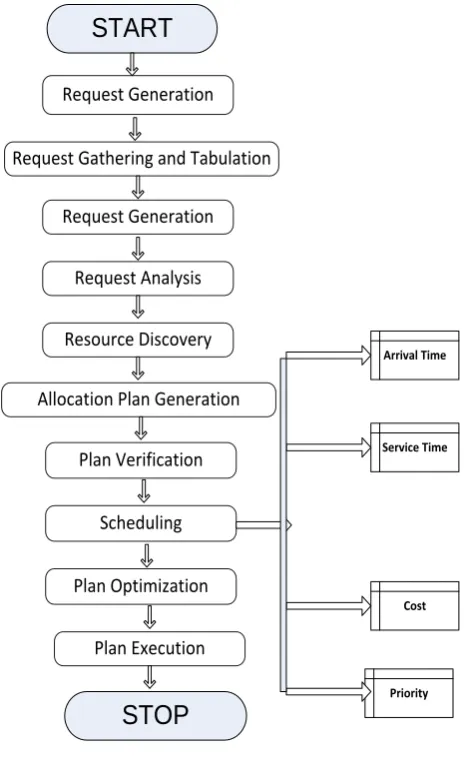
Here in this paper, we have proposed an algorithm, namely RDSA for resource allocation, and therefore resulting in resource management. RDSA stands for resource Request, resource Discovery, resource Scheduling and resource Allocation. The system model, data structure used in the algorithm and the proposed algorithm are as follows: System Model:
There are „n‟ number of end users. There are „m‟ number of resource types. There are „p‟ number of resource providers.
A resource type can be supplied/provided by any „k‟ number out of „p‟ providers, where k ≤ p
Query generated by an end user is in a format of a three-column tuple, Q (Uid, Rid, Tq)
Request generated by an end user is in a format of a three-column tuple, R (Uid, Rid, Tr)
Where,
Uid is the unique ID of an end user, Rid is the ID of the resource,
Tq is the timestamp of generated query
Tr is the timestamp of request made by end user.
Flowchart:
Data Structure Used in the Algorithm:
Resource Request Table (RRT): Resource Request Table (RRT) is maintained, that keeps the track of all the requests made by the end users. RRT is a table with a four-tuple record, of the form (Uid, Rid, Tr, St).
Where:
International Journal of Innovative Technology and Exploring Engineering (IJITEE) ISSN: 2278-3075, Volume-9 Issue-2, December 2019
Rid depicts Resource ID, and
Tr or Tq depicts timestamp of request. St depicts the time of service
Resource Query Table (RQT): Resource Query Table (RQT) is maintained, that keeps the track of all the queries made by the end users. RQT is a table with a four tuple record, of the form (Uid, Rid, Tq , St).
Where:
Uid depicts unique ID of User. Rid depicts Resource ID, and Tq depicts timestamp of query. St depicts the time of service
Resource Allocation table (RAT): Resource Allocation table (RAT) is a matrix of „m‟ X 5 dimensions. This is maintained to keep the track of available resources. The table is represented by five-tuple record, (RN, Rid, RPid, Pid, S)
Where:
RN depicts Resource Name. Rid depicts Resource ID,
RPid stands for the ID of Resource Provider, and S stands for status of resource, its value is 1 if the resource is available and
0 if resource is already scheduled and -1 if resource has been already allocated.
On the arrival of new service provider, it can be added to the system after verifying its configurations. The configuration of incoming resource should match the current technology measures. These measures may include durability of resource, feasibility of its usage. Scalability of the resource
provider is also one of the major constraints to be checked before its integration into the system.
Whenever a new resource provider enters into a system, it updates all its resource availability into this RAT.
Similarly, if a resource is unavailable or has been allocated to any resource requestee(end-user), the event will be updated in the table.
Algorithm:
1. Client generates request for specific resource, or generates a query about the availability of the required resource. 2. Resource manager gathers all the requests and queries,
and tabulates them accordingly.
3. Next step is to analyze the requests and queries generated by all the end users. The output of this analysis phase is requirement report. All the requirements are identified and classified dynamically.
4. As soon as requirements are identified, the resources are discovered in the complete system by searching the resources in Resource Allocation Table (RAT).
5. After knowing the availability, a plan is made to allocate the resources to the end users. The plan is modelled where the required resources are assumed to be allocated to the end users.
6. The plan is then verified according to the client‟s requirements. It is checked whether the system is delivering the same resource as requested by the end user. 7. After verification the plan is used to schedule the
resources.
8. After scheduling, the plan is again optimized for efficient use of resources as well as to minimize the response time to the end user.
9. Optimized plan is then implemented and resources are allocated to the end users according to the plan. This allocation can be done on the basis of any strategy:
On the Basis of Arrival Time:
The timestamps of all the requests for a resource can be analyzed from RRT. The user whose request timestamp is smallest, will be allotted with the required resource. After this allocation RRT as well as RAT, both will be updated accordingly.
On the basis of Service time:
Here, the all the current requests are analyzed and the request with smallest service time, is allocated with the resource.
On the basis of Costing Factor:
In some cases, the allocation can be done on the basis of costing factor. The request paying high for a service, can be served prior to the one paying less for the same service.
On the basis of predefined or dynamic Priority If there are two or more than two requests for the same resource, the request with the higher priority will be served first. The priority can be a predefined number or can be set dynamically. Priority can be set on the basis of type of request, the service time, the payment, the arrival time.
START
Request Generation
Request Gathering and Tabulation
Request Generation
Request Analysis
Resource Discovery
Allocation Plan Generation
Plan Execution Plan Optimization
Scheduling Plan Verification
STOP
Arrival Time
Service Time
Cost
[image:3.595.47.282.49.435.2]Priority can also be defined on the basis of political, economic and managerial influences.
10. Once the allocation is complete, the complete system including both new dynamic requirements and already allocated resources, are monitored.
11. The resources that are allocated to the requesting users, are then updated in Resource Allocation Table (RAT).
12. The resources are being used by the end users and are maintained by the resource manager for their efficient use in future. If the resource or the service are destructed intentionally by service provider or unintentionally due to some failures, then it must be reported back to the service provider.
IV. ANALYSISOFTHEPROPOSEDRDSA
ALGORITHM
Any scheduling algorithm can be analysed on the basis of some specific criteria. A scheduling algorithm must follow some specific criteria to be proved as an efficient one. The criteria are namely
Demand driven allocation Fairness
Resource Tracking System Updation
According to the above algorithm, all the requests and queries are first gathered and analysed. On the basis of requests made by end user, an allocation is made, therefore, algorithm is proved to be demand- driven.
the first strategy used in resource allocation is FCFS. Allocating resource to the user arriving first is a fair manner of allocation. Therefore, the above algorithm is a fair one.
After allocation and release of a resource, every change is tracked so as to make it possible to judge the availability or non-availability of a resource.
Whenever an allocation is made by the algorithm, or a release takes place the data structure named RAT (Resource Allocation Table) is updated. It can be accomplished by modifying the value of a tuple named status in following way:
S stands for status of resource, its value is 1 if the resource is available and 0 if resource is already scheduled and -1 if resource has been already allocated.
III. VII.CONCLUSION
One can face many obstacles when building a smart city. Such challenges include technical, social, and finance as well as challenges in governance. Once a city is developed as a smart city, retaining its smartness while maintaining the quality of service is the main challenge. This quality of service can be calculated with a decreased number of resources as an improved throughput. Therefore, when running a smart city, load management as well as load balancing is an unavoidable obstacle. Our research is focused on a specific challenge, i.e. resource allocation of resources in an IoT environment. Our main contribution is an algorithm for resource allocation in an IoT environment. The proposed
RDSA (Request-Discovery-Scheduling-Allocation)
algorithm is based on the different ways of making decisions
during resource scheduling. This resource scheduling is based on request and discovery of various resources in the IoT environment. After scheduling efficiently with one way or the other, the algorithm allocates the resources to various users. This algorithm is a fair and efficient algorithm. It can further be extended to dynamic allocation of multiple resources among various users.
REFERENCES
1. Vongsingthong, Suwimon, and Sucha Smanchat. "Internet of things: a review of applications and technologies." Suranaree Journal of Science and Technology 21, no. 4 (2014): 359-374
2. Perera, Charith, Chi Harold Liu, and Srimal Jayawardena. "The emerging internet of things marketplace from an industrial perspective: A survey." IEEE Transactions on Emerging Topics in Computing 3, no. 4 (2015): 585-598
3. Matta, Priya, Bhaskar Pant, and Minit Arora. "All you want to know about Internet of Things (IoT)." In 2017 International Conference on Computing, Communication and Automation (ICCCA), pp. 1306-1311. IEEE, 2017
4. Baraniuk, Richard G. "More is less: signal processing and the data deluge." Science 331, no. 6018 (2011): 717-719.
5. Hendricks, Drew. "The Trouble with the Internet of Things." London Datastore. Greater London Authority. Retrieved 10 (2015).
6. Chen, Shanzhi, Hui Xu, Dake Liu, Bo Hu, and Hucheng Wang. "A vision of IoT: Applications, challenges, and opportunities with china perspective." IEEE Internet of Things journal 1, no. 4 (2014): 349-359. 7. Lee, In, and Kyoochun Lee. "The Internet of Things (IoT): Applications, investments, and challenges for enterprises." Business Horizons 58, no. 4 (2015): 431-440.
8. Taivalsaari, Antero, and Tommi Mikkonen. "A roadmap to the programmable world: software challenges in the IoT era." IEEE Software 34, no. 1 (2017): 72-80.
9. Mijić, Dejan, and Ervin Varga. "Unified IoT Platform Architecture Platforms as Major IoT Building Blocks." In 2018 International Conference on Computing and Network Communications (CoCoNet), pp. 6-13. IEEE, 2018.
10. Matta, Priya, and Bhasker Pant. "Internet-of-Things: Genesis, Challenges and Applications." Journal of Engineering Science and Technology 14, no. 3 (2019): 1717-1750.
11. Borgia, Eleonora, Danielo G. Gomes, Brent Lagesse, Rodger Lea, and Daniele Puccinelli. "Special issue on" Internet of Things: Research challenges and Solutions"." Computer Communications 89, no. 90 (2016): 1-4.
12. Chiang, Mung, and Tao Zhang. "Fog and IoT: An overview of research opportunities." IEEE Internet of Things Journal 3, no. 6 (2016): 854-864.
13. Waldner, Jean-Baptiste. Nanocomputers and swarm intelligence. John Wiley & Sons, 2013
14. Semasinghe, Prabodini, Setareh Maghsudi, and Ekram Hossain. "Game theoretic mechanisms for resource management in massive wireless IoT systems." IEEE Communications Magazine 55, no. 2 (2017): 121-127. 15. Sundmaeker, Harald, Patrick Guillemin, Peter Friess, and Sylvie Woelfflé. "Vision and challenges for realising the Internet of Things." Cluster of European Research Projects on the Internet of Things, European Commision 3, no. 3 (2010): 34-36.
16. Zhang, Junsheng, and Yunchuan Sun. "Managing resources in internet of things with semantic hyper-network model." In 2012 IEEE 21st International Workshop on Enabling Technologies: Infrastructure for Collaborative Enterprises, pp. 318-323. IEEE, 2012.
17. Brintrup, Alexandra, Tomas Sanchez Lopez, and Marc-Andre Isenberg. "Resource Management in the Internet of Things: Clustering, Synchronization and Software Agents." (2011).
18. Helsinger, Aaron, Michael Thome, and Todd Wright. "Cougaar: a scalable, distributed multi-agent architecture." In 2004 IEEE International Conference on Systems, Man and Cybernetics (IEEE Cat. No. 04CH37583), vol. 2, pp. 1910-1917. IEEE, 2004.
International Journal of Innovative Technology and Exploring Engineering (IJITEE) ISSN: 2278-3075, Volume-9 Issue-2, December 2019
20. Yu, Rong, Yan Zhang, Stein Gjessing, Wenlong Xia, and Kun Yang. "Toward cloud-based vehicular networks with efficient resource management." arXiv preprint arXiv:1308.6208 (2013).
21. Mahmoud, Rwan, Tasneem Yousuf, Fadi Aloul, and Imran Zualkernan. "Internet of things (IoT) security: Current status, challenges and prospective measures." In 2015 10th International Conference for Internet Technology and Secured Transactions (ICITST), pp. 336-341. IEEE, 2015.
22. Wan, Jiafu, Baotong Chen, Muhammad Imran, Fei Tao, Di Li, Chengliang Liu, and Shafiq Ahmad. "Toward dynamic resources management for IoT-based manufacturing." IEEE Communications Magazine 56, no. 2 (2018): 52-59.
23. Gupta, Harshit, Amir Vahid Dastjerdi, Soumya K. Ghosh, and Rajkumar Buyya. "iFogSim: A toolkit for modeling and simulation of resource management techniques in the Internet of Things, Edge and Fog computing environments." Software: Practice and Experience 47, no. 9 (2017): 1275-1296.
24. Caglar, Faruk, Shashank Shekhar, Aniruddha Gokhale, and Xenofon Koutsoukos. "Intelligent, performance interference-aware resource management for iot cloud backends." In 2016 IEEE First International Conference on Internet-of-Things Design and Implementation (IoTDI), pp. 95-105. IEEE, 2016.
25. Chang, Chii, Satish Narayana Srirama, and Rajkumar Buyya. "Internet of things (IoT) and new computing paradigms." Fog and Edge Computing: Principles and Paradigms (2019): 1-23.
26. Persai, Prashant, and Sunil Kumar Katiyar. "Development of Information Evaluation System for Smart City Planning Using Geoinformatics Techniques." Journal of the Indian Society of Remote Sensing 46, no. 11 (2018): 1881-189
27. Jadhav, Digambar, Vaibhav Muddebhalkar, and Laxman Khandare. "Utilization of Resource‟s in IoT." International Journal of Computer Applications 167, no. 3 (2017).
28. Tao, Fei, Ying Cheng, Li Da Xu, Lin Zhang, and Bo Hu Li. "CCIoT-CMfg: cloud computing and internet of things-based cloud manufacturing service system." IEEE Transactions on Industrial Informatics 10, no. 2 (2014): 1435-1442
29. Sarkar, Chayan, et al. "DIAT: A scalable distributed architecture for IoT." IEEE Internet of Things journal 2.3 (2014): 230-239.
30. Khanna, Abhirup, and Rishi Anand. "IoT based smart parking system." In 2016 International Conference on Internet of Things and Applications (IOTA), pp. 266-270. IEEE, 2016.
31. Botta, Alessio, Walter De Donato, Valerio Persico, and Antonio Pescapé. "Integration of cloud computing and internet of things: a survey." Future generation computer systems 56 (2016): 684-700. 32. Monzon, Andres. "Smart cities concept and challenges: Bases for the
assessment of smart city projects." In 2015 international conference on smart cities and green ICT systems (SMARTGREENS), pp. 1-11. IEEE, 2015.
33. Sciancalepore, Vincenzo, Flavio Cirillo, and Xavier Costa-Perez. "Slice as a service (SlaaS) optimal IoT slice resources orchestration." In GLOBECOM 2017-2017 IEEE Global Communications Conference, pp. 1-7. IEEE, 2017.
34. Jia, Xiaolin, Quanshui Lei, Taihua Fan, and Quanyuan Feng. "Multimedia education resources management based on service oriented architecture." In 2013 3rd International Conference on Consumer Electronics, Communications and Networks, pp. 404-408. IEEE, 2013.
35. Kovacs, Erno, Martin Bauer, Jaeho Kim, Jaeseok Yun, Franck Le Gall, and Mengxuan Zhao. "Standards-based worldwide semantic interoperability for IoT." IEEE Communications Magazine 54, no. 12 (2016): 40-46.
AUTHORSPROFILE
Priya Matta received her graduate degree from HNB Garhwal University, Post graduate from IGNOU and GEU, India in 2000, 2003 and 2010. She is currently pursuing Ph.D. in computer science and engineering with Graphic Era University, India. Her current research interests include Internet-of-Things and Information Security. She has 12 publications in top quality international conferences and journals. She is a member of several professional bodies, including CSTA (Association for Computing Machinery), IAENG and IEEE. She is a recipient of the Eminent Research Award (Computer Science & Engineering Engineering) of the Graphic Era University two times.
Dr. Bhasker Pant completed his graduate from M.B. Khalsa College, Indore, post graduate from Barkatullaha University, Bhopal, and doctoral studies at Maulana Azad National Institute of Technology, Bhopal, India in 2000, 2003 and 2012 respectively. He has done significant research work on Data Mining, Machine Learning, and Bioinformatics. His research interest includes Internet-of-Things and soft-computing too. He has 7 doctoral students and supervised more than 20 master‟s students. He has delivered invited talks, guest lectures and presented his research results in various counties like China, Singapore and India. He has more than 40 publications in top quality international conferences and journals. He is holding senior level academic positions the university time to time. He is currently the Dean (Research and Development) in Graphic Era University. He is a recipient of the Eminent Research Award (Computer Science & Engineering Engineering) of the Graphic Era University.