International Journal of Innovative Technology and Exploring Engineering (IJITEE) ISSN: 2278-3075, Volume-9 Issue-1, November 2019
Abstract: In reinforced concrete (RC) frames, the masonry infill walls are used to fill the gaps between the two columns and one horizontal beam which form the single bay. Stiffness of this bay or reinforced concrete frame structure increases by filling the gap between the bays of a structure. The present study investigates that the influence of the infill wall in the vertical irregular tall structure with bottom soft storey and the behavior of (G+14) storey building subjected to seismic load. The study carries different type of models which are regular frame, regular full infilled frame, regular infilled with 15% central opening frame and regular infilled with 15% corner opening frame are analysed. Similarly the same study has been extended for vertical irregular bare frame, inverted vertical irregular bare frame. This study is made for a case applicable to earthquake zone (III), soil type (II) with importance factor (1) and M20 grade of concrete. The analysis is performed using the equivalent static method and response spectrum method as per IS 1893-2016 using E-Tabs 2015 commercially available software. The parameters considered for study are storey displacement, storey drift and base shear. The results obtained for storey displacement and storey drift, in the infilled frame are reduced due to presence of infill wall. However, as expected, the base shear is increased from bare frame to infilled frame.
Keywords: bare frame, Infill wall, storey displacement, storey Drift.
I.INTRODUCTION
Now a day’s natural calamities have become more common due to the imbalance in the nature or it may also be due to the increasing global temperature. Amongst them, earthquake is also one of the most vulnerable, dangerous natural hazards, where both economy and loss of life takes place. Every intellectual know very well that, natural calamity like earthquake cannot be avoided, however an attempt may be made, at least to prevent the curtail quantum of disaster. Earthquake will happen due to sudden emission of energy in earth’s lithosphere, the ground shakes and an earthquake will occur. This energy primarily emerges from stresses built up during tectonic activity between the earth crust and interior of the earth. A large portion of the devastation is because of collapsing of building or damaging of building, thus it is essential to plan the structures to resist, moderate to serious earthquake ground motion depending upon its size and significance of the structure.
Revised Manuscript Received on November 05, 2019.
Shreenath, PG Student, Department of Civil Engineering, PDA College of Engineering Gulbarga-585102, Karnataka India
Email: [email protected]
Dr. Rajendrakumar Harsoor , Professor, Department of Civil Engineering, PDA College of Engineering Gulbarga-585102, Karnataka, India
Email:[email protected]
During an earthquake, the mass is imported by the building, where on the acceleration is imparted by ground distribution. In order to deliver a minimum force, the mass of the building should be as low as possible. Reinforced cement concrete frame with masonry infill walls are popular form of construction in the tallest building in urban and semi urban areas around the world infill structure is formed by constructing infill walls in moment resisting Reinforced cement concrete frames. The infill wall is formed of stones, brick or concrete unit.
In universal, while designing the structure the common practice is to consider the infill wall as non-structural component and the building is designed as framed structure without considering structural action of infill wall. The soft storey effectiveness and presence of infill, in any building, changes the structure, behavior of frame action due to relative changes of stiffness and lateral load distribution mechanism and therefore may induce change in phenomenon like lateral displacement and inter storey drift.
Masonry is normally considered as non-structural element and their stiffness contribution are generally neglected in practice. Such an approach can lead to an unsafe design. The masonry infill wall though considered as secondary element behaves as a constituents part of the structural system. Reinforced concrete frame building with masonry infill wall has been widely constructed for commercial, industrial and multi-storey residential used in seismic region. Masonry infill wall are constructed between beams and columns of the reinforced concrete frame.
II.OBJECTIVES OF STUDY
1. To study the behavior of the vertical irregular tall building due to effect of seismic load and to obtain the Maximum Storey Displacement, Storey Drift and base shear.
2. To study the effect of infill wall in vertical irregular R.C.C frame.
III.METHODOLOGY A. Equivalent static method:
The method of finding the design lateral force is as well known as equivalent static method or seismic coefficient method or linear static method. This method is found to be simplest method as it requires less computational effort and is based on the formulae as per the code of practice. First, the design base shear is computed for the whole given building and then the resulted base shear is distributed all along the height of the building. The lateral force at each floor level is distributed to individual lateral
load resisting elements.
Effect of Infill Wall on Vertical Irregular Tall
Structure
Seismic Base Shear (Vb)
The design seismic base shear (Vb) or the total design lateral
force along any principle direction is computed by using the relation from IS 1893(part 1) page 17 clause 7.2.1
Vb= Ah x W
B. Response spectrum method:
In this method, multiple modes of response of a building to an earthquake are taken into account. The responses of the different modes are combined to provide an estimate of the total response of the structure using the modal combination methods such as,
1.Absolute Sum (ABS) method
2.Square root of Sum of Squares (SRSS) 3.Complete Quadratic Combinations (CQC).
IV.ANALYTICAL MODELLING A) Types of the models:
Model 1: Regular frame with ground soft storey.
[image:2.595.399.495.57.241.2]Model 2: Vertical irregular frame with ground soft storey. Model 3: Inverted vertical irregular with ground soft storey. B) Description of the models:
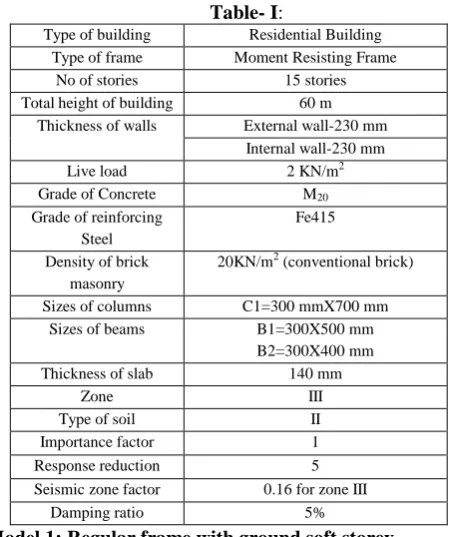
Table- I:
Type of building Residential Building Type of frame Moment Resisting Frame
No of stories 15 stories Total height of building 60 m
Thickness of walls External wall-230 mm Internal wall-230 mm Live load 2 KN/m2 Grade of Concrete M20
Grade of reinforcing Steel
Fe415 Density of brick
masonry
20KN/m2 (conventional brick) Sizes of columns C1=300 mmX700 mm
Sizes of beams B1=300X500 mm B2=300X400 mm Thickness of slab 140 mm
Zone III Type of soil II Importance factor 1 Response reduction 5 Seismic zone factor 0.16 for zone III
Damping ratio 5%
Model 1: Regular frame with ground soft storey
Fig.1. Showing bare frame model
[image:2.595.59.552.274.823.2]Fig.2. Showing infilled frame model
Fig. 3. Infilled frame with 15% central and corner opening
[image:2.595.54.280.303.572.2]Model 2: Vertical Irregular frame with ground soft storey
[image:2.595.244.544.501.833.2]International Journal of Innovative Technology and Exploring Engineering (IJITEE) ISSN: 2278-3075, Volume-9 Issue-1, November 2019
Fig. 5.Infilled Frame With 15% Centre and Corner Model 3: Inverted vertical irregular frame with ground soft store
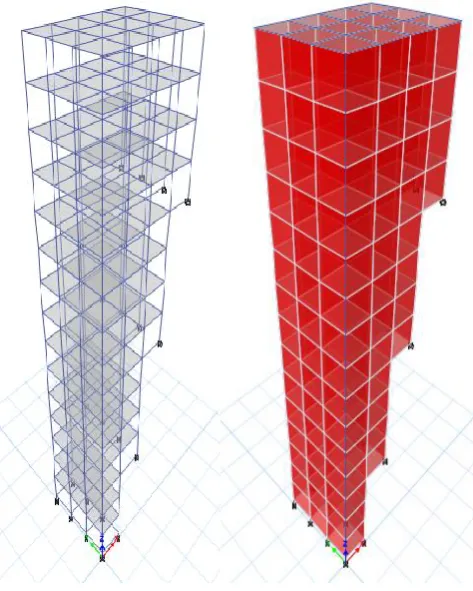
[image:3.595.352.522.82.313.2]Fig. 6. Bare frame and Infilled Frame
Fig. 7. Infilled Frame With 15% Centre and Corner
V.DESIGN DATA Load Calculations:
Wall load B1 = (4-0.5) x0.23x20 = 16.1 KN/m. Wall load B2 = (4-0.4) x0.23x20 = 16.56 KN/m. Dimensions of opening:
Center opening
Dimension of frame =4x4 m = 16m2 15% opening =16x0.15 =2.4m2 Providing square opening =√2.4 =1.55m Bottom distance = (4-1.55)/2 =1.225m Left distance = (4-1.55)/2 =1.225m Corner opening
Dimension of frame =4x4 m = 16m2 15% opening =16x0.15 =2.4m2 Providing square opening =√2.4 =1.55m Bottom distance =0.225m
Left distance =0.225m
VI.RESULTS AND DISCUSSION A. Storey Displacement
i) Regular frame
Fig. 8. Storey Displacement of regular frame obtained by Equivalent Static method in
[image:3.595.48.285.396.692.2]In Equivalent Static method for regular bare frame(Fig. 8), the maximum displacement in X-Direction was found to be 36.8 mm whereas for model 2(Infill Frame) suddenly the displacement is brought down to 10.8 mm X-Direction (i.e. 70.65%) this is due to the presence of infill. In model 3 that infill with 15% square central opening the displacement was found to be 10.9 mm which is little more than that the model 2. In model 4, infill with 15% square corner opening the displacement was found to be 12.8 mm which is greater than model 3 values because the stiffness still reduced. Hence,from the above result for model 3and model 4 having the central square opening and square corner opening will affect the stiffness of the model that makes difference in the value
.
Fig. 9 Storey Displacement of regular frame obtained by Response Spectrum method in X direction In Response Spectrum method for regular bare frame( Fig. 9), the maximum displacement in X-Direction was found to be 23.755 mm whereas for model 2(Infill Frame) suddenly the displacement is brought down to 8.368 mm X-Direction (i.e. 64.77%) this is due to the presence of infill. In model 3 infill with 15% square central opening the displacement was found to be 8.383 mm which is not much more than the model 2. In model 4, infill with 15% square corner opening the displacement was found to be 11.075 mm more than model 3 values. Hence, from the above result for model 3 and model 4 the square central opening and square corner opening will make the difference in the model.
[image:4.595.51.288.229.350.2]i) Vertical Irregular Frame
Fig. 10 Storey Displacement of Vertical Irregular frame obtained by Equivalent static method in X
direction
In Equivalent Static method for regular bare frame( Fig. 10), the maximum displacement in X-Direction was found to be 43.829 mm whereas for model 6(Infill Frame) suddenly the displacement brought down to 9.975 mm X-Direction (i.e. 77.89%) this is due to the presence of infill. In model 7 that
[image:4.595.312.541.308.433.2]infill with 15% square central opening the displacement was found to be 10.893 mm which is little more than that the model 6. In model 8, infill with 15% square corner opening the displacement was found to be 10.942 mm which is greater than model 7 values because the stiffness still reduced. Hence, from the above result for model 7 and model 8 having the central square opening and square corner opening will affect the stiffness of the model that makes difference in the value.
Fig. 11. Storey Displacement of Irregular frame obtained by Response Spectrum method in X direction iii) Inverted vertical Irregulat Frame
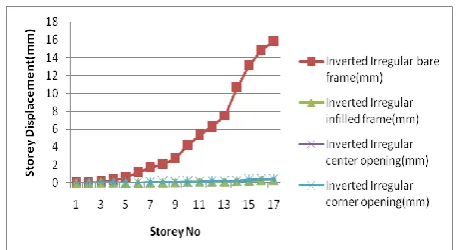
Fig. 12. Storey Displacement of Inverted Vertical Irregular frame obtained by Equivalent static method in X direction In Equivalent Static method for inverted vertical irregular bare frame ( Fig. 12), the maximum displacement in X-Direction was found to be 15.9 mm whereas for model 10 (Infill Frame) suddenly the displacement is brought down to 0.3 mm X-Direction (i.e. 98.11%) this is due to the presence of infill. In model 11 that infill with 15% square central opening the displacement was found to be 0.4 mm which is little more than that the model 10. In model 12, infill with 15% square corner opening the displacement was found to be 0.4 mm which is equal to model 11 values because the stiffness still reduced. Hence, from the above result for model 7 and model 8 having the central square opening and square corner opening will affect the stiffness of the model that makes difference in the value
.
Fig. 13. Storey Displacement of Inverted Vertical Irregular
[image:4.595.46.292.541.680.2] [image:4.595.305.549.623.828.2]International Journal of Innovative Technology and Exploring Engineering (IJITEE) ISSN: 2278-3075, Volume-9 Issue-1, November 2019
Spectrum method in X direction
In Response Spectrum method for inverted vertical irregular bare frame ( Fig. 13), the displacement in X-Direction was found to be 10.955 mm whereas for model 10 (Infill Frame) suddenly the displacement is brought down to 0.309 mm X-Direction (i.e. 97.17%) this is due to the presence of infill. In model 11 infill with 15% square central opening the displacement was found to be 0.42 mm which is more than the model 10. In model 12, infill with 15% square corner opening the displacement was 0.427 mm which is almost nearer to model 11 values. Hence, from the above result for model 11 and model 12 having square the central opening and square corner opening will make difference
.
[image:5.595.302.550.144.290.2]B. Storey Drift i) Regular frame
Fig. 14 . Storey Drift of regular frame obtained by Equivalent Static method in X direction
In Equivalent Static method for regular bare frame (Fig. 14), the drift in X-Direction was found to be 0.00024 whereas for model 2(Infill Frame) suddenly the drift is brought down to 0.00012 X-Direction (i.e. 50%) this is due to the presence of infill. In model 3infill with 15% square central opening the drift found to be 0.00012 which is equal to the model 2. In model 4, infill with 15% square corner opening the drift was found to be 0.0008 which is less than model 3 values. Hence, from the above result for model 3 and model 4 having the square central opening and square corner opening will make difference to the model.
Fig. 15. Storey Drift of regular frame obtained by Response Spectrum method in X direction In Response Spectrum method for regular bare frame
(Fig.
15), the drift in X-Direction was found to be 0.00018 whereas
for model 2(Infill Frame) suddenly the drift is brought down to 0.000088 X-Direction (i.e. 51.11%) this is due to the presence of infill. In model 3 infill with 15% square centralopening the drift was found to be 0.000089 which is equal to the model 2. In model 4, infill with 15% square corner opening the drift is 0.000056 which is almost equal to model 3values. Hence, from the above result for model 3 and model 4 having the square central opening and square corner opening will make difference to the model.
[image:5.595.48.287.238.408.2]ii) Vertical Irregular Frame
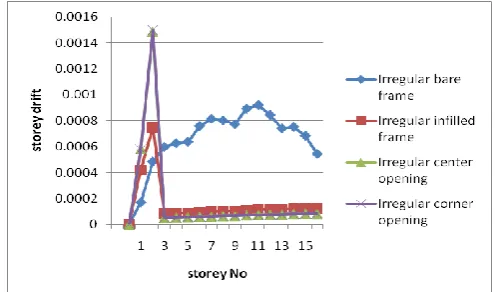
Fig. 16. Storey Drift of Vertical Irregular frame obtained by Equivalent static method in X direction In Equivalent Static method for
v
ertical irregular bare frame(Fig. 16)
, the drift in X-Direction was found to be 0.00054 whereas for model 6(Infill Frame) suddenly the drift is brought down to 0.000121in Y-Direction (i.e. 77.77%) this is due to the presence of infill. In model 7 infill with 15% square central opening the drift found is 0.00013 which is equal to model 6. In model 8 infill with 15% square corner opening the drift 0.000081 which is equal to model 7 values. Hence, from the above result for model 7 and model 8 having the square central opening and square corner opening will make difference in the model.
Fig. 17. Storey Drift of Vertical Irregular frame obtained by Response Spectrum method in X direction
In Response Spectrum method for vertical irregular bare frame (Fig. 17), the drift in X-Direction was found to be 0.00042 whereas for model 6(Infill Frame) suddenly the drift is slowly brought down to 0.000077 X-Direction (i.e. 81.66%) this is due to the presence of infill. In model 7 infill with 15% square central opening the drift was found to be 0.000046 which equal model 6. In model 8, infill with 15% square corner opening the drift is 0.000086 which is equal to model 7 values. Hence, from the
[image:5.595.305.551.462.609.2] [image:5.595.46.287.575.707.2]opening and square corner opening will make difference
[image:6.595.303.551.58.376.2]ii)Inverted vertical Irregular Frame
Fig. 18. Storey Drift of Inverted Vertical Irregular frame obtained by Equivalent static method in X direction In Equivalent Static method for inverted vertical irregular bare frame (Fig. 18), the displacement in X-Direction was found to be 0.000234 whereas for model 10 (Infill Frame) suddenly the drift is brought down to 0.00001 X-Direction (i.e. 95.72 %) this is due to the presence of infill. In model 11 infill with 15% square central opening the drift was found to be 0.000013 which is equal model 10. In model 12, infill with 15% square corner opening the drift is 0.000012 which is equal to model 11 values. Hence, from the above result for model 11 and model 12 the square central opening and square corner opening will make difference.
Fig. 19. Storey Drift of Inverted Vertical Irregular frame obtained by Response Spectrum method in X
direction
In Response Spectrum method for inverted vertical irregular bare frame, the drift in X-Direction was found to be 0.000167 whereas for model 10 (Infill Frame) suddenly the drift is brought down to 0.000011 X-Direction (i.e. 98.15%) this is due to the presence of infill. In model 11 infill with 15% square central opening the drift found is 0.000004 which slightly more the model 10. In model 12, infill with 15% square corner opening the drift is 0.00004 which is slightly more than model 11 values. Hence, from the above result for model 11 and model 12 having the square central opening and square corner opening will make difference.
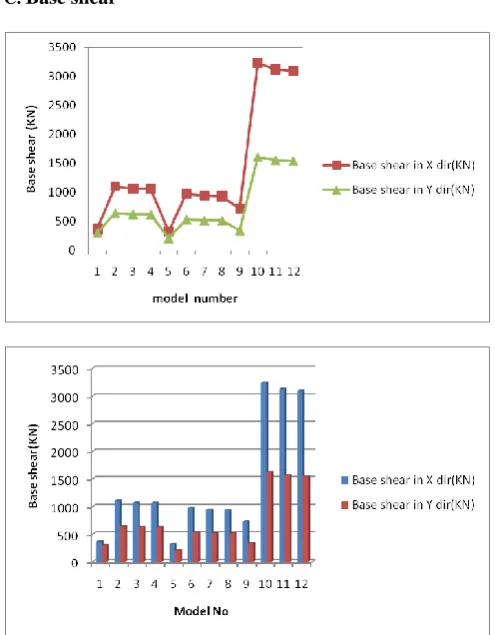
[image:6.595.47.281.108.283.2]C. Base shear
Fig. 20.Base Shear obtained by Equivalent static method
[image:6.595.305.548.412.721.2] [image:6.595.47.290.442.618.2]International Journal of Innovative Technology and Exploring Engineering (IJITEE) ISSN: 2278-3075, Volume-9 Issue-1, November 2019
It is observed that presence of infill wall, the base shear of the regular infilled frame increased by 51.6% to 64.30% by both the method.
The presence of infill wall, the magnitude of the base shear of the irregular infilled frame is increased by an amount of 58.7% to 66.94% when compared to vertical irregular bare frame.
The presence of infill wall, the magnitude of the base shear of the inverted irregular infilled frame is increased by an amount of 77.53%, to 82.36% when compared to inverted vertical irregular bare frame.
Consequently, the openings in the infill wall resulted in decrease in base shear.
VII.CRITICALOBSEVARTIONS
From the result and discussion the following critical observations are drawn
1. The presence of infill wall, the magnitude of the lateral displacement (obtained by both Equivalent static method and Response spectrum method) of the regular infilled frame are reduced by an amount of 64% to 70.65% when compared to regular bare frame.
2. The presence of central opening in infill wall, the lateral displacement of the regular frame is increased by an amount of 0.4% to 0.99% by both Equivalent static method and Response spectrum method when compared to fully infilled regular frame.
3. Presence of opening both at centre and corner in the infill wall are also been observed carefully, it is found that the lateral displacement of the frame, having corner opening is increased by an amount of 14.84% to 24.3% by both Equivalent static method and Response spectrum method when compared to central opening..
4. Due to the presence of infill wall, the lateral displacement of the infilled frame is reduced by an amount of 77% to 78.5% (by both Equivalent static method and Response spectrum method) when compared to vertical irregular bare frame.
5. It is observed that the presence of central opening in infill wall, the lateral displacement of the vertical irregular infilled frame is increased considerably, by an amount of 2.06% to 8.42% (analysed by both Equivalent static method and Response spectrum method) when compared to fully infilled vertical irregular frame.
6. Presence of opening both at centre as well as corner in the infill wall are also been observed carefully, it is found that the lateral displacement of the frame, having corner opening is increased by an amount of 0.2% to 0.4% by both Equivalent static method and Response spectrum method when compared with central opening.
7. Due to the presence of infill wall, the lateral displacement of the infilled frame is reduced by an amount of 98.11% to 98.95% both Equivalent static method and Response spectrum method when compared to inverted vertical irregular bare frame.
8. Similarly, the presence of central opening in infill wall, the lateral displacement of the inverted vertical irregular infilled frame is increased by an amount of 20% to 40% both Equivalent static method and Response spectrum method when compared to fully infilled frame.
9. Presence of opening both at centre as well as corner in the infill wall is also been observed carefully, it is found that the lateral displacement of the frame, having almost equivalent value in both Equivalent static method and Response spectrum method.
10. Due to the presence of infill wall, the storey drift of the regular infilled frame is reduced by an amount of 50% to 71.42% by both Equivalent static method and Response spectrum method when compared to regular bare frame. 11. The storey drift resulting both in case of in infill wall with
central opening and corner frame are almost equivalent, when analysed by both Equivalent static method and Response spectrum method.
12. When compared to vertical irregular infilled frame and Vertical irregular bare frame, the storey drift of the irregular infilled frame is reduced by an amount of 71.93% to 81.66% due to the presence of infill wall. (Analysed by both Equivalent static method and Response spectrum method)
13. Due to the presence of infill wall, the storey drift of the inverted verticalirregular infilled frame is reduced by an amount of 95.72% to 98.15% both Equivalent static method and Response spectrum method when compared to inverted vertical irregular bare frame.
14. It is observed that presence of infill wall, the base shear of the regular infilled frame increased by 51.6% to 64.30% by both the method when compared to regular bare frame.
15. Due the presence of opening (centre to corner) in infill wall, the base shear of the regular frame is decrease by an amount of 2.6% to 3.85% by both methods when compared to fully infilled regular frame.
16. The presence of infill wall, the magnitude of the base shear of the vertical irregular infilled frame is increased by an amount of 58.7% to 66.94% when compared to vertical irregular bare frame.
17. Due the presence of opening (centre to corner) in infill wall, the base shear of the irregular frame is decrease by an amount of 2.68% to 4.36% by both methods when compared to fully infilled vertical irregular frame. 18. The presence of infill wall, the magnitude of the base
shear of the inverted vertical irregular infilled frame is increased by an amount of 77.53%, to 82.36% when compared to inverted vertical irregular bare frame. 19. Due the presence of opening (centre to corner) in infill
wall, the base shear of the inverted vertical irregular frame are reduced by an amount of 3.02%, to 5.03% by both Equivalent static method and Response spectrum method when compared to fully infilled inverted vertical irregular frame.
VIII.CONCLUSIONS
From the critical observation made above the following conclusions were drawn.
1. It is concluded that the lateral displacement of the regular bare frame are reduced by 64% to 70.65% by providing of infill in the frame.
3. The lateral displacement of the inverted verticalirregular infill frame are get reduced by 98.11 % to 98.95% when compared with lateral displacement of inverted irregular bare frame.
4. The storey drift of the regular infilled frame are reduced by an amount of 50% to 71.42% when compared to regular bare frame.
5. The variation in the storey drift of the vertical irregular infilled frame is found to be less by an amount of 71.93% to 81.66% when compared to irregular bare frame 6. It is found that the presence of infill wall, the storey drift
of the inverted vertical irregular infilled frame is reduced by an amount of 95.72% to 98.15% when compared to inverted irregular bare frame.
7. The base shear of the regular infilled frame increased by 51.6% to 64.30% by both the method when compare to regular bare frame.
8. The magnitude of the base shear of the vertical irregular infilled frame is increased by an amount of 58.7% to 66.94% when compared to vertical irregular bare frame. 9. The base shear of the inverted vertical irregular infilled frame is increased by an amount of 77.53%, to 82.36% when compared to inverted vertical irregular bare frame. 10. Similarly, the various type of openings in the infill wall
resulted in decrease in base shear.
REFERENCES
1. C V R murty, Sudhir k jain” Beneficial influence of masonry infill
walls on seismic performance of frame building” 2000
2. Luis decanini, Fabrizio mollaioli,” Seismic performance of masonry infilled reinforced concrete frames” 2004
3. Saimak satter, Abbie B. liel,” Seismic performance of reinforced concrete frame structures with and without infill walls” 2010
4. Haroon Rasheed Tamboli, Umesh karadi,” Seismic analysis of RC frames structure with and without infill walls” ISSN 976-0977, volume 3 October- 2012.
5. Nikhil agrawal,prof.P.B Kulkarni,pooja Raut, ”Analysis of masonry infilled R.C frame with and without opening including soft storey of symmetric building” ISSN 2320-3153,Volume 8,issue 1,2013.
6. Nikhil agrawal,prof.P.B Kulkarni,pooja Raut, ”Static Analysis of
masonry infilled R.C frame with and without opening including soft storey by using Equivalent Diagonal Strut Method” ISSN 2250-3153,Volume 3,issue 9,2013.
7. Lila M.Abdel-Hafez, A.E.Y Abouelezz, “Behavior of masonry
strengthened infilled reinforced concrete frames under in-plan load” 2014
8. Ayman Abd-Elhamed, Sayed Mahmud, “Effect of Infill Walls on Response of Multi Storey Reinforced Concrete Structure”
Volume: 9, No: 5, 2015.
9. Raj Paudel1, Santosh Kumar Adhikari, “Effect of Masonry Infill’s on Seismic Performance of RC Frame Building” Volume. 4, Issue
8, August2015.
10. OmanSayyed, Suresh Singh Kushwah, Aruna Rawat “Effect of Infill and Mass Irregularity on RC Building under Seismic Loading”
e-ISSN: 2395 -0056 Volume: 04Issue: 02 | p-ISSN: 2395-0072, Feb
-2017.
11. Tanushri Mahajan, Prathamesh Musale, Shivkumar Hallale, Vaishnavi Mahajan, Snehal Barapatre, “Seismic analysis of plan and vertical irregularity of building with and without infill action using ETABS” ISSN: 2454-132X ,Impact factor: 4.295 ,Volume 4, Issue 3,2018.
12. Dr.satish B.Allampallewar, Shubham M.Adkar,” Impact of masonry
infill walls on the seismic response of G+7 RC building” ISSN 2394-3386,volume-5,iissue-3,2018.
AUTHORS PROFILE
Shreenath, PG Student, Department of Civil Engineering, PDA College of Engineering Gulbarga Karnataka, India.585102
Email:
Mobile: +918494867073
Dr. Rajendra kumar Harsoor,
Professor, Department of Civil Engineering, PDA College of
Engineering Gulbarga Karnataka, India.585102
Email: [email protected]