Published By:
Abstract: Focus of the paper is to explore the behavioural characteristics of recycled aggregate concrete shear wall using SAP2000. In India, earthquakes are becoming threats to the human being and sequentially construction waste has been increasing due to the fast development of construction industries. According to a survey, 7 to 8 million tons of concrete demolition wastes are produced in India. This study focuses on the potential use of recycled waste aggregate in development of reinforced concrete shear wall. The appropriateness of result is constrained by the kind of divider and parameter subspace. Various disappointment modes can happen contingent upon parameter, for example, a sort of cross-segment, support itemizing and amounts, properties of strengthening steel, concrete compressive quality and limit condition. Complex ruinous wonders incorporate solid splitting, cooperation impact among steel and solid, steel yielding and solid squashing in pressure under non-straight powerful investigation. At long last, the reused total solid shear divider can continue the seismic plan necessity of a structure.
Keyword: SAP2000, recycled aggregate concrete (RAC), seismic analysis, non-linear dynamic analysis.
I.
INTRODUCTION
Today, seismologist in many countries of the world is on the
lookout for reliable techniques that would enable them to
forecast the location, time and strength of earthquake. With
such techniques put in our possession, explosive or fire
hazardous processes and to evacuate people from building.
Besides, to keep people under canvas for long time is
acceptable in warm climate only. The earthquake hazard was
neglected at the time of construction and damage to
non-earthquake resistant structure was total. The exercise
instructed from the harms because of seismic tremor and the
examination work being done in the research facilities give
better comprehension about the structure and their parts.
Revised Manuscript Received on October 22, 2019.
R. Chitra, Asistant Professor, Department Of Civil Engineering,,Bharath Institution of Higher Education And Research,TamilNadu, India Email: [email protected]
Shruthi M V, Asistant Professor,,Department Of Civil Engineering,,Bharath Institution Of Higher Education And Research,TamilNadu, India .Email: [email protected]
Rinu Isah, Asistant Professor,,Department Of Civil Engineering,,Bharath Institution Of Higher Education And Research,TamilNadu, India .Email: [email protected]@gmail.com
Harm in reused total solid structure was mostly respected to
the deficient specifying of support, absence of vertical steel
and repression of cement in basic component. Run of the mill
disappointment was weak in nature, exhibiting lacking ability
to disperse and retain inelastic vitality. This requires a
superior comprehension of the plan and specifying of fortified
solid structure under different stacking. To carry out these
process, the SAP2000 extends the capabilities by adding a
nonlinear element , a multilinear plastic hinge for use in frame
element , cable behavior, geometric effect, including
pushover analysis , non linear time history analysis by modal
superposition or direct integration buckling analysis ; and
frequency domain – analysis.
II.
REVIEW
OF
LITERATURE
Norio et al (1997) introduced a paper on numerical method
for dynamic non-direct limited component examination is
proposed to break down 3-D strengthened solid shear divider
structure exposed to seismic tremor movement. The
demonstrated shear divider is semi 3-D structure which is
made out of plane component considering the in-plane
solidness of symmetrical rib boards. The test outcomes are
performed one of the dynamic model test for assessment of
seismic conduct of atomic reactor building. Qiuhongzhao
(2004) researched on composite shear divider framework
which is utilized as horizontal opposing framework in
elevated structure .the example had the option to withstand
33cycle of example removal and it arrives at the most extreme
bury story float more than 0.05. The outline of this
exploration is during plate cycle and after shear yielding of
the steel plate, inelastic nearby clasping of the steel plate and
inelastic neighborhood clasping of the steel plate shear
divider happened in territory between the jolts. Suchitatuppad
(2005) displayed a paper on use of programming for ideal
situating of fortified solid shear divider in a multi story
structure exposed to seismic conduct. The primary point of
this work is to limit the parallel uprooting of the multi story
working with shear divider exposed to seismic tremor load.
A.
Goal of study The most important objective of present
study includes:
Behaviour of Structural Shear Wall with
Recycled Aggregate Concrete using Sap2000
To identify the behavioural characteristic of RAC shear
wall during a seismic loading using non-linear dynamic
analysis.
To understand the effectiveness of Recycled Aggregate
Concrete during a seismic behaviour.
III.
E
XPERIMENTAL STUDY ONRAC
[image:2.595.332.519.306.694.2]The aim of the paper is to compare the basic properties of
natural aggregate concrete (NAC) and the properties of 25%
recycled aggregate concrete (RAC). Coarse aggregate are the
most mined material in the world. Coarse aggregate are a
component of composite material such as concrete and
asphalt concrete; the aggregate serves as reinforcement to add
strength to the overall composite material. Gravel of size
12mm is sieved and used in this research. Table -1 and Table
-2 shows the physical properties and mechanical properties of
both RAC and NAC (natural aggregate concrete) respectively
was determined as per IS2386(1963) part-1.[1]-[6]
[image:2.595.51.276.322.709.2]Table -1 Physical Properties of NAC and RAC
Table – 2 Mechanical Properties of NAC and RAC
IV.
M
ODELLING AND ANALYSISThe current work includes the comparative study of
RAC and NAC six storey shear wall in zone IV is analyzed
using SAP 2000. Seismic analysis is done using equivalent
lateral force method.
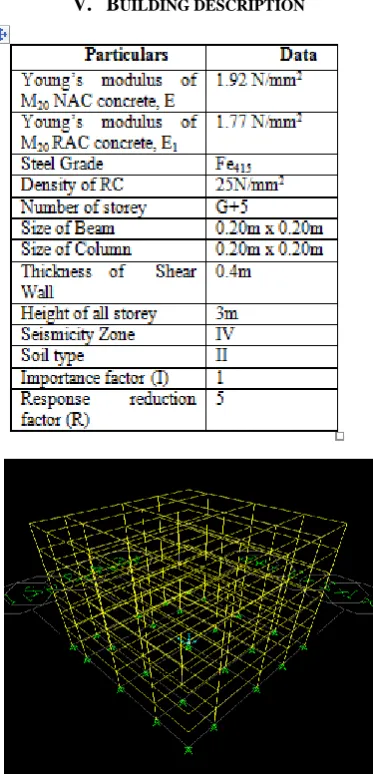
For this work, G+5 storey building with 3m height for every
storey is taken. Building has four bays of 5m width in both X
and Y direction building material properties are given below.
In this work, the behavior of RAC structure and NAC
structure is taken as objective function. The objective
function of the work is to know the effectiveness of RAC
during a seismic behavior
The input for genetic algorithm are programmed as,
In –plane element component behavior is non-linear
Out of plane element component behavior is linear
Stiffness reduced to 75% to exclude the effect of cracking
Provide 3% confined element for boundary element at
bottom of the floors
Provide 0.4% unconfined element for in-between boundary
element at the bottom floors
Provide 0.3% of unconfined element for top floor /
remaining floors
Non-linear direct integration history has scale factor of
32.2. [7]-[12]
V.
B
UILDING DESCRIPTIONPublished By:
Fig2: location of shear wall for framed structure
Fig3: framed building with material data inputted.
VI.
R
ESULTA.
Deformed shape for framed building
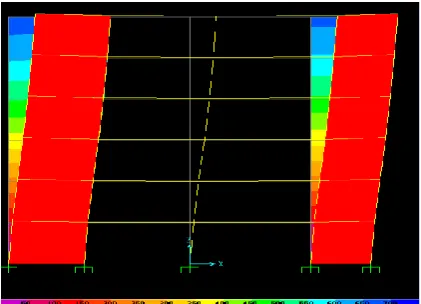
The representation of the maximum response of idealized
SDOF system having certain period and damping. The fig.a
and fig.b. represent the deformed shape of shear wall building
which contains RAC and NAC material respectively. From,
the figure it’s found that the response spectrum of NAC
building shows 196 range with scale factor of 32.2. Whereas
RAC building shows 350 range with the same scale
factor[13]-[21]
[image:3.595.321.532.55.207.2]Fig4. deformed shape of building with NAC
[image:3.595.326.529.240.414.2]Fig 5. deformed shape of building with RAC
[image:3.595.325.526.443.632.2]Fig .6. deformed shape of building with NAC-uplift force
acting on it.
Fig.7. deformed shape of building with RAC-uplift force
acting on it
[image:3.595.64.272.562.705.2]B.
Model mass for framed building
Fig.8. modal mass representation of NAC
Fig.9. Modal mass representation of RAC
The modal mass for give mode = 6 has a unique value for
NAC building structure of 41.33 sec and RAC building
structure of 45.77 sec with irrespective of scaling factor
C.
Relative virtual work/volume of framed building
Fig.10. and fig.11 represent the relative virtual work/
volume of structure
Fig.10. relative virtual work/ volume of NAC building.
Fig11. relative virtual work / volume of RAC building.
From the fig.11 and fig12 shows that the relative
displacement of other level from one level above of RAC
building increases when compared to NAC building.
D.
Shear stress of framed building
According , IS 13920:1993 if the factored shear stress in the
wall exceed 0.25√fck , reinforcement shall be provided in
curtains, each having bars running in the longitudinal and
transverse direction in the plane of the wall. [22]-[28]
Fig.11. shear stress of NAC framed building
Fig.12 shear stress of RAC framed building.
Fig.11. and fig.12 represent the shear stress of RAC and NAC
of framed building. From these two figures its noted the two
structure is within the factored shear stress but the range of
shear stress of RAC framed building is higher than the NAC
framed building.[29]-[34]
VII.
C
ONCLUSIONBased on the above result from the analysis of RAC and NAC
building models, the following conclusions are made,
The analytical research has found the RAC and NAC
building structure shown insignificant strength degradation
and reasonable stability of stiffness.
Increased value of physical properties in RAC is due to
attached mortar and cement paste in the RAC.
The compressive strength of RAC is relatively lower up to
10% of the NAC
The deformed shape of RAC and NAC at mode=6 it is seen
that the time period taken by RAC is much higher than NAC
structure
.
REFERENCES
Published By:
2. Kumar J., Sathish Kumar K., Dayakar P.,Effect of microsilica on high strength concrete, International Journal of Applied Engineering Research,V-9,I-22,PP-5427-5432,Y-2014.
3. Dayakar P., Vijay Ruthrapathi G., Prakesh J., Management of bio-medical waste, International Journal of Applied Engineering Research,V-9,I-22,PP-5518-5526,Y-2014.
4. Swaminathan N., Dayakar P., Resource optimization in construction project, International Journal of Applied Engineering Research,V-9,I-22,PP-5546-5551,Y-2014.
5. Venkat Raman K., Dayakar P., Raju K.V.B.,An experimental study on effect of cone diameters in penetration test on sandy soil, International Journal of Civil Engineering and Technology,V-8,I-8,PP-1581-1588,Y-2017.
6. Saritha B., Chockalingam M.P.,Photodradation of malachite green DYE using TIO2/activated carbon composite,International Journal of Civil Engineering and Technology,V-8,I-8,PP-156-163,Y-2017 7. Shendge R.B., Chockalingam M.P., Saritha B., Ambica A.,Swat
modelling for sediment yield: A case study of Ujjani reservoir in Maharashtra, India,International Journal of Civil Engineering and Technology,V-9,I-1,PP-245-252,Y-2018
8. Chockalingam M.P., Balamurgan V.,Modernisation of an existing urban road-sector in Chennai, a case study report,International Journal of Civil Engineering and Technology,V-8,I-8,PP-1457-1467,Y-2017
9. Saritha B., Chockalingam M.P.,Adsorption study on removal of basic dye by modified coconut shell adsorbent, International Journal of Civil Engineering and Technology,V-8,I-8,PP-1370-1374,Y-2017 10. Saritha B., Chockalingam M.P.,Adsorptive removal of heavy metal
chromium from aqueous medium using modified natural adsorbent,International Journal of Civil Engineering and Technology,V-8,I-8,PP-1382-1387,Y-2017
11. Chockalingam M.P., Palanivelraja S.,Retrospective analysis of a theoretical model used for forecasting future air quality near the north Chennai thermal power plant,International Journal of Civil Engineering and Technology,V-8,I-8,PP-1457-1467,Y-2017 12. Saritha B., Chockalingam M.P.,Photodegradation of methylene blue
dye in aqueous medium by Fe-AC/TiO2 Composite,Nature
Environment and Pollution
Technology,V-17,I-4,PP-1259-1265,Y-2018
13. Shendge R.B., Chockalingam M.P., Kaviya B., Ambica A.,Estimates of potential evapotranspiration rates by three methods in upper Bhima Basin, In Maharashtra, India,International Journal of Civil Engineering and Technology,V-9,I-2,PP-475-480,Y-2018
14. Shendge R.B., Chockalingam M.P.,The soil and water assessment tool for Ujjani Reservoir,International Journal of Mechanical Engineering and Technology,V-9,I-2,PP-354-359,Y-2018
15. Shendge R.B., Chockalingam M.P.,A review on soil and water assessment tool,International Journal of Mechanical Engineering and Technology,V-9,I-2,PP-347-353,Y-2018
16. Sachithanandam P., Meikandaan T.P., Srividya T.,Steel framed multi storey residential building analysis and design,International Journal of Applied Engineering Research,V-9,I-22,PP-5527-5529,Y-2014 17. Meikandaan T.P., Ramachandra Murthy A.,Study of damaged RC
beams repaired by bonding of CFRP laminates,International Journal of Civil Engineering and Technology,V-8,I-2,PP-470-486,Y-2017 18. Meikandaan T.P., Ramachandra Murthy A.,Retrofittng of reinforced
concrete beams using GFRP overlays,International Journal of Civil Engineering and Technology,V-8,I-2,PP-423-439,Y-2017
19. Meikandaan T.P., Ramachandra Murthy A.,Flexural behaviour of RC beam wrapped with GFRP sheets,International Journal of Civil Engineering and Technology,V-8,I-2,PP-452-469,Y-2017
20. Meikandaan T.P., Murthy A.R.,Experimental study on strengthening of rc beams using glass Fiber,International Journal of Civil Engineering and Technology,V-9,I-11,PP-959-965,Y-2018 21. Meikandaan T.P., Hemapriya M.,Use of glass FRP sheets as external
flexural reinforcement in RCC Beam,International Journal of Civil Engineering and Technology,V-8,I-8,PP-1485-1501,Y-2017 22. Saraswathy R., Saritha B.,Planning of integrated satellite township at
Thirumazhisai,International Journal of Applied Engineering Research,V-9,I-22,PP-5558-5560,Y-2014
23. Saritha B., Ilayaraja K., Eqyaabal Z.,Geo textiles and geo synthetics for soil reinforcement,International Journal of Applied Engineering Research,V-9,I-22,PP-5533-5536,Y-2014
24. Ambica A., Saritha B., Changring G., Singh N B., Rajen M., Salman Md.,Analysis of groundwater quality in and around Tambaram taluk, Kancheepuram district,International Journal of Civil Engineering and Technology,V-8,I-8,PP-1362-1369,Y-2017
25. Arunya A., Sarayu K., Ramachandra Murthy A., Iyer N.R.,Enhancement of durability properties of bioconcrete incorporated with nano silica,International Journal of Civil Engineering and Technology,V-8,I-8,PP-1388-1394,Y-2017 26. Ilayaraja K., Krishnamurthy R.R., Jayaprakash M., Velmurugan
P.M., Muthuraj S.,Characterization of the 26 December 2004 tsunami deposits in Andaman Islands (Bay of Bengal, India),Environmental Earth Sciences,V-66,I-8,PP-2459-2476,Y-2012
27. Ilayaraja K.,Morphometric parameters of micro watershed in Paravanar sub-basin, Cuddalore District,International Journal of Civil Engineering and Technology,V-8,I-8,PP-1444-1449,Y-2017 28. Ilayaraja K., Singh R.K., Rana N., Chauhan R., Sutradhar N.,Site
suitability assessment for residential areas in south Chennai region using remote sensing and GIS techniques,International Journal of Civil Engineering and Technology,V-8,I-8,PP-1468-1475,Y-2017 29. Ilayaraja K., Reza W., Kumar V., Paul S., Chowdhary R.,Estimation
of land surface temperature of Chennai metropolitan area using Landsat images,International Journal of Civil Engineering and Technology,V-8,I-8,PP-1450-1456,Y-2017
30. Chitra R.,Experimental study on beam using steel fiber and latex,International Journal of Civil Engineering and Technology,V-8,I-8,PP-1395-1403,Y-2017
31. Chitra R.,Analysis of traffic and management at Kovilambakkam intersection,International Journal of Civil Engineering and Technology,V-8,I-8,PP-1433-1443,Y-2017
32. Aswathy M.,Experimental study on light weight foamed concrete,International Journal of Civil Engineering and Technology,V-8,I-8,PP-1404-1412,Y-2017
33. Aswathy M.,Wastewater treatment using constructed wetland with water lettuce (Eichornia Crasipies),International Journal of Civil Engineering and Technology,V-8,I-8,PP-1413-1421,Y-2017 34. Kiruthiga K., Anandh K.S., Gunasekaran K, Assessment of
influencing factors on improving effectiveness and productivity of construction engineers, 2015, International Journal of Applied Engineering Research, V - 10,I -17,p -13849-13854.
AUTHORS
PROFILE
R. Chitra, Asistant Professor, Department Of Civil Engineering,,Bharath Institution of Higher Education And Research,TamilNadu, India
Shruthi M V, Asistant Professor,,Department Of Civil Engineering,,Bharath Institution Of Higher Education And Research,TamilNadu, India