Rochester Institute of Technology
RIT Scholar Works
Theses Thesis/Dissertation Collections
2-1-2011
Scapes
Masa BajcFollow this and additional works at:http://scholarworks.rit.edu/theses
This Thesis is brought to you for free and open access by the Thesis/Dissertation Collections at RIT Scholar Works. It has been accepted for inclusion in Theses by an authorized administrator of RIT Scholar Works. For more information, please [email protected].
Recommended Citation
SCAPES
By
MAŠA BAJC
THESIS
Submitted in Partial Fulfillment of the Requirements for the Degree of
Master of Fine Arts in Imaging Arts
Rochester Institute of Technology, Rochester, NY
February, 2011
Patricia Ambrogi, Chair Date
Jessica Lieberman, Committee Advisor Date
ACKNOWLEDGMENTS
I would not be writing this had it not been for the support of my amazing family. Thank you for sharing this great adventure and all the special moments we spent on video chat.
A big thank you from the bottom of my heart goes to my committee members, who were ever patient and most of all believed I could pull it off when I myself had doubts. Patti, Jessica and Alex – you are simply the best!
Last but not least, a special thank you to my dear friends and colleagues: Ratna, Rosa, Fabi, Providencia and Chas, without you it would be hard to imagine putting up the show and having such a great opening; Alysia, Alex and Chris, you made the installation happen (and Chris rocked the dance floor); Pavel, you kept me sane from the start; Daniel, our conversations helped ideas move as you sometimes understood what I was doing better than I did, ; and Grant, you selflessly took time to proof read and gave me that last push to finish.
Thanks for being there for me, you bring me so much joy!
SCAPES
By
Maša Bajc
ABSTRACT
Scapes examines the experience of the oneiric landscape conceived through the place of the artwork. Created photographs, videos and the installation are regarded as places that blend the inner space with the outer. Fukei, the Japanese concept of
landscape, serves as a framework through which I explore the idea of a personal engagement with a place, and its relationships to the conceptions of space and landscape. Influenced by the philosophy of Gaston Bachelard, space is viewed as an expansion of one’s intimate being. The thesis also addresses cross‐disciplinary discourse on the meaning of place and its new found significance within the field of photography and related media.
CONTENTS
List of figures v
List of exhibited works vi
1. Introduction 02
2. The Oneiric Landscape 06
3. A Place to Return To 19
3.1. Place of the Still Image 20
3.2. Place of the Moving Image 24
3.3. Place of the Installation 28
4. Conclusion 31
Bibliography 32
LIST OF FIGURES
1.1. Scape No.01, 2008 01
2.1. Scape No.09, 2009 05
2.2. Conceptual framework of Scapes
09
2.3. Hiroshi Sugimoto, Sea of Japan, Oki V, 1987 13
2.4. Scape No. 3, 2008 14
3.1. Scape No.7, 2009 18
3.1.1. Mark Rothko, No.14, 1960 21
3.1.2. Scape No.2, 2008 22
3.2.1. Video stills from Treescape, 2010 25
3.2.2. Scapes, exhibition view, Rochester, 2010 26
3.3.1. Installation No.1, 2010 27
3.3.2. James Turrell, Gap from the ‘Tiny Town’ series, 2001/2006. 28
LIST OF EXHIBITED WORKS
1. STILL IMAGES
Scapes, 9 untitled photographs, 20082010
Dye ink print on archival matte paper, 46x32”
2. MOVING IMAGES
2 video projections, min. 9 ft wide
1. Unitled (Lakescape), 2010, 2 min loop,1080x720
2. Untitled (Treescape), 2010, 12 min loop, 1080x720
I. INTRODUCTION
Halfsubmerged in water I face the sky, eyes fixed in infinity, the rest engulfed in
silence of a higher density. I find myself floating in a place where two worlds meet. I
am a part of both, belonging to neither, someplace in between. On the horizon perhaps.
It must be, as it escapes my sight completely. Unless I tilt my head and trace the
remainder of the line enclosing a now distorted view. Once I am perfectly still again, it
is no longer there. Nothing but the quietness of the vast space blending with my own. A
place to return to; a place of a reverie.
The written and visual parts of this thesis aim to explore both the place of an
artwork and its ability to generate the experience of an oneiric landscape1. In
addressing the idiosyncrasies of a place, its relationships to the conceptions of space
and landscape are examined. Through mediums of photography, video and
installation, I create places that blend the inner world (interior to the body) with the
outer (exterior to the body), thereby eliciting the subjective view and intimate
engagement with a place. Personal involvement and a higher degree of subjectivity
seem to be more inherent in some of the Japanese concepts of a landscape and less
1 I borrow terms “oneiric landscape” and “intimate immensity” from Gaston Bachelard, Water and
so in its Western counterparts.2 For that reason I utilized the concept of fukei as a
framework for Scapes which enabled me to, in a more coherent manner,
contextualize my view of a space as an expansion of one’s intimate being.
In addressing these issues I found inspiration in the art practices of Yves
Klein, Mark Rothko, and contemporaries like Hiroshi Sugimoto, Roni Horn, Olafur
Eliasson and James Turrell. However, the phenomenological approach to the
experience of a place which I found in the works of humanist geographer Yi‐Fu Tuan
as well as writings on imagination by French philosopher Gaston Bachelard, truly
set the foundation for my research. Complexity of assigning one meaning to a place
is reflected in contemporary discourse across disciplines3, as places we find in us
and around us come with many faces, lacking a definite structure. Bachelard for
example valorized a place as “an ingredient in the productions of poetic
imagination”,4 connecting it with space through, what he called, intimate immensity,
a concept I heavily draw upon.
Ingrained in my work is a “vision of a submerged view”5, one describing a
different spatiality that, just like water, subdues sound and slows down movement.
Deep, dense and infinite. The oneiric landscape emerges from this view that is void
2 Japanese concepts fukei and keikan are examined in relationship to English landscape and German
Landschaft in the following chapter.
3 According to accessed literature and discussions within the fileds of art, humanist geography and philosophy. See Yi‐Fu Tuan, Edward Casey and Helen Westgeest, ed.
4 On Bachelardian view of a place see Edward S. Casey, The Fate of Place: a philosophical history (Berkley, 1997), p.286
of geographical reference to a particular place. In a way it constitutes an escape to a
different kind of reality, to a conception of a place or nature one desires. The
experience of it, however, remains undoubtedly real.6 Comprised of still and moving
images and an installation piece, more than anything else, each Scape is a place, a
point to stop at and leave the rest to imagination.
II. THE ONEIRIC LANDSCAPE
Sterile apartment complex, grey roads, brick city campus and back again. Only a small
patch of seemingly untamed thicket on the way, a little oasis amidst the bleakness of a
daily routine. Just a few miles down the road, grey turns blue as I chill my feet in late
September waters. With a sense of relief, I fade into the void.
The idea of landscape in my work was initially tied to places of tranquility I
sought to find in nature. It seems we escape to different conceptions7 of nature
based on values and meanings we assign to the space around us. But no matter what
our assumptions of the space are and what kind of reality we find ourselves in, we
are always somewhere, in a place. My interest in place is twofold: I question the
emotional engagement we have with a place, and by extension view the space as an
expansion of one’s intimate being. In addition, I am concerned with the part place
takes in the image making process, inherently regarding the image as a place in
itself. This is also true for the place of the installation.
I adopt Yi‐Fu Tuan’s view on the difference between place and space,
conceiving space as being more abstract. I believe we come to know the space
through the inner sense of placement. This is also reflected in Bachelard’s words: “In
intimate immensity I enter space from place itself. I come to the immense from
within rather than on the basis of exteriority… Place is no longer just a delimited
part or portion of space. Space is now wholly immanent in place rather than
reverse.”8 The notion that our sense of space depends on the place emerges from the
evident shift of the universality of space to the particularity of the place9. As
geographer Denis Cosgrove explains, this “spatial” or “cultural turn” in rethinking
space has brought about new convergence between social sciences and humanities.
Relative space is dependant on other processes and objects through which we
convey its meaning and is thus open to interpretations from multiple perspectives
and disciplines. Furthermore, Cosgrove goes on to say, it seems that “capacity to
capture and materialize”10 this relativity lies with the idea of landscape.
I too embraced this approach while working on Scapes. There are several
available definitions of the word scape11 which could theoretically apply to my work.
Firstly, scape is a forming noun denoting a view, picture, or (literal or figurative)
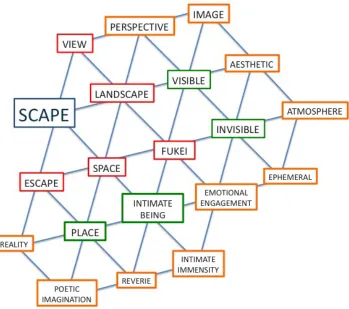
landscape. Both view and landscape, in that sense, connect primarily to visible
structures (see Figure 2.1) that in junction with invisible structures form the basis of
fukei theory which is used as a framework for Scapes and will further be explained
in greater detail.
8 Bachelard quoted in Edward S. Casey, The Fate of Place: a philosophical history (Berkley, 1997), p.294
9 see Edward S. Casey, The Fate of Place: a philosophical history (Berkley, 1997) 10 Denis Cosgrove, Landscape and Landschaft (2004)
Secondly, scape is defined as an act of escaping. In my work, the idea of
escape to a conception of a place moves on from treating escapism as essentially
negative and emphasizes the experience of a different kind of reality. By extension, I
draw away from treating landscape‐image as a mere record of impressions, rather
emphasizing the projection of an experience that is conceived through a personal
engagement with a place.12 Finally, scape is an anagrammatized space, playfully
revealing the subject of inquiry: the way we experience space in us and around us.
12 On relation of self to place see Yi‐Fu Tuan, Escapism (Baltimore, 1998) and Space and place: the
[image:16.612.136.485.119.428.2]
Fig. 2.1: Conceptual framework of Scapes
This figure illustrates how definitions describing a SCAPE branch out into a map of interrelated ideas relevant to conceptual and formal development of my thesis. For example, FUKEI is defined in terms of VISIBLE and INVISIBLE structures as explained in the text. It is also a specific understanding of a LANDSCAPE (and SPACE by extension) characterized by personal involvement attached to the concept (INTIMATE BEING) and EMOTIONAL ENGAGEMENT we have with a PLACE.
The influence of fukei photography on my work, as well as the conceptual
underpinnings of fukei theory within geography, form the theoretical backdrop of
Scapes. I was first introduced to the idea through the metaphysical images of Hiroshi
Sugimoto. Passage of time and remembering the past, as seen in his work , are
essential elements of fukei photography. By privileging place in my discourse, I
slightly drift away from the concept that defines the landscape photograph in terms
of the flow of time. However, time is emergent from space not only in the subjective
sense but even in physics and general relativity.
In the Japanese language fukei is a composite of two characters: FU (風)
meaning “wind” or “flow” and KEI (景) signifying a “view” or a “scape”. While “Fu”
pertains to the invisible structures, such as a feeling or atmosphere, “Kei” stands for
the visible structure of “sun light and shadow”.13 According to Ueda, “fukei is a
phenomenon of dynamic change from “landscape” to “place” through individual
landscape perception”14 and focuses on the individual experience of the land. In his
introduction to fukei photography, Vartianian points to the paradoxical nature of a
landscape that is seen this way: it is a fixed view of something that is always flowing.
Landscape is ever changing and transient in nature.
13 Definitions according to Ivan Vartianian, ed. Writings by Japanese Photographers (New York, 2006) and Ueda (Kassel, 2009)
“Every time I view the sea, I feel a calming sense of security, as if visiting my
ancestral home; I embark on a voyage of seeing.”15, Sugimoto writes about
Seascapes, a series of photographs he has been taking since the 1970s. The still,
abstracted space of water and sky invites us to see and feel both visible and invisible
structures in his work. Facing a visually non‐referential space takes us on an
emotional journey into a psychological realm. This is also true for Alfred Stieglitz’s
Equivalents, images of clouds taken from 1923 to 1931 and perhaps the first
intentionally abstracted series of photographic work. Stieglitz elegantly redefines
photography’s inherited realistic view by using form, shape and color to represent
his own experiences and contemplations. Although there is no certain proof Stieglitz
was directly influenced by Asian art, his work has recently been analyzed in that
context16, pointing to the possibility that his use of abstraction in order to express
emotional states might have been influenced by the ‘new way’ of seeing prompted
by the emerging presence and influence of Asian art on Western art at the time. On
that note, Scapes has been constructed in a dialogue with both Western and Eastern
photographic traditions that employ a certain use of abstraction in transposing
reality. However, in that context, works of Mark Rothko and Yves Klein were critical
and more relevant to my understanding of how the idea of space developed, both
formally and philosophically.17
15 http://www.sugimotohiroshi.com/seascape.html (accessed on November 1, 2010)
16 Munroe, ed., The Third Mind: American Artists Contemplate Asia, 18601989 (New York, 2009), p.89‐131
Going back to the previous discussion of fukei, it is important to note that the
Japanese distinguish among several concepts of landscape, fukei and keikan being
most commonly used. While keikan closely relies on the Western idea of landscape,
being derived from the German Landschaft, fukei emerged from China in the 8th
century and does not have an equivalent in the European languages.18 The main
differences between the two lie in the degree of personal involvement attached to
the concept and is essential to fukei. Although nowadays we understand landscape
through its multiple meanings19 that also incorporate subjective human experience,
principles of fukei, in addition to the movement’s specificity within the field of
photography, has provided a better conceptual structure for Scapes.
18 Hirofumi Ueda, A Study on resident landscape perception through landscape image: 4 case studies in
German and Japanese rural communities (Kassel, 2009), p. 14
Interrelation of visible and invisible structures brings forth questions about
presence and absence in the work. What is it we see or sense in the image? How
does our inner understanding of space and landscape relate to the outer? In a way
this is illustrated by Roni Horn’s installation Pi (1998), in which she creates a
landscape from photographs taken from her series “To Place”. She explores
relationship between the image and the architectural space, circumscribing the
viewer with the horizon of photographs. On the other hand, the installation You are
the Weather (1994‐95) doesn’t necessarily function as a place itself.20 As we are
surrounded by a hundred almost identical portraits of a woman, our sense of place
seems to emerge from our relationship with her, perhaps being rooted in the
identity of the subject.
This kind of a relative approach to place is in accord with aforementioned
contemporary spatial conceptions that regard place as lacking an independent
existence and elicit the subjective view.21 From a philosophical point of view, Casey
discusses the primacy of place over the universality of space which dominated
theory and practice from the Renaissance through modernity, and concludes that
“place in itself is no fixed thing: it has no steadfast essence”.22 Horn herself observes
that “the landscape is the point at which something becomes too complex to be itself
only: it's synthetic... a landscape includes everything you put in it."23
20 Roni Horn in interview with Lynne Cooke in Lynne Cooke, Roni Horn (London, 2000), p.18 21 According to Cosgrove, Landscape and Landschaft, p.58
22 Edward S. Casey, The Fate of Place: a philosophical history (Berkley, 1997), p. 286
In order to create a notion of a place in between, of a reverie, I utilized
relationships between movement, stillness, perception and imagination employed
among the media used (photographs, videos and installation). In still images,
movement is invisible but perceived through tilted horizons and empty spaces that
infinitely unfold before those who stop to wonder. Bachelard identifies the type of
movement that comes from within: “As soon as we become motionless we are
elsewhere: we are dreaming in a world that is immense. Indeed, immensity is the
movement of a motionless man”.24 The aforementioned relationships are further
explored in two moving images that play with the viewer’s perception by enhancing
the illusion of stillness and challenging the viewer to quiet himself in order to
actually see the movement. At the same time these visual poems serve as an inquiry
into the moving potential of a still image.
Installation literally embodies the idea of a fixed view of something in flux. On
one level there is the physical movement of a viewer, while the site of the
installation is fixed. In the dark we are confronted with a dim glow and sharp hissing
sounds that come from the same direction. If we stand close enough it is possible to
see steam rising from a heated metal plate, indicating water is dripping from a
structure above. Indeed, it is through the element of water that the installation
inhabits many places at the same time. A drop of water never quite realizes its
at the Whitney, New York. Saatchi Gallery website. http://www.saatchi‐
destination as it instantly disappears from a surface it is trying to reach, just to
journey back, once more, to its first state of being. The sound keeps us aware of this
never ending cycle, as we absorb and become a part of the experience.
Blending the quietness of inner and outer spaces lends Scapes a sense of
wonder and revelation, assimilating them into a personal reverie. A daydream
emerges through inner sense, adhering to invisible structures of landscape that take
part in a production of poetic reality. Once more I turn to Bachelard who reflects on
the nature of such a landscape: “Before becoming a conscious sight, every landscape
is an oneiric experience... But the oneiric landscape is not a frame that is filled up
with impressions; it’s a pervading substance.”25
III. PLACE TO RETURN TO
In water, awakened, I dream.
Still and moving, visible and invisible, heavy and light, water never stops, it is
always flowing. Its complex nature reveals itself through richness of meanings. The
surface of water mirrors that which it faces. Its depths hold and reflect our intimate
desires and fears. But it is upon us to choose what we see.
Water is always with me, within me, never letting go. That place from within
forms my view, through there I sense the space around me. In Water and Dreams I
find perhaps the most genuine depiction of this relationship I feel: “To disappear
into deep water or to disappear toward a far horizon, to become a part of depth or
infinity, such is the destiny of man that finds its image in the destiny of water…
Perhaps more than any other element, water is a complete poetic reality.” 26
3.1. PLACE OF THE STILL IMAGE
Place is gaining more attention across disciplines and, it seems, a new found
significance within photography that was traditionally concerned with issues of
time. The recently published Take place: Photography and Place from Multiple
Perspectives (2009) theorizes the complex relationship of place and photograph in
the context of contemporary art projects which often employ multimedia. As I never
thought of an image as a mere trace of a place, Helen Westgeest’s remark that “the
photographs themselves create new meaningful places, of which we can only find
traces in the real world”27, was a view I readily agreed with. Past the objecthood of
photographs, I think of my images as places in themselves.
The idea is not entirely new. Rothko thought of his paintings “as places where an
action is staged and that describe ‘an unknown adventure’ in an unknown space”,
almost like a performance for artist and viewer alike. The Artist’s reality (2006) had
a profound influence on my working process, as did a personal encounter with
Rothko’s work at Tate Britain in 2009. That work used controlled and dimmed
lighting, helping to create an intimate relationship between the image and the
viewer. I appropriated this method in setting up my thesis show.
Mark Rothko, No. 14, 1960, SFMOMA
Scape No. 2, 2008
Production of a feeling or an atmosphere in the works and their relation with
the viewers was from a start a major concern. At the thesis exhibition opening, a
visitor reflected on his experience with an image, saying he felt floating himself,
sensing the space through atmosphere. Another person had a meditative experience
in the encounter with the installation, while the same was opposed by a viewer who
found it to be somewhat unsettling. Although a certain atmosphere is already
present, the way it is perceived seems to stem from the intimate space of a viewer
who engages it.
Gernot Böhme lends a valuable perspective with his general theory of
perception in which he proposes atmosphere as a concept of a new aesthetics. He
too believes that a work of art possess its own reality, and although we can interpret
it, this might lead to “denying the experience of the presence of the represented”28,
which is atmosphere. He defines it as an “in‐between”, through which human states
and environmental qualities are connected29, a shared reality between the perceived
and the perceiver who is bodily present.
3. 2. PLACE OF THE MOVING IMAGE
Untitled (Treescape) and Untitled (Lakescape) are video loops constructed
from still images, 12 and 2 minutes in original duration, respectively. Long‐
exposure still photographs are reassembled non‐linearly, transitioning into each
other. Very slow and subtle changes30 enhance the illusion of stillness and urge the
viewer to question the moving image.
Framing of a sequence is fixed as the element of light differs in each still and
consequently becomes essential to breathing life into inanimate imagery: movement
occurs as a function of changing spatial qualities of each layer rather than from their
succession in time, which becomes a secondary concern. Created video loops can be
understood as fixed views (or projections) that are infinitely in flux. There is no
marked beginning or ending, no visible credits or titles. The light itself circulates in
Treescape, the very element that makes the image now stares back at us. In
Lakescape, waves already annihilated with long exposures rise up and fall down on
the horizon never reaching the shore, forever stuck “in between”. The wonder of
moving stillness touches the quietness we find within ourselves.
3. 3. PLACE OF THE INSTALLATION
The idea for the installation matured in an attempt to interact with places still
and moving images failed to inhabit. Built around the same principles, the
installation further experiments with the notion of place and construction of
experience, introducing the element of physicality that enhances the performance of
a viewer. Today it is perhaps the most dominant form of contemporary art, rooted in
practices of minimalism and conceptual art and influenced by the phenomenology of
Martin Heidegger, Edmund Husserl and Maurice Merleau‐Ponty. In Take Place
(2009), Anja Novak inquires into the site of installation art, observing how our
experience of it hovers between an outer, ‘perceivable place’ and an inner,
‘imaginary place’31. Due to its ambiguous quality, she thinks of a place as being
“theatrical”, inviting viewers to perform and observe their experience at the same
time: viewer’s experience is the real site of the installation.
I vividly remember my first encounter with James Turrell’s light installation at
Albright‐Knox Art Gallery in Buffalo in 2007. Approaching the blue illuminating
rectangle, I was at first unsure of what I was seeing. I wanted to confirm with a
touch, but my hands went right through it. Confronting this set‐up space made a
lasting impression and my experience was that of an uplifting sensation of wonder.
Turrell’s work was both real and dream‐like, like a “wordless thought”32, a kind we
see with our inner sense. Experimenting with sensory experience is also at the core
of Olafur Eliasson’s artwork. He often recreates natural environments, questioning
our perception of place and conditions that define space. As working with
installation was a new territory for me, studying the works of Turrell and Eliasson
helped shape my ideas into producing an atmosphere that becomes the core of our
experience.
In the process of developing the visual part of my thesis, I was concerned about
showing images and the installation together, worrying that encounter with the
image might be reduced to a comparatively representational experience. However,
moving through the exhibition space between still and moving images and the
installation room became a part of the experience. A place of an image and a place of
an installation are both absent in a way, beyond our grasp, but we get absorbed in
them, propelled by inner desire to reach them and make them our own. Through the
atmosphere, every Scape became a part of the same reverie.
32Craig E. Adcock, James Turrell: the art of light and space (Berkley, 1990), p.227
IV. CONCLUSION
Destination: someplace unknown.
The notion of a daydream is something we carry inside us, it is a part of our
inner place which sometimes coalesces with that outer place we inhabit, influencing
our perception of reality. Exploring it, I was predominantly guided by the
philosophy of Gaston Bachelard, consciously limiting my inquiry to the experience
of the oneiric landscape33. (either get rid of it or expand footnote)
The journey I started with my eyes closed, floating on the surface of water,
became an exploration of seeing, of being suspended between inner and outer
places.
Although I have barely scraped the surface, I am hopeful Scapes are only a
first milestone in my experimentation with the way we sense space.
33 According to Casey Bachelard neglects ‘sexual, social, political and historical aspects of space’ in
SELECTED BIBLIOGRAPHY
1. Ackling, Roger and Simon Cutts, ed. The unpainted landscape. London : Coracle
Press; Edinburgh : Scottish Arts Council : Graeme Murray Gallery, c1987
2. Adcock, Craig E. James Turrell: the art of light and space.
Berkeley : University of California Press, 1990
3. Andrews, Richard. James Turrell: sensing space. Seattle : Henry Art Gallery, University
of Washington, 1992
4. Art21. “Spirituality”. Season 1, 2001. PBS website.
http://video.pbs.org/video/1237561674 (accessed March 20 2010)
5. Art21. “Structures”. Season 3, 2005. PBS website.
http://video.pbs.org/video/123961568 (accessed April 10 2010)
6. Auping, Michael, ed. Declaring space : Mark Rothko, Barnett Newman, Lucio Fontana,
Yves Klein. Fort Worth, Tex. : Modern Art Museum of Fort Worth ; Munich ; New York :
Prestel, 2007
7. Baas, Jacquelynn and Mary Jane Jacob, ed. Buddha mind in contemporary art. Berkeley
: University of California Press, 2004
8. Baas, Jacquelynn. Smile of the Buddha: Eastern philosophy and Western art from Monet
to today. Berkeley : University of California Press, 2005
9. Bachelard, Gaston. Air and dreams : an essay on the imagination of movement. Dallas :
Dallas Institute Publications, Dallas Institute of Humanities and Culture, 1988
10. Bachelard, Gaston. Poetics of space. New York: Orion Press,1964
11. Bachelard, Gaston. Water and dreams : an essay on the material imagination. Dallas :
Pegasus Foundation, 1983
12. Binstock, Jonathan. Wild Choir: cinematic portraits by Jeremy Blake. Washington, D.C.:
Corcoran Gallery of Art, 2007
13. Böhme, Gernot. “Atmosphere as the Fundamental Concept of a New Aesthetics”,
Thesis Eleven no. 36 (1993): 113‐126. Doi: 10.1177/072551369303600107 (accessed
14. Brougher, Kerry, ed. Sugimoto. Los Angeles: Museum of Contemporary Art, 1993.
Accompanies an exhibition organized by Kerry Brougher and presented at The Museum of
Contemporary Art, Los Angeles (December 19,1993 to February 6, 1994) as part of the museum's Focus Series.
15. Casey, Edward S. The Fate of place: a philosophical history. Berkley : University of
California Press, 1997
16. Cooke, Lynne, Louise Neri, Thierry de Duve and Roni Horn. Roni Horn. London:
Phaidon, 2000
17. Cosgrove, Denis E. and Stephen Daniels: The Iconography of landscape : essays on the
symbolic representation, design, and use of past environments. Cambridge (England) ; New
York : Cambridge University Press, 1994
18. Cosgrove, Denis E., “Prospect, Perspective and the Evolution of the Landscape idea.”,
Transactions of the Institute of British Geographers, New Series 10, no. 1(1985): 45‐62.
http://www.jstor.org/stable/622249 (accessed April 13, 2010).
19. Cosgrove, Denis E., “Landscape and Landschaft” (Lecture delivered at the “Spatial
Turn in History” Symposium German Historical Institute, February 19, 2004), GHI Bulletin
no. 35 (Fall, 2004):57‐71.
http://www.ghidc.org/index.php?option=com_content&view=article&id=182&Itemid=100. (accessed April 13, 2010)
20. Drutt, Matthew, ed. Olafur Eliasson: photographs. Houston, Tex. : Menil Foundation ;
New York : D.A.P./Distributed Art Publishers, 2004
21. Eliasson, Olafur. Olafur Eliasson: your only real thing is time. Boston : Institute of
Contemporary Art ; Ostfildern: Hatje Cantz, 2001
22. Gelburd, Gail. The trans parent thread: Asian philosophy in recent American art.
Hempstead, N.Y.: Hofstra University; Annandale‐on‐Hudson, N.Y. : Bard College ; Philadelphia, PA: distributed by University of Pennsylvania Press, 1990
23. Gombrich, Ernst, H. Norm and Form: studies in the art of the Renaissance. London ;
New York: Phaidon, 1971
24. Horn, Roni. Roni Horn aka Roni Horn. New York: Whitney Museum of American Art;
Gottingen: Steidl, 2009. Published on the occasion of an exhibition held at Tate Modern, London, Feb. 25‐May 25, 2009, at Collection Lambert, Avignon, 2009, and at the Whitney Museum of American Art, New York, Nov. 2009‐Feb. 2010
26. Kandinsky, Wasssily. Concerning the spiritual in art. Boston: MFA Publications, 2006
27. Krauss, Rosalind: “Stieglitz/Equivalents”, Essays in Honor of Jay Leyda” 11 (Winter
1979): 129‐140. http://www.jstor.org/stable/778239 (accessed April 15, 2010).
28. Kwon, Miwon. One Place After Another: SiteSpecific Art and Locational Identity.
Cambridge: The MIT Press, 2002.
29. Mulvey, Laura. Death 24x a second: stillness and the moving image. London: Reaktion
Books, 2006.
30. Munroe, Alexandra. The third mind : American artists contemplate Asia, 18601989.
New York: Guggenheim Museum: D.A.P./Distributed Art Publishers, 2009
31. Rosenblum, Robert, ed. The abstraction of landscape: from northern romanticism to
abstract expressionism. Madrid: Fundación Juan March : Editorial de Arte y Ciencia, 2007
32. Rothko, Mark. The Artist’s Reality: philosophies of art. New Haven: Yale University
Press, 2004
33. Rothko, Mark. “No.14, 1960”, SFMOMA website. Collection SFMOMA. Helen Crocker
Russell Fund purchase © 1998 Kate Rothko Prizel & Christopher Rothko / Artists Rights
Society (ARS), New York. Source: http://www.sfmoma.org (accessed December 15, 2010)
34. Schama, Simon. Landscape and Memory. New York: A.A. Knopf : Distributed by
Random House, 1995
35. Sugimoto, Hiroshi. “Sea of Japan, Oki V, 1987”, Collection SFMOMA. Purchase through
a gift of Mimi and Peter Haas, © Hiroshi Sugimoto. Source: http://www.sfmoma.org
(accessed December 15, 2010)
36. Sugimoto, Hiroshi. Sugimoto, New York: Fotofolio, 1999
37. Tuan, Yi‐Fu. Escapism. Baltimore, Md. : Johns Hopkins University Press, 1998
38. Tuan, Yi‐Fu. Place, art and self. Santa Fe, NM ; Staunton, VA : Center for American
Places ; [Charlottesville, Va.] : Distributed by the University of Virginia Press, 2004
39. Tuan, Yi‐Fu. Space and place: the perspective of experience. Minneapolis : University of
Minnesota Press, 2001
40. Ueda, Hirofumi. “A Study on Resident Landscape Perception through Landscape
Image: Four case Studies in German and Japanese Rural Communities”, PhD diss, University of Kassel, 2009. urn:nbn:de:hebis:34‐2009072029116
41. Vartanian, Ivan, Akihiro Hatanaka and Yutaka Kambayashi, ed. Setting sun: writings
42. Viola, Bill. “The Reflecting Pool.” Youtube. Video post. http://www.youtube.com/watch?v=D_urrt8X0l8 (accessed March 20, 2009)
43. Westgeest, Helen, ed. Take place: photography and place from multiple perspectives.
Amsterdam : Valiz, 2009
44. Whelan, Richard, ed. Stieglitz on photography: His selected essays and notes. New
York: Aperture, 2000.