Double-Resonance
Magnetometry in Arbitrarily
Oriented Fields
Stuart Ingleby
Overview
•
Quantum Technology Hub
–
Practical focus: apply QT to sensors
•
Design choices
–
Unshielded sensor
•
B
0
orientation
–
Signal amplitude and phase effects
•
Exploitation
–
Demonstrator system
•
Led Birmingham University
–
Includes Strathclyde, Nottingham,
Sussex, Southampton, NPL &
industry
–
Started Jan 2015
•
Unshielded portable sensor
–
Geophysical measurement
–
Low size, power requirement
–
Sub-pT sensitivity
Unshielded Double
Resonance Sensor
•
Dynamic range - yes
–
No requirement for µT compensation
•
Noise rejection - yes
–
Homodyne detection
–
Polarimetry
–
Gradiometry
•
Arbitrary B
0orientation - ?
–
Dead-zones
–
Heading errors
•
Portability - yes
–
Single frequency pump-probe
–
Firmware signal processing
Unshielded Double
Resonance Sensor
•
Dynamic range - yes
–
No requirement for µT compensation
•
Noise rejection - yes
–
Homodyne detection
–
Polarimetry
–
Gradiometry
•
Arbitrary B
0orientation - ?
–
Dead-zones
–
Heading errors
•
Portability - yes
–
Single frequency pump-probe
–
Firmware signal processing
INGLEBY, O’DWYER, GRIFFIN, ARNOLD, AND RIIS PHYSICAL REVIEW A 96, 013429 (2017)
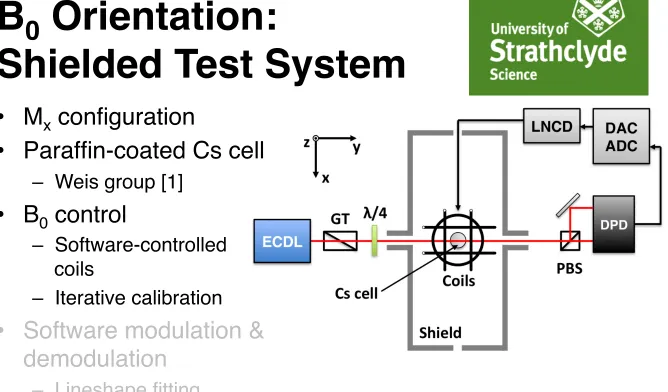
FIG. 1. Schematic of the apparatus used in this work, show-ing external cavity diode laser (ECDL), Glan-Thompson linear polarizer (GT), quarter-wave plate (λ/4), magnetometer cell,
five-layer mu-metal shield, three-axis Helmholtz coils, polarizing beam splitter (PBS), differential photodetector (DPD), low-noise coil driver (LNCD), and data acquisition system (DAC/ADC). The data acquisition system is controlled using a PC (not shown).
writing
ρ =
2F
!
k=0 k
!
q=−k
mk,qTq(k), (1)
where Tq(k) are irreducible basis tensors in the chosen
quantization basis. We consider a three-stage process to derive the observed polarimeter signal; the creation of atomic magnetization through optical pumping, the evolution of that magnetization in the magnetic field, and the observable effects on transmitted light. This three-stage model is only valid in the case of weak optical pumping (where the optical pumping rate is much smaller than the magnetic spin relaxation rate), in which the evolution of the magnetization (stage two) can be considered due to the action of magnetic fields only.
Figure 2 shows the coordinate basis used to describe the laboratory frame. If the quantization axis is parallel to the k
vector of the pump light, then nonabsorbing atomic dark states are described by sums of atomic multipoles in which onlymk,0
moments are nonzero, wherek may be any positive integer for
circularly polarized light and k any even positive integer for
linearly polarized light [19]. Optical pumping dynamically couples multipole moments of any k,q to moments for which q = 0 in this basis. In a static magnetic field the resulting
equilibrium moments meqk,q depend on the rate of optical
pumping and the orientation of the static field B0 [19].
Our magnetometer signal is the oscillating magnetization response to BRF(ωRF), so we define a rotating wave frame x′ −y′ −z′(RW) such thatB0lies alongz′, and the component
ofBRF perpendicular toB0 at t = 0, BRF⊥ , is in the negative x′
direction. In the presence of weak optical pumping, the atomic polarization relaxes to states which are symmetric around the quantization axis B0, in which only m′k,eq0 are nonzero.
The evolution of mk,q in the presence of a magnetic field
was derived from the Liouville equation in [18] and is given by
d
dtmk,q =
!
q′
O(qqk)′mk,q′ − $ (k) qq′
"
mk,q′ −m eq k,q′
#
, (2)
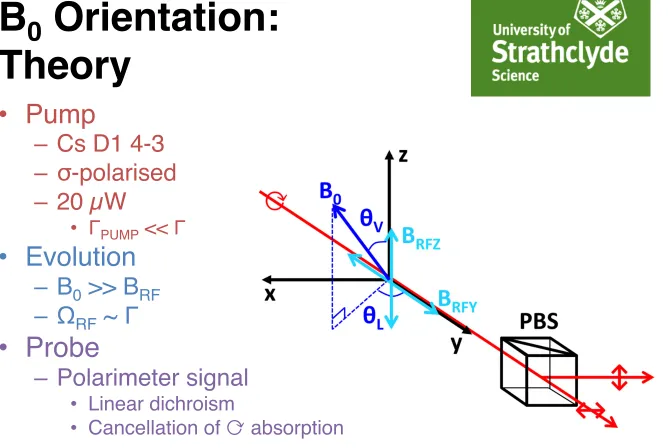
FIG. 2. Schematic showing the geometry of the magnetometer system in the laboratory frame. The orientation of the static fieldB0
is defined by the angles to the light propagation and vertical axes,
θL and θV, respectively. Inset, alternative polar basis angles α and β
are defined. The orientations of the oscillating fieldsBRF Z andBRF Y,
and the polarization analyser (PBS), are also shown.
where O(qqk)′ is a (2k +1) ×(2k +1) matrix describing the
action ofB0andBRF onmk,q and$qq(k)′ is a (2k + 1)× (2k + 1)
matrix describing the relaxation of mk,q to meqk,q. By solving
for equilibrium multipole moments in the RW framem′k,q and
transforming to the laboratory frame, we obtain expressions for the oscillating components of mk,q(t). Transformations of mk,q(t) under rotation are obtained using Wigner D matrices
(see [20] for details).
A balanced polarimeter is used for these measurements, ensuring that the observed signal is sensitive to relative changes in the transmission of orthogonal linearly polarized light through the cell. Signal contributions due to oscillating transmission of circularly polarized light will be observed in-phase on both polarimeter channels and will not contribute to the measured differential signal. The measured signal is thus modeled by the difference in absorption of the orthogonal linear polarization states of the light received at the polarization analyser (see Fig. 2). The absorption coefficient κ for linearly
polarized light in a medium described by multipole moments
mk,q(t) is proportional to
κ ∝ √A0
3m0,0 −
$
2
3A2m2,0, (3) where A0 and A2 are analyzing powers [18]. The analyzing
powersA0,A2, and monopole momentm0,0are invariant under
rotations of basis, and cancel in subtraction, so we can write a function f(t) which is proportional to the polarimeter signal,
f(t) = m2,0(t) −m′′2,0(t)
= 32m2,0(t) −
%
3
8[m2,2(t) + m2,−2(t)], (4)
where mk,q(t) denotes multipole moments in the laboratory
frame and m′′k,q(t) multipole moments in a frame rotated such
that the quantization axis is coincident with the orthogonal
013429-2
B
0
Orientation:
Shielded Test System
•
M
xconfiguration
•
Paraffin-coated Cs cell
–
Weis group [1]
•
B
0control
–
Software-controlled
coils
–
Iterative calibration
•
Software modulation &
demodulation
–
Lineshape fitting
20/08/17 Stuart Ingleby - Strathclyde University 6
INGLEBY, O’DWYER, GRIFFIN, ARNOLD, AND RIIS PHYSICAL REVIEW A 96, 013429 (2017)
FIG. 1. Schematic of the apparatus used in this work, show-ing external cavity diode laser (ECDL), Glan-Thompson linear polarizer (GT), quarter-wave plate (λ/4), magnetometer cell,
five-layer mu-metal shield, three-axis Helmholtz coils, polarizing beam splitter (PBS), differential photodetector (DPD), low-noise coil driver (LNCD), and data acquisition system (DAC/ADC). The data acquisition system is controlled using a PC (not shown).
writing
ρ =
2F !
k=0 k !
q=−k
mk,qTq(k), (1)
where Tq(k) are irreducible basis tensors in the chosen
quantization basis. We consider a three-stage process to derive the observed polarimeter signal; the creation of atomic magnetization through optical pumping, the evolution of that magnetization in the magnetic field, and the observable effects on transmitted light. This three-stage model is only valid in the case of weak optical pumping (where the optical pumping rate is much smaller than the magnetic spin relaxation rate), in which the evolution of the magnetization (stage two) can be considered due to the action of magnetic fields only.
Figure 2 shows the coordinate basis used to describe the laboratory frame. If the quantization axis is parallel to the k
vector of the pump light, then nonabsorbing atomic dark states are described by sums of atomic multipoles in which onlymk,0
moments are nonzero, wherek may be any positive integer for
circularly polarized light and k any even positive integer for
linearly polarized light [19]. Optical pumping dynamically couples multipole moments of any k,q to moments for which q = 0 in this basis. In a static magnetic field the resulting
equilibrium moments meqk,q depend on the rate of optical
pumping and the orientation of the static field B0 [19].
Our magnetometer signal is the oscillating magnetization response to BRF(ωRF), so we define a rotating wave frame
x′ −y′ −z′(RW) such thatB0lies alongz′, and the component
ofBRF perpendicular toB0 at t = 0, BRF⊥ , is in the negative x′
direction. In the presence of weak optical pumping, the atomic polarization relaxes to states which are symmetric around the quantization axis B0, in which only m′k,eq0 are nonzero.
The evolution of mk,q in the presence of a magnetic field
was derived from the Liouville equation in [18] and is given by
d
dtmk,q =
!
q′
O(qqk)′mk,q′ − $
(k) qq′
"
mk,q′ −m eq k,q′
#
, (2)
FIG. 2. Schematic showing the geometry of the magnetometer system in the laboratory frame. The orientation of the static fieldB0
is defined by the angles to the light propagation and vertical axes,
θL and θV, respectively. Inset, alternative polar basis angles α and β
are defined. The orientations of the oscillating fieldsBRF Z andBRF Y,
and the polarization analyser (PBS), are also shown.
where O(qqk)′ is a (2k +1) ×(2k +1) matrix describing the
action ofB0andBRF onmk,q and$qq(k)′ is a (2k + 1)× (2k + 1)
matrix describing the relaxation of mk,q to meqk,q. By solving
for equilibrium multipole moments in the RW framem′k,q and
transforming to the laboratory frame, we obtain expressions for the oscillating components of mk,q(t). Transformations of
mk,q(t) under rotation are obtained using Wigner D matrices
(see [20] for details).
A balanced polarimeter is used for these measurements, ensuring that the observed signal is sensitive to relative changes in the transmission of orthogonal linearly polarized light through the cell. Signal contributions due to oscillating transmission of circularly polarized light will be observed in-phase on both polarimeter channels and will not contribute to the measured differential signal. The measured signal is thus modeled by the difference in absorption of the orthogonal linear polarization states of the light received at the polarization analyser (see Fig. 2). The absorption coefficient κ for linearly
polarized light in a medium described by multipole moments
mk,q(t) is proportional to
κ ∝ √A0
3m0,0 −
$
2
3A2m2,0, (3) where A0 and A2 are analyzing powers [18]. The analyzing
powersA0,A2, and monopole momentm0,0are invariant under
rotations of basis, and cancel in subtraction, so we can write a function f(t) which is proportional to the polarimeter signal,
f(t) = m2,0(t) −m′′2,0(t)
= 32m2,0(t) − %
3
8[m2,2(t) + m2,−2(t)], (4)
where mk,q(t) denotes multipole moments in the laboratory
frame and m′′k,q(t) multipole moments in a frame rotated such
that the quantization axis is coincident with the orthogonal
013429-2
B
0
Orientation:
Shielded Test System
•
M
xconfiguration
•
Paraffin-coated Cs cell
–
Weis group []
•
B
0control
–
Software-controlled
coils
–
Iterative calibration
•
Software modulation &
demodulation
–
Lineshape fitting
20/08/17 Stuart Ingleby - Strathclyde University 7
Figure 4: Variation of relaxation rate, sensitivity (unshielded NEP) and signal amplitude with varying modulation depth.
Although signal amplitude is, to first order, proportional to modulation depth, resonance width increases when BRF.gF ~ Γ. Measurement of sensitivity with varying modulation depth identified a range of suitable magnitudes for BRF.
Figure 5: Shielded and unshielded magnetic resonances observed with optimised field gradient, orientation and modulation depth.
Figure 5 shows the amplitudes of demodulated in-phase (X) and quadrature components (Y) of the polarisation rotation response to field modulation depth of 1 nT (7 nT unshielded). The estimated magnetometric sensitivity is 173 fT.Hz-1/2 (19.6 pT.Hz-1/2 unshielded).
By creating PID-controlled feedback from the in-phase signal to the
B
0
Orientation:
Shielded Test System
•
B
0control
•
Low-noise current
drivers
–
Shield degauss
–
Single-axis calibration
[2]
–
3D calibration
[C. O’Dwyer poster]
•
200 nT B
0– δ
|B| = 0.24 nT
– δθ
= 0.23 mrad
20/08/17 Stuart Ingleby - Strathclyde University 8
B0 (µT)
INGLEBY, O’DWYER, GRIFFIN, ARNOLD, AND RIIS PHYSICAL REVIEW A96, 013429 (2017)
FIG. 1. Schematic of the apparatus used in this work, show-ing external cavity diode laser (ECDL), Glan-Thompson linear polarizer (GT), quarter-wave plate (λ/4), magnetometer cell,
five-layer mu-metal shield, three-axis Helmholtz coils, polarizing beam splitter (PBS), differential photodetector (DPD), low-noise coil driver (LNCD), and data acquisition system (DAC/ADC). The data acquisition system is controlled using a PC (not shown).
writing
ρ =
2F !
k=0 k !
q=−k
mk,qTq(k), (1)
where Tq(k) are irreducible basis tensors in the chosen
quantization basis. We consider a three-stage process to derive the observed polarimeter signal; the creation of atomic magnetization through optical pumping, the evolution of that magnetization in the magnetic field, and the observable effects on transmitted light. This three-stage model is only valid in the case of weak optical pumping (where the optical pumping rate is much smaller than the magnetic spin relaxation rate), in which the evolution of the magnetization (stage two) can be considered due to the action of magnetic fields only.
Figure 2 shows the coordinate basis used to describe the laboratory frame. If the quantization axis is parallel to the k
vector of the pump light, then nonabsorbing atomic dark states are described by sums of atomic multipoles in which onlymk,0 moments are nonzero, wherek may be any positive integer for
circularly polarized light and k any even positive integer for
linearly polarized light [19]. Optical pumping dynamically couples multipole moments of anyk,q to moments for which q = 0 in this basis. In a static magnetic field the resulting
equilibrium moments meqk,q depend on the rate of optical
pumping and the orientation of the static fieldB0 [19].
Our magnetometer signal is the oscillating magnetization response to BRF(ωRF), so we define a rotating wave frame
x′ −y′ −z′(RW) such thatB0lies alongz′, and the component
of BRF perpendicular toB0 att = 0, BRF⊥ , is in the negative x′ direction. In the presence of weak optical pumping, the atomic polarization relaxes to states which are symmetric around the quantization axis B0, in which only m′k,eq0 are nonzero.
The evolution of mk,q in the presence of a magnetic field was derived from the Liouville equation in [18] and is given by
d
dtmk,q =
!
q′
O(qqk)′mk,q′ −$qq(k)′
"
mk,q′ −m eq k,q′
#
[image:9.720.45.713.28.476.2], (2)
FIG. 2. Schematic showing the geometry of the magnetometer system in the laboratory frame. The orientation of the static fieldB0
is defined by the angles to the light propagation and vertical axes,
θL andθV, respectively. Inset, alternative polar basis angles α and β
are defined. The orientations of the oscillating fieldsBRF Z andBRF Y,
and the polarization analyser (PBS), are also shown.
where O(qqk)′ is a (2k +1) ×(2k +1) matrix describing the
action ofB0andBRF onmk,q and$
(k)
qq′ is a (2k +1) ×(2k +1) matrix describing the relaxation of mk,q to m
eq
k,q. By solving for equilibrium multipole moments in the RW frame m′k,q and
transforming to the laboratory frame, we obtain expressions for the oscillating components of mk,q(t). Transformations of
mk,q(t) under rotation are obtained using Wigner D matrices (see [20] for details).
A balanced polarimeter is used for these measurements, ensuring that the observed signal is sensitive to relative changes in the transmission of orthogonal linearly polarized light through the cell. Signal contributions due to oscillating transmission of circularly polarized light will be observed in-phase on both polarimeter channels and will not contribute to the measured differential signal. The measured signal is thus modeled by the difference in absorption of the orthogonal linear polarization states of the light received at the polarization analyser (see Fig.2). The absorption coefficient κ for linearly polarized light in a medium described by multipole moments
mk,q(t) is proportional to
κ ∝ √A0
3m0,0 − $
2
3A2m2,0, (3)
where A0 and A2 are analyzing powers [18]. The analyzing
powersA0,A2, and monopole momentm0,0are invariant under rotations of basis, and cancel in subtraction, so we can write a function f(t) which is proportional to the polarimeter signal,
f(t) = m2,0(t)−m′′2,0(t)
= 32m2,0(t)− %
3
8[m2,2(t) +m2,−2(t)], (4) where mk,q(t) denotes multipole moments in the laboratory frame and m′′k,q(t) multipole moments in a frame rotated such
that the quantization axis is coincident with the orthogonal
013429-2
B
0
Orientation:
Theory
•
Pump
–
Cs D1 4-3
–
σ
-polarised
–
20 µW
• Γ
PUMP<<
Γ
•
Evolution
–
B
0>> B
RF– Ω
RF~
Γ
•
Probe
–
Polarimeter signal
•
Linear dichroism
•
Cancellation of ⟳ absorption
INGLEBY, O’DWYER, GRIFFIN, ARNOLD, AND RIIS PHYSICAL REVIEW A96, 013429 (2017)
FIG. 1. Schematic of the apparatus used in this work, show-ing external cavity diode laser (ECDL), Glan-Thompson linear polarizer (GT), quarter-wave plate (λ/4), magnetometer cell,
five-layer mu-metal shield, three-axis Helmholtz coils, polarizing beam splitter (PBS), differential photodetector (DPD), low-noise coil driver (LNCD), and data acquisition system (DAC/ADC). The data acquisition system is controlled using a PC (not shown).
writing
ρ =
2F !
k=0 k !
q=−k
mk,qTq(k), (1)
where Tq(k) are irreducible basis tensors in the chosen
quantization basis. We consider a three-stage process to derive the observed polarimeter signal; the creation of atomic magnetization through optical pumping, the evolution of that magnetization in the magnetic field, and the observable effects on transmitted light. This three-stage model is only valid in the case of weak optical pumping (where the optical pumping rate is much smaller than the magnetic spin relaxation rate), in which the evolution of the magnetization (stage two) can be considered due to the action of magnetic fields only.
Figure 2 shows the coordinate basis used to describe the laboratory frame. If the quantization axis is parallel to the k
vector of the pump light, then nonabsorbing atomic dark states are described by sums of atomic multipoles in which onlymk,0 moments are nonzero, wherek may be any positive integer for
circularly polarized light and k any even positive integer for
linearly polarized light [19]. Optical pumping dynamically couples multipole moments of anyk,q to moments for which q = 0 in this basis. In a static magnetic field the resulting
equilibrium moments meqk,q depend on the rate of optical
pumping and the orientation of the static fieldB0 [19].
Our magnetometer signal is the oscillating magnetization response to BRF(ωRF), so we define a rotating wave frame
x′ −y′ −z′(RW) such thatB0lies alongz′, and the component
of BRF perpendicular toB0 att = 0, BRF⊥ , is in the negative x′ direction. In the presence of weak optical pumping, the atomic polarization relaxes to states which are symmetric around the quantization axis B0, in which only m′k,eq0 are nonzero.
The evolution of mk,q in the presence of a magnetic field was derived from the Liouville equation in [18] and is given by
d
dtmk,q =
!
q′
O(qqk)′mk,q′ −$qq(k)′
"
mk,q′ −m eq k,q′
#
, (2)
FIG. 2. Schematic showing the geometry of the magnetometer system in the laboratory frame. The orientation of the static fieldB0
is defined by the angles to the light propagation and vertical axes,
θL andθV, respectively. Inset, alternative polar basis angles α and β
are defined. The orientations of the oscillating fieldsBRF Z andBRF Y,
and the polarization analyser (PBS), are also shown.
where O(qqk)′ is a (2k +1) ×(2k +1) matrix describing the
action ofB0andBRF onmk,q and$
(k)
qq′ is a (2k +1) ×(2k +1) matrix describing the relaxation of mk,q to m
eq
k,q. By solving for equilibrium multipole moments in the RW frame m′k,q and
transforming to the laboratory frame, we obtain expressions for the oscillating components of mk,q(t). Transformations of
mk,q(t) under rotation are obtained using Wigner D matrices (see [20] for details).
A balanced polarimeter is used for these measurements, ensuring that the observed signal is sensitive to relative changes in the transmission of orthogonal linearly polarized light through the cell. Signal contributions due to oscillating transmission of circularly polarized light will be observed in-phase on both polarimeter channels and will not contribute to the measured differential signal. The measured signal is thus modeled by the difference in absorption of the orthogonal linear polarization states of the light received at the polarization analyser (see Fig.2). The absorption coefficient κ for linearly polarized light in a medium described by multipole moments
mk,q(t) is proportional to
κ ∝ √A0
3m0,0 − $
2
3A2m2,0, (3)
where A0 and A2 are analyzing powers [18]. The analyzing
powersA0,A2, and monopole momentm0,0are invariant under rotations of basis, and cancel in subtraction, so we can write a function f(t) which is proportional to the polarimeter signal,
f(t) = m2,0(t)−m′′2,0(t)
= 32m2,0(t)− %
3
8[m2,2(t) +m2,−2(t)], (4) where mk,q(t) denotes multipole moments in the laboratory frame and m′′k,q(t) multipole moments in a frame rotated such
that the quantization axis is coincident with the orthogonal
013429-2
B
0
Orientation:
Theory
Multipole moment model
[3][4]
•
Pump
–
Creation of
k = 1,2
…
–
Equilibrium
q = 0
•
B
0frame
•
Evolution
–
RW frame
•
B
0// z
•
B
RF(t=0) // -x
–
Obtain
m
kq(t)
•
Probe
–
Difference in
↕
︎
and
↔
︎
20/08/17 Stuart Ingleby - Strathclyde University 10
INGLEBY, O’DWYER, GRIFFIN, ARNOLD, AND RIIS PHYSICAL REVIEW A96, 013429 (2017)
FIG. 1. Schematic of the apparatus used in this work, show-ing external cavity diode laser (ECDL), Glan-Thompson linear polarizer (GT), quarter-wave plate (λ/4), magnetometer cell,
five-layer mu-metal shield, three-axis Helmholtz coils, polarizing beam splitter (PBS), differential photodetector (DPD), low-noise coil driver (LNCD), and data acquisition system (DAC/ADC). The data acquisition system is controlled using a PC (not shown).
writing
ρ =
2F
!
k=0 k
!
q=−k
mk,qTq(k), (1)
where Tq(k) are irreducible basis tensors in the chosen quantization basis. We consider a three-stage process to derive the observed polarimeter signal; the creation of atomic magnetization through optical pumping, the evolution of that magnetization in the magnetic field, and the observable effects on transmitted light. This three-stage model is only valid in the case of weak optical pumping (where the optical pumping rate is much smaller than the magnetic spin relaxation rate), in which the evolution of the magnetization (stage two) can be considered due to the action of magnetic fields only.
Figure 2 shows the coordinate basis used to describe the laboratory frame. If the quantization axis is parallel to the k vector of the pump light, then nonabsorbing atomic dark states are described by sums of atomic multipoles in which onlymk,0
moments are nonzero, wherek may be any positive integer for circularly polarized light and k any even positive integer for linearly polarized light [19]. Optical pumping dynamically couples multipole moments of any k,q to moments for which q = 0 in this basis. In a static magnetic field the resulting equilibrium moments meqk,q depend on the rate of optical pumping and the orientation of the static field B0 [19].
Our magnetometer signal is the oscillating magnetization response to BRF(ωRF), so we define a rotating wave frame
x′ −y′ −z′(RW) such thatB0lies alongz′, and the component ofBRF perpendicular toB0 att = 0,BRF⊥ , is in the negativex′
direction. In the presence of weak optical pumping, the atomic polarization relaxes to states which are symmetric around the quantization axis B0, in which only m′k,eq0 are nonzero.
The evolution of mk,q in the presence of a magnetic field
was derived from the Liouville equation in [18] and is given by
d
dtmk,q =
!
q′
O(qqk)′mk,q′ −$( k) qq′
"
mk,q′ −m eq k,q′
#
, (2)
FIG. 2. Schematic showing the geometry of the magnetometer system in the laboratory frame. The orientation of the static fieldB0 is defined by the angles to the light propagation and vertical axes, θL andθV, respectively. Inset, alternative polar basis angles α andβ are defined. The orientations of the oscillating fieldsBRF Z andBRF Y, and the polarization analyser (PBS), are also shown.
where O(qqk)′ is a (2k +1)×(2k+1) matrix describing the
action ofB0andBRF onmk,q and$( k)
qq′ is a (2k+1)×(2k+1)
matrix describing the relaxation of mk,q to m eq
k,q. By solving
for equilibrium multipole moments in the RW framem′k,q and transforming to the laboratory frame, we obtain expressions for the oscillating components of mk,q(t). Transformations of
mk,q(t) under rotation are obtained using Wigner D matrices
(see [20] for details).
A balanced polarimeter is used for these measurements, ensuring that the observed signal is sensitive to relative changes in the transmission of orthogonal linearly polarized light through the cell. Signal contributions due to oscillating transmission of circularly polarized light will be observed in-phase on both polarimeter channels and will not contribute to the measured differential signal. The measured signal is thus modeled by the difference in absorption of the orthogonal linear polarization states of the light received at the polarization analyser (see Fig.2). The absorption coefficient κ for linearly polarized light in a medium described by multipole moments mk,q(t) is proportional to
κ ∝ √A0
3m0,0 −
$
2
3A2m2,0, (3) where A0 and A2 are analyzing powers [18]. The analyzing powersA0,A2, and monopole momentm0,0are invariant under
rotations of basis, and cancel in subtraction, so we can write a functionf(t) which is proportional to the polarimeter signal,
f(t) = m2,0(t)−m′′2,0(t) = 32m2,0(t)−
%
3
8[m2,2(t)+m2,−2(t)], (4)
where mk,q(t) denotes multipole moments in the laboratory
frame andm′′k,q(t) multipole moments in a frame rotated such that the quantization axis is coincident with the orthogonal
013429-2
INGLEBY, O’DWYER, GRIFFIN, ARNOLD, AND RIIS PHYSICAL REVIEW A96, 013429 (2017)
FIG. 1. Schematic of the apparatus used in this work, show-ing external cavity diode laser (ECDL), Glan-Thompson linear polarizer (GT), quarter-wave plate (λ/4), magnetometer cell, five-layer mu-metal shield, three-axis Helmholtz coils, polarizing beam splitter (PBS), differential photodetector (DPD), low-noise coil driver (LNCD), and data acquisition system (DAC/ADC). The data acquisition system is controlled using a PC (not shown).
writing
ρ =
2F
!
k=0 k
!
q=−k
mk,qTq(k), (1)
where Tq(k) are irreducible basis tensors in the chosen
quantization basis. We consider a three-stage process to derive the observed polarimeter signal; the creation of atomic magnetization through optical pumping, the evolution of that magnetization in the magnetic field, and the observable effects on transmitted light. This three-stage model is only valid in the case of weak optical pumping (where the optical pumping rate is much smaller than the magnetic spin relaxation rate), in which the evolution of the magnetization (stage two) can be considered due to the action of magnetic fields only.
Figure 2 shows the coordinate basis used to describe the laboratory frame. If the quantization axis is parallel to the k
vector of the pump light, then nonabsorbing atomic dark states are described by sums of atomic multipoles in which onlymk,0
moments are nonzero, wherekmay be any positive integer for
circularly polarized light and k any even positive integer for
linearly polarized light [19]. Optical pumping dynamically couples multipole moments of anyk,q to moments for which q = 0 in this basis. In a static magnetic field the resulting
equilibrium moments meqk,q depend on the rate of optical
pumping and the orientation of the static field B0 [19].
Our magnetometer signal is the oscillating magnetization response to BRF(ωRF), so we define a rotating wave frame x′ −y′ −z′(RW) such thatB0lies alongz′, and the component ofBRF perpendicular to B0 att = 0,BRF⊥ , is in the negativex′
direction. In the presence of weak optical pumping, the atomic polarization relaxes to states which are symmetric around the quantization axisB0, in which only m′k,eq0 are nonzero.
The evolution of mk,q in the presence of a magnetic field
was derived from the Liouville equation in [18] and is given by
d
dt mk,q =
!
q′
O(qqk)′mk,q′ −$
(k) qq′
"
mk,q′ −m eq k,q′
#
, (2)
FIG. 2. Schematic showing the geometry of the magnetometer system in the laboratory frame. The orientation of the static field B0
is defined by the angles to the light propagation and vertical axes,
θL and θV, respectively. Inset, alternative polar basis angles α andβ
are defined. The orientations of the oscillating fieldsBRF Z andBRF Y,
and the polarization analyser (PBS), are also shown.
where O(qqk)′ is a (2k+1)×(2k+1) matrix describing the
action ofB0andBRF onmk,q and$
(k)
qq′ is a (2k+1)×(2k+1)
matrix describing the relaxation of mk,q to meqk,q. By solving
for equilibrium multipole moments in the RW frame m′k,q and
transforming to the laboratory frame, we obtain expressions for the oscillating components of mk,q(t). Transformations of mk,q(t) under rotation are obtained using Wigner D matrices
(see [20] for details).
A balanced polarimeter is used for these measurements, ensuring that the observed signal is sensitive to relative changes in the transmission of orthogonal linearly polarized light through the cell. Signal contributions due to oscillating transmission of circularly polarized light will be observed in-phase on both polarimeter channels and will not contribute to the measured differential signal. The measured signal is thus modeled by the difference in absorption of the orthogonal linear polarization states of the light received at the polarization analyser (see Fig. 2). The absorption coefficientκ for linearly
polarized light in a medium described by multipole moments
mk,q(t) is proportional to
κ ∝ √A0
3m0,0 −
$
2
3A2m2,0, (3) where A0 and A2 are analyzing powers [18]. The analyzing powersA0,A2, and monopole momentm0,0are invariant under
rotations of basis, and cancel in subtraction, so we can write a function f(t) which is proportional to the polarimeter signal,
f(t) = m2,0(t)−m′′2,0(t)
= 32m2,0(t)−
%
3
8[m2,2(t)+m2,−2(t)], (4)
where mk,q(t) denotes multipole moments in the laboratory
frame and m′′k,q(t) multipole moments in a frame rotated such
that the quantization axis is coincident with the orthogonal
013429-2
INGLEBY, O’DWYER, GRIFFIN, ARNOLD, AND RIIS PHYSICAL REVIEW A96, 013429 (2017)
FIG. 1. Schematic of the apparatus used in this work, show-ing external cavity diode laser (ECDL), Glan-Thompson linear polarizer (GT), quarter-wave plate (λ/4), magnetometer cell,
five-layer mu-metal shield, three-axis Helmholtz coils, polarizing beam splitter (PBS), differential photodetector (DPD), low-noise coil driver (LNCD), and data acquisition system (DAC/ADC). The data acquisition system is controlled using a PC (not shown).
writing
ρ =
2F
!
k=0 k
!
q=−k
mk,qTq(k), (1)
where Tq(k) are irreducible basis tensors in the chosen
quantization basis. We consider a three-stage process to derive the observed polarimeter signal; the creation of atomic magnetization through optical pumping, the evolution of that magnetization in the magnetic field, and the observable effects on transmitted light. This three-stage model is only valid in the case of weak optical pumping (where the optical pumping rate is much smaller than the magnetic spin relaxation rate), in which the evolution of the magnetization (stage two) can be considered due to the action of magnetic fields only.
Figure 2 shows the coordinate basis used to describe the laboratory frame. If the quantization axis is parallel to the k
vector of the pump light, then nonabsorbing atomic dark states are described by sums of atomic multipoles in which onlymk,0
moments are nonzero, wherekmay be any positive integer for
circularly polarized light and k any even positive integer for
linearly polarized light [19]. Optical pumping dynamically couples multipole moments of anyk,q to moments for which q = 0 in this basis. In a static magnetic field the resulting
equilibrium moments meqk,q depend on the rate of optical
pumping and the orientation of the static fieldB0 [19].
Our magnetometer signal is the oscillating magnetization response to BRF(ωRF), so we define a rotating wave frame x′ −y′ −z′(RW) such thatB0lies alongz′, and the component
ofBRF perpendicular toB0 at t =0,BRF⊥ , is in the negativex′
direction. In the presence of weak optical pumping, the atomic polarization relaxes to states which are symmetric around the quantization axis B0, in which onlym′k,eq0 are nonzero.
The evolution of mk,q in the presence of a magnetic field
was derived from the Liouville equation in [18] and is given by
d
dtmk,q =
!
q′
O(qqk)′mk,q′ −$( k) qq′
"
mk,q′ −m eq k,q′
#
, (2)
FIG. 2. Schematic showing the geometry of the magnetometer system in the laboratory frame. The orientation of the static fieldB0
is defined by the angles to the light propagation and vertical axes,
θL and θV, respectively. Inset, alternative polar basis angles α and β
are defined. The orientations of the oscillating fieldsBRF Z andBRF Y,
and the polarization analyser (PBS), are also shown.
where O(qqk)′ is a (2k +1)×(2k +1) matrix describing the
action ofB0andBRF onmk,q and$( k)
qq′ is a (2k +1)×(2k +1)
matrix describing the relaxation of mk,q to meqk,q. By solving
for equilibrium multipole moments in the RW frame m′k,q and
transforming to the laboratory frame, we obtain expressions for the oscillating components of mk,q(t). Transformations of mk,q(t) under rotation are obtained using Wigner D matrices
(see [20] for details).
A balanced polarimeter is used for these measurements, ensuring that the observed signal is sensitive to relative changes in the transmission of orthogonal linearly polarized light through the cell. Signal contributions due to oscillating transmission of circularly polarized light will be observed in-phase on both polarimeter channels and will not contribute to the measured differential signal. The measured signal is thus modeled by the difference in absorption of the orthogonal linear polarization states of the light received at the polarization analyser (see Fig. 2). The absorption coefficient κ for linearly
polarized light in a medium described by multipole moments
mk,q(t) is proportional to
κ ∝ √A0
3m0,0 − $
2
3A2m2,0, (3) where A0 and A2 are analyzing powers [18]. The analyzing
powersA0,A2, and monopole momentm0,0are invariant under
rotations of basis, and cancel in subtraction, so we can write a functionf(t) which is proportional to the polarimeter signal,
f(t) = m2,0(t)−m′′2,0(t)
= 32m2,0(t)−
% 3
8[m2,2(t)+m2,−2(t)], (4)
where mk,q(t) denotes multipole moments in the laboratory
frame and m′′k,q(t) multipole moments in a frame rotated such
that the quantization axis is coincident with the orthogonal
013429-2
B
0
Orientation:
Amplitude
•
4
π
angular scan
–
1646 resonance fits
–
3
½
hours
•
R
–
Extract X and Y
from f(t)
•
Dead-zones
20/08/17 Stuart Ingleby - Strathclyde University 11
INGLEBY, O’DWYER, GRIFFIN, ARNOLD, AND RIIS
PHYSICAL REVIEW A
96
, 013429 (2017)
FIG. 5. Calculated (top) and observed (bottom) distribution of
on-resonance first-harmonic polarimeter signal phase over 4
π
solid
angle in response to a field modulation
B
RF
applied parallel to the
light propagation (
y
) axis.
where cos
β
=
sin
θ
V
cos
θ
L
and tan
α
=
tan
θ
V
sin
θ
L
define
an alternative polar basis in the laboratory frame.
In practical magnetometry measurements we are concerned
with the amplitude
R
and phase
φ
of the magnetometer signal
response. Defining
R
2
≡
X
2
+
Y
2
,
(11)
tan
φ
≡
X/Y,
(12)
we obtain on-resonance signal amplitudes
R
RF y
2
=
A
2
sin
2
2
β
(cos
2
β
cos
2
2
α
+
sin
2
2
α
)
,
(13)
R
RF z
2
=
A
2
sin
4
θ
V
[4 cos
2
θ
V
(1
+
cos
2
θ
L
)
2
+
sin
2
2
θ
L
]
,
(14)
and phases
tan
φ
RF y
=
−
2 sin 2
α
sin
β
cos 2
α
sin 2
β
=
(sin
2
2 sin
θ
L
tan
θ
V
θ
L
tan
2
θ
V
−
1) cos
θ
L
sin
θ
V
,
(15)
tan
φ
RF z
=
−
sin 2
θ
L
sin
θ
V
(1
+
cos
2
θ
L
) sin 2
θ
V
,
(16)
where
A
=
3
m
′eq
2,0
S
4(4
S
2+
1)
.
Using the
B
0
control, signal demodulation, and resonance
line-shape fitting described in [
15
], angular scans of the
FIG. 6. Calculated (top) and observed (bottom) distribution of
on-resonance first-harmonic polarimeter signal phase over 4
π
solid
angle in response to a field modulation
B
RF
applied parallel to the
vertical (
z
) axis.
measured on-resonance signal amplitude
R
and phase
φ
were
made. Each angular scan comprised 1646 varying orientations
of
B
0
=
200 nT spread with equal angular density over the full
4
π
solid angle. Figures
3
–
6
show these data plotted alongside
distributions calculated using Eqs. (
13
)–(
16
).
IV. CONCLUSIONS
Equations (
13
) and (
14
) model the observed dead-zones
(orientations of
B
0
for which
R
→
0) and symmetries in
the distribution of observed signal amplitude
R
(Figs.
3
and
4
). We note that our experimental measurements of signal
amplitude differ slightly in shape to the predicted distributions,
a feature which could be reduced by inclusion of
higher-order multipole moments in the model signal calculation. In
the case where the polarimeter is not perfectly balanced, the
signal contribution due to the evolution of first-order multipole
moments
m
1
,q
, which modulate the transmission of circularly
polarized light, will not be fully canceled by the differential
photodetector. This may also account for discrepancies
be-tween the observed and calculated distributions of
R
.
Equations (
15
) and (
16
) appear to model the observed
polarimeter signal phase well, and the observed data
con-firm the strong correlation of on-resonance phase with
B
0
orientation (Figs.
5
and
6
). The clarity and good agreement
of the measured data with calculated signal phase may be
013429-4
[image:11.720.320.646.108.488.2]ORIENTATIONAL EFFECTS ON THE AMPLITUDE AND . . . PHYSICAL REVIEW A96, 013429 (2017)
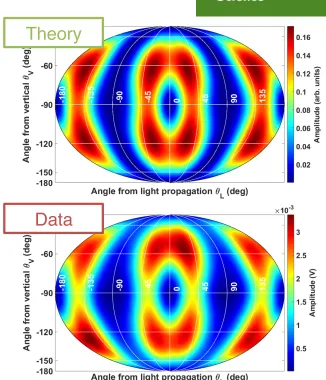
FIG. 3. Calculated (top) and observed (bottom) distribution of on-resonance first-harmonic polarimeter signal amplitude over 4π
solid angle in response to a field modulationBRF applied parallel to
the light propagation (y) axis.
linear polarization axis (x axis). Since the orthogonal linear
states separated by the analyzer are not sensitive tom1,q(t) and
m0,0 is constant in time,k =2 for the lowest-order multipole
moments contributing tof(t).
Following [18], and definingx ≡ (γB0 −ωRF)/$andS ≡
γBRF⊥ /$for convenience, we obtain the following equations of motion for the RW-framek=2 multipole moments:
i
$m˙ ′
2,q =Mqq′m′2,q′ +im′
eq
2,q, (5)
where γ is the gyromagnetic ratio for the Cs 62S1/2 (F =4)
ground state and
Mqq′ =
⎛ ⎜ ⎜ ⎜ ⎜ ⎜ ⎜ ⎜ ⎝
2x −i S 0 0 0
S x−i
$
3
2S 0 0
0 $32S −i
$
3
2S 0
0 0 $3
2S −x −i S
0 0 0 S −2x −i
⎞ ⎟ ⎟ ⎟ ⎟ ⎟ ⎟ ⎟ ⎠ . (6)
We have assumed that relaxation in the system is isotropic with rate$, and thatBRF ≪ B0.
Steady-state solutions for m′2,q in the RW frame are
obtained by setting ˙m′2,q = 0. After transformation to the
laboratory frame we obtain terms ine0iωRFt,e1iωRFt, ande2iωRFt
FIG. 4. Calculated (top) and observed (bottom) distribution of on-resonance first-harmonic polarimeter signal amplitude over 4π
solid angle in response to a field modulationBRF applied parallel to
the vertical (z) axis.
corresponding to dc, first-harmonic, and second-harmonic resonant magnetization responses to the perturbing fieldBRF.
III. ANISOTROPY IN RESONANT POLARIMETER SIGNAL RESPONSE
To measure the first-harmonic response to BRF(ωRF), the
polarimeter signal is digitized and demodulated in software with a reference phase-locked to BRF(t). Collecting terms
fromf(t) in cos(ωRFt) and sin(ωRFt) we derive expressions
for the in-phase, X, and quadrature, Y, components of the
demodulated signal. The on-resonance (x = 0) amplitudes of X and Y are strongly dependent on the orientation ofB0 and
BRF relative to the light propagation axis. For BRF aligned
along they andzaxes (denoted RFy and RFz, respectively),
XRF y = −
3m′2eq,0S
4S2 +1sin 2αsinβ, (7)
YRF y =
3m′2eq,0S
2(4S2 +1)cos 2αsin 2β, (8)
XRF z = −
3m′2eq,0S
2(4S2 +1) sin 2θLsinθV, (9)
YRF z =
3m′2eq,0S
2(4S2 +1)(1+cos
2
θL) sin 2θV, (10)
013429-3
ORIENTATIONAL EFFECTS ON THE AMPLITUDE AND . . . PHYSICAL REVIEW A96, 013429 (2017)
FIG. 3. Calculated (top) and observed (bottom) distribution of on-resonance first-harmonic polarimeter signal amplitude over 4π
solid angle in response to a field modulationBRF applied parallel to
the light propagation (y) axis.
linear polarization axis (x axis). Since the orthogonal linear
states separated by the analyzer are not sensitive tom1,q(t) and
m0,0 is constant in time,k =2 for the lowest-order multipole
moments contributing tof(t).
Following [18], and definingx ≡ (γB0 −ωRF)/$andS ≡
γBRF⊥ /$for convenience, we obtain the following equations
of motion for the RW-framek=2 multipole moments: i
$m˙
′
2,q =Mqq′m′2,q′ +im′
eq
2,q, (5)
where γ is the gyromagnetic ratio for the Cs 62S1/2 (F =4)
ground state and
Mqq′ = ⎛ ⎜ ⎜ ⎜ ⎜ ⎜ ⎜ ⎜ ⎝
2x −i S 0 0 0 S x−i
$
3
2S 0 0
0 $32S −i
$
3
2S 0
0 0 $3
2S −x −i S
0 0 0 S −2x −i
⎞ ⎟ ⎟ ⎟ ⎟ ⎟ ⎟ ⎟ ⎠ . (6)
We have assumed that relaxation in the system is isotropic with rate$, and thatBRF ≪ B0.
Steady-state solutions for m′2,q in the RW frame are
obtained by setting ˙m′2,q = 0. After transformation to the
laboratory frame we obtain terms ine0iωRFt,e1iωRFt, ande2iωRFt
FIG. 4. Calculated (top) and observed (bottom) distribution of on-resonance first-harmonic polarimeter signal amplitude over 4π
solid angle in response to a field modulationBRF applied parallel to
the vertical (z) axis.
corresponding to dc, first-harmonic, and second-harmonic resonant magnetization responses to the perturbing fieldBRF.
III. ANISOTROPY IN RESONANT POLARIMETER SIGNAL RESPONSE
To measure the first-harmonic response to BRF(ωRF), the
polarimeter signal is digitized and demodulated in software with a reference phase-locked to BRF(t). Collecting terms
fromf(t) in cos(ωRFt) and sin(ωRFt) we derive expressions
for the in-phase, X, and quadrature, Y, components of the
demodulated signal. The on-resonance (x = 0) amplitudes of X and Y are strongly dependent on the orientation ofB0 and
BRF relative to the light propagation axis. For BRF aligned
along they andzaxes (denoted RFy and RFz, respectively),
XRF y = −
3m′2eq,0S
4S2 +1sin 2αsinβ, (7) YRF y =
3m′2eq,0S
2(4S2 +1)cos 2αsin 2β, (8) XRF z = −
3m′2eq,0S
2(4S2 +1) sin 2θLsinθV, (9) YRF z =
3m′2eq,0S
2(4S2 +1)(1+cos
2
θL) sin 2θV, (10)
013429-3