Phare Ex Post Evaluation. Phase 1, Multi-Beneficiary Programmes: TAIEX
TAIEX: Multi-Beneficiary
Programme
Programmes covered:
ZZ-9626, ZZ-9734, ZZ-9801,
ZZ-9918, ZZ-0005, ZZ-0025
ZZ-0026, ZZ-0104, ZZ-0122,
ZZ-0123, 2002/001-091
2004/016-813, 2004/006-219
October 2007
The views expressed are those of the MWH Consortium and do not necessarily reflect those of the European Commission.
This report has been prepared as a result of an independent evaluation by the MWH Consortium contracted under the Phare programme.
EUROPEAN COMMISSION
DG
E
NL A RGEM E NTE
VALUATIONU
N I TTABLE OF CONTENTS GLOSSARY OF ACRONYMS
PREFACE
EXECUTIVE SUMMARY
MAIN REPORT ...1
1. INTRODUCTION ...1
1.1 Objectives ...1
1.2 Background and Context...1
1.3 Results of Previous Evaluation ...2
1.4 Methodology...3
1.5 Constraints ...4
2. PERFORMANCE OF TAIEX ASSISTANCE ...5
2.1 Scope expanded to meet needs as the pre-accession process accelerated ...5
2.2 Considerable volume of outputs generated, and cost-effectiveness improved, but scope for further savings 9 2.3 Planned results largely achieved ...13
2.4 Immediate impact was largely good, and databases and Peer Reviews also made good wider impacts...13
2.5 Sustainability of translation/transposition good, but weaker for training activities ...15
3. THEMATIC/ CROSSCUTTING FINDINGS ...17
3.1 Performance in implementing and enforcing the acquis strengthened ...17
3.2 The role and effect of TAIEX in building sustainable administrative capacity is limited ...17
3.3 Current TAIEX structures effective...17
3.4 The MBP approach effective, but scope to be more cost-effective...18
3.5 Scope for greater complementarity with other instruments ...18
4. CONCLUSIONS AND RECOMMENDATIONS ...19
4.1 Conclusions...19
4.2 Recommendations...19
ANNEXES...23
Annex 1. Terms of Reference...24
Annex 2. Evaluation questions, indicators and primary sources of evidence...29
Annex 3. Overview of TAIEX Operations...32
Annex 4. Follow-Up of Recommendations from Previous Report ...35
Annex 5. Sample Database 2002-2004 ...39
Annex 7. Overview of TAIEX Objectives 1995-2004 ...43
Annex 8. TAIEX Intervention Logic...45
Annex 9. Key TAIEX Statistics ...46
Annex 10. TAIEX events 2001-2004...47
Annex 11. TAIEX Organisation...48
Annex 12. TAIEX Staffing 2000-2004 ...49
Annex 13. Sample TAIEX Order Form ...50
Annex 14. Achievement of Immediate Objectives...51
Annex 15. List of Documents...53
GLOSSARY OF ACRONYMS
AP Accession Partnership
acquis Acquis Communautaire
CC Candidate Country
CFI Court of First Instance
DG Directorate General
EC European Commission
ECJ European Court of Justice
ENP European Neighbourhood Programme
EU European Union
MBP Multi-Beneficiary Programme
M€ Millions Euros
NPAA National Programme for the Adoption of the Acquis
PF Project Fiche
RR Regular Report(s)
RTP Regional Training Programme
SME Small and Medium-Size Enterprise
TA Technical Assistance
PREFACE
This ex post Evaluation Report has been prepared by the MWH Consortium between December 2005 and July 2006,1 and reflects the provision of Phare assistance through the TAIEX multi-beneficiary programmes between 1996 and 2004. The cut-off date of the Report is 1 May 2006. It examines the performance of TAIEX in addressing the programme objectives and intended results, provides a general assessment of the programme and draws conclusions and highlights lessons learned from nine years of TAIEX assistance.
The evaluation is based on an analysis of documents produced at the start, during and on completion of the TAIEX programmes, on interviews with EC Services, the TAIEX team, beneficiaries of TAIEX activities a sample of new member states, Bulgaria and Romania, and with representatives of the European Commission’s Directorates General within whose areas of competence TAIEX has been working.
1 The report was prepared by Elizabeth Cunningham, assisted by key expert Colm Dunne and Short-Term International
EXECUTIVE SUMMARY
Scope and Objectives
The purpose of this ex post evaluation is to review the 1999-2001 Phare support to the Technical Assistance Information Exchange Office (TAIEX) as well as Phare allocations in the period 2002-2005. The overall objective of this evaluation is to provide accountability with respect to the use of European Commission funds, and lessons learned for decision making on improvements of pre-accession aid to remaining and future candidate countries.
Evaluation Findings
Overall, TAIEX has performed well. TAIEX was set up to provide short-term, demand driven assistance for partner countries to support the process of transposing, implementing and reinforcing EU acquis communautaire. In this context, its activities were relevant, a large number of outputs were delivered, and the speedy mobilisation and the handling of administrative details are greatly appreciated by many line Directorates General and beneficiary countries and organisations. Thus, TAIEX was an important instrument in supporting the accession process. The individuals that participated in TAIEX events have benefited, and the databases and coordination of Peer Reviews represent a wider impact. Study visits and expert missions have provided good ‘hands on’ experience. As TAIEX does not have a specific mandate to strengthen institutional structures, it is complemented by, and complements, several other institution building instruments.
TAIEX expanded its scope to meet needs as the pre-accession process accelerated. The objectives of TAIEX have expanded significantly since its inception, from support of internal market legislation in 1995, to all acquis areas, in both candidate countries and new member states. The role of TAIEX has also changed from a mechanism to coordinate the delivery of assistance from the Commission and EU-15 as part of the accession process, to a provider of demand-driven assistance. It has been able to address needs which could not be met under Phare national programmes and other financial regulations, and this has created an important niche for TAIEX. The recent inclusion of Peer Reviews in support of the Commission’s assessment of progress towards the adoption of the acquis is a valuable initiative.
However, the underlying philosophy of TAIEX as a demand-driven instrument made it difficult to put in place a coherent strategy over time. Areas for annual funding or centrally-programmed activities were not necessarily aligned with country or sectoral priorities. Although links between TAIEX and line DGs have improved over the years, there remains a need for a more structured/strategic dialogue.
management has many advantages, the overall production costs seem high, accounting for one to two-thirds of the cost of events in 2002-2005 for example. The external contractor has concluded contracts with local companies to facilitate implementation, but it is unclear whether this local support is reducing the overall delivery costs.
Planned results have largely been delivered, but arrangements for monitoring quality have only recently been introduced. The Project Fiches define immediate objectives in terms of outputs, which are not quantified due to the ‘demand-driven’ nature of the instrument. However, the outputs specified in the fiches have been achieved successfully. Central translation facilities were established and successfully supported; translation activities were coordinated and the quality of translation ensured. Advice was delivered on transposition, implementation and enforcement of legislation. Interviews with beneficiaries indicated a high level of satisfaction with the quality of TAIEX events. The ‘rapid response’ nature of TAIEX was particularly appreciated, and the TAIEX support for candidate participation in expert working groups and other Commission activities and events, which would otherwise not have been possible due to candidates’ financial constraints. However, there were some instances of poor quality speakers and inaccurate targeting of seminars and workshops. Systematic collection and evaluation of feedback commenced in 2004 and a greater focus on quality and efficiency issues was introduced in 2006.
Immediate impact was good, while databases and Peer Reviews had a wider impact on the accession process. The large number of participants and the widespread satisfaction with quality of TAIEX events indicates a high level of impact at the individual level, although impact varied depending on quality of event. However, because TAIEX is designed to deliver a high volume of small-scale events across a wide range of acquis chapters, substantive and wider capacity-building impacts at the level of individual organisations are not generally envisaged. Little intermediate impact was observed, also because there was no systematic dissemination of TAIEX material within beneficiary organisations. However, where a sufficient number of individuals attended an event, it is possible that more substantive intermediate impact could accrue to the organisation. TAIEX has had good wider impact in supporting the accession process through its databases, which have been extensively used during the immediate pre-accession period, and through its strong coordination role of Peer Reviews.
Candidate country capacity for translation/transposition was strengthened and the accession process supported. TAIEX support has had a good impact on managing the legal translation and transposition process, and has made an important contribution to the efficiency of the accession process. TAIEX databases have been extensively used by a wide range of public administrators preparing for implementation and enforcement of the acquis. Without TAIEX support, the volume of work associated with the translation would not have been recognised or provided for. In addition, contact with EU-15 experts has provided informal on-site mentoring for their counterparts. Through its organisation and coordination of Peer Reviews, TAIEX support has helped to focus the programming effort for Phare national funds.
supported by internal resources for dissemination or roll-out. Because TAIEX events focus on gap filling, providing short-term advice on specialised topics and supporting beneficiary countries and organisations’ requests for training and know-how transfer, development of sustainable capacity has to be assessed within a sector-based policy of the interventions of all the instruments within a national framework.
Although TAIEX activities are not strategically programmed and potential sustainability is not a determining factor in approval of requests, there has been good sustainability of translation and transposition outputs, which are available to legislators, lawyers and citizens. Local ongoing collaboration has established an in-country capacity to support legal translations. The sustainability of training activities, via the Regional Training Programme is likely to be constrained by lack of funding for roll out and future training.
Current TAIEX structures effective, but refinements needed in the light of TAIEX’s expansion. The current TAIEX structures have been effective in delivering a large number of generally good quality outputs, which have helped to support the accession process. However, a number of weaknesses have been identified that should be addressed as TAIEX expands both geographically (to the Western Balkans) and scope (i.e. to support new instruments such as the advisory missions). For candidate countries, the Accession Partnerships and National Programme for the Adoption of the Acquis provide a good and generally up-to-date framework for ensuring relevance of activities and filtering requests for assistance. However for countries where accession is not on the agenda, this framework is less comprehensive. Therefore greater clarity of how requests are filtered to access funding will be required. In addition, more attention is needed to increasing local ownership of results and ensuring follow-up of interventions.
There is scope for greater complementarity with other instruments. Because of its centralised structure, TAIEX is implemented largely in parallel with other instruments (such as SIGMA) and importantly in parallel with the Phare national programmes. Overlaps are avoided through consultation with the relevant Commission staff and while this works well to ensure relevance of individual events and activities, there is little strategic consideration of the respective roles of Phare national programmes and TAIEX in meeting country-level needs and priorities. In many instances, it is unclear why particular activities have been supported, rather than others. In addition, candidate country national aid co-ordinators, who are the mandated interlocutors for donor funding, have received very limited information about the planning and execution of TAIEX programmes. This has implications for ownership of results and outputs and the commitment of resources for dissemination of results.
Conclusions
TAIEX has a definite role within the Commission portfolio of institution building measures. It is a short-term, service-oriented and flexible complement to other instruments. It meets needs that the Phare national programmes are not meeting, for a variety of reasons – the required intervention is too small or too short, or needs to be mobilised too quickly. TAIEX also fills gaps that the Directorates General and other organisations are unable to fill through lack of local networks, knowledge, staff, time and the ability to mobilise resources which are restricted by the rigidity of financial regulations.
TAIEX has been and continues to be an important tool in promoting practical co-operation between EU-15 and CC administrations.
TAIEX has played a valuable role in supporting the accession process through its translation and transposition work and through its support for the Peer Review process. The Peer Reviews in particular have been important foundations for the Regular Reports which, in turn, have been instrumental in guiding and targeting the Phare annual programmes.
Sustainability of TAIEX interventions would be enhanced by a more strategic approach and enhanced local ownership. TAIEX runs in parallel with the Phare national programmes, and local institutional ownership of the interventions has not been maximised. Dissemination of lessons learned and good practices between countries and interventions could be improved. The range of tools used by TAIEX (short-term technical assistance, etc.) is sufficient to ‘plug gaps’, but they are not sufficient to build sustainable capacity at institutional level. Cumulatively, these factors have reduced the sustainability of some interventions. In particular, attention needs to be paid to the sustainability of the Regional Training Programme, which is becoming an important TAIEX activity.
Good efforts are ongoing to improve cost-effectiveness, and these should be continued. As designed, TAIEX deals with a high volume of short-term, largely demand-driven interventions and as such, wider impacts and sustainability can only be limited. In this context therefore, cost-effectiveness is a core concern. This relates not only to the cost of delivering the interventions, but striking a balance with maintaining high quality, both in terms of logistics and importantly in terms of content. For training events, ‘quality’ includes appropriateness of content to participants, appropriate participants and good quality trainers and speakers. Since 2003 good efforts are ongoing to improve cost-effectiveness, and these should be continued, together with the establishment of clear benchmarks for both cost and quality of actions.
Recommendations
Recommendation 1. Recognise and focus on areas where TAIEX delivers added value. TAIEX clearly delivers added value in areas where a horizontal approach is required (tracking the transposition process through tailored databases, providing large-scale information sharing, awareness-raising, networking opportunities, etc.). However, the added value of TAIEX in providing logistical support for the organisation of study visits and expert missions, etc., is limited, and more attention should be paid to achieving this in a more cost-effective manner (see next recommendation).
Recommendation 3. The Commission should continue to develop and strengthen internal quality review arrangements for TAIEX, to identify underlying problems affecting the consistent delivery of high quality TAIEX products and to propose solutions. This has six distinct elements:
• The identification of appropriate expertise/speakers;
• Development of an appropriate and agreed agenda;
• Participation of the relevant target group from the beneficiary country/countries;
• Good quality logistical support;
• A mechanism to identify problems (in particular the systematic administration and analysis of appropriately design feedback questionnaires);
• A mechanism to address problems identified through the quality control process.
Recommendation 4. Ensure that the quality of the advisory visits and assessment missions continue at a high standard. The Peer Review system is held in high regard by the beneficiary countries due to the close links between the reviews and the Commission’s Regular Reports. The introduction of the advisory visits and assessment missions is a good initiative that should clarify needs and that should help to target TAIEX and other Commission support. However there is a risk that these will be seen as less important than the Peer Reviews and treated accordingly. Therefore, the quality of the exercise, including the quality of experts and the quality of the expert reports is very important.
Recommendation 5. The internal monitoring of TAIEX should be improved. DG ELARG Institution Building Unit should improve its internal monitoring system so that it is capable of providing information on performance to TAIEX management and other key stakeholders on an annual basis. This monitoring function should assess the adequacy of information currently provided by TAIEX as a basis for policy, strategic and operational decision-making and develop appropriate indicators.
Recommendation 6. TAIEX should continue to strengthen a more structured dialogue with line DGs. Relations between TAIEX and the technical Directorates General and regional and geographic units have improved considerably since 2004, but there is still scope for closer cooperation. Cooperation with technical DGs could be improved through formalised and regular meetings with relevant counterparts, a regular electronic newsletter and other forms of information exchange.
Recommendation 7. TAIEX should revisit its communication strategy to increase dissemination of seminar, workshop, and study tour results. TAIEX should to look at ways to make more use of outputs and to increase visibility of the programme and its capabilities, particularly in the beneficiary countries. Outputs (with the exception of the Peer Reviews) should be made available on a systematic basis through the TAIEX website in appropriate, user-friendly formats, with particular attention to qualityand dissemination of lessons learned and good practice.
MAIN REPORT
1. INTRODUCTION
1.1 Objectives
1. The evaluation of the assistance from the Technical Assistance Information Exchange Office (TAIEX) is one of a series of evaluations of Phare multi-beneficiary programmes (MBPs) carried out as part of the ex post evaluation of the Phare programmes 1999-2001. This evaluation feeds into a consolidated report on the Phare MBPs in the 1996-2001 period which will in turn form part of a consolidated ex post evaluation of the Phare programmes in the period 1999-2001.
2. This evaluation report has both an ex post aspect (dealing with programmes from 1996-2001) and an interim aspect, whereby it addresses developments in the 2002-2004 period.
3. The overall objective of the ex post evaluation of TAIEX is to provide accountability with respect to the value for money of the use of European Commission (EC) funds, and to derive lessons learned for decision-making on improvements to pre-accession aid to remaining and future candidate countries (CCs) and on future aid which may be extended via TAIEX to other countries. This evaluation will focus mainly on the outputs, results and impacts of TAIEX on the adoption and implementation of the acquis communautaire (henceforth ‘acquis’); from the translation of the acquis into languages that would become official languages of the European Union (EU), through to the implementation and enforcement of the acquis ‘on the ground’ in each of the thirty five chapters of the accession agreements.
1.2 Background and Context
4. The European Council meeting in Copenhagen2 identified alignment to the acquis, in particular with regard to the internal market,3 as one of the main elements of the pre-accession strategy. The CCs recognised that translation of the acquis and other texts into national languages was a common problem and consequently identified a need for better translation and interpretation capacity.
5. The European Commission White Paper on ‘Preparation of the Associated Countries of Central and Eastern Europe for Integration into the Internal Market of the Union’4 emphasised the importance of the implementation and control structures, establishment of which must accompany the adoption of legislation in the internal market. The White Paper provided for the establishment of a Technical Assistance Information Exchange Office (TAIEX) “…inside the Commission in order to provide for the exchange of information and to give direct advice to associated countries.”
6. The TAIEX Office was created on 5th July 1995 and commenced operations in January 1996. It was originally set up for a two-year period to provide complementary and focussed technical assistance in the areas of legislation covered by the White Paper. Specifically
2 June 1993.
3 The Copenhagen Criteria specified that
the applicant country must have achieved stability of its institutions guaranteeing democracy, the rule of law, human rights and respect for and protection of minorities. It must have a functioning market economy and the capacity to cope with competition and market forces within the EU. It must have the ability to take on the obligations of membership, including adherence to the aims of political, economic and monetary union.
TAIEX was established to provide information and advice on the adoption and implementation of the internal market legislation. In 1996 this concept was extended to enable TAIEX to assist the CCs with translation and interpretation of the single market legislation into national languages (see Annex 3 for more information on TAIEX operations).
7. Importantly, following adoption of Agenda 2000, the remit of TAIEX was extended to cover the entire acquis. In 2001, TAIEX was made available to Cyprus and Malta, in 2003 to Turkey and the Western Balkans and in 2004 to Northern Cyprus and further throughout the Balkans. The accession of ten CCs to the EU in 2004,5 and the continuation of TAIEX activities, mean that TAIEX assistance now encompasses post-accession requirements as well as pre-accession assistance. More recently, a role for TAIEX in the European Neighbourhood Policy (ENP) is envisaged, which will make TAIEX available to countries for which EU membership is not on the immediate agenda.
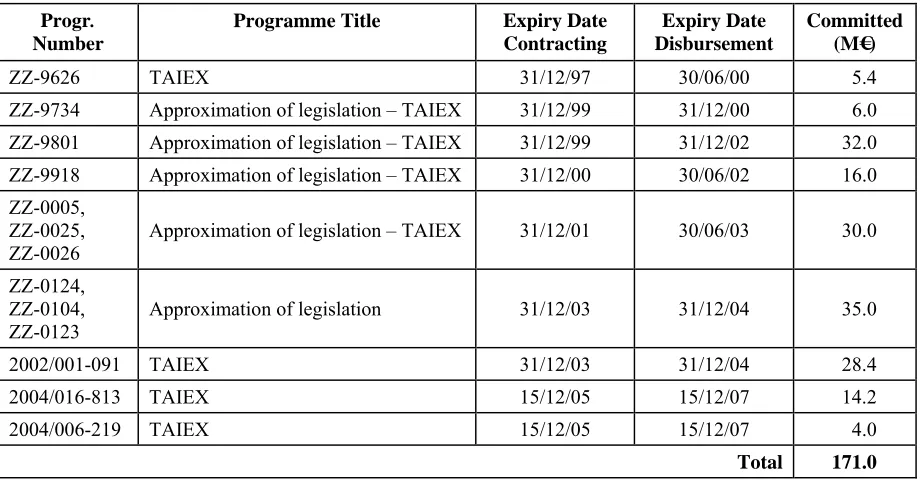
[image:12.595.69.529.321.561.2]8. The TAIEX Office has been funded through a series of Phare MBPs, as shown in Table 1. In the 1996-2004 period, M€ 171 was made available.
Table 1. Overview of TAIEX funding 1996-2004 Progr.
Number
Programme Title Expiry Date Contracting
Expiry Date Disbursement
Committed (M€)
ZZ-9626 TAIEX 31/12/97 30/06/00 5.4
ZZ-9734 Approximation of legislation – TAIEX 31/12/99 31/12/00 6.0 ZZ-9801 Approximation of legislation – TAIEX 31/12/99 31/12/02 32.0 ZZ-9918 Approximation of legislation – TAIEX 31/12/00 30/06/02 16.0 ZZ-0005,
ZZ-0025,
ZZ-0026 Approximation of legislation – TAIEX 31/12/01 30/06/03 30.0 ZZ-0124,
ZZ-0104,
ZZ-0123 Approximation of legislation 31/12/03 31/12/04 35.0
2002/001-091 TAIEX 31/12/03 31/12/04 28.4
2004/016-813 TAIEX 15/12/05 15/12/07 14.2
2004/006-219 TAIEX 15/12/05 15/12/07 4.0
Total 171.0
1.3 Results of Previous Evaluation
9. TAIEX was evaluated in 2000.6 The Evaluation Report recognised that TAIEX had developed a capacity for delivering a large number of events and was generally efficient. Contractors and recipients of events had performed well. The wider and immediate objectives of the programme - to provide information and advice on implementation of internal market measures - had been achieved. The immediate objectives concerning support to the transposition, implementation and enforcement of internal market legislation had also been achieved, as had the other immediate objectives of creating a translation infrastructure and supporting activities connected with institution building and twinning.
5 Eight ‘Phare’ countries; Czech Republic, Estonia, Hungary, Latvia, Lithuania, Poland, Slovenia and Slovak Republic;
Malta and Cyprus.
10. The Report made a number of recommendations aimed at
• Clarifying the TAIEX strategy (whether it should be pro-active or reactive);
• Putting in place an organisational structure to support this new approach;
• Increasing coordination between the TAIEX Office and the Phare national programmes and between the TAIEX Office and its key stakeholders including the Commission’s technical Directorate Generals (DGs) and DG Enlargement;
• Improving the effectiveness of activities through more attention to needs assessment;
• Decentralisation of activities to the beneficiary countries;
• Improved auditing and evaluation of TAIEX funds, including the development of appropriate impact indicators;
• Allow for provision of medium-term support by TAIEX.
11. The majority of recommendations have been implemented only partially. Organisational changes have taken place in TAIEX, largely along the sectoral lines recommended by the Report. Coordination with the Technical DGs has improved, in particular through the introduction of more systematic coordination mechanisms, although it is still not optimal (this issue is dealt with later in this Report). Other recommendations remain valid (i.e. have not been implemented), such as the desirability of decentralisation of some activities to the beneficiary countries and the need to improve indicators for measuring the effectiveness of activities. Annex 4 contains a brief commentary on the treatment of recommendations made by the previous Report.
1.4 Methodology
12. Evaluation questions were established in the Terms of Reference (ToR) for this evaluation (see Annex 1), and are divided into performance evaluation questions and thematic/cross-cutting questions. The ToR also includes the methodology for the evaluation, and indicators (see Annex 2).
13. The evaluation exercise has to meet not only accountability requirements, but also to provide findings that will be useful for operational decision-making. Accordingly (and in line with the ToR), the evaluation of earlier TAIEX interventions is brief and the main focus is on an in-depth evaluation of the more recent allocations to ensure utility for decision-makers.
14. The methodology consisted of a desk study and structured interviews. A sample of fifty events was drawn randomly from the total population of projects and all available documents from TAIEX relating to these projects were reviewed (i.e. reports, attendance lists, speaker lists and format). A review was made of TAIEX files of participant responses to TAIEX events, where these existed and/or were available.
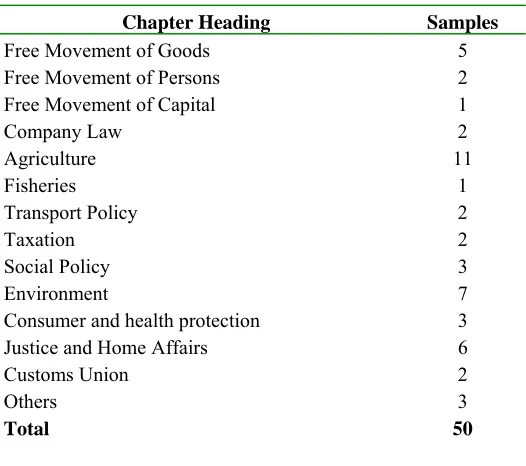
15. To facilitate an in-depth evaluation of the 2002-2004 period, the desk study included assembly and analysis of a database of approximately 20% of the TAIEX events organised among six focus countries (Estonia, Hungary, Poland, Slovak Republic, Bulgaria and Romania). This database shows the type of event, the accession agreement chapter heading, the date of the event and the beneficiary country or countries (see Annex 5). The distribution of samples by sector, by country and by acquis chapter is shown in Annex 6.
activity has been most intensive. These were indicated by the 20% sample as being (in terms of relevant Directorates General):
• DG Market (Chapters 1 to 6); • DG Agri (Chapter 7);
• DG SANCO (Chapter 7 - Animal Health);
• DG Environment (Chapter 22).
17. Insofar as possible, participants in activities related to these sectors were prioritised for interview. The fieldwork comprised interviews with TAIEX management and team leaders, relevant personnel in the DGs and personnel in the target countries who participated in events organised by TAIEX and/or who worked in Government departments that benefited from TAIEX interventions. A number of experts who participated as speakers or presenters or trainers at TAIEX events were also interviewed. The structure of these interviews followed the format of the performance evaluation questions in Annex 2.
1.5 Constraints
Box 1. Evolution of the TAIEX mandate Mandate, 1996: To channel technical assistance on
approximation of single market legislation in a focused way to the public and semi-public bodies of the Associated Countries. This advice can come from the Commission services, from the administrations and public or semi-public bodies of the member states. The advice and assistance can extend beyond the understanding of the EC legislation and the drafting of corresponding texts to the implementation and enforcement of the legislation;
To increase transparency as to how and where technical assistance is being provided by the Commission and EU-15 in each CC. Information about assistance activities can be shared so as to avoid redundancies of effort;
To set the information regarding technical assistance which has already been provided, against the objectives planned or achieved in each country, in order to allow a more focussed and rational deployment of assistance to each CC. This more focussed TA effort should help speed up the achievement of the most appropriate conditions for entry into the internal market.
Source: Report on the Activities of TAIEX for 1996
Mission Statement, 2004
• To provide institution building support in all areas of the EU acquis with the view to support the alignment, application, and enforcement of the acquis in the new member states, the candidate countries, the Western Balkans and Turkish Cypriot community in the North part of Cyprus;
• To provide centrally managed short-term technical assistance in the field of approximation, application and enforcement of EU legislation;
• To meet demand-driven requests for assistance from the beneficiary countries, the Commission Services and member states.
Source: TAIEX Activity Report 2004
2. PERFORMANCE OF TAIEX ASSISTANCE
2.1 Scope expanded to meet needs as the pre-accession process accelerated
19. Overall objectives of TAIEX have changed significantly since its inception. From its initial focus in 1995 on providing support
for the transposition, implementation and enforcement of internal market legislation, TAIEX has expanded to provide support for all acquis areas, in both CCs and the new member states (see Annex 7 for an overview of TAIEX objectives over the period 1996-2004).
20. TAIEX has evolved from a coordination mechanism to a provider of demand-driven assistance. The philosophy underlying early TAIEX included a focus on transparency not only of TAIEX activities, but of the delivery of technical assistance (TA) by both the Commission Services and the EU-15 to the CCs (see Box 1). Thus early TAIEX was seen as a mechanism to promote coordination between the various Commission and EU-15 support for the accession process. However, from 1999 onwards, it was clear that the volume of assistance and the extensive demands of the accession process made it all but impossible to ensure a central coordination of inputs. Furthermore, each country was proceeding at a different pace, necessitating different responses. Therefore the role of TAIEX changed from that of a mechanism to coordinate delivery of assistance, to a parallel provider of demand-driven assistance. The 2004 Mission Statement (see Box 1) clearly sums up the TAIEX philosophy as it stood at the end of the ex post evaluation period.
21. Lack of flexibility in Phare and other financial regulations has helped to create a niche for TAIEX. A further impetus for the development of TAIEX into its current form is the lack of flexibility in both the Phare financial regulation and the financial regulations governing the work of the DGs own activities.7 A niche for TAIEX has therefore evolved in delivering short-term inputs where existing financial regulations are inflexible either with respect to the type of activity that can be funded, or the link with existing programmes, or the duration of the
7 Many Community Programmes managed by the DGs have extended their application to the CCs, e.g. Customs 2002, LIFE,
input or the geographical coverage allowed. The TAIEX niche is therefore its ability to address gaps that have emerged due to rigidities in the Phare and community programme financial regulations.
22. TAIEX was specifically designed to have a direct and short-term link to the acquis elements of accession process. TAIEX was designed as a ‘problem solver’, a broker and as a catalyst, using its resources, networks and accumulated expertise to solve problems identified by the beneficiary countries first and foremost, but also as defined by the Commission Services through the Peer Reviews, Regular Reports and screening exercises. TAIEX is also empowered to respond to requests for assistance from parliaments, municipalities, social partners and economic operators. However, the TAIEX focus is firmly on the acquis elements of the accession process. Expansion of the TAIEX mandate has included new types of activities (e.g. Peer Reviews) and extension to new geographical areas rather than an expansion into non-acquis areas.
23. TAIEX has lacked a coherent strategy over time and across sectors. As important as its formal objectives, is the modus operandi of TAIEX. As set out in the first Financing Proposal, TAIEX acts as a broker, intermediary, or ‘one-stop shop’. It was intended that TAIEX would be demand-driven, that is, capable of responding to requests for assistance from both its beneficiary groups (or ‘client groups’) be they officials of new member states, CCs, DGs, parliamentarians or economic operators. Thus the underlying philosophy of TAIEX made it difficult to put in place a coherent strategy over time. In addition, as one of the defining characteristics of TAIEX was its perceived non-directive nature, previous management was reluctant to impose a structure and strategy on the instrument. This has been an important factor in the later decision to use TAIEX as the first Commission instrument to provide assistance to Northern Cyprus.
24. In practice TAIEX is not a purely demand-driven instrument. On one hand the TAIEX unit stimulates demand through its road shows and information days and on the other hand, the TAIEX unit makes clear choices as to the priority areas for funding on an annual basis and delivers a number of activities on a ‘programmed’ basis. For example, in 2003 the TAIEX unit identified a need for multi-country introductory seminars for the newly eligible Western Balkans on topics such as organised crime, food safety and public procurement legislation. Programmed activities in 2004 included a series of 30 seminars in EU law and activities with the Joint Research Centre (JRC). More recently, a multi-annual programme for the Turkish Cypriot community has been developed.
25. TAIEX has expanded appropriately to include support for Peer Reviews. Peer Reviews were included in the TAIEX portfolio in 2003 in response to the Commission’s 2002 Strategy Paper.8 In this context, TAIEX provides logistical and administrative support for the delivery of Peer Reviews by the relevant DGs, which in turn inform both the compilation of the Commission’s Regular Reports and in the immediate pre-accession period provide input for the Comprehensive Monitoring Report (CMR). The Regular Reports and the CMRs are important pillars for the programming of the national funds under Phare and later under the Transition Facility. The added value of TAIEX is the high volume of Peer Reviews that can be completed within a short period – 24 in Bulgaria and 28 in Romania in 2004. However, it is worth noting that not all DGs use TAIEX for Peer Reviews, preferring to rely on their own networks of experts.
8 The overall objective of the Peer Review process is to ascertain whether adequate administrative infrastructure and capacity
26. TAIEX provides relevant support for translation and transposition. The TAIEX Project Fiches (PFs) indicate that the TAIEX role extends beyond translation and transposition issues to the broader task of supporting capacity building for enforcement of the acquis. The current positioning of TAIEX within the institution-building unit of DG Enlargement confirms that TAIEX is seen as an institution-building instrument, albeit with a limited mandate (focussing on the transposition, implementation and enforcement of the acquis communautaire). For translation and transposition activities, TAIEX has been an appropriate instrument. As common understandings among translators and ‘transposers’ (administrators, lawyers) about the substantive meaning of the acquis is essential, a coordinated, multi-country response that allowed for cooperation and dialogue between translation and transposition practitioners was appropriate. There are perhaps other agencies in the Commission or the Council to which the task might have been assigned. (i.e. translation might have been given to the interpretation service and transposition to the Secretariat General or the individual DGs), but TAIEX was specifically tasked, manned and funded to provide services to CCs while other existing units are oriented to responding to needs of the institutions. Centralised support for the Translation Coordination Units (TCUs), as a co-ordinated multi-country activity has been essential to ensure that an effective in-country capacity to manage the translation process is in place and the various databases are appropriately designed. Expert missions to the beneficiary countries of practitioners from the EU-15 with in-depth, practical and specific experience of the subject area are appropriate for supporting the transposition process, in particular for providing hands-on input and for hands-on-site mentoring. Study tours can be useful to see how the transposition process is managed in different EU-15 countries. However for both the expert missions and study tours, success depends inter alia on the design of the intervention, and with regard to the expert missions, the quality of the expert provided.
27. A key challenge for users of TAIEX is to ensure that benefits to individuals are translated into wider institutional learning. Institutional capacity building requires a broad awareness of the institutional framework and the location of the intervention clearly within the institution’s development plan. Given the number of countries involved and the scope of the acquis, at best TAIEX workshops and seminars can only be expected to provide limited, sporadic or one-off interventions at the level of individual organisations. The short-term, tightly focussed and highly specialised nature of TAIEX interventions (particularly workshops and seminars lasting 2-3 days), coupled with a focus on information sharing, rather than skill-transfer means that impacts are limited to gap filling, rather than systematic and strategic capacity-building. While TAIEX meets urgent needs in individual organisations in terms of information provision, the overall structure of the TAIEX instrument cannot bring substantive capacity building at individual organisation level. For example, a 2-day multi-country ‘Workshop on Medical Devices: Best practices, Market Surveillance and Vigilance’ is useful for enhancing understanding of best practices in the area, but unless it is part of a more concerted enforcement plan, its effects will remain at the level of individual knowledge enhancement. Therefore a key challenge for users of TAIEX is to ensure that benefits to individuals are translated into wider institutional learning and development. Feedback from interviews shows a range of experience with dissemination, from publication of materials on internal web-sites, to follow-up workshops with relevant colleagues and stakeholders.
Box 2. TAIEX in Operation in Bulgaria
The TAIEX NCP for Bulgaria is located at the Council of Ministers. Initial support started in 1998 with the screening of legislation for alignment with the acquis. This task was completed in 2003. In later years, the TAIEX support has focused on transfer of good practice for administrative capacity building to implement legislation. Visits to and from EU counterparts have been particularly useful. In 2004, requests for TAIEX were centralised by the Council of Ministers.
The Bulgarian TAIEX co-ordination unit issues letters to ministries (Ministers) calling for applications for TAIEX interventions. These letters are passed down the chain to Deputy Ministers/Directors who are often the chairpersons of Sectoral Working Groups. The letter emphasises to need to avoid overlaps with existing Phare assistance.
The TAIEX Unit comes on mission to Sofia for general events and this helps to spread the knowledge of TAIEX throughout the administration. The TAIEX Unit in Brussels also forwards lists of participants at TAIEX events to avoid duplicate applications for assistance. Peer Reviews often generate further TAIEX work.
In 2004, 273 requests for TAIEX assistance were submitted to Brussels, and 199 were implemented. In 2005, 262 requests were submitted and 211 implemented. The main reasons for rejection of requests included: expanding the scope in order to launch a multi-country event; avoidance of study visits and the availability of a suitable alternative elsewhere (e.g. support from Europol for JHA activities).
The main advantages of TAIEX include a quick response time and knowledge transfer from EU-15 experts in sectors such as agriculture and forestry.
the basis of ‘first come first served’. Where clarifications are needed as to the relevance of the assistance required, consultations take place with line DGs, EC Delegations, and Country Teams in DG Enlargement. The majority of activities surveyed were relevant, in term of priorities identified in the Regular Reports. However, for many of the activities (workshops and seminars) at both country and sector level, it is unclear to what extent they are in line with country or sectoral level priorities. This has downstream implications for the level of resources that are made available for follow-up or dissemination activities.
29. Links between TAIEX and line DGs have improved, but the need for more strategic dialogue remains. Interviews confirm that relations with the line DGs have improved gradually in the 2002-2004 period and TAIEX has been active in promoting more structured dialogue with counterparts in both line DG and regional and geographic units. The TAIEX ability to mobilise assistance quickly and to handle administrative arrangements is greatly appreciated by the line DGs. In some key areas, such as agriculture and food safety and justice and home affairs (JHA), up to 250 requests for assistance are processed annually by the relevant TAIEX teams. In the absence of the TAIEX unit this task would fall to the DGs who are currently not equipped to process such a high volume of requests and indeed administer the resulting interventions. However, relations with DGs depend to a large extent on personal relations between the TAIEX team and the DG. In some areas such as environment, agriculture and JHA, relations function
well, with good coordination, while other areas have been less successful.
30. The network of National Contact Points has functioned adequately. In-country coordination of TAIEX information dissemination has performed well, and there is a good awareness of the instrument and the eligibility criteria across the interviewed beneficiaries. However in some cases, the National Contact Points (NCPs) themselves are by-passed by the beneficiaries as they make direct contact the TAIEX Unit in Brussels and/or their counterpart institutions in the EU-15.
31. The National Aid Co-ordination
Units are not systematically involved in TAIEX coordination. While identification of needs at sectoral level is carried out appropriately by the relevant institutions, there is no evidence (in the sample countries at least) of prioritising between sectors, or identification of priority needs at country level. While this is consistent
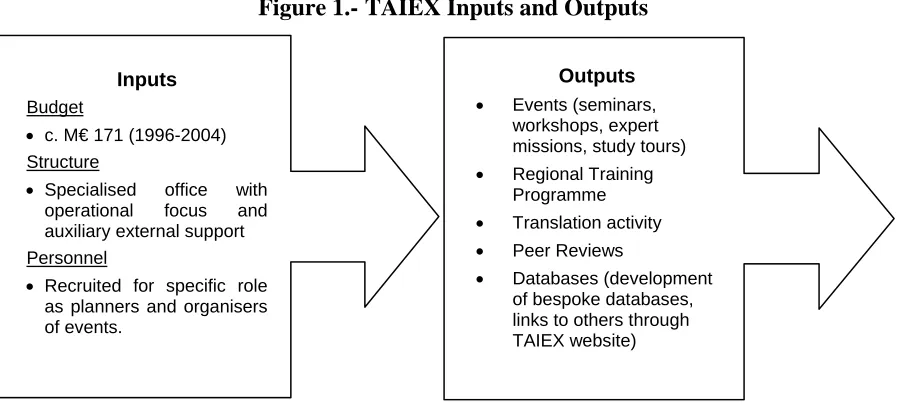
Inputs
Budget
• c. M€ 171 (1996-2004) Structure
• Specialised office with operational focus and auxiliary external support Personnel
• Recruited for specific role as planners and organisers of events.
Outputs
• Events (seminars, workshops, expert missions, study tours)
• Regional Training Programme
• Translation activity
• Peer Reviews
• Databases (development of bespoke databases, links to others through TAIEX website)
2.2 Considerable volume of outputs generated, and cost-effectiveness improved, but scope for further savings
[image:19.595.71.522.188.390.2]32. The unique selling point of TAIEX is it ability and willingness to take on ‘logistically demanding actions. This could be considered as one of the central features of TAIEX that distinguishes it from other Phare interventions, and the organisation and funding of TAIEX reflects this. Analysing the TAIEX intervention logic we can see inputs and outputs as shown in Figure 1 below (for a full reconstructed intervention logic please see Annex 8).
Figure 1.- TAIEX Inputs and Outputs
33. Accountability of TAIEX in the 1996-2001 period has been poor. Quantifying TAIEX outputs and in some cases inputs in the evaluation period is complicated firstly by unavailability of data and secondly where data is available it is not comparable year on year due to a lack of consistency in the definition of categories and beneficiaries. Between 1996 and 2000 only three annual reports have been prepared, covering the periods 1996, 1997 and 1998-2000 respectively. The reports provide a basic overview of TAIEX activities in the period but only gross figures on outputs are given and there is no strategic analysis of the TAIEX activities, or identification of impacts.
34. TAIEX inputs have generated a considerable volume of outputs. TAIEX inputs to date include a budget of M€ 171 used to support both the actual costs of delivery of outputs (e.g. room hire, translation, per diems, flights etc.) and the organisational costs for supporting the outputs (i.e. staffing both internal and external). A more detailed discussion on cost-effectiveness is given below and section 2.3 deals with quality of outputs.
Training Programme9 (RTP) also grew up to 2005. With accession completed for eight of the ten Phare countries in 2004, there was a decrease in the number of Peer Reviews.
Table 2. TAIEX events by sector/type of activity (new member states and CCs)
Number of events
2003 2004 2005 2006
Transport, Environment and Energy 42 64 87 74
Internal Market 60 87 132 95
Freedom Security & Justice 21 60 114 120
Translation of the Acquis 10 0 2 0
Peer Reviews/Assessment Missions/Advisory
Visits 161 58 51 52
Regional Training Programme 145 188 188 147
Agriculture & Food Safety 46 109 109 65
Individual Mobilisation: Expert and Study Visits 82 87 140 117
Total 567 653 823 670
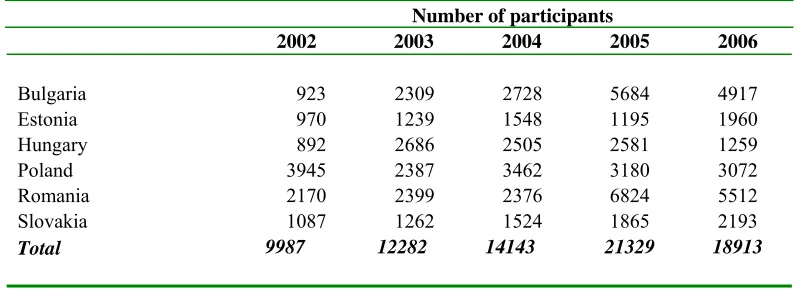
Table 3. Participants by sample beneficiary country
Number of participants
2002 2003 2004 2005 2006
Bulgaria 923 2309 2728 5684 4917
Estonia 970 1239 1548 1195 1960
Hungary 892 2686 2505 2581 1259
Poland 3945 2387 3462 3180 3072
Romania 2170 2399 2376 6824 5512
Slovakia 1087 1262 1524 1865 2193
Total 9987 12282 14143 21329 18913
36. There was a sharp increase in TAIEX activities as the CCs approached membership. The data shows that there was a sharp increase in the number of events (and the level of participation) as the CCs approached membership in 2004 (see Table 4). To understand this trend in more detail, the evaluators analysed a 20% random sample (see Annex 10). From this analysis we can see that agriculture was the leading chapter with about one third of the total. This area divides into the responsibility of DG Agriculture and DG SANCO (animal health). Next in importance is internal market, which covers the first six chapters of the acquis. Environment is in third place and transport fourth.
[image:20.595.98.497.342.487.2]
Table 4. Acceleration of TAIEX activities in pre-accession period Percentage of activities in period 2002-04
2002 2003 2004
Bulgaria 14.1 22.5 62.0
Estonia 21.5 26.2 52.3
Hungary 19.5 26.0 50.6
Poland 21.5 28.0 47.3
Romania 14.9 25.3 57.3
Slovakia 23.5 27.9 45.6
37. Current organisational structure broadly meets TAIEX needs. At the cut-off date of this evaluation, the Institution Building Team at DG Enlargement (TAIEX) comprised 46 staff organised by activity type (Individual Mobilisation, RTP, and Peer Reviews), sector (agriculture and food safety, justice and home affairs, and internal market) and geographically (cooperation with Western Balkans, co-operation with Northern Cyprus). Country Contact Points are distributed through the sectoral and activity-based teams (see Annexes 10 and 11). This represents a considerable improvement on the situation pertaining at the time of the last evaluation.10
38. Use of external contractors is essential for coordination of logistical support under the current centralised management. The functions of TAIEX are divided between the TAIEX unit in DG Enlargement and an external contractor. The latter is responsible for arranging travel, accommodation and other services for the events once TAIEX has approved the activity. The contractor is responsible for making all the payments. There seems no alternative to the use of external contracting, given the volume of work involved in centralised coordination of logistical support. However, there are constraints. A contractor must be a public body or private body with public purpose to be eligible for devolved financial responsibilities. This limits the number of possible contractors and has an adverse impact on reducing prices through competition.
39. Some overlap between work of external contractor and work of TAIEX Unit staff. When a request is made for an event, TAIEX creates an Order Form (see Annex 13) containing basic information on the proposed event (the names of speakers, presenters, participants as well as hotels, travel requirements etc.). This form is accessible to the external contractor and when the final decisions have been made, the external contractor begins to reserve flights, hotels and other facilities. The interface between the two units works well, but there is an inevitable degree of overlap with the results that TAIEX personnel are involved in some of the administrative work.
40. Delivery is excessively centralised. It should be emphasised that almost all of the preparatory work for an event is completed in Brussels by the external contractor. Use of local contractors is minimal. It is argued that this is efficient and that almost all details are more efficiently procured in Brussels and transported to the beneficiary country than can be done on the spot by local contractors or suppliers. Centralised organisation is certainly appropriate to many kinds of TAIEX activities, e.g. peer reviews, maintenance of databases and organisation of speakers and locations for multi-country events (which comprise a significant proportion of
10 The present set up is an important simplification on what was there before, because the distribution of activity type
TAIEX events).11 Central control also allows for consistent quality, which may be difficult to guarantee if tasks are decentralised to the beneficiary or organising country. However, centralisation of the administration, including booking flights, hotels, printing and dispatching conference documentation, place names and other details seems excessive and probably accounts for what appears to be high production costs relative to outputs (see 42 below).
41. ‘Rapid response’ nature of TAIEX can have adverse impacts on the quality of events. In addition to the ‘normal’ logistical problems expected with such a high volume of small-scale transactions (15,000 payment transactions in 2004 alone), the ‘rapid response’ nature of TAIEX interventions can have adverse impact on quality (see 45 and 50), in particular the choice of experts may be driven by availability rather than appropriateness. While the main message from the interviewing process regarding the quality of events was positive, a significant number of interviewees noted inconsistent logistical quality of events. Problems ranged from speakers failing to turn up, confusion about hotels, late arrival of flight tickets, and last minute changes to agenda.
42. Centralised logistical support of TAIEX activities was costly, but efforts have been made to improve cost-effectiveness, and these should be continued. In the period 2002-2005, the total cost of events (fees, travel, accommodation, etc.) was around M€ 15. The combined cost of the TAIEX Office and the external contractor was approximately M€ 10 million, with almost 100 persons employed in the two organisations. Thus, based on these figures, for the period 2002-2005 it cost € 2 to spend € 3. From 2003 however, ongoing efforts have been made to improve cost-effectiveness, and more recent data12 (albeit within a different timeframe) indicates that production costs are reducing. Using 2003 as a ‘base year’, in the period 2003-2006 figures provided by DG ELARG Institution Building Unit indicate a ratio of approximately €1 spent on ‘production’13 activities for every €3 spent on operational expenses. Although the production costs appear high, the estimated average cost per participant-day was relatively competitive with commercial organisers of training events. During 2003-2006, the average cost per participant-day was estimated by DG ELARG Institution Building Unit as €451 (2003), €483 (2004), €345 (2005) and €328 (2006), including Commission overheads. Over the same period, the number of events organised was 1,008 (2003), 1105 (2004), 1322 (2005) and 1106 (2006).
43. Options for decentralisation must ensure that quality is maintained and savings are passed on. Provision of centralised (Brussels-based) logistical support (purchase of airline tickets and booking of hotel rooms) appears to be a cumbersome and costly approach. Advances in the use of internet booking and the rise of low-cost airlines would seem to reduce the need for centralised support for logistical arrangements, and suggests an argument for at least partial decentralisation. However the centralised approach does have certain benefits, for example, centralised buying allows the external contractor to negotiate attractive prices for airline tickets and hotel rates. The prepaid nature of arrangements also ensures that local participants are not prevented from taking part in TAIEX events through lack of access to finance. Centralised delivery also ensures that events (at least from an organisational point of view) are of good quality. However, considering the number of people employed by the external contractor, there are substantial overheads to be covered. To facilitate implementation of in-country events, the external contractor has concluded contracts with local companies and
11 For example, in 2004 in the priority area of agriculture and food safety, multi-country events accounted for 89 of 201 events
(44%).
12 Dated 9 March 2007.
13 ‘Production’ activities are broadly defined as activities involved in producing the TAIEX product, and include inputs in
this would indicate that there are savings to be made. However, it is unclear whether these are reducing the overall delivery costs. In addition, any decentralisation must ensure that quality of events is maintained and this needs to be built into the overall quality control function, and the additional costs of monitoring local activities would need to be taken into account.
2.3 Planned results largely achieved
44. Planned outputs have been delivered. Immediate objectives are defined by the PFs in terms of outputs, and in this sense they have largely been delivered: central translation facilities were established and supported successfully; translation activities were coordinated, and quality of translation was ensured.14 Later, advice was delivered on transposition, implementation and enforcement of legislation and information and know-how has been provided through seminars, training and documentation. However, as noted earlier, TAIEX operates in a demand-driven manner and is thus reluctant to be prescriptive in relation to the scope or quantity of outputs to be delivered.
45. Information on the quality of outputs, scale of immediate impacts and use of resources has only recently been collected and analysed in a systematic manner. TAIEX activities have involved over 70,000 individuals in the period under evaluation. However, systematic collection and collation of feedback from participants on TAIEX events commenced only in late 2004. Before this, only a limited number of TAIEX teams invited comments on TAIEX events on a regular basis, and then not according to a defined format. While these responses were useful to the Teams and Team Leaders concerned, they were insufficient to support more general conclusions about TAIEX. As of 2006, the TAIEX Office also started to put in place arrangements to track costs and hence efficiency of TAIEX activities.15
46. Beneficiaries interviewed report a high level of appreciation of TAIEX activities. Interviews with beneficiaries and with DGs indicate a high level of satisfaction with the quality of the TAIEX events. Speakers were felt to be largely appropriate and the information provided considered relevant. Many interviewees noted the value of TAIEX’s ability to support missions from EU-15 experts and practitioners to the CCs to provide ‘hands-on’ support for the specific areas. The ‘rapid response’ nature of TAIEX was particularly appreciated, and the TAIEX support for CC participation in expert working groups and other Commission activities and events, which would otherwise not have been possible due to CC financial constraints. However, there were cases of poor quality speakers/experts, and inaccurate targeting of seminars and workshops (i.e. subject matter not precisely targeted to audience), which reduced the quality of the outputs) (see 41 above).
2.4 Immediate impact was largely good, and databases and Peer Reviews also made good wider impacts.
47. Impact assessment is constrained by nature of TAIEX activities. TAIEX is designed to deliver a large volume of small and short-term activities (over 10,000 in the evaluation period), across a wide range of acquis chapters. TAIEX also acts as a catalyst and facilitator. Therefore, substantive and wider capacity-building impacts at the level of individual organisations are not generally envisaged.
14 More information is given in Annex 13.
15 In its comments on the draft report, the Institution Building Unit, D4, report that since 2006 a quality control function has
48. Measuring/assessing impact is not integrated in the TAIEX work cycle. The PFs for TAIEX are not based on logical framework analysis. While this may be consistent with the internal logic of TAIEX as a ‘demand driven’ instrument, it makes monitoring and evaluation difficult if not impossible. TAIEX reporting focuses primarily on the activities delivered by TAIEX and only in limited cases (Peer Reviews, transposition activities) is there a focus on immediate or wider impacts of the TAIEX support. Furthermore, current reporting does not differentiate between the TAIEX role as an instrument facilitating the work of other DGs or CCs, and its role in initiating and delivering substantive inputs, e.g. through the RTP or its work with translation and transposition.
49. From a thorough analysis of TAIEX, the Evaluators have reconstructed an intervention logic (see Annex 8). From this logic, the impacts can be discussed in four types: a) immediate impacts on individuals; b) intermediate impacts on institutions; c) intermediate impacts on the Phare programming process; d) wider impacts on the accession process.
50. Immediate impacts on individuals varied depending on quality of event. The potential for TAIEX to contribute to skill building at individual level is considerable. The large number of participants and the widespread satisfaction with quality of TAIEX events indicates a high level of impact at the individual level. However, there were cases of logistical problems (see 41), poor quality of speakers and experts, and inaccurate targeting of seminars and workshops (i.e. subject matter not precisely targeted to audience, see 45), which reduced the immediate impact at this level.
51. Mixed experience with dissemination of knowledge within beneficiary organisations. Interviews indicate that there is a mixed experience with dissemination of knowledge gained through participation in TAIEX events. In some cases there are systems in place for the transfer of experience, including circulation of mission reports, or information meetings within the organisation. However this is not a common feature of all beneficiaries organisations interviewed. Systematic dissemination of TAIEX materials was also not addressed by the beneficiaries interviewed. This limited the intermediate impact.
52. TAIEX has had good wider impact in supporting the accession process through the databases and Peer Reviews. The most evident wider impacts of TAIEX are found in two areas: support for the translation and transposition process and through the coordination of Peer Reviews. The translation and transposition databases have not only been useful tools in monitoring the rate of transposition of legislation,16 helping to manage the translation and transposition process and avoiding bottlenecks in the period immediately preceding accession. The databases have also served to enhance the transparency of the accession process and to provide access to EU legislation in national languages to a wide audience. The databases have been extensively used in the immediate pre-accession period. For example, the CCVista database received 1,000 hits in the period leading up to and immediately after accession.17
53. TAIEX has provided added value to the Peer Review process through its strong coordination role. The Peer Reviews are widely recognised as having had significant impacts on the programming of the Phare national envelopes, through identification of areas where Phare support should be targeted, thus improving effectiveness. They also provide essential
16 See Annex 3 for an overview of the TAIEX databases.
17 CCVista is an electronic database containing all EU legislation (over 100,000 pages) translated into the national languages
input into the Commission’s Regular Reports, which in turn are central to the Phare programming process. Given that the TAIEX role in Peer Reviews is limited to providing logistical support, it is difficult at first glance to see the added value of the TAIEX intervention, but its added value in the process lies in its ability to organise and coordinate a large number of short-term interventions (up to 28 Peer Reviews in Romania alone in 2004).
54. The 2004 TAIEX work programme sees the extension of the Peer Review concept to include assessment missions18 and advisory visits19 to all TAIEX beneficiary countries where formal monitoring is not the aim but where the purpose is to provide a gap analysis or assist in strategy development. This is an important change in the role and focus of this kind of activity. Impact will be contingent on these missions and visits having the same status as the Peer Reviews, particularly in terms of political commitment and quality of the outputs.
2.5 Sustainability of translation/transposition good, but weaker for training activities 55. TAIEX activities are not strategically programmed and potential sustainability is not a determining factor in approval of requests for assistance. In some cases, the very nature of the intervention is such that long-term sustainability is not envisaged. For example, the Law Approximation Database (LAD), which gives an updated overview of the legislation adopted by each CC, is not sustainable in the post-accession environment, but it is an important tool in monitoring transposition in the pre-accession context. Like impact, sustainability of TAIEX results is also constrained by the limited size and duration of individual interventions, and staff turnover in the new member states and CCs.
56. Good sustainability of translation and transposition outputs. There are some areas where TAIEX results have been sustained: particularly in the area of translation and transposition of legislation. A considerable amount of work has been done to develop a body of legislation translated into the new official languages of the EU. This is now available to legislators, legal practitioners and other interested parties. While the future of the TCUs in the post-accession environment is somewhat in doubt (translation of EU legislation is the responsibility of the Commission Services), on-going support for the TCUs, together with specialist workshops and training for legal practitioners (‘jurist linguists’) have helped to put in place an in-country capacity to support legal translation.
57. Design of the TAIEX databases has focussed on ensuring compatibility with existing databases (e.g. CCVista is completely compatible with the systems used by the Commission’s Translation Service, Legal Service and Official Publications) and the Pre-Notification Database20 has been merged with the Notification Database, which deals with notifications from the member states. Of concern is the future sustainability of the JurisVista database currently hosted by TAIEX. This has been useful in ensuring wide access to the judgments of the European Court of Justice (ECJ) and the Court of First Instance (CFI). The AVIS (animal diseases), VETLEX (veterinary legislation) and PHYTOLEX (phytosanitary legislation) have good prospects for sustainability as they have been developed as commercial products under licence agreements (free access is provided for a limited number of relevant officials in the
18 Assessment missions can be conducted where formal monitoring is not the aim but where the purpose is to identify needs,
provide a gap analysis or elaborate a strategy in a given sector. Such an approach is foreseen as a mechanism for assistance to the Turkish Cypriot community.
19 Advisory visits are a new third type of peer-based assessments within this category. These visits would be organised at the
request of the beneficiary country to assist them to identify gaps in their administrative or legislative preparations.
20 Launched in 2003, the Pre-Notification Database helped acceding countries to meet their obligations ahead of accession
competent ministries). Given the geographical expansion of TAIEX into new countries which are not on an accession path, it is unclear what the future role of the TAIEX databases will be.