B
UDGET
P
ERSPECTIVES
2005
Tim Callan
Aedín Doris
Daniel McCoy (eds.)
Shane Garrett, Catherine Mathieu,
Anne Nolan, Brian Nolan,
Henri Sterdyniak
Copies of this paper may be obtained from The Economic and Social Research Institute (Limited Company No. 18269). Registered Office: 4 Burlington Road, Dublin 4.
www.esri.ie
Price €20.00
Research Officer, Anne Nolan is a Post-Doctoral Fellow and Shane Garrett is a Research Assistant at The Economic and Social Research Institute. Catherine Mathieu is a Senior Research Fellow at the OFCE (Observatoire Français des Conjonctures Economiques). Henri Sterdyniak is a Senior Research Fellow at the OFCE and Professor of Economics at the Universitė de Paris IX-Dauphine.
B
UDGET
P
ERSPECTIVES
2005
Tim Callan
Aedín Doris
Daniel McCoy (eds.)
Shane Garrett, Anne Nolan,
Brian Nolan, Catherine Mathieu,
Henri Sterdyniak
© THE ECONOMIC AND SOCIAL RESEARCH INSTITUTE
DUBLIN, 2004
The papers included here have benefited substantially from comments and suggestions offered by ESRI staff, FFS members and by the Director, Brendan Whelan. We are very grateful to our colleagues for their valuable input in this regard. We thank Eleanor Bannerton and Daphne McNamara Lancha for organising the administration of the Conference. Thanks are also due to Mary Cleary, Regina Moore and Deirdre Whitaker for their invaluable help in bringing this paper to publication.
Page
Acknowledgements
iv
OPENING ADDRESS 1
Brendan Whelan
Chapter
1 IN SEACH OF AN APPROPRIATE EUROPEAN FISCAL FRAMEWORK 4
Catherine Mathieu and Henri Sterdyniak
2 RELATIVE INCOME POVERTY: LEARNING FROM THE
BEST-PERFORMING COUNTRIES 54
Tim Callan and Brian Nolan
3 IRELAND’S HEALTH CARE SYSTEM: SOME ISSUES AND
CHALLENGES 70
OPENING ADDRESS
Brendan Whelan
Director, The Economic and Social Research Institute
W
ELCOMEI
would like to welcome you all to this, the seventh Budget Perspectives Conference, which is co-hosted by the Economic and Social Research Institute and the Foundation for Fiscal Studies. The objective of these conferences is to set the scene for the national debate on budgetary priorities by presenting a number of papers on topics relating to taxation and public expenditure. I should, of course, remind everyone that the views expressed are strictly those of the individual authors; neither the ESRI nor the FFS takes corporate or institutional positions in relation to any of the issues raised.The economic context in which the 2005 Budget is being constructed is quite different from that facing the Minister last year. At that time, the international economic situation had been quite depressed, with very slow growth in world trade and interest rates at historic lows. Inflation in Ireland was running at a higher level than in other EU countries and tax revenues had been quite weak. As the economy faces into 2005, most of these negative trends have been reversed. The international economy is expanding and the Irish growth rate has improved appreciably. Tax revenues have become much more buoyant and have been further boosted by a number of special factors. The pace of inflation has moderated with the Irish rate now below that prevailing in some of our EU partners.
This situation gives the Minister more room for manoeuvre in devising the budgetary strategy. While remaining prudent by continuing to target an overall position of broad fiscal balance, it should be possible to introduce some changes in the patterns of taxation and expenditure. The papers presented at today’s conference, and the ensuing debate, will, I hope, help to clarify what those changes might be and how they could be implemented.
T
he conference opens with a presentation by Daniel McCoy and Shane Garrett, summarising some of the key trends identified in the recent Quarterly Economic Commentary. They project that growth will be around its long-run potential level of 5 per cent this year andA
Macro-economic
Perspective
next (for both GDP and GNP), that inflation will average over 2 per cent and that the General Government Balance will remain in modest surplus, comfortably within the requirements of the Stability and Growth Pact. Employment is expected to continue to grow and unemployment to stay at historically low levels. The authors also take up in their presentation a number of policy themes addressed in recent editions of the QEC such as the possible macro-economic effects of the Special Savings Investment Accounts and the increasingly significant role of house building in the economy.
O
ne of the great benefits of the Budget Perspectives Conferences is that they give us the opportunity to hear the views of experts from outside the country. This year we very fortunate to have with us a distinguished speaker from the Observatoire Français des Conjonctures Économiques, Dr Catherine Mathieu. Her paper, which is co-authored with Henri Sterdyniak, reviews the development of the Stability and Growth Pact, assesses the difficulties which have arisen with it and suggests an agenda for reform. The paper evaluates the wide range of reforms that have been proposed by academics and others, including the “golden rule”, new committees and institutions and the role of ageing and pension provision in the debate. The authors’ own solution emphasises the need for a relatively light regulatory touch. They suggest that surveillance at EU level should bear only on issues which have the potential to lead to negative externalities between countries in the monetary union, especially by ensuring that inflation within each country stays in line with a specified inflation target for the eurozone as a whole. This morning Catherine will only have time to present the main points of this comprehensive paper; the full version in the published volume repays further careful study.An Appropriate
Fiscal Framework
for the Eurozone
I
n the third presentation, Tim Callan and Brian Nolan examine why relative income poverty rates in Ireland have remained high compared with many other EU countries. They begin by presenting the basic facts of the situation and look at a variety of possible explanations for the observed patterns. They conclude that differences in demographic factors, such as age structure, the pattern of labour force participation and household composition do not generally account for differences between Ireland and better performing countries such as Denmark and the Netherlands. The most likely explanation appears to lie in the different tax and welfare structures of these countries which involve substantially higher costs in the form of higher taxation. This conclusion raises important strategic choices in relation to economic incentives, labour market behaviour and economic growth.T
he final presentation of the morning, by Anne Nolan and Brian Nolan, examines three key aspects of Ireland’s health care system. It begins by taking an overall view and benchmarks the Irish system against that in 21 other countries. In general they characterise the performance of the health care system as disappointing. They also show that the most striking feature of Ireland’s health spending is how rapidly it has increased in absolute terms in recent years. The second part of the paper considers the use of general practitioner services by persons at different income levels, in particular those with and without entitlement to free GP services. They find a marked difference between the utilisation rates of the two groups and consider the implications for policy. The last section of the paper examines the complex mix of public and private health care operating in Ireland and how it interacts with the market for health insurance. Almost half of the Irish population now pays for private health cover and the authors address the issues to which this gives rise in relation to equity and incentives.Issues in Relation
to Ireland’s
Health Care
System
I
t is clear from this brief outline that this morning’s papers cover a very wide terrain. There will be scope for a short period of discussion after each paper and time for a somewhat more extended interaction after the final paper. I hope that as many as possible of you will participate.I
N
S
EARCH OF AN
A
PPROPRIATE
E
UROPEAN
F
ISCAL
F
RAMEWORK
Catherine Mathieu
*
and Henri Sterdyniak
**
T
he implementation of the Stability and Growth Pact (SGP) illustrates how simple policy rules may not be enforceable if they lack sound economic rationale. The 3 per cent of GDP deficit rule embedded in the SGP has been breached in a growing number of EU-15 countries since the initiation of the economic downturn in late 2000. With six of the ten new Member States in the same position, as many as twelve of the twenty-five Member States were subject to an Excessive Deficit Procedure (EDP) in September 2004.1.
Introduction
Since the early days of the SGP, the provisions inherited from the Maastricht Treaty had been criticised by a number of economists and policy-makers arguing that the procedures of fiscal surveillance were not providing a satisfactory framework of economic policy co-ordination in the European Union. The implementation of the SGP had started in a favourable situation of rapid growth. But the need for reforming the SGP has become more and more obvious since the economic downturn of late 2000. In November 2003, when the Ecofin Council did not endorse the European Commission recommendations requesting France and Germany to take new budgetary measures to bring their deficit below 3 per cent of GDP, the SGP seemed almost dead and the EU fiscal policy framework under high uncertainties. Ten months later, the SGP is still alive, at least on paper, but a new framework seems
4
* OFCE (Observatoire français des conjonctures économiques) – 69, quai d’Orsay
– 75340 Paris cedex 07 – France; e-mail: [email protected].
**OFCE and CERPEM-CREFED Université de Paris IX-Dauphine; e-mail:
more than ever necessary in an enlarging Union. On 3 September 2004, the Commission expressed ‘ideas’ depicted by Joachim Almunia as ‘an evolution rather than a reform of the SGP’ (European Commission, 2004b). On 10 September, the Ecofin Council opened the door to a possible reform of the Pact. This paper presents a critical assessment of the debate.
Section 2 recalls the fiscal policy framework in the euro area and addresses its weaknesses. Section 3 provides an assessment of the first six years of existence of the SGP. Section 4 is devoted to the reforms proposed by the Commission. Section 5 discusses proposals made by economists to improve the European fiscal policy framework. Section 6 concludes.
B
efore the launch of the economic and monetary union (EMU), two views had been proposed on the conduct of fiscal policies. In one view, the EMU should allow each Member State to choose and run domestic fiscal policy in full independence. Independent fiscal policy is a prerequisite in a monetary union since monetary policy, conducted at the area aggregate level, becomes ineffective in the event of asymmetric shocks. The exchange rate can no more be used as an instrument of economic policy. Price and wage adjustments, as well as labour mobility, only play a minor role in Europe. But fiscal policy gains strength in a monetary union as it will not be counteracted by interest rate rises or exchange rate responses.2.
The Existing
Fiscal Policy
Framework
According to another view, if each country was allowed to conduct fiscal policy without any binding rule, all countries would run excessively expansionary policies because they do not have to care anymore about their external current account balance or about speculation on exchange rate and interest rate markets. Last, a country implementing an expansionary fiscal policy alone will not be strongly affected by the central bank’s rise in interest rate.
Box 1: On the Compatibility Between a Single Monetary Policy and Independent National Fiscal Policies
The functioning of each Member State economy may be summarised as follows: yi =di+gi−σrand i
0
i i y
π =π +α where yiis
the level of output in the country i (as deviation from potential output); πi, inflation rate in the country i, expressed as deviation
from the central bank’s inflation target); 0
i
π , initial inflation (as deviation from the target) or a price shock; di an indicator of private
demand and gi an indicator of public demand (assumed to be equal
to the public deficit); r: the single interest rate. It is not possible that each country uses fiscal policy with a view to maintaining full employment, while monetary policy uses the interest rate to keep the aggregate inflation of the area at the desired level. If 0
i
π stands on average above the central bank’s inflation target, fiscal and monetary policies will be incompatible. The central bank would raise the interest rate to cut inflation whereas national governments would raise public deficits to maintain full employment. This would lead to a permanent increase in the interest rate and public deficits (Capoen, Sterdyniak and Villa, 1994).
How can this interdependence be managed? A framework for a permanent co-ordination of fiscal policies and monetary policy could have been designed. However, it is difficult to imagine how urgent decisions could have been conditional on negotiations, with no final agreement certain of being reached; an agreement would have been imposed on all countries and would have been a direct constraint on fiscal policies, which is politically difficult. So it was decided to impose constraints on national fiscal policies through the SGP. These constraints are not totally rigid. National policies kept some room for manoeuvre which could compensate for the fact that the rules were not perfectly adapted. But the institutional logic is such that constraints are getting stronger over time: national authorities are becoming progressively entangled in a ‘spider web’.
2.1
THE INSTITUTIONAL FISCAL FRAMEWORKThe monitoring of fiscal discipline is based on four elements: criteria inherited from the Maastricht Treaty: the 3 per cent of GDP deficit threshold and the 60 per cent reference value for the ratio of government debt to GDP; an institutional framework to implement fiscal surveillance: the Stability and Growth Pact and a co-ordination process for economic policy: the Broad Economic Policy Guidelines (BEPGs).
Member States should discuss and define in an open process the policies to be implemented in Europe in view of the different national situations. If the objective is to run a common economic policy, then a democratically elected economic government of Europe should be settled. No clear choice has been made between these three possibilities.
2.2
THE RATIONALE FOR THE3
PER CENT OF GDPREFERENCE VALUE
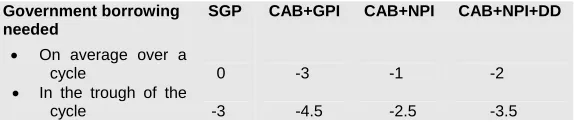
The 3 per cent ceiling for deficits is the absolute reference in the current fiscal framework because it is the only criterion which may lead to sanctions. However, it has no economic rationale. Why 3 per cent? The reasons given are awkward. A deficit of 3 per cent of GDP would stabilise the debt level at 60 per cent of GDP under a nominal GDP growth of 5 per cent. But in that case the reference should apply to the cyclically-adjusted balance or to the average borrowing over an economic cycle. Then comes the question: why 60 per cent? The 3 per cent figure would be close to the share of public investment in EU GDP. But, there again, the reasoning can apply only to cyclically-adjusted deficits. The level of the deficit would need to be compared with the observed level of public investment, so that a country implementing public investment programmes would be entitled to a higher deficit.
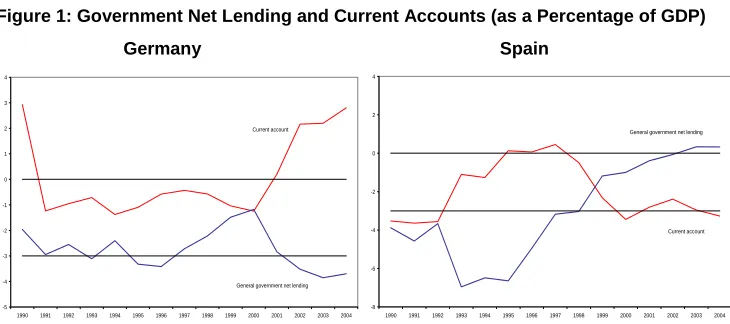
public deficits. Why do surveillance procedures control public balance and not external accounts?
Figure 1: Government Net Lending and Current Accounts (as a Percentage of GDP)
Germany Spain
-5 -4 -3 -2 -1 0 1 2 3 4
1990 1991 1992 1993 1994 1995 1996 1997 1998 1999 2000 2001 2002 2003 2004 Current account
General government net lending
-8 -6 -4 -2 0 2 4
1990 1991 1992 1993 1994 1995 1996 1997 1998 1999 2000 2001 2002 2003 2004 Current account General government net lending
Source: OECD Economic Outlook No. 75, June (2004).
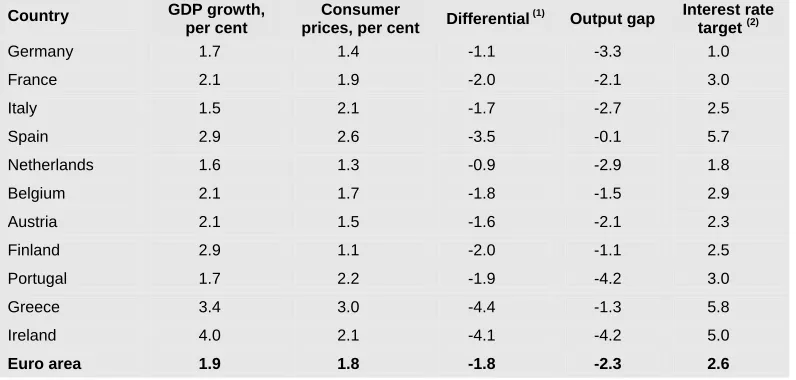
In the past, deficits have been higher than 3 per cent of GDP quite often in industrial countries (see Figure 2) and were then judged necessary to support activity. It could be different now only if monetary policy was more growth-oriented than in the past. But this is not the ECB’s remit. Besides a single monetary policy cannot fit all different national cyclical positions (see Table 1) and cannot react to country-specific cyclical downturns. Hence, euro area countries should be given greater room for budgetary manoeuvre, since they can no longer use the exchange rate and interest rates.
Figure 2: General Government Net Lending
As a percentage of GDP
-9 -7 -5 -3 -1 1 3
70 72 74 76 78 80 82 84 86 88 90 92 94 96 98 00 02 04
USA
Japan Germany
France
Note:Excluding proceeds relative to UMTS licences in the euro area.
[image:14.496.172.450.432.617.2]The 3 per cent of GDP requests governments either to strongly reduce cyclically-adjusted borrowing, so that some ‘cyclical room for manoeuvre’ becomes available, or to maintain some cyclically-adjusted deficit and then loose any cyclical room for manoeuvre. Some authors (Artis and Buti, 2000, or Barrell, 2001) evaluate the level of structural deficit needed in each country to prevent public deficits from rising above 3 per cent of GDP in downturns. But such deficits are not optimal, since they are conditional on the arbitrary 3 per cent ceiling.
If we consider that there may be a negative output gap of 3 per cent of GDP in euro area economies and that a 1 per cent fall in GDP generates a 0.5 per cent of GDP rise in public deficits, then deficits of 1.5 per cent of GDP could be allowed in normal times. Let d, the level of public deficit as a share of GDP, b, the level of public debt as a share of GDP, g, nominal output growth. In equilibrium: b=d g/ . If, as in Germany, g equals 3 per cent, b will
converge towards 50 per cent if d equals 1.5 per cent on average. If, as for new members of the Union, g equals 7, b will converge towards 21 per cent. The 3 per cent limit has different consequences in terms of public debt depending on output growth. These consequences have not been explicitly taken into account in the existing fiscal framework. As pointed out by Fitz Gerald et al. (2004), the recent enlargement of the Union makes the issue more critical as the new Member States have higher nominal GDP growth potentials than the EU-15 average.
If Member States want to have safety margins to avoid breaching the 3 per cent ceiling in downturns, they need to run restrictive fiscal policies in ‘good times’. But the provisions of the SGP only apply in situations where deficits breach the 3 per cent ceiling, and hence are most likely to operate in downturns, i.e., when running pro-cyclical restrictive policies will add to the weakness of output growth. The Commission wishes to be entitled to react in ‘good times’ (see Section 4). But it is then difficult to define appropriate policies because of the uncertainties on the level of the output gap and on the optimal level of public deficit.
Table 1: Interest Rates, GDP Growth and Inflation Forecasts, June 2004
Country GDP growth, per cent
Consumer
prices, per cent Differential
(1) Output gap Interest rate
target (2)
Germany 1.7 1.4 -1.1 -3.3 1.0
France 2.1 1.9 -2.0 -2.1 3.0
Italy 1.5 2.1 -1.7 -2.7 2.5
Spain 2.9 2.6 -3.5 -0.1 5.7
Netherlands 1.6 1.3 -0.9 -2.9 1.8
Belgium 2.1 1.7 -1.8 -1.5 2.9
Austria 2.1 1.5 -1.6 -2.1 2.3
Finland 2.9 1.1 -2.0 -1.1 2.5
Portugal 1.7 2.2 -1.9 -4.2 3.0
Greece 3.4 3.0 -4.4 -1.3 5.8
Ireland 4.0 2.1 -4.1 -4.2 5.0
Euro area 1.9 1.8 -1.8 -2.3 2.6
(1)Differential between the short-term interest rate (2 per cent) and consumer price inflation plus real GDP growth forecasts for 2004 (as of June 2004).
(2) Defined as r= + +g π 0.5(π−2.0)+0.5(y−y) where g: potential output growth, π inflation rate
and(y−y): OECD’s output gap.
Sources: Consensus Economics, OECD Economic Outlook, No. 75, June (2004), own calculations.
There is no certainty that a single interest rate will lead a single public deficit to GDP ratio to be optimal for each country, independently of the strength of domestic private demand. Public deficits targets do not ensure that countries will fulfil the inflation target. A country with buoyant private demand may have both high inflation and a fiscal surplus. Such norms for deficits restrict the possibility for countries to run countercyclical fiscal policies. Each country of the euro area will see falls in domestic output if demand or inflation are high in partner countries (see Box 2). Conversely, the fiscal policy needed to stabilise domestic demand and to keep inflation under control, is such that an economy operating at below capacity should be entitled to run some government deficit whereas countries in a better cyclical position should run some budget surplus.
Box 2: Stabilisation Policies and Fiscal Rules
There is no evidence that different countries having the same interest rate should implement the same fiscal policy. Let us consider the model presented in Box 1. In order to reach the single inflation target, each country has to target a level of output such
as: 0
/
i i
y = −π α. The central bank, considering the aggregated
situation of the area, will set the interest rate as:
0
( / ) /
r= Σ + Σdi π αi nσ ; i.e. at the level that allows reaching the
0 0
/ ( / ) /
i i i i i
g = − −d π α+ Σ + Σd π α n. National deficits will differ so
as to take account of different national cyclical positions and to equalise inflation rates. Ex post the level of output in each country will only depend on domestic factors.
Conversely, let us assume that each country is requested to keep its deficit at gi =0. Under the central bank’s interest rate rule,
domestic output levels are: 0 . This level is
( /
i i i i
y =d − Σ + Σd π α) /n
not compatible with the inflation target. Each country must let domestic output fluctuations depend on internal demand and so will implement a sub-optimal policy. The country is negatively affected by rising demand or inflation in partner countries.
The Treaty establishing the European Community mentions the necessity for Member States to maintain their debt to GDP ratios below a reference level (60 per cent), unless the ratio is ‘diminishing and approaching the reference level at a satisfactory pace’. In practice, the debt limit has not been considered since 1997, since several Member States with debt largely above 60 per cent of GDP (Italy, Belgium and Greece) were allowed to join the monetary union. However, the debt ratio is the relevant criterion to assess fiscal sustainability although it is difficult to define the level above which default risk emerges (public debt reached 138 per cent of GDP in Belgium in 1993 without any default risk emerging) and the optimal debt level.
2.3
THE RATIONALE FOR MEDIUM-
TERM BUDGETARYPOSITIONS IN BALANCE
The SGP requires euro area countries to present a stability programme at the end of each year. This programme must provide a macroeconomic projection and a budgetary plan for the current and the three following years. It has to target a budgetary position ‘close to balance or in surplus’ in the medium run. So, the 3 per cent and the 60 per cent limits both turn out to be zero in practice.
The rationale for a medium-term balanced budget has no clear economic justification. A country where private savings are spontaneously too low (high) may need some budget surplus (deficit). It is also reasonable to finance public investment through government borrowing and therefore some public deficit may be justified. The justification given by the Commission is that budgetary positions in balance will allow policies to react to normal cyclical fluctuations without breaching the 3 per cent of GDP limit (itself arbitrary).
1998 to 2001 (8 years). This never happened in the euro area; in Germany in 1970, 1973, 1989 (3 years), in France from 1970 to 1974, in 1977 and 1980 (6 years). The Pact intends to impose as a permanent reference a situation that occurred only rarely in the past.
A deficit kept permanently at 0 per cent of GDP would lead nominal public debt to be stable and constantly declining as a percentage of GDP down to 0. But savers, in particular pension funds, need to own public assets, because these are long term, liquid and safe assets. If savers wish to own interest-bearing financial assets while private companies are reluctant to borrow, 0 per cent of GDP public deficits and debts may require low long-term interest rates, below GDP growth, which would not be optimal. If demand for bonds exceeds supply, a country that controls its domestic interest rate may cut it. But in a country not having control of interest rates, higher public deficits and debts are needed. Paradoxically, the independence of the central bank is a major cause for higher public deficits (Creel and Sterdyniak, 1995). The stability of a debt to GDP ratio at 40 per cent for instance would be a more reasonable medium-term objective. With nominal GDP rising by 4.5 per cent per year, it would allow a cyclically-adjusted deficit of 1.8 per cent of GDP.
2.4
THE STABILITY AND GROWTH PACT ANDECONOMIC POLICY CO
-
ORDINATIONThe procedure of the stability programmes implies that governments are able to make reliable forecasts on a four-year horizon, and to commit themselves to implementing a fiscal policy in line with this projection. Governments are likely to be tempted to present an optimistic forecast, showing strong and sustained output growth bringing government borrowing into balance in a four-year time horizon. But what shall be done if GDP growth turns out to be lower than forecast? If a depressive shock occurs, should countries keep their fiscal policy stance unchanged? Should they stick to the forecasted deficits (meaning in practice tightening their policies) or should they rather maintain announced public spending and taxation (meaning accepting rising deficits)? Forecasting economic activity without errors is impossible in practice, even on a 1-year horizon. Hence, the procedure of an annual submission of stability programmes generates permanent tensions between governments wishing to keep the possibility to adapt fiscal policy to the current circumstances and the Commission claiming for a strict fulfilment of the stability programmes.
target would have been indicative. The objective started to be more binding when a given year was chosen for government borrowing to be in balance (2002, then 2004, then 2006) independently of the cyclical situation.
If the procedure were strictly followed, it would put a strong constraint on fiscal policy in the countries where fiscal deficits remain. For example, general government borrowing reached 3.3 per cent of GDP in France in 2002. The fulfilment of the commitment made in Seville in 2002 to reach a balanced budgetary position in 2004 would have required the French government to cut borrowing by 1.6 per cent of GDP both in 2003 and in 2004: a contractionary policy should have been run these two years, independently of the economic situation. The lower output growth, the stronger the budgetary effort. Fiscal policy is necessarily pro-cyclical in the path towards equilibrium.
In theory, stability programmes put strong constraints on fiscal policies. In practice, coalitions have happened to emerge in the Council not to vote the Commission recommendations.1 Member
States are not compelled to follow the recommendation as long as their deficit remains below 3 per cent of GDP. This is the ‘bad example’ shown by France in September 2002 when the government refused to present a stability programme showing a budgetary position in balance in 2004, and not even in 2006.
The procedure is not economic policy co-ordination, but a forced convergence toward a priori defined norms of public finance. The Commission does not set a target of economic growth in Europe and does not define a strategy to reach it. Monetary authorities do not take part in the process. The cyclical position of the European economy, global or country-specific, is only partly taken into consideration. National stability programmes are evaluated separately, without analysing the impact they will have on partner countries. With the view that discretionary fiscal policy must be avoided and that automatic stabilisers may be allowed to run only in countries where budgetary positions are in balance, whereas efforts should be intensified in the countries where it is not the case, it is difficult anyway to see what co-ordination the Commission could organise.
A satisfactory co-ordination process would consist in examining precisely the economic situation of the area as a whole in terms of inflation and output growth in order to set the appropriate level of interest rates, before analysing a comparison of the national situations in detail so as to set adequate national fiscal policies (see Box 3).
2.5
THE LIMITS OF THE BROAD ECONOMIC POLICY GUIDELINES(BEPG
S)
The procedure of BEPGs is not much reported in the press and in public opinion. How could Member States accept to bind their policies to comply with decisions made by technocratic committees without any democratic debate? The BEPGs refer mainly to structural policies. In line with the Lisbon strategy, they focus on ‘making Europe the most competitive and dynamic knowledge-based economy by the year 2010’. They focus more on the need to cut deficits than to support activity, advocating a preference for lower tax and public expenditure. In our view this should remain a national choice: each country should remain free to choose the organisation of its pension, health or education systems.
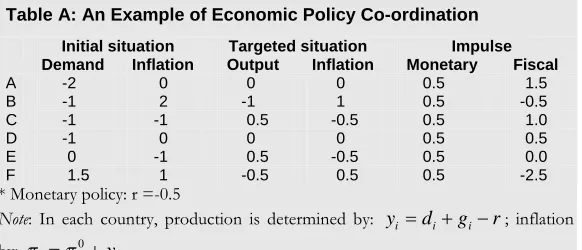
Box 3: An illustrative Example of Co-ordination
[image:20.496.157.448.413.538.2]Six countries of the same size are assumed to form the area (see Table A). Column 1 shows the ex ante demand level, column 2 the level of inflation (both in deviation from the objective). The strategy chosen is that any gap between actual inflation and the objective should be reduced by half during the period. The desirable situation may then be calculated (columns 3 and 4). The average impulse needed in terms of output (+0.5) is provided by monetary policy (column 5). The fiscal policy answer adapted to each domestic situation is shown in column 6: countries A, C and D must run an expansionary fiscal policy. Countries B and F, where inflation is too high, need to run a restrictive fiscal policy and to accept a negative output gap.
Table A: An Example of Economic Policy Co-ordination
Initial situation Targeted situation Impulse Demand Inflation Output Inflation Monetary Fiscal
A -2 0 0 0 0.5 1.5
B -1 2 -1 1 0.5 -0.5
C -1 -1 0.5 -0.5 0.5 1.0
D -1 0 0 0 0.5 0.5
E 0 -1 0.5 -0.5 0.5 0.0
F 1.5 1 -0.5 0.5 0.5 -2.5
* Monetary policy: r =-0.5
Note: In each country, production is determined by: yi =di+gi−r; inflation
by: 0
i i y
π =π + i.
From 1977 to 1992, public debts rose from 30.5 to 60.5 per cent of GDP in the euro area. The cumulated increase reached 60 percentage points in Belgium, 70 percentage points in Greece, 50 percentage points in Italy. This led virtuous countries like Germany to ask for the introduction of a mechanism that would protect themselves from less virtuous countries. Besides national and European technocracies, financial and business leading circles wanted to use the creation of EMU as an opportunity to modify the conduct of fiscal policies in Europe, to stop and even reverse the increase of public spending and debts. So they advocated for rigid and enforceable rules to control national governments, accused to have, for electoral reasons, expansionist and extravagant biases. In this context, the existing fiscal framework cannot be justified by purely economical reasons. The Commission set a four pillar strategy – the 3 per cent limit, the medium-term budgetary position in balance, cuts in public spending and the avoidance of discretionary fiscal policies – to impose a liberal strategy: to deprive the national governments of any freedom of action; to ask them to undertake structural reform. The conflict between national governments and European institutions was ineluctable when these constraints would appear too rigid, i.e. in the first downturn.
T
he lack of fiscal discipline is not the original sin of the European Union Member States. Net public debt was only 20 per cent of GDP in 1979, before the surge in real interest rates; 36 per cent in 1989, before the Maastricht Treaty. In the 1990s public debt levels rose mainly due to real interest rates being kept at excessive levels as compared to real output growth. Public deficits had widened to 5.8 per cent of GDP in 1993. Member states had to run expansionary fiscal policies in face of the weakness of private demand and of the restrictive stance of monetary policy. In 1996 and 1997 the candidate countries to the euro area ran restrictive fiscal policies to meet the Maastricht criteria, which led to a surplus of 2.9 per cent of GDP of the euro area structural primary balance in 1997 (see Figure 3). After the launch of the euro, the area structural primary balance surplus declined to 1.2 per cent of GDP in 2002 and remained close to that level since then.3.
The Stability
and Growth
Pact: An
Assessment
3.1 1997-2000:
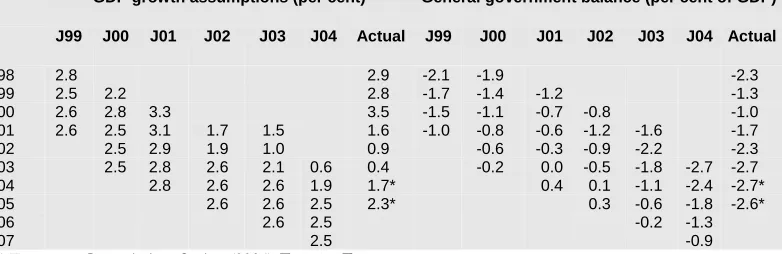
FAVOURABLE ECONOMIC CONDITIONSpercentage point (see Table 2). The cyclical improvement allowed public balances to move away from the excessive deficits threshold. Owing to faster than anticipated output growth (see Table 3), Member States easily fulfilled the objectives of their stability programmes. At the end of 2000, governments could announce that government borrowing would be in balance in 2004, albeit implementing fiscal reforms that were deteriorating public balances. In the stability programmes’ updates of late 2000, the euro area public deficit was anticipated to be cut by 0.7 per cent of GDP between 2000 and 2003 due to lower interest payments (0.3 percentage points) and a positive cyclical effect (1 percentage point), while a positive fiscal impulse of 0.6 percentage points was expected.
Figure 3: Euro Area and US Cyclically-Adjusted Primary Government Balance
Per Cent of Potential GDP
-3 -2 -1 0 1 2 3 4
1986 1988 1990 1992 1994 1996 1998 2000 2002 2004
Euro area USA
Table 2: General Government Balances in the Euro Area
Percentage of GDP
1997 1998 1999 2000 2001 2002 2003 2004
General government
balance (1) -2.6 -2.3 -1.3 -1.0 -1.7 -2.3 -2.7 - 2.8
Cyclical component (2) -0.9/-0.4 -0.5/-0.1 -0.1/0.3 0.4/0.9 0.3/0.8 -0.3/ 0.1 -0.9/-0.6 -1.1/-0.6
Interest payments 4.6 4.4 3.9 3.6 3.5 3.2 3.1 3.0
Cyclically-adjusted
primary balance 2.9 2.6 2.7 2.2 1.5 1.2 1.3 1.3
Notes: (1) Excluding proceeds relative to UMTS licences. (2) OECD Economic Outlook, No. 75, June (2004). In Italics, numbers of the Commission, Spring (2004) Economic Forecasts.
[image:23.496.55.446.498.625.2]Sources: European Commission, OECD.
Table 3: Euro Area GDP Growth and General Government Balances According to the Stability Programmes
GDP growth assumptions (per cent) General government balance (per cent of GDP) J99 J00 J01 J02 J03 J04 Actual J99 J00 J01 J02 J03 J04 Actual
98 2.8 2.9 -2.1 -1.9 -2.3
99 2.5 2.2 2.8 -1.7 -1.4 -1.2 -1.3
00 2.6 2.8 3.3 3.5 -1.5 -1.1 -0.7 -0.8 -1.0
01 2.6 2.5 3.1 1.7 1.5 1.6 -1.0 -0.8 -0.6 -1.2 -1.6 -1.7
02 2.5 2.9 1.9 1.0 0.9 -0.6 -0.3 -0.9 -2.2 -2.3
03 2.5 2.8 2.6 2.1 0.6 0.4 -0.2 0.0 -0.5 -1.8 -2.7 -2.7
04 2.8 2.6 2.6 1.9 1.7* 0.4 0.1 -1.1 -2.4 -2.7*
05 2.6 2.6 2.5 2.3* 0.3 -0.6 -1.8 -2.6*
06 2.6 2.5 -0.2 -1.3
07 2.5 -0.9
* European Commission, Spring (2004) Economic Forecasts.
3.2 2001-2004:
THE DIFFICULT YEARSPublic deficits rose gradually under the effect of the economic slowdown in 2001 and 2002. Fiscal reforms or public spending programmes launched in 2000 contributed to raise public deficits in some countries (Germany, the Netherlands and Ireland). Deficits started to rise again in almost all euro area Member States. Expansionary fiscal policies were all the more needed to support activity that monetary policy was not very active. There was a slightly positive fiscal impulse in the area: 0.7 percentage points in 2001 (mainly due to Germany) and 0.3 in 2002. The updates of the stability programmes presented in early 2002 were still counting on a significant economic upturn in 2002. All countries with the exception of France and Ireland were maintaining the objective of balanced or in surplus budgets in 2004. Euro area public deficits were expected to be cut by 1.3 per cent of GDP between 2001 and 2004, with lower interest payments contributing to 0.3 percentage points and discretionary measures to 1 percentage point: governments were committing themselves to run restrictive budgetary policies, independently of the economic situation.
In 2002, two alternative views were proposed. According to some governments, particularly the French, it was important both to support activity in the downturn, in the absence of inflationary pressures and to fulfil electoral promises of tax cuts. In the view of European authorities, the credibility of the SGP procedures was weakened by actual deficits well above the targets presented in the stability programmes and by some governments unwilling to introduce the corrective measures needed to reach their targets for deficits in 2004. But the warnings of the European authorities were inappropriate given the economic situation and therefore were hardly listened to. The euro area deficit reached 2.3 per cent of GDP in 2002 instead of 0.9 per cent as anticipated in the stability programmes released earlier that year (see Table 3). However, the deficit was modest in comparison with past similar circumstances: 4.9 per cent of GDP in 1986 and 4.3 per cent in 1996.
Almost all countries said they would reach the close-to-balance target in 2006. However, this was conditional on an annual 3 per cent real GDP growth in Italy. Germany anticipated a negative fiscal impulse of 1 per cent of GDP per year during four years. The French deficit was expected to remain around 1 per cent of GDP in 2006, after three years of an annual negative fiscal impulse of 0.4 per cent of GDP. Growth turned out to be significantly lower than expected in the euro area in 2003 (0.5 per cent against 2.1 per cent) and public deficits reached 2.7 per cent of GDP (against 1.9 per cent). Several countries (Germany, Italy, the Netherlands) did not implement the fiscal consolidation they had announced.
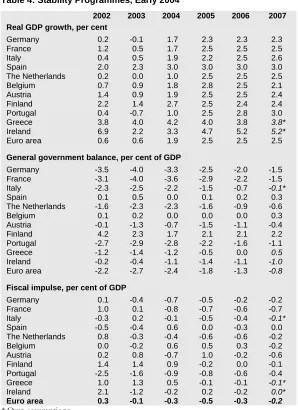
Table 4: Stability Programmes, Early 2004
2002 2003 2004 2005 2006 2007 Real GDP growth, per cent
Germany 0.2 -0.1 1.7 2.3 2.3 2.3
France 1.2 0.5 1.7 2.5 2.5 2.5
Italy 0.4 0.5 1.9 2.2 2.5 2.6
Spain 2.0 2.3 3.0 3.0 3.0 3.0
The Netherlands 0.2 0.0 1.0 2.5 2.5 2.5
Belgium 0.7 0.9 1.8 2.8 2.5 2.1
Austria 1.4 0.9 1.9 2.5 2.5 2.4
Finland 2.2 1.4 2.7 2.5 2.4 2.4
Portugal 0.4 -0.7 1.0 2.5 2.8 3.0
Greece 3.8 4.0 4.2 4.0 3.8 3.8*
Ireland 6.9 2.2 3.3 4.7 5.2 5.2*
Euro area 0.6 0.6 1.9 2.5 2.5 2.5
General government balance, per cent of GDP
Germany -3.5 -4.0 -3.3 -2.5 -2.0 -1.5
France -3.1 -4.0 -3.6 -2.9 -2.2 -1.5
Italy -2.3 -2.5 -2.2 -1.5 -0.7 -0.1*
Spain 0.1 0.5 0.0 0.1 0.2 0.3
The Netherlands -1.6 -2.3 -2.3 -1.6 -0.9 -0.6
Belgium 0.1 0.2 0.0 0.0 0.0 0.3
Austria -0.1 -1.3 -0.7 -1.5 -1.1 -0.4
Finland 4.2 2.3 1.7 2.1 2.1 2.2
Portugal -2.7 -2.9 -2.8 -2.2 -1.6 -1.1
Greece -1.2 -1.4 -1.2 -0.5 0.0 0.5
Ireland -0.2 -0.4 -1.1 -1.4 -1.1 -1.0
Euro area -2.2 -2.7 -2.4 -1.8 -1.3 -0.8
Fiscal impulse, per cent of GDP
Germany 0.1 -0.4 -0.7 -0.5 -0.2 -0.2
France 1.0 0.1 -0.8 -0.7 -0.6 -0.7
Italy -0.3 0.2 -0.1 -0.5 -0.4 -0.1*
Spain -0.5 -0.4 0.6 0.0 -0.3 0.0
The Netherlands 0.8 -0.3 -0.4 -0.6 -0.6 -0.2
Belgium 0.0 -0.2 0.6 0.5 0.3 -0.2
Austria 0.2 0.8 -0.7 1.0 -0.2 -0.6
Finland 1.4 1.4 0.9 -0.2 0.0 -0.1
Portugal -2.5 -1.6 -0.9 -0.8 -0.6 -0.4
Greece 1.0 1.3 0.5 -0.1 -0.1 -0.1*
Ireland 2.1 -1.2 -0.2 0.2 -0.2 0.0*
Euro area 0.3 -0.1 -0.3 -0.5 -0.3 -0.2 * Own assumptions.
The early 2004 Updates of the Stability Programmes anticipated negative fiscal impulses in 2004, 2005 and 2006 (see Table 4). The German, French, Dutch, Portuguese and Italian programmes indicate restrictive fiscal policies of up to an annual 0.8 per cent of GDP in 2004 and 2005, which would not be sufficient to bring the deficits back to 0 in 2007 according to four of the programmes and is also likely to be the case for Italy. Only five countries look ‘virtuous’ in terms of deficits: Finland, Spain, Belgium, Ireland and Austria. Belgium and Austria have, however, a debt above the 60 per cent limit. From 2003 to 2007, the euro area public deficit is expected to decline by 1.7 percentage points, 1.3 points resulting from restrictive fiscal policy and 0.4 from the reduction of the cyclical part of the deficit.
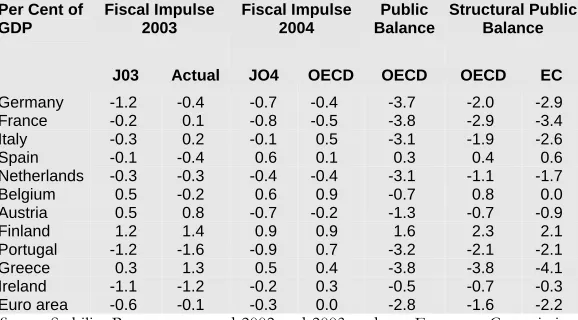
Table 5: Public Balances in 2004
Per Cent of GDP
Fiscal Impulse 2003
Fiscal Impulse 2004
Public Balance
Structural Public Balance J03 Actual JO4 OECD OECD OECD EC
Germany -1.2 -0.4 -0.7 -0.4 -3.7 -2.0 -2.9
France -0.2 0.1 -0.8 -0.5 -3.8 -2.9 -3.4
Italy -0.3 0.2 -0.1 0.5 -3.1 -1.9 -2.6
Spain -0.1 -0.4 0.6 0.1 0.3 0.4 0.6
Netherlands -0.3 -0.3 -0.4 -0.4 -3.1 -1.1 -1.7
Belgium 0.5 -0.2 0.6 0.9 -0.7 0.8 0.0
Austria 0.5 0.8 -0.7 -0.2 -1.3 -0.7 -0.9
Finland 1.2 1.4 0.9 0.9 1.6 2.3 2.1
Portugal -1.2 -1.6 -0.9 0.7 -3.2 -2.1 -2.1
Greece 0.3 1.3 0.5 0.4 -3.8 -3.8 -4.1
Ireland -1.1 -1.2 -0.2 0.3 -0.5 -0.7 -0.3
Euro area -0.6 -0.1 -0.3 0.0 -2.8 -1.6 -2.2
Sources: Stability Programmes, end 2002 and 2003 updates, European Commission, Public Finances in EMU 2004; OECD Economic Outlook No. 75.
If we compare the commitments made in the latest updates of the programmes with June 2004 OECD forecasts, it seems once again that most countries will not implement the planned budgetary effort in 2004 (see Table 5). Thus, it is very likely that deficits will still exceed the 3 per cent limit in six euro area countries in 2004: Germany, France, Italy, the Netherlands, Greece and Portugal. The United Kingdom deficit will come very close to the limit (2.9 per cent according to the OECD).
3.3
THE EXCESSIVE DEFICIT PROCEDURE:
IMPLEMENTATION AND IMPEDIMENTSThe widening of public deficits in a context of decelerating activity led the Commission to initiate the excessive deficit procedure (EDP) for a growing number of Member States. In November 2002, the Commission submitted a recommendation to the Council to initiate the EDP against Portugal (for year 2001) and Germany (for 2002) and recommended the sending of an early warning to France (for 2003). The Council adopted these recommendations on 21 January 2003. In April 2003, the Commission sent a recommendation to the Council to launch an EDP against France (for year 2002). This recommendation was adopted by the Council on 3 June 2003: the French government, which planned a deficit of 3.4 per cent of GDP for 2003, was asked to reduce it below 3.0 in 2004, then to reduce the structural deficit by at least 0.5 percentage points a year. Denmark and the Netherlands voted against this recommendation because it did not oblige France to implement restrictive measures in 2003 and allowed the public deficit to exceed the 3 per cent limit during two consecutives years (2002 and 2003) without fines.
The crisis erupted at the Council meeting of 25 November 2003. It was then clear that deficits would exceed the 3 per cent limit in 2004 for the third consecutive year in France and Germany. The two “sinners” refused to undertake restrictive fiscal policies in “bad times” and to implement the significant cuts needed to bring government deficits below the 3 per cent limit (implying a cut of 1 per cent of GDP in 2004). For the Commission and for several Member States (Spain, Finland, Austria and the Netherlands) strongly committed to the SGP, this was not acceptable because this was destroying the credibility of the Pact. The Commission submitted a recommendation to the Council asking France to present before the end of 2003 a budgetary programme including a reduction of 1 per cent of GDP of its structural deficit in 2004 and of 0.5 per cent in 2005. France would have to present in each quarter the situation of its publics finances to the European authorities. This recommendation did not achieve the qualified majority. It obtained 30 votes (Belgium, Greece, Spain, the Netherlands, Austria and Finland), while there were 30 votes against (Germany, Italy, Portugal, Luxembourg and Ireland).2 The Council
adopted a less stringent conclusion accepted by the French government (Spain, Finland, Austria and the Netherlands voting against): France will have to reduce its structural deficit by 0.8 percentage points in 2004 and by 0.6 in 2005, so that the deficit falls below 3 per cent of GDP in 2005; thereafter the structural deficit
will have to be cut by an annual 0.5 percentage points until the close-to-balance target is reached. The EDP was hold in abeyance and no fines imposed. Similarly, the Commission recommendation on Germany (a reduction in the structural deficit of 0.8 per cent of GDP in 2004 and 0.5 per cent in 2005 and quarterly reports) was not adopted by the Council, which required instead a reduction of 0.6 per cent of GDP in 2004 and 0.4 per cent in 2005.
The Commission considered that the non-adoption by the Council of its recommendations was not in conformity with the commitment made by the Member States when signing the SGP: procedures and fines are automatic; Member States have the obligation to adopt the Commission recommendations if the conditions are met. So the Commission brought an action before the Court of Justice of the European Communities. According to the majority of the Member States, the Council is entitled to take the economic situation into consideration. The paradox is that these countries did not suggest any reform of the SGP; they still – at least officially – agree on the principle of cutting public deficits notwithstanding the economic situation and do not try to improve economic policy co-ordination in Europe. The votes expressed in the November Council gave the unpleasant feeling to small Member States that there are two kinds of countries in the EU: the smaller ones, which have to obey the rules and the larger ones which may decide not to obey. But fiscal policy is needed more in larger countries than in smaller ones, as the latter may more easily use fiscal (like Ireland) or wages (like the Netherlands) competition, benefit from European subsidies (Ireland, Spain) or from low real interest rates, as compared to their GDP growth rates (Spain, Ireland, Greece).
bringing their deficits below 3 per cent: 2006 for Malta, 2007 for Poland and Slovakia, 2008 for the Czech Republic and Hungary, due to ‘special circumstances’ (‘structural adjustment in the context of their recent accession to the EU’).
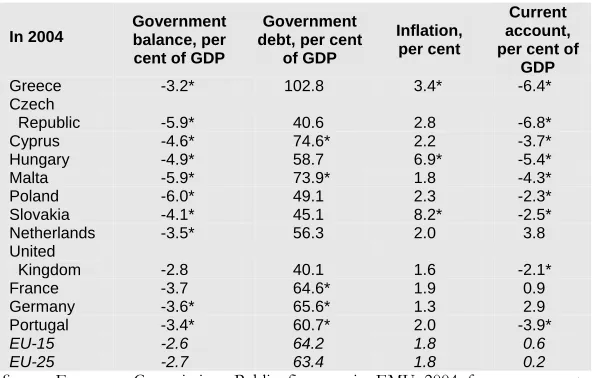
Table 6: Member States Under the Excessive Deficit Procedure, June 2004
In 2004 Government balance, per cent of GDP
Government debt, per cent
of GDP
Inflation, per cent
Current account, per cent of
GDP
Greece -3.2* 102.8 3.4* -6.4*
Czech
Republic -5.9* 40.6 2.8 -6.8*
Cyprus -4.6* 74.6* 2.2 -3.7*
Hungary -4.9* 58.7 6.9* -5.4*
Malta -5.9* 73.9* 1.8 -4.3*
Poland -6.0* 49.1 2.3 -2.3*
Slovakia -4.1* 45.1 8.2* -2.5*
Netherlands -3.5* 56.3 2.0 3.8
United
Kingdom -2.8 40.1 1.6 -2.1*
France -3.7 64.6* 1.9 0.9
Germany -3.6* 65.6* 1.3 2.9
Portugal -3.4* 60.7* 2.0 -3.9*
EU-15 -2.6 64.2 1.8 0.6
EU-25 -2.7 63.4 1.8 0.2
Source:: European Commission, Public finances in EMU 2004 for government
variables, Spring Forecasts otherwise.
On 13July 2004, the Court of justice did not condemn the non-adoption by the Council of the Commission recommendations against France and Germany. According to the Court, the Council has a discretion in the implementation of the EDP. So, the logic of the Pact, which was to sanction automatically deficits above 3 per cent of GDP, is broken. But the Court stated also that the Council cannot hold the EDP in abeyance and cannot modify the recommendations for correcting an excessive deficit without an initiative from the Commission. So, the Council’s conclusions of 25 November were annulled. The EDP appears to require an agreement between the Commission and a qualified majority in the Council. Without this agreement, the procedure comes to a standstill.
I
n July 2001, the Ecofin Council adopted the first reform of the procedures (European Commission, 2002a). The objective was to provide a ‘more effective surveillance’. Countries shall present their annual stability programme before 1 December. The assumptions for the world economy outside the European Union shall be provided by the Commission. Domestic policies have to be in line with the BEPGs. The medium-term target must fulfil the rule of balanced budgets. But it also has to enable a rapid decline in thedebt to GDP ratio and to provide room for manoeuvre for future ageing-related expenditure. The stability programmes will have to incorporate a projection of the impact of ageing populations on public finance sustainability. Member States will be asked to commit themselves to undertake in the course of the year the correcting measures necessary to reach the targets set in their plans. Member States have to bring cyclically-adjusted public deficit into balance and then to maintain a structural position in balance or in surplus.
The reference to ageing populations is a way of putting permanent pressure on countries so that they reduce the burden of old-age pensions public spending or run budget surpluses to guarantee the future funding of pensions. But no country intends to finance the future rise in pension spending through a permanent public deficit, which would be impossible anyway. If a country is willing to finance the future increase in social expenditure through higher social contributions, there will be no impact on partner countries. Besides it is difficult to imagine how countries can fulfil the objectives of their programmes when GDP growth turns out to be much lower than expected. Should pro-cyclical policies be run? If it was applied, the text would deprive the national governments of any freedom; they would only be allowed to let automatic stabilizers play. This limitation is not in the Treaty. In spite of its important implications, the text was adopted by the Ecofin Council without any public and open debate. On 18 October 2002, Romano Prodi, EC President, said: ‘I know very well that the Stability Pact is stupid, like all decisions that are rigid’.3 Romano Prodi proposed (A stronger, better Stability and
Growth Pact, 21 October) that economic policy co-ordination should be in the hands of a ‘strong authority’ which ‘can both apply the rules strictly to prevent behaviour that is off-course and adapt the rules to changing circumstances By its very nature, the Commission is therefore naturally suited to this steering role’. So Romano Prodi proposed the adoption of less rigid rules as the counterpart of stronger powers given to the Commission, although he did not set out how the Commission would implement these powers.
On 21 November 2002, the European Commission (2002b) presented a set of measures to ‘strengthen the co-ordination of budgetary policies’:
(1) The ‘close-to-balance or in surplus’ requirement of the SGP should be interpreted in terms of cyclically-adjusted budget balances, as estimated by the Commission.
(2) National structural deficits will have to be cut by at least 0.5 per cent of GDP per year, even more rapidly in countries having a high deficit or debt, or ‘favourable growth conditions’. Once the close-to-balance or in surplus
3 “Je sais très bien que le Pacte de stabilité est stupide, comme toutes les décisions
requirement is reached, automatic stabilisers will be allowed to run but expansionary discretionary budgetary policies will not.
(3) To avoid the occurrence of expansionary fiscal policies in times of favourable growth, countries must run budget surpluses when they have a positive output gap.
(4) The Commission wishes to give its authorisation for a ‘small temporary deterioration in the underlying budget position’ to the countries which undertake structural reforms in line with the Lisbon strategy. But these countries must have a debt well below 60 per cent of GDP and a low level of implicit debt on public pensions; they must keep a safety margin to avoid breaching the 3 per cent reference value.
(5) ‘The sustainability of public finances should become a core policy objective’. The Commission wants to give more importance to the debt criterion of the EDP. Countries with debts above 60 per cent of GDP will have to present a debt reduction strategy in their stability programme. (6) ‘Member States should reaffirm their political commitments
to the SGP’. They should endorse a resolution to strengthen fiscal policy co-ordination, including the commitment to cut structural deficits by at least 0.5 per cent of GDP a year, to reduce significantly debt levels when they are higher than 60 per cent of GDP, to facilitate the implementation of the enforcement procedures of the Pact. (7) The Commission wants to take account of the ‘quality of
the public finances’. It wants to make sure that countries will reduce government borrowing through expenditure cuts and not through higher taxation, and that public spending will be productive. The Commission intends to strengthen its surveillance of Member States, to carry out country studies and to make them public.
(8) The Commission wants ‘more effective enforcement procedures’ of the Pact: the early-warning mechanism should be activated more rapidly and more automatically; the Commission would issue early-warnings directly to Member States without a Council’s vote; warnings would possibly be sent to the countries undertaking expansionary policies in good times; the EDP could be launched against countries where insufficient efforts to bring public debts below 60 per cent of GDP are made.
policies. Member States will have take account of the Commission’s report in the preparation of their budgets. The Commission accepted that the assessment of the medium-term target (but not the 3 per cent of GDP limit) be made in medium-terms of cyclically-adjusted budget balances. But these are difficult to estimate, since they depend on the measurement of potential output. The Commission estimates potential output with a production function (Denis, Mc Morrow and Röger, 2002). Capital is taken as exogenous: capital growth decelerates in economic downturns which lowers potential output. Labour force is measured as the product of the population of working age, the participation rate and the complement to one of the non-accelerating inflation rate of unemployment (NAIRU). The participation rate is also considered as exogenous, whereas it fluctuates in practice in line with the economic situation: a rise in unemployment will discourage a part of potentially active workers to search for a job. Last, the NAIRU is measured as a moving average of the actual unemployment rate. Hence potential output growth under this definition tends to reproduce past growth: euro area potential output is estimated to have grown by an annual 2.1 per cent in 1981-1982, 2.8 per cent in 1989-1990, 2 per cent in 1993-1994 and 2.5 per cent in 2000-2001. The output gap is underestimated in recessions while the structural deficit overestimated. Past slow growth will necessarily lower current potential output. For instance, the Commission estimated that there was a positive output gap of 0.3 per cent in France in 2002 despite an unemployment rate of 8.7 per cent in its Spring 2003 Economic Forecasts. If output growth has been stronger than 2.3 per cent a year in 2003-2004 in France, the Commission would have called for a restrictive policy to be implemented.
Table 7: How Large was the French Output Gap in 2003?
According to… Per cent of potential GDP
French Ministry of the Economy -2.7
OECD -2.4
EC -0.7
IMF -2.1
countries. In that case co-ordination is useless. If, on the contrary, fiscal policy is thought to have an effect on activity, then fiscal policy co-ordination is useful and there is no reason why fiscal policy should be limited to automatic stabilisers. Discretionary fiscal policy may be useful to strengthen or to reduce the effects of automatic stabilisers. If a given country is hit by an adverse demand shock, the single monetary policy will not be very proactive. A positive fiscal impulse will be needed in order to stabilise domestic output (see Box 4). The US government has run deliberately discretionary expansionary fiscal policies to boost activity in 2002 and 2003, which added to the expansionary monetary policy stance. There is no reason why such policies should be forbidden in Europe. Last, the size of automatic stabilisers varies according to the budget structure (level of the tax to GDP ratio and tax rate progression, weight of unemployment allowances), which is a priori unrelated to stabilisation needs. The only rationale of the Commission’s view is the fear that if governments kept their budgetary powers, they would run over-expansionary policies permanently. Buti and van den Noord (2004), for instance, think that the difficulties of the SGP ‘have little to do with its intrinsic quality’, but reflects fiscal behaviour affected by electoral motives. But they do not explain why EMU governments should abandon fiscal activism while the US or Japanese governments continue to use it. They say that ‘the fiscal philosophy of EMU’s budgetary rules is to bring deficit close to balance and then let automatic stabilisers play freely’. The French, German or Italian governments do not share this philosophy. One may regret that these governments do not clearly express their disapproval instead of signing texts which they do not intend to follow.
Box 4: How to Stabilise Output, Government Borrowing and Public Debt: Some Simple Arithmetic
Let us consider a simple model: y= + +g d c(1−t y) ; wh+ere g is a
public spending shock, d: a private spending shock, c: propensity to consume (equal to 0.5), t: tax rate, equal to 0.5. GDP level is 100; ρ, debt to GDP ratio, is 50 per cent. A fall in private spending (column 1) will lead to a rise in the public deficit and in the debt to GDP ratio ex post despite the effect of automatic stabilisers. A rise in public expenditure (column 2), hence of the so-called structural deficit, is necessary to stabilise fully activity. Trying to stabilise government borrowing (column 3) induces a large fall in activity. Moreover, cuts in public expenditure lead to a rise in the debt to GDP ratio because of the fall in activity. It is therefore impossible to bring the debt to GDP ratio down to its initial level through lower public spending. This is true since ρ > −(1 c)(1−t).
Impact of a fall in private demand
d = -1 g = 0 g = 1 g = -2
y
-1.33 0 -4
Government borrowing
-0.66 -1 0
Debt to GDP ratio, in
per cent 51.3 51 52.1
The Ecofin Council of 7 March 2003 and the European Council of 20-21 March finally adopted a text very close to the Commission proposal. This decision was adopted without public debate on the respective roles of European and national institutions, on a fiscal policy framework based on fiscal targets and not on output growth targets.
…the commitment of the Member countries to the SGP as the framework for the co-ordination of budgetary policy and to a rules-based system. The Member States should use periods of economic recovery to improve their budgetary policy. The objective is to achieve a budgetary surplus in good times. The Members States look forward to possible proposals of the Commission to strengthening and clarifying the implementation of the SGP. Improved economic policy co-ordination could support the objective to raise growth potential.
The declaration does not explain why ten countries did not fulfil the 3 per cent limit of the SGP in 2004, what is meant by “economic policy co-ordination”, how “good times” periods are characterised and it does not give evidence that a “budgetary surplus” is needed in good times.
At the end of June 2004 (EC, 2004a) and in early September (EC, 2004b), the Commission made new proposals to reform economic governance in EMU. The Commission proposed a few changes in the SGP, but still without questioning the Treaty: the 3 and 60 per cent limits must remain the “centrepiece of multilateral surveillance”. The Commission continues to confuse fiscal policies co-ordination with the fulfilment of arbitrary public finance targets. Moreover, the ‘shy’ attempt made by the Commission in September 2004 to reform the SGP has been immediately criticised by several countries (among them the Netherlands and Austria), and by the Bundesbank, in favour of a strict implementation of the existing framework. Large countries show a certain degree of indifference as they wish to keep their autonomy and hence are not very much in favour of a well-designed Pact they would have to fulfil. The Commission (EC, 2004b) made seven proposals4:
(1) An evolution rather than a reform of the Stability and Growth Pact.
(a) The Commission wishes to ‘place more focus on debt and sustainability in the surveillance of budgetary positions’; to clarify the definition of ‘a satisfactory pace’ of debt reduction and to take in account the implicit debt due to the ageing population to evaluate the level of explicit debt. This means some countries will be in permanence subject to an EDP (Belgium, Italy and Greece), which will generate permanent tensions among European countries. Countries with ‘pay-as-you-go’ pensions systems (France, Germany, Italy) will also be placed under stricter surveillance. No figure is provided with this proposal, which is designed to facilitate the adhesion of the UK and of the new Member States to the euro area. (b) The Commission proposes to better take into account
different economic and debt situations when setting the medium-term objective for each member state.
The Commission recognises that the uniform medium-term objective of “close to balance or in surplus” ‘does not appear appropriate and lacks economic rationale given the increasing economic diversification in an EU of 25 Member States’. It proposes to allow for small deficits in countries with low debt ratios and/or high potential growth rates and to maintain the ‘close to balance or in surplus’ objective only for countries with high public debts. But it recalls that countries running a deficit have a great risk of breaching the 3 per cent reference value in slowdowns.
(c) The Commission agrees to extend the ‘exceptional circumstances’ criteria for a prolonged period of sluggish growth. This is a step towards taking account of the output gap before blaming a country for breaching the 3 per cent limit.
(d) The Commission wants to consider “economic circumstances and developments in the implementation of the EDP”.
A less rapid adjustment may be required from countries breaching the 3 per cent limit because of a protracted period of slow growth or from countries with a low level of public debt. The Commission expects this will encourage countries to make more efforts to reduce their debts.
(e) The Commission wants to ‘ensure earlier action to correct inadequate budgetary developments’, meaning countries would be required to run surpluses in good times. This raises again the issues of the identification of ‘good times’ periods and the economic relevance of running a budget in balance.
(2) Co-ordinating budgetary policies.
The Commission would like BEPGs to have a stronger influence on national fiscal and economic policies. It wished to send early warnings to oblige countries to follow its recommendations, and has been given this power by the Constitution.
The Commission suggests that fiscal policies should be discussed at the euro area level in the first half of the year: BEPGs would then be adopted and Member States would have to present their Stability Programmes in line. In the second half of the year, each Member State would vote their budget in line with the decisions made at the Community level in the first half of the year. This would allow the Commission to influence national budgets ex ante, instead of making a judgement ex post. National Parliaments would see their power of decision significantly reduced: they would have to vote on a budget according to guidelines agreed at the Community level six months earlier. This would entail a significant loss of democracy.
(3) Improving enforcement.