
UNIVERSITI TEKNIKAL MALAYSIA MELAKA
FAKULTI KEJURUTERAAN ELEKTRIK
SEMESTER 2 SESSION 2015/2016
4 BEKM
BEKU 4792 FYP (FINAL YEAR PROJECT)
OBJECT RECOGNITION USING BOWS MODEL
MEMBERS : SOON WEI JUN B011210124
SUPERVISOR : NURSABILLILAH BINTI MOHD ALI
OBJECT RECOGNITION USING BOWS MODEL
SOON WEI JUN
A report submitted in partial fulfilment of the requirements for the Degree of Mechatronics Engineering
Faculty of Electrical Engineering
UNIVERSITI TEKNIKAL MALAYSIA MELAKA
“I hereby declare that I have read through this report entitle “Object Recognition Using BOWS Model” and found that it has comply the partial fulfilment for awarding the Degree of Bachelor of Mechatronics Engineering”
Signature : ...
Supervisor’s Name : ...
I declare that this report entitle “Object Recognition Using BOWS Model” is the result of my own research except as cited in the references. The report has not been accepted for any degree and is not concurrently submitted in candidature of any other degree.
Signature : ...
Name : ...
ACKNOWLEDGEMENT
I would like to dedicate my deepest gratitude to my FYP supervisor, Mrs Nursabillilah Binti Mohd Ali for accepting me under her supervision. I had received her thoughtfulness, irreplaceable support, beneficial guidance and direction throughout my research. Her knowledge in solving problems using digital imaging processing had always been a great help for my study. Apart from that, her constructive comments and technical advices had also aided me in the completion of this research.
Besides my FYP supervisor, I would also like to give my appreciation to my family. My parents deserve a special mention for their unconditional support when I am conducting my research. I would like to thank them for being supportive not only during my FYP, but also during my entire educational career. I have no doubt that I could not have reached this far without their support and encouragement.
ABSTRACT
ABSTRAK
TABLE OF CONTENTS
CHAPTER TITLE PAGE
ACKNOWLEDGEMENT I
ABSTRACT II
ABSTAK III
TABLE OF CONTENTS IV
LIST OF TABLES VII
LIST OF FIGURES VIII
LIST OF APPENDICES IX
LIST OF ABBREVIATION X
1 INTRODUCTION 1
1.1 Motivation 1
1.2 Problem Statement 4
1.3 Objectives 5
1.4 Scope 5
1.5 Report Outline 6
2 LITERATURE REVIEW 7
2.1 Introduction 7
2.2 Bag-of-Words 7
2.3 BOW Model using
Scale-Invariant-Feature-Transforms (SIFT)
9
2.4 BOW Model using
Speeded-Up-Robust-Features (SURF)
12
Principal Component Analysis (PCA)
2.6 BOW Model using Histogram of
Dense Sub-Graphs Method
17
2.7 BOW Model using Oriented FAST
and Rotated BRIEF (ORB)
22
2.8 BOW Model using SIFT+SURF 25
2.9 Analysis of Techniques 26
2.10 Confusion Matrix 27
3 METHODOLOGY 29
3.1 Introduction 29
3.2 Gantt Chart 29
3.3 Project Flowchart 30
3.4 Bag-of-Words (BOW) System Build 31
3.5 Experimental Setup 32
3.6 Precautions 35
3.7 Pseudo code of the system 36
4 RESULTS, ANALYSIS & DISCUSSION 37
4.1 Introduction 37
4.2 Feature Extraction Test 38
4.3 Feature Matching Test 40
4.4 Basic Accuracy Test 42
4.5 Test of Effect of Library Size on
Accuracy of System
49
4.6 Test of Effect of Library Size on
Processing Time of System
52
4.7 Selecting Best Library Size 55
4.8 Selecting Best Threshold Value 57
4.9 Operation under Selected Settings 60
5 CONCLUSIONS 63
6 REFERENCES 65
LIST OF TABLES
NO. TITLE PAGE
2.1 Results of BoLSg approach 20
2.2 Results of Different Combination of BoWSPM and BoLSg 21
2.3 Processing Time of ORB using Pyramid, oFast and rBRIEF 23
2.4 Summary of Analysis 26
2.5 Example of Confusion Matrix 27
3.1 Pre-identified Classes of Images 34
4.1 Confusion Matrix for BOW Classifier Using SURF (Training Class
= 10 Images) 42
4.2 Confusion Matrix for BOW Classifier Using SURF (Training Class
= 10 Images) 43
4.3 Confusion Matrix for BOW Classifier Using SIFT+SURF
(Training Class = 10 Images) 43
4.4 Confusion Matrix for BOW Classifier Using Improved SIFT
(Training Class = 10 Images) 44
4.5 Confusion Matrix for BOW Classifier Using Improved FAST
SURF (Training Class = 10 Images) 44
4.6 Accuracy of different system by using different library size 50
4.7 Raw Data for Processing Time of Different System by Using
Different Library Size 56
LIST OF FIGURES
NO. TITLE PAGE
1.1 Infrared Vision for Bugs Detection 2
2.1 Basic Object Recognition Process using Bag-of-Words 8
2.2 A pixel with its 8 neighbours 10
2.3 LoG approximation 12
2.4 SURF orientation estimation 13
2.5 Examples of keypoint descriptor 14
2.6 Algorithm Flow Diagram 15
2.7 Comparison between (a) common SIFT (b) SIFT with grid patches (c)
SIFT with grid patches implemented with PCA 16
2.8 Example of 3 layer spatial pyramid 17
2.9 (a) Nonlinear SPM (b) Linear ScSPM 18
2.10 Impact of SPR on Accuracy of Classification 20
3.1 Flowchart of FYP Work Progress 30
3.2 Image Classification Using BOW model 31
3.3 Project methodology 33
4. 1 Features of (a) Cat-1 (b) Cat-2 (c) Cat-3 (d) Cat-4 (e) Cat-5 (d) Human
Face (g) Table (h) Motorcycle Extracted from Learning Class using SURF 38
4.2 Features of (a) Cat-1 (b) Cat-2 (c) Cat-3 (d) Cat-4 (e) Cat-5 (d) Human
Face (g) Table (h) Motorcycle Extracted from Learning Class using SIFT 39
4.3 Feature matching using SURF descriptor – 1 40
4.4 Feature matching using SURF descriptor – 2 40
4.5 Feature matching using SIFT descriptor – 1 41
4.6 Feature matching using SIFT descriptor – 2 41
4.7 Overall recognition accuracy of algorithm tested 45
4.8 Overall true value of each class of algorithm tested 45
4.10 Feature points on table – 2 47
4.11 Accuracy Performance vs. Library Size for Different Extractor Descriptor 49
4.12 Blank Lines and Comment Lines in Coding 52
4.13 Processing Time Performance vs. Library Size for Different Extractor
Descriptor 53
4.14 Image (a) with more feature points than (b) at identical filter threshold and
extractor 54
4.15 Replacing increment new images with original images 54
4.16 Recommended Range of Library Size 55
4.17 Relationship between number of feature points and accuracy with threshold
value 58
4.18 Relationship between number of feature points and processing time with
threshold value 59
4.19 Phase 1 of object recognition process 60
4.20 Phase 2 of object recognition process 61
4.21 Final phase of object recognition process 61
4.22 Auto tabulated results in Result.txt file 62
LIST OF APPENDICES
Appendix A - Gantt Chart Of FYP Timeline Planning
LIST OF ABBREVIATION
BOG - Bag of Visual Graph
BoLSg - Bag of Local Sub-graph
BOW - Bag-of-Words
BoWSPM - Bag-of-Words using Spatial Pyramid Matching
CAD - Computer Aided Diagnosis
CPM - Cell Pyramid Matching
DoG - Difference of Gaussians
gSpan - Graph-based Substructure Pattern
HEp-2 - Human epithelial type 2
HIK - Histogram Intersection Kernel
LLC - Locality-constrained Linear Coding
MKL - Multi-Kernel Learning
ORB - Oriented FAST and Rotated BRIEF
PCA - Principal Component Analysis
RBF - Radial Basis Function
SIFT - Scale-Invariant Feature Transform
SPM - Spatial Pyramid Matching
SPR - Spatial Pyramid Representation
SURF - Speeded Up Robust Features
CHAPTER 1
INTRODUCTION
1.1 Motivation
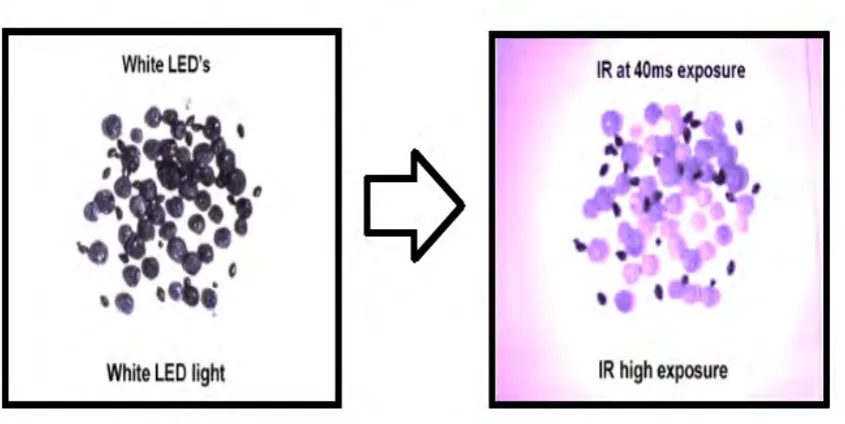
Figure 1.1: Infrared Vision for Bugs Detection
This method could be referred as a wide combination of image processing techniques. Combining every different detection method, detection method and classification method, BOWs could produce similar results of object recognition but with different processing time and accuracy.
The BOWs model possesses the advantages as follow:
• By clustering the features of the local image into visual words, it helps to save a lot of computational time and memory if compared with storing and matching each feature of the local image individually [7].
• The process of gathering set of local features derived from an image into one global
histogram of visual words allows the users to apply statistical learning algorithms, on them [7].
• The BOW representation could be classed (category) independent which will
reduce the amount of supervision required in the classification assignment [7].
BOW is said to be the promising model of the future applications because with a robust and accurate object recognition system, a lot of things could be achieved without so much of lifting a finger. Law enforcers could find a stolen car within days, locate the last location of a known terrorist within hours or even send tickets to car owners that were speeding. Agriculture workers could identify the stage of the fruits without checking on them daily. Forest fire or house fire could be identified as soon as possible with the help of aerial vehicles or devices to minimise the damage.
1.2 Problem Statement
In order to make this project a success, the key step is to identify the problem to be addressed with the existing Bag-of-Word recognition model. The main problem of the BOW model is that the accuracy of the existing system is not accurate enough, which generate accuracy of averagely 94.7%. Ideally, a recognition system is expected to achieve 100% accuracy. Hence, in this project the BOW model will be put under research and development to solve the issue of such considerably low accuracy.
There is in fact several algorithms designed lately that achieved a recognition accuracy of nearly 95%. Yet it is not consider as the perfect solution as in order to achieve that kind of high accuracy performance, the researchers usually had to make the hard choice and decrease its processing speed. In other word, the problem of current Bag-of-Word recognition system possessing low processing speed will be addressed in the project as well.
Last but not least, a problem to be considered is that the feature detection ability. Algorithms with low feature ability cause detection drop-out, which means that the feature retrieval method was unable to collect the feature information of the images [1]. There are also cases where the feature detection is not functioning properly and detect the background of the image as part of the object’s features. Hence, this project will also be addressing the problem of features drop-out of current Bag-of-Word recognition model.
1.3 Objectives
The main objectives of carrying out this project are:
1. To develop an algorithm for object recognition based on BOWs model
2. To identify the best feature extraction and detection based on the object recognition.
3. To evaluate the system performance in terms of speed and accuracy.
1.4 Scope
The scopes of the project are listed as follow:
1. The object categories are limited to detect and recognise cats, airplanes, tables, human and motorcycle.
2. The algorithm developed will not take into account on the environment of the
object that might causes the object to be difficult to be detected and classified.
3. The vocabulary of the database development is limited to 100 images per class.
4. The developed system is only applicable to static images.
1.5 Report Outline
CHAPTER 2
LITERATURE REVIEW
2.1 Introduction
There are several researches done on how to improve the performances of image classification using Bag-of-Words models. It is wise for every researchers to study about them to know the state-of-the-art of the technique to develop the improvement required and also to avoid repeating research that is already been done by any other researchers.
Four journals of research were selected to be studied and the methods used were identified. Analysis was made to benchmark the ideas of improvement in order to combine the advantages of few methods and eliminating their drawbacks.
2.2 Bag-of-Words
Object recognition using Bag-of-Words is a strategy that was inspired by the text retrieval community and enables efficient indexing for local image features.
word counts (known as a bag-of-words). Since the occurrence of a given word tends to be sparse across different documents, an index that maps words to the files in which they occur can take a keyword query and immediately produce relevant content.
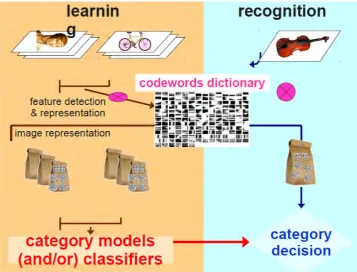
Researchers then implement this idea to carry out object recognition. The basic flow of the model is very straight forward and similar to document classification using Bag-of-Words. First, a training class has to be built by using several training images. Features will be detected by using different feature descriptor of choice and extracted. Extracted features are then put into a bag of features that can be used to represent that class of object. Few bags are formed together to create a category models or classifier.
[image:23.595.125.483.416.688.2]Then, a test image which is not in those bags is passed through the systems. Features of the test image are extracted as well and to be used to match compare with the existing bag-of-features. Finally, the best category or class is chose to represent that image according to different matching algorithm. An illustration of the system explained can be seen clearly in Figure 2.1:
2.3 BOW Model using Scale-Invariant-Feature-Transforms (SIFT)
In order for a BOW recognition system to work, keypoints or feature points of an object are required. For any object within an image, many “special points” could be extracted to provide a “feature description” of the object. This description can later be processed to trace the item in an image having various other objects.
SIFT is one of the detector or also known as extractor where its image features offer a set of features of an object that are not affected by many of the problems faced such as different object rotation and scaling between library and targeted images, making SIFT features very robust to the effects of noises in the image.
The SIFT method uses an image and transforms it into a large collection of local feature vectors. Each of these feature vectors is invariant to any scaling, rotation or translation of the original image. The features extraction is done through four different stages:
1. Scale-space extrema detection
This is a filtering stage where a scale space is used to determine locations and scales that are identifiable from different views on the same object. The scale space is defined by the function:
L(x, y,σ) =𝐺𝐺(𝑥𝑥,𝑦𝑦,𝜎𝜎)∗ 𝐼𝐼(𝑥𝑥,𝑦𝑦) (2.1)
Given:
* is the convolution operator.
𝐺𝐺(𝑥𝑥,𝑦𝑦,𝜎𝜎) = variable-scale Gaussian function.
![La politique d'association et de regimes preferentiels de la Communaute = The association policy and preferential regimes of the Community [external relations] SEC (70) 1351 final, 15 April 1970](data:image/gif;base64,R0lGODlhAQABAIAAAP///wAAACH5BAEAAAAALAAAAAABAAEAAAICRAEAOw==)