Jointly Optimised Iterative Source-coding, Channel-coding and .Modulation
for Transmission over Wireless Channels
S.
X.
Ng,
F.
Guo,
J. Wang,
L-L.
Yang and
L.
Hanzo
School of ECS, University of Southampton,
SO17 IBJ,
UK.
Tel: +44-23-8059 3125,
Fax: +44-23-8059 4508
Email:
{
sxn,fg01r,jw02r,lly,lh} @ecs.soton.ac.uk,
http://www-mobile.ecs.soton.ac.uk
Absrracr
-
Joint souree-coding, channel-coding and modn- lation schemes based on Variable Length Codes (VLCs),Trellis
Coded Modulation (TCM), Turbo T C M (TTCM), Bit-Interleaved Coded Modulation (BICM) and iteratively decoded BICM (BICM. ID) schemes are proposed. A significant coding gain is achieved without bandwidth expansion, when exchanging information be- tween the V L C a n d the coded modulation decoders with the ad- vent of iterative decoding. With the aid of using independent in- terleavers for the In-phase and Quadrature phase components of the complex-valued constellation, further diversity gain may be achieved. The performance of the proposed schemes is evdu- ated when communicating over both AWGN and Rayleigb fading channels. Explicitly, at BER=lO-' most of the proposed schemes have BER curves around 2 dBs away from the channel capacity limit.1. INTRODUCTION
Trellis Coded Modulation (TCM) [ I , 21 and Turbo TCM ('ITCM) [2, 31 constitute bandwidth-efficient joint channel coding and modu- lation schemes, which were originally designed for transmission over Additive White Gaussian Noise (AWGN) channels. Set Partitioning (SP) based phasor constellation labelling W ~ F used in these schemes in order to increase the minimum Euclidean distance between the en- coded information bits in the signal-space. A symbol-based turbo interleaver and a symbol-based channel interleaver were utilised for the sake of achieving time diversity, when communicating over Ray- leigh fading channels. Another powerful Coded Modulation (CM) scheme utilising bit-based channel interleaving in conjunction with Gray signal labelling. which is referred to as Bit-Interleaved Coded Modulation (BICM), was proposed in [4, 51. It combines conven- tional non-systematic convolutional codes with several independent bit interleavers. The number of parallel bit-interleaven used equals the number of channel coded bits in a symbol [2,4]. Recently. itera- tively decoded BICM using SP based signal labelling, referred to as BICM-ID bas also been proposed [ 6 ] .
In an effolt to increase the achievable time diversity, a multidi- mensional TCM scheme utilising a symbol interleaver and two en- coders was proposed in [71, where the individual encoders generate the In-phase (I) and Quadrature-phase (Q) components of the com- plex transmitted signal, respectively. Another TCM scheme using constellation rotation was proposed in [SI. which utilised two separate channel interleavers for interleaving the I and Q components of the complex transmitted signals. but assumed the absence of I/Q cross- coupling. when communicating over Rayleigh fading channels. Ex- plicitly, IIQ cross-coupling is the phenomenon imposed by convolv-
financial support of both the EPSRC. Swindon UK and the EU under the auspices of the Phoenix project is gratefully acknowledged.
ing the transmitted signal with the complex-valued Channel Impulse Response (CIR) where the I (or Q) component of the received signal becomes dependent on both the I and Q components of the transmit- ted signals. The technique of invoking separate I and Q interleav- ing and optimally rotating the constellation in order to increase the achievable diversity gain was first proposed in [9]. This type of diver- sity was referred to as modulation diversity or signal-space diversity in [IO], where a significant performance improvement was achieved in the context of both an uncoded system [IO] as well as in a TCM scheme
[SI.
Recently. a new approach which amalgamates Space- Time Block Coding (STBC) [I I] with IQ-interleaved CM (STBC-IQ- CM) schemes using no constellation rotation was proposed, which is suitable for transmission over both AWGN as well as Rayleigh fading channels imposing I/Q cross-coupling [I?., 131. The diver- sity achieved with the advent of IQ-interleaving without constellation rotation was refelred to as IQ-diversity in [IZ, 131. It was shown in 1121 that the STBC-IQ-based TCMIlTCM scheme is capable of quadrupling the achievable diversity potential of conventional single- transmitter based symbol-interleaved TCMKTCM, when communi- cating over narrowband uncorrelated Rayleigh fading channels wirh- our compromising rhe coding gain rrrrairinbie over AWGN channels. Furlhermore, the STBC-IQ-BICM-ID scheme of [I31 is also capable of benefiting from Qinterleaving owing to employing iterative de- tection and SP-based phasor constellation labelling.Lossless Variable Length Codes (VLCs) constitute a family of low-complexity source compression schemes. In order to exploit the residual redundancy of VLCs. numerous trellis-based VLC decoding techniques have been proposed, such as the joint sourcelchannel cod- ing scheme of [ 141. where the VLC decoder uses the bit-based trellis svucture of [15]. Explicitly, in [I41 a reversible VLC [I61 was in- voked as the outer code and
a convolutional code was utilised
as the
inner code. However, the explicit knowledge of the number of VLC output bits per transmission frame is required for the VLC's bit-based trellis decoding, which has to be signalled to the decoder, reducing both the compression efficiency and the ermr resilience.In order to improve the bandwidth and power efficiency of the joint sourcelchannel coding scheme contrived in [14]. in this conrri- burion we proposed the novel concepr of amalgamored source-coding. channel-coding arid modularion. The performance benefits of the scheme will be demonslrated in the context of a range of CM arrange- ments, namely TCM-VLC, lTCM-VLC, BICM-VLC and BICM-ID- VLC, which invokes TCM. l T C M , BICM and BICM-ID coded mod- ulation as the inner constituent code. Note that unlike the iterative BICM-ID scheme, the non-iterative BICM scheme of [I31 does not benefit from IQ-interleaving. Therefore, in our investigations we will also invoke the IQ-TCM, IQ-TTCM and IQ-BICM-ID scheme of [I31
as the inner COnStiNent code for the sake of attaining additional IQ- diversity, when communicating over Rayleigh fading channels. Note that the signal-space diversity or IQ-diversity has also been incorpo-
Fading
Encoder
Encoder
C h a n n e l sIterative
CM-VLC
[image:2.614.131.546.77.157.2]decoder
Figure 1: Block diagram of the CM-VLC scheme. The notations U, G, b, x, y and
of the Source symbols, the VLC coded bits, the CM coded symbols, the received symbols and the bit interleaver, respectively.
denote the vectors of the source symbols, the estimates
Bitlimc
"+,
'1
12 T
b
Figure 2: Code-tree and trellis for the VLC G =
{oo,
i i , o i o , i o i ,
o i i q 1 5 j OIEEE. 1997, ~ a l a k i r ~ k y .rated into the BICM-ID scheme of 1171 where an un-rotated 16-level Quadrature Amplitude Modulation (16QAM) constellation and a half- rate non-systematic convolutional code were employed for communi- cating over uncorrelated Rayleigb fading channels imposing no UQ cross-coupling.
2. SYSTEM OVERVIEW
We employ the reversible VLC codes from [ 161, where the codewords are C = {00,11,010,101,0110} associated with the source symbol sequence of U = {0,1,2,3,4}. Specifically, the longest VLC code-
word length is l,,, = 4. The associated entrophy is 2.14 bitslsymhol and the average codeword length is 2.46 bits, giving a coding rate of R,I, = 2.1412.46 = 0.87. The VLC outer encoder of Fig- ure I maps the source symbol U to a variable-length codeword. which
can be represented as a binary bit sequence b = { b l ,
bz,
. . . ,
bi}of length 1, where 1
5
I,,,,,,
at each encoding instance. However, we fix the VLC encoder's total hit sequence length to Lb>,. in the range of (2048m - I m o z )5
(Lb%t+
L,,,,)5
2048% where m is the number of original VLCmcoded bits per CM coded sym- bol. l,,,, is the longest VLC codeword length and Ls,de is the num- ber of bits required for conveying the side information related to the number of VLC output bits per transmission frame to the VLC de- coder. Furthermore, Ldunrny number of zero-valued dummy bits are concatenated to the VLC output bit sequence, such that we have Lb,*+
Ldvmml+
L s f d e = 2048m bits. In an' effort to render our investigations as realistic as possible, the side information related to the number of VLC output bits per transmission frame conveying the VLCs is explicitly signalled to the decoder by repeating the hits three times for the sake of majority logic based detection and then further protected by the CM scheme. The resultant 2048m number of bitsrepresenting the VLC output bits, dummy bits and side information bits are mated as input bits of the CM encoder. which has a coding rate of R,, =
$&
and employs a 2"f'-level modulation scheme.ThetreesmctureoftbeVLCC = {00,11,010,101,0110}used in our investigations is shown at the left of Figure 2, where the nodes in the tree are subdivided into a so-called root-node (R). intemal nodes (I) and terminal nodes (T) according to [IS]. A section of the corre- sponding trellis diagram between the bit time instants n and n
+
1 is illustrated at the right of Figure 2. Explicitly. there is a single mot state which corresponds to the root node R of the code m e and a num- ber of further states, that are labelled by the intemal nodes 11. . .
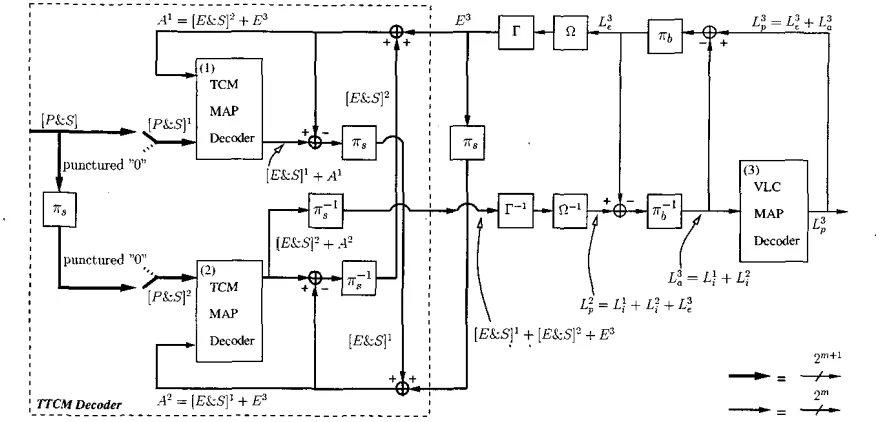
15 of the tree. All terminal nodes lead again to the root state R=T of Figure 2. This is a relatively simple and time-invariant trellis s m c - m e . For a VLC sequence, which consists of N bits, the trellis can be terminated after N sections. Since the trellis describing the VLC source code can be considered as the trellis of a channel code, which consists of code words having a length of N , the bit-baed Maximum Aposteriori Probability (MAP) [2] algorithm can be used for comput- ing the a posteriori probability for each bit value and then fed back to the coded modulation decoder.The novel decoder smcture of the (IQ-)TTCM-VLC scheme is illustrated in Figure 3. where there are three constituent decoders, each labelled with a round-bracketed index. Symbol-based and bit- based MAP algorithms [2] operating in the logarithmic-domain are employed by the TCM decoders and by the VLC decoder, respec- tively. The notations P, S, A and E denote the logarithmic-domain es of the parity information. the systematic information, the a p r i o r i information and the e x t r i n s i c information, respectively. The notations L,, L , and L , denote the Logarithmic-Likelihood Ra- tio (LLR) of the a posteriori, e x t r i n s i c and intrinsic information, respectively. The probabilities or LLRs associated with one of the three constituent decoders having a label of . l .
.
. 3 are differentiated by the superscript of 1 . . .3. The logarithmic-domain symbol prob- abilities of the IQ-interleaved or symbol-interleaved TTCM-coded symbols are computed by the demodulator based o n the approach of [12]. There are 2"+' prohab es associated withan
(m+
1)- bit 'ITCM-coded symbol, which have to be determined for the MAP decoder [2]. These probabilities are input to the TTCM MAP de- coder as [P&S], which indicates the inseparable n a m e of the par- ity and systematic information [2, 31. The a p o s t e r i o r i informa- tion of the m-bit systematic part of an ( m+
l)-bit TTCM symbol at the output of a constituent TCM decoder can be separated into two components (Section 9.4 [2] and [3]): I ) the inseparable e x t r i n s i c and systematic component [EBLS] also referred to as the i n t r i n s i c component, which is generated by one of the constituent TCM de- coders, and 2) the a p r i o r i component A, which is provided by the other constituent TCM decoder. However, in our proposed scheme the a p r i o r i component A comprises also the additional e x t r i n s i c infor- mation provided by the constituent VLC decoder, namely E 3 , as we can see from Figure 3. Explicitly. we have A(',*) = [E&S](2,')+E3, [image:2.614.101.327.197.372.2]2m+l
-=
-+-
2 m
-=
+
[image:3.619.92.532.85.296.2] [image:3.619.101.540.348.465.2]I
7TC.M Decoder...
Figure 3: Block diagram of the (IQ-j'ITCM-VLC scheme. The notations rr(.,b) and 1~;:~) denote the interleaver and deinterleaver, while the subscript s o r b denote the symbol-based or bit-based nature of the interleaver, respectively. Furthermore,
r
andr-'
denote LLR-to-symbol and symbol-to-LLR probability conversion, while R and R-' denote the addition and deletion of the LLRs of the side information and dummy bits.Figure 4: Black diagram of the (IQ-)BICM-ID-VLC scheme. The notations 'ip and rrb denote the BICM scheme's independent parallel bit interleavers and the VLC scheme's bit interleaver, respectively, while T-' denotes bit deinterleaver. Furthermore, P and ly-' denote serial-to- parallel and parallel-to-serial conversion. while R and R-' denote the addition and deletion of the LLRs of the side information and dummy bits.
where the extrinsic component E3 conmbuting to A' is the symbol- Only the extrinsic LLR L2 is passed back to the 'ITCM decoder. interleaved version of E" conmbuting to A'. The a posteriori infor- The VLC decoder's extrinsic LLR Lz is concatenated with the LLRs mation of the m-bit systematic part of an (m
+
1)-bit l T C M symbol of the side information, where the latter component is represented by provided by the second TCM decoder is then symbol-deinterleaved zeros in the LLR-domain, since the corresponding probabilities are and converted to LLRs. assumed to be 0.5. Furthermore, the LLRs of the dummy zero bits arethe CO,,,,,,enCement of
n c
decoding, the side information concatenated as large negatiM; LLR values. Finally, LLR-to-symbol conveying the number of VLC output bits in the transmission frame probability conversion is invoked for generating E 3 . At the final outer has be extracted. H ~based on the side information segment of ~ ~ ~ , iteration, a maximum likelihood sequence estimation based on L: is the ~ C decoded M a posteriori L L R ~ , the number of dummy bits invoked for yielding the original uncoded information bits. By the and the number OSVLC output bits has to bemen
only the Same token, an (IQ-)TCM-VLC decoder structure is similar to that a posteriori L L R ~ associated with the VLC bit sequence are passed of Figure 3 , with the simplification that the second TCM decoder is on to the VLC decoder.me
a priori LLR of a VLC.co&d bit is removed and the a posteriori information of the first TCM decoder constituted by the sum of the intrinsic LLRs of both TCM decoders. is passed directly to the symbol-to-LLR probability converter. which is shown in Figure 3 as L: = L i+
L:. Based on L: and onFigure 5 : BER versus Et,/No performance of the proposed I6QAM- based CM-VLC schemes and VLC IPSK, when communicating over AWGN channels. AU of these schemes have an effective throughput of 2.61 BPS.
rithms
[?I
operating in the logarithmic-domain are employed by the BICM decoders and by the VLC decoder. The notations P ( c ) and P ( u ) denote the LLRs of the m+
1 coded hits and the m uncoded information bits of the BICM scheme, respectively. The subscripts of p , e, a and i denote the a posteriori, extrinsic, a priori andintrinsic nature of the LLR, respectively. Again, the superscripts of
1
..
. 3 represent the associated constituent components having a label of 1 . . .3. Note that if a systematic convolutional code is employed by the BICM encoder, we have P,(u) = P?(u)+
P:(u), wheref i * ( u ) denotes the intrinsic LLRs of the uncoded information bits representing the extrinsic information provided by the decoder itself and the systematic information obtained from the systematic part of
P:(c). By contrast, for a BICM scheme employing a non-systematic
convolutional code, we have P,'(u) = P z ( u )
+
P,"(u), since no sys- tematic infonation accrues fromP,'(c).
However, the computationof P.?(u) is still dependent on Pi(,). Similarly, the computation of
P:(c) is also dependent on F: ( U ) . The LLR probabilities of the IQ- BICM-ID and BICM-ID are computed by the demodulator based on the approach of [12]. On the other hand, the BICM-VLC decoder structure is similar to that of Figure 4, with the simplification that there is no internal iteration between the demodulator and the BICM decoder.
3. SIMULATION RESULTS
We evaluated the performance of the proposed schemes using both 4- level Quadrature Amplitude Modulation (4QAM) and 16-level QAM (16QAM) in the context of the @-state TCM scheme of [I]. the 64- state BICM scheme of [4]
as
well as invoking an iterative I-state 'ITCM arrangement using four decoding iterations [3] and an 8-state BICM-ID arrangement employing eight decoding iterations [6]. These CM parameters were chosen for the sake of maintaining a similar de- coding complexity, since the total number of trellis-stages was identi- cal [ 121. We also set the maximum number of outer iterations between the CM decoder and the VLC decoder to four, where an outer itera- tion is constituted by one C M decoding and one VLC decoding oper- ation. The effective throughput of the system is 1 x R,,, = 0.87 and 3 x = 2.61 Bit Per Symbol (BPS). when 4QAM and I6QAM CM-VLC schemes are employed, respectively.... 1 iter
4 iter
-7-
,
.~, ... 6.. ... VLC BPSK-4
--_
*::::o.... ....
0 TFCM-VLC
0
BICM-ID-VLCA IQ-TCM-VLC
7 8
'....~ . . .. ...&
.' . .
.
<
....'"6 ...
-b b::.::
>
,"e. ...[:T
'... ... .... h.... ... ...
U,.. .. * ~ .
1 ...
'"0 ...
Figure 6: BER versus Et,/No performance of the proposed I6QAM- based (IQ-)CM-VLC schemes and VLC IPSK. when communicating over Rayleigh fading channels. All of these schemes have an effec- tive throughput of 2.61 BPS.
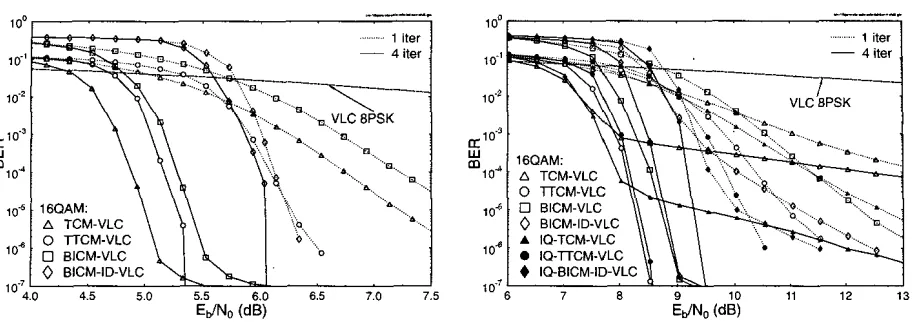
The Bit Error Ratio (BER) versus signal to noise ratio per hit, namely Eb/No, performance of the proposed schemes having an ef- fective throughput of 2.61 BPS andcommunicatingover AWGN chan- nels is shown in Figure 5 . As illustrated in Figure 5, all the CM- VLC schemes attain an iteration gain, when the number of outer iter- ations is increased from one to four. During the first iteration, before any feedback is provided by the VLC decoder. the best performer at B E R z ~ O - ~ is BICM-ID-VLC. followed by 7TCM-VLC. TCM-VLC and BICM-VLC. Owing to the different code slructure of the various CM schemes, the iteration gain of each CM-VLC scheme is differ- ent. Therefore. after the fourth iteration, the best to poorest perfor- mance order has changed to TCM-VLC. TTCM-VLC, BICM-VLC and BICM-ID-VLC. The same performance trends can also be ob- served in the context of the Symbol Error Ratio (SER) measured in terms of the Levenshtein distance [ 181, which is defined as the min.
imum number of insertions, deletions or substitutions required for transforming one symbol sequence into another. However, the SER performance curves were not shown here for reasons of space econ- omy.
7he BER versus Et,/No performance of the proposed (IQ-)CM- VLC schemes having an effective throughput of 2.61 BPS and com- municating over uncorrelated Rayleigh fading channels is shown in Figure 6. At B E R z ~ O - ~ the hest performer during the first iteration is IQ-BICM-ID-VLC, fallowed by IQ-TTCM-VLC, 'ITCM-VLC. BICM- ID-VLC, BICM-VLC, IQ-TCM-VLC and TCM-VLC. Again, all sche- mes benefit from invoking the outer iterative decoding loop. Af- ter the founh iteration, the performance order is 7TCM-VLC, IQ- TTCM-VLC, BICM-VLC, BICM-ID-VLC, IQ-BICM-ID-VLC, IQ- TCM-VLC and TCM-VLC.
Note in Figure 6 that during the first iteration, all IQ-CM-VLC schemes exhibit a better performance than their CM-VLC counter- parts, which is an added benefit of their IQ-diversity gains. However, the IQ-diversity gain advantage of Q'ITCM-VLC and IQ-BICM- ID-VLC gradually eroded, as the number of outer iterations was in- creased from one to four, since a near-Gaussian performance was at- tained. Nonetheless. as seen in Figure 6, the BER floor of IQ-'ITCM- VLC and IQ-BICM-ID-VLC is still lower than that of their non-IQ- interleaved c o u n t e r p ~ s , exhibiting a BER below IO-'. As shown in Figure 6, the TCM-based I6QAM scheme exhibits an error floor
I BER=lO->. unit=dB I AWGN I Ravleieh I and modulation in m iterative decoding scheme in order to jointly op- timise the achievable system performance. Our future work invokes similar schemes in the context of interactive audio and video codecs.
5. REFERENCES
[I] G. Ungerbtk, "Channel coding with multileveVphase signals." IEEE Transactions on Inj%nonnorion 7hheov, vol. ?8. pp. 5547, January 1982. 121 L. k r o , T. H. Liew and B. L. Yeap. Turbo Coding. Turbo Equalisorion
arid S p e e 7ime Coding for Tmnrtnirsion over wireless channels. New York. USA: John Willy IEEE Press. 2002.
[3] P. Robensan. T. Wiirr, "Bondwidth-efficient turha trellis-coded modula- tion using puncturedcomponent codes," IEEEJounzal on SelectedAmos in Communicarions. vol. 16, pp. 206218, February 1998.
[4] E. Zehavi, "8-PSK trellis codes for a Rayleigh fading channel:' IEEE Tronsmrionr OII Co,mnunicotions, vol. 40. pp. 873483, May 1992.
151 G. Caire. G. Taricco and E. Bielieri. "Bit-Interleaved Coded Modula-
__
.
._.IQ-TTCM-VLC.4QAWO.87
I
-I
-
I
3.76I
40.34 IQ-BICM-ID-VLC, 4QAW0.87I
I
-I
3.47I 40.63
Perfect coding. JQAW0.87I
cqacity=-O.lOI
capacity=1.26Table I: Coding gain values of the proposed (IQ-)CM-VLC schemes. The performance of the best scheme is printed in bold. The term 'perfect coding' refers to unlimited coding and decoding effort [I] which leads to the error-free performance at channel capacity Limits.
owing to the existence of uncoded bits in the 16QAM symbol.
Al.
though the iterative decoding procedure exchanging information be- tween TCM and VLC subsequently improves the attainable coding gains. the error floor of TCM-VLC after the first and founh iterations remains similar. On the other hand, the IQ-TCM-VLC scheme is ca- pable of providing a significantly lower error floor compared to that of TCM-VLC. Again. the SER performance c w e of CM-VLC ex- hibits a similar performance trend to that of Figure 6. Specifically, the n C M - V L C I6QAM scheme utilising four outer iterations is the best performer in terms of both the achievable BER and SER, when communicating over uncorrelated Rayleigh fading channels.
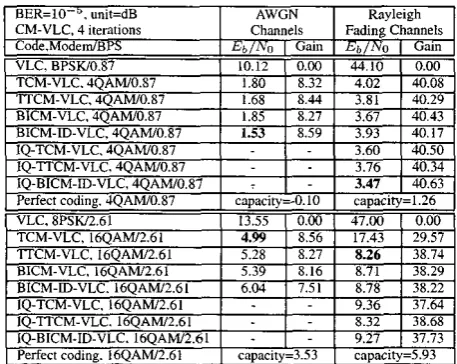
The coding gain values of the proposed schemes using 4QAM and I6QAM after the founh outer iteration are tabulated in Table 3. When compared to the channel capacity limit of the 4QAM and I6QAM modulation schemes at the effective throughput of0.87 and 2.6 I BPS I,
we can see that most of the proposed schemes have a BER perfor- mance about 2 dBs from the corresponding capacity limit. In fact, the proposed BICM-ID-VLC 4QAM scheme is only 1.63 dBs away from the AWGN channel capacity limit of 4QAM at
BER=
when attaining an effective throughput of 0.87 BPS.4. CONCLUSIONS
In this contribution the novel concept of amalgamated source-coding, channel-coding and modulation was proposed. The achievable per- formance benefits were demonstrated in the context of the novel (IQ-) CM-VLC schemes advocated, which are suitable for transmissions over both AWGN and uncorrelated Rayleigh fading channels. It was shown that the proposed schemes are capable of providing a low BER performance, while performing about 2 dBs from the channel capacity limits at the same effective throughput. Although the additional cod- ing gain provided by the IQ-diversity reduces, as the number of outer iterations increases, nonetheless, a lower error floor is achievable by the IQ-CM-VLC scheme compared to the CM-VLC scheme. It is therefore beneficial to integrate the source-coding, channel-coding
'These values were computed based on [I. 51.
tion," IEEE Tronsacriom on In/ononnarion Theop. vol. IT44, pp. 927- 946.May 1998.
[6] X. Li, J. A. Ritcey. "Bit-interleaved coded modulation with iterative del coding using soft feedback," IEE Eiecrmnics Lerrer.~, vol. 34, pp. 942- 943, May 1998.
171 S. AI-Semari and T. Fuja. "I-Q TCM: Reliable communication over the Rayleigh fading channel close to the cunoff rate," IEEE Trorisnctions on lrlfonnarion Theov. vol. 43, pp. 25s262, January 1997.
[XI B. D. Jelieic and S . Roy. "Design of trellis coded QaM for Rat fading and AWGN channels," IEEE Trarisacriom on Vehicular Tec)uiolog\., vol. 44, pp. 192-201. February 1994.
191 K. Boulle and 1. C. Belfiare. "Modulation scheme designed for the Ray- leigh fading channel:' in Pmreedirigr o/ClSS, (Princeton, NJ). pp. 288- 293, March 1992.
[IO] J. Bourros and E. Viterho. "Signal Space Diversity: A Power- and Bandwidth-Efficient Diversity Technique for Rayleigh Fading Channel." IEEE Tmnsacrions on Infonnorion Thheov, vol. 44, pp. 1453-1467. July 1998.
[ I l l S. M. Alamouti, "A simple m s m i t t e r diversity %heme for wireless communications," IEEE Jooanwl on Sclected Area$ in Cornmunlcarions.
vol. 16, pp. 1451-1458. October 1998.
1121 S. X. Ng and L. Hanzo. "Space-Time IQ-interleaved TCM and T K M far AWGN and Rayleigh Fading Channels," IEE Elecrmnics Lerters, vol. 38, pp. 1553-1555, November 2002.
1131 S . X. Ng and L. H m o . "Space-lime Block Coded ICNnterleaved Joint Coding and Modulation for AWGN and Rayleigh Fading Channels:' in IEEE Vehicular Technology Conference. (Jeju. Korea), 22-25 Apd 2003. 1141 R. Bauer. I. Haeenauer. "On variable leneth codes for iterative ~~~
~~~~ ~ ~~.
. 1
sourcelchannel decoding:' in IEEE Dora Compression Conference. (UT, USA), pp. 273-282,27-29 March 2001.
[I51 V. B. Balakilunhy. "Joint source-channel coding with variable length
codes," in IEEE Inremotional Symposium on Iilfonnorion ?hemy. (LJlm
Germany),p.419.29June-4July 1997.
[I61 Y. Takishimy M. Wada and H. Mur&ami. "Reversible variable length codes,"IEEE Troronsocrions on Commuaicorions. vol. COM-43, no. 2/3/4.
1171 A. Chindapol and J. A. Ritcey. "Design, Analysis and Performance Eval- uation for BICM-ID with Square QAM Constellations in Rayleigh Fad- ing Channels," IEEE b u m a l on Selecred Amas in Cornmunirarions, vol. 19. pp. 944-957, May 2001.
[ 181 T. Okuda, E. Tanaka and T. Kasai. "A method for the correction of garled
words based on the Levenshtein metric:' IEEE Transactions on Compur-
err. vol. C-25. pp. 172-176. February 1976. pp. 15a162. 1995.
[image:5.612.76.305.83.265.2]