Knowledge Sharing in Knowledge Restaurants
Jolán Velencei
1– Zoltán Baracskai
2– Viktor Dörfler
31Budapest University of Technology and Economics Department of Management and Corporate Economics
H-1111 Budapest, Műegyetem rkp. 3-9. Hungary Phone: +36-1-463-1092
e-mail: [email protected]
2DoctuS Ltd.
H-1027 Budapest, Csalogány u. 45/B. Hungary Phone: +36-20-390-7195
e-mail: [email protected]
3University of Strathclyde Department of Management Science
40 George Street, Graham Hills Bld., Glasgow, G1 1QE, UK Phone: +44-141-548-4540
e-mail: [email protected]
Abstract
In the present paper we examine the different ways of knowledge sharing in the contemporary business environment. In order to do this, we need to divorce R from D in R&D. For the purpose of this paper we distinguish four types of knowledge and correspondingly we introduce four metaphors of knowledge sharing: the four knowledge restaurants. In buffets ready-made knowledge is offered for self-service; there are restaurants in which the knowledge broker fulfils the role of the waiter offering a la cart menus; in some very expensive restaurants we can try what is recommended by the chef; finally, we sometimes make our own coffee in the coffee room and, obviously, have a chat along.
Keywords: knowledge sharing, knowledge transfer, knowledge types, coaching
1. Knowledge sharing in the f-era
identified three types of knowledge; the knowledge of facts, skills, and intuition. (Dörfler et al., 2008) In that model we did not distinguish between two kinds of intuition; this we will do in the present study. That way, we can match the four types of knowledge sharing to the four knowledge types.
For the present inquiry we conceptualize knowledge sharing in the following way: First, we delineate knowledge sharing from knowledge transfer. In knowledge transfer knowledge is passed from one person to another person; if there are more persons on the receiving end we can describe the process as multiple knowledge transfers. The reason for this is that we regard knowledge as constructive in nature; i.e. the increased personal knowledge will be born in the complex interaction of the existing personal knowledge and the new knowledge that is being received. For instance, a professor is talking to a class of 10 students and the 10 students will all learn something different from the same talk due to their different existing person knowledge. Thus this teaching-learning process can be described as 10 knowledge transfer processes. Knowledge transfer may also happen in interactive way; i.e. one person is passing on some knowledge to another one and this second one is passing some knowledge back to the first one. This we do not call knowledge sharing, only bidirectional (or, in case of more people involved multidirectional) knowledge transfer.
Knowledge sharing, naturally, comprises knowledge transfer but also something else. In our conception knowledge sharing is the transpersonal dimension of the knowing process; this means that, apart from transferring knowledge to each other, the interaction will result in additional knowledge which does not come from any of the participants. This transpersonal knowledge creation is in our view the essence of knowledge sharing. And, in turn, knowledge sharing becomes the essence of all collaboration.
In the present business environment the well-structured definitions are rare; usually only the outdated concepts are well-defined. In the age of discontinuity (Drucker, 1969) and unreason (Handy, 1991) when the business is ‘funky’ (Nordström & Ridderstråle, 2002) and the profitability is killing the enterprise (Mintzberg, 2007) we cannot wait until we can properly define the four ways of knowledge sharing. Therefore we use metaphors. We talk about four restaurants in which the knowledge sharing happens. To signify that it is a new era which we use as our frame of thinking, we also introduce a new name for this era.
f-era. Of course, this is only a convenient ex-post explanation: what we originally wanted to emphasize is the idea of freedom. Still, the previous explanation is correct as we think that the freedom dominantly characterizes the post-e-era.
This study is structured the following way: first we introduce the types of knowledge; then we describe our four knowledge restaurant metaphors; finally we provide a process-oriented picture for find the appropriate ‘locations’ for the knowledge restaurants, i.e. their role in an organization.
2. Knowledge types
In this section we define four types of knowledge; each type will have a focal and a subsidiary subtype. First we introduce the distinction between focal and subsidiary and then the four major types. The four types of knowledge will form the basis for describing our knowledge restaurants.
2.1. Focal and subsidiary
When describing the act of knowing Polanyi (1962: 55-65) realized that e.g. when hammering a nail we are differently aware of the hammer and of the nail. What is in the focus of our act he called “focal awareness”, in this case we have focal awareness of driving in the nail; of everything else, in this case of the feeling in our palm, of the hammer, etc., we have “subsidiary awareness”. In many cases, what we have focal awareness of is further from us, therefore Polanyi calls it the distal part; and those things that we have subsidiary awareness of are often nearer, therefore these make the proximal part. Polanyi (1966: 11) uses these terms in a metaphor borrowed from anatomy to describe the structure of the two types of awareness:
“… we are aware of the proximal term of an act of tacit knowing in the appearance of its distal term; we are aware of that from which we are attending to another thing, in the appearance of that thing.”
It is important (but not easy) to understand that the elements that make the proximal part belong to the domain of explicit knowledge, while the distal part, i.e. what is in the focus, belongs to tacit knowledge. So the focal knowledge is tacit and the subsidiary knowledge is explicit. For instance, we can teach someone letters, rules of grammar etc. But we cannot teach anyone how to write a good poem. We must also note that if we talk in terms of knowing (an act in which we use knowledge, such as learning something new or applying our knowledge) rather than knowledge, as Polanyi did, the tacit and explicit will swap places. So, the focal knowing is explicit and the subsidiary knowing is tacit. The explanation of this is that, when talking about knowing, we talk about what the process is aimed at; and we are consciously aware of this. For instance, when we are trying to understand the text, hammer the nail, or write a poem, we are able to refer to the text, nail, or poem. At the same time, we are not consciously aware of the letters and rules of grammar or of the hammer, therefore we cannot identify these.
Of course the fact that it is possible to teach the rules of grammar does not imply that we necessarily acquire them in a classroom. For instance, we can follow our parents’ example of how they talk and that way gradually becoming able to speak following the rules of grammar without ever being able to put them into words – this does not neglect the fact that rules of grammar can be thought. Therefore we will consider that subsidiary knowledge is explicit, even though it may not be in certain cases; the focal knowledge, as we have already shown through several examples and further examples will be provided later, is always tacit.
The distinction of focal and subsidiary knowledge will form one dimension of our knowledge typology. We will introduce four types of knowledge in the following section and each type will have a focal and a subsidiary part.
2.2. Four kinds of knowledge
Ryle (1949) was the first in our era to examining the nature of knowledge from this perspective, and he asserted that not all knowledge can be described as a set of facts and propositions. We may know how to do things, which we cannot necessarily formulate as a list of propositions. The knowledge of facts and propositions Ryle calls “knowing that” and the knowledge of how to do things “knowing how”. The essence of distinction between ‘know-that’ and ‘know-how’ is the falsification of the intellectualist legend, according to which an act can be considered intelligent if and only if the person is thinking what (s)he is doing while doing it. This would mean that (s)he observes rules or applies criteria. Borrowing an example from Ryle (ibid: 30) this would mean that:
“The chef must recite his recipes to himself before he can cook according to them.”
If you have ever seen a chef you will know that this is not the case.
If we dig deeper, we can find further knowledge categories that are not covered by ‘know-that’ and ‘know-how’. For one, if we do know how to perform a particular operation and detect and correct the mistakes and also to improve the process, it is not necessary that we would have also been capable of creating this ‘know-how’. So there seems to be a deeper understanding, which is necessary to create a novum, although, we can polish an existing process without it. To adopt a similar term to ‘know-that’ and ‘know-how’ this kind of knowledge category could be named ‘know-why’; this is the knowledge of the creatives. Once we have already defined this kind of knowledge, we had to realize that Gurteen (1998: 5) has also identified it, has named it the same and, similarly to Ryle, he used the chef as an example: if there is an ingredient missing from your cake, knowing why that ingredient was part of the recipe might help you finding a substitution; and he adds:
“In fact, know-why is often more important than know-how as it allows you to be creative – to fall back on principles – to re-invent your know-how and to invent new know-how.”
In the very first version of our knowledge typology, we identified three types of knowledge, the facts, the skills, and the intuition. Later we have added another dimension, which was the focal-subsidiary distinction, as it was indicated in the previous section. However, when we tried to explain what belongs to the each of the six subtypes, we had to realize that the typology is not yet complete.
model we have found that the focal skill corresponds to ‘know-how’, the focal intuition to ‘know-why’, and all types of subsidiary knowledge are ‘know-that’. For a while we attempted to describe the focal facts also with ‘know-that’, as Ryle called this knowledge type facts and propositions. This was a mistake. The ‘know-that’ only contains secondhand facts and propositions. It is not about what we experience but what someone else tells us.
If we experience an event, we will know more about it than what we can put into words. For proper distinction we must consider the phenomenology of the events and include qualia into the conceptualization of focal facts. The concept of qualia can easily be understood from Jackson’s (1982) famous thought experiment: Mary had grown up in a completely black-and-white environment; she was never allowed to leave her room and to see Nature. She had never seen any colour apart from black and white. She had been educated about the colours, about the perception, about the biology of seeing. She had learned everything that can be learned about the colours from others without actually experiencing anything in colour. Then she leaves her room; she sees a red rose and passes out. There is something that cannot be explained, something that needs to be experienced personally. Following Ryle’s naming-logic, we call the focal knowledge of facts ‘know-it’. Now, that all three knowledge types with their subtypes seemed to be covered, we have found the model satisfactory. Temporarily. But then, we were working with decision takers and we realized that they know something that is still missing from the model.
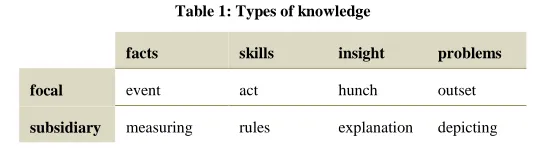
Table 1: Types of knowledge
facts skills insight problems
focal event act hunch outset
subsidiary measuring rules explanation depicting
In the following section these types of knowledge will be offered as outputs in the different forms of knowledge sharing (actually the skills do not appear explicitly in the output but they usually play role in producing the output). So the various knowledge types are the products in the knowledge restaurants.
3. The restaurants
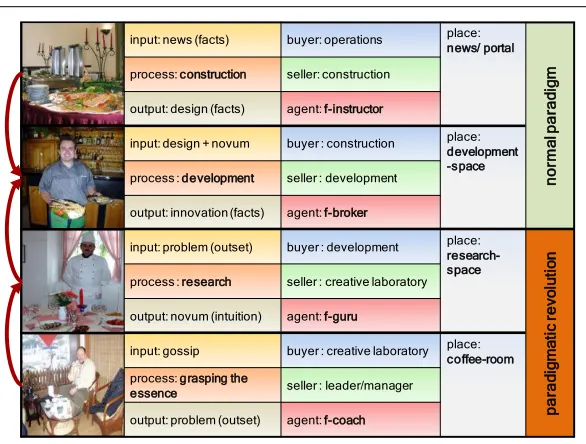
input: news (facts) buyer: operations place:news/ portal n o rm al p a ra di gm
process: construction seller: construction
output: design (facts) agent: f-instructor
input: design + novum buyer : construction place:development
-space
process : development seller : development
output: innovation (facts) agent: f-broker
input: problem (outset) buyer : development place: research-space p a ra di gma tic re vo lu tio n
process : research seller : creative laboratory
output: novum (intuition) agent: f-guru
input: gossip buyer : creative laboratory place:coffee-room
process: grasping the
essence seller : leader/manager
[image:8.420.64.357.56.278.2]output: problem (outset) agent: f-coach
Figure 1: The buffet, the waiter, the chef and the coffee-room.
3.1. The knowledge buffet
In a ‘buffet’ you can choose from the food on the table. There is nothing done to your order (apart from an occasional omelette), everything is ready-made, you can choose from what you see. On some buffet tables you will only find ham and cheese, on some there will be even oysters; it happens that you only find three types of food and the drink is limited to tea and coffee but there are also some buffets where you get freshly squeezed orange papaya juice and champagne. The variety and the quality of food are typically in direct relation with the price of the buffet. In terms of knowledge sharing this corresponds to having a choice of ready-made knowledge items offered; if we go to a knowledge buffet with our colleagues we can try different things and perhaps various mixes of what is offered and recommend to each other what we like the most.
This kind of knowledge sharing usually happens in interaction between the construction and the operations (here this means the main process of an organization). On the input side of the process of knowledge sharing we find facts, i.e. up-to-date subsidiary facts that are essentially the news from the knowledge domain. This is why we call the virtual versions of knowledge buffets news portals. The output is also well-structured and explicit, so we know that it will be some sort of subsidiary knowledge. The members of construction and operations review the existing operational processes in the light of the new facts from the domain; this process we call the construction. The output of the construction is a design (facts arranged along existing patterns to improve the processes of operations). This means that the knowledge created in the construction will belong to subsidiary skills (process description in form of rules and second-hand facts of the operations) and subsidiary facts (rules and second-hand facts of measurement and product specifications). Occasionally some focal facts and skills are also created in the knowledge buffet but this is less significant and should be explained by the presence of some components of the other knowledge restaurants.
In the face-to-face version of the knowledge buffet the agent of this is an instructor delivering the new facts but it may also often happen on conferences or reading from books and papers, in which cases there is no agent present. We call the agent the f-instructor to emphasize the importance of being free when choosing from the buffet table – in the case of virtual knowledge buffet this means free surfing.
3.2. The knowledge broker
customization of the knowledge that the source offers. The recommendations are here made by the waiter, who has the insider knowledge of the kitchen (e.g. that the trout is not fresh today or that the cook is not great making lamb shank) and, if (s)he is really good, can probably advise which of the available wines fits perfectly your chosen dish.
In a face-to-face setting we may get external consultants trying to deliver some sort of customized knowledge but this is rarely successful, as they are not familiar with the organizational context. More successful variants would include workshops between various departments, at least one of which is development-related. In the virtual world a version of collaborative space can fulfil this role, starting from various fora, blogs, wikis – but an appropriate solution should also include a tool for knowledge modelling and playing with scenarios, therefore we call these development spaces. Nothing radically new happens in the à la cart knowledge restaurants but all development happens here – thus it is a very significant form of knowledge sharing.
This kind of knowledge sharing typically happens in interaction between the construction and the development. To the input side the construction is delivering the design from the previous knowledge buffet, while the development is bringing the novum from the chef’s restaurant, which will be introduced next. We have already seen that the design consists of well-structured subsidiary facts and skills; and in the following restaurant we will see that novum belongs to the intuitive insight (containing both the focal and the subsidiary part). The output is presented as well-structured but this is not entirely true. The output is innovation. This means that the novum (creative idea) is converted into a value in the context of existing and forthcoming design; it will enhance the value of the operational processes. The process in the à la cart knowledge restaurant is the development, in which the existing facts are arranged into new patterns; this indicates new operational processes and/or new products. Therefore this type of knowledge sharing is the source of competitive advantages. It is the source of success in competition is in being different from the others. The innovation, once successful, really can be described in terms of subsidiary knowledge; we have to consider subsidiary facts, skills and intuition. However, more frequently than in the previous knowledge buffet, focal knowledge types also appear, although they are still far from becoming dominant. Importantly, the regular guests of the à la cart knowledge restaurant will gradually acquire focal skills required for development and by getting used to experiencing the nova they will also acquire valuable focal facts. The most talented ones may even shift towards having intuitive hunches or outsets.
between them. The f-broker’s knowledge is very different from the guests of the à la cart knowledge restaurant – (s)he is not in the knowledge domain. The f-broker has a deep knowledge of people and wide but superficial knowledge of the domain, sufficient to understand who is interested in what. This is very similar to how much the waiter knows about cooking.
The first two knowledge restaurants, i.e. the knowledge buffet facilitated by the f-instructor and the à la cart knowledge restaurant in which the f-broker serves the dish from the menu, belong to the domain of normal paradigm in Kuhnian (1962) sense. Nothing radical happens; the existing knowledge is polished further and innovative ideas originating elsewhere are converted into values. In contrast, the next two knowledge restaurants belong to the domain of paradigmatic changes, to revolutions. The ‘recommended by the chef’ restaurant and the ‘coffee room’ are the places for the radical ideas. The players here change their glasses through which they see the world all the time.
We also have to divorce R from D in R&D, to draw a sharp distinction between research and development. We consider research to be the creative process producing a novum; the development is an innovation based on this novum and the existing design. A breakthrough innovation is usually based on a breakthrough novum but only a small percentage of great nova becomes a breakthrough innovation. As innovation is about creating a value based on the novum, it is also possible to have a breakthrough innovation based on a minor novum – but it is unlikely to give you such advantage as one based on a brilliant idea. We are probably biased but we believe that the great nova make the difference in the world.
3.3. Recommended by the chef
The face-to-face version of this knowledge restaurant is much more likely than a virtual one. The importance of the focal fact, of experiencing the event, increased so much that the virtual version can only fulfil a partial role. It seems that the participants need to sense each others’ physical presence. The virtual version, as much as it can help, should be a research space. The research space primarily differs from the development space in that it is much more focused on supporting the informal, ill-structured processes. It needs to support a complex web of concepts (if possible 3D), enable search across various types of communication records (including multimedia). To make it even more difficult, the results from this knowledge restaurant should be exportable in a well-structured format to be used in the previous à la cart one.
This type of knowledge sharing happens in interaction between the development and the creative laboratory. On the input side we can see the initial problem which has been born in the coffee room from the next section; the focal part of it is the intuitive outset and the subsidiary part is the depicting. Both enter this knowledge sharing process which is un-describable as each and every instance of it involves a different act of creation; this is what we call research. The outcome of the research is the novum, i.e. a creative solution to a problem. But the problem at the end of the research (for which a solution has been produced) is not anymore the same initial one that entered the research process. The novum, which is the solution to the final version of the problem, is something that did not exist before; a new idea that can form the basis for a forthcoming development in the previous à la cart knowledge restaurant. In this knowledge restaurant the focal knowledge becomes more important than the subsidiary knowledge although both are part of the output. The hunch, the flash in which the novum is born, as well as the explanation of it. Not only that the focal insight gains dominance over other kinds of knowledge in this restaurant but the participants also seem to value it above any other knowledge form.
In the chef’s restaurant only the chef can make recommendations. This restaurant is not about the guests but about the chef. In the research space only the guru, as we call her/him, the f-guru can be the agent. We will tell more about the guru in Section 4, in which we adopt a more process-based view to place the knowledge restaurants into organizational context. For now it is sufficient that the f-guru tells you how things are, and (s)he is right. (S)He is like the prophet of the domain; her/his view validates the knowledge.
3.4. In the coffee room
most interested in. It is about where we are going forward. It is about our joint dreams. In the ‘coffee room’ the differences of position disappear, all are equal. That means all who are allowed into the coffee room. They are equal but they are not the same. The differences of this sort are the source of potential in transpersonal knowing processes of intuitive nature that are aimed at identifying what problems are worth engaging with.
The face-to-face version of the knowledge coffee room is often quite literally a coffee room or even a pub. The virtual versions, similarly to the research space, are rare and can only partially fulfil their role. The participants of the knowledge coffee room need to get together face to face, at least occasionally. One would expect that the virtual knowledge coffee rooms are even more complex than the previous collaborative spaces but this is not the case. All sorts of collaboration tools can be parts of it as long as they do not need to be in the centre of attention but seamlessly supporting the informal chit-chat; they should just connect the parties and get out of the way of the communication.
In this type of knowledge sharing the participants are the leader (decision taker) and the creative problem solver, who we will later call the alchemist. The inputs in this knowledge sharing are two types of informal generic views of what is going on in the field; as both of these are ill-structured we call them gossips. The viewpoint of the leader is what is needed, where the organization is heading and the viewpoint of the creatives is what new knowledge is available and can be created. This way they figure out what problems need and can be solved. This process we call grasping the essence. The output of the process is a problem, more frequently a set of problems, that will be the input for the chef’s knowledge restaurant. The most interesting aspect of this type of knowledge sharing is that the leader and the creatives sometimes do not even appear to speak of the problem(s) under scrutiny; it sound rather like a social chat. Or, at least, this is what an outsider can hear. This is a very deep sort of collaboration which assigns the direction of the future research.
We said earlier that the leader and the creative are alone in the knowledge coffee room; this is not always and necessarily true. The process of grasping the essence often works better if supported by the coach – who, in the f-era, we call f-coach. This type of knowledge sharing is very important for the full picture and as an input source for the previous stage, therefore we will dig somewhat deeper to figure out the various ways of coaching the most complex knowledge restaurants.
4. Coaching reinterpreted
knowledge restaurants are structural elements the purpose of which can only be seen if placed in the relevant processes. In order to do this, we need to make another distinction; following Kotter (1999), we distinguish the leader from the manager. The leader has a fuzzy vision of the future and deals with the change. The manager needs to transform this fuzzy vision into day-to-day operations in order to make the organization function; (s)he deals with complexity. They will have central roles in positioning our knowledge restaurants; to signify the f-era we may speak of f-managers and f-leaders but when we do not add the “f” we still think about them in the same way. But adding the “f” may be a useful reminder.
We need three additional players; while we cannot provide in-depth examination of these roles here, we draw a rough picture, only what is necessary to understand the positioning of the knowledge restaurants. The guru has already been mentioned but now we need to explain her/his role more accurately. For this study, the guru is the chief of the tribe (paradigm). (S)He is not necessarily coming up with the new ideas (although sometimes (s)he may) but her/his words decides what is included in the domain knowledge; i.e. (s)he single-handedly validates the new knowledge and (s)he also disseminates it. The guru, in this sense, is similar to a prophet of a field. The coach is a person outside the organization but within the domain. (S)He is delivering the teachings of the guru to the organization, helps combining it with the newly created ideas (nova), and puts these into the context of the organization. Following Handy (1999) we call the third role the alchemist. As the alchemists of occultism made gold out of lead, our alchemists make something out of nothing. They create the novum only out of their existing knowledge by rearranging what they know.
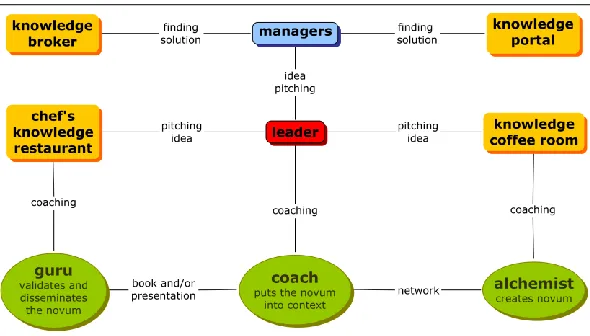
Figure 2: Support in knowledge restaurants
The two knowledge restaurants of paradigmatic revolutions, in which the knowledge is recommended by the chef and the knowledge coffee room in which we make our own drink, are connected to the leader. A better understanding of how these two versions of knowledge sharing work, we need to reinterpret the concept of coaching. It is possible that we will find other terms for more accurate description at a later time but currently we can just extend the concept of coaching.
The fundamental form of executive coaching is what we call shadow coaching. As the coach in this case is constantly with the leader (like a shadow) there is no knowledge restaurant directly associated with coaching; however, important knowledge sharing takes place in this relationship. If we wanted to follow the analogy of restaurants, this would be eating a hotdog on the street along the way. There is no need to stop for this type of knowledge sharing, apart from occasional reflections – just think about eating your hotdog on the street and the mustard dripping. The coach is linked, apart from the leader also to the guru and the alchemist. During the shadow coaching (s)he uses the teachings of the guru, acquired typically from the books and conference presentations of the guru, and the nova of the alchemists, typically acquired through her/his network, and puts these into the context of the organization in interaction with the leader. This will affect directly where he organization is going to go in the future. This is the most natural and most frequent work of the executive coach. Strangely, this is also the only type of coaching, as we interpret coaching for this study, which necessarily involves the coach.
The third type of coaching happens in restaurants where the chef is recommending the knowledge. Most of the restaurants where the chef is recommending the dish have two parts. One we call the restaurant, the other the laboratory. For instance Ferran Adrià, the world no. 1 chef, has his restaurant open only for 6 months a year, the rest he spends in his laboratory – inventing new dishes. As nobody knows what is going on in the laboratory, we did not include it on the picture, although this is the part which corresponds to the research space described above. The guru and the alchemist lock themselves in the laboratory, eventually letting in the guys from the development, and they do some really occult things of creating the nova. The other part of the restaurant is what the guests can see; here the nova are pitched to the leader. It is true, as we described above, the novum cooked up in the occult laboratory of the chef’s knowledge restaurant will be used by the development but this will only happen if the novum was successfully pitched and caught; i.e. if it has the leader’s approval. The knowledge sharing in both parts of this knowledge restaurant may involve some coaching in a similar sense as in the previous case; i.e. frequently without a coach being present.
To place the four knowledge restaurants in the organizational context we need three types of processes. The first is about finding a solution (ready-made or from the menu), in these cases the solutions need to be served. The pitching-catching process is related to the radical new knowledge, to the nova; this process we use in the sense as described by Elsbach (2003). The managers and the leader are also connected through pitching-catching processes. The managers may pitch the new knowledge found on the knowledge portal or suggested by the knowledge broker; this is then re-contextualized by the leader in terms of the future of the organization. We can also consider a special form of pitching-catching process the leader delivering the fuzzy vision regarding the organization’s future; this is then re-contextualized by the managers in terms of the organization’s present. We believe that the successful organizations of the future will be those which can run these three processes in order to provide appropriate spaces for the four knowledge restaurants.
5. Conclusions
We have developed such web a metaphors in three steps. First we introduced a typology of knowledge, in which we distinguish between the facts, the skills, the intuitive insights and the intuitive knowledge of problems. All the four knowledge types had a tacit focal part and an explicit subsidiary part. Based on these types of knowledge we have introduced four types of knowledge restaurants, namely the knowledge buffet, the à la cart knowledge restaurant, the chef’s knowledge restaurant, and the knowledge coffee room. The four restaurants are metaphors of different types of knowledge sharing, resulting in a different new knowledge. These knowledge restaurants were then placed into organizational context through establishing relationships between the restaurants and the major players of the organizational knowing processes.
Through this three-step process we introduced a knowledge-based view of organizations, focusing on the transpersonal dimension of the knowing processes. We could try to invent a name for these organizations, such as knowledge-based organizations, but any of the potential names will fail to capture one or more important aspects. Therefore, as we believe that this is what the successful organizations of the f-era will be like, we simply call them f-organizations.
References
[1] Viktor Dörfler, Zoltán Baracskai, Jolán Velencei & Fran Ackermann: Intuition: A New Knowledge Model for Knowledge Management, AoM 2008: The Sixty-seventh Annual Meeting of the Academy of Management, 8-13 August 2008, Anaheim, CA.
[2] Peter Ferdinand Drucker: The Age of Discontinuity: Guidelines to our Changing Society, Heinemann, London, 1969.
[3] Peter Ferdinand Drucker: Management Challenges for the 21st Century (paperback
edition), Butterworth-Heinemann, Burlington, MA, 2002.
[4] Kimberly D. Elsbach: How to Pitch a Brilliant Idea, Harvard Business Review, 81, September, 2003, 1-7.
[5] David Gurteen: Knowledge, Creativity and Innovation, Journal of Knowledge Management, 2, 1, 1998, 5-13.
[6] Charles Handy: The Age of Unreason: New Thinking for a New World (2nd edition), Arrow Books, London, 1991/2002.
[7] Charles Handy: The New Alchemists: How Visionary People Make Something out of Nothing, Hutchinson, London, 1999.
[9] John P. Kotter (Ed.) (1999) John P. Kotter on What Leaders Really Do, Harvard Business School Press, Boston, MA.
[10] Thomas Samuel Kuhn: The Structure of Scientific Revolutions (3rd edition), The University of Chicago Press, Chicago, IL, 1962/1996.
[11] Henry Mintzberg: Productivity Is Killing American Enterprise, Harvard Business Review, 85, July-August, 2007,
[12] Kjelle Nordström & Jonas Ridderstråle: Funky Business: Talent Makes Capital Dance (2nd edition), Prentice Hall, London, 2002.
[13] Michael Polanyi: Personal Knowledge: Towards a Post-Critical Philosophy, Routledge, London, 1962/2002.