S
TRATHCLYDE
D
ISCUSSION
P
APERS IN
E
CONOMICS
D
EPARTMENT OF
E
CONOMICS
U
NIVERSITY OF
S
TRATHCLYDE
G
LASGOW
A BAYESIAN SPATIAL ECONOMETRIC ANALYSIS OF THE
2010 UK GENERAL ELECTION
Revised April 2011
B
Y
CHRISTA JENSEN, DONALD LACOMBE AND STUART
MCINTYRE.
A Bayesian Spatial Econometric Analysis of the
2010 UK General Election
April 5, 2011
Abstract
The Conservative Party won the 2010 General Election in the United
Kingdom, gaining the most votes and seats of any single party. Using
Bayesian spatial econometric methods, we show that significant
spa-tial dependence exists in Conservative voting behaviour and select the
spatial Durbin model as the best model to explain this phenomenon.
This paper examines these spatial effects as well as the effects of a
range of economic, socio-economic, and political variables. Perhaps
the most interesting result is that incumbency has effects beyond the
1
Introduction
The 2010 UK General Election was held on 6th May, 2010, during which
nearly 30 million votes were cast across the UK. The Conservative Party
achieved their biggest increase in seats at a single election since 1931, with
a net gain of 97 parliamentary constituencies (seats). In many respects, the
2010 UK General Election was a “change” election. During this election,
the incumbent Labour Party was removed from power after 13 years, and
replaced with the UK’s first coalition government since the Second World
War. The Conservative Party leader, David Cameron, became the youngest
Prime Minister since Lord Liverpool in 1812. The election campaign itself
was also notable as it was the first General Election in UK history to involve
televised debates between the leaders of the three main parties. Also, for
the first time since 1979, none of the leaders of the three largest parties had
previously led their parties into a General Election. The campaign officially
got underway after the dissolution of Parliament on 12th April, 2010.
Recent history demonstrates that changes in support for any one
partic-ular party do not occur uniformly across the UK. For example, consider that
in the UK General Election of 1997, the Conservative Party lost all of their
seats in both Scotland and Wales. In the subsequent General Elections of
2001 and 2005, the Conservative Party won a lone seat in Scotland in both
elections, while they won no seats in Wales in 2001, and three in 2005.
Dur-ing these same two elections, the Conservative Party experienced national
gains of 1 and 33 seats in 2001 and 2005 respectively. In the 2010 General
Parliament (MPs), while Wales returned 5 additional Conservative MPs.
The purpose of this paper is twofold: 1) to determine whether or not
voting patterns in the 2010 General Election exhibit spatial dependence and
if so, 2) to attempt to model these spatial dependencies and to interpret what
they mean. This paper focuses on identifying and consistently estimating the
effects of the constituency characteristics that determine the percentage of
votes cast for the UK Conservative Party. We focus on the percentage of the
vote obtained by Conservatives rather than either of the other main parties
(Labour and Liberal Democrats) since the UK Conservative Party won the
most votes and seats in this particular election. This analysis is further
motivated by the geographic relationships found in maps of the 2010 UK
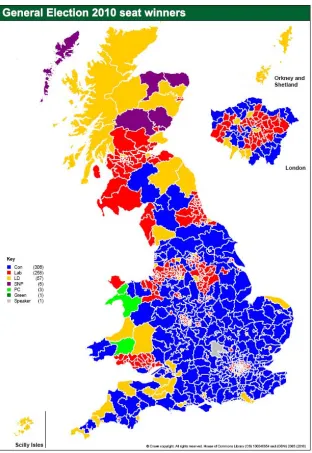
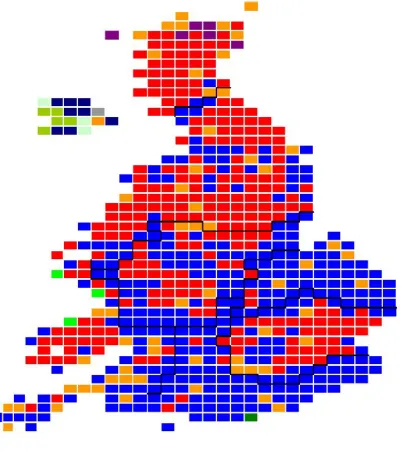
General Election results, shown in Figures 1 and 2 below. Figures 1 and 2 are
both maps from a House of Commons Briefing paper (HoC, 2010). Figure
1 illustrates the party affiliation of the winning candidate in each of the
UK constituencies (excluding Northern Ireland). Figure 2 shows the same
results in a map where each constituency is represented by an equally-sized
rectangle to mitigate the large differences in geographic area between urban
and rural constituencies. These two maps seem to provide initial evidence
of spatial dependence among the party affiliation of the winning candidate,
given the obvious non-random geographic distribution of the data.
[Insert Figure 1 here]
[Insert Figure 2 here]
The remainder of this paper is organised as follows: Section 2 reviews
voting patterns, Section 3 provides an overview of the data used in this
analysis, and Section 4 presents the baseline ordinary least squares (OLS)
model and results. Section 5 introduces Bayesian spatial econometric models
as an improvement on the OLS model, Section 6 details the results of the
Bayesian model comparison exercise and results from applying the resulting,
most appropriate model, and Section 7 concludes.
2
Literature Review
2.1 The impact of geography on voting outcomes
The impact of environment, or geographical context, on British voting
pat-terns has been acknowledged for many years; the earliest of which may be
Butler and Stokes (1969). They found evidence that constituencies with a
larger proportion of working class people tended to disproportionately show
support for the British Labour Party–providing anecdotal evidence to
sup-port the hypothesis that a voter’s environment does impact voting outcomes
(Butler and Stokes, 1969: 146-150). Their findings are consistent with the
three components of geographical context for elections highlighted in Agnew
(1987: 5):
1. Locale, i.e. the setting for routine social interaction.
2. Location, i.e. the role of the place in the world economy.
3. Sense of place, i.e. the socialization that comes with living in a place.
In explaining UK voting behaviour, it seems logical to expect that 1)
this paper, 2) is harder to motivate since the role of the place in the world
economy is fairly constant across the UK (e.g. there are no differences in
trade laws or currencies). However, upon reflection and in light of the recent
economic downturn affecting the world economy, it could perhaps be argued
that parts of the UK that are more dependent on world trade have been
disproportionately affected. Living in areas experiencing larger effects from
this downturn could have affected voters’ decisions in a different way than
living in areas less affected by the global recession. A report published in
November 2008 by the Local Government Association for England (LGA,
2008) provides some evidence for such regional variation in impacts from
the global recession. The report concluded that, “the projected local
vari-ations from the national average performance are very marked” and “very
strong variations in [economic] performance are likely within individual
re-gions”(LGA, 2008:iii). Not only do they observe regional variations, but
also localised variations within regions. A report by the Institute for Public
Policy Research (IPPR, 2009) makes the same argument. Their report goes
further and suggests that these asymmetric impacts are driven by increased
unemployment, fuelled by redundancies in low value-added manufacturing
industries that are facing competitive pressures from emerging economies
that have a clear cost advantage (IPPR, 2009:10).
The literature on the relationship between the health of the economy
and voting decisions is vast (see for example, Kramer, 1971; MacKuen et
al., 1992; Pacek and Radcliff, 1995; and Sanders et al. 2001). There is
some existing evidence (e.g. Owens and Wade, 1988) that suggests that
in the UK. A similar effect is established for Sweden by Elinder (2010),
who finds that local economic conditions did affect support for the Swedish
government between 1985 and 2002. Similarly, Hellwig (2001) finds that
while accounting for the “exposure” of the domestic economy to the world
economy acts to offset the impact of domestic economic differences in
ex-plaining voting behaviour, these impacts are tied to occupational differences
(Hellwig, 2001:1156).
Given the degree of geographical differentiation in the composition of
the UK economy, examining voting behaviour in a manner that accounts for
spatial differences, as we do in this paper, is a valuable exercise. Other
au-thors seem to agree that considering space when examining voting behaviour
is important. For example, Pattie and Johnston (2000) and O’Loughlin et
al. (1994) argue that socio-economic variables alone are insufficient in
ex-plaining electoral behaviour and that it is important to include locational
effects as well. O’Loughlin et al. (1994) list a number of other studies which
demonstrate the importance of geographic context in explaining electoral
outcomes. Studies listed include one which focuses on Italy (Agnew, 1987),
another which focuses on Scotland (Mercer and Agnew, 1988), and a final
one which analyses the southern United States (Johnston, 1991). All of
these studies tend to emphasise the role played by history and shared
soci-etal experience in understanding spatial variations in electoral outcomes.
There is also a wider literature examining the effect of differing
geo-graphic neighbourhoods on election outcomes. One sub-section of this
liter-ature looks specifically at racial makeup as one aspect of the neighbourhood.
on white voter behaviour. He finds that living in an area with a higher black
voter density increases the chance that a white voter will vote for a black
candidate. A similar effect is recorded by Branton (2004) who finds that
living in a racially diverse community makes voters less likely to support
initiatives in ballots that burden minorities (Branton, 2004:309). These
re-sults are the opposite of those found in two earlier studies, Schoenberger
and Segal (1971) and Wright (1976), both of whom argue that living in an
area with a larger black population increased the proportion of the vote
for the pro-segregationist George Wallace in the US Presidential election of
1968. These studies by no means exhaust the literature on racial context
and voting outcomes, but they are intended to give a flavour of the analyses
that have been undertaken.
Others examine the many aspects of the neighbourhood as a whole.
Pat-tie and Johnston (2000) look at micro-level data for the 1992 UK General
Election and conclude that voters in the UK are influenced both by local
neighbourhood effects and by the political beliefs of those around them,
particularly where these people are family members with whom they
dis-cuss politics (Pattie and Johnston, 2000:62). Burbank (1997) goes further,
examining how a voter’s local level context impacts individual level voting
behaviour. Another study, Macallister et al. (2001), examines voting
be-haviour in the 1997 UK General Election and finds very strong evidence of
a neighbourhood voting effect.
Despite a significant literature existing on neighbourhood effects, we
find that most authors imply that these effects stop at the boundary of the
articles, the characteristics of a constituency affect only that constituency’s
behaviour. Our hypothesis is that there is a more complex system of spatial
interaction that affects voting behaviour. The purpose of our paper, in
part, is to demonstrate this by using the approach outlined in the following
sections. We can then consider the different spatial effects that are involved
in, and help to explain, the observed voting behaviour in the 2010 UK
General Election. By establishing the presence of a spatial dimension in
voting behaviour, we demonstrate that the neighbourhood effects discussed
by others do indeed extend beyond constituency boundaries.
2.2 Spatial Econometric Voting Analysis
We propose to build on the existing analyses relating a voter’s environment
and voting behaviour to assess the strength of these environmental effects
using a spatial econometric model. Before outlining our modelling approach
in Section 4, we first summarise the existing applications of spatial
econo-metric and statistical techniques that analyse voting behaviour. Perhaps
the earliest voting analysis that considers space is Kirby and Taylor (1976).
They examine the spatial pattern of votes cast in the 1975 UK
referen-dum on whether or not to join the European Economic Community, now
the European Union. The vote itself was a straightforward yes/no
refer-endum. While their analysis is not consistent with the spatial econometric
methodology employed here, they did recognise and attempt to model a
spatial dimension in observed voting behaviour. Their analysis divided the
UK into 23 regions and computed two “factor” variables - “core-periphery”
variables. These factors are then included in a linear regression analysis.
Developments in the literature suggest that the regression results obtained
in Kirby and Taylor (1976) may be unbiased but inconsistent (e.g. Barry
et al., 1998). This early work recognised, but could not prove, what we
attempt to establish in this paper - namely that UK voting patterns exhibit
spatial dependence.
Kohfeld and Sprague (1995) examine two elections for citywide offices
in St. Louis, Missouri using a spatial contiguity matrix and the residuals
from a prior non-spatial regression analysis to determine the existence and
strength of spatial dependence in voting behaviour. They conclude that
spatial dependence in voting existed and was quite strong in both elections.
Others make use of an element of exploratory spatial data analysis
-the Moran’s-I statistic - to examine -the existence of spatial dependence in
voting analyses. Seabrook (2009) and Kim, Elliot, and Wang (2003) examine
spatial dependence in US Presidential elections using the Moran’s-I statistic.
Given the similarity in the two approaches, we only discuss the approach of
Seabrook (2009) here. The interested reader is referred to Kim, Elliot, and
Wang (2003) for further details and specific results. Seabrook (2009) uses
this approach to analyse the 2004 and 2008 US Presidential elections. He
measures the degree of homogeneity across counties according to both the
percentage of votes cast for the Democratic candidate and the percentage
of votes cast for the Republican candidate. Seabrook finds that there are
strong and statistically significant levels of positive spatial autocorrelation
in the votes cast for both parties (Seabrook, 2009:4). He also shows that
and 2008.
There are even fewer analyses of voting behaviour that employ more
recent spatial econometric techniques (see LeSage and Pace (2009) for a full
overview of these techniques). There are two notable exceptions: Lacombe
and Shaughnessy (2007) and Cutts and Webber (2010) whom both estimate
a series of spatial econometric models for voting behaviour.
Lacombe and Shaughnessy (2007) analyse US voting behaviour by
ex-amining the 2004 US Presidential election. They argue that despite a
sig-nificant amount of effort being spent on identifying the variables that
in-fluence electoral decisions, the variables that are almost always omitted are
those that differ across space (Lacombe and Shaughnessy, 2007:484). This
omission can result in spatially correlated regression residuals, which lead
to misleading regression coefficients and inferences. They demonstrate the
importance of accounting for spatial dependence in voting analyses by
com-paring the results of a spatial error model with those from a standard OLS
regression. They conclude that OLS regression results based on spatially
autocorrelated data are unbiased but inefficient. Due to a downward bias
in the standard errors, the use of OLS regression techniques on spatially
autocorrelated data can lead to incorrect inferences from the results (e.g.
Lacombe and Shaughnessy, 2007:492 and Barry et al., 1998).
Cutts and Webber (2010) employ several regression analyses (both
non-spatial and non-spatial) in addition to the Moran’s-I statistic to examine vote
share for all major parties in the 2005 UK General Election. Although
like-lihood ratio tests indicate that models which account for spatial dependence
of the coefficients in these spatial regressions may be misleading, in that
they neglect to calculate the direct, indirect, and total effects as developed
by LeSage and Pace (2009).
As a final note, LeSage and Dominguez (2010) look at spatial spillover
effects in the context of public choice issues. Although they examine a
public choice issue related to voting, they do not analyze voting patterns
as we do here. However, LeSage and Dominguez (2010) do demonstrate
the need to take the spatial dimension into account when analyzing such
issues. By examining the impacts of demographic change on local service
provision, they show that increased spending is associated with higher own
county marginal tax cost. In addition, they demonstrate that there is a
spillover effect, which implies that higher spending in one county increases
the marginal tax cost of neighbouring counties. They attribute this result to
“mimicking” behaviour in neighbouring counties where increases in county
service provision create pressure for similar increases in nearby counties.
The interested reader is referred to LeSage and Dominguez (2010) for more
details on their method and other public choice issues examined.
3
Data
The data used in this paper come from a number of different sources. The
primary data source is from a database collected and published online by Dr.
Pippa Norris of Harvard University, available athttp://www.pippanorris.
com/. The dataset used in this study is “May 6th 2010 British General
were a number of seats in which the constituency boundaries changed
sig-nificantly between 2005 and 2010. Due to these changes, many independent
variables that could have been used in this analysis are not yet available for
the 2010 boundary definitions. For example, at the time of this analysis,
data on income and education variables are only available for the 2005
con-stituency boundaries. For consistency, all of the data subsequently used in
this analysis are those available at the 2010 constituency boundaries, and
all are studentized, whereby each variable is transformed by subtracting its
mean and dividing by its standard deviation.
Additional variables were obtained for the unemployment benefit claimant
count from the National Online Manpower Information Service (NOMIS)
website, accessible at https://www.nomisweb.co.uk/Default.asp. This
website is a result of collaboration between the UK Office of National
Statis-tics and the University of Durham and provides statisStatis-tics on the UK Labour
Market. The NOMIS dataset accessed and used in this paper is “claimant
count - age and duration”. This dataset is used to provide a measure of
long-term unemployed (taken as those who have been claiming benefits for
more than 1 year) as a proportion of total claimants in each constituency.
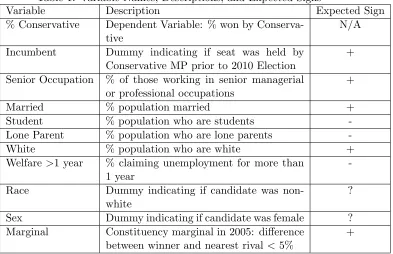
Descriptions of each variable, along with descriptive statistics and the
ex-pected coefficient signs are presented below in Table 1.
We obtained the geographical data for the spatial weight matrix from
the Ordnance Survey website, using the product “Boundary Line”1. This product provides detailed geographic information on the boundaries of each
1
of the UK Parliamentary constituencies as in force on May 6th, 2010. In
all model specifications, we use a contiguity weight matrix based on
Delau-nay triangles. For these 630 UK Parliamentary constituencies, the average
number of neighbors is 6.
It should be noted that we chose to exclude the 18 constituencies in
Northern Ireland from our analysis as the UK Conservative Party does not
directly field candidates in Northern Ireland. Instead, there is an electoral
alliance with the Ulster Unionist Party (UUP) who field candidates with
the understanding that any elected UUP Member of Parliament will take
the Conservative Party whip and could serve in a Conservative Government
(Porter, 2010). We also exclude two additional constituencies from our
anal-ysis: Thirsk & Malton and Buckingham. The election in Thirsk & Malton
was delayed by three weeks due to the death of the UK Independence Party
candidate during the election campaign. As such, we excluded this
con-stituency to focus our analysis on votes that were cast simultaneously. The
seat of Buckingham was excluded as it was the seat of the sitting Speaker
of the House of Commons, John Bercow MP. By convention, the Speaker
is not contested by any of the three main parties when seeking re-election
(HOC-IO, 2010). Our analysis was therefore carried out using data on the
remaining 630 UK Parliamentary constituencies.
[Insert Table 1 here]
As for our prior expectations, given the well known advantages of
the percentage of the vote won by the Conservative candidate. Also, given
that the Conservative Party had high profile initiatives to help married
cou-ples and to limit immigration, we expect that the higher the percentage of
the constituency population that is married, the higher the percentage
Con-servative vote. Similarly, the higher the percentage of the constituency
pop-ulation that is white (and conversely, the lower the non-white poppop-ulation),
the higher the percentage Conservative vote. Other high profile policies,
such as maintaining or increasing student tuition fees, as well as reducing
benefits for those who refuse jobs offers, lead us to expect that the more
stu-dents and the larger percentage of long term unemployed in a constituency,
the lower the percentage vote for the Conservative Party. Also, given the
Conservative Party pledge to scale back some of the tax credits which gave
financial assistance to lone parents, we expect that the more lone parents
there are in a constituency, the lower the percentage Conservative vote. On
the expected sign of some other variables, such as the race and sex of the
Conservative candidate and whether the seat is a marginal seat, we are
gen-uinely undecided and could posit either a positive or negative relationship
between these explanatory variables and the dependent variable.
4
Benchmark OLS Results
To provide an initial baseline regarding the effects of our set of independent
variables on the percentage of the Conservative vote, an OLS regression
y = Xβ+ε (1)
ε ∼ M V N0, σ2In
whereyis ann×1 vector of observations on the percentage of votes cast
for the Conservative Party,Xis ann×kmatrix of economic, socio-economic
and political variables,β is a k×1 vector of coefficient estimates, andε is
ann×1 vector of i.i.d. errors that are distributed multivariate normal with
mean 0 and variance-covariance matrixσ2In.
As previously noted, we studentized the dependent variable, as well as
the matrix of independent variables, by subtracting the mean and dividing
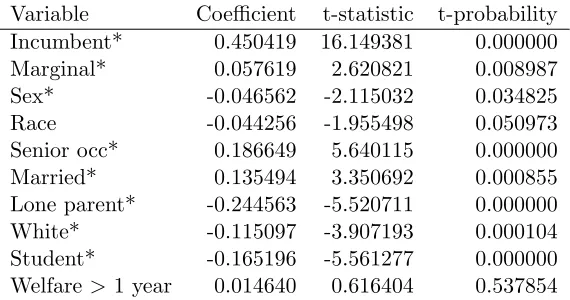
by the standard deviation, leading to standardized variables2. The results from the OLS model are given in Table 2. We find that all of the independent
variables are statistically significant at the 5% level, with the exception of the
race variable (significant at the 10% level), and the welfare>1year variable,
which is not statistically significant at any reasonable level.
In terms of our a priori hypotheses regarding the signs of the
coeffi-cient estimates, we find mixed evidence. For example, the seat being held
by a Conservative MP in the last Parliament has a positive effect on the
percentage votes received by the Conservatives. This confirms our initial
expectations about the power of incumbency. The candidate sex and
can-didate race variables have negative coefficients, indicating that where the
2
Conservative candidate was female or of non-Caucasian race, there was a
lower vote for that Conservative candidate. This result is particularly
inter-esting in the context of the recent UK debates about increasing the number
of women and minorities who stand for Parliament. However, it is difficult
here to determine causality. It may be the case that there is a selection issue
in which, women and minorities may, on average, be selected as
Conserva-tive candidates for seats where the ConservaConserva-tive vote is lower, rather than
that the presence of a woman or minority Conservative candidate depresses
the Conservative vote. This perhaps provides one interesting area for future
examination.
Other variables do not conform to our expectations, namely the white
and welfare>1year variables. The percentage of the population that are
white has a negative effect on the percentage of the vote obtained by the
Conservative candidate. This implies that as the percentage of the
popula-tion who are white increases, there is a decrease in the percentage of votes
cast for the Conservative candidate. Given the Conservatives pledged to put
a cap on immigration, as well as their general perception of being tougher
on immigration issues than the other two main parties, we expect their
sup-port to be strongest where the immigrant population is low. It is worth
noting here than an opinion poll, carried out by the polling agency YouGov
for the UK Daily Telegraph newspaper in 2009, found that a majority of
those polled thought that the anti-immigrant British National Party “had
a point” and were correct to “speak up for the interests of the indigenous,
white British people”(Thompson, 2009). In this context, it can perhaps be
who are white are expected to be more supportive of parties, like the UK
Conservative Party, who are seen to be tougher on immigration than the
other main parties. The overall fit of the OLS model is fairly good, with an
adjustedR2 of approximately 70%.
5
Bayesian Spatial Econometric Models
Given the geographic nature of the data, it is reasonable to suspect that
spatial autocorrelation may be an issue. Spatial autocorrelation is formally
defined as follows (Anselin and Bera, 1998):
cov (yi, yj) =E(yi, yj)−E(yi)E(yj)6= 0 f or i6=j (2)
where,yiandyjare observations on a random variable at locationsiand
jin space. The subscriptsiandjcan refer to any geographic designation and
the equation implies non-independence of the random variable across space.
Spatial autocorrelation can pose problems when using standard econometric
techniques, such as OLS.
Spatial econometric models come in three basic varieties, the spatial
autoregressive (SAR) model, the spatial error (SEM) model, and the spatial
Durbin model (SDM). The SAR model can be represented as follows:
ε ∼ M V N0, σ2In
where y is an n×1 vector of observations on the dependent variable,
X is an n×k matrix of independent variables, εis ann×1 vector of i.i.d.
errors, ρ is a scalar spatial autocorrelation parameter, β is a k×1 vector
of regression parameters, and W is an n×n row-stochastic spatial weight
matrix.
The SAR model is used when one believes that spatial autocorrelation is
exhibited in the dependent variable. In our particular empirical application,
it may be that voters across constituencies share common characteristics
regarding voting preferences. Therefore, their votes would be
geographi-cally correlated. It may also be that voters engage in “copy-cat” behavior,
where voters across geographic space mimic each other’s voting preferences.
Regardless of the rationale for the spatial autocorrelation in the dependent
variable, from an econometric perspective, if the true data generating
pro-cess (DGP) for the data is the SAR model, and one uses OLS for estimation
purposes, the resulting coefficient estimates will be biased and inconsistent
due to the endogeneity of theρW y term on the right hand side of the
equa-tion (LeSage and Pace, 2009).
Another variety of spatial econometric model is the SEM model. This
model posits that the spatial autocorrelation is found in the error term and
can be represented mathematically as follows:
u = λW u+ε
ε ∼ M V N0, σ2In
where y is an n×1 vector of observations on the dependent variable,
X is an n×k matrix of independent variables, εis ann×1 vector of i.i.d.
errors, λ is a scalar spatial autocorrelation parameter, β is a k×1 vector
of regression parameters, and W is an n×n row-stochastic spatial weight
matrix.3 It is possible that for a variety of reasons, when an econometric model is specified and estimated, certain factors that should be included in
the model are not and that these factors are correlated over space, resulting
is residual spatial error correlation. In our application regarding
Conserva-tive votes, there may be omitted spatially correlated variables such as shared
cultural norms, media exposure, or other social phenomenon that are either
not quantitatively expressible and/or impossible to proxy for in any
quan-titative or qualitative sense. Additionally, it may be that the constituency
boundaries cut across natural communities, resulting in spatial
autocorre-lation. Or, as is common in the UK, there may be services that are shared
by multiple constituencies; one example of this would be hospital
manage-ment.4 If the true DGP is the SEM model and we use OLS which fails to account for this spatial dimension, the OLS estimators of the coefficients are
unbiased but inefficient and the estimates of the variance of the estimators
3Technically, the SEM model illustrated in the text is a spatial error model with au-toregressive errors. The other, less often used SEM model is the spatial error model with moving average errors.
are biased (LeSage and Pace, 2009). In practice, this can lead to incorrect
inferences regarding the statistical significance of independent variables, and
thus lead one to believe that an independent variable is explaining variation
in the dependent variable when it is actually not.
A final spatial econometric model, a basic extension of the SAR model,
labeled the spatial Durbin model, is mathematically expressed as follows:
y = ρW y+Xβ+W Xθ+ε (5)
ε ∼ M V N0, σ2In
where y is an n×1 vector of observations on the dependent variable,
X is an n×k matrix of independent variables, εis ann×1 vector of i.i.d.
errors,ρis a scalar spatial autocorrelation parameter,β is ak×1 vector of
regression parameters,θis a vector of regression parameters on the spatially
weighted W X variables, and W is an n×n row-stochastic spatial weight
matrix.
The difference between the standard SAR model described above and
the SDM model is the inclusion of spatially weighted independent variables.
LeSage and Pace (2009) show that the SDM model should be used when one
believes that there may be omitted variables that follow a spatial process
and are correlated with included independent variables.
In our empirical application, it is likely that there are some omitted
vari-ables that we are not likely to be able to control for in our empirical
correlated omitted variables are correlated with an included independent
variable, LeSage and Pace (2009) show from a theoretical perspective that
the spatial Durbin model is the most appropriate model.5 One example of such a variable is media outlets/media coverage which is especially relevant
in this particular election because it was the first to televise political
de-bates. Newspapers and other print media are additional examples of media
outlets that we are unable to control for in a meaningful way but that may
be spatially correlated as they tend to service specific geographic areas.
For example, those employed in senior occupations are also consumers
of certain types of media, perhaps business journals or other “conservative”
media outlets. As another example, students may consume different types
of media services, relying on “alternative” media outlets that reflect their
particular political world–view. Again, if these media variables are unable
to be properly entered into our estimating equation and these variables are
correlated with the included variables, we have a strong theoretical case for
use of the spatial Durbin model.
As another example, consider individuals who may be members of
cer-tain civic groups, such as the Rotary Club or other organizations with a
specific agenda. More than likely, membership in these organizations is
spa-tially correlated in that members are most likely from a certain concentrated
geographic area. Since membership information for these groups is
unavail-able, it represents an omitted variable in our econometric specification that
is spatially correlated. This omitted variable is also extremely likely to be
correlated with one of our included explanatory variables, notably the
per-5
centage of the constituency that are in senior occupation fields. Given these
two facts, namely that we have an omitted variable that is spatially
corre-lated and that is also correcorre-lated with an included explanatory variable, we
have another strong argument for using the spatial Durbin model.
Recall that the Parliamentary constituency boundaries changed
signifi-cantly between the 2005 General Election and the 2010 UK General Election.
Independent variables that are not yet available for the new constituency
boundaries, such as income and education level, may also represent
omit-ted variables that are correlaomit-ted with included variables and exhibit spatial
autocorrelation.
Our motivation for using Bayesian spatial econometric techniques, as
opposed to the more familiar maximum likelihood paradigm, is that the
Bayesian paradigm allows one to make non-nested model comparisons in a
statistically coherent manner. Given this advantage, we now turn to the
sta-tistical development of the Bayesian variants of spatial econometric models
and Bayesian model comparison.
By way of notation, letθdenote a vector of parameters of interest,π(θ)
the prior probability density function (pdf) for θ, and let f(y|θ) represent
the likelihood function. The posterior distribution of the parameters, namely
π(θ|y), is derived via Bayes’ Rule:
π(θ|y) = π(y|θ)π(θ)
π(y) (6)
probability density integrates to unity.6
Given thatπ(y) does not involve the parameter vectorθ, we can ignore
this constant in subsequent analyses and write Bayes’ Theorem in a familiar
form:
π(θ|y)∝π(y|θ)×π(θ) (7)
thus resulting in the familiar Bayesian phrase, “the posterior is
propor-tional to the likelihood times the prior”. Ideally, we would like to draw
inferences regarding the parameters of the model by analytically integrating
the joint posterior distribution for each of the model’s parameters, resulting
in a marginal distribution for each parameter. However, the analytical
so-lution to this integration problem is available only in a few select cases. In
deriving the marginal distributions, these complications force us to draw
in-ferences using iterative procedures, referred to generically, as Markov Chain
Monte Carlo (MCMC) methods. Specifically, we will make use of the Gibbs
sampler and the Metropolis-Hastings algorithm to provide robust inferences
regarding the model parameters.
The Gibbs sampler is an algorithm used to generate a sequence of
sam-ples from the joint posterior distribution of the parameters when an
analyt-ical solution is unavailable. There are two necessary conditions for Gibbs
sampling the SAR, SEM, or SDM model, or any model, for that matter.
First, the full conditional distributions comprising the joint posterior must
be available in closed form. Second, these forms must be tractable in the
sense that it is easy to draw samples from them. In terms of the regression
coefficients, represented by thek×1 vector β, these requirements are met
in that random draws from the multivariate normal distribution are used to
obtain parameter estimates. This is also true in terms of the error variance
parameter,σ2, whereby inferences are obtained via random draws from the inverse Gamma distribution. The only full conditional distribution that does
not fall into this category is the spatial autocorrelation parameter,ρ, which
must employ a relatively straightforward random–walk Metropolis–Hastings
algorithm.
The Metropolis-Hastings algorithm is an accept-reject type algorithm
in which a candidate value is proposed and then one decides whether to set
the next value of the chain equal to this proposed value or to remain at the
current value. The Metropolis-Hastings algorithm mimics the Gibbs
sam-pling algorithm but the difference is that the Metropolis-Hastings algorithm
can be used for conditional distributions that do not have any recognizable
distributional form. If the Metropolis-Hastings algorithm is used in
com-bination with standard Gibbs sampling techniques, it is referred to as the
“Metropolis-within-Gibbs” method. Further mathematical and
computa-tional details regarding MCMC estimation of spatial econometric models is
covered in LeSage and Pace (2009) and Lacombe (2008).
The formula for Bayes’ Rule explicitly allows for prior information to
be included in the statistical analysis. In each of our models, we use proper
prior distributions, but with fairly uninformative values. Specifically, we set
mean ˆβ ≡0K and covariance Cβˆ≡10,000×IK. The prior values for theσ
parameter, which comes from the inverted Gamma distribution, areυ0 ≡1
and s20 ≡ 1 and the prior values for the ρ term comes from a univariate normal prior, with meanρ0 ≡0 and standard deviation 10,000.
Another appealing aspect of Bayesian analysis is the formal statistical
derivation of model comparison techniques. In the empirical application that
follows, we were uncertain about which model is the correct one, i.e. SAR
vs. SEM vs. SDM. We solve this problem by calculating posterior model
probabilities and choosing the best model based on these calculations.7 The essential inputs in Bayesian model comparisons are the marginal likelihoods
of competing models. As previously mentioned, the marginal likelihood,
de-notedπ(y), is the integrating constant that ensures that the posterior
distri-bution integrates to unity. Until recently, the computation of the marginal
likelihood has proved to be extremely burdensome for all but the simplest
models. In our model comparison exercise, we use the marginal likelihood
calculation as outlined in Chib and Jeliazkov (2001), which is an extension of
the algorithm proposed in Chib (1995) for models that include a Metropolis–
Hastings step. The marginal likelihood can be used to calculate posterior
model probabilities according to the following formula:
π(Mi|y) =
π(Mi)π(y|Mi) J
P
j=1
π(Mj)π(y|Mj)
(8)
where π(Mi|y) is the posterior probability of model i, π(Mi) is the
prior probability of model i , and π(y|Mi) is the marginal likelihood for
modeli , where{M1, . . . , MJ} denotes each of theJ models. Model choice
then proceeds by choosing the model with the highest posterior probability.
6
Results
The posterior model probabilities for each of the 3 models are given in Table
3. We ran each of the 3 models for 20,000 iterations using the initial 10,000
iterations as “burn in” of the sampler, and assumed that each model was a
priori equally probable, i.e. π(Mi) was equal to 1/3 for each model. The
results from our Bayesian model comparison exercise indicate that the most
preferred model is the spatial Durbin model, with a posterior probability of
approximately 100%. This empirical finding is in accordance with our
previ-ous theoretical discussion regarding the appropriateness of using the spatial
Durbin model when one believes that there are omitted variables that are
spatially correlated and that are correlated with included explanatory
vari-ables. Given such a high posterior model probability, as well as theoretical
considerations, we limit our discussion to the results of the spatial Durbin
model.
In our spatial model, as is the standard practice in Bayesian regression
analyses, we calculated 95% credible intervals from the Gibbs samples for
the regression coefficients. Those intervals that do not contain zero are
considered “significant” in the sense that the variable is associated with
is followed by a * in Table 4, the respective coefficient on that variable is
associated with the dependent variable at the 95% level, i.e. the 95% credible
interval points to a posterior distribution for the parameter estimate that is
far enough away from zero which gives credence to an important role played
by these variables in explaining the percentage of Conservative votes.
We begin our discussion of the regression results by noting that the
spatial autocorrelation coefficient,ρ, has a value of.6977 and a 95% credible
interval of [.6318, .7614] meaning that there is a 95% probability that the
true value of ρ lies within this interval. We also note that the value of ρ
indicates a moderate to high level of spatial autocorrelation in our dependent
variable.
LeSage and Dominguez (2010) argue that directly comparing OLS β’s
andβ’s from a spatial autoregressive (SAR) or spatial Durbin (SDM) model
is inappropriate due to the fact that the coefficients in an OLS regression
model accurately measure the effect of a change in an explanatory variable
on the dependent variable, while a SAR or SDM model’s coefficients “are
not directly interpretable with regard to how explanatory variables in the
model influence the dependent variable” (LeSage and Dominguez, 2010:4).
We follow LeSage and Pace (2009, Chapter 2) and calculate the direct,
indirect, and total effects estimates in regards to each of our independent
variables.
The first thing to note is that all of the signs on our statistically
signif-icant independent variables are in accordance with our prior expectations,
a marked difference from our benchmark OLS model. For example, in the
contrast to our expectations. The SDM model, without exception, exhibits
coefficient signs that are in accordance with our hypothesized signs, as well
as political and economic theory.
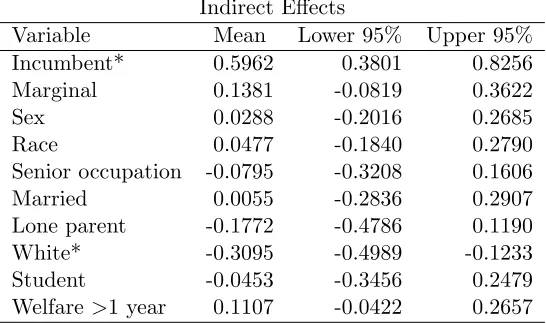
Table 4 shows that the incumbent variable has a positive and significant
direct, indirect and total effect on the percentage of the vote obtained by the
Conservative candidate. This result is in line with the commonly understood
advantages incumbents have over challengers including name recognition,
ac-cess to public funding as part of the MPs communications allowance, and
a record in office on which to campaign. The positive and significant
indi-rect effect suggests that there is an important impact that incumbent MPs
can have in increasing their parties support in neighbouring constituencies.
There are a number of reasons that could help explain this effect; for instance
an incumbent has both resources and staff available to publicise themselves
in the media (a medium that does not respect constituency boundaries).
Similarly, there may be local issues on which incumbents may have
“own-ership”, but which affect neighbouring constituencies as well (for example
hospital closures or policing issues). Another explanation could stem from
the fact that an incumbent MP is a full time advocate for their party in
the community, and that part of this role is (implicitly or explicitly) to
pro-mote their party in neighbouring constituencies (including for example, by
mentoring the party’s candidates for neighbouring seats) which are currently
held by other parties. Whatever the reason, the existence of such an effect is
interesting and helps us to better understand the full effects of incumbency
beyond the narrow focus of increasing the re-election chances of the
of “foothold effects” where a party that managed to gain a foothold in a
hitherto unwinnible area may be able to use this initial gain to spur a wider
increase in their party’s support, although it may have been the same effect
(operating in favour of the opposition party) that led the area to become
unwinnable in the first place.
The positive and significant coefficients on the direct effects of the senior
occupation and married variables are also expected. The high profile pledge
made by the Conservative Party to recognize marriage in the tax system
(Watt, 2010) and the introduction by the incumbent Labour government of
a top income tax rate of 50% (BBC News, 2009) – which the Conservatives
indicated they would repeal once the economy recovered (Conservative Party
Website, 2010) – seem to help explain our findings here. Neither of these
variables has a significant indirect or total effect, suggesting that the effect
of the proportion of the the local population in these groups is limited to
“within” the constituency. This is a reasonable result since it is difficult
to conceive how an increase in the number of married couples or senior
managers in one constituency could have an effect on the level of support
for a political party in a neighbouring constituency.
The direct effects of the student and lone parent variables seem to be
reflecting the fact that these are “non-core” Conservative voting groups
and despite recent attempts by the UK Conservative Party to “woo” these
groups, these results indicate that where these groups are more populous in
a constituency, they exert a negative effect on the percentage of the votes
cast for the Conservative candidate. Arguably, the biggest issue currently
fees for university education. The Conservatives claimed that they would
keep tuition fees, unlike their Liberal Democrat opponents (and subsequent
coalition partners) who pledged to fight to remove them (Grimston, 2010).
It is perhaps not a surprise that a party pledging to keep university fees
in place, and even to increase them, would not find favour with students.
Indeed, an opinion poll conducted in the UK in April 2010 showed that
some 68% of students surveyed would be less likely to vote for a party that
planned to increase tuition fees (Endsleigh, 2010). Similarly, there was a
suggestion that the recognition of marriage in the tax system that
Conser-vatives proposed would hurt single-parent households (Walker, 2009). This
may explain, in part, our findings that the more lone parents there are in a
constituency, the lower the percentage of the vote won by the Conservative
Party.
The next variable of consequence is the white variable, which has a
positive and significant direct effect coefficient suggesting that the higher
the percentage of the population that is white, the higher the percentage
Conservative vote. The indirect effect estimate for this variable is also
signif-icant, but negative. This result implies that the higher the proportion of the
population that are white in one constituency, the lower the support for the
Conservative Party in neighbouring constituencies. Conversely, the lower
the percentage of the population in one constituency who are white, the
higher the support for the Conservative Party in neighbouring
constituen-cies. The latter explanation is consistent with cases of community tensions
surrounding constituencies with a particularly high level of non-white
population that is non-white (perhaps composed of a number of current
asylum seekers) could create cohesion issues around shared amenities. This
may result in voters in neighbouring constituencies increasing their support
for parties that are considered to be tougher on immigration issues. We
provide no support here for any particular direction of causality and are
merely speculating as to the cause of this effect. Perhaps the most
interest-ing aspect of the results relatinterest-ing to the white variable is that the size of the
negative indirect effect easily dominates the positive direct effect, resulting
in a negative and significant total effect.
The welfare variable has a negative and significant direct effect
coeffi-cient implying that the higher the percentage of benefit claimants who are
considered “long term”, the lower the percentage Conservative vote. This
result is not surprising in light of the high profile campaign the
Conserva-tives ran to cut benefits for unemployed people who refuse offers of work
(Shipman, 2010). The indirect effect estimate is insignificant, as is the total
effect estimate.
The marginal variable, which is a dummy variable indicating that the
gap between the first and second place candidates in the previous 2005
UK General Election was <5%, has a positive and significant direct effect
estimate. This suggests that the percentage of the Conservative vote was
higher where the race was closer. This could suggest that the Conservative
voters are more responsive to the closeness of the race, perhaps recognising
7
Conclusion
We set out to test two principle research questions, 1) whether or not there
is spatial dependence in the votes cast for the Conservative Party in the 2010
UK General Election and 2) what economic, socio-economic, and political
factors help explain the variation in the percentage of the vote won by the
Conservative Party across the UK. Many empirical models of voting
out-comes ignore the effects of spatial dependence, resulting in estimates that
can be biased, inconsistent, or both. To take account of spatial dependence,
we estimated a series of Bayesian spatial econometric models designed to
control for any spatial dependence inherent in the data. We examined three
different spatial econometric models, and used modern Bayesian model
com-parison techniques to produce posterior model probabilities for guiding our
model selection.
On examining the coefficients in the most appropriate model, the
spa-tial Durbin model, we found that almost all of the significant explanatory
variables reinforced our prior beliefs. The incumbent, senior occupation,
married, and white variables all exerted a positive and significant effect on
the percentage of the votes for the Conservatives, while student, lone parent,
and welfare<1 year all exerted a significant negative effect on the percentage
of votes cast for the Conservative Party. Perhaps the most interesting result
from our analysis is that the incumbent variable has a positive and
signif-icant indirect effect. There are a number of possible explanations for this
which were discussed earlier in this paper. What this finding does though,
be-yond the realm of candidate self-preservation and focuses it also on these
indirect effects, which are a potentially interesting aspect of understanding
election outcomes. The full results presented in this paper demonstrate that
controlling for residual spatial autocorrelation is a vital component of any
empirical analysis of voting behavior.
Spatial econometric techniques are garnering more attention in the field
of economics and beyond. The full suite of spatial econometric models that
are now available provide an excellent basis on which to better model and
examine the underlying relationships in datasets like the one used here.
Additionally, the Bayesian statistical paradigm allows one to make
non-nested model comparisons with relative ease and provides a more nuanced
approach to model selection.
Future research will look at the insights that can be gained from looking
at these issues further using different modelling approaches, including
con-sideration of “regional level” effects, where the spatial effects are modeled
as unobserved effects at a regional level.
8
References
Agnew JA (1987)Place and Politics, Boston: Allen and Unwin
Anselin L, Bera A (1998) Spatial dependence in linear regression
mod-els with an introduction to spatial econometrics. In: Ullah A, Giles
DEA (eds) Handbook of applied economic statistics. Marcel Dekker,
Barry R, Pace RK, and Sirmans CF (1998) Spatial statistics and real
estate. Journal of Real Estate Finance and Economics 17(1): 5-13
BBC News (2009) Tax rise as UK debt hits record, BBC News Website,
last updated Wednesday, 22 April 2009, available from: http://news.
bbc.co.uk/1/hi/uk_politics/8011321.stmAccessed: 22 July 2010
Branton RP (2004) Voting in Initiative Elections: Does the Context of
Racial and Ethnic Diversity Matter? State Politics and Policy
Quar-terly 4(3): 294-317
Burbank MJ (1997) Explaining Contextual Effects on Vote Choice
Po-litical Behavior 19(2): 113-132
Butler D and Stokes D (1969) Political Change in Britain (1st.
edi-tion). MacMillan: London
Carsey TM (1995) The Contextual Effects of Race on White Voter
Behavior: The 1989 New York City Mayoral ElectionThe Journal of
Chib, S (1995) Marginal Likelihood from the Gibbs Output Journal
of the American Statistical Association 90(432): 1313-1321
Chib, S and Jeliazkov I (2001) Marginal Likelihood from the Metropolis–
Hastings OutputJournal of the American Statistical Analysis96(453):
270-281
Conservative Party Website (2010) Where we stand: the economy, The
Conservative Party website, available from: http://www.conservatives.
com/Policy/Where_we_stand/Economy.aspxAccessed: 21 July 2010
Cutts D and Webber DJ (2010) Voting patterns, party spending and
relative location in England and WalesRegional Studies44(6): 735-760
Elhorst, JP (2010) Applied Spatial Econometrics: Raising the Bar
Spatial Economic Analysis 5(1): 9-28
Elinder, M (2010) Local economies and general elections: The
influ-ence of municipal and regional economic conditions on voting in
Swe-den 1985-2002European Journal of Political Economy 26(2): 279-292
Endsleigh (2010) Student vote could swing election as a top-up fee
from: http://www.endsleigh.co.uk/Media/Pages/StudentElection2010.
aspxAccessed: 25 August 2010
Grimston J, Labour revolt over tuition fees, The Sunday Times Online,
available fromhttp://www.timesonline.co.uk/tol/news/politics/
article7094316.eceAccessed: 11 April 2010
Hellwig TT (2001) Interdependence, Government Constraints, and
Economic VotingThe Journal of Politics 63(4): 1141-1162
House of Commons (2010)“General Election 2010: Final edition”,
House of Commons Briefing Paper, available fromhttp://www.parliament.
uk/briefingpapers/commons/lib/research/rp2010/RP10-036.pdf
House of Commons-Information Office (2010) “The Speaker”, House
of Commons Information Office Factsheet, M2, available fromhttp://
www.parliament.uk/documents/commons-information-office/m02.
Institute for Public Policy Research (2009) “The Impact of the
Reces-sion on Northern City-Regions”, IPPR Report, available fromhttp://
www.ippr.org.uk/members/download.asp?f=/ecomm/files/impact_
Johnston RJ (1991)A question of place Basil Blackwell: Oxford
Kirby AM and Taylor PJ (1976) A Geographical Analysis of the
Vot-ing Pattern in the EEC Referendum, 5 June 1975Regional Studies 10:
183-191
Kohfeld CW and Sprague J (1995) Racial context and voting
behav-ior in one-party urban political systems Political Geography 14(6-7):
543-569
Kramer G (1971) Short-Term Fluctuations in U.S. Voting Behavior,
1896-1964The American Political Science Review 65(1): 131-143
Kim J, Elliot E, and Wang D (2003) A spatial analysis of county-level
outcomes in US Presidential elections: 1988-2000Electoral Studies 22:
741-761
Lacombe DJ and Shaughnessy TM (2007) Accounting for Spatial
Er-ror Correlation in the 2004 Presidential Popular Vote Public Finance
Lacombe DJ (2008) An Introduction to Bayesian Inference in Spatial
Econometrics, SSRN Working Paper, available from http://ssrn.
com/abstract=1244261Accessed: 24 July 2010
LeSage JP and Dominguez M (2010) The importance of modeling
spa-tial spillovers in public choice analysis (in press)Public Choice
LeSage JP and Pace RK (2009)Introduction to Spatial Econometrics
CRC Press: Boca Raton
Local Government Association of England (2008) “From recession
to recovery: the local dimension”, Local Government Association of
England Report, available from http://www.lga.gov.uk/lga/aio/
1215871Accessed: 24 August 2010
Macallister I, Johnston RJ, Pattie CJ, Tunstall H, Dorling DFL, and
Rossiter DJ (2001) Class Dealignment and the Neighbourhood Effect:
Miller RevisitedBritish Journal of Political Science 31: 41-59
MacKuen MB, Erikson RS and Stimson JA (1992) Peasants or Bankers?
The American Electorate and the U.S. EconomyThe American
Mercer J and Agnew J (1988) Small worlds and local heroes: the 1987
General Election in Scotland Scottish Geographical Journal 104(3):
138-145
O’Loughlin JV, Flint C, and Anselin L (1994) The geography of the
Nazi vote: context, confession and class in the Reichstag election of
1930Annals of the Association of American Geographers 84: 351-380
Owens JR and Wade LL (1988) Economic Conditions and Constituency
Voting in Great BritainPolitical Studies 36(1): 30-51
Pacek AC and Radcliff B (1995) Economic Voting and the Welfare
State: A Cross-National AnalysisThe Journal of Politics 57: 44-61
Pattie C and Johnston R (2000) People Who Talk Together Vote
To-gether: An Exploration of Contextual Effects in Great BritainAnnals
of the Association of American Geographers 90(1): 41-66
Porter A (2010) David Cameron launches biggest Conservative
shake-up for decades The Daily Telegraph Published: 11:47PM BST 23 Jul
2008, available fromhttp://www.telegraph.co.uk/news/newstopics/
politics/conservative/2450913/David-Cameron-launches-biggest-Conservative-shake-up-for-decades.
Sanders D, Clarke H, Stewart M, and Whiteley P (2001) The Economy
and VotingParliamentary Affairs 54: 789-802
Schoenberger RA and Segal DR (1971) The Ecology of Dissent: The
Southern Wallace Vote in 1968 Midwest Journal of Political Science
15(3): 583-586
Seabrook NR (2009) The Obama Effect: Patterns of Geographic
Clus-tering in the 2004 and 2008 Presidential Elections The Forum 7(2),
Article 6
Shipman T (2010) “Cameron in benefits threat to the workshy as
he declares: ‘The free ride is over’ ”, The Daily Mail Online, Last
Updated: 8:43am on 21st April 2010, available from http://www.
dailymail.co.uk/news/election/article-1267465/General-Election-2010-Cameron-benefits-threat-workshy-declares-The-free-ride-over.
htmlAccessed: 14 July 2010
Thompson D (2009) “Opinion poll: more than half of British voters
think the BNP ‘has a point’ ”, The Daily Telegraph Blogs, Last
up-dated: October 23rd, 2009, available fromhttp://blogs.telegraph.
co.uk/news/damianthompson/100014692/opinion-poll-more-than-half-of-british-voters-think-the-bnp-has-a-point/
Walker K (2009) “Cameron denies ‘war’ on lone parents after
pledg-ing to support marriage through the tax system”, The Daily Mail
online, Last updated 8th December 2009, available fromhttp://www.
dailymail.co.uk/news/article-1233939/Cameron-insists-Tories-support-single-parents-backlash-married-couple-tax-breaks-policy.
htmlAccessed: 12 August 2010
Watt N (2010) “Conservatives commit to 150 tax break for married
couples”, The Guardian website, Saturday 10 April 2010, available
fromhttp://www.guardian.co.uk/politics/2010/apr/10/conservatives-tax-breaks-married-couples
Accessed: 13 July 2010
Wright GC, Jr. (1976) Community Structure and Voting in the South
9
Figures
[image:43.612.150.462.193.646.2]10
Tables
Table 1: Variable Names, Descriptions, and Expected Signs
Variable Description Expected Sign
% Conservative Dependent Variable: % won by Conserva-tive
N/A
Incumbent Dummy indicating if seat was held by
Conservative MP prior to 2010 Election
+
Senior Occupation % of those working in senior managerial or professional occupations
+
Married % population married +
Student % population who are students
-Lone Parent % population who are lone parents
-White % population who are white +
Welfare>1 year % claiming unemployment for more than 1 year
-Race Dummy indicating if candidate was
non-white
?
Sex Dummy indicating if candidate was female ?
Marginal Constituency marginal in 2005: difference
between winner and nearest rival <5%
Table 2: OLS Results
Variable Coefficient t-statistic t-probability
Incumbent* 0.450419 16.149381 0.000000
Marginal* 0.057619 2.620821 0.008987
Sex* -0.046562 -2.115032 0.034825
Race -0.044256 -1.955498 0.050973
Senior occ* 0.186649 5.640115 0.000000
Married* 0.135494 3.350692 0.000855
Lone parent* -0.244563 -5.520711 0.000000
White* -0.115097 -3.907193 0.000104
Student* -0.165196 -5.561277 0.000000
Welfare >1 year 0.014640 0.616404 0.537854
R-squared = 0.7117 Rbar-squared = 0.7076
Table 3: Model Comparison Results
Model Log-Marginal Likelihood nse Posterior Probability
SAR -310.6830 .1968 ≈0
SEM -482.98 .1969 ≈0
Table 4: Effects Estimates
Direct Effects
Variable Mean Lower 95% Upper 95%
Incumbent* 0.2802 0.2379 0.3238
Marginal* 0.0370 0.0034 0.0712
Sex -0.0345 -0.0695 0.0003
Race -0.0325 -0.0688 0.0036
Senior occupation* 0.1794 0.1189 0.2389
Married* 0.1608 0.0936 0.2289
Lone parent* -0.1016 -0.1729 -0.0288
White* 0.0868 0.0297 0.1444
Student* -0.1161 -0.1658 -0.0659
welfare >1 year* -0.0673 -0.1109 -0.0243
Indirect Effects
Variable Mean Lower 95% Upper 95%
Incumbent* 0.5962 0.3801 0.8256
Marginal 0.1381 -0.0819 0.3622
Sex 0.0288 -0.2016 0.2685
Race 0.0477 -0.1840 0.2790
Senior occupation -0.0795 -0.3208 0.1606
Married 0.0055 -0.2836 0.2907
Lone parent -0.1772 -0.4786 0.1190
White* -0.3095 -0.4989 -0.1233
Student -0.0453 -0.3456 0.2479
[image:48.612.169.442.352.514.2]Total Effects
Variable Mean Lower 95% Upper 95%
Incumbent* 0.8764 0.6434 1.1228
Marginal 0.1751 -0.0663 0.4178
Sex -0.0058 -0.2574 0.2565
Race 0.0152 -0.2417 0.2731
Senior occupation 0.0999 -0.1548 0.3543
Married 0.1662 -0.1403 0.4650
Lone parent -0.2788 -0.5955 0.0356
White* -0.2227 -0.4172 -0.0311
Student -0.1615 -0.4912 0.1612