
Interactions between normal-fluid and superfluid vortex rings in
Helium-4
Demosthenes Kivotides
Department of Aeronautics, Imperial College London
PACS 67.40.Vs– Vortices and turbulence PACS 47.32.cb– Vortex interactions
PACS 67.30.he– Textures and vortices
Abstract –By employing both vortex-dynamical and self-consistent Navier-Stokes methods of analysis, an investigation of interactions between normal-fluid and superfluid vortex rings in helium-4 is performed. It is shown that, under the influence of normal-fluid vortices, super-fluid vortices grow in size in order to match the size of the latter. In turbulence, this mechanism hints to atendencytowards scale-to-scale energy equipartition in the spectral regimes correspond-ing to the inertial-range in the normal-fluid. Yet, the analysis shows that the induced superfluid vorticity is not trapped by the cores of the normal-fluid vortices, and, consequently, there is no strong correlation between normal-fluid and induced superfluid vorticity patterns. Hence, there is no significant vortex locking effect.
Prologue. – Vortex rings are basic objects of classical fluid dynamics [1]. Indeed, in laminar flow, complicated velocity patterns can be understood in terms of interactions between (much simpler) vortex rings, and in turbulent flow [2], vortex ring-like structures are employed (together with vortex blobs and vortex sheets) as models of classical eddies. Vortex rings are even more important in Bose-Einstein Condensed (BEC) quantum fluids (concisely called superfluids from now on) and, more importantly, in case of helium-4. This is because line-vortices are the only type of topological defects allowed in helium-4, they carry a universal (quantized) circulation, and, due to their topological-defect nature, are stable objects [3]. Moreover, due to their atomic-scale size cores, they macroscopically appear as real-life examples of isolated vortex-lines in Euler fluid dynamics. In this way, despite being inviscid, superfluids appear similar to normal-fluids, in the sense that key aspects of vortical viscous flow are also present in an inviscid superfluid flow. These are related to the ability of a classical fluid to freely generate vortical flow modes of vanishingly small energy, a process that appears gapped in superfluids. Indeed, a finite-energy barrier quantum tunnelling process is required for a superfluid in uniform motion to spontaneously decelerate via quantized vortex excitation. In other words, superfluid physics are much richer and more interesting than their inviscid nature
implies.
At finite temperatures, BEC quantum fluids include, in addition to superfluid degrees of freedom, a normal-fluid component that corresponds to the (quasi-particle) exci-tations of the vacuum state, and, in the hydrodynamic regime, obeys (forced) Navier-Stokes dynamics. Normal-fluids and vortical superNormal-fluids are coupled together via drag (Hall-Vinen) and lift (Iordanskii) forces [4]. Notably, these couplings are only active along quantized vortex contours. Hence, both classical and superfluid vortex rings are present at finite temperature, BEC quantum flows, and their interactions are expected to be key features of superfluid turbulence physics [5–7]. In this Letter, an analysis of normal-fluid/superfluid vortex-ring interactions is attempted. Central points of interest are the morphology of superfluid vorticity induced by normal-fluid rings, and whether any induced superfluid vorticity becomes trapped in regions of intense normal-fluid vorticity.
˙
Xs=Vs+h1X′s×(Vn−Vs) +h2X′s×[Xs′ ×(Vn−Vs)], where Vs is the Biot-Savart velocity Vs(Xs) =
κ 4π
R
Ls
(x−Xs)×dx
|x−Xs|3 , ˙Xs =∂Xs/∂tis the superfluid vortex velocity, X′
s =∂Xs/∂ξs is the unit tangent vector (indi-cating the direction of the singular superfluid vorticity),
Vnis the normal-fluid velocity,κis the quantum of
circu-lation, and h1, h2 are dimensionless temperature depen-dent parameters given in terms of fluid properties only [8]: h1 = D2 ρsκD0
0+(ρnκ+ρsκ)2, and h2 =
−ρnκ(ρnκ+ρsκ)−D
2 0
D2
0+(ρnκ+ρsκ)2 , where D0 is the drag coefficient of superfluid vortex motion in the normal-fluid [4]. In all calculations performed here, h1= 0.179 and h2=−7.98×10⁻².
Similarly, let Xn(ξn,t) be the vortex positions on the centerlines of the normal-fluid vortex tangle Ln = ∪Nl(t)
i=1 Xin(ξn,t), where Nl(t) denotes the number of normal-fluid vortex filaments at time t. The evolution equation of Xn(ξn,t) is ˙Xn = Vn(Xn) [9]. Notably, in this vortex dynamical formulation, the back-reaction of Ls on Ln is not included. This is not too critical in the present calculations, since I am going to deal here with rel-atively diluteLstangles. The second (hybrid) formulation based on the Navier-Stokes equation for the normal-fluid allows for two way coupling, and can quantify the strength of back-reaction effects. In a vortex filament method, the key element is the prescription of normal-fluid vorticity profiles within the filaments. I employ hereLeonard vor-tices [10], for which the normal-fluid vorticity ωn is dis-tributed within the vortex cores in an axisymmetric fash-ion, without any vortex-line torsion:
ωn(x, t) =
X i Γ Z Ci 1 σi(ξn, t)3
ζ
|x−Xi n(ξn, t)| σi(ξn, t)
∂Xi
n ∂ξn
+x−X i n(ξn, t) σi(ξn, t)
∂σi ∂ξn
dξn.
Here,Ciis the centerline contour of filamenti,ξnis the ar-clength parametrization, Γ is the circulation strength, and σi(ξn) is the core radius along a filament. The smoothing kernel ζ describes the way vorticity spreads around the
vation during inviscid evolution dtd(σ(Xn)
∂Xn ∂ξn
dξn) = 0, which is applied to each discrete vortex segment at each time step, and it is a direct consequence of the incompressibility of the fluid, and the fact that in Euler dynamics vortex lines move with the fluid velocity. In addition, normal-fluid vortex cores are growing due to the diffusive part of molecular fluctuations (which do not preserve filament volume). This effect is captured with the core spreading method [12]: dσdt2 = 2γνn, where νn in the kinematic viscosity of the normal-fluid, andγ is a factor depending on the particular kernel ζg employed, and is equal to γ = 1 for my Gaussian choice of kernel. Leonard has also elaborated the numerical analysis of his vortices, which I follow here and discuss in more detail in [9]. Finally, the superfluid vortex dynamics follow a standard treatment, as discussed extensively in other works [4, 8].
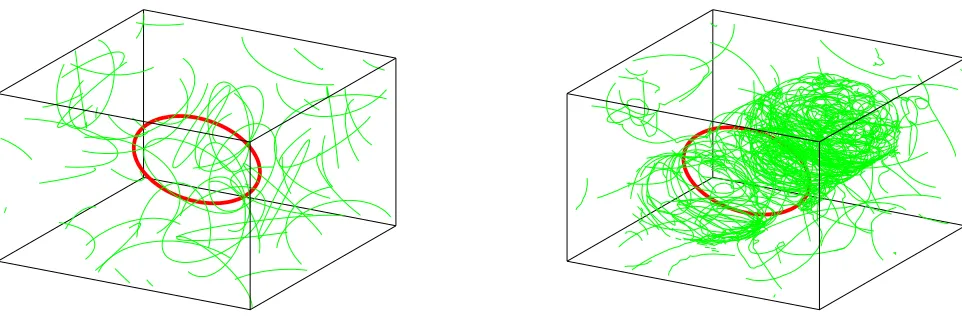
Fig. 1: Left: Normal-fluid vortex ring (thick line) and superfluid vortex rings of similar diameter at t= 0. Right: Evolution of the initial configuration att= 1.6527×10⁻³
[image:3.595.85.562.358.513.2]s. The induced superfluid vorticity is organized into a full “tube” of diameter similar to the size of the normal-fluid vortex-ring.
Fig. 2: Left: Normal-fluid vortex ring (thick line) and superfluid vortex rings of much smaller diameter at t = 0. Right: Evolution of the initial configuration at t= 3.9×10⁻³
[image:3.595.357.561.358.505.2]s. Small superfluid rings that are “swallowed” by the normal-fluid vortex-ring are blown to a similar to the latter size, but are not trapped by its core.
Fig. 3: Left: Normal-fluid vortex ring (thick line) and comoving superfluid vortex ring of much smaller diameter att = 0. Center: As the normal-fluid vortex-ring “swallows” the superfluid vortex-ring, the latter’s diameter grows (t= 5.72×10⁻⁴
s). Right: The superfluid vortex-ring cannot keep up with the normal-fluid vortex-ring, and it is left behind (t= 1.5×10⁻³
Fig. 4: The core of a normal-fluid vortex ring and its associated streamlines. The vectors indicate the direction of the velocity field along the selected streamlines.
elements of length lb/64 cm, and the normal-fluid ring with elements of lengthlb/72 cm. Att= 1.6527×10⁻³ s, the system has evolved to a new state shown in fig. 1 (right). At this time, viscous diffusion has increased the normal-fluid ring core-radius to the value σ = 0.125Rn. The key result is that the normal-fluid ring “swallows” any superfluid vorticity it meets in its path causing it to expand to its own size. This process is accompanied by the superfluid vorticity pushed towards the normal-fluid ring centerline. By itself, this process would lead to the accumulation of superfluid vorticity on the normal-fluid centerline supporting the vortex-locking concept. However, the calculation shows that the newly induced superfluid vorticity is not trapped by the normal-fluid vortex core, and instead is left behind forming the tube-like structure of fig. 1. The physics of this effect is explained later on.
[image:4.595.51.299.82.279.2]Interactions between rings of disparate sizes. – In order to investigate whether this physical picture extends to interactions between disparate turbulent scales, I insert a normal-fluid ring of radiusRn = 0.04 cm and Re = Γ/νn = 5000 within a periodic box of size lb = 0.3 cm, at T = 1.3 K. The core of the ring has size σ = 0.1Rn. This ring interacts with a suspension of 300 superfluid rings of much smaller diameter, i.e., Rs ∈ [0.08,0.12]Rn. The superfluid rings are discretized with elements of length lb/64 cm, and the normal-fluid ring with elements of length lb/64 cm. The initial configuration is shown in fig. 2 (left). After a period of time equal to t = 3.9 ×10⁻³ s, the normal-fluid vortex-core radius has only increased by an imperceptible amount. The system’s configuration is shown in fig. 2 (right). The normal-fluid ring had time to interact with a small number of superfluid rings which have grown to
Fig. 5: Time evolution of (scaled withh|Vs|i)h|h1X′s×(Vn−
Vs)|i (upper curve) andh|h2X ′
s×[X
′
s×(Vn−Vs)]|i (lower
curve) terms in the equation for ˙Xs. The interactions of the
superfluid vortex-ring with the normal-fluid vortex-ring are or-ders of magnitude stronger than its own inertia.
a similar size. This indicates that the effect of ring-ring interactions is to transfer energy from the normal-fluid to the superfluid, driving the energy spectra in both fluids towards equipartition in the range of scales corresponding to the radius of the normal-fluid ring. However, there is not a strong correlation between the actual physical location of the vorticities in the two fluids, since as fig. 2 indicates, the blown-up superfluid rings are not “slaved” to the motion of the normal-fluid ring. Indeed, after a superfluid ring grows during its encounter with the normal-fluid ring, it does show a tendency of following its motion, but this effect cannot match the velocity of the normal-fluid ring which leaves the superfluid ring behind. This finding suggests taking a closer look to the interaction of a single, small superfluid ring with a normal-fluid ring, in order to understand better the mechanism of superfluid vorticity growth.
Fig. 6: Initial normal-fluid vorticity isosurface (|ωn|= 100 s
−1 ) in the Navier-Stokes modeling case. The large central structure is the normal-fluid ring. The numerous “islands” correspond to the normal-fluid vorticity around the superfluid rings, that is induced by the vortex-fluid couplings [13]. These normal-fluid vorticity “halos” around superfluid rings is a good method for their detection in experiments that can measure normal-fluid velocity fields [14].
and the direction of motion of the superfluid ring, it is easy to deduce that the h1 term points outwards along the radial superfluid ring direction, hence explaining the growth. On the other hand, the h2 term always opposes Vn, but sinceh2 <0, it corresponds to motion along Vn. This explains why, after the normal-fluid ring “swallows” the superfluid ring, there is a tendency of the latter to be trapped by the former. Yet, the normal-fluid ring propagates with velocity of order Vn, whilst the superfluid ring moves with velocity h2Vn which is much smaller, sinceh2=−7.98×10⁻². This explains why there is no observable vortex locking effect. The dominant role of the normal-fluid/superfluid ring interactions over the latter’s inertia is demonstrated in fig. 5. The figure shows the terms h|h1X′s×(Vn−Vs)|i/h|Vs|iand h|h2X′s ×[X′s×(Vn −Vs)]|i/h|Vs|i versus time. The averages are formed over the superfluid ring contour. The term responsible for superfluid vortex ring growth dominates the term dragging the vortex, and both of them dominate the superfluid ring’s inertia. Their effect is to induce superfluid vorticity at the scale of normal fluid vorticity without locking the two vorticities together.
Hybrid Navier-Stokes/Vortex-dynamics model. – I switch here to a fully coupled computation, where the normal-fluid ring obeys Navier-Stokes physics, i.e., its evolution satisfies the the mass equation ∇ ·Vn = 0, and the momentum equation
∂Vn(x, t)
∂t +∇
p ρn+ρs
+Vn·Vn
2
−Vn×(∇ ×Vn)−
Fig. 7: Normal-fluid vorticity isosurface (|ωn|= 200 s
−1 ) at
t = 7.452×10⁻²
s (Navier-Stokes modeling case). In agree-ment with vortex methods, strongly affected superfluid rings grow to (approximately) the normal-fluid ring size. Moreover, deformations of normal-fluid ring core structure due to colli-sions with superfluid rings are also observed.
µ ρn
∇2
Vn−κ
Z
L
d|XL|[X ′
L×(Vn−X˙L)]δ 3
(x−XL)−
D0
ρn
Z
L
d|XL|{X ′ L×[X
′
L×(Vn−X˙L)]}δ 3
(x−XL) = 0.
Here, p is the pressure field, and µ the normal-fluid viscosity. From start to end, we have the inertia, poten-tial (“Bernoulli-group”), vortex, viscous, lift and drag (mutual-friction) forces [4]. The last two forces signify the coupling of normal-fluid with superfluid vortices, and will be collectively called “vortex couplings”. Navier-Stokes physics can overcome shortcomings of the vortex-dynamical formulation by including the back-reaction (i.e., vortex couplings) from the superfluid vortices on the normal-fluid ring, as well as, a dynamic vortex core. As initial condition, I introduce a normal-fluid ring of radius Rn= 0.04 cm andRe= Γ/νn= 500 within a periodic box of sizelb= 0.3 cm, atT = 1.3 K. The core of the ring has size σ = 0.25Rn. This ring interacts with a suspension of 600 superfluid rings of much smaller diameter, i.e., Rs ∈ [0.08,0.12]Rn. The initial configuration is similar to the one shown in fig. 2 (left). The Navier-Stokes equation is solved on an 1283 grid. The superfluid rings are discretized with elements of lengthlb/64 cm. In order to initialize the normal-fluid flow field, the initial Leonard vortex was discretized with elements of lengthlb/512 cm. The time step is chosen so that viscous diffusion processes are resolved, hence ∆t = 8.65×10⁻⁵ s. The particular Reynolds number andσ/Rn values are chosen in order to avoid the well known instabilities in the propagation of classical vortex rings [15–17], which would only obfuscate the present conclusions.
rings that have been left behind by the swiftly moving normal-fluid ring. Thus, the main physical conclusions are not altered in the more powerful modeling case. One difference with previous results is that the normal-fluid ring core is dynamic, hence it is deformed by its collisions with the superfluid rings (fig. 7). However, due to the (relatively) weak circulation of the superfluid rings, such collisions do not appear to be dynamically important.
Epilogue. – Using an array of physical models and calculations, I have shown that the major effect of normal-fluid vortex rings on superfluid ones is an energy transfer that blows-up the latter to the size of the former. During such processes, two fluid interactions are orders of magnitude stronger than inertial effects in the superfluid. Thus, it is expected that, as a result of these interactions, the energy content of spectrum scales in the superfluid that correspond to those in the normal-fluid ought to grow. This process is not accompanied by the locking of vorticities in the two fluids. This implies that the coherent superfluid vortex bundles studied in [18] must be put in the system “by experimental design”, and are not emergent structures of superfluid turbulence. For the case of fully developed turbulence at finite temperature superfluid helium-4, the implication is that, at steady state, homogeneous, isotropic turbulence, the energies in the two fluids are expected to reach an equilibrium with similar but not necessarily equal levels. The actual energy level ratios would be universal and a function of the particular scale in the spectrum. Testing this conjecture for realistic Reynolds number values would require large-scale numerical calculations that could be perfomed in the near future.
In another important context, I mentioned above that the choice of the Navier-Stokes vortex ring parameters was dictated by the need to avoid any high Re num-ber normal-fluid ring instabilities. In this respect, the observation of [19] of stable normal-fluid vortex rings of 104 ≤ Re ≤ 5×10⁴ (i.e., above the classical stability limit) can only be attributed to the effects of superfluid vorticity via a kind of damping mechanism which could
[7] Stamm G., Bielert F., Fiszdon W. & Piechna, J., Physica B,194-196(1994) 589.
[8] Kivotides D.,J. Fluid Mech.,668(2011) 58.
[9] Kivotides D.andWilkin S.L.,J. Low Temp. Phys.,156
(2009) 163.
[10] Leonard A.,Phys. Fluids,6(1994) 765.
[11] Leonard A.and Winckelmans G.S., J. Comp. Phys.,
2(1993) 247.
[12] Leonard A.,J. Comp. Phys.,37(1980) 289.
[13] Kivotides D., Barenghi C.F.andSamuels D.C., Sci-ence,290(2000) 777.
[14] Guo W., Wright J.D., Cahn S.B., Nikkel J.A.and
McKinsey D.N.,Phys. Rev. Lett.,102(2009) 235301.
[15] Bergdorf M., Koumoutsakos P.andLeonard A.,J. Fluid Mech.,581(2007) 495.
[16] Shariff K.and Leonard A., Annu. Rev. Fluid Mech.,
24(1992) 235.
[17] Shariff K., Verzicco, R. and Orlandi P., J. Fluid Mech.,279(1994) 351.
[18] Wacks D.H., Baggaley A.W. & Barenghi C.F.,Phys. Fluids,26(2014) 027102.
![Fig. 5: Time evolution of (scaled with ⟨|superfluid vortex-ring with the normal-fluid vortex-ring are or-curve) terms in the equation for VVs|⟩) ⟨|h1X′s × (Vn −s)|⟩ (upper curve) and ⟨|h2X′s × [X′s × (Vn − Vs)]|⟩ (lowerX˙s](https://thumb-us.123doks.com/thumbv2/123dok_us/1596213.112417/4.595.51.299.82.279/evolution-scaled-superuid-vortex-normal-uid-vortex-equation.webp)
![Fig. 6: Initial normal-fluid vorticity isosurface (|vorticity “halos” around superfluid rings is a good method fortheir detection in experiments that can measure normal-fluidinduced by the vortex-fluid couplings [13]](https://thumb-us.123doks.com/thumbv2/123dok_us/1596213.112417/5.595.83.237.87.264/vorticity-isosurface-vorticity-superuid-detection-experiments-uidinduced-couplings.webp)
