City, University of London Institutional Repository
Citation
:
Pothos, E. M. and Bailey, T. M. (2009). Predicting Category Intuitiveness With the Rational Model, the Simplicity Model, and the Generalized Context Model. Journal of Experimental Psychology: Learning Memory and Cognition, 35(4), pp. 1062-1080. doi: 10.1037/a0015903This is the unspecified version of the paper.
This version of the publication may differ from the final published
version.
Permanent repository link:
http://openaccess.city.ac.uk/1974/Link to published version
:
http://dx.doi.org/10.1037/a0015903Copyright and reuse:
City Research Online aims to make research
outputs of City, University of London available to a wider audience.
Copyright and Moral Rights remain with the author(s) and/or copyright
holders. URLs from City Research Online may be freely distributed and
linked to.
Predicting category intuitiveness with
the rational model, the simplicity
model, and the Generalized Context
Model
Emmanuel M. Pothos
Department of Psychology
Swansea University
Todd M. Bailey
School of Psychology
Cardiff University
in press: JEP: LMC
Please address correspondence to Emmanuel Pothos, Department of Psychology,
Swansea University, Swansea SA2 8PP, UK, or to Todd Bailey, School of
Psychology, Cardiff University, Cardiff CF10 3AT, UK. Electronic mail may be sent
at [email protected] or [email protected]
Running head: GCM category intuitiveness; Word count (running text, excluding
Abstract
Naïve observers typically perceive some groupings for a set of stimuli as more
intuitive than others. The problem of predicting category intuitiveness has been
historically considered the remit of models of unsupervised categorization. In
contrast, this paper develops a measure of category intuitiveness from one of the most
widely supported models of supervised categorization, the Generalized Context
Model (GCM). Considering different category assignments for a set of instances, we
ask how well the GCM can predict the classification of each instance on the basis of
all the other instances. The category assignment that results in the smallest prediction
error is interpreted as the most intuitive for the GCM—we call this way of applying
the GCM unsupervised GCM. The paper then systematically compares predictions of
category intuitiveness from the unsupervised GCM and two models of unsupervised
categorization, the simplicity model and the rational model. We found that the
unsupervised GCM compares favorably to the simplicity model and rational model.
This success of the unsupervised GCM illustrates that the distinction between
supervised and unsupervised categorization may have to be reconsidered. However,
no model emerges as clearly superior, indicating that there is more work to be done in
understanding and modeling category intuitiveness.
Keywords: supervised categorization, unsupervised categorization, exemplar theory,
Introduction
The distinction between supervised and unsupervised categorization has been central
to the development of categorization theory in cognitive science. Supervised
categorization concerns predicting how novel instances will be classified, with respect
to a set of existing categories; such predictions can be typically carried out with
impressive accuracy. Prominent classes of supervised categorization models include
the exemplar theory (Medin & Schaffer, 1978; Nosofsky, 1988; Van Vanpaemel &
Storms, 2008), prototype theory (Hampton, 2000; Minda & Smith, 2000; Posner &
Keele, 1968), and the general recognition theory (Ashby & Perrin, 1988). Supervised
categorization typically involves training procedures with corrective feedback. By
contrast, in a typical unsupervised categorization experiment participants are asked to
divide some stimuli into categories which are intuitive, without any corrective
feedback.
Interest in unsupervised categorization largely originates from the notion of
category coherence (Murphy & Medin, 1985). Why do certain groupings of objects
form psychologically intuitive categories, but other groupings are nonsensical? For
example, most cultures have concepts such as happiness or animal. By contrast, a
grouping which includes the Eiffel Tower, children under five, and apples would be
considered entirely nonsensical. Murphy and Medin (1985) suggested that a category
is coherent if it fits well with our overall understanding of the world; they argued that
explanations based on similarity are inadequate (cf. Heit, 1997; Lewandowsky,
Roberts, & Yang, 2006; Wisniewski, 1995). Unfortunately, creating categorization
models on the basis of general knowledge is extremely difficult (e.g., Fodor, 1983;
Pickering & Chater, 1995; but see Griffiths, Steyvers, & Tenenbaum, 2007 or
people do use similarity in unsupervised categorization, at least in some cases.
Accordingly, some researchers have developed unsupervised categorization models
which are based on similarity (e.g., Compton & Logan, 1993; Love, Medin, &
Gureckis, 2004; Milton & Wills, 2004; Pothos & Chater, 2002).
Unsupervised categorization involves two slightly separate problems: first,
identifying the classification for a set of stimuli, which would be preferred by naïve
observers. For example, in Figure 1, the preferred classifications for the dots are the
ones indicated by the continuous curves (here and elsewhere, points represent objects
and the axes are assumed to correspond to dimensions of some putative internal
mental space; similarities are inversely related to distances). A second problem in
unsupervised categorization is, given a classification for a stimulus set and another for
a different stimulus set, deciding which one is more intuitive. In Figure 1, the
classification on top should be perceived as more intuitive compared to the
classification in the bottom panel (this is because the difference of within- versus
between-category similarity in the top panel is higher than in the bottom; Pothos &
Chater, 2002). In other words, if real stimuli are created after the Figure 1 points,
participants are likely to identify the top classification as preferred more frequently
and with more confidence, compared to the bottom classification. In principle, a
model of category intuitiveness provides the basis for a model of unsupervised
categorization, under the assumption that the most intuitive categorization will also be
the preferred one.
---FIGURE 1---
A main objective of this work is to examine predictions of category
intuitiveness from computational models of unsupervised categorization, for a range
this kind. This is an important shortcoming, given the strong intuitions we can have
about which categorizations are more intuitive than others. We consider category
intuitiveness predictions from the rational model (Anderson, 1991; Sanborn, Griffiths,
& Navarro, 2006) and the simplicity model (Pothos & Chater, 2002). The inclusion of
these two models has been partly motivated by the fact that they can readily produce a
measure of category intuitiveness (this is not always the case with models of
unsupervised categorization; e.g., see Compton & Logan, 1993).
Unsupervised and supervised categorization have typically been assumed to
correspond to different psychological processes and the related research traditions
have been mostly separate. A model is typically proposed as either a model of
supervised categorization or a model of unsupervised categorization. However, this is
an assumption which may be inappropriate. The other main objective of this paper is
to show that a measure of category intuitiveness can be derived from one of the best
known models of supervised categorization, Nosofsky’s Generalized Context Model
(GCM; Nosofsky, 1988, 1989, 1991, 1992). The version of the GCM which can
produce predictions of category intuitiveness will be referred to as unsupervised
GCM, to reflect the fact that, in this mode of application, the GCM assesses the
intuitiveness of a particular classification instead of classifying new instances with
respect to existing categories. Predictions of category intuitiveness from the GCM
will be compared to those from the rational model and the simplicity model.
Unsupervised GCM
The GCM predicts classification probabilities for a set of test stimuli based on their
similarity to a set of previously seen training stimuli. The GCM is described by two
XB B XA A XA A X A P ) |
( ………(1a)
A j q r D k r jk xk kXA c w y y
/ 1 1 | | exp ……….(1b)
P(A|X) is the probability of making a category A response, given instance X (the
terms are category biases and XA is the sum of the similarities between X and all the
A exemplars). This is Luce’s (1963) choice rule; it sometimes involves an exponent to
the similarities. In equation (1b), c is a sensitivity parameter, r is a Minkowski
distance metric parameter, q determines the shape of the similarity function, wk are
dimensional attention weights, and y’s are item coordinates. The input to the GCM
consists of the coordinates of a set of training stimuli, information about the
assignment of the stimuli to categories, and the coordinates of a set of test stimuli. On
the basis of this information, the parameters of the GCM are adjusted so as to predict
as closely as possible empirically determined probabilities of how the test items are
classified. An error term can be computed as
i i i P O O ln
2 , where Oi are the target
probabilities and Pi the predicted probabilities from the model; the summation ranges
over all the test items. Target probabilities typically correspond to how participants
classify test items into training categories. This equation computes a likelihood ratio
chi-square statistic (e.g., see Hahn, Bailey, & Elvin, 2005). We refer to this error term
as a log likelihood error term.
How could the GCM compute (relative) category intuitiveness? Suppose that
in the top panel of Figure 1 we want to evaluate the intuitiveness of classification {1,
2, 3,4, 5, 6}{7, 8, 9} versus {1, 2, 3}{4, 5, 6, 7, 8, 9}. In evaluating classification {1,
4, 5, 6, are in category {1, 2, 3,4, 5, 6} with 100% probability and likewise for items
7, 8, 9 and category {7, 8, 9}. In other words, exemplars are assigned to categories in
accordance with the category structure being evaluated and GCM fits are computed
on this basis. A main insight in this paper is that when the GCM self-classifies a set of
stimuli in this way, the corresponding error term can be interpreted as a measure of
category intuitiveness. We postulate that where the error term is lower, then the
corresponding classification is more consistent with the assumptions about
categorization ingrained in the GCM and that, therefore, such classifications are
considered more psychologically intuitive by the GCM. For example, self-classifying
the Figure 1 items relative to the classification {1, 2, 3,4, 5, 6}{7, 8, 9} should be
associated with a very small error term, as the two categories are well separated. By
contrast, self-classification relative to {1, 2, 3}{4, 5, 6, 7, 8, 9} should lead to a high
error term. These results correspond to the obvious impression that, for the stimuli in
Figure 1, classification {1, 2, 3,4, 5, 6}{7, 8, 9} is psychologically more intuitive than
{1, 2, 3}{4, 5, 6, 7, 8, 9}.
This scheme constitutes a proposal for using the GCM to produce a measure
of category intuitiveness (cf. Feldman, 2004; Pothos & Chater, 2002). We believe that
given a measure of category intuitiveness one can create a full model of unsupervised
categorization, but this is an objective for future work. One can ask what kind of
category structures will be predicted as more intuitive by the GCM. For example,
Feldman (2004) suggested that the Boolean complexity of concepts defined through
logical expressions determines their psychological intuitiveness. Work on basic level
categorization has assumed that category structure can be understood in terms of the
ratio of within category similarity to between category similarity (Murphy, 1991;
1992), or a tradeoff between cue and category validities (Jones, 1983). The
corresponding claim for the unsupervised GCM is that an intuitive classification will
be possible for a set of stimuli if there are groupings which maximize within category
similarity, both with respect to the original representation of the stimuli, and the
various transformations for this representation allowed by the GCM parameters
(suppression of dimensions and stretching/ compression of psychological space). This
latter characteristic particularly distinguishes the GCM from other unsupervised
categorization models based on similarity. The unsupervised and supervised versions
of the GCM are based on the same equations, but applied to answer different
questions. In the former case, the computed error term is interpreted as category
intuitiveness, in the latter case classification probabilities of novel instances are
predicted. Crucially, in the unsupervised GCM parameters are not adjusted to match a
particular pattern of empirical results (parameters are determined by item coordinates,
so that parameter search is guided by a prerogative to achieve an intuitive
classification), while in the supervised GCM parameters are specified so as to achieve
particular probabilities for the classification of new instances.
So, our measure of category intuitiveness from the GCM is based on the same
equations as the standard GCM (cf. Love, 2002). This is an important point, since it
shows how a model which has been considered the hallmark of supervised
categorization can be directly applied to unsupervised categorization. The specific
details of how we applied the GCM are standard. The city block (r=1) and the
Euclidean (r=2) metrics are the only metrics that have received psychological
motivation, and likewise for the exponential (q=1) and Gaussian (q=2) forms of the
similarity function. It has not been possible to motivate more specific values of r and
Category biases were allowed to vary freely between zero and one, subject to the
constraint that they summed to one, and likewise for the attentional weights. The
sensitivity parameter, c, determines the extent to which the classification of an
instance is influenced by remote exemplars or not. When c is very small, all
exemplars will have an effect on how a test item is classified. As c increases in size,
classification of a test item will be influenced primarily by its nearest neighbor
amongst the training items, or, in a situation where the training items are the same as
the test items, just by itself. This latter situation is pathological, so we required the
unsupervised GCM to classify each stimulus on the basis of all the other stimuli in a
stimulus set only. Given this requirement, in all our simulations the default approach
was to allow c to vary freely between zero and infinity. We will later examine directly
whether the unsupervised GCM can function adequately with an unrestricted c.
It is by no means obvious at the outset that our proposal will necessarily
succeed. A common criticism for the GCM (and similar models) is that its parameters
allow it too much flexibility in fitting empirical data (Olsson, Wennerholm, &
Lyxzen, 2004; Myung, Pitt, Navarro, 2007; Navarro, 2007; Nosofsky, 2000; Nosofsky
& Zaki, 2002; Smith, 2007; Smith & Minda, 1998, 2000; 2002; Yang &
Lewandowsky, 2004). Accordingly, one can wonder whether our suggestion for the
unsupervised GCM might fail because the GCM can perfectly describe any
assignment of stimuli into categories (regardless of whether the corresponding
classifications are more or less intuitive). The burden is on us to demonstrate that not
only is this not the case, but that the unsupervised GCM can perform comparably with
established models of unsupervised categorization.
Many models of unsupervised categorization (including the unsupervised GCM and
the simplicity model) rely on similarity. It is interesting to include in the comparisons
a model that makes no explicit reference to similarity. Anderson’s (1991) rational
model adopts a category utility approach. In other words, it assumes that categories
are formed because they are useful to us, specifically because they allow us to infer
unknown information about novel instances (cf. Corter & Gluck, 1992; Gosselin &
Schyns, 2001; Jones, 1983; Medin, 1983; Murphy, 1982).
The rational model is an incremental, Bayesian (cf. Tenenbaum & Griffiths,
2001; Tenenbaum, Griffiths, & Kemp, 2006) model of unsupervised categorization. It
assigns a new stimulus with feature structure F to whichever category k makes F most
probable. For example, a new object with many features of a ‘cat’, would be assigned
to the category of cats, since the feature structure of the object is most probable given
this category membership.
We implemented the continuous version of the rational model, which assumes
that stimuli are represented in terms of continuous dimensions (for more details see
Anderson, 1991; Anderson & Matessa, 1992). The continuous version allows the most
direct comparison with the unsupervised GCM, since the latter also assumes
continuous dimensions. In the rational model, the probability of classification of a
novel instance into category k depends on the product P(k)P(F|k). P(k) is given by
equation (3a):
cn c cn k
P k
) 1 ( ) (
………(3a)
In equation (3a), nk is the number of stimuli assigned to category k so far, n is the total
number of classified stimuli, and c is a coupling parameter. The coupling parameter
Thus, c indirectly determines the number of categories that the rational model will
produce for a stimulus set. The probability that the new object comes from a new
category is given by
cn c c P ) 1 ( 1 ) 0
( . P(F |k)is computed as in equation (3b):
i
i x k
f k
F
P( | ) ( | )
………..……….(3b)
where i indexes the different dimensions of variation of the stimuli and x indicates
the different values dimension i can take. That is, fi(x|k) is the probability of
displaying value x on dimension i in category k, and is approximated by
)
/
1
1
,
(
i i iai
t
, which is the t distribution with ai degrees of freedom. iand2
i
are given by equations (3c) and (3d).
n y n i 0 0 0 ………(3c) n y n n s n i 0 2 0 0 0 2 2 0 0 2 ) ( ) 1 ( ………..………....(3d)
-3d- is the variance for classifying into the i dimension. This tells us how much it
‘matters’ whether a stimulus has a particular value on dimension i or not, for
classification into a particular category.
In these equations, i 0 n, i 0 n, n is the number of observations in
category k, y is their mean along dimension i, and s2 is their variance. Finally,
0
0 1
, 0 is the halfway point of the range of all instances and 0 is the square
of a quarter of the range (Anderson, personal communication).
It is possible to introduce a dimensional weighting mechanism in the rational
each dimension is weighted by w1, w2 etc., to indicate the relative importance of the
dimensions in classifying a new item. In other words,
The question is what kind of weighting scheme is going to be optimal for
the rational model. Taking logs in the above equation, we have:
Suppose that . Then,
clearly, the weight combination which maximizes is w1=0, w2=1. In other
words, in the rational model, optimal dimensional weighting corresponds to assigning
a weight of 1 to the most useful dimension and a weight of 0 to all the other
dimensions (so that, in contrast to the GCM, graded weighting is never optimal for the
rational model). Therefore, in the simulations below, where we refer to the ‘rational
model with dimensional selection’, we assess the probabilities for the predicted
classifications along all one-dimensional projections.
Note that the standard rational model can compute the probability for a
classification, given a particular order of the items. However, all the empirical
examples below assume concurrent presentation of the stimuli. Sanborn, Griffiths,
and Navarro (2006) provided algorithms for the rational model, which approximate
classification probabilities from the rational model, as if all items had been presented
concurrently. Sanborn et al.’s examination of their algorithms was shown to both have
desirable normative properties and outperform the standard rational model in specific
empirical cases. Specifically, we used the Gibbs sampler algorithm to compute the
probability for the most probable classification for a stimulus set. Moreover, we
adapted the algorithm to compute the probability of any particular classification (not
necessarily the most probable one) for a stimulus set. In either case, higher
Simplicity model
The simplicity model of unsupervised categorization (Pothos & Chater, 2002, 2005;
Pothos & Close, 2008) differs from the rational model and the unsupervised GCM in
a number of interesting ways. First, the simplicity model is non-metric (a metric space
is not assumed), while this is not the case for the other two models. Second, the
simplicity model has no free parameters, a characteristic which contrasts most sharply
with the unsupervised GCM. Third, the simplicity model aims to maximize within
category similarity and minimize between category similarity, but only the former
constraint is relevant to the unsupervised GCM. Finally, the simplicity model is
currently the only model which has been applied to data from entirely unconstrained
categorization procedures; it is therefore interesting to compare it with the rational
model and the unsupervised GCM against such data.
According to the simplicity model, more intuitive categories are ones that
maximize within category similarity and minimize between category similarity (cf.
Rosch and Mervis, 1975). The model is specified within a computational framework
based on the simplicity principle (Chater, 1996, 1999). The first step is to compute the
information content of the similarity structure of a set of items without categories.
This is done by assuming that every pair of stimuli is compared with every other pair.
For example, suppose that we have four stimuli, labeled by 1,2,3,4. Then, similarity
information would be encoded as similarity(1,2)>similarity(1,3),
similarity(1,2)<similarity(1,4), etc., with each comparison requiring one bit of
information to specify whether the first pair is more similar or less similar than the
second (assuming no exact equalities).
Categories are defined as imposing constraints on the similarity relations
all similarities between categories. For example, suppose that we decide to place
stimuli 1,2 in one category and stimuli 3,4 in a different category. Then, our definition
of categories implies that similarity(1,2)>{similarity(1,3), similarity(1,4)} and that
similarity(3,4)>{similarity(1,3), similarity(1,4)}. Thus, the codelength for the
similarity structure for a set of stimuli can be reduced by using categories, if the
constraints specified by the categories are numerous and, generally, correct (note that
equalities in similarity relations do not falsify the constraints; Hines, Pothos, &
Chater, 2007). If in u constraints there are e incorrect ones, the number of bits of
information required to correct the errors is given by equation (2a).
)! ( ! ! log ) 1 (
log2 2
e u e
u
u ………..…(2a)
Moreover, we have to take into account the information-theoretic cost of specifying a
particular category structure of n categories for r objects, which is given by
)) , ( (
log2 Part r n , where Part(r,n) is given by equation (2b).
! )! ( ) ( ) 1 ( ) , ( 1
0 n v v
v n n r Part r n v v
………(2b)Overall, there is a codelength without categories and a codelength with categories.
The ratio of the latter to the former indicates how much codelength reduction is
afforded by the use of categories; it is typically reported as a percentage and referred
to as just ‘codelength’. The lower its value, the more intuitive a particular category
structure is predicted to be. The lowest possible value of codelength is about 50%.
When trying to identify the most intuitive classification from scratch, the simplicity
model employs a search algorithm akin to those in agglomerative clustering
Analyses
Our analyses are divided in three parts. First, all three models are examined with a
simple toy stimulus set. For the rational model and the simplicity model, this exercise
illustrates the way they are applied and some basic implementational assumptions.
Regarding the unsupervised GCM, this exercise is more important, since it
corresponds to a preliminary test of whether the model can capture some obvious
intuitions about category intuitiveness. Second, we examined a range of classic
stimulus sets from the supervised categorization literature, on the assumption that
category learnability is related to intuitiveness. Third, we considered data from studies
which employed an entirely unsupervised categorization procedure.
Toy stimulus set/ illustration of the models’ operation
Four stimulus sets were created to assess the three models with respect to the
straightforward intuition that well-separated, coherent categories should be more
intuitive than less-separated ones. Each stimulus set was intended to correspond to a
category structure composed of two clusters. The stimulus sets differed on how close
the two clusters were to each other, with category prototypes being 2, 3, 4, or 5 units
apart. The two most extreme stimulus sets are shown in Figure 2; the other stimulus
sets were in between these extremes.
Unsupervised GCM intuitiveness values were obtained as log likelihood error
terms, which reflect the deviance between the intended assignment of stimuli into
categories and the predicted assignment by the GCM. A lower error term implies that
the corresponding classification is considered more intuitive. Constrained
optimization of the GCM parameters was done with the fmincon Matlab function
(version R2007b). We examined the log likelihood error term for a particular
lowest error term was taken to be the intuitiveness value from the unsupervised
GCM). To facilitate comparisons with other models, we normalized the log likelihood
values for all category structures onto a 0-1 scale (with 0 corresponding to least
predicted intuitiveness and 1 corresponding to the greatest intuitiveness), through the
transformation
min max
min 1
X , where X is the log likelihood error for any of the four
category structures, min is the least log likelihood error (of these four values), and
max is the greatest error. By carrying out this (or analogous) transformation for the
predictions from all models, we can derive an impression of how the models compare
with each other. The normalized scores have been used in all figures, raw model
predictions in the tables.
Simplicity model predictions were given as codelength values, so that a lower
codelength indicates a more intuitive classification. Codelength values typically range
between 50% and 100%. Recall that the input to the simplicity model is not item
coordinates, but rather information of which pairs of similarities are greater or smaller
than others. In order to derive such information from item coordinates, a distance
metric has to be assumed. Consistently with previous examinations of the simplicity
model (e.g., Pothos & Chater, 2002, 2005), we opted for the Euclidean metric. The
Euclidean metric is an appropriate default choice, since it corresponds better to the
way physical distances are perceived psychologically. Of the models considered, the
simplicity model was the most straightforward to run, requiring less than a minute per
stimulus set. Simplicity values were transformed onto a 0-1 scale as above.
Using Sanborn et al.’s (2006) adaptation of the rational model, it is possible to
identify the best classification for a set of items and compute the probability for any
particular classification—as noted, these probabilities can be interpreted as
of iterations for different stimulus sets (at least 10,000), with a view to ensure that not
more than 10 hours were required per stimulus set. Sample spacing was set to 20. For
the coupling parameter we employed the commonly used value of 0.5. Finally, for the
rational model with dimensional selection, intuitiveness values corresponded to the
most probable classification regardless of whether all dimensions or a particular
dimension were employed.
All models correctly predicted that category structures for which the two
categories are closer together should be less intuitive, compared to category structures
for which the categories are further apart (Table 1). This is hardly an exciting
prediction, but nonetheless an important basic test that the models are consistent with
expectations in such an intuitive case. Note that the rational model with dimensional
selection correctly predicts that the optimal dimension in all cases is dimension 1 (in
other words, the probability of the best possible classification along dimension 1 is
greater than the corresponding probability along either dimension 2 or both
dimensions). In this straightforward case, there is agreement between the rational
model and the rational model with dimensional selection. Regarding the simplicity
model, the lowest possible codelength in this case is 51.6; as noted, the exact value
will somewhat depend on the particular classification. Also, the worst possible
codelength is 117.9, well over 100. This reflects the fact that when the prototypes are
only two units apart, the costs associated with correcting errors in the constraints
specified by the classification are so high, that we are actually better off describing
the similarity information without categories.
The behavior of the models can be seen in Figure 3, where each of the model
measures has been transformed on a 0 to 1 scale. While such a transformation
appreciating model similarities and differences (in this case, for example, the fact that
the unsupervised GCM and the simplicity model rise quickly to their highest value,
while the rational model’s rise is more gradual).
---FIGURES 2,3, TABLE 1---
Supervised categorization data
Supervised categorization data can be used to derive estimates of category
intuitiveness in two ways. First, we assume that if classification A is more difficult to
learn than classification B, then, in an unsupervised context, classification A will be
considered more intuitive compared to B. The empirical evidence supports this
assumption. Colreavy and Lewandowsky (in press) found no difference between a
supervised categorization condition and a matched unsupervised one, in terms of
strategy development and rate of learning (see also Griffiths, Christian, & Kalish,
2008). Love (2002) reached the opposite conclusion, but his supervised and
unsupervised stimulus sets were not directly comparable, and the learning task was
not entirely equivalent to an unsupervised categorization one.
Second, consider categories A and B and a new instance X. Suppose that
participants are more likely to classify X into category A than B. Since participants
classified X with category {A} rather than {B}, they must think that the overall
grouping {A,X}{B} must be more intuitive than the alternative grouping {A}{B,X}.
Therefore, we can assume that classification {A,X}{B} is more intuitive than
{A}{B,X}. We can then examine whether the unsupervised categorization models
consider{A,X}{B} as more intuitive compared to {A}{B,X}. Note that the
application of the unsupervised GCM to such data is very different from the standard
application of the GCM, where the objective is to predict classification probabilities
Finally, methodologically, one can ask whether the categories employed in
supervised categorization research may be so unstructured that they would never be
created in a spontaneous fashion. But, this is not a problem since the difference in
relative intuitiveness between two classifications, however unstructured, can always
be empirically examined: participants’ spontaneous classifications should be more
similar to the one which is predicted to be more intuitive.
Shepard, Hovland, and Jenkins (1961). Shepard et al. (1961) considered the
difficulty of learning six binary classifications with stimuli made of three binary
dimensions (Table 2). Classification 1 is simple to learn because it covaries perfectly
with the first dimension of the stimuli. Classification 2 reflects an ‘exclusive OR’
(non linear) category structure in its first two dimensions, while the third dimension
constitutes random noise. Classifications 3, 4, and 5 can be described by
one-dimensional rules with exceptions and require attention to all three dimensions.
Classification 6 also requires attention to all three dimensions, but in this case there
are no obvious regularities. Shepard et al. reported that the cumulative error rate
conforms to the following ordering: Classification 1 (easiest) < Classification 2 <
{Classifications 3, 4, 5} < Classification 6 (most difficult). This result has become a
benchmark for assessing models of supervised categorization (e.g., Love et al., 2004;
Kurtz, 2007; Nosofsky & Palmeri, 1996).
---TABLES 2, 3, FIGURE 4---
As discussed, we assumed that more intuitive classifications should be easier
to learn (the results of Griffiths et al., 2008, support this assumption in the case of the
Shepard et al. data, with a kind of unsupervised induction task). The unsupervised
GCM, the simplicity model, and the rational model were applied by computing the
raw results are shown in Table 3 and normalized predicted intuitiveness scores are
shown in Figure 4. The unsupervised GCM performed better than both the simplicity
model and the rational model. The unsupervised GCM correctly predicted that
Classifications 1, 2 should be the most intuitive, 3,4,5 of intermediate intuitiveness,
and, finally, that Classification 6 should be the least intuitive. Note that
Classifications 1 and 2 are not distinguished (the former should be more intuitive than
the latter). The simplicity model considered all classifications highly unintuitive; the
codelength values produced were very close to 100, predicting that participants
receiving these stimulus sets would be unlikely to spontaneously produce the Shepard
et al. classifications. The model does predict that Classification 1 should be the most
intuitive and Classification 6 the least intuitive one. However, the simplicity model
was confused by Classification 2, which was predicted to be less intuitive than 3,4,5.
The rational model had a similar problem: as with the simplicity model, the rational
model correctly predicted Classifications 1 and 6 to be the most and least intuitive,
respectively; however, it incorrectly predicted Classification 2 to be less intuitive than
Classifications 3,4,5. The same pattern of results was predicted by the rational model
with dimensional selection, even though the optimal dimension varied in different
cases. To sum up, with the Shepard et al. data, the unsupervised GCM outperformed
the models of unsupervised categorization.
5-4 category structure. The 5-4 category structure (Medin & Schaffer, 1978) has been
extensively explored in the context of the debate between prototype and exemplar
theory (e.g., Johansen & Kruschke, 2005; Nosofsky, 2000; Smith & Minda, 2000; but
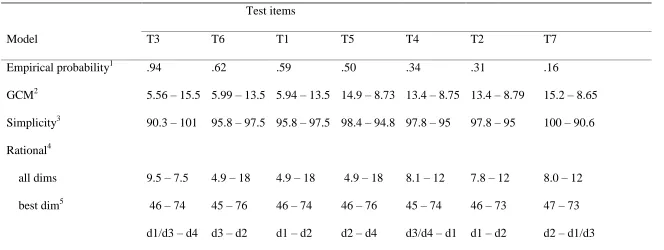
see Homa, Proulx, & Blair, 2008). Medin and Schaffer (1978) reported classification
probabilities for seven test items (Table 4) and, as discussed, we can use these
categorization model, two computations were made for each test item: One with the
test item assigned to the first category and another with the test item assigned to the
second category. These two computations corresponded to two intuitiveness values
for each item. The difference between these two values should correspond to the
classification probabilities reported by Medin and Schaffer (1978).
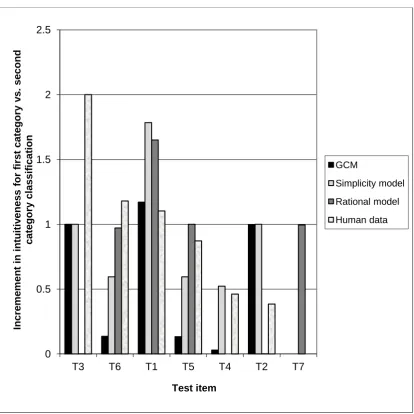
---TABLES 4, 5, FIGURE 5---
The results are shown in Table 5 and Figure 5. To create Figure 5, for the
unsupervised GCM we computed the difference in log likelihood error for the
classification when the first test item was assigned to the first category minus the log
likelihood error for the classification when the first test item was assigned to the
second category; and likewise for the other test items. (In other words, we subtracted
the values in each of the cells in Table 5.) Subsequently, these differences were
converted onto a uniform scale, as in the other examples (in this case, the scale was
0—2; model predictions corresponded to differences between two intuitiveness
values, and such differences could be negative). An analogous procedure was adopted
for the other models. Correlating classification probabilities and the differences in
predicted intuitiveness values, for the unsupervised GCM, the simplicity model, the
rational model, and the rational model with dimensional selection respectively, we
obtained: -.857, -.960, .068, -.412. Note that a negative correlation is in the predicted
direction for the unsupervised GCM and the simplicity model, since for these models
lower values (lower error or lower codelength) correspond to more intuitive
classifications and, hence, should be associated with higher classification probabilities
in Medin and Schaffer’s data. The GCM and the simplicity model competently
describe the Medin and Schaffer (1978) data; however, the rational model had
Linear separability. A classification is linearly separable if a straight line (or the
equivalent in more than two dimensions), can divide all the items which belong to one
category from all items which belong to another. Linear separability is an important
consideration in categorization, since exemplar theory is consistent with non-linearly
separable categories, but this is not the case for prototype theory. The empirical
results have been somewhat ambiguous (Ashby & Maddox, 1992; Kalish,
Lewandowsky, & Kruschke, 2004; Kemler Nelson, 1984; Kemler Nelson, 1984;
Olsson, Enkvist, & Juslin, 2006; Medin & Schwanenflugel, 1981; Ruts, Storms, &
Hampton, 2004; Shepard et al., 1961; Smith, Murray, & Minda, 1997; Wattenmaker,
1995). The latest research with schematic stimuli indicates that linearly separable
categories are more intuitive (Blair & Homa, 2001). Of the category structures Blair
and Homa used, most relevant are the ones with four categories each, in which each
category had nine points (these were the largest stimulus sets). The linearly separable
category structure was referred to by Blair and Homa as LS9 and the non-linearly
separable one as NLS9. Blair and Homa reported an advantage of the LS9
classification relative to the NLS9 one, in terms of ease of learning.
We modeled the LS9 vs. NLS9 contrast reported by Blair and Homa (2001).
Each LS9 category was based around a prototype and nine ‘high distortion’ items
from the prototype. Each NLS9 category was based around the same prototypes, six
‘low distortion’ items from the prototype, and one low distortion item from each of
the other three prototypes (the items from the other prototypes result in non-linearity).
Blair and Homa reported the coordinates of six items from each prototype in three
dimensions, which were derived from similarity ratings (Blair, personal
communication). To approximate the Blair and Homa stimulus sets, the coordinates of
prototype. Then, we computed the average distance between the prototypes and
low/high distortion items, and so created enough low/high distortion items to
approximate the LS9 and NLS9 category structures (Appendix). We created two more
extreme stimulus sets, referred to as LS9X and NLS9X, in which the prototype
coordinates were changed so that the least distance between any two prototypes would
be at least 1.5 times the distance between a prototype and a high distortion item. The
LS9, NLS9 stimulus sets can only be said to approximate the actual Blair and Homa
stimulus sets. Therefore, we examined linear separability of each stimulus set with a
series of logistic regressions attempting to predict category membership (Ruts et al.,
2004). Our re-creation of LS9 is not linearly separable (probably because categories
are too close to each other), but it is a lot more so compared to NLS9. Moreover, the
new stimulus set LS9X is linearly separable.
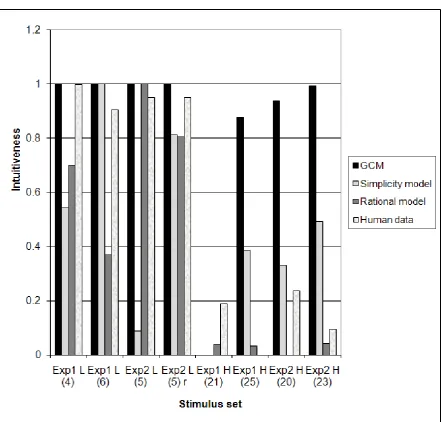
---TABLE 6, FIGURE 6---
The empirical finding we aimed to model was that LS9 was easier to learn
compared to NLS9. Although there are no relevant empirical results for LS9X and
NLS9X, we tentatively assume that for LS9X increasing the distance between
category prototypes would make a category structure more salient (a straightforward
assumption), but this would not be the case for NLS9X (a more controversial
assumption). The results are shown in Table 6 and Figure 6. The unsupervised GCM
and the simplicity model successfully predicted a difference between LS9 and NLS9
and a more pronounced difference between LS9X and NLS9X. Note that using the
unsupervised GCM to predict category intuitiveness is a different computation from
that corresponding to the standard GCM and, so, our results do not bear on the fact
that Blair and Homa (2001) could not identify satisfactory (standard) GCM fits for the
classifications were extremely unlikely, and maybe this obscured any finer differences
due to linear separability.
Unsupervised categorization data
Compton & Logan (1999). Compton and Logan (1999) reported extensive data on
judgments of category intuitiveness, in an entirely unsupervised categorization task.
They presented participants with diagrams of dots, as in Figure 1 (but without any
curves), and asked participants to classify the dots in a way that seemed immediately
natural and intuitive, by drawing curves to indicate their groupings. There were no
constraints at all as to how the items should be classified (including no constraints on
the number of groups; cf. Murphy, 2004). Compton and Logan measured category
intuitiveness in terms of classification variability, that is, the number of unique
classifications for each diagram shown to participants, so as to examine whether
classification variability changed when the arrangement of dots in a diagram was
transformed (e.g., reflected or rotated). Compton and Logan employed 48 unique
diagrams, which consisted of 12 examples for each numerosity of dots from 7 to 10,
inclusive (each participant classified 144 diagrams, the 48 original ones and various
transformations of them). Each unique diagram was created by randomly arranging
the appropriate number of dots in a 40x40 grid.
The categorization procedure of Compton and Logan somewhat deviates from
the standard procedure in unsupervised categorization experiments: participants drew
lines around points, instead of classifying stimuli as separate entities. For example,
the classification of dots in a diagram will be affected by the nearest neighbor
structure in the diagram; participants would rarely classify in the same cluster dots
which are far away from each other. By contrast, in standard unsupervised
classification of highly dissimilar items into the same group is sometimes observed.
However, Compton and Logan (1999) is currently the most extensive report of
unsupervised categorization results. Moreover, perceptual grouping processes in
Compton and Logan’s experiment is arguably very similar to the grouping by
similarity, postulated by models such as simplicity and the GCM: in both cases, the
assumption is that participants will prefer groupings which enhance within category
similarity. Finally, some researchers have argued that such dot diagrams is a valid
way to study unsupervised categorization (Pothos & Chater, 2002).
Compton and Logan only reported the diagrams for which they observed the
two highest and two lowest classification variability values in each of their two
experiments; we read off the item coordinates from the diagrams (Appendix), so as to
examine whether the predictions of the unsupervised categorization models are
consistent with the highest/ lowest classification variability results reported by
Compton and Logan: there should be less classification variability for stimulus sets
for which the models can identify more intuitive classifications.
---TABLE 7, FIGURE 7---
The simplicity model and the rational model can identify the best possible
classification for a set of items. In the case of the simplicity model, we employed the
agglomerative search algorithm described in Pothos and Chater (2002) and for the
rational model the Gibbs sampler algorithm in Sanborn et al. (2006), which computes
the most probable classification for a set of items, in a way that approximates
concurrent presentation of the items.
Regarding the unsupervised GCM, we have no algorithm to identify the
preferred classification from scratch. Therefore, we examined the log likelihood error
model with dimensional selection, and K-means two- and three-cluster algorithms
(excluding some all-inclusive categories identified by the rational model, since such
categories are pathological for the unsupervised GCM); the intuitiveness prediction
from the GCM for a stimulus set corresponded to the lowest identified log likelihood
error term overall. In this case, we also examined a modification for the unsupervised
GCM, for which the sensitivity parameter was fixed to a constant value (we chose
c=0.5, noting that which value of c is suitable will depend on the coordinate units).
Why is this consideration relevant in this case, but not in the case of the stimulus sets
from supervised categorization studies? In unsupervised research, the classifications
considered are typically chosen to be intuitive to naïve observers. Accordingly,
without a restriction on c, the GCM can always stretch the representational space in
such a way that the corresponding classification is maximally intuitive.
Psychologically, by restricting the sensitivity parameter, we suggest that participants
spontaneously classify an item not just by considering its single nearest neighbor, but
in relation to many of the other items as well (this seems highly plausible in the case
of the Compton & Logan results, and also the Pothos & Chater results, considered
next).
The results are shown in Table 7 and Figure 7. Note first that the standard
unsupervised GCM is unable to discriminate between the intuitive and unintuitive
stimulus set, but this is not so when a restriction in the sensitivity parameter is
introduced. We next correlated the classification variability results reported by
Compton and Logan with the intuitiveness values generated from each model. These
(Pearson) correlations were for the unsupervised GCM, .319, the unsupervised GCM
with a c restriction, .407, the simplicity model, .430, the rational model, -.032, and the
higher values from the unsupervised GCM and the simplicity model correspond to
less intuitive categories, but higher values from the rational model to more intuitive
categories). Of these correlations, the one involving the rational model with
dimensional selection probabilities was the highest, showing that allowing
dimensional selection in the rational model is a key modification regarding the
model’s explanatory power. Moreover, the unsupervised GCM with c restricted
performs better than the unrestricted GCM. Specifically, it correctly identifies the four
low variability stimulus sets as more intuitive than all the four high variability ones.
Pothos and Chater (2002). Pothos and Chater examined four 10-item stimulus sets
for which there were differing intuitions about the most intuitive classification
(Appendix). In the first one, there were two well-separated clusters of equal size
(referred to as ‘two clusters’). In the second one, there were also two well-separated
clusters, but one was larger than the other (referred to as ‘big small’). In the third
stimulus set there were three well-separated clusters (‘three clusters’). Finally, there
was little classification structure in the last stimulus set (referred to as ‘little’).
We consider Experiment 2 of Pothos and Chater, whereby item coordinates
were mapped onto (separable) dimensions of physical variations, to create stimulus
pictures that were printed on separate sheets of paper and given to participants to be
sorted into groups that were “intuitive and natural”. No constraints were imposed on
participants’ classifications (e.g., participants could use as many clusters as they liked,
they could see the stimuli in any order or way they liked, and they could make
changes in their classifications). This represents the most naturalistic unsupervised
categorization study we found in the published literature. Pothos and Chater employed
28 participants and measured classification performance in terms of three indices, the
the number of robust distinct classifications (these are the distinct classifications with
a frequency greater than one), and the frequency with which the best possible
classification was produced. Because of the small sample, these three measures did
not correlate very well with each other; Pothos and Chater considered the last two as
the most valid. We derived two separate rank orderings for the four stimulus sets from
these two measures, which we subsequently added together to obtain an overall rank
ordering for the observed intuitiveness of different stimulus sets. For the ‘two
clusters’, ‘big, small’, ‘three clusters’, and ‘little’ stimulus sets, the summation of the
ranks for these two measures produced 3, 2, 5, and 7 respectively, whereby a lower
number indicates higher category intuitiveness.
---TABLE 8, FIGURE 8---
Unsupervised GCM category intuitiveness predictions were computed for the
classifications predicted by the simplicity model, the rational model with dimensional
selection, and K-means two-cluster and three-cluster algorithms. As before, we
explored the version of the unsupervised GCM with and without restricting the
sensitivity parameter; for the rational model we employed the Sanborn et al. (2006)
algorithms. The simplicity model was applied to the stimulus sets by searching for the
best possible classification on the basis of item coordinates. The results are shown in
Table 8 and Figure 8. The simplicity model and the restricted unsupervised GCM
accurately predicted the ordinal ordering of empirical classification intuitiveness in
Table 8, but this was not the case for the unrestricted unsupervised GCM (which
failed to discriminate between any of the stimulus sets). Finally, the rational model
with dimensional selection was in much closer correspondence to the empirical results
Conclusions
Naïve observers can often have very compelling intuitions that a particular grouping
for a set of stimuli may be more appropriate than another. Therefore, understanding
the computational basis for such intuitions appears an important objective for models
of unsupervised categorization. One aim of this paper was to examine predictions
about category intuitiveness, from computational models of categorization, against a
series of studies from the categorization literature.
Models of unsupervised categorization which can readily produce a measure
of category intuitiveness are the rational model and the simplicity model and so these
two models were tested in our analyses. Future work could fruitfully include
additional models, such as Schyns’ (1991) self-organizing neural network, which was
used to model category emergence, Compton and Logan’s (1993, 1999) perceptual
grouping approach to unsupervised categorization, or Love et al.’s (2004; Gureckis &
Love, 2002) SUSTAIN model, which assumes two slightly separate mechanisms for
supervised and unsupervised categorization (respectively, an explicit error term and
surprisingness with a principle of similarity). Finally, there has been an extensive
literature on statistical clustering (e.g., Fisher and Langley, 1990; Krzanowski &
Marriott, 1995), which looks relevant to studies of unsupervised categorization. Such
models could serve as psychological models of categorization, after some additional
theoretical elaboration.
Another aim of this paper was to explore the possibility that a measure of
category intuitiveness could be derived from a supervised model of categorization, the
GCM. In our adaptation of the GCM, a candidate classification for a set of items is
examined by considering how well the intended classification of each item can be
computed, which indicates the ability of the GCM to describe the candidate
assignment of items to categories. We postulated that when this error term is lower,
then the corresponding classification is more consistent with the assumptions of the
GCM about categorization, so that such a classification would be predicted (by the
GCM) to be more psychologically intuitive. Both the supervised and unsupervised
GCM are based on exactly the same equations, but are applied differently. The
unsupervised GCM computes a number which can be interpreted as category
intuitiveness, while the supervised GCM predicts classification probabilities for novel
instances. Crucially, in the unsupervised GCM no parameter fitting is taking place
relative to empirical data (parameters are searched so as to identify the best possible
classification for a set of stimuli), while in the supervised GCM parameters are
specified so as to achieve particular probabilities for the classification of new
instances.
The unsupervised GCM favors groupings of items that maximize within
category similarity. The crucial difference between the unsupervised GCM and
models such as the simplicity one is that similarity groupings are assessed not just
against the initial/ unprocessed dimensional representation of the items, but against all
possible derivative representations, which would be forthcoming from dimensional
weighting, stretching/ compression of psychological space etc. This representational
flexibility is, of course, the hallmark of GCM predictions and its characteristic which
has allowed it to provide impressive fits to empirical data. It is also a characteristic
that has provoked some criticism since, if the GCM is proved to be too flexible, then
its explanatory power would be limited. Accordingly, a possible way in which our
demonstration could have failed would be if the unsupervised GCM could predict
this was not the case, and the accuracy of the predictions from the unsupervised GCM
compared favorably from those of the rational model and the simplicity model.
One can ask whether the unsupervised GCM is meant to be understood as a
full model of unsupervised categorization. For a full model of unsupervised
categorization what is needed is a criterion of category intuitiveness and a search
algorithm which can use this criterion to identify the optimal classification for a set of
stimuli from scratch. The unsupervised GCM fulfills only the first requirement. It can
be used to compute the predicted category intuitiveness for a stimulus set, a prediction
which can be compared with the ones from the rational model and the simplicity
model. However, the current formulation of the unsupervised GCM fails the second
requirement. To appreciate why this is the case, consider first how the simplicity
model (equally for the rational model) works. The simplicity model can easily
identify the predicted most intuitive classification for a set of stimuli from scratch,
with simple search algorithms which take the stimulus configuration and identify the
classification which best optimizes the model’s criterion for category intuitiveness.
For the unsupervised GCM, the problem is that there is no single stimulus
configuration, but rather an infinite number of possible ones, defined by stretching/
compressing psychological space or different relative attentional weighting of the
item dimensions (in other words, the situation is like having different stimulus sets,
the original one and all possible transformations of the original one, as allowed by the
GCM parameters). Thus, in the case of the unsupervised GCM the search space is
much more extensive, making optimization of its criterion for category intuitiveness
intensive and difficult (so that, for example, the straightforward agglomerative
algorithm which works for the simplicity model will not work for the unsupervised
Regarding the results of our simulations, all models performed reasonably
well, but no model could be identified as clearly superior when compared to the
others. More work needs to be done in order to model category intuitiveness in a
satisfactory way. For example, with the Shepard, Hovland, Jenkins (1961) data, the
unsupervised GCM performed better than both the simplicity model and the rational
model. In the case of the 5-4 category structure (Medin & Schaffer, 1978), the
simplicity model came out ahead, with the unsupervised GCM providing the second
best fit. In the case of comparing Blair and Homa’s (2001) LS/ NLS category
structures, the simplicity model and the unsupervised GCM could both provide a
perfect account of the empirical findings. Compton and Logan (1999) provided one of
the early studies with an entirely unsupervised categorization procedure. The best
description for their results was from the rational model with dimensional selection.
The unrestricted unsupervised GCM was too powerful for this data. It was necessary
to constrain the sensitivity parameter before the unsupervised GCM could accurately
predict an intuitiveness difference between the low and high variability stimulus sets
(cf. Stewart & Brown, 2005; Olsson et al., 2004). Finally, the restricted unsupervised
GCM and the simplicity model could account for Pothos and Chater’s (2002) data,
and the results from the rational model with dimensional selection were in close
correspondence too.
The relative success of the unsupervised GCM calls into question the
distinction between supervised and unsupervised categorization which has dominated
the literature. We showed that a model of supervised categorization could be
straightforwardly adapted to make predictions about category intuitiveness. Also, the
converse situation is implied in our demonstration: models of unsupervised
studies, by assuming that when a classification is more difficult to learn then it should
be less intuitive (cf. Colreavy and Lewandowsky, in press). It is therefore possible
that both supervised and unsupervised categorization could be described within the
same mathematical framework (e.g., the GCM), noting, however, that behavioral or
neuroscience data may show these to correspond to distinct psychological processes
(e.g., cf. Ashby & Ell, 2002; Ashby & Perrin, 1988; Nomura et al., 2007; Zeithamova
& Maddox, 2006; see also Love et al., 2004). Future work will hopefully address
these exciting issues, as well as extend formalisms like the rational model and the
Acknowledgments
This research was partly supported by ESRC grant R000222655 to EMP. We would
like to thank Peter Hines, Mark Johansen, Matt Jones, Rob Nosofsky, Amotz
Perlman, David Smith, and Safa Zaki. We are grateful to John Anderson for his help
with the implementation of the continuous version of the rational model, to Adam
Sanborn for helping with the Gibbs sampler, and to Mark Blair for his suggestions for
specifying the LS/ NLS stimulus sets, from the Blair & Homa study.
References
Anderson, J. R. (1991). The Adaptive Nature of Human Categorization. Psychological
Review, 98, 409-429.
Anderson, J. R. & Matessa, M. (1992). Explorations of an incremental, Bayesian
algorithm for categorization. Machine Learning, 9, 275-308.
Ashby, G. F. & Perrin, N. A. (1988). Towards a unified theory of similarity and
recognition. Psychological Review, 95, 124-150.
Ashby, G. F. & Maddox, W. T. (1992). Complex decision rules in categorization:
contrasting novice and experienced performance. Journal of Experimental
Psychology: Human Perception and Performance, 18, 50-71.
Ashby, G. F. & Ell, S. W. (2002). Single versus multiple systems of category
learning: Reply to Nosofsky and Kruschke (2002). Psychonomic Bulletin &
Review, 9, 175-180.
Blair, M. & Homa, D. (2001). Expanding the search for a linear separability constraint
on category learning. Memory & Cognition, 29, 1153-1164.
Chater, N. (1996). Reconciling Simplicity and Likelihood Principles in Perceptual
Chater, N. (1999). The Search for Simplicity: A Fundamental Cognitive Principle?
Quarterly Journal of Experimental Psychology, 52A, 273-302.
Colreavy, E. & Lewandowsky, S. (in press). Strategy development and learning
differences in supervised and unsupervised categorization. Memory & Cognition.
Compton, B. J. & Logan, G. D. (1993). Evaluating a computational model of
perceptual grouping. Perception & Psychophysics, 53, 403-421.
Compton, B. J. & Logan, G. D. (1999). Judgments of perceptual groups: Reliability
and sensitivity to stimulus transformation. Perception Psychophysics, 61,
1320-1335.
Corter, J. E. & Gluck, M. A. (1992). Explaining Basic Categories: Feature
Predictability and Information. Psychological Bulletin, 2, 291-303.
Feldman, J. (2000). Minimization of Boolean complexity in human concept learning.
Nature, 407, 630-633.
Fisher, D., & Langley, P. (1990). The structure and formation of natural categories. In
Gordon Bower (Ed.), The Psychology of Learning and Motivation, Vol. 26 (pp.
241-284). San Diego, CA: Academic Press.
Fodor, J. A. (1983). The modularity of mind. Cambridge, MA: The MIT press.
Gosselin, F. & Schyns, P. G. (2001). Why do we SLIP to the basic-level?
Computational constraints and their implementation. Psychological Review, 108,
735-758.
Griffiths, T. L., Steyvers, M., & Tenenbaum, J. B. (2007). Topics in semantic
representation. Psychological Review, 114, 211-244.
Griffiths, T. L., Christian, B. R., & Kalish, M. L. (2008). Using category structures to
test iterated learning as a method for identifying inductive biases. Cognitive
Gureckis, T.M., Love, B.C. (2002). Who says models can only do what you tell
them? Unsupervised category learning data, fits, and predictions. In Proceedings of
the 24th Annual Conference of the Cognitive Science Society. Lawrence Erlbaum:
Hillsdale, NJ.
Hahn, U., Bailey, T. M., & Elvin, L. B. C. (2005). Effects of category diversity on
learning, memory, and generalization. Memory & Cognition, 33, 289-302.
Hampton, J.A. (2000) Concepts and Prototypes. Mind and Language, 15, 299-307.
Heit, E. (1997). Knowledge and Concept Learning. In K. Lamberts & D. Shanks
(Eds.), Knowledge, Concepts, and Categories (pp. 7-41). London: Psychology
Press.
Hines, P., Pothos, E. M., & Chater, N. (2007). A non-parametric approach to
simplicity clustering. Applied Artificial Intelligence, 21, 729-752.
Homa, D., Proulx, M. J., & Blair, M. (2008). The modulating influence of category
size on the classification of exception patterns. The Quarterly Journal of
Experimental Psychology, 61, 425-443.
Johansen, M. K. & Kruschke, J. K. (2005). Category representation for classification
and feature inference. Journal of Experimental Psychology: Learning, Memory, and
Cognition, 31, 1433-1458.
Jones, G. V. (1983). Identifying basic categories. Psychological Bulletin, 94, 423-428.
Kalish, M. L., Lewandowsky, S., & Kruschke, J. K. (2004). Population of linear
experts: knowledge partitioning and function learning. Psychological Review, 111,
1072-1099.
Kemler Nelson, D. G. (1984). The effect of intention on what concepts are acquired.
Krzanowski, W. J. & Marriott, F. H. C. (1995). Multivariate Analysis, Part 2:
Classification, Covariance Structures and Repeated Measurements. Arnold: London.
Kurtz, K. J. (2007). The divergent autoencoder (DIVA) model of category learning.
Psychonomic Bulletin & Review, 14, 560-576.
Lewandowsky, S., Roberts, L., & Yang, L. (2006). Knowledge partitioning in
categorization: boundary conditions. Memory & Cognition, 34, 1676-1688.
Love, B. C. (2002). Comparing supervised and unsupervised category learning.
Psychonomic Bulletin & Review, 9, 829-835.
Love, B. C., Medin, D. L., & Gureckis, T. M. (2004). SUSTAIN: A network model of
category learning. Psychological Review, 111, 309-332.
Luce, R. D. (1963). Detection and recognition. In R. D .Luce, R. R. Bush, & E.
Galanter (Eds.) Handbook of Mathematical Psychology, 1, 103-190. New York:
Wiley.
Medin, D. L. (1983). Structural principles of categorization. In B. Shepp & T. Tighe
(Eds.), Interaction: Perception, development and cognition (pp. 203-230). Hillsdale,
NJ: Erlbaum.
Medin, D. L. & Schaffer, M. M. (1978). Context Theory of Classification Learning.
Psychological Review, 85, 207-238.
Medin, D. L. & Schwanenflugel, P. J. (1981). Linear separability in classification
learning. Journal of Experimental Psychology: Human Learning and Memory, 75,
355-368.
Milton, F. & Wills, A. J. (2004). The influence of stimulus properties on category
construction. Journal of Experimental Psychology: Learning, Memory, and