World Maritime University
The Maritime Commons: Digital Repository of the World
Maritime University
World Maritime University Dissertations Dissertations
2000
Proposals for the improvement of maritime
administration and policy in Vietnam
Vu The Quang
World Maritime University
Follow this and additional works at:http://commons.wmu.se/all_dissertations
Part of theEconomic Policy Commons
This Dissertation is brought to you courtesy of Maritime Commons. Open Access items may be downloaded for non-commercial, fair use academic purposes. No items may be hosted on another server or web site without express written permission from the World Maritime University. For more
Recommended Citation
Quang, Vu The, "Proposals for the improvement of maritime administration and policy in Vietnam" (2000).World Maritime University Dissertations. 59.
WORLD MARITIME UNIVERSITY
Malmö, Sweden
---PROPOSALS FOR THE IMPROVEMENT
PROPOSALS FOR THE IMPROVEMENT
PROPOSALS FOR THE IMPROVEMENT
PROPOSALS FOR THE IMPROVEMENT
OF MARITIME ADMINISTRATION AND
OF MARITIME ADMINISTRATION AND
OF MARITIME ADMINISTRATION AND
OF MARITIME ADMINISTRATION AND
POLICY IN VIETNAM
POLICY IN VIETNAM
POLICY IN VIETNAM
POLICY IN VIETNAM
BY
VU THE QUANG
VU THE QUANG
VU THE QUANG
VU THE QUANG
Socialist Republic of VietnamA dissertation submitted to the World Maritime University in partial
fulfilment of the requirements for the award of the degree of
MASTER OF SCIENCE
in
MARITIME ADMINISTRATION AND ENVIRONMENTAL PROTECTION
2000
DECLARATION
I certify that all the material in this dissertation that is not my own work has
been identified, and that no material is included for which a degree has previously
been conferred on me.
The contents of this dissertation reflect my own personal views, and are not
necessarily endorsed by the University.
...
20 August 2000
Supervised by:
Lt.Cdr. Maximo Quibranza Mejia Jr
Lecturer, Maritime Administration and Environmental Protection
World Maritime University
Assessor:
Capt. John Liljedahl
Lecturer, Maritime Administration and Environmental Protection
World Maritime University
Co-assessor:
Capt. Poul Jeppesen
To Develop and Establish Efficient and Effective
ACKNOWLEDGEMENT
It is with greatest pleasure that I extend my sincere appreciation to all those
who have assisted me over the period of my study at World Maritime University and
who have contributed to the successful completion of this dissertation by providing
me with information, support and inspiration. In particular, I would like to express
sincere thanks and gratitude to:
TOKYO Foundation (Japan) who offered me the fellowship to support my
two years of studies at the World Maritime University;
Mr. Bui Ngoc Chau, the Chairman of the Vietnam National Maritime Bureau,
and Mr. Kieu Quang Dang, the late Director of the Personnel Department, for
affording me the opportunity to study at the World Maritime University;
Capt. Nguyen Viet Anh, the Head of the Vietnam Liaison Office to IMO, for
giving me his full support during the entire period of my study at the World Maritime
University;
Lt.Cdr. Maximo Quibranza Mejia Jr., Lecturer in Maritime Administration
and Environmental Protection, at the World Maritime University, for his supervision
of this dissertation;
Mr. Bruce J. Carlton, Associate Administrator for Policy and International
Trade, United States of American Maritime Administration, for his assistance in
providing documents vital for the preparation of my dissertation;
Ms. Susan Jackson, Assistant Academic Registrar, for her assistance during
Mrs. Christine Moulder, Voluntary English Instructor, for her assistance
during my course program and her correction of this dissertation;
Mr. Vo Duy Quy, former WMU student, for his guidelines in the World
Maritime University;
Other professors, lecturers and staff members of the World Maritime
University, both visiting and resident, for their contribution through lectures and
instruction;
The maritime administrations of Sweden, Denmark, Finland, Norway, Japan,
Canada and the United Kingdom for the knowledge gained through the various
programes organised during course field trips and on-the-job training activities;
My classmates at the World Maritime University, who shared with me deeply
during the two years in Malmö, Sweden; and
Finally, my mother, father, sister and brother, who always gave me their
ABSTRACT
Title of Dissertation: Proposals for the Improvement of Maritime
Administration and Policy in Vietnam
Degree: Msc
This dissertation is a study of the organisation of the maritime administration
and the implementation of maritime policy in Vietnam. The method of this study is
through considering, analysing and evaluating such matters in comparison with a
proper relevant mechanism and the competent MARAD in leading maritime
countries.
The current situation of the Vietnamese Maritime Administration system is
reviewed from overall framework to performance of some specific bodies, like the
VINAMARINE, VIWA and VR. Some analyses are made in major areas through
break down of areas of activity. The Vietnamese maritime policy is also reviewed,
particularly the Vietnamese Maritime Code, subsidiary legislation and the
implementation of IMO’s conventions. Then the study points out the weaknesses of
the Vietnamese Maritime Administration and maritime policy, which are effecting
maritime industry in Vietnam.
The Model of MARAD in leading maritime countries, such as Canada, Japan,
Sweden and USA, are examined. The concept of new public management also is
presented.
The Chapter V gives proposals to improve maritime administration and
maritime policy, including the structure of maritime administration, maritime
legislation, port and shipping management policy, maritime education and training
and the implementation of international conventions. Recommendations are made
toward improving the effectiveness of the maritime administration and maritime
policy in Vietnam.
KEYWORDS: Maritime Administration, Maritime Policy, Improvement,
TABLE OF CONTENTS
Declaration
Acknowledgements
Abstract
Table of Contents
List of Tables
List of Figures
List of Abbreviations
I. Introduction
I.1 Introduction
I.2 Location and Geographic Features of Vietnam
I.3 Sea-borne Trade
I.3.1 Foreign Trade
I.3.2 Domestic Trade
I.3.3 Forecast Sea-borne Trade
I.4 The National Mercantile Fleet
I.4.1 The Structure of the National Fleet
I.4.2 The National Fleet’s Owners
I.4.3 National Fleet’s Operation
I.4.4 Forecast Developing of National Fleet
I.5 The Commercial Port System
I.5.1 The Port System at Present
I.5.2 Forecast Volume of Cargoes Handled by the Port System
I.5.3 Planning to Develop the Commercial Port System
I.6 The Shipbuilding and Shiprepairing Industry
I.7 The Maritime Education and Training System
The Education and Training System
I.7.2 The Vietnamese Seafarers and Manning
II. The Current Maritime Administration System and
Maritime Policy in Vietnam
II.1 General
II.2 The Vietnam National Maritime Bureau
II.2.1 VINAMARINE: A General Overview
II.2.2 Port Authorities
II.2.3 Vietnam Maritime Safety Agency
II.2.4 Vietnam Maritime Safety Inspectorate
II.2.5 Vietnam Maritime Search and Rescue Co-ordination Center
II.2.6 Vietnam Ship Communication and Electronic Company
II.3 The Vietnam Inland Waterways Administration
II.4 The Vietnam Register
II.5 Vietnam Marine Police
II.6 The Maritime Legislation
II.6.1 The Vietnamese Maritime Code
II.6.2 Subsidiary Legislation
II.6.3 Enforcement of Maritime Legislation in Vietnam
II.7 The Implementation of International Conventions
III. Analysis of the Vietnamese Maritime Administration
and Its Weaknesses
III.1 Analysis of the VMA-Its Structure, Function and Roles
III.1.1 The Vietnamese Maritime Administration Framework
III.1.2 Breakdown of Areas of Activity of VMA
III.1.3 Analysis Breakdown of Areas of Activity of VMA
III.1.3.1 Economic Management-Policy Development
III.1.3.2 Economic Management-Regulation Legislation
III.1.3.3 Economic Management-Maritime Services
III.1.3.4 Safety Management-Policy Development
III.1.3.5 Safety Management-Regulation Legislation
III.1.3.6 Safety Management-Maritime Safety Services
III.1.3.7 Environmental Management-Policy
Development
III.1.3.8 Environmental Management- Regulation,
Legislation
III.1.3.9 Environmental Protection-Marine Services
III.1.3.10 Other Possible MARAD Responsibilities
III.1.3.10.1 Policy
III.1.3.10.2 Enforcement of Laws and
Regulation
III.1.3.10.3 Provision of Services
III.2.1 The Weaknesses of Organisation-Structure,
Function and Role
III.2.1.1 The Weaknesses of VINAMARINE
III.2.1.2 The Weaknesses of Vietnam Register
III.2.1.3 The Overlap Between VIWA and VINAMARINE
III.2.2 The Weaknesses of Maritime Legislation
III.2.2.1 Primary Legislation
III.2.2.2 Subsidiary Legislation
III.2.3 The Deficiency of the Shipping Management Policy
III.2.3.1 The Deficiency of State-Owned Shipping
Enterprise
III.2.3.2 The Slowness of Establishing a “Level Playing
Field” for the Maritime Transport Industry
III.2.3.3 The Lack of Financial Support Policy
III.2.3.4 The Various and High Maritime Taxation
Rates and Fees
III.2.3.5 Lack of the Right Transport Protection
Policy for the National Fleet
III.2.3.6 Lack of Foreign Joint Venture and Investment
Policy in the Shipping Industry
III.2.4 The Weaknesses of the Port Management Policy
III.2.4.1 Lack of Port Management Unification
III.2.4.2 Unreasonable Situation of Port’s Financial Policy
III.2.5 The Weaknesses of Maritime Education and Training
III.2.5.1 Lack of Modern Curriculum
III.2.5.2 Lack of Equipment for Education and Training
III.2.5.3 Lack of Seafarer Database System
III.2.6 The Deficiency of Implementation of International
Agreements and Conventions
III.2.6.1 The Deficiency of the Implementation of
Conventions in Maritime Environment
III.2.6.2 The Deficiency of the Implementation of
Conventions in Safety of Ships
III.2.6.3 The Deficiency of the Implementation of
Convention in SAR
III.2.6.4 The Deficiency of the Implementation
of Tokyo MOU on PSC
IV. Model Organisation Structure of Other Maritime Administration
IV.1 The Canadian Maritime Administration
IV.2 The Japanese Maritime Administration
IV.3 The Swedish Maritime Administration
IV.4 The US. Maritime Administration
IV.5 Review and Analysis Vis-a-vis Vietnam MARAD
V. Proposals to Improve Maritime Administration
and Maritime policy in Vietnam
V.1 Reform of the Organisational Structure of the Maritime
Administration
V.1.1 The Basis of the proposals
V.1.2 The Areas Requiring Reform and Its Advantages
V.2 Improving maritime Legislation
V.2.1 Revising and Amending the Vietnamese Maritime Code
V.2.2 Revising and Amending the Subsidiary Legislation
V.3 Improving the Shipping Management Policy
V.4 Establishing the New Port Management Policy
V.4.1 Basis of New Port Management policy
V.4.2 Establishing the New Port Management Policy
V.5 Improving Maritime Education and Training
V.6 Promotion of the Implementation of International Conventions
VI. Conclusions
References
Appendix: The Collection of Vietnamese Maritime Legislation
65
65
65
66
70
70
71
72
73
73
74
75
76
78
80
LIST OF TABLES
Table 1.1. Volume of Sea-borne Trade 1995-1998 4
Table 1.2. Forecast Volume of Sea-borne Trade 2000 – 2010 5
Table 1.3. Shipowners Groups 6
Table 1.4. The Development of the National Fleet Demend 2005 –2010 7
Table 1.5. Forecast Volume of Cargoes Handled by Vietnam’s Ports up to Year 2020 8
Table 1.6. Number of Seafarers in Vietnam 11
Table 3.1. Breakdown of Areas of Activity of VMA 38
Table 4.1. Breakdown of Areas of Activity of CMA 57
Table 4.2. Breakdown of Areas of Activity of JMA 59
Table 4.3. Breakdown of Areas of Activity of SMA 61
LIST OF FIGURES
Figure 1.1. Map of Vietnam 3
Figure 2.1. The Vietnamese Maritime Administration 14
Figure 2.2. The Organisation Chart of Vietnam National Maritime Bureau 17
Figure 2.3. The Organisation Chart of VIWA 24
Figure 2.4. The Organisation Chart of the Vietnam Register 28
Figure 2.5. The Vietnam Marine Police Diagram 29
Figure 3.1. Vietnamese Maritime Administration Framework 37
Figure 4.1. The Organisation Chart of CMA 56
Figure 4.2. The Organisation Chart of JMA 58
Figure 4.3. The Organisation Chart of SMA 60
Figure 4.4. The Organisation Chart of USMARAD 62
Figure 5.1. Model of a MARAD Organisational Structure for Developing Countries 66
Figure 5.2. The Proposed Structure of Vietnamese Maritime Administration 67
Figure 5.3. The Proposed VMA Structural Framework 68
LIST OF ABBREVIATIONS
ABS American Bureau of Shipping
ARPA Automatic Radar Piloting Aid
ASEAN Association of South East Asian Nations
ATN Aid to Navigation
BV Bureau Veritas
CCG Canadian Coast Guard
CIF Cost, Insurance and Freight
CLC International Convention on Civil Liability for Oil Pollution
Damage
CMA Canadian Maritime Administration
COLREG 72 Convention on the International Regulations for Preventing
Collisions at Sea, 1972
DFO Department of Fisheries and Oceans
DND Department of National Defence
DOC Document of Compliance
DOT Department of Transport
DWT Deadweight Ton (metric ton)
EEZ Exclusive Economic Zone
FMC Federal Maritime Commission
FOB Free on Board
FSI Flag State Implementation
FUND92 International Convention on the Establishment of an International
Fund for Compensation for Oil Pollution Damage, 1992
GCSC Governmental Continental Shelf Committee
GDMH General Department of Meteorology and Hydrography
GMDSS Global Maritime Distress and Safety System
GT Gross tonnage
IACS International Association of Classification Societies
ILO International Labour Organisation
IMDG International Maritime Dangerous Goods Code
IMO International Maritime Organisation
INMARSAT 76 Convention on the International Maritime Satellite Organisation
and Operating Agreement, 1976
INTERVENTION International Convention to Intervention on the High Seas in Cases of Oil Pollution, 1969
ISM Code International Safety Management Code
ISO International Standards Organisation
JAMSA Japanese Maritime Safety Agency
JMA Japanese Maritime Administration
LOAD LINES66 International Convention on Load Lines, 1966
LR Lloyd’s Register of Shipping
MARAD Maritime Administration
MARPOL 73/78 International Convention for the Prevention of Pollution from
Ships, 1973, as modified by the Protocol 1978 relating thereto
MERSAR Manual Emergency Response for Search and Rescue
MOD Ministry of Defence
MOE Ministry of Energy
MOF Ministry of Finance
MOFi Ministry of Fisheries
MOSTE Ministry of Science, Technology and Environment
MOT Ministry of Transport
MOU Memorandum of Understanding
MPI Ministry of Planning and Investment
NOAA National Oceanic and Atmospheric Administration
OMS Office of Maritime Safety
OPRC International Convention on Oil Pollution Preparedness, Response
and Co-operation, 1990
PMU Project Management Unit
PSC Port State Control
PSCO Port State Control Officer
RCMP Royal Canadian Mounted Police
RDITI Research and Design Institute of Transport Industry
SAR Search and Rescue
SLSA Saint Lawrence Seaways Authority
SLSDC Saint Lawrence Seaways Development Co-operation
SMA Swedish Maritime Administration
SMC Safety Management Certificates
SMS Service of Maritime Safety
SOE State Owned Enterprise
SOLAS 74/78 International Convention for the Safety of Life at Sea, 1974, as
amended by the Protocol 1978 relating thereto
STCW International Convention on Standards of Training, Certification
and Watchkeeping for Seafarers, 1978
TEU Twenty-foot equivalent unit
Tonnage 69 International Convention on Tonnage Measurement of Ships, 1969
UN United Nations
UNCLOS United Nations Convention on the Law of the Sea
USCG United States Coast Guard
USMARAD United States Maritime Administration
VIMARU Vietnam Maritime University
VINALINES Vietnam National Shipping Lines
VINASHIN Vietnam Shipbuilding Industry Corporation
VISHIPPEL Vietnam Ships Communication and Electronic Company
VIWA Vietnam Inland Waterways Administration
VMA Vietnamese Maritime Administration
VMS Vietnam Maritime Safety Agency
VMSI Vietnam Maritime Safety Inspectorate
VMP Vietnam Marine Police
VMRCC Vietnam Maritime Search and Rescue Co-ordination Centre
VOGC Vietnamese Oil and Gas Corporation
VR Vietnam Register
VRA Vietnam Road Administration Bureau
WATCO Waterways Transport Company
WMU World Maritime University
CHAPTER I
VIETNAM MARITIME INDUSTRY
OVERVIEW
I.1 Introduction
Vietnam is a developing maritime country. The utilisation of sea transport in
the country appeared hundreds of years ago for various purposes, such as the
transport of cargoes, fishing, military activities, etc.. During French colonial rule
from 1858 to 1945, sea transportation was mainly carried out by French shipping
companies. Vietnam declared independence on September 2, 1945, but unfortunately,
Vietnam’s Wars of Liberation lasted for almost 30 years (1946 - 1975); therefore, it
was quite difficult for Vietnam’s own ships to operate during this period. However,
the Vietnam Shipping Industry as a matter of fact, was founded in the late 1960s.
Then it comprised merely some small coastal vessels, and a few seaports and
shipyards.
On July 2, 1976 Vietnam was reunified, and as a result all economic and
social infrastructures were constructed or reconstructed, including these related to
maritime affairs. The process of development and reconstruction of the country from
1976 to now could be divided into two periods. The 1976 - 1986 period was
transitional, and the development of shipping industry was, therefore, limited and
rather unclear in many aspects. From 1986 to now, Vietnam has been in the process
of “Doi Moi” (Renovation), including the shipping industry. The country has shifted
from a centrally planned, bureaucratic and subsidised economy to a market economy,
with efficiency as its supreme goal. Many great things have been subjected to change
gradually playing an important role for both domestic and foreign trade. Some good
progress has been recorded, such as raising the national fleet tonnage up to one
million GT; the capacity of shipbuilding raised up to 6,500 GT; and all major ports
are in process of development and modernisation etc. However, this industry is still
facing many obstacles and difficulties, especially in maritime administration and
policy matters. It is proposed to examine these aspects further on.
I.2 Location and Geographic Features of Vietnam:
In order to consider, research and highlight the relevant matters regarding
Vietnamese maritime affairs, the geographic location of Vietnam has to be taken in to
account, along with attendant features. (See Figure 1.1)
Vietnam is located in the center of the Southeast Asia region. Vietnam has an
area of 331,688 square kilometers and a population of over 78,6 million (1999). The
country is bordered by China to the north, Laos and Cambodia to the west, and the
East Sea and Pacific Ocean to the Southeast.
Vietnam has a large network of inland waterways totaling about 41,900 km,
of which 11,400 km is suitable for waterborne transportation. The network extends to
almost all populated areas and industrial zones, in particular, the Red River Delta in
the north and Cuu Long River Delta in the south.
Vietnam's coastline is 3,260 km long and its territorial waters are as large as
one million square kilometers; it has been awarded a series of large seaports such as
the ones at Hai Phong, Da Nang, and Saigon. Offshore from Vietnam's mainland are
thousands of islands and islets lying scattered from north to south.
The major natural resources of Vietnam are petroleum, natural gases, coal, tin
and phosphates. The principal crops are rice, sugar, coffee and cassava.
The characteristics of Vietnam’s geographic location, as well as the consumer
demand of the high population have led to the development of inland water transport
potential natural resources offshore and in the continental shelf, have also led to the
development of various fields of the maritime sectors.
Further, lying on the rim of the Pacific Ocean, Vietnam holds an important
geographic position not only for the sea-born traffic in the region but also for
activities relating to search and rescue at sea, protection of the marine environment
and fighting against unlawful acts on the high seas.
I.3 Sea-borne Trade:
I.3.1 Foreign Trade:
With economic development, the demand for the transportation of goods is
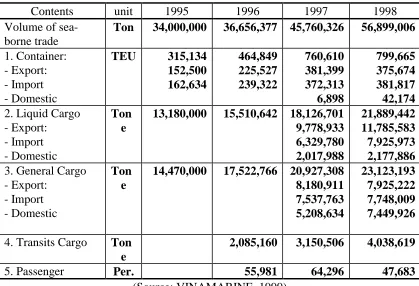
increased, therefore, sea-born trade is increased rapidly. Table 1.1 shows the volume
of sea-born trade during 1995 - 1998. The volume of sea-born trade has increased
from 34 millions tons in 1995 to 56,899 million tons in 1998. This sector has been
paid special attention by the government.
Table 1.1. Volume of Sea-borne Trade 1995 - 1998
Contents unit 1995 1996 1997 1998
Volume of sea-borne trade
Ton 34,000,000 36,656,377 45,760,326 56,899,006
1. Container: - Export: - Import - Domestic TEU 315,134 152,500 162,634 464,849 225,527 239,322 760,610 381,399 372,313 6,898 799,665 375,674 381,817 42,174 2. Liquid Cargo
- Export: - Import - Domestic
Ton e
13,180,000 15,510,642 18,126,701 9,778,933 6,329,780 2,017,988 21,889,442 11,785,583 7,925,973 2,177,886 3. General Cargo
- Export: - Import - Domestic
Ton e
14,470,000 17,522,766 20,927,308 8,180,911 7,537,763 5,208,634 23,123,193 7,925,222 7,748,009 7,449,926
4. Transits Cargo Ton
e
2,085,160 3,150,506 4,038,619
5. Passenger Per. 55,981 64,296 47,683
So far, Vietnam has established trade with more than 90 countries, of which
the major partners are Japan, Korea, Taiwan, China, and the countries of South East
Asian and Eastern Europe. In the coming years, Vietnam also hopes to increase trade
with Western Europe and Latin America.
I.3.2 Domestic Trade
In recent years, rapid economic development has intensified domestic traffic
considerably, and about 80% of domestic transportation is carried out on waterways.
Cargo demand in 1995 was 164% greater that that in 1990; the volume of domestic
transportation increased from 7,260,259 tons and 6,898 TEU in 1997 to 13,696,467
tons and 42,174 TEU in 1998, and is likely to increase.
I.3.3 Forecast Sea-borne Trade
In the forthcoming years, sea-borne trade is expected to increase steadily.
Major exports includes rice (3.2 million tons in 1999) crude oil (14 million tons in
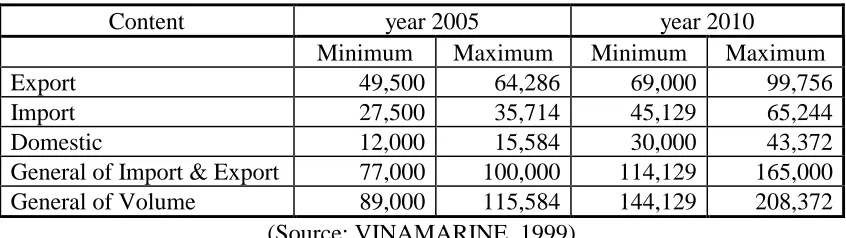
1999) and coal. Table 1.2 shows forecast volume of sea-borne trade up to the year
2010.
Table 1.2. Forecast Volume of Sea-borne Trade 2000 - 2010
Unit: 1000 Tons
Content year 2005 year 2010
Minimum Maximum Minimum Maximum
Export 49,500 64,286 69,000 99,756
Import 27,500 35,714 45,129 65,244
Domestic 12,000 15,584 30,000 43,372
General of Import & Export 77,000 100,000 114,129 165,000
General of Volume 89,000 115,584 144,129 208,372
(Source: VINAMARINE, 1999)
I.4 The National Mercantile Fleet:
I.4.1 The Structure of the National Fleet
With 3,260 kilometers of coastline and 11,400 kilometers of inland waterway,
Vietnam has a natural advantage for the development of transportation by waterway.
At the end of 1999, Vietnamese mercantile fleet had 629 seagoing ships with
total of 1,225,951 DWT, including bulk cargo, container, tanker and general cargo
vessels. The average age of the fleet is about 15 years, including 251 vessels under 10
years old, 237 vessels from 10 to 20 years old, 101 vessels from 21 to 30 years old,
and 40 vessels over 30 years old. The National Fleet is old, obsolete and in extremely
poor condition. Many vessels are completely unsuitable to modern operating
methods. Operating and maintenance costs are high because of the low level of
technology used and because no use is made of efficiently operated specialized
vessels. Although the potential demands for capital is substantial, it is difficult to see
how domestic capital alone can meet the needs of the shipping industry. The
technical situation of most of these vessels is not up to date. The fleet structure is far
from suitable, mostly being general cargoes. Tankers and container vessels are very
few; there are only 10 container vessels and 8 tankers. There are no passenger ship.
I.4.2 The National Fleet ‘s Owners
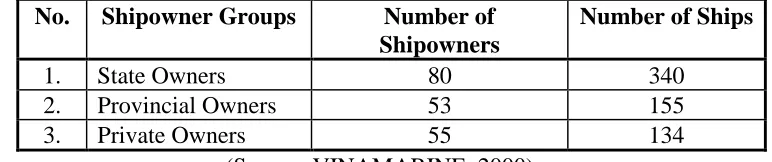
The Vietnamese mercantile fleet is owned by 188 owners, which are divided
into three main groups: State Owners, Provincial Owners and Private Owners. (sea
Table 1.3)
Table 1.3. Shipowner Groups
No. Shipowner Groups Number of Shipowners
Number of Ships
1. State Owners 80 340
2. Provincial Owners 53 155
3. Private Owners 55 134
(Source: VINAMARINE, 2000)
I.4.3 National Fleet’s Operation
At present, Vietnamese flags’ vessels operate on 30 international sea routes
and visit over 100 international seaports in the world. The total tonnage carried by
the national fleet is 11,440,576 tons in 1997, 12,866,309 tons in 1998 and 16,266,300
tons in 1999. This is an increase of 11% in international transportation and 34.7 % in
(in 1999). That is one of the difficult problems, Vietnamese Government wants to
solve it and increase this percentage.
I.4.4 Forecast Development of National Fleet
According to the development of the country’s economy, the forecast volume
of sea-borne trade and the situation of the national merchant fleet, VINAMARINE
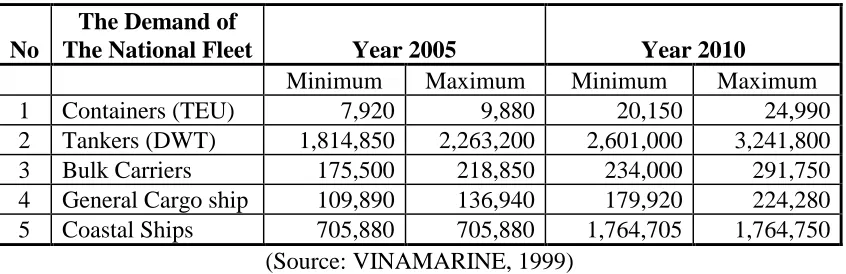
had makes a project namely “The Project of Planning and Developing Vietnamese
National Merchant Fleet up to 2010”. (See Table 1.4)
Table 1.4. The Development of the National Fleet Demand
No
The Demand of
The National Fleet Year 2005 Year 2010
Minimum Maximum Minimum Maximum
1 Containers (TEU) 7,920 9,880 20,150 24,990
2 Tankers (DWT) 1,814,850 2,263,200 2,601,000 3,241,800
3 Bulk Carriers 175,500 218,850 234,000 291,750
4 General Cargo ship 109,890 136,940 179,920 224,280
5 Coastal Ships 705,880 705,880 1,764,705 1,764,750
(Source: VINAMARINE, 1999)
The Project expected the national fleet will be able to carries about 25% of
total volume of Vietnamese sea-borne trade in the year 2005, and 35-40% in 2010.
I.5 The Commercial Port System
I.5.1 The Port System at Present
Vietnam has more than 100 ports of variety types are located along rivers and
the coast from the north to the south of the country. They form a very important chain
to contribute to the comprehensive infrastructure of transportation in the whole
country. Many of these ports are classified as capable of handling sea-going vessels
up to 30,000 DWT. Among them, Saigon and Haiphong are the largest ports, each
normally handling about six to ten million tons of cargoes per year. They are also the
main points of transhipment of goods to the whole northern and southern parts of the
country. Others such as Danang, Quangninh Vungtau and Cantho are now
The infrastructure of the port system includes several hundred berths with a
total length of more than 20 kilometers, over one million square kilometers of
warehouse and over two million square kilometers of cargo shed etc.
Management of the ports is grouped into the following five categories:
(1) Ministry in the central government (MOT, through VINAMARINE)
(2) Local government (provinces, cities)
(3) A general company in the shipping industry (VINALINES)
(4) State-owned enterprises under other ministries
(5) Public-owned enterprises under provinces and cities
In recent years, the total amount of cargo handled by Vietnamese ports has
increased year by year: 34 million tons in 1995, 36.65 million tons in 1996, 45.76
million tons in 1997, 56.89 million tons in 1998 and 67.54 in 1999
I.5.2 Forecast Volume of Cargoes Handled by the Port System
According to the forecast of VINAMARINE, the volume of cargoes handled
by the ports in Vietnam will increase rapidly. Table 1.5 shows the forecast up to year
2000.
Table 1.5.
Forecast Volume of Cargoes Handled by Vietnam’s Ports up to Year 2020
(Unit: tones)
Areas /Year 2003 2010 2020
The North 29,500,000 50,000,000 122,000,000 The Center 26,000,000 50,000,000 86,000,000 The South 50,500,000 103,000,000 187,000,000 Total 106,000,000 203,000,000 395,000,000
(Source: VINAMARINE, 1999)
I.5.3 Planning to Develop the Commercial Port System
“The Master Plan to Develop Vietnam’s seaport system up to year 2010” was
signed by the Prime Minister on 12 October 1999. Its stated aims are building new
ports, modernising the seaport system, building specialized ports, such as container
The Master Plan divided the port system into 8 groups based on the country’s
physical feature. The potential ports and international hub-ports, such as Dungquat
and Vanphong port, are also determined. The capacity of these national ports will be
106 million tones of cargo in 2003 and 203 million tones in 2010.
I.6 The Ship-building and Ship-repairing Industries
At present, the country has over 60 shipyards, building and
ship-repairing companies, with the capacity to build floating docks up to a maximum of
8,500 DWT, general cargo ships up to a maximum of 6,500 DWT and tanker of up to
3,500 DWT. They can also build patrol ships with speed up to 30 nautical miles and
fishing vessels with main engine capacity of up to 600 CV. These companies are also
able to repair a variety of ships over 100,000 DWT. Some of the major shipyards are
Bachdang Shipyard, Halong shipyard, Pharung Shipyard, Bason Shipyard and
HYUNDAI - VINASHIN.
Most of such units are under the control of the Vietnam Shipbuilding Industry
Corporation (VINASHIN), one of the State-owned Corporations. The others are
controlled by ministries, provinces and cities.
In the last decade, over 200 new ships were built in Vietnam. Most of them
are less than 1,000 DWT, and most of the machinery, equipment and materials were
imported. This results in variable quality. The reasons for it are that the companies
concerned are not technically advanced, the infrastructure of the shipyards is not
synchronism and their capacity limited, and the time taken to build a new ship is too
long. For instance, it takes about 15 months for a shipyard to build a new ship of
1,000 DWT with a length of 65 meters, and the quality of ship is not so high. Further
more, the industry has not met the development demand of the national fleet. Most
shipowners do not want to build new ships locally, they want to buy foreign
second-hand ships, saving money and time. Added to this, the lack of funding is a big
difficulty at present.
As part of their strategic planning, the Government is trying to subside,
who order ship in local shipyards priority subsidies for the government budget; which
the aim to improving and developing shipbuilding and shiprepairing industry in
Vietnam.
I.7 The Maritime Education and Training System
I.7.1 The Education and Training System
Maritime education and training in Vietnam is different from some other
maritime countries in the world. The pre-sea training is not compulsory for
acceptance to maritime university and training schools. During study at university or
training schools sea-training will be included in every academic year. The entry
qualifications for candidates, who want to join in Vietnam Maritime University, are
that they must have finished the secondary school and passed the national
examination for the university. For entry to the maritime secondary schools, a
certificate of finishing secondary school and an additional test are required.
Vietnam has one Maritime University, two Maritime Secondary Schools and
several Seafarer Training Centers as follows:
(1) Vietnam Maritime University (VIMARU):
Established on April 1st, 1956 in Haiphong city, VIMARU is the only
university in Vietnam, which offers courses leading to Bachelor degree, Diploma,
Master of Science, Doctorate and training courses required by the STCW 78/95 for
the Vietnamese maritime industry. VIMARU consists of the following faculties:
• Faculty of Navigation
• Faculty of Marine Engineering
• Faculty of Marine Electrical and Electronics Engineering
• Faculty of Economic of Sea Transport
• Faculty of Naval Architecture
• Faculty of Waterway Construction
• Faculty of Information Technology
It takes four and a half to five years for Bachelor courses and three and a half
years for Diploma courses. At present, VIMARU employs 558 lecturers, the total
number of students is 7,854 and the number of graduates is over 20,000.
(2) Maritime Secondary Schools:
The country has two Maritime Secondary Schools. One is located in
Haiphong and the another one in HoChiMinh city. These schools are mainly
crew-suppliers for the national mercantile fleet. It takes, normally, two years to complete
the deck and engine rating’s course, in which some months for sea training are
included. Those candidates who finish Maritime Secondary School can serve on
board ships as a sailor or oiler and after a certain period of experience at sea they can
sit examinations to qualify as captains, chief engineers of grades III and IV and
officers of the watch class III.
So far, school enrolments are 2,000 per academic year and about 20,000
students have been trained by these schools.
Being aware of the importance of maritime training and education to the
development of the national shipping industry, the Vietnamese Government has paid
much attention to upgrading the VIMARU and Maritime Secondary Schools in terms
of both quality and facilities in accordance with the STCW 78/95 and national
regulations.
I.7.2 The Vietnamese Seafarers and Manning
At the end of 1998, there were more than 20 thousand Vietnamese seafarers,
including 6,110 deck officers, 4,373 engineering officers, and other kind of officers
and sailors. Some of them were trained abroad in East European countries, (See
Table 1.6)
Table 1.6. Number of Seafarers in Vietnam
Capacity of Ship (GT)
Capacity of main engine
(KW)
Over 3,000 - Captain - Chief Mate - Deck Officer
179 327 921
Fr. 500 to 3,000 - Captain
- Chief Mate - Deck Officer
583 275 1,398
Fr. 100 to 500 - Captain
- Chief Mate - Deck Officer
943 56 104
Up to 100 - Captain
- Chief Mate - Deck Officer
1,226 104
Total 6,110
Over 3,000 - Chief Engineer
- Second Engineer Officer - Engineer Officer
183 248 737
Fr. 750 to 3,000 - Chief Engineer
- Second Engineer Officer - Engineer Officer
246 138 608
Fr. 150 to 750 - Chief Engineer
- Second Engineer Officer - Engineer Officer
894 103 317
up to 150 - Chief Engineer
- Second Engineer Officer
801 98
Total: 4,373
(source: VINAMARINE, 1999)
From early 1990s, they started working on the foreign ships; this is increased
year by year. For instance, in 1995 is 815, 1996 is 705, 1997 is 637, and 1998 is 780
CHAPTER II
THE CURRENT MARITIME ADMINISTRATION SYSTEM
AND MARITIME POLICY IN VIETNAM
II.1 General
The Maritime Administration is a part of the overall government
administration. The expression “Maritime Administration” means the Administration
of essential matters pertaining to the Maritime Sector in any country and calls for
specialised knowledge and skills of a high order. The object of a maritime
administration organisation within the frame work of a country’s overall maritime
activities is to provide the government with the machinery which would enable it to
satisfactorily and efficiently undertake those functions, which are embodied within
the country’s merchant shipping legislation (i.e. national maritime law). These
functions would include the implementation of the requirement of international
maritime conventions, national rules and regulations under the authority of the
merchant shipping Act.
Therefore, the roles and functions of maritime administration can be divided
into following categories:
1. Advisory functions,
2. Administrative functions,
3. Regulatory functions, and
4. Development/ promotional function.
In order to carry out these functions, the structure of a maritime
which enable it to advise the government on the adoption and implementation of the
national legislation and other regulations required for development of the country’s
maritime industry and for discharging the obligation of the government under
international conventions which is undertaken by government.
Generally speaking, different countries may have different structures of their
maritime administrations, depending upon their political systems or traditional
practices.
In Vietnam, from the end of 1950s, the government has paid attention to
setting up the Vietnamese Maritime Industry. Accordingly, special agencies,
responsible for maritime matters, were founded. They are under the control of the
Ministry of Transport (MOT) and they include General Department of Sea-way (it
changed to Vietnam National Maritime Bureau in 1992), Vietnam Inland Waterway
Administration (VIWA), and Vietnam Register of Shipping (it changed to Vietnam
Register in 1997). Such agencies exercise both technical, administrative and
commercial functions over the Vietnam Maritime Industry.
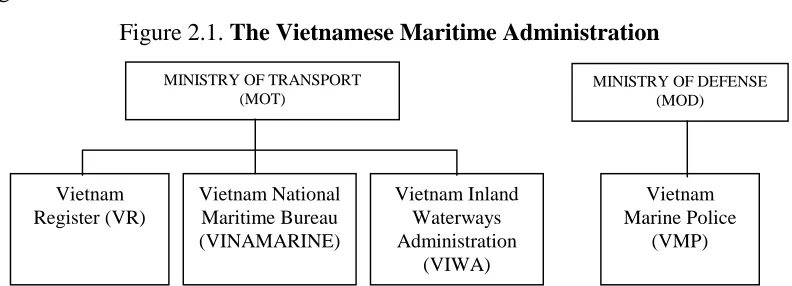
The Vietnamese Maritime Administration is currently organized as shown in
Figure 2.1
Figure 2.1. The Vietnamese Maritime Administration
MOT is the highest government body, of the government responsible for
overall maritime affairs in the whole country. It works through three executive
agencies, namely the Vietnam National Maritime Bureau (VINAMARINE), the
Vietnam Inland Waterways Administration (VIWA) and the Vietnam Register (VR).
MINISTRY OF TRANSPORT (MOT)
MINISTRY OF DEFENSE (MOD)
Vietnam Register (VR)
Vietnam National Maritime Bureau (VINAMARINE)
Vietnam Inland Waterways Administration
(VIWA)
Vietnam Marine Police
VINAMARINE is the national maritime administration in the whole country,
with control over all state-owned enterprises, private companies, organisations and
individuals.
IWB is a body exercising State management over the inland waterways,
communications and transport nationwide.
VR is a specialist support unit that acts as a classification society; it classifies
and issues technical certificates of sea-going vessels.
The Vietnam Marine Police (VMP) is under the control of the Ministry of
Defence, and is responsible for protecting the sovereign rights of Vietnam in the
Exclusive economic zone (EEZ) including sea areas and continental shelf.
In order to get an overall picture of the existing problems in the Vietnamese
maritime administration system, Vietnamese maritime legislation and maritime
policy, ranging from national level to local level, the following factors need to be
taken into account.
II.2 The Vietnam National Maritime Bureau (VINAMARINE)
II.2.1 VINAMARINE: A General Overview
VINAMARINE was established by the Ordinance of Vietnamese Government
No. 239/HDBT dated 29 June 1992, and the Decree No.31/TTg dated 2 February
1993 prescribed the rules of the organisation and the operation of VINAMARINE.
This organisation came into operation a few months later in July 1993. In fact, it was
the re-organised Vietnam Maritime Corporation. Under the control of MOT,
VINAMARINE is the powerful State-owned body that controls the Vietnamese
Shipping Industry as regards both administrative and commercial aspects. At that
time, it had a staff of about 30,000 working at headquarters and at 40 subsidiary
enterprises and agencies located through out the country.
The reform of Vietnam’s economic and social aspects has developed
considerably so far. It demands not only a proper economic policy but also a proper
Government has decided to change its role in the commercial field. All the major
ministries have had to give up direct control over business aspects. Accordingly,
VINAMARINE transferred its business enterprises to Vietnam National Shipping
Lines (VINALINES) and Vietnam Shipbuilding Industry Corporation (VINASHIN).
Its main functions, sine the end of 1995, have been in the areas of national shipping
policy making and maritime safety. This change affects dramatically the Vietnamese
Shipping Industry. It has created good opportunities not only for doing business with
more freedom but also for promoting more strongly competence in maritime
administrative affairs.
According to Article 1 of the Ordinance No. 239/HDBT, VINAMRINE is the
authority of state maritime administration in the whole country. On behalf of
Minister of Transport and being responsible to the Prime Minister, the Chairman of
the Bureau exercises the functions of the state administration over the maritime
sector throughout the country, including all state-run maritime units (belonging both
to central and local authorities) and non state-run maritime enterprises, organisations
and individuals (foreign organisations and individuals functioning in the territory of
Vietnam are also included). The organisation chart of VINAMARINE is shown in
Figure 2.2.
Under control of the MOT, VINAMARINE has main legal duties, rights and
functions as follows:
1. To work out strategy, a five year programme and long term plans for
development of the Vietnamese shipping industry throughout the country, and to
submit these to the minister of transport for his consideration, and thereafter, to
the prime minister, for approval.
2. Together with state competent authorities to join in domestic and foreign
investment projects of maritime infrastructure development in Vietnam. The
bureau also acts as investor/sponsor or as administrative agency for the maritime
Figure 2.2
Organisation Chart of Vietnam National Maritime Bureau
CHAIRMAN
Vice Chairmans
Headquarter Representative Offices Organisation under Direct Control
Port Authorities
Administration Hai Phong Vietnam Search and
Rescue Centre
Quang Ninh
People’s Inspection Dept. HCM City
Hai Phong
Sea-port Dept. Danang
Vietnam Maritime Safety (VMS)
Le Mon – Thanh Hoa
Finance and Accounts Dept.
Vietnam IMO Office
Vietnam salvage Corporation
Nghe Tinh Maritime Technical and
Training School I
Maritime Technical and Training School II
Maritime Project Management Unit I
Maritime
Vietnam
Maritime Construction Advisory Co.
Pilot Company I
Pilot Company II
Pilot Company III
Cai Lan Port
Nghe Tinh Port Song Hau Pilot Company
Qui Nhon Port
Nha Trang Port Maritime Legal Dept. Safety Inspection Dept. Personnel Dept. International Co-operation Dept. Thuan An Da Nang Qui Nhon Nha Trang Vung Tau Sai Gon Dong Thap My Tho
My Thoi – An Giang
Can Tho
Kien Giang
Nam Can – Minh Hai
Dong Nai Science and Technology
Dept.
Maritime Project Assessment Div.
STCW Standing Office
Hai Thinh
Register of Ships and Seafarers Office
Investment and Planning Dept. Shipping Transport Dept.
Maritime
3. To make out draft laws, ordinances, under-law circulars, regulations, policies,
rules of management, procedures and legal norms on maritime activities and
submit them to the Minister of Transport for his decision, as empowered, or for
his submission to the government, and to publish the circulars, giving guidelines
on their implementation.
4. To carry out international co-operation in shipping, to propose to the minister of
transport and the prime minister to join (or not to join) international conventions
or to sign shipping acts and protocols; under the authority of the Prime Minister
or of the Minister of Transport to sign shipping agreements with foreign countries
and join international shipping organisations and conventions. Together with
other competent authorities of the government to examine application for licenses
for co-operation and investment as well as for operation permits in the shipping
field.
5. Authorised by the minister of transport to promulgate the statutes of seaports and
declare their opening for navigation. The bureau also issues entry permits to
foreign ships and boats entering into the territorial waters of Vietnam in
accordance with the law of the Socialist Republic of Vietnam and international
shipping customs.
6. To issue the certificates of registry for sea-going vessels with dead weight
capacity of over 100 tons. To issue or withdraw the professional working permits
in shipping, register cards and sea-passes of the crew working on board ships
over 100 tons belonging to enterprises and individuals throughout the country.
The Bureau also presents to competent authorities for approval or approves as
empowered the new formation or upgrading of seaports and navigation aids
systems throughout the country and delivers permits, guidelines and control over
the statutory activities of shipping agents, shipbrokers, pilotage, maritime service
7. To co-ordinate and co-operate with domestic and regional countries’
organizations to effectively carry out the search, rescue and salvage operations for
vessels involved in accidents at sea.
8. To perform the procedures of shipping public notary as provided by laws.
9. To undertake and give guidance on research and application of shipping
technology as well as training, examination and certification of ship officers.
10.To furnish leading, inspection and control over the execution of laws, regulations
and state provisions in shipping. To investigate and settle violations regarding
shipping activities as empowered.
In order to give a better understanding of the maritime administration system
in Vietnam, the major agencies, which fall under the direct control of
VINAMARINE, will also be examined in parts below
II.2.2 Port Authorities
There are 19 Port Authorities located thought the country, each acting as the
local maritime administration in the area for which it is responsible maritime area.
The port authority system is a part of the national maritime administration as
provided in Article 58 of the Vietnamese Maritime Code: “A specialised agency
conducting maritime administrative tasks at sea-port waters and regional navigable
zones is referred to as a port authority”.
According to Decree No.639/TTg of the Vietnamese Government, dated 12
August 1997, the organisation, functions, duties and rights of a port authority are:
1. To work out strategy and plans for development of its sea-port area, under the
conduct of Chairman of VINAMARINE, and to supervise the implementation of
such plans.
2. To co-ordinates with state competent authorities to supervise the implementation
of national rules, regulations and ratified international conventions, relating to
maritime safety, prevention of marine environmental pollution and traffic order in
3. To monitoring traffic to ensure the safety of waterways. Not to permit vessels to
enter or leave the port if they are unseaworthy or fail to clear outstanding debts,
fines for violation of rules and regulations of the port.
4. To impose administrative fines for the violation of rules and regulations relating
to maritime navigation safety, environmental pollution prevention, maritime
sanitation and order.
5. To exercise temporary detention, maritime lien on sea-going vessels or to carry
out the warrant of arrest of sea-going vessels issued by the statutory state
competent authorities.
6. To grant permits for vessels, boats operating or persons working within the areas
under the control of the port authority, and to revoke such permits if such vessels,
boats or persons fail to maintain the conditions required for marine navigation
safety.
7. To organize search and rescue of vessels or people in distress in the areas under
the control of the port authority. To investigate the maritime casualties and
accidents that have occurred in the areas for which it is responsible.
8. To endorsing Ship’s Logbooks, Seamen’s Books, Ship’s Sea Protests and other
ship’s documents.
9. Under the direction of VINAMARINE, to carry out the Port State Control
procedure, according to Tokyo MOU, as regards foreign vessels and the flag state
implementation as regards Vietnamese flag’s vessels.
10.To supervising the adequacy depth of waterways, wrecks and other constructions
affecting the safety of the traffic channels.
When conducting maritime safety inspection and investigating maritime
casualties and accidents, the port authorities have a permanent link to
VINAMARINE for assistance and advice. This ensures that actions taken by port
authorities are considered carefully, especially in cases of detention of ships.
The Vietnam Maritime Safety Agency (VMS) was founded in May 1975, as
the sole agency responsible for maritime safety in Vietnam. The new administrative
framework was formed on 1 January 1995 with responsibility not only for
conventional aid to navigation services but also for new services such as search and
rescue, vessel safety, protection of the maritime environment and hydrography. It
also carries out maintenance once of the lighthouse and light beacon system in the
whole the country. At present, maritime safety services are carried out by the Office
of Maritime Safety (OMS) and the Service of Maritime Safety (SMS), which are
under the direct control of VMS, in the north and the south of Vietnam. The total
number of VMS staff is about 2,000. However it has insufficient staff and facilities
for performing its new functions.
II.2.4 Vietnam Maritime Safety Inspectorate (VMSI)
VMSI was founded by Prime Minister Decision No. 204/TTg dated 28
December 1992. This Decision gives VMSI powers to:
- Monitor implementation of all maritime regulations and international
conventions effecting Vietnamese and foreign ships which conduct
activities in Vietnam,
- Inspect sea-going vessels, their load and equipment, port facilities, marine
navigation and other related equipment,
- Order port authorities to investigate causes of accidents,
- Propose to VINAMARINE measures to ensure maritime safety and
environmental protection,
- Monitor safety standards of port authority activities, pilot and search and
rescue services,
- Promote dissemination of knowledge concerning maritime safety and
environmental protection.
The Decision defines the areas in which the inspectors have jurisdiction: not
only physical condition of ship but also qualifications and safety knowledge of crew,
VINAMARINE to stop, temporarily, activities of sea-going vessels if safety is
endangered. Levels of fines are defined in accordance with seriousness of violations
of the regulations. The Decision also defines in general terms the qualifications of the
VMSI, allowing lower ranked officers to operate with specialist knowledge in only
certain fields.
II.2.5 Vietnam Maritime Search and Rescue Co-ordination Center
(VMRCC)
This organisation was established in 1996 by decision No.
2628QD/TCCB-LD of Minister of Transport dated 2 October 1996. Under the control of
VINAMARINE, VMRCC commands directly and co-ordinates search and rescue
activities at sea of forces and units which belong to the Vietnam maritime industry. It
is also responsible for co-ordinating internal and external forces in order to search for
and rescue vessels in distress at sea.
The structure of this system includes VMRCC head-quarters in Hanoi and
three regional centres at Haiphong VMRCC in the north, Danang VMRCC in the
centre and VungTau VMRCC in the south. These regional centres perform SAR
services along the shore and offshore in the assigned area and region. Moreover, they
take responsibility of SAR co-ordination in adjoining areas if need, be according to
assigned command of VMRCC.
In addition, each port authority under VINAMARINE also has an SAR office
to co-ordinate SAR activities with the regional maritime SAR co-ordination centres
within the waters for which they are responsible.
The lack of facilities and human resource are a big problem, which makes it
difficult to carried out such duties so far: the number of staff is very few and they
now have not any rescue ship or helicopter etc. The Government has planned to build
6 new rescue ships. But they will only appear in the next few years.
To enhance the effectiveness of SAR service at sea, VMRCC needs to
modern and hi-technical facilities and competent personnel. Hopefully, this will be
done in the forthcoming years.
II.2.6 Vietnam Ship Communication and Electronic Company (VISHIPPEL)
The responsibility for administration of maritime communications was
transferred from the Post and Telecommunications Corporation to MOT in 1994.
Therefore, VISHIPPEL, under VINAMARINE, is charged with operating and
maintaining the communication system, includes five international registered coastal
radio stations and two national radio stations. Those seven stations are keeping watch
around the clock for search and rescue, medical assistance, weather forecasts at sea,
commercial services and so on.
The problems with present communications are that most of the facilities and
equipment of these coastal radio stations are very old and out of date. In addition, the
technical condition of most ships and other facilities in service at present are poor
and outdated. VISHIPEL now has plans to improve and increase the number of
coastal station along the country. The difficulty is the lack of modern facilities and
finances to improve and re-build these coastal stations.
II.3 The Vietnam Inland Waterways Administration (VIWA)
Normally, VIWA has not a part of Maritime Administration. But in fact,
according to physical and political features in Vietnam, VIWA has concerned with
Maritime Administration, that makes confuse with other maritime administrative
authorities. Therefore, this organisation also be examined.
Founded on 30 January 1993 by Decree No.08/CP of the Government, VIWA
is a body which administers the inland waterways communications and transport
nation-wide, including the communications and transport on rivers, lakes, canals,
coastal lines along bays, sea lanes from seashores to islands and between islands in
the inland waters (hereafter referred to collectively as inland waterways).
Figure 2.3.
The Organization Chart of VIWA
BOARD OF DIRECTORS Sub-office In HCM City Investment Planning Division Transport legislature Division
Science & Technology Division Finance & Accounting Division Inspection Division Administration Technical Equipment Division Personnel Division
Waterways Management Sections (No.1-No.14)
Stations 1-9 In North 10-14 in South
State Business Block State Management Block
Waterways Transport Co. WATCO No.1, WATCO No.2
Inland Ports
WT Means Overhauling Factory
(Produce Buoy & Signal)
Waterway surveying/ Designing Companies Waterways Communications Navigation Supporting Enterprise (Install Buoy & Signal)
Project management Board 1. Sub Office in South
2. MR TU PMU-SW
Technical & Professional Navigation Center No.1
(North)
According to Decision No. 3619/1998/QD-BGTVT of December 1998 of MOT,
the main tasks and power of VIWA are as follows:
1. To manage the planning and plans for maintenance of inland waterways systems.
To organize and direct the management, maintenance and exploitation of inland
waterways infrastructure and arrange the inland waterways traffic signal systems
in order to ensure the safety and efficient exploitation of the inland waterways
systems according to assigned responsibilities.
2. To elaborate and participate in the elaboration of bills, sub-law documents,
mechanisms and policies regarding the specialized inland waterways so that the
3. Minister of Communications and Transport submits them to competent bodies for
promulgation or promulgates them according to his/her competence.
4. To participate in drafting, negotiating and/or concluding international treaties on
inland waterways communications and transport; to propose the accession or
amendments to or extension, cancellation of international treaties on inland
waterways communications and transport, which Vietnam has signed or acceded
to, for submission to the Minister of transport for decision.
5. To organize, guide and inspect the implementation of the Ministry’s legal
documents on inland waterway communications and transport nation-wide. To
propose to the Minister of Transport matters related to the management of inland
waterways communications and transport so that the Minister of Transport
promulgates them according to his/her competence or proposes to the government
for promulgation.
6. To elaborate the strategy, planning, long-term, five-year and annual plans on
inland waterways communications and transport development nation-wide so that
the Minister of Transport submits them to the government for approval.
7. Communications and transport services or public work services (regarding the
assigned plan or goods production order) in the management and/or maintenance
of the inland waterways and the execution of investment plans for construction of
8. To publicize the inland waterways communications lines; to license the use of
water areas on the inland waterways managed by the central government. To
announce the opening and closure of inland ports and ferries under its
management on the inland waterways controlled by the central government; to
perform the administrative tasks and powers at the inland ports and ferries.
9. To elaborate planning, plans and policies for inland waterways transport and the
development of transport means suited to the situation on waterways and rivers
so that the Minister of Transport may submit them to the government for
promulgation or promulgate them by him/herself according to his/her
competence. To guide, organize and inspect the implementation thereof.
10.To perform the registration of inland waterways transport means; to issue permits
for river-going vessels according to existing Vietnamese law and relevant
international conventions
11.To supervising the training and examination of inland waterways means operators
as well as the granting and changing of driving licenses therefor throughout the
country according to competence. To organize the granting and changing of
licenses for river ship captains and chief mechanics as prescribed by the MOT.
II.4 The Vietnam Register
The Vietnam Register (VR) was founded in 1979 and subjected to major
reorganisations in 1980 and 1997. According to the Vietnamese Government
Ordinance No. 75/Ttg, dated 3 February 1997, on duties, rights and organisation of
VR: “VR, which is under direct control of MOT, is to carry out the professional
management functions of technical safety and quality registration and certification for
all kinds of transport means, offshore installations, floating structures and their
equipment, relating to the transport field, which are intended for seaway, railway,
roadway, inland waterway and offshore sector. ”
On the one hand, VR is the only organisation in Vietnam to carry out
national standards, rules and regulations or the requirements of the international
conventions which Vietnam has signed.
On the other hand, VR is permitted to carry out surveys and issue required
safety certificates and tonnage certificates to foreign sea-going ships under the
authorisation of foreign classification societies, or at the request of a competent
Vietnamese authority or of a shipowner.
Foreign ship registers are only permitted to carry out their services in Vietnam
under co-operation agreements with VR and with the acceptance of the ministry of
transport, as stated in Articles 2 and 6 of the Prime Minister’s decision No 203/Ttg
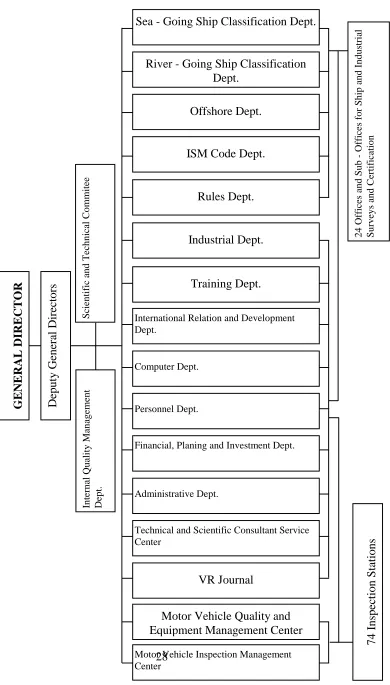
dated 28 December 1992. Figure 2.4 shows a structure of this organisation
The VR has main duties and functions as follows:
1. To organise and carry out technical and scientific research;
2. To draft rules and regulations, and other related technical legal documents for
safety and quality of the objectives which are under scope of service of VR, to
submit to the ministry of transport or ministry of science-technology and
environment for consideration, approval and promulgation;
3. To review and approve technical designs for the construction, repair, renewal or
reinstallation of sea-going ships as well as river-going ships;
4. To carry out inspections/testing and issue relevant certificates for materials,
equipment and components intended for the objects which are under scope of
service of VR;
5. To carry out surveys/inspections to river-going ships, sea-going ships, floating
structures, offshore installations, motor vehicles, work machines, locomotives
and carriages, boilers, pressure vessels, lifting appliances, containers, etc. , under
construction/manufacture, conversion, repair or assembly;
Figure 2.4. The organisation chart of the Vietnam Register
Sea - Going Ship Classification Dept.
River - Going Ship Classification Dept.
Offshore Dept.
ISM Code Dept.
Industrial Dept. Rules Dept.
International Relation and Development Dept.
Training Dept.
Computer Dept.
Personnel Dept.
Financial, Planing and Investment Dept.
Administrative Dept.
Technical and Scientific Consultant Service Center VR Journal GE NE RAL DIRE CT OR
Deputy General Directors
In tern al Qu ality Man ag em en t Dep t. 24 O ffi ces and S
ub - O
7. To issue relevant certificates in compliance with the requirements of the rules
and regulations, technical standards and the international conventions;
8. To measure, calculate and issue the tonnage certificate according to the
international convention on tonnage measurement of ship 1966 or the national
regulation;
9. To carry out audit and issue certificates as required by ISM Code and in
conformity with ISO 9000.
With 70 agencies and service centers and number of technical staff of about 400
located whole the country, VR has had now extended its technical service activities
over the transport industry in Vietnam. It also had technical co-operation with other
classification associates such as the Russian Register of Shipping, the Germannischer
Lloyd, the Lloyd’s Register (LR) and the Bureau Veritat (BV).
II.5 Vietnam Marine Police
Vietnam Marine Police (VMP) is established by the Ordinance on Vietnam
Marine Police, which was ratified by Vietnamese parliament on 28 March 1998.
Under the control of MOF (see Figure 2.5), the main duties of VMP are to exercise
the State sovereign jurisdiction and control over Vietnamese territorial waters, EEZ
and continental shelf. VMP also co-operates with other related authorities, including
foreign authorities, in search and rescue, oil pollution protection, piracy and
anti-smuggling patrols at sea.
Figure 2.5. The Vietnam Marine Police Diagram
As it was only established two years ago, VMP still lacks the human resources,
facilities and detailed legislation, which it needs to carry out its duties.
MINISTRY OF DEFENCE (MOD)
Vietnam Marine Police (VMP)
Patrol Zone No.1
Patrol Zone No.2
Patrol Zone No.3