* Corresponding Author;
Address:Public Health Nutrition Research Group, Rowett Institute of Nutrition and Health, Greenburn Rd, Bucksburn, Aberdeen, AB21 9SB, UK
Validation of Simple Epidemiological or Clinical Methods for the Measurement
of Body Composition in Young Children
Diane M Jackson1*, PhD; Zoe Donaghy2, PhD; Kurosh Djafarian3, PhD; John J Reilly2, PhD
1Public Health Nutrition Research Group, Rowett Institute of Nutrition and Health, University of Aberdeen, Bucksburn, Aberdeen, UK, 2University of Glasgow Medical Faculty, Division of Developmental Medicine, Yorkhill Hospitals, Glasgow, Scotland,3Clinical Nutrition Department, School of Nutritional Sciences and Dietetics, Tehran University of Medical Sciences, Tehran, Iran
Received:Oct 10, 2013; Accepted:Aug 16, 2014;First Online Available:Aug 16, 2014
Abstract
Objective:The present study aimed to determine the validity of simple epidemiological and clinical methods for the assessment of body fatness in preschool children.
Methods:In 89 children (42 boys, 47 girls; mean age 4.1 SD 1.3y) measures of body fatness were made using total body water (TBW), dual energy x-ray absorptiometry (DXA), air displacement plethysmography (BODPOD) and skinfold thickness. Methods were compared by Bland–Altman analysis using TBW as the reference method, and by paired comparisons and rank order correlations.
Findings:Bias for DXA was +1.8% body fat percentage units (limits of agreement +15.5% to -11.9%), bias for BODPOD was -3.5% (limits of agreement +18.9% to -5.9%) and bias for skinfolds using the Slaughter equations was -6.5% (limits of agreement +10.0% to –23.1%). Significant rank order correlations with TBW measures of fatness were obtained for DXA estimates of fatness (r=0.54,P=0.01), but not for estimates of fat by skinfold thickness (r=0.20,P=0.2) or BODPOD (r=0.25,P=0.1). Differences between both DXA and BODPOD and the reference TBW estimates of body fatness were not significant (P=0.06 and P=0.1 respectively); however, the difference in estimated body fatness between skinfold thickness and TBW was significant (P<0.001).
Conclusion:Estimates of body fatness in preschool children were inaccurate at the level of the individual child using all the methods, but DXA might provide unbiased estimates and a means of making relative assessments of body fatness.
Iranian Journal of Pediatrics, Volume 24 (Number 5), December 2014, Pages: 685-691
Key Words:Body Composition; Preschoolers; DXA; TBW; Skinfold Thickness; BODPOD; Body Fatness
Introduction
Body composition methodology is often considered as being central to obesity research, and important to many other aspects of public health nutrition and clinical nutrition[1-3]. Body
composition is an important topic in clinical nutrition research, particularly in the case of
certain disease states as it can provide valuable information regarding the natural history of these diseases, along with an improved understanding of the success of nutritional care[2,4-7]. There has
been increasing interest in the pediatric clinical applications of body composition[1], due partly to
pediatric clinical nutritional practice. Even methods traditionally considered to be limited to small-scale applications, such as dual energy x-ray absorptiometry (DXA), are being used increasingly in large-scale studies of nutritional epidemiology, such as birth cohort studies[12].
One major concern over the use of body composition methodology is accuracy. The validation of body composition methods requires them to be compared against a reference method of greater accuracy[9,10]. While ‘multi-component’
models provide the highest accuracy[1,2], use of
multi-component models in pediatric validation studies presents practical problems and as a result has been very rare, and confined largely to small studies, with <20 participants per age/sex group[3]. Of the ‘two-component’ methods of
measuring body composition total body water (TBW) should, theoretically, have the greatest accuracy[9], and this has been confirmed by
empirical studies[9,11]. Therefore, measurements of
body fatness derived from TBW can be used as a reference method for the validation of other less accurate body composition methods, and the practical utility of TBW measurement permits larger sample sizes than have been achieved in validation studies involving multi-component models[3]. A literature search carried out prior to
the present study identified no validation studies of body composition methods in preschool children (3-5 year olds). The aim of the present study was therefore to assess the accuracy of several simple body composition methods in healthy preschool children relative to the TBW method.
Subjects and Methods
A convenience sample of participating children was recruited to the Rowett Assessment of Childhood Appetite and Metabolism (RASCAL) study[12]. Verbal consent was obtained from
children to participate in the study, and their parents gave informed written consent. The research was approved by the Grampian Research Ethics Committee. All measurements were taken by trained researchers at the Human Nutrition Unit, Rowett Research Institute, Scotland, UK.
Measurements of body fatness were made using four body composition methods in all participating children: Dual energy x-ray absorptiometry (DXA), total body water (TBW), air displacement plethysmography (BODPOD) and Skinfold thickness. Body weight of the children were measured using a digital scale of high precision (OHAUS Corporation, Pine Brook, USA, model: CD11) to the nearest 0.1 kg. Height was also measured using a standard stadiometer to the nearest 0.1 cm (Holtain Ltd, Crymych, Dyfed, Wales). For descriptive purposes, height, weight and BMI of children were converted into age and sex corrected BMI standard deviation scores (SDS), using the UK 1990 reference data[13].
Body composition from TBW was used as the reference method. A fasting ‘baseline’ urine sample was collected, after which each child received an oral dose of 2 H labeled water based on their weight. At 2, 4, and 6 hours after dosing, further urine samples were collected. Each sample was analyzed in duplicate and the mean value was used for analysis to determine the plateau enrichment of 2 H. Dilution space of 2 H was calculated as described elsewhere[1]and TBW was
assumed to be 4% smaller than 2 H space. From the measurement of TBW, fat free mass (FFM) and fat mass (FM) were calculated using age and gender specific constants for the hydration of fat-free mass in children[14].
Total body FFM and FM were measured using DXA with the Norland XR-26, Mark ІІ high speed pencil beam scanner equipped with dynamic filtration, using version 2.5.2 of the Norland software (Norland Corporation, Fort Atkinson, WI, USA). For the duration of the scan, the subject lay on a bed quietly and was scanned from head to foot, which took around 15 minutes.
Calibration of the volume of the BODPOD chamber was carried out with a known standard and weighing scales were also calibrated against a known weight of 20 kg, prior to measurements. The barometric pressure and relative humidity of the room were recorded, along with temperature (a constant temperature of 24-26°C). The procedure was fully explained to children and they were asked to wear a swimsuit and bathing cap as clothing was found to have an effect on the
volume[15], and the cap helped minimize
isothermal air trapped within the hair[16]. Children
and relaxed for two measurements of around 50 seconds each; during this the subject’s raw body volume was obtained. If agreement between the two measures of body volume was within 150 ml, the two trials were averaged, but if they were not, then a third trial was performed in attempt to obtain two trials with volume measures within 150 ml. Bodpod software was used to provide the estimates of body fatness used in the present study.
Skinfold thickness measurements were made in duplicate (or triplicate where necessary) at the biceps and triceps site by a trained observer. The biceps and triceps site were used in conjunction with the ‘Slaughter’ equations[17], these equations
had highest accuracy relative to a reference method in older children[18]. The prediction
equations used were as follows:
Subjects with sum of two skinfolds < 35mm:
% body fat Boys = 0.21 (sum of two skinfolds)–0.008 (sum of two skinfolds 2)–1.7%
% body fat Girls = 1.33 (sum of two skinfolds)–0.013 (sum of two skinfolds 2)– 2.5.
Subjects with sum of two skinfolds >35mm:
% body fat Boys = 0.783 (sum of two skinfolds)–1.7 % body fat Girls = 0.546 (sum of two skinfolds)+9.7
Measures of body fat (%) obtained from the TBW measures were used as the reference method, and the estimates of fatness compared against the TBW measured body fat (%) values. Validity of DXA, BODPOD and skinfold thickness for the estimation of body fatness was assessed by calculating biases and limits of agreement (bias±t.SD) relative to the measures of fatness provided by the TBW method following the method of Bland–Altman[16]. Bland-Altman focuses
on the individual differences between methods and aims to provide an assessment of agreement between two methods.
The differences between paired observations, was also assessed for statistical significance using paired t tests between the body fatness measure obtained from TBW and from each method. Finally, the ability of DXA, BODPOD and skinfold thickness to make relative assessment of body fatness was assessed by using the Spearman’s rank order correlations between estimates of body fatness (%) from each method and that provided by TBW. Rank order correlations are useful to test whether approximate relative ranking is similar between the reference method and other methods, and may be particularly informative for epidemiological applications of body composition measures in childhood[3].
No power calculation was performed in the present study, but in previous validation studies of body composition in older children and adolescents samples of around 20-30 children have been adequately powered to detect agreement at the individual level and the presence of meaningful biases between methods, achievable because disagreement between methods is usually very marked[3,9,18]. The present study therefore
aimed to recruit samples of at least 30 children for each paired comparison of methods.
Findings
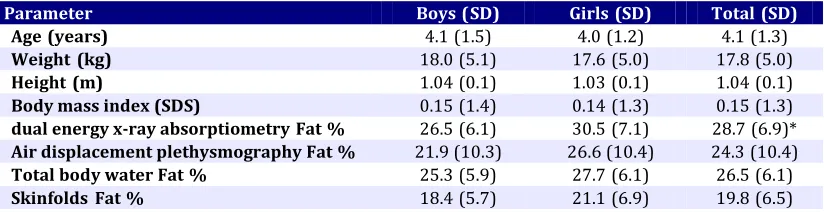
[image:3.612.102.514.609.715.2]Eighty nine Caucasian children, forty two boys and forty seven girls, mean age 4.1 y (SD 1.3) participated in the present study (Table 1). All were asked to take part in all of the body composition measurement techniques. Some children refused to take part in some of the measures, or did not comply adequately, and these
Table 1:Characteristics of Study Participants
Parameter Boys (SD) Girls (SD) Total (SD)
Age (years) 4.1 (1.5) 4.0 (1.2) 4.1 (1.3)
Weight (kg) 18.0 (5.1) 17.6 (5.0) 17.8 (5.0)
Height (m) 1.04 (0.1) 1.03 (0.1) 1.04 (0.1)
Body mass index (SDS) 0.15 (1.4) 0.14 (1.3) 0.15 (1.3)
dual energy x-ray absorptiometry Fat % 26.5 (6.1) 30.5 (7.1) 28.7 (6.9)*
Air displacement plethysmography Fat % 21.9 (10.3) 26.6 (10.4) 24.3 (10.4)
Total body water Fat % 25.3 (5.9) 27.7 (6.1) 26.5 (6.1)
Skinfolds Fat % 18.4 (5.7) 21.1 (6.9) 19.8 (6.5)
were marked as missing/invalid data and not used in the analyses shown here. Numbers (percentages) of missing/invalid data from each method were as follows: TBW 22 (25%); DXA 34 (38%); BODPOD 59 (66%); Skinfolds 29 (33%). The amount of missing and invalid data also provides an indication of the practical utility of the various techniques in this age group. For the entire sample of children mean BMI SD score was +0.15 (SD 1.31), 11 children were obese (BMI above the 95th percentile for UK 1990 reference data), and 5 overweight (BMI between 85th and 95th percentiles).
Bland-Altman plots of the differences in body fatness (%) between measures derived from TBW and DXA, BODPOD, and skinfold thickness, are shown in Figures 1-3 respectively. With a mean fatness of 26.5% (SD 6.1) by TBW, bias for DXA was+1.8% (limits of agreement+15.5% to -11.9%), bias for BODPOD was 3.5% (limits of agreement +18.9% to -25.9%) and bias for skinfolds was -6.6 (limits of agreement +10% to –23.1%). The limits of agreement between each method and the reference were generally wide (Fig. 1-3). Paired comparisons with the reference method (TBW) were also made for each method and the significance of differences assessed by paired t-test. Differences between DXA and TBW and between BODPOD and TBW estimates of body fatness were not statistically significant (DXA: 95% CI for the paired difference –0.1 to +3.7;
P=0.06 BODPOD: 95% CI for the paired difference
+0.7 to-7.8%; P=0.1). The difference between
estimates of fatness from skinfolds and TBW was statistically significant (95% CI for the paired difference –8.7 to –4.4%;P<0.001).
Rank correlations with the reference method (TBW) were positive and significant for DXA (r=0.54, P<0.001). However, estimates of fatness
from BODPOD (r=0.25, P=0.2) and skinfold
thickness (r=0.20, P=0.1) measures were not
significantly rank correlated with measures by TBW.
Discussion
To our knowledge the present study was the first validation study of body composition methods
[image:4.612.317.532.71.209.2]r=-0.20,P=0.1
Fig. 1:Bias (solid line) and limits of agreement (broken lines) between total body water measures of body fatness and dual energy x-ray absorptiometry estimates of fatness in young children (n=55).
[image:4.612.316.525.276.406.2]r=0.53,P=0.002
Fig. 2: Bias (solid line) and limits of agreement (broken lines) between total body water measures of body fatness and air displacement plethysmography estimates of fatness in young children (n=32).
r=0.06,P=0.6
Fig. 3:Bias (solid line) and limits of agreement (broken lines) between total body water measures of fatness and skinfold thickness estimates of fatness in young children (n=60).
[image:4.612.315.536.475.626.2]were used were fairly inaccurate at the level of the individual child, with wide limits of agreement between each method and the reference. There are no directly comparable studies in preschool children, however validation studies in older children and adolescents report broadly similar findings: relatively wide limits of agreement are
common, indicating poor accuracy of
epidemiological and clinical body composition methods at the level of the individual child or adolescent[3,9-11,18,20-22]. The present study
therefore adds evidence from young children to a growing body of evidence which suggests that most body composition methods are inadequate in terms of accuracy for individuals in most pediatric populations. The significant rank order correlations for estimates of fatness from DXA with TBW measures of fat observed in the present study provide some support for the use of the combination of DXA hardware and software used in the present study in providing relative assessments of fatness in preschool children. Skinfold thickness and BODPOD estimates of fatness were not significantly rank correlated with measures of fatness from TBW. Combined with the evidence from the Bland-Altman analysis, the present study suggests that BODPOD commercial hardware and software, and skinfolds using the Slaughter equations, are probably not useful for providing quantitative assessments of body fatness in individual young children.
The present study suggests that caution is required when making estimates of body fatness using simple clinical and epidemiological methods in healthy young children, and errors in estimation of body fatness in disease states might be expected to be even greater, because violations in body composition model assumptions are usually greater in individuals with chronic disease[20,23].
The present study had a number of weaknesses. It was focused on the accuracy of estimation of body fatness, however other concepts[24] such as
precision are also important when deciding when to, or whether to use body composition methods. Nevertheless, the findings in relation to accuracy of the various methods are sufficiently clear for informing choice of method. Compliance with the different body composition methods by the preschool children in the present study varied substantially between the methods. Non-adherence to the measurement protocols, or
refusal to participate in certain methods, may reflect the inherent difficulty in obtaining body composition measures in young children, even when recruiting a convenience sample in a research setting. Non-adherence and/or refusal might be even more of a problem among more representative samples, or in clinical settings. Access to all of the different potentially useful clinical and epidemiological methods of estimating body fatness in children was not available in the present study. Of particular note, bioelectrical impedance (BIA) was not used. This may be potentially important as BIA is a particularly practical method for epidemiological and clinical use with children, though validation studies in older children tend to suggest poor agreement between different variants of BIA and reference methods[9,11,20]. It is also possible that use of
different variants of DXA, or skinfolds, or BODPOD, by using different prediction equations, or by not relying on manufacturer’s software, might have improved the accuracy of the estimates observed from the various techniques in the present study.
However, the observations of relatively large error at the level of the individual child in the present study are consistent with evidence from older children and adolescents[2,3,9-11,20-22], and in
some studies even larger biases have been observed for the techniques tested in the present study, so there is no indication that biases and individual errors are specific to preschool body composition studies[3]. The results of recent
published systematic review indicated that the most equations are suitable for population-based researches; however some concerns still arise on an individual basis[25]. In addition, DXA have
several limitations in assessment of body composition in young children including difficulties in bone edge detection during scan analysis, and difficulties in the accurate interpretation of DXA data in children as bone size, pubertal stage, skeletal maturation, ethnicity and body composition are needed to be considered[26-28].
Conclusion
body composition methods was limited in young children, and the accuracy of three of the methods was poor at the level of the individual child. Of the three methods tested against TBW derived measures of fatness, the present study is probably most supportive of DXA. However, the present study suggests that all body composition methods should be used with caution in young children. Further research aimed at improving the accuracy and practical utility of these simple clinical and epidemiological methods of body composition in young children, or research aimed at developing new methods, would be desirable.
Acknowledgment
The authors have no conflicts of interest to declare. The authors thank the RASCAL families for their participation in the study. The study was funded by the Scottish Executive Environmental and Rural Affairs Department (SEERAD) and Tehran University of Medical Sciences scholarship to Kurosh Djafarian. The funding body had no role in the content of the manuscript or the decision to publish.
Authors’ Contribution
D.M. Jackson: Concept/design, data analysis/interpretation, critical review and revision of manuscript
Z. Donaghy: Manuscript preparation/ data analysis/ interpretation
K. Djafarian: Data collection and analysis/interpretation, critical review and revision of manuscript
J. J. Reilly: Data analysis/ interpretation, critical review and revision of manuscript.
All authors contributed extensively to the work presented and approved the final version of the paper.
Conflict of Interest:None
References
1. Wells JCK, Fewtrell MS. Measuring body
composition,Arch Dis Child2006; 91(7):612-7.
2. Wells JC, Fewtrell MS. Is body composition important for paediatricians ?.Arch Dis Child2008; 93(2):168-72.
3. Reilly JJ, Gerasimidis K, Paparacleous N, et al. Validation of dual energy x-ray absorptiometry and foot-foot impedance against deuterium dilution measures of fatness in children. Int J Pediatr Obes
2010; 5(1):111-5.
4. Goon DT. Fatness and fat patterning as independent
anatomical characteristics of body composition: a
study of urban South African children.Iran J Pediatr
2013; 23(4):423-9.
5. Mirhosseini NZ, Shaha S, Ghayour-Mobarhan M, et
al. Body fat distribution and its association with cardiovascular risk factors in adolescent Iranian
girls.Iran J Pediatr2012; 22(2):197-204.
6. Arvay JL, Zemel BS, Gallagher PR, et al. Body composition of children aged 1 to 12 years with Biliary Atresia or Alagille syndrome. J Pediatr Gastroenterol Nutr2005; 40(2):146-50.
7. Barera G, Mora S, Brambilla P, et al. Body composition in children with celiac disease and the effects of a gluten free diet: a prospective case control study.Am J Clin Nutr2000; 72(1):71-75. 8. Ness AR, Leary SD, Mattocks C, et al. Objectively
measured physical activity and fat mass in a large
cohort of children.PLOS Med2007; 4(3):e97.
9. Wells JCK, Fuller NJ, Dewit O. Four component model of body composition in children: density and hydration of fat free mass and comparison with simpler methods.Am J Clin Nutr1999; 69(5): 904-12.
10. Reilly JJ. Assessment of body composition in infants
and children.Nutrition1998; 14(10):821-25.
11. Parker L, Reilly JJ, Slater C, et al. Validity of six field and laboratory methods for measurement of body
composition in boys.Obes Res2003; 11(7):852-8.
12. Jackson DM, Djafarian K, Stewart J, et al. Increased television viewing is associated with elevated body fatness but not with lower total energy expenditure in children.Am J Clin Nutr2009; 89(4):1031-6. 13. Cole TJ, Freeman JV, and Preece MA. Body mass
index reference curves for the UK, 1990. Arch Dis Child1995; 73(1):25-9.
14. Fomon SJ, Haschke F, Ziegler EE, et al. Body composition reference children from birth to age 10
years.Am J Clin Nutr1982; 35(5 Suppl):1169-75.
15. Shafer KJ, Siders WA, Johnson LK, et al. Interaction of clothing and body mass index affect validity of air displacement plethysmography in adults. Nutrition
2008; 24(2):148-54.
16. Fields DA, Hunter GR, Goran MI. Validation of the BODPOD with hydrostatic weighing: influence of body clothing.Int J Obes Relat Metab Disord2000; 24(2):200-5.
17. Slaughter MH, Lohman TG, Boileau RA, et al. Skinfold equations for estimation of body fatness in
children and youth.Hum Biol1988; 60(5):709-23.
18. Reilly JJ, Wilson J, Durnin JVGA. Determination of body composition from skinfolds: a validation study.
Arch Dis Child1995; 73(4):305-8.
19. Bland JM, Altman DG. Statistical methods for assessing agreement between two methods of clinical measurement. Lancet 1986; і:307-10. 20. Williams JE, Wells JC, Wilson CM, et al. Evaluation of
the DXA Lunar Prodigy for assessing body composition in healthy persons and patients by comparison with the criterion 4 component model.
21. Wong WW, Hergenroeder AC, Stuff JE, et al. Evaluating body fat in girls and female adolescents:
advantages and disadvantages of DXA.Am J Clin Nutr
2002; 76(2):384-9.
22. Shypaillo RJ, Butte NF, Ellis KJ. DXA; can it be used as a reference for body fat measurements in children?
Obesity (Silver Spring)2008; 16(2): 457-62.
23. Elia M. Body composition analysis: an evaluation of 2 component models, multi-component models and
bedside techniques.Clin Nutr1992; 11(3):114-27.
24. Gately PJ, Radley D, Cooke CB, et al. Comparison of body composition methods in overweight and obese children.J Appl Physio (1985)2003; 95(5):2039-46. 25. Silva AS, Fields DA, Sardinha LB. A PRISMA-driven
systematic review of predictive equations for assessing fat and fat-free mass in healthy children
and adolescents using multicomponent molecular models as the reference method. J Obes2013 (In press).
26. Bachrach LK. Dual energy X-ray absorptiometry (DEXA) measurements of bone density and body
composition: promise and pitfalls. J Pediatr
Endocrinol Metab2000; 13(Suppl 2):983-8.
27. Leonard MB, Shults J, Elliott DM, et al. Interpretation of whole body dual energy X-ray absorptiometry measures in children: comparison with peripheral
quantitative computed tomography. Bone 2004;
34(6):1044-52.
28. Helba M, Binkovitz LA. Pediatric body composition analysis with dual-energy X-ray absorptiometry.