
T h e o p e n – a c c e s s j o u r n a l f o r p h y s i c s
New Journal of Physics
Relativistic plasma surfaces as an efficient second
harmonic generator
M J V Streeter1,2,8, P S Foster1,3, F H Cameron1, M Borghesi3, C Brenner1,4, D C Carroll4, E Divall1, N P Dover2, B Dromey3, P Gallegos1,4, J S Green1, S Hawkes1, C J Hooker1, S Kar3,
P McKenna4, S R Nagel2, Z Najmudin2, C A J Palmer2, R Prasad3, K E Quinn3, P P Rajeev1, A P L Robinson1, L Romagnani3,5, J Schreiber2,6,7, C Spindloe1, S Ter-Avetisyan3, O Tresca4, M Zepf3 and D Neely1,4
1Central Laser Facility, STFC, Rutherford Appleton Laboratory,
Didcot OX11 0QX, UK
2Blackett Laboratory, Imperial College London, London SW7 2AZ, UK 3School of Mathematics and Physics, Queen’s University Belfast,
Belfast BT7 1NN, UK
4Department of Physics, SUPA, University of Strathclyde,
Glasgow G4 0NG, UK
5LULI, École Polytechnique, CNRS, CEA, UPMC, route de Saclay,
91128 Palaiseau, France
6Max-Planck-Institut für Quantenoptik, Garching, Germany
7Department für Physik, Ludwig-Maximilians-Universität München,
Garching, Germany
E-mail:[email protected]
New Journal of Physics13(2011) 023041 (10pp) Received 17 November 2010
Published 24 February 2011 Online athttp://www.njp.org/
doi:10.1088/1367-2630/13/2/023041
Abstract. We report on the characterization of the specular reflection of 50 fs laser pulses in the intensity range 1017–1021W cm−2 obliquely incident
with p-polarization onto solid density plasmas. These measurements show that the absorbed energy fraction remains approximately constant and that second harmonic generation (SHG) achieves efficiencies of 22±8% for intensities approaching 1021W cm−2. A simple model based on the relativistic oscillating mirror concept reproduces the observed intensity scaling, indicating that this is
6. Conclusions 9
Acknowledgments 9
References 9
1. Introduction
With increasing laser intensity and decreasing pulse duration, plasma-based optics become a more attractive way of temporally and spatially manipulating ultrashort laser pulses [1]. They can also be used to generate harmonics of the laser frequency as the result of two main processes, which are described by the coherent wakefield emission (CWE) [2] and the relativistically oscillating mirror [3,4] (ROM) models. For the case of p-polarized interactions these processes are both capable of generating second harmonic emission in the specular direction with conversion efficiencies predicted to be in excess of 40% [5]. The conventional method for second harmonic generation (SHG) for laser applications is frequency doubling through nonlinear interactions in birefringent crystals, such as potassium dihydrogen phosphate (KDP), which achieves similar efficiencies for femtosecond laser pulses. However, this also produces adverse effects, such as pulse stretching by group velocity dispersion, self-phase modulation and self-focusing [6, 7], which can reduce the spatial coherence of the beam. These nonlinear effects are considered to have an appreciable detrimental effect when the B -integral exceeds unity, where B=2πλ−01R n2I(z)dz for laser wavelength λ, intensity I and propagation axis z, and wheren2 is the Kerr nonlinearity of the medium. In the case of a 15 J 50 fs laser9 with a beam diameter of 15 cm, using a 300µm KDP crystal would introduce a B-integral of ∼10, which would limit the subsequent maximum achievable intensity [8]. By contrast, harmonics produced from the surface of solid target interactions do not stretch the pulse [9] and exhibit very high spatial coherence as long as the target remains flat throughout the interaction [10,11].
CWE occurs as electron bunches, pulled out of the plasma by the component of the electric field that is parallel to the density gradient [12], are accelerated up the plasma density gradient generating plasma oscillations in their wake. As the electrons are temporally bunched at intervals of the laser period, plasma frequencies that are integer multiples of the laser frequency are resonantly excited, generating harmonics up to the plasma frequency corresponding to the maximum density of the target. In the ROM process, the region from which the laser
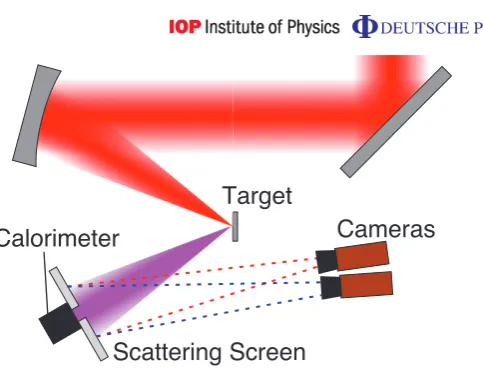
Figure 1. Schematic diagram of the experimental setup showing the focusing geometry and the specular reflectivity monitor.
of frequency ω0 is reflected, given by the critical density ncrit=ω20me0/e2, is considered
to oscillate in the laser field. Since the reflection point moves during the period of the driving pulse, the phase of the reflected wave is redistributed. In particular, as the critical density surface moves towards the laser, it compresses the pulse, creating rapid changes in phase, resulting in the generation of high harmonics. The motion of the surface is a function of the intensity, angle of incidence and polarization, as well as the local density gradient, which dictates the restoring force of the plasma opposing the displacement due to the laser field.
These mechanisms are differentiated by their intensity dependence [13] and the phase of the resultant harmonics [9]. There is also a maximum harmonic cutoff for CWE corresponding to the maximum plasma density [2], whereas the maximum ROM harmonic number is dictated byγmax, the maximum relativistic gamma factor of the critical surface motion [14].
The plasma scale length, defined asL =ne(dne/dx)−1at the critical density surface, where
ne is the electron density, has an important role in determining the efficiencies of both methods
of harmonic production [15, 16]. This is difficult to measure directly during experiment, but the variation of scale length with intensity can be qualitatively determined by monitoring the specularly reflected laser energy [17].
2. Experimental setup
The experiment was carried out using the Astra Gemini laser [18], which delivered 12 J in a 50 fs pulse at the central wavelength λ0=800 nm. Figure 1shows the setup in which an f/2 parabola focused the laser onto targets at 35◦ angle of incidence with p-polarization to create a focal spot with 2.5µm full-width at half-maximum (FWHM) containing ∼35% of the laser energy. The contrast, defined as the ratio of the intensity of the preceding amplified spontaneous emission (ASE) to the peak intensity, was measured using a scanning autocorrelator as 10−6. Double plasma mirrors [19] were used to increase this to 10−10. The intensity on the target was varied in the range of 1017–1021W cm−2 by defocusing the focal spot by moving the focusing
Figure 2.Images of the specularly reflected beam. The top line shows the 800 nm (ω0) and the second line the 400 nm (2ω0) images from the same shots. The small hole at the bottom of the beam, visible in theω0image, is caused by a hole in a mirror at the output of the compressor used for pulse length measurement. The central hole was used to calibrate the camera for energy measurements. Note that the brightness of the 2ω0image for 1017W cm−2has been multiplied by a factor
of 10 to make it visible on the same scale.
The specularly reflected light from the target was incident on a plastic scattering screen, which was imaged by two cameras, each with an interference filter, one centred at 800 nm with 25 nm bandwidth, corresponding to the fundamental frequency ω0, and the other centred at 400 nm with 10 nm bandwidth to observe the second harmonic 2ω0. The screen covered an angular range equivalent to an f/0.62 cone and had a 31 mm diameter circular aperture cut in the centre to allow direct energy calibration with a surface absorbing calorimeter. Several low-intensity shots were taken to ensure that almost all the energy incident on the energy meter was at ω0 with a relatively uniform intensity profile, providing a calibration of the camera signal with the calorimeter. The 400 nm camera was calibrated relative to the 800 nm camera by taking into account the relative responses of the cameras and the opacity of their respective filters at the relevant wavelength. The reflected energy for each wavelength was measured by integrating the signal on the scattering screen, compensating for the holes and edges of the screen. This adjustment was typically∼10% of the total energy.
3. Experimental results
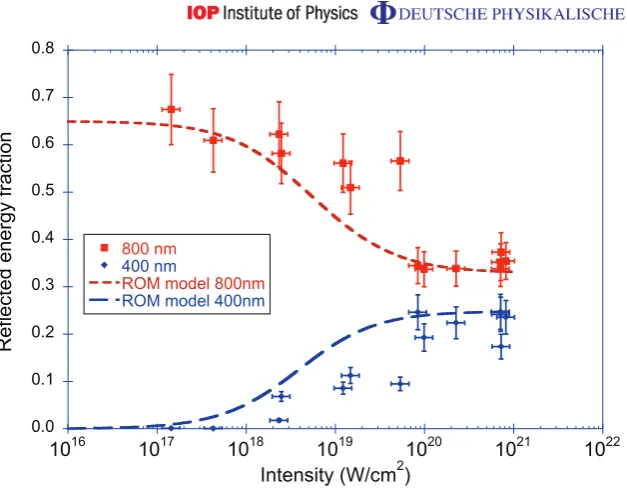
Figure 3. Energy incident onto the scattering screen as observed at 800 nm (squares) and 400 nm (diamonds). Vertical error bars are combined calibration and measurement errors. In the region near the focus, the intensity was calculated as the mean within the FWHM radius; away from the focus, it is the mean intensity within the beam radius. The dashed lines represent the results of the ROM model.
The observed 400 and 800 nm energy on the screen as a fraction of incident laser energy is shown in figure 3. Measurements of the specular 400 nm beam show the conversion efficiency to 2ω0 increasing to 22(±8)% as the intensity rises up to 1021W cm−2 and is consistent with
a previous work [21] giving a >5% efficiency at 1019W cm−2. The energy converted to 2ω0
represents a significant fraction of the incident laser energy and accounts for most of the reduction in reflected 800 nm energy.
The reflected ω0 beam profile shows a loss of brightness while retaining the same beam structure as the intensity is increased. Higher spatial frequency modulations will be spread over a larger area in the focal plane and thus will be reflected from regions of lower intensity, which retain high reflectivity. The lower spatial frequencies, however, will be concentrated in the high-intensity regions, where they are preferentially attenuated by nonlinear processes such as absorption, scattering, transmission or frequency conversion. This would give rise to the high-frequency modulations seen at the highest intensities and is analogous to spatial filtering with a high-pass filter.
The profile of the second harmonic beam matches theω0 beam profile at lower intensities, although for I >1019W cm−2 it becomes more centrally peaked. The 2ω0 beam is also
v⊥=
2aαc
a2+α2+ 1, vk=
(a2−α2+ 1)c
a2+α2+ 1 , (2)
whereais the normalized vector potential andαis a constant of integration.
For the ROM model any drift velocity will be eliminated as long as the average position of the solid surface is assumed to remain constant. This is done by finding the value ofαfor which the time-averagedvkis zero. Equations (2) can then be integrated to give the particle position as a function of time. The projection of this particle motion onto the target normal axis gives the surface motion of the oscillating mirror.
The phase of the reflected beam is redistributed by the motion of the reflecting surface, and as the periodicity of the plasma surface is phase locked to the laser field, this results in harmonics being generated in the reflected pulse.
The reflected pulse at a point is given by
Er=E0sin(ω0t0), (3)
where E0is the amplitude of the electric field and
t0=t+2z 0cosθ
c . (4)
Here, t0 and z0 are the retarded time and position, respectively, andθ is the angle of incidence. The retarded position is the position of the surface when the laser light that passed a fixed point at timet reflects off it. This position is obtained numerically, which allows the reflected field to be calculated. The plasma surface motion is calculated for the given intensity, whereas the input field is given a sin2(t/T)-intensity envelope where T is the pulse length, which is set to 50 fs. Figure4shows the motion of the ROM and the electric field distribution for intensities ranging from 1017to 1020W cm−2, showing the increasing nonlinearity in the reflected pulse due to the
Doppler redistribution of photon energy.
The Fourier transform of the reflected field gives the spectral content and the strengths of
Figure 4. Two cycles of (a) the plasma surface position and (b) the reflected electric fields, normalized to the maximum amplitude at each intensity, given by the ROM model (the deviation from the input field is negligible for 1017W cm−2).
τ is the period of the laser.
Figure 5.Specular reflectivity intoω0and 2ω0given by the model and measured experimentally. Potential calibration errors are not included in the error bars in order to allow easier relative comparison with the model.
and also displays the saturation in SHG efficiency and ω0 reflectivity at the level determined experimentally.
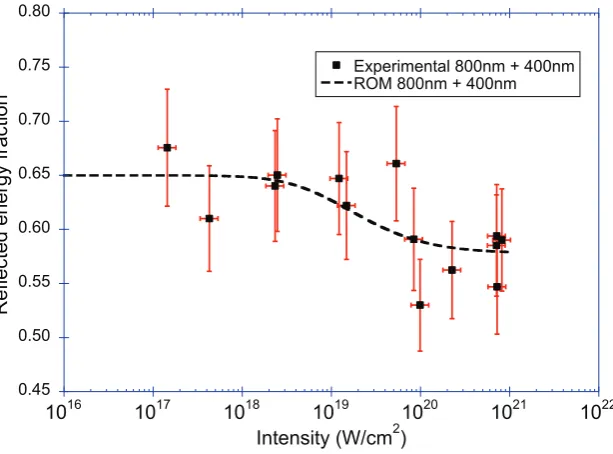
[image:7.595.151.458.335.562.2]Figure 6. Reflectivity as a function of intensity. Combined ω0 and 2ω0 signal from this experiment plotted alongside data previously collated in [17]. Note the contrast quoted here is the ratio of energy in the ASE to that in the main pulse (as opposed to intensity contrast as used elsewhere in this paper).
5. Discussion
Both the measurements and the model show that the efficiency of SHG here is intensity dependent and becomes efficient only in the relativistic regime Iλ2>1018Wµm cm−2 [15].
The good agreement between the two indicates that the ROM process is dominant. CWE, on the other hand, is only weakly dependent on intensity and is efficient at intensities above 1016W cm−2 [2], which implies that it is unlikely to be a major contribution to our observed
SHG. However, the scale length of the plasma at the time of the interaction, which has a significant effect on the efficiency of harmonics generated by either process [15, 16], was not measured directly.
Figure6shows that thetotalspecular reflectivity (combinedω0and 2ω0) of the plasma was approximately constant over the intensity range 1017–1021W cm−2. This puts an upper limit on the plasma absorption which does not significantly change with intensity, unlike previous results [23, 24]. This disagreement may be due to the differing relationship between intensity and plasma scale length for the different experiments. For the high-contrast interactions studied here, the plasma scale length will have remained relatively short over the intensity range. Hence, we did not observe the rapid decrease in reflectivity seen previously above a certain threshold intensity, for lower contrast measurements. This emphasizes the importance of the plasma scale length in determining the absorbed fraction of laser energy in this intensity range [25,26].
There is a close correlation between the reflectivity for this experiment and for the EASE/E =2×10⁻⁵ (energy contrast) data set taken with Astra, which has the same front end
6. Conclusions
The conversion efficiency for the generation of second harmonic was observed to be 22(±8)% for intensities greater than 1020W cm−2. This conversion efficiency is comparable to that
achievable with an optimized KDP frequency doubling crystal, but without the problems of pulse stretching and reduced spatial coherence, provided the quality of the plasma surface is maintained. Optimizing this process would allow for extremely high-contrast, high-intensity laser–plasma interactions with 400 nm femtosecond pulses.
A model based on the relativistic oscillating mirror concept agrees well with the observed reflectivities. This indicates that this is the dominant mechanism for SHG for the intensity range 1017–1021W cm−2 for ultrashort pulses with high contrast. The model also suggests that
the conversion efficiency into the second harmonic with this process saturates at ∼22% for intensities>1019W cm−2at 35◦ angle of incidence.
In addition, the specular reflectivity of the plasma reveals that plasma absorption remains almost constant over four orders of magnitude in intensity. We attribute this difference to previous measurements to be due to their much lower laser contrast in comparison to the experiment described here. The 8% drop in reflectivity, which is observed for intensities
>1019W cm−2, indicates that extra absorption, scattering or higher harmonic generation
processes are occurring in this range.
The high reflectivity at high intensities is obviously advantageous when attempting to optimize the conversion of laser energy into high harmonics. The ROM model suggests that 7% of the reflected energy can be attributed to higher harmonic generation, but the measurement of high harmonics at these high intensities with these high-contrast ultrashort pulses remains to be realized.
Acknowledgments
We are grateful to the Central Laser Facility for excellent support. The experiment was performed as part of the LIBRA Basic Technology consortium (grant no. EP/E035728/1).
References
[1] Gold D M 1994 Direct measurement of prepulse suppression by use of a plasma shutterOpt. Lett.192006–8
[2] Quéré F, Thaury C, Monot P, Dobosz S, Martin P, Geindre J-P and Audebert P 2006 Coherent wake emission of high-order harmonics from overdense plasmasPhys. Rev. Lett.96125004
[3] Bulanov S V, Naumova N M and Pegoraro F 1994 Interaction of an ultrashort, relativistically strong laser pulse with an overdense plasmaPhys. Plasmas1745–57
[4] Lichters R, Meyer ter Vehn J and Pukhov A 1996 Short-pulse laser harmonics from oscillating plasma surfaces driven at relativistic intensityPhys. Plasmas33425–37
[5] Gibbon P 1996 Harmonic generation by femtosecond laser–solid interaction: a coherent ‘water-window’ light source?Phys. Rev. Lett.7650–3
[6] Marcinkeviˇcius A, Tommasini R, Tsakiris G D, Witte K J, Gaiˇzauskas E and Teubner U 2004 Frequency doubling of multi-terawatt femtosecond pulsesAppl. Phys.B79547–54
[7] Mironov S, Lozhkarev V, Ginzburg V and Khazanov E 2009 High-efficiency second-harmonic generation of superintense ultrashort laser pulsesAppl. Opt.482051–7
absorptionPhys. Rev. Lett.104135001
[17] Pirozhkov A Set al2009 Diagnostic of laser contrast using target reflectivityAppl. Phys. Lett.94241102
[18] Hooker C Jet al2006 The Astra Gemini project: a dual-beam petawatt Ti : sapphire laser systemJ. Physique IV133673–7
[19] Ziener C, Foster P S, Divall E J, Hooker C J, Hutchinson M H R, Langley A J and Neely D 2003 Specular reflectivity of plasma mirrors as a function of intensity, pulse duration and angle of incidenceJ. Appl. Phys.
93768–70
[20] Spindloe C and Lowe H F 2006–7 White light interferometric profiling of ultra-thin foil high power laser targetsCLF Annu. Rep. 247
[21] Horlein R et al 2008 High contrast plasma mirror: spatial filtering and second harmonic generation at 1019W cm−2New J. Phys.10083002
[22] Landau L D and Lifshitz E M 1975The Classical Theory of Fields(Oxford: Pergamon) pp 112–3
[23] Ping Yet al2008 Absorption of short laser pulses on solid targets in the ultrarelativistic regimePhys. Rev. Lett.100085004
[24] Davies J R 2009 Laser absorption by overdense plasmas in the relativistic regime Plasma Phys. Control. Fusion51014006
[25] Haines M, Wei M, Beg F and Stephens R 2009 Hot-electron temperature and laser-light absorption in fast ignitionPhys. Rev. Lett.1021–4

![Figure 6. Reflectivity as a function of intensity. Combined ω0 and 2ω0 signalfrom this experiment plotted alongside data previously collated in [17]](https://thumb-us.123doks.com/thumbv2/123dok_us/1688121.122185/8.595.150.465.88.339/reectivity-function-intensity-combined-signalfrom-experiment-alongside-previously.webp)
