GST polymorphisms and
arsenic related skin lesions
The Harvard community has made this
article openly available. Please share how
this access benefits you. Your story matters
Citation
McCarty, Kathleen M, Louise Ryan, E Andres Houseman, Paige L
Williams, David P Miller, Quazi Quamruzzaman, Mahmuder Rahman,
et al. 2007. “A Case-Control Study of GST Polymorphisms and
Arsenic Related Skin Lesions.” Environmental Health 6 (1). https://
doi.org/10.1186/1476-069x-6-5.
Citable link
http://nrs.harvard.edu/urn-3:HUL.InstRepos:41426797
Terms of Use
This article was downloaded from Harvard University’s DASH
repository, and is made available under the terms and conditions
applicable to Other Posted Material, as set forth at
http://
BioMedCentral
Environmental Health
Open Access
Research
A case-control study of
GST
polymorphisms and arsenic related skin
lesions
Kathleen M McCarty*
1,2, Louise Ryan
3, E Andres Houseman
3,
Paige L Williams
3, David P Miller
2, Quazi Quamruzzaman
4,
Mahmuder Rahman
4, Golam Mahiuddin
4, Thomas Smith
2,
Ernesto Gonzalez
5, Li Su
2and David C Christiani
2Address: 1Yale University School of Medicine, Epidemiology and Public Health, Division of Environmental Health Sciences, New Haven, CT, USA, 2Harvard School of Public Health Department of Environmental Health, Boston, MA, USA, 3Harvard School of Public Health Department of Biostatistics, Boston, MA, USA, 4Dhaka Community Hospital, Dhaka, Bangladesh and 5Massachusetts General Hospital, Boston MA, USA
Email: Kathleen M McCarty* - [email protected]; Louise Ryan - [email protected]; E
Andres Houseman - [email protected]; Paige L Williams - [email protected]; David P Miller - [email protected]; Quazi Quamruzzaman - [email protected]; Mahmuder Rahman - [email protected]; Golam Mahiuddin - [email protected];
Thomas Smith - [email protected]; Ernesto Gonzalez - [email protected]; Li Su - [email protected]; David C Christiani - [email protected]
* Corresponding author
Abstract
Background: Polymorphisms in GSTT1, GSTM1 and GSTP1 impact detoxification of carcinogens by GSTs and have been reported to increase susceptibility to environmentally related health outcomes. Individual factors in arsenic biotransformation may influence disease susceptibility. GST activity is involved in the metabolism of endogenous and exogenous compounds, including catalyzing the formation of arsenic-GSH conjugates.
Methods: We investigated whether polymorphisms in GSTT1, GSTP1 and GSTM1 were associated with risk of skin lesions and whether these polymorphisms modify the relationship between drinking water arsenic exposure and skin lesions in a case control study of 1200 subjects frequency matched on age and gender in community clinics in Pabna, Bangladesh in 2001–2002.
Results and discussion: GSTT1 homozygous wildtype status was associated with increased odds of skin lesions compared to the null status (OR1.56 95% CI 1.10–2.19). The GSTP1 GG polymorphism was associated with greater odds of skin lesions compared to GSTP1 AA, (OR 1.86 (95%CI 1.15–3.00). No evidence of effect modification by GSTT1, GSTM1 or GSTP1 polymorphisms on the association between arsenic exposure and skin lesions was detected.
Conclusion: GSTT1 wildtype and GSTP1 GG are associated with increased risk of skin lesions.
Background
Arsenic exposure through drinking water is a global prob-lem, and has reached crisis status in Bangladesh [1-5]. A
well established exposure-response relationship exists between arsenic level of drinking water and skin
Published: 6 February 2007
Environmental Health 2007, 6:5 doi:10.1186/1476-069X-6-5
Received: 18 May 2006 Accepted: 6 February 2007
This article is available from: http://www.ehjournal.net/content/6/1/5 © 2007 McCarty et al; licensee BioMed Central Ltd.
lesions[6,7]. Skin lesions are considered one of the most distinctive endpoints of chronic arsenic exposure[8]. It has been proposed that there are differences in suscep-tibility to arsenic due to individual genetic variability in biotransformation of the metal[9]. Polymorphisms in
GST genes have been associated with susceptibility to a range of diseases, and GST polymorphisms alone and in concert with environmental exposures are associated with disease outcomes and behavior of several enzymes [10-12]. Glutathione S-transferases (GST) are a superfamily of enzymes that are key in the detoxification step of Phase II metabolism, usually by catalyzing the conjugation of reduced glutathione (GSH) into hydrophobic and elec-trophilic compounds along with other Phase II enzymes [10-12]. In vivo studies have shown that GSH serves as a reducing agent required for the reduction of arsenate to arsenite[13]. GSH also serves as a reducing agent in the methylation of arsenic from arsenite to MMM (V) and from MMA (III) to DMA (V) [13]. GST activity is involved in the metabolism of endogenous and exogenous com-pounds, including catalyzing the formation of arsenic-GSH conjugates[13,14]. Animal data had demonstrated that these conjugates are transported by multidrug resist-ant protein transporters (MRP) from the liver to the bile [14-17]. Glutathione and related enzymes are also involved in cellular protection against reactive oxygen species (ROS) [11,12]. Chronic arsenic exposure has been shown to alter glutathione metabolism and cellular redox status and maintenance of cellular redox state may have an important role in arsenic related pathology[14,18,19]. The biologic control of GST enzymes is multifaceted in that they demonstrate specific patterns of expression that depend on sex, age, tissue, and species and vary between individuals [11,20]. GSTM1, GSTT1 and GSTP1 are mem-bers of the Mu (μ), Theta (θ), and Pi (π) classes respec-tively[10]. Polymorphisms in GSTT1, GSTM1 and GSTP1
alone or in concert with environmental exposures may be associated with increased susceptibility to environmen-tally related diseases such as cancer and other clinical out-comes[10,12]. The GSTT1 null and GSTM1 null genotypes are deletion polymorphisms and have no θ or μ -glutath-ione S transferase activity respectively. The GSTP1 poly-morphism is a single base pair substitution where adenine is replaced by guanine resulting in an amino acid change in which isoleucine (I105) is replaced by valine (V105),
pos-sibly resulting in lower enzyme activity[21,22]. At higher arsenic exposure, increased GST activity may be associated with saturation of MRP transporters allowing increased tissue accumulation[14]. We hypothesized that elevated glutathione-S-transferase activity, specifically activity of glutathione-μ,θ, and π transferases, may be associated with increased risk of skin lesions.
We investigated the relationship between GSTT1, GSTM1, and GSTP1 polymorphisms and skin lesions. In addition, we assessed possible effect-modification by GST geno-types in modifying the risk of arsenic related skin lesions using well water arsenic concentration to estimate expo-sure.
Methods
Study population
This study was conducted in the Pabna district of Bangla-desh, located north of Dhaka on the Pabna (Ganges) River. Pabna was chosen for the following reasons: ele-vated arsenic was suspected in some of the region's vil-lages due to proximity to the River; Dhaka Community Hospital (DCH) has a well established clinic network in the area; and Pabna is representative of socioeconomic status of much of non-urban Bangladesh. Eligible cases were Pabna residents, at least 16 years of age, with one or more type of skin lesion: diffuse/spotted melanosis, dif-fuse/spotted keratosis, hyperkeratosis, or leukomelanosis. One physician made the diagnosis, and treatment was provided at DCH when necessary. Controls were healthy individuals diagnosed as free of skin lesions and arsenic related disease randomly selected in a 1:1 ratio from Pabna, age of at least 16 years, living in the same village as cases but not sharing a tube well. Controls were also fre-quency matched to cases based on gender and age (+/- 3 years). To ensure heterogeneity of exposure and to prevent overmatching on exposure, controls were further selected so as to ensure that 80% were in "low-exposure" arsenic (<50 μg/l) communities and 20% were from suspected "high exposure" (≥50 μg/l) areas. This last ensured that the exposure distribution among controls matched that which has been reported for the Pabna region as a whole[23].
Initial measurements of well arsenic levels were made with Merck field test kits[24]. Individuals found to have arsenic exposure greater than 50 μg/l were advised of alter-native drinking water sources. The participation rate was 98.0%; a total of 24 subjects from 1224 declined to partic-ipate. Cases and controls had similar reasons for refusal. The population is ethnically homogenous, and similar to the population of Bangla (West Bengal), India. Informed consent was obtained from all study participants. The study protocol was approved by the Institutional Review Boards at Dhaka Community Hospital, Bangladesh and Harvard School of Public Health Boston, MA, USA.
Interviews and sample collection
lit-Environmental Health 2007, 6:5 http://www.ehjournal.net/content/6/1/5
ers of water/liquid ingested per day, disease history, resi-dential history including identification of the primary water source (tube well), years of use, and use of a previ-ous tube well.
Collection of well water samples was designed to mini-mize bias. Due to the fact that "high" exposure (≥50 μgAs/ l) wells were often painted red and "low" exposure wells (<50 μgAs/l) were often painted green, the field team would have known if they had some indication as to whether the well was above or below 50 μg As/l. However, the field team did not know the arsenic concentration of the well at the time the subject was examined and inter-viewed, a procedure similar to a study in West Bengal [25]. Additionally, it has been documented that wells are often mislabeled[26]. Thus, the field team was blind to the true exposure level of the subjects at the time case status was determined. Water samples were analyzed in the United States and the field team received results after subjects were enrolled.
Upon collection of each 100 ml water sample two drops (0.2 ml) of pure nitric acid was added. The samples were stored in a cooler before storage in a 4°C refrigerated room. Analysis of each sample for arsenic concentration was completed using Environmental Protection Agency (EPA) method 200.8 with Inductively Coupled Plasma Mass Spectroscopy (ICP-MS) (Environmental Laboratory Services, North Syracuse, New York)[27]. The method limit of detection was 1 μg As/l.
Two 10 ml EDTA tubes were used to collect blood and were stored in a cooler on ice until processed with cell lysis solution. Samples were sent to the Molecular Epide-miology Laboratory at Harvard School of Public Health for DNA extraction and genotyping.
Genotyping
DNA samples were stored at -80°C. The GSTM1 and
GSTT1 genetic polymorphisms were evaluated using a previously described multiplex PCR technique[28].
GSTP1 polymorphism was genotyped by the 5' nuclease assay (TaqMan) using the ABI Prism 7900HT Sequence Detection System (Applied Biosystems, Foster City, CA). The primers, probes, and reaction conditions are available upon request. Genotyping for GSTT1 and GSTM1 was completed for 1062 subjects, and genotyping for GSTP1
was completed for 1101 subjects. Laboratory personnel were blinded to case status, and a random 5% of the sam-ples were repeated to validate genotyping procedures. Two authors independently reviewed all results with 100% concordance.
Statistical analysis
Analysis was restricted to subjects who reported using the same well greater than 6 months to minimize potential for temporal variability in well arsenic concentration. Since subjects were frequency matched by age and sex, these variables were included in all regression mod-els[29,30]. Arsenic concentration and volume of liquid consumed per day were not combined as a dose variable, since liquid volume included juice, milk, soup, tea, and water. Data exploration using generalized additive models (GAMs), implemented in R (version 1.8.1), suggested that the log-odds of case status varied linearly with the arsenic concentration of well water; consequently untransformed arsenic concentration was used as a continuous predictor of case status. The models suggested that the log-odds of case status had a nonmonotonic relationship with BMI; therefore a quadratic term for BMI was included. To facil-itate numerical stability, both linear and quadratic terms for BMI were centered at the median BMI value, 19.1. Consolidated categories for educational status and age were established.
Univariate analyses were performed to describe popula-tion characteristics and to identify possible data errors and/or outliers. Continuous variables were summarized using means, medians, standard deviations and ranges, while categorical variables were described using percent-ages. Bivariate analyses (chi-squared tests or t-tests, as appropriate) were conducted explore differences between cases and controls prior to multivariate modeling. The fre-quency distribution of the GSTT1, and GSTM1 polymor-phisms were tested among controls to ensure Hardy-Weinberg equilibrium. The heterozygote and homozygote variant were not combined for GSTP1.
Multiple unconditional logistic regression was used to evaluate the associations between arsenic exposure in drinking water on case status. Odds Ratios were obtained from the regression models, as were their 95% confidence intervals. Regression models were fit using Statistical Analysis Systems (SAS Institute Inc, Cary NC) version 8.2. Two different analyses were done to investigate: 1) the associations of GST polymorphisms with skin lesions, adjusting for well arsenic concentration and 2) the modi-fication of the relationship between well arsenic concen-tration and skin lesions by GST polymorphisms. The joint effects (interaction) of arsenic exposure and each of the genes were evaluated in additive and multiplicative mod-els. Categorical variables were created for measures of arsenic exposure: drinking water arsenic concentration <50 μg/l and ≥50 μg/l. The deletion polymorphisms
heter-ozygote variant and the homheter-ozygote variant might be associated with risk of developing skin lesions compared to wildtype. Variables were created for each combination of arsenic exposure and genotype, with the reference cate-gory being low arsenic exposure and either GSTT1 null,
GSTM1 null or GSTP1 wildtype AA. Adjusted ORs and 95% CIs were evaluated for deviation from the expected null value on the additive or multiplicative scale. Interaction Contrast Ratios (ICR) and Bootstrap Percentile Method 1 (BP1) 95% CIs were calculated to quantify departure from additivity[31]. Synergy on the additive scale is implied by ICRs greater than zero. ICRs of zero imply no additive effects on the additive scale. Antagonism on the additive scale is implied by ICRs less than zero[32]. To estimate interaction on the multiplicative scale adjusted ORs and 95% CIs were estimated in separate logistic regression models with interaction terms for each genotype and arsenic exposure as a continuous variable. Likelihood ratio tests were conducted comparing adjusted models with main effects for GSTT1, GSTM1 or GSTP1 and arsenic exposure and an interaction term compared to the same model excluding the interaction term.
Sensitivity analysis was conducted by varying weights of controls selected having a well concentration less than 50
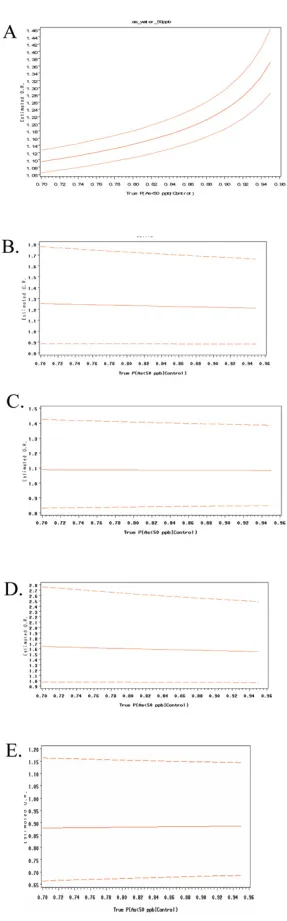
μg/l in a weighted logistic regression analysis as described previously[33]. Briefly, this method was used to deter-mine whether the percentage of controls selected from suspected high and low arsenic areas impacted the stabil-ity of the ORs of all of the covariates in the regression models. The weighting varied between 70%–95% of con-trols with suspected low exposure (<50 μg As/l) and 30% -5% of controls with suspected high exposure (≥50 μg As/ l). Results can be examined graphically in Figure 1.
Results
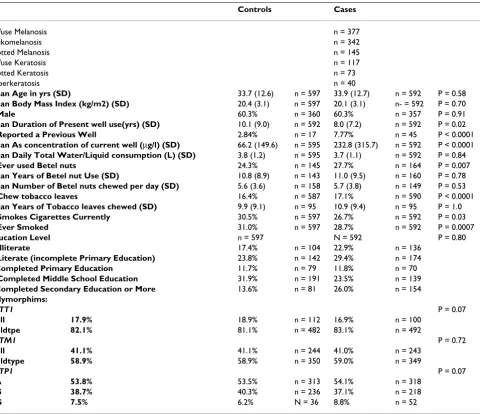
Demographic data are presented in Table 1. Of 592 cases, diffuse melanosis accounted for 31.7% of the cases (n = 377), followed by leukomelanosis (n = 342), spotted melanosis (n = 145), diffuse keratosis (n = 117), spotted keratosis (n = 73) and hyperkeratosis (n = 40). Subjects often had multiple types of lesions. Cases and controls were not significantly different in terms of age, BMI or gender. Controls reported using their current well for a longer duration (p = 0.02), and, conversely, cases reported a higher frequency of previous well use (p = 0.007). As expected, cases had significantly higher well arsenic con-centrations (p < 0.0001). No significant difference in total liquid consumption was observed. A higher proportion of cases reported betel nut use (p = 0.007), however there was no significant difference between cases and controls in terms of years of betel nut use (p = 0.78) and number of betel nuts chewed daily (p = 0.53). A higher proportion of cases reported chewing tobacco use (p < 0.0001), how-ever there was no difference in years of chewing tobacco
use. Conversely, a higher proportion of controls reported current cigarette use (p = 0.03) and ever having smoked (p = 0.0007). Educational status was not significantly differ-ent between cases and controls. Table 1 shows the geno-types frequencies for GSTM1 and GSTT1 and allele frequencies for GSTP1 among cases and control subjects. The crude frequencies of the GST SNPs were not signifi-cantly different between cases and controls.
The main effects for each genotype on skin lesions adjusted for well arsenic concentration was shown in Table 2. The GSTT1 wildtype gene carried a higher risk of skin lesions compared to the null polymorphism (OR = 1.56 (95%CI 1.10–2.19). Compared to the reference cat-egory GSTP1 AA, the GG genotype had a 86% increase odds of skin lesions (OR = 1.86 95%CI 1.15–3.00). We were not able to detect a significant association with
GSTM1 genotype and skin lesions. All models were adjusted for well As level, L/day of total liquid, previous well use, age, sex, education, BMI, chewing tobacco, betel nut use, and smoking status.
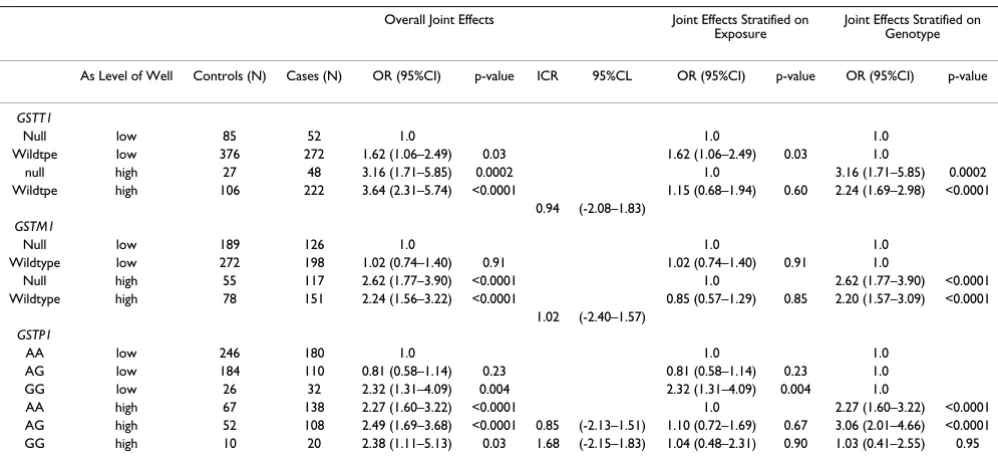
Adjusted ORs for the joint effects of well arsenic exposure and each GST polymorphisms on skin lesions are shown in Table 3. Reference categories were low arsenic exposure and GSTM1 null, GSTT1 null or GSTP1 AA, respectively. When the results were stratified on exposure, individuals with the GSTT1 wildtype had a higher risk of lesions in the low (OR = 1.62, 95% CI 1.06–2.49) exposure group as well as the high exposure group, though the relationship was not significant at the high arsenic exposure level (OR = 1.15 95%CI 0.68–1.94). There is little evidence of effect modification by the GSTM1 genotype. In the low expo-sure strata, individuals with the GSTP1 GG genotype had a higher risk of skin lesions (OR = 2.32, 1.31–4.09) than those individuals with the AA genotype. In the high expo-sure strata there was no significant effect of the GSTP1
genotype. When the analysis is stratified by genotype for
GSTP1, results were difficult to interpret due to the insuf-ficient numbers in high exposure and GSTP1 GG category. Likelihood Ratio Tests (LRT) were not statistically signifi-cant (GSTT1 0.88, GSTM1 0.96, and GSTP1 0.21). Interaction Contrast Ratios (ICR)s for the joint effects of arsenic exposure and the GST polymorphisms are shown in Tables 3. ICRs were not significant. The results are imprecise and should be interpreted cautiously.
Environmental Health 2007, 6:5 http://www.ehjournal.net/content/6/1/5
[image:6.612.233.377.87.549.2](A) Results from a sensitivity analysis conducted to determine the stability of the main effect of tube well arsenic concentra-tion in 50 ug/L intervals on the odds ratio for developing skin lesions
Figure 1
GSTM1, GSTT1, or GSTP1 for risk of skin lesions (Figure 1).
Discussion
We found that GSTT1 wildtype compared to GSTT1 null, and GSTP1 GG compared to GSTP1 AA were associated with an increased odds of arsenic related skin lesions. While the data were suggestive of GST polymorphisms modifying the effect of arsenic exposure levels in drinking water on risk of skin lesions, these effects were not statis-tically significant.
We found that there was an increased risk of skin lesions among GSTT1 wildtype individuals who produce enzymes that may be associated with increased reduction of glu-tathione. Previous research has found GST levels increased in arsenic exposed mice and this was thought to
be associated with enhanced arsenic efflux by MRP trans-porters[14]. While there has been no experimental evi-dence for GSTT1, increased GST activity is associated with enhanced arsenic efflux by MRP transporters, and it is hypothesized that transporters may become saturated at higher exposures. Saturation may result in elevated tissue accumulation of arsenic and increased risk of disease[14]. Furthermore GSTP1 activity may work synergistically with MRP transport of inorganic arsenic as a tri-GSH conju-gate[34].
[image:7.612.70.550.99.513.2]We report for the first time that the GSTP1 GG genotype increases the risk of arsenic related skin lesions in a popu-lation based study. In vitro studies have shown that cells that express higher levels of GSTP1 activity were less sen-sitive to arsenic trioxide induced apoptosis, than cells devoid of GSTP1 activity and expression[35]. GSTP1 has
Table 1: Characteristics of Skin-Lesion Cases and Population-Based Controls in Pabna, Bangladesh
Controls Cases
Diffuse Melanosis n = 377
Leukomelanosis n = 342
Spotted Melanosis n = 145
Diffuse Keratosis n = 117
Spotted Keratosis n = 73
Hyperkeratosis n = 40
Mean Age in yrs (SD) 33.7 (12.6) n = 597 33.9 (12.7) n = 592 P = 0.58
Mean Body Mass Index (kg/m2) (SD) 20.4 (3.1) n = 597 20.1 (3.1) n- = 592 P = 0.70
% Male 60.3% n = 360 60.3% n = 357 P = 0.91
Mean Duration of Present well use(yrs) (SD) 10.1 (9.0) n = 592 8.0 (7.2) n = 592 P = 0.02
% Reported a Previous Well 2.84% n = 17 7.77% n = 45 P < 0.0001
Mean As concentration of current well (μg/l) (SD) 66.2 (149.6) n = 595 232.8 (315.7) n = 592 P < 0.0001
Mean Daily Total Water/Liquid consumption (L) (SD) 3.8 (1.2) n = 595 3.7 (1.1) n = 592 P = 0.84
% Ever used Betel nuts 24.3% n = 145 27.7% n = 164 P = 0.007
Mean Years of Betel nut Use (SD) 10.8 (8.9) n = 143 11.0 (9.5) n = 160 P = 0.78
Mean Number of Betel nuts chewed per day (SD) 5.6 (3.6) n = 158 5.7 (3.8) n = 149 P = 0.53
% Chew tobacco leaves 16.4% n = 587 17.1% n = 590 P < 0.0001
Mean Years of Tobacco leaves chewed (SD) 9.9 (9.1) n = 95 10.9 (9.4) n = 95 P = 1.0
% Smokes Cigarettes Currently 30.5% n = 597 26.7% n = 592 P = 0.03
% Ever Smoked 31.0% n = 597 28.7% n = 592 P = 0.0007
Education Level n = 597 N = 592 P = 0.80
% Illiterate 17.4% n = 104 22.9% n = 136
% Literate (incomplete Primary Education) 23.8% n = 142 29.4% n = 174
%Completed Primary Education 11.7% n = 79 11.8% n = 70
% Completed Middle School Education 31.9% n = 191 23.5% n = 139
%Completed Secondary Education or More 13.6% n = 81 26.0% n = 154
Polymorphims:
GSTT1 P = 0.07
Null 17.9% 18.9% n = 112 16.9% n = 100
Wildtpe 82.1% 81.1% n = 482 83.1% n = 492
GSTM1 P = 0.72
Null 41.1% 41.1% n = 244 41.0% n = 243
Wildtype 58.9% 58.9% n = 350 59.0% n = 349
GSTP1 P = 0.07
AA 53.8% 53.5% n = 313 54.1% n = 318
AG 38.7% 40.3% n = 236 37.1% n = 218
Environmental Health 2007, 6:5 http://www.ehjournal.net/content/6/1/5
been shown to increase growth inhibition of arsenic treated cancer cells and to prevent apoptosis by inhibiting JNK and p38 kinase activity[36]. Our findings are consist-ent with this, in that those individuals with the polymor-phism associated with lower enzyme activity may be more sensitive to the effects of arsenic. However another in vitro study noted that cancer cells were most sensitive to arsenic exposure when GSH was depleted, but that the cellular level of GST-π did not affect cellular sensitivity to arsenic[37]. While GSTO1-1 has been shown to reduce methylated arsenic intermediates, in vitro studies have suggested that GSTP1 expression may promote arsenic methylation in cancer cells [38-41]. Further study is needed to clarify the role of the GSTP1 Iso105Val
poly-morphism in arsenic metabolism and in the risk of arsenic related skin lesions.
It has been suggested that GST substrates and glutathione conjugates have the ability to induce a variety of Phase II enzymes, so that polymorphisms in GST may influence other chemical defense mechanisms[12]. The role of the
GSTP1 Isoleucine (105) to Valine (105) polymorphism remains to be explained [42], as the polymorphism lead-ing to lower enzyme activity appears to be associated with higher risk of skin lesions. In contrast, the expression of glutathione-theta-transferase through GSTT1 wildtype
expression appears to be associated with a higher risk of disease. The impact of GSTT1, and GSTP1
polymor-Table 3: Joint effects of GST genotype and drinking water level of arsenic on Case Status
Overall Joint Effects Joint Effects Stratified on Exposure
Joint Effects Stratified on Genotype
As Level of Well Controls (N) Cases (N) OR (95%CI) p-value ICR 95%CL OR (95%CI) p-value OR (95%CI) p-value
GSTT1
Null low 85 52 1.0 1.0 1.0
Wildtpe low 376 272 1.62 (1.06–2.49) 0.03 1.62 (1.06–2.49) 0.03 1.0
null high 27 48 3.16 (1.71–5.85) 0.0002 1.0 3.16 (1.71–5.85) 0.0002
Wildtpe high 106 222 3.64 (2.31–5.74) <0.0001 1.15 (0.68–1.94) 0.60 2.24 (1.69–2.98) <0.0001 0.94 (-2.08–1.83)
GSTM1
Null low 189 126 1.0 1.0 1.0
Wildtype low 272 198 1.02 (0.74–1.40) 0.91 1.02 (0.74–1.40) 0.91 1.0
Null high 55 117 2.62 (1.77–3.90) <0.0001 1.0 2.62 (1.77–3.90) <0.0001
Wildtype high 78 151 2.24 (1.56–3.22) <0.0001 0.85 (0.57–1.29) 0.85 2.20 (1.57–3.09) <0.0001 1.02 (-2.40–1.57)
GSTP1
AA low 246 180 1.0 1.0 1.0
AG low 184 110 0.81 (0.58–1.14) 0.23 0.81 (0.58–1.14) 0.23 1.0
GG low 26 32 2.32 (1.31–4.09) 0.004 2.32 (1.31–4.09) 0.004 1.0
AA high 67 138 2.27 (1.60–3.22) <0.0001 1.0 2.27 (1.60–3.22) <0.0001
AG high 52 108 2.49 (1.69–3.68) <0.0001 0.85 (-2.13–1.51) 1.10 (0.72–1.69) 0.67 3.06 (2.01–4.66) <0.0001 GG high 10 20 2.38 (1.11–5.13) 0.03 1.68 (-2.15–1.83) 1.04 (0.48–2.31) 0.90 1.03 (0.41–2.55) 0.95
[image:8.612.53.561.99.247.2]All models adjusted for liters of liquid/day, age, gender, educational status, BMI, chewing tobacco, betel nut use, smoking status, and previous well use Table 2: Crude and Adjusted Odds Ratios and 95% CIs for Skin Lesions Predicted by GST Polymorphisms.
Drinking Water Arsenic Concentrations
Crude Model 1 Adjusted Model 1
Genotype OR (95% CI) p-value OR (95% CI) p-value
GSTP1
AA 1.0 1.0
AG 0.90 (0.69–1.17) 0.44 0.89 (0.68–1.17) 0.41
GG 1.79 (1.12–2.88) 0.02 1.86 (1.15–3.00) 0.01
GSTT1 null 1.0 1.0
GSTT1 wildtype 1.52 (1.08–2.13) 0.02 1.56 (1.10–2.19) 0.01
GSTM1 null 1.0 1.0
GSTM1 wildtype 1.0 (0.78–1.29) 0.98 0.99 (0.77–1.28) 0.95
[image:8.612.55.554.489.717.2]phisms, arsenic exposure and skin lesions and molecular mechanisms require further study.
Limitations of our study include the possibility of recall bias with regard to reported Liters of liquid consumed per day. Moreover, this measure included water as well as other beverages, resulting in possible exposure misclassi-fication for that variable. As with all sample analysis there is a potential for measurement error. However, rigorous quality control procedures were in place for the analysis of water, as well as for DNA extraction and genotyping. In a previous study in West Bengal India, it was reported by Ghosh et al. that individuals with GSTM1 wildtype had significantly higher risk of arsenic-induced skin lesions (Odds Ratio, 1.73; 95% confidence interval, 1.24–2.22) [43]. This study did not observe an association between
GSTT1 or GSTP1 and skin lesions in an arsenic exposed population. Frequencies of GST polymorphisms were similar between the West Bengal study and our results. Due to a much smaller sample size Ghosh et al may have had limited power to detect associations with GSTT1 and
GSTP1. Additionally the West Bengal study had only 22 controls and 33 cases who were homozygote null (-/-), and 156 controls and 211 cases who were (+/-) or (+,+). They may not have had an adequate sample size to detect a significant association for GSTT1. For GSTP1, they had even fewer subjects which would not have allowed the ability to detect an association. In the Pabna population, we reported that individuals with the GG genotype (Val/ Val) had a 1.86 increased odds of skin lesions compared to those individuals with the GSTP1 AA genotype (OR 1.86 (95%CI 1.15–3.00). Ghosh et al reported having 3 cases and 3 controls with the (Val/Val) or GG genotype so they lacked the power to detect the association[43]. Our results are at odds with this population, however as with all studies of single-nucleotide polymorphisms there may be other polymorphisms that are of importance that are in linkage disequlibrium and that may be responsible for some of the observed effects. It has been hypothesized that GSTP1 activity can compensate for the absence of
GSTM1 activity[44]. Our study in Pabna, Bangladesh was an ethnically homogenous population of a much larger sample size than the previous study. Our results were also limited by sample size when analysis was stratified on exposure and genotype for case control status for GSTP1 GG due too few subjects in the high exposure category. However, GSTP1 GG was statistically significant overall for skin lesions, as well as in the low exposure drinking water strata. Despite these limitations, significant differ-ences in risk of skin lesions associated with main effects of
GSTT1 and GSTP1 genotypes.
Conclusion
While we did not detect statistically significant interac-tions on the multiplicative or additive scale between
arsenic level and GSTT1, GSTM1 and GSTP1 polymor-phisms, we report that the main effects of GSTT1 wildtype
and GSTP1 GG appear to be associated with increased risk of skin lesions. A larger sample size would allow a better investigation of the effect of the GSTP1 polymorphism at higher arsenic exposure. There was no evidence of effect modification of GST polymorphisms and arsenic concen-tration of drinking water on risk of skin lesions. Further work is required to characterize the potential mechanisms related to arsenic metabolism and GSTT1 and GSTP1 pol-ymorphisms.
Abbreviations
GST Glutathione S-transferase, GSH Glutathione, As Arsenic, Monomethylarsonic acid MMA (V), Monometh-ylarsonous Acid MMA (III), Dimethylarsinic acid DMA (V), multidrug resistant protein transporters (MRP), reac-tive oxygen species (ROS), LRT Likelihood Ratio Test, OR Odds Ratio, Interaction Contrast Ratios (ICR), Body Mass Index (BMI), Deoxyribonucleic acid (DNA), JNK, c-Jun NH2-terminal kinase.
Competing interests
The author(s) declare that they have no competing inter-ests.
Authors' contributions
KMM was responsible for preparation of the manuscript, analysis of the data, and was involved in lab work and sample preparation.
LR was responsible for study design, statistical consulta-tion and manuscript editing.
AH was involved in statistical consultation.
PW was involved in statistical consultation and manu-script editing.
DPM was involved in statistical consultation and manu-script editing.
QQ, MR, and GM were responsible for study coordination in Bangladesh, questionnaire data collection, and collec-tion of samples and data entry.
TS was responsible for exposure methods and editing of manuscript.
EG was responsible for dermatologic consultation regard-ing skin lesions.
Environmental Health 2007, 6:5 http://www.ehjournal.net/content/6/1/5
DCC was the study PI, responsible for study design and management, manuscript editing.
All authors approve of the manuscript.
Acknowledgements
This work was supported by grants ES011622, ES 05947, and ES 00002 from the National Institutes of Health (NIH). K.M.M. was supported by NIH training grant T32ES 06790. We gratefully acknowledge the expertise of Dr. Miroslav Styblo and Dr. Richard Wilson; the DCH-Pabna field team for subject recruitment, sample collection and data entry; Janna Frelich for data management and Lucille Pothier for programming assistance; Tap Van Geel in the Harvard Molecular Epidemiology Laboratory; Lia Shimada for her expertise and assistance in Human Subjects approval; and the study partic-ipants from Pabna, Bangladesh
References
1. Ahsan H, Perrin M, Rahman A, Parvez F, Stute M, Zheng Y, Milton AH, Brandt-Rauf P, van Geen A, Graziano J: Associations between drinking water and urinary arsenic levels and skin lesions in Bangladesh. J Occup Environ Med 2000, 42(12):1195-1201. 2. Anawar HM, Akai J, Mostofa KMG, Safiullah S, Tareq SM: Arsenic
poisoning in groundwater: Health risk and geochemical sources in Bangladesh. Environment International 2002,
27(7):597-604.
3. Smith AH, Lingas EO, Rahman M: Contamination of drinking-water by arsenic in Bangladesh: a public health emergency. Bull World Health Organ 2000, 78(9):1093-1103.
4. Nickson R, McArthur J, Burgess W, Ahmed KM, Ravenscroft P, Rah-man M: Arsenic poisoning of Bangladesh groundwater. Nature
1998, 395(6700):338.
5. Harvey CF Swartz, Badruzzaman AB, Keon-Blute N, Yu W, Ali MA, Jay J, Beckie R, Niedan V, Brabander D, Oates PM, Ashfaque KN, Islam S, Hemond HF, Ahmed MF.: Arsenic mobility and groundwater extraction in Bangladesh. Science 2002, 298(5598):1602-1606. 6. Tondel M Rahman M, Magnuson A, Chowdhury IA, Faruquee MH,
Ahmad SA.: The relationship of arsenic levels in drinking water and the prevalence rate of skin lesions in Bangladesh. Environ Health Perspect 1999, 107(9):727-729.
7. Haque R Mazumder DN, Samanta S, Ghosh N, Kalman D, Smith MM, Mitra S, Santra A, Lahiri S, Das S, De BK, Smith AH.: Arsenic in drinking water and skin lesions: dose-response data from West Bengal, India. Epidemiology 2003, 14(2):174-182.
8. Yu RC, Hsu KH, Chen CJ, Froines JR: Arsenic Methylation Capac-ity and Skin Cancer. 2000, 9(11):1259-1262.
9. Vahter M: Genetic polymorphism in the biotransformation of inorganic arsenic and its role in toxicity. Toxicology Letters 2000,
112-113:209-217.
10. Strange RC, Jones PW, Fryer AA: Glutathione S-transferase: genetics and role in toxicology. Toxicology Letters 2000, 112-113:357-363.
11. Chiou HY Hsueh YM, Hsieh LL, Hsu LI, Hsu YH, Hsieh FI, Wei ML, Chen HC, Yang HT, Leu LC, Chu TH, Chen-Wu C, Yang MH, Chen CJ.: Arsenic methylation capacity, body retention, and null genotypes of glutathione S-transferase M1 and T1 among current arsenic-exposed residents in Taiwan. Mutat Res 1997,
386(3):197-207.
12. Hayes J, Pulford DJ: The glutathione S-transferase supergene family: regulation of GST and the contribution of the isoen-zymes to cancer chemoprotection and drug resistance. Crit Rev Biochem Mol Biol 1995, 30(6):445-600.
13. Kitchin KT: Recent Advances in Arsenic Carcinogenesis: Modes of Action, Animal Model Systems, and Methylated Arsenic Metabolites. Toxicology and Applied Pharmacology 2001,
172(3):249-261.
14. Xie Y, Liu J, Liu Y, Klaassen CD, Waalkes MP: Toxicokinetic and genomic analysis of chronic arsenic exposure in multidrug-resistance mdr1a/1b(-/-) double knockout mice. Mol Cell Bio-chem 2004, 255(1-2):11-18.
15. Kala SV, Neely MW, Kala G, Prater CI, Atwood DW, Rice JS, Lieber-man MW: The MRP2/cMOAT Transporter and
Arsenic-Glu-tathione Complex Formation Are Required for Biliary Excretion of Arsenic. 2000, 275(43):33404-33408.
16. Gyurasics A, Varga F, Gregus Z: Glutathione-dependent biliary excretion of arsenic. Biochemical Pharmacology 1991,
42(3):465-468.
17. Gregus Z, Gyurasics A: Role of glutathione in the biliary excre-tion of the arsenical drugs trimelarsan and melarsoprol. Bio-chemical Pharmacology 2000, 59(11):1375-1385.
18. Ochi T, Kaise T, Oya-Ohta Y: Glutathione plays different roles in the induction of the cytotoxic effects of inorganic and organic arsenic compounds in cultured BALB/c 3T3 cells. Experientia 1994, 50(2):115-120.
19. Schuliga M, Chouchane S, Snow ET: Upregulation of Glutathione-Related Genes and Enzyme Activities in Cultured Human Cells by Sublethal Concentrations of Inorganic Arsenic.
2002, 70(2):183-192.
20. Styblo M, Thomas DJ: Binding of arsenicals to proteins in an in vitro methylation system. Toxicology and Applied Pharmacology
1997, 147(1):1-8.
21. Coles BF, Kadlubar FF: Detoxification of electrophilic com-pounds by glutathione S-transferase catalysis: determinants of individual response to chemical carcinogens and chemo-therapeutic drugs? Biofactors 2003, 17(1-4):115-130.
22. Watson MA, Stewart RK, Smith GB, Massey TE, Bell DA: Human glutathione S-transferase P1 polymorphisms: relationship to lung tissue enzyme activity and population frequency distri-bution. 1998, 19(2):275-280.
23. BGS/DPHE: Arsenic contamination of groundwater in Bangla-desh.Vol 2. Final Report. Edited by: Kinniburgh DG SPL. Key-worth UK , British Geological Society; 2001.
24. Kinniburgh DG, Kosmus W: Arsenic contamination in ground-water:some analytical consideration. Talanta 2002, 58:165-180. 25. Mazumder DNG, Haque R, Ghosh N, De BK, Santra A, Chakraborty D, Smith AH: Arsenic levels in drinking water and the preva-lence of skin lesions in West Bengal, India. 1998,
27(5):871-877.
26. Erickson BE: Field kits fail to provide accurate measure of arsenic in groundwater. Environ Sci Technol 2003, 37(1):35A-38A. 27. USEPA: Method 200.8 Determination of Trace Elements in Waters and Wastes by Inductively Coupled Plasma Mass Spectrometry. Edited by: Agency USEP. Cinncinati, OH ; 1994. 28. Liu G, Miller DP, Zhou W, Thurston SW, Fan R, Xu LL, Lynch TJ,
Wain JC, Su L, Christiani DC: Differential Association of the Codon 72 p53 and GSTM1 Polymorphisms on Histological Subtype of Non-Small Cell Lung Carcinoma. 2001,
61(24):8718-8722.
29. Rothman KJ, Greenland S: Chapter 10 Matching. In Modern Epide-miology Volume 2nd Edition. New York , Lippincott, Williams, & Wilkins; 1998:147-161.
30. Rothman KJ, Greenland S: Chapter 21 Introduction to Regres-sion Modeling. In Modern Epidemiology Volume 2nd Edition. New York , Lippincott, Williams & Wilkins; 1998.
31. Assmann SF, Hosmer DW, Lemeshow S, Mundt KA: Confidence intervals for measures of interaction. Epidemiology 1996,
7(3):286-290.
32. Li Y, Millikan RC, Bell DA, Cui L, Tse CK, Newman B, Conway K:
Polychlorinated biphenyls, cytochrome P450 1A1 (CYP1A1) polymorphisms, and breast cancer risk among African American women and white women in North Carolina: a population-based case-control study. Breast Cancer Res 2005,
7(1):R12-8.
33. McCarty KM Houseman EA, Quamruzzaman Q, Rahman M, Mahiud-din G, Smith T, Ryan L, Christiani DC.: The impact of diet and betel nut use on skin lesions associated with drinking-water arsenic in Pabna, Bangladesh. Environ Health Perspect 2006,
114(3):334-340.
34. Leslie EM, Haimeur A, Waalkes MP: Arsenic Transport by the Human Multidrug Resistance Protein 1 (MRP1/ABCC1): EVIDENCE THAT A TRI-GLUTATHIONE CONJUGATE IS REQUIRED. 2004, 279(31):32700-32708.
35. Zhou L, Jing Y, Styblo M, Chen Z, Waxman S: Glutathione-S-trans-ferase {pi} inhibits As2O3-induced apoptosis in lymphoma cells: involvement of hydrogen peroxide catabolism. 2005,
105(3):1198-1203.
Publish with BioMed Central and every scientist can read your work free of charge
"BioMed Central will be the most significant development for disseminating the results of biomedical researc h in our lifetime."
Sir Paul Nurse, Cancer Research UK
Your research papers will be:
available free of charge to the entire biomedical community
peer reviewed and published immediately upon acceptance
cited in PubMed and archived on PubMed Central
yours — you keep the copyright
Submit your manuscript here:
http://www.biomedcentral.com/info/publishing_adv.asp
BioMedcentral cells: involvement of hydrogen peroxide catabolism. Blood
2005, 105(3):1198-1203.
37. Yang CH, Kuo ML, Chen JC, Chen YC: Arsenic trioxide sensitivity is associated with low level of glutathione in cancer cells. Br J Cancer 1999, 81(5):769-769.
38. Tanaka-Kagawa T, Jinno H, Hasegawa T, Makino Y, Seko Y, Hanioka N, Ando M: Functional characterization of two variant human GSTO 1-1s (Ala140Asp and Thr217Asn). Biochemical and Bio-physical Research Communications 2003, 301(2):516-520.
39. Whitbread AK, Masoumi A, Tetlow N, Schmuck E, Coggan M, Board PG: Characterization of the Omega Class of Glutathione Transferases. In Methods in EnzymologyVolume Volume 401. Aca-demic Press; 2005:78-99.
40. Schmuck EM, Board PG, Whitbread AK, Tetlow N, Cavanaugh JA, Blackburn AC, Masoumi A: Characterization of the monometh-ylarsonate reductase and dehydroascorbate reductase activ-ities of Omega class glutathione transferase variants: implications for arsenic metabolism and the age-at-onset of Alzheimer's and Parkinson's diseases. Pharmacogenet Genomics
2005, 15(7):493-501.
41. Zakharyan RA SRA Healy SM, Tsaprailis G, Board PG, Liebler DC, Aposhian HV.: Human monomethylarsonic acid (MMA(V)) reductase is a member of the glutathione-S-transferase superfamily. Chem Res Toxicol 2001, 14(8):1051-1057.
42. Liu J, Chen H, Miller DS, Saavedra JE, Keefer LK, Johnson DR, Klaas-sen CD, Waalkes MP: Overexpression of Glutathione S-Trans-ferase II and Multidrug Resistance Transport Proteins Is Associated with Acquired Tolerance to Inorganic Arsenic.
2001, 60(2):302-309.
43. Ghosh P Basu A, Mahata J, Basu S, Sengupta M, Das JK, Mukherjee A, Sarkar AK, Mondal L, Ray K, Giri AK.: Cytogenetic damage and genetic variants in the individuals susceptible to arsenic-induced cancer through drinking water. Int J Cancer 2006,
118(10):2470-2478.