1
A STUDY ON
ASTHIVAATHAM
Dissertation submitted to
THE TAMILNADU Dr. M.G.R MEDICAL UNIVERSITY
Chennai-32
For the partial fulfillment of the requirements to the
Degree of
DOCTOR OF MEDICINE (SIDDHA)
(Branch III, SIRAPPU MARUTHUVAM)
DEPARTMENT OF SIRAPPU
MARUTHUVAM
GOVERNMENT SIDDHA MEDICAL COLLEGE
PALAYAMKOTTAI – 627 002.
3
ACKNOWLEDGEMENTS
I express my sincere thanks & gratitude to
Prof. Dr. N. CHANDRAMOHAN DOSS, M.D.(S)., Principal, Govt.
Siddha Medical College, Palayamkottai, who has permitted to make use
of facilities available in the college.
I would like to thank Prof. Dr. S. SAUNDARRAJAN, M.D.(S).,
B.L., vice principal, Govt. Siddha Medical College, Palayamkottai for
giving me valuable suggestions on my trial medicine.
I convey my heartfelt thanks to Asso.Prof. Dr. S. KANIRAJA,
M.D(S)., Head of the department, Department of P.G. Sirappu
Maruthuvam, Govt. siddha Medical college, Palayamkottai for his
constant help, valuable guidance and constructive suggestion at all stags
of this dissertation work.
I cordially thank to Dr. D. RAJASEKAR, M.D.(S)., Lecturer and
Dr. A.S. POONKODI KANTHIMATHI, M.D. (S), Lecturer, Department
of P.G. Sirappu Maruthuvam Govt. Siddha Medical College,
Palayamkottai for their valuable suggestions for my dissertation work.
I am proud to pay my sincere thanks to Dr. S. RAMAGURU,
M.B.B.S., M.S.Ortho, D.Ortho., for the support be rendered through all
circumstances. Paricularly for his guidance and arrangement of the camp
4
I take this opportunity to thank Prof. Mrs. N. NAGAPREMA,
M.Sc., Department of Bio-Chemistry for her cooperation in bio-chemical
analysis of the trial medicine.
I wish to convey my thanks to Mr. KALAIVANAN, M.Sc.,
Lecturer, Department of Modern Pharmacology to bring out the efficacy
5
CONTENTS
INTRODUCTION
AIM AND OBJECTIVES REVIEW OF LITERATURES
I. REVIEW OF SIDDHA LITERATURES II. REVIEW OF MODERN LITERATURES MATERIALS AND METHODS
OBSERVATION AND RESULTS DISCUSSION
SUMMARY CONCLUSION
ANNEXURE ANNEXURE-I
PREPARATION & PROPERTIES OF DRUGS ANNEXURE – II
BIOCHEMICAL ANALYSIS ANNEXURE – III
PHARMACOLOGICAL ANALYSIS ANNEXURE – IV
6
INTRODUCTION
I want take this opportunity of doing this dissertation to
bring out the simple and very effective native medicine of
siddha medicine as siddha medicine is the knowledge of
thousands of years old tamil people and not yet known around
the world.
The constitution of India expects the citizens to spread the
scientific temper as a fundamental duty. so it is over duty to
spread the in-depth Knowledge of the tamil people.
It is believed that the tamil culture is thousands of years
old there were three ancient civilization in this world one is
euphrades – digress civilization, another one is nile civilization
and one more is Indus valley civilization among these 3
civilization.
Indus is peoples are considered to be more civilized than
others. Many archiologists and anthropologist all around the
world have come to the conclusion that the original inhabitance
of Indus – valley civilizations were Dravidians the term
dravidians means tamil. The tamil culture is having thousands of
years of experience, knowledge in all aspects of life especially
in medicine. The intuitive intelligence of the original tamil
people has brought out even the molecular level science
applicable practically as a science of medicine. Even their
7
experiments reveal the sonographic application of vibrations
because of their experiments. The recognition is mentioned by
tholkappiar as
“The society will not survive without the clans of panan
para.iyan, Thudian, kadamban”.
The continuity of all their dimensions is still in the form
of siddha medicine.
Siddhars, the forefathers of siddha medicine classified
the diseases into 4448 types. The more scientific approach to the
all aspects of life even before thousands of years should be
appreciated and bring in to limelight . I take this opportunity to
8
AIMS AND OBJECTIVES
The indepth wisdom of siddha medicine, exposing simple and
powerful medicine of siddha medicine, making siddha medicine as a
general tonic, and giving a lending to manufactures of siddha medicine
are considered as points before setting aims and objectives.
1. To Make a study on the clinical course of the disease Asthivatham
with keen observation on etiology, Pathology, diagnosis,
Prognosis.
2. To make use of the unique diagnostic methods mentioned in the
siddha Medicine, and to study how the disease Asthivatham alters
the normal physiological conditions under the topics mukkutram,
poripulangal, udal thathukkal and envagai thervugal.
3. To study the extent of correlation of etiology, signs and symptoms
of asthivatham in siddha aspect with Osteoporosis in Allopathy.
4. To have an idea about the incidence of the disease with ago, sex,
socio economic status, habit, family history and climatic
conditions.
5. To have a pilot study on Asthivatham with „Pirandai vatam‟
internally.
6. To Study the Biochemical and pharmacological effects of the trial
9
7. To Apply modern parameters to confirm the diagnosis and
prognosis of the diseases.
8. To have a plan for further research work in this disease.
9. To Bring out pirandai Vatakam to a medicine for Asthivatham if
the results are satisfactory.
10.To make pirandai vatakam a common medicine for diseases of
10
REVIEW OF LITERATURES
The Siddha text thanvanthri vaithyam, Part I denotes the diseases
„Asthivatham”, one of the diseases under vatha diseases.
Thanvanthri is the author of that book he explains asthivatham as a
diseases of the bone, which is due to the derangement of the vatha kutram
The term „ Asthi‟ means Bone
The term „vatham” means one of the three forms acting in the
body.
The three forms are vatham, pitham and kabam
The Siddha and medicine, the cause for the diseases in the body are
the derangements in these three forces. the three forces are called as
„Mukkutrm‟
This is written by thiruvalluvar as
‘kpfpDk; FiwapDk; Neha;nra;Ak; E}Nyhh;
tspKjyh vz;zpa %d;W”
Which means Disease will arise in the body if the three forces
mentioned by the authors of the medical texts starting with vatham (vali)
increases or decreases.
Vatham is a force which results in the combination of the two
natural elements Vayu (air) and aahayam (space) of the five natural
11
Vatham, the force comes out of the reaction of vayu and
aahayam is responsible for the all aspects of movements in the body.
The characteristics of the vatham in the body are dry, quick,
rough, cold, light, mobile and minute.
Location of vatham
Yugi, one of the fore fathers of the siddha system of medicine
states that vatham lies in the body below the umbilicus.
‘cz;b rikj;Jlw; $l;Lq; Flw;gFjp
jpz;bw nyd;G nrtpFwq;F „ tpz;l
njhLTzHT Njhw;Wtpf;Fk; NjhypLg;gpt;thWk;
tLtp yplkha; tspf;F”
- kUj;jt jdp ghly;
The Siddha medical texts lik „Tamil vaidhya sadhagam‟ and
Thirumoolae naadi explains lip. thigh, bones, undhiyam keel Moolam
(below the umbilicus), nerves, muscles, hair follicles, kolluppu ( one of
the seven udal thathus), Joints, tongue, and Bone Marrow as the residing
places of vatham.
‘nespe;jpl;l thjkgh dj;ijg; gw;wp
epiwe;jpiliar; NrHe;Je;jpf; fPNo epd;W
Fspe;jpl;l %ykjJ} nlOe;J fhkf;
nfhbapiliaf; gw;wpiaOq; Fzj;ijg; ghNu
12
- rpj;j kUj;Jthq;f RUf;fk;
Natural Properties of vatham
‘xOq;Fld; jhNoo; %r;Nrhq;fp ,aq;f
vOr;rpngw vg;gzpg;G khw;w „ vOe;jphpa
Ntfk; Gyd;fSf;F Ntr; RWRWg;G
thfspf;Fk; khe;jhf;F thA”
It gives Briskness to the body movements
Responsible for respiration
The movement of the vayus (air in the effect of vatham) is responsible for the functioning of the mind, thought and the body
Responsible for the fourteen vegams (physiological reflexes)
Responsible for the movements and functions of seven udal thathukkal ( Body tissues classified according to Siddha system)
Responsible for the functions of the Aimporihal (functions of body,
mouth, eye, Nose and ear)
Own Qualities
Kadina Rough
Varatchi Dry
Elagu Light
Kulirchi cold
13
Anuthuyam Subtle
Opposite Qualities
Mirudhu Soft
Pasumai Unctuous
Paluvu Heavy
Akkini Hot
Sthiram Stable
Katti Solid
Tastes and vatham:
‘Gsp Jth; tpQ;R fwpahy; g+hpf;Fk; thjk;”
- fz;Zrhkpak;
The tastes sour and Astringent are having the action of increasing
the vatham.
‘thjNk ypl;lhy; kJuk; Gspg;G”
- fz;Zrhkpak;
The tastes sweet, sour and salt are having the action of decreasing
the vatham in the body.
As
Vatham = Vali + Aahayam
14
The element air is present in butter, Astringent and bitter tastes.
The element aahayam is present in bitter taste
Tastes and element.
Sweet = earth + Water
Sour = Earth + Fire
Salt = Water + Fire
Bitter = Air + Aathayam
Pungent = Air + Fire
Astringent = Earth + Air
Fluctuations in Vatham According to Seasons:
Vatham is Active in the tamil months of aadi, aavani, purattasi and
aippasi.
This activeness is natural and physiological
1. Thannilai valarchi of vatham:
„Thannilai valarchi‟ means a kutram, which is provoked on its own
places of action.
Vathamgets this type of provocation during Mudhuvenil kaalam
(The Tamil Months of aani, and aadi)
2. Vetryunilai Valarchi of Vatham.
„Vetrunilai Valarchi‟ means a kutram, which is provoked in other
locations in its action vatham gets the trype of provocation in kaar kaalam
15
3. Thannilai adithal of vatham:
„Thannilai adaithal means‟ a Kutram, which is provoked earlier
comes to itas normal physiological action.
The provoked vatham attains normal action in koothirkaalam (in
the tamil months of Aippasi and kaarthigai)
Functions of deranged Vatham Body ache
Pain of different types like severe pain of local character, traumatic
pain, throbbing pain.
Displacement of point
Numbers and pricking pain in the bones.
Contraction, muscle wasting, inflammation and fractures
Sleep impairment, decreased excretion of stools & urine.
Blackish discoloration of stool.
Types of Vaatham
Based on the sizes of dominace and function Vaatham is classified
into 10 in Siddha treatises. They are,
1. Pranan
According to YUGI MUNI, pranan starts from Moolatharam and
comes through the nostril and does inspiration and expiration.
16
Its primary function is to empty the bowel, bladder relieves status,
semen and menstrual fluid.
It reaches the ingested food extracts to their respective places.
3. Udhanan (Mel Nokkum Kaal) :-
This help digestion of ingested food in the upper gastro-intestinal
tract.
It is also responsible for speech & memory.
4. Vyanan (Paravu Kaal) :-
It activate voluntary and involuntary movements of the body and
thus make then to extend or contract.
It is responsible for taking the absorbed essence of the food to the
different parts of the body.
5. Samanan (nadukaal) :-
Samanan is the moving force that transports these nutrients to the
various tissue elements and discharge wastes into the colon.
6. Nagan :-
It is responsible for the higher intellectual functions learning,
thinking etc. It causes opening and closing of eyelids.
7. Koorman :-
This causes yawning, closure of eyelids lachrymal secretion is also
attributed to koorman.
17
Salivary secretions, nasal secretion hunger, concentration of the
mind on one particular thing, sneezing, cough are all attributed in
Kirugaran.
9. Devadathan :-
Laziness is attributed to devadhthan. The ocular movements, anger
are also related to this vaayer.
10. Dhananjeyan :-
This vayu is the causative factor for the foul smell after death and
bursts open.
Pitham
1. Anal Pitham :-
It helps digestion and dries up moist substances. It also regulates
body temperature.
2. Ranjagam :-
Ranjaga Pitham is responsible for healthy blood.
3. Sathagam :-
It helps in determination & accomplishment of desired function.
4. Aalosagam :
It helps the faculty of seeing.
5. Prasagam :-
It gives colour and complexion and brightness of the skin.
18
1. Avalambakam :-
It causes firmness of the limps. This is vital among all types of
kapham for it controls the other four kapha forces and maintains
equilibrium.
2. Kilethagam :-
It promotes the digestive process.
3. Bothagam :-
It helps to realize the taste of the consuming food.
4. Tharpagam :
It is responsible for moisture in nose, mouth and eyes.
5. Santhigam :-
Lubricates joints keeps skin soft
Seven physical constituents :-
1. Saaragam :-
It is responsible for all groups and development. It keeps the
individual in good sprit and it directly nourishes the immediate
constituent, the blood.
2. Chenneer :
Chenneer nourishes the body and is responsible for the ability and
intellect of an individual.
3. Oon :
19
4. Kozhuppu :-
It helps in lubricating the different organs and maintains greasiness
/ fatty matter of the body.
5. Enbu :-
The bone and cartilage tissue, Enbu thatcu, which is pervaded by
the elements earth with air and space inside, is next in the nourishment
lineage.
It is responsible for the shape, posture and movement of the body
and protects the internal organs.
6. Moolai :-
It occupies the Medulla of the bones and gives strength to them.
7. Sukkilam / Suronitham :
It is the subtle and pervasive essence of remaining in the body
before it becomes the material for procreation.
‘Kiwahk; gpuhzNdh lghdd; tpahdd;
%Hf;fkh KjhdNdhL rkhd dhfd;
jpwikahq; $HkNdhL fpUf ud;whd;
Njtjj;j NdhLjdQ; raDkhFk;”
- a+fp itj;jpa rpe;jhkzp
Measurement of Vatham :-
Vatham can be measured in the body by various methods. One
20 Rhythm of pulse
The measurement of the normal rhythm of three thathus
Vatham – 1 Mathirai
Pitham – ½ Mathirai
Kabhham – ¼ Mathirai
Character of the pulses
‘thfpdpyd;dq;Nfhop kapnyd elf;Fk; thjk;
Vfpa thikal;il apitnad elf;Fk; gpj;jk;
Nghfpa jtisghk;G nghythk; Nrj;Jke;jhd;
mfpa ehb %d;W kkHe;jpbw; rd;dahNk”
Variations in the Vathanadi in a day.
‘fhiyapy; thjehb fbifapy; gj;jhFk;
ghiyapy; gpj;jehb gfUr;rp gj;jhFk;
khiyahk; Nrj;Jkehb kjpg;Gld; gj;jhFk;
thiyah kNdhd;kzpf;F tFj;Jnk njhFj;jjhNk”
- itj;jpa rhu rq;fpufk;
jpdfu DjaQ; NrUk; thjk;
vdthk; ez;gfy; ,aYk; gpj;jk;
me;jp thpNd milatJ [ak;
gpe;jputpd; Kjw; NgRk; thjk;
21 ifg;gb nry;Ynkd; wwptPH gplfNu”
According to Siddha physiology the vatha naadi is influenced in
between 6-10 am.
‘nts;sp ntz;bq;fs; tpsq;Fk; Gjdplk;
njs;spa QhapW nrt;tha;rdp tyk;
ts;spa tpahod; tsHgpiof;Nfh ,lk;
njs;spa tpahod; Nja;gpiwf;Nf tykhNk”
1. re;jpuehl; fhiyapy; thjk;
ele;jpby; RfnkaJk;”
2. ‘re;jpuehsQ; rrpGfw;Gj;jp
Rf;fpy gf;fr; Ruw;FU fhiyapy;
,iwt dpaq;fpy; va;JQ; RfNk”
From the above text we can perceive that the vathanaadi is more
dominant in Monday, Wednesday, Friday and Saturday.
‘Gfw; - nts;sp
Ge;jp - Gjd;
FU-tpahod;
re;jpuehb -thj ehb
R+hpaehb-gpj;jehb
RopKid-Iaehb
22
Variations in vathanaadi in the months of the year ‘%tU kPwp KdpT nfhshky;
jj;jk; epiyapy; jd;durpaYk;
fhiy tiujidf; fpswf; Nfz;kpd;
Mbahjpaha; Ig;grp <uhq;
mdpykjw;Nfh uurpay; fhyk;
kPd; Kjyhsp tPW nfhs; ke;jphp
Njd; Kjd; khrp Nrdhjpgjpf; Nf”
‘rpj;jpiu itfh rpf;FQ;
nrOq;fjp Ujae; jd;dpy;
mj;jkh khdp ahb
Ig;grp fhh;j;jp iff;Fk;
kj;jpah dj;jpw; ghh;f;f
khh;fop ijA khrp
tpj;jfd; fjpNuhd; Nkw;fpy;
tpOfpd;w Neue; jhNd”
“jhdJ igq;$ dpf;Fe;
jdJey; yht zpf;Fk;
23 kw;iwuhj; jphpapw; ghh;f;fj;
Njndd;w %d;W ehbj;
njspthff; fhZ nkd;W
fhdkh Kdpth; nrhd;d
fUj;ijeP fz;L ghNu”
According to this manuscript the vathanaadi is influenced in the
months of
Aadi,
Aaavani
Purattasi
Iypassi
Normally the three kutrams vatham, pitham and kapam are perceived in
24
MODERN ASPECT
OSTEOPOROSIS
The disease Asthivatham in siddha system can be correlated with
the osteoporosis in modern Medicine.
According to the international classification of disease (ICD),
The striking feature of the osteoporosis is the reduced bone mineral
density, which results in the deterioration of the Micro level architecture
of the bone tissue.
This may result in the risk of fractures.
The Bone density started decreasing along with the increase in
age, especially in women.
Fractures related to osteoporosis are calculated to affect
around 30% of women and 12% of men in developed countries.
PATHOPHYSIOLOGY:
In normal physiology, the bone mass increases during skeletal
growth to reach a peak bone mass.
This occurs at the age between 20 and 40 years and started to
decreases after that.
In women due to the estrogen deficiency after menopause, the
rate of deterioration in the bone mass increases. In that condition the
25
formation by osteoblasts. Generally the age–related bone loss is common
in both genders.
Particularly the bone formation is reduced unable to keep pace with
bone resorption.
Deposition of fat in the space of the bone marrow also occurs due to
age–related fall in the ability of bone marrow stem cells to distinguish
into osteoblasts and an increase in their ability to differentiate into
adipocytes.
The genetic factors and environmental factors are playing a role in
the attainment of peak bone mass and also bone loss.
In majority of the population, the genetic factors play a vital role in
peak bone mass and other determinants of fracture risks such as bone size
and bone turnover.
Many genetic variants remain to be discovered as some
polymorphisms have been discovered in several genes that are
responsible for pathogenesis of osteoporosis, including the estrogen
receptor gene(ESR1) , the lipoprotein receptor related protein 5
gene(LRP5) and the genes which encode osteoprotegerin (TNPRSF11B)
Rank (TNPRSF11A) and the alpha l chain of type I collagen(COL 1A1).
The environmental factors responsible for osteoporosis are
26
Smoking plays a deciding effect on Bone Mineral density and it is
also associated with an increased risk of fracture. Even though female
smokers are getting earlier menopause than non-smokers that practice is
not noteworthy in India. Regarding alcohol, moderate intake does not
show impact on Bone Mineral density but high alcohol intake is a
recognized reason for the osteoporosis.
The most common cause of osteoporosis is the estrogen deficiency;
particularly early menopause is a striking risk factor for osteoporosis.
In men osteoporosis is less common and secondary cause may be
identified in about half of the cases.
Hypogonadism, alcoholism and the use of corticosteroids are the
most common causes.
The Pathogenesis of osteoporosis is due to hypogonadism is as
described for post menopausal osteoporosis as in women, in men the
testosterone deficiency results in an uneven proportion between bone
resorption and bone formation.
Genetic factors playing an important role in almost half of the
cases with no identifiable cause.
The Patients who undergoes corticosteroid therapy are prone to
osteoporosis.
The corticosteroid of prednisolone exceeds 7.5 mg daily and also
27
Corticosteroids have negative effect on calcium metabolism and bone cell
function. Corticosteroids play vital role on the osteoblasts function and
osteocyte apoptosis and steroid-induced osteoblast. The intestinal
absorption of the calcium is also inhibited by the Corticosteroids. It
results in the reduced serum calcium level which results in secondary
hyperparathyroidism along with increase in osteoclastic bone resorption.
High dose of steroids intake also may results in hypogonadism.
There are some cases in which the cause is unknown, like
osteoporosis associated with pregnancy. It presents with back pain and
multiple vertebral fractures during second or third trimester.
Even though the cause is unknown, it may be due to increased bone
loss in that period in patients with pre-existing low bone density.
The other causes are due to endocrine diseases, in some
inflammatory diseases, in case of particular drugs, and in some gastro
intestinal diseases primary hyperparathyroidism results in bone loss
because of elevation in parathyroid hormone increases bone turnover and
the balance between the bone formation and bone resorption is disturbed
negatively. A same mechanism is applicable in thyrotoxicosis, due to
raised levels of thyroid hormones.
A rare cause for osteoporosis is Cushing‟s disease. In this case the
mechanism is identical with that of the Corticosteroid induced
28
Calcium in take plays a vital role in osteoporosis Anorexia nervosa
results in osteoporosis in due to column deficiency and vitamin D
deficiency consequent secondary hyperparathyroidism .
Also in AIDS osteoporosis is due to decreased body weight
prolonged immune activation and anti-retroviral theraphy. Chronic
inflammatory diseases increase bone resorption and also suppresses bone
formation by release of the pro-inflammatory cytokines such as 1L-1 and
TNF and increased expression of RANK by lymphxytes . Bone resorting
factors like INF, Lymphotoxin and parathyroid hormone-related
protein(PTHrp) having similar mechaniss functions in some cancers.
Systemic mastocytosis causes release of bone resorting factors.
Gancher‟s diseases
29
MATERIALS AND METHODS
The disease Asthivatham is mentioned and has been dealth in the
Book „Dhanvanthri Vaithya par I written by Dhanvanthri. The internal
medicine „Pirandai vatakam‟ mentioned in the „The siddha formulary of
India‟ and also in the „Siddha Vaithya thirattu‟ has been selected as the
trial medicine for the disease „Asthivatham‟.
The disease Asthivatham of Siddha medicine is studied and
correlated with the osteoporosis in Allopathy.
Selection of Patients:
Patients were selected according to the symptoms mentioned under
„Asthivatham‟ and also the modern investigations were used to confirm
the diagnosis. For this purpose a screening camp for osteoporosis has
been done in the government siddha medical college palayamkottai.
Eighty patients were diagnoseded and out of that 20 patients were
admitted in the in patient department of government siddha medical
college palayamkottai. Another 40 patients were selected for the
treatment with calcium for the comparative study.
Before starting the trial of the medicine the biochemical analysis
and the pharmacological analysis were done in the Biochemistry lab and
pharmacology labs of the government siddha medical college
30
In this study detailed history was taken from the patients, separate
questionnaire were prepared for this purpose.
And separate case sheets were prepared for this purpose based on
Both Siddha and Modern Concepts.
Investigations:
As Asthivatham is correlated with the Osteoporosis, the modern
investigations for that disease is also applied to the Asthivatham along
with the siddha type of investigations. Some of the investigations are
routine blood tests, urine tests, and golden investigation, the Bone
Mineral density and X-ray were done. Along with this, Blood Sugar,
Blood urea, cholesterol were also investigated. Along with the Siddha
way of investigations like Poriyaltherthal, Pulanaal arithal, Vinathal
mukkutra nilaihal, envagaithervugal, and examination of seven udal
thathukkal.
Management:
The damaged vatham was brought to normal by purgative.
Internal Medicine Agasthiyar Kuzhambu 135mg with plam Jaggery with
hot water was used as purgative for this purpose. Then the trial drug
„Pirandai Vatakam‟ was given thrice a day with milk. The trial drug was
prepared in the P.G Practical hall with the Knowledge and supervision of
31
RESULTS AND OBSERVATION
For this clinical study, 20 In-patients and 60 Out-patients were
selected and treated in P.G. III, Sirappu Maruthuvam, Govt. Siddha
Medical College & Hospital, Palayamkottai. Results were observed with
respective the following criteria.
1. Age distribution
2. Sex distribution
3. Mukkutra Kaalam
4. Thegi
5. Gunam
6. Religion
7. Thinai
8. Occupation
9. Socio economic status
10.Diet factors
11.Predisposing factors
12.Associated diseases
13.Aetiological factors
14.Mode of onset
15.Duration of illness
32
17.Clinical manifestations
18.Kosangal
19.Mukkutram
a. Disturbances in Vatham
b. Distrubances in Pitahm
c. Disturbances in Kabham
20.Involvement of Seven Udal Thathukkal
21.Envagai Thervugal
22.Gradation of symptoms
33
Table – I
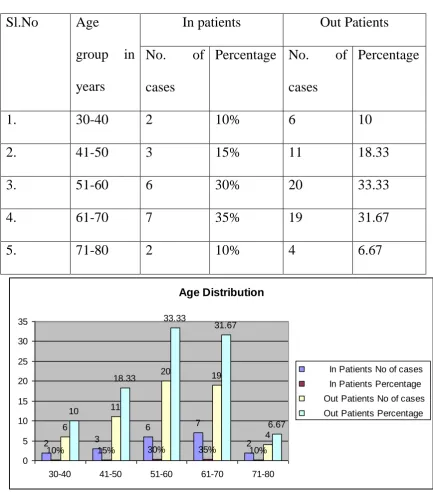
AGE DISTRIBUTION
Sl.No Age
group in
years
In patients Out Patients
No. of
cases
Percentage No. of
cases
Percentage
1. 30-40 2 10% 6 10
2. 41-50 3 15% 11 18.33
3. 51-60 6 30% 20 33.33
4. 61-70 7 35% 19 31.67
5. 71-80 2 10% 4 6.67
Age Distribution
2 3
6 7
2
10% 15% 30% 35% 10%
6 11 20 19 4 10 18.33 33.33 31.67 6.67 0 5 10 15 20 25 30 35
30-40 41-50 51-60 61-70 71-80
In Patients No of cases
In Patients Percentage
Out Patients No of cases
Out Patients Percentage
Among 60 Out-Patients
10% of cases were observed in the age group of 30 to 40 years.
15% of cases were observed in the age group of 41 to 50 years.
34
35% of cases were observed in the age group of 61 to 70 years.
10% of cases were observed in the age group of 71 to 80 years.
Majority of cases were observed in the age group of 51 to 60 years.
Among 20 In-Patients
10% of cases were observed in the age group of 30 to 40 years.
18.33% of cases were observed in the age group of 41 to 50 years.
33.33% of cases were observed in the age group of 51 to 60 years.
31.67% of cases were observed in the age group of 61 to 70 years.
6.67% of cases were observed in the age group of 71 to 80 years.
35
Table – II
SEX DISTRIBUTION
Sl.No Sex In patients Out Patients
No. of
cases
Percentage No. of
cases
Percentage
1. Male 12 60 23 38.33
2. Female 8 40 37 61.67
Sex Distribution
12
60 23
38.33
In patients No of cases
In patients Percentage
Out patients No of cases
Out patients Percentage
Among 20 In-Patients
Out of 20 In-Patients 60% were Males and 40% were females.
Among 60 In-patients
Out of 60 Out-Patients 38.33% were Males and 61.67% were Females.
36
Table – III
KAALAM
Sl.No Kaalam In patients Out Patients
No. of
cases
Percentage No. of
cases
Percentage
1. Vatha Kaalam - - - -
2. Pitha Kaalam 16 80 52 86.67%
3. Kapha
Kaalam
4 20 8 13.33%
Kaalam 16 80 52 86.67% 4 20 8 13.33% 0 10 20 30 40 50 60 70 80 90
No of cases Percentage No of cases Percentage In patients Out Patients
1 Vatha Kaalam 2 Pitha kaalam 3 kapha kaalam
Out of 20 In-Patients
80.00% of Cases were seen in the Pitha Kaalam.
20.00% of Cases were seen in the Kapha Kaalam.
37
Out of 60 Out-Patients
86.67% of Cases were seen in the Pitha Kaalam.
13.33% of Cases were seen in the Kapha Kaalam.
38
Table – IV
CONSTITUTION OF THE BODY
Sl.No Construction
of Body
In patients Out Patients
No. of
cases
Percentage No. of
cases
Percentage
1. Vatha thegi 12 60 34 56.67
2. Pitha thegi 6 30 15 25
3. Kapha thegi 2 10 11 18.333
4. Thontha thegi - - - -
Constituiton of the body
0 12 6 2 60 30 10 0 34 15 11 56.67 25 18.333 0 10 20 30 40 50 60 70 Construction od Body
Vatha Thegi Pitha Thegi Kapha Thegi Thontha Thegi
Series1
Series2
Series3
39
Table – V
GUNAM
Sl.No Gunam In patients Out Patients
No. of
cases
Percentage No. of
cases
Percentage
1. Sathuvam - - - -
2. Rajothuvam - - - -
3. Thamogunam 20 100 60 100
20
100
60
100
0 10 20 30 40 50 60 70 80 90 100
No of cases Percentage No of cases Percentage
In Patients Out Patients
Gunam
Sathuvam
Rajothuvam
40
Table – VI
RELIGION
Sl.No Religion In patients Out Patients
No. of
cases
Percentage No. of
cases
Percentage
1. Hindu 18 90 51 85
2. Christian 2 10 6 10
3. Muslim - - 3 5
Religion 18 90 51 85 2
10 6 10
3 5 0 10 20 30 40 50 60 70 80 90 100
No of cases Percentage No of cases percentage
In patients Out patients
Hindu
Christian
Muslim
Out of 20 In-Patients
90.00% of Cases belongs to Hindu
41
Out of 60 Out-Patients
85.00% of Cases belongs to Hinduism.
10.00% of Cases belongs to Christianity.
15.00% of Cases belongs to Islam.
42
Table – VII
THINAI
Sl.No Thinai In patients Out Patients
No. of
cases
Percentage No. of
cases
Percentage
1. Kurinji - - - -
2. Mullai - - - -
3. Marutham 20 100 51 85
4. Neithal - - 9 15
5. Palai - - - -
Thinai 20 100 51 9 85 15 0 20 40 60 80 100 120 Kur iniji Mul lai Mar utha m Nei thal Pal ai
In patients No of cases
In patients Percentage
Out Patients No of cases
Out Patients Percentage
Out of 20 In-Patients
43
Out of 60 Out-Patients
85.00% of Cases were coming from Marutha Nilam
15.00% of Cases were coming from Neithal
44
Table – VIII
OCCUPATION
Sl.No Occupation In patients Out Patients
No. of
cases
Percentage No. of
cases
Percentage
1. Farmer 5 25 5 8.33
2. Tailor 1 5 2 3.33
3. House Wives 8 40 34 56.67
4. Retired person - - 3 5
5. Driver 2 10 4 6.67
6. Other
Workers
4 20 12 20
Occupation
25%
5%
40% 0%
10% 20%
Farmer Tailor House wives Retired Person Driver
45
Out of 20 In-Patients
15% of patients worked as farmers
5% of patients worked as Tailor
40% of patients worked as House wives
10% of patients worked as Driver
20% of patients worked
Out of 60 Out-Patients
8.33% of patients worked as farmers
3.33% of patients worked as Tailor
56.67% of patients worked as House wives
5.00% of patients worked as Retired Person
6.67% of patients worked as Driver
20.00% of patients worked
46
Table – IX
SOCIO-ECONOMIC STATUS
Sl.No Socio
Economic
Status
In patients Out Patients
No. of
cases
Percentage No. of
cases
Percentage
1. Rich - - 5 8.33
2. Middle Class 6 30 14 23.33
3. Poor 14 70 41 68.33
Socio Economic Status
5 8.33 6 30 14 23.33 14 70 41 68.33 0 10 20 30 40 50 60 70 80
No of cases Percentage No of cases Percentage In patients Out Patients
Rich
Middle Class poor
Out of 20 In-Patients
30% of cases belonged to Middle Class socio-economic status and 70%
47
Out of 60 Out-Patients
8.33% of cases belonged to Rich socio-economic status, 23.33% of cases
belonged to Middle Class socio-economic status and 68.33% of cases
48
Table – X
DIETARY INCIDENCE
Sl.No Dietary
incidence
In patients Out Patients
No. of cases
Percentage No. of cases
Percentage
1. Vegetarian - - - -
2. Non-vegetarian
20 100 60 100
Dietary Incidence 20 100 60 100 0 20 40 60 80 100 120
No of cases Percentage No of cases Percentage In patients Out Patients
2 Non-vegetarian 1 Vegetarian
( Here the author considers all those taking milk as non-vegetarians)
Out of 20 In-Patients
All cases belonged to Non-Vegitarian
Out of 60 Out-Patients
49
Table – XI
PREDISPOSING FACTORS :
Sl.No Predisposing
Factors
In patients Out Patients
No. of
cases
Percentage No. of
cases
Percentage
1. Smoking 9 45 5 8.33
2. Alcoholism 7 35 3 5
3. Low Calcium
intake
12 60 29 48.33
4. Immobilization 10 50 23 38.33
Predisposing Factors 9 45 5 8.33 7 35 3 5 12 60 29 48.33 10 50 23 38.33 0 10 20 30 40 50 60 70
No of cases Percentage No of cases Percentage In Patients Out Patients
50
Out of 20 In-Patients
45% had the history of smoking
35% had the history of Alcoholism
60% had the history of low calcium intake
50% had the history of Immobilization
Out of 60 Out-Patients
8.33% had the history of smoking
5% had the history of Alcoholism
48.33% had the history of low calcium intake
51
Table – XI
ASSOCIATED DISEASES :
Sl.No Associated
Diseases
In patients Out Patients
No. of
cases
Percentage No. of
cases
Percentage
1. Deformity 2 10 7 11.66
2. Osteoarthritis
knee joints
4 20 13 21.66
3. Cervical
Spondylosis
2 10 7 11.66
4. Lumbar
Spondylosis
3 15 6 10
Associated diseases 2 10 4 20 2 10 3 15 0 5 10 15 20 25
No of cases Percentage No of cases Percentage In Patients Out patients
1 Deformity
2 Osteoarthritis knee joints
52
Out of 20 In-Patients
10% had past history of Deformity
20% had past history of Osteoarthritis knee joints
10% had past history of Cervical Spondylosis
15% had past history of Lumbar Spondylosis
Out of 60 Out-Patients
11.66% had past history of Deformity
21.66% had past history of Osteoarthritis knee joints
11.66% had past history of Cervical Spondylosis
53
Table – XII
AETIOLOGICAL FACTOR :
Sl.No Aetiological
factor
In patients Out Patients
No. of
cases
Percentage No. of
cases
Percentage
1. Age related
osteoporosis
17 85 18 90
2. Post
menopausal
Osteoarthritis
3 15 2 10
Aetiological Factors 17 85 18 90 3 15 2 10 0 10 20 30 40 50 60 70 80 90 100
No o cases Percentage No of cases Percentage In patients Out Patients
54
Out of 20 In-Patients
85% of patients had age related osteoporosis
15% of patients had post menopausal osteoporosis
Out of 60 Out-Patients
90% of patients had age related osteoporosis
55
Table – XIII
MODE OF ONSET :
Sl.No Mode of onset In patients Out Patients
No. of
cases
Percentage No. of
cases
Percentage
1. Acute - - - -
2. Insidious 20 100 60 100
Mode of onset
20
100
60
100
0 20 40 60 80 100 120
No of cases Percentage No of cases Percentage In Patients Out patients
Insidious Acute
According to this study 100% of Cases had gradual onset of disease.
56
Table – XIV
DURATION OF ILLNESS :
Sl.No Duration of
illness
In patients Out Patients
No. of
cases
Percentage No. of
cases
Percentage
1. 1-6 months 5 25 6 10
2. 6-12 months 3 15 17 28.33
3. 12-24 months 5 25 8 13.33
4. 24-36 months 2 10 13 21.66
5. Above 36
months
5 25 16 26.66
5 25 6 10 3 35 17 28.33 5 25 8 13.33 2 10 13 21.66 5 25 16 26.66 0 5 10 15 20 25 30 35 1-6 months 6-12 months 12-24 months 24-36 months Above 36 months
Duration of illness
In Patients No of cases
In Patients Percentage
Out patients No of cases
57
Out of 20 In-Patients
25% of the patients had the duration of illness between 1-6 months.
15% of the patients had the duration of illness between 6-12 months.
25% of the patients had the duration of illness between 12-24 months.
10% of the patients had the duration of illness between 24-36 months.
25% of the patients had the duration of illness above 36 months.
Out of 60 Out-Patients
10% of the patients had the duration of illness between 1-6 months.
28.33% of the patients had the duration of illness between 6-12 months.
13.33% of the patients had the duration of illness between 12-24 months.
21.66% of the patients had the duration of illness between 24-36 months.
58
Table – XV
CLINICAL MANIFESTATIONS :
Sl.No Clinical
Manifestations
In patients Out Patients
No. of
cases
Percentage No. of
cases
Percentage
1. Low backache 20 100 60 100
2. Bony pain 20 100 60 100
3. Pain in all
joints
9 45 42 70
4. Weakness of
limbs
20 100 60 100
5. Fractures 1 5 3 5
6. Deformity 3 15 8 13.33
20 100 60 100 20 100 60 100 9 4542 70 20 100 60 100
153 5 3 15 8 13.33 0 10 20 30 40 50 60 70 80 90 100 Low backache
Pain in all joints
Fractures
Clinical manifestations
In patients No of cases
In patients Percentage
Out Patients No of cases
59
Out of 20 In-Patients
100% of the cases had Low backache, bony pain and weakness of limbs.
45% of the cases had Pain in all joints
5% of the cases had Fractures.
15% of the patients had Deformity
Out of 60 Out-Patients
100% of the cases had Low backache, bony pain and weakness of limbs.
70% of the cases had Pain in all joints
5% of the cases had Fractures.
60
Table – XVI
KOSANGAL :
Sl.No Kosangal In patients Out Patients
No. of
cases
Percentage No. of
cases
Percentage
1. Annamaya
Kosam
20 100 60 100
2. Pranamaya
Kosam
20 100 60 100
3. Manomaya
Kosam
20 100 60 100
4. Vinganamaya
Kosam
20 100 60 100
5. Ananthamaya
Kosam
61
Kosangal
20 20 20 20
100 100 100 100
60 60 60 60
100 100 100 100
0 20 40 60 80 100 120
Annamaya Kosam Pranamaya
Kosam Manomaya
Kosam Vinganamaya
Kosam Ananthamaya
Kosam
Out patients Percentage
Out patients No of cases
In patients Percentage
62
Table – XVI
MUKKUTRAM : (a) Disturbances in vatha
Sl.No Vatham In patients Out Patients
No. of
cases
Percentage No. of
cases
Percentage
1. Pranan 20 100 60 100
2. Abanan 6 30 16 26.67
3. Viyanan 20 100 60 100
4. Udhanan 20 100 60 100
5. Samanan 20 100 60 100
6. Nagan - - - -
7. Koorman 4 20 7 11.67
8. Kirukaran 10 50 21 35
9. Devthathan 7 35 18 30
63 Mukkutram
20 6 20 20 20 4 10 7 100
30
100 100 100
20 50 35 60
16
60 60 60
7 21
18 100
26.67
100 100 100
11.67 35 30 0 50 100 150 200 250 300 Pra nan Aba nan Viy anan Udh anan Sam
ananNagan Koo rman Kiru kara n Dev that han Dha nanj eyan Out patients percentage
Out patients No of cases
In patients Percentage
64
Table – XVII
MUKKUTRAM : (b) Disturbances in Pitha
Sl.No Pitha In patients Out Patients
No. of
cases
Percentage No. of
cases
Percentage
1. Anarpitham 9 45 28 46.67
2. Ranjaga
Pitham
8 40 26 43.33
3. Prasaka
Pitham
- - - -
4. Alosaga
Pitham
08 40 15 25
5. Santhaga
Pitham
65 Mukkutram
8
40 15
25 In patients No of cases 9 8
In patients Percentage 45 40 Out patients No of cases 28 26
-66
Table – XVIII
MUKKUTRAM : (c) Disturbances in Kabha
Sl.No Pitha In patients Out Patients
No. of
cases
Percentage No. of
cases
Percentage
1. Avalambagam 20 100 60 100
2. Kilethagam 6 30 7 35
3. Pothagam - - - -
4. Tharpagam - - - -
5. Santhigam 5 25 36 60
Mukkutram
5
25
36 60
In patients No of cases 20 6
In patients Percentage 100 30 Out patients No of cases 60 7
-67
Table – XIX
INVOLVEMENT OF SEVEN UDAL THATHUKKAL :
Sl.No Pitha In patients Out Patients
No. of
cases
Percentage No. of
cases
Percentage
1. Saaram 20 100 60 100
2. Senneer 8 40 26 43.33
3. Oon 20 100 60 100
4. Kozhuppu 5 25 5 25
5. Enbu 20 100 60 100
6. Moolai - - - -
7. Sukkilam /
Sironitham
- - - -
0 0
0.2 0.4 0.6 0.8 1
Mukkutram
-68
Table – XX
ENVAGAI THERVUGAL :
Sl.No Envagi
Thervugal
In patients Out Patients
No. of
cases
Percentage No. of
cases
Percentage
1.
Naadi Vatha
Pitham 20 100 60 100
2. Sparisam 20 100 60 100
3. Naa 20 100 60 100
4. Niram 9 45 6 30
5. Mozhi - - - -
6. Vizhi 8 40 15 25
7. Malam 6 30 24 40
69 Envagi Therougal
20 20 9 8 6
100 100
45 40 30
60 60
6 15 24
100 100
30 25 40
0 50 100 150 200 250 300 Spa
rism Naa Nira
m Moz
hi Vizhi
Mal am Moo thira m Out Patients Percentage
Out Patients No of cases
In patients Percentage
In patients No of cases
70
Table – XXI
SYMPTOMS :
Sn Symptoms
In Patients Out Patients
Mild Moderate Severe Mild Moderate Severe No.
of cases
% No. of cases
% No. of cases
% No. of cases
% No. of cases
% No. of cases
%
1. Low
backache
6 30 11 55 3 15 12 20 39 66 9 15
2. Bony pain 4 20 9 45 7 35 15 25 20 33.33 25 41.66
3. Pain in all
joints
4 20 3 15 1 5 16 39 21 50 5 12
4. Weakness
of limbs
8 40 9 45 3 15 15 25 42 70 3 5
Symptoms 6 30 11 55 3 15 12 20 39 66 9 15
In Patients Mild No. of cases
In Patients Mild % In Patients Moderate No. of cases
In Patients Moderate % In Patients Severe No. of cases
In Patients Severe % Out Patients Mild No. of cases
Out Patients Mild % Out Patients Moderate No. of cases
71
Table – XXII
ASSESSMENT OF RESULTS :
Sl.No Result In patients Out Patients
No. of
cases
Percentage No. of
cases
Percentage
1. Excellent - - 2 3.33
2. Good 7 35 39 65
3. Moderate 13 65 17 28.33
4. Poor - - 2 3.33
72
DISCUSSION
Asthivatham, a disease classified under vatha diseases results in
bone pain has been correlated with the osteoporosis in modern science.
Pirandai Vatakam mentioned in the Siddha formulatory of India
and Siddha Vaithya thirattu has been chosen by me for the study on the
disease Asthivatham for the Dissertation Purpose.
A camp was held for the purpose of diagnosing the patients and 80
patients were selected for the trial and consent has been obtained from
them and trial was started, out of this, 20 patients were admitted in the
government Siddha Medical College Palaymkottai in-patient department.
Before starting the trial, the Bio-chemical analysis and an
Pharmacological actions of the drug was done in the laboratories of the
government Siddha Medical College, Palayamkottai.
AGE:
The patients had undergone the trial belonged to different age
groups from 30-80. The highest incidence was seen in the fifith decade
and above.
SEX:
38.33% of the patients were males and 61.67% were females in the
out patients.
73 MUKKURAKAALAM:
80% of the inpatients and 86.67% of the outpatients were noted in
the Pithakaalam and 20% of the inpatients and 13.33% of the outpatients
were noted in the kabakaalam since „laghu‟ of the bone occur after the
age of 40. majority of the patients‟ incidence is from Pitha Kaalam. THEGI
60% of the inpatients and 56.67% of the outpatients were
vathathegi 30 of the inpatients and 25% of the outpatients were Pithathegi
10% of inpatients and 18.33% of outpatients were kabathegi.
GUNAM
90% of the inpatients and 85% of the outpatients were hindus.
10% of the inpatients and 10% of the outpatients were Christians 0% of
the inpatients and 5% of the outpatients were muslims.
THINAI
All the inpatients and 85% of the outpatients wee from
Maruthanilam and 15% of the cases were from Neithal Nillam. In
general Maruthanilam is the area where the severity of all the diseases is
less. But this incidence may be due to the alteration in the food habit,
stress, senile, lifestyle and other activities
OCCUPATION
25% of inpatients and 8.33 of outpatients were farmers 40% of the
74
inpatients and 3.33% outpatients were tailors 10 of the inpatients and
10% of the outpatients were drivers 5% of the out patients were retired
persons.
SOCIO-ECONOMIC STATUS:
30% of cases in patients belonged to Middle class and 70% cases
belonged to poor section. ot of 60 Out patients 8.33% belonged to rich
socio economic status, 23.33% Of cases belonged to poor socio economic
status.
AETIOLOGICAL STATUS
85% of the inpatients and 90 of the outpatients had age related
osteoporosis of the inpatients and of outpatients has post menopausal
osteoporosis. Since the major risk factor of osteoporosis is advancement
of age.
MODE OF ONSET
100% of the inpatients and outpatients has gradual onset of
osteoporosis.
DURATION OF ILLNESS:
24 of the inpatients and 10 of the outpatients has the duration of
illness between 1-6 months.
15% pf the inpatients and 29.33 of the outpatients has the duration
75
25 of the inpatients and 13.33 of the outpatients has the duration of
illness between 12-24 months.
13 of the In-patients and 21.66 of the out patients has the duration
of illness 24-36 months.
25 of the Inpatients and 26.66% of the outpatients has the duration
of illness above 3 years
.NUMBER OF DAYS TREATED:
15% of Inpatients were treated for 45 days.
45% of In-patients were treated for above 45 days.
All the Outpatients were treated for above 40 days.
CLINICAL MANIFESTATIONS:
100 Percentage of the In-patients and the Outpatients had low back
ache bone pain, pain in all joints, weakness of limbs.
50% of the Inpatients and 60% of the Outpatients had pain in all
joints
10% of the Inpatients and 35% of the Outpatient ha fractures.
15% of the Inpatients and 25% of the Outpatients had deformity.
ASSOCIATED DISEASES
10% of the IN-patients and 13.33% of Outpatients has deformities.
20% of the In-patients and 20 of Outpatients had arthritis knee.
10% of the Inpatients and 11.66% of Outpatients had lumbar
76
15% of the In-patients and 11.66% of out patients had cervical
spondylosis
DIET FACTORS:
100% of the inpatients and Outpatients were
Non-vegetarians. (Here I consider all those takes milk as non-vegetarians).
PREDISPOSING FACTORS:
According to this study 45% of the Inpatients and 8.33 of the
Outpatients has this disease due to smoking 35 of the Inpatients and 5%
of Outpatients had alcoholic history 60% of Inpatients had the history of
low calcium intake and immobilization 49.33 of Outpatients had the
history of low calcium intake and 50% of the inpatients and 38.33% of
Outpatients had the history of immobilization.
KOSANGAL:
Except the annantha Maya Kosam, Annamya kosam, Pranamaya
kosam, manomayakosam, vignanamayakosam all were affected in 100%
of the inpatients and 100% of the Outpatients.
DISTURBANCES IN VATHA:
Derangement of Praanan was found in cent percent of In-patient
and Out-patients.
Affected Praanan produced indigestion.
Derangement of Abanan was found 30% of inpatients and 26.67%
77
Affected Abanam produced constipation.
Derangement of Viyam was found in 100% of inpatients and 100%
of the Outpatients.
Affected Viyanan produces pain in the bones.
Derangement of udhanan is found in all patients
Derangement of samanan was found in 100% of the inpatients and
100% of the Outpatients.
Affected Samanan produced loss of appetite and indigestion.
Nagan is not found to be affected in all patients.
Derangement of Koorman was found in 20% of the inpatients and
11.67% of the Outpatients.
Affected Koorman produced disturbance in vision.
Derangement of Kirukan was found in 50% of the inpatients and
35% Outpatients.
Affected Kirukaran produced indigestion.
Derangement of Devathathan was found in 50% of the
inpatients and 35% of inpatients and 30% of the Outpatients.
Devathathan affected normal sleep rhythm.
Disturbances in pitha:
Anarpitham was affected in 45% of the inpatients and 46.67% of
the Outpatients.
78
Ranjaga pitham was affected in 40% of inpatients and 43.33% of
the Outpatients,
Affected Ranjaga pitham results in decreased haemoglobin
presence in the blood.
Alosaga pitham was affected in 40% of the Inpatients and 25%
outpatients.
Affected Alosaga pitham produced disturbances in vision.
Saathaga pitham was affected in 100% of inpatients and
Outpatients.
Affected Saathaga Pitham produced inability to do usual works.
Disturbances in Kabha:
Avalambagam was affected in 100% of Inpatients and Outpatients
affected Kilethagam produced loss of appetite and indigestion.
Santhigam was affected in 25% of Inpatients and 60% of
Outpatients. Affected Santhigam produced pain in the joints and
restriction of movements.
Involvement of seven udal thathukkal:
Saaram was affected in all the inpatients and outpatients and
produces the patients fatigue. senneer was affected in 45% of the
inpatients and 43.33% of the outpatients which produces pain and low
79
Oon was affected in all the inpatients and outpatients which
produces muscle weakness.
Enbu was affected in all the inpatients and the Outpatients which
produces bone pain and pain in joints.
Kozhuppu was affected 25% of the Inpatients and Outpatients
which produces restricted movements.
Moolai and sukkilam were not found to be affected.
Envagai thervugal
Naadi : In 100% of inpatients and Outpatients the naadi was vatha pitham
Sparisam : was affected in 100% of Inpatients and Outpatients.
Naa : Was affected in 100% of inpatients and outpatient Tongue was coated and pale in
color due to and constipation.
Mozhi : Was normal.
Vizhi : Was affected in 40 of inpatients and 25 of outpatients and disturbances in vision.
Moothiram : Was normal, neerikuri was neikuri were done in all the inpatients and outpatients neerkuri
80
oil dropped into the urine was spreading like
snake. (vatha neer) and also pitha neer found.
Gradation of back pain, bony pain, pain in all joints in all joints ,
weakness of limbs:
30% of inpatients and 20 Outpatients had mild back pain.
55% of Inpatients and 66% of Outpatients had moderate back pain
15 of inpatients and 15 of outpatients and severe back pain.
20% of inpatients and 25% of outpatients had mild bony pain 45%
of in-patients and 66 of outpatients had severe bone pain.
20% of inpatients and 38 outpatients had mild pain in all joints.
15 % of inpatients and 50% of outpatients had moderate pain in
joints. And
5% of inpatients and 12% of inpatients had severe pain in joints.
40% of inpatients and 25% of outpatients had mild weakness of
limbs 45% of inpatients and 70% of Outpatients had moderate weakness
of limbs and 15% of the inpatients and 5% outpatients had severe
weakness of limbs.
Laboratory investigations:
As in Asthivatham, the deciding factors is the Bone mineral
density, the focus has been given to the BMD investigation before and
after treatment. All the other Investigations like Xray, haematological
81 Management:
Every patient was advised to take Agathiyar Kulambu for
Purgation to bring the vitiated into normal prior to the treatment.
Then the internal trial medicine pirandai vatakam with milk
was given thrice a day after food. No adverse reactions developed during
the entire periods of study.
Assessment of Results:
3.33% of outpatients showed excellent results
75% of the inpatients and 78.66% out patients showed good
response, 25 the inpatients and 16.66% of the outpatients showed
moderate response and3.33% of the inpatients showed poor response.
At the end of the treatment the patients were discharged and they
are advised to take medicines from the Outpatient of sirappu Maruthuvam
for their further follow up.
During the entire trial was each patient was advised to follow
balanced diet and good moral behavior.
The mean value of the increased BMD due to the intake of calcium in the
40 patients is (9.5 divided by 40) 0.2375.
The mean difference of the increased in the patients of the trial of
pirandai vatakam is (48.9 divided by 80) 0.61125.
It shows that comparatively pirandai vatakam has a good effect in
82
Bone densitometry report - OP patients (Pirandai Vatagam)
BMD (gm / cm2) - T Score
Sl. No OP No Name Age Sex
83
84
Bone densitometry report - IP patients (Pirandai Vatagam)
BMD (gm / cm2) - T Score
Sl. No OP No Name Age Sex
Before Treatmen t During Treatmen t After Treatmen t
1 3312 Servarayan 56 M -4.5 -4.3 -4.0 2 3377 Samy 67 M -2.1 -1.9 -1.5 3 3393 Saravnan 36 M -1.7 1.5 -1.3 4 3337 Muthu 45 M -3.2 -2.9 -2.5 5 3310 Murugan 65 M -3.5 -3.2 -2.9 6 3452 Joseph 70 M -5.1 -4.8 -4.3 7 3421 Aarumugam 54 M -4.3 -4.1 -3.9 8 3621 Mayaandi 75 M -2.8 -2.5 -2.1 9 3344 Muthiah Konar 76 M -1.5 -1.3 -1.2 10 3425 Ambigambal 60 F -3.2 -3.0 -2.8 11 3791 Muthu Karupan 65 M -1.9 -1.5 -1.0 12 3629 Pandaram 53 M -2.0 -2.0 -1.8 13 3512 Venkateswaran 60 M -1.8 -1.5 -1.3 14 3365 Lakshmi 57 F -3.3 -3.1 -2.7 15 3652 Muthusamy 63 M -5.1 -4.9 -4.6 16 3175 Petchiammal 48 F -2.0 -1.8 -1.8 17 3263 Pappa 40 F -3.0 -2.8 -2.5 18 3123 Karpagam 43 F -2.9 -2.5 -2.3 19 3477 Chellammal 55 F -3.8 -3.7 -3.4 20 3238
Meenakshi
85
Bone densitometry report - OP patients (Standard Drug)
BMD (gm / cm2) - T Score
Sl. No OP No Name Age Sex
Before Treatmen t During Treatmen t After Treatmen t
1 74237
Chandra
sekaran 56 M -1.2 -1.2 -1.0 2 74232 Rajan 46 M -2.0 -2.0 -1.8 3 74242 Manikkam 49 M -1.9 1.8 -1.5 4 74275 Muthumalai 58 M -3.3 -3.3 -3.0 5 74259 Muthukrishnan 62 M -1.8 -3.3 -1.5 6 74267 Chellappa 62 M -2.1 -1.8 -1.8 7 74313 Panneer Vel 57 M -1.5 -2.0 1.2 8 74296
Agastin
Jeyakumar 35 M -2.1 -1.5 -2.0 9 74302 Ponraj 60 M -1.8 -2.2 -1.5 10 72509 Muthukaruppan 63 M -1.9 -1.6 -1.5 11 74346 Sellappa 58 M -2.2 -1.9 -2.1 12 74365 Subbiah 57 M -1.8 -2.0 -1.5 13 74400 AyyaPillaiar 70 M -2.0 -1.7 -1.5 14 74450 jeccab 50 M -2.5 -2.0 -2.2 15 74488
Sethu
86
87
SUMMARY
Asthivatham which can be correlated with osteoporosis is selected
for the clinical trial for the purpose of dissertation by the internal
medicine pirandai vatakam, to see its efficiency in this diseases.
80 patients were selected for this trial with their consent.
20 patients out of this were admitted in the Hospital and underwent
the trial.
Before starting the treatment, the medicine underwent the lab
investigations for biochemical analysis and pharmacological actions.
The patients were prepared by undergoing „Bethi‟ to normalize the
elevated vatham.
40 more patients were administered with standard drug (calcium).
All the results in all aspects were analyzed and discussed.
The comparative discussion of the results of the pirandai vatakam
and calcium also done.
88
CONCLUSION
The Clinical trial by me for the Asthivatham in the internal
medicine Pirandai Vathakam at Governement Siddha Medical College
found to be satisfactory in 98% of cases.
The trial drug was absolutely free from adverse reactions. The trial
medicine has significant analysis and good anti inflammatory activities.
Biochemical analysis of Pirandai Vatakam showed the presence
of calcium, Chloride, starch, ferrous iron, Tannic and, unsaturated
compound, and Amino acid.
As Asthivatham is a diseases characterized by reduced bone
mineral density leading to pain and disability, the symptoms and the risk
of fractures can be reduced and the quality of life can be improved after
92
ANNEXURE – I
PREPARATION OF MEDICINE PIRANDAI VATAKAM
INGREDIENTS:
1.Pirandai -350 grms
(root of Cissus quadrangularis)
2.Kadukkaai thol -35 grms
(terminalia chebula)
3.Sukku -35 grms
(zingiber officinalis)
4.Kollu -35 grms
(macrotyloma uniflorum)
5.manjal - 35 grms
(curcuma longa)
6.Milaku - 35 grms
(piper nigrum)
7.vellaip poondu - 35 grms
(allium sativum)
8.seeraham - 35 grms
93
9.vaaivilangam - 35 grms
(emblica ribes)
10. Inthuppu - 35 grms
11.ulunthu -35 grms
(vigna mungo)
12. puliththa kaadi -sufficient quantity
13. more (butter milk) - sufficient quantity
Method of Preparation:
Remove the skin from item 1 by scraping, split the pieces and put
in a container. Pour enough of item 13 to submerge the pieces. keep in
sun for two days and dry so that the slime disappears. Pound it finely,
Grind drugs 2 to 11 with item 12 add with more of