A COMPARATIVE STUDY OF CONVENTIONAL THERAPY VS
MODIFIED CONSTRAINT INDUCED MOVEMENT THERAPY
ALONG WITH CONVENTIONAL THERAPY IN IMPROVING
UPPER EXTREMITY FUNCTION OF STROKE PATIENTS
A dissertation submitted in partial fulfillment of the requirement
for the degree of
MASTER OF PHYSIOTHERAPY
ELECTIVE – ADVANCE PT IN NEUROLOGY
(Reg. No.27091909)
RVS COLLEGE OF PHYSIOTHERAPY
(Affiliated to the Tamil Nadu Dr. M.G.R Medical University, Chennai – 32)
SULUR, COIMBATORE – 641 402
TAMIL NADU
A COMPARATIVE STUDY OF CONVENTIONAL THERAPY VS
MODIFIED CONSTRAINT INDUCED MOVEMENT THERAPY
ALONG WITH CONVENTIONAL THERAPY IN IMPROVING
UPPER EXTREMITY FUNCTION OF STROKE PATIENTS
ADVISOR
Prof. Mrs. R. NAGARANI SHANMUGHAM, MPT, (Ph.D).,
RVS COLLEGE OF PHYSIOTHERAPY SULUR, COIMBATORE.
SUBMITTED IN PARTIAL FULFILLMENT OF THE REQUIREMENT FOR
DEGREE OF “MASTER OF PHYSIOTHERAPY” AT THE TTAMIL NADU DR. M.G.R. MEDICAL UNIVERSITY,
A COMPARATIVE STUDY OF CONVENTIONAL THERAPY VS
MODIFIED CONSTRAINT INDUCED MOVEMENT THERAPY
ALONG WITH CONVENTIONAL THERAPY IN IMPROVING
UPPER EXTREMITY FUNCTION OF STROKE PATIENTS
INTERNAL EXAMINER
EXTERNAL EXAMINER
SUBMITTED IN PARTIAL FULFILLMENT OF THE REQUIREMENT FOR
DEGREE OF “MASTER OF PHYSIOTHERAPY” AT THE TTAMIL NADU DR. M.G.R. MEDICAL UNIVERSITY,
DECLARATION
I hereby declare and present my project work entitled “
A COMPARATIVE
STUDY OF CONVENTIONAL THERAPY VS
MODIFIED
CONSTRAINT INDUCED MOVEMENT THERAPY ALONG WITH
CONVENTIONAL THERAPY IN IMPROVING UPPER EXTREMITY
FUNCTION OF STROKE PATIENTS
” The outcome of the original research work undertaken and carried out by me, under the guidance of Professor Mrs. R.NAGARANI SHANMUGHAM, MPT., (Ph.D)., RVS COLLEGE OF
PHYSIOTHERAPY, Sulur, Coimbatore.
I also declare that the material of this project work has not formed in any way
the basis for the award of any other degree previously from the Tamil Nadu Dr. M.G.R Medical University.
SIGNATURE
ACKNOWLEDGEMENT
I express my thanks to God Almighty for providing me the wisdom and knowledge to complete my study successfully.
I acknowledge my sincere thanks to CHAIRMAN and SECRETARY OF
RVS EDUCATIONAL TRUST, Sulur, Coimbatore for providing the opportunity to
pursue my Post graduation studies in their esteemed institution.
I would like to thank my guide Mrs. R.NAGARANI SHANMUGHAM M.P.T., (PhD)., offering me perceptive inputs and guiding me entirely through the course of my work and without his tired less guidance and support this project would not have come through.
I offer my grateful thanks for all the staff members of physiotherapy rehabilitation centre.
I also thank my friends for their co-operation in completion of this project. I offer my thanks and gratitude to our librarians for their supports in providing books to complete my study.
ABSTRACT
Purpose of the study: To find out effectiveness of modified constraint movement therapy along with conventional therapy on upper extremity function of stroke patients.
METHOD: The study conducted was an experimental approach. Sample of 30
subjects satisfying the criteria were divided into two groups, control (group A) and experimental group (group B).
Control group received only conventional therapy
For experimental group, in addition to conventional physiotherapy, modified
constraint induced therapy were given. Treatment was given for 3 weeks. The outcome measure taken was Box and block test and Modified Barthel index.
RESULT: The test used for statistical analysis was paired t test and independent t test. The statistical analysis showed significant improvement in experimental group than control group.
Conclusion: The modified constraint induced movement therapy seemed to be
beneficial in improving motor performance of upper extremity in stroke patients
TABLE OF CONTENT
CHAPTER TITLE PAGE
NO 1 2 3 4 5 6 7 8 9 10 11 12 INTRODUCTION
• Need and significance of the study
• Statement of the study
• Objective of the study
• Hypothesis
REVIEW OF LITERATURE
OPERATIONAL DEFINITION
RESEARCH DESIGN AND METHODOLOGY
• Research design
• Settings
• Criteria for selection
• Inclusion criteria
• Exclusion criteria
• Sample population
• Method of sampling
• Variables used in the study
• Methodology
MEASURING TOOL
DATA ANALYSIS AND INTERPRETATION
RESULT
DISCUSSION
SUGGESTION AND LIMITATION
LIST OF TABLE
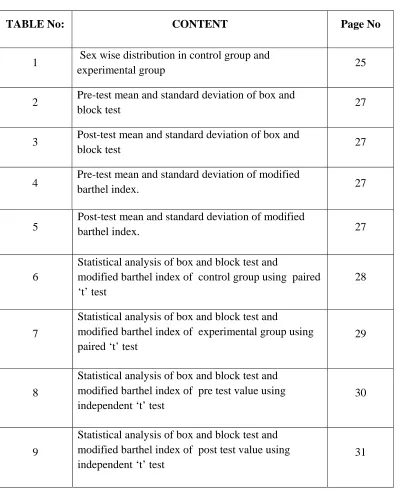
TABLE No: CONTENT Page No
1 Sex wise distribution in control group and
experimental group 25
2 Pre-test mean and standard deviation of box and
block test 27
3 Post-test mean and standard deviation of box and
block test 27
4 Pre-test mean and standard deviation of modified
barthel index. 27
5 Post-test mean and standard deviation of modified barthel index. 27
6
Statistical analysis of box and block test and
modified barthel index of control group using paired ‘t’ test
28
7
Statistical analysis of box and block test and
modified barthel index of experimental group using paired ‘t’ test
29
8
Statistical analysis of box and block test and modified barthel index of pre test value using independent ‘t’ test
30
9
Statistical analysis of box and block test and modified barthel index of post test value using independent ‘t’ test
LIST OF GRAPH
GRAPH
NO: CONTENT Page No
1 Sex wise distribution in control group and
experimental group 25
2 Mean difference of box and block test in control
and experimental group 26
3 Mean difference of modified barthel index test in
INTRODUCTION
Stroke is the sudden loss of neurological function caused by an interruption of
blood flow to brain and it is a leading cause of serious long term disabilities, including
loss of motor, sensory or cognitive functions. The cerebrovascular accident or Stroke
is accompanied by either ischemic or hemorrhagic cerebrovascular lesions. Stroke is
the major contributor of mortality and morbidity world wide. A WHO study in 1999
quoted incidence of mortality due to stroke in India to be73/100,000/year. After heart
disease, Stroke is the second leading single cause of death with 5.8 million fatal cases
per year, 40% of which are in younger than 70years.
The majority of individuals who survive a stroke have minimal to moderate
neurological deficits and 50% of them are expected to live more than 5 years.
Problems affecting the upper limb following stroke are often persistent and disabling
with only 20% to 56% of patients regaining useful upper limb function after three
months. Improving upper limb function is therefore often a core element of
rehabilitation after stroke in order to maximize patient functional independence and
reduce disability.
Approximately 70% of 80% of people who sustain a stroke have upper
extremity Impairment. The increasing number of persons surviving with stroke are
left with impairment of hand and foot, which ultimately decrease the functional status
and quality of life. The prevalence of stroke in India varies in different regions of the
country and ranges from 40 to 270 per 1,00,000 population. About 12% of all strokes
occur in the populations <40 years of age. Major risk factors identified in India are
hypertension (blood pressure>95mmHg diastolic), hyperglycemia, tobacco use, low
Modified Constraint induced movement therapy (mCIMT) is a intensive
treatment program that aims to improve the functional use of affected upper limb. It
consists of family of treatments. The most frequently used variant involves motor
restriction of the unaffected upper extremity by a resting hand splint and sling and
training of the affected extremity. It involves three weeks of using restraint on the
unaffected arm after stroke for 90% of waking hours in conjunction with this, three
weeks of intensive exercise with the affected arm are undertaken for around six hours
daily. The exercise program uses the training technique ‘shaping’. Shaping involves
interacting and useful activities that are progressed in small steps, where only positive
feedback is given to the participants. The massed practice of skills is likely to be
responsible for the occurrence of use-dependent increase in cortical reorganization
and neuroplasticity (ability of the brain to change and repair itself).
Constraint Induced Movement Therapy was developed by Dr. Edward Taub of
the University of Alabama in Birmingham. According to him, after a stroke the
patient stops using the affected limb because they are discouraged by the difficulty.
As a result, a process called “learned non use” sets in furthering the deterioration. It is
this process constraint induced movement therapy seeks to reverse.
NEEDS AND SIGNIFICANCE OF THE STUDY
The impairment of upper extremity motor function following stroke is the
most deliberating condition for the patients and the recovery of these lost functions
are a great challenge for physical therapist. Dysfunction from the upper extremity
paresis impairs performance of daily activities such as dressing, bathing, self care and
are needed to reduce the long-term disability and functional impairment for the upper
extremity hemiparesis.
Learned non use is a most common problem seen in stroke. Patients with
stroke are used to perform task using their unaffected upper limb and progressively
avoid using the affected upper limb resulting in a learned non-use phenomenon. Focus
on early training as soon as possible after brain damage to utilize specific windows of
opportunity and avoid learned non-use. So there is a great need to rehabilitate the
upper extremity and regain the lost motor function within the maximum expected
recovery period.
STATEMENT OF THE STUDY
The present investigation is done to understand the role of modified Constraint
Induced Movement Therapy on upper extremity function in Middle Cerebral Artery
stroke patient.
The study entitled: “Effectiveness of modified Constraint Induced Movements
Therapy and Conventional therapy on upper extremity function in stroke patients”.
OBJECTIVES OF THE STUDY
• To determine the efficacy of modified constraint induced movement therapy
along with conventional physiotherapy in improving upper limb motor
function in middle cerebral artery stroke.
• To determine the efficacy of conventional physiotherapy to patients with
HYPOTHESIS
NULL HYPOTHESIS: There is no significant difference in giving Modified
constraint induced movement therapy along with Conventional therapy in stroke
patients.
ALTERNATE HYPOTHESIS: There is significant difference in giving Modified
constraint induced movement therapy along with Conventional therapy in stroke
patients.
REVIEW OF LITERATURE
SECTION A-STROKE
SECTIONB- MODIFIED CONSTRAINT INDUCED MOVEMENT THERAPY
SECTION C-CONVENTIONAL THERAPY
SECTION A:
¾ E.S Sapna et al. (2009)
They suggested that apart from acute stage mortality of >20% stroke survivors
frequently exhibit persistent functional impairments that limit quality of life.
¾ K O Berg et al. (1972)
They concluded that stroke causes problems across multiple systems including
motor control, upper extremity function, gait and balance. Impairment
resulting from stroke such as sensory, motor and impairment in postural
control and balance pose threat to physical safety and can lead to fear of one’s
safety with self imposed restriction on activities of daily living.
¾ World Health Organisation. (1970)
Stroke is defined as “rapidly developing clinical signs of focal and global
disturbances of cerebral blood function with symptoms lasting 24hours or
longer or leading to death with no apparent cause other than vascular origin.
¾ T.S Oslen : He founded that, while the lower extremity functions improve in 89%
recovery process of upper extremity functions is often slower than the recovery of
lower extremity functions.
SECTION B:
¾ YANG Qing-lan et al. (2009)
The objective of the study is to “observe curative effect of Constraint Induced
Movement Therapy on upper limb function in sub-acte stroke patients”. It
showed significant increase in upper limb function in sub-acute stroke
patients.
¾ ZENG Yu-shan. (2009)
The study entitled “ the effects of Constraint Induced Movement Therapy
(CIMT) on upper limb functional recovery and Activity of Daily Living
(ADL) improvement in patients with hemiplegic stroke”. They concluded that
Constraint Induced Movement Therapy is more effective than Routine
Rehabilitation Therapy in improving the upper limb motor function and ADL
in the patients with Hemiplegic stroke.
¾ STELLA De BODE et al.(2009)
They describes the feasibility and efficacy of the use of constraint induced
movement therapy in 4 individuals who underwent cerebral hemispherectomy.
The showed qualitative changes consistent with reorganization of
sensorimotor cortical representations of both paretic and nonparetic hands in
one isolated hemisphere. The concluded that, CIMT may be feasible method
of rehabilitation in individuals with chronic hemiparesis,possibly leading to
¾ WANG Wenqing et al.(2008)
The objective of the study is “to observe curative effect of Constraint Induced
Movement Therapy on the recovery of upper limb moving mode and hand’s
function of patients with cerebral infraction there were significant
improvements in upper limb function after CIMT treatment.
¾ Leeman B et al. (2008)
The purpose of Constraint Induced Movement Therapy (CIMT) is to stimulate
the use of the affected upper arm following stroke and to improve the
integration of the arm in activities of daily living. They concluded the efficacy
of CIMT seems to be confirmed by the literature and our observations. It is
superior to the usual treatment.
¾ Marco Caimmi et al.(2008)
This preliminary study aims “using Kinematic Analysis to evaluate Constraint
Induced Movement Therapy in chronic stroke patients”. Concluded that the
method of Kinematic Analysis was sensitive for as assessment of motor
recovery induced by CIMT. The Kinematic results suggest that the increase in
the use of the paretic limb in activities of daily living after the intervention is
not only attributable to the patients increased attention to it and better hand
dexterity, but it is also a consequence of the improved speed of movement and
better co-ordination between shoulder and elbow joints.
The objective of the study is to evaluate the benefits of Constraint Induced
Movement Therapy (CIMT) relative to traditional intervention equal in
treatment intensity and use of restraint mitt outside rehabilitation on motor
performance and daily functions in stroke patients. This is the first randomized
controlled trail to show the benefits of CIMT, relative to control treatment
equal in amount of therapy in improving motor performance and some aspects
of basic and extended activities of daily living.
¾ Koyama T et al.(2007)
The study entitled “effective targets for Constraint Induced Movement
Therapy for patients with upper extremity impairment after stroke”.
Concluded that statistical analysis shows that CIMT is most beneficial for
treating hand function, suggesting an efficient application of this treatment.
¾ WANG Jun et al. (2007)
The study entitled “the efficacy of Constraint Induced Movement Therapy
(CIMT) on minimum motor criterion of upper-extremity for individuals with
hemiparesis after stroke. They concluded CIMT is an efficacious treatment to
improve the affected arm in stroke patients.
¾ WuCY et al. (2007)
The study entitled “Kinematic and Clinical Analyses of upper extremity
movements after Constraint Induced Movement Therapy in patients with
stroke, a randomized controlled trail.. The study shows that there is a
differenced in motor control strategies as measured by kinematic variables
performance at the impairment and functional levels, CIMT conferred
therapeutic benefits on control strategies determined by kinematic analysis.
¾ Ro T et al.(2006)
The study entitled “functional reorganization and recovery after Constraint
Induced Movement Therapy in subacute stroke”. The enlarged motor
representation in the lesioned hemisphere for hand movement correlated with
improved motor function of the affected hand suggesting a link between
movement representation sizes as measured with Transcranial Magnetic
Stimulation and functionality. These results suggest that TMS can safely and
effectively used to assess brain function in subacute stroke and further suggest
that CIMT may enhance cortical/subcortical motor reorganization and
accelerate motor recovery when started with in first two weeks after stroke.
¾ Jama. (2006)
The objective of the study is to compare effects of a two week multisite
program of CIMT v/s usual and customary care on improvement in upper
extremity function among patients who had a first stroke with in the previous
3 to 9 months.They concluded that CIMT produced statistically significant and
clinically relevant improvements in arm motor function that persisted for at
least 1 year.
¾ WENG Chang-Shui et al.(2006)
The objective of the study is “to determine the efficacy of Constraint Induced
extremity after stroke”. They concluded CIMT is an effective rehabilitation
technique to improve motor function in stroke patients.
¾ Bonifer NM.(2005)
The objective of the study is “to examine the effects of Constraint Induced
Movement Therapy (CIMPT) on chronic to severe upper extremity motor
impairment after stroke. “CIMT conferred significant changes in objective
measures in subjects with chronic to moderate to severe impairments after
stroke.
¾ Weng Chaangshui et al. (2004)
They conducted a study on efficacy of Constraint Induced Movement Therapy
for stroke patients. They concluded that CIMT is an efficacious method of
improving function and use of the more affected arms of sub acute and chronic
stroke patients.
¾ Dromerick A.W et al. (2000)
They found that motor dysfunction after unilateral de-afferentation in primates
can be overcome by restraining the unaffected limb. Result was a clinical trail
of CIM therapy during acute rehabilitation is feasible. Constraint induced
movement therapy was associated with less arm impairment at the end of
treatment.
¾ Desrosiers J et al. (1994)
The goal of the present study was to verify the test-retest reliability and
impairment. The results shows that, the test-retest reliability is high
(intra-class correlations coefficients of 0.89 to 0.97) and the validity of the test are
shown by significant correlations between the BBT, and upper limb
performance measurement and a functional independence measurement.
SECTION C:
⇒R PS Van Peppen et al.(2004)
The objective of the study is to determine the evidence for physical therapy
interventions aimed at improving functional outcome after stroke. Results:
Based on high-quality randomized controlled trials (RCTs) strong evidence was
found in favour of task-oriented exercise training to restore balance and gait, and
for strengthening the lower paretic limb. Summary effect sizes for functional
outcomes ranged from 0.13 (95% CI 0.03–0.23) for effects of high intensity of
exercise training to 0.92 (95% CI 0.54–1.29) for improving symmetry when
moving from sitting to standing. Strong evidence was also found for therapies
that were focused on functional training of the upper limb such as
constraint-induced movement therapy (SES 0.46; 95% CI 0.07–0.91), treadmill training
with or without body weight support, respectively 0.70 (95% CI 0.29–1.10) and
1.09 (95% CI 0.56–1.61), aerobics (SES 0.39; 95% CI 0.05–0.74), external
auditory rhythms during gait (SES 0.91; 95% CI 0.40–1.42) and neuromuscular
stimulation for glenohumeral subluxation (SES 1.41; 95% CI 0.76–2.06). No or
insufficient evidence in terms of functional outcome was found for: traditional
neurological treatment approaches; exercises for the upper limb; biofeedback;
functional and neuromuscular electrical stimulation aimed at improving
therapy interventions for reducing hemiplegic shoulder pain and hand oedema.
Conclusions: This review showed small to large effect sizes for task-oriented
exercise training, in particular when applied intensively and early after stroke
OPERATIONAL DEFINITIONS
:
CONVENTIONAL PHYSIOTHERAPY: A currently accepted and widely used
physiotherapy treatment for certain types of diseases based on the results of past
research.
Modified Constraint Induced Movement Therapy- Modified Constraint induced
movement therapy is a form of therapy that helps stroke and central nervous system
damaged victims regain the use of affected limbs.
NERUAL PLASTICITY: The brain's ability to reorganize itself by forming
new neural connections throughout life. Neuroplasticity allows the neurons (nerve
cells) in the brain to compensate for injury and disease and to adjust their activities in
response to new situations or to changes in their environment
MIDDLE CEREBRAL ARTERY STROKE: It is the sudden onset of focal
neurological deficit resulting from brain infraction or Ischemia in the territory
RESEARCH DESIGN AND METHODOLOGY
4.1 RESEARCH DESIGN
:
The type of the study design used for the present study is a randomized
pre-test post-test experimental group design. Whole sample was divided randomly
into two equal groups. Both groups underwent a pre-test and post-test measurements
using Box and Block test and Modified Barthel Index. After pre-test measurement,
group A received conventional physiotherapy and group B received Modified
Constraint Induced Movement Therapy along with conventional therapy for three
weeks. Post-test assessment was done after three weeks.
Group A:
These patients received Conventional Physiotherapy.
Group B:
These patients received Modified Constraint Induced Movement Therapy along with
Conventional Physiotherapy.
4.2 STUDY SETTING
This study was conducted in Physiotherapy Rehabilitation Centre-
Kunnamangalam, Study duration was one month.
4.3 POPULATION OF THE STUDY
Population for the study was chosen from the patients who were referred for
the physiotherapy by neurologist and diagnosed as middle cerebral artery
stroke. Both male and female patients were included whose age group was
between 50-65 years were selected. Informed consent was obtained from the
4.4 CRITERIA OF SELECTION:
4.4.1. INCLUSION CRITERIA:
1. AGE: 50-65 Years
2. SEX: Both Males and Females.
3. Duration: 3 to 9 months after stroke.
4. Ability to extend at least 10 degree at the MCP and IP joints and 20
degree at wrist.
5. Patient with stable cardio vascular parameter.
6. Patients diagnosed and reoffered by neurologist as left and right MCA
stroke patients.
7. No excessive pain in affected upper extremity as measured by a score
of 4 or higher on VAS scale.
8. No visual perceptual problem.
9. Brunstrom scaling, 4.
4.4.2. EXCLUSION CRITERIA
1. Traumatic brain injury.
2. Peripheral neuropathy.
3. Severe cardio vascular condition.
4. Demyelinating disease.
5. Painful joint range of motion.
6. Psychiatric and non-co-operative patients.
7. Inability to extend the wrist for at least 10 degree at MCP and IP joints
and 20 degree at wrist.
4.5VARIABLES:
4.5.1. INDEPENDENT VARIABLE:
1. Conventional physiotherapy
2. Modified Constraint Induced Movement Therapy
4.5.2. DEPENDENT VARIABLE
1. Upper limb motor function
STUDY SAMPLING
30 patients satisfying the inclusion criteria were selected and were divided into
two groups by random sampling method
Experimental group: B
15 patients received Modified Constraint Induced Movement Therapy along
with Conventional Physiotherapy
Control Group: A
METHODOLOGY
The patients in Group A (Control group) were given conventional
physiotherapy which include active assisted range of motion exercise of right upper
and lower extremity for left Middle cerebral artery stroke and left upper and lower
extremity for right Middle cerebral artery stroke, functional mobility exercises such
as bed mobility exercise, balance training. Each subject in control group received the
above treatment once daily 6 days in a week for three weeks and each session
approximately 40 minutes. Participants in Group B (Experimental group) were given
Modified Constraint Induced Movement Therapy by wearing a sling on their
unaffected upper extremity for a goal of 90% of their waking hours over a 3 weeks
period, including 3 weekends. Tasks along with Modified Constraint Induced
Movement Therapy were Ball squeeze, Combing, Putting cans in a cup board,
Stacking blocks, Eating, Rinsing mouth, Sweeping, Removing coin from the purse
and Grooming. Each task will be progressed by making the participants reach further
or faster, or by using smaller pieces .Each task will be doing 25 times at a time and
repeat the same 4 times a day.
TREATMENT PROTOCOL FOR CONVENTIONAL THERAPY
Conventional therapy given for Group A and Group B
A. Passive movement: Four repetitions for each joint to maintain the joint
integrity
B. Active assisted range of motion exercise of right upper and lower extremity
for left Middle cerebral artery stroke and left upper and lower extremity for
right Middle cerebral artery stroke.
D. Spasticity management.
E. Balance training.
F. Gait training.
Each subject in Control group and Experimental group was given the above
treatment once daily for 1 hour.
Group B (Experimental Group)
Total duration of mCIMT is 6 hours treatment, in that 2 hours given in hospital
setup and rest is given in home setup under supervision of care taker. The
upper limb is constraint using a sling for 90% of waking hours for 3 weeks.
Group B received 1 hour conventional therapy along with additional 2 hours of
mCIMT in hospital setup. In addition, 4 hours treatments were given in home
setup under supervision of care taker with home activities. Total duration of
treatment is 6 hours/day.
HOSPITAL ACTIVITIES
¾ Turning pages in a book.
¾ Proper use of writing utensil (pen, pencil).
¾ Picking up a cup and bringing it to mouth.
¾ Opening container. (Lid of bottles) Eating with a fork.
¾ Holding a book.
¾ Folding towels.
¾ Picking up pin and placing it in proper place.
EXERCISE PROTOCOL AT HOSPITAL
Second week – 15 repetition of each activity.
Third week - 15 repetition of each activity.
Total duration of the study was 1month.Data collection was done for 3 weeks.
5 Minutes rest is given after every 15 minutes.
Experimental group was given mCIMT along with conventional treatment.
EXERCISE PROTOCOL AT HOME
HOME ACTIVITIES
¾ Reaching for and grasping a cup.
¾ Proper use of eating utensil (spoon, fork).
¾ Using a hair brush or comb.
¾ Tying shoes.
¾ Buttoning a shirt.
¾ Eating with a fork.
¾ Brushing teeth.
¾ Opening and closing door with the use of a key.
¾ Flipping cards.
¾ Grasping a can.
In giving mCIMT in home setup while doing home activities
Second week- 25 repetitions of each activity
Third week- 30 repetitions of each activity
5 minute rest is given after every treatment
There should be a care giver to monitor the patient when he/she was doing
MEASUREMENT TOOL
Box and Block test:
It measures unilateral gross manual dexterity. It is a quick, simple and
inexpensive test. It is composed of a wooden box divided in two compartments
by a partition and 150 blocks(2.5cm in size).Wooden block dimension is two
containers of 25.4cm each. Administered by asking the client to move, one by
one the maximum number of blocks from one compartment of a box to another
of equal size, within 60 seconds. It is administered for 2-5 minutes. The box
should be placed at the clients midline, with compartment holding the blocks
oriented towards the hand being tested. The finger tips must cross the partition
when transferring the blocks, and that they do not need to pick up the blocks
that might fall outside of the box.
Modified Barthel Index scale:
It measures the extent to which somebody can function independently and has
mobility in their activities of daily living (ADL)that is personal hygiene, bathing, self,
feeding, toileting, stair climbing, dressing, bowel control, bladder control, ambulation,
chair transfer. The index also indicates the need for assistance in care.
Validity and Reliability:
Both Box and Block and Modified Barthel index is a valid and reliable
measurement.
MATERIALS USED
1. Sling
2. Box and Block (2.5cm)
3. Stop watch
4. Pen
5. Pencil
6. Glass/Cup
7. Comb
8. Spoon/Fork
9. Brush
10. Shirt, Towel
11. Book
12. Card,Can
13. Evaluation sheet
14. Data collection sheet
DATA ANALYSIS AND INTERPRETATION
1. Arithmetic Mean
X =
N X
∑
Where, X = Arithmetic Mean
∑
X = Sum of the variablesN = Total number of variables
2. Standard Deviation (S.D)
S.D =
N x x
∑
( − )2Where, x = the individual score
X = the mean score
N = the total number of scores
3. Paired ‘t’ test
t =
Where, S =
d = mean of deviation
n = total number of subjects
s = standard deviation
Σd² = sum of squared deviation
4. Independent ‘t’ test
1 2 1 2
1 2
x
x
n n
t
s
n
n
− −
−
=
+
Where S =
2 2 1 2 1 2 1 2
(
)
(
)
2
x
x
x
x
n
n
− −
−
+
−
+
−
∑
∑
X1 = Mean of Control group
X2= Mean of Experimental group
n1 = Number of Subjects in Control group
n2 = Number of Subjects in Experimental group
S = Standard Deviation
Data were collected from 30 patients analysed using paired ‘t’ test and
Independent ‘t’ test to find out within group difference. All data was analysed using
TABLE 1
Demographic presentation of Sex
Content Control Experimental
Male 10 9
Female 5 6
Total 15 15
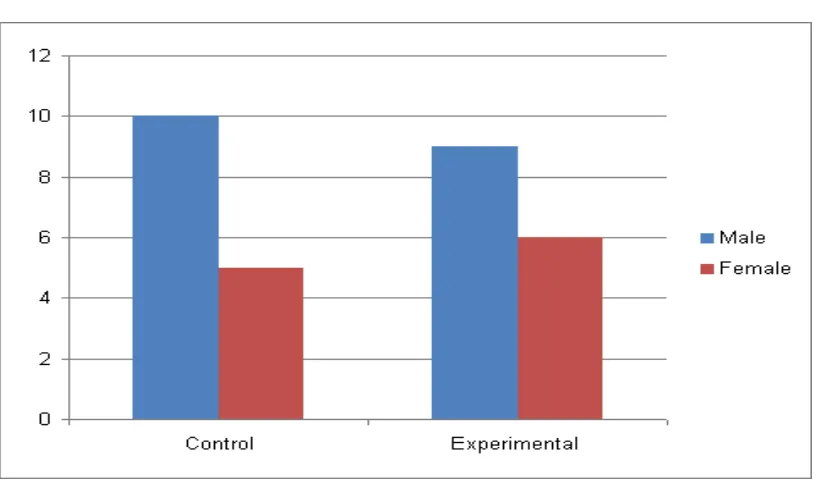
GRAPH 1
Sex wise distribution in control group and experimental group
The above bar graph shows, in control group 10 males and 5 females were selected;
and in experimental group 9males and 6 females were selected.
GRAPH 2
Mean difference of BBT in control group and experimental group
GRAPH 3
Mean difference of MBI in control group and experimental group
Table 2. PRE TEST MEAN AND STD. DEVIATION OF BBT
GROUP N (No. of Subjects) MEAN STD. DEVIATION
CTRL GP 15 10.2 1.37321
[image:36.612.123.552.238.324.2]EXP GP 15 9.333 1.04653
Table 3.POST TEST MEAN AND STD. DEVIATION OF BBT
GROUP N (No. of Subjects) MEAN STD. DEVIATION
CTRL GP 15 14.2 2.4571
EXP GP 15 19 2.4285
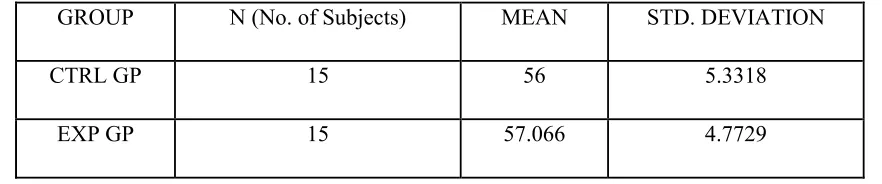
Table 4.PRE TEST MEAN AND STD. DEVIATION OF MBI
GROUP N (No. of Subjects) MEAN STD. DEVIATION
CTRL GP 15 56 5.3318
EXP GP 15 57.066 4.7729
Table 5. POST TEST MEAN AND STD. DEVIATION OF MBI
GROUP N (No. of Subjects) MEAN STD. DEVIATION
CTRL GP 15 60.8 5.46678
[image:36.612.119.560.399.491.2] [image:36.612.125.564.567.656.2]INTERPRETATION OF DATA:
STATISTICAL ANALYSIS OF BOX AND BLOCK TESTAND MODIFIED
BARTHEL INDEX OF CONTROL GROUP USING PAIRED t TEST
TABLE 6.
GROUP
CTRL MEAN SD t DF Sig t value
BBT PRE 10.2 1.3732 10.583 14 4.6096
POST 14.2 1.5675
MBI PRE 56 5.3318 21.5692 14 3.85
POST 60.8 5.4667
Interpretation-Box and block test control group-
Above table shows the mean of the pre test data for the control group as
10.2±1.373213 (SD) and post test value as 14.2±1.567528 (SD).The calculated t value
is 10.58300524 which is greater than that of table value(2.145). It indicates that there
is significant difference between pretest and post values of Box and block test upper
extremity in control group.
Interpretation-Modified barthel index control group-
Above table shows the mean of the pre test data for the control group as
56±5.331845(SD) and post test value as 60.8±5.466783(SD).The calculated t value is
21.5692 which is greater than that of table value(2.145). It indicates that there is
significant difference between pretest and post test values of MBI upper extremity in
STATISTICAL ANALYSIS OF BOX AND BLOCK TEST AND MODIFIED
[image:38.612.126.512.165.285.2]BARTHEL INDEX OF EXPERIMENTAL GROUP USING PAIRED t TEST
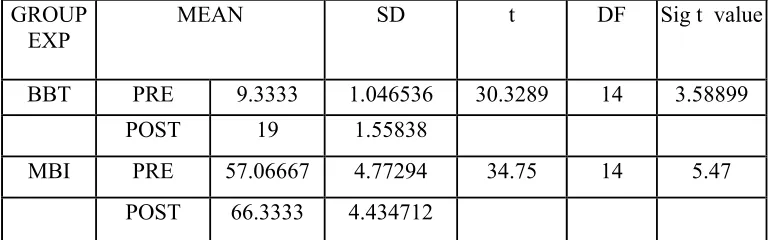
TABLE 7.
GROUP
EXP MEAN SD t DF Sig t value
BBT PRE 9.3333 1.046536 30.3289 14 3.58899 POST 19 1.55838
MBI PRE 57.06667 4.77294 34.75 14 5.47
POST 66.3333 4.434712
Interpretation-Box and block test experimental group
Above table shows the mean of the pre test data for the experimental group as
9.33±1.04653623 (SD) and post test value as 19± 1.558387 (SD).The calculated t
value is 30.32892596 which is greater than that of table value(2.145). It indicates that
there is significant difference between pretest and post values of Box and block test
upper extremity in experimental group.
Interpretation-Modified Barthel index experimental group-
Above table shows the mean of the pre test data for the experimental group as
57.06±4.77294 (SD) and post test value as 66.33± 4.434712 (SD).The calculated t
value is 34.75 which is greater than that of table value(2.145). It indicates that there is
significant difference between pretest and post test values of MBI upper extremity in
STASTICAL ANALYSIS OF BOX AND BLOCK TEST AND MODIFIED
[image:39.612.126.557.158.290.2]BARTHEL INDEX OF PRE TEST VALUE USING INDEPENDENT T TEST
TABLE 8.
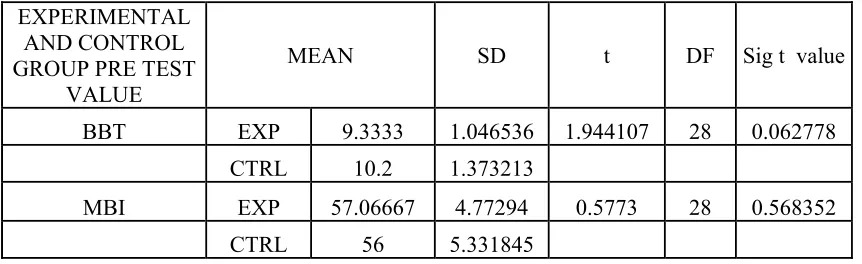
EXPERIMENTAL AND CONTROL GROUP PRE TEST
VALUE
MEAN SD t DF Sig t value
BBT EXP 9.3333 1.046536 1.944107 28 0.062778
CTRL 10.2 1.373213
MBI EXP 57.06667 4.77294 0.5773 28 0.568352
CTRL 56 5.331845
INTERPRETATION-BOX AND BLOCK TEST UPPER EXTRIMITY
CONTROL AND EXPERIMENTAL GROUP PRETEST VALUE
Above TABLE shows the mean of pre test data for experimental group as
9.33 ±1.046536(SD)the calculated t value is 1.944107 and control group mean
10.2±1.373213 and calculated t value is 1.944107 for both experimental and control
group It indicates that there is no significant difference between experimental and
control group.
INTERPRETATION-MODIFIED BARTHEL INDEX UPPER
EXTIMITY CONTOL AND EXPERIMENTAL GROUP PRETEST VALUE
Above TABLE shows the mean of pre test data for experimental group as
57.06667±4.77294 (SD) the calculated t value is .05773 and control group mean
56±5.331845 and calculated t value is 0.5773 for both experimental and control
group. It indicates that there is no significant difference between experimental and
STASTICAL ANALYSIS OF BOX AND BLOCK TEST AND MODIFIED
BARTHEL INDEX POST TEST VALUE USING INDEPENDENT T TEST
TABLE 9.
EXPERIMENTAL AND CONTROL
GROUP POST TEST VALUE
MEAN SD t df value Sig t
BBT EXP 19 1.558387 8.41 28 0.0379
CTRL 14.2 1.567528
MBI EXP 66.333 4.434712 3.04 28 0.005
CTRL 60.8 5.466783
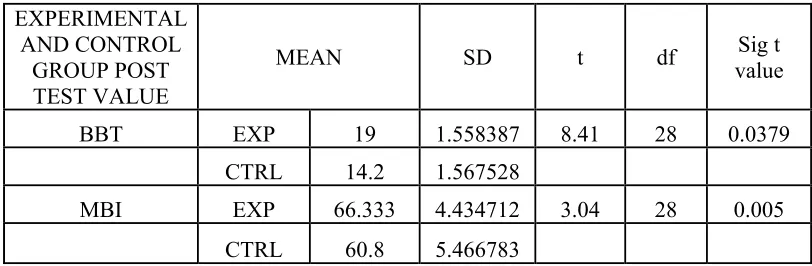
INTERPRETATION- BOX AND BLOCK TEST UPPER EXTRIMITY
CONTROL AND EXPERIMENTAL GROUP POST TEST VALUE
Above TABLE shows the mean of post test data for experimental group as 19
±1.558387 (SD) the calculated t value is 8.41 and control group mean 14.2±1.567528
and calculated t value is 8.41 for both experimental and control group.It indicates that
there is a significant difference experimental group value than control group.
INTERPRETATION- MODIFIED BARTHEL INDEX UPPEREXTRIMITY
CONTOL AND EXPERIMENTAL GROUP POST TEST VALUE
Above TABLE shows the mean of post test data for experimental group as
66.333.±4.434712 (SD) the calculated t value is 3.04 and control group mean
60.8±5.466783 and calculated t value is 3.04 for both experimental and control group.
It indicates that there is a significant difference in experimental group value than
[image:40.612.125.531.163.296.2]RESULTS
BOX AND BLOCK
• Effectiveness of Control Group (Conventional Physiotherapy)
While comparing the pre-test and post test values of control group using
Paired ‘t’ test, the calculated t value is 10.58300524 whereas the table value is
2.144786681.Since the calculated value is more than critical value, it states that there
is significant difference between the pre-test and post-test values of control group.
When comparing the mean values of both, the post-test mean value is 14.2 which are
greater than the pre-test mean value 10.2.Hence it confirms that there is a significant
improvement in post-test control group than pre-test control group.
• Effectiveness of Experimental Group ( Modified Constraint Induced Movement
Therapy and Conventional Physiotherapy)
While comparing the pre-test and post test values of experimental group using
Paired‘t’ test, the calculated value is 30.32892596 whereas the table value is
2.144786681.. Since the calculated value is more than the critical value, it states that
there is significant difference between the pre-test and post-test values of
experimental group. When comparing the mean values of both, the post-test mean
value 19 which is greater than the pre-test mean value 9.33. Hence it confirms that
there is a significant improvement in post-test experimental group than pre-test
MODIFIED BARTHEL INDEX
• Effectiveness of Control Group (Conventional Physiotherapy)
While comparing the pre-test and post test values of control group using
Paired ‘t’ test, the calculated t value is 21.56922 where as the table value is
2.144787.Since the calculated value is more than critical value, it states that there is
significant difference between the pre-test and post-test values of control group. When
comparing the mean values of both, the post-test mean value is 60.8 which is greater
than the pre-test mean value 56.Hence it confirms that there is a significant
improvement in post-test control group than pre-test control group.
• Effectiveness of Experimental Group ( Modified Constraint Induced Movement
Therapy and Conventional Physiotherapy)
While comparing the pre-test and post test values of experimental
group using Paired ‘t’ test, the calculated value is 34.75 whereas the table value is
2.144787. Since the calculated value is more than the critical value, it states that there
is significant difference between the pre-test and post-test values of experimental
group. When comparing the mean values of both, the post-test mean value 66.33
which is greater than the pre-test mean value 57.06. Hence it confirms that there is a
significant improvement in post-test experimental group than pre-test experimental
DISCUSSION
The study was an experimental approach to find out the efficacy of mCIMT
to improve upper extremity motor performance in subacute stroke patients. The age of
subjects was almost identical in both groups about 50-65years. The duration of
condition was 3 -9months after onset: 10 males and 5 females in control group and 9
males and 6 females in experimental group .The duration of the treatment was 3
weeks after onset.
Both groups were assessed in the first day and last day of treatment. The
tool taken to measure the outcome was Box and block test and Modified barthel
index. The instrument has high reliability and good validity for assessing motor
function .BBT has impressive test retest reliability inter rater reliability and construct
validity.The Box and block test is an efficient measurement tool that can be
performed in approximately 5 minutes and it measures unilateral gross manual
dexterity.
Another outcome measure is Modified barthel index. This scale has been
found to be highly reliable and its validity and usefulness in measuring the progress of
patients.
Control group was given ROM exercises, strengthening exercises, spasticity
management, Balance training and Gait training. mCIMT were additionally given to
experimental group , while rest of treatment were same .
On statistical analysis of Box and block test upper extremity, paired t test
showed significant difference in pre and post test scores of both control and
On statistical analysis of Box and block test independent t test showed
significant difference in post test scores of experimental group over control group
On statistical analysis of Modified Barthel index. Paired t test show significant
difference in pre test and post test scores of both control group and experimental
group.
On statistical analysis of Modified Barthel index, Independent t test show
significant difference in post test score of experimental group over control group.
Approximately 30% to60% of stroke survivors report persistent end of
impairment of upper extremity movement and are unable to use their affected arm in
daily activities. Learned non use is a most common problem seen in stroke Patients.
They used to perform tasks using their unaffected upper extremity and progressively
avoid using the affected upper extremity resulting in al earned non-use phenomenon.
Repeated affected limb ADL practice may be critical viable in overcoming learned
nonuse.
A primary therapeutic factor in mCIMT appears to be repeated use with the
more affected limb which is thought to induce cortical reorganization and correlative
functional improvement. Less intensive practice of the affected upper extremity and
restraint of the unaffected upper extremity under a variety of functional tasks may
provide opportunity for patients to explore optimal ways (i.e., more preplanned
control) to achieve various functional tasks .Therefore intensive practice may improve
motor planning and promote experience-related adaptations of brain function, leading
Modified Constraint-Induced Movement Therapy (mCIMT) refers to a new set
of rehabilitation techniques designed to reduce functional deficits in the more affected
upper extremity of stroke survivors. The two key features of mCIMT are restraint of
the unaffected hand/arm and increased practice /use of the affected hand/arm. since
stroke survivors may experience “learned non-use” of the upper extremity within a
short period of time mCIMT is designed to overcome learned non-use by promoting
cortical reorganization. Engage in repetitive and intense use of novel tasks that
challenge the stroke survivor to acquire necessary motor skills to use the involved
SUGGESTIONS
1. To establish the efficacy of the treatment, a large sample size study is
required.
2. To make the results more valid a long term study may be carried out
LIMITATIONS
1. Study was conducted for a short period of time.
2. Since study time was short only limited sample size could be considered for the study.
3. The study assessed only short term progress of the patients.
4. No follow ups could be done.
5. All the measurement were taken manually and this may introduce human error, which could create errors in proving the hypothesis.
CONCLUSION
The study projects that Modified constraint Induced Movement Therapy is an effective exercise regime in improving motor performance of upper extremity.
REFERENCES
1. Cash’s text book of neurology for physiotherapist, 4th edition, 1993
2. Geraint. Fuller, neurological examination made easy, 3rd edition, 1993.
3. Marilyn A. Harrison , Physiotherapy in stroke management, 1995.
4. Morris DM,et al;”Constraint induced movement therapy for recovery after
stroke”.Neurorehabilitation.1997;9:29-43.
5. Neurology and Neuro surgery, illustrated, 2nd edition, 1992.
6. Petricia. M. Davies , right in the middle (selective trunk activity in the
treatment of adult hemiplegia) 1990.
7. Brain foundation-article 2003
8. National stroke association –the complete guide to stroke.Engle wook, CO,
2003.
9. Doidge,Norman.”The brain that changes itself”Viking, 2007.
10. Nakayama H et al; ”Compensation in recovery of upper extremity function
after stroke: the Copenhagen Stroke Study”. Arch Phy Med Rehabil.1994;
75:852-857.
10. Johanne Higgins et al; Rehabilitation research and Development(J)P:65-
76,January/February 2005,Vol 42
11. www.Stroke Engine.com-Box and block test and Modified Barthel Index for
12. Physical Rehabilitation-Sullivan,5th Edition
13. Janet Carr -4th edition 2000-Neurorehabilitation
14. Ostendorf CG,Wolf SL.” Effects of forced use of the upper extremity of a
hemiplegic patient on changes in function: a single- case design”.Phys
Ther.1981;61:1022-1028.
15. Taub E et al.(2003)”Improved motor recovery after stroke and massive
cortical reorganization following Constraint induced movement
therapy.”Phy Med Rehab Clin N Am:14;S77-S91.
16. Bonifer NM,et al.”Constraint induced movement therapy after
stroke:efficacy for patients with minimal upper extremity motor ability”
Arch Phy Med Rehab Sep;86(9):1867-73 2005.
17. Shah,S(1998).Modified Barthel Index or Barthel index(Expanded).
18. Shah,S;Vanclay,Cooper,B(1989).Improving the sensitivity of the Barthel
Index for stroke rehabilitation.Journal of clinical
epidemiology,42(8),703-709.
19. Koyama.T et al;Thomas Land Publishers Inc Constraint induced therapy
approach to restoring function after neurological injury. Volume
8,number3/fall 2001,p 1-77.
20. Levin P et al;” Mental practice with motor imagery: evidence for motor
recovery and cortical reorganization after stroke”Apr;38(4):1293-7.Pub
APPENDIX I
DATA COLLECTION SHEET
Patient Name……….Patient ID………
Date ……… ……, Gender……… Age …………..……….
Weight …... Blood Pressure ……….heart rate
Stage of the disease (Brunnstrom stage of scaling) ………..
Duration of the condition……….
Medications Taken Before Test………..
………
Time of Last Medication………
Before test After test
Score of Box and block test
Score of modified barthel index
APPENDIX-2
NEUROLOGICAL ASSESSMENT FORM
SUBJECTIVE ASSESSMENT
Name :
Age :
Sex :
Dominance :
Occupation :
Address
Chief Complaints :
History of present illness :
Past Medical History :
Prior treatment history :
Drug History :
Family History :
Social History :
Personal History :
General Examination :
Vital signs
• Temperature
• Pulse rate
• Respiratory rate
• Blood Pressure
Cardio vascular system
Respiratory system
Abdomen
OBJECTIVE ASSESSMENT
ON OBSERVATION:
Head
Eye
Face
Back/Trunk
Built of patient
Gait
Posture
Attitude of limb
Atrophy
Colour of skin
Contour of joints
External appliances
Fasciculation
Involuntary movements
Mode of ventilation
Oedema
ON PALPATION:
Tenderness
Warmth
Tone
Oedema
Spasm
Anatomical landmarks
ON EXAMINATIONS:
I Higher Functions:
a) Level of consciousness
Glasgow coma scale ( E4 M6 V5 )
1) Eye Opening
Spontaneous - 4
To speech - 3
To pain - 2
No response - 1
2) Best Motor Response
Follows motor commands - 6
Localizes pain - 5
Abnormal flexion - 3
Abnormal Extension - 2
No response - 1
3) Verbal Response
Oriented - 5
Confused conversation - 4
Inappropriate words - 3
Incomprehensible sounds - 2
No response - 1
b) Orientation Time
Place
Person
c) Attention
d) Cognition
1) Fund of knowledge 2) Calculation Ability 3) Proverb Interpretation
Mini Mental State Examination test is used to assess cognition
e) Co-operation
f) Memory
Declarative
Non declarative
Long term
II Cranial Nerve Examination
Nerves Right Left
Olfactory
Optic
Oculomotor
Trochlear
Trigeminal
Abducent
Facial
Vestibulocochlear
Glosso pharyngeal
Vagus
Spinal Accessory
Hypoglossal
III Sensory Assessment
Sensory Assessment Scale
1) Intact : Normal, Accurate 2) Decreased : Delayed response
3) Exaggerated : Increased sensitivity or awareness of the stimulation after it has ceased
4) Inaccurate : Inappropriate perception of a given stimulus 5) Absent : No response
7) ASIA Sensory Scoring
0 - Absent
1 - Impaired
2 - Normal
NT - Not testable
Sensation Upper extremity
lower
extremity Trunk
Right Left Right Left Right Left
a) Superficial
Pain
Touch
Temperature
Pressure
b) Deep
Movement Sense
Position Sense
Vibration Sense
c) Combined Cortical
IV Motor Examinations
a) Muscle power
0 - No palpable or observable muscle contraction
1 - Palpable muscle contraction, no observable motion
2 - Full available ROM against gravity minimizes plane, no
resistance
3 - Full available ROM against gravity , no resistance
4 - Full available ROM against gravity nearly moderate manual
resistance
5 - Full available ROM against gravity, strong manual resistance
Upper Extremity
Muscle Right Left
Shoulder
Flexors Extensors Abductors Adductor Internal rotators External Rotators
Elbow
Flexors Extensors
Forearm
Wrist
Wrist flexors Wrist extensors
Finger
Finger flexor
Finger Extension
Lower Extremity
Muscle Right Left
Hip
Flexors
Extensors
Abductors
Adductor
Internal Rotators
External Rotators
Knee
Flexors
Extensors
Ankle
Dorsi flexors
Foot
Invertors
Evertors
Toe
Flexors
Extensors
Trunk
Abdominals
Extensors
b) Tone
Assess Hyper tonicity and Hypotonicity
Hyper Tonicity
Brunstrom scale-
STAGE 1 Recovery from hemiplegia occurs in a stereotyped sequence of events that begins with a period of flaccidity immediately following the acute episode. No movement of the limbscan be elicited.
STAGE 2 As recovery begins, the basic limb synergies or some of their components may appear as associated reactions or minimal voluntary movementresponses may be present. At this time, spasticity begins to develop.
STAGE 3 Thereafter, the patient gains voluntary control of the movement synergies,
STAGE 4 Some movement combinations that do not follow the paths of either synergy are mastered, first with difficulty, then with more ease, and spasticity begins to decline.
STAGE 5 If progress continues more difficult movement combinations are learnedas the basic limb synergies lose their dominance over motor acts.
STAGE 6 With the disappearance of spasticity, individual joint movements become possible and coordinationapproaches normal. From here on, as the last recovery step, normal motor function is restored, but this last stage is not achieved by all, for the recovery process can plateau at any stage.
From Brunnstrom, S: Movement Therapy in Hemiplegia. Harper& Row, New York, 1970, with permission
C Girth Measurement:-
D Deep tendon Reflexes
0 - No response
1+ - Present but depressed
2+ - Average, normal
3+ - Increased, brisker than average
Reflex Right Left
Biceps (C5, C6)
Bracheoradialis (C5,C6)
Triceps (C6,C7)
Finger flexors (C6-T1)
Hamstrings (L5,S1,S2)
Quadriceps (L2,L3 ,L4)
Tendo Achilles (S1-S2)
Jaw jerk
E Superficial reflex
Reflex Right Left
Plantar (S1, S2)
Abdominals
Above umbilicus ( T8- T10)
Below umbilicus (T10 – T12)
Corneal
Cremasteric (L1, L2)
F Primitive Reflexes
0+ - Absent
1+ - Tone change , slight, transient with no movement of extremities
2+ - Visible movement of extremities
3+ - Exaggerated , full movement of extremities
4+ - Obligatory and sustained movement lasting for more than 10
Reflexes Right Left
ATNR
STNR
Tonic Neck Reflex
Tonic Labrynthine Reflex
Flexor withdrawal
Grasp reflex
Moro
Startle
Sucking
Rooting
G Range of motion
Joint Right Left
Shoulder
Flexion
Extension
Abduction
Adduction
Internal rotation
External rotation
Elbow
Flexion
Fore arm
Supination
Pronation
Wrist
Flexions
Extension
Radial deviation
Ulnar Deviation
Finger
Flexion
Extension
Hip
Flexion
Extension
Abduction
Adduction
Internal rotation
External rotation
Knee
Flexion
Ankle
Dorsi flexion
Plantar flexion
Foot
Inversion
Eversion
Neck
Flexion
Extension
Side flexion
Rotations
Trunk
Flexion
Extension
Rotation
Side flexion
V Co-ordination
Co-ordination Grading
5 - Normal Performance
4 - Minimal impairment . Able to accomplish, slightly, less than normal speed Requires supervision, minimal contract guarding
2 - Severe impairment - Able only to initiate activity without completion, requires maximal contact guarding
1 - Activity impossible
Non Equilibrium Test
Co-ordination Test Grade Right Grade Left
Finger to nose
Finger to finger
Finger opposition
Mass grasp
Pronation / Supination
Rebound test
Tapping (Hand)
Tapping (Foot)
Pointing & Past pointing
Heel to knee
Drawing a circle (Hand)
Drawing a circle (Foot)
Equilibrium Test
Co-ordination Test Grade
Standing – Normal posture
Standing – Normal posture with vision occluded
Standing – Feet together
Standing - Lateral flexion
Tandem walking
Walking sideways
Walking backwards
Walk in a circle
Walk on heels
Walk on toes
Romberg Test
Sharpened Romberg test
Stair climbing
Balance Assessment Scales
Berg Balance Scale
Tinetti Performance Oriented Motor Assessment (POMA)
Timed up and go test (TUGT)
VI Gait Assessment
Observational Gait Analysis
Step Length
Stride Length
Cadence
VII Functional Assessment
Functional Independent Measure (FIM)
CONSENT FORM
I. ………..voluntarily consent to
participate in the research study named
“ Comparative study of conventional therapy Vs Modified constraint induced movement therapy and conventional therapy on upper extremity function of stroke patients”.
The researcher had explained to me the treatment approach in detail, risk of the participants and had answered the questions related to the research to my satisfaction.
Participant’s Signature:
Signature of the Witness:
Descriptive data of Control group
Serial
number Age
(Years)
Sex Box and Block test Modified Barthel Index
Pre -test Post-test Pre -test Post-test
1. 61 M 10 14 63 67
2. 59 F 12 16 52 56
3. 63 M 8 13 64 69
4. 65 F 11 15 50 55
5. 55 M 9 14 49 53
6. 50 F 12 15 60 64
7. 62 M 11 14 55 60
8. 60 M 8 11 59 64
9. 57 F 10 14 61 66
10. 65 M 9 13 53 57
11. 61 M 11 15 62 67
12. 52 F 9 17 54 61
13. 64 M 10 14 48 53
14. 59 M 11 12 58 64
Descriptive data of Experimental group
Serial number
Age (Years)
Sex Box and Block test Modified Barthel Index
Pre-test Post-test Pre-test Post-test
1. 60 M 10 18 59 68
2. 59 M 9 20 54 63
3. 62 F 8 16 49 58
4. 65 M 11 21 57 67
5. 56 F 10 19 64 72
6. 59 M 9 18 52 61
7. 50 F 8 17 63 73
8. 58 M 10 20 58 67
9. 61 F 11 21 56 66
10 63 M 10 19 60 68
11 55 M 8 21 59 67
12. 64 F 10 20 61 69
13. 53 M 9 19 55 66
14. 60 M 8 17 61 71
Modified Barthel Index scale
Item Unable to
perform task Substantial help required Moderate help provided Minimal help required Fully independent Personal hygiene
0 1 3 4 5
Bathing self 0 1 3 4 5
Feeding 0 2 5 8 10
Toilet 0 2 5 8 10
Stair climbing 0 2 5 8 10
Dressing 0 2 5 8 10
Bowel control 0 2 5 8 10
Bladder control
0 2 5 8 10
Ambulation 0 3 8 12 15
or Wheelchair*
0 1 3 4 5
Chair/Bed transfer
0 3 8 12 15