Copyright © 1998, American Society for Microbiology
Implication of a Central Cysteine Residue and the HHCC
Domain of Moloney Murine Leukemia Virus Integrase
Protein in Functional Multimerization
GEORGE A. DONZELLA,1† OSCAR LEON,2ANDMONICA J. ROTH1*
Department of Biochemistry, University of Medicine and Dentistry of New Jersey-Robert Wood Johnson Medical
School, Piscataway, New Jersey 08854,1and Instituto de Bioquimica, Facultad de Ciencias, Universidad
Austral de Chile, Casilla 567, Valdivia, Chile2
Received 11 July 1997/Accepted 21 October 1997
Moloney murine leukemia virus (M-MuLV) IN-IN protein interactions important for catalysis of strand transfer and unimolecular and bimolecular disintegration reactions were investigated by using a panel of chemically modified M-MuLV IN proteins. Functional complementation of an HHCC-deleted protein (ND105) by an independent HHCC domain (CD232) was severely compromised by NEM modification of either subunit. Productive ND105 IN-DNA interactions with a disintegration substrate lacking a long terminal repeat 5* -single-stranded tail also required complementation by a functional HHCC domain. Virus encoding the C209A M-MuLV IN mutation exhibited delayed virion production and replication kinetics.
Productive retroviral infections require the stable insertion of the reverse-transcribed viral genome into the host chromo-some, a step that is mediated by the virus-encoded IN protein. Following reverse transcription of the retrovirus genome, the IN protein processes the termini of the viral long terminal
repeats (LTRs) by endonucleolytic cleavage of the 39-terminal
dinucleotides. This 39-processing reaction exposes a 59-CA-39
dinucleotide that is subterminally embedded in the LTRs and is conserved among known retroelements (3, 27, 28, 31, 41, 45).
The 39processing of the viral DNA termini leaves behind a 59
overhang or single-stranded (ss) tail which may impart IN-DNA complex stability in vitro (16, 48). Integration of the viral DNA copy occurs by a staggered transesterification of the
recessed viral 39ends and the phosphodiester backbone of the
target DNA (19). Repair of the resultant single strand gaps creates the hallmark duplication of target DNA sequence flanking the retroviral integration site (4, 28, 45).
Biochemical and genetic studies suggest that IN functions as a multimer which coordinates the integration of both viral DNA termini (18, 23, 24, 26, 28, 35, 37, 44, 46). The retroviral IN protein contains three functionally important domains: an N-terminal HHCC domain, a central catalytic core, and a C-terminal domain implicated in nonspecific DNA binding (2, 34, 47, 49, 50). The results of chemical cross-linking, equilibrium sedimentation, gel filtration, and yeast two-hybrid studies sug-gest that regions throughout IN are mediators of homomeric IN-IN interactions (1, 7, 23, 26, 46). The crystal and solution structures of the N-terminal HHCC (containing zinc), central catalytic core, and C-terminal subdomains of IN have substan-tiated the dimeric nature of these subdomains independent of DNA (5, 7, 15, 33). Furthermore, recent findings indicate that metal-dependent IN-IN (17, 52) and IN-DNA interactions
(38) are involved in functional, higher-order multimerization of the IN protein.
Various assays for IN function have been developed
includ-ing integration (39 processing and strand transfer) (12, 29),
disintegration (10), and coordinated disintegration (8, 13, 35). For disintegration, the substrate is unimolecular; strand trans-fer and coordinated disintegration are dependent on bimolec-ular assembly of the substrate mediated by multimeric IN-DNA interactions. The domains of IN which are important for these interactions vary among IN proteins and are implicated in such interactions through mutational analysis (6, 24, 30, 43, 46, 47), analysis of modified substrates (9, 14, 42), and the ability of defective IN mutants to complement each other in trans (8, 18, 24, 35, 44).
In previous studies, the C terminus of M-MuLV IN could only be minimally truncated (28 amino acids) in vitro and in vivo (24, 39). The M-MuLV HHCC domain was shown to be
essential for 39 processing (24). M-MuLV IN lacking the
HHCC region could catalyze unimolecular disintegration (24) and single and double disintegration on a tailed crossbone substrate (13). Under less-saturating enzyme conditions, dou-ble-end disintegration was strictly dependent on trans-subunit IN interactions promoted by the HHCC domain (13). With the crossbone substrate, the intramolecular “foldback” reaction is
mechanistically similar to 39 processing (13). The foldback
reaction was found to be dependent on both the LTR 59-ss tail
and N-terminal HHCC domain of M-MuLV IN, whereas ei-ther determinant sufficed to promote intermolecular activity (13). Collectively, these data suggested differing roles of the HHCC domain in the formation of the initial IN-DNA com-plexes and coordinated IN-IN interactions.
Prior studies had indicated that the M-MuLV IN was sen-sitive to N-ethylmaleimide (NEM) modification (25). Comple-mentation studies performed with human immunodeficiency virus type 1 IN have identified an NEM-sensitive site (Cys 56) which is required in trans to the HHCC domain (17). In the present work, multimeric M-MuLV IN-IN interactions impor-tant for strand transfer and unimolecular and coordinated (bi-molecular) disintegration reactions were studied by comple-mentation analysis of NEM-modified M-MuLV IN subunits. A central cysteine within the catalytic core domain, C209, and the
* Corresponding author. Mailing address: Department of Biochem-istry, University of Medicine and Dentistry of New Jersey-Robert Wood Johnson Medical School, 675 Hoes Ln., Piscataway, NJ 08854. Phone: (732) 235-5048. Fax: (732) 235-4783. E-mail: [email protected] gers.edu.
† Present address: Aaron Diamond AIDS Research Center, New York, NY 10019.
1691
on November 9, 2019 by guest
http://jvi.asm.org/
HHCC domain were identified as NEM-sensitive sites, both of which were necessary to mediate functional complementation. Furthermore, a critical requirement of the C209 NEM-sensi-tive site for efficient viral replication was demonstrated, sug-gesting a novel model for multimeric IN function.
NEM modification of wild-type (WT) and mutant M-MuLV IN proteins.Several M-MuLV IN mutants, which have been previously characterized (13, 24), were used to probe the NEM sensitivity of the IN-IN and IN-DNA interactions (Fig. 1).
CD232 is an inactive C-terminal truncation that contains the
HHCC domain and terminates just beyond the first aspartate residue of the active site (Fig. 2 and 3, lanes 3 and 4) (24). A point mutant that eliminates the sole non-HHCC cysteine res-idue located within the central catalytic core domain of M-MuLV IN, C209A, is active for integration and disintegration
reactions (Fig. 2 and 3, lanes 5 and 6) (24). ND105 lacks the
N-terminal HHCC domain and is inactive for 39processing but
is active for unimolecular disintegration (Fig. 2B, lanes 7 and 8) and coordinated disintegration of a tailed crossbone sub-strate (Fig. 3B, lane 3). In strand transfer assays, however,
ND105 retains a limited capacity to mediate integration into a
single target site (Fig. 2A, lanes 7 and 8) (24). Full integration
activity of ND105 can be restored by complementation with
CD232 (Fig. 2A, MOCK, lane 11) or by increasing the reducing
conditions and protein levels in the assay (24).
To investigate the nature of the IN-IN interactions impor-tant for functional complementation, each of the M-MuLV IN proteins was subjected to NEM alkylation followed by quench-ing with excess dithiothreitol (DTT). Strand transfer and uni-molecular and biuni-molecular disintegration assays were per-formed in parallel. A total of 120 pmol of each protein to be treated was separately diluted to a final concentration of 2 to
2.5 pmol/ml with ice-cold diluent (20 mM HEPES [pH 7.4]–
20% glycerol) and equilibrated on ice for 5 min. As a control, mock reactions were performed in which each of the M-MuLV IN proteins were preincubated on ice with 40 mM DTT for 20 min, followed by incubation with 10 mM NEM (freshly pre-pared; Sigma Chemical Corp) for a further 20 min. For the NEM reactions, proteins were first incubated on ice in 10 mM NEM for 20 min, followed by a 20-min quench with 40 mM DTT on ice. The NEM and mock-treated M-MuLV IN pro-teins were then assayed individually and for functional comple-mentation. A final DTT concentration of 40 mM was present in both mock and NEM reactions. In complementation assays where only one of the IN protein pairs was alkylated, DTT was present at a 20 mM concentration. Reactions were incubated at 37°C for 1.5 h and terminated. Similar results were obtained when the nonalkylated protein in the mixture was either un-treated, mock treated (indicated in the figure legends), or DTT treated (data not shown).
[image:2.612.52.289.76.217.2]Effects of NEM modification on strand transfer and unimo-lecular disintegration reactions.The results of the NEM treat-ment and completreat-mentation of the M-MuLV IN proteins for strand transfer and disintegration are shown in Fig. 2A and B, respectively. Compared to the control mock reactions (Fig. 2A, MOCK, lanes 1 and 2), NEM-treated WT protein was inactive for strand transfer (Fig. 2A, NEM, lane 2). Similar to WT IN,
FIG. 1. M-MuLV IN mutants used for NEM alkylation studies. The con-served domains and residues of IN are depicted, with the cysteines highlighted in italics (top); the black box represents a C-terminal insertion of 36 amino acids unique to M-MuLV IN. Cysteine targets of NEM modification in the WT, C209A, ND105, and CD232 proteins are highlighted in italics (bottom). Residues at which ND105 and CD232 initiate or terminate are also indicated.
FIG. 2. Activity of NEM-alkylated M-MuLV IN proteins in strand transfer and unimolecular disintegration reactions. (MOCK) Lanes 1 to 8, odd and even numbered lanes are reactions that respectively contained 10 and 20 pmol of the mock-treated proteins; lanes 9 to 11, complementation reactions which contained 10 pmol each of the indicated mock-treated proteins. (NEM) Assays were performed with 10 pmol of each of the indicated proteins. M-MuLV IN proteins that were subjected to NEM alkylation are indicated by bold underlined characters. Non-underlined proteins are untreated IN. Lane 1, NEM-alkylated CD232 negative-control reaction; lanes 2 to 13, reactions that contained individual or mixed pairs of treated and untreated proteins. (A) Strand transfer reactions with substrate 2784/2785 (13, 24). (B) Unimolecular disintegration reactions with the standard Y substrate (Y3154ds [13, 14]). The position of the 5932P-labeled C strand of oligonucleotide 3152
(14) is indicated (v).
on November 9, 2019 by guest
http://jvi.asm.org/
[image:2.612.60.543.495.663.2]the strand transfer activity of ND105 protein was severely com-promised by alkylation (Fig. 2A, NEM, lane 10 versus Mock,
lane 7). ND105 (at 20 pmol) remained sensitive to NEM (data
not shown). Since ND105 contains only a single cysteine, the
loss of ND105 strand transfer activity indicates that residue
C209 in the central catalytic core is NEM sensitive. These results indicate that modification of C209 blocks the catalytic functions of IN. C209 per se is not essential for catalysis in vitro, since the mutant C209A is capable of mediating single-end strand transfer (Fig. 2A, lanes 5 and 6) and unimolecular (Fig. 2B, lanes 5 and 6) and bimolecular (Fig. 3A, lanes 5 and 6) disintegration reactions. This is supported by NEM treat-ment of C209A (Fig. 2A, NEM, lane 6), which cannot be modified in the catalytic core and maintained activity, albeit yielding reduced levels of strand transfer, double disintegra-tion, and foldback product. The partial diminution of activity implies that the HHCC domain may serve as an additional target for NEM modification.
Complementation analysis allowed us to directly assess the sensitivity of the HHCC domain versus that of the central catalytic core’s C209 site to NEM modification since these domains are present as separate proteins. Previous analysis of
ND105-C209A, a double mutant that both lacks the HHCC
domain and contains an alanine substitution for residue C209, indicated that although it retains limited integration and dis-integration activity it cannot be functionally complemented by
CD232 (24). This implied that residue C209 and the HHCC
domain may be in close proximity. It was therefore tested
whether the CD232 protein could protect residue C209 from
alkylation with NEM. For premixed complementation reac-tions, 60 pmol of each protein pair was mixed together and then diluted immediately to a total protein concentration of 2
pmol/ml. Premixing CD232 with WT IN prior to NEM
treat-ment did not protect WT or ND105 IN from alkylation (Fig.
2A, NEM, lanes 3 and 11) and caused a slight reduction in the strand transfer activity of C209A (Fig. 2A, NEM, lane 7).
The effect of NEM treatment on multimeric IN-IN interac-tions could therefore be addressed in complementation reac-tions in which only one of the pairs of M-MuLV IN proteins
was alkylated. Untreated CD232 was unable to complement
NEM-treated WT, C209A, and ND105 M-MuLV IN for the
strand transfer reactions (Fig. 2A, NEM, lanes 4, 8, and 12,
respectively). When the HHCC domain of CD232 was
alky-lated and tested for complementation, little effect on the strand transfer activity of untreated WT and C209A IN pro-teins was noted (Fig. 2A, NEM, lanes 5 and 9, respectively). A low level of strand transfer activity was seen for
complemen-tation of ND105 by NEM-treated CD232 (Fig. 2A, NEM, lane
13); however, this level of complementation was below that of the MOCK-treated sample (Fig. 2A, MOCK, lane 11). This is a result of functional complementation by a limited number of
CD232 molecules that were resistant to alkylation (51).
In the unimolecular disintegration reactions, NEM modifi-cation of the individual M-MuLV IN proteins (WT, C209A,
and ND105) only resulted in a partial loss of activity (Fig. 2B,
NEM, lanes 2, 6, and 10, respectively). For the unimolecular
disintegration reactions, mixing of CD232 with WT, C209A, or
ND105 prior to NEM treatment did not protect the
NEM-sensitive subunits against alkylation (Fig. 2B, NEM, lane 3, 7,
or 11, respectively). Premixing CD232 with WT or ND105, in
fact, decreased the yield of joining product. Under these con-ditions, the HHCC domain may assist in exposing the cysteines for NEM modification. For complementation, the untreated
CD232 protein stimulated the disintegration activity of
NEM-treated WT and C209A by 1.5- to 2-fold and that of ND105 by
4-fold (Fig. 2B, NEM, lanes 4, 8, and 12, respectively). The
alkylated CD232 HHCC domain did not interfere with
produc-tive unimolecular IN-DNA interactions mediated by the WT,
C209A, and ND105 proteins (Fig. 2B, NEM, lanes 5, 9, and 13,
respectively).
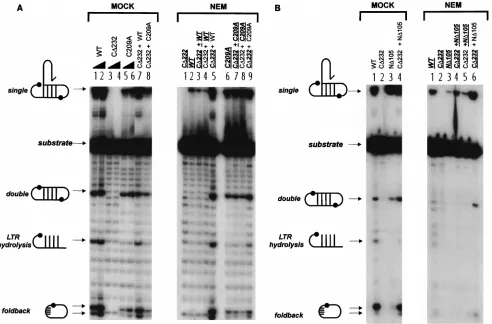
NEM alkylation and multimeric IN function: effects on bi-molecular coordinated disintegration reactions. The NEM-treated M-MuLV IN proteins were assayed for coordinated disintegration to more directly address the effect of alkylation on the productive assembly of bimolecular IN-DNA com-plexes. In the bimolecular disintegration reactions, four major products have been identified by using tailed crossbone sub-strates: intermolecular single disintegration and circular dou-ble disintegration products, a foldback product formed by an
intramolecular attack by the target DNA 39-OH, and an LTR
hydrolysis product (Fig. 3) (13). The catalytic properties of WT
IN, ND105, C209A, and CD232 on this substrate have
previ-ously been characterized (13).
NEM treatment of WT (Fig. 3A, NEM, lane 2 and Fig. 3B,
NEM, lane 1) and ND105 (Fig. 3B, NEM, lane 3) clearly
compromised activity. This point is illustrated by the severe reduction of single disintegration and by the total ablation of double disintegration and foldback reactions compared to the
control WT (Fig. 3A, NEM, lanes 1 and 2) and ND105 (Fig. 3B,
NEM, lane 3). In contrast, C209A was only moderately af-fected by NEM alkylation, with a slight decrease in the level of double disintegration and foldback products (Fig. 3A, NEM, lane 6). C209A has been previously characterized as catalyzing intramolecular foldback reactions less efficiently than WT (13). To identify targets of NEM important for coordinated disin-tegration and to test if the loss of IN function could be rescued, different combinations of treated and untreated proteins were
assayed for complementation. Mixing of CD232 with WT,
C209A (Fig. 3A and B, NEM, lanes 3 and 7), or ND105 (Fig.
3B, NEM, lane 4) prior to NEM treatment did not protect the NEM-sensitive subunits against alkylation. The activity of NEM-treated C209A was not changed by complementation
with untreated CD232 (Fig. 3A, NEM, lane 8). Significantly,
the coordinated disintegration activity mediated by
NEM-al-kylated WT (Fig. 3A, NEM, lanes 4) and ND105 proteins (Fig.
3B, NEM, lane 5) could not be restored by complementation
with an untreated CD232 HHCC domain. The NEM-alkylated
CD232 HHCC domain did not alter the activity of untreated
WT (Fig. 3A, NEM, lane 5) or C209A (Fig. 3A, NEM, lane 9), indicating that the loss of complementation functions was not due to incomplete quenching of unreacted NEM. Importantly,
NEM-treated CD232 was unable to complement untreated
ND105 (Fig. 3B, NEM, lane 6). The untreated CD232 protein
did function as a multimer with ND105, as indicated by the
restoration of double disintegration and foldback products to WT levels in the control reactions (Fig. 3B, MOCK, lane 4,
compared to ND105, lane 3 and WT IN, lane 1).
Thus, when either residue C209 or the HHCC domain was alkylated by NEM treatment, functional complementation could not be achieved. These data collectively suggest that residue C209 of M-MuLV IN, in conjunction with the HHCC domain, participates in the multimeric assembly of bimolecular IN-DNA complexes and coordinated IN-IN interactions.
The HHCC domain of M-MuLV IN is required for produc-tive interactions with an untailed unimolecular disintegration substrate.The function of the HHCC in retroviral integration remains obscure. Its proposed role in IN-IN interactions, LTR positioning, or in the maintenance of stable IN-LTR DNA complexes (13, 16, 17, 24, 25) has been inferred from biochem-ical analysis of mutant proteins through multiple assay systems. The importance of the HHCC domain in the absence of the
LTR 59-ss tail has been documented for coordinated
on November 9, 2019 by guest
http://jvi.asm.org/
gration reactions (13). The requirements for bimolecular sub-strate assembly in coordinated disintegration, however, is dis-tinct from that of a unimolecular disintegration reaction. In the context of unimolecular disintegration, the HHCC domain is
not critical when an LTR 59-ss tail is present on the Y substrate
(24). To further define the function of the HHCC domain, conditions were identified which strictly require the HHCC for unimolecular disintegration (Fig. 4A).
In the absence of both the HHCC domain and the LTR 59-ss
tail, no disintegration activity of the ND105 protein was
de-tected by using an untailed dumbbell substrate (Fig. 4A, lane 2). The critical requirement of the HHCC domain for produc-tive interactions with the untailed disintegration substrate was
demonstrated by functional complementation with the CD232
protein (Fig. 4A, lanes 3 to 7), with maximal disintegration
occurring at a 1:1 molar ratio of CD232 to ND105 protein. This
suggests that in the absence of the 59-ss tail, productive
uni-molecular IN-DNA interactions are dependent on a functional IN multimer containing an HHCC domain in stoichiometric levels with the catalytic core and C terminus of M-MuLV IN. In this simplified assay, the HHCC domain is required directly for LTR stabilization and not bimolecular substrate assembly. This necessity of the HHCC domain for productive IN-DNA
interactions in the absence of the LTR 59-ss tail was further
investigated by NEM alkylation of the ND105 and CD232
complementation pairs (Fig. 4B). In comparison to the
complementation of ND105 by CD232 (Fig. 4B, lane 2), NEM
treatment of the CD232 protein resulted in complete loss of
functional complementation (Fig. 4B, lane 3). When the C209
site of ND105 was alkylated, complementation by untreated
CD232 was also inhibited (Fig. 4B, lane 4). These data indicate
that both the HHCC domain of CD232 and residue C209 of
ND105 represent NEM-sensitive sites when present as
inde-pendent domains. In the context of WT M-MuLV IN (Fig. 4B, lane 5), NEM alkylation also caused a complete loss of func-tion with the untailed dumbbell substrate (Fig. 4B, lane 6).
Residue C209 of M-MuLV IN influences the retrovirus life cycle in vivo. The results of NEM alkylation on multimeric M-MuLV IN function in vitro prompted an investigation of its importance to viral replication in vivo. M-MuLV proviral DNA clones (pNCA-C [11, 20]) that encoded either WT or C209A IN proteins were transiently transfected into Rat-1 cells by the DEAE-dextran method (36). Rat-1 cells were maintained in
5% CO2at 37°C in Dulbecco’s modified Eagle’s medium
sup-plemented with 10% bovine calf serum (HyClone), 2 mM
[image:4.612.56.548.69.393.2]glutamine, 50 U of penicillin/ml, 50mg of streptomycin/ml, and
FIG. 3. Activity of NEM-alkylated M-MuLV IN proteins in coordinated bimolecular disintegration reactions. Reaction products of coordinated disintegration are indicated at the left of each panel. The input crossbone oligonucletide substrate consists of tailed half-crossbones 4166-4167 (13). M-MuLV IN proteins that were subjected to NEM alkylation are indicated by bold underlined characters. Non-underlined proteins are untreated IN. (A) Tailed coordinated disintegration reactions mediated by WT and C209A M-MuLV IN. (MOCK) Lanes 1 to 6, odd and even numbered lanes are reactions that respectively contained 10 and 20 pmol of the mock-treated proteins; lanes 7 and 8, complementation reactions which contained 10 pmol each of the indicated mock-treated proteins. (NEM) Assays were performed with 10 pmol of each of the indicated proteins. Lane 1, NEM-alkylated CD232 negative-control reaction; lanes 2 to 9, reactions that contained individual or mixed pairs of treated and untreated proteins. (B) Tailed coordinated disintegration reactions contrasting WT and ND105 M-MuLV IN. The activity of complementation mixtures containing 10 pmol of each indicated protein pair (MOCK, lane 4, and NEM, lanes 4 to 6) is compared to the activity of reaction mixtures containing 10 pmol of the individual proteins (lanes 1 to 3).
on November 9, 2019 by guest
http://jvi.asm.org/
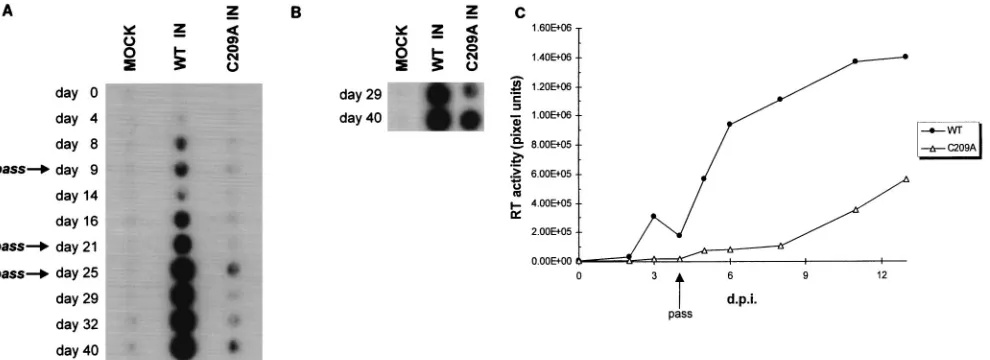
100mg of gentamycin sulfate/ml. Viral propagation was mea-sured over time by assaying supernatant medium for reverse transcriptase (RT) activity (21). In comparison to WT M-MuLV, C209A IN virion production was delayed 2 to 3 weeks (Fig. 5A, WT and C209A). RT activity levels of the C209A IN producer cells remained low throughout the time course. This implied that the C209A mutant virus was infecting cells extremely poorly and was hindered by dilution of the low
level of infected cells during passage. To test this possibility, plates from passage on day 21 were maintained through day 40 with changes of the medium every 1.5 weeks and assayed for viral spread. Under these conditions, the C209A IN-infected cells showed increasing RT activity levels on days 29 and 40 (Fig. 5B). No virus was detected in the control cells (Fig. 5A and B, MOCK), and the WT maintained the high level of viral release under these conditions.
The delayed spread of the viral C209A IN mutant suggested a defect in replication kinetics affected by the C209A IN mu-tation. Supernatants from the WT and C209A IN producer cells at 40 days postinfection were normalized with respect to RT activity levels and used to infect fresh Rat-1 cells to address this possibility. The kinetics of C209A IN viral spread showed a 1.5- to 2-week delay compared to WT M-MuLV (Fig. 5C). To confirm that the phenotype of the C209A IN virus was not due to reversion or second-site mutations, low-molecular-weight viral DNA was isolated from infected cells (22), and the full IN coding region was amplified by PCR (data not shown). Se-quencing of the 1.2-kb IN coding region confirmed that the C209A mutation was retained in the producer cell virions at 40 days postinfection (data not shown). Though a single nucleo-tide change was found, this was in a codon wobble position which did not affect the amino acid sequence of the IN protein
(ACT3ACG, Thr112).
Immunoprecipitation of C209A M-MuLV IN viral particles produced in the RT time course (Fig. 5B) indicated that nor-mal levels of proteins (i.e., CA, MA, TM, SU, RT, and IN) are incorporated into the C209A M-MuLV IN virions (data not shown). Similarly, Southern blot analysis of unintegrated DNA indicated the levels of linear viral DNA from C209A were similar to those of the WT virus at days 2 and 4 (data not shown). PCR amplification of C209A and WT M-MuLV re-gions of pol occurred with equivalent levels of input Hirt DNA. These results indicate that the replication defect probably does not reflect aberrant levels of viral protein synthesis, protein incorporation into mature viral particles, or subsequent viral DNA synthesis (32, 40). Taken together with the in vitro data, the replication-defective phenotype of the C209A IN virus
FIG. 4. Influence of the HHCC domain, residue C209, and the LTR 59-ss tail on ND105. The structures of the 59-32P-labeled untailed dumbbell substrate
[image:5.612.52.288.66.264.2](7440, 59-TGAAAGCGTAAGCTTTCAACCTGCGTAAGCAGGTAGACCG CAAGGTCT-39) and the reaction product of unimolecular disintegration are indicated on the left of each panel. (A) Requirement of the HHCC domain in trans to ND105 for unimolecular disintegration of an untailed dumbbell disinte-gration substrate. Lane 1 contains a control buffer reaction. The molar quantities of the proteins and their ratios in each reaction are respectively indicated above and below each lane. (B) Effect of NEM alkylation of residue C209 or the HHCC domain on productive interactions with an untailed dumbbell substrate. Individ-ual M-MuLV IN proteins and complementation protein pairs are indicated as in Fig. 2 and 3. NEM-treated samples are indicated in bold and are underlined.
FIG. 5. In vivo analysis of the effects of the C209A IN mutation on viral replication. (A) Time course of viral RT release into medium by Rat-1 producer cells. Days posttransfection are indicated on the left. Passages of the transfected producer cell line are indicated by arrows. (B) Accumulation of C209A viral RT in medium of plates maintained from passage on day 21 through day 40. (C) Time course of viral spread in Rat-1 cells. WT and C209A (pNCA-c/C209A IN) viruses collected at 40 days posttransfection were normalized for RT activity and used to infect fresh Rat-1 cells. RT activity was quantitated on a Molecular Dynamics PhosphorImager (Sunnyvale, Calif.). The pixel densities for each time point during the infection represent relative RT activity and are indicated on the y axis. The drop in RT activity at day 4 was due to passage of the infected cell lines. d.p.i., days postinfection.
on November 9, 2019 by guest
http://jvi.asm.org/
[image:5.612.54.549.492.672.2]suggests that residue C209 may affect in vivo multimeric IN functions that are important for coordinated integration (37).
Model for assembly of IN multimers.The in vitro integra-tion and unimolecular and bimolecular disintegraintegra-tion reac-tions mediated by M-MuLV IN have been shown to be subtly influenced by substrate determinants and domains of the IN protein (13, 14, 24, 25). Thus, the assembly of different pro-ductive IN-DNA complexes may be achieved through compli-cated and distinct multimeric IN-IN and IN-DNA interactions. The combined approach of complementation and chemical modification of M-MuLV IN mutants in each of the in vitro reactions was used to investigate these different states of IN function.
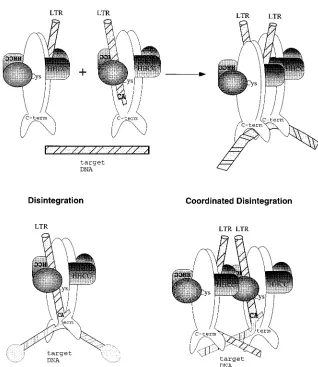
A model for the assembly of functional multimers for each of the integration and disintegration substrates is presented in Fig. 6. Two symmetric dimers of M-MuLV IN bind indepen-dent LTRs in a fashion that is analogous to how one holds a pen: the thumb, index finger, and middle finger each contribute
to the mechanism and stability of the grasp. In the working model, each of these stabilizing factors are represented by the HHCC domain of IN, the CA dinucleotide of the LTR, and the
LTR 59-ss tail. Elimination of one or more of these factors
would cripple the stability of LTR binding to various degrees. This is exemplified in Fig. 4, where unimolecular disintegration
of a 59-untailed substrate is dependent on the HHCC domain.
We have previously demonstrated that under nonsaturating conditions, coordinated disintegration mediated by the
HHCC-deleted ND105 protein was strongly dependent on
[image:6.612.138.456.112.479.2]trans-subunit interactions promoted by an independent HHCC domain (13). The model presented here proposes that coordi-nated IN activity is arbitrated by an interaction of the HHCC domains at the multimerization interface, in the vicinity of the C209. Two LTR strand transfer and coordinated disintegration would be dependent on this assembly, whereas the unimolecu-lar disintegration substrate is essentially “preassembled,” with the attacking nucleophile position maintained by the substrate
FIG. 6. Model of multimeric M-MuLV IN functions in vitro and in vivo. An illustration of M-MuLV IN domains and multimeric subunit interactions is shown. A dimeric interface is formed by parallel association of M-MuLV IN monomers, reflecting the structure studies of the catalytic core and C terminus of human immunodeficiency virus type 1 and avian sarcoma virus IN (5, 15, 33). DNA is depicted as striped bars. The N terminus of M-MuLV IN through the HHCC region is shaded. (Top) LTR coordination and multimeric assembly of subunits for integration. (Bottom) Substrate coordination and subunit interactions for unimolecular disintegration (left) and bimolecular coordinated disintegration (right).
on November 9, 2019 by guest
http://jvi.asm.org/
structure, and may be supported by a minimal protomeric subunit.
The sensitivity of the C209 and the HHCC domain to NEM modification can be visualized in this model. Both the C209 and the HHCC region participate in the productive assembly of multimeric IN-IN complexes. For unimolecular
disintegra-tion, the structural arrangement of the attacking target 39-OH
and scissile bond diminishes any steric constraints that could be imposed by NEM alkylation. These would only be visible under conditions of suboptimal LTR recognition, such as the
absence of the 59-ss tail. C209 is not essential for catalysis; the
C209A full-length protein as well as the C209A-ND105
trun-cated protein can catalyze single LTR strand transfer (24). The addition of the large maleimide group onto the C209 blocks IN-DNA and/or IN-IN interactions required for the strand transfer and coordinated disintegration reactions.
While NEM treatment of the core C209 site greatly reduced catalytic activities of the M-MuLV IN proteins, variation was detected in the sensitivity of the HHCC domain to NEM. The N-terminal HHCC domain may represent multiple functional
domains. CD232 consists of the N-terminal 176 amino acids of
M-MuLV IN, of which the HHCC structure per se only ac-counts for 41 amino acids. For M-MuLV, the N terminus of IN contains an additional 56 amino acids which are not conserved among related retroviral IN proteins. For HIV-1, the nuclear magnetic resonance solution structure (7) identified the dimer interface within the HHCC domain. For M-MuLV, an HHCC
construct smaller than CD232 is a dimer as well (51). The IN
constructs which are catalytically active were not renatured in the presence of exogenously added zinc. Preliminary data (32a) indicate an inverse relationship between NEM sensitivity and zinc coordination. The absence of zinc may also explain the inability of the HHCC domain to complement LTR hydrolysis in the coordinated disintegration reactions. It is possible that NEM may inhibit one function of the HHCC, such as LTR positioning, while maintaining a second function, such as dimerization. Additional studies to separate these functions are under way.
This work was supported by American Cancer Society grant RPG-95-056-03-VM and NSF-International Program NSF-INT-9408501/ Fundacion ANDES (travel grant). G.A.D. was supported by NIH training grant 5T32AI07043.
REFERENCES
1. Andrake, M. D., and A. M. Skalka. 1995. Multimerization determinants reside in both the catalytic core and C terminus of avian sarcoma virus integrase. J. Biol. Chem. 270:29299–29306.
2. Andrake, M. D., and A. M. Skalka. 1996. Retroviral intregrase, putting the pieces together. J. Biol. Chem. 271:19633–19636.
3. Brown, P. O., B. Bowerman, H. E. Varmus, and J. M. Bishop. 1987. Correct integration of retroviral DNA. Cell 49:347–356.
4. Brown, P. O., B. Bowerman, H. E. Varmus, and J. M. Bishop. 1989. Retro-viral integration: structure of the initial covalent product and its precursor, and a role for the viral IN protein. Proc. Natl. Acad. Sci. USA 86:2525–2529. 5. Bujacz, G., M. Jaskolski, J. Alexandratos, A. Wlodawer, G. Merkel, R. A.
Katz, and A. M. Skalka.1995. High-resolution structure of the catalytic domain of avian sarcoma virus integrase. J. Mol. Biol. 253:333–346. 6. Bushman, F. D. 1994. Tethering human immunodeficiency virus 1 integrase
to a DNA site directs integration to nearby sequences. Proc. Natl. Acad. Sci. USA 91:9233–9237.
7. Cai, M., R. Zheng, M. Caffrey, R. Craigie, G. M. Clore, and A. M.
Gronen-gorn. 1997. Solution structure of the N-terminal zinc binding domain of HIV-1 integrase. Nat. Struct. Biol. 4:567–577.
8. Chow, S. A., and P. O. Brown. 1994. Juxtaposition of two viral DNA ends in a bimolecular disintegration reaction mediated by multimers of human im-munodeficiency virus type 1 or murine leukemia virus integrase. J. Virol.
68:7869–7878.
9. Chow, S. A., and P. O. Brown. 1994. Substrate features important for rec-ognition and catalysis by human immunodeficiency virus type 1 integrase identified by using novel DNA substrates. J. Virol. 68:3896–3907. 10. Chow, S. A., K. A. Vincent, V. Ellison, and P. O. Brown. 1992. Reversal of
integration and DNA splicing mediated by integrase of human immunode-ficiency virus. Science 255:723–726.
11. Colicelli, J., and S. P. Goff. 1985. Mutants and pseudorevertants of Moloney murine leukemia virus with alterations at the integration site. Cell 42:573– 580.
12. Craigie, R., T. Fujiwara, and F. Bushman. 1990. The IN protein of Moloney murine leukemia virus processes the viral DNA ends and accomplishes their integration in vitro. Cell 62:829–837.
13. Donzella, G. A., C. B. Jonsson, and M. J. Roth. 1996. Coordinated disinte-gration reactions mediated by Moloney murine leukemia virus integrase. J. Virol. 70:3909–3921.
14. Donzella, G. A., C. B. Jonsson, and M. J. Roth. 1993. Influence of substrate structure on disintegration activity of Moloney murine leukemia virus inte-grase. J. Virol. 67:7077–7087.
15. Dyda, F., A. B. Hickman, T. M. Jenkins, A. Engelman, R. Craigie, and D. R.
Davies.1994. Crystal structure of the catalytic domain of HIV-1 integrase: similarity to other polynucleotidyl transferases. Science 266:1981–1986. 16. Ellison, V., and P. O. Brown. 1994. A stable complex between integrase and
viral DNA ends mediates human immunodeficiency virus integration in vitro. Proc. Natl. Acad. Sci. USA 91:7316–7320.
17. Ellison, V., J. Gerton, K. A. Vincent, and P. O. Brown. 1995. An essential interaction between distinct domains of HIV-1 integrase mediates assembly of the active multimer. J. Biol. Chem. 270:3320–3326.
18. Engelman, A., F. D. Bushman, and R. Craigie. 1993. Identification of dis-crete functional domains of HIV-1 integrase and their organization within an active multimeric complex. EMBO J. 12:3269–3275.
19. Engelman, A., K. Mizuuchi, and R. Craigie. 1991. HIV-1 DNA integration: mechanism of viral DNA cleavage and DNA strand transfer. Cell 67:1211– 1221.
20. Felkner, R. H., and M. J. Roth. 1992. Mutational analysis of N-linked gly-cosylation sites of the SU protein of Moloney murine leukemia virus. J. Vi-rol. 66:4258–4264.
21. Goff, S. P., P. Traktman, and D. Baltimore. 1981. Isolation and properties of Moloney murine leukemia virus mutants; use of a rapid assay for release of virion reverse transcriptase. J. Virol. 38:239–248.
22. Hirt, B. 1967. Selective extraction of polyoma DNA from infected mouse cell cultures. J. Mol. Biol. 26:365–371.
23. Jones, K. S., J. Coleman, G. W. Merkel, T. M. Laue, and A. M. Skalka. 1992. Retroviral integrase functions as a multimer and can turn over catalytically. J. Biol. Chem. 287:16037–16040.
24. Jonsson, C. B., G. A. Donzella, E. Gaucan, C. M. Smith, and M. J. Roth. 1996. Functional domains of Moloney murine leukemia virus integrase de-fined by mutation and complementation analysis. J. Virol. 70:4585–4597. 25. Jonsson, C. B., and M. J. Roth. 1993. Role of the His-Cys finger of Moloney
murine leukemia virus integrase protein in integration and disintegration. J. Virol. 67:5562–5571.
26. Kalpana, G. V., and S. P. Goff. 1993. Genetic analysis of homomeric inter-actions of human immunodeficiency virus type 1 integrase using the yeast two-hybrid system. Proc. Natl. Acad. Sci. USA 90:10593–10597.
27. Katz, R. A., G. Merkel, J. Kulkosky, J. Leis, and A. M. Skalka. 1990. The avian retroviral IN protein is both necessary and sufficient for integrative recombination in vitro. Cell 63:87–95.
28. Katz, R. A., and A. M. Skalka. 1994. The retroviral enzymes. Annu. Rev. Biochem. 63:133–173.
29. Katzman, M., R. Katz, A. M. Skalka, and J. Leis. 1989. The avian retroviral integration protein cleaves the terminal sequences of linear DNA at the in vivo sites of integration. J. Virol. 63:5319–5327.
30. Kulkosky, J., K. S. Jones, R. A. Katz, J. P. G. Mack, and A. M. Skalka. 1992. Residues critical for retroviral integrative recombination in a region that is highly conserved among retroviral/retrotransposon integrases and bacterial insertion sequence transposases. Mol. Cell. Biol. 12:2331–2338.
31. Kulkosky, J., and A. M. Skalka. 1990. HIV DNA integration: observations and inferences. J. Acquired Immune Defic. Syndr. 3:839–851.
32. Leavitt, A. D., G. Robles, N. Alesandro, and H. E. Varmus. 1996. Human immunodeficiency virus type 1 integrase mutants retain in vitro integrase activity yet fail to integrate viral DNA efficiently during infection. J. Virol.
70:721–728.
32a.Leon, Oscar. Unpublished data.
33. Lodi, P. L., J. A. Ernst, J. Kuszewski, A. B. Hickman, A. Engelman, R.
Craigie, G. M. Clore, and A. M. Grononborn.1995. Solution structure of the DNA binding domain of HIV-1 integrase. Biochemistry 34:9826–9833. 34. Lutzke, R. A., C. Vink, and R. H. A. Plasterk. 1994. Characterization of the
minimal DNA-binding domain of the HIV integrase protein. Nucleic Acids Res. 22:4125–4131.
35. Mazumder, A., A. Engelman, R. Craigie, M. Fesen, and Y. Pommier. 1994. Intermolecular disintegration and intramolecular strand transfer activities of wild-type and mutant HIV-1 integrase. Nucleic Acids Res. 22:1037–1043. 36. McCutchan, J. H., and J. S. Pagano. 1968. Enhancement of the infectivity of
simian virus 40 deoxyribonucleic acid with diethylaminoethyl-dextran. J. Natl. Cancer Inst. 41:351–357.
37. Murphy, J. E., and S. P. Goff. 1992. A mutation at one end of Moloney murine leukemia virus DNA blocks cleavage of both ends by the viral
on November 9, 2019 by guest
http://jvi.asm.org/
integrase in vivo. J. Virol. 66:5092–5095.
38. Pemberton, I. K., M. Buckle, and H. Buc. 1996. The metal ion-induced cooperative binding of HIV-1 integrase to DNA exhibits a marked prefer-ence for Mn(II) rather than Mg(II). J. Biol. Chem. 271:1498–1506. 39. Roth, M. J. 1991. Mutational analysis of the carboxyl terminus of the
Molo-ney murine leukemia virus integration protein. J. Virol. 65:2141–2145. 40. Roth, M. J., P. Schwartzberg, N. Tanese, and S. P. Goff. 1990. Analysis of
mutations in the integration function of Moloney murine leukemia virus: effects on DNA binding and cutting. J. Virol. 64:4709–4717.
41. Roth, M. J., P. L. Schwartzberg, and S. P. Goff. 1989. Structure of the termini of DNA intermediates in the integration of retroviral DNA: dependence on IN function and terminal DNA sequence. Cell 58:47–54.
42. VanDenEnt, F. M. I., C. Vink, and R. H. A. Plasterk. 1994. DNA substrate requirements for different activities of the human immunodeficiency virus type 1 integrase protein. J. Virol. 68:7825–7832.
43. vanGent, D. C., A. A. M. O. Groeneger, and R. H. A. Plasterk. 1992. Muta-tional analysis of the integrase protein of human immunodeficiency virus type 2. Proc. Natl. Acad. Sci. USA 89:9598–9602.
44. vanGent, D. C., C. Vink, A. A. M. O. Groeneger, and R. H. A. Plasterk. 1993. Complementation between HIV integrase proteins mutated in different do-mains. EMBO J. 12:3261–3267.
45. Varmus, H. E., and P. O. Brown. 1989. Retroviruses, p. 53–108. In M. Howe,
and D. Berg (ed.) Mobile DNA. American Society for Microbiology, Wash-ington, D.C.
46. Vincent, K. A., V. Ellison, S. A. Chow, and P. O. Brown. 1993. Character-ization of human immunodeficiency virus type 1 integrase expressed in Esch-erichia coli and analysis of variants with amino-terminal mutations. J. Virol.
67:425–437.
47. Vink, C., A. A. M. O. Groeneger, and R. H. A. Plasterk. 1993. Identification of the catalytic and DNA-binding region of the human immunodeficiency virus type 1 integrase protein. Nucleic Acids. Res. 21:1419–1425. 48. Vink, C., R. A. Lutzke, and R. H. A. Plasterk. 1994. Formation of a stable
complex between the human immunodeficiency virus integrase protein and viral DNA ends. Nucleic Acids Res. 22:4103–4110.
49. Woerner, A. M., M. Klutch, J. G. Levin, and C. J. Marcus-Sekura. 1992. Localization of DNA binding activity of HIV-1 integrase to the C-terminal half of the protein. AIDS Res. Hum. Retroviruses 8:297–304.
50. Woerner, A. M., and C. J. Marcus-Sekura. 1993. Characterization of a DNA binding domain in the C-terminus of HIV-1 integrase by deletion mutagen-esis. Nucleic Acids Res. 21:3507–3511.
51. Yang, F., O. Leon, and M. J. Roth. Unpublished data.
52. Zheng, R., T. M. Jenkins, and R. Craigie. 1996. Zinc folds the N-terminal domain of HIV-1 integrase, promotes multimerization, and enhances cata-lytic activity. Proc. Natl. Acad. Sci. USA 93:13659–13664.