
Headache: The Patient's View
5
0
0
Full text
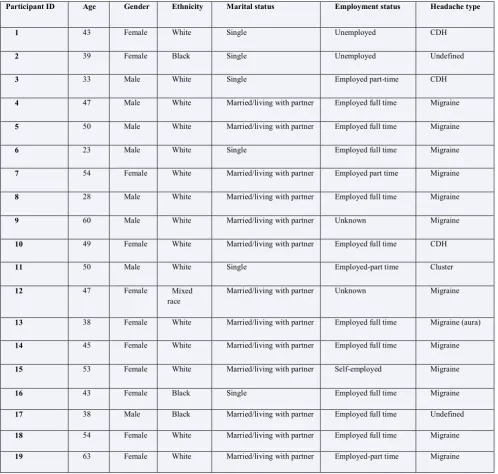
(2) Citation: Leone Ridsdale, Adam J Noble, Farah Nadeem, Myfanwy Morgan (2014) Headache: The Patient’s View. J Neurol Neurosurg 1(1): 4 Page 2 of 5. Methods Design: This qualitative study, which was nested in a prospective cohort study, sought to provide a detailed knowledge of the views and experiences of patients with headache who had been referred by their FP to a neurologist. Qualitative methods were ideally suited for such hitherto unexplored research topics as participants are able to raise what they personally regard as important aspects and concerns rather than these being specified in advance by the researcher. The South-East Multi-Centre Research Ethics Committee approved the study (MREC01/01/032). Informed consent was obtained from all participants. Recruitment: Participants were recruited from a cohort of 48 adults (aged > 18 yrs) with headache who were prospectively recruited after they had been referred by their FP in the south of England to a neurologist for headache [11]. This mean age of participants in this sample was 41and 64% % were female. We slightly over-sampled men given their smaller numbers in the cohort and selected individuals with a similar age distribution as the cohort. These patients were approached by letter to participate in this interview study with a response slip. A follow-up phone call was made to nonresponders. Data collection: Semi-structured interviews undertaken by a researcher independent of the cohort study (LJ), lasted on average 45 minutes, and were conducted in a location of the participant's choice. A topic guide was used to frame the interviews. This was developed on the basis of themes identified from the literature and refined through open interviews. The main themes covered were patients’ experience of having a headache disorder and its impact on their lives, including their fears and concerns; their use of hospital Emergency Departments, whether they had been referred for a scan, how this had occurred and how helpful this had been. Interviews were conducted on average two years after referral to a neurologist to provide a long term perspective. Participants were encouraged to talk freely and the interviewer probed and prompted responses as required. Information of the participants’ headache diagnosis was from the database of information collected for the cohort study in which these people had previously participated[11]. Data analysis: Interviews were audio-recorded and transcribed verbatim. Data were entered into NVivo 9 a computerized qualitative analysis package. FN read each transcript line-by-line and generated codes through open coding. These codes were then categorized thematically and relationships between themes were identified through a process of constant comparison, with particular reference to explanations for patients’ decision making and the beliefs and experiences of ‘deviant cases’. LR, AN and MM reviewed the codes and categories and discussed emerging interpretations.. Results. Sample Characteristics A total of 19 people comprising 8 men and 11 women were interviewed (Table 1). Thirteen had been categorized as having migraine, three chronic daily headaches and three as ‘other headache’. J Neurol Neurosurg. Analysis of the transcripts provided insights into patients’ fears about the cause of their headache and the implications that this had for their use of different health care services. Three key themes were identified. These were: headache-related fears and use of emergency departments; perceived need for a scan; and the outcome of a scan in terms of perceived reassurance. Quotations are presented to illustrate themes. Headache-related Departments. fears. and. use. of. Emergency. Patients generally identified fear about what their headache might mean as a key issue prompting service use. One patient mentioned her worry and anxiety reaching up to a point: ‘It’s a, what’s called a tipping point really I think, you know if you think of catastrophe theory that something will grow up to that point and suddenly it will tip.’ (P.12, Female, 47). For 3/19 participants, severe headaches made them resort to Emergency Department (ED) visits to a hospital after they had seen the FP. One said: ‘the one that was really frightening I ended up in X Hospital because it developed into what I thought that I might have been having a heart attack, because I was so worried about the headache’. (P.5, Male, 50). Continuous headache also led relatives to act on the patient’s behalf. One said: ‘it was like a continuous thing every weekend…my parents would take me up the hospital, thinking there was something wrong, and what it was, was migraine.’ (P.6, Male, 23). Perceived need for a scan Worry about a serious medical problem led ten participants to ask their doctor for a brain scan. Altogether eight of these patients received a scan subsequently. Before the scan, these patients described consistent fear of a possible physical cause, mainly a brain tumour. Patients described their headache as not reducing after advice given by their FP, and believed they needed to persist to get their doctor to arrange scan.. ‘...I wanted to be treated. I wanted somebody to tell me that I wasn’t gonna have a brain tumour and fall down dead.’ ‘...But I actually found I had to push for a scan, I had to insist on it almost, and yet that was the thing that had been the most worrying right from the very beginning... I had to insist on something, something physical being done.’ (P13, Female, 38). These patients generally explained that they had been referred for a scan for peace of mind: ‘Yes because I got so worried because it had gone on for so long and they said we’ll send you for one for peace of mind, we’re saying we know there’s no problem up there, but for peace of mind for you we’ll send you for one.’ (P.7, Female, 54) An additional three participants who had been referred and seen a neurologist reported having brain scans that were initiated at the request of a neurologist, rather than themselves. Vol. 1. Issue. 1. 21000106.
(3) Citation: Leone Ridsdale, Adam J Noble, Farah Nadeem, Myfanwy Morgan (2014) Headache: The Patient’s View. J Neurol Neurosurg 1(1): 4 Page 3 of 5. The outcome of a scan in terms of perceived reassurance Following the scan, 6/8 of the participants who reported asking for a scan, stated that their anxiety, stress, and worry had reduced considerably, and described themselves as ‘relaxing a bit’. Three of these patients reported that normal results from the scan reduced their headache symptoms also: ‘But I think I had the scan to put my mind at rest. I knew that there was nothing serious about it. But perhaps even that may have made the fact that it’s tailed off, you know, sort of eased it on its way sort of thing.’ (P19, Female, 63).. Discussion Summary of main findings We found most people with headache who were referred for a scan described fears about a physical cause for their headaches, in particular a brain tumor. Patients believed they had needed to put pressure on their doctors to get a referral for a scan. They typically described feeling relieved after a normal scan, with one reporting alleviation of headache symptoms altogether. After a scan most felt they had the confidence to use other strategies to manage their headache.. After the scan one participant reported the headaches diminished to such an extent they were no longer consulting their doctor. Table 1: Participant characteristics Participant ID. Age. Gender. Ethnicity. Marital status. Employment status. Headache type. 1. 43. Female. White. Single. Unemployed. CDH. 2. 39. Female. Black. Single. Unemployed. Undefined. 3. 33. Male. White. Single. Employed part-time. CDH. 4. 47. Male. White. Married/living with partner. Employed full time. Migraine. 5. 50. Male. White. Married/living with partner. Employed full time. Migraine. 6. 23. Male. White. Single. Employed full time. Migraine. 7. 54. Female. White. Married/living with partner. Employed part time. Migraine. 8. 28. Male. White. Married/living with partner. Employed full time. Migraine. 9. 60. Male. White. Married/living with partner. Unknown. Migraine. 10. 49. Female. White. Married/living with partner. Employed full time. CDH. 11. 50. Male. White. Single. Employed-part time. Cluster. 12. 47. Female. Mixed race. Married/living with partner. Unknown. Migraine. 13. 38. Female. White. Married/living with partner. Employed full time. Migraine (aura). 14. 45. Female. White. Married/living with partner. Employed full time. Migraine. 15. 53. Female. White. Married/living with partner. Self-employed. Migraine. 16. 43. Female. Black. Single. Employed full time. Migraine. 17. 38. Male. Black. Married/living with partner. Employed full time. Undefined. 18. 54. Female. White. Married/living with partner. Employed full time. Migraine. 19. 63. Female. White. Married/living with partner. Employed-part time. Migraine. Notes: The headache diagnosis listed is that made by the neurologist. Chronic daily headache is abbreviated to CDH. JNeurosurg J Neurol Neurosurg. Vol. 1. Issue. 1. 21000106.
(4) Citation: Leone Ridsdale, Adam J Noble, Farah Nadeem, Myfanwy Morgan (2014) Headache: The Patient’s View. J Neurol Neurosurg 1(1): 4 Page 4 of 5. Strengths and limitations of this tudy This qualitative study consisted of interviews with men and women recruited from a large cohort of patients who had been referred for headaches about two years earlier [11]. It is one of few qualitative studies to explore patients’ ideas and experiences about headache [13]. It is the only one we know to explore patients’ views about their role in decision-making about referral and investigation by a neurologist. It was not large, and no participants reported scans leading to incidental findings which might potentially increase their anxiety.. Relationship to other studies We previously interviewed FPs to determine their views of reasons for referral, and found they felt patients pressured for a scan mostly because of fears of an organic cause [12]. Some of our participants described a cycle of worry which included visits to the ED. Headache is a common neurological reason for ED visits, which is something health services planners are seeking to reduce owing to their high cost. After scanning our participants reported their fears were reduced, and sometimes their headache symptoms too. These findings add depth to evidence from a trial which found that scans do not on average increase patients’ fears [14]. In this trial the fears of those scanned were reduced after 3 months [14]. Health services for patients who were randomized to no scan cost more, as those denied scans were more likely to have visited another neurologist, with up to a third being given a scan later [14]. It has been suggested that up to a third of patients referred to neurologists, particularly those with headache have symptoms unexplained by organic disease [15], with an implication that addressing health anxiety is important also. Some of the participants in this study described health anxiety, and some resorted to visiting the hospital on an emergency basis. There is evidence that, in addition to conventional therapy, relaxation, behavioural and cognitive-behavioural management may help people with headache and migraine, particularly when it is associated with anxiety [2,16,17].. Implications for clinical practice and research If doctors wish to respect patient autonomy, our evidence suggests some patients choose a scan. Communication about the likelihood of negative results, false positives results and cost, would also contribute to informed consent. Our participants were interviewed an average of two years after referral to a neurologist. They reported a negative result had helped relieve their fears, and move on to self-management. Open access to brain scanning for doctors working in primary care may reduce anxiety, reduce cost and increase access to neurologists for other patients. More research is required to determine whether patients with health-anxiety, who are additionally offered relaxation and cognitive-behavioural can reduce headache and improve quality of life. We are currently exploring this by means of a trial (NIHR PB-PG-0610-22373).. Acknowledgements We thank the practices and patients, and Linda Jenkins J Neurol Neurosurg. who undertook the interviews: The study was funded by the Medical Research Council (UK): Grant Number G0001083, ethical approval SE Multi-Centre Research Ethics Committee (MREC01/01/032).. References 1. Beauchamp TL, Childress JF (2001) Principles of Biomedical Ethics. Oxford University Press, Oxford 2. National Institute for Health and Clinical Excellence (2012) Headache: diagnosis and management of headache in young people and adults. Clinical Guidelines. CG150. In: Excellence NIfHaC (ed), London 3. Hayward R (2003) VOMIT (victims of modern imaging technology)—an acronym for our times. BMJ 326: 1273 4. Morris Z, Whiteley WN, Longstreth WT, Jr., Weber F, Lee YC, et al. (2009) Incidental findings on brain magnetic resonance imaging: systematic review and meta-analysis. BMJ 339: b3016 5. Kernick D, Stapley S, Hamilton W (2008) GPs' classification of headache: is primary headache underdiagnosed? Br J Gen Pract 58: 102-104 6. McCrone P, Ridsdale L, Clark LV, Dowson AJ, Goldstein LH, et al. (2011) Service use and costs for people with headache: a UK primary care study. J Headache Pain 7. Latinovic R, Gulliford M, Ridsdale L (2006) Headache and migraine in primary care: consultation, prescription and referral rates in a large population. J Neurol Neurosurg Psychiatry 77: 385-387. 8. Ridsdale L, Mtandabari S, Noble A (2012) 038 Referral patterns to neurology: past, present and future. J Neurol Neurosurg Psychiatry 83: e1 9. Simpson GC, Forbes K, Teasdale E, Tyagi A, Santosh C (2010) Impact of GP direct-access computerised tomography for the investigation of chronic daily headache. Br J Gen Pract 60: 897-901 10. Thomas R, Cook A, Main G, Taylor T, Galizia Caruana E, Swingler R (2010) Primary care access to computed tomography for chronic headache. Br J Gen Pract 60: 426-430 11. Ridsdale L, Clark LV, Dowson AJ, Goldstein LH, Jenkins L, McCrone P, et al. (2007) How do patients referred to neurologists for headache differ from those managed in primary care? Br J Gen Pract 57: 388-395 12. Morgan M, Jenkins L, Ridsdale L (2007) Patient pressure for referral for headache: a qualitative study of GPs' referral behaviour. Br J Gen Pract 57: 29-35. 13. Peters M, Abu-Saad HH, Vydelingum V, Dowson A, Murphy M (2003) Patients' decision-making for migraine and chronic daily headache management. A qualitative study. Cephalalgia 23: 833841 14. Howard L, Wessely S, Leese M, Page L, McCrone P, et al. (2005) Are investigations anxiolytic or anxiogenic? A randomised controlled trial of neuroimaging to provide reassurance in chronic daily headache. J Neurol Neurosurg Psychiatry 76: 1558-1564 15. Stone J, Carson A, Duncan R, Coleman R, Roberts R, et al. (2009) Symptoms ‘unexplained by organic disease’ in 1144 new neurology out-patients: how often does the diagnosis change at follow-up? Brain 132: 2878-2888 16. Holroyd KA, Cottrell CK, O'Donnell FJ, Cordingley GE, Drew JB, et al. (2010) Effect of preventive (beta blocker) treatment, behavioural migraine management, or their combination on outcomes of optimised acute treatment in frequent migraine: randomised controlled trial. BMJ 341: c4871 17. Symvoulakis EK, Clark LV, Dowson AJ, Jones R, Ridsdale L (2007) Headache: a 'suitable case' for behavioural treatment in primary care? Br J Gen Pract 57: 231-237.. Vol. 1. Issue. 1. 21000106.
(5) Citation: Leone Ridsdale, Adam J Noble, Farah Nadeem, Myfanwy Morgan (2014) Headache: The Patient’s View. J Neurol Neurosurg 1(1): 4 Page 5 of 5. *Corresponding author: Leone Ridsdale, Clinical Neuroscience, Institute of Psychiatry, King’s College London, UK, SE5 8AF, Tel: +44 0207848 5182; Email: [email protected]. Received Date: Jan 29, 204, Accepted Date: April 23, 2014, Published Date: May 14, 2014. Copyright: © 2014 Leone Ridsdale, et al. This is an open access article distributed under the Creative Commons Attribution License, which permits unrestricted use, distribution, and reproduction in any medium, provided the original work is properly cited. Citation: Leone Ridsdale, Adam J Noble, Farah Nadeem, Myfanwy Morgan (2014) Headache: The Patient’s View. J Neurol Neurosurg 1(1): 4. J Neurol Neurosurg. Vol. 1. Issue. 1. 21000106.
(6)
Figure
Related documents
Accumulated dose to the rectum, measured using dose – volume histograms and dose-surface maps, is different from planned dose in all patients treated with radiotherapy for
Where RL representing a large substituent, RS represents a small substituent adjacent to carbonyl group. Accordingly, for the first time, we have developed a simple and efficient
Methods: Immunohistochemistry and fluorescence in situ hybridization (FISH) were performed in 30 MFS cases (including 2 epithelioid variant) to detect the expression of MET protein
Stress affects everyone and must be managed effectively to reduce its chronic and deleterious effects This study consists of two sections : in first section the principals of
In the rare hereditary bone disorder of osteopetrosis, reduced bone resorption function leads to both the.. development of densely sclerotic fragile bones and
In race stratified models, marital status was related to better SRPH for Whites and Blacks, but the magnitude of this link was larger for Blacks compared to Whites.. Conclusion:
Solar thermal energy can be used also for heat (and cooling) generation. Currently it is broadly used for hot water production in various buildings like
Surgical procedure was drainage along with debridement in 6 patients, wide debridement along with rib resection in 2 patients and wide debridement along with chest wall resection
