Undergraduate Research Projects: Practice and Perceptions
Gayle Brewer, Anne Dewhurst & Dawn Doran
Undergraduate research forms an integral part of Higher Education and the research project in particular represents an important component of the undergraduate degree. The study investigated current practice and student and supervisor perceptions of undergraduate research using both online surveys and telephone interviews. Important differences between student and supervisor perceptions of undergraduate research were identified. In particular, whilst both students and supervisors viewed the research project as a collaborative process, students reported that the project was more student led than supervisors rated it as being. Students were also more likely than supervisors to view activities as part of the supervisor role or believe that the supervisor should act as a mentor. Students were less likely than supervisors to report that the research project enhanced skill development or that they were members of the departmental or psychological research community. There were no
Introduction
The inter-relationship between teaching and research distinguishes Higher Education from other forms of education and the demand for the integration of teaching and research has increased further in recent years. Engagement with undergraduate research may confer a number of benefits for the student (Seymour, Hunter, Laursen, & DeAntoni, 2004). In particular, undergraduate research promotes deep approaches to learning (Kuh, 2007), skill development (Bauer & Bennett, 2003), satisfaction and intellectual accomplishment (Lopatto, 2004). Furthermore, undergraduates engaging in research display greater degree completion and higher degree aspirations (Hathaway, Nagda, & Gregerman, 2002; Pascarella &
Terenzini, 2005) and are more likely to enter a research career (Kuh, 2007) or postgraduate education (Pascarella & Terenzini, 2005). Research experience may be particularly beneficial for those wishing to work within the subject discipline (Lopatto, 2004).
In British universities, particular emphasis is placed on the role of the final year or capstone research project. According to Booth and Harrington (2003, p29) ‘an extended piece of individual academic research is what characterises an honours degree’. Consequently, the dissertation holds “a privileged place within many degree programmes” (Hemmings, 2001,
p241). In addition, the project forms a substantial part of the degree classification (Pathirage, Haigh, Amaratunga, Baldry & Green, 2004) and may be used to determine student ability at examination boards (Webster, Pepper & Jenkins, 2000). This further emphasizes the
importance of investigating undergraduate research.
Compared to other pedagogic issues however, little information exists about the undergraduate research project. Previous studies often focus on postgraduate research (Todd, Bannister & Clegg, 2004) or practice within American universities, particularly in the
empirical sciences. Important differences exist between British and American institutions and between undergraduate and postgraduate education, therefore extrapolation from these
studies is problematic (Rowley & Slack, 2004). Similarly, important differences exist between subject disciplines (Robertson & Blackler, 2006) and the capstone project is
Healey (2005) identifies four primary ways (research led, research oriented, research based and research tutored) in which undergraduates engage with research and inquiry. According to Healey, each of these should be incorporated within the curriculum. For example, it is important for students to learn about research methodology in addition to research findings.
Levy’s (2009) model focuses specifically on research projects conducted by students. Levy distinguishes between projects that are staff or student led and research that explores and acquires existing knowledge or research that builds disciplinary knowledge. Four project types are identified: pursuing or information-active (student led projects that explore and acquiring existing knowledge); authoring or discovery-active (student led projects that build knowledge); identifying or information-responsive (staff led projects that explore and acquire existing knowledge) and producing or discovery-responsive (staff led projects that build knowledge). Little information exists however about current practice and the experiences of students engaging in each type of research project.
The current study investigates practice and perceptions of undergraduate research within Psychology Departments at British Higher Education Institutions. The project
investigates both student and supervisor perceptions of undergraduate research and the extent to which these are consistent. The project also considers the impact of student or supervisor leadership and the acquisition of new knowledge (Levy, 2009) on student satisfaction in order to develop a more advanced understanding of the student research experience and to inform practice in the area.
Method
Participants
Students (N = 108) and supervisors (N = 62) completed the online survey. The majority of student participants (Mage = 23.3, SD = 5.2) were female (88.9%) and enrolled at
university full time (94.4%). The majority of supervisors (Mage = 43.9, SD = 9.7) completing
the online survey were also female (57.4%). Supervisors had managed up to 20
Materials and Procedure
Potential participants (i.e. students that had completed an undergraduate research project and academics that had supervised undergraduate projects) were emailed and invited to take part in the study. All those based within Psychology Departments at a British
University were eligible to take part in the online survey and / or interview. The online survey and questionnaire schedule were developed in response to informal discussions with students and project supervisors.
The online survey addressed a number of important areas with separate versions available for students and supervisors. Participants were first asked to report how prepared students were to complete a number of tasks by the time of the first supervisory meeting and then rate how student or supervisor led various aspects of the research project were.
Participants then completed a number of items relating to skill development, the role of the supervisor, membership of the departmental or psychological research community,
publication of research findings and the overall project experience. Students and supervisors were asked additional questions where appropriate (see Appendix 1 for the survey completed by student participants).
Telephone interviews (20-30 minutes) investigated a range of subjects with students and supervisors in more depth. The issues discussed included the process of study design and development, the student – supervisor relationship, the utility and purpose of the research project, integration within the wider research community, the level of skill development and satisfaction with the experience. Interviews were conducted, transcribed and coded by Research Assistants.
Results
Online Survey
A series of MANOVAs were performed to investigate student and supervisor
perceptions of undergraduate research projects as reported in the online surveys. Preliminary assumption testing was conducted and whilst no serious violations were noted, the more conservative Pillai’s Trace was reported due to the unequal student and supervisor sample
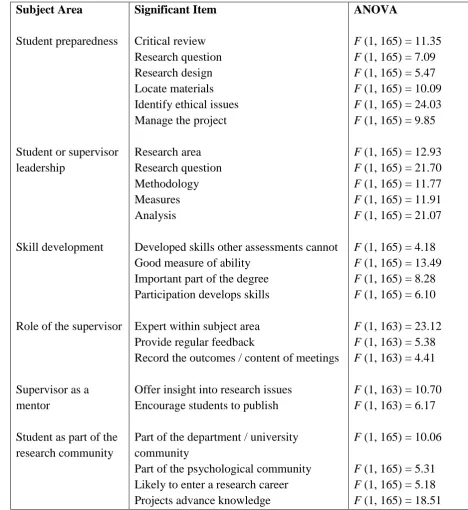
There was a significant difference between student and supervisor perceptions of student preparedness (F (9, 157) = 4.79, p <.05; Pillai’s Trace = .22). For six specific areas (critical review, research question, research design, locate materials, identify ethical issues and manage the project), students reported being significantly more prepared than supervisor ratings. When asked whether the project was student or supervisor led, student and supervisor reports significantly differed (F (5,161) = 6.85, p, <.05; Pillai’s Trace = .18). Students
believed the project to be more student led than supervisor reports with regard to research area, research question, methodology, measures and analysis. Supervisors were significantly more likely than students to report that the project enhanced skill development (F (7, 159) = 3.39, p <.05; Pillai’s Trace = .13). Further analyses revealed that supervisors assigned more value to the project, believed that the project developed skills that other assessments could not, formed a good measure of ability, represented an important part of the degree and also reported that participation in other projects was beneficial.
Students and supervisors perceived the role of the supervisor differently (F (9, 155) 4.35, p <.05; Pillai’s Trace = .20). Students were more likely to report that supervisors should be an expert within the subject area, provide feedback about progress and record the content and outcomes of supervisory meetings. The belief that the supervisor should also act as a mentor differed between students and supervisors (F (6, 158) = 4.56, p <.05; Pillai’s Trace = .15). Students were most likely to report that supervisors should provide this insight and encourage students to publish. There was a significant difference between students and
supervisors on the extent to which students were part of the research community (F (6, 160) = 9.33, p <.05; Pillai’s Trace = .26). Further analysis revealed that supervisors were more likely to perceive students as members of the departmental or psychological research community and believed students more likely to enter research following the project. However, students were more likely to report that undergraduate research enhances knowledge.
There was no significant difference between students and supervisors on student satisfaction (F (4, 162) = .86, p >.05; Pillai’s Trace = .02). Regression analyses revealed that the extent to which projects advanced knowledge and leadership of the project (supervisory or student led) significantly predicted student satisfaction (F (2,106) = 10.85, p < .01). The adjusted R2 value indicated that 17% of the variance in student satisfaction could be
accounted for by the model. The extent to which projects advanced knowledge (β = .22, t = 2.43, p < .05) and leadership of the project (β = .29, t = 3.16, p < .05) were significant
reported higher levels of satisfaction, suggesting that the authoring (discovery-active) and identifying (information-responsive) types of supervision were the most and least satisfying respectively.
Interview
Following transcription and coding of the interview data, thematic analysis was used to identify recurring themes (Braun & Clark, 2006). Both commonly occurring themes and interesting observations that were less prevalent were noted in accordance with previous recommendations (Braun & Clark, 2006).
Both students and supervisors described the research project as a collaborative
process. Students conceptualised supervision as “guiding students” referring to the role as “as a guide I would say and a sounding board” that served “to make sure that you are on the right track”. Supervisor input was greatest when there was an existing research project and student input was greatest when the project was not in the supervisor’s area of expertise. Students
expressed some concern that greater supervisor support would reflect negatively and impact on the project grade. There was also a perception that some students benefited from
supervision more than others and students were conscious of colleagues’ experiences.
Supervisors expected students to take ownership of the project and described the supervisory role as that of a “facilitator” who would “scaffold” and “steer” the process,
providing support when required “if they fall off the tightrope I can catch them”. Supervisors emphasised the need for flexibility, stating that the project is “driven by the student needs and expectations”. Consequently, the level of supervisor guidance “varies a lot”. Student
capability often determined the level of guidance provided “a very good student might be much more independent and the weaker students in particular will need more input from the supervisor so it will depend to some extent on the skills of the student”.
Students reported developing a range of research specific (e.g. “scientific writing”, “knowledge on the EEG”) and transferable skills (e.g. “time management) that “you can’t get from anywhere else”. According to one student “I have definitely developed skills and I am definitely a different person to the one I was three years ago”. Students particularly noted the
is so integral to being an actual psychologist that if you don’t do that then you are not really well prepared”.
Supervisors identified a range of skills such as “analytic thinking” and “time management” that students had developed and emphasised the progression that occurred throughout the research process “they learn how to be more independent”. The dissertation was believed to be a fundamental part of a psychology degree “essential, I think it’s the key to everything they do”. Supervisors explained that “I think anybody can read about
psychology and regurgitate some facts in an exam but I think the practical hands-on element is absolutely critical”. Further emphasising the importance of the importance of the project,
one supervisor commented “in terms of their development as a student in psychology I think it is the most important thing”.
A number of students reported that their project did make an important contribution to the field “it is relevant to ongoing research” but recognised the fact that this would be
restricted if the results were not disseminated. As explained by one student “I think that there might be potential to contribute to our understanding but I don’t think it will, I think it will just become grey literature and I don’t think it will be seen by anybody. I think the projects
could contribute to psychology but I don’t think that it ever gets out there”.
Most supervisors viewed the project as a pedagogic learning exercise rather than psychological research. A number of supervisors reported that the strength or ambition of the student determined the extent to which the project could make this type of wider contribution. One supervisor reported that it was “dependent on the ambition and execution and the quality of those students erm, others are less qualified and less capable so they are not gonna have that impact on the wider understanding and it’s about ticking a set of boxes”.
Students reported that methodology was the most difficult feature of the project, citing a range of specific issues such as participant recruitment, statistical analysis and the transcription of qualitative data. In contrast the feeling of achievement and transformation to a subject specialist when completing the project and the opportunity to obtain “real” data were the most enjoyable aspects of the project for students. Some students noted that this had influenced their future plans “when I first started the degree and the thought of doing
independent research, erm I thought that’s not for me I definitely don’t want to do that but
Supervisors were aware of student concerns and also reported that students found statistical analysis difficult. One supervisor discussing student difficulties reported “invariably the analysis of the statistics”. Supervisors acknowledged that the freedom to
explore a subject in depth (“they see that they have taken an idea and worked it all the way through”) and the sense of achievement on completion (“the that final realisation that they can do it”) were important. Ownership of the project idea was believed to be particularly important “it’s that element of discovery and you know going in and doing something that
they want to do rather than someone else wants them to do um and finding out you know an answer to a question that they have set themselves rather than having it more directed than previous years”.
Discussion
Undergraduate research forms an integral part of Higher Education (Booth &
Harrington, 2003) and the research project in particular represents an important component of the undergraduate degree (Parthirage, et al, 2004). The current study investigated student and supervisor perceptions of research, extending previous research conducted at American institutions or focussing on postgraduate research to a British undergraduate sample. Consistent with previous findings (Wuetherick & Berry, 2008), the current study revealed important differences between student and supervisor perceptions of undergraduate research.
Students reported being more prepared for the research project than supervisor ratings and afforded a greater leadership role to students. Students were also more likely than
supervisors to believe that a number of activities were part of the supervisory role or that the supervisor should act as a mentor. Students were less likely than supervisors to report that the research project enhanced skill development or that they were members of the departmental or psychological research community. There were no differences between supervisor estimates and direct student ratings of student satisfaction. Students were more satisfied if they believed that their project was student (as opposed to supervisor) led and advanced knowledge in the subject area.
The research project provides a unique opportunity for students develop or
range of subject specific and transferable skills developed may increase the value that students assign to undergraduate research and promote employability. Students should be encouraged to identify and record the research specific (e.g. saliva sampling) or transferable skills (e.g. time management) developed during the project. A skills audit incorporated into supervisory meetings may also raise awareness of skill development.
Students were more likely than supervisors to report that undergraduate research enhances disciplinary knowledge. Despite this, students were less likely to believe that students form part of the (departmental or psychological) research community. These findings are consistent with Zamorski’s (2000 p1) conclusion that “While students value being close to research, and to the idea of a university as a research community in which they are included, there are many ways in which they feel excluded”. Supervisors should
encourage students to become members of the research community, through for example wider integration and dissemination of findings. A wide range of traditional and
undergraduate journals and conferences are available, providing opportunities for students at a range of levels.
Student projects may vary considerably and it is important to consider how this variation may impact on the student experience. Levy (2009) highlights the importance of project leadership (supervisor or student led) and the acquisition of new or existing
knowledge, resulting in four primary research types (pursuing [information-active], authoring active], identifying [information-responsive] and producing
[discovery-responsive]). In the current study students were more satisfied if the research project had been student led and acquired new knowledge, suggesting that authoring (discovery-led) research is the most rewarding and identifying (information-responsive) the least rewarding form of undergraduate research. Therefore encouraging students to take ownership of the project and build new knowledge may enhance the student experience.
benefit both supervisors and students. It is of course important for supervisors and students to discuss the range of project types available and student goals at an early stage of the
supervisory process, in order to adapt to student needs.
It is important to note that the current study was dependent on voluntary participation and self-reports. In addition, student research skills and project quality were not measured. Future research may consider the impact of student ability and aspiration. For example, whilst the acquisition of new information may be of interest, this may not be a priority for students with less developed research skills or those that do not wish to enter a research career. Furthermore the finding that project experiences may vary across disciplines (Boyer, 1998) suggests that subsequent studies should consider the importance of research area. Research projects and the student experience may for example differ between educational psychology and neuroscience projects.
Acknowledgements
References
Bauer, K. W., & Bennett, J. S. (2003). Alumni perceptions used to assess undergraduate research experience. Journal of Higher Education, 74, 210-230.
Berthiaume, D. (2008). Teaching in the disciplines in higher education. In: Ketteridege, S., Marshall, S., & Fry, H. (eds.). The effective academic: A handbook for enhanced academic practice 3rd ed. London: Kogan Page, pp215-225.
Booth, C., & Harrington, J. (2003). Research methods modules and undergraduate business research: An investigation. International Journal of Management Education, 3, 19-31. Boyer, E. (1990). Scholarship Reconsidered: Priorities of the Professoriate, Princeton
University Press, The Carnegie Foundation for the Advancement of Teaching, Princeton, NJ.
Boyer Commission on Educating Undergraduates in the Research University (1998). Reinventing undergraduate education: A blueprint for America’s research
universities. Stony Brook: State University of New York at Stony Brook.
Braun, V., & Clarke, V. (2006). Using thematic analysis in psychology. Qualitative Research in Psychology, 3, 77-101.
Brew, A. (2003). Teaching and research: New relationships and their implications for inquiry-based teaching and learning in higher education. Higher Education Research & Development, 22, 3-18.
Elton, L. (2001). Research and teaching: Conditions for a positive link. Teaching in Higher Education, 6, 43-56.
Hathaway, R. S., Nagda, B. A., & Gregerman, S. R. (2002). The relationship of
undergraduate research participation to graduate and professional education pursuit: An empirical study. Journal of College Student Development, 43, 614-631.
Healey, M. (2005). Linking research and teaching to benefit student learning. Journal of Geography in Higher Education, 29, 183-201.
Jenkins, A., Breen, R., Lindsay, R., & Brew, A. (2003). Reshaping higher education: Linking teaching and research. London: RoutledgeFalmer.
Kuh, G. D. (2007). Experiences that matter: Enhancing student learning and success. Bloomington, IN: Center for Postsecondary Research.
Levy, P. (2009). Inquiry-based learning: A conceptual framework (version 4). Sheffield: Centre for Inquiry-based Learning in the Arts and Social Sciences, University of Sheffield.
Lopatto, D. (2004). Survey of Undergraduate Research Experiences (SURE): First findings. Cell Biology Education, 3, 270-277.
Pascarella, E. T., & Terenzini, P. T. (2005). How college affects students: A third decade of research. San Francisco: Jossey-Bass.
Pathirage, C., Haigh, R., Amaratunga, D., Baldry, D., & Green, C. (2004). Improving
dissertation assessment. Education in a Changing Environment, University of Salford.
Robertson, J., & Blackler, G. (2006). Students experience of learning in a research environment. Higher Education Research and Development, 25, 215-229.
Rowley, J., & Slack, F. (2004). What is the future for undergraduate dissertations? Education and Training, 46, 176-181.
Seymour, E., Hunter, A-B., Laursen, S. L., & DeAntoni, T. (2004). Establishing the benefits of research experiences for undergraduates in the sciences: First findings from a three-year study. Science Education, 91, 36-74.
Styles, I., & Radloff, A. (2001). The synergistic thesis: Student and supervisor perspectives. Journal of Further and Higher Education, 25, 97-106.
Todd, M., Bannister, P., & Clegg, S. (2004). Independent inquiry and the undergraduate dissertation: Perceptions and experiences of final-year social sciences students. Assessment & Evaluation in Higher Education, 29, 335-355.
Webster, F., Pepper, D., & Jenkins, A. (2000). Assessing the undergraduate dissertation, Assessment & Evaluation in Higher Education, 25, 71-80.
Scholarship of Teaching and Learning Conference, Edmonton, Canada, 16-19 October.
Table 1: Significant Differences Between Student and Supervisor Perspectives of the Undergraduate Research Experience
Subject Area Significant Item ANOVA
Student preparedness Critical review F (1, 165) = 11.35
Research question F (1, 165) = 7.09
Research design F (1, 165) = 5.47
Locate materials F (1, 165) = 10.09
Identify ethical issues F (1, 165) = 24.03
Manage the project F (1, 165) = 9.85
Student or supervisor leadership
Research area F (1, 165) = 12.93
Research question F (1, 165) = 21.70
Methodology F (1, 165) = 11.77
Measures F (1, 165) = 11.91
Analysis F (1, 165) = 21.07
Skill development Developed skills other assessments cannot F (1, 165) = 4.18
Good measure of ability F (1, 165) = 13.49
Important part of the degree F (1, 165) = 8.28
Participation develops skills F (1, 165) = 6.10
Role of the supervisor Expert within subject area F (1, 163) = 23.12
Provide regular feedback F (1, 163) = 5.38
Record the outcomes / content of meetings F (1, 163) = 4.41
Supervisor as a mentor
Offer insight into research issues F (1, 163) = 10.70
Encourage students to publish F (1, 163) = 6.17
Student as part of the research community
Part of the department / university community
F (1, 165) = 10.06
Part of the psychological community F (1, 165) = 5.31
Likely to enter a research career F (1, 165) = 5.18
Appendix 1: Online Survey - Student Participants
Background information and the development of the research project
Age
Gender
When completing the final year project were you registered full time or part time
By the time that you had your first supervisory meeting, how prepared did you feel for the following
(1 = not very prepared, 7 = very prepared)
Locating relevant information on the subject area 1 2 3 4 5 6 7
Critically reviewing previous research 1 2 3 4 5 6 7
Developing a research question 1 2 3 4 5 6 7
Developing a research design 1 2 3 4 5 6 7
Locating or developing research materials (e.g. information sheets) 1 2 3 4 5 6 7
Identifying and addressing ethical issues 1 2 3 4 5 6 7
Identifying appropriate forms of analysis 1 2 3 4 5 6 7
Conducting appropriate analysis 1 2 3 4 5 6 7
Managing a research project of this type 1 2 3 4 5 6 7
How student or supervisor led were the selection of the following
(1 = entirely supervisor led, 7 = entirely student led)
General research area 1 2 3 4 5 6 7
Specific research question 1 2 3 4 5 6 7
General methodology (e.g. questionnaire, interview) 1 2 3 4 5 6 7
Specific measures (e.g. particular questionnaires or stimulus materials) 1 2 3 4 5 6 7
Skill development
To what extent do you agree or disagree with the following statements (1 = strongly disagree, 7 = strongly agree)
During the project I developed important research skills 1 2 3 4 5 6 7
During the project I developed important transferable skills (e.g. time management) 1 2 3 4 5 6 7
Projects develop skills that other forms of assessment do not 1 2 3 4 5 6 7
The project is a good measure of my ability 1 2 3 4 5 6 7
The final year project is an important part of a psychology degree 1 2 3 4 5 6 7
Employers value the final year project 1 2 3 4 5 6 7
Taking part in other people’s research developed my skills or understanding 1 2 3 4 5 6 7
The role of the supervisor
To what extent do you agree or disagree that the following are an important part of the supervisory role
(1 = strongly disagree, 7 = strongly agree)
Being an expert within the specific subject area 1 2 3 4 5 6 7
Providing regular feedback about progress 1 2 3 4 5 6 7
Providing a schedule or plan of work 1 2 3 4 5 6 7
Maintaining regular contact with their students 1 2 3 4 5 6 7
Recording the content and outcomes of supervisory meetings 1 2 3 4 5 6 7
Being available for meetings or to answer queries 1 2 3 4 5 6 7
Providing general motivation and encouragement 1 2 3 4 5 6 7
Providing advice about academic writing / preparation of the dissertation 1 2 3 4 5 6 7
Providing advice about research design and analysis 1 2 3 4 5 6 7
To what extent do you agree or disagree that supervisors should also act as a mentor by doing the following
(1 = strongly disagree, 7 = strongly agree)
Discussing the future career plans of their students 1 2 3 4 5 6 7
Identifying the research skills that students have developed 1 2 3 4 5 6 7
Identifying the general skills that students have developed 1 2 3 4 5 6 7
Providing a wider insight into research issues (e.g. grant applications) 1 2 3 4 5 6 7
Encouraging students to present at and attend conferences 1 2 3 4 5 6 7
The research community
To what extent do you agree or disagree with the following statements(1 = strongly disagree, 7 = strongly agree)
I feel a part of the department / university research community 1 2 3 4 5 6 7
I feel a part of the psychological research community 1 2 3 4 5 6 7
The project made me more likely to enter a research career 1 2 3 4 5 6 7
The project made me more likely to enter a further study 1 2 3 4 5 6 7
My project provided a research-type experience which differs from ‘real’ research 1 2 3 4 5 6 7
My project advances knowledge within the subject 1 2 3 4 5 6 7
Publications
My supervisor has spoken to me about the potential for publication of my findings Yes No
To what extent do you agree or disagree with the following statements(1 = strongly disagree, 7 = strongly agree)
I would value the opportunity to publish my work 1 2 3 4 5 6 7
It is more beneficial to publish findings of the project than to research an area that I am interested in
1 2 3 4 5 6 7
Overall experience
To what extent do you agree or disagree with the following statements(1 = strongly disagree, 7 = strongly agree)
I was satisfied with the range of project subjects available 1 2 3 4 5 6 7
I was satisfied with the quality of supervision 1 2 3 4 5 6 7
I was satisfied with the quantity and availability of supervision 1 2 3 4 5 6 7